




Abstract
Growing research demonstrates the toll of correctional work on the mental health and well-being of staff. Within this body of work, researchers note that work life conflict is a significant stressor faced by correctional workers, though minimal research has examined this topic qualitatively. Drawing on open-ended survey responses from a study on provincial and territorial correctional worker well-being in Canada, we consider how different types of work life conflict, including time, strain and behavior based conflicts, impact sense of self and social identities among workers. More specifically, we examine how work life conflicts give way to: changes in self tied to negative impacts on personality, disposition, and attitudes; loss of self due to lack of time and emotional energy to enact non-work roles and identities; and loss of social identities as a result of both externally and self-imposed forms of social isolation. Findings highlight how work life conflict can have cumulative effects resulting in estrangement with respect to one's self, others, and society more generally.
Keywords
Introduction
Correctional work environments are often emotionally and physically demanding, with staff facing exposure to different types of operational and organizational stressors (Denhof et al., 2014). A growing body of literature examining correctional worker well-being demonstrates that work environments can have negative effects on staff mental health and quality of life (Brower, 2013; Ferdik & Smith, 2017; Viotti, 2016). A subset of research on correctional worker well-being has examined how work negatively spills into private lives; i.e., the problem of “work life conflict,” or the incongruence and tensions between home and work roles (Triplett et al., 1999). Such research highlights how the personal lives and relationships of correctional workers can be adversely shaped by the features of correctional work due to different types of time, strain, and behavior-based conflict (Lambert et al., 2020; Triplett et al., 1999).
The topic of work life conflict has been explored in terms of occupational causes (e.g., Kinman et al., 2017), socio-demographic correlates (e.g., Triplett et al., 1999) and individual and organizational outcomes associated with work life conflict (e.g., Armstrong et al., 2015; Vickovic & Morrow, 2020). Given the extent to which correctional work impacts personal lives – through forms of time, strain and behavior-based conflict – surprisingly little research has examined subjective experiences of work life conflict. In the current study, we draw on qualitative survey data from provincial/territorial correctional workers in Canada, collected prior to the Covid-19 pandemic, to unpack how different types of work life conflict impact workers’ sense of selves and social identities.
The Work and Private Lives of Correctional Workers
Work Life Conflict in Correctional Work
Mounting research on correctional worker well-being overwhelmingly and consistently points to the finding that the features of correctional work can have detrimental impacts on the mental health, well-being, and relationships of staff (Brower, 2013; Ferdik & Smith, 2017; Viotti, 2016). The spillover of work into private lives is captured by the concept of work life conflict, referring to the process whereby the domains of work and private life collide or are incongruent (Triplett et al., 1999). While conflict can emerge in both directions (Frone et al., 1996), studies involving correctional staff typically emphasize work life conflict in terms of the spillover of work into personal lives (e.g., Lambert et al., 2004).
The incongruence between work and home lives takes different forms. Studies of work life conflict among correctional workers highlight three main types, namely time, strain, and behavior-based conflict (Lambert et al., 2020; Triplett et al., 1999). Time-based conflict speaks to competing demands all emerging at one time, with time spent performing one role taking away from time spent carrying out other roles. Time-based conflict can be an issue in work fields, such as correctional services, marked by schedules and patterns that reflect the need for ongoing and constant staffing, including shift work and overtime (Lambert et al., 2004, 2010a). Numerous studies have emphasized that time-based conflict is a key concern for correctional workers (e.g., Lambert et al., 2004). Long hours and work schedules may, for example, lead to a lack of time to fulfill family responsibilities, including an inability to attend family events and celebrations (Akoensi, 2018). In this sense, time conflicts may result in workers missing out on events as well as the processes of relational development and maintenance.
Strain-based conflict emerges “when the demands and tensions from work negatively impact the quality of a worker's home life” (Lambert et al., 2006, p. 372). Those working in stressful atmospheres may experience adverse impacts on mood and energy, which in turn can be brought home and precipitate family conflict (Lambert et al., 2002). For example, following exposure to stressful work situations, workers may come home “on edge, tense, irritable, or even in shock” (Lambert et al., 2010a, p. 42). In this sense, the emotional reactions triggered by work events are not left at the door, and negative disruptions to mood and disposition can in turn negatively affect personal relationships (Lambert et al., 2015b). Beyond critical incidents, everyday interactions in prison occur in a highly emotional space (Crawley, 2004, 2011). The routine aspects of correctional work can involve a high degree of emotional labor; i.e., work to manage one's emotional performance in line with occupational emotion “rules,” as well as to manage the emotions of prisoners/clients (Crawley, 2004; Humblet, 2020; Nylander, 2011). Performing emotional labor can in turn come at a high cost to staff, such as emotional exhaustion (Nylander, 2011).
Strain-based conflict may not simply be episodic or situational. Rather, the effects on moods and dispositions may be cumulative and ongoing, affecting a worker's very character and personality (Suliman & Einat, 2018). Illustratively, Suliman and Einat (2018) found that following only a few years of employment, correctional officers experienced an increase in neuroticism, which “relates to anxiety, anger, depression, poor control of urges, social embarrassment, and vulnerability” (629). Another cumulative impact is burnout, referring to emotional exhaustion, depersonalization, and decreased personal accomplishment (Maslach et al., 2001). Studies highlight that burnout is prevalent among correctional workers in different national contexts (e.g., Useche et al., 2019), with negative implications for well-being and quality of life (e.g., Rania et al., 2020). Staff experiencing burnout may withdraw not only at work but in personal spheres (Lambert et al., 2010a). Personality changes and burnout highlight how correctional work can have longer-term impacts on one's emotional state and well-being, in addition to more situational or immediate effects.
Behavior-based conflict speaks to the tensions between the norms and expectations associated with one role versus another, illustrated, for example, when an individual's working personality infiltrates family interactions (Cheek & Miller, 1983; Crawley, 2002; Lambert et al., 2004). This type of conflict can be particularly pronounced (and problematic) in fields like correctional services, where the qualities of working personalities (e.g., authoritative, routine-oriented, skeptical) can be at odds with those associated with other social roles, such as parenting and spousal roles (Crawley, 2002; Lambert et al., 2014, 2015b). As noted by Lambert et al. (2006, p. 372), “correctional staff are required to learn roles at work that are not necessarily appropriate in social and family life.” Staff may find it difficult to switch back and forth between highly disparate role expectations, illustrating a form of role conflict (Crawley, 2002; Lambert et al., 2014).
Cheek and Miller (1983:, p. 117) note that when the “working personality” comes home, family members of correctional workers may experience behavior perceived as “increasingly controlling, bossy, demanding, suspicious, fearful, negative, critical, cold, impersonal, self-righteous, and self-justifying.” More recently, in a qualitative study, Higgins et al. (2021) found that staff brought their work habits and dispositions, i.e., a “correctional instinct,” back into their home lives. Rather than a conscious disposition, the correctional instinct involves attributes that become second nature to staff working in prisons, largely shaped by the perception of situations as having the potentiality for danger. Expressions of hyper-vigilance, such as analyzing cues of danger in others and the environment, can shape one's social interactions in the outside world, with potentially negative impacts during family events, outings, and occasions (e.g., appearing “cold” to others). Bringing home their work habits, dispositions and behaviors, correctional workers may see their home lives marked by strain and breakdown (e.g., divorce; Cheek & Miller, 1983).
Social Identity and Social Insularity
The literature on work life conflict among correctional workers has highlighted the factors associated with conflict (e.g., role conflict, role overload, job danger, exposure to aggression; Kinman et al., 2017; Lambert et al., 2015b, prevalence and correlates (Lambert et al., 2004), job outcomes (e.g., job satisfaction, job stress, organizational commitment, turnover; Armstrong et al., 2015; Lambert et al., 2006; Vickovic et al., 2022), and well-being outcomes (e.g., burnout, depression; Lambert et al., 2010a; Obidoa et al., 2011). Minimal research has examined the subjective impacts of work life conflict in terms of sense of self, referring to one's sense of “who I am”, as mediated by social experiences (Mead, 1934), and social identity, or who one is as conveyed and constructed through social interactions and group membership (Tajfel & Turner, 1985).
Sociological accounts of correctional work cultures do capture how correctional workers may come to see themselves within a particular “insider” group, positioned in contradistinction to outsiders – that is, they take on a social identity (Tajfel & Turner, 1985). A key aspect of this identity is an inward orientation with coworkers and “distance” from those outside of work circles (Ashforth et al., 2007). This inward orientation is, in some ways, tied to pragmatic considerations. Coworkers are best positioned to understand each other with respect to the highly unique circumstances that characterize their work. However, insularity is also promoted by correctional work cultures marked by principles such as in-group loyalty and outward secrecy (Higgins et al., 2021). Such principles in turn create work life conflict; for example, Higgins et al. (2021) found that correctional workers become emotionally disconnected from their families as they come to rely on coworkers to provide mutual support in relation to work events, feeling as though family could not or should not be involved.
Beyond sharing more common ground with coworkers, correctional workers may be socialized into occupational cultures marked by outright skepticism and distrust of “outsiders” (both in and beyond correctional spaces; Arnold et al., 2007; Chenault, 2010; Crawley & Crawley, 2008). Part of this social insularity appears to be driven by a sense among correctional workers that they are misunderstood and even viewed negatively within society (Ashforth et al., 2007). The “dirty work” conception of correctional work begins with the stigma attached to imprisoned persons, which is extended to those who work with them, who are seen as undertaking the undignified task of administering “punishment” (Tracy, 2004). Since correctional work is largely invisible to the public eye, outside perceptions are thought to be shaped by misunderstandings and stereotypes (Crawley & Crawley, 2008), such as correctional officers being “professional babysitters” or the “scum of law enforcement” (Tracy, 2004; Tracy & Scott, 2006). While correctional staff may not share these perceptions, and engage in different techniques of taint management (Chenault & Collins, 2019; Tracy & Scott, 2006), they may bear a sense of underappreciation and low social value, in turn contributing to a distrust of and distance from outsiders (Crawley & Crawley, 2008). In this sense, work spillover can involve social meanings tied to workers’ sense of “who they are” and “who they are not.” One's work self, therefore, is not necessarily less authentic than private selves (Tracy, 2004) and may “come home” and shape who one is at a fundamental level.
Across studies of work life conflict and correctional worker cultures is a common implication that correctional work can have far reaching impacts on workers' private lives, relationships, and social orientations more generally. However, there is minimal consideration of the subjective impacts of different types work life conflict. The current analysis considers more explicitly work life conflict from the point of view of self and social identity. Specifically, we examine how staff discuss work life conflict in terms of three salient themes that emerged from the data: changes to self, loss of self, and loss of social identity.
Methods
We derived data for the current analysis from the Correctional Worker Mental Health and Well-being Study, intended to examine mental health disorders, Operational Stress Injury (OSI) symptoms, and other well-being considerations among correctional staff working across institutional, community, and administrative correctional services in Canada. Participants were from provincial and territorial correctional services in Manitoba, Saskatchewan, New Brunswick, Newfoundland and Labrador, Nova Scotia, and Yukon. Respondents included correctional staff working in both community correctional settings and provincial/territorial institutions, including probation officers, correctional officers, program and other rehabilitative staff, healthcare staff, administrative staff, as well as management. Research ethics boards at the University of Regina (file #2017-098) and Memorial University of Newfoundland (file #20201330-EX) provided approval for the study.
We invited employees within the six services to participate in an anonymous online survey between 2018 and 2019. The data presented is cross sectional, representing a moment in time, and was collected prior to the Covid-19 pandemic. We followed established guidelines for online survey research and included open-ended items to allow for additional insight into the context of responses to close-ended survey items (Ashbaugh et al., 2010). Participants were presented with questions pertaining to self-reported mental health symptoms and a range of closed and open-ended questions pertaining to different aspects of well-being.
The recruitment process was similar across provinces and the territory. Specifically, a representative from the Ministry of the Solicitor General or Department of Justice/Public Safety and/or the local union emailed their employee or membership listserv to inform potential respondents about the study and about how to participate. Participation was voluntary and possible during paid work hours, if an individual desired. The circulated email provided a link directing interested recipients to the consent form, study information page, and survey. As respondents self-selected to participate after being invited through email listservs (which has some level of duplication), we do not have a well-defined sampling frame and cannot discern a response rate.
In starting the survey, each respondent received a randomly generated unique access code. The code allowed respondents to access the anonymous survey from any device (e.g., phone, computer). Thus, respondents could complete the survey over multiple sittings by exiting and subsequently resuming the survey without having to restart. Several factors, including the length of responses to open-ended items, reading speeds, and device used, affected how long participants needed to complete the survey, however we estimate the survey required between 25 and 40 minutes on average to complete.
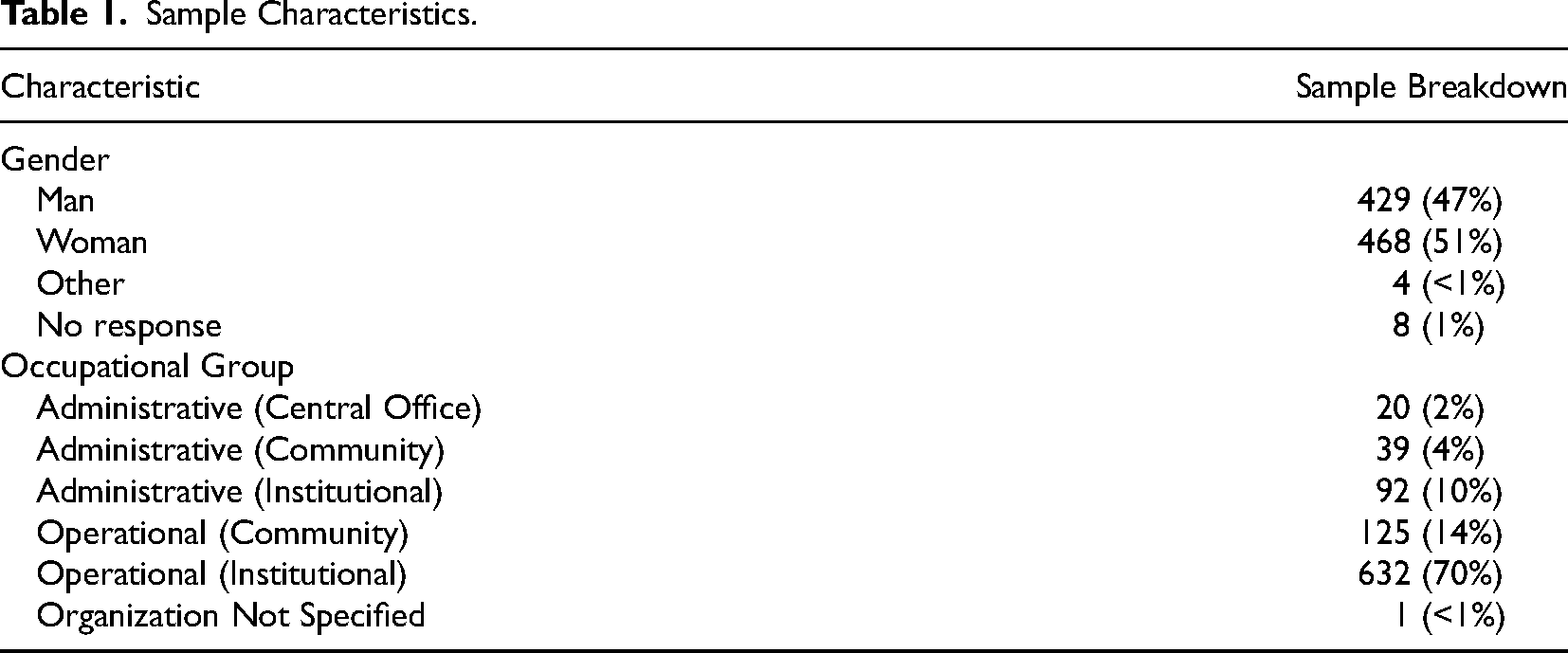
In total, 2033 respondents provided informed consent and accessed the survey with complete or near complete data, while 909 participants or around 45 percent provided some response to the optional open-ended item under analysis. Total participation (and specific question participation) by province was 769 (380) from Manitoba, 840 (369) from Saskatchewan, 115 (35) from Newfoundland and Labrador, 212 (84) from Nova Scotia, 34 (17) from New Brunswick, and 63 (24) from Yukon. The data from the 909 participants constitute the current study. Discrepancies in sample sizes are partially due to significant differences in jurisdictional sizes. For example, in 2018/2019, Manitoba had roughly 8,428 adults under provincial correctional jurisdiction on any given day, whereas Yukon had around 348 (Malakieh, 2020). Correctional officers (including in youth facilities) were by the far the most common occupational group represented (i.e., roughly 56%), reflecting their relative presence in the provincial correctional workforce more generally. Probation officers, including youth probation officers, accounted for approximately 12% of respondents. Remaining occupational groups (accounting for less than 10% each), included non-correctional institutional staff and other types of community staff such as administrative staff, healthcare staff, program/rehabilitative staff, and management. See Table 1 for sample characteristics.
For the present analysis, the following open-ended question was analyzed: “Please describe how your job has a negative or positive impact on your relationships.” This item solicited comments about a specific topic, creating a space for respondents to comment on the impacts of the job on their relationships with family, colleagues, and peers. Responses to the open-ended question varied considerably in length, from just a few words to detailed descriptions and illustrative examples. A thematic inductive process (Hesse-Biber & Leavy, 2004) was used, specifically, a constructed semi-grounded emergent theme approach (Charmaz, 2014; Glaser and Strauss, 1967; Ricciardelli et al., 2010) to identify themes of salience across responses. Author one employed axial coding (Strauss & Corbin, 1990) and an exhaustive but not mutually exclusive coding scheme. More specifically, responses were coded according to an emergent coding scheme, which involved identifying themes and sub-themes and categorizing data into “parent” (primary themes), “child” (secondary themes) groups. Both authors came together for the analysis of distinct themes. In the presentation of results, we draw on quotes to provide concrete illustrations of themes discussed, as well as to highlight the voices of respondents. We use such quotes in cases where the respondent granted consent for direct use, and the content did not compromise the privacy or reveal the identity of any person. Minor edits were made to quotes where necessary to correct for spelling and grammar but without compromising meaning or tone.
Findings
Changes in Self
Selfhood is not merely driven by internal forces, but is shaped by social interactions and social experiences (Mead, 1934); resultantly, the self is not static, but may “adapt and modify according to interpersonal processes” (Baumeister, 2011). For correctional workers, selfhood may be shaped by immersion within a unique occupational field, that may present workers with individuals, situations and environments that they might not otherwise encounter. Whereas some respondents described particular ways in which they had changed, others described more general changes. For example, a correctional manager from Manitoba explained, “it affects how you act, feel and treat people, how you perceive the world.” A Correctional Officer from New Brunswick similarly stated, “your job has an effect on your mind and perception of others.” The changing self was not welcomed or experienced in positive terms. In speaking to impacts to the self, changes were described as negative, such as becoming bitter, jaded, hardened and/or unhappy: “This job has changed me and tainted me forever. There is no going back or changing” (Correctional Officer, Saskatchewan); “this job has done something to me, I have a hard time being happy at all” (Correctional Officer, Manitoba); “I used to be a very fun and positive person to be around but the longer I work in this field the grumpier, easily frustrated and short tempered my personality becomes. I used to be very social but as I get older I am sometimes not fun to be around” (Teacher, Saskatchewan).
The changing self may begin and be experienced in a seemingly trivial way in daily instances of “bringing work home.” As in many professions, correctional workers may find work stressors continue to affect them following shift's end, impacting their disposition, mood, feelings, and behaviors, i.e., strain-based conflict. Emotional spillover was described in negative terms; for example, being quick-tempered, irritable, and moody, resulting in family conflict insofar as negative emotions are offloaded onto loved ones. As a Correctional Officer from Manitoba explained, “I come home and I’m angry all the time, [and] take it out on my child.” Expressing a similar sentiment, a Correctional Officer from Saskatchewan explained, “I have less patience and [am] easily irritated which has made dealing with family hard.” Some participants lamented, and expressed guilt about, their loved ones bearing the brunt of the effects of work stress, highlighting a disconnect between beliefs about who they should be versus who they are (Table 1).
Sample Characteristics.
Highlighting behavior-based conflict, workers may have difficulty “shifting gears” between work and home, finding that their work personalities come home with them and impact familial interactions. Role conflict can emerge when the normative expectations in one social domain shape interactions in an other – or, as Higgins et al. (2021) explain, when the “correctional instinct” comes home. This appeared to be a challenge for correctional officers in particular, who experienced difficulties “turning off the guard” in the context of familial interactions (Correctional Officer, Saskatchewan). Noting the disparate qualities of work and family roles, a Correctional Officer from Manitoba referenced the difficulty in switching gears “from authoritarian to equal/loving relationship.” The correctional worker disposition, marked by a perceived need for control and sense of being “too authoritarian” (Probation Officer, Nova Scotia), impinges on home life. Illuminated is the tension associated with role accumulation, as working personalities are not easily “turned off” at the end of a shift.
Examples of behavior-based strain highlight how the dispositions, habits and personalities that collectively form the work self can, over time, come to shape who one is and how one acts beyond work walls. Another example relates to lingering hyper-vigilance (an impact also described by Higgins et al., 2021), whereby staff experience non-work situations as though they are in a correctional environment, i.e., “being on guard all the time” (Correctional Officer, Manitoba). During outings in public, for example, staff may experience social situations through the correctional worker lens, feeling as though threats are omnipresent, thus prompting adaptive behaviors, consciously or not, to mitigate threats, such as being “on guard.” Such perceptions of public spaces and social interactions can erode the quality of experiences and reduce the desire to go certain places. In effect, staff may feel as though their private (non-work) selves are infiltrated by their occupational role expectations, leading to interpersonal relationships and social situations being experienced through the correctional worker role.
The causes of changes to the self, when discussed, were linked to the realities of correctional work, which include direct and indirect exposure to disturbing events, dangerous situations as well as negative elements of society. “I have changed due to what I have seen,” wrote a Correctional Officer from Manitoba. Beyond everyday impacts on mood, disposition and behavior, an enhanced awareness of violence and interpersonal harms in society can in turn shape orientations towards family members, and experiences of different social situations. Pessimistic views towards others and/or fear of violent outcomes, for example, can lead workers to have disproportionate reactions to situations where harm could occur, or a general feeling of over-protectiveness. To such respondents, beyond simply the stress of a “bad day,” work is perceived as impacting one's orientations towards and experiences of personal relationships. As an Institutional Manager (Saskatchewan) stated, “I see too many horrible things and get overly worried about those in my life getting hurt and become over protective.”
Illustrated in participants’ discussions is how “taking work home” is not simply a matter of short-term or situational impacts on mood and emotional state. Rather, responses reveal how more fundamental changes in one's sense of self are shaped by correctional work – in essence, workers feel their work has “changed them” as a person, including they feel, think, behave, and interact with others outside of work.
Loss of Self
The self adapts to social conditions (Baumeister, 2011). With adaptations can mean erosion of the features and qualities that have previously defined selfhood. Specifically, workers described how work roles came to override non-work roles. In the most basic sense, this loss of self is tied to work life conflict that results in one's time and energies being expended at work, with little “left over” to enact roles and identities in the context of personal lives and relationships. The ability to enact one's selfhood outside of work fades, particularly with respect to familial relationships.
The time-based element of this conflict is explained by conditions of work – namely long and irregular hours and shift rotations, being on call, working overtime, and working when others are off. A Correctional Officer from Yukon, wrote: “Being scheduled regularly between 90 and 110 hours bi-weekly, which includes nightshifts to dayshifts with one day off in between and being called almost every day I’m not scheduled, has negatively affected my life. For example work/life balance is non-existent.” Illustrated in the officer's words, challenges around scheduling for an essential service provider role – for which staff are needed 24 hours a day and seven days a week, and staffing shortages may be the norm – impede the very possibility of work life balance, given the shortage of time to devote to the roles or activities associated with non-work selves.
Loss of time with children, spouses, parents, and friends was described by many as a negative effect of work schedules. Specifically, shift work as well as working overnight, weekends, and holidays, result in missed family time, social engagements, and special occasions, as prior researchers have noted (e.g., Akoensi, 2018). Such losses result in an impaired ability to engage in the activities and behaviors associated with familial identities and roles. Over time, absence from both routine and celebratory family time can take a toll on staff, their family, and their social lives: “[I] can’t attend family events, can’t go to holidays. Tough to keep family relationships and friendships going when I can’t show up” (Correctional Officer, Nova Scotia). A Correctional Officer from New Brunswick commented on how her status as a casual on-call employee working 16 hour shifts interfered with her ability to care for children (she stated: “A babysitter took care of my children”) and also prevented her from providing end of life care to her parent. Similarly, several respondents reported being unable to spend time with their spouses due to irregular work hours. Describing their absence from family life, a Correctional Officer from Saskatchewan commented that “shift work and scheduling has had a major impact on my family's well-being”. Thus, the loss of one's private roles as a result of time-based conflict has collateral impacts, affecting not only worker but familial well-being.
The loss of private roles is not only due to time-conflict, but strain-based conflict. Like time, physical and emotional energies are finite and may be prone to being asymmetrically allocated to work activities. Specifically, correctional work, as respondents explained, can require a considerable amount of physical, emotional, and psychological energy. The energy that work requires in turn can leave an individual feeling depleted during non-work hours. Such depletion may be particularly common for employes working long shifts and irregular hours (e.g., overnight shifts), which results in much time at home spent sleeping or otherwise preparing for the next shift. A Correctional Officer from Manitoba wrote: “When I am not at work, I am usually tired and recovering from the 12 hour shifts (plus 2 hour drive time)”. Workers may feel “wiped out” (Community Youth Worker, Saskatchewan) and lack energy to devote to other areas of their life: “Corrections can wear me down physically and mentally at times which reduces the amount of energy and ambition I have in my social/personal life” (Correctional Officer, Yukon).
Depletion of emotional and physical energy results in loss of energies devoted to the non-work self and one's relationships, with collateral consequences on family functioning: “After work, [I have] no emotional strength to take proper care of the family” (Institutional Manager, Yukon). Echoing others, a Correctional Officer from Yukon noted, “The amount of stress I am under and the mental health deterioration has made it hard to enjoy time together, to focus on our time together, and on the energy I can put into our time together.” Thus, the time associated with enacting roles outside of work is experienced both in terms of loss in quantity (due to long hours at work and/or time spent at work when others are home) and erosion in quality (due to expending considerable energy at work, causing energy depletion at home). In effect, less time and energy are available for workers to perform the roles that define them outside of work, contributing to a loss of the non-work self.
Loss of Social Identity
As correctional workers experience a change in their personality, attitudes, moods, and disposition (the changing self), and have less time and energy to enact role non-work selves, a related impact becomes a loss of social identity, referring to who one is as enacted through social interactions and relationships (Tajfel & Turner, 1985). More specifically, workers expressed feeling a declining sense of connectedness with others and/or membership within social groups beyond the work setting. Social isolation appears to be an outcome of different types of work life conflict; however, it can be both externally-imposed and self-imposed by workers themselves.
The logistical aspects of work can contribute to externally-imposed forms of social isolation. Participants felt that the time constraints posed by their work schedules, as well as working irregular hours, compromised their ability to engage in their relationships, or develop new relationships (e.g., work scheduling “makes it hard to make friends outside of work”, Correctional Officer, Saskatchewan). Some expressed this difficulty in regards to the formation of intimate relationships: “With no set schedule and no weekends off it is hard to find someone to date. When I am able to find someone to date, I rarely see them and cannot go out due to being on call. Lack of understanding regarding the schedule demands from work leads to relationships not lasting long” (Correctional Officer, Manitoba). Simply put, lack of time and logistical constraints tied to work life conflict can have the impact of impeding the development and formation of social bonds, potentially leading to isolation outside of work.
For some, externally-imposed isolation is tied to the geographical location of their work. Specifically, some provincial/territorial jails and probation offices are located in remote or rural areas. The physical location of work sites can lead to disconnection from one's social network due to physical separation or extended commute times (e.g., “I relocated here for the position and have gradually lost touch with the friends I used to see,” Probation Officer, Saskatchewan). Working in remote areas can also render it difficult for correctional workers to establish new personal relationships, particularly given their occupational role in the community. To exemplify, another Probation Officer from Saskatchewan explained: “as I live in a small community and manage the caseload for that specific community I have not engaged in creating any relationships outside of work whether it be romantic or otherwise”. The respondent's words evidence the potential social isolation that can be associated with correctional work, for those in community or institutional correctional services, tied to socio-geographical factors.
A sense of social isolation occurs not only due to temporal and physical constraints, but emotional disconnection. For example, some respondents explained how they were unable to speak openly with their loved ones regarding events or situations that were affecting their emotional state due to work rules around privacy. A Community Youth Worker/Probation Officer from Saskatchewan explained, “because we are unable to talk about the daily interactions/events that happen with the clients and families we work with with our spouses and friends, it is difficult to describe why we may feel stress and have no ability/energy to maintain general household duties in the evenings; especially after an emotionally and mentally challenging day of work.” Feeling unable to “open up” due to concerns around privacy and confidentiality can leave workers in a position where they are unable to explain the sources of stress and reasons behind their dispositions and moods. Thus, despite “taking work home,” they may be unable to outwardly explain sources of stress and draw on the support of family members when working through work-related experiences. Consequently, workers may feel “unsupported” (Probation Officer, Manitoba) or not understood by their family: “I can’t discuss the things I see and deal with at work, I feel those around me just don’t understand the stressors I have or the job I have to do” (Institutional manager, Manitoba).
Emotional disconnection from others was not only explained in terms of externally-imposed factors. For some, social isolation in the home was self-imposed – a response to dealing with strain-based conflict in the form of strategies of decompression, retreat, or avoidance. In the words of a Probation Officer from Nova Scotia, “sometimes you just want some time alone after a long day.” A Correctional Officer from Saskatchewan similarly explained a preference to be alone and rest as opposed to interacting with their loved ones, leading to a feeling of being “disconnected” in their relationships. Here, social retreat may be tied to energy depletion and/or adverse impacts of work stress on mood. While an adaptive response to coping with work stress, retreat can have maladaptive impacts on home life, including an absence of communication and emotional estrangement or “distance.” Thus, while seemingly self-imposed, withdrawal to cope with work stress can have the longer-term effect of relationship breakdown, as respondents described.
Beyond the need for alone time following shifts to cope with stress and/or replenish energies, some respondents described broader shifts in their orientations towards others, specifically, a reduced interest in engaging with others, attributable to changes in their mood, perceptions, or attitudes. Here, larger changes in self, discussed above in terms of strain-based conflict, may precipitate social retreat, withdrawal, or being socially “guarded.” Such changes reflect the growing inward orientation that correctional staff often experience (Arnold et al., 2007; Chenault, 2010; Crawley & Crawley, 2008). Growing social retreat was sometimes explained as precipitated by a deteriorated view of and distrust towards others caused by exposure to negative experiences during one's correctional career. An Institutional Manager from Manitoba explained: “[I am] suspicious of everyone. [I] feel that all people are up to no good. [I] lost faith in humanity.” A Probation Officer from Saskatchewan stated, “you learn not to trust people. You also tend to shy away from people as you see so much during the day.” For some, a sense of skepticism towards others impaired the development of romantic partnerships. Illustratively, a Probation Officer from Manitoba expressed that her work experiences led to distrust of, and distance from, men. She stated: “It affects dating relationships. I have trust issues and think most men have the potential to be abusive. It makes me not at all interested in meeting new people.” Her words, like those of many others, show how social skepticism can lead to self-imposed forms of social retreat or withdrawal from or avoidance of certain types of relationships.
Some expressed social isolation as tied to a sense of alienation, that is, a feeling of being different from others who work outside of correctional services, reflecting the sense of being “misunderstood” common among correctional staff (Ashforth et al., 2007; Crawley & Crawley, 2008). In some cases, correctional workers felt they had a lack of common ground with non-correctional workers, or that outsiders simply did not understand them or their work. A Correctional Officer from Saskatchewan, like others, expressed, “Non corrections friends and family have difficulty fully understanding the experiences that I go though as a CO.” Another Correctional Officer from Saskatchewan similarly noted, “[it is] hard to find someone outside of corrections who understands how you feel dealing with offenders.” Some expressed that this sense of differentiation made connecting with others challenging, if not impossible: “[I have] less willingness to open up to those that don't understand what mentally a correctional officer goes through on a daily basis” (Correctional Officer, Manitoba); “I’ve distanced myself from people who don't understand my job” (Program Officer, Nova Scotia). The respondents' words collectively demonstrate the difficulty workers may experience in communicating elements of their work to others outside the field, and the sense that their experiences rendered them different from non-correctional workers.
In some ways, sentiments of social alienation speak to the sense among correctional workers that they are social “outsiders.” However, in other ways, workers may experience social realities that are unknown or not understood by members of the general public; rather than outsiders, they have a greater knowledge of “things in society the regular public doesn’t know” (Community Correctional Supervisor, Saskatchewan). Exposure to the “darker” elements of society places them in a different social vantage point, shaping their worldview and sense of others. A Probation Officer from Manitoba articulated: “It's hard to relate to non-justice friends and family. I feel like I’m holding a snow globe looking into a nice scene, where people don’t know the dangers of their community, and that I don’t fit in anymore because of how my job had impacted me.” As the social realities to which one is exposed through correctional work contribute to a changing understanding of the social world and one's place within it, workers can feel disconnected from those who do not share their same social vantage point or worldview. Consequently, a wedge can emerge in relationships because “you can’t find common ground” (Correctional Officer, Saskatchewan).
In addition to their own changing worldviews, some expressed feeling as though they themselves were subject to negative perceptions by others, i.e., feeling “contaminated” by the nature of their work (see also Crawley & Crawley, 2008), contributing to a sense of feeling different. Some felt that their job lacked social value and worth (e.g., “people react negatively when they learn you work for corrections” Institutional manager, Nova Scotia), or was viewed disparagingly by loved ones. For example, a Community Youth Worker/Probation Officer from Saskatchewan explained: “My parents and friends have limited understanding or compassion for the work I do which makes it difficult for them to respect the work I do or understand how I am impacted by it.” The perceived lack of understanding and appreciation for one's work in turn can create relationship tensions: “it's hurt my relationship with my parents because they see me negatively” (Probation Officer, Saskatchewan). Some also recounted that people in their lives had distanced themselves due to negative changes the worker experienced, or other undesirable impacts of correctional work on the worker (“I have lost friends due to this line of work. My family and friends say that I have changed since I became a Correctional Officer;” “I’m a negative bitter person so people don’t want to be around you,” Correctional Officers, Manitoba). Several respondents even attributed the breakdown of their marriages/romantic partnerships and other familial relationships to different aspects of work life conflict, including factors such as changes in oneself, distance/withdrawal in relationships, logistical factors, and lack of support for one's career.
In summary, participants described how their social bonds were negatively impacted by correctional work, contributing to an erosion of social identities outside of work. Different types of work life conflict contribute to social isolation, though workers themselves may distance themselves from others due to different factors, including changing views of others and a declining sense of social belonging or connectedness with those outside of work.
Discussion and Conclusion
For correctional workers, the realms of work and private life, and associated roles in each, can collide to produce different types of conflict (Lambert et al., 2006). Our analysis sheds light on how work life conflicts emerge and the implications for correctional workers' sense of self and social identity. While recognizing that experiences of work life conflict are not universal, as work and personal lives can intersect in different ways depending upon work and personal circumstances, we highlighted three salient and interrelated themes: changes in self; loss of self; and loss of social identity. Consistent with prior research, we found respondents emphasized the spillover of work into the home (Higgins et al., 2021), in terms of time-based conflict, strain-based conflict (impacts on mood, disposition, and well-being) and behavior-based conflict (bringing work roles into the home). Importantly, this spillover was not simply articulated in terms of situational or immediate impacts, but larger changes in the self. Workers spoke to negative changes in their attitudes, personality, and character (e.g., becoming bitter, jaded, angry, authoritative), demonstrating the deeper impacts of correctional work on the self. Highlighted in accounts is how “work selves” are not necessarily less authentic than “private selves” (Tracy, 2004), exemplified by how working orientations can have broader changes on personalities and dispositions of staff (Cheek & Miller, 1983; Higgins et al., 2021; Suliman & Einat, 2018). Disruptions to the self are also tied to the loss of time (and energy) to enact roles and identities outside of work. Specifically, as workers expend their time and energy at work, they may have little “left over” to enact other important roles they may inhabit, be it a parent, spouse, sibling, friend, or other role. This sense of self loss is tied to the qualities of correctional work that render it demanding in terms of time (e.g., shift work, overtime) and emotional energy (Crawley, 2004; Nylander, 2011).
Related to the changing self and loss of self is the loss of social identity, which is tied to feelings of being alienated from others and wider society. Prior research highlights how correctional workers may develop an inward orientation due to a sense of shared common ground with coworkers and mistrust of outsiders (Crawley & Crawley, 2008; Higgins et al., 2021) and a sense of being misunderstood or viewed negatively by outsiders (Ashforth et al., 2007). In the present analysis, we noted how different types of externally-imposed and self-imposed forms of isolation impaired social bonds and sense of social connectedness outside of work. In terms of logistical factors and work structures, the remote location of work sites, difficult schedules, and privacy rules inhibiting discussions of work presented as social barriers. For some, isolation was tied to negative perceptions by others, whether due to negative changes in the worker or negative views of their work. Self-imposed forms of isolation were tied to both immediate strategies to recuperate between shifts, as well as longer-term changing social orientations. Regarding the latter, pessimistic views of others, as well as a sense of alienation from non-correctional workers, may result in workers having reduced interest in pursuing or maintaining relationships outside of work. In sum, workers’ social identities and social group memberships can become limited outside of their work environment.
The current study is not without limitations. First, as the response rate could not be discerned, the possibility of sampling bias is present, limiting the ability to generalize specific findings. Second, the methodological approach involving analysis of survey data did not allow for probing or clarification on responses. As with all forms of textual analysis, it is possible that there is discrepancy between the meanings intended by respondents and the interpretations by the researchers. Third, the analysis does not account for how the nuances shaping working experiences within particular institutions and locales impact work life conflict. It is important not to obscure the very different operational contexts of correctional services, shaped by factors such as population profiles (e.g., men, women, youth), security level, physical infrastructure, work cultures, and so on. Findings are also likely influenced by the fact that Correctional Officers constituted a majority of the sample, with less representation from other types of correctional workers, though this is in line with actual staffing structures. However, we did note consistent themes across the provinces and occupational positions examined.
Data for the current study was collected prior to the Covid-19 pandemic. It is highly likely that the obstacles associated with Covid-19 have impacted work life conflict for correctional workers. This may be particularly true for staff who must be physically present at work (e.g., correctional officers, healthcare staff) and in environments where Covid-19 impacts (e.g., outbreaks) are pronounced. Given the theme of social isolation across respondents accounts pre-Covid-19, understanding work life conflict during this period of time, and resulting immediate and long-term impacts, is recommended as an area for future inquiry. This includes developing an understanding of the spillover effects and impacts on social relationships tied to working in higher risk settings during Covid-19 and changes in social practices as a result thereof.
Work life conflict among provincial/territorial correctional workers is complex and multi-dimensional, making solutions neither simple nor straightforward. Previous authors have recommended changes at various levels that address the scope and impacts of work life conflict, including human resources approaches that involve proactive training on work life conflict for workers and their families (Higgins et al., 2021), greater flexibility in work schedules (Lambert et al., 2006), and cultural changes that could alleviate certain strain and behavior-based conflicts, including more interactional correctional approaches to reduce confrontational atmospheres (Lambert et al., 2021). Ultimately, negative work impacts on employees affect organizational well-being by way of outcomes such as reduced organizational commitment, job dissatisfaction, absenteeism, and increased turnover intent (Lambert et al., 2010b; 2015a, 2020; Vickovic & Morrow, 2020), thus obscuring the differentiation between personal and organizational problems.
Like the many quantitative studies on work life conflict in correctional services, our study reiterates the extent to which correctional work spills over into other aspects of workers’ lives. While not all aspects of correctional work are negative for workers, respondents disproportionately emphasized how their careers interfered with relationships and social identities outside of work. Different types of time, strain, and behavior-based conflicts can result in estrangement from oneself and others. Yet, as they are feeling disconnected from themselves, others, and society more generally, correctional workers are tasked with assisting in the rehabilitation and safe reintegration of others. Such a task may, in no small way, be difficult for workers who themselves no longer feel integrated within their immediate social circles and larger social worlds.
Footnotes
Declaration of Conflicting Interests
The author(s) declared no potential conflicts of interest with respect to the research, authorship, and/or publication of this article.
Funding
The author(s) disclosed receipt of the following financial support for the research, authorship, and/or publication of this article: This work was supported by the Canadian Institute for Health Research, (grant number 16234).
