




Abstract
As the United States’ population ages, it is also becoming more diverse. The country’s Older Americans Act requires county-level offices on aging to be both service and information providers. But it is unclear to what extent offices on aging can identify gaps within the aging services information they provide and improve efforts to meet the information needs of diverse older adults. Utilizing an action research methodology, this study describes a partnership with an office on aging which ultimately resulted in the development and deployment of a diversity audit which is used to increase diverse representation in the aging services information their organization provides. The results reinforce the importance of designing resources with diversity in mind. By implementing the diversity audit and its recommendations, other aging services providers worldwide can ensure they are prepared to serve all older adults who may benefit from the services and information they have to offer.
Keywords
• Introduces tool for understanding, organizing, and addressing goal of diversity inclusion in aging services • Increases representation of library and information science connections to diversity, equity, and inclusion in gerontology research
• Provides practical steps for aging services to improve diverse representation in information provided to older adults. • Provides an example of how various disciplines can apply their theories and methods to addressing diversity, equity, and inclusion challenges in applied gerontologyWhat this paper adds
Applications of study findings
Introduction
Earth’s population is aging. The United Nations reported that in 2018, for the first time in recorded history, people 65 years and older outnumbered those 5 years and younger (United Nations, 2020). As the older population continues to grow over the coming decades, they will present fresh opportunities for aging services—social programs designed to meet the needs of older people (Colello & Napili, 2024; Morrow-Howell & Hasche, 2013).
But demographic aging will affect countries in different ways. For instance, in the United States, a twin phenomenon is occurring. As the country’s population ages, it is also becoming more diverse racially, ethnically, and otherwise (Mather & Scommegna, 2024). This means that the people seeking care—as well as those providing it—represent broader categories such as race and sexual orientation than they have in the past (Anderson & Flatt, 2018). Given that inclusion of diverse populations is a desired social value, the United States represents a useful case for considering how to meet the needs of diverse older adults worldwide (Winberry & Mehra, 2022).
The primary funder of aging services in the United States is the Older Americans Act (OAA). Since it became law in the 1960s, the OAA has continuously evolved to protect millions of older adults from malnutrition, poverty, and abuse among other problems (Colello & Napili, 2024). The legal and financial mandates of the OAA are accomplished through the aging network which provides a structure for providing services from the federal government’s Administration on Aging, to state and regional area agencies on aging, down to a county or municipal office on aging (OOA). But the services of an OOA are only useful if they can be accessed. To facilitate access, the OAA stipulates that the aging network should serve as an information conduit—a vessel through which older adults and their caregivers can seek, find, and share information to meet aging-related needs (OAA, 2020, P.L. 89–73, as amended).
While the OAA is meant to support information engagement for all older adults, there have been tacit acknowledgments that just saying so may not be enough. For instance, recent OAA regulations require that their funding recipients, such as offices on aging, provide useful services information specifically to lesbian, gay, bisexual, and transgender plus (LGBT+) older adults and others, as explored in the next section that highlights literature on gaps between “talking the talk and walking the walk” (Sage, 2020).
Literature Review
Representation
In this study, representation refers to the opportunity for diverse or marginalized groups to see people in their group included in society. Research indicates that seeing a role model inspires others in that same group and can improve the inclusivity practiced by those in other groups (Campbell & Wolbrecht, 2006; Davis, 2020; Morgenroth et al., 2015; Schiappa et al., 2006). The importance of representation has been documented in studies on race (Mastro, 2015; Rhodes et al., 2022), gender (Chen et al., 2019; Fan et al., 2019), sexual orientation (Floegel & Costello, 2019; Galdi et al., 2023), and intersections with two or more sub-groups overlapping (Aspler et al., 2022; Brooks & Hébert, 2006; Mehra & Irvin, 2024; Ward, 2017), among others.
While the literature indicates that representation matters for members of disenfranchised populations, it also discusses numerous examples of intentional or unintentional destruction of that representation. Symbolic annihilation refers to the negative impact that erasure of marginalized or minoritized group in the media has for that population and the broader society (Tuchman, 1978). Select settings of symbolic annihilation occurrence include archives (Caswell, 2014), cartoons (Klein & Shiffman, 2009), and marketing (Gurrieri, 2021). Such annihilation wipes out certain populations out of the historical record or social narrative, which makes it easier for others to minimize their existence and needs. Other forms of threats to representation of minoritized groups, include epistemicide which values the knowledge and intellectual process of privileged sets over others (de Sousa Santos, 2015; Patin et al., 2021), and information marginalization which results in additional barriers that minority groups face around accessing and using information in comparison to others (Bronstein, 2020; Gibson & Martin, 2019). These represent some threats to representation, which in turn can keep certain populations without the information and broader support they need, particularly relevant to older adults to age with dignity.
Aging Services
The OAA was drafted as part of a multi-decade legislative push to combat poverty experienced by older adults (Olah & Harvey, 2019). By the 1970s, the law which had been on shifting grounds seemed more secure as it established the aging network that could meet the needs of its constituents throughout much of the country (Hudson, 2019). Increasingly, the purpose of the OAA has been to help older adults stay in their homes for as long as possible—a phenomenon also known as aging in place (Vasunilashorn et al., 2012)—which the act has accomplished perhaps most visibly through meal provision (Kowlessar et al., 2015).
Despite the desire to help older adults live independently for as long as possible, there are signs that the aging network is not well prepared for older adults from diverse backgrounds. For instance, research has shown that many aging services providers are unsupportive of establishing services specifically for diverse groups such as LGBT+ older adults (Knochel et al., 2011). This is a problem because if the aging network is not inclusive towards meeting the specific needs of ALL diverse older adults, this increases the likelihood of marginalized groups not receiving the support they need as they age (Manthorpe et al., 2009; Whitfield & Baker, 2013). Local offices on aging embedded in their communities are best positioned to assess diverse needs beyond what federal programs currently emphasize. The problem is how to identify and make accessible needs of “invisible” groups for to services information providers and get them to meet those needs met at the local level (Hughes et al., 2011).
Information Needs and Creation
A core component of a person’s life is understanding what information they need to move forward, ranging across significant domains of everyday life circumstances (Savolainen, 1995). Older adults have information needs that extend across the entire spectrum of the human experience as well as needs related to their health as they age (Chadhuri et al., 2013; Pang et al., 2020; Sharit et al., 2008; Washington et al., 2011). In some cases, there is no information available to meet a need. This results in older adults going without meeting their needs, negotiating their need with information sources, or continuing to endlessly search (Taylor, 1968). Another option is to create afresh the missing information.
Scholars recognize information creation as an understudied area in library and information science (Thompson, 2017). It can take many forms; as a teaching tool to help students conceptualize and execute ideas (Koh, 2013; Kuhlthau, 1991; Trace, 2007), for personal enrichment (Gainor, 2009; Harlan et al., 2014; Hartel, 2014) and applied toward community service and activism to rectify when a significant social need is not met by existing information sources (Cuevas-Cerveró et al., 2023; Kitzie et al., 2022; McKinney, 2020). Information creation for activism is especially relevant to this study, and engaging with underserved stakeholders is helpful for recognizing what needs require information creation.
The brief review of literature in this article demonstrates the significance of intersections in diversity representation, aging services, information needs, and information creation for ensuring that aging services meet the needs of diverse older adults. Yet, even when the power of representation for increasing inclusion of diverse populations is recognized, it remains unclear how information can be created to increase diverse representation within aging services. This research fills the gap in exploring how frontline providers—such as county or municipal levels OOA—can better meet the aging services information needs of diverse older adults (e.g., LGBT+ older adults, older adults with disabilities, etc.).
Methodology
This study applies action research to frame a systematic and intentional approach and develop action-oriented, tangible products (beyond mere theory) that can generate positive community impacts extending the value of traditional academic scholarship (Mehra et al., 2018). In his landmark study, Lewin (1946) argued that research on social change must require a form of action beyond conventional scholarly practices (Masters, 1995; Olson & Kellogg, 2014). Lewin’s iterative steps of planning, executing, fact-finding, and reflecting inspired this research to understand, organize, address, and review progress for greater inclusion of diverse older adults via the development of a diversity audit tool in partnership with an OOA in the Southeastern US (Burnes, 2020; Davison et al., 2021; Winberry, 2023). This article describes the process of developing the diversity audit tool for not only knowing how to develop such a practical application, but also, to explain the steps involved to develop this applied research tool that can be used to improve diverse representation in practice (Mehra et al., 2016). This process of generating “action” in action research is directly connected to its empirical value as a form of applied research. This research applies the strategic diversity manifesto (Mehra & Davis, 2015) to operationalize action research in developing the diversity audit tool, and does so through steps to organize, address, and review (Winberry, 2023).
Action Process and Results
Organize
The first author met with the office on aging director who agreed to participate in a diversity audit process. The federally funded aging network—like many public service organizations such as public libraries—often find themselves doing more with less (Elgamal et al., 2024). The first author secured a small grant to help incentivize diversity audit participation from a professional association where the second author served in a role to influence decision-makers of the value of such work. The project involved use of the funding by the first author to create an advertisement in the organization’s resource booklet with specific content marketing deliberately to diverse older adults. The OAA mandates that such organizations have a resource list that they provide to older adults and caregivers (OAA, 2020, P.L. 89–73). The booklet is made available free to the public and thousands of copies are shared with local service organizations biannually. This is accomplished by charging local organizations for advertisements in the back of the booklet. Home health companies and pharmacies were some of the organizations who usually advertised.
Placing an advertisement in the directory made sense for diverse older adults because it would make them “visible,” help pay for the publishing of the organization’s cornerstone information source and incentivize the organization to prioritize participation with a paying advertiser. The advertisement included drawn images of older adults of different races. One older adult in the picture wore glasses and another wore a visible hearing aid. A third had a pink triangle earring to represent the LGBT+ community. The advertisement included a short statement about how the office wished to serve older adults from all backgrounds. Because the advertisement was to be included in the resource booklet, it was guaranteed to be seen by thousands of external stakeholders who peruse the directory passively or in search of specific resources. A similar statement was placed at the front of the booklet as a diversity and inclusion statement. As such the advertisement served a second purpose beyond helping fund the booklet. It would raise awareness and ideas of diversity and inclusion to anyone who would read the booklet in paper or online through the OOA’s website.
Address
With the director’s support of the inclusion of the advertisements in the resource booklet, it was time to conduct a diversity audit. Data used in the diversity audit were collected through informal conversations with relevant staff, existing resources such as the print resources booklet and the organization’s web presence, and environmental scans of what resources for diverse elders were available at the local, national, and international levels (Güntner et al., 2019; Oliphant, 2015).
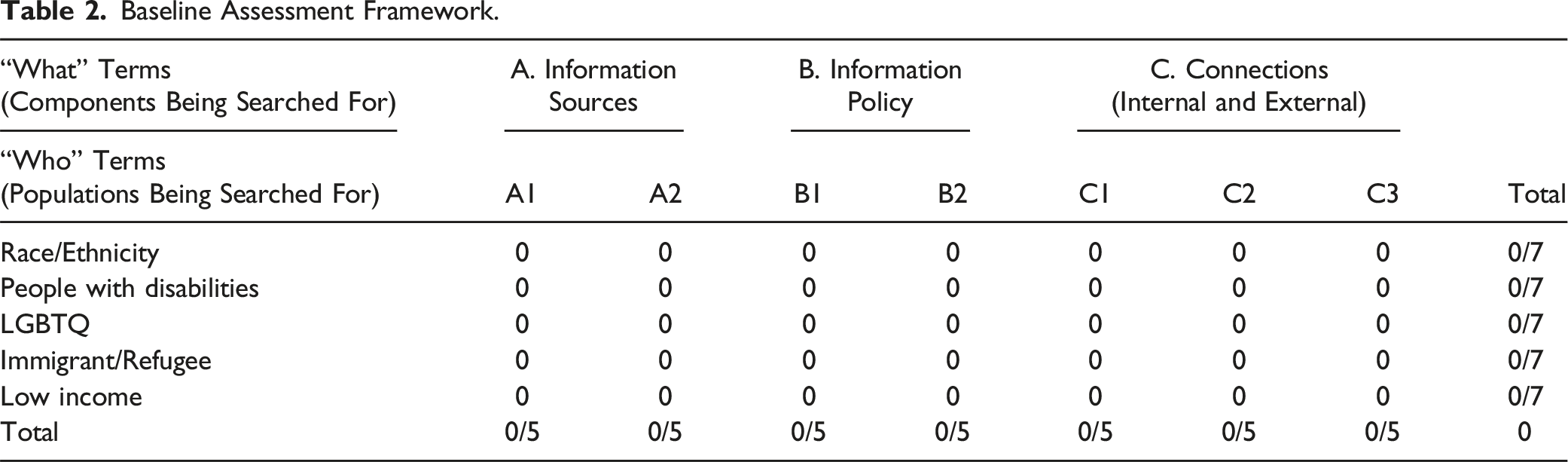
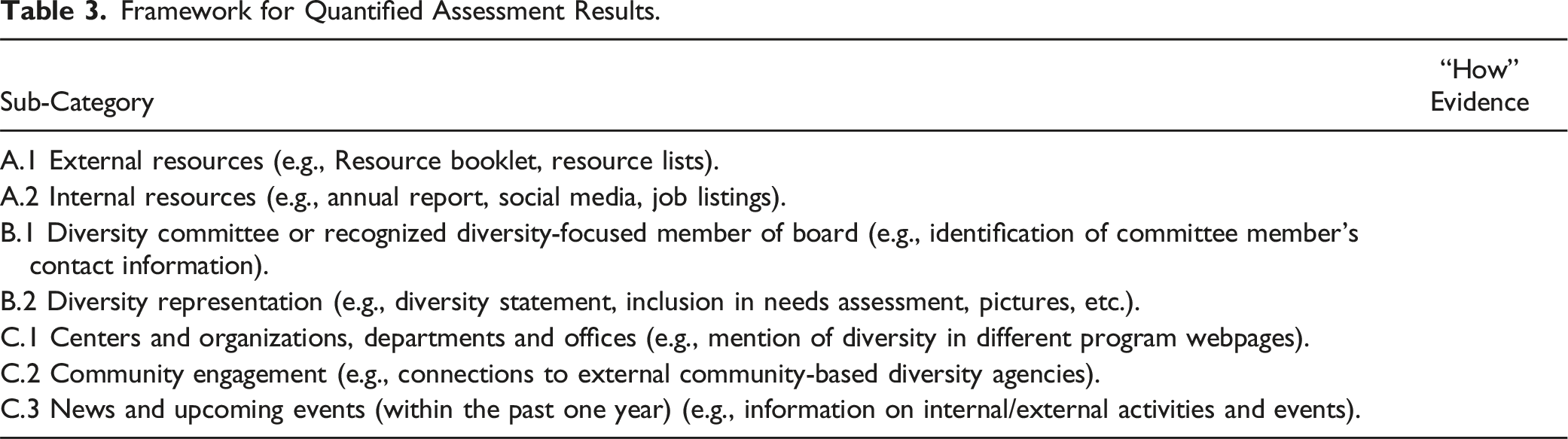
The initial framework used to analyze the data was called the strategic diversity manifesto and was developed previously to examine how diverse representation of various populations are represented in libraries (Mehra & Davis, 2015). It includes three core components: (1) the what, (2) the who, and (3) the how. “What” terms are components being searched for such as information sources, information policy and planning, and connections whether internal or external. “Who” terms are populations you are searching for to understand how they are currently being represented in your materials such as people with disabilities, LGBT + people, people of color, or any other population an organization would like to ensure is represented in their aging services information. “How” examples are the results you find. In other words, the “how” is evidence of how your organization is representing different populations (the “who”) in your varying information materials (the “what”).
Baseline Assessment Description With “What” Categories.
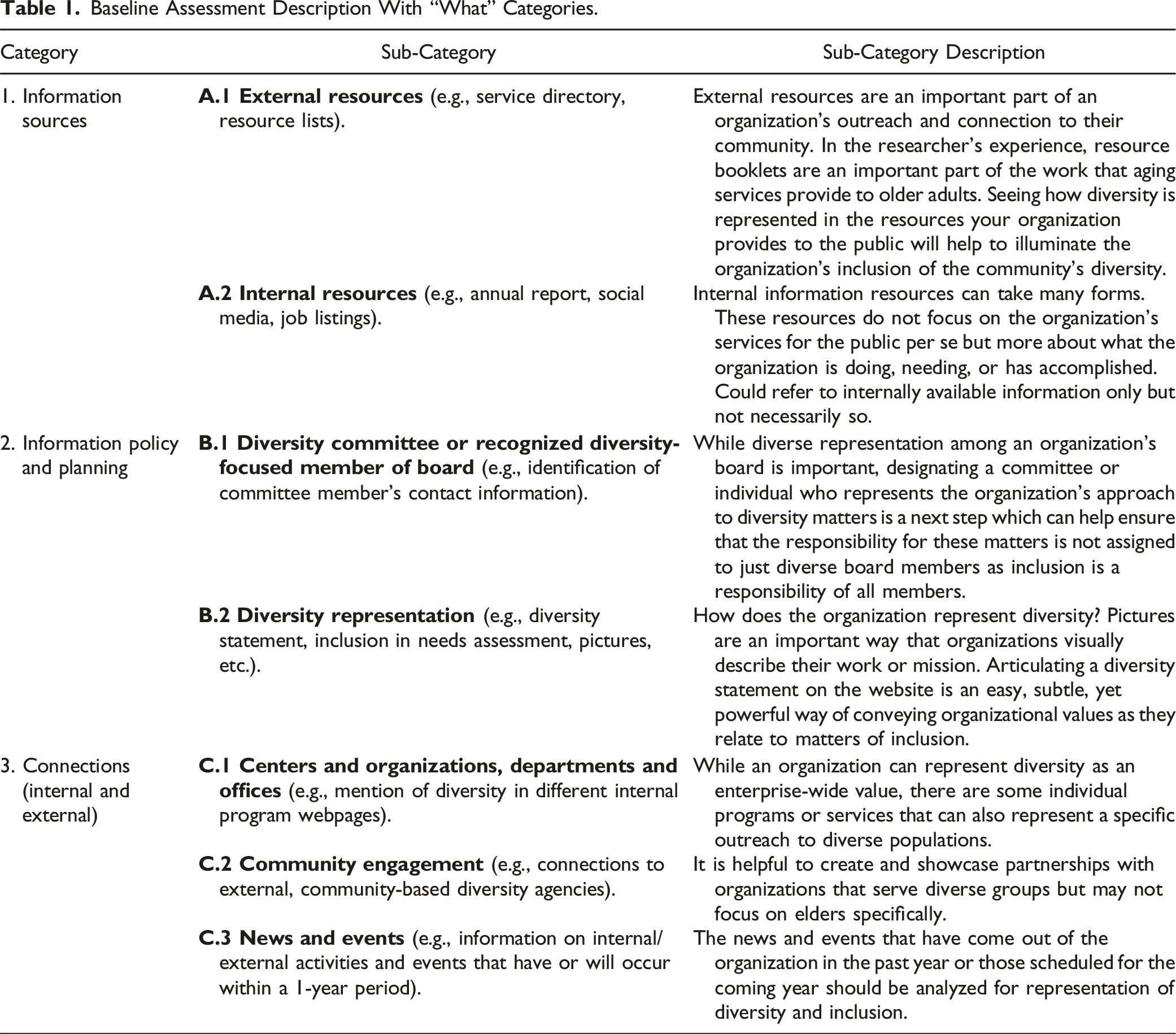
With the “what” terms stated and defined, the lead author was able to begin searching for examples of them in the collected data. This was accomplished by searching individually for the “who” terms such as “LGBT” or “African American.” Analog materials collected for the review were examined page by page. Digital materials such as websites or web documents can be searched by entering string commands and the website URL in Google or searching through search boxes on the website (Mehra & Davis, 2015). The search function of the computer can also be used to find examples of diversity when applicable in digital materials such as websites or PDFs.
Baseline Assessment Framework.
Framework for Quantified Assessment Results.
Review
The results of the diversity audit demonstrated that the OOA did have some representation of diversity in their print and digital information resources. However, the audit suggested that these representations were by chance and not part of a concerted effort to include diverse representation by design (Dali & Caidi, 2017, 2020). More could be done to ensure that information was created with diverse inclusion in mind. The OOA director agreed to work with the lead author to improve the diverse representation in the office’s information materials.
This process also showed that while the adapted tool used to conduct the diversity audit was helpful in identifying current levels of diverse inclusion, it did not provide much guidance for how deficiencies could be improved. Further review of academic literature and environmental scan of what other offices were doing and what other resources existed resulted in a list of action steps that organizations could do to improve their diverse representation in case their completion of the diversity audit found deficiencies (Rathi et al., 2017). These steps were worked through iteratively with the OOA staff. Some of the changes adopted across the partnership period included ultimately drafted a diversity and inclusion statement, adding it and the advertisement permanently to the resource booklet and website, creating a new webpage listing local, national, and international resources for diverse older populations, and added more diverse local resources to the resource booklet itself. They also agreed to regularly review and maintain these aspects.
Action Steps Planning Matrix.
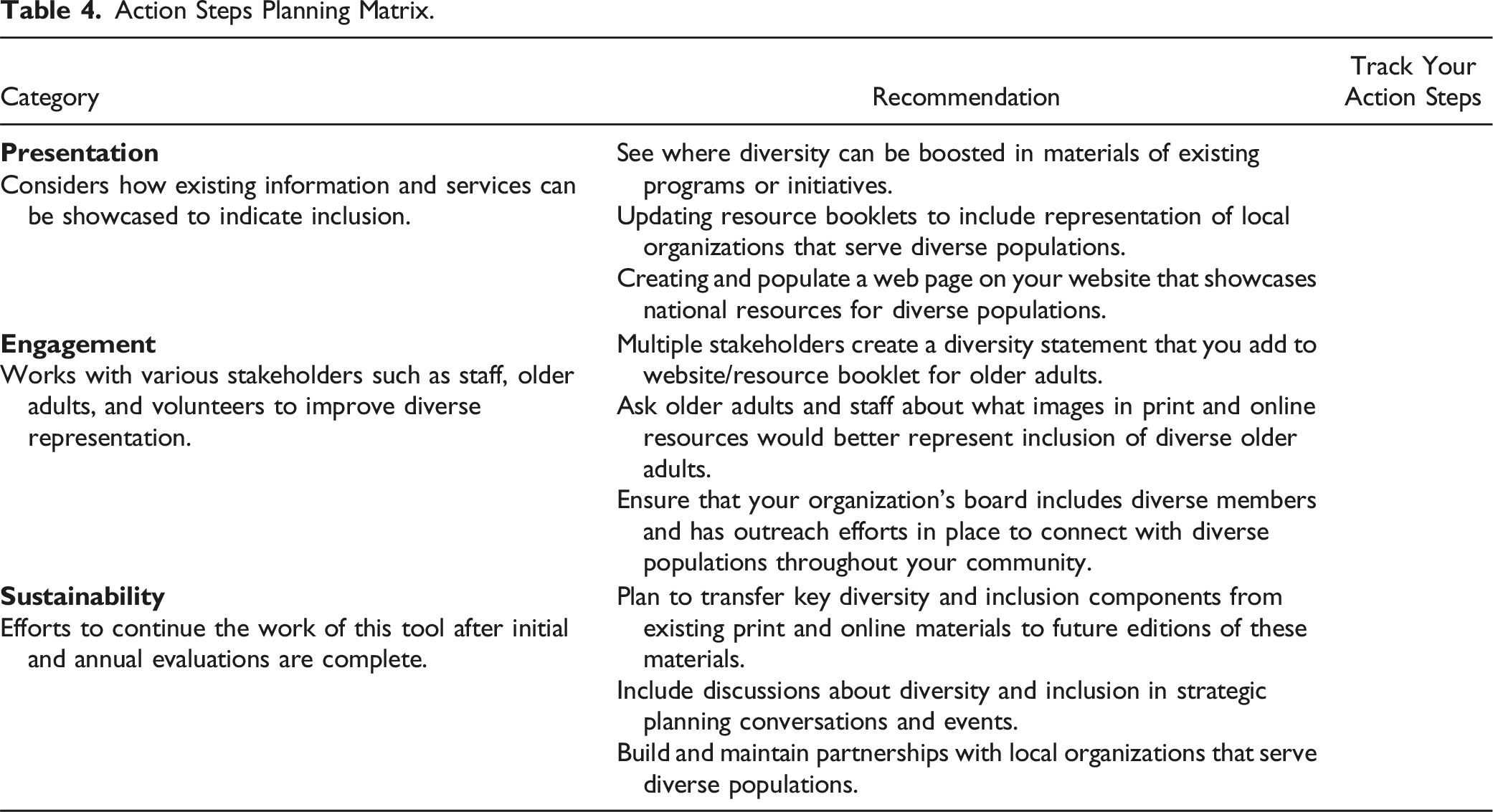
This action research project resulted in the development of a tool called the Every Group Gets Older Diversity Inclusion Improver Tool or EGGODIIT (e-go-dit) tool. The tool measures existing diversity inclusion in the aging services information provided by an organization such as an office on aging and offers action steps on how to improve any deficiencies discovered by the audit. The main audience of this tool are aging services providers seeking to improve their representation of the diverse older adults who live in their community and who would benefit from their organization’s services. The tool can be found and downloaded for use through this journal’s website or on the lead author’s website: (https://josephwinberry.org/products).
Discussion
This action research gives a glimpse of how frontline providers can better meet the aging services information needs of diverse older adults. Its significance lies in its value as an action-oriented deliberate strategy to operationalize representation of diversity beyond an abstracted and general concept (Mehra, 2021), but also considering that the world’s population is aging, a focus on diversity among older adults is timely and imperative. However, working with the community partner on this project demonstrated how difficult it is to achieve diversity representation without centering that effort given the many other demands for attention facing public organizations. One answer is to encourage stronger efforts to incorporate that representation (Dali & Caidi, 2017, 2020). This study and resulting diversity audit tool have implications around diverse representation in both the process of the tools development as well as the components of the tool itself.
Action research—and especially forms of community-engaged or participatory action research—has been described as an underutilized research approach in various fields including in the researchers’ domain of information sciences (Winberry, 2023). The process of developing this research tool involved learning from the community being served in addition to the literature. By developing this project in connection with Office on Aging staff and through the authors’ engagements with other members of the community being served, the tool represents insights and buy-in from important stakeholders necessary for its continued use beyond the scope of this individual project. As future researchers seek to develop partnerships to develop applied research tools and projects, the steps taken in this article to organize, address, and review the audit tool’s development can be useful guideposts that others can use to implement their own projects.
Beyond the process value that this project has for the community it was first created to serve and to other applied researchers conducting community-engaged research projects and tools, the specific components that were ultimately included have positive implications for research and practice. Information meant for older adults cannot be expected to meet the needs of all older adults if their diversity of identity and life experiences are not also taken into consideration. Recognizing the role of information to possibly meet the needs of diverse older adults illustrated “teasing out” what has been called the red thread of information in broader social contexts (Bates, 1999; Hartel, 2020). By considering the role of information in diverse social contexts, the resulting tool can help providers serve who older people are—and where they are—rather than putting them in one box.
But while representation in information is valuable, it is important to note that it alone is not enough to ensure proper inclusion of diverse people. Inclusive treatment, for instance, is necessary to help address mental health disparities faced by older adults of color (Jimenez et al., 2022). Seeing culturally responsive information in an advertisement for cognitive behavioral therapy is not actually helpful if the therapy itself is not considerate of those cultural needs (Huey Jr. et al., 2023). If webpages are adorned with same-sex couples and promises of support, engaging with staff who are not trained or willing to work with older LGBT+ people will prove that information is only so deep (LeCompte et al., 2021). Improving diversity inclusion in information is therefore just one of many aspects necessary for ensuring truly culturally inclusive and competent provision of care to older adults.
This article is therefore a contribution to the information component of a larger effort to improve inclusion of diverse people who receive services from offices on aging and other older adult providers. Diversity audits can be useful in addressing gaps in inclusive representation (Bright & Ghouse, 2019; Emerson & Lehman, 2022; Wells et al., 2023). But the diversity audit developed as part of this study represents interactions with just one office on aging. Future research will need to test the value of this tool with a larger set of aging services providers. This may bring about further insights which modify the tool further and increase its usefulness in future efforts to address the needs of diverse older adults.
Conclusion
The events of 2020 brought attention to the inequities experienced by various groups such as racial minorities and people with co-morbidities (Gibson et al., 2020)—populations with which many older adults intersect. In the years since, there has been a backlash led by politicians and anti-inclusion activists against many of the principles of diversity and inclusion the pandemic renewed attention to. While not everyone will think in terms of diversity and inclusion, most service providers do wish to serve the needs of all the people who fall within their mandate. It is the responsibility of researchers—in the authors’ view—to facilitate where possible the tools for doing so in partnership with the groups and organizations that need them. The process and results of this study represent one effort to do just that with the hopes that other offices on aging might also use this tool to demonstrate their commitment to serving all older adults (Appendix).
Supplemental Material
Supplemental Material - Operationalizing Inclusion of Diverse Older Adults in Aging Services Information
Supplemental Material for Operationalizing Inclusion of Diverse Older Adults in Aging Services Information by Joseph Winberry and Bharat Mehra in Journal of Applied Gerontology.
Footnotes
Declaration of Conflicting Interests
The author(s) declared no potential conflicts of interest with respect to the research, authorship, and/or publication of this article.
Funding
The author(s) disclosed receipt of the following financial support for the research, authorship, and/or publication of this article: This study was made possible through an ALISE Community Conn@ct mini grant and University of Tennessee Office of Engagement & Outreach matching funds which together purchased the advertisement discussed in the paper.
IRB
The UNC IRB found that the study (#23-2599) did not involve human subjects research as defined by the regulations.

Supplemental Material
Supplemental material for this article is available online.
References
Supplementary Material
Please find the following supplemental material available below.
For Open Access articles published under a Creative Commons License, all supplemental material carries the same license as the article it is associated with.
For non-Open Access articles published, all supplemental material carries a non-exclusive license, and permission requests for re-use of supplemental material or any part of supplemental material shall be sent directly to the copyright owner as specified in the copyright notice associated with the article.
