




Abstract
The workforce is not prepared to meet the needs of the number of older adults (OAs) across the globe. The study examines the Theory of Planned Behavior via the Working with Older Adults Scale (WOAS) in a group of university-aged international students to better understand global perceptions of working with older adults. We also compared North American and International students’ attitudes, perceived behavioral control, and intention to work with older adults. Students were enrolled at a public university in Canada. Participants completed the WOAS, Ageism Attitude Scale, and answered an open-ended question, “How are older adults viewed in your culture?” Attitude, Subjective Norm, and Perceived Behavioral Control predicted Intention to work with older adults for the full sample, and subgroups. While there were many similarities, North Americans had lower intention to work with older adults and higher ageism than International students. Further research is necessary to understand these cultural nuances.
• Demonstrates the use of the Working with Older Adults Scale with an international student group. • Increased understanding of cultural differences in intention to work with older adults and ageism.
• Cultural views of older adults can apply to interactions as this subset of the population becomes increasingly diverse. • Language that may be more appropriately used based on the cultural background of older adults.What this paper adds
Applications of study findings
Introduction
As the population ages, there is demand for health service providers to meet OAs’ needs (American Psychological Association, 2014; Institute of Medicine, 2012). Unfortunately, providers consistently exhibit hesitance to work with older populations (Karel, et al., 2012). This creates a client care gap wherein there are not enough healthcare providers ready and willing to work with OAs. Research largely supports the role of attitudes and competence as major deterring factors (Helmes & Gee, 2003; Tomko & Munley, 2013), with a lesser body of research pointing to social influences (Brown et al., 2008; Meiboom et al., 2015). Understanding factors that influence whether a student will consider a career working with OAs may help address the gap between population needs and available providers.
Ageism, labeled over 50 years ago (Butler, 1969), originally included, among others, the belief OAs are slow or rigid. The World Health Organization (2024) defines ageism as “the stereotypes (how we think), prejudice (how we feel) and discrimination (how we act) towards others or ourselves based on age.” It includes positive or negative discrimination based on age, including discrimination directed at younger or older people because of their age. Ageism is present in many cultures (Ayalon, 2019), with one proposed theoretical basis of Intergroup Threat Theory. Being a member of the out-group (i.e., older or younger adults) takes away resources from the in-group (i.e., working adults contributing to the economy). Research on multi-nation attitudes indicates there may be both similarities (Runkawatt et al., 2013) and differences (Chiu et al., 2001) across cultures (Ayalon, 2019) regarding how OAs are treated. Most research from around the globe focuses on attitudes as the main explanation for provider hesitance to work with OAs (Bleijenberg, 2012).
There are cultural differences and expectations in how OAs are treated, depending on the questions asked (Vauclair et al., 2017). Several cross-cultural studies have compared attitudes towards older workers, OAs residing in long-term care, and OAs in the general population. Nurses who provided care in-home, as is the case in Thai multigenerational households, had similar positive attitudes towards OAs compared to nurses providing care in Swedish long-term care homes (Runkawatt et al., 2013); experience and knowledge about OAs decreased ageism. In a study of perceptions of older workers, the general population in Hong Kong perceived older people more positively but older workers more negatively, compared to the general population the UK (Chiu et al., 2001). This may be due to the belief in Hong Kong that younger workers should be prioritized.
Studies across the globe reported students’ change in attitudes towards OAs after spending time with them, specifically an increase in positive attitudes (Ross et al., 2018) or a change from slightly negative to neutral (Bleijenberg, 2012). Another review (Liu et al., 2012) found physicians and medical students across 13 countries showed a more positive attitude towards OAs, while other healthcare students showed more negative attitudes over time. Physicians were trained to increase positive attitudes, whereas other providers were not trained.
Until recently, there has not been a standardized way to measure students’ intention to work with OAs. The Working with Older Adults Scale (WOAS; Graham & Rosén, 2020) is grounded in the theory of planned behavior (TPB; Ajzen, 1991), using intention to engage in a behavior as the best proxy for true behavior (in this case, working with OAs). Intention is predicted by attitude, subjective norm, and perceived behavioral control as they relate to the target behavior of working with OAs. In the TPB, attitudes are measured in terms of the behavior’s perceived usefulness and pleasantness directed toward a particular behavior, rather than toward an object. Subjective norm is the degree to which an individual perceives approval from various important social influences (family, mentors, etc.) regarding engagement in a specific behavior. Perceived behavioral control measures the perceived ease or difficulty of engaging in the behavior. Graham and Rosén (2020) demonstrated good reliability and validity for the WOAS, supporting the TPB as a predictive model (i.e., intention to engage in a behavior predicted by attitudes, subjective norm, and perceived behavioral control). Interestingly, subjective norms were more predictive of intention than often-studied attitudes. Graham and King (2022) evaluated the WOAS within a sample of psychology doctoral students in the United States, expanding to include other variables as distal predictors of intention. The WOAS again exhibited good reliability, supporting its ongoing scholarly use. The TPB model was also largely supported, with subjective norm being the strongest predictor.
The TPB has been used globally with studies finding similar prediction of intended behavior based on attitudes, subjective norm, and perceived behavioral control. For example, it has been applied in Korea (Shin & Kim 2015), Northern Ireland (Giles & Larmour, 2000), and with racial and ethnic minority youth in the USA (Boekeloo et al., 2017). One study in Malaysia used the TPB to predict nursing students’ intentions to work with OAs (Che et al., 2018). These studies provide evidence the TPB is relevant on a global scale.
Current Study
We are not aware of any prior study measuring impacts of attitudes, competence, and social influence on intentions to work with OAs across cultures. Therefore, our study aimed to expand upon this area of research in a global context, applying the WOAS to international students in North America, as the original (Graham & Rosén, 2020) and replication (Graham & King, 2022) of the WOAS used U.S. samples. This mixed methods study used the WOAS (Graham & Rosén, 2020) and the Ageism Attitudes Scale (Yilmaz & Terzioglu, 2011) in a sample of over 500 undergraduates in Canada. The objectives of the study were (1) to explore the application of the WOAS as representative of the TPB within an international sample, and (2) to explore differences between North American and International students on the WOAS, ageism, and open-ended questions. We hypothesized the TPB model would remain consistent in International and North American samples. We viewed the second objective of the study as exploratory, and although we believed ageism attitudes would be similar across samples, we were uncertain if there would be differences in intention to work with OAs.
Methods
Participants and Procedures
Demographics.
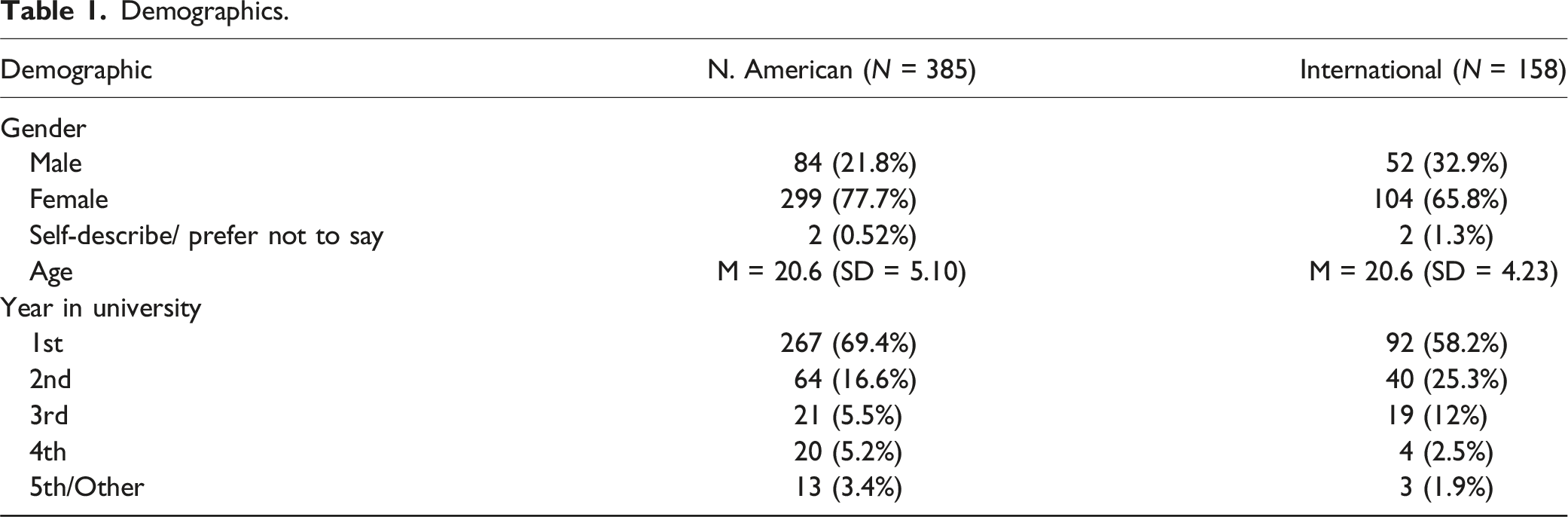
Professors posted recruitment materials on online course pages, linking to the survey. Participants accessed the study online. Student participation was voluntary, and students could receive an extra 1% credit towards their final grade. Students were notified they would be giving consent by submitting the survey, and they could discontinue answering questions at any time without consequences. They were given random identification numbers after which they were redirected to a separate URL to enter their university ID and email for extra credit; it was impossible to link identity and responses.
Materials
We collected demographics, as noted above.
Working with Older Adults Scale (WOAS)
The Working with Older Adults Scale (WOAS; Graham & Rosén, 2020) measures intention to work with OAs based on the Theory of Planned Behavior (TPB), and consists of 20 Likert-scale questions ranging from 1 = Strongly disagree to 7 = Strongly agree. The WOAS uses Attitude, Subjective Norm, and Perceived Behavioral Control to predict Intention to work with OAs. All subscales showed good internal consistency in the current sample: (1) Attitude (AT; Cronbach’s α = .85; example item: “Working with older adults is valuable”), (2) Subjective Norm (SN; Cronbach’s α = .92; example item: “My mentors want me to work with older adults”), (3) Perceived Behavioral Control (PBC; Cronbach’s α = .88; example item: “I lack knowledge to work with older adults”), and (4) Intention (INT; Cronbach’s α = .91; example item: “I have significant personal interest in working with older adults”). Higher total scores (Cronbach’s α = .92) indicate more positive AT, SN, PBC and INT to work with OAs.
Ageism Attitudes Scale
The Ageism Attitudes Scale (AAS; Yilmaz & Terzioglu, 2011) includes 23 Likert-scaled items from 1 = Strongly Agree to 5 = Completely Disagree) on three subscales (Positive: 6 items; e.g., “Elderly people are more tolerant of younger people,” Negative: 8 items; e.g., “Elderly people are always ill,” and Restricting Lives: 9 items; e.g., “Elderly people can’t carry bags or packages without help”). Higher scores indicate more ageism. Reliability in the current sample was acceptable for the full scale AAS (Cronbach’s α = .80).
Open-Ended Responses of Older Adults Across Cultural Backgrounds
Participants were asked, “Please take a moment to briefly describe how older adults are viewed in your culture.”
Data Analyses
We conducted linear regression analyses with the entire sample (N = 547) and separately with North American (N = 385) and International (N = 158) students to predict intention to work with OAs from attitude, subjective norm, perceived behavioral control, and age. All assumptions for linear regression were checked and met. We conducted Welch’s t-tests to compare mean scores on the WOAS subscales, and on the AAS subscales between North American and International students. Finally, we conducted an ANCOVA to examine the impact of positive and negative ageism (covariates) on intention to work with older adults for North American and International students.
Global Regions, Countries, and Number of Responses.
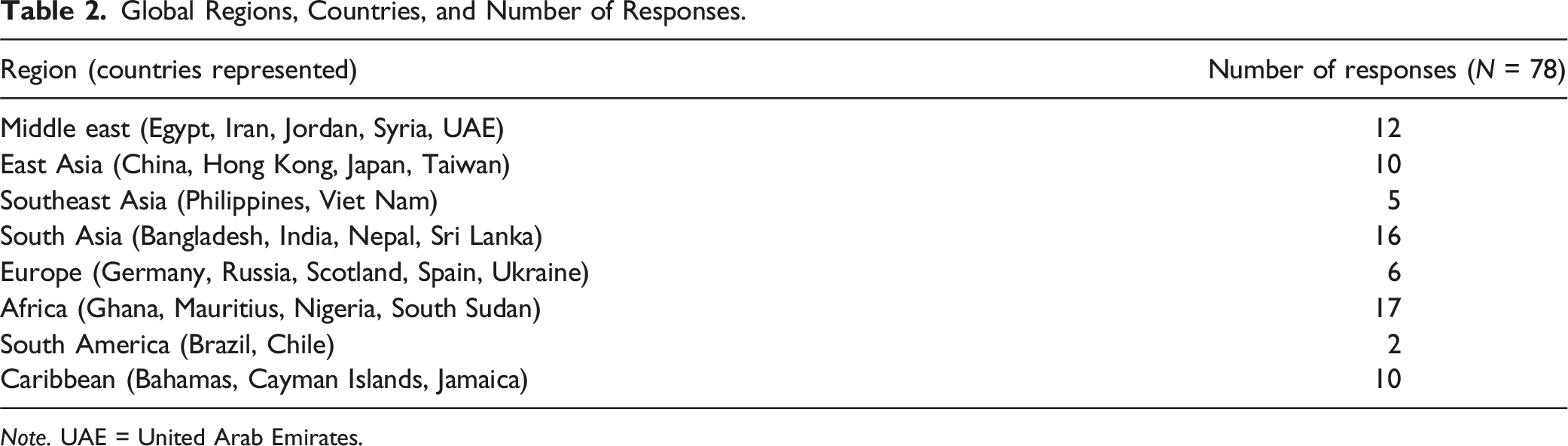
Note. UAE = United Arab Emirates.
Results
Descriptives for Subscale Values of Interest, Split by Sample.
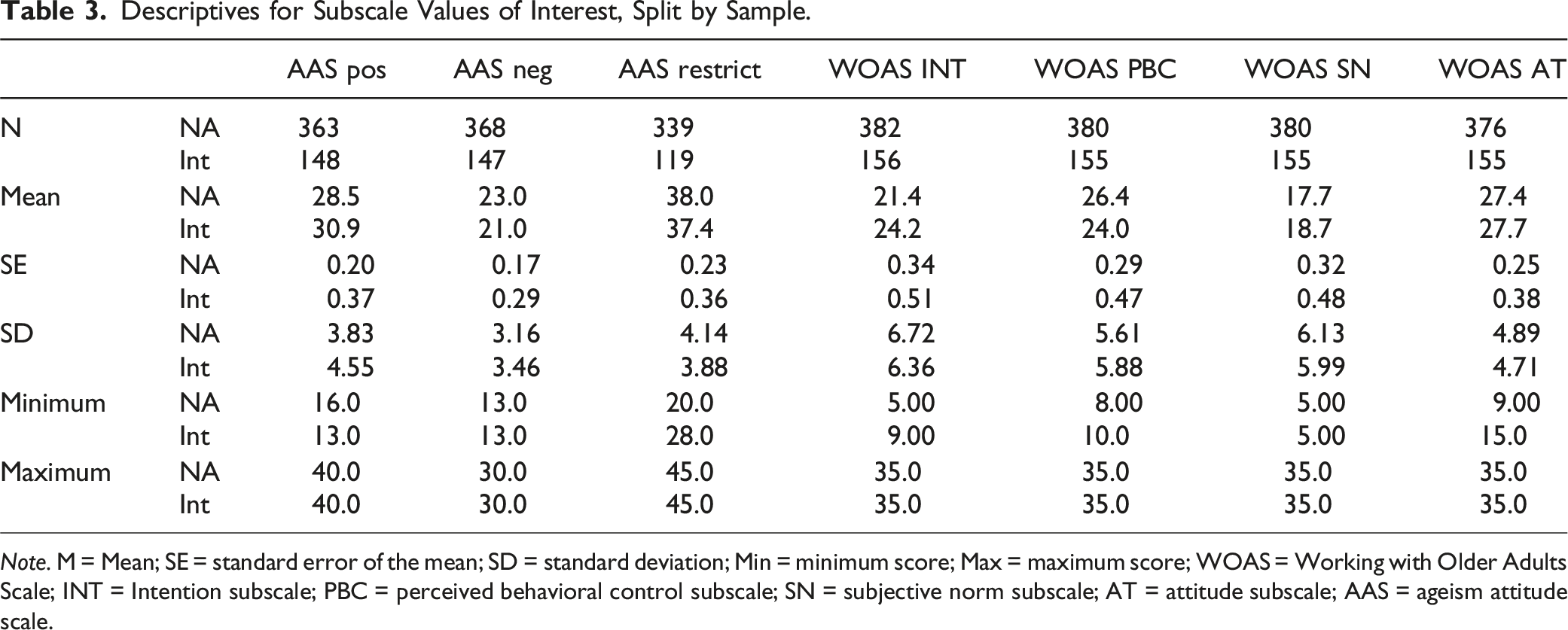
Note. M = Mean; SE = standard error of the mean; SD = standard deviation; Min = minimum score; Max = maximum score; WOAS = Working with Older Adults Scale; INT = Intention subscale; PBC = perceived behavioral control subscale; SN = subjective norm subscale; AT = attitude subscale; AAS = ageism attitude scale.
Regression Analyses
A hierarchical linear regression with the full sample of students found that age, AT, SN, and PBC, significantly predicted scores on INT to work with OAs, F (4,486) = 153.42, p < .001, and accounted for 56% of the variance. Age was not a unique predictor of INT; however, all other subscales uniquely and significantly predicted scores on the INT subscale (PBC: t = 2.92, p = .004, ß = .10; SN: t = 14.74, p < .001, ß = .47; AT: t = 12.10, p < .001, ß = .41).
Regression Coefficients for the Full Sample of Students and by Subgroup.
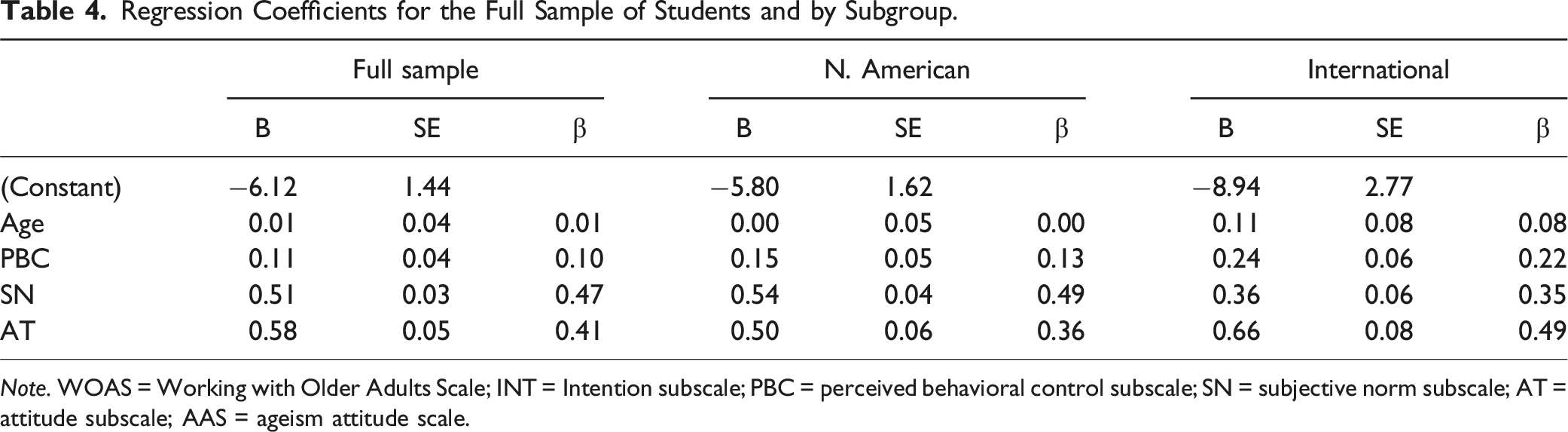
Note. WOAS = Working with Older Adults Scale; INT = Intention subscale; PBC = perceived behavioral control subscale; SN = subjective norm subscale; AT = attitude subscale; AAS = ageism attitude scale.
Group Comparisons
Independent Samples t tests, Comparing Scores WOAS and AAS Subscales Between International and N. American Students.
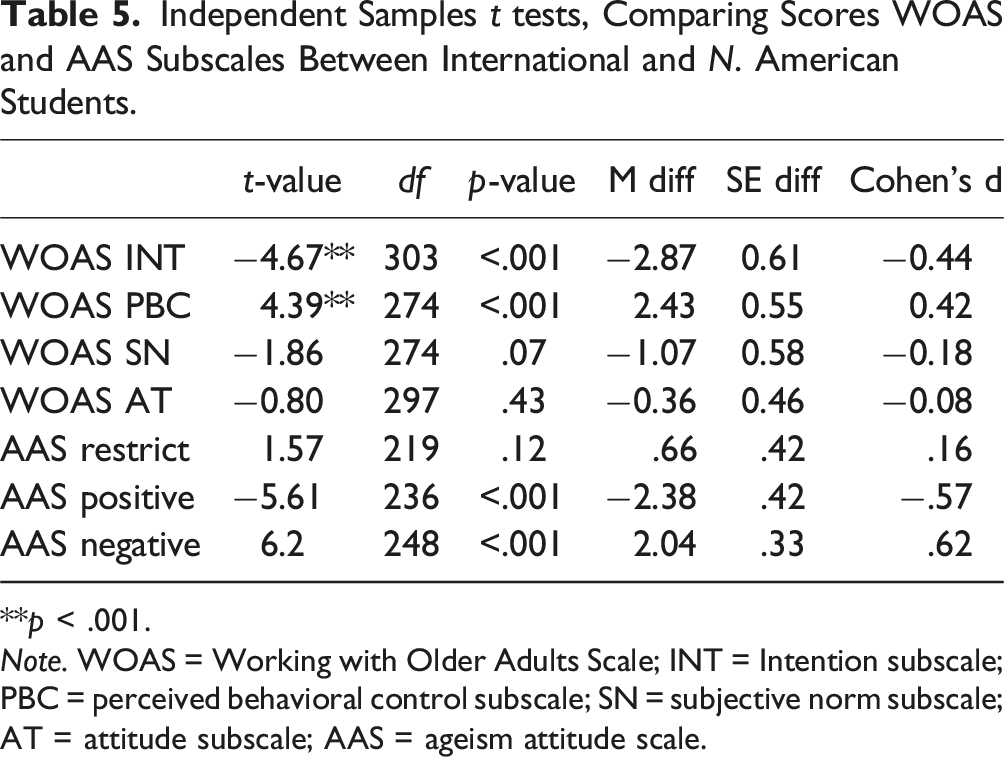
**p < .001.
Note. WOAS = Working with Older Adults Scale; INT = Intention subscale; PBC = perceived behavioral control subscale; SN = subjective norm subscale; AT = attitude subscale; AAS = ageism attitude scale.
On subscales of the Ageist Attitudes Scale (AAS), there were significant differences between North American and International students on Positive (t (236) = −5.61, p < .001, Cohen’s d = −0.57) and Negative (t (248) = 6.2, p < .001, Cohen’s d = 0.62) subscales, both with medium effects. North American students had lower positive ageism (M = 28.5, SD = 3.83) and higher negative ageism (M = 23, SD = 3.16) scores compared to International students (Positive M = 30.9, SD = 4.5; Negative M = 21, SD = 3.46). There were no significant differences between the groups on the subscale Restricting Lives of the Elderly (t (219) = 1.57, p = .12, Cohen’s d = 0.16).
The ANCOVA found that the covariate, positive ageism, was significantly related to the outcome INT with a medium effect, F (1, 493) = 27.11, p < .001, ω2 = .05; the covariate of negative ageism was not significantly related to INT, F (1, 493) = .65, p = .42, ω2 = −.00. After accounting for the covariates, there was a significant effect of group on INT, F (3,493) = 16.80, p < .001. International students demonstrated higher intention to work with older adults even after accounting for positive and negative attitudes.
Qualitative Results
Qualitative Themes, Definitions, and Frequencies.
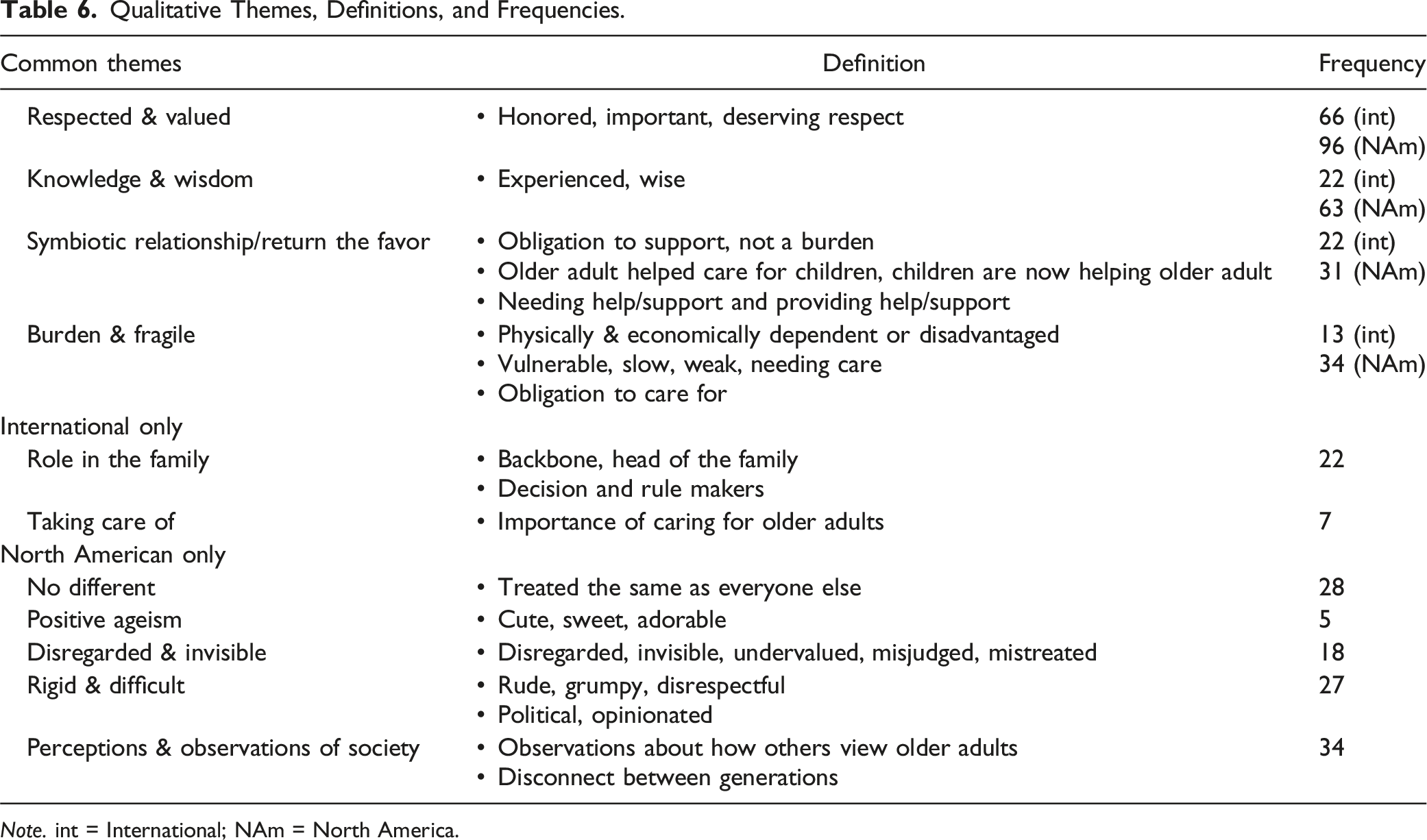
Note. int = International; NAm = North America.
Common Themes
Theme 1: Respected and Valued
Both groups shared how well-respected and valuable OAs are within communities, for example, “The elderly are viewed as people that should be given respect, supported and given help without question” (North American student) or “In the Persian culture, older adults are the most important group among all, and anyone who do not respect them in any way is considered as an uneducated person” (International student – Iran). This theme was the most common across the sample (n = 162 of total sample or 65%; n = 96 North American and n = 66 International).
Theme 2: Knowledge and Wisdom
This theme often went with respect and value, but not always, and was the second most common theme for North American students (n = 63, 35%). Students discussed how they could learn from OAs based on lived experience through difficult times. “They [older adults] know shortcuts, they know the truth about life, and they know how to enjoy life. Their life lessons are priceless and unique to each individual” (International student – Chile) or “In my culture, older adults are viewed as wise. Older adults have experience in particular things that younger people do not. Therefore, my culture values the stories, opinion, and advice of older people…” (North American student).
Theme 3: Symbiotic Relationship/Return the Favor
This theme was coded in responses reflecting a duty or obligation (total sample n = 53, 21%), but not a burden to care for OAs. It was also reflected in responses where both individuals (younger and older) could benefit from interacting. “We have a saying ‘once a man, twice a child’ old people were once taking care of us so now it’s our turn” (International student – Jamaica). While this theme was prominent in Caribbean and African respondents, it was also in many North American student responses. “…it is up to my parents or the grandchildren to help them with certain tasks… The belief that they have devoted much time, care, and energy from their lives to support you, therefore, they should be shown the same respect and courtesy if need be” (North American student).
Theme 4: Burden or Fragile
Across groups, the theme of being a burden or fragile was often buffered by another theme with a positive message. For example, North American students responded, “Older adults are viewed as people who need to be respected, but they are also often seen as fragile and needing assistance” or “They are viewed as weak, and defenceless. All elders are unique individuals, and should not be categorized based on a set of parameters.” Similarly, the minority of International students who mentioned this theme also paired it often with more positive messages. “Older adults should always be respected and valued by their family and the society. Just like children, they are vulnerable, so they require a lot of care …” (International student, Viet Nam).
North American Students
Theme 1: No Different
Students voiced the perception that OAs are just like everyone else. For example, “I personally respect pretty much every adult that I meet and it is because my parents taught me to give respect to all people around you” or “Older adults are viewed to be the same as anyone else in my culture.” These statements were fairly common (n = 28, 16%) but not in any International response.
Theme 2: Positive Ageism
Although it was a minority (n = 5, 3%), North American students used phrases or words associated with positive ageism to talk about OAs, words that were not used by International students. “They are viewed as cute people that tell lots of stories” and “I feel as though in Canada the elderly tend to be seen as very sweet and friendly …”
Theme 3: Disregarded and Invisible
The theme of “disregarded and invisible” (n = 18, 10%) was used in comments about how OAs were erased from society, “Older adults are often not thought of in everyday lives. Lots of people tend to forget about the elderly …” “Unfortunately, I feel older adults are pushed aside, and forgotten in my culture.” One particularly salient comment was, “They have often just been sent off to nursing homes in my experience.”
Theme 4: Rigid and Difficult
This theme perpetuates some stereotypes of OAs (n = 27, 16%), and often appeared with the assumption that OAs are conservative and hold right-wing political views. “In my culture, we respect elders. Although they are known to be wise and smart, I do believe that some elders are very old fashioned, which can clash with the type of society we are living in. For example, same sex couples or having babies before we are married; this may be something that they do not agree with that has changed in our societies throughout the years. These are a couple of examples of how I still respect the elder, but not necessarily agree with them and their ways of thinking.”
Theme 5: Perceptions of Society
This theme was used when individuals tried to distance themselves or contrast their personal view or attitudes from what their culture or society more broadly believes (n = 34, 20%). When observing this discrepancy, individuals generally tried to place their own perspectives in a more positive light than how they see their culture views OAs. “Most look up to older adults as they have often experienced more than us and have lived through some difficult times and their knowledge is valuable. Unfortunately, some see older adults as a burden (not myself as I love older adults) and feel they lived their lives and are not as important” or “In my opinion, older people are highly misjudged in our culture now a days. People see elders at a lower level than they see young adults…”
International Students
Theme 1: Role in the Family
This theme was unique to International students and captured the importance of OAs in the family structure, and their role as leaders (n = 22, 28%). This theme appeared with different variations depending on the region. For example, it was not coded in any response for students from the Middle East. However, many students from South Asia indicated that OAs are the “head of the family.” A student from Nepal stated “… We are raised up in a society where old people in the family is considered as the head of the family…it is always a blessing to live under the hands of your elders.” Similarly, a student from India indicated “They are the head of the family. They will be approached for major decision making as their experience and knowledge is considered valuable.” Both respondents from South America referred to the OAs in their culture as the “roots of the family tree.” In Nigeria, adults were consistently noted to be the primary decision makers. “They are given priority in making decision…” and “…they make the rules, while we, the young adults obey.”
Theme 2: Taking Care of
This theme appeared in International responses that emphasized the importance of caring for older family members (n = 7, 9%). “Older adults are viewed as a blessing to the society and therefore, they are highly respected and taken good care of” (South Sudan) or “… elderly people are always taught to be respected and to be taken care of” (Bahamas).
Discussion
The primary aim of the current study was to examine the application of the Working with Older Adults Scale (Graham & Rosén, 2020) with international students, examining how the Theory of Planned Behavior (TPB), translated to a more global sample. Our main finding demonstrated that the WOAS predicted intention to work with OAs with International and North American students. This is the first study using the WOAS within this diverse context of international students and thus offers an expansion of research in this area. A secondary objective was to examine the relationship of ageism and intention to work with OAs between North American and International students. Findings revealed significant differences between the groups across quantitative and qualitative data. While international students had higher scores on their intention to work with OAs, lower negative and higher positive ageism scores compared to North American students, qualitatively, North American students were more likely to explicitly disclose positive and negative ageism. International students uniquely emphasized the importance of OAs as integrated in the family structure or decisions (“Role in the Family”). However, there were many similarities across students in qualitative responses as well, including the need to respect and value OAs, the wisdom and experience OAs offer, and the younger generations’ duty to care about older generations. Finally, we examined how intention to work with OAs might be impacted by ageism for students. Indeed, our findings demonstrated positive ageism, but not negative ageism, impacted the relationship between student groups and intention to work with OAs.
The Theory of Planned Behavior (Ajzen, 1991) posits intention as a proxy for behaviors, predicted by attitude, subjective norm, and perceived behavioral control. The original validation of the WOAS (Graham & Rosén, 2020) supported intention to work with OAs as predicted by subscales of attitude, subjective norm, and perceived behavioral control related to working with OAs. In the original study, subjective norms most strongly predicted intention to work with OAs compared with more often-studied attitudes or competence. Our study hoped to apply the TPB framework in a sample of students from countries all over the world. The TPB was an appropriate framework for both North American and International students, accounting for almost two thirds (56%–61%) of the variance in their intention to work with OAs. Similarly, prior studies using the TPB in an international context (e.g., Che et al., 2018) found it predicted Malaysian nursing students’ intention to work with OAs.
North American students demonstrated the exact pattern as the original study; subjective norms were most predictive of intention (i.e., highest standardized Beta), followed by attitudes, and perceived behavioral control. International students showed a different pattern. Attitudes predicted intention most, followed by subjective norm, and perceived behavioral control. Future research could explore if the differences found in the present study are replicated in samples across the globe. In both groups, perceived behavioral control was the least predictive of intention. Our study, coupled with the original studies (Graham & King, 2022; Graham & Rosén, 2020) suggest that social influences like subjective norms may play a more important role in individuals’ intention to work with OAs than previously emphasized.
We compared North American and International students on WOAS subscales and attitudes (Yilmaz & Terzioglu 2011). Although there are limitations in grouping heterogeneous international students into one entity, this strategy was a first step in expanding understanding of ageism and intention to work with OAs beyond the dominant North American or Euro-centric approaches. We attempted to remediate this limitation by examining patterns in themes across countries and continents. For example, almost all Nigerian students discussed OAs as leaders and decision makers, students from South America referenced older adults as “roots” of family trees, and students from South Asia referenced older adults as the “head” of families. While all share a similar valence to the value OAs provide, the differences in language hint at nuance that should be further explored.
Our mixed methods examination highlighted many similarities and some key differences between groups. International students reported higher intention to work with OAs, more positive ageism and lower negative ageism towards OAs, and lower perceived behavioral control compared to North American students. Responses to open-ended questions paralleled quantitative findings. Open-ended responses showed higher levels of explicit negative ageism in the North American student sample. Prior work (e.g., Helmes & Gee, 2003; Tomko & Munley, 2013) and current findings indicate attitudes predict intention, so it should come as no surprise, therefore, that International students had a higher intention to work with OAs. Given the group differences on negative and positive ageist attitudes on the AAS, in contrast, there were no differences between the groups on the WOAS Attitudes subscale. This is likely due to the sensitivity of the AAS, designed to assess general attitudes towards OAs. In comparison, there are only five items on the WOAS Attitudes subscale specific to working with OAs, so it may not be as sensitive to ageism.
Finally, we found that positive ageism, but not negative ageism was related to intention to work with OAs. This finding is supported by recent work (Shea et al., 2021), finding a shift from negative ageism predicting intention to work with OAs prior to the onset of the COVID-19 pandemic, to positive ageism predicting intention for students who completed measures during the pandemic. As that study was cross-sectional, it remains unclear if this is a true shift in attitudes, or an inherent difference in groups that had nothing to do with the pandemic. In the current study, we were most interested in students’ intention to work with OAs after accounting for ageist attitudes—positive or negative. Differences in students’ intention to work with OAs remained after accounting for ageism, and international students report higher intentions.
As noted, grouping international individuals into a single entity has limitations, yet our findings lay the groundwork for increasing understanding of ageism and intention to work with OAs from a cross-cultural perspective. However, all were individuals who left their country of origin to pursue studies in North America, so it is possible their views differ from those remaining in their country of origin. Students were enrolled in introduction to psychology courses, and many of them in the earlier years of study, with a mean age 20. Prior research suggests additional experiences with OAs, even into an undergraduate curriculum may shape a student’s perceptions of OAs (Merz et al., 2018). There is certainly a possibility that intention to work with OAs may shift throughout an undergraduate degree. Future work may include longitudinal designs to measure shifts in international students’ intentions and should delve deeper into the cultural and societal norms that may influence attitudes towards and intention to work with OAs.
Ageism scales have not historically included separate subscales for positive or negative ageism, thus, future work will need to continue to learn about the role of positive ageism. Finally, the WOAS has not been validated for individuals who speak English as an additional language (EAL). While validating the tool for EAL speakers may be important for further work in this area, the students in our initial study here were all enrolled at an institution for higher learning, taking courses in English. While sufficient for the current study, validating the WOAS for EAL speakers may be necessary for more nuanced work that our study indicates is needed.
Our findings mirrored Graham and Rosén (2020), highlighting the important role subjective norms may have as an influence on intention to work with OAs. This is an additional path to be explored for the workforce pipeline: how can we increase students’ exposure to professionals who work with OAs? The larger systems that individuals exist within is an important part of the puzzle. When experiences are made available to students and valued within the health system, the social norms should shift and impact both attitudes and intention to work with OAs.
Conclusions
Overall, this study has implications for application and future research. The WOAS appears to be reliable for assessing intention to work with OAs in students from around the world, not only in Eurocentric student populations. As the population of OAs grows, attracting individuals to work in health services with OAs is an issue highlighted across the world. While much of the research on intention to work with OAs has focused on decreasing negative ageism, our work emphasizes that increasing exposure to careers working with OAs (subjective norms) and positive ageism may be key aspects of intention to work with OAs.
Footnotes
Declaration of Conflicting Interests
The author(s) declared no potential conflicts of interest with respect to the research, authorship, and/or publication of this article.
Funding
The author(s) received no financial support for the research, authorship, and/or publication of this article.
