




Abstract
Israel became the first country to offer the second COVID-19 booster vaccination. The study tested for the first time, the predictive role of booster-related sense of control (SOC_B), trust and vaccination hesitancy (VH) on adoption of the second-booster among older adults, 7 months later. Four hundred Israelis (≥60 years-old), eligible for the first booster, responded online, two weeks into the first booster campaign. They completed demographics, self-reports, and first booster vaccination status (early-adopters or not). Second booster vaccination status was collected for 280 eligible responders: early- and late-adopters, vaccinated four and 75 days into the second booster campaign, respectively, versus non-adopters. Multinomial logistic regression was conducted with pseudo R2 = .385. Higher SOC_B, and first booster early-adoption were predictive of second booster early-vs.-non-adoption, 1.934 [1.148–3.257], 4.861 [1.847–12.791]; and late-vs.-non-adoption, 2.031 [1.294–3.188], 2.092 [0.979–4.472]. Higher trust was only predictive of late-vs.-non-adoption (1.981 [1.03–3.81]), whereas VH was non-predictive. We suggest that older-adult bellwethers, second booster early-adopters, could be predicted by higher SOC_B, and first booster early-adoption, 7 months earlier.
What this paper adds
• For the first time, we tested the predictive value of vaccination views on second booster adoption, 7 months later. By contacting responders three times, we were able to make a time-sensitive comparison: early-adopters (received the second booster by day 4 of the campaign), late-adopters (day 75), and non-adopters. • A 1 unit (1–5 scale) increase in sense of control due to the booster (SOC_B) doubled the chances for second booster adoption, 7 months later. First booster early-adopters were 2–5 times more likely to adopt the second booster. • Vaccine hesitations were non-predictive, and trust was only predictive of the difference between second booster late- and non-adopters.
Applications of the study findings
• The literature marks bellwethers (early-adopters) as vital for healthcare innovation diffusion. Importantly, early-adopters of the second booster could be identified already during the first booster campaign. These are the early-adopters of the first booster, with higher SOC_B. • With possible new waves of pandemics, we suggest focusing on early-adopters of previous vaccinations, as they are more likely to become bellwethers of new vaccinations. • Vaccine campaigns could also address sense of control as a positive motivator encouraging earlier vaccinations in older age.
On January 2nd 2022, Israel was the first country to approve the second booster vaccine for COVID-19 (a fourth dose), for individuals 60 years and older, and other high-risk populations, due to the extensive growth in infections among vaccinated people (Burki, 2022). Later analysis revealed that the second booster lead to a substantial reduction in severe illness, hospitalizations and deaths due to COVID-19, as compared to only one booster dose (Arbel et al., 2022). Given the toll incurred globally due to the COVID-19 pandemic, it is important to learn more about factors predictive of vaccination behavior among older adults, especially as related to early-adopters. As individuals adapt social norms by observing others, these early-adopters are considered Bellwethers that can aid in the diffusion of healthcare innovations (Berwick, 2003; Chevallier et al., 2021). Our previous study indicated that a novel factor, Sense of Control Due to the Booster vaccine (SOC_B), was highly associated with the adoption of the first booster among eligible older adults, as well as more “traditional” psychological factors, such as Trust and Vaccine Hesitancy (Ben-David et al., 2022). However, several caveats impeded its validity: it was a cross-sectional study, and the act of first booster vaccination might have had a strong effect on SOC_B and other questionnaires. In the current study, we reached the same responders to assess how perceptions toward the first booster gauged on august 2021 could predict second booster behavior by March 2022, seven months later.
Sense of Control Due to the Booster
Generally, sense of control (SOC) refers to the extent to which individuals feel they can influence situations in their own life (Gerstorf et al., 2014). It has been found to be related to vaccine hesitancy and compliance (Murphy et al., 2021). SOC_B, specifically, is the extent to which SOC increased because a booster vaccination is available. Our previous study found higher SOC_B to be the most prominent factor associated with early first booster adoption among older adults, as compared to delayed or booster refusal (Ben-David et al., 2022). This is not surprising, as aging is characterized by lower SOC (Gerstorf et al., 2014), partially due to physical and cognitive age-related changes (Ben-David et al., 2018; Hadar et al., 2021), while the pandemic exaggerated feelings of uncertainty, mortality and ageism (Ayalon, 2020). In these times, early vaccine adoption may increase the sense of self-efficacy and agency; in parallel, higher self-efficacy (SOC) leads individuals to initiate healthcare actions, overcoming perceived barriers (Champion & Skinner, 2008).
Vaccine Hesitancy
Vaccine hesitancy refers to negative attitudes, and reluctance to be vaccinated. VH is fueled by concerns about safety of the vaccine, doubts about its efficiency and necessity given the low risks of the pandemic. Higher VH was noted to be one of the most prominent factors related to lower vaccine compliance (Troiano & Nardi, 2021). Higher VH was also associated with higher risk for depression and peritraumatic stress, even for individuals who received the COVID-19 vaccination and after lifting social-restrictions (Keisari et al., 2022; Palgi et al., 2021). Specifically, our previous study showed that lower VH was related to first booster early-adoption (Ben-David et al., 2022).
Trust
The willingness to vaccinate is also influenced by the (mis)trust of health authorities and the government (Troiano & Nardi, 2021). Indeed, political affiliation and information sources (related to trust) were found to impact older adults’ COVID-19 vaccine inclinations (Bhagianadh & Arora, 2022). In our previous study, Trust was found to be related to the difference between opposers and early-adopters of the first booster (Ben-David et al., 2022). Interestingly, Trust was not related to the difference between first booster opposers and delayers.
The goal of the current study was to test how first booster early-adoption, SOC_B, Trust and VH, as gauged two weeks into the first booster campaign, could be predictive of early-, late- and non-adoption of the second booster COVID-19 vaccine, seven months later.
Method and Participants
Participants were Israeli citizens (60–80 years old), eligible for the second booster vaccine, recruited and compensated via the “Midgam” online panel. Self-reports (as detailed below) and first booster vaccination status were collected in T1: August 11–12, 2021, two weeks into the first booster campaign. Second booster vaccination status was collected twice: T2: January 5–6, 2022, five days into the second booster campaign; and T3: March 15–20, 2022, with over 750,000 second booster vaccinations administered in Israel, representing about 60% of the target population (Ministry of Health, 2022).
Multinomial Logistic Regression.
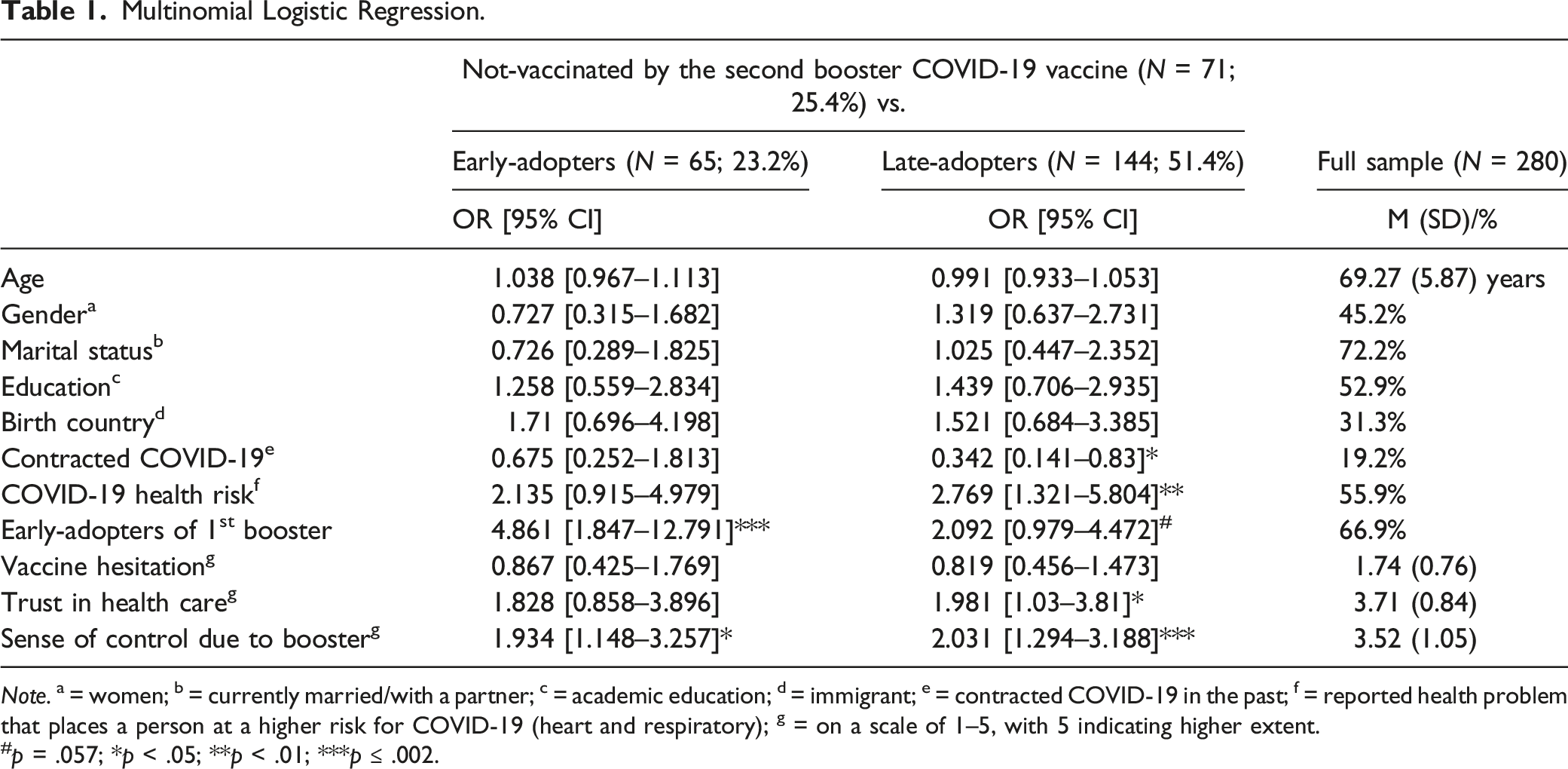
Note. a = women; b = currently married/with a partner; c = academic education; d = immigrant; e = contracted COVID-19 in the past; f = reported health problem that places a person at a higher risk for COVID-19 (heart and respiratory); g = on a scale of 1–5, with 5 indicating higher extent.
#p = .057; *p < .05; **p < .01; ***p ≤ .002.
Second Booster Vaccination Behavior
Participants were separated to three group based on their reported vaccination behavior: Early-Adopters received the second booster by T2 (23.5%); Late-Adopters received the second booster by T3 (51.2%); Non-Adopters did not receive it by T3 (25.3%).
In the statistical model, we examined how well the following factors, collected in T1, could predict second booster adoption, as collected by T3: (A) VH (α = .92, yielding one factor; Palgi et al., 2021), with nine questions, e.g., “The vaccine might be more dangerous than the disease itself”; (B) SOC_B (α = .97), with four items, for example, “Due to the availability of the COVID-19 booster vaccine, I feel more in control of my life”; (C) Trust (α = .77), with four items, for example, “I trust the Israeli health system” (Appendix A presents the full questionnaires); (D) First booster vaccination timing: early-adopters (vaccinated by T1), or not; E) Demographics and COVID-19 health status.
Results
Multinomial logistic regression compared non-adopters to the two adopter groups. The full model, as presented in Table 1, can explain about 40% of the variance, pseudo R2 (Nagelkerke) = .385. Appendix B presents subgroup averages. Appendix C replicates the analysis with 187 first booster early-adopters.
Higher SOC_B was associated with early- and late-adopters of the second booster over non-adopters (OR = 1.9 [1.15–3.26], and OR = 2.0 [1.29–3.19]; respectively, p < .05). Higher Trust was related to the difference between late- and non-adopters (OR = 2.0 [1.03–3.81], p < .05), but not to the difference between early- and non-adopters. VH, conversely, was not significantly related to either comparison. Taken together, it appears that SOC_B could distinguish adopters from non-adopters of the second booster, unlike Trust and VH. Interestingly, first booster behavior was predictive of second booster behavior. An early-adoption of the first booster was associated with second booster early-vs.-non-adoption (OR = 4.9 [1.85–12.79], p = .001) and second booster late-vs.-non-adoption (OR = 2.1 [0.98–4.47], p = .057).
Background control variables were included to control for external sources of variance. Two effects are noteworthy. (1) Contracting COVID-19 in the past was related to lower chances for second booster late-vs.-non-adoption (OR = 0.3 [0.14–0.83], p < .05). (2) Risk group membership (heart and respiratory) was related to increased chances for second booster late-vs-non-adoption (OR = 2.8 [1.32–5.80], p < .01). These two factors were not related to early-vs.-non-adopter differences, again hinting that early-adopters form a unique group.
Discussion
Booster vaccination compliance in older adults is essential to combat the COVID-19 pandemic given its effectiveness to lessen mortality and severe illness (Arbel et al., 2022). Israel presents a special case-study as it was the first country to offer second booster vaccinations to eligible Israeli older adults at no cost; and the choice when and whether to receive it was their own. Our previous study, conducted weeks into the first-booster campaign, indicated that Sense of Control due to the Booster vaccine (SOC_B), Vaccine Hesitation (VH) and Trust were associated with compliance with the first booster (Ben-David et al., 2022). In the current longitudinal study, we reached the same responders and tested the predictive value of SOC_B, VH and Trust as assessed during the first booster campaign on adoption of the second booster, seven months later. By contacting responders twice, days and months into the second booster campaign, we were able to make a time-sensitive comparison based on real-life vaccination behavior (rather than based only on intentions): early-adopters (received the second booster by day 4 of the campaign), late-adopters (received the second booster by day 75), and non-adopters (did not receive the second booster by day 75).
Findings point to the important role of SOC_B and Trust, as assessed in August 2021, in predicting second booster behavior among eligible older adults, as assessed by March 2022. Namely, a one unit increase in SOC_B (on 1–5 scale) doubled the chance for second booster (early and late) adoption-vs.-non-adoption, seven months later. Similarly, a one unit increase in Trust doubled the chance for late-vs.-non-adoption of the second booster. Interestingly, first booster early-adoption increased by five folds the chance for second booster early-adoption (vs. non-adoption); and by two folds the chance for second booster late-adoption (vs. non-adoption). In other words, Bellwethers, early-adopters of the second booster could be identified already during the first booster campaign. Clearly, they are more likely to be previous early-adopters. Importantly, they perceived higher SOC due to the booster, 7 months earlier (even when focusing only on first booster early-adopters; Appendix C). Indeed, general SOC becomes an inherent factor in older age, especially when health turns frail (Gerstorf et al., 2014). Higher SOC due to the booster can increase the sense of self-efficacy - an important factor in the initiation of health-related behavioral changes (Champion & Skinner, 2008). Perhaps this explains why SOC_B is so crucial and stable in predicting vaccination behavior in this population.
In contrast to our previous study, where VH was associated with first booster adoption, in the current study VH was not predictive of second booster adoption. This is of special interest, as older adults’ opinions about the COVID-19 vaccine’s safety and efficacy (VH) were found to be the best predictors for intention to vaccinate (Nikolovski et al., 2021). It is likely that individuals with higher VH did not eventually receive the first booster (or delayed it extensively) and thus were not eligible for the second booster by March 2022. It is also possible that the act of first booster vaccination strongly decreased VH, as it might dispel fears about post-vaccination dangers.
Regarding background variables, note that older individuals who already contracted COVID-19 were less likely to adopt the second booster. These findings echo results from our first study regarding first booster adoption. This could be related to the timing of their illness, or to their feeling that contracting COVID-19 provides a strong immunization against future infections. It is also noteworthy that older individuals who reported COVID-19 health risk were more likely to take the second booster. This stands to reason as this sub-population may feel a higher need to protect themselves from the disease. In both cases, effects were only significant when comparing late-vs.-non-adopters. Consequently, early-adopter Bellwethers may represent a unique subgroup with motivations unrelated to their COVID-19 health status.
Taken together, our results could be framed by the Health-Belief-Model (Champion & Skinner, 2008), whereby increased susceptibility (not contracted COVID-19), perceived severity (COVID-19 health risk), perceived benefits (Trust), and self-efficacy (SOC_B) are predictive of vaccine adoption.
The study has several limitations. An online panel is commonplace in aging research, but it does not fully represent older adult population, with a risk for excluding less healthy and less technologically literate individuals. Our inclusion criteria, individuals who received three doses of the vaccine, clearly limits our research, with the relatively smaller number of second booster early-adopters decreasing the statistical power to detect effects. We also have no information on the reasons for drop-out. However, to the best of our knowledge, this is the first study to delineate factors involved in COVID-19 second booster compliance, and the first to provide a longitudinal analysis across seven months for the timing of first and second booster adoption.
Finally, with possible new waves of COVID-19 and other pandemics, we suggest focusing on early-adopters of previous vaccinations, as they are more likely to become Bellwethers of new vaccinations, catalysts for their diffusion (Berwick, 2003). Vaccine campaigns could also address SOC as a positive motivator encouraging earlier vaccinations in older age. This is of special importance, as the second booster was found to be 90% effective against mortality in older age, as compared to a single-booster (McConeghy, 2022).
Supplemental Material
Supplemental Material - COVID-19 Booster Vaccination Bellwethers: Factors Predictive of Older Adults’ Adoption of the Second Booster COVID-19 Vaccine in Israel: A Longitudinal Study
Supplemental Material for COVID-19 Booster Vaccination Bellwethers: Factors Predictive of Older Adults’ Adoption of the Second Booster COVID-19 Vaccine in Israel: A Longitudinal Study by Bernadette Boaz M. Ben-David, Shoshi Keisari, Tali Regev, and Yuval Palgi in Journal of Applied Gerontology
Footnotes
Author Contributions
All authors were responsible for the concept, study design, and collection of data. BB-D conducted the statistical analysis. BB-D and SK wrote the first draft of the manuscript. TR and YP provided useful comments to the manuscript and statistical analysis. All authors approved the manuscript.
Declaration of Conflicting Interests
The authors declared no potential conflicts of interest with respect to the research, authorship, and/or publication of this article.
Funding
The authors received no financial support for the research, authorship, and/or publication of this article.
Ethical Approval
Ethical approvals were received from the Reichman University (IDC Herzliya) Institutional Review Board, IRB(P_2021138; P_2022003).
Data Availability
The full data pertinent for the current study will be available upon request.

Supplemental Material
Supplemental material for this article is available online.
References
Supplementary Material
Please find the following supplemental material available below.
For Open Access articles published under a Creative Commons License, all supplemental material carries the same license as the article it is associated with.
For non-Open Access articles published, all supplemental material carries a non-exclusive license, and permission requests for re-use of supplemental material or any part of supplemental material shall be sent directly to the copyright owner as specified in the copyright notice associated with the article.
