




Abstract
Israel became the first country to offer the booster COVID-19 vaccination. The study tested for the first time the role of sense of control (SOC) due to vaccinations, trust and vaccination hesitancy (VH), and their association with compliance to the booster COVID-19 vaccine among older adults, during the first 2 weeks of the campaign. 400 Israeli citizens (≥ 6 years old), eligible for the booster vaccine, responded online. They completed demographics, self-reports, and booster vaccination status (already vaccinated, booked-a-slot, vaccination intent, and vaccination opposers). Multinomial logistic regression was conducted with pseudo R 2 = .498. Higher SOC and lower VH were related to the difference between early and delayed vaccination (booked-a-slot, OR = 0.7 [0.49‐0.99]; 2.2 [1.32‐3.62], intent OR = 0.6 [0.42‐0.98]; 2.7 [1.52‐4.86]), as well as to rejection (OR = 0.3 [0.11‐0.89]; 8.5 [3.39‐21.16]). Increased trust was only related to the difference between early vaccinations and vaccine rejection (OR = 0.3 [0.11‐0.89]). We suggest that SOC, as well as low VH, can be used as positive motivators, encouraging earlier vaccinations in older age.
Israel was early to initiate a large-scale vaccination operation comprising two shots lifting social restrictions almost completely by mid-April 2021 (Ministry of Health, 2021). Starting July 30, 2021, following the rise of the Delta COVID-19 variant, Israel became the first country to distribute the third COVID-19 vaccine (booster), initially prioritizing adults aged 60 years or older. Booster vaccines have been offered free of charge, distributed by local health services across the country. At the beginning of the Israeli campaign, the FDA had not yet approved the booster vaccine. Thus, it was not clear who would comply with vaccination efforts, and at what pace. The aim of the current study was to understand factors associate with compliance to the third COVID-19 vaccine among older adults during the first 2 weeks of the campaign.
The current study tested for the first time the role of sense of control due to the vaccine (SOC) as related to compliance to the vaccine. SOC refers to the extent to which individuals feel they can influence events or situations in their own life. Old age is often accompanied by a decrease in SOC due to changes in many life aspects (Gerstorf et al., 2014). Indeed, biological and physical age-related changes, such as degraded hearing and vision (Ben-David & Schneider, 2009; 2018), as well as age-related social changes, such as loss of status in the labor market and loss of relatives and friends (Wrzus et al., 2013), can impair SOC. This is especially true during the COVID-19 pandemic, which has led to a rise in uncertainty, mortality, and ageism (the stereotyping of older adults, Ayalon, 2020). Control in general has been found to be related to VH and vaccine compliance (Aharon et al., 2018; Murphy et al., 2021). Higher SOC due to the vaccine might be associated with early booster vaccinations, as vaccinations can validate control over the pandemic.
Two other factors, often related to vaccine behavior, were also tested: vaccine hesitancy and trust. Vaccine hesitancy (VH) refers to the negative attitudes, reluctance, or even refusal to be vaccinated. VH is a major health threat to the global efforts to cope with COVID-19, as it directly affects vaccination compliance (Larson et al., 2014). During the first wave of COVID-19 vaccinations in Israel, VH was found to be a prominent risk factor for psychological distress, even among vaccinated individuals. Specifically, higher levels of VH were found to double the risk for depression and peritraumatic stress (Palgi et al., 2021). VH is fueled by conspiracy theories, such as a fear that vaccines are dangerous and that they serve economic and political interests (Shahbari et al., 2020). Accordingly, VH can be linked with the degree of public trust in the government, the health system, and the vaccine (Vergara et al., 2021).
Trust is another variable that plays a major role in shaping individual decisions on vaccinations during COVID-19. Trust facilitates decision-making by reducing uncertainty and perceived risk, and by increasing perceived reliability and security (Murphy et al., 2021). Specifically, trust was found to influence older adults’ vaccination decisions regarding influenza (Kwong et al., 2010). During the COVID-19 pandemic, studies suggested that older adults’ vaccine attitudes are related to trust and VH. Namely, political affiliation and information sources (related to trust) and perceived risk of the pandemic and of the vaccine (related to VH) were found to impact older adults’ vaccine inclinations (Bhagianadh & Arora, 2022; Callow & Callow, 2021). However, these studies did not test actual compliance to the COVID-19 vaccine.
The goal of the current study was to identify factors that are related with vaccine compliance among the older population. Specifically, we examined how SOC, VH, and trust are associated with the tendency to comply with the COVID-19 booster vaccine. We hypothesized that early vaccination would be associated with higher SOC and trust, and with lower levels of VH.
Method and Participants
Participants were Israeli citizens (≥ 60 years old), eligible for the booster vaccine, and recruited and compensated via the “Midgam” online panel. All responded online on August 1112, 2021, two weeks into the booster vaccination campaign, with over 720,000 booster vaccinations administered, representing more than a third of the target population (Ministry of Health, 2021). The study was published online for all Midgam panel users, 458 individuals replied and 47 individuals did not complete the survey (similar to completers in age, t (445) = .83, p = .41 and gender, χ 2 (1) = 1.10, p = .28). Of the 411 who completed the survey, 400 met the inclusion criteria (e.g., individuals who could not receive the booster vaccine due to medical reasons were removed): mean age, 69.19 years (SD = 6.1); 48.5% women, 71.5% married/with a partner, 53.0% with academic education, 32.3% immigrants, 4.5% contracted COVID-19 in the past, and 56.3% reported medical conditions related to increased risk of COVID-19 complications (heart and respiratory). Ethical approval was received from the IRB of the corresponding author’s university (P_2021138). All participants gave written informed consent.
Participants completed an online demographics questionnaire, including booster vaccination status: Vaccinated—already received the booster vaccine (60.0%), Booked-a-slot—booked booster vaccine slot (19.8%), Intent—intent for booster vaccination at a later date (12.5%), and Oppose—opposing booster vaccination all together (8.7%).
Self-reports on a scale of 1–5 included (A) a single item for self-rated health and quality of life (taken from Palgi et al., 2021); (B) VH (α = .92; taken from Palgi et al., 2021), with 11 questions, such as “the vaccine might be more dangerous than the disease itself,” “the vaccine is not necessary if one maintains a healthy lifestyle, and follows social restrictions,” and “COVID-19 vaccination policy is affected by the economic interests of pharmaceutical companies”; (C) SOC due to the vaccine (α = .97), with the following four items: “Due to the availability of the COVID-19 booster vaccine, ___” “…I feel more in control of my life,” “…I feel more secure about the future,” “…I feel more protected,” and “…I feel more hope”; (D) Trust (α = .77), with four items: “the Israeli population receives sufficient information about the third vaccine,” “I trust the Israeli health system,” “the reasons for the third vaccine campaign are ____,” and “political” [reverse item] and “medical.”
Results
Multinomial logistic regression.
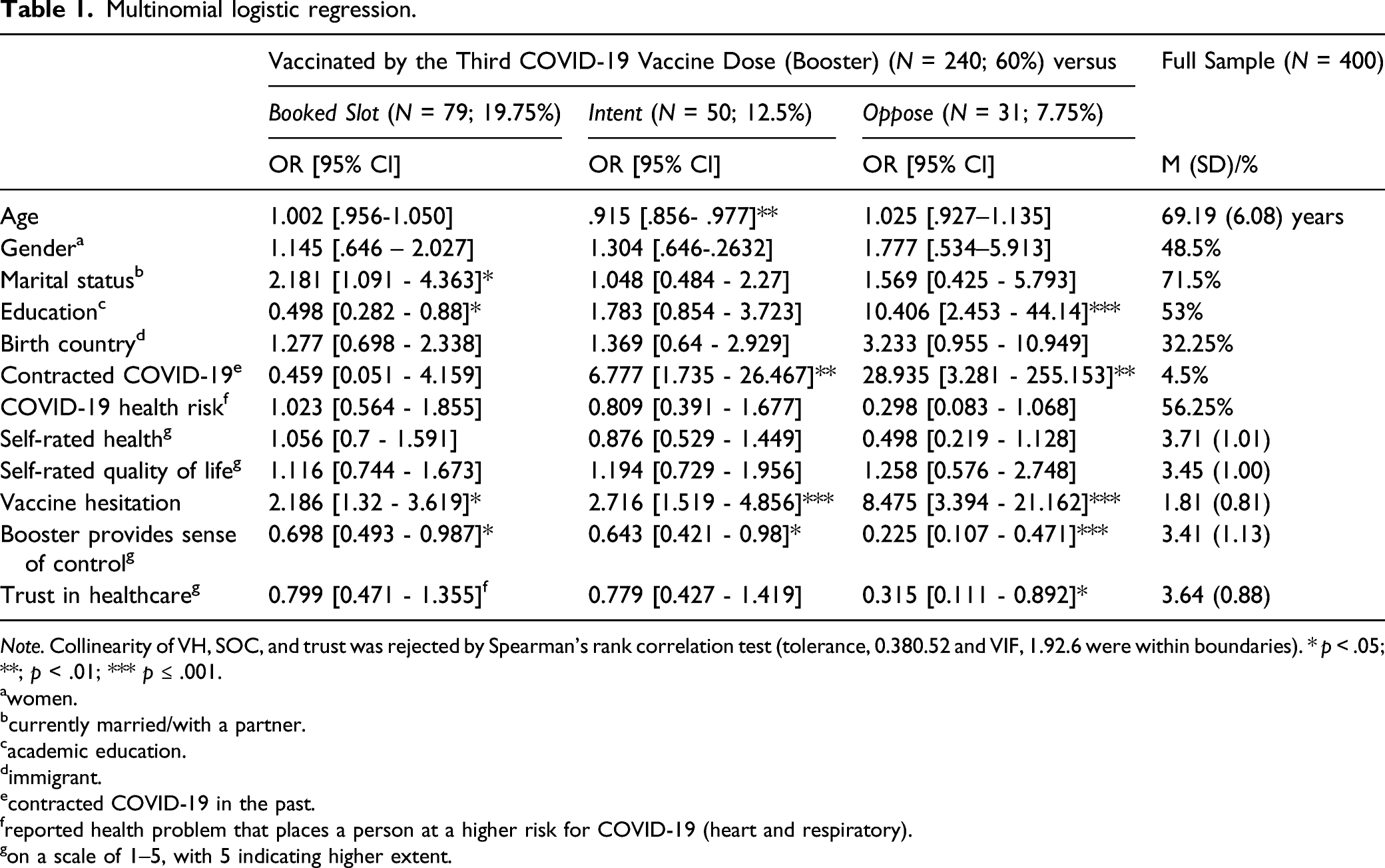
Note. Collinearity of VH, SOC, and trust was rejected by Spearman’s rank correlation test (tolerance, 0.380.52 and VIF, 1.92.6 were within boundaries). * p < .05; **; p < .01; *** p ≤ .001.
awomen.
bcurrently married/with a partner.
cacademic education.
dimmigrant.
econtracted COVID-19 in the past.
freported health problem that places a person at a higher risk for COVID-19 (heart and respiratory).
gon a scale of 1–5, with 5 indicating higher extent.
Lower VH and higher SOC were related to early booster vaccinations over booking-only groups (OR = 2.2 [1.323.62] and OR = 0.7 [0.490.99], respectively, p < .05), intent (OR = 2.7 [1.524.86], p < .001, and OR = 0.6 [0.420.98], p < .05; respectively), and oppose-vaccination (OR = 8.5 [3.3921.16] and OR = 0.2 [0.110.47]; respectively, p < .001). Higher trust was related only to the difference between vaccinated and oppose-vaccination groups (OR = 0.3 [0.11-0.89], p < .05), but not with the difference between vaccinated and booked-a-slot or intent groups. This suggests that trust was related to vaccine rejection, whereas SOC and VH could also distinguish between early vaccinated individuals and those who postpone the vaccine, but do not reject it all together. A secondary comparison found that the two vaccine-postponement groups (booking-only and intent) did not differ in either SOC, VH, or trust (OR = 1.0 [0.60–1.80], OR = 1.4 [0.71–2.60], and OR = 0.9 [0.41–1.97], respectively, p > .35 for all). This hints that the tested psychological factors were not related to the act of booking a slot.
Background control variables were included to control for external sources of variance. Two effects are noteworthy. (1) Academic education was related to double the chances for vaccinated versus booked slot status (OR = 0.5 [0.280.88], p < .05), but lower chances for vaccinated versus opposing-vaccine (OR = 10.4 [2.4544.14], p < .001). (2) Contracting COVID-19 was related to lower chances for vaccination versus intent (OR = 6.8 [1.7426.47], p < .01) and versus opposing-vaccination (OR = 29.0 [3.28255.15], p < .01). Finally, Appendix A shows that limiting the full analysis to the 256 responders aged ≥ 67 years lead to highly similar results as with the full group, with the notable exception that trust was not related to any significant group difference.
Discussion
Vaccination compliance in older adults is essential to combat the COVID-19 pandemic and lessen mortality. The current study tested factors associated with compliance with the COVID-19 booster vaccine in Israeli older adults. This study did not only compare vaccinated versus vaccine opposers, but its timing provided a unique opportunity for a comparison between early adopters and those who delayed the booster vaccine. Note, booster vaccines were offered to all eligible Israeli older adults at no cost, and the choice when and whether to receive it was their own.
Findings point to the important role of SOC and VH in vaccination behavior in older age. Namely, higher SOC and lower VH were related to the difference between early vaccinated individuals and those who delayed the vaccine or rejected it all together. Trust was an important predictor, but only of vaccine opposers. In other words, the timing of the vaccine—a crucial factor in preventing the spread of the pandemic—was related to the extent of control older adults perceived that they had, and to their belief in the efficacy and safety of the vaccine. Given the cross-sectional nature of the study, results cannot establish a hierarchical relationship between the three factors: SOC, VH, and Trust. However, it appears that SOC was better associated with vaccine behavior than trust, especially for the ≥ 67-year-old group. Recently, older adults’ opinions about the COVID-19 vaccine’s safety and efficacy (VH) were found to be the best predictors for intention to vaccinate (Nikolovski et al., 2021). Future studies should further test the possible relationships between these factors in longitudinal methods.
Furthermore, analyses cannot indicate whether differences in SOC, VH, and trust lead to early vaccination, or whether the act of vaccination engendered the differences. Note, results hint that the act of booking a slot did not yield a difference in these factors. However, it is possible that the act of vaccination has a strong effect on VH and SOC, as it might dispel conspiracy theories about post-vaccination dangers (VH) and reflect control (SOC). Future studies should further test the possible relationships between these factors in longitudinal methods.
Regarding the background variables, it is interesting to note that academic education was related both to earlier vaccination and to vaccine rejection. It is possible that older adult academics were actively seeking information about the vaccine, with extreme and opposing opinions (see also, Bhagianadh & Arora, 2022). It is also noteworthy that older individuals who already contracted COVID-19 were less likely to take the booster. Future studies may wish to focus on these two factors.
The study has several limitations. An online panel with convenience sampling is commonplace in aging research, but it does not fully represent older adult population, with a risk for excluding less healthy and less technologically literate individuals. As aforementioned, a cross-sectional study cannot lead to causation. However, to the best of our knowledge, it is the first study to delineate factors involved in COVID-19 booster vaccine compliance. Our finding suggests that vaccine campaigns should consider addressing SOC as a positive motivator encouraging earlier vaccinations in older age. Indeed, booster vaccinations could be presented as a means to “take control over the pandemic,” increasing older adults’ sense of self efficacy. SOC may also be considered in therapy, as increased uncertainty is a marker of the COVID-19 pandemic.
Footnotes
Author contributions
All researchers were responsible for the concept, study design, and collection of data. The first author conducted the statistical analysis. The first and second authors wrote the first draft of the manuscript, and the third author provided useful comments to the manuscript and statistical analysis. All authors approved the manuscript.
Declaration of Conflicting Interests
The author(s) declared no potential conflicts of interest with respect to the research, authorship, and/or publication of this article.
Funding
The author(s) received no financial support for the research, authorship, and/or publication of this article.
Ethics
The study was approved by the Reichman University (IDC, Herzliya) Institutional Review Board P_2021138.

Appendix A
Multinomial logistic regression for the subgroup of responders aged ≥ 67 years. Pseudo R2 (Nagelkerke) = .507