




Abstract
With the growing reliance on Personal Support Workers (PSWs) in health care delivery for older adults across hospital, nursing and long-term care home, and home and community (HC) sectors, understanding the PSW labor market is critical for healthcare human resource capacity to care for an aging population. This study utilizes a longitudinal, cross-provincial, individual-level dataset of PSWs in Canada from 1996–2010 to provide socio-demographic characteristics of PSWs by sector. Means, proportions, and multivariate tests of significance showed that PSWs differed significantly by care sector across many factors—including sex, health, family, and education characteristics. That HC PSWs were more likely to be older with lower health and higher disability status is important to consider when examining labor policies. Evidence of sector heterogeneity can lead to important differential effects on PSW labor supply behaviors and this research highlights the importance of tailoring initiatives aimed at recruitment and retention by sector.
Keywords
• This paper utilizes one of the few existing sources to compare PSWs across sectors and expand upon previously reported variables within a single study. • The significant sector differences across a wide range of characteristics suggests that the PSW workforce could be more accurately defined as a series of sub-markets versus an all-encompassing homogenous labor market. • The average HC PSW was more likely to be older, with worse health, living with family members who were unemployed or with a disability compared to LTC or hospital PSWs.
• Recruitment and retention initiatives should take into account both PSW characteristics overall and differences by sector, for instance, older PSWs have historically been more prevalent in the HC sector, but efforts could be made to attract younger PSWs. • Improvements to unpaid family caregiving supports are likely to affect PSW labor supply across all sectors, where childcare initiatives may be particularly relevant for LTC PSWs and disability caregiving for HC PSWs. • Policies should focus on improving PSW health, especially in HC, where PSWs had significantly higher disability status compared to other sectors.What this paper adds
Applications of study findings
Background
In recent years, changes to health care delivery in many countries have led to greater use of Personal Support Workers (PSWs). In Canada, for example, such changes include efforts to shift the site of health care delivery where possible from institutions to the home and community sector (Government of Ontario, 2012) where PSWs provide the majority of paid home care (Home Care Sector Study Corporation, 2003), changes in types of care required to deal with a higher proportion of patients of older age (Health Council of Canada, 2012) or suffering from chronic conditions (Roberts et al., 2015), and an increase in specific cost-reduction strategies such as devolving tasks to lower cost health care providers (Berta et al., 2013), amongst other factors. In part as a result of such changes, projections of PSW demand indicate a substantial increase in the need for PSW-type work in years to come in Canada (Toews, 2016), as well as in other countries including the UK (Saks & Allsop, 2007) and the US (Bercovitz et al., 2011). The COVID-19 pandemic further exacerbated pre-existing health human resource challenges for PSWs (Zagrodney et al., 2021) with unclear long-term consequences for PSW supply and those seeking PSW care. Furthermore, the increased dependence on PSWs for care delivery may vary by sector, which is often divided by hospital, nursing homes and long-term care home (LTC), and home and community (HC) sectors. However, in contrast to the literature which characterizes the increasing demand for PSWs distinguishing by sector (e.g., Home Care Sector Study Corporation, 2003), the literature which examines the supply of PSWs by sector is relatively limited (Hewko et al., 2015). This is of heightened importance with an aging population as PSWs provide care to many older adults and the appropriateness of PSW supply by sector translates to capacity to provide care to an aging population where and when they want to receive care.
In the available literature, the majority of PSW samples have been described within specific geographic regions and/or sectors—leading to major gaps in our understanding of the PSW workforce between sectors at the national level. Comparing across multiple Canada and US-based sources suggests sector differences in the demand for labor often supplied by PSWs (ESDC, 2021a; 2021b; Home Care Sector Study Corporation, 2003) and sector differences in PSW characteristics such as sex (Montgomery et al., 2005; Silver et al., 2020), age (Dill et al., 2012; Montgomery et al., 2005; Silver et al., 2020), visible minority status (Lum et al., 2015; Montgomery et al., 2005), immigrant status (Montgomery et al., 2005), marital status (Dill et al., 2012; Montgomery et al., 2005), health status (Alamgir et al., 2007), and education levels (Kelly & Bourgeault, 2015; Silver et al., 2020). However, to our knowledge, a single study that compares PSWs across hospital, LTC, and HC sectors in terms of a large array of characteristics—including the factors listed above as well as under-reported factors such as living with a family member with a disability, difficulty changing jobs due to a disability, current stress levels, and relevancy of education—on a longitudinal and nation-level is currently unavailable. Such information is useful in understanding the distinctions by sector within the PSW labor market and in the creation of effective policies that are sector-specific regarding the supply of PSWs—to better meet the sector-specific demand. For instance, the majority of older adults Canadians have indicated that they would prefer to receive care at home; yet, this is not always possible as a result of multiple factors within the current healthcare system, including current capacity limitations in the HC sector (Sinha & Nolan, 2020). Hospital, LTC, and HC sectors differ in many ways in Canada, including funding differences, where only PSWs in hospital must be publicly-funded. Any differences in PSW characteristics by sector are likely to have important implications for retention and recruitment and policies directed at PSWs would be better informed by such findings.
This research aims to fill some of the gaps in the current PSW literature by utilizing a large nationwide dataset to provide a description of PSW characteristics by sector. The main research objective was to examine whether there were significant differences by care sector (hospital, LTC, HC) in socio-demographic (sex, age, marital status, immigrant status, visible minority status), family and household (family member employment characteristics, informal caregiving), health (self-reported health status, self-reported stress level, disability status, difficulty changing jobs due to condition), education (highest education level, relatedness of education to PSW job), and experience (number of years of work experience full-year and full-time) variables for a population representative sample of Canadian PSWs. While in Canada, health care is organized at the provincial level, here, the focus is on the extent to which PSW characteristics vary by sector—so the analysis is implemented, and the results are largely reported at the national level (although there are some supplementary tests of significance by province and over time). PSW characteristics examined here are related to, and are likely to impact, labor supply behaviors such as participation, wages, and hours worked based on labor economic theory (Killingsworth, 1984), and therefore, knowledge of these characteristics is vital to the understanding of the PSW labor market; such factors are commonly reported for other labor markets in healthcare. If PSWs are historically heterogeneous by care sector, effective policies should consider that the PSW labor market likely consists of distinct sub-markets and variations can be expected in how PSWs behave and respond to policy by sector.
Methodology
Data
The Survey of Labor and Income Dynamics (SLID) was the data source used in this research. The survey collected longitudinal individual data related to labor market experiences, income, individual, and socio-demographic variables (Statistics Canada, 2013b).
Variables of interest reported in this paper for socio-demographic factors included sex, age, marital status, immigrant status, and visible minority status. Immigrant status reflects having been born outside of Canada and does not reflect years since immigration. Visible minority status was captured as belonging to Black, South Asian (Indo Pakistani), Chinese, Korean, Japanese, South East Asian, Filipino, Oceanic (Other Pacific Islanders), West Asian and North African (Arab), or Latin American (Visible Minority) groups. Family and household characteristics include family member employment status and full-time full-year employment, living with children, living with birth parents, and living with family members aged 16 or older with a disability. The SLID variable was specific to living with “birth parents,” and so we match this explicit terminology in reporting this variable. Health-related variables included disability, reported difficulty changing jobs due to disability, self-reported health status (on a 5-point Likert scale of excellent, very good, good, fair, or poor), and self-reported current stress level (on a 4-point scale of very, somewhat, not very, or not at all stressful). Disability was defined in the SLID by a series of questions including difficulty with activities of daily living (Statistics Canada, 2013a). Education and experience were captured by highest level of education, how closely related their job was to their education (on a 3-point scale of closely, somewhat, or not at all related), and number of years of work experience full-year full-time in any occupation. More information about how these variables were collected can be found in the SLID data dictionary (Statistics Canada, 2013a).
The SLID places individuals into occupational codes, from which we pulled the sample of PSWs used in this research (see the next section for more about the working sample of PSWs). The SLID collected data on groups of individuals (panels) consisting of approximately 34,000 participants per panel for 6 years. In this way, a single individual could appear for up to six consecutive years in the dataset. Panels overlap so that every year, data for approximately 68,000 participants are collected across two overlapping panels. Complete data required for the analyses here was available from 1996 to 2010. Data was used up to 2010 as this was the last year of full panel sample collection before the survey closed. The SLID was based on a sample of the Canadian population, which was selected from an area frame and based on a stratified, multi-stage design utilizing probability sampling. The survey included all provinces, but excluded residents of Yukon, Nunavut and the Northwest Territories, Indian reserves; these exclusions amounted to less than three percent of the Canadian population (Statistics Canada, 2013b). The proportions of survey respondents by province were reflective of the total national proportions by province. More information about the SLID is provided by Statistics Canada (Statistics Canada, 2013b).
Working Sample
Statistics Canada Industry Code and Description by Sector.

Weighted samples were utilized in all reported results to ensure population representativeness, as is common practice with Statistics Canada data (Statistics Canada, 2012). Weighted samples are utilized under the assumption that sampling a portion of a population allows for extrapolating findings that can be applied to the larger population group—including those who were not sampled. Statistics Canada (2012) recommends the use of longitudinal weights with SLID samples to adjust for non-response, improve population representativeness, and confidentiality of survey participants.
Statistical Methods
Descriptive statistics included frequencies, proportions, means and standard deviations. One-way ANOVA was used to assess statistical significance between each variable of interest and sector (hospital, HC, and LTC). Results were averaged over all years of data collection (1996–2010); as required by Statistics Canada to ensure that individuals cannot be identified. All analyses utilized Stata 10 software (StataCorp, 2007).
Results
Sample Size and Distribution
The working sample of PSWs utilized the weighted SLID sample (n = 2,179,400), corresponding to approximately 6000 instances where an individual worked as a PSW in their primary job in a given year. The greatest proportion of the PSW sample worked in the LTC sector (46.20%, n = 1,006,800 weighted or approximately 2700 unweighted), followed by HC (32.66%, n = 711,700 weighted or approximately 2000 unweighted), and the hospital sector (21.15%, n = 460,900 weighted or approximately 1200 unweighted). These proportions are comparable with available information on the distribution of PSWs by sector in Canada (Lum et al., 2015).
Socio-Demographic Characteristics
Means, Proportions, and Significance of PSW Characteristics by Sector.
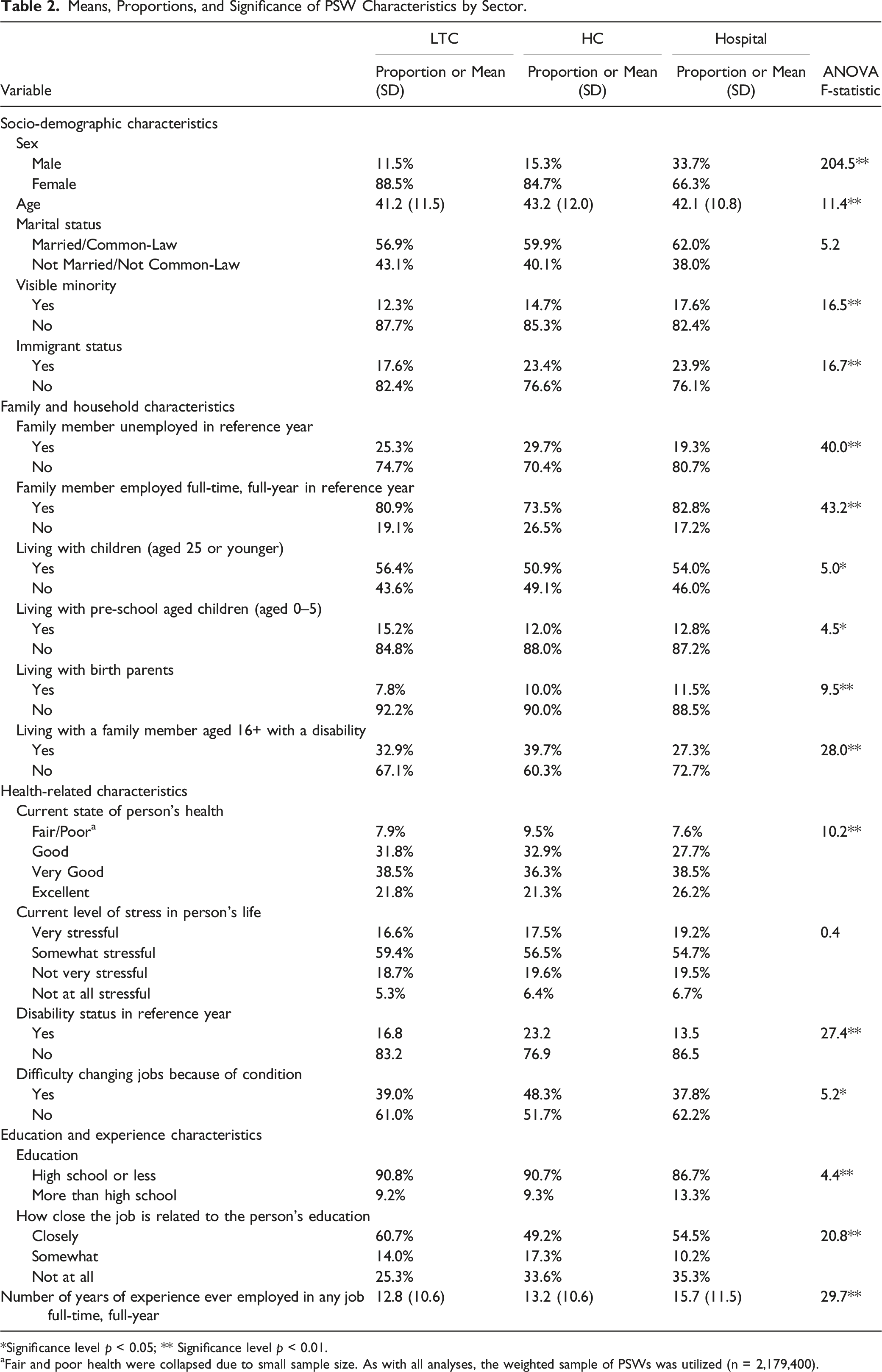
*Significance level p < 0.05; ** Significance level p < 0.01.
aFair and poor health were collapsed due to small sample size. As with all analyses, the weighted sample of PSWs was utilized (n = 2,179,400).
As proximity to retirement age is expected to influence the likelihood of continuing to work, the age of the PSW labor force is consequential to future supply. The average age of PSWs in this sample was 42.0 years (SD = 11.6). A greater proportion of PSWs were over 45 years of age (45.1%) than were under 35 (28.2%)—evidence of an older workforce. On average, PSWs working in LTC were the youngest (M = 41.2, SD = 11.5), followed by PSWs in hospitals (M = 42.1, SD = 10.8), and in HC (M = 43.2, SD = 12.0). The mean differences in age by sector were small, but statistically significant (F (2, 2179395) = 11.4, p < 0.01) suggesting that the impact of PSW retirement will vary by sector. The majority of PSWs were married or living common-law (59.0%), reflecting previous Canadian province-specific findings from Nova Scotia and Ontario (Dill et al., 2012; Zeytinoglu et al., 2016). In contrast to other findings, this sample had no differences in marital status by sector (Dill et al., 2012; Montgomery et al., 2005; Silver et al., 2020).
The proportion of immigrants in the PSW labor force (20.8%) matched well with the proportion of immigrants in the general Canadian population in 2006 (19.8%) (Statistics Canada, 2007). Supplemental analyses of our sample showed significant differences in immigration status by province and by year. There were significant differences in immigrant status by sector (F (2, 2179398) = 16.7, p < 0.01), with higher levels of immigrant status in hospitals (23.9%) and HC (23.4%) versus PSWs in LTC (17.6%).
We observed significant differences in visible minority status by sector (F (2, 2179398) = 16.5, p < 0.01). Hospital PSWs had the largest proportions of visible minority status (17.6%), followed by HC (14.7%), and LTC (12.3%) based PSWs.
Family and Household Characteristics
Approximately one-quarter (25.5%) of PSWs in our sample had one or more family members that were unemployed. Overall, hospital PSWs tended to have the lowest prevalence of unemployed family members (see Table 2); and when employed, a hospital PSW’s family member was more likely to be employed full-year and full-time (82.8%) versus the households of PSWs in LTC (80.9%) or HC (73.5%) (F (2, 2179398) = 43.2, p < 0.01).
Flags for potential informal caregiving in this study included whether or not PSWs lived with children, parents (who may or may not receive unpaid family care), or family members with a disability. Approximately one-third of PSWs (30.1%) report living with at least one family member over the age of 16 with a disability. PSWs working in HC were more likely to live with a family member with a disability and the differences by sector were significant (F (2, 2179398) = 28.0, p < 0.01). Across sectors, higher proportions of LTC PSWs lived with children and pre-school children versus HC or hospital PSWs and the differences by sector were significant (F (2, 2179398) = 5.0, p < 0.05) (F (2, 2179398) = 4.5, p < 0.05). PSWs working in hospitals were the most likely to live with their parents and differences by sector were significant (F (2, 2179398) = 9.5, p < 0.01).
Health
The majority of PSWs in this sample reported that their health was very good or good (69.1%) and most PSWs rated their current level of stress as “somewhat stressful” (57.4%). Approximately one-fifth of PSWs reported having a disability (18.2%)—more than double the proportion of employed Canadians reporting a disability in 2006 (approximately 7.86%) (Statistics Canada, 2006).
There were significant sectoral differences by self-reported health status (F (2, 2179395) = 10.2, p < 0.01), disability (F (2, 2179398) = 27.4, p < 0.01), and difficulties changing jobs due to a having a disability (F (2, 2179398) = 5.2, p < 0.05). Level of stress did not significantly differ by sector. Differences in self-rated health by sector were statistically significant but often proportionally small (see Table 2). HC PSWs were the least likely to report “Excellent” or “Very Good” health and most likely to report at the lower end of the scale with “Good,” “Fair,” or “Poor” health; the opposite is true for hospital employed PSWs. HC PSWs were the most likely to have a disability (23.2%) versus LTC (16.8%) or hospital based PSWs (13.5%). For those with a disability, difficulty changing jobs due to that disability was highest for HC PSWs (48.3%) followed by LTC (39.0%) and hospital (37.8%) PSWs. Overall, across all health variables, hospital PSWs were the healthiest, while HC PSWs were the least healthy across multiple health-related variables; Sterling et al. (2021) reported similar sector trends across other health-related variables.
Education and Experience
PSW education requirements are non-standardized across Canada; therefore, any education requirements imposed may vary by employer, sector, and/or province and even over time. The majority of PSWs’ highest level of educational attainment was above a high school diploma (65.5%). Few PSWs reported completion of a post-secondary certificate (10.1%). However, it is important to note that supplemental analyses found that PSW education significantly increased for the entire sample over time. PSWs employed in the hospital sector had the highest education levels overall compared to LTC and HC PSWs; similar to previously reported trends (Sterling et al., 2021).
Although when asked how closely they perceived their PSW job to be related to their education, most PSWs reported educational attainment closely related to PSW work (55.7%), approximately one-third reported no relation (30.1%), with the remaining reporting education as somewhat related (14.3%). This variable, “education related to their job,” was not collected prior to 2001 and reporting is therefore limited to the years 2001–2010. Reporting more information for this variable was not possible due to Statistics Canada restrictions on data reporting to ensure anonymity. How closely the PSW job-related to obtained education significantly differed by sector (p < 0.01). Although reporting higher average education levels, hospital PSWs had the highest prevalence of education “not at all related to the job” (35.3%) versus HC (33.6%) and LTC (25.3%) PSWs.
Work experience may to some degree compensate for any lack of related formal education. There were significant sectoral differences in the number of years of work experience full-year and full-time in any occupation (F (2, 2179398) = 29.7, p < 0.01)—where hospital PSWs had the highest average years of experience (M = 15.7, SD = 11.5), followed by HC (M = 13.2, SD = 10.6), and LTC PSWs (M = 12.8. SD = 10.6).
Discussion
Overall, our results provide further insight into the characteristics of the PSW workforce by utilizing one of the few existing data sources which allowed for direct comparison by sector. This paper added to existing PSW literature by reporting on living with a family member with a disability, self-reported stress, and difficulty changing jobs due to disability by sector. Such variables relate to PSW supply, and, in combination with other work, can be used to contribute towards capacity improvements for care to older adults (and others seeking care) across HC, LTC, and hospital sectors. Our results suggest that any policies—including forecasting of need—for PSWs across care sectors should be cognizant of the differing PSW characteristics by sector, which may have important differential effects on the supply of these workers by sector. In the relative absence of comparable data, this paper provides some awareness of expected PSW sector differences; however, more recent data—particularly in light of the COVID-19 pandemic—could confirm that such patterns continued in the current PSW labor market. Datasets with expanded variables would also be of value as the differences by sector may be, in part, a reflection of characteristics that are inherent to each sector, such as differences in scheduling and types of tasks that PSWs perform within each sector.
The relatively high proportions of PSWs that were female and unpaid family caregivers in this sample matched well with other findings (e.g., Alamgir et al., 2007; Dill et al., 2012) and are important for policymakers to consider. For instance, expanding beyond the historically gendered recruitment pool and creating a strong care infrastructure that supports family caregivers would be expected to benefit the PSW workforce. Although many PSWs across sectors would benefit from additional caregiving supports, HC PSWs may especially derive benefits as they had increased family and household responsibilities in terms of living with both unemployed family members and family members aged 16+ with a disability. Although LTC PSWs were further from retirement age—which is beneficial for LTC PSW supply in terms of number of PSWs retained over time—previous research indicates that younger PSWs with family caregiving responsibilities typically work less hours (Alamgir et al., 2008). Therefore, as LTC PSWs were younger and more likely to live with children, any investment in initiatives related to childcare may have the greatest impact on LTC PSWs compared to PSWs in other sectors.
The strikingly high number of PSWs with a disability status fits well with previous research (e.g., Alamgir et al., 2007) and points to the need to address the health of this workforce. Workplace injuries are a commonly reported problem for the PSW workforce (Baughman & Smith, 2012) and improved work conditions could be a future area for employers, organizations, and policymakers to focus on. When analyzing by sector, findings indicate that HC PSWs were more likely than LTC or hospital PSWs to have disability status, difficulties changing jobs due to having a disability, and lower self-rated health. As a result, the HC PSW workforce may face relatively higher labor supply challenges resulting from factors such as a higher likelihood of requiring time off from paid PSW work due to disability and a higher likelihood of facing increased barriers to upward job mobility than would PSWs in other sectors; limited career advancement opportunities have been noted throughout the HC PSW literature (Baughman & Smith, 2012). Additionally, although there is a need for employers to offer health benefits and improve workplace health and safety to decrease likelihood of injury at work for all PSWs, this may be particularly salient for HC PSWs who tend to have lower levels of health benefit coverage (e.g., 23% of HC PSWs with employer-based coverage vs. 44% in LTC and 63% in hospital (Smith & Baughman, 2007)). Higher levels of self-employment and small employer size in HC may contribute to the relatively limited benefits provided to HC PSWs (Smith & Baughman, 2007). PSWs did not report significant differences in levels of reported stress by sector; a novel finding that future studies could build upon.
Discrepancies between our findings and other reports, wherein other studies reported higher proportions of visible minority and immigrant PSWs (e.g., 15.7% in this sample vs. 42% in a 2009 Ontario HC-based survey (Lum et al., 2015; Zeytinoglu et al., 2016)), may be due to provincial differences and changes over time. Indeed, supplementary analyses found significant differences in immigrant status by province and year. Future work that can add to this discussion of immigrant PSWs would be useful as assessing the attractiveness of PSW jobs relative to the increasingly competitive global PSW labor market (Kaplan & Inguanzo, 2017) may be more relevant for supply in sectors that rely more heavily on immigrant PSWs.
An interesting and novel finding was that many PSWs reported no relation between their education and their PSW job; this has potential implications for both PSWs in terms of lower career upward mobility (Pyatt, 1966) and the ability for PSWs to cope with the demands of the job. However, as significantly higher education levels were found over time, the relevancy of education to PSW jobs may have improved over more recent years; this is an area for future work to examine further.
Obtaining education related to PSW work may be more important in the LTC sector than years of work experience or high educational attainment per se. Higher proportions of LTC PSWs reporting education closely related to their job matches well with prior LTC-specific PSW research findings (Chamberlain et al., 2019). This may reflect more stringent expectations and/or formal government policies requiring PSW college-level training to work as a publicly-funded LTC PSW within some Canadian provinces (for instance, through the Long-term Care Act (2007) in Ontario), without similar government-level legislation applied to hospital or HC sectors. The degree of match between required skills and the needs of care recipients can be expected to influence care quality and can also impact PSW labor supply outcomes (Price-Glynn & Rakovski, 2012). Differences in standard educational requirements by employers or differences in the applicability of PSW training for each sector at the time of this study may differ by sector and could have affected these results.
That full-time full-year work experience differed by sector provided further insight into PSWs work history than previously reported by sector. Work experience did not reflect age differences and was higher for hospital PSW versus other sectors, which could be expected to influence labor supply outcomes such as wages. Hospital PSWs tended to have characteristics which often correspond to better labor supply outcomes, such as a higher number of years working full-year and full-time, better health, lower likelihood of family caregiving responsibilities for children or those with a disability.
Limitations
Available PSW longitudinal, national, and cross-sectoral data is relatively limited, and the SLID was one of the few available that captured relevant PSW characteristics. However, the survey could have captured more information to provide further insight, such as education type, years of PSW working experience working, job-related tasks, and more specific job location information (e.g., employer name). Expanding the sample size of PSWs so that anonymity could be maintained while reporting across more variables and at the national, provincial, and regional level could provide more detailed insight. Reporting more detailed minority status or ethnicity variables from the SLID was not possible for this sample of PSWs, as certain groups had a sample size smaller than was allowed to be vetted by Statistics Canada rules to ensure anonymity. It would be of immense value for governments to invest in tracking this vital health workforce so that similar data from more recent years could be captured. With more recent data, we could verify that past sector differences continue to current times. Future work could report work-related factors (e.g., wages) by sector, focus on changes over time, and utilize methods like regression modeling.
Conclusion
The comparatively high proportion of women, of older age, of visible minority status, with a disability, observed in our nationally representative dataset is highly meaningful from an equity lens when considering that PSWs generally constitute a low-paid and undervalued occupation (Zagrodney & Saks, 2017). The findings presented in this paper suggest, though, that there is some heterogeneity of PSWs by sector, with a multitude of differences in terms of socio-demographic, family and household, health, education and experience characteristics. Overall, our findings provide more evidence towards significant differences in PSW characteristics by sector and generally point towards a relatively advantaged hospital PSW labor supply versus LTC or HC sectors. The implications of such sectoral differences include plausible impacts on labor supply—such as PSW labor market participation levels. For instance, as HC PSWs tend to be older with worsened health and higher disability, PSW retirement is of greater concern in the HC compared to the LTC or hospital sectors. It follows that initiatives aimed at increasing labor supply, recruitment, or retention should take the differing characteristics of the PSW workforce by sector into account and plan accordingly. It is important that PSW labor supply within each care sector matches shifts in sector-based demands as patient population needs change, particularly as PSWs represent a critical component of care for the aging population.
Research Ethics in line with Statistics Canada policy, this survey data was collected by Statistics Canada and ethics applications to use the de-identified information are not required. More information about Statistics Canada ethics policies can be found here: https://www.statcan.gc.ca/en/microdata/data-centres/faq/mitigation
Footnotes
Acknowledgments
We would like to thank the Toronto Research Data Centre (RDC) for providing access to the Statistics Canada data.
Declaration of Conflicting Interests
The author(s) declared no potential conflicts of interest with respect to the research, authorship, and/or publication of this article.
Funding
The author(s) received no financial support for the research, authorship, and/or publication of this article.
