



Abstract
Little is known about how grade 12 students with learning disabilities (LD) face the complex and emotional task of deciding what to do after high school. To expand on current research, we explored the experiences, emotions, and support of Canadian students with LD from the theoretical perspective of basic psychological needs (BPNs). We conducted a triangulation mixed-method study that included survey data and interviews. Participants were asked to identify their emotions, and if their BPNs of autonomy (e.g., feeling in control), competence (e.g., feeling capable), and relatedness (e.g., feeling connected to others) were satisfied or frustrated. Based on survey questions, participants indicated high satisfaction with their BPNs during decision-making and low levels of negative emotions. We used a deductive analysis to link participant interviews to BPNs and found greater satisfaction with these needs than frustration. Moreover, the mixed-method analysis integrating the results in a joint display uncovered that participants identified more positive emotions when their BPNs of autonomy and relatedness were satisfied, and more negative emotions when their BPNs of relatedness and competence were frustrated. We discuss the emotional experience of making decisions after high school. Limitations and future research directions are discussed.
The end of grade 12 signals the end of compulsory schooling and requires students to make important decisions about what the next stage of life will involve. Although these decisions matter to all graduates, they may be particularly challenging for students with learning disabilities (LD). Students with LD have difficult school trajectories and, although many successfully complete high school, they may be uncertain about the best ways forward (see Horowitz et al., 2017 for a comprehensive review). Students with LD who pursue postsecondary struggle to graduate with higher rates of dropping out compared to their peers (Bolt et al., 2011; Kurth & Mellard, 2006; Lipka et al., 2019). Those who chose to work following high school report higher unemployment and lower salaries than the general population (PACFOLD, 2007). Clearly, the stakes are high and, as such, students likely experience a wide range of emotions during decision-making. Understanding these emotions is important as students with LD have been found to have difficulties regulating and managing strong emotions (both positively and negatively; Elias, 2004) and emotion regulation is important for decision-making (Heilman et al., 2010).
To help this process, some students may turn to family, friends, teachers, or other school personnel for guidance and support in making decisions. Other times these same family, friends, teachers, or other school personnel may impose their perspectives on students even if they are unwanted. One approach to understanding these interactions is to focus on the type of advice sought by students or given by relevant others. However, a limitation of this approach is that it focuses on discrete ideas, rather than the complexities of how students interpret or internalize the information from these various sources. An alternative is to apply a psychological approach to understanding decision-making that can subsume discrete actions. One such psychological perspective is self-determination theory (SDT; Ryan & Deci, 2017), which posits that actions that support the basic psychological needs (BPNs) of autonomy, competence, and relatedness are beneficial for individual well-being and emotions. In contrast, actions that thwart these BPNs contribute to lower well-being, less vitality, and higher levels of depressive symptoms (Chen et al., 2015). Arguably, the BPN satisfaction or frustration related to decision-making at the end of grade 12 can facilitate or thwart well-being and emotions at this critical juncture. Thus, the purpose of the current mixed-method study was to consider connections between decision-making, BPN satisfaction, and emotions in a sample of 23 graduating students with LD.
Students With LD
Students with LD make up a broad category of individuals who can experience various difficulties associated with word reading, comprehension, spelling, written expression, number sense, and/or mathematical reasoning (see the Diagnostic and Statistical Manual of Mental Disorders [fifth edition, text revision; DSM-5-TR; American Psychiatric Association, 2022]). Moreover, these individuals can have challenges with processing speed, memory, attention, executive functions, and social perceptions or interactions (Learning Disabilities Association of Canada, 2015). Perhaps unsurprisingly, these challenges experienced by students with LD can make it very difficult for them to complete high school (Horowitz et al., 2017). Moreover, many of these students experience various emotions related to their disability such as frustration, sadness, anxiety, or embarrassment (Ehmke, 2023), and often feel stigmatized and misunderstood because of their LD by their peers or instructors (Janiga & Costenbader, 2002; Mather et al., 2020; Roussy, 2016).
While preparing for the years after high school can be complex for students broadly (e.g., Denice, 2019), students with LD have additional considerations to keep in mind. For example, they confront challenges in accessing accommodations at their postsecondary institution or workplace, having the appropriate documentation about their LD to access these accommodations, choosing to disclose their LD, and understanding their legal rights in these different situations (White & Case LLP, 2018). These additional factors can lead to confusing and overwhelming emotions for students (Madaus, 2005). As such, exploring their emotions and the environmental context in which they are making their decisions for what to do after high school is a much-needed area of research.
Theoretical Framework
Basic psychological needs is a subtheory within SDT that suggests there are three needs essential for an individual’s well-being and can be supported or frustrated by their environment, and the individuals within that setting (Ryan & Deci, 2017). The first is autonomy when the individual feels that their actions are aligned with their own choices and interests. In terms of students completing their final year of high school, they might experience autonomy satisfaction if they believe they have a choice in what they are going to do next year, or autonomy frustration if someone, such as a parent, is telling them that next year they must go on to postsecondary education (PSE), and the student feels pushed into that decision. The second BPN is relatedness when an individual feels a sense of belonging to others around them. A student might feel relatedness satisfaction when making plans with friends to take courses together at the local university or feel relatedness frustration if their friends are all going to the same postsecondary institution next year and they are not, as they might feel excluded. Lastly is competence, when one feels capable when completing activities. Students in grade 12 might experience competence satisfaction if they have chosen a postsecondary program that aligns with their skills and abilities, or they could feel competence frustration if they did not get into their desired postsecondary program because of a low grade point average (GPA).
Self-determination theory and by extension, BPNs is a well-established theory in the motivation literature (see Ryan & Deci, 2017 for review). However, research examining students with LD from a BPN lens during this high school time of transition could not be found and highlights an important area in need of investigation. Nevertheless, previous research has examined students’ plans for after high school from an SDT lens. Research by Goegan et al. (2022) examined the decision-making of grade 12 students broadly, from the theoretical framework of causality orientations theory (COT), a subtheory within SDT, to examine how the motivational orientations of autonomy, control, and impersonal impacted the students plans for after high school. Based on the open-ended survey responses, the researchers identified several factors in their decision-making that aligned with autonomous motivation (e.g., their interest in the area of study); however, the researchers also identified the subthemes of competence (e.g., picking a degree that the student excelled in at high school) and relationships (e.g., both of their parents having gone to university) under control motivation, which align with the BPNs of competence and relatedness, respectively.
A key tenant of SDT theory is that BPN satisfaction is positively associated with positive affect and negatively associated with negative affect (Chang et al., 2015; Ryan & Deci, 2000; Stanley et al., 2021). In a meta-analysis by Stanley and colleagues (2021), they investigated the association between the satisfaction of BPNs with positive and negative affect and found that higher positive affect was significantly associated with greater satisfaction of autonomy, relatedness, and competence, while the opposite was found for negative affect. While providing important information about BPN satisfaction and affect, the frustration of BPNs was not examined. The frustration of BPNs is suggested to be associated with ill-being (Bartholomew et al., 2011; Vansteenkiste & Ryan, 2013).
While at face value, it seems logical to connect the satisfaction of BPNs to positive emotions, and the frustration of BPNs to negative emotions, researchers suggest that the experiences of individuals may be more complicated than that. Indeed, Bartholomew and colleagues (2011) suggest that a low score on a measure of BPN satisfaction indicates need dissatisfaction, rather than frustration or thwarting. They go on to provide the example of “I do not feel related” versus “I feel I am rejected” (p. 1461). Moreover, research by Goegan and Daniels (2022) examining students with LD and their peers during online learning found in their regression analyses that the positive impact of relatedness satisfaction on student fatigue was overtaken by the inclusion of autonomy and competence frustration in the model. As such, examining BPN satisfaction and frustration is important within our investigation of the decision-making after high school for students with LD.
The Current Study
Deciding on plans for after high school is a complex task, filled with emotions. This may be particularly true for students with LD, who have additional challenges to consider when planning. Therefore, to better understand the satisfaction or frustration of BPNs and emotions, the research team investigated a group of grade 12 students with LD (n = 23) and examined their decision-making while making plans for after high school. Our research questions were as follows:
Method
We used a convergent triangulation mixed-method research design (see Figure 1). The purpose of convergent triangulation mixed-method designs is “to obtain different but complementary data on the same topic” (Morse, 1991, p. 122). Through an intentional integration strategy, we combined the qualitative and quantitative results to increase our confidence in the findings across the research methodologies producing a better understanding of the phenomenon under investigation (Turner et al., 2017), here being the experiences of students with LD transitioning to PSE, and the emotions they experience. As such, the data was collected sequentially and independently analyzed before the integration of the findings occurred.
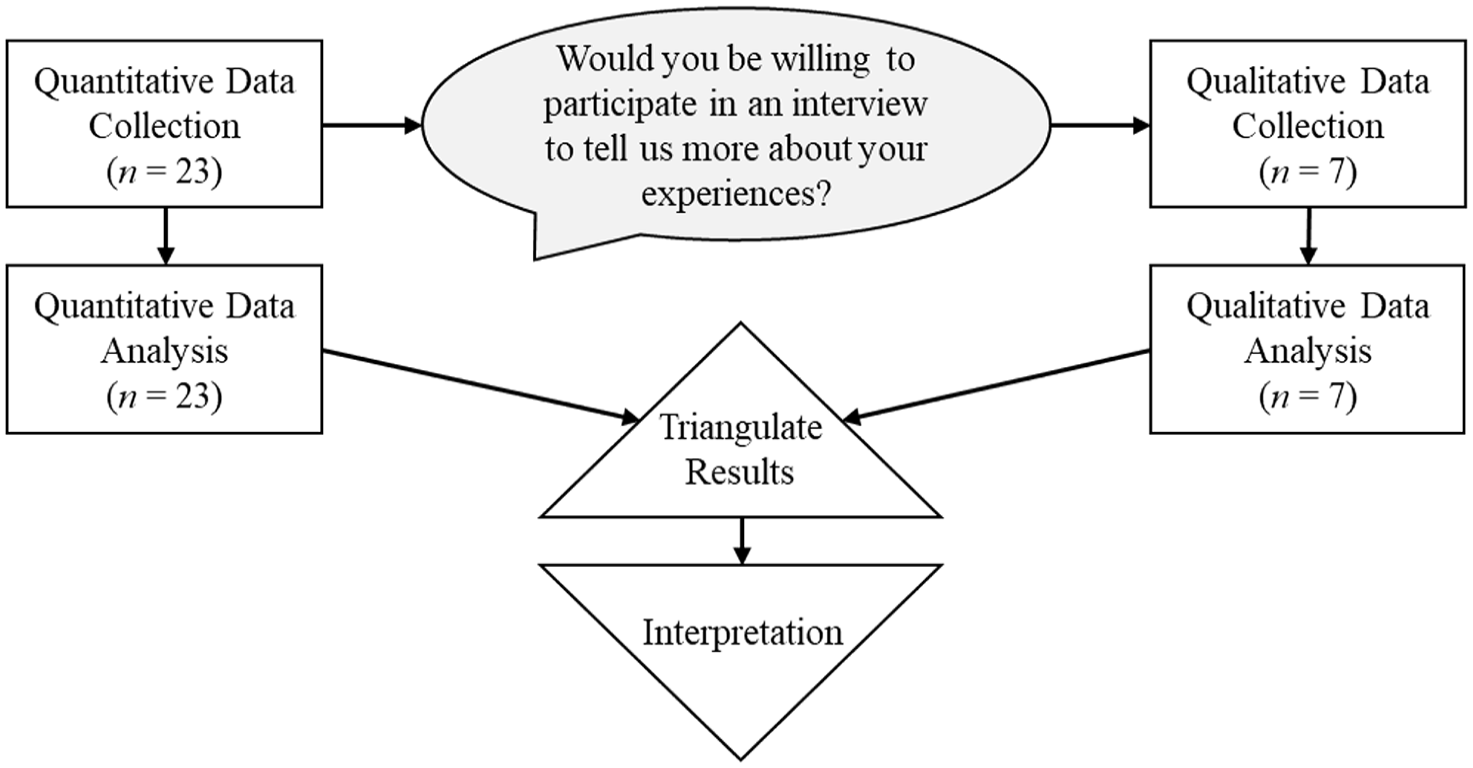
Visual Representation of Mixed-Method Design
First, we had grade 12 students complete a short questionnaire including items related to BPN and emotions and identify their interest in participating in a subsequent interview. The interviews were scheduled to take place right away to ensure participants were still in their last 2 months of high school and in the process of finalizing their decisions for what to do after high school. The study design and procedures were reviewed and approved by the research ethics review board at the researchers’ institution.
Participants
We partnered with a school specifically designed to support students in grades 3 to 12 with a formal diagnosis of LD, located in an urban city in western Canada. Learning disability status was obtained from self-identification and inferred by enrollment at the school. The school’s mission outlines its role in facilitating learning for individuals with LD while providing excellent educational programs. The school population is about 300 students with approximately 30 students in grade 12 during the year of data collection. In total, 23 students completed the questionnaire, and seven students agreed to participate in an interview about their plans for after high school. The sample was predominately male (69.6%, with 26% identifying as female, and 4.4% choosing not to disclose), and largely identified as Caucasian (87%), with the remaining participants identifying as Chinese, Latin American, or choosing not to disclose. Moreover, the participants ranged in age from 17 to 18 years old.
Descriptive Measures
We asked the students to indicate their gender, ethnicity, and age. We did not ask students to provide any additional documentation of having LD as they were already attending a school intended to support students with LD, with specific admissions criteria, including a diagnosis of LD.
Quantitative Measures
Basic Psychological Needs
We adapted Chen et al.’s (2015) scale to measure autonomy, competence, and relatedness from both satisfaction and frustration perspectives while making plans for what to do after high school, resulting in six subscales: (a) autonomy satisfaction, (b) autonomy frustration, (c) relatedness satisfaction, (d) relatedness frustration, (e) competence satisfaction, and (f) competence frustration. In particular, the prompt for the items was modified to identify the specific context for which they were to consider each item. The prompt read: As you think about your decisions for life after high school, please respond to the following items on a scale from 1 (completely untrue) to 5 (completely true). Moreover, where necessary the items were adjusted to reflect the decisions students were making more specifically. For example, an original autonomy frustration item states, “I feel pressured to do too many things” and the new item was “I feel pressured into these decisions,” and an original relatedness satisfaction item was “I feel close and connected with other people who are important to me” and was changed to “I feel close and connected with other people who are important to me when making these decisions” (italics added for emphasis). Each of the subscales consisted of four items for a total of 24 items. Scores for each subscale were created based on the sum of the four items and averaged with higher scores indicating stronger agreement.
Positive and Negative Affect Scale
We utilized the Positive and Negative Affect Scale (PANAS; Watson et al., 1988) to measure the positive and negative emotions students were experiencing related to the decision-making process for after high school plans. This measure was selected as it was the most cited affect scale in studies examining BPNs and affect in the meta-analysis by Stanley et al. (2021). The prompt for these items was modified to identify the specific context for which they were to consider each emotion. The prompt was: “To what extent have you felt this way during your decision-making process for life after high school?,” and students responded on a Likert scale from 1 (very slightly or not at all) to 5 (extremely). Students responded to 10 positive emotions (e.g., interested, excited, determined, proud, etc.) and 10 negative emotions (e.g., distressed, upset, nervous, afraid, etc.). Scores for the positive and negative emotions subscales were created by summing the 10 items and averaging them, with higher scores indicating stronger agreement.
Qualitative Measures
Students who agreed to take part in an interview met online with the first author and discussed their plans for after high school. Prior to the interviews, the research team collaboratively created a semi-structured interview protocol to guide the conversation while allowing participants substantial flexibility in sharing their experiences. This interview protocol consisted of several what and how open-ended questions to uncover the lived experiences of the students as they made decisions in their plans for what to do after high school (Smith & Osborn, 2007). The first question was “What are your plans for after high school?” We chose this question because it was broad in scope, utilizing a funneling approach where subsequent questions would be more specific (Brace, 2013). The second structured question was “How did you decide on your plans for after high school?” The final structured question was “How have you felt about the transition?” We chose to phrase the questions in terms of “felt” rather than asking about specific emotions in order to allow participants to bring a wide range of feelings into their experience without weighing whether or not the feeling was precisely an emotion (i.e., participants could talk about stress without discerning if this was precisely an emotion). To aid comprehension, these questions were designed to be short and succinct, explicitly targeting plans for after high school and the emotions of the participants. Moreover, several probing questions were created to guide the conversation (e.g., what other emotions have you been feeling? Can you tell me more about. . .?). The interview protocol is available upon request.
Procedures
An information letter was sent home to parents and guardians to inform them of the study taking place. If they wanted additional information, or to withdraw their child from participation they were able to contact the research team. Following the distribution of the information letter, the researchers and school personnel arranged a time for the students to complete the survey. Due to the COVID-19 pandemic, the project was introduced to students during school time via Zoom, and they were able to ask the researcher any questions. Students were also provided with contact information, should they have additional questions later on. A week later, the students were provided with a link to the survey during class time. Once students clicked the link, they were presented with an information letter that outlined the details of the study again. Consent was implied by the completion of the questionnaire which required approximately 5 to 10 minutes.
The questionnaire consisted of 75 questions, of which only a portion of the data is presented here. Specific to this project, participants provided demographic information and answered questions related to their plans for after high school, their BPNs, and emotions. At the end of the survey, students were asked if they were interested in participating in an interview to talk more about their plans for after high school.
Interviews were arranged online with the researchers and the school and lasted between 45 and 75 minutes. At the beginning of the interview, students were provided with another information letter and were able to ask any questions. Then students were asked verbally if they consented to participate in the interview. The interview was semi-structured in nature and focused on how students made their plans for after high school, and the emotions they were experiencing. At the beginning of the interview, students were asked, “What school has been like over the last year?” to facilitate the rapport building before the main interview questions (outlined above). At the end of the interview, participants were asked to provide any additional information they thought was important in understanding their experiences. Following the interview, participants were emailed a gift card in thanks for their time.
Rationale for Analysis
We conducted our analyses in three stages. First, we analyzed quantitative and qualitative data on BPNs separately. We examined the quantitative data by performing descriptive statistics, including reliabilities and correlations for the BPN subscales. We ran six one-sample t-tests to examine if students’ responses differed from neutral, which was a 3 on the scale. We analyzed the interviews by conducting a deductive content analysis (Nowell et al., 2017) from the students’ responses about their decisions for their post-high school plans. Together, the authors reviewed the items from the adapted Chen et al. (2015) scale to discuss the components of autonomy, competence, and relatedness from the perspective of transitioning to PSE. Next, a table was created with participants’ names in the left column and BPNs across the top row (similar to Table 1). With this table, the authors identified instances where their decision-making was associated with one of the BPNs of autonomy, competence, or relatedness, and if that BPN was satisfied or frustrated based on their comments. This allowed us to answer the first two research questions as they pertained to BPN.
Joint Display of Quantitative and Qualitative Findings Concerning Basic Psychological Needs.

Second, we turned our attention to the quantitative and qualitative data on students’ emotions. We examined the descriptive statistics including reliabilities and correlations for the emotion subscales and ran two additional one-sample t-tests to examine students’ responses again to see if they differed from neutral. Then we deductively analyzed the interviews by creating a list of significant statements to examine the participants’ emotions (Creswell, 2014). These statements included the emotions participants identified experiencing during their decision-making process for after high school, and the context the student provided for why they felt that emotion. This allowed us to answer the first two research questions as they pertained to emotions.
Third, for the convergent triangulation mixed-method analyses, we integrated the results from the separate quantitative and qualitative analyses and created a joint display. We chose to integrate the means from all the subscales in the survey with the deductively identified explanations of BPN and emotions to determine the extent of convergence. This allowed us to answer our third research question, how do the results from the quantitative and qualitative data converge?
Results
Basic Psychological Needs Satisfaction and Frustration
Quantitative Strand
The means, standard deviations, skewness, kurtosis, range, and reliabilities for each of the subscales are provided in Table 2. All subscales of Cronbach’s alphas ranged from .70 to .93 suggesting good internal consistency (Nunnally, 1978). All correlations between subscales are provided in Table 3, and we highlight several important correlations here. Basic psychological needs satisfaction subscales were positively correlated with other BPN satisfaction subscales, while BPN frustration subscales were positively correlated with one another. We performed six one-sample t-tests to examine how students’ responses on the BPN subscales differed from neutral (3). To reduce type-1 error from running multiple t-tests, we adjusted the p-value to indicate a significant difference when p ≤ .001. The results from the t-tests and Cohen’s d are presented in Table 2. For BPN satisfaction, students identified agreement with autonomy, competence, and relatedness subscales when making their decisions for plans after high school. Alternatively, for BPN frustration, students identified disagreement with relatedness frustration.
Descriptive Statistics for Quantitative Data.

Note. For the Students’ t-test, the alternative hypothesis specifies that the mean is different from 3.
p < .001.
Correlation Matrix for Quantitative Data.

p < .05. ** p < .01. *** p < .001.
Qualitative Strand
The first and second authors independently engaged in a deductive analysis of the transcripts for instances where student BPNs were being satisfied or frustrated in their decision-making for their after high school plans. Inter-rater reliability was calculated to be 86%. Disagreements were resolved through discussion or consultation with the third author. Below is a summary of the accounts of the students from an autonomy, relatedness, and competence lens. Pseudonyms have been given to each student to differentiate their comments below.
Autonomy
The participants interviewed overwhelmingly felt that they had a choice and freedom in their decisions about what to do after high school, and that these decisions reflected what they wanted. For example, Claire commented that she “fe[lt] happy with [her] choice.” Deacon reflected on his program of study for the following year mentioning “that’s what I want to do,” likewise, Gavin said, “I love computers and [name of school] has some really good computer courses, and so that was like the main thing that influenced my choice.” An important deviation to note here is Benjamin who initially mentioned “I chose education because I found that I really like working and helping kids,” but later also mentioned that “it wasn’t exactly like what I wanted to [do]. It’s just like the best choice that I should do,” suggesting some conflicting perspectives related to his sense of autonomy when it came to decisions for after high school.
Relatedness
Like above, all participants commented on feeling connected to other people when making their decisions for after high school plans. For example, Everett talked about his interactions with a teacher wherein he mentioned “looking for a school about [subject]” and the teacher started looking for options for Everett. Additionally, Fletcher remembers going to an open house for the school and he “got to meet some of the professors and like they all seemed really nice” and how that was important for his decision to attend the school in the Fall. When it came to relationships with parents, the participant’s comments aligned with satisfaction and frustration. For example, Deacon talked about how his parents were “very supportive” of his decisions, and Benjamin commented that his mom was “the main source of support” while making plans for after high school. Alternatively, Alexander mentioned that his parents “didn’t really help that much with the decision” and Gavin noted, “the only real thing that they helped me plan for was like “yeah it would be best to take a gap year.”
Competence
Overall, the students felt competent in their plans for after high school. For example, Gavin mentioned his experience working in his chosen field before: “I’ve upgraded my own computer at my house. I’ve taken an entire course on computers.” Some of the students provided statements that connected with both competence satisfaction and frustration. Alexander commented on selecting a postsecondary institution that would accommodate his learning needs, and feeling insecure about his abilities, resulting in him going to an open house to be “able to understand the process a lot more.” Benjamin also reflected on the need for accommodations, and concerns that he does not know “how successful [he would] be without support from home.” Everett also alluded to insecurities about his decisions, in that he was “not ready to move out.” Moreover, Fletcher commented on the difficulty in getting into the school he wanted, and his need to take a “gap year” so that he could “get into the [name] program.”
Triangulation of Quantitative and Qualitative Strands for BPNs
Taken together, the quantitative and qualitative analyses highlight the connection between BPNs and students’ decisions about their post-high school plans. For example, in terms of BPN satisfaction, students identified significant agreement with the autonomy, competence, and relatedness subscales and their comments from the interviews also highlighted the satisfaction of their BPNs (apart from Fletcher and competence satisfaction).
Positive and Negative Emotions
Quantitative Strand
The means, standard deviations, skewness, kurtosis, range, and reliabilities for the positive and negative emotions subscales are provided in Table 2, and correlations are provided in Table 3. Positive emotions were not significantly correlated with negative emotions; however, positive emotions were significantly positively correlated with all satisfaction subscales and negatively correlated with autonomy frustration and competence frustration. Alternatively, negative emotions were positively correlated with all frustration subscales and negatively correlated with competence satisfaction. We performed two one-sample t-tests to examine how student responses to the emotions differed from neutral (3). The results from the t-tests and Cohen’s d are presented in Table 2. Students felt fewer negative emotions but did not experience either more or fewer positive emotions (p = .12).
Qualitative Strand
The first and second authors created a “list of significant statements” to examine the participants’ emotions (Creswell, 2013, p. 193). These statements included the emotions that participants identified they were experiencing during their decision-making process for after high school. Participants identified between two and seven emotions, with each student identifying at least one positive and negative emotion. Collectively, the student identified 8 different positive emotions (confident, excited, glad, good, happy, hopeful, interested, and optimistic) and 11 unique negative emotions (anxious, confident [-], frustrated, nervous, overwhelmed, sad, scared, solemn, stressed, weird, and worried).
Triangulation of Quantitative and Qualitative Strands for Emotions
Taken together, students transitioning from high school to PSE experience a complex mix of emotions. However, when asked to identify their emotions on a scale compared to conversing about their lived experiences, students identified more negative emotions in the latter.
Convergent Triangulation Analysis: BPNs and Emotions
A joint display was created to examine the convergence of BPNs and emotions across both the quantitative and qualitative data. The BPNs are presented in the middle of Figure 2, with positive emotions on the left and negative emotions on the right. The means from the quantitative data are presented in brackets below each construct. The specific emotions identified in the figure are from the qualitative data (i.e., the interviews), presented in alphabetical order, with bold emotions also present in the PANAS subscales. Moreover, the arrows represent the connections between the emotions students identified and the associated BPN, with larger arrows identifying notably more connections made by the students. The location of the arrows was determined by cross-referencing the specific emotions students identified in their interviews, and the context they provided for those specific emotions. We utilized the significant statements generated previously for each emotion and categorized the context provided by the participants as satisfying or frustrating their BPNs while making their decisions for their after high school plans. For example, one of the participants commented “I’m excited to have more freedom.” This was identified as the emotion of excitement and connected to the satisfaction of autonomy. Qualitative results from all participants are included in the mixed analysis.
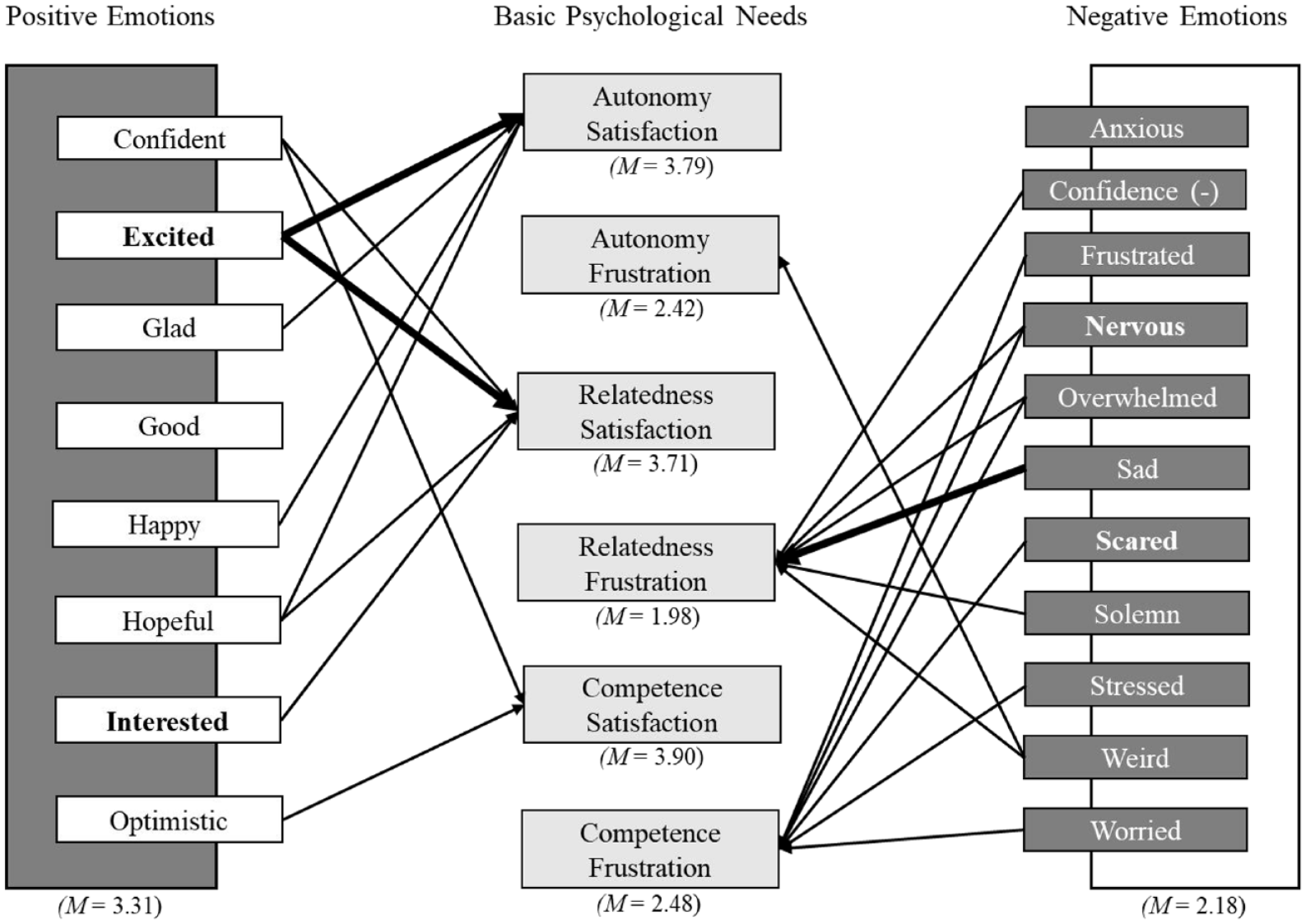
Joint Display Quantitative and Qualitative Findings Concerning BPN and Emotions
The mixed analysis resulted in three mixed insights. First, positive emotions only connect to the satisfaction of BPNs, while negative emotions only connect to the frustration of BPNs. Second, in terms of positive emotions, there are more connections to autonomy satisfaction and relatedness satisfaction components, compared to competence satisfaction. Said differently, students experience more positive emotions when their BPNs of autonomy and relatedness are satisfied in the decision-making processes after high school. Third, for the negative emotions, there are more connections to relatedness frustration and competence frustration compared to autonomy frustration. Students felt more negative emotions when their BPNs of relatedness and competence were frustrated when making their plans for after high school.
Discussion
Making decisions about what to do after high school can be an emotional experience for students broadly, and in particular for students with LD. Twenty-three grade 12 students with LD were surveyed, and seven completed interviews during the final months of their last year of high school to share their experiences and emotions during this time. The study findings highlight the various emotions experienced by these students and the importance of supporting student BPNs. In this discussion, we consider the interconnectedness between emotions and BPNs, and how to support students with LD during this important time of planning and decision-making. We highlight first, the range of emotions experienced by students, the divergence between the participant responses on the Likert scale items and the emotions they identified during their interviews, and second, the importance of supporting students’ BPNs during this time of transition, and in particular, relatedness. In closing, we discuss the implications, directions for future research, and limitations of this work.
The Emotional Experience of Making Decisions for After High School
Overall, the students who participated in this study identified several emotions as they were making plans for what to do after high school. For example, in the interviews, the students identified several positive emotions, such as excited, happy, hopeful, and optimistic, as well as various negative emotions such as anxious, nervous, scared, stressed, and worried. This stands in contrast to the findings from the Likert scale items, wherein students identified not experiencing negative emotions, and not differing from neutral on the positive emotions. We offer some possible explanations for this difference. The discrete emotions within the PANAS are different from those identified spontaneously by students during interviews. Indeed, only four of the 19 emotions identified by the students in their interviews were also presented in the PANAS Likert scale items: excited, interested, nervous, and scared. While the PANAS was designed to improve upon existing scales that were described by Watson et al. (1988) as unreliable, and having poor convergent or discriminate properties, perhaps they are not the most pertinent emotions for this specific period in an individual’s life.
In a review of the emotion literature, Weidman and colleagues (2017) identified 65 different emotions that were measured by researchers. They go on to discuss the significant overlap between the emotions included in research and suggest that “emotions are characterized in part by overlapping constellations of words, rather than unique sets of words” (p. 283). Indeed, jittery is included within the PANAS negative affect subscale, and also included within the analysis of Weidman and colleagues as a narrower component of the broader emotion of anxiety that the students here identified. As such, the level of specificity might be important to examine in future research when it comes to the emotions that students are experiencing. Nevertheless, the students are identifying several positive and negative emotions during this time, which is consistent with other researchers who identify this time of transition for students and the wide variety of emotions that can take place (Dias & Sá, 2014).
Another important finding to address is the significant one-sample t-test where students reported a significantly lower endorsement of feeling negative emotions than neutral, but also identified more negative than positive emotions in their interviews. Students identifying a considerable number of negative emotions is consistent with previous research by Moeller and colleagues (2020), who found in a nationwide survey of high school students in the United States, 75% of the self-reported feelings students identified related to school where negative, with the three most common being stressed, tired and bored. Stress was also identified by our participants as they were making plans for after high school. This finding is not surprising for students with LD, as they are at a higher risk of increased stress during the school year as well (Wilson et al., 2009).
Why students identified experiencing negative emotions during the interview, but not in the Likert scale items, might be related to a mode effect (Kiesler & Sproull, 1986; Zhang et al., 2017). Mode effects are associated with different survey methods (e.g., paper and pencil vs. online), wherein the same questions can lead to different responses based on the mode of delivery. We extend this thinking to our findings, and the questions related to emotions presented in Likert scale versus interview formats. Another potential factor for the difference could be a result of rapport built between the interviewer and the students with LD. Rapport is an essential part of the interview, and “involves trust and a respect for the interviewee and the information he or she shares” (DiCicco-Bloom, & Crabtree, 2006, p. 316). The interviewer was also a person with LD and self-disclosed to the participants before the interview which could have supported rapport building, and potentially reduced potential concerns participants may have had about potential stigma and misunderstanding of LD by the interviewer (Janiga & Costenbader, 2002; Mather et al., 2020; Roussy, 2016). As such, we would encourage where possible to have individuals with LD or who have significant knowledge about LD issues to conduct interviews to support the building of trust and respect during the interviews.
The Importance of BPNs
Basic Psychological Needs: Satisfaction
Overall students identified that their BPNs of autonomy, competence, and relatedness were being satisfied during the last few months of high school as they were making decisions for their plans for the year ahead. This was evident in both the quantitative data wherein the subscales of autonomy, relatedness, and competence satisfaction all significantly differed from neutral in a positive direction, and in the qualitative interviews where the students identified examples where their BPNs were being satisfied during this time. The only exception was Fletcher who did not report an experience that was coded as competence satisfaction. Overall, students felt like they had a choice in their plans and were interested in pursuing their chosen paths, connected with various individuals in their lives such as family, friends, and school personnel to support them, and felt capable in their decisions.
Additionally, the positive emotions identified by students were related to the satisfaction of BPNs, which is consistent with previous research (Chang et al., 2015; Ryan & Deci, 2000; Stanley et al., 2021). Extending the findings of these researchers, we found that the connection between the students’ positive emotions and the satisfaction of their BPNs was particularly strong for autonomy and relatedness satisfaction. Therefore, providing students with LD the necessary information to make an informed choice (autonomy) while also empathizing with many individuals who do not know what they want to do right out of high school (relatedness) may be important steps in supporting students during this transition. The work of Skinner and Lindstrom (2003) also highlights the importance of a support network, including parents, friends, teachers, school counselors, and other school personnel when students with LD are planning for what to do after high school.
Basic Psychological Needs: Frustration
The negative emotions experienced by students were connected to the frustration of their BPNs, which is consistent with SDT (Ryan & Deci, 2000; Ryan & Deci, 2017). Specifically, the frustration of relatedness and competence were more strongly linked to negative emotions than the frustration of autonomy. Therefore, to support students with LD during this time of transition, it is important to offer choices (as mentioned above) but ensure that those choices support students’ perceptions of competence. For example, providing students with various programs of studies at postsecondary institutions that they will likely get accepted into and thrive in, or employment that highlights their strengths and skills. Indeed, the work of Siegel and Gaylord-Ross (1991) highlights the importance of job match, that is the link between an individual’s characteristics and the demands of the job for successful employment of youths with LD.
Moreover, to reduce competence frustration while making decisions for what to do after grade 12, and perhaps support competence satisfaction, it is important to develop students’ self-efficacy skills. Self-efficacy is defined as the “beliefs in one’s capabilities to mobilize the motivation, cognitive resources, and courses of action needed to meet given situational demands” (Wood & Bandura, 1989, p. 407). Goegan and Daniels (2022) found that students with LD felt more self-efficacy when their need for competence was satisfied, while also reporting lower levels of self-efficacy than their non-LD peers. Therefore, to reduce competence frustration, it is important to ensure that the post-high school plans presented to students align with their self-beliefs in terms of their abilities to complete those academic programs or to be successful in the jobs selected. Indeed, previous research examining postsecondary programs for students with LD and ADHD has highlighted the need to include goal-setting support (e.g., Farmer et al., 2015). Moreover, coaching as a service delivery model at postsecondary institutions has also been found to support students with LD and positively impact their self-efficacy, self-awareness, self-management skills, subjective well-being, and confidence about future success (Parker & Boutelle, 2009; Richman et al., 2014). Coaching can also support the BPN of relatedness, as they would be able to connect with someone who can provide feedback and guidance while making decisions, thus making the process less isolating and disconnected.
Relatedness Is Key
We would be remised if we did not acknowledge the importance of relatedness during this time for grade 12 students. On the one hand, relatedness satisfaction had the strongest agreement from participants and was strongly connected to the positive emotions identified by the students. On the other hand, relatedness frustration was the only frustration subscale significantly different from neutral in a negative direction in the one-sample t-tests, and yet relatedness frustration was strongly connected to the negative emotions identified by the students. Taken together, considering a student’s need for relatedness during the final months of high school while students are making important decisions for what comes next is crucial and multifaceted. This is consistent with previous research, as Goegan et al. (2022) in their examination of how students make their plans for after high school, identified the theme of relationships, and acknowledged several important individuals within a student’s life as they make plans for after high school, including parents, family, friends, co-workers, teachers, and school counselors. Moreover, Goegan and Daniels (2020) found that for first-year students at postsecondary institutions, social integration was important for satisfaction, and this connection was stronger for students with LD compared to their non-LD peers.
As students transition to plans for after high school, their social support networks can change for many students, which can be difficult to adapt or find new connections (Dias & Sá, 2014). As such, we offer two recommendations for supporting students with LD as they make decisions about what to do after high school. First, when providing transition support to students, the importance of social connection cannot be ignored. Students should be encouraged to incorporate social elements into their plans that complement the academic integration needed to do well in PSE such as attending class and studying for exams. Second, it would be advantageous to look for social connections in places outside of school before the transition occurs to provide some form of consistency. This could involve joining a sports team, taking an art class, or participating in a book club. Indeed, extracurricular activities can support the development of social skills (Brooks et al., 2015). Moreover, a longitudinal research project by Palmer et al. (2017) found a statistically significant association between postsecondary degree completion for students with disabilities more broadly and extracurricular activity participation in high school.
Implications From the Research
Building on the recommendations connected to relatedness identified above, we offer three additional implications with recommendations from this research. The results from this study highlight the importance of considering both satisfaction and frustration of BPNs rather than just the satisfaction of these needs, as it provides a more nuanced understanding of the experiences of the participants. Indeed, frustration has been under-studied relative to need satisfaction (Oram et al., 2020), and we encourage future research to consider both. In terms of examining emotions and individuals with LD transitioning to PSE, future research should consider the connections and overlap between emotions rather than unique words (Weidman et al., 2017). Indeed, students identified several emotions, and the connections between positive and negative emotions with their BPNs show a significant pattern in how emotions relate to these BPNs. This pattern demonstrates the larger picture of supporting students with LD transitioning to PSE by considering their emotions and BPNs holistically. Another implication of our findings is the importance of rapport-building with participants who identify with equity-seeking populations and who might have experienced stigma and misunderstanding in the past. Where possible, we encourage researchers to reflect on who is conducting their focus groups or interviews to ensure that communication is met with trust and understanding. This could also extend to who the professionals are provided information on the transition to PSE for students and the supports available.
Limitations and Future Directions
The results of this study should be considered with reflection on three limitations. First, we recruited a sample of students with LD who were completing high school from one high school in western Canada. Moreover, this high school is specifically designed to support students with LD during their grades 3 to 12 schooling. As such, their experience might not be reflective of other grade 12 students with LD. Indeed, the students in our study had several supports in place to aid their learning and transitioning to PSE specifically designed for them, which is not present at other high schools. Although the results here connect well to previous research and theory about emotions and BPNs, future research could extend the result to other high schools to determine if similar experiences are found.
Second, although the data adequately answered the mixed-method question, both the discrete quantitative and qualitative analyses were relatively limited. From the quantitative perspective, the measurement tools are well-known with adequate reliability and validity evidence but they focus on a narrow set of constructs. Likewise, although interviews were long and participants had many things to say, the deductive analyses may have obscured some of the richness of the narrative. Despite these separate limitations, the intentional integration was able to show how the different sources converged in describing connections between decision-making, BPNs, and emotions, thereby supporting the overall design choice.
Third, the results here did not extend to the student’s experiences after high school and focused more on the plans and decisions they were making. It would be advantageous for future research to conduct a longitudinal research design to examine the satisfaction or frustration of BPNs during the first term, or first year at PSE and the connection to student emotions. Indeed, previous research has highlighted the importance of considering the satisfaction of BPNs during the first year of PSE for students broadly (e.g., Chevrier & Lannegrand, 2022; Mohamedhoesein & Crul, 2018), and more work is needed to examine students with LD in particular.
Conclusion
The purpose of this study was to consider connections between decision-making, BPNs, and emotions in a sample of 23 graduating students with LD. The results of this study demonstrate the complexity of students’ emotions during the time of transition from high school to PSE, and the satisfaction and frustration of their BPNs. Based on Likert-scale survey questions, participants indicated high satisfaction with their BPNs during the decision-making process and low levels of negative emotions. However, based on our deductive analysis, students identified more negative than positive emotions. Moreover, the mixed method analysis integrating the results in a joint display uncovered that participants identified more positive emotions when their BPNs of autonomy and relatedness were satisfied, and more negative emotions when their BPNs of relatedness and competence were frustrated. Recommendations have been provided to support the BPNs of students with LD during this time, in particular, the satisfaction of relatedness. Nevertheless, additional research is needed to further investigate the emotions and BPNs of students with LD during this time of transition to PSE.
Footnotes
Declaration of Conflicting Interests
The author(s) declared no potential conflicts of interest with respect to the research, authorship, and/or publication of this article.
Funding
This work was supported by a Social Sciences and Humanities Research Council of Canada (SSHRC) Insight Development Grant (430-2020-00560) awarded to the first and third authors.
