




Abstract
The current study investigated the effectiveness of an intensive writing intervention focusing on mathematical reasoning through written expression. A group pretest–intervention–posttest comparison experimental design was used to implement a 12-lesson intervention, delivered through a combination of Google Classroom and in-person classroom teacher support, to fifth-grade students with specific learning disabilities (n = 19). Although underpowered, our results indicated the intensive writing intervention led to all students in the intervention group (n = 11) significantly outperforming the students in the control group (n = 8) on subtraction and division word problems requiring an explanation of their solution in written form. Additionally, student treatment interviews revealed the strategy was both enjoyable and helpful in solving and explaining their word problem solutions and the teacher provided insight into potential additional scaffolds to support the most intensive students. Lessons learned and implications for research and practice are presented.
The National Council of Teachers of Mathematics emphasizes the significance of mathematical communication in learning mathematics (National Council of Teachers of Mathematics [NCTM], 2000). This involves using mathematical language and conceptual ideas to reach conclusions through logical sequences (NCTM, 2000). The Common Core State Standards in Mathematics (National Governors Association Center for Best Practices & Council of Chief State School Officers, 2010) also supports the importance of mathematical communication, advocating for students to construct viable arguments and critique others’ reasoning (p. 6). Clearly, expressive communication and mathematical discourse are valued in mathematics education.
In the last decade, the emphasis on mathematical writing has brought several benefits to students. Participating in mathematical writing activities has been linked to increased mathematical achievement (e.g., C. S. Martin, et al., 2017), better reasoning (Hughes et al., 2019; Kiuhara et al., 2020), improved problem-solving skills (Moran et al., 2014), enhanced conceptual understanding (C. L. Martin, 2015), improved attitudes toward math writing (Baxter et al., 2008), and better self-regulation during problem-solving activities (C. S. Martin et al., 2017).
Solving mathematics word problems and explaining reasoning requires an integrated approach involving reading, writing, and mathematics (Seo, 2015). Students must read the problem, extract essential information, select an efficient strategy, perform computations, and articulate their reasoning cohesively. This task combines knowledge and learning strategies from both language arts and mathematics, which are often taught separately. The challenges posed by this complex task may compound for students with learning difficulties in reading, writing, mathematics, and executive function skills. This study focuses on informative/explanatory writing, specifically addressing word problem-solving and considering student learning differences, particularly specific learning disabilities (SLD).
Considerations for Students With SLD
Students with SLD may encounter several challenges to successful task completion. The Individuals with Disabilities Education Act (2004) characterizes that a SLD may result in challenges to listening, thinking, speaking, reading, writing, spelling, or doing mathematical calculations. Students with SLD often experience difficulties with their mathematical performance (Geary, 2007). Their difficulties are often deepened by challenges encountered when reading (Willcutt et al., 2013) and writing (Soares et al., 2018). For students who experience learning with SLD in reading, educational tasks are especially taxing and difficult, especially written expression of mathematical reasoning. Given the importance of targeted and intense literacy (reading and writing) instruction for students with SLD, and the synergistic role reading and writing has on mathematics learning and performance, a logical next step is for researchers to investigate instructional scaffolds and supports necessary for students with SLD to be successful when engaged mathematical writing tasks more purposefully.
The benefits of mathematical writing for students with SLD are growing, but specific methods for supporting students with SLD writing in mathematics are underdeveloped. The typical writing activities and techniques embedded in the current core mathematics program may not be sufficient in dosage and/or comprehensiveness (e.g., Fuchs et al., 2017) to significantly improve their mathematical performance as evidenced by their continued poor performance. Without well-designed intensive interventions, the benefits of mathematical writing may go unrealized for students with SLD.
Foundational Studies in Mathematical Writing Informing the Current Study
To purposefully address the teaching needs of students with SLD, we build from previous research on writing and mathematics to bridge the fields. Results from Graham and colleagues’ (2020) meta-analysis examining the effects of writing indicated that writing had a significant impact on learning. Research suggests that strategy instruction and summarization has the greatest impact on the quality of writing (Graham & Perin, 2007). Following this guidance, we considered self-regulated strategy development (SRSD) as a comprehensive instructional strategy with the potential to adapt to the content-specific needs of mathematics. One strength of SRSD is that it teaches students how to address tasks with multiple steps or components (Harris et al., 2008). SRSD has considerable empirical support for writing achievement and has been applied to mathematics to help students work through multiple steps to solve word problems; (e.g., Kong et al., 2021). Fuchs et al. (2021) recommend deliberate instruction on word problems that includes teaching problem types, how to identify what the problem is requesting the reader to do, and developing a plan of strategies to solve the problem. These recommendations for word problems complement other recommendations to use clear and concise mathematical language and representations to support conceptual understanding (Hughes et al., 2016).
Self-Regulated Strategy Development for Mathematical Writing
A small, but growing, body of research has applied SRSD specifically to mathematical writing activities. Kiuhara et al. (2020) developed a six-lesson SRSD intervention to support students’ written expressions of mathematics arguments. Results indicated that students in the treatment group performed better on a test of fraction knowledge, through quality of mathematical reasoning, number of rhetorical elements, and total words written. In addition, students with disabilities in the treatment group demonstrated greater gains in fraction knowledge than peers with disabilities in the control group.
In our previous work, we evaluated the effects of an SRSD writing strategy on students’ expository written expressions of mathematical reasoning when provided with a word problem requiring students to solve and explain their reasoning. In a proof-of-concept study, Hughes and colleagues (2019) evaluated the effects of a six-lesson SRSD strategy on students’ mathematical writing performance (pretest–posttest). Students in the treatment group outperformed students in the control group, albeit the difference was not significant. Hughes and Lee (2020) furthered this line of inquiry by evaluating the effects of the next iteration of PRISM✓ (pretest–posttest). Students in the PRISM✓ group statistically outperformed students in the control group on quality of written expression, number of salient mathematical writing parts addressed, and length of written response. These studies yielded promising results while exposing the potential for iterative change and need for further.
For example, in a subsequent study conducted by Hughes and colleagues (accepted), teachers delivered the instruction to fourth-grade students in an inclusive setting. Students in the PRISM✓group significantly outperformed students in the comparison group on the quality of mathematical reasoning; however, post hoc analysis indicated that the strategy had a differential impact favoring students without disabilities. As special educators, these differential impacts prompted us to investigate ways to purposefully scaffold and intensify the strategy components to address the unique needs of students with disabilities, with particular attention to content literacy.
Current Study
The purpose of the current study is to continue to expand the knowledge base of effective expository mathematical writing strategies and support for students with SLDs. We replicated the study conducted by Hughes and colleagues (accepted), which included some students with SLDs, with a few marked differences in the current study: (a) we worked with a private school for students with SLD and (b) we made real-time, data-driven decisions during the intervention to intensify instruction, add scaffolded supports, or add accommodations as needed to meet the learning needs of students during strategy instruction through a formative process (Reinking & Bradley, 2008). We document all scaffolds that diverged from the base strategy to determine what additional instructional supports students with SLD may need to be successful with mathematical writing. Specifically, the following four research questions were addressed:
Method
Participants and Setting
Participants were 19 (out of 20) fifth-grade students enrolled in a private school for students with SLD in a small city in the Southwest United States that provides an intensive day-instruction program to students with SLD. The school population is relatively homogeneous in terms of socioeconomic status and racial and ethnic group membership which our sample mirrored. The 19 participating students consented to participate, fully completed the assessments, had identified SLDs as determined by their originated school district following the state guidelines in reading (n = 5), writing (n = 1), mathematics (n = 2), reading and writing (n = 7), writing and mathematics (n = 2), and reading and mathematics (n = 1), while one student was diagnosed with ADHD. All students demonstrated difficulties in mathematics by scoring below average on the school benchmark assessment, ACT Aspire. Race consisted of approximately 90% (n = 15) White, 5% (n = 1) Black, and 5% (n = 1) Asian. All participants were in the fifth grade and ranged in age from 11 to 12 years. The participant demographic data are presented in Table 1.
Demographic Information for Participants in the Study on Mathematical Reasoning Through Written Expression.
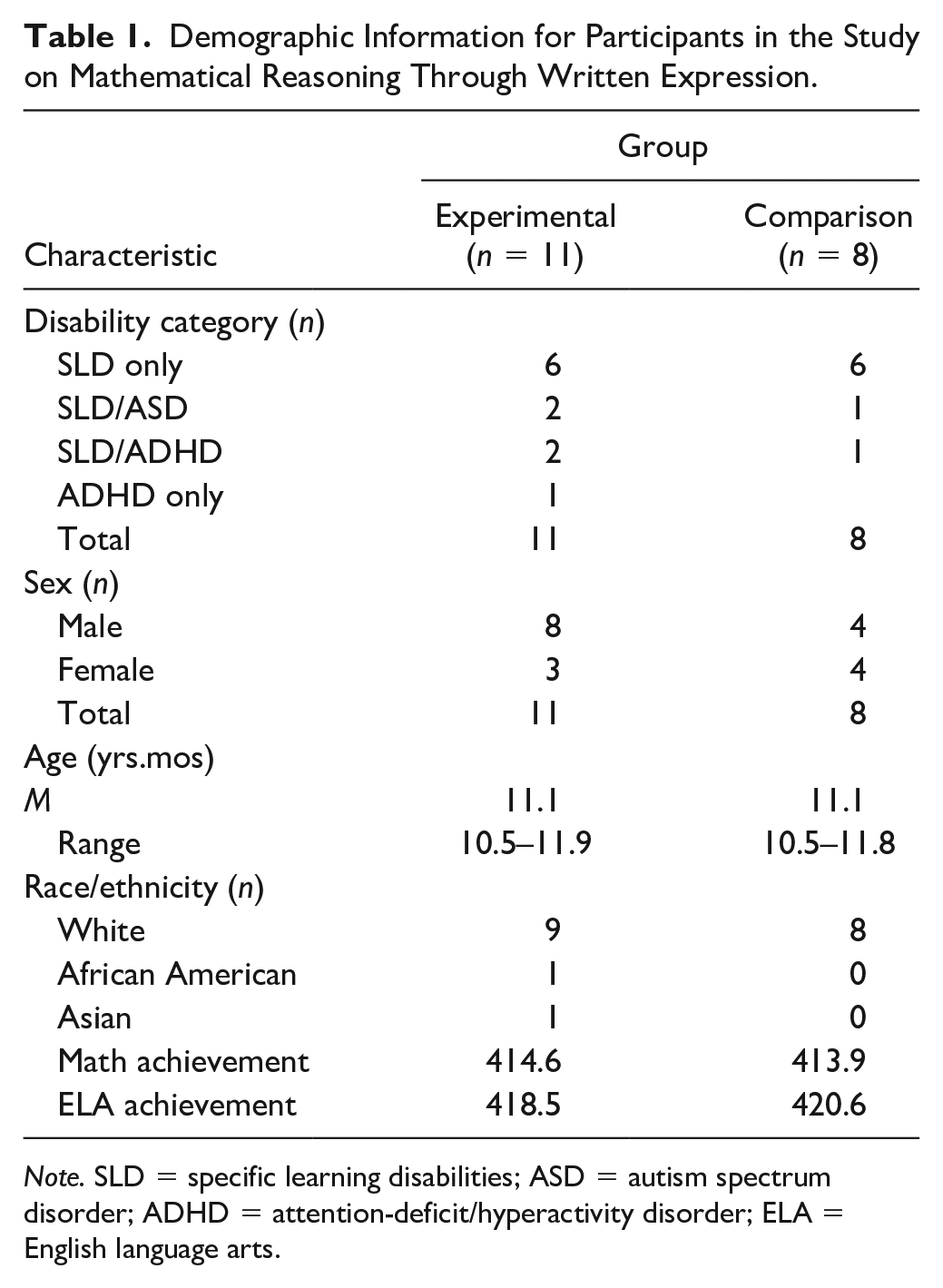
Note. SLD = specific learning disabilities; ASD = autism spectrum disorder; ADHD = attention-deficit/hyperactivity disorder; ELA = English language arts.
For this quasi-experimental group study, we first assigned the students to one of two conditions (treatment or comparison) at random and had 11 students in the treatment condition and 8 students in the comparison condition. The intervention group had three more participants due to scheduling conflicts. The two classroom teachers both meeting state requirements for teaching in a private school, both females with 5 years of teaching experience at the school, provided in-person support (non-instructional), while the intervention was delivered via Google Meets by a trained doctoral research assistant and certified special education teacher with 4 years of experience teaching special education mathematics.
Measures
Calculations
We used the Calculation test from the Woodcock-Johnson IV Tests of Achievement (WJ IV ACH; Schrank et al., 2014) to measure students’ ability to perform mathematical computations prior to the intervention (Schrank & Wendling, 2018). This test required students to calculate simple to complex mathematical facts and equations (Schrank & Wendling, 2018). The reported median internal consistency for this measure was r11=.93 (Schrank & Wendling, 2018).
Complex Computation
To evaluate students’ complex computation proficiency, we developed 20 items that required students to compute three-digit by two-digit subtraction, two-digit subtraction, two-digit by one-digit multiplication, two-digit by two-digit subtraction, and three-digit by two-digit division. We examined the internal consistency of those items, which resulted in Cronbach’s α = .773.
Word Problems
We wrote three word problems based on state-released examples of open-construction questions. We shared the word problems with participating teachers and the math coordinator to verify appropriateness, alignment with expectations, and to verify students had been taught the underlying mathematics concepts and skills prior to the study implementation. Although the problems could be solved using a variety of differing solution pathways (counting for addition and repeated addition for multiplication), the grade level expectation for students is addition, multiplication, and division solution pathways (e.g., the way students solve the problem).
The first open-response problem was a word problem that required students to use subtraction to find a solution: Sal and Ali collected shells on the beach. If Sal collected 79 shells and Ali collected 146 shells, how many more shells did Ali collect than Sal? Solve and explain your reasoning. The second problem required students to use multi-step computation involving multiplication and then subtraction to find a solution: Mary reads 20 minutes each day for 4 days. If she wants to read for 90 minutes in 5 days, how many minutes does she need to read on the 5th day? Solve and explain your reasoning. The third word problem was intended to prompt students to ideally use division to find the solution: Jim put coins into groups of 10. If he has 120 coins, how many groups of coins does he have? Show your work and explain your reasoning
We measured students’ quality of mathematics reasoning, quality of writing, and the number of mathematical writing parts at pretest and posttest, with the same problems. We used previously mastered material (e.g., below grade level) to ensure (to the best of our ability) that the students could accurately solve the equation, allowing us to better evaluate potential change in the communication of reasoning. The strategy in this study did not introduce new math concepts. For these reasons, we did not anticipate a change in calculation accuracy from pretest to posttest.
Scoring
Quality of Mathematics Reasoning
We used a researcher-created rubric with five scales (Hughes et al., in press) to quantify students’ quality of mathematics reasoning in their written responses. We scored students’ ability to (a) find critical quantities to solve the problem, (b) visualize the mathematical relationships within the context of the problem with a pictorial representation, (c) select accurate operations and build correct equations with numeric symbols, (d) reasonably describe why the operations were chosen, and (e) derive an accurate answer (Lepak et al., 2018). Each scale ranged from 0 to 2. We assigned 1 point to the students’ responses that were partially incorrect or illogical in the process of mathematical reasoning. For example, their responses earned 1 point if they (a) failed to find all critical quantities but found partial information from the problem statement, (b) visualized a partial, but accurate, relation of the quantities they found, (c) selected accurate operations for the equation(s), but wrote the quantities in an inaccurate order, (d) omitted any step of the problem-solving procedure, or (e) made a minor mistake in mathematical computation (Hughes et al., in press).
To ensure content validity for the scales, we conducted a survey with a panel of experts consisting of two mathematics teachers, two language art teachers, and a math education researcher. The results allowed us to evaluate the appropriateness of the scales in assessing students’ mathematical writing performance. The content validity ratio (CVR) ranged from 0.60 to 1.00. For the construct validity check, we previously conducted a confirmatory factor analysis (CFA) with a larger sample of 153, fourth-grade students from an elementary school in a mid-Atlantic region (Hughes et al., in press), using robust weighted least squares (WLSMV) estimation. The fit indices were as follows: for the first subtraction problem, χ2(5) = 1.548, p = .907; CFI = 1.000; TLI = 1.000; RMSEA = 0; SRSM = .019; for the second multi-step computation problem, χ2(5) = 10.446, p = .063; CFI = .993; TLI = .986; RMSEA = .064; SRSM = .030; and for the third division problem, χ2(5) = 22.175, p < .001; CFI = .919; TLI = .931; RMSEA = .064; SRSM = .055.
Quality of Writing
We utilized a research-created rubric with five scales to score students’ quality of writing. From students’ written responses to the three word problems, the writing scales scored students’ ability to (a) maintain a single apparent and consistent point about a main topic; (b) include sufficient content with elaboration and explanation; (c) organize the content in a logical sequence with appropriate transitions; (d) show accurate knowledge of grammar, spelling, and sentence structures (Deatline-Buchman & Jitendra, 2006); and (e) use appropriate mathematical vocabulary (Powell et al., 2017). Each scale ranged from 0 to 2. Students earned 1 point when they (a) included any off-topic sentence but showed evidence of overall understanding of the writing task, (b) well-generated the content but omitted critical information as the task required, (c) partially included inappropriate transitions that may cause lack of cohesion in the text, (d) used one or two inaccurate math vocabulary terms, or (e) included one or two grammatical errors that did not deteriorate overall comprehensibility of the text (Hughes et al., in press).
The CVRs for all five scales were 1.00. With the same sample as the scales of the mathematics reasoning, the CFA with WLSMV estimation resulted in the following: for the subtraction problem, χ2(5) = 9.485, p = .091; CFI = .986; TLI = .972; RMSEA = .067; SRSM = .022; for the multi-step computation problem, χ2(5) = 28.320, p < .001; CFI = .986; TLI = .971; RMSEA = .075; SRSM = .062; and for the division problem, χ2(5) = 16.476, p = .006; CFI = .988; TLI = .975; RMSEA = .052; SRSM = .045 for the division problem.
Number of Mathematical Writing Parts
We counted the number of mathematical writing parts that were included in students’ written responses. The PRISM✓ strategy encouraged students to write a response that included a total of eight parts that supported their mathematical writing: (a) highlighted or underlined critical numbers on the problem statement, (b) representation(s) to visualize the relationship between/among the quantities, (c) equation(s), (d) restatement(s) of the problem, (e) statement(s) of the problem-solving procedures, (f) statement(s) of the reason for selecting the methodology to solve the problem, (g) provision for the right answer, and (h) confirmation on the computation(s). Each part was scored as 1 and students earned 1 point when their response included a functional part.
Reliability
A graduate student who was not involved in this study was trained by the third author before scoring. At the completion of the training, the graduate student consistently demonstrated scoring reliability greater than 90% when compared with the previous studies’ scores. The graduate student scored more than 36% of the student responses (n = 7) to calculate the percentage of interrater agreement. The scores among the two raters reached 93.8% of agreement across the pre- and posttests.
Procedures
Interventionist and In-Class Teacher Training
The interventionist and in-class teacher support training consisted of viewing short professional development videos for each scripted lesson. Each video was approximately 2 to 4 min, provided a lesson overview, highlighted the most important parts of the lessons, and addressed potential challenges for students in the lessons. The interventionists and in-class support teachers were given scripts and sample student workbooks at the time of the training. The materials included a student workbook with answers and potential responses and was followed for the delivery of the intervention. Additionally, interventionists and support teachers re-watched the short videos again within the 24 hours prior to implementing intervention lessons.
Intervention
The intervention was delivered virtually, via Google Meets, by the interventionist during a 50-minute intervention class period for English language arts (ELA). This time was agreed upon because school administrators determined it would be less disruptive to the school schedule because all students were already in the ELA intervention class. Both classes, led in-person by the classroom teachers in separate rooms, joined the virtual classroom. One class consisted of five students and the other class consisted of 6 students. The intervention was delivered across 7 weeks (28 school days) during the months of April and May. In all intervention lessons, the interventionist led the lesson by introducing lesson objectives, modeling the correct use of the strategy to solve problems, and discussing positive self-statements and writing goals. The classroom teachers provided some additional support but mostly did behavior management such as making sure students were on the correct page and had pencils. We would have expected the interventionists to do these routine teacher behaviors if the intervention was delivered in person.
The intervention was designed to teach students a framework for responding to mathematical questions requiring a written explanation. There were 12, 45- to 60-min lessons designed on the SRSD writing instructional procedures (e.g., Harris et al., 2008) and incorporating evidence-based practices (Hughes et al., 2019) to support students’ written explanations. All lessons included an advanced organizer, goal setting, review of prior lesson big ideas, teacher modeling, and meaningful guided and independent practice opportunities (e.g., Archer & Hughes, 2011). Similar to SRSD strategy instruction described by Harris et al. (2008), lesson instruction affords the option to teach lessons across multiple days and with flexibility as needed. As such, the PRISM✓ strategy included 12 structured lessons with a semi-structured script and corresponding student workbook (see Note 1). The first two lessons, in which the strategy was introduced, were delivered in three class periods. Lessons 4 through 9, in which students practiced the individual parts of the strategy, took two to four class periods per lesson to complete. The final three lessons, in which students practiced using the complete strategy either independent or with a peer, took three class periods per lesson.
Intervention lessons followed elements of explicit instruction. Each lesson started with an advanced organizer to assess relevant prerequisite skills, inform students of lesson objectives, set individual student goals, and identify a rationale for the lesson. Next, a demonstration of the strategy part was presented through teacher modeling and think-aloud. Following the model, students engaged in multiple guided practice opportunities while the teacher gradually withdrew support as students’ competence improved. Finally, students engaged in independent practice opportunities.
The pace of instruction in these lessons was slower due to the more complex nature of the content and the challenges inherent to remote learning for school-age children, such as audio and video delays. Lesson 7 took four class periods to complete. During the last day of instruction for Lesson 7, students began using an interventionist-created bank of common vocabulary and sentence starters. This aid was printed and placed on students’ desks. In subsequent Lessons 8 through 12, the interventionist encouraged students to use this aid when they began independent practice. We will share the scripted teacher book and student book upon request.
Comparison
Students in both conditions received core mathematics instruction using the school-adopted fifth-grade curriculum. During the study, core mathematics instruction did include some opportunities for mathematical writing practice, but it only included general guidance that stated: Read the problem, draw a picture, determine the questions, solve, explain, and check your work. We recognize that growth and improvement in math writing may happen with repeated exposure and practice (e.g., C. S. Martin, et al., 2017). To address this, students in the comparison group (n = 8) engaged in three mathematics writing days. On these days, students were given two open-response word problems and asked to solve and explain. We selected three days because that aligned with the number of intervention days that the intervention students are engaged with full math writing practice. We used open-response word problems from the intervention student journals to align exposure to the same types of problems. This also allowed students in the comparison group to be familiar with the structure and format of the word problems assessment. Students’ math writing practices were collected at the end of each class. They were not reviewed by the teacher, and no feedback was provided to the students.
Data Analyses
We utilized one-way mixed analysis of variance to examine the effects of the intervention on the quality of mathematics reasoning, the quality of writing, and the number of mathematical writing parts. If there were no main effects for time (i.e., pretest vs. posttest) or group (i.e., treatment vs. control groups), we conducted a one-way ANOVA with repeated measures or a one-way ANOVA between participants to examine whether there was a significant change over time or between groups. For effect sizes, we imputed Hedges’ g, considering the small sample bias (What Works Clearinghouse, 2022). We used SPSS version 27 for all data analyses.
Fidelity of Treatment and Comparison Instruction
Fidelity for the intervention and comparison groups was measured at two levels using a researcher-created checklist tailored to each of the 12 lessons. The checklist items varied based on the lesson, but they generally related to the introduction of the lesson and stated purpose, teacher modeling, student goal setting, adherence to lesson script, guided and independent practice opportunities, and other specific lesson activities (e.g., partner practice). First, researchers directly observed 25% of sessions from both the comparison and treatment group sessions via Google Classroom to be assessed for fidelity. The first author and the school administrator independently assessed the fidelity of both comparison and treatment groups using the fidelity checklist for direct observations. The checklists required present/not present responses for each key feature of the intervention and group sessions. Point-by-point interrater reliability across lesson elements was 95% (90% for intervention lessons and 100% for comparison mathematical writing practice sessions). Both the treatment and the comparison groups’ fidelity were rated as high for lesson elements observed across all sessions rated as “present.” The second level of fidelity involved the comparison and treatment teachers completing the same fidelity checklist for each session; it indicated 100% of lesson elements were completed. There is sufficient fidelity data demonstrating strong evidence that both the treatment and the comparison sessions were implemented as designed for the duration of the study.
Student Interviews
Immediately following the completion of the posttest, students were interviewed separately by the primary researcher, who audio-recorded their responses and transcribed them verbatim in a Word document. Their responses provide insight into the social validity of the strategy. The interview protocol consisted of six questions/prompts:
What part of the PRISM✓ strategy did you like the most?
And why is that so?
What part of the PRISM✓ strategy did you like the least?
And why is that so?
Explain how the PRISM✓ strategy helped you the most?
Do you think you will continue to use the PRISM✓ strategy next year?
After each student’s response was recorded, students were asked if there was anything else they wanted to add. If they said no, the interview was ended. In general, the interviews lasted from 5 to 8 min. After the interview audio-recordings were transcribed, we summarized the student responses.
Results
Results are organized by research questions. Results regarding the quality of mathematics reasoning, quality of writing, number of mathematical parts, student interview themes, and teacher observations follow sequentially.
Quality of Mathematics Reasoning
To investigate the effects of the PRISM✓ strategy instruction on students’ quality of mathematics reasoning, a one-way mixed ANOVA was conducted to examine the main effects for time, group, and the interaction between time and group. For the subtraction word problem, the results indicated that there was no significant main effect for time, F(1, 17) = 0.375, p = .548, partial η2 = .022. However, there was a significant main effect for group, F(1, 17) = 20,084, p < .001, partial η2 = .915, and time by group, F(1, 17) = 10.392, p = .004, partial η2 = .391. The effect size was g = 2.169, SE = 0.566. Regarding the nonsignificant main effect for time on the quality of mathematical reasoning, we conducted a one-way ANOVA with repeated measures to check if there was any significant difference from pretest to posttest for the two separate groups. The results revealed that there was a significant change over time for the treatment group, F(1, 10) = 12.576, p = .005, partial η2 = .577, while students in the control group did not show any progress in the quality of mathematical reasoning after the intervention, F(1, 7) = 2.250, p = .177, partial η2 = .243.
For the multi-step computation word problem, the analysis resulted in a significant main effect for time, F(1, 17) = 15.333, p = .001, partial η2 = .474; group, F(1, 17) = 17.355, p < .001, partial η2 = .505; and time by group, F(1, 17) = 17.281, p < .001, partial η2 = .504. The effect size for the multi-step computation problem was g = 2.339, SE = 0.584. For the division problem, there was a significant main effect for time, F(1, 17) = 9.070, p = .008, partial η2 = .348; group, F(1, 17) = 6.797, p = .018, partial η2 = .286; and time by group, F(1, 17) = 21.626, p < .001, partial η2 = .560. The effect size was g = 2.018, SE = 0.551. The descriptive statistics for the average pretest and posttest scores of students in each group are reported in Table 2, while Figure 1 visualizes the interaction between group and time.
Means and Standard Deviations for Pretest and Posttest Scores.
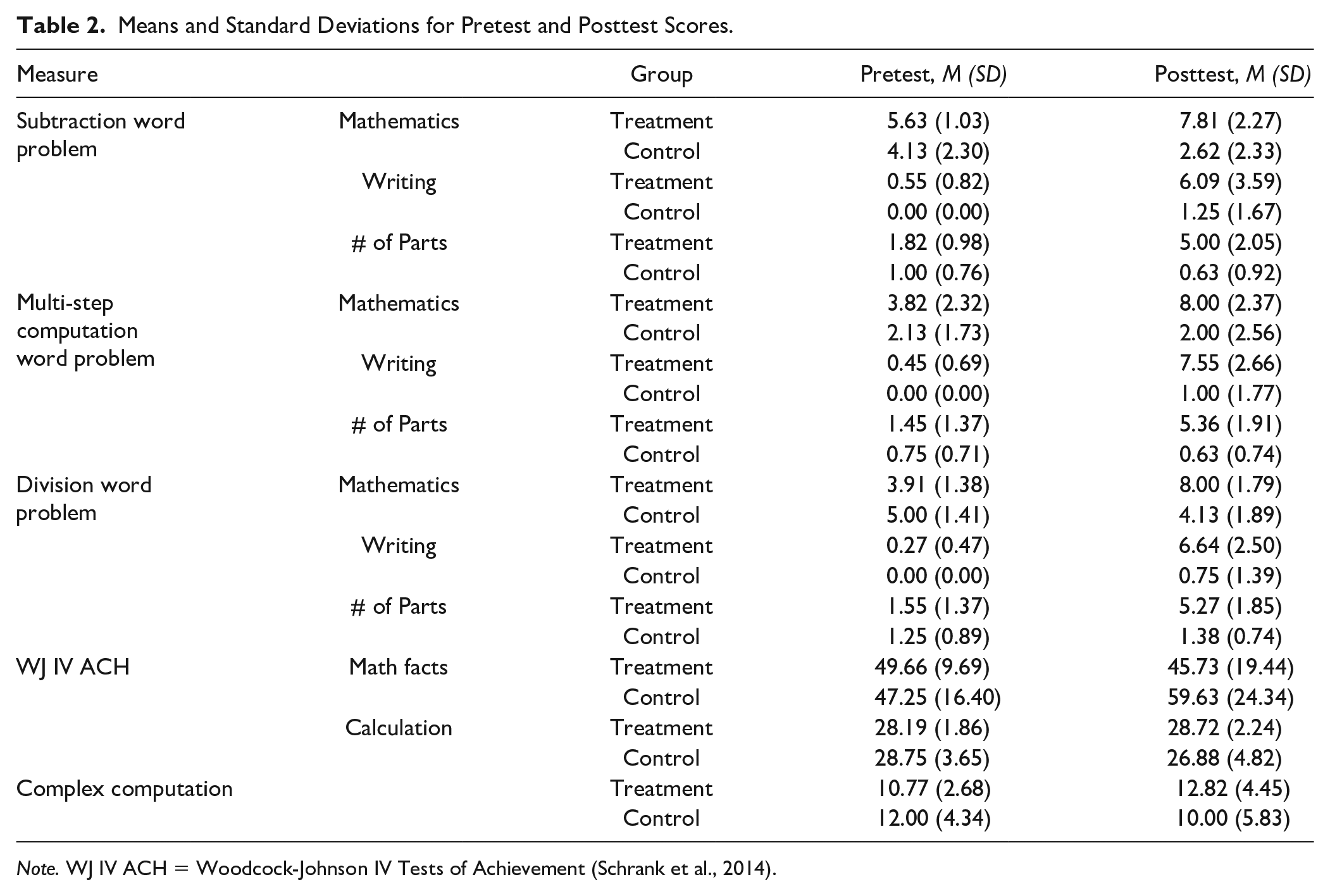
Note. WJ IV ACH = Woodcock-Johnson IV Tests of Achievement (Schrank et al., 2014).
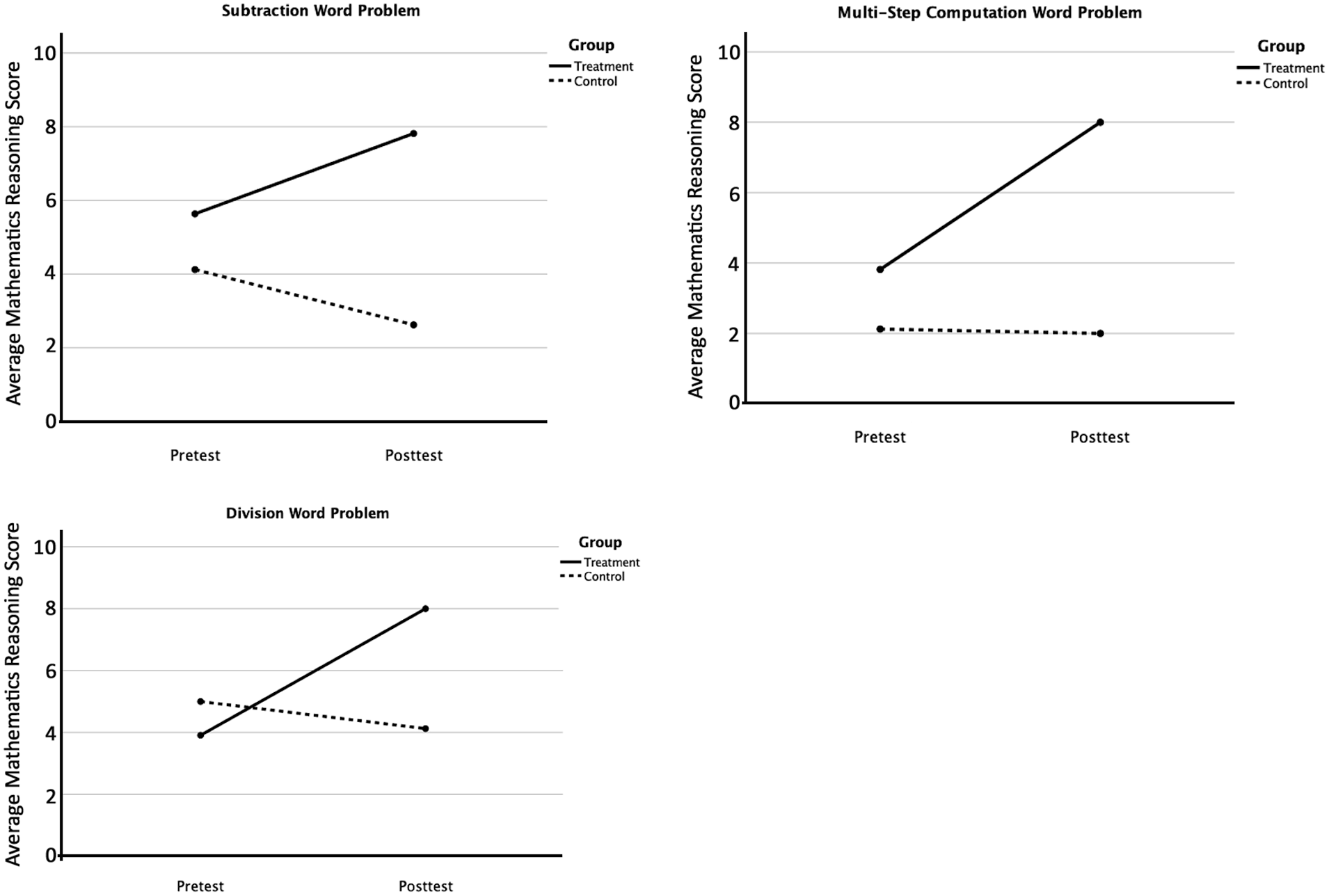
Intervention Effects on the Quality of Mathematics Reasoning.
Quality of Writing
For the subtraction word problem, the results of the one-way mixed ANOVA revealed a significant main effect for time, F(1, 17) = 27.498 p < .001, partial η2 = .618; group, F(1, 17) = 12.830, p = .002, partial η2 = .430; and time by group, F(1, 17) = 10.987, p = .004, partial η2 = .393. The effect size was g = 1.565, SE = 0.511. For the multi-step computation word problem, the ANOVA also resulted in a significant main effect for time, F(1, 17) = 57.973, p < .001, partial η2 = .773; group, F(1, 17) = 36.397, p < .001, partial η2 = .682; and time by group, F(1, 17) = 32.855, p < .001, partial η2 = .659. The effect size was g = 2.680, SE = 0.621. For the division problem, the results indicated that there was a significant main effect for time, F(1, 17) = 55.304, p < .001, partial η2 = .765; group, F(1, 17) = 35.385, p < .001, partial η2 = .675; and interaction between time and group, F(1, 17) = 34.440, p < .001, partial η2 = .670. The effect size was g = 2.661, SE = 0.619. The descriptive statistics in Table 2 and Figure 2 exhibit the interaction effects between time and groups.
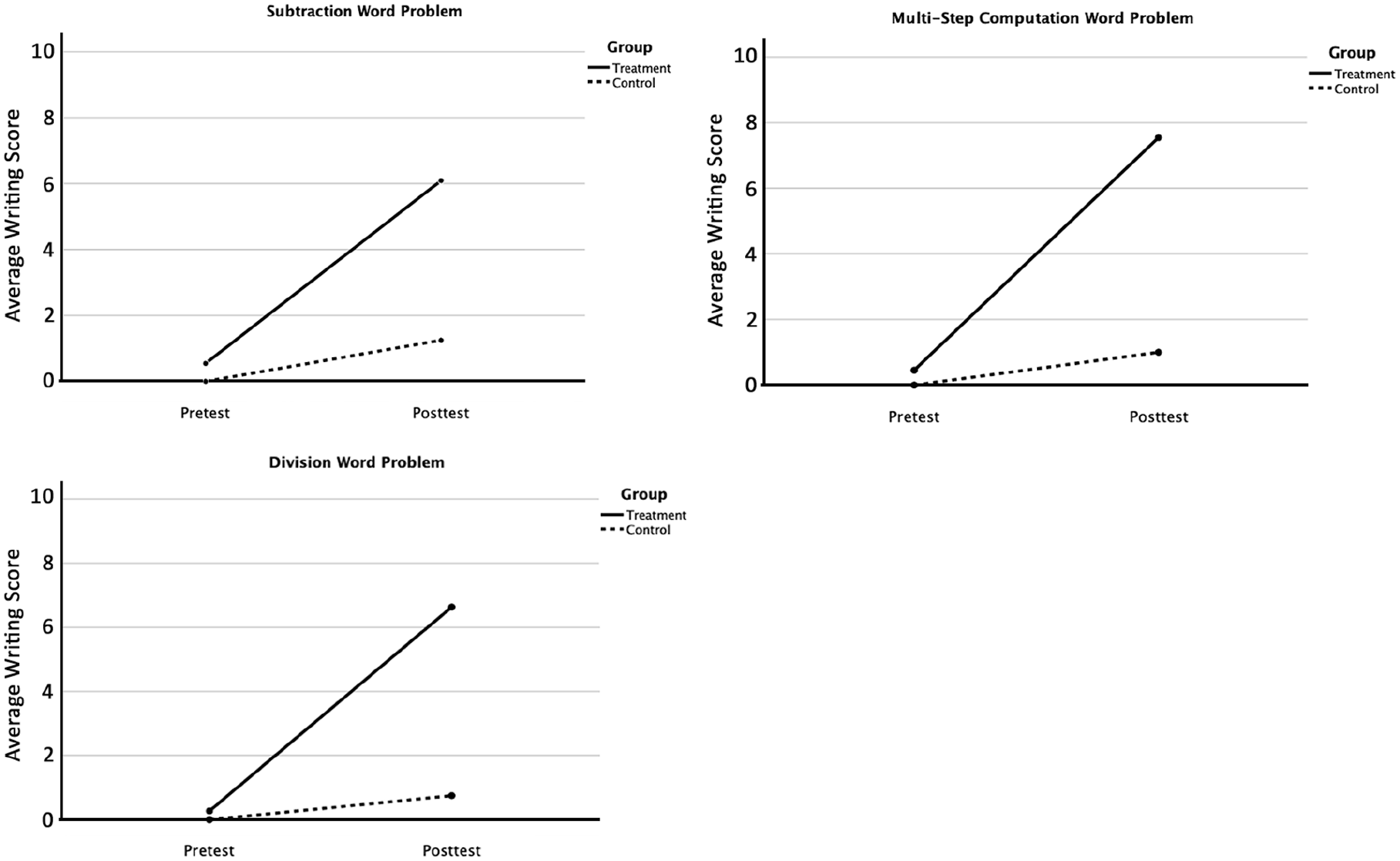
Intervention Effects on the Quality of Writing.
Number of Mathematical Writing Parts
For the subtraction problem, the one-way mixed ANOVA on the number of mathematical writing parts revealed a significant main effect for time, F(1, 17) = 17.468, p < .001, partial η2 = .507; group, F(1, 17) = 24.265, p < .001, partial η2 = .588; and interaction between time and group, F(1, 17) = 28.050, p < .001, partial η2 = .623. The effect size was g = 2.486, SE = 0.600. For the multi-step computation word problem, the analysis resulted in a significant main effect for time, F(1, 17) = 24.626, p < .001, partial η2 = .592; group, F(1, 17) = 29.340, p < .001, partial η2 = .633; and time by group, F(1, 17) = 27.987, p < .001, partial η2 = .622. The effect size was g = 2.934, SE = 0.651. For the division word problem, the results also indicated that there was a significant main effect for time, F(1, 17) = 21.223, p < .001, partial η2 = .555; group, F(1, 17) = 19.916, p < .001, partial η2 = .539; and interaction between time and group, F(1, 17) = 18.558, p < .001, partial η2 = .522. The effect size was g = 2.483, SE = 0.599. The descriptive statistics for the number of writing parts are presented in Table 2, and Figure 3 provides a visual of the interaction effects between time and groups for the number of mathematical writing parts.
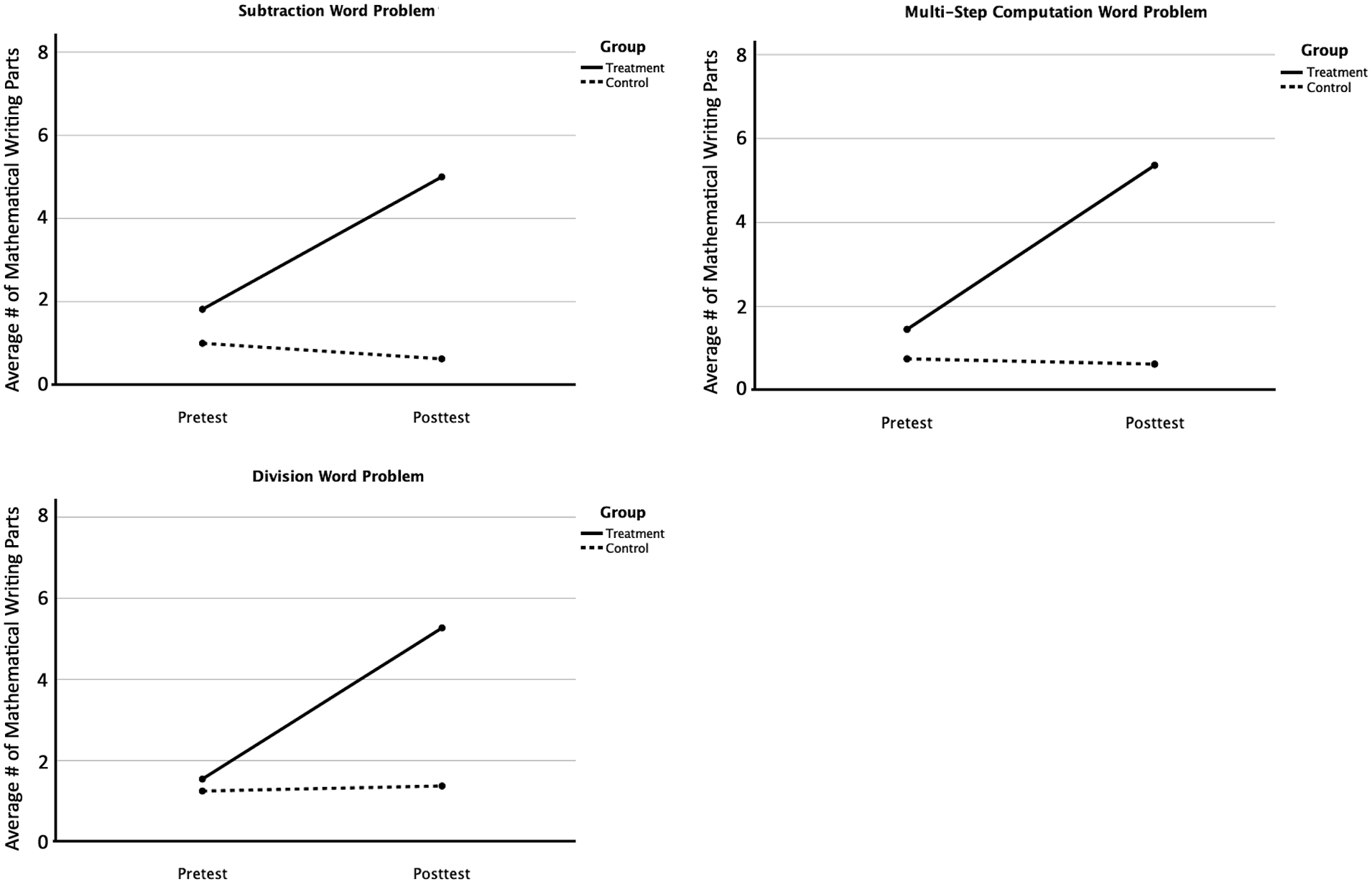
Intervention Effects on the Number of Mathematical Writing Parts.
Student Interview Themes
Findings from the student interviews indicated students found the strategy, in general, to be helpful and emphasized that the PRISM✓ checklist is what they liked most about the strategy. Student responses revealed they found the step-by-step framework of the strategy to be the most helpful part because it provided them with a process to follow. Student responses revealed they found the drawing of pictures (e.g., representations) and spelling to be the most difficult part of the strategy.
All students indicated that they thought the strategy helped them explain their problem solutions. One student provided this response that captures elements of all student responses: It helps me to be a better mathematician and it helps me to break the problem down and it helps me to do math correctly, and you know, it was very fun and it helps us to solve a problem. I think PRISM✓ is a really great thing to do.
Another student responded, “My opinion on the PRISM✓ is that it helps me understand how to explain my answer and helps me to get the right answer.” All students indicated that they would like to continue to use the PRISM✓ strategy in the future.
Interventionist and In-Class Teacher Notes and Observations
One important goal of this study was to determine what additional scaffolds or supports may be necessary specifically for students with SLD. Both interventionist and in-class teachers were asked to identify areas that caused students the most difficulty. The pacing of the lessons was identified as one of the most challenging aspects of the PRISM✓ strategy. They noted the lessons were taking much longer than the 40-min allocated time because students’ writing was slowed due to spelling concerns and vocabulary issues. They indicated that adding word banks to each lesson, especially the lessons with the most writing, would significantly help students by scaffolding spelling. They also indicated the use of sentence starters during the initial writing lessons would be an important addition to the PRISM✓ strategy. Additionally, they noted that some of the lessons had too many examples and practice problems that took much longer than expected. They thought it would be better if teachers could pick two to three examples and practice problems to use versus trying to get through all of them in one lesson. They recommended breaking down Lesson 7 into two lessons. They all noted how surprised they were that students seemed to enjoy the strategy and emphasized that students looked forward to the class in which the strategy was being used.
Discussion
Consistent with past studies, results of the present study clearly demonstrate that an intensive SRSD-based intervention focused on mathematical reasoning through written expression increased the quality of participants’ mathematics reasoning and writing. The discussion is organized by research question and followed by implications for practice, study limitations, and future directions.
Quality of Mathematical Reasoning
Students who received the intervention improved their ability to explain their mathematical reasoning in written form. The PRISM✓ strategy provided students with an organized checklist to work through to help them choose the correct operation, create a more accurate representation of the word problem, and develop a cohesive explanation of their reasoning. Students’ responses demonstrated that they had not only learned the checklist but also applied it correctly as they were working through the word problems. This finding is consistent with previous SRSD research.
We hypothesized the PRISM✓ strategy would help students learn a logical progression to work through a word problem while simultaneously developing a mathematically accurate explanation through a highly scaffolded and intensively designed instructional program. The effectiveness of the PRISM✓ strategy intervention is likely a result of the combination of explicit instructional design features and additional demonstrably effective scaffolds. The additional scaffolds aligned with three of the six recommendations highlighted in the recent Institute of Education Science Practice Guide: (a) clear and concise language, (b) use of representations, and (c) word problem instruction (Fuchs et al., 2021). Implementation of these recommendations supports achievement within the broader domain of math proficiency specifically in mathematical reasoning.
Quality of Writing
Consistent with previous intervention studies of SRSD-based writing interventions, the quality of students’ writing improved after the PRISM✓ strategy. The improvement was observed in the students’ organization, clarity, and logical reasoning compared with the comparison group, whose writing continued to be disconnected, incoherent, and more focused on the what versus the why (e.g., Casa et al., 2016). A recognized strength of SRSD-designed writing strategies is the emphasis on students learning to both develop a plan before beginning to write and using self-regulated strategies to revise their initial response; these core elements of SRSD were embedded in the PRISM✓ strategy.
Although both interventionist and in-class teachers noted the challenges students experienced while grappling with math-specific terminology during the intervention, they included more accurate and precise vocabulary in their written explanations than the comparison group. After Lesson 7, word banks were added as an extra scaffold to ease the vocabulary difficulty by eliminating spelling and guiding students’ vocabulary selection. Given the inherent challenges for students with disabilities (e.g., Morin & Franks, 2009) and the importance of using academically precise vocabulary (Powell et al., 2019) in written explanations, the PRISM✓ would be improved if additional vocabulary scaffolds are provided.
Implications for Practice
Results from this study highlight the potential benefits of using an intensive writing intervention for students with SLD in reading, writing, and mathematics. Furthermore, this work adds to the scant literature demonstrating the importance of intensive interventions focused on mathematical reasoning through written expression for students with SLD and their specific learning characteristics. It also highlights the lack of effectiveness of many mathematics curricula and the need for specially designed instruction for students with SLD. Students with SLD would likely benefit if the curriculum included more teacher modeling, mathematically appropriate visual representations, more guided practice opportunities, and instructional scaffolding (Doabler et al., 2018).
Although the intervention resulted in improved writing, students still struggled with vocabulary, spelling, and writing. As teachers try to support students’ writing in mathematics, these are areas that should receive more intensive support. Powell and colleagues (2019) emphasized the importance of using precise and accurate mathematical language embedded within daily instructional routines as a way of supporting the development of mathematical language. Teachers can support and enhance language development through the use of Frayer models (Powell et al., 2019), including a math glossary section in their notebooks or journals (Bruun et al., 2015) and vocabulary games. Incorporating these types of strategies and activities can make mathematical vocabulary more accessible and ordinary, thereby helping students to more readily acquire the language.
As noted by the classroom teachers, spelling presented challenges to students throughout the intervention, causing a significant slowing of the lesson pace and thus resulting in lessons extending past their allocated time. One example of how the pace was slowed involved students who would stop and wait for assistance when they wanted to use a word they could not spell. The addition of word lists or word banks for each lesson, starting in Lesson 7, helped to alleviate the students’ focus on spelling. This resulted in fewer spelling questions and helped to increase the pace of the lessons. In addition to word lists, increasing the visibility and use of essential mathematics vocabulary throughout mathematics lessons (not just when writing) would likely help to reduce spelling concerns.
Limitations and Future Directions
At least four limitations of this work should be acknowledged in the context of future directions for research. Primarily, the study was underpowered by the small sample size. The interpretations of an underpowered study should be used with caution (Crutzen & Peters, 2017), but they can serve as the basis for improving and guiding future research. Although underpowered, the number of participants in our study aligned with other publications on writing interventions (e.g., Allen & Lembke, 2020; Ray & Graham, 2020) and uniquely included only students with SLDs, while many studies have included a variety of students with math difficulties determined by a cut score that varied widely across researchers (Lewis & Fisher, 2016). The fact that our study specifically included students with diagnosed learning disabilities in reading, writing, and mathematics is noteworthy.
Second, our sample was relatively homogeneous in terms of socioeconomic status and racial and ethnic group membership. Therefore, results from this study may not generalize to more diverse populations. Future research should seek to replicate this study with larger sample sizes and more diverse populations.
Third, the measures used in this study may also limit the generalization of the results. The mathematical writing measure was used to capture students’ quality of reasoning and writing through a researcher-created rubric. Although the rubric was determined to have adequate technical adequacy (Hughes et al., accepted), results of this study might have differed if dissimilar mathematical writing measures had been used. Future research should seek to develop and refine technically adequate measures for evaluating the quality of students’ reasoning through written expression.
Finally, the effects of the intensive writing intervention faded with time, indicating learning was not permanently affected. This is not unexpected given the intervention ended in the last week of school and the delayed post-test could not be given until 5 months after the intervention ended. It has been well-documented that students with SLD often have deficits in memory that significantly affect learning (McNamara & Wong, 2003). Future research should examine the impact of booster sessions distributed at various intervals following the completion of the initial 12-lesson intervention.
Conclusion
Despite the past 50 years of writing interventions for students with SLD, the field in general is still unclear about how to support mathematical reasoning through written expression for students with intensive needs in reading, writing, and mathematics. Given the frequency and commonality of this type of task and increasing expectations, it is imperative to expand our knowledge of math writing interventions for students with SLD. Students with SLD are expected to communicate their mathematical reasoning through written expression, yet research in this area is just beginning.
Footnotes
Declaration of Conflicting Interests
The author(s) declared no potential conflicts of interest with respect to the research, authorship, and/or publication of this article.
Funding
The author(s) received no financial support for the research, authorship, and/or publication of this article.