



Abstract
Prior research suggests that vicarious (i.e., indirect or second-hand) racism is harmful to psychological health; moreover, the psychological impacts of vicarious racism may be especially distressing for Black women. Nevertheless, because much of the vicarious racism and mental health literature has been quantitative, the broader contexts in which vicarious racism occurs are poorly understood. Although qualitative literature has explored vicarious racism, it has focused on Black mothers and their children’s experiences of racism. We build on both literatures to analyze vicarious racism accounts reported by Black women in early adulthood. Using data from 32 respondents, the study provides greater context for experiences of vicarious racism (e.g., who are the targets and perpetrators, settings in which vicarious racism occurred), reports what happens in the “aftermath” of vicarious racism, and documents psycho-emotional responses that expand beyond traditional mental health indicators (e.g., major depression). Implications of findings for vicarious racism research are discussed.
Although racism is a pillar upon which the United States was founded, blatant instances of law enforcement-inflicted violence against Black people and communities has brought into sharp focus the ongoing effects of racism in contemporary society. Amidst the unjust deaths of Black people at the hands of law enforcement and the rise of the Black Lives Matter movement, it is apparent that racism remains a salient feature of American life. Thus, it is perhaps unsurprising that mounds of research confirm Black Americans’ experiences of direct interpersonal race-based discrimination (Bobo 2017; Feagin and Ducey 2018; D. R. Williams, Lawrence, and Davis 2019). In addition, perceptions of racial discrimination are linked to a battery of both physiological and psychological health indicators (Cuevas et al. 2020; Goosby, Cheadle, and Mitchell 2018; D. R. Williams et al. 2019). That is, racial discrimination translates into poor physical and mental health for Black people in general and Black women in particular.
Despite the proliferation of studies focused on interpersonal forms of race-based discrimination, much less empirical research has assessed network-based manifestations of racism. That is, even if not experiencing racism directly, interpersonal discrimination experienced by others within one’s social network (e.g., children and romantic partners) can have serious negative health implications (Brantley 2023; Colen et al. 2019; Heard-Garris et al. 2018). Thus, in addition to direct exposure to discrimination, nascent literature indicates that vicarious (i.e., indirect or “second hand”) race-based discrimination is critical to investigate because its health implications are just as potent, if not more so, as direct experiences of discrimination (Daniels et al. 2023).
Vicarious racism appears to be particularly distressing for U.S. Black women. Despite reporting a similar “prevalence” of vicarious racist events within their personal networks, a recent study reported that vicarious discrimination was associated with elevated psychological distress among Black women but not Black men (Moody, Thomas Tobin, and Erving 2022). This finding aligns with qualitative research detailing the emotional impact of vicarious racism on Black mothers, particularly regarding fears and anxiety produced by the realities of their children experiencing racial discrimination (Brantley 2023; Dow 2019). These two bodies of literature motivate this study to investigate the contours of vicarious racism among Black women. Specifically, this study leverages qualitative data to contextualize Black women’s reports of indirect discrimination. The three research questions motivating this study are (a) What are the contexts and circumstances under which Black women experience vicarious racism? (b) How do Black women respond to and what are the consequences of vicarious racism? and (c) What are the emotional and psychological impacts of vicarious racism for Black women?
This study stands to make at least two contributions to the extant literature. First, regarding research examining the psychological effects of vicarious racism (e.g., Louie and Upenieks 2022; Moody 2022; Moody et al. 2022), this study will expand the parameters imposed on quantitative measures of vicarious racism, as most studies operationalize vicarious racism using modified versions of widely used discrimination scales (e.g., Major Discrimination Scale) originally purposed to measure direct experiences of discrimination. This study can be leveraged to develop new quantitative measures of vicarious discrimination that account for the unique racial and gender positionality of Black women as well as identify other contexts and scenarios in which vicarious racism can transpire. Second, qualitative research revealing vicarious racism as a prominent stressor among Black women has primarily focused on mothers (e.g., Brantley 2023; Dow 2019; Elliott and Reid 2019; Leath, Butler-Barnes, and Haynes-Thoby 2022). This study elucidates the experiences of vicarious racism for Black women in emerging adulthood, many of whom are not yet mothers. In this way, this study broadens the “targets” or recipients of racial discrimination from solely a focus on children to other significant members of one’s social network potentially including, but not limited to, romantic partners, siblings, and friends.
Background
Conceptualizing Vicarious Racism
As opposed to being on the direct receiving end of racially motivated negative actions, vicarious racism can be conceptualized as “second hand” or “indirect” (Harrell 2000; Truong, Museus, and McGuire 2016). Shelly P. Harrell (2000) offers one of the first definitions of vicarious racism: Racism exerts its influence not only through direct personal experience, but also vicariously, through observation and report. The inclusion of vicarious experiences is critical in understanding the nature of racism’s effect on individuals (Essed 1991; Root 1992). Experiences of prejudice and discrimination that happen to members of one’s family and close friends (Steele et al. 1982; Tatum 1987), as well as those involving strangers . . . can be quite distressing. (P. 45)
Therefore, another essential aspect of our conceptualization is that vicarious racism is a stress exposure germane to the experiences of racially minoritized populations. Race-related stress exposure is important to examine because it has been shown to elicit psychological and physiological stress responses (Utsey et al. 2013).
We also wish to emphasize that vicarious racism can be experienced even when a racist event has occurred to a stranger (Harrell 2000; Lee et al. 2023; for a different perspective, see Quinn et al. 2023). For instance, Connor D. Martz and colleagues (2019) expand the definition of vicarious racism to not only include “experiences of racism among friends or family,” but three other more distal scenarios: hearing about racism in the news, witnessing racism in public, and racism depicted in movies and television shows. This operationalization conveys that vicarious racism could occur even when the “other” is not personally known. This recognition is especially salient, given the current sociopolitical context in which imagery of police brutality against Black people has become ubiquitous across various media platforms (Lee et al. 2023; S. Williams 2021). In the “digital era” characterized by rapid changes led by digital technologies, videos documenting the public execution of Black bodies as reported by traditional news sources and social media outlets such as Facebook, Instagram, and Twitter have become almost normative (e.g., the killings of Eric Garner in 2014, Alton Sterling in 2016, and George Floyd in 2020). Moreover, emerging adults (between the ages of 18 and 29 years) are especially likely to see images of violence and assault against members of their racial group (Lee et al. 2023), as 84% of emerging adults (18–29 years) use social media (Auxier and Anderson 2021).
In sum, vicarious racism manifests as: (a) interpersonal racism experienced within a person’s social network (e.g., sibling, romantic partner, uncle, cousin), or (b) racism occurring to a stranger that becomes known through witnessing an acute event directly or learning of the incident through a news source (e.g., newspaper and television) or social media (e.g., TikTok and SnapChat) outlet, and is necessarily (c) pertinent to members of historically marginalized racial groups. Here, we focus on Black women in emerging adulthood. We explain the significance of vicarious racism for this specific population in the section that follows.
Theoretical Framework: Black Women’s Unique Intersectional Care Burdens
This study draws from both the multidimensional conceptualization of racism-related stress model (Harrell 2000) and the intersectionality framework (Collins 1990; Collins and Bilge 2020; Crenshaw 1989, 1991). Harrell’s (2000) multidimensional conceptualization of racism-related stress theorizes the myriad pathways through which racism impacts psychological health. Racism-related stress is defined as: “the racism-related transactions between individuals or groups and their environment that emerge from the dynamics of racism, and that are perceived to tax or exceed existing individual and collective resources or threaten well-being” (Harrell 2000:44). Within this model, six forms of racism are described. The one most relevant for this study is vicarious racism experiences, of which Harrell (2000) notes: They [vicarious racism experiences] can create anxiety, a heightened sense of danger/vulnerability, anger, and sadness, among other emotional and psychological reactions. These vicarious experiences can also teach valuable lessons about the places where racism hides and resides. (P. 45)
Vicarious racism is especially salient for Black Americans, given the recent high-profile killings of Black men and women at the hands of law enforcement. This inundation of imagery emphasizing Black deaths via social media and the news airways can produce a sense of collective trauma for Black Americans (Leath et al. 2022; Moody et al. 2022; T. R. Williams et al. 2024), and in turn, strengthen a sense of “linked fate” within this population. “Linked fate” refers to the belief that instances of inequality (and triumph) among Black Americans are related to one’s own life chances because of shared racial group membership. Ellis P. Monk Jr (2020) recently found a direct association between linked fate among Black Americans and poor mental health. Thus, it is logical to conclude that witnessing or being made aware of race-related discriminatory events involving a Black person(s) will be disturbing for Black Americans, bolstering Harrell’s (2000) claim that vicarious racist events are an important indicator of racism-related stress.
The intersectionality framework emphasizes the ways multiple systems of power produce inequalities in life experiences and life chances (Collins and Bilge 2020; Crenshaw 1989, 1991). Systemic racism and sexism coalesce to disadvantage Black women based on both their disadvantaged racial and gender statuses (Collins and Bilge 2020; Crenshaw 1991). As it has been argued elsewhere, an intersectional perspective is required to understand why and how Black women may be particularly psychologically vulnerable to vicarious racism (Moody et al. 2022). Understanding Black women’s reports of vicarious racism necessitates an intersectional theoretical orientation that not only considers racism, but other systems of inequality that disadvantage Black women and those within their social network (e.g., parents, children, friends, romantic partners). In addition to placing emphasis on their multisystem structural disadvantages, an intersectional perspective suggests that Black women face unique, compounding gendered-racialized stressors that are pertinent to and disproportionately befall them (Erving, Patterson, and Boone 2021).
Regarding gender roles and expectations, women are socially expected to nurture and care for others (Kessler and McLeod 1984), engage in emotional labor in private and work settings (Hochschild 1979; Smith-Tran 2023), and provide social support within their immediate and extended networks (Irby-Shasanmi and Erving 2020). Beyond gendered expectations imposed on all women, an intersectional perspective posits that the gender and racial positionality of Black women could make them uniquely vulnerable to vicarious racism. For Black women, their gendered role as caretakers in tandem with vigilance over others in the context of racism can have negative health consequences (Daniels et al. 2023). These co-formed gendered and racialized processes have been conceptualized as motherwork (Collins 1996), highlighting the unique stress-burdened care that Black mothers perform in attempts to protect their children from racism; this level of hypervigilance, in turn, produces worry, fear, and sadness (Brantley 2023; Daniels et al. 2020, 2023; Dow 2015, 2019; Leath et al. 2022).
Extending beyond their roles as mothers, Black women in general experience network stress and sociocultural pressures to be “strong,” two lived realities that might increase exposure to vicarious racism. Cheryl L. Woods-Giscombé et al. (2015) found that network-related stress was experienced with greater frequency than direct stress exposure among Black women; moreover, network stress was associated with psychological distress. Relatedly, Tené T. Lewis and colleagues (2023) confirmed that among Black women, network stressors had a greater influence on cardiovascular disease risk than directly experienced stress exposure. Drawing from relational cultural theory, Joy Harden Bradford (2023) argues that Black women navigate the world in community with people in their intimate social networks; these connections, in turn, serve as “sites of meaning and healing” (p. 42). The “downside” to such relationships, however, is perhaps best elucidated in a vein of research focused on Black women feeling a unique sociocultural burden to be strong, invincible, superwomen by espousing character traits such as caring for others to the point of self-neglect, self-sacrificing, and bearing the burdens of family members, friends, church members, and coworkers (Beauboeuf-Lafontant 2009; Dow 2015; Woods-Giscombe 2010). Given this body of research, Black women could be disproportionately affected by vicarious racism. More research is needed to better understand the circumstances and contexts in which they experience vicarious racism.
Vicarious Racism and Mental Health
A growing literature confirms that vicarious racism is pathogenic with regard to its effects on psychological well-being (Louie and Upenieks 2022; Moody 2022; Moody et al. 2023; Moody, Thomas Tobin, and Erving 2022). This finding has been consistent among Black Americans, affecting a range of psychological and emotional responses including life satisfaction (Moody 2022), psychological distress (Moody et al. 2022), depressive symptoms (Chae et al. 2021; Holloway and Varner 2023; Louie and Upenieks 2022; Moody and Lewis 2023; Wofford et al. 2019), anxiety (Chae et al. 2021; Jochman et al. 2019; Louie and Upenieks 2022; Moody et al. 2023), and anger (Louie and Upenieks 2022). A recent study discovered that vicarious discrimination is particularly harmful to Black women’s mental health (Moody et al. 2022). Focusing on vicarious experiences of major discrimination (adapted from the Williams et al. 1997 major discrimination scale), Myles D. Moody and colleagues (2022) assessed indirect experiences such as “been unfairly fired or denied a promotion,” “been unfairly discouraged by a teacher from pursing a job/career,” and “for unfair reasons, neighbors made life difficult.” Nevertheless, the specific source of vicarious discrimination was not analyzed, providing an opportunity to further explore who specifically are the “targets” of discrimination within a Black woman’s social network.
Specific sources (i.e., relative versus friend) and manifestations of vicarious racism seem to be particularly detrimental to health. For instance, Patricia Louie and Laura Upenieks (2022) found that, among Black Americans, vicarious experiences of family members had a more robust negative influence on depressive symptoms than those of friends. Although not focused on mental health, Izraelle I. McKinnon and colleagues (2022) reported that vicarious exposure to racism-related events when witnessed in person was related to poor sleep quality in Black women; however, vicarious exposures observed via social media were not related to sleep. Relatedly, Jacob E. Cheadle and colleagues (2020) found weak to null associations between vicarious racism via social media and emotional arousal among Black college students. This pattern of findings suggests that vicarious experiences that occur to family members and are witnessed in person could be the most psychologically harmful.
Most scholarship exploring the psychological effects of vicarious racism has been quantitative in nature (e.g., see Chae et al. 2021; Louie and Upenieks 2022; Moody 2022). Although this scholarship is valuable in expanding our knowledge base, certain aspects of vicarious racism and mental health may be missed because of the necessarily close-ended structure of questionnaire items used to construct quantitative measures. Moreover, scholars draw attention to the lack of conceptual clarity and, as a result, inconsistent measures of vicarious racism across studies (Heard-Garris et al. 2018; Quinn et al. 2023). Hence, we view these inconsistencies as an opportunity to contribute to construction of new vicarious racism measures for future use in quantitative studies, as analyzing qualitative or open-ended responses unveils the processes, contexts, and innerworkings of vicarious racism in ways that quantitative research was not designed to do. Using qualitative data, we build on the extant vicarious racism and mental health literature by (a) providing greater contexts of vicarious racism (e.g., who is the target, circumstances surrounding the event), (b) reporting what happens in the “aftermath” of vicarious racism with a focus on consequences and responses to vicarious racism, and (c) documenting the myriad emotional and psychological responses to vicarious racism that expands beyond “traditional” mental health measures (e.g., depressive symptoms).
Research Design
Data are from a larger mixed-methods study, the Gendered Racism and Well-being Questionnaire. The sample comprised 234 Black female-identified undergraduate and graduate students attending a southern Historically Black College or University (HBCU). Participant recruitment occurred in two stages. First, in fall 2020, Black female-identified students enrolled in undergraduate psychology courses at HBCU were the initial target sample. Respondents were incentivized by receiving extra credit in their psychology course. Second, in spring 2021, data collection was expanded to Black female-identified students across the university (i.e., of any major, undergraduate, and graduate level) who were sent a recruitment flyer with a link to the survey through their university email accounts. As an incentive to participate, the second group of students participated in a raffle for the chance to win one of six $25 Amazon Gift Cards as compensation for their time and participation in the online survey. The survey took 30 to 40 minutes to complete. Should they feel discomfort when responding to sensitive questions (e.g., experiences with discrimination), participants were provided contact information for the university counseling center and other local community mental health resources before and after survey completion. The university Institutional Review Board (IRB) approved the study. All participants were English-speaking, 18+ years of age, and enrolled in coursework at the time of participation. Between September 2020 and April 2021, participants completed the online survey via Qualtrics.
Experiences with racism were captured by an open-response opening question to the Prolonged Activation and Anticipatory Race-related Stress Scale (PARS; Utsey et al. 2013). Prior to answering 19 quantitative items comprising PARS, participants were asked to respond to the following prompt: Please describe an event/situation involving racism that you or someone close to you (like a family member or close friend) experienced in the past. Some examples of racism include being treated unfairly because of your race; being ridiculed, humiliated, or harassed because of your race; being denied a job, housing, or access to other services because of your race; or observing a situation in which another person of your race was harassed or mistreated because of their race. These are just a few examples of how you or someone close to you might experience racism. It would be impossible to list all of the ways in which a person can experience racism, so you must decide if an event/situation happened to you because of your race.
Importantly, this question did not ask specifically about vicarious racism; therefore, our analysis only captures respondents who described vicarious racism. However, most respondents reported direct experiences with racism. That said, this analysis is a conservative estimate of the “prevalence” of vicarious racism experiences within this sample of Black women.
Coding and Analysis
Two co-authors initially and independently coded the data to distinguish between direct and indirect vicarious racism reports. There was agreement for 20 indirect instances. The first coder initially coded 23 responses as indirect, while the second identified 26 indirect experiences with racism. Other categories arose from the coding process because some responses had recounts of both direct and indirect experiences, described broader systemic racism, or were vague. Three co-authors then met twice to discuss the responses and their corresponding codes to find consensus and reconcile the ones where there was disagreement to reach intercoder reliability. We agreed that 32 responses referred to vicarious racism and those answers became our universe of analysis.
We followed a thematic analysis centering on the settings, emotions, and perpetrators of racism experiences to find the patterns that we discuss in the findings section. We also analyzed the type of experience, such as police-related, disrespect, or assumptions of criminal intent. Our universe of analysis of 32 responses indicating vicarious racism were further divided into three categories: indirect, systemic, and bystander. A more detailed breakdown of the categories can be found in Table 1.
Definitions of Three Codes for Vicarious Racism.
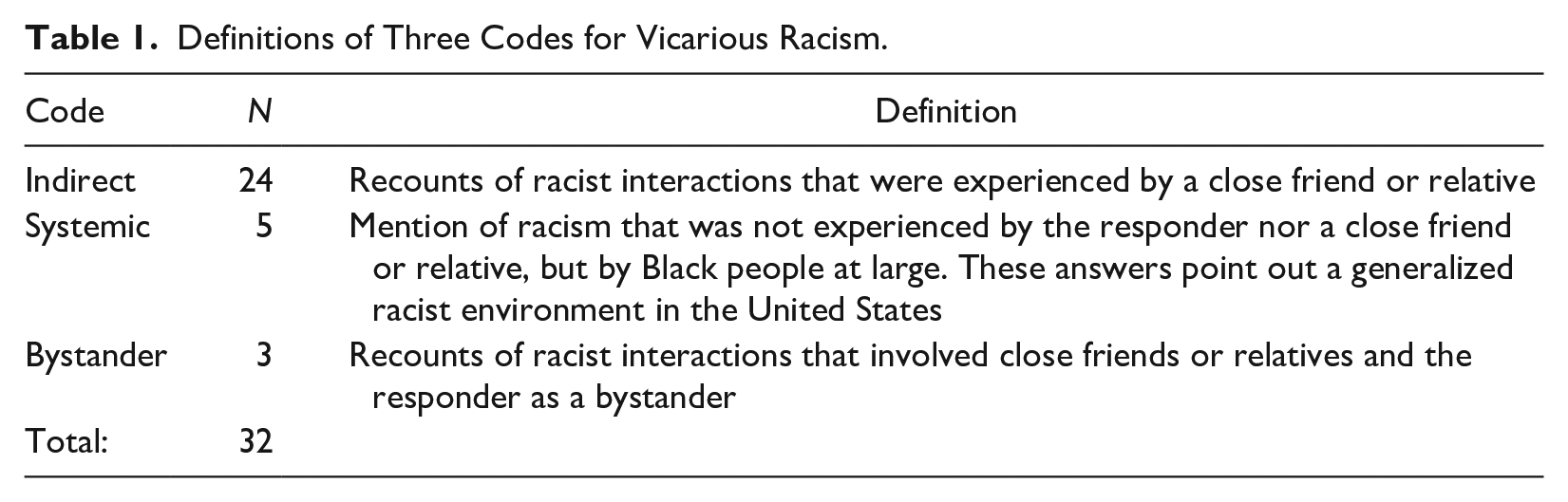
It is important to draw attention to the categories of “systemic” and “bystander” because they conceptually blur conventional definitions of vicarious racism. By coding responses referring to systemic racism as vicarious, we assert that vicarious racism is not only relevant when occurring to close others, but to “strangers who are part of one’s racial community” (Brantley 2023:5). Furthermore, responses in the “bystander” category point to being physically present but not the target of racism.
Positionality Statement
As researchers, we note our own positionality and the ways our social statuses could influence the research process (Haynes et al. 2020). We understand that research is not objective; instead, the formulation of research questions, analysis of data, and conclusions drawn from that research are all socially embedded within how we develop interpretative meaning. Accordingly, each author has included a description of their positionality in relation to the research that was conducted.
The first author identifies as a cisgender Black woman and is a faculty member at a historically White institution. She is a first-generation college student from a working-class family. However, the first author recognizes her current socioeconomic privilege as a tenured professor. The author has experienced both direct and vicarious racism in the form of witnessing family members stopped by police officers without justification, being followed around in stores, and being presumed incompetent by students in higher education settings. That said, the first author’s own experiences with both direct and indirect racism could influence how she analyzes and interprets the data. The second author identifies as a cisgender Black woman and faculty member at an HBCU. She is a first-generation college student who grew up in a low-socioeconomic background. The privileged identities she acknowledges are socioeconomic status, being able-bodied, and heterosexual sexual orientation. She also has experienced direct and indirect instances of racism throughout her lifetime. In her work as a psychologist, she often witnesses the profound effects of vicarious racism, through social media platforms and news outlets, on Black women’s mental and physical health, relationships with others, perceptions of the self, and sense of safety. Thus, the second author had to be mindful of the ways her own personal or professional experiences of vicarious racism could impact the research process and analysis. The third author is a cisgender Mexican woman identified as White-Hispanic, although racial classifications in Mexico have a different historical background and do not necessarily align with those of the United States. She is a sociology PhD student at a historically White institution. Although she has no first-hand experience as a target of racism in Mexico where whiteness is a privilege, she is acutely aware of the racism experienced by Indigenous and afro-Mexican people in Mexico and Black, Latinx, and Asian people in the United States. As a Mexican woman, she is empathetic to the experience of violence and constant fear and has direct experiences with sexism. Her education and class mobility have allowed her to have a keen eye for gender and class inequalities, which directly impacts what she highlighted and noticed while interpreting the data. The fourth author identifies as a Black girl who was born and raised in the deep South. She is actively growing into her Black womanhood, and this maturation into Black womanhood is currently being shaped by the complexities associated with her being a first-generation undergraduate scholar at a predominantly White institution. She has been educated in predominantly white spaces since she was in middle school which meant that school (for her) has been more than a place for educational advancement. School has been a setting that (regrettably) has exposed her to gendered racial microaggressions (e.g., unfairly labeled as aggressive). As such, she can personally relate to many experiences of direct and indirect racism detailed by the respondents.
Results
Demographic data on respondents reporting vicarious racism are available in Table 2. 1 The average age of respondents is 22 years (SD = 4.72). Most respondents are undergraduate students (91%), U.S.-born (97%), are not parents (91%), and identify as heterosexual (81%). Nearly two-thirds of respondents are first-generation college students (i.e., first in their family to attend college) and about 19% are working full-time.
Descriptive Characteristics of Respondents Reporting Vicarious Racism (N = 32).
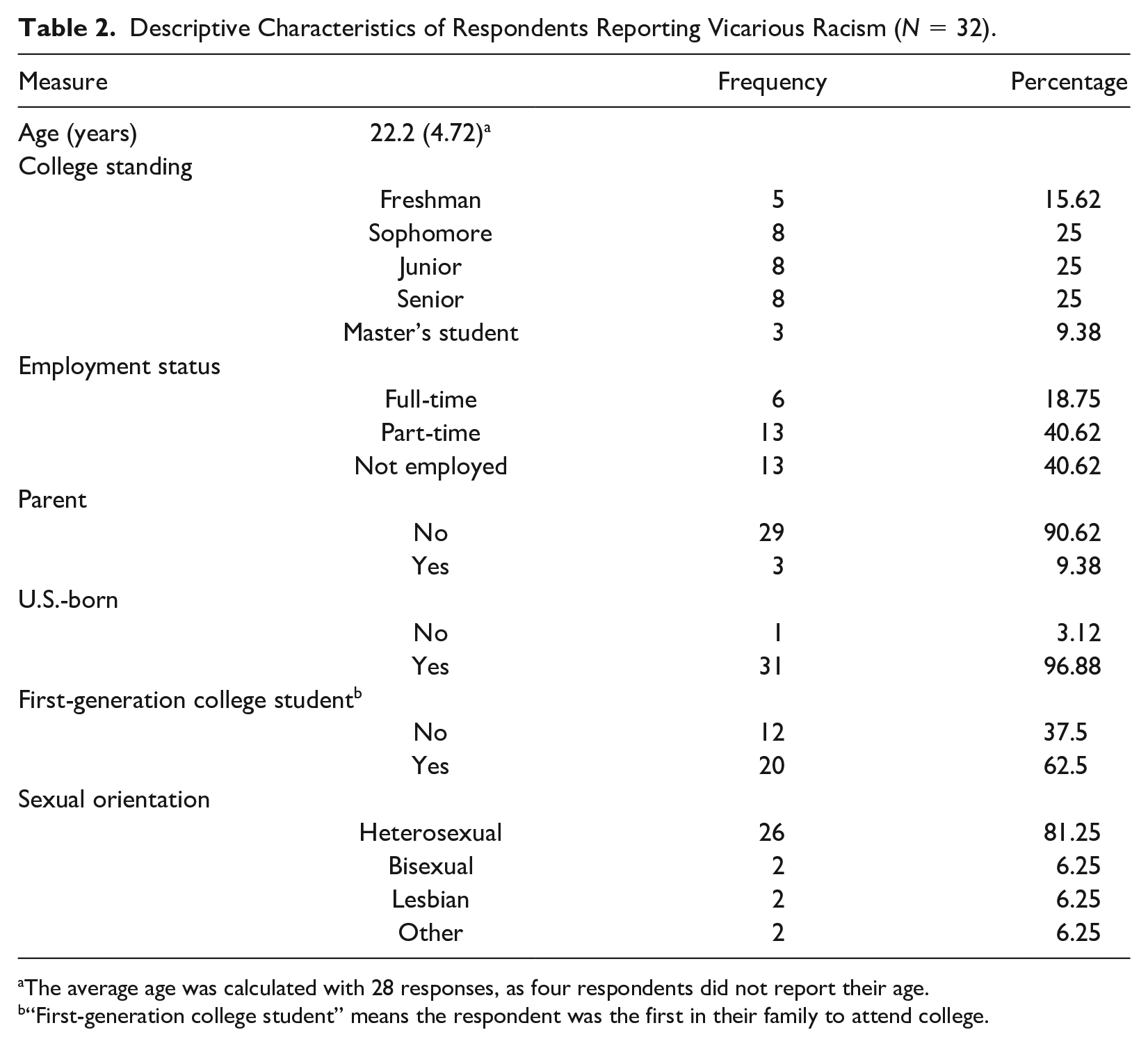
The average age was calculated with 28 responses, as four respondents did not report their age.
“First-generation college student” means the respondent was the first in their family to attend college.
Contexts and Circumstances of Vicarious Racism
We organize findings in this section into four parts: targets, perpetrators, setting, and types of vicarious racism experiences. In Table 3, we include summative data regarding the “targets” and “perpetrators” of vicarious racism. “Targets” are defined as the person or people on the direct receiving end of racism. Our findings revealed that family members were common targets (78%), but Black people in general were also repeatedly mentioned as targets (14.71%). “Perpetrators” refer to individuals, systems, or institutions responsible for a racist act or racism in general. Police and law enforcement more generally were frequent perpetrators (41%).
Targets and Perpetrators of Vicarious Racism (N = 32).
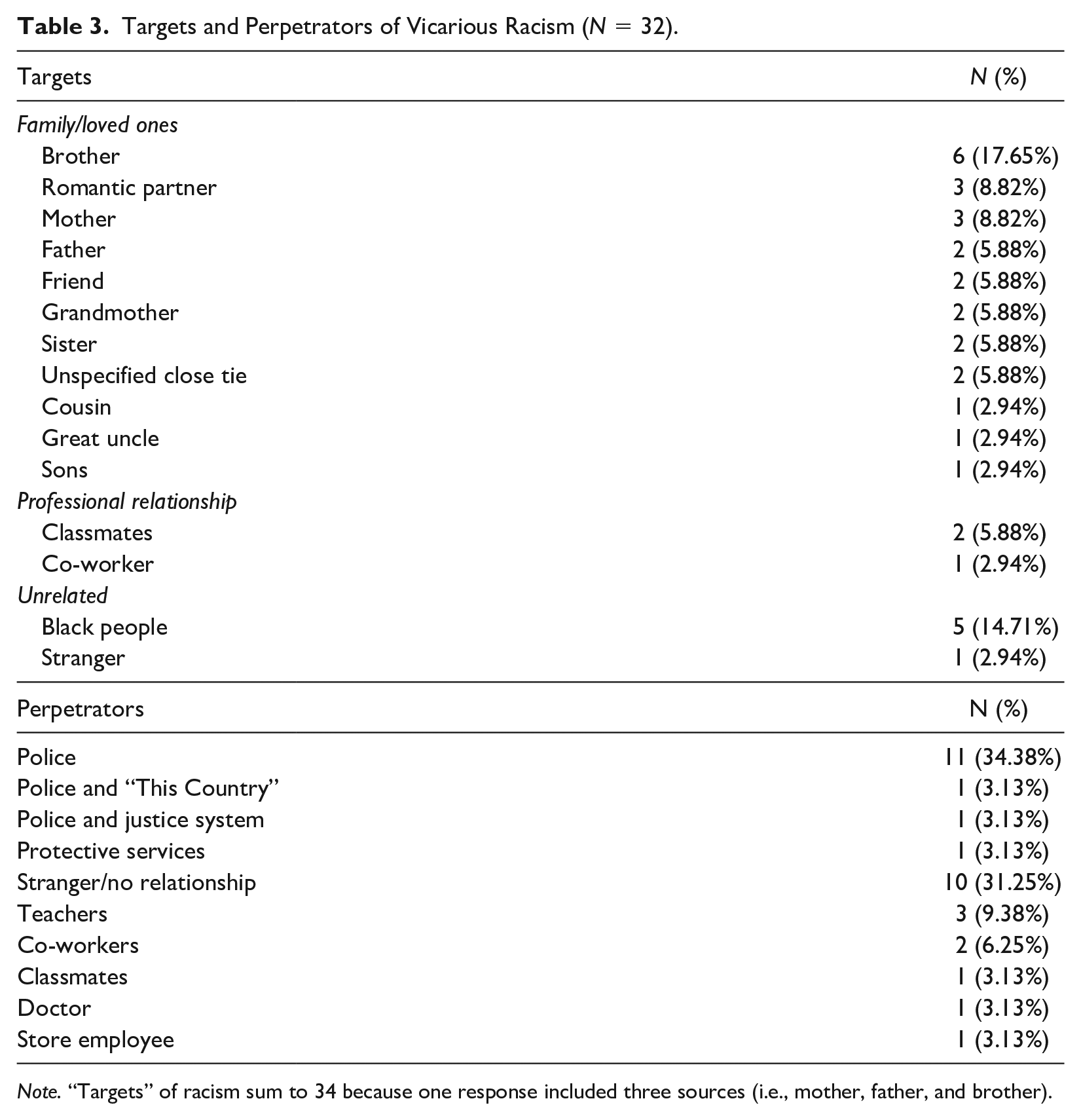
Note. “Targets” of racism sum to 34 because one response included three sources (i.e., mother, father, and brother).
When examining settings in which vicarious racism occur, findings reinforce the need for renewed attention on racial profiling, as 22% of encounters described the phenomenon of “driving while Black” (Harris 1996). Schools (16%) and stores (16%) were tied as the second most common settings. Social media, America, and the world also were frequent settings (13%), demonstrating the relevance of expanding the definition of vicarious racism beyond direct, close ties to include one’s racialized community. Settings of vicarious racism are shown in Figure 1.
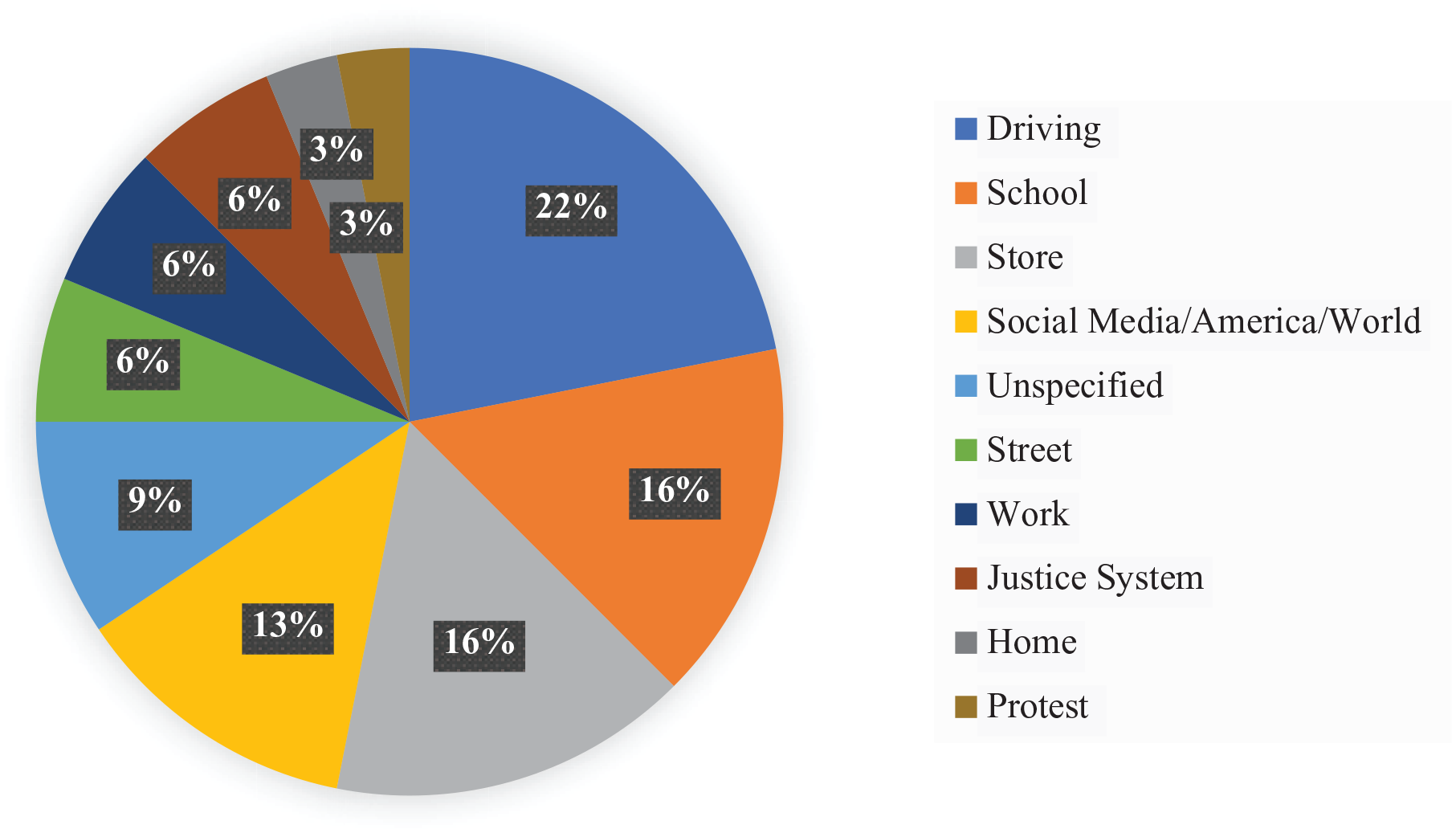
Settings of vicarious racism.
Targets of racism
Respondents reported on indirect experiences in which their relatives, intimate partners, loved ones, and co-workers were primary targets. Family members or close ties were the most common reported targets. Men and brothers were subjected to racial profiling while driving and the police’s unwarranted use of violence. The following account from a 20-year-old junior is representative of the precarious relationship between young Black men and the police: One experience is watching my brother being slammed on the ground and a knee held on his back because he “fit the description” in a crime that happened in a neighborhood we just moved to. Someone called the cops on us because they saw me and my brother outside and since we were the new black family to the neighborhood were profiled.
Although the respondent was present at the time of the event, the primary target was her brother. Assumptions of criminal intent, racial profiling, and immediate use of unwarranted violence were common occurrences for Black men.
In contrast, racist encounters involving women were more related to being called racial slurs or actions of disrespect, such as being reprimanded for speaking up at school or being labeled the “angry Black girl.” A particular target mentioned frequently was “Black people.” This response was most common with respondents who talked about systemic racism, as opposed to concrete encounters. A 22-year-old senior phrased it like this: I know that some people look at things like “well that wasn’t exactly you experiencing those things,” but in my mind it is me. The actions imparted on black people everywhere affect me because the actions are done because the person is black. There’s no personal reason for the hate, it’s simply because of being black and it makes me feel like I have a target on my back.
She reflects that racism affects her even though she is not the direct target because she recognizes herself as a part of a racial community with a linked fate (Monk 2020). Hearing about actions imparted on Black people touches her vicariously because it makes her feel targeted for being Black. The racial encounters respondents recalled when talking about Black people were mostly related to the police, the most mentioned perpetrators.
Perpetrators of Racism
The state and its direct or indirect use of violence was the primary perpetrator. The police were the main apparatus enforcing this violence, while other people spoke about the justice system and protective services as racist institutions. As mentioned before, racial profiling and assumptions of criminal intent were common regarding interactions with the police. An account similar to the following appeared repeatedly: My boyfriend being pulled over by 5 police/sheriffs cars and have guns pulled out on him because a car was stolen in the area (the person that stole the car was already in custody) (22-year-old, Senior)
In these instances, the police detained Black people who were not engaging in criminal activity and immediately escalated the situation by deploying guns. In several accounts, the persons detained (usually Black men) did not match the profile of the suspects or there was already someone in police custody.
The justice system and protective services were alluded to in relation to institutional racism. One respondent recalls that her mother was in a relationship involving domestic violence. When protective services got involved, instead of providing refuge, They made my mother seem like a criminal for being a victim of domestic violence. They tried to dig up any and everything bad about her to use against her in court and even lied to the judge about her in court. I feel like this had to do with race because if it had been a white woman; it would have gone differently. (Freshman, 18-year-old)
Similarly, the father of a 24-year-old master’s student was accused of identity theft. He was taken to jail and then released shortly after because they found “the guy that was actually doing it.” Being left with emotional and financial burdens, they: Never even received an apology (. . .) I know because of our race, they assumed my dad was guilty and that my mom was lying to defend him. I know that because of our race, they didn’t even care to knock or arrest my dad out of the view of his 3 young children.
These two responses point out institutional racism, which coexists with the interpersonal racism more readily recounted. Institutions whose aim is to ostensibly provide justice and protection function instead to perpetuate racism, which has a wide range of consequences not just to the people directly involved, but to those who live the experience vicariously.
Teachers and classmates were also mentioned as perpetrators, particularly in predominantly White institutions. Classmates performed “black face” or taunted Black people, while teachers often silenced Black girls, dismissing them from class for speaking up and treating them as adults or with disrespect. Finally, co-workers were perpetrators of racism, also in majority-White workplaces. One respondent recalls that she was the only Black female in her department and her co-workers had a voodoo doll they would push a pin into. When a Mexican new co-worker was hired: Days after her employment, they added a sombrero to the doll and continued the tradition of pushing a pin into the doll.
After expressing a grievance, human resources (HR) had the doll removed. Schools and workplaces enabling racist actions highlight the racialized character of organizations (Ray 2019) that place additional emotional stress on racially minoritized students or employees. Moreover, the delayed response from HR implies there are unspoken expectations of compliance and cooperation for racially minoritized workers within racially toxic environment (Harvey-Wingfield 2010). Perpetrators operate in a variety of settings which we will describe below.
Setting
Summative data on the settings in which vicarious racism occurred are reported in Figure 1. The most prevalent setting was driving (22%), as we have described in relation to “driving while Black,” particularly for young Black men. The second most frequent settings were schools (16%) and stores (16%). Accusations of criminal intent were common in stores where Black people were shopping or browsing. For instance, a 30-year-old master’s student noted: “My brother and fiancé were attacked outside of Walmart called [r]acials (sic) slurs and objects hurled at them. My mother was verbally attacked in a Kroger.” These types of infractions in quotidian places such as stores or restaurants make targeted people feel unwelcome and surveilled. Relatedly, social media, America, and the world (13%) appear as a common setting. Social media immediacy and the coverage of police brutality against Black people also have an impact on how racism is perceived as a constant threat in everyday reality. Hence, social media serves as an important setting for vicarious racism based on identifying oneself as part of a targeted racial community (Lee et al. 2023; Tynes et al. 2012).
This study reveals vicarious racism mostly manifested through false assumptions of criminal activity, police brutality, abuse of power, and general disrespect which were most perpetrated by police, strangers, and professional or educational colleagues. It is also important to highlight the role of majority-White environments (e.g., educational settings and professional workplaces) in perpetrating racism. As scholars have noted, the protected “White habitus” makes Black people’s presence in predominantly White spaces appear aberrant and deviant (Bonilla-Silva 2006). Accordingly, majority White spaces demonstrate how racism is embedded in institutions that, in turn, create unsafe spaces for upwardly mobile, middle-class Black Americans (Jackson and Stewart 2003).
Types of experiences
The distinct types of racist encounters have been described in the subsections above. However, what follows is a detailed categorization of the encounters to analyze their prevalence and set the stage to describe their consequences, responses, and emotional impact. The most frequent type of experience was disrespect (28%), followed by accusations of criminal intent activity (19%), racial slurs (19%), police brutality (16%), physical violence (6%), and generalized violence (6%). Disrespect refers to more subtle experiences in which unfair treatment was deliberate and targeted based on the target’s race. The following two experiences clearly illustrate the category: He and a (white) female friend were supposed to go to prom his senior year. When it got close to the prom day, her parents told her she couldn’t go with him. (Senior, 21 years old) Someone close to me works at a mostly white facility and she/he is black so they treat she/he differently and by that, I mean with disrespect. And, they treat the white, like their (sic) the queens/kings of this earth when in reality they are NOT. (Sophomore, 19 years old)
Racial slurs are often yelled out by strangers passing by, exercising power over public spaces, and erupting unexpectedly, eliciting a hypervigilant state among Black Americans.
Finally, generalized violence points to more elusive experiences that are not physical nor direct, but reflect chronic stress and trauma felt by Black people due to systemic racism (T. R. Williams, Walker, and Wyatt 2022). Respondents referring to such experiences described “the stressful events that were plastered over the media concerning Black people and Black Lives Matter” or, as a 22-year-old puts it: “The feeling of America waking up to the truth about how African Americans are treated in this country, but also the feeling of them not caring either way.” 2 Such experiences have varied consequences and elicit different responses from people experiencing them vicariously, which we explore next.
Consequences of and Responses to Vicarious Racism
Self-removal and detached acceptance were common responses to vicarious discrimination. Self-removal from racially hostile environments arose as a prevalent self-preservation strategy to cope with and limit racist experiences. For example, quitting one’s job is an example of removing oneself from a hostile environment that is, unfortunately, not always the most economically feasible option for many individuals. Thus, this action-based strategy should be interpreted through racial and class lenses due to the cascade of risks and collateral harms this strategy can trigger. The next experience narrated by a 20-year-old sophomore is indicative of this: My grandmother was a nanny to a white family who had a son who was 6 years old. My grandmother took him to the grocery store and was approached by 3 white ladies who accused her kidnapping the young boy. The police was called on her however my grandmother explained to the police the situation. After being held at the store for 2 hours my grandmother decided to quit her job as a nanny the very next day.
This account illustrates the negative economic consequences racism can instigate, which, on a broader level, could have serious consequences for the economic attainment of Black people. Similarly, respondents narrated the financial strain of interacting within racist institutions. Recalling the account of the man who was wrongfully arrested for identity theft, the respondent mentioned that her family was “left with lawyer fees which put a strain on our already tight income.”
Racial institutions also affect the educational attainment of Black people through diverse mechanisms: dismissing students from class for speaking up against racism, upholding the controlling image of the “angry Black woman” against Black girls, and the adultification of Black children. The following account from an 18-year-old freshman encapsulates these mechanisms Any reaction would make me the “angry black girl” Looking back, kinda (sic) wishing I didn’t put up with it to conform. Also the disrespect certain faculty would treat black students with versus white students. Especially black girls, who constantly were treated like adults and not like the children we were. Like faculty felt threatened by us for whatever reason.
Dealing with these mechanisms daily at school is a racialized process that can have consequences on academic performance and educational attainment. Furthermore, the effects of racism can reverberate to the point of pushing families to relocate, illustrating how the consequences are not solely applicable to direct targets, but for their whole network. This was the experience of a 19-year-old sophomore: My brother was subjected to racism in Elementary School. When I was at the same school I had no issues but because my brother is this young black boy they targeted him. This eventually led to us moving to another city and starting over. This was also a difficult time because I had to leave all my childhood friends and start over in a new city. My parents sold their house of 15 years and we moved into an apartment and I went to a inner city school. I was so used to going to schools where it (sic) was diversity and I was sheltered from a lot of the outside world and what really went on. It was a major culture shock and it this evidently led me to go into a deep depression.
Faced with racism, this family had to start over in a new city, which had economic, educational, and emotional consequences for those involved. We now turn to the emotional effects of vicarious racism.
Emotional and Psychological Impacts of Vicarious Racism
Although the question did not require respondents to do so, 12 respondents (38%) described the emotional and psychological impacts of vicarious racism. Emotional responses included fear, sadness, and anger. Psychological responses included symptoms associated with depression and trauma. The most notable example of fear as an emotional trigger was identified by a respondent who “hadn’t experienced any racism,” but indicated that “the things going on in the world as far as police brutality frightens me” (Senior, 21 years old). Fear expressed in her response can be reasonably interpreted as a concern that racially motivated violence will continually plague her community, and a fear that the violence witnessed could eventually befall her. Fear was a common emotional response for those who described systemic manifestations of racism. For instance, the previously mentioned 22-year-old senior who described feeling like, “I have a target on my back,” demonstrates the hypervigilance many Black Americans report because of highly publicized racially motivated events (Zeligman et al. 2022).
Sadness was another emotional response. Vicarious racism seems to elicit sadness because of empathy for those experiencing discrimination directly. For instance, an 18-year-old freshman recalled: A friend of mine, while riding through Culman, Alabama, was called the n word. While I wasn’t there, I could feel his sadness and disdain as he told me.
In addition to sadness, anger and indignation were emotional responses triggered by vicarious racism. One respondent’s sister was called a racial slur on the street. She reflects that as an African American Muslim woman, “this wasn’t the first time either of us had heard something like this.” However, her sister’s experience still caused the respondent “to feel angry and at the time embarrassed.” (Sophomore, 20 years old)
Symptoms of depression were also described. Although depression was not named outright in all accounts, such responses are worthy of analysis considering that Black women’s depression is severely underdiagnosed, unrepresented, and mischaracterized as ordinary hardship (Walton and Payne 2016). A 22-year-old senior described a “darkness” coming over her because of vicarious racism: I’ll never forget in one week, I was bombarded with videos of George Floyd, the death of Oluwatoyin Salau, riots, a video of a black woman being hit with a skateboard, a video of a black woman being thrown in a dumpster, and videos of police officers brutalizing peaceful protestors in almost every city in America. That’s a week I will never forget, even typing about it brings a darkness over me. I felt that same darkness for weeks.
2
In one instance, depression was named explicitly. A respondent whose family had to move to a less-diverse environment because of her brother’s experiences with racism at school notes: I was so used to going to schools were (sic) it was diversity and I was sheltered from a lot of the outside world and what really went on. It was a major culture shock and it (sic) this evidently led me to go into a deep depression. With troubles at school and at home things just kept getting worse and worse. (Sophomore, 19 years old)
Although depression was mentioned only in a case where racist interactions translated into a significant life change, generalized stress was linked to vicarious racism. One respondent detailed how stress is closely related to being African American: An event occurred during the summer, on a family vacation, that made me think even more deeply of how stressful times can be as an African American. While vacationing in the Smoky Mountains, my family and I were racially profiled while shopping in the plaza. An employee in the shop accused my five-year-old cousin of stealing a small toy that originally came with a happy meal. Once we were leaving out, the security stopped my aunt and began to explain that we didn’t pay for a toy. It was an extremely embarrassing event but upset me even more that I noticed plenty of “other” children running around with toy water guns, glasses, balls and more. Situations as such are easily noticed and upsetting because we can tell where we aren’t welcomed. (Junior, 22 years old)
As she recounts, this event was upsetting because other children were visibly enjoying childhood and play while her cousin was being accused of stealing. In sum, the emotional consequences of racism are lived vicariously and elicit fear, sadness, anger, and generalized distress. Feeling these emotions can produce a state of hyperawareness, and hypervigilance can have consequences for the mental and physical health of Black people, particularly Black women, who carry a heightened expectation of care for others.
Conclusion
Examining how Black women describe vicarious racism provides greater context for their lives that entails a deep connection to those within their social networks and Black people more broadly (Bradford 2023; Woods-Giscombé et al. 2015). The arguments put forth by the concept of motherwork (Collins 1996), the linked fate thesis (Monk 2020), and relational-cultural theory (Bradford 2023) are reflected in the fact that nearly 14% of respondents in our original research question about direct experiences of racism instead reflected on racialized experiences of others. Accordingly, this study called upon an intersectional perspective to investigate Black women’s accounts of vicarious racism.
Study results revealed that vicarious racism manifests across a wide range of young Black women’s social networks, is perpetrated by a variety of actors, and occurs in multiple settings. As such, our analysis can aid in developing more comprehensive quantitative measures of vicarious racism for use in large survey data. For instance, our results suggest that vicarious racism measures should not be constrained to racist incidents occurring to individuals within one’s immediate social network. As referenced by young Black women throughout our analysis, racist actions against Black people in general have psycho-emotional impacts. We encourage future research to include broader acts of racism beyond an individual’s social network in the operationalization of vicarious racism measures in quantitative research.
Findings also confirmed Harrell’s (2000) hypothesis that vicarious racism produces negative psychological effects. In alignment with previous quantitative studies on vicarious racism and mental health (e.g., Moody et al. 2022), vicarious racism produced feelings of fear, sadness, and anger among Black women. However, we leveraged our data to develop a more inclusive operationalization of psychological well-being by identifying emotional responses more broadly. In addition to the psychological effects of vicarious racism, future research should examine the physiological impacts of vicarious racism (Cheadle et al. 2020). One recent study reported that Black mothers who reported vicarious racism-related vigilance (on behalf of their children) experienced higher allostatic load, a measure of underlying health across multiple biological systems (Daniels et al. 2023). More research is needed to determine whether vicarious racism events also elicit physiological chronic stress responses.
Despite study strengths, some limitations are noteworthy. First, our analysis includes young adult Black women attending a single HBCU. Future studies should build on our findings by investigating these processes among young Black women in other contexts (e.g., predominantly White colleges). Second, our results did not capture vicarious racism experiences for respondents who reported a direct exposure to racism. Similarly, the prompt did not ask respondents to describe psychological or emotional responses to vicarious racism. As noted earlier, a pattern of vicarious racism reports emerged from initial analysis of the full data. Despite limitations, this study builds on sociological understanding of a relatively newer stress exposure and elucidates the contexts in which vicarious racism becomes psychologically harmful for Black women.
Footnotes
Declaration of Conflicting Interests
The author(s) declared no potential conflicts of interest with respect to the research, authorship, and/or publication of this article.
Funding
The author(s) disclosed receipt of the following financial support for the research, authorship, and/or publication of this article: This research was supported by grant, P2CHD042849, Population Research Center, awarded to the Population Research Center at The University of Texas at Austin by the Eunice Kennedy Shriver National Institute of Child Health and Human Development. The content is solely the responsibility of the authors and does not necessarily represent the official views of the National Institutes of Health.
