



Abstract
This article examines the relationship between cultural participation patterns and access to social resources, proxied by the position generator tool. In addition, it asks to what extent social networks are class-homogeneous (closed) depending on the configuration of cultural practices. The survey results show that participation in highbrow culture is a more relevant predictor of access to higher prestige contacts than participation in popular culture. Both styles are related with the general volume of contacts and the heterogeneity of social resources. Moreover, the analysis indicates that the structure of social capital (i.e., the proportion of contacts with upper-, middle-, and lower-class members) is connected with pursuing different cultural profiles. The effect of network homogeneity is stronger for highbrow style than for any other style. The results are interpreted in terms of social closure and the role that culture plays in monopolizing access to social resources and maintaining social boundaries.
Introduction
In the framework developed by Paul DiMaggio (1987) and Mary Douglas and Baron Isherwood (1979), culture has come to be construed as a communicative resource, used to draw boundaries and build bridges between its participants (Childress et al. 2021; Sokolova and Sokolov 2020). In this perspective, some cultural forms (more demanding, niche, arcane such as highbrow taste) mostly provide the basis for enhancing group solidarity and excluding outsiders, while others (e.g., popular or common) predominantly serve for establishing communication across wide social distances. This line of thought was developed further by network-oriented scholars such as Bonnie H.Erickson (1996), Omar Lizardo (2006), Kevin Lewis and Jason Kaufman (2018) and formalized in a model of mutual relationship between social networks and cultural patterns (or inter-convertibility of cultural and social capital—to use terms developed by Bourdieu [1997]). Within this tradition, personal cultural tastes and practices do not result only from adopting culture due to the exposure to social influences and identity seeking but they also actively assist in forming and sustaining social relationships (Puetz 2015). Social ties form as a result of cultural matching (i.e., discovering and exploring common grounds with interactional partner) or because some tastes constitute a form of generalized capital that fosters tie formation with anyone, regardless of cultural similarity (Lewis and Kaufman 2018). Although the relation between cultural tastes and various social network characteristics has gained more attention over the last decade (Cebula 2020; Erickson 1996; Kane 2004; Lizardo 2006), there is further potential to map how specific cultural configurations of tastes or practices (lifestyles) are related to resources made available to individuals by virtue of a given stock of social ties—that is with social capital (Lizardo 2013; Meuleman 2021; Meuleman and Jæger 2023). The core of the social capital argument is that social connections have the potential to affect people’s opportunities in life (Lin 2001; Pena-López, Rungo, and Sánchez-Santos 2021; van der Gaag and Snijders 2005). Social capital is relevant to labor market entry and job finding (Granovetter 1995; Verhaeghe, Van der Bracht, and Van de Puette 2015), job prestige and income (Shen and Bian 2018; Son and Lin 2012), and health and life satisfaction (Pena-López, Atilano and Sánchez-Santos 2017; Smith and Christakis 2008).Therefore, understanding the link between the availability of social resources and cultural participation may provide crucial insight into social stratification and reproduction process (Bourdieu 1997).
Moreover, by exploring the culture—network link, it is possible to open a hitherto untapped path to studying the consequences of unequal participation in culture for the structure of social capital. Based on status argument by Pierre Bourdieu (1984) and building on the idea that people socialize with similar others (homophily principle) (McPherson, Smith-Lovin, and Cook 2001), it is argued that pursuing different lifestyles may result in having connections with the representants of different social classes, that is having different network composition. For instance, consuming highbrow culture may be associated with the predominance of members of higher middle class in someone’s social network, because highbrow culture is a cultural code that integrates higher status groups and excludes those who do not reciprocate it (DiMaggio 1987; Meuleman 2021; Meuleman and Jæger 2023). However, popular tastes have been argued to hold a more generalized conversion value (Lizardo 2006), helping in the formation of diverse social ties (i.e., crossing class boundaries) or facilitating connections with lower status groups. Understanding the patterns of network composition has important implications for the study of more general phenomena: social closure, “opportunity hoarding,” and the process of accumulation of social advantages (Murphy 1988; Otero, Volker, and Rozer 2021; Parkin 1974; Pena-López et al. 2021; Tilly 1998). However, the most recent inquiries have settled for mapping lifestyle differences, rather than the ways in which these differences are related to network selectivity and the processes of exclusion and monopolization of opportunities and advantages that may result from this (see, for example, Jarness 2017; Lamont 1992; Lamont and Molnár 2002; Weber 1978).
Against this background, the main contribution of this study is not only to identify cultural correlates of the access to social capital, but more importantly, to explore the degree to which the differences in cultural participation are reflected in having class-homogeneous networks.
The research questions are thus as follows:
To answer these questions, I use representative survey data collected in Poland in 2017 for one urban population aged 18 to 75 years (and =1,010). The survey covered a wide range of lifestyle practices and utilized the position generator tool (Lin and Dumin 1986) to capture social capital. In the next section, I develop some theoretical intuition connecting cultural participation and social networks/social resources and propose the empirical hypotheses. After discussing the data set and measures, I present empirical evidence and close with general implications and limitations of the study.
Theoretical Background
Cultural Participation and Access to Social Capital
The convertibility of different forms of capital—that is, the use of one type of capital to gain another—is argued by Pierre Bourdieu (1997) to be the main strategy used to attain social position and ensure social reproduction. He also specifies that the reproduction of social capital (that is social resources available through the possession of durable social network relations of mutual acquaintance and recognition) presupposes an unceasing effort of sociability and investment of social competences and capital (e.g., cultural activities and tastes) to hold these relations. Cultural consumption may be thus a means facilitating social capital accumulation.
This thought, although merely hinted at by Bourdieu, has been elaborated more explicitly by scholars concerned with the mutual relationship between social networks and cultural tastes (DiMaggio 1987; Erickson 1996; Lizardo 2006, 2013). They proposed two explanatory models linking cultural items with sociability. The first, called the traditional model of contagion or influence, presumes “acquiring” cultural tastes and pursuits from existing social networks (Erickson 1996; Kane 2004). The second model, that has gained more attention in recent years, causally privileges culture by arguing that persons actually use their preexisting tastes and dispositions to build or maintain social relationships (Lewis and Kaufman 2018; Lizardo 2006, 2013; Selfhout et al. 2009). It is so because some tastes and characteristics (especially those most visible or peculiar) provide interactional cues concerning one’s personality, lifestyle, and values that may be unconsciously processed and used to select new friends (similar to us) (Vaisey and Lizardo 2010) and/or because cultural tastes function as a skill or conversational resource whereby people finding something in common have greater chance to establish or maintain social relationships (DiMaggio 1987; Lizardo 2006, 2013, 2016; Meuleman and Jæger 2023; Nagel, Ganzeboom, and Kalmijn 2011; Puetz 2015). What is more, tastes may also impact ties indirectly by serving as “foci” around which joint activities are organized (Benediktsson 2012; Feld 1981; Hachen et al. 2024).
Various cultural tastes are theorized to be associated with various network relations. DiMaggio (1987) argued that cultural objects play different roles in establishing and maintaining social connections depending on whether their assimilation requires mastery of a sophisticated code. More arcane cultural forms (such as highbrow or specialized culture in a given context) may serve to identify and seek entrance into closed groups and work as excluding factor, while other forms (common or popular culture) may provide a stock of common symbols for nearly everyone and thus enable social cohesion among different social groups. In terms of social networks theory, it means that some tastes should be associated with network closure whereas others with greater network diversity (Lizardo 2006). Another line of argumentation suggests that the diversity of connections should be even stronger if one holds taste for a wide array of cultural forms, as in the case of cultural omnivores (Peterson and Kern 1996). It is because cultural omnivores show a greater number of cultural interests often encompassing both highbrow and lowbrow culture, giving them greater opportunity to communicate with people from different walks of life. The reverse is also true. People possessing a diverse set of social contacts are more likely to encounter and hence learn more diverse cultural repertoire. Previous studies, have demonstrated quite unequivocally that networks of cultural omnivores are larger, more diverse and composed of weaker ties (usually of friendship or acquaintance nature) than those of cultural univores (Cebula 2019, 2020; Cepić and Tonković 2020; Erickson 1996; Lizardo 2006; Widdop 2014).
While this strand of research is promising, it does not directly address how diverse cultural repertoires are related to access to network resources postulated in social capital theories (Lizardo 2013). This is quite surprising since these resources are linked to social inequalities and status attainment (in terms of occupation, promotion, income) (Contreras et al. 2019; Lin 2001) and underpin Bourdieu’s (1997) idea of reproduction. In the present article, social capital is conceptualized from micro perspective as the socioeconomic resources embedded in people’s social networks (Lin 2001; Pena-López et al. 2021). This represents an instrumental approach to social capital, focused on individual access and returns that can be obtained from social connectivity and it differs from the more collective view that regards social capital as the way of social organization (Putnam 1993). Having personal connections to people holding higher occupational positions, knowing people with occupations across a wide range of social prestige or having more social contacts are indicative of this kind of social capital (Lin 2001: 62–63; van der Gaag, Snijders, and Flap 2008).
Some previous studies started to explore the links between cultural resources (e.g., tastes) and social resources. For example, Omar Lizardo (2013) and Cebula (2023) have demonstrated that the likelihood of having learned about job vacancy through social ties is higher for individuals endowed with larger repertoire of taste (omnivores), thus suggesting the convertibility of cultural resources into social capital. Roza Meuleman (2021) has provided evidence that highbrow and popular tastes could play different roles in access to social resources. She found a positive relationship between taste for highbrow culture (art museum, opera) and having contacts with people attaining higher educational level and job status (that is making up better social capital). This is the case because highbrow culture marks higher social status and is used to uphold social boundaries; thereby, those who cannot reciprocate this kind of culture are excluded from rewarding social networks (DiMaggio 1987). What is more, this highbrow taste effect operates in part via highbrow talk, which means that individuals must manifest their tastes through exchanging information and sharing interests to form and sustain high-quality social ties (Meuleman and Jæger 2023).
Meanwhile, popular culture (such as pop concerts, cinema, or sports) is argued to hold a more generalized conversion value. Due to its lower association with social position, it is seen as more universal cultural currency in sociability. Thus, the consumption of popular culture may be linked with developing more heterogeneous social ties (in terms of access to resources). This is the hypothesis that I put forward, even though Meuleman’s (2021) study pointed out that this relationship disappears when network size is controlled. This suggests that popular taste may heighten the number of connections but not necessarily the diversity of accessed resources. In this study, I use different measures of social capital (volume, range and position of respondents’ contacts) derived from the position generator tool (Lin and Dumin 1986; van der Gaag et al. 2008) and compare them in order to show how they are connected to specific cultural consumption patterns. The latter are revealed through inductive exploration of a much broader set of cultural and recreational practices than before.
Based on the presented theoretical framework, I put forward the following hypotheses:
In these hypotheses, popular culture is seen as more universal cultural capital with a generalized conversion value; hence, it is expected correlation with heterogeneity of social resources (see H2). At the same time, its operation is not symmetrical across the whole spectrum of social structure. It means that popular culture’s capability for building connections with people occupying higher social positions is lesser than of highbrow culture that traditionally signals high status background (H1). In consequence, both types of culture working in tandem (as presumed by the “cultural omnivore” thesis) should be connected with the general number of social contacts since being more omnivore creates the best opportunity to communicate with people from different walks of life (H3).
Cultural Participation and Network Composition
If participation in various cultural forms is associated with access to various social contacts, then a different structure (composition) of social capital can be expected depending on the predominant style of cultural participation. Based on the argument on class-related lifestyles (Bourdieu 1984) and following the homophily principle (McPherson et al. 2001), I will now theorize to what extent distinct configurations of cultural practices or tastes might be implicated in network selectivity in terms of class contacts. Understanding this connection is crucial for the study of social closure, “opportunity hoarding” and the process of status attainment (Lin 2001; Murphy 1988; Otero et al. 2021; Pena-López et al. 2021; Tilly 1998). According to Max Weber (1978), lifestyles are the key element of status recognition and network formation because people judge and decide with whom to keep in touch and with whom not on the basis of similarity of lifestyles. Differences in ways of life are thus the basis for exclusion and inclusion and contribute to social closure—the process whereby one social group monopolizes privileges by closing off opportunities (such as jobs and posts) to another group defined as inferior and ineligible (Jarness 2017; Murphy 1988; Parkin 1974). So far, the exclusionary consequences of cultural participation have been seldom addressed by scholars preoccupied with a rather limited question on the distribution on lifestyles in social structure. One exception is the work of M. Lamont and her colleagues (Lamont 1992; Lamont and Fournier 1992; Lamont and Molnár 2002) which popularized the notion of symbolic boundaries, that is conceptual distinctions made by social actors in order to categorize people, practices, tastes, attitudes, manners in everyday life and that may be the foundation of social boundaries (objectified forms of social differences and patterns of associations) (Jarness 2017; Lamont and Molnár 2002). The latter concept closely resembles the idea of Weberian social closure. Following this, I propose a novel research strategy that is a modification of Lamont’s theory. Instead of seeking the manifestations of social exclusion at the level of subjective classifications and judgments, I utilize the network composition as a behavioral indicator of social closure and investigates how it is tied to cultural participation styles.
In line with previous considerations, I presume that participation in highbrow culture is particularly relevant for network closure in terms of social contacts with higher class people. As a restricted cultural code and acknowledged status symbol, highbrow culture assists in the formation of “local” connections with people who are more capable to fully decode it and reciprocate it in social interactions (DiMaggio 1987). As it has been shown by Clayton Childress and colleagues (2021), strong ties to more elite social positions mirrors a more traditionally snobbish taste configuration. From the strategic point of view, access to people holding the most prominent social positions is particularly valuable because it ensures the best available social resources (Otero et al. 2021). Thus, it makes more sense to expect that network selectivity with reference to privileged social positions will be stronger for people pursuing highbrow style than any other style. Other styles (such as popular style) are argued to be less discriminatory, that is, less tied to network closure because they are not strong markers of social position and referred to as a more inclusive, easy to reciprocate and used more widely socially (DiMaggio 1987; Meuleman 2021). In this sense, non-elite culture (if it is not unequivocally stigmatizing) can function as less specific cultural currency that binds people even from different social positions.
This leads to the following hypotheses:
An auxiliary assumption for these hypotheses is that the participation in a specific kind of culture affects (or is affected by) the predominance of contacts with representatives of a given social class, because different styles are associated with different social classes. However, this assumption is not directly tested here, similarly as homophily between the individual and their social contacts in terms of social class belonging. Thus, it is possible that people from lower status groups have contacts with people from higher status groups if they have mastered the appropriate cultural code (as suggested by “cultural mobility” hypothesis [DiMaggio 1982]).
Although in the presented model network features are considered as outcome variables, it should be kept in mind that due to the cross-sectional nature of data, it is more appropriate to treat hypotheses as pertaining to associations rather than to causal effects.
Data and Methods
The empirical material for the study is a representative sample of 1,010 persons aged between 18 and 75, drawn from the municipal population of Wrocław (Poland). The survey was a part of a research project examining mutual relationships between social networks, cultural tastes/practices, and social locations. 1 As a fourth-largest city in Poland (counting 638,364 people in 2017) and a capital of the historical region of Lower Silesia, Wrocław epitomizes a typical path of postcommunist transformation marked by the shift from industrial to postindustrial economy, with decreasing number of citizens employed in production or crafts and a rapidly increasing level of education. Wrocław is diversified, with industrial sites, businesses, R&D/IT/financial companies, public administration, universities, and many cultural institutions and venues (Kajdanek et al. 2022; Książek and Suszczewicz 2017) that makes it a convenient micro-cosmos of the nation and relevant research area. These data were collected by the means of Computer-Assisted Personal Interviewing (CAPI) methodology in the latter part of 2017. Based on the address data obtained from the population registration system (PESEL), a three-step sampling approach was used: random choice of streets (with spatial specification), addresses on these streets, and respondents at given addresses (the “next birthday method”). The overall response rate was 34.8 percent and did not deviate from the average rate for similar surveys. A comparison of the sample in terms of sex, age and education with simultaneously conducted research (Kajdanek and Pluta 2017) revealed much convergence which proves the validity of the measurement.
The dependent variables (social capital and network composition) were measured using a position generator (Lin and Dumin 1986; Lin and Erickson 2008) that is a widespread method for measuring latent social capital (van der Gaag et al. 2008). Its usefulness boils down to providing summary measures of how many people in different kinds of social locations are known to the respondent. It can thus serve as a reasonable proxy for the volume, heterogeneity, and composition of informal social connections, hence the kind and the amount of social resources available through them.
In our case, the respondents were acquainted with a list of 14 occupations (containing both low and high status jobs) and asked whether they personally knew someone (among family members, friends or acquaintances) in each of the occupations. 2 The instruction dictated to name only those people whom respondents “know well enough to be able to start a casual conversation.” Based on the answers, the following dependent variables were calculated: (1) the network volume or extensity (i.e., the total number of occupations in which a respondent knows someone), ranging from 0 to 14 (M = 8.53; SD = 3.66); (2) the average status of contacts, calculated as the mean of the prestige of all occupations indicated by the respondent (the prestige scores were assigned according to the Polish Scale of the Occupational Prestige [Domański et al. 2009]), ranging from 20.10 to 79.70 (M = 55.2; SD = 9.20); and (3) the range of accessed positions, that is the distance between the highest and lowest accessed prestige, ranging from 0 to 64 (M = 52.9; SD = 15.2). The implicit assumption is that having contacts of higher prestige means access to better (more resourceful) social capital whereas spanning distant positions entails benefits from heterogeneity and “structural holes” (Burt 1992; van der Gaag et al. 2008).
The network composition dimension refers to the types of social-class contact in a respondent’s social networks. The occupations included in the position generator were classified into three class categories, following Polish Sociological Classification of Occupations (Domański et al. 2009): (1) upper/upper-middle class (six items: lawyer, doctor, scientist, local politician, journalist, artist/actor/musician); (2) (lower) middle class (five items: teacher, IT specialist, business/owner, book-keeper, nurse); (3) lower class (three items: mechanic, counter clerk, construction worker, or finisher). 3 Next, the percentage of contacts in the respondent’s network per class was calculated. 4 For example, for someone declaring knowing a doctor, teacher, counter clerk and mechanic (four items) the proportion of class contacts will be as follows: 25 percent—upper middle class, 25 percent—middle class, 50 percent—lower class. The degree to which individuals have contact with people from a given social class can be used as a proxy measure of network selectivity/closure (Otero et al. 2021). 5 The higher the share of social ties to a given class, the more embeddedness in a given social world.
Our focal independent variables include a wide array of cultural and leisure activities, chosen with an eye toward local cultural ecology (Lewis and Kaufman 2018). Informed by previous research experiences on participation in culture in Wrocław (Błaszczyk and Cebula 2016; Cebula 2019) and theoretical considerations (Van Eijck 2001), we selected items representing both traditional division into “popular” culture (e.g., going to the cinema and playing computer games) and “highbrow” culture (e.g., going to the theater, or a classical music, opera performance), as well as those more locally distinctive: representing style oriented to contemplation and calm (e.g., reading books for pleasure), do-it-yourself (e.g., gardening), or self-indulgence (e.g., undergoing beauty treatments, walking in shops and commercial centers for pleasure). Altogether 22 practices were taken into account. They were measured on a five-point frequency scale, which ranged from 1—“never” to 5—“at least once a week.” Although the hypotheses center around “highbrow-popular” distinction, the adopted analytical strategy is fully inductive, bottom-up in nature. That is, rather than using exogenous criteria to determine what counts as “highbrow” and “popular,” I reveal patterns of cultural participation in a given social setting using data exploratory technique.
To reduce the number of variables, principal component analysis (PCA) with varimax rotation was performed. It yielded five component solution that explained 59.2 percent of total variance. 6 The first factor was dubbed “highbrow style” due to the prevailing content of “elite” cultural practices, such as visiting the opera/philharmonic hall/attending a classical music performance; going to the theater; visiting an art museum/gallery/exhibition/vernissage; and going to the arts cinema (see Appendix A to learn the full list of items and their assignments to the components). The second factor included nine items, for example, using sport facilities such as a swimming pool, gym, and fitness club; visiting a café/restaurant/pub; going to a disco/club; playing computer games; hiking; attending sport events; and was named “popular style.” Performance of manual works such a sewing, woodwork and going to one’s garden/gardening loaded most on the third factor—determined as “practical style,” whereas practices such as: reading books for pleasure and going to a park built the fourth factor—called “reading” style. The last factor combined walking in shops and commercial centers for pleasure, going to mass events like fairs, festivals and going to a disco/club (similarly to popular style) and was dubbed “consumer” one. The first two factors, most relevant to our hypotheses, fit the traditional division into “popular” and “highbrow” culture, identified in other research (Gans 1974; Meuleman 2021) and theorized as epitomizing more general cultural orientations: toward entertainment and pleasure, and sheer contemplation, respectively (Van Eijck 2001). What is important, these styles fully match the local cultural distinctions as evidenced by other studies conducted in Wrocław (Błaszczyk and Cebula 2016; Cebula 2019; Kajdanek et al. 2022). The remaining styles are also interpretable: practical style resembles the functional one of the lower class (Bourdieu 1984); consumer style epitomizes practices typical for consumer society (going shopping) and younger generations, whereas “reading style” fits the reclusive type of consumption restricted to private or semi-private areas (Błaszczyk and Cebula 2016; Kajdanek et al. 2022). The latter is also related to education and more generally to cultural capital (although not to economic capital), which corresponds to the thesis of elite provenance of reading as observed by Wendy Griswold, Terry McDonnell, and Nathan Wright (2005). Unrelated component scores calculated for every respondent are preserved for further analyses, as they are more appropriate to regression models than summative indices. 7
A number of control variables were considered in the study, including respondent’s social standing. Addressing the latter is crucial to appraising the extent to which cultural participation is an independent predictor (or correlate) of access to social capital and of network closure. Social standing was operationalised via following indicators: educational attainment (measured in nine categories, ranging from 1—“primary or no education” to 9—“PhD”), education of mother and father (measured using four levels, ranging from 1—“primary or no education” to 4—“higher education”), 8 a general interest in the visual arts (evaluated on a five-point scale from 1—“not at all interested” to 5—“very interested”), economic standard of living (indexed via possession of eleven durable goods/assets, such as dishwasher, a smartphone worth over PLN 700, a laptop/notebook/tablet, a coffeemaker, a car, a sport equipment, etc.), 9 financial condition of the household (evaluated on a five-point scale from 1—“we are living very poorly” to 5—“we are living very well”), and subjective social status (self-assessed on a 10-point scale where 1 meant “very poor” and 10—“very good”). All these indicators were meant to epitomise cultural or economic capital (Bourdieu 1984). This assumption was confirmed by the PCA analysis with varimax rotation that revealed two factors (interpreted as dimensions of the social space) which explained 62 percent of the total variance. The first factor (explaining 32.7% of the variance after rotation) was loaded mainly by culture related variables (parental education, respondent’s education, and general interest in arts) and thus named “cultural capital.” The second factor, constituted most by financial situation, economic standard of living and social status, explained 29.2 percent of the variance, and was referred as “economic capital.” Further analyses were carried out using respondents’ scores on these two factors.
Other control variables included gender, age (six categories), household size (five categories), having dependent children (three categories), and employment status (in employment vs. not in employment).
Results
In order to estimate the effects of independent variables on access to social capital and network composition, a series of multivariable regression models via ordinary least squares (OLS) was performed. I estimated two models per outcome variable: one with control variables only and one with cultural participation profiles added.
Social Capital and Cultural Participation
For access to social capital, models of network volume, network prestige, and network range were assessed. Table 1 summarizes the results.
Regression Models of Access to Social Capital for Three Indicators.
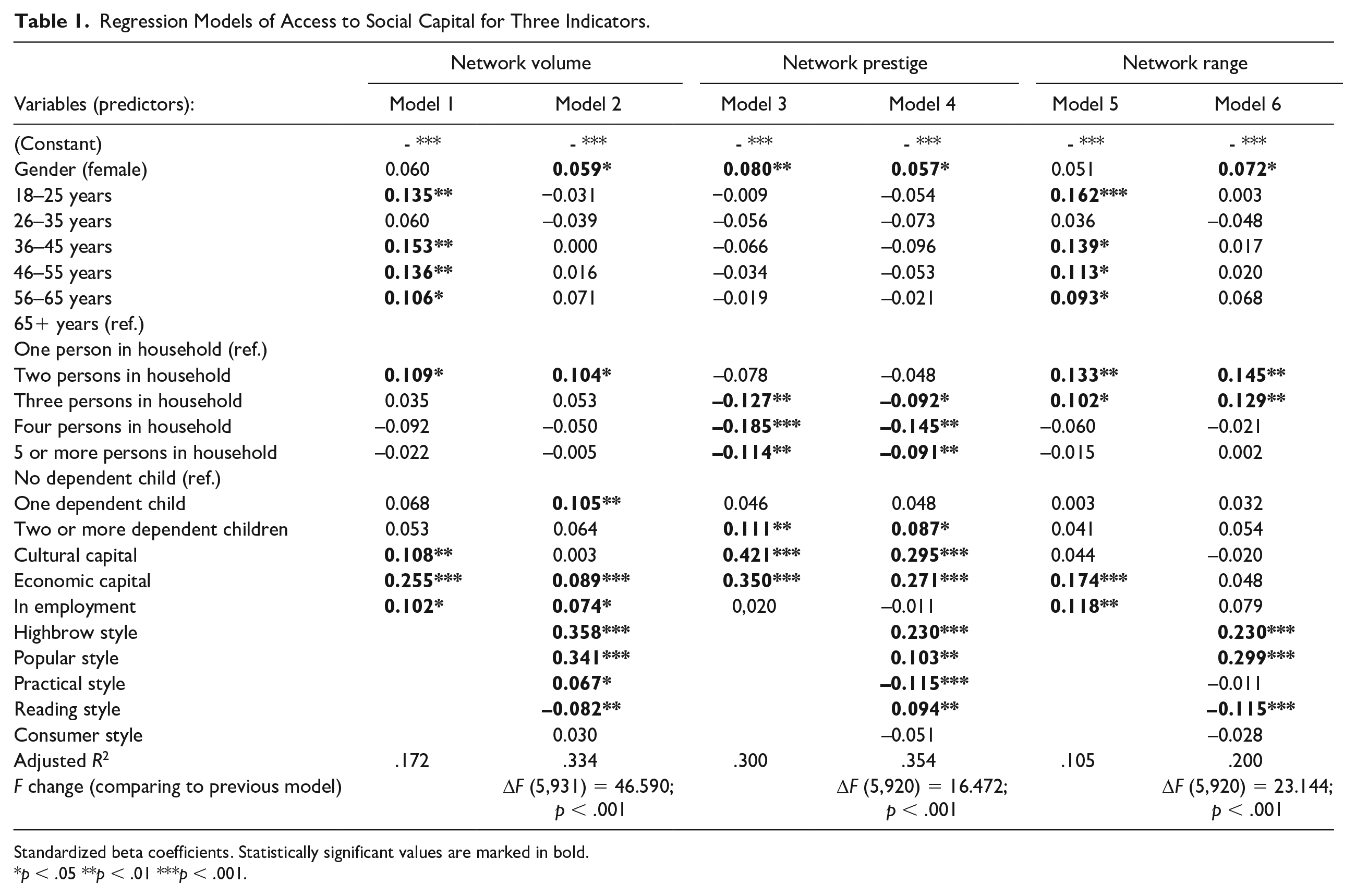
Standardized beta coefficients. Statistically significant values are marked in bold.
p < .05 **p < .01 ***p < .001.
Among the socioeconomic variables of first block, the most important in terms of their predictive value is economic and cultural capital. 10 People who score higher on economic scale show higher indication on all three measures of social capital, that is, get access to larger number of occupations, occupations of higher prestige and more diversified. With respect to cultural capital, it matters mainly in access to higher status jobs. Taken together, this result confirms previous studies (Pena-López et al. 2021; Van Tubergen and Volker 2015) that show that the distribution of social capital is aligned to favor the reinforcement of general social inequality.
In addition, the contribution of the current study is to show the independent predictive value of cultural variables in explaining the distribution of social capital. This is done in Models 2, 4, and 6 of Table 1. These models explain statistically more variance than preceding models (the rise in variance explained ranges from 5.4 percent for network prestige to 16.2 percent for network volume). The most interesting finding is perhaps that different cultural profiles have different consequences for the access to social capital. For network volume (Model 2) we can see that both elite culture (“highbrow style”) and popular culture (“popular style”) are strongly positively associated with the number of occupations accessed (β = .358*** and β = .341***, respectively). In terms of relative input of both variables, the calculated semipartial (part) correlations show that highbrow style explains a little more variance in network volume (rpart2 = 9.49%) than popular style (rpart2 = 7.24%). Additional tests (see Appendix B, Figure B1) that compare people with different configurations of mentioned styles indicate that those scoring above the average on highbrow style and below the average on popular scale do not differ statistically from those with the reverse profile (after controlling for all other variables). This suggests that both highbrow style and popular style have similar importance in explaining network volume. This is in line with the assumed theoretical model (see H3) according to which different cultural tastes may simultaneously help in building connections with people from different walks of life (Cebula 2020; Erickson 1996; Lizardo 2006). An alternative explanation is that having more social contacts facilitates acquiring different taste orientations. The only exception in this case is the “reading style,” which is negatively correlated with the number of ties in the position generator (β = −.082**).
At the same time, some cultural styles are more predestined to create high status networks and networks of greater range. The case of the former is the “highbrow style” (β = .230***) which, next to the “reading style” (β = .094**), is positively associated with having more prestigious contacts in network (Model 4). In contrast, pursuing style associated with lower social class (“practical style”) has a negative effect (β = −.115***) on this aspect of social capital. As expected, access to higher status jobs is less selectively associated with participation in “popular style” (β = .103**; rpart2 = 0.66%) when compared to participation in “highbrow style” (rpart2 = 3.92%). Furthermore, individuals participating above the average in highbrow culture (and below the average in popular culture) have statistically more prestigious networks than those biased more toward popular culture and less toward highbrow culture (p < .01) (Figure B2 in Appendix B). Adding popular style to an already above-average highbrow style no longer increases the average prestige of contacts, which means that the tendency to build higher status network is less a matter of popular culture and more a function of highbrow culture, traditionally tuned to uphold status boundaries (see H1).
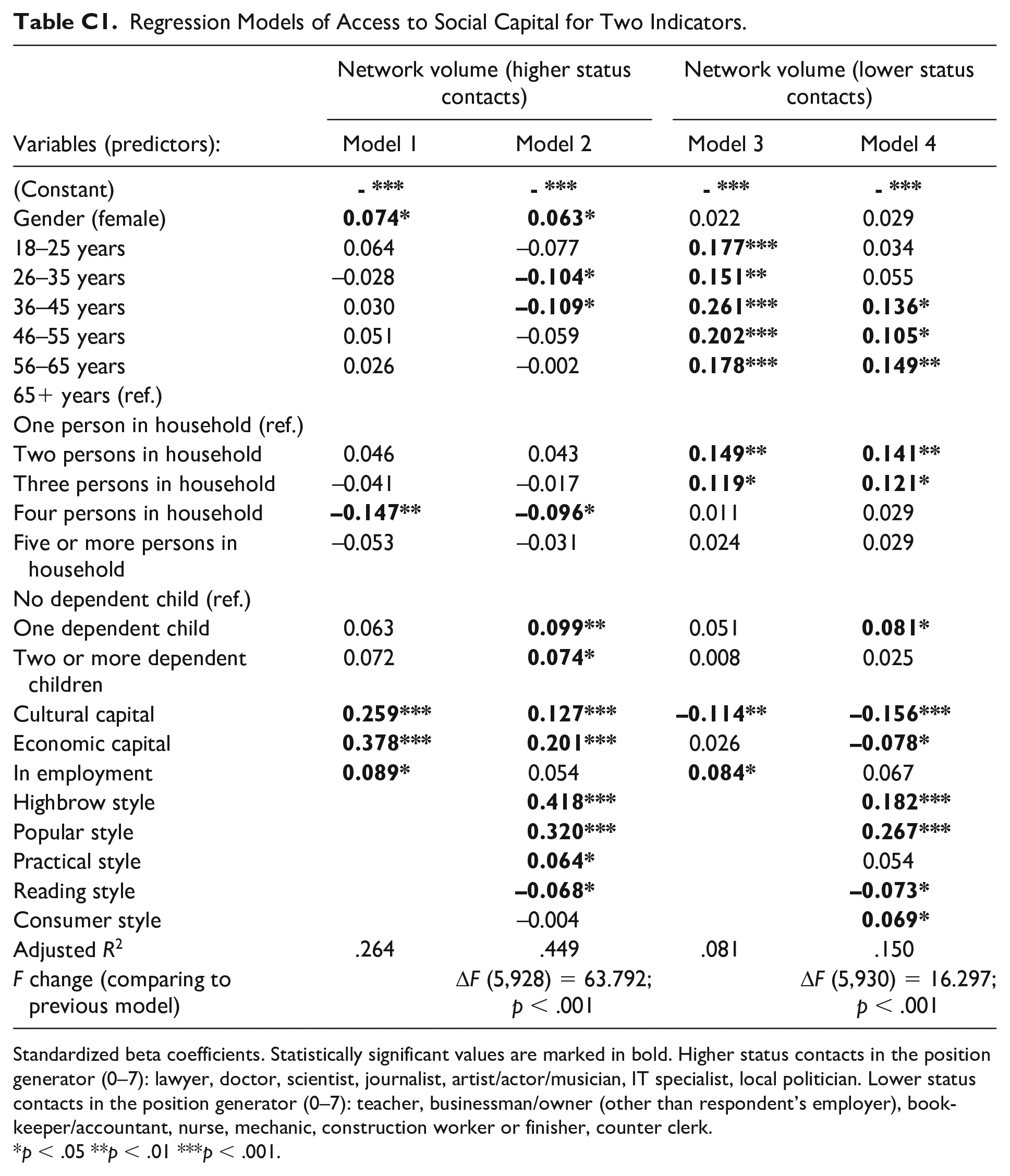
The findings are mainly the same if the dependent variable (average status of alters) is replaced by two separate indices: the number of higher prestige contacts (0–7) and the number of lower-prestige contacts (0–7) (see the Appendix C). As expected, the availability of high-status alters is more a function of the “highbrow style” than the “popular style,” whereas the reverse is true for low-status social ties.
Turning to the network range (Model 6), the findings are largely opposite: here the most significant predictor is “popular style” (β = .299***), explaining 5.57 percent (rpart2) of the total variance of the dependent variable, while the “highbrow style” shows weaker but positive correlation (β = .230***) with an explained variance of 3.88 percent. The “reading style” proved negatively but weakly associated with the outcome variable. Figure B3 in Appendix B depicts no statistical difference with regard to network range between group of above-average participation in popular culture and below-average participation in highbrow culture, and the group of the opposite pattern. Against this background, the expectation expressed in H2 is at best partially met. Both popular and elite culture assist in access to more diverse social contacts and resources available through them.
Network Composition and Cultural Participation
Next, the results for the analysis of social network composition, that is, the proportion of higher-, medium-, and lower class contacts are shown. The estimates in Table 2 inform us that, as expected, higher position in social hierarchy (indicated by economic and cultural capital) meaningfully increases the tendency to form social networks with higher class people and decreases the tendency to keep relations with lower status persons (Models 1, 3, and 5).
Regression Models of Network Composition.
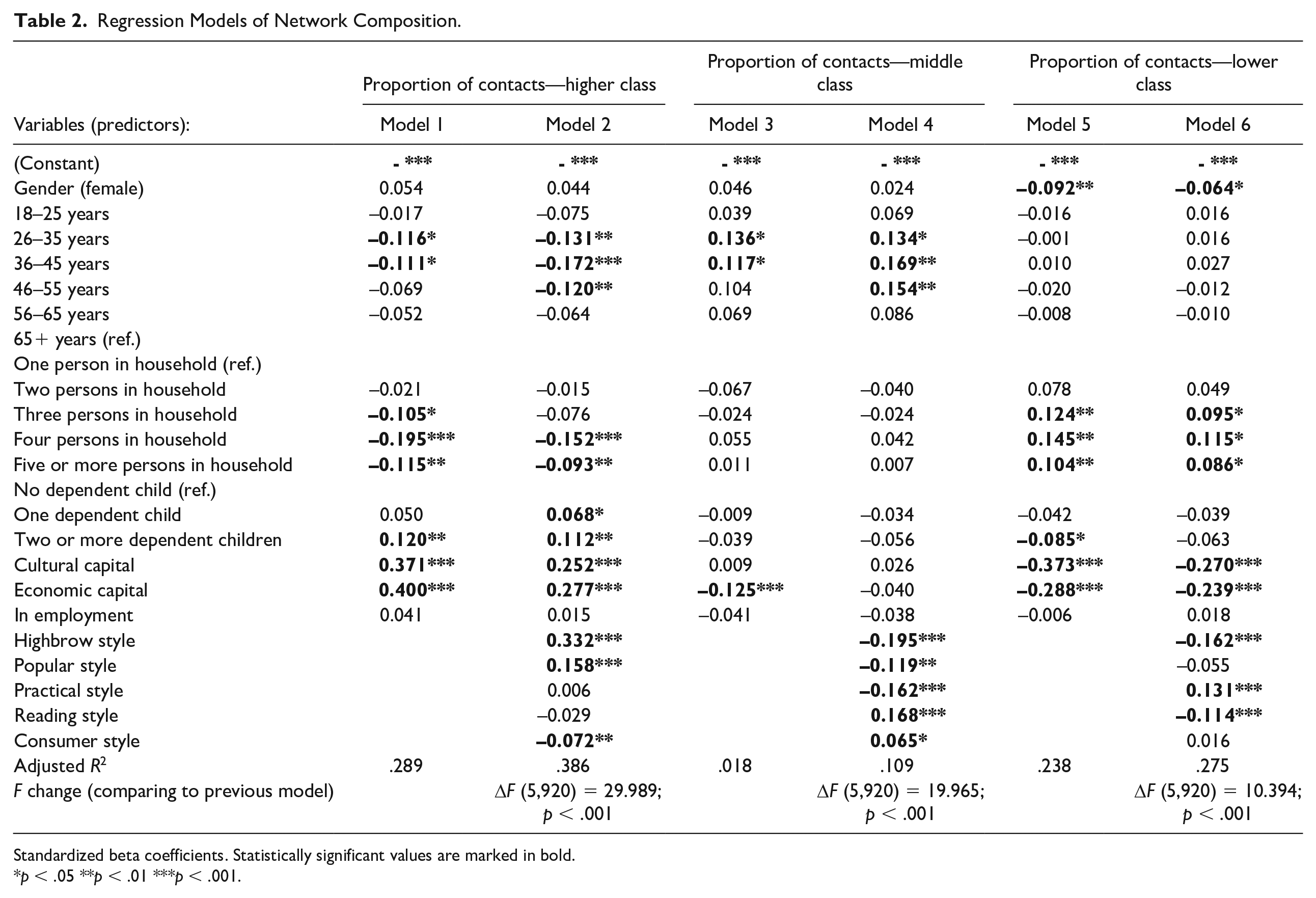
Standardized beta coefficients. Statistically significant values are marked in bold.
p < .05 **p < .01 ***p < .001.
In regard to middle class contacts, their proportion is lower for people with greater economic capital (but not cultural capital). These results indicate that social networks are segregated with respect to social standing and are important means of consolidating social classes (Alecu et al. 2022; Otero et al. 2021).
However of great importance here is that, aside from social standing, cultural participation (in general) is an important predictor of network composition as evidenced by estimates in Models 2, 4, and 6 of Table 2. These models increase the overall variance explained between 3.7 percent for lower class contacts and 9.7 percent for higher class contacts. At the same time the relationships between specific cultural profiles and network composition run in different directions. The pattern that emerges from the data shows that there are some key cultural orientations that account for the network selectivity toward three social classes: the “highbrow style” for higher class contacts (β = .332***); the “reading style” (β = .168***), and, to lesser degree, the “consumer style” (β = .065*) for middle class contacts; and the “practical style” (β = .131***) for lower class contacts. These findings comply with Hypothesis 4. Presumably, these styles of cultural participation represent distinct cultural codes through which members of different classes communicate with each other. In consequence, pursuing a given class code results in having proportionally more social contacts within a class that is associated with this code. The opposite is also true: exposition to specific class contacts facilitates acquiring the relevant class-related lifestyle.
In addition, comparing distinct coefficients in Table 2 we can discern that the highest discriminatory power (regarding social network homogeneity) is shown by the “highbrow style” (β = .332***). This style is positively related to holding connections with higher class members but negatively with middle- (β = −.195***), and lower class members (β = −.162***). Highbrow style accounts for five times more variance in proportion of contacts with upper/upper-middle class (rpart2 = 8.12%; Model 2) than popular style (rpart2 = 1.56%). As depicted in Figure D1 (see Appendix D), individuals pursuing the highbrow style but not the popular style may count on significantly larger proportion of contacts with higher class contacts in their networks (p < .001) than individuals pursuing the popular style but not the highbrow style. Moreover, being an omnivorous consumer (of both styles) does not increase the share of higher-status contacts above the share stemming from being a consumer of only highbrow culture. This all supports our Hypothesis 5 and is in line with our theoretical arguments. Since the access to highest rank networks is of strategic importance in securing social advantages, it is expected that it will be protected by the most demanding and restricted cultural code, that is, highbrow culture (Bourdieu 1984; Nagel et al. 2011; Weber 1978).
Furthermore, there are some noticeable localized class distinctions. People who show tendency to connect with middle class members eschew the “practical style” (β = −.162***) that may be referred to lower social standing. At the same time, those oriented more to lower class contacts present some isolation as they shun the cultural styles most characteristic for higher class (the “highbrow style”: β = −.162***) and middle class (the “reading style”: β = −.114***). A little surprising is the negative association between the “popular style” and the proportion of ties to middle class. A complementary analysis, not depicted here, reveals that both the “popular style” and the “highbrow style” go together with the absolute number of upper-, middle-, and lower-class contacts (in accordance with Model 2 of Table 1). Nevertheless, in relative terms, the network closure within middle class is the stronger, the less frequent participation in popular practices and the greater the attachment to the “reading style.” Perhaps, we have to do with the syndrome of Bourdieusian “cultural goodwill” (Bourdieu 1984)—here in the local version of eschewing what is popular and sticking to the safe option of reading practices as more legitimized and scholarly consecrated. As has been noticed by Griswold et al. (2005), reading books is still held in high esteem in many societies.
In summary, the presented findings quite unequivocally demonstrate that cultural participation is entangled with network composition thus showing that culture is not neutral but is an active means of building class boundaries.
Discussion and Conclusion
This article contributes to the literature on social capital and cultural participation in two ways. First, it expands the existing research program concerning the mutual relationship between cultural tastes (practices) and various social network characteristics that has gained a considerable attention in sociology in recent years (DiMaggio 1987; Erickson 1996; Lewis and Kaufman 2018; Lizardo 2006; Puetz 2015) by asking how these cultural factors are also connected to socioeconomic resources available through the network. Second, the paper takes up a new thread—the composition of social capital (network selectivity) by illuminating the extent to which different cultural participation styles link with the predominance of social ties within specific social classes. In this sense, the article shed light on potential mechanisms whereby culture is used to draw class boundaries and protect resources gathered in higher social positions on the one hand, and build “bridges” between people who share it, on the other hand (Bourdieu 1984; Childress et al. 2021; DiMaggio 1987; Meuleman 2021; Otero et al. 2021; Pena-López et al. 2021). This contribution is achieved by using the position generator methodology (Lin and Dumin 1986; Lin and Erickson 2008; van der Gaag et al. 2008) and exploring a wide array of cultural and leisure practices, clustered in locally-specific styles of cultural participation.
When answering the first research question, the results show that different cultural participation profiles are relevant for an understanding distribution of social capital, that is, network volume, average accessed prestige and network range, even after controlling for socioeconomic variables. In more detail, participation in highbrow culture (represented by the “highbrow style”) was, next to the “reading style” (also associated with elite consumption [Griswold et al. 2005]), consistently positively related to having contacts of, on average, higher prestige. At the same time, the “highbrow style” played a greater role in explaining the access to prestigious networks than the “popular style,” in line with the expectation (see H1). Although, the latter was more systematically positively correlated with the network range, treated as a measure of network resources heterogeneity, additional tests proved no statistical advantage of people plugged into popular culture (but not into highbrow culture) over participants of highbrow culture distancing themselves from popular culture. Rather, it is a combination of two styles that helps span distant network contacts. Therefore, H2 is at best partially confirmed. Both “highbrow style” and “popular style” were comparably significant predictors of the number of contacts in the position generator (see H3). At the same time, the “practical style,” associated with lower social class (Bourdieu 1984) showed a negative association with access to more prestigious social contacts. These findings support our expectations as well as central assumptions of the existing literature regarding mutual relationship between culture and social networks/social capital. According to them, culture is not only a result of participation in existing social networks (a model of influence or contagion) but also shows efficacy in shaping and maintaining social relationships as an identity marker, conversational resource/skill or generalized capital (Lewis and Kaufman 2018; Lizardo 2006; Puetz 2015; Selfhout et al. 2009). What is more, different forms of culture are selectively associated with different network and social capital effects. Highbrow culture is more relevant in explaining higher status contacts because as a restricted cultural code (in double sense of the word: difficult to reciprocate and limited in social range) it is the preferred style of communication among higher status groups. As such it is utilized as a criterion of belonging to, and exclusion from resourceful social networks (Meuleman 2021; Meuleman and Jæger 2023). Popular culture is less discriminatory, but contrary to theoretical expectations, it has not a greater generalized conversion value (Lizardo 2006) understood as a capacity to expand the range of accessible social resources than highbrow culture. This finding is similar to that of Meuleman (2021). The results are rather more consistent with the “omnivorous” scenario (Peterson and Kern 1996; Widdop 2014) according to which, the best results in acquiring social contacts and heterogeneous resources are achieved by combining the “popular style” and “highbrow style” in one repertoire. This pattern creates the best opportunity to communicate with people from different social backgrounds. Overall, the study indirectly proves that culture can be capital if it can be converted into various resources and social networks (Bourdieu 1997).
The results also deliver support for the expected tendency of network selectivity (in terms of social class) depending on cultural participation patterns, regarding to the second research question. Various styles of cultural participation correspond with the tendency of having relatively more contacts within three main social classes: (1) higher class when pursuing the “highbrow style” and eschewing the “consumer style”; (2) middle class when engaging in the “reading style” and avoiding the “practical style,” the “highbrow style,” and the “popular style”; (3) lower class when participating in “practical style” but not in the styles most characteristic for higher and middle class, that is, the “highbrow style” and the “reading style.” In other words, specific cultural profiles seem to be associated with specific network compositions, thus suggesting that these profiles function as communication codes that bind the members of a given class together (see H4). Although the idea that cultural consumption and social class divisions converge is not new (see Bennett et al. 2009; Bourdieu 1984; Jarness 2017), there has not been enough evidence so far that pursuing specific “lifestyles” may be consequential for (or a result of) a tendency to having contacts within different social classes. Furthermore, such tendency (toward social closure) is more pronounced for some cultural styles than others, as in the case of the “highbrow style” associated with higher status contacts. Individuals who engage in this form of participation (but not in the popular form) tend to have a larger proportion of higher-class contacts in their networks than the group with the opposite cultural profile. Moreover, only the “highbrow style” is negatively related to the other two measures of network closure, that is, the relative number of contacts with middle- and lower-class, as predicted in H5. Following Bourdieu (1984) and Weber (1978) (see also Murphy 1988; Parkin 1974), one can argue that members of higher class may (consciously or unconsciously) seek to preserve the social resources and thus establish cultural barriers of inclusion and exclusion to profitable social networks. This underlines the theories about particularized conversion value of highbrow culture (DiMaggio 1987; Meuleman 2021; Meuleman and Jæger 2023) and point at a more general issue that culture is not innocent and may be used to sustain and strengthen social inequalities (Bourdieu 1984). In Lamont’s parlance (Lamont 1992; Lamont and Fournier 1992; Lamont and Molnár 2002), we can talk about the relationship between symbolic boundaries (i.e., conceptual distinctions of reality that social actors draw) and real divisions (social boundaries) that flow from them. So far, few studies have empirically demonstrated the role of cultural consumption in the processes of exclusion and monopolization of opportunities and advantages from the perspective of social networks (Jarness 2017).
The findings should be considered in light of several limitations. Methodologically, the study is cross-sectional in design. Although it suggests causal efficacy of cultural variables in access to social capital and network composition, it is also possible that social capital and networks may affect adopting specific cultural participation patterns. Without a panel data tracing the shift in cultural tastes and practices as well as configurations of social ties in time, adjudicating between the mechanisms of selection and influence is extremely hard to be achieved. Some previous studies (Lewis and Kaufman 2018; Lizardo 2006; Meuleman 2021; Selfhout et al. 2009) have shown that effect of cultural variables on social networks characteristics is stronger than the effect of network characteristics on cultural tastes and that previous cultural similarity between individuals leads to the formation of social connection between them in the future. Nevertheless, one should not attempt to draw causal conclusions based on this study.
Second, while a useful device for estimating the general accessibility of social resources and the structure of web of contacts, the position generator has also some limitations. It has been designed to measure the latent utility of social contacts before they are activated and thus it cannot indicate what kind of resources are or may be mobilized in purposive actions and with what results (van der Gaag et al. 2008). The future studies could incorporate other measures of social capital (e.g., the resource generator [van der Gaag and Snijders 2005]) to confirm the foregoing conclusions and shed more light on what specific kind of resources are connected with different cultural participation profiles (see e.g. Cebula and Perchla-Włosik 2023).
Third, the observational character of research data precludes the investigation of the mechanisms whereby cultural participation is (potentially) translated into network configurations and access to resources. It is unspecified whether it is talking about cultural interests, participating in the same activities or presenting specific cultural profiles that bind people together (cf. Lewis and Kaufman 2018). The future research should tread in Roza Meuleman and Mads Meier Jæger’s (2023) footsteps and probe into social expressions of cultural tastes and their consequences for network building, access to social resources and social exclusion.
Fourth, although the measurement of cultural participation has been designed with the local cultural ecology in mind (Lewis and Kaufman 2018) by grounding it in previous research (Błaszczyk and Cebula 2016; Cebula 2019) and using an inductive approach, it is still uncertain how well it captures cultural differences. I only examined what people consume, but not how they demonstrate or appropriate culture (Jarness 2015) nor what specific content (meaning) lies behind the broad categories of “going to the opera” or “going to the restaurant, café or pub.” One could argue that within types of activities, various forms of cultural legitimacy and taste might exist (Childress et al. 2021). In this respect, the study does not address new forms of cultural distinction such as cultural eclecticism, openness or emergent cultural capital (e.g., Prieur and Savage 2013). Nevertheless, the styles of cultural participation that emerge from the analysis are interpretable and chime with other research (Bourdieu 1984; Kajdanek et al. 2022; Meuleman 2021; Van Eijck 2001).
Finally, the data source used in this study is restricted to the population of inhabitants of one city in Poland. This puts some limits on generalizability to the entire population of adult Poles. However, the studied social processes are sufficiently generic social mechanisms that one can imagine them functioning in similar ways in other contexts and samples. For example, the results confirmed that access to social capital as well as network composition are highly dependent on one’s position in social hierarchy—a finding that is consistent across multiple social contexts (Contreras et al. 2019; Lin 2001; Pena-López et al. 2021; Van Tubergen and Volker 2015).
Despite these limitations, the study is one of the first to demonstrate the conversion of cultural participation into network resources and network closure.
Footnotes
Appendix A
Cultural Practices: Percentage Who Participated in Selected Activities.
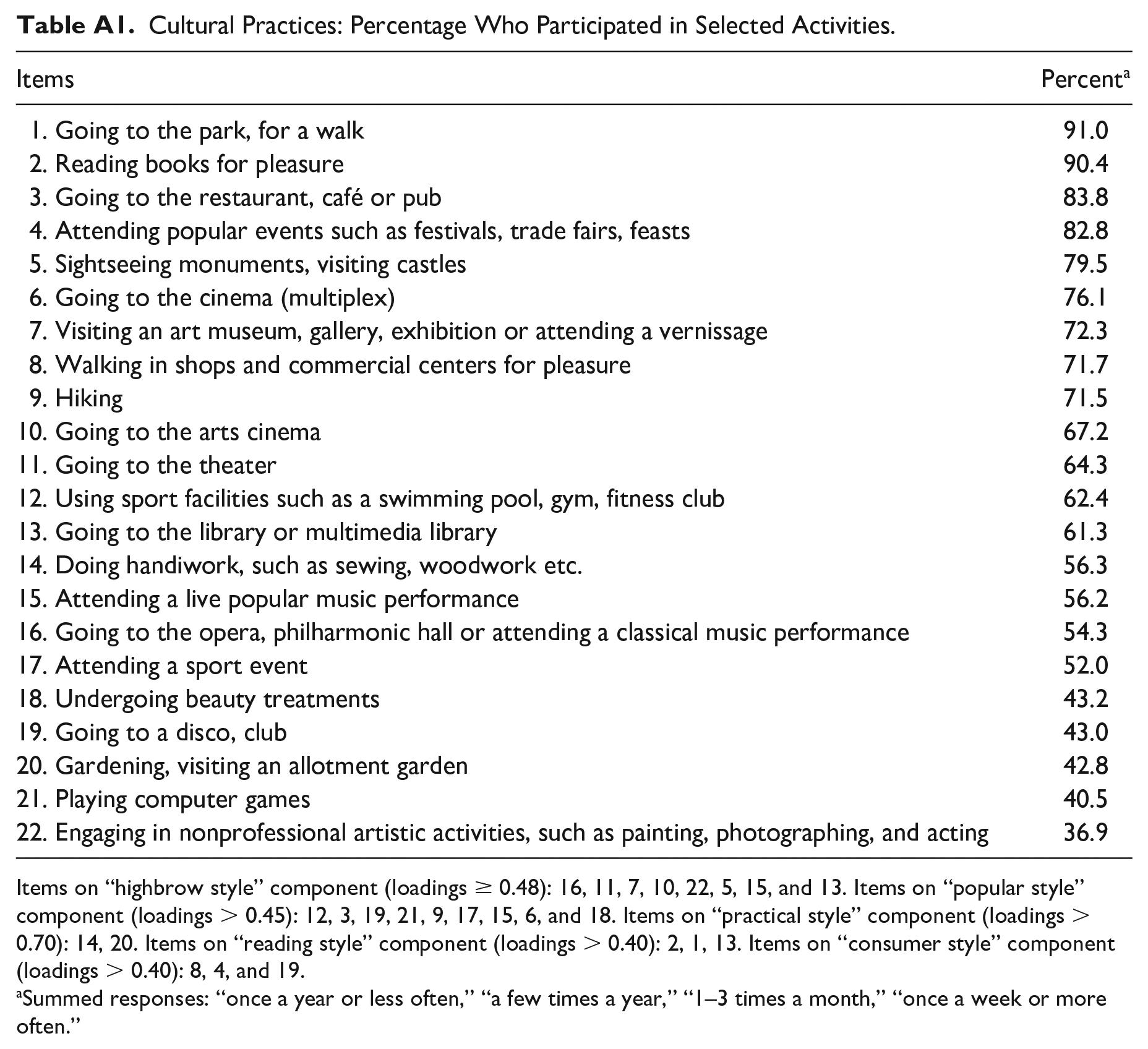
| Items | Percent a |
|---|---|
| 1. Going to the park, for a walk | 91.0 |
| 2. Reading books for pleasure | 90.4 |
| 3. Going to the restaurant, café or pub | 83.8 |
| 4. Attending popular events such as festivals, trade fairs, feasts | 82.8 |
| 5. Sightseeing monuments, visiting castles | 79.5 |
| 6. Going to the cinema (multiplex) | 76.1 |
| 7. Visiting an art museum, gallery, exhibition or attending a vernissage | 72.3 |
| 8. Walking in shops and commercial centers for pleasure | 71.7 |
| 9. Hiking | 71.5 |
| 10. Going to the arts cinema | 67.2 |
| 11. Going to the theater | 64.3 |
| 12. Using sport facilities such as a swimming pool, gym, fitness club | 62.4 |
| 13. Going to the library or multimedia library | 61.3 |
| 14. Doing handiwork, such as sewing, woodwork etc. | 56.3 |
| 15. Attending a live popular music performance | 56.2 |
| 16. Going to the opera, philharmonic hall or attending a classical music performance | 54.3 |
| 17. Attending a sport event | 52.0 |
| 18. Undergoing beauty treatments | 43.2 |
| 19. Going to a disco, club | 43.0 |
| 20. Gardening, visiting an allotment garden | 42.8 |
| 21. Playing computer games | 40.5 |
| 22. Engaging in nonprofessional artistic activities, such as painting, photographing, and acting | 36.9 |
Items on “highbrow style” component (loadings ≥ 0.48): 16, 11, 7, 10, 22, 5, 15, and 13. Items on “popular style” component (loadings > 0.45): 12, 3, 19, 21, 9, 17, 15, 6, and 18. Items on “practical style” component (loadings > 0.70): 14, 20. Items on “reading style” component (loadings > 0.40): 2, 1, 13. Items on “consumer style” component (loadings > 0.40): 8, 4, and 19.
Summed responses: “once a year or less often,” “a few times a year,” “1–3 times a month,” “once a week or more often.”
Appendix B
Figures B1 to B3 depict the effects of highbrow/popular style configuration on three indicators of social capital. These effects are OLS regression coefficients for dummy variables from models including socio-demographic controls (as in Table 1), practical style, reading style, and consumer style. Parameters that share no letter in their subscript differ significantly from one another. In order to create the highbrow/popular style configuration, both variables (z-scores) were dichotomized by the mean value (0) and then cross-tabulated to create four categories. Values above the average are signed “+” and those below the average “-”. The category “highbrow style (-); popular style (-)” is a reference category in model.
Appendix C
Regression Models of Access to Social Capital for Two Indicators.
| Variables (predictors): | Network volume (higher status contacts) | Network volume (lower status contacts) | ||
|---|---|---|---|---|
| Model 1 | Model 2 | Model 3 | Model 4 | |
| (Constant) |
|
|
|
|
| Gender (female) |
|
|
0.022 | 0.029 |
| 18–25 years | 0.064 | –0.077 |
|
0.034 |
| 26–35 years | –0.028 |
|
|
0.055 |
| 36–45 years | 0.030 |
|
|
|
| 46–55 years | 0.051 | –0.059 |
|
|
| 56–65 years | 0.026 | –0.002 |
|
|
| 65+ years (ref.) | ||||
| One person in household (ref.) | ||||
| Two persons in household | 0.046 | 0.043 |
|
|
| Three persons in household | –0.041 | –0.017 |
|
|
| Four persons in household |
|
|
0.011 | 0.029 |
| Five or more persons in household | –0.053 | –0.031 | 0.024 | 0.029 |
| No dependent child (ref.) | ||||
| One dependent child | 0.063 |
|
0.051 |
|
| Two or more dependent children | 0.072 |
|
0.008 | 0.025 |
| Cultural capital |
|
|
|
|
| Economic capital |
|
|
0.026 |
|
| In employment |
|
0.054 |
|
0.067 |
| Highbrow style |
|
|
||
| Popular style |
|
|
||
| Practical style |
|
0.054 | ||
| Reading style |
|
|
||
| Consumer style | –0.004 |
|
||
| Adjusted R2 | .264 | .449 | .081 | .150 |
| F change (comparing to previous model) | ΔF (5,928) = 63.792; p < .001 | ΔF (5,930) = 16.297; p < .001 | ||
Standardized beta coefficients. Statistically significant values are marked in bold. Higher status contacts in the position generator (0–7): lawyer, doctor, scientist, journalist, artist/actor/musician, IT specialist, local politician. Lower status contacts in the position generator (0–7): teacher, businessman/owner (other than respondent’s employer), book-keeper/accountant, nurse, mechanic, construction worker or finisher, counter clerk.
p < .05 **p < .01 ***p < .001.
Appendix D
Declaration of Conflicting Interests
The author(s) declared no potential conflicts of interest with respect to the research, authorship, and/or publication of this article.
Funding
The author disclosed receipt of the following financial support for the research, authorship, and/or publication of this article: This work was supported by the National Science Centre, Poland under grant number 2016/21/D/HS6/02424.
