




Abstract
Though some frameworks suggest that siblings deplete family resources, alternative conceptualizations suggest that siblings, particularly in working-class and minoritized families, are pivotal sources of educational support that may replenish familial capital. Drawing on 41 in-depth interviews with Latino first-generation college students, this study addresses how siblings negotiate educational support. This study builds and extends prior literature on familial capital by proposing that college attendance generates additional resources that (re)shape family obligations and expectations, a process I refer to as the sibling intragenerational bargain. In negotiating the sibling intragenerational bargain, Latino students seek to (1) contribute to the family’s intragenerational mobility by providing educational support and/or (2) repay sibling sacrifices and help with their academic success. Furthermore, birth order and sibling educational attainment shape how students negotiate the sibling intragenerational bargain. This study shows how Latino first-generation siblings (older and younger) are agentic producers of familial capital.
A four-year college degree promotes upward mobility (Torche 2011), yet not all students have equal access to a college education (Astin and Oseguera 2004). For example, Latinos are the largest ethnic minority in the United States (comprising 18 percent of the population) but are half as likely as their White counterparts to graduate from college (Fry 2005). Latinos are also more likely to be first-generation college students 1 compared to other racial/ethnic groups (Latino et al. 2020). Latino first-generation college (LFGC) students often face barriers such as limited access to information about higher education, limited financial resources, and inhospitable campus climates that contribute to disparities in college enrollment and completion (Conchas 2001; Gonzalez 2015; Lopez 2003). Given the barriers LFGC students often face, it is important to consider the sources of support that facilitate educational attainment.
The family is one site of educational support that mitigates and exacerbates intergenerational inequality (e.g., Lareau 2011). For instance, Latino immigrant working-class parents—who are often not familiar with the norms, expectations, and procedures of higher education—are essential sources of educational support but are limited in their ability to help children navigate school environments (Ceja 2004, 2006; Valdés 1996). Thus, LFGC students often rely on siblings for educational help (Azmitia, Cooper, and Brown 2009; Lanuza 2017). Although some research documents how siblings deplete familial resources (Coleman 1988; Downey 1995), alternative research suggests that children perceive siblings to be integral sources of educational support that promote higher education in first-generation college families (Ceja 2006; Pérez and McDonough 2008; Yosso 2005). LFGC siblings, hence, can help (re)position children on a path of upward mobility by generating familial capital, conceptualized as educational resources (instrumental, emotional, and financial) that are embedded in families and have the potential to shape not only individuals but also family members (Roksa et al. 2020).
Research documenting the importance of LFGC sibling educational support, however, typically focuses on the capital contributions of older college-going siblings in K–12, emphasizing the college choice process (Ceja 2006; González, Stoner, and Jovel 2003; Pérez and McDonough 2008), and thus suggests that sibling transfers of educational support are top-down. Older siblings with college experience generate familial capital, and younger siblings are passive recipients of said capital. A hierarchical (older-younger) focus on the nature of LFGC sibling educational support fails to consider the agentic role of younger siblings in assisting the educational journeys of older siblings. It is important to consider reciprocity in LFGC sibling relationships to gain a more holistic picture of siblings’ contributions to familial capital. Considering how siblings produce familial capital can illuminate how families negotiate intragenerational mobility, a process where siblings hold the potential to positively shape siblings’ educational experiences (Hamilton, Roksa, and Nielsen 2018; Roksa 2019; Roksa et al. 2020).
This study expands the scope of familial capital to examine how LFGC students negotiate educational support during the transition to young adulthood. I draw on 41 semi-structured interviews with LFGC students to explore how students frame siblings’ educational contributions to intragenerational mobility. The data reveal that LFGC students conceptualize siblings as key sources of educational support beyond the college choice process, a process I term the sibling intragenerational bargain. I argue that college attainment generates additional knowledge and resources for LFGC families that (re)shape familial expectations and obligations. In negotiating the sibling intragenerational bargain, LFGC students are motivated to succeed academically to (1) contribute to the family’s future mobility and/or (2) repay the academic help and familial sacrifices made by siblings. The sibling intragenerational bargain considers how sibling characteristics such as birth order and sibling educational attainment shape LFGC student exchanges of educational support in three ways. First, older non-college-going Latino siblings provide younger college-going siblings with pivotal emotional and financial support. Second, older college-going Latino siblings nurture younger high school-going siblings’ educational trajectories through role modeling and by helping them develop strong college portfolios. Third, Latino siblings attending college together during the transition to young adulthood experienced a reciprocal exchange of educational support whereby siblings support one another’s college trajectories. These findings point to the value of considering how siblings make sense of their educational contributions as sources of replenishment—an alternative perspective from depletion—in secondary and postsecondary education.
Background
Siblings as Replenishing Sources of Familial Capital
The resource dilution model is a prominent framework used to explain the relationship between familial resources and children’s educational outcomes. This model posits that as the number of children in a family increases, the amount of time, energy, and resources parents can devote to children decreases (Downey 1995). Studies find that increases in sibling size groups impair educational attainment (Downey 2001; Grätz 2018; Jæger 2009; Steelman et al. 2002). Although the resource dilution model explains how siblings shape children’s educational outcomes, this model historically pays less attention to how children in non-White families frame siblings as sources of educational support (see review McHale, Updegraff, and Whiteman 2012). This omission is consequential as cultural and socioeconomic factors uniquely shape familial capital, including sibling contributions (Lareau 2011; Yosso 2005). Examining how children perceive sibling educational support in diverse family contexts may illuminate supplementary processes of familial capital that facilitate intragenerational mobility.
A community of cultural wealth framework (Yosso 2005), which takes a strength-based approach to the knowledge and support of minoritized students, suggests that siblings of color from working-class backgrounds hold valuable capital that augments educational resources in families. Children support family needs by helping take care of siblings, helping with siblings’ schoolwork, and being advocates for siblings’ wellbeing (Flores 2018; Lanuza 2017; Valenzuela 1999). Siblings also nurture familial capital by promoting sibling college attendance, a social process that is more salient for disenfranchised families (Azmitia et al. 2009; González et al. 2003; C. M. Smith 2020; Zang et al., 2023). As siblings transition to college, they continue to contribute skills and knowledge to the family (Lanuza 2020; Lanuza and Bandelj 2015; Ovink 2014; Sy and Romero 2008; Wiggins, Harrington, and Gerstel 2023). For instance, Jospia Roksa (2019) finds that siblings in disenfranchised families do not only dilute financial resources but also invite increased contributions (financial and emotional). Thus, Roksa (2019) calls for a resource dilution model revision to include bidirectional flows of familial resources to capture complementary processes that may contribute to family capital over the life course. Yet, sibling bidirectional flows of familial capital are understudied. It is important to account for the multiple strengths of LFGC families and center sibling-sibling educational support to better understand the familial dynamics of intragenerational resource transmission (Luedke 2020; Roksa 2019). Given the interconnectedness of the family, children may view siblings as integral sources of educational support that replenish familial capital.
LFGC Student Family Support and Educational Trajectories
Parents are important sources of academic support for LFGC students. LFGC parents, who often highly value education, provide encouragement, consejos (nurturing advice), and financial support to champion the education of their children (Ceballo 2004; Early 2010; Espino 2016; Gloria and Castellanos 2012). Although parental support is a strong predictor of LFGC student success (Ceballo 2004; Ceja 2004, 2006), structural constraints make it difficult for Latino parents from working-class and/or immigrant backgrounds to help children decode the hidden curriculum of college (Ceballo 2004; Ceja 2004, 2006; Hurtado-Ortiz and Gauvian 2007). Thus, siblings, who may be more familiar with the U.S. educational system, may take on increased importance in LFGC families.
Motivated in part by cultural values like familismo—characterized by the prioritization of family unity (nuclear and extended) and the expectation of support—LFGC siblings are valuable sources of educational support (Ceja 2006; Hurtado-Ortiz and Gauvian 2007; Pérez and McDonough 2008). Older LFGC siblings serve as educational guides that help nurture younger siblings’ college trajectories with language acquisition (Kibler, Palacios, and Baird 2014), academic motivation (Alfaro and Taylor 2010; Flores 2018; Puente and Simpkins 2019; Valenzuela 1999), reading comprehension (Delgado 2023), and homework assistance (Azmitia et al. 2009; Lanuza 2017; Ramos Carranza and Simpkins 2021). Older LFGC siblings function as role models that pave the way for younger siblings to follow in their footsteps, a dynamic that can be bolstered by parents (Altmejd et al. 2021; Aquilino 2006; Hamewey et al. 2019; Loury 2004; Sáenz et al. 2020; C. M. Smith 2020). Older LFGC siblings seek to set a good example to younger siblings to show younger siblings that college is attainable (Dueñas and Gloria 2024; Patrón 2020). As younger Latino siblings develop concrete college plans, older LFGC siblings provide information about the college application process. Younger Latino siblings in first-generation college families often rely on older college-going siblings to develop college materials, complete financial aid materials, and select colleges (Ceja 2006; Luedke 2020; Pérez and McDonough 2008; Ramirez 2011; Sáenz et al. 2020). The educational support of Latino siblings is often a gendered process that involves older sisters undertaking significant caretaking roles compared to brothers (Flores 2018; Lopez 2003; Ovink 2014; Sáenz et al. 2020). Although the academic contributions of older LFGC siblings are well documented, because parents have remained the foci of social mobility studies, questions remain about how intrafamily dynamics shape sibling negotiations of educational support in transitions to young adulthood.
Studies highlighting the importance of sibling educational support in LFGC families tend to overlook the agentic role of younger siblings in the production of familial capital. Yet, in the transition to young adulthood, LFGC students may experience an increased sense of family obligation which may be consequential in how older and younger siblings negotiate educational support (Fuligni 2007; Fuligni and Pedersen 2002; Killoren et al. 2017). Studying how LFGC siblings engage in educational support during the transition to young adulthood, thus, may reveal emergent patterns of sibling educational support. Moreover, few studies consider how family dynamics such as birth order and differences in sibling educational attainment shape LFGC educational support. For instance, the contributions of older Latino non-college-going siblings are seldom explored. It is important to consider how younger Latino college-going students make sense of non-college-going educational support to holistically assess the availability of familial capital to students. Though older non-college-going Latino siblings may not possess first-hand experiences of college (positive or negative) to help younger siblings navigate college environments, we may expect their familial contributions to mirror those of LFGC parents (Ceballo 2004; Gloria and Castellanos 2012). Older non-college-going Latino siblings similar to their parents can be funds of emotional and financial support that encourage younger LFGC siblings to pursue higher education (Dueñas and Gloria 2024; Matos 2015). Yet older non-college-going Latino siblings, like first-generation college parents, may frame their educational trajectory as a counter example younger siblings should not follow and may see their investment in younger siblings’ education as the family’s last chance to achieve social mobility (Gofen 2009; Harper, Zhu, and Kiyama 2020; Lee 2016; Rondini 2015). To capture the nuances of LFGC educational support, it is necessary to explore how students make sense of the contributions of generally overlooked family members: siblings.
Extending the Immigrant Bargain: How Latino Siblings Negotiate the Sibling Intragenerational Bargain
Although family and education scholars have considered how diverse family contexts are sites of educational resources for minoritized students, parent-child relationships have remained the focus of social mobility research. The salience of siblings in generating familial capital has been generally overlooked (see a review in McHale et al. 2012). Questions remain about how students (re)negotiate sibling educational support during the transition to young adulthood while in college, a life transition marked by increased autonomy and exploration (Fuligni 2007; Fuligni and Pedersen 2002). This study extends prior research on the role of the family in the educational experience of LFGC students and offers a conceptual framework situated in an asset-based approach that considers sibling dynamics and captures bidirectional flows of support beyond the college choice process: the sibling intragenerational bargain.
I draw on the immigrant bargain (Louie 2012; R. Smith 2006), which posits that immigrant children seek to repay the sacrifices made in parental migration with educational success, to argue that LFGC families negotiate a sibling intragenerational bargain. The sibling intragenerational bargain shifts the focus from parent-child relationships and immigration status and instead centers sibling-sibling relationships to understand how students navigate providing and/or receiving educational support. This study shows that students use siblings as a frame of reference to succeed academically and view siblings as valuable educational resources that contribute to the family’s upward mobility. In doing so, the sibling intragenerational bargain extends literature on the community of cultural wealth by identifying siblings as a cultural asset embedded in families that possess resources, skills, and knowledge to help siblings navigate the educational context (Yosso 2005). The supplementary role siblings play in educational trajectories, particularly for first-generation students, generates an indebtedness that siblings aim to repay with academic success in the hopes of (re)positioning families on the path of social mobility (Louie 2012).
Expanding on frameworks documenting how elder siblings’ educational support uniquely transforms familial relationships (e.g., Flores 2018, 2021), the sibling intragenerational bargain broadens the scope of sibling care work to illuminate two distinct social processes. First, the sibling intragenerational bargain pays close attention to how sibling dynamics (including birth order and differences in sibling educational attainment) shape the negotiation of sibling educational support. Understanding differences in sibling experiences by characteristics such as birth order and educational attainment can reveal dynamic dimensions of intrafamily support. Second, the sibling intragenerational bargain is attuned to reciprocity processes of sibling educational support over the life course. It is important to consider the relational components of sibling relationships to capture changes in sibling educational support over time, including beyond the college choice process. Though prior sibling care work research emphasizes the hierarchal nature of sibling relationships where older siblings are givers of educational support and younger siblings are receivers of support (Ceja 2006; Flores 2018, 2021; Pérez and McDonough 2008), the sibling intragenerational bargain illuminates how sibling support transforms from hierarchal to more egalitarian exchanges during shared life transitions like college. For LFGC families, the sibling intragenerational bargain posits that older Latino siblings regardless of college experience aid intragenerational mobility by actively supporting the educational trajectories of younger LFGC siblings. Younger LFGC siblings, who are the passive receivers of said support, seek to repay older siblings’ educational help with academic success. Younger LFGC siblings, however, become active producers of familial capital when older and younger siblings experience life transitions (e.g., attending college) at the same time, thus illuminating bidirectional flows of educational support. The sibling intragenerational bargain offers a framework that emphasizes the agentic role of both older and younger siblings to illuminate how sibling characteristics (e.g., birth order and educational attainment) and reciprocity processes generate additional educational resources for families.
Methods
I draw on 41 in-depth semi-structured interviews with college students who (1) self-identified as Latino, (2) had parents who did not graduate college, and (3) had at least one sibling. I recruited one college-going sibling per family unit from 2018 to 2019 through flyers, emails, class announcements, and social media platforms at a Southern California university, which is designated as a Hispanic-Serving Institution (HSI). California is a prime location for this study because of its high Latino population (39.4 percent) (U.S. Census Bureau 2020) and its growing HSI designation (46 emerging HSIs in the 2018–2019 academic year) (Excelencia in Education 2020). Thus, it is imperative that California colleges understand the role of the family in LFGC student trajectories and how this support system operates in the college context.
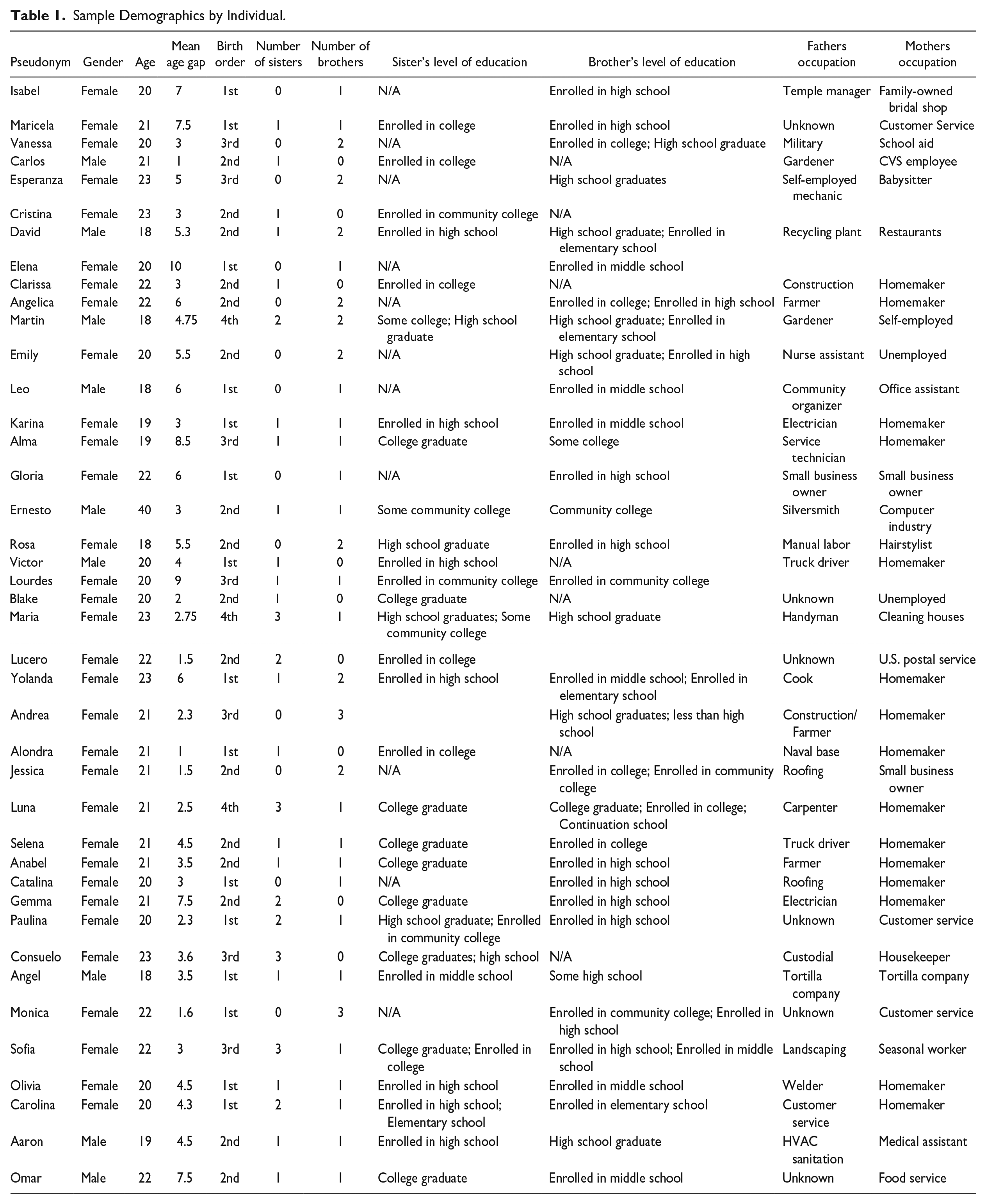
Table 1 provides sample characteristics by individuals. Most participants were women (78 percent), reflecting the overrepresentation of Latinas in higher education (Lopez 2003). Participants grew up in working-class backgrounds with parents’ occupations including housekeeping, landscaping, and construction. Participants are, on average, 21 years old (with an age range of 18–40 years). Most participants are the firstborn (37 percent) or secondborn (34 percent) in their family. Participants on average had two siblings. About one fourth (24 percent) of the sample has one sibling, nearly half (46 percent) has two siblings, and one third (30 percent) has more than three siblings. Because most participants had more than one sibling, the sample includes a combination of the following sibling educational experiences: siblings enrolled in K–12 (58 percent), siblings who are high school graduates but have no college experience (24 percent), and siblings enrolled in college or are college graduates (41 percent). Most participants (54 percent) are older siblings who are the first in the sibling constellation to enroll in college.
Sample Demographics by Individual.
I captured a range of college experiences by recruiting students through class announcements, identity-based clubs (e.g., Mesa Unida, Society of Hispanic Professional Engineers), professional clubs (e.g., Business Association, Teachers of Tomorrow), sororities and fraternities, and residential areas. After gaining initial access, a snowball sampling technique was used to identify additional participants (Goodman 1961). The study procedure included in-person semi-structured interviews with one family member—college-going sibling—to explore how the transition to young adulthood transforms sibling educational support in college. Although the data reflect the perspective of one family member, the interview protocol asked participants to reflect on each sibling relationship independently in addition to asking about the role of parents, extended family, friends, teachers, and counselors in their college trajectories. Examples of questions included in the interview guide were as follows: “Tell me about your parent/sibling(s)’ involvement in the college application process?” and “What kind of support did they provide?” I adopted a sequential interviewing technique to test interview findings and to assess how these resonated with students (Small 2009). For example, drawing from the perspective of being an older sibling, the interview guide was keenly acute to the ways older siblings provided educational support. However, initial interviews revealed how younger siblings also served as sources of educational support to older siblings. Thus, I modified the interview guide to ask about reciprocity in sibling educational support.
Interviews ranged one to three hours in length, were audio-recorded, and were later professionally transcribed verbatim. I reviewed all transcripts for accuracy, and in instances where participants seamlessly transitioned from English to Spanish, I did the Spanish translation manually. I assigned all participants pseudonyms to protect their privacy. I conducted all interviews in person at the location and time most convenient to students. Participants received a $5 gift card for their participation. My status as a Mexican-American first-generation college student facilitated building rapport and trust with participants (Zinn 2001). For example, although recruitment materials were advertised in English, participants often unpromptedly spoke Spanish or Spanglish during interviews. As a native Spanish speaker, I was able to engage with participants and culturally connect with bilingual participants. This study was approved by the institutional review board of my university.
I used Dedoose, qualitative coding software, to complete data analysis. Data analysis occurred in two stages. In the first stage, I used index coding to identify broad themes derived from interview questions and existing literature, such as parent relationships, sibling relationships, and educational experiences (Deterding and Waters 2021). In the second stage, I conducted inductive coding of the deductive code “sibling relationships.” The deductive code “sibling relationships” included any discussions of sibling interactions past or present. The inductive coding identified additional themes that emerged in the data related to educational support (Charmaz 2006; Deterding and Waters 2021). Examples of these themes included sibling high school advice, sibling involvement in the college application process, financial and emotional support, and career advice. I wrote analytic memos for each participant noting the type of educational support received and/or given and paid close attention to differences in birth order and sibling educational attainment.
Findings
The Sibling Intragenerational Bargain: Negotiating Sibling Relationships and Generating Educational Resources
LFGC siblings are important sources of academic support. This study finds that LFGC students frame siblings as positive contributors of familial capital and illuminates the heterogeneous ways siblings are academic socializers. This study shows how birth order scripts and siblings’ diverse educational pathways generate additional resources for LFGC families, which shape sibling expectations and obligations, a process I term the sibling intragenerational bargain. I find that LFGC students broker the sibling intragenerational bargain by providing academic support to siblings and/or by repaying said support with academic success.
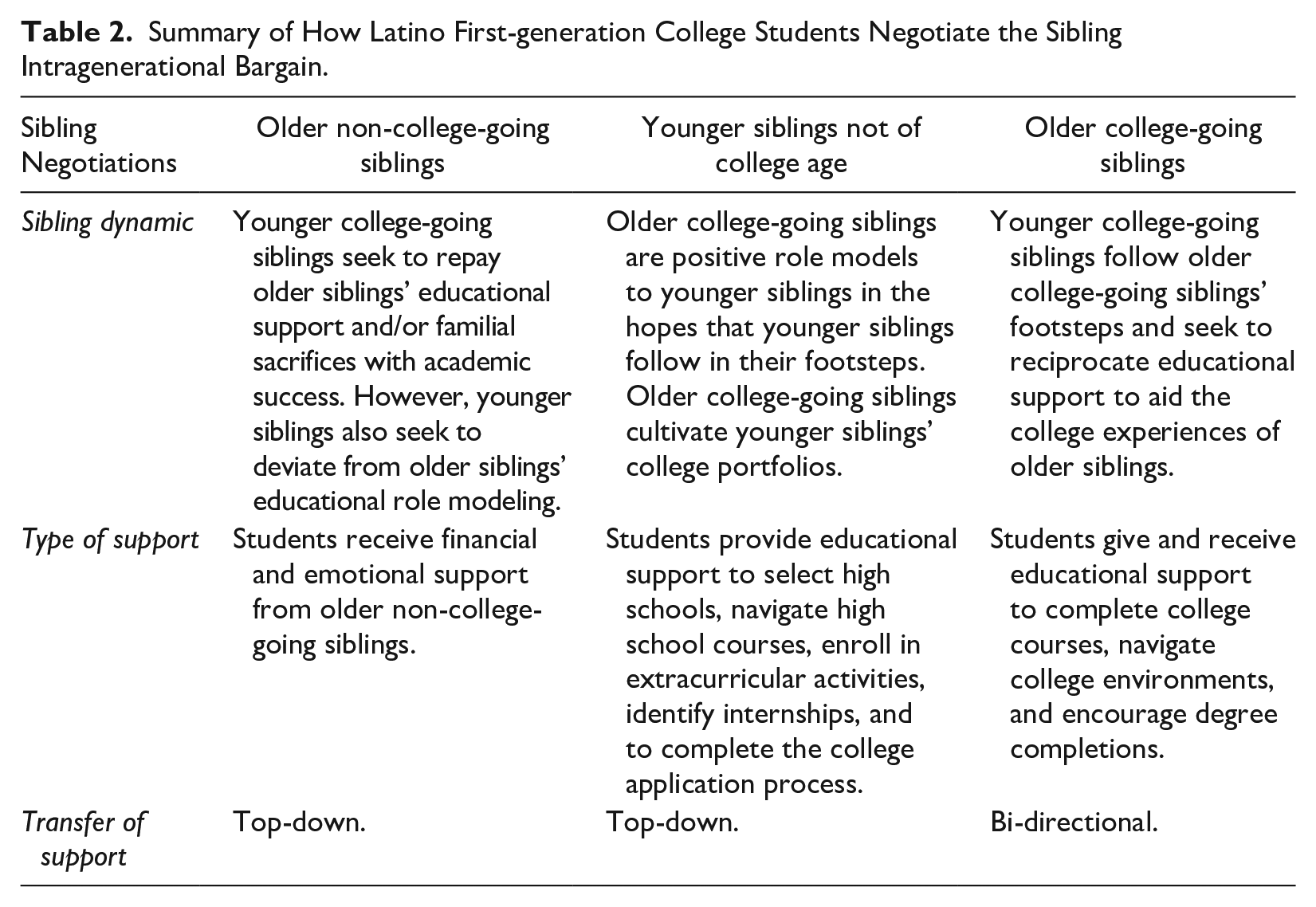
Furthermore, I find that the sibling intragenerational bargain is negotiated differently across three sibling arrangements: (1) older non-college-going siblings, (2) younger siblings not of college age, and/or (3) older college-going siblings. First, LFGC students with older non-college-going siblings sought to repay older siblings’ familial sacrifices and academic support with educational success while simultaneously attempting to deviate from older siblings’ educational role modeling—a process most salient for brother-sister relationships. Second, LFGC students with younger siblings not of college age are supplementary caregivers who cultivate strong college portfolios as a means of positioning younger siblings on the path to upward mobility. Third, LFGC students with older college-going siblings experience a transformation in educational support whereby younger siblings reciprocate educational support to aid the educational trajectory of older siblings. Below, I describe how families navigated the sibling intragenerational bargain across birth order and sibling educational attainment. Table 2 summarizes how the sibling intragenerational bargain operates in the three sibling arrangements.
Summary of How Latino First-generation College Students Negotiate the Sibling Intragenerational Bargain.
Having Older Non-college-going Siblings: Repaying Sacrifices and Deviating from Sibling Educational Role Modeling
Younger college-going Latino siblings sought to repay older non-college-going siblings’ familial sacrifices and educational support with college success, a process most salient for brother-sister relationships. Latino students with older non-college-going siblings navigate the sibling intragenerational bargain through (1) indebtedness, (2) top-down financial and emotional support, and (3) avoidance of following older siblings’ educational trajectory.
Indebtedness to older non-college-going Latino sibling sacrifices
Younger college-going students commonly described older non-college-going siblings entering the workforce after high school to financially support the family. Sisters, in particular, narrated feeling indebted to older non-college brothers who forwent higher education to help meet family needs, a decision they framed as a familial sacrifice. Consequently, younger college-going sisters attempted to repay said sacrifices with college success. Esperanza, 23 years old, and the youngest of three, exemplifies how youth negotiate the sibling intragenerational bargain. Esperanza in part credited her college enrollment to her older brothers Samuel, 33 years old, and Hector, 32 years old, who entered the workforce after high school to help the family meet immediate financial needs. She remarked, They [older brothers] told me that I had to go to school regardless if I didn’t know what I wanted to do . . . For me to decide on going to college was really hard because I felt like I was needed more at home than in school.
Though Esperanza expressed feeling needed at home, her brothers “pushed” her to apply so that unlike them she could have a pathway to upward social mobility. Her brother, Samuel, reassured Esperanza that he could continue to financially provide for the family while she attended college.
Esperanza recognized that she benefited from her brother’s financial contributions because it lessened the pressures she felt to financially support the family in the short term. Esperanza was grateful for her older siblings’ sacrifices because they garnered her more educational opportunities. In this manner, younger siblings reaped the benefits of older sibling sacrifices. This negotiation suggests that older siblings can be replenishing sources of familial support that positively contribute to younger siblings’ educational trajectories.
Similarly, Rosa, 18 years old, and the second oldest credited her educational success to her eldest brother’s sacrifices. Rosa’s brother entered the workforce after high school to help support the family following their father’s deportation. Rosa acknowledged that because her brother was the firstborn, he took on increased financial responsibilities, limiting his ability to pursue higher education. Although her brother took this family responsibility “sourly,” he was “proud” of Rosa because at least one of them got to go to college. Rosa emphasized that her college success was a form of repayment to her brother who shouldered the family’s difficult financial circumstances. The sacrifices of older non-college-going siblings, particularly brothers, paved the way for younger siblings’ intragenerational mobility. Younger Latino siblings in turn pursued higher education as a form of repayment for older siblings’ sacrifices.
The top-down financial and emotional support of older non-college-going Latino siblings
The sacrifices of older non-college-going siblings were coupled with top-down financial and emotional support for younger siblings’ educational trajectories. Because older siblings were no longer embedded in the educational context, younger siblings could not reciprocate the educational support received. This dynamic bolstered younger siblings’ indebtedness to older non-college-going siblings and motivated students to succeed academically as a form of repayment.
Younger siblings reported that older non-college-going siblings consolidated resources to contribute to the family’s upward mobility. Older sibling financial support included paying for college applications, books/supplies, gas, and groceries. Esperanza, for example, described how her eldest brother alleviated college financial stresses: If I have a problem here at school, let’s say I don’t have money to buy a book. . .my brother, he’ll tell me well, how much do you need? I’m just missing 10 more bucks it’s all and then I could pay for my book and then he’ll give it to me. He’s just there for me when I need something.
Esperanza’s experience highlights how older non-college-going siblings provide financial relief when younger siblings run into financial “problems.” Sisters frequently described how older non-college-going brothers were sources of financial support when they experienced financial distress in college. The financial contributions of older non-college-going siblings generated additional resources for the educational journey of younger siblings.
Sisters also received emotional support from older non-college-going brothers. Siblings’ familiarity with the U.S. educational system allowed students to connect with older siblings who were perceived to understand more than their parents. Older non-college-going siblings’ emotional support included encouragement, reassurance, and empathetic listening. Like other students, Esperanza recalls how her eldest brother motivated her to apply to her dream schools. He said, “You are better than these Cal States. You are selling yourself short. If you don’t apply to like your dream schools, you’re basically going to stay in the same place and you’re not going to move up.” Later, Esperanza disclosed that her brother’s encouragement “pushed” her to apply to more prestigious schools although they were further from home. Although older Latino siblings did not undergo the college application process, older siblings leveraged their general understanding of the educational system to encourage younger siblings’ upward mobility.
Older sibling emotional support was also present during the crafting of personal statements. Esperanza described how her second oldest brother helped her with the personal statement: I was telling my brother I don’t know what to write . . . And then my brother’s the one who told me you’re supposed to sell yourself the best you can . . . But he made me type it all out . . . every single question.
Esperanza’s brothers illustrate how the emotional support of older siblings propels younger siblings to complete the college application process. Younger siblings commonly described older siblings as sounding boards throughout educational challenges (e.g., failing a course and experiencing a lack of belonging).
It is important to note that the sibling intragenerational bargain functioned in this way for students who reported overall positive relationships with older non-college-going siblings. An exception to this pattern was David, 18 years old, who was the second oldest of five and the first in the family to attend college. David characterized his sibling relationships as poor and overall perceived minimal family support. David expressed, Most of the time I felt alone, isolated considering I have siblings. I have a big brother, but he wasn’t really there for my emotional needs or any support, and my [other] siblings since their young, they can’t really relate.
David went on to share that his older brother treated him like “the worst thing ever” and was not particularly helpful in his educational journey. David did not consider his brother a source of educational support, and thus, he did not feel indebted to his brother. Instead, David credited his educational success to the support of college access programs. A sense of indebtedness to older non-college-going siblings was present when participants described overall positive relationships with siblings, but not when participants described overall negative relationships with siblings.
Negative role modeling: Not wanting to follow older non-college-going siblings’ footsteps
Negotiating the sibling intragenerational bargain was not always easy for younger college-going Latino siblings. Though older sibling sacrifices generated additional resources for the family, sibling relationships were complex. Participants’ indebtedness to older siblings was coupled with younger siblings’ educational differentiation. The academic performance of older siblings served as a foil for younger siblings, a dynamic that often was reinforced by parents. This process was most salient among brother-sister relationships in part because of brothers’ racialized experiences in school that contribute to negative educational outcomes. For example, Rosa who “admired” her eldest brother simultaneously sought to differentiate herself from her brother’s poor academic performance. Rosa explained how her brother’s educational trajectory created additional “problems” for her parents. Seeking to lessen her family’s burden, Rosa was motivated to perform well in school to make her parents proud. Emily, 20 years old and who is one of three, also spoke of appreciating her eldest brother’s sacrifices, but as an example, that was not to be followed according to their mother. When asked about her brother’s role modeling, Emily shared how her mother contributed to her differentiation: She [mother] personally would tell me you don’t want to be like your brother, you know, is that what you want to do? Or like I’d get in trouble like once in a while and she’d be like, see here just like your brother. And it was kind of like I grew up like not wanting to be the way he was at least in school.
For Emily, parental comparisons encouraged her to pursue an educational path different from her brothers. Although students recognized the positive contributions of older non-college-going Latino siblings, younger college-going siblings did not want to follow in their footsteps.
Younger Latino siblings navigated the sibling intragenerational bargain by repaying older non-college-going siblings’ sacrifices with their educational success. Older non-college-going Latino siblings provided financial and emotional support to aid the educational journey of younger siblings. However, older non-college-going siblings also served as foils that motivated younger siblings to deviate from older siblings’ educational examples. This flow of educational support was most common in brother-sister dyads. Given that older siblings were not pursuing education, younger siblings could not reciprocate this support. Thus, the transfer of sibling educational support was top-down.
Being an Older College-going Sibling with Younger Siblings Not of College Age: Supplementing Family Resources and Cultivating College Portfolios
Older college-going Latino siblings are positive role models who leveraged their college knowledge to help younger siblings build competitive college portfolios. Latino students with younger siblings not of college age navigate the sibling intragenerational bargain by promoting younger siblings’ school success through (1) positive role-modeling, (2) cultivating college portfolios, and (3) top-down transmission of educational knowledge.
Positive role modeling: You are setting the example
Latino older college-going siblings are positive role models to younger siblings. As the eldest, Isabel, 20 years old, was expected in part by her parents to set a good example for her younger brother Santiago, 13 years old. Isabel’s father reminded her that her actions impacted her brother, “Whatever you do, you’re setting the example for your brother. So, don’t do anything bad.” By serving as a positive role model, Isabel became responsible for her own educational success and that of her younger brother. Victor, 20 years old and the oldest of two, shared a similar responsibility with his younger sister, Carolina, 16 years old. Victor explained that he was motivated to persist despite academic challenges to be a positive role for his sister, a role that was encouraged by his parents: She sees that if I could do it then she could do it as well . . . when I was going through [high school] I always had questions as to whether I could do it just because I never had any influences or inspirations . . . but since I am going through it and I am her brother she sees that she could do that.
Like other participants, Victor saw his academic success as setting the groundwork for his sister’s upward mobility. Older college-going siblings commonly expressed that they hoped their academic success communicated to younger siblings that college was an option for them too. Older college-going siblings negotiated the sibling intragenerational bargain through positive role modeling and looked forward to leveraging their experiences to guide the educational journey of younger siblings.
Cultivating college portfolios and top-down transmission of educational knowledge
Latino older college-going siblings supplemented parental support by cultivating younger siblings’ college portfolios. Such practices included selecting high schools, course selection advice, enrollment in extracurricular activities, college access programs, and financial planning. In particular, Latina sisters who engaged in sibling educational care work viewed themselves as secondary “mothers” to younger siblings (sisters and brothers). The transmission of educational knowledge was top-down as younger siblings’ experiences in the educational system were limited.
Students narrated learning from their educational “mistakes” and using these experiences to strengthen younger siblings’ college portfolios, hoping younger siblings could achieve greater academic success. For example, Isabel leveraged her college knowledge and mobilized resources to help her brother access the Gifted and Talented Education (GATE) program. Isabel describes being presented with the same opportunity in middle school but because she held limited knowledge of resources that could help her prepare for the exam, she failed. When her brother was presented with the same opportunity, Isabel supported him by coaching him through practice problems—a resource she became aware of after her exam. With her support, her younger brother was placed in GATE.
Older college-going siblings were also influential in helping younger siblings strategically select high schools, a choice that is consequential for educational pathways. Isabel continued to nurture her brother’s academic trajectory by advising his high school selection process: So, he wanted to go to [high school A], which is a pretty academic-focused school. But I don’t think it’s convenient for him to do that because then he’d have to be the absolute best. I was like, ‘Go to [high school B]. Be the best at [high school B]. It’s easier to be the best at [high school B] than it is to be at [high school A].’ I convinced him to go to [high school B] . . .
Isabel drew on her gained educational knowledge to “convince” her brother to attend a less selective high school where he would be a “big fish in a little pond.” Older college-going siblings often worked with parents to help identify high schools that would provide more college preparation compared to their high school. The integral role of older college-going Latino siblings positioned them as a necessary caretaker in the family’s intragenerational mobility.
Older college-going siblings also enhance younger siblings’ education by helping them enroll in college access programs. Rosa, a middle sibling and the first in the family to attend college, capitalized on her high school social network to secure her younger brothers’ enrollment in a college access process. Rosa’s high school introduced the Advancement Via Individual Determination (AVID) program when she was a senior and thus was not eligible to participate in the program. She saw this missed opportunity as an opening her younger brother, a freshman, could capitalize on. She described her involvement as follows, I was like turn in the application and he didn’t. And so, I had to pull some strings behind the scenes . . . because I was really good friends with the counselors I said, ‘Hi, can you please accept my brother? . . . And they were still accepting people but just behind the scenes.
Rosa resisted the institutional authority of deadlines and became an advocate for her younger brother.
Other students built their younger siblings’ educational profiles by encouraging involvement in extracurricular activities. Yolanda, 23 years old, realized after concluding the college application process herself, how important extracurricular activities were to build a strong college portfolio. She was determined to help her younger sister secure an internship before applying to college: I made her apply to this internship . . . I told her to send me your answers before you have to meet your application. And I was reading them, and I was like, “Oh my God,” if she submits this she’s not going to get in. So, I had to rewrite her answers for her.
Yolanda assisted her sister in editing application responses and drew on her friendship network to receive feedback before submission. Latino older college-going siblings made constant efforts to supplement parental support helping younger siblings prepare strong college portfolios.
Older Latino siblings found alternate ways of transmitting college knowledge when they were not physically with younger siblings, Angelica, 22 years old and the second oldest, created a book of “wisdom” to share with her younger brother. She describes the book’s contents as follows, It has a whole bunch of shit in there. How to talk to your teachers about issues, how to properly take notes, and how to properly read books. It’s pretty thick. I made them myself. I just had it up on Word, bound it for him, mailed it to him . . .
Angelica equipped her younger brother with strategies and skills to navigate his future college experience with the creation of this book. Older college-going siblings’ contributions extended to the college choice process where students assisted younger siblings with college visitations, personal statements, and Free Application for Federal Student Aid (FAFSA).
Latino older college-going siblings sought to be positive role models and cultivate college portfolios by transmitting college information to younger siblings. However, because younger siblings had not undergone the transition to young adulthood, younger siblings could not reciprocate this educational support.
Having Older Siblings with College Experience: A Reciprocal Exchange of Educational Support
Latino siblings in college and undergoing the transition to young adulthood experience a transformation in the negotiation of the sibling intragenerational bargain. Like the aforementioned sibling configuration, younger siblings received support from older siblings in secondary school and during the college application process. Now in college, younger Latino siblings received help from older siblings to navigate college environments. For instance, older Latino siblings helped younger siblings select college courses, craft emails, and interact with professors. Because older and younger siblings were on similar life course trajectories, sibling exchanges experienced reciprocity. This shift illuminates how younger college-going siblings are perceived to be replenishing sources of educational support for older college-going siblings. The following sections show how the sibling intragenerational bargain becomes bidirectional when siblings share educational experiences in the transition to young adulthood.
Grateful for the educational support of older siblings, younger siblings seized the opportunity to reciprocate sibling educational support during the transitions to young adulthood. Clarissa, 21 years old and the youngest of two, experienced a role reversal when she provided emotional support to her sister who was attending college at the same time but took a leave of absence. Clarissa described encouraging her sister to return to college, “Oh, you should apply to FAFSA because even if you don’t go during fall, you can go into winter or spring . . .” I feel like I’m pushing her [older sister] more into the idea of going back to school . . .
Clarissa reflected that providing educational support to her older sister was a shift in her sibling dynamic because she “now [was] having to be the older sister.” Younger siblings transitioned from being passive receivers of educational support to active producers of familial capital for older siblings.
Younger Latino siblings also reciprocated older sibling support with academic support. Angelica, 22 years old and a middle sibling, is a prime example of bidirectionality exchanges of support for siblings who share similar academic pathways. Angelica’s elder brother relied on her to successfully complete the college application process: He came to me because I already had the experience. He was able to rely on me . . . I helped him with his applications and what to do and how to apply for financial aid . . . I think he off chance mentioned how he felt bad that I did it by myself and that he didn’t really help me . . . Oddly enough, I helped my older brother apply to colleges.
For Angelica, supporting her older brother’s academic trajectory was “odd” because normative sibling relationship scripts assume older-younger sibling transmissions of educational support. Yet, Angelica’s example highlights how resources can also be transmitted bottom-up in LGFC families.
Angelica and her brother experienced reciprocity when they were both enrolled in college. Angelica’s older brother went from “relying” on Angelica to providing academic help in math and statistics. After receiving a C on an assignment, Angelica would “mostly call him crying about how I failed.” Angelica shared that her brother reassured her and proceeded to help her with her college coursework through the phone. Though Angelica’s older brother expressed feeling “bad” for not being able to help her during the college application process when they both were in college and in the transition to young adulthood, the exchange of educational support became reciprocal.
Experiencing college and undergoing the transition to young adulthood at the same time (re)shaped the sibling intragenerational bargain. Lucero, who is one of the three sisters and the middle child, detailed helping both her eldest and youngest sister throughout the college application process when she became the first to transfer to a 4-year college. When Lucero’s sisters transferred shortly after, exchanges of sibling educational support achieved reciprocity. For example, Lucero relied on her youngest sister for financial support during orientation, The Uber was too much money. We have nothing. We couldn’t go. And my sister got mad because I started crying. I’m not meant to go to college. This is a sign . . . So she called the Uber for us and she paid for it.
After getting lost in the city and interpreting it as a “sign” that she was not meant to go to college, Lucero’s younger sisters’ financial contribution made it possible for her older sister to attend orientation.
Younger Latino siblings also reciprocated older college-going siblings’ support by sharing professional development resources. For example, Carlos, 21 years old and the youngest of two, supported his older sisters’ educational achievement by sharing information. Because Carlos and his sister were interested in graduate school, but only Carlos had access to an undergraduate program aimed to enhance research skills and exposure to graduate school, he shared information with his sister. When his older sister was discouraged from applying to graduate school because of her limited research experience, Carlos said, [You] could also just volunteer at a research lab. I told her to look into [University] to see if they needed any research assistants and it was just actually kind of like the roles switched. I was the one telling her about opportunities.
The switch in roles younger siblings experienced highlights the transformation of sibling relationships who share higher education trajectories during the transition to young adulthood.
For younger Latino siblings with older college-going siblings, the sibling intragenerational bargain was marked by a reciprocal exchange of educational support. Younger Latino siblings were motivated to reciprocate the help they received from older college-going siblings who had gone through the process first. In families where older siblings were not the first to attend college, a reciprocal exchange of support nonetheless developed as older siblings felt “bad” that they could not assume this familial responsibility earlier. A mutual understanding of college combined with transitions to young adulthood allowed for a bidirectional exchange of educational support.
Discussion
Although quantitative studies show how siblings may negatively impact educational outcomes in families (Downey 1995, 2001; Steelman and Powell 1993; Steelman et al. 2002), less research investigates how students frame the role of siblings (positive and negative) in their educational trajectories. Because sibling familial contributions are often conceptualized vis-à-vis parents, how children make sense of siblings’ generation and transmission of resources within families is poorly understood. This study identifies sibling educational support as an important yet understudied form of familial capital that is consequential. Though prior studies have identified how college-going siblings in disenfranchised families are important sources of educational support (Ceja 2006; Luedke 2020; Pérez and McDonough 2008; Sáenz et al. 2020; Zang et al., 2023), these studies are limited to primary and secondary education. This study extends this research by examining how LFGC siblings provide and receive educational support during the transition to young adulthood in the college context. This study suggests that students frame siblings (older and younger) as agentic members of the family’s intragenerational upward mobility.
The results indicate that college attendance generates additional familial capital that prompts a (re)negotiation of sibling educational support. This study offers a theoretical framework, the sibling intragenerational bargain, to analyze how intrafamily dynamics shape negotiations of educational support. In the sibling intragenerational bargain, LFGC students are motivated to succeed academically as a means of contributing to the family’s intragenerational mobility and to repay sibling familial sacrifices and/or sibling educational support. The sibling intragenerational bargain extends prior literature (e.g., Ceja 2006; Flores 2018, 2021; Pérez and McDonough 2008) by (1) examining how sibling dynamics (e.g., birth order and differences in sibling attainment) shape negotiations of educational support and by (2) centering reciprocity processes to include the contributions of older and younger siblings beyond the college choice process. It is important to consider the complexity of sibling dynamics over the life course to assess the availability of resources within families. Taken together, the findings show how in the sibling intragenerational bargain students view siblings as cultural assets that bolster familial capital and promote navigational capital to guide siblings through educational institutions (Luedke 2020; Patrón 2020; Roksa 2019; Yosso 2005).
This study extends research on how minoritized and working-class families are sources of educational support. Most of the existing research focuses on how parents and older college-going siblings support the educational trajectory of students (Ceballo 2004; Ceja 2006; González et al. 2003; Pérez and McDonough 2008). I contribute to this work by uncovering how older non-college-going Latino siblings are important motivators and sources of educational support. Like parents with a high school education or less, older non-college-going Latino siblings provide younger college-going siblings with financial and emotional support (Dueñas and Gloria 2024; Matos 2015). Although younger college-going siblings recognized that older non-college-going siblings fulfilled familial responsibilities, older non-college-going siblings served as a sibling foil. This finding aligns with previous research highlighting how older siblings function as a comparison tool for younger siblings’ progression in school (Davies 2015, 2019). Like first-generation college parents, older non-college-going Latino siblings view younger siblings as a “last” opportunity to achieve intragenerational mobility (Harper et al. 2020; Lee 2016; Rondini 2015). This study illuminates the often-unrecognized educational support of older non-college-going Latino siblings and reveals the complexity that arises with siblings who do not share similar educational trajectories.
Consistent with prior studies, older college-going Latino siblings were important sources of information and educational help for younger siblings (Azmitia et al. 2009; Delgado 2023; Flores 2018; Lanuza 2017; Puente and Simpkins 2019; Ramos Carranza and Simpkins 2021). I extend this research by illuminating how older college-going Latino siblings help younger siblings cultivate college portfolios before the college application process. Older college-going siblings served as role models, a role sometimes encouraged by parents, to younger siblings in the hopes they would follow in their footsteps (Alfaro and Taylor 2010; Altmejd et al. 2021; Aquilino 2006; Hamewey et al. 2019; Loury 2004; Patrón 2020; Sáenz et al. 2020). Latino older college-going siblings were college concierges and helped younger siblings select high schools, courses, and extracurricular activities. Latino older college-going siblings learn from their educational mistakes and help younger siblings avoid similar mistakes to optimize their college prospects. This finding supports cultural mobility studies suggesting that students exposed to higher education can gain familiarity with college environments, which can become a family resource that has spillover effects for younger siblings (Roksa et al. 2020; Yosso 2005). Thus, Latino older college-going siblings actively produced familial capital to support the family’s intragenerational mobility.
Because prior research has primarily focused on sibling educational support in secondary school and the college application process (Ceja 2006; González et al. 2003; Pérez and McDonough 2008), negotiations of sibling educational support tend to be conceptualized as top-down (Ceja 2006; Hurtado-Ortiz and Gauvian 2007; Pérez and McDonough 2008). Yet, sibling educational exchanges may experience reciprocity as siblings age and gain educational knowledge. This study reveals that siblings experiencing college together during the transition to young adulthood experience a transformation in sibling educational support. Although Latino college-going siblings may promote changes in family arrangements (e.g., moving out), the transition to young adulthood is also a time when cultural values like familismo may become more salient (Fuligni 2007; Fuligni and Pedersen 2002; Killoren et al. 2017). This shift allows Latino younger college-going siblings to reciprocate educational support to older college-going siblings. That is, Latino younger siblings go from being passive recipients of sibling educational support to becoming active producers of educational support. Younger college-going siblings promote the educational journey of older college-going siblings by providing academic, emotional, and career support in college. The bidirectionality of sibling educational support during the transition to young adulthood creates a unique opportunity for older siblings to rely on younger siblings to navigate higher education environments. This study underscores how the transition to young adulthood (re)shapes familial capital and the consequences this has on intragenerational mobility (Roksa 2019; Roksa et al. 2020; C. M. Smith 2020).
In addition to theoretical implications, this study offers important insights for education policy. College access and university mentoring programs aimed to increase enrollment and retention for historically underrepresented families generally engage parent-child relationships and/or one student per family unit (e.g., Upward Bound). Although student involvement in said programs can have spillover effects for siblings, sibling participation is typically not embedded in programming. Findings from this study show that siblings in LFGC students engage in notable forms of educational labor on behalf of families. The salience of siblings in the educational trajectories of historically underrepresented students requires that educational institutions broaden the scope of family engagement (Kiyama and Harper 2018). To lessen the familial responsibility of Latino first-generation students and augment family resources, particularly at HSIs, educational institutions should carefully consider ways to increase sibling engagement in programs. The presented findings reveal the importance of centering sibling-sibling relationships in educational reforms.
It is important to note that this study draws from an ethnic homogenous sample to highlight the within variation of LFGC sibling educational support across birth order and sibling educational attainment. Thus, additional research is needed to further examine how the sibling intragenerational bargain is negotiated by social location. First, additional research is needed to investigate variations in sibling support practices by race/ethnicity. Prior research suggests that older siblings across racial/ethnic groups experience pride and/or pressure to be role models to younger siblings (Brooks 2015; Pyke 2005; Wu et al. 2018). However, cultural differences among racial/ethnic groups, such as familismo and Confucianism, may produce distinct sibling dynamics across birth order. On one hand, the hierarchal emphasis of sibling relationships in Asian American families can generate tensions with younger siblings who can grow resentful of sibling educational involvement (Pyke 2005). On the other hand, a strong interdependent emphasis coupled with a cultural encouragement of emotional expression in Latino families may overburden older siblings (Ceja 2006; Pérez and McDonough 2008). This prior research suggests key cultural differences in how students may negotiate the sibling intragenerational bargain despite similarities in birth order scripts. Studies that include ethnoracial comparisons could provide valuable insights to the similarities and differences of sibling educational support.
Second, future research would benefit from a systematic analysis of gender within the context of racialized student experiences. Research shows that the generation and transmission of educational capital is a gendered process. Sisters take more holistic approaches to caregiving, while brothers provide familial support through discrete tasks (Flores 2018; Lopez 2003; Ovink 2014; Sáenz et al. 2020). Although gender was not the primary analysis of this study, the data indicate that older non-college-going Latino brothers often forwent college for work and as a result primarily provided financial support (e.g., paying for college applications, books, gas) and emotional encouragement to younger siblings. Furthermore, older college-going Latinas often viewed themselves as “second mothers” and proactively guided younger siblings’ educational success (including instrumental, financial, and emotional support). A deeper gender analysis that meaningfully explores the racialized experiences of students would enrich our understanding of how sibling dynamics shape resource exchanges. Third, class variations in sibling educational support deserves careful consideration. This study was conducted with first-generation college students, and the sibling patterns observed may not be representative of continuing-generation college student experiences. Research on cultural reproduction (Hamilton et al. 2018; Roksa et al. 2020) would suggest that continuing-generation college students may replicate middle-class parenting strategies to support the educational journey of siblings. Yet, the extent to which class shapes sibling educational support remains understudied.
Future research would also benefit from incorporating multiple family members from one family unit—including parents and more than one sibling—to gain additional insight into how family dynamics shape the accumulation of familial capital. This study builds on prior research to explore mechanisms that shape exchanges of sibling educational support; however, the perspective of educational support may vary by family member. Studies that include multiple family members could provide valuable insight into how family units work together to produce familial capital and how siblings navigate within family inequality (see review McHale et al. 2012; Wigen 2023).
This study demonstrates that to develop a comprehensive understanding of how families shape educational trajectories, it is necessary to consider how older and younger siblings generate familial capital (in addition to the more commonly considered parental capital). The findings suggest that siblings are active producers of familial capital. LFGC siblings indirectly and directly provide educational support, a process I term the sibling intragenerational bargain. A within exploration of LFGC families highlights the complexities of negotiating the sibling intragenerational bargain. LFGC siblings negotiate the sibling intragenerational bargain in three keyways. First, younger Latino college-going siblings are motivated to succeed academically as a form of repayment for older non-college-going siblings’ sacrifices and educational support. Second, older college-going siblings serve as role models that cultivate the college portfolios of younger siblings. Third, Latino siblings experiencing college together engage in reciprocal exchanges of educational support to aid one another in college. In asserting that “He was to rely on me,” LFGC students actively build a sibling-sibling network that generates additional resources for the family. Recognizing how siblings are building blocks of familial capital is essential to better understand the mechanisms that promote intragenerational mobility.
Footnotes
Declaration of Conflicting Interests
The author(s) declared no potential conflicts of interest with respect to the research, authorship, and/or publication of this article.
Funding
The author disclosed receipt of the following financial support for the research, authorship, and/or publication of this article: The author received financial support from the University of California Institute for Mexico and the United States and the Social Science Research Council for the research of this article.