




Abstract
Under what conditions do Latinx communities mobilize in response to threats of repressive policing? This article addresses this question by comparing three cases of community organizing against civil gang injunctions. Drawing on six years of ethnographic fieldwork, 20 semi-structured interviews, and analysis of news reports, my findings reveal that mobilization was achieved in low-income Latinx neighborhoods located within affluent White cities, where organizers drew upon strong ties to community insiders to combine analyses of the threat of citywide gang injunctions with critiques of White racism and political power. Conversely, mobilization did not occur when this strategy was used to organize a low-income Latinx neighborhood within a primarily working-class, Latinx city, where organizers confronted a more narrowly targeted gang injunction and had weaker ties to community insiders. I argue this lack of mobilization in the latter campaign cannot only be attributed to the insufficient threat posed by the gang injunction. Rather, local racial and ethnic dynamics, where Chicanx organizers struggled to develop grassroots leadership among community insiders, build solidarity with first-generation Latinx immigrants and link threats of repressive policing to anti-Latinx racism impeded mobilization. These findings highlight how popular mobilization against perceived threats of repressive policing is not race-neutral but instead depends upon racial and ethnic contexts where organizers can effectively link the issue to White racism.
Keywords
Introduction
Previous research has shown that state-sanctioned violence and repression have had contradictory impacts on popular mobilization. On the one hand, some studies have shown that state violence and repression can sometimes discourage mobilization, in line with the expectations of political opportunity perspectives (Costain 1992; Eisinger 1973; McAdam 1999; Meyer 2004; Tarrow 1989; Tilly 1978, 1995). On the other hand, research has also shown that threats of actual or potential state violence and political repression can sometimes stimulate protest movements by reducing the legitimacy of the state and inducing popular mobilization in response to perceived threats to groups’ interests or values Overall, this research reveals how groups experience and respond to threats and grievances related to state violence and repression varies considerably and depends upon specific structural and social conditions are critical to movement emergence (Almeida 2003, 2019b; Brockett 1993; Goldstone and Tilly 2001; McKane and McCammon 2018; Van Dyke and Soule 2002).
This study is guided by the research question: Under what conditions do people mobilize in response to threats of repressive policing? Combining theoretical insights from scholarship on social movements and the racialization of Latinx people in the United States, I investigate the factors shaping the development and mobilizing outcomes of three grassroots organizing campaigns against civil gang injunctions in three predominantly Latinx communities in Southern California. Comparing different cases of community organizing against civil gang injunctions, my findings suggest that the racial and ethnic context and dynamics of organizing campaigns against repressive policing, as well as the scale of the threat, significantly shapes their mobilizing outcomes or the extent to which communities mobilize in response to them.
Civil gang injunctions are among the most popular, and the most criticized methods that police have used to try to suppress gang activity, and have largely been implemented within low-income communities of color (Smith 2000). A civil gang injunction is a lawsuit filed by a district attorney or city attorney in a civil court and approved by a judge, alleging that a gang and its members have occupied a specific geographic area or “safety zone” within a city in a manner that constitutes a “public nuisance” (National Association of District Attorneys 2009). Specifically, these injunctions prohibit people identified as gang members from a variety of activities that are otherwise legal, such as being in public in certain places, hanging out together, wearing certain colors, or even riding a bike (Scott and Spady 2015). This approach to gang suppression is based on “social disorganization” and “deterrence” theories of policing in which it is predicted that “sure, swift, and severe sanctions” against gang members will deter criminal behavior (Maxson, Hennigan, and Sloane 2005). Law enforcement officials have argued that civil gang injunctions cause alleged gang members to believe that they are being closely watched by the police and more likely to be arrested and prosecuted for violations of the injunctions. In turn, they argue that fear of arrest and prosecution will weaken gang identity, and participation in gang-related behavior will decrease (Maxson et al. 2005). However, since the introduction of civil gang injunctions in the 1980s, legal rights organizations and communities have fought the use of these policies, arguing they violate basic civil liberties, disproportionately target poor communities of color, and reinforce systemic racism (Almada 2014; Ochoa 2018; Cabrera 2014a, 2014b, 2014c, 2014d; Esquivel 2014; Molina 2014b; People ex rel. Gallo vs. Acuna 1997; San Roman 2016).
Based on six years of ethnographic fieldwork with communities organizing against gang injunctions, and 20 semi-structured interviews with movement participants, community members, and attorneys, this article investigates the relationship between threats of state repression associated with civil gang injunctions and the strategies organizers developed to mobilize three low-income Latinx communities. Drawing insights from scholarship on Latinx racialization and ethnic identity in the United States, and the social movements literature on threat and oppositional consciousness, I examine why some anti-gang injunction campaigns were far more successful in mobilizing Latinx residents to participate in organizing than others. Complicating race-neutral approaches to threat-induced mobilization, I observe that the mobilization of Latinx communities in response to threats of gang injunctions was not universal. Beyond the presence of large-scale threats of gang injunctions, I argue that community mobilization was highly contingent on the local racial/ethnic context as well as organizers’ ties to community insiders. Mobilization tended to be higher in Latinx barrios, or low-income neighborhoods, located within affluent White cities, where organizers drew upon strong ties with community insiders to develop grassroots leadership for organizing campaigns and combined analyses of the threat of citywide gang injunctions with critiques of White racism and political power. Conversely, mobilization was lower in a Latinx barrio within a primarily working-class, Latinx city, where organizers confronted a more targeted gang injunction and had fewer ties to community insiders and struggled to develop grassroots leadership. Overall, my findings highlight how threat-based mobilization is shaped by the racial and ethnic context and dynamics of community organizing.
In what follows, I first review the social movement scholarship on threat-induced mobilization and how multi-ethnic Latinx social movement organizations, community insiders, and other grassroots activists have mobilized against the racialization of Latinx people in the United States. Next, I provide background information that is relevant to my comparative case studies, including background on civil gang injunctions, the rise in community opposition to civil gang injunctions within Southern California, and the Chicanxs Unidxs organization of Orange County. These sections are followed by a description of ethnographic and interview data and methods as well as my comparative case study research design. In my findings section, I compare separate organizing campaigns against civil gang injunctions in the cities of Orange, Santa Barbara, and Santa Ana and analyze the different processes and outcomes of these campaigns. Each of these three campaigns was organized by Chicanxs Unidxs members using similar tactics, but they took place in different contexts and differed in their relative success in mobilizing Latinx residents around this issue.
Theoretical Framework
Threat-Induced Social Movements and Grassroots Leadership
“Threats” are a group of actual or potential conditions perceived by a group as jeopardizing, or likely to jeopardize, their “interests, values, and at times survival” (Tarrow 1998:86). A threat may create new grievances or intensify preexisting grievances, which refer to perceptions of an existing injustice or injury, which may have been imposed gradually or rapidly, and understood over a longer or shorter time period by those experiencing it. Popular mobilization and collective action have emerged in response to multiple types of threats. As Almeida has shown, social movements have sometimes mobilized in response to increased threats of state violence and political repression, especially within authoritarian regimes (Almeida 2003, 2019a, 2019b). Other scholars have demonstrated how suddenly imposed grievances such as environmental catastrophe or military conflict can be significant in mobilizing individuals to act collectively, as well as regional economic strains or perceived religious threats (McVeigh, Crubaugh, and Estep 2017; Van Dyke and Soule 2002; Walsh 1981).
For threats and grievances to mobilize a group, it is necessary that these are seen as collective and understood through “shared meaning making and experience” (McKane and McCammon 2018:403). For example, for many Latinx and Chicanx barrios with historic experiences with White racism and repression from the police, the creation of civil gang injunctions posed threats to activists’ earlier gains in civil rights protections from racial discrimination. Thus, the creation of civil gang injunctions in Southern California has heightened Latinx and Chicanx community grievances regarding criminalization, incarceration, and violence by law enforcement.
As many scholars have noted, popular mobilization often emerges in response to increased threats to groups’ interests and values, including threats of state violence and political repression (Almeida 2003, 2019b; Goldstone and Tilly 2001; McKane and McCammon 2018; Reese, Vega, and Geidraitis 2005; Van Dyke and Soule 2002). This theoretical model contrasts with traditional political opportunity approaches that link movement emergence to increased political opportunities to make gains (Eisinger 1973; McAdam 1999; Meyer 2004; Tarrow 1989; Tilly 1978). In particular, some scholars have observed a curvilinear relationship between movement protest and political opportunity, with protest occurring in contexts in which the window of opportunity is neither fully open nor closed. Thus, the signaling of some level of political opportunity or a closing window has been discussed as a necessary condition for the emergence and operation of social movements (Eisinger 1973; Kitschelt 1986; McAdam 1999; Meyer 2004; Snow and Soule 2010; Tarrow 1998). The threat-induced social movement model also differs from classic resource mobilization perspectives that link movement emergence among deprived groups to increase in their access to organizational resources (Eltantawy and Wiest 2011; Jenkins 1983; McCarthy and Zald 1977).
Of course, threat-based mobilization, political opportunity, and resource mobilization perspectives are not inherently mutually exclusive. Various studies have fruitfully combined these perspectives to develop more comprehensive theories for social movement emergence. For example, organizational resources that emerged in response to political mobilization during eras of widening political opportunities can provide resources for mobilizing in response to subsequent eras of political repression (Almeida 2003). Scholars have also shown that access to organizational resources can help groups translate their grievances into mobilization and influence the size of a movement (Owens, Cunningham, and Ward 2015) and that the presence of movement organizations can facilitate threat-based mobilization and influence which groups mobilize (Almeida 2003; Reese et al. 2005).
Although threats and grievances often stimulate outrage and protest, especially when there is little risk of repression, threats of repression and violence can sometimes be viewed as reducing political opportunities for making social change and spreading fear, both of which can diminish protest among vulnerable groups (McKane and McCammon 2018). In addition, scholars have theorized how social movement mobilization may at times be impeded by a history of tensions between groups such as racial or ethnic divisions among groups and organizations or a lack of access to organizational resources (e.g., see McKane and McCammon 2018).
My theoretical perspective combines insights from the literature on threat-induced mobilization with research emphasizing the role of racial/ethnic community dynamics and the presence of community insiders and grassroots leaders on mobilization outcomes. With regard to the latter point, previous research has shown that the active participation of community insiders and grassroots leaders often encourages or facilitates the rise in social movement mobilization (Meyer 2015; Staples 2001). Grassroots leaders can be understood as individuals who are situated within a particular locality and understand the community in which they work in order to direct and guide a group (Nardini et al. 2022; Staples 1984). Among their functions, grassroots leaders utilize their insider status to communicate movement ideas and goals, weave together networks, manage coalitions, and forge connections among people and organizations to build organizational infrastructure (Satell 2019; Suarez 2019). Leaders build these connections by centering insider’s perspective of the needs, resources, and operations within a community and speaking passionately and personally on its behalf (Bublitz et al. 2016; Fredrick 2018; Nardini et al. 2022; Talukdar et al. 2005). To effectively create and sustain grassroots organizations and mobilization, leadership skills must be consciously developed among all members through organized mentoring and training (Braithwaite 2000). This is particularly noteworthy in multiracial organizations in which finding common ground among diverse members can be challenging as can constructing collective analyses and action. Thus, consciousness-raising or the development of “oppositional consciousness” that prepares a group to act to undermine, reform, or overthrow an oppressive system, along with leadership training, is an effective combination in mobilizing diverse grassroots groups (Carroll 2008; Morris and Braine 2001; Staples 2001).
Drawing upon these insights and findings from my comparative case studies, my research highlights how the success of efforts to mobilize Latinx residents in response to threats of repressive policing depends upon local racial /ethnic dynamics and the incorporation of community insiders as grassroots leaders. Despite the presence of threats of repressive policing, social movement organizations, and legal resources in three separate cases, I observed that the level of community mobilization against civil gang injunctions varied across communities. In particular, the presence of community insiders and grassroots leadership, and the local racial-ethnic contexts influenced community perceptions of threats and mobilization outcomes. In the organizing campaigns I observed, developing grassroots leadership among community insiders and effectively linking critiques of gang injunctions with local experiences of Chicanx and Latinx racialization, criminalization, and marginalization were central to cultivating oppositional consciousness and mobilizing residents against these policies. Moreover, the ability of organizers to work with community insiders and leaders to promote an oppositional consciousness that recognizes the existence of oppressive structures that subject Chicanx and Latinx communities to repressive forms of policing served a direct function in mobilizing communities as well as creating barriers to community mobilization.
Latinx Racialization and Ethnic Consciousness
The synthesis of theories of Latinx racialization in the United States with social movement scholarship is central to my analysis of Latinx community mobilization against threats of repressive policing. Although social movement theories tend to be race-neutral, some scholars have drawn upon theories of ethnic competition and racial threat to produce important insights into the dynamism of group consciousness and perception and how race and local context can interact with such consciousness to produce mobilization (Azab and Santoro 2017; Cunningham and Phillips 2007; Okamoto and Ebert 2010). Theories of ethnic competition and conflict, for example, have emphasized the role of threat in producing collective action intended to preserve in-group resources and status quo power relations (Blalock 1957, 1967). Such explanations posit that the salience of group bonds generally increases in the presence of competition for scarce resources (Barth 1969), especially in contexts where ethnic identification and mobilization are more likely to occur (Medrano 1994). As ethnic group boundaries harden in an effort to “close ranks,” possibilities for ethnic mobilization increase (Hannan 1979; Olzak 1992). This theoretical approach overlaps with theories that examine the mobilizing influence of perceived threats to the racial or ethnic status quo (Einwohner and Maher 2011; Goldstone and Tilly 2001; Maher 2010; Reese et al. 2005; Van Dyke and Soule 2002).
Building upon the literature on threat-induced mobilization, I apply theories of Latinx racialization and ethnic consciousness to understand how racial/ethnic context interacts with the threat to shape community oppositional consciousness and mobilization against gang injunctions. Social science scholars have identified and discussed how immigrants of color and their descendants face processes of racialization in the United States that put them at more risk for discrimination and racism. Challenging prevalent assimilationist assumptions that immigrant experiences are race-neutral, scholars have examined how race shapes the experiences of migrants, immigration legislation, and law enforcement (Sanchez and Romero 2010). Central to this analysis is an understanding that the United States immigration system historically excluded and restricted the rights of certain racial groups who were once considered “undesirables” (García 2017:2). This process of racialization and legal exclusion has been directed especially at migrants from Mexico and countries in Latin America (García 2017; Mirandé 1987; Romero 2001, 2006).
Racism and racialization in U.S. immigration policy have influenced law enforcement agencies to continuously treat migrants from Latin America as suspects based on what is constructed as their perceived “foreignness” to the dominant White, Anglo-Saxon population. This practice has severely impacted the lives of Latinx migrants, as well as Mexican Americans/Chicanxs and Latinx Americans who are American citizens, but whose citizenship and daily activities are questioned based on their physical appearance, transforming them into second-class citizens who are not afforded the same rights as White citizens. At times, this has produced tension and conflict between Latin American migrants and Mexican Americans and Chicanxs, as sustained migration from Latin America has been perceived by some Mexican Americans/Chicanxs as complicating their efforts to assimilate into the dominant culture and institutions (Gutiérrez 1995; Ochoa 2004).
It is well documented how tensions between Mexican American/Chicanx and migrant communities existed in a number of political organizations and social movement efforts throughout the twentieth century. However, there is also evidence demonstrating that mutual experiences with White racism and repression have at times served to reinforce the realization among Mexican American/Chicanx and migrant communities that while they are heterogeneous, they are inextricably linked and may be subjected to similar practices of racism and exclusion (Gutiérrez 1995). Such realizations have played a central role in the emergence of collaborative, multi-ethnic Mexican American and Latinx social movements and coalitions throughout the twentieth and twenty-first centuries including labor strikes, the Chicano movement and Chicano Moratorium, immigrant rights movements, and various community campaigns (Gutiérrez 1995; Ochoa 2004; Pardo 1998; Zepeda-Millán 2017). Mexican and Latinx racialization in the United States, which varies somewhat across local contexts and over time, significantly shapes racial power relations, the U.S. legal system, and Chicanx and Latinx social movements. Below, I apply these insights to understand and compare the racial and ethnic dynamics of three Chicanx-led campaigns against civil gang injunctions, and how these dynamics related to different levels of popular mobilization.
Historical Background: Gang Injunctions
Since 1992, more than 150 civil gang injunctions have been filed in civil courts in the state of California and nearly all of them have been placed in poor Chicanx, Latinx, and Black neighborhoods (Muñiz 2015; O’Deane 2012; Spady et al. 2021). Contrary to dominant law enforcement narratives, studies conducted on how civil gang injunctions affect crime rates have produced mixed findings and do not clearly support arguments that they are universally effective (Grogger 2002; Los Angeles County Civil Grand Jury 2004; Scott and Spady 2015). There is, however, considerable legal and social science scholarship arguing civil gang injunctions violate basic civil liberties, disproportionately target poor communities of color, and reinforce systemic racism (Barajas 2007; Crawford 2009; Muñiz 2015; Smith 2000; Spady et al. 2021; Stewart 1998). Social scientists and community organizations have also documented how civil gang injunctions, among other anticrime law enforcement initiatives, emerged in the context of a dramatic shifts in the global political economy and reorganization of state institutions of incarceration and violence in the late twentieth century (Camp 2016; Gascon and Roussell 2019; Gilmore 2007; Murch 2015; Oliver 2008; Schrader 2019). In particular, scholars have identified how gang injunctions tend to target communities of color that border neighborhoods with increasing property values and that are undergoing revitalization or gentrification (Alonzo 1999; Barajas 2007; Muñiz 2015; Zilberg 2002).
Since law enforcement agencies in Los Angeles began pursuing civil gang injunctions in the early 1980s, attorneys and civil rights organizations have challenged the constitutional legitimacy of civil gang injunctions in court (San Roman 2016). With the exception of one 1993 case where a judge removed a civil gang injunction in the city of Westminster, California (People ex rel. Jones v. Amaya 1993), Circuit Courts and the Supreme Court of California have consistently upheld the constitutionality of civil gang injunctions. Most notably, in People ex rel. Gallo vs. Acuna (1997), the California Supreme Court explicitly ruled that the City of San Jose may “implement a civil gang injunction that restricts non-criminal behavior if committed by alleged gang members in a particular neighborhood.” However, since the late 2000s, an increasing number of communities and organizations began taking more active roles in sharing information and organizing campaigns to challenge civil gang injunctions and have increasingly won legal victories (Ochoa 2018; Almada 2014; Cabrera 2014a, 2014b; Esquivel 2014;Molina 2014a). Below, I seek to contribute to emerging research on opposition to civil gang injunctions by providing a comparative case study of multiple organizing movements against civil gang injunctions that documents the historic activities of Latinx grassroots organizations and specific communities, and identifies the factors that shape and constrain organizing outcomes or the level of popular mobilization.
Chicanxs Unidxs and Organized Opposition to Gang Injunctions
Chicanxs Unidxs de Orange County (CU) is among the leading organizations in Southern California’s anti-gang injunction movement and is widely regarded as the main organization in Orange County, having participated in campaigns against four different civil gang injunctions since 2009. CU is a grassroots community organization founded in 2006 and based in Orange County, California, dedicated to the “preservation of Chicanx, Mexicanx, Indigenous cultural heritage” and the historical legacy of their ancestral homeland in the South Western United States (Chicanxs Unidxs 2006:1). They define themselves as a multiethnic, multigenerational, and multi-issue grassroots organization, with the stated mission of being “an informed, independent, and community based Chicanx Mexicanx Indigenous organization that proactively and consistently identifies and challenges racism, violence, and institutional oppression” (Chicanxs Unidxs 2006:1).
CU began organizing and campaigning against civil gang injunctions in 2009 in response to threats the policies posed to Chicanx and Latinx communities including the loss of legal rights, criminalization, and more aggressive policing. During their first campaign organizers from CU worked collaboratively with residents of the Orange Varrio Cypress neighborhood (OVC) in the city of Orange and attorneys from the American Civil Liberties Union and private law firms to mobilize a four-year community and litigation campaign (2009–2013) opposing the injunction. This first campaign led to 62 individuals being removed from the civil gang injunction and a Federal Appeals court removing the ability of law enforcement to enforce the civil gang injunction in 2013 (ACLU 2013). Following this initial legal victory CU went on to organize a campaign against the Townsend Street Civil Gang Injunction in the city of Santa Ana (2014–2019), and participated in campaigns against a proposed civil gang injunction in the city of Santa Barbara (2013–2014) and two proposed gang injunctions in the city of Placentia (2015–2018).
Based on their organizational mission and organizing experience, Chicanxs Unidxs developed a model for organizing against civil gang injunctions focusing on (1) mobilizing residents of neighborhoods placed under civil gang injunctions to publicly oppose and organize against the civil gang injunction and (2) mobilizing legal resources to help residents contest their inclusion and challenge the constitutional legitimacy of civil gang injunctions in court. In addition to attending court hearings, CU used a variety of tactics to educate and mobilize local residents around these policies, which were usually not widely known or publicized, including speaking to the media, working in coalitions and collaborative projects with nonprofit and grassroots organizations, hosting legal aid clinics, picketing and staging public protests, canvassing neighborhoods, holding teach-ins and community forums, and giving presentations to local university, community college, and high school classes. Although they used similar organizing tactics, they did so within different contexts and with variable success in mobilizing local residents against civil gang injunctions.
Method and Data
This study employs a comparative ethnographic research design based on Burawoy’s (1998) “extended case method” to investigate three grassroots organizing campaigns against civil gang injunctions by the Chicanxs Unidxs organization. The extended case method (ECM) is a research method that focuses on conducting detailed and reflexive ethnographic studies of concrete empirical cases in order to link empirical observations to larger structural forces in society (Burawoy 1998; Burawoy et al. 1991). In the extended case method, researchers participate in, and observe, events and actions of individuals and groups over an extended period of time in order to analyze a social phenomenon. Rather than applying an established theory to explain observed phenomena, researchers using the extended case method construct an ethnographic story, then theorize about their observations, and extract general principles from specific observations (Mills, Durepos, and Wiebe 2012). Through ethnographic fieldwork, in-depth interviews, and analysis of media reports and organizational documents, I analyzed and compared participant perspectives and views of organizing work, as well as the processes and outcomes of three separate campaigns.
For this study, I collaborated as an active member of the Chicanxs Undixs organization for more than six years. Since 2014, I have been an active “core” member of the organization and have assisted CU with organizing campaign events and actions, conducting research on civil gang injunctions, documenting the organization’s history using writing and photography, and assisting attorneys with analyzing the evidence presented by the Orange County District Attorney (OCDA) in an active civil gang injunction case. In addition to working directly on CU’s campaigns and projects, from 2016 to 2019 I made regular visits to one neighborhood where CU is still actively seeking the removal of a civil gang injunction. During these visits, I would have conversations with residents on a wide range of topics, including problems affecting the community related to policing and gang injunction. There were also multiple occasions where I attended candle light vigils for residents who had passed away from gang violence and drug overdoses, served as an expert witness and “gang expert” in court, and I even spent three months in 2017 assisting CU with transporting a local youth to and from school while he was working with attorneys on getting removed from the California State Gang Database. All data collected for this project was pursuant to a Human Subjects Research protocol (Institutional Review Board [IRB]) from the IRB at the University of California, Riverside. This review established the risks to participants were minimized by using procedures consistent with a sound research design that does not unnecessarily expose participants to risk.
Although I am an “insider” to CU in the sense of being an active member of the organization, I occupy a very different positionality and possess very different frames of analysis as well as opportunities and privileges for conducting this type of research when compared to most other CU members. I am an “outsider” in the sense that I am a White, middle-class, male, academic, and do not reside in the communities where CU conducted its organizing campaigns (Corbin Dwyer and Buckle 2009; Ergun and Erdemir 2009; Mullings 1999). I believe it is important to acknowledge that as a middle-class and White individual, I have access to resources that allow me to remove myself from the research site and avoid being criminalized for my participation in organizing activities. Reflecting my positionality, in the organizing campaigns, my role has not been one of leadership but providing ancillary support in the form of research, volunteering at campaign events, documenting events in writing and photographs, and supporting public actions. In addition, my privileged position has at times been strategically leveraged by CU to gain access to certain resources, spaces, and privileges that are not enjoyed by the organization or the many of the individual members. For example, at times, my White middle-class positionality and appearance have been deployed by CU to gain (unimpeded) access to elite political and business spaces and meetings to gain access to privileged information on law enforcement activity. I have also served as an expert and character witness in legal trials in which CU is providing legal aid and support to incarcerated Latinx youth or youth facing incarceration. Thus, my position in these campaigns has yielded different experiences and analytical perspectives from many CU members. To address this, I have conducted in-depth interviews with CU members and movement participants in addition to my ethnographic fieldwork, in order to produce a more comprehensive and thorough understanding of events than could be achieved with either method alone. Throughout the research and writing process for this article, I have consulted CU members on my interpretation of events and processes I have observed. This process of consultation with CU and drawing upon multiple sources of data was aimed at addressing my position as a privileged outsider (White middle-class male and academic) that supports the Chicanx people leading the campaigns discussed below. It is worth noting that my explicit naming of Chicanxs Unidxs throughout this paper was not my personal decision but based on the organization’s formal decision to be recognized for their organizing work and to promote their cause of challenging gang injunctions.
Interviews
I utilized 20 semi-structured interviews with members of Chicanxs Unidxs, residents of the Townsend Street neighborhood, OVC neighborhood, and the City of Santa Barbara, and attorneys who participated in litigation battles against civil gang injunctions. All interviews were conducted only after receiving direct written and verbal consent from each participant. Interviews were confidential, and I have concealed the identities of participants in my writing and transcripts by assigning pseudonyms. All interviews were recorded with a digital voice recorder while I took notes in a notepad. The interviews were one to two hours in length, and at times, I requested additional time or scheduled additional interviews. All interview transcripts, audio recordings, field notes, and memos have been stored in a password-protected computer. The topics discussed during interviews included their individual involvement with organizing against or litigating civil gang injunctions, their experiences and perceptions of civil gang injunctions, as well as their perceptions of organizing goals, strategies, tactics, and outcomes. Participants were selected for the study based on the following characteristics: (1) sustained and active involvement in organizing, planning, and participating in campaigns against civil gang injunctions; (2) individual efforts to litigate inclusion in a civil gang injunction; and (3) involvement in litigating civil gang injunction cases in court or providing legal consultation to groups litigating civil gang injunction cases. Among the 20 interviews conducted, the select quotes displayed in the below findings section were identified as being most useful for describing the narrative of the organizing campaigns and displaying participant perceptions of events and processes of each campaign.
Comparison of Organizing Campaigns
I chose to conduct a comparative analysis of anti-gang injunction campaigns that took place in three different cities whose residents varied in their social and political composition: OVC is a multigenerational working-class Chicanx Barrio located in the city of Orange, a predominately White, conservative, middle- and upper-middle-class city in Orange County. The city of Santa Barbara is a politically liberal, middle- and upper-middle-class city in Santa Barbara County, where working-class multi-ethnic Chicanx, Mexicanx, and Latinx barrios were targeted for a gang injunction. Townsend Street or “Calle Townsend” is a working-class and multiethnic neighborhood highly populated by Latinx immigrants, located in the majority Latinx, working-class, and politically Democrat/ Liberal city of Santa Ana in Orange County. These three cases of organizing campaigns were selected for this study based on the fact that each campaign was spearheaded and led by members of the Chicanxs Unidxs organization and preceded each other in chronological order. Additionally, cases were selected based on my personal proximity to the Chicanx Unidxs organization and accessibility to study participants and research cites.
I systemically compare these three different campaigns in order to find patterns of difference and similarity between them. Reflecting Mills’ method of difference, a comparative approach to research is concerned with identifying factors that are common and different in a given context, from which inferences can be made regarding the conditions that explain an event (Mill [1843] 2011). Building upon comparative approaches from quantitative/statistical social science, qualitative social scientists developed the comparative qualitative approach as a “synthetic strategy” that would “integrate the best features of the case-oriented approach [qualitative] with the best features of the variable-oriented approach [quantitative/statistical]” (Ragin 1987:84). Rather than basing research on the premises of quantitative research, the qualitative comparison aims to develop a method that is firmly rooted in an analysis of specific cases. Cases are viewed as “singular, whole entities” carefully selected by researchers and are not “homogeneous observations drawn at random from a pool of equally plausible selections” (Ragin 1994:300). Thus, most case-oriented studies start with the seemingly simple idea that social phenomena in like settings (such as organizations, neighborhoods, cities, countries, regions, cultures, and so on) may parallel each other sufficiently to permit comparing and contrasting them. Fundamentally, this methodological approach is based on an analysis of social phenomena as resulting not only from multiple causes but also from a particular combination of them and is designed to identify specific processes and mechanisms contributing to such phenomena, rather than traditional (quantitative) counterfactual models of causality that seek discreet causal variables (Small 2013).
All three campaigns combined courtroom litigation and community mobilization. These organizing objectives and strategies emerged in response to the specific threats that civil gang injunctions represent to communities: restricting legal rights and enabling police officers to engage in more aggressive policing tactics and practices. Yet, despite the shared presence of political and repressive threats, and coordinated organizing campaigns, organizing strategies produced very different outcomes with higher levels of popular mobilization in low-income Latinx and Chicanx neighborhoods within cities with largely White populations than in a low-income Latinx and Chicanx neighborhoods with a significant gang presence, located within a majority Latinx city.
Findings
How did organizing strategies and racial/ethnic context interact with threat to shape community oppositional consciousness and mobilization against gang injunctions? Why were some anti-gang injunction campaigns more successful than others in mobilizing residents to participate in organizing? Based on an analysis of ethnographic field notes, interview transcripts, CU meeting minutes, and media reports, Table 1 (page 28) summarizes my comparison of the different dynamics and outcomes of the campaigns. The first three columns of Table 1 describe the specific factors within each campaign being, the local political power structure and ethnic/racial community dynamics, Chicanxs Unidxs’s organizational ties to each community, and the scale and scope of each gang injunction (threat). The fourth column of Table 1 describes the level of community mobilization that was achieved in each campaign. Below I explain these campaign dynamics and outcomes in greater detail.
Mobilization Outcomes of Campaigns
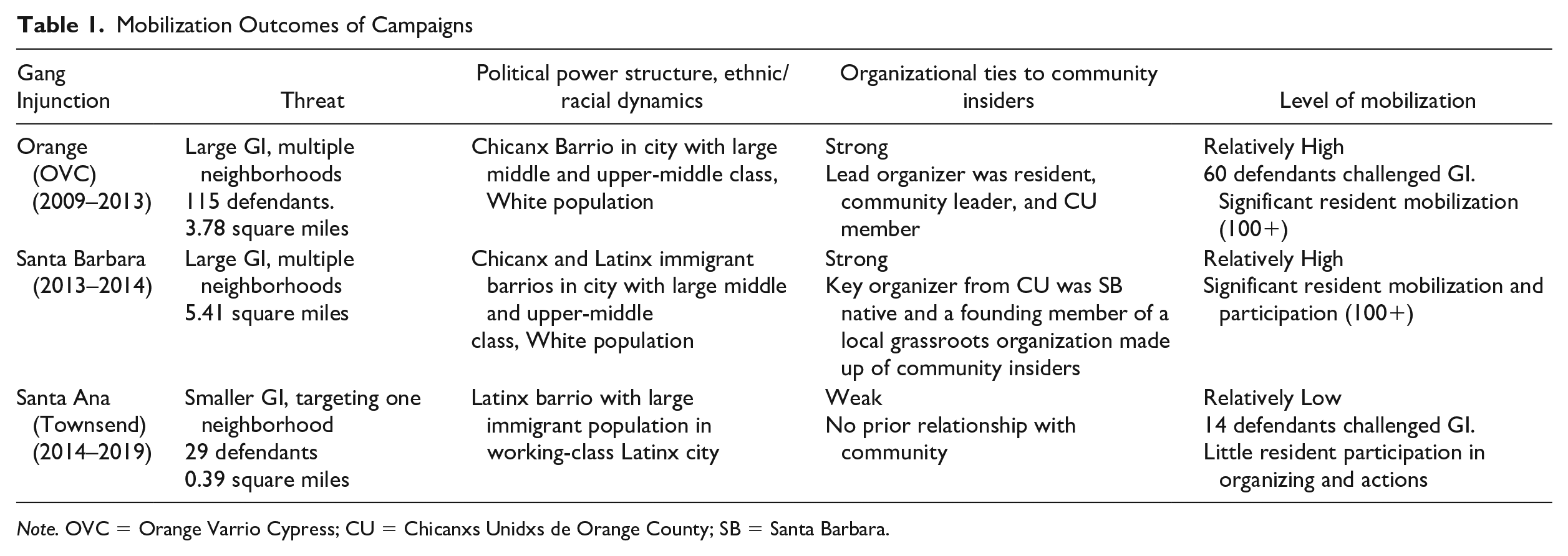
Note. OVC = Orange Varrio Cypress; CU = Chicanxs Unidxs de Orange County; SB = Santa Barbara.
When Racialization and Threat Produce Mobilization
From 2009 through 2013, CU collaborated with residents of the OVC barrio in the city of Orange to organize their first campaign against a civil gang injunction. The city of Orange is a politically conservative, primarily middle and upper-middle-class city, where Whites make up the largest racial group (about 44 percent) and are the primary actors within the political power structure. During my first visits to downtown or “Old Towne” Orange, I was struck by the city’s (highly cultivated) American college town (and overwhelmingly White) aesthetic. Unlike the highly modern, suburban, and cookie-cutter style of architecture and urban planning, in many Orange County cities, downtown Orange is made up of a diversity of brick-and-mortar shops, restaurants, and American sports bars and breweries, as well as numerous historic craftsmen, Mediterranean, Spanish colonial, and Victorian homes, many displaying large American flags on their front porches. However, immediately adjacent to the downtown district is the working-class OVC neighborhood, one of the oldest Mexican American Barrios in Southern California. Like many of the historic Mexican Barrios of Orange County, residents of the OVC neighborhood were historically segregated from the White areas of the city. Reflecting this history, the OVC gang injunction identified residents of this neighborhood as its primary targets.
Prior to the OVC campaign CU members from a neighboring city with (a similar history of anti-Mexican racism and racial segregation) maintained strong personal ties to residents of the OVC neighborhood spanning decades. One of these OVC residents ran a local nonprofit organization that provided after-school activities for “at-risk-youth” and reached out to CU members for help organizing a campaign against the gang injunction. As described by Judy: One day I went to my office early . . . and I saw one of my [after school program] kids there, and he was pissed off, and he’s crying and he has this big thing [packet] of paper, and I go what the heck are you doing here? And he goes “[Judy], the police were at my house at four o’clock this morning and look what they gave me” . . . It was over seven hundred pages of [legal] documents, and it was like a lawsuit. It was this gang injunction . . . and all of a sudden I started having more and more clients come [that day]. So I started to read it and I said it looks like they’re suing you guys . . . I was reading through the documents and I knew I needed to call [name redacted CU member] . . . I called him and said I need your help. (Personal Interview, June 24, 2019)
Judy (among other residents) would join CU as a “core” voting member and work with the organization in developing the campaign and mobilizing residents to oppose the gang injunction. Assembling a legal team of ACLU and private attorneys, and a group of motivated residents, the campaign combined litigating the gang injunction in court with mobilizing residents to publicly oppose the gang injunction by attending court hearings, organizing events, and public protests. As part of their strategy, CU collaborated with Judy and other residents to share information about threats the gang injunction posed to the neighborhood and encouraged people to attend court hearings and public actions to voice opposition. Central to their strategy was linking the gang injunction with the city’s White political power structure and the local history of racial segregation, violence, and the criminalization of Mexicans throughout the twentieth century. As put by Judy, “I used to tell the [neighborhood] guys you know this is the new genocide of our people . . . they want to incarcerate you guys” (Personal Interview, June 24, 2019). These efforts fueled opposition toward the gang injunction among the primarily latter-generation Mexican American residents and achieved a relatively high level of community mobilization with more than 100 residents consistently attending court hearings, including 60 people who worked with the legal team to litigate their inclusion in the gang injunction (ACLU 2013; Wood 2013). Beyond the courtroom, the campaign was successful at mobilizing residents to participate in public demonstrations and protests, with more than 50 residents participating at different times. While the number of participants was not extensive (when compared to popular mobilizations of thousands of participants), with the number of participating residents ranging into the hundreds, this level of mobilization was relatively high compared to that achieved in the Townsend Street neighborhood of Santa Ana (discussed later).
Utilizing the organizing knowledge and legal network they had acquired from the first campaign, from 2013 to 2014, CU members worked with organizers in the city of Santa Barbara to challenge a gang injunction that was being planned for a large area of the city. Similar to the local setting for the OVC campaign, Santa Barbara is a majority White, middle- and upper-middle-class city, with a White liberal political power structure. Additionally, the proposed gang injunction in Santa Barbara would cover a large area of 5.41 square miles targeting the city’s low-income Latinx and Chicanx barrios and downtown business/shopping district. Once news of the proposed injunction went public, a small group of Santa Barbara residents and ex-residents grew concerned it posed a significant threat to local Latinx and Chicanx communities. Among these ex-residents was a member of CU who would help form a local grassroots organization in Santa Barbara to lead a campaign to stop the injunction. Reflecting the heterogeneous makeup of Santa Barbara’s Latinx community, the new organization’s membership was made up of both first- and latter-generation Mexican Americans/Chicanxs and Latinxs to lead the campaign.
Mirroring the first campaign in OVC, organizers in Santa Barbara pursued a strategy of community mobilization and litigation. To achieve the legal strategy, they acquired pro-bono legal support from private law firms and the ACLU to challenge the gang injunction in court. At the same time, organizers waged a large public organizing campaign portraying the gang injunction as racially profiling Chicanxs and Latinxs and as a continuation of the local history of racial discrimination and segregation. Among the tactics used were community walks and canvassing, posting flyers, hosting cultural events and open mics, creating short documentary films, and sharing information about the threat of gang injunctions online. This strategy proved highly successful in building solidarity and promoting critiques of the gang injunction among Mexican American/Chicanx, Latinx, and undocumented barrio residents and mobilized many to attend and participate in organizing events, public actions, and protests as well as court hearings and city council meetings. Additionally, as CU members organized group trips and caravans from Orange County to Santa Barbara to attend events and collaborate with Santa Barbara activists, a regional network of activists and organizations across Southern California developed, who would pool resources and knowledge on fighting gang injunctions. As described by CU member and Santa Barbara local Guadalupe: Me and a handful of people from Santa Barbara, most of us ex-gang associates . . . [we] researched how to fight against and organize against an injunction . . . the strategy came from meeting up with [name redacted], an attorney who was fighting the injunctions in LA with [name redacted organization]. We were meeting with their organizers I met with [name redacted attorney] here in Santa Ana, in Orange County with the ACLU. I met with pretty much anybody that we could, Oxnard folks, and (tried to ) figure it out . . . Out of all of this, [we developed] what can we use to create a bigger strategy. And like, what was needed. Like, media, you know like press, politics. You know like we broke it all down. We understood that . . . the organizing had to come from different angles. (Personal Interview, December 26, 2018)
Table 1 (page 26) illustrates how the observed relationship between each city’s White political power structure, the threat of each gang injunction, and the organizational ties of CU to community insiders interacted to produce popular mobilization in the OVC and Santa Barbara campaigns. In both cases, low-income, working-class Latinx and Chicanx barrios within (majority) middle- and upper-class White cities were targeted for large gang injunctions, as well as each city’s affluent and White, downtown business/ shopping districts. Informed by local experiences and histories of White racism, segregation, and policing, many Latinx and Chicanx residents in the OVC and Santa Barbara communities perceived gang injunctions as a new form of anti-Latinx and Chicanx discrimination that sought to criminalize Latinx residents and prevent their physical presence in more affluent areas of each city. Thus, central to CU’s organizing strategy in the OVC and Santa Barbara campaigns was working with community “insiders” or “grassroots leaders” to build solidarity and trust with residents and portray how the gang injunctions unfairly criminalized the neighborhoods and were racially profiling Mexican Americans/Chicanxs as gang members (James and Srisavasdi 2009). Among their strategies to bring awareness to the issue in the OVC campaign, organizers coordinated marches with more than 50 residents from the neighborhood to the city’s downtown business and a shopping district known as “the Circle.” Consistent with the campaign narrative, during these marches OVC organizers and residents were often subject to racist, anti-Mexican slurs and public confrontations with White patrons and business owners.
As described by Marcos, We started marching through the city of Orange protesting to the circle with signs and everything. People were calling us beaners and stuff like that . . . It was like, 50 years ago [during the civil rights and Chicanx movements]. They were all [White] people just calling us shit as you go through the restaurants there . . . They were like “how dare you guys [Mexicans] come into our circle.” (Personal Interview, January 26, 2018)
Reflecting on the event Marcos described, Judy described how the racial and criminalization narrative organizers had been promoting synthesized with the critical (and at times overtly racist) response they received from local Whites, giving many residents a “reason to fight” (Personal Interview, December 26, 2018).
In Santa Barbara, the strategy of presenting the proposed gang injunction as racially profiling and criminalizing Latinxs and Chicanxs proved highly successful in mobilizing Mexican American/Chicanx, Latinx, and undocumented residents, as well as progressive non-Latinx residents, to attend organizing events and actions, court hearings, and city council meetings. As described by Miguel, the parents . . . a lot of people of color . . . got involved because they knew that their children would get affected . . . And they knew that this gang injunction . . . it wasn’t specific to an area. The proposed gang injunction was just overkill . . . The minority who were like the college conservatives, [and] upper-middle class White folks, they were just outnumbered . . . it was just overwhelming support against it. (Personal Interview, August 9, 2019)
In the OVC and Santa Barbara campaigns, the local contexts/dynamics and organizers ability to respond to these dynamics was key to cultivating oppositional consciousness and producing popular mobilization. In both contexts, organizers from CU shared strong ties with community insiders who worked to recruit additional community members and promote opposition to the gang injunction. Aiding these efforts, each city maintained White political power structures that sought large gang injunctions targeting Latinx residents for sanctions not only within their own neighborhoods but throughout the more White and affluent areas of each city. These factors clearly bolstered the campaign narrative that the policies unfairly criminalize Chicanx and Latinx communities and sought to repress and limit the mobility of Latinx residents. As described by Carolina, I remember doing the presentations . . . and I remember people being shocked . . . shocked with how oppressive and suppressive these laws work. For people just being put on a [gang injunction enforcement] list and there’s no way to know why you’re on the list or how to get off it . . . the normalization of being put on lists was being challenged . . . Folks in different communities and communities that we belong to, a lot of people just take it, like when something happens [with police] and they know it’s wrong they’re just like “ah whatever that’s just the way it is” [but we pushed] for people to be like no you don’t have to do this, no this is not okay, and no even if you are in a gang you deserve due process. (Personal Interview, December 26, 2018)
Linking this narrative to the threat of a large civil gang injunction was essential to mobilizing Latinx and Chicanx residents to oppose civil gang injunctions and participate in organizing activities. However, in contexts where CU maintained few connections to community insiders and where Latinx and Chicanx communities were not confronting a gang injunction covering large areas of a city maintaining a primarily White political power structure, organizing was much more difficult. As the below analysis will show, in the latter contexts, CU was far less successful at building solidarity and mobilizing residents to oppose the threat of a gang injunction.
When Threat and Racialization Do Not Produce Mobilization
From the fall of 2013 through 2016, CU waged a third campaign against a gang injunction in the Townsend Street neighborhood in the city of Santa Ana, California. Different from the cities of Orange and Santa Barbara, Santa Ana is a predominately working-class and low-income city, with a majority (85 percent) Latinx population, and one of the highest per capita immigrant populations in the United States. Reflecting the city’s demographics, the local political power structure is highly Latinx and moderately liberal, with a Latinx mayor and police chief, majority Latinx City Council (five out of six members), and an all Latinx school board. At the same time, the Townsend Street gang injunction covered a smaller and more targeted surface area than the OVC and Santa Barbara injunction zones, with law enforcement activity focusing on a few blocks of densely populated apartment complexes notorious for gang activity and drug dealing.
In addition to differences of local setting and the size of the gang injunction, unlike previous campaigns organizing in Townsend Street was not initiated by “insiders” from the community. As discussed earlier, CU members had significant personal and family ties to the Latinx and Chicanx communities in the Santa Barbara and OVC campaigns. In the Townsend Street campaign, the latter generation Chicanx CU organizers had relatively weak ties and few personal connections to the mixed Chicanx and first-generation Latinx immigrant residents. To integrate themselves and develop trust with the community, CU collaborated with other grassroots and nonprofit organizations to conduct community walks in the area to distribute information about gang injunctions and hold meetings with residents. During this process, I participated in collaborative strategizing/ organizing meetings that often took place outside of the Townsend neighborhood and were overwhelmingly made up of non-Townsend Street residents. In these meetings, organizers would receive updates from members of the legal team and discuss strategies for reaching residents and integrating themselves with the community. In addition to community walks and meetings, community outreach events were organized, including holiday toy drives, open-air movie nights, and other activities for youth and families, as well as free legal aid clinics to document resident experiences with police abuse.
CU were able to recruit a small group of adult and youth residents from the Townsend Street neighborhood who were interested in organizing against the gang injunction and 14 individuals who were willing to work with pro-bono attorneys to contest their inclusion in the gang injunction. Working with these residents, they pushed an anti-gang injunction narrative on social media and in local media outlets, staged multiple public actions, and voiced opposition to the gang injunction at public court hearings and city council meetings. However, organizers also encountered residents of Townsend Street who expressed a desire to see action taken against crime and violence associated with the gang. To address these concerns, CU sought to portray how a gang injunction would do more harm than good by criminalizing the entire community and would be ineffective in addressing crime and violence. However, complicating CU’s narrative, some local politicians, evangelical ministers, and a nonprofit based in the neighborhood portrayed the injunction as the only solution to reducing crime, dividing opinions among residents.
Ultimately, only three individuals named in the Townsend Street gang injunction would continue to challenge their inclusion, and the high levels of neighborhood support seen in earlier campaigns were not achieved. With minimal community participation, CU’s organizing efforts became increasingly focused on litigation, with members facilitating meetings and communication between attorneys and clients, and trying to mobilize residents to attend the court hearings. Over a period of months, organizing in the neighborhood became less frequent, and all efforts specific to mobilizing residents to oppose the injunction through collective action were abandoned. Although CU was able to achieve the support of 15 youth, parents, and adults, the significant degree of public support and community involvement in organizing the OVC and Santa Barbara campaigns was not achieved on Townsend Street.
Multiple social and structural dynamics affected the unsuccessful community mobilization on Townsend Street that were not present in previous campaigns. Unlike the large OVC and Santa Barbara gang injunctions, which targeted working-class and marginalized Chicanx and Latinx barrios within affluent cities with large White populations, the Townsend Street injunction narrowly targeted a multi-ethnic Chicanx and Latinx barrio within the working-class and majority Latinx city of Santa Ana. These differences in the scale and scope of the injunction, as well as the different racial and ethnic dynamics presented a barrier to mobilizing residents based on Chicanx and Latinx identity and critiques of White supremacy and communicating how the gang injunction presented a threat of racial profiling and criminalization. For example, during my fieldwork on Townsend Street, I encountered residents (some opposing the gang injunction) who did not believe the gang injunction was racially motivated or that police targeted the community based on racist assumptions. Many argued this was because the majority of the city and their public officials including the mayor, city council, police chief, and many of the officers enforcing the injunction were of Mexican or Latin American descent. Lacking the specific structural and social conditions of the Santa Barbara and OVC campaigns, CU’s strategy of cultivating mobilized opposition to the gang injunction by linking gang injunctions to Latinx racialization and marginalization was severely limited.
Residents’ perceptions of violence and crime also presented significant challenges to achieving community mobilization. Different from the OVC and Santa Barbara injunctions, which covered large areas of each city (including affluent tourist and downtown business districts) and slovenly named hundreds of residents as gang members, the Townsend Street injunction was tailored to a smaller area that was notorious for gang activity and named 29 individuals as gang members. Within CU, members hypothesized that the smaller gang injunction in the Townsend neighborhood was a strategic response from the Orange County District Attorney to CU’s mounting legal victories against the larger injunctions. Although CU encountered residents who felt fearful of police and did not support the gang injunction, many expressed concerns about issues of crime and violence, and a desire to see the gang issue addressed. Complicating this even further, a number of events and local actors and organizations emerged to circumvent CU’s anti-gang injunction narrative. During the course of the campaign, two deadly shootings of teenaged residents occurred, cementing the media narrative that the neighborhood suffered from a severe gang and crime problem. At the same time, community insiders including a prominent local politician, a nonprofit organization based in the neighborhood, and local Christian ministers actively presented the gang injunction as the only solution to violence and crime. For example, throughout my fieldwork, there were numerous occasions where I observed evangelical pastors preaching to groups of residents in apartment building courtyards, explicitly threading pro-law enforcement, and anti-social justice narratives into their sermons. These events and local actors played a significant role in dividing the opinions of residents on the gang injunction. As described by Carolina, I personally think they stalled a lot of the organizing . . . [They were] the folks that had the ear to like the parents and you know the predominantly Spanish speaking [residents] . . . so it wasn’t a matter of the demographics of the neighborhood. It was a matter of who had the ear to the folks over there. NAME REDACTED [the non-profit] had a little more credibility than Chicanos Unidos because they had been there offering after school programs . . . so I honestly think that was the bigger issue, that had the folks in those positions been willing to push and really emphasize the severity of what was happening like it would’ve been a lot different. (Personal Interview, October 28, 2018)
Moreover, the narrative that gang injunctions posed threats to the legal rights and the safety of residents was more difficult to communicate when organizers encountered events and local actors aligned with law enforcement narratives of rampant violence and crime.
Local dynamics on Townsend Street presented new structural barriers to CU’s efforts to mobilize residents to oppose the gang injunction, but CU is adamant that the outcomes were also the result of strategic decisions and a failure to develop grassroots leadership and build solidarity with residents. Many of the study participants identified that the campaign lacked clear goals and failed to produce the same level of local leadership as previous campaigns. As one CU member explained, We didn’t want the gang injunction, but we didn’t really have a plan on how we we’re gonna do that. It was more just like, “We need to stop it in any way we can.” We didn’t recruit that many people from the neighborhood just because we didn’t have a good plan. (Personal Interview, October 28, 2018)
In addition to an initial lack of personal ties to community insiders, CU members discussed how their organizing failed to address the heterogeneous national and ethnic identities of the Townsend Street residents, many of whom were immigrants. Whereas the majority of CU members were born in the United States and identify as Chicano/a/x, many of the adult residents of Townsend Street are immigrants from Mexico or other regions of Latin America. Many Townsend Street residents are also monolingual Spanish speakers. Study participants lament that they could have navigated this context more effectively. As CU member Ramona put it, We knew that the community was highly immigrant, highly Mexican and I think we didn’t utilize enough of our Spanish speakers . . . We’re talking about two very distinct communities. One is Mexican immigrant and then you have Mexican Americans, Chicanos. They exist in the same space but they don’t. A lot of times they don’t even talk to each other . . . We were there in the space, but we weren’t in their space. We should’ve been more. I think again, we should’ve used more Spanish language. Maybe used more organizing tactics that are used in Mexico . . . I know organizing in this community is very possible, you can see that it is. People have been quite successful in Santa Ana organizing immigrant communities and we weren’t quite as successful as we could’ve been. (Personal Interview, December 19, 2018)
Ramona’s reflection on organizing such communities is reflective of findings from the literature examining the role of grassroots leaders to social movement mobilization as well as the literature on the political mobilization of Latinx immigrant communities. In regard to the latter literature, despite evidence suggesting Latinx immigrant communities are less civically engaged relative to other groups (Ramakrishnan and Viramontes 2010; Seif 2011), there is considerable evidence that their participation in activism and organizing has “flourished” in relation to specific sociodemographic characteristics (Nicholls 2014), legal consciousness (Abrego 2011), connections to community-based organizations (Varsanyi 2005), and receptive political contexts (Burciaga and Martinez 2017; Martinez and Salazar 2018; Nicholls 2014). CU members made efforts to facilitate bilingual events and meetings with neighborhood residents. But according to Ramona and other members I spoke with, they failed to consciously make the use of Spanish central to their organizing strategy and did not recruit a grassroots leader with whom a majority of residents could identify. For her and other participants, this was symptomatic of a larger failure to develop greater organizational ties with community insiders and utilize specific organizing strategies addressing the differences in ethnic and national identity between CU members and residents. This analysis is consistent with findings from research on multilingual organizing which suggests that conscious, multilingual approaches to organizing that utilize experienced multilingual facilitators are more effective than monolingual approaches in regard to the development of innovative ideas, coordinating actions, and cultivating solidarity among movement participants (Doer 2009; Polletta 1999; Staggenborg 1989).
CU may have lacked clear strategies specific to the local population, but the organization was not entirely unsuccessful in its outreach efforts. A small group of CU members were highly active in the community for several months and recruited some residents to participate in organizing. Nevertheless, many people I spoke to identified how these efforts were not sustained. As described by Will, a local teacher and organizing participant, We had people. There was twenty to thirty people [organizers] coming in and that’s pretty strong. People from the neighborhood were coming at different times. I thought that was good. But, we stopped door-knocking and we stopped educating folks at one time . . . they [community and union organizers] talk about the inside- outside organizing [in communities] . . . We weren’t doing the inside organizing. (Personal Interview, January 26, 2019)
As is clear from Will’s statement, some organizers believe they should have continued to pursue outreach efforts and built greater solidarity between themselves and the residents. Although this strategy may not have overcome the concerns of violence and crime held by some residents, establishing greater solidarity between CU members and residents would have aided organizers in communicating the threats posed by civil gang injunctions and countering the dominant narratives about these policies. It is possible that such an approach would have developed a greater degree of opposition and mobilization against the gang injunction among residents.
Conclusion
Scholars have rightly identified how social movements at times emerge in response to increased threats of state violence and political repression, and how the presence of organizational resources and leaders can stimulate groups to mobilize against threats (Almeida 2019a; McKane and McCammon 2018). This being said, threats, resources, and political opportunities do not automatically lead to mobilization or collective action. At times, threats of state violence and repression can function to quell dissent and present barriers to mobilization, and local political and social context has a significant influence on when and to what degree social movement mobilization emerges. I argue that specific structural and social conditions are critical to movement emergence. Regarding Latinx communities in the United States, racialization and racial oppression have informed their experiences, and the ability of organizers to work with community insiders and grassroots leaders to respond and appeal to these experiences can influence community mobilization against threats of repressive policing. An analysis of these dynamics is critical for understanding how racial–ethnic consciousness and ethnic culture can contribute to community solidarity and collective action against perceived threats, while failure to develop grassroots leadership and incorporate organizing strategies accounting for ethnic and linguistic differences between organizers and community residents impedes it. Moreover, in this article, I have sought to demonstrate the conditions under which racialized, repressive threats associated with civil gang injunctions, did, and did not lead to grassroots mobilization against those threats.
Despite the shared presence of threats posed by civil gang injunctions, legal and organizing resources, and an extensive history of collaborative Chicanx, Latinx, and immigrant social movement organizing, campaigns against civil gang injunctions were not universally successful in achieving community mobilization. The success of the OVC and Santa Barbara campaigns was dependent on the ability of CU organizers to build solidarity with residents and communicate the perceived threat of repressive policing. This was achieved through deploying organizing strategies that promoted Chicanx and Latinx racial-ethnic narratives linking the threat of large gang injunctions to issues of White racism and racial inequality, and a critique of local White political power structures. Key to this process was the presence of CU organizers and community insiders organically connected to the Santa Barbara and Orange Varrio Cypress communities who led outreach efforts and communicated these narratives. Lacking preexisting ties to the Townsend Street neighborhood, confronting the largely Latinx, working-class demographics of Santa Ana, local issues of crime and violence, and failing to center organizing strategies specific to mobilizing immigrant and mono-lingual Spanish-speaking residents, latter-generation Chicanx organizers encountered much difficulty in developing grassroots leaders, building solidarity, and cultivating opposition to the gang injunction among residents by linking the issue to racial profiling and criminalization. These dynamics became amplified when two deadly shootings occurred, and local community leaders presented the gang injunction as the only possible solution to homicide and crime in the community. Rather than strategizing around these dynamics organizing became increasingly focused on the legal strategy and courtroom action, while community outreach and consciousness-raising efforts were sidelined. Based on this comparative study, I argue that repressive threats, racial-ethnic consciousness, and ethnic culture can be effectively combined to successfully mobilize barrio residents against the threats of civil gang injunctions when organizers build community solidarity and opposition organically through grassroots leaders, develop effective counternarratives, and are responsive to the local cultural and social context.
My research reveals important aspects of how racial dynamics or context and organizing strategies shape the conditions under which Latinx and Chicanx communities in Southern California mobilize in response to threats or threat-related repression in the form of civil gang injunctions. In doing so this piece is intended to contribute to the social movement scholarship on threat-induced mobilization that has tended to reproduce a race-neutral model of mobilization. I hope to bolster the social movement scholarship on grassroots leadership, portraying how local racial and ethnic contexts interact with organizing strategies and community ties to shape the cultivation of grassroots leaders. To complement my study, future research should address both similar and different instances of community mobilization against threats of policing and state violence. Such studies should pursue case studies in both Latinx and non-Latinx movements and contexts, as well as mobilization against civil gang injunctions and other policing issues. In doing so, future studies can go further in interrogating the complex and combined roles of threats, racial/ethnic identity and context, and grassroots leadership in social movement mobilization. Adding new empirical evidence and case studies will broaden our understanding of the role of racial/ethnic identity in social movement emergence, Latinx social movements, and the dynamics around movements confronting issues of repressive policing and state violence.
Footnotes
Declaration of Conflicting Interests
The author(s) declared no potential conflicts of interest with respect to the research, authorship, and/or publication of this article.
Funding
The author(s) received no financial support for the research, authorship, and/or publication of this article.