




Abstract
This article analyzes how a formerly mocked policy idea became a widespread solution. Through content analysis of newspaper articles and legal documents, I develop a framework that extends timelines of social movement influence, expands the range of actors and locations of mobilization, and traces how activists frame policy ideas over time: the policy relay. This framework allows for an analysis of how opponents unintentionally advanced the reform process in 1993 by turning its originators into laughingstocks. Anti-rape advocates eventually reformulated the policy in 2014. This time, the origin was removed from the story, presenting a concise narrative that credited politicians and college administrators, rather than activists, for the reform. By tracing the ideas of a movement, rather than focusing on organizations or public protests, I uncover a complicated process of social change, where consequential actors work across different settings to ignite reforms and strategically remove controversial aspects from narratives of social change.
Introduction
The first time that affirmative consent—initially designed as a set of guidelines requiring sexual partners to obtain verbal consent for every act throughout a sexual encounter—garnered public attention was in 1993 when Saturday Night Live (SNL) aired a sketch called “Is It Date Rape.” The writers devised a jeopardy-style game show requiring contestants to determine whether hypothetical scenarios from categories such as “halter top,” “she led me on,” and “I paid for dinner” counted as date rape according to Antioch College’s affirmative consent policy. 1 The next day, the policy and the students who devised it—the Womyn of Antioch—became national laughingstocks. 2 Yet, 25 years later, a version of affirmative consent became policy when California governor, Jerry Brown, mandated that all public universities and high schools in the state adopt the consent rules. 3 By 2014, the most controversial aspects of the story—the origin of the policy and the need for verbal consent—were removed (California Legislative Information 2014).
Understanding how a formerly mocked policy idea becomes a widely adopted policy solution is a challenge for social movement and social change scholars because there is a tendency for analysts to rely on a narrow range of actors and time frames for influence while examining outcomes of mobilization (see Andrews 1997; Meyer 2017; Staggenborg and Taylor 2005; Taylor 1989). Yet, tracing the transformation of a policy idea allows us to examine how a diverse set of actors located in various settings can use different tools to advance the ideas of a movement (see Skocpol 1995; Staggenborg and Taylor 2005; Taylor 1989) without explicit coordination, offering a unique opportunity to theorize the mechanisms of movement influence.
To understand this process, I ask two overlapping questions. First, how does a formerly mocked policy idea become a story of a widespread solution? Second, how do narratives of reform change as different actors carry policy ideas into fruition? This paper aims to answer these questions through a content analysis of newspaper articles, legal documents, and media sources. By tracing the response to affirmative consent and contextualizing the shifts in public discourse within changes to federal guidelines on campus sexual violence, I show how the narrative of a policy idea is transformed as a variety of consequential actors located in different political settings turn a narrowly crafted policy idea into a widely accepted solution. This process reveals that to fully understand the extended consequences of mobilization requires us to expand the timelines of movement influence while diversifying the range of political actors included in our analyses (see Meyer 2017; Staggenborg and Taylor 2005). In doing so, we can examine how the origin of a policy is removed from the story of implementation (see Meyer 2006; Meyer and Rohlinger 2012; Taylor 1989). I begin by reviewing the scholarly insights on activism and the policy process. Next, I describe the historical context of this case study, the data, and methods. After an analysis of the findings, I conclude by discussing the theoretical implications of the paper and directions for future research.
Policy Relay
Although the social movement literature claims that mobilization can have long-term consequences (Meyer and Whittier 1994; Taylor 1989), scholars have devoted less attention to unexpected policy outcomes over time (but see Andrews 1997; Meyer 2017; Staggenborg and Taylor 2005). Analysts have typically evaluated the role of episodic protests (McAdam and Su 2002) or social movement organizations (SMOs) in generating political influence (Amenta, Caren, and Stobaugh 2012; Elliott, Amenta, and Caren 2016). Yet, these studies have tended to rely on narrow time frames for influence and a limited scope of actors involved in transforming a movement’s ideas into reforms (Meyer 2017; Taylor 1989). Thus, we have yet to fully understand how proximate setbacks during the policy process can result in long-term opportunities for activists. This study extends prior research on the long-term outcomes of mobilization (McCann 1994; Meyer 2017; Skocpol 1995; Staggenborg and Taylor 2005) and offers a conceptual framework that lengthens time horizons of influence, broadens the range of actors and locations of mobilization, and traces how the framing of policy ideas changes from inception to implementation: the policy relay.
Unlike most relay races, the policy relay is not necessarily linear but is dependent on having allies located in different arenas working toward a shared goal (Banaszak 2010; Meyer 2017; Taylor 1989). The process starts with one group developing a solution to a social problem, advancing its policy goals, and possibly facing setbacks along the way. Different actors operating in a range of political arenas, not necessarily working in coordination with one another, can seize upon the idea and pass it along until they transform it into a reform (Andrews 1997; Meyer 2017; Staggenborg and Taylor 2005; Taylor 1989). Participants in the policy relay can continue advancing policy goals without securing public attention through unobtrusive mobilization (Banaszak 2010; Katzenstein 1990; Schmitt and Martin 1999; Taylor 1989). Although the work occurring outside national media attention may be difficult to detect, it is essential for the policy relay. Tracing a policy idea from its inception to implementation helps uncover the work of different actors involved in the policy relay, who may work largely independently and reframe the solution over time. To develop this framework, I draw upon three literatures: (1) the political outcomes of movements; (2) movement institutionalization; and (3) framing of social problems and reputations over time.
Extending Time Horizons of Movement Influence
To examine the policy relay, we need to extend time frames for considering movement influence. Scholars have long documented the analytical drawbacks of examining long-term movement outcomes (Andrews 1997; Meyer 2017; Staggenborg and Taylor 2005). For example, decisions on where to begin and end analysis of the influence of collective action affect the conclusions we can draw (Haydu 1998; Staggenborg and Taylor 2005). Treating movements as episodic and disruptive (McAdam, Tarrow, and Tilly 2001) may urge some to focus on proximate and highly publicized outcomes (see Andrews 1997; Meyer 2017; Staggenborg and Taylor 2005), preventing a thorough examination of what happens after protests, like indirect, unintended, and long-term outcomes. To fully understand the consequences of mobilization, we need to trace policy ideas as they move from different arenas to implementation (see McCann 1994; Skocpol 1995).
By extending this line of inquiry, I offer a conceptual framework, the policy relay, that extends time frames for considering influence. By tracing the policy relay, we can examine more complex processes of social change, such as how setbacks can lead to opportunities in the long run (Andrews 1997; Boutcher 2011). This process, however, comes with drawbacks; for instance, the longer the time frame of influence, the harder it is to draw clear causal lines between an event and an outcome (see Gamson 1990; Meyer 2017). But tracing who is carrying a policy idea and how public perception of an idea changes as it moves from different groups helps avoid such setbacks. We need to think about the policy process as enacted by a network of consequential actors (see Banaszak 2010; Taylor 1989), including opponents, that can advance a movement without explicit coordination.
Diversifying Range of Actors and Locations
Movements operate with blurry borders and depend on allies who may not claim a movement identity (Banaszak 2010; Matthews 2005; Meyer 2017; Taylor 1989), leading scholars interested in studying the policy relay to trace the actors carrying policy solutions over time. It is tempting to solely focus on the activism that gained public attention or to use an organization to set boundaries on a movement. But using a narrow scope of movement activity and actors prevents a thorough investigation of the policy process. Thus, to examine longer-term outcomes, we need to widen the range of actors and sites we include in analyses.
We need to examine the impacts of various consequential actors, including activists mobilizing on the streets who make policy claims, as well as others working within institutions (see Meyer 2017; Staggenborg and Taylor 2005). Activists on the ground can play an essential role because even if they face setbacks, their efforts draw attention to the ideas of a movement. By getting their policy ideas into the national arena, activists can alert others committed to addressing a particular social problem to a potential solution (Stone 2002), seeding their ideas into future policy goals (Wasow 2020). These actors can seize upon the idea and mobilize in different contexts, such as inside formal institutions, to transform a claim into a reform (Banaszak 2010; Matthews 2005).
Insider activism happens below the public radar, making it difficult for scholars to draw connections between protests and long-term outcomes (Staggenborg and Taylor 2005). Although often undetected, it is critical for keeping movement ideas alive (Taylor 1989). For example, in the 1980s, grassroots activism within the Women’s Movement appeared to diminish to a point where scholars and the public claimed that the movement was in decline (e.g., Epstein 2001). However, activists remained unobtrusively active, with insider feminists redefining issues, filing lawsuits to obtain equal rights, and recruiting politicians to join their cause (Banaszak 2010; Katzenstein 1990; Staggenborg and Taylor 2005). Assuming a movement declines once activists are no longer visible can obscure the connections between mobilization to long-term outcomes (Banaszak 2010; Katzenstein 1990; Rupp and Taylor 1987; Schmitt and Martin 1999; Taylor 1989). To examine the policy relay, we need to trace the events gaining attention as well as the actions that fail to secure media coverage.
Framing the Present and the Past
Examining the long-term outcomes of mobilization requires a detailed examination of how activists give meaning to policy ideas over time. As different people carry the policy idea, they can use different resources to frame both the solution and the social problem it aims to address. The changes in how a policy idea is defined make it difficult to identify connections between the actors involved in the policy process. Tracing the long-term and unintended consequences of mobilization requires close attention to how activists construct the meaning of social problems and policy solutions from inception to implementation.
Contemporaneous framing: defining social problems
It is here that the framing literature informs the discussion. The framing perspective regards movement actors as “signifying agents” who are actively involved in the creation and maintenance of meaning for the members of a group, movement antagonists, and broader audiences (Benford and Snow 2000). Framing is the process of how activists define their policy platforms by providing meaning to social problems and potential solutions, and they promote these frames through collective action (e.g., Benford and Snow 2000; Gamson and Meyer 1996; Tarrow 1998). They do so by using events to promote the importance of a problem and the viability of particular solutions (Kingdon 1995; Stone 2002). With this, activists can alert the public to a movement’s goals, seeding their ideas in the public arena (Wasow 2020).
Framing social problems is a generally contested process, as a range of actors try to attach their preferred definition to an event or problem (Coulter and Meyer 2015; Fetner 2001; Stone 2002). Attacks may create short-term setbacks, but they can also place formerly ignored ideas into the public arena (Wasow 2020). An increase in public attention can alert insider activists to a campaign’s definition of a salient problem and its preferred remedies. Without explicit coordination, they can pick up the ideas and resurrect them, by using their position in mainstream political institutions to reframe issues, such as how legal activists can use the courts to transform a social problem into a violation of rights (Matthews 2005; McCann 1994; Reynolds 2019). Thus, attacks can create long-term opportunities for movements (Fetner 2001). These opportunities, however, would go unnoticed by scholars without careful attention to which actors are carrying the policy idea at what time, and the different ways in which they frame it.
Framing the past: constructing reputations of policy ideas
Central to understanding the policy relay is taking a closer look into how actors frame the past (see Armstrong and Crage 2006; Meyer 2006; Meyer and Rohlinger 2012; Polletta 1998). Translating an idea into a policy reform is long and complicated, but the stories told after the fact usually are not. At each part of the policy process, people advocating for change have an interest in constructing the provenance of their ideas. Rather than a messy and complicated depiction of social change, they present strategically constructed narratives. This process becomes clearer by looking at different policy histories, like the Affordable Care Act (ACA) and Universal Basic Income (UBI). Although Democratic politicians credit President Obama for the ACA, its origin lies with the Heritage Foundation—a right-wing think tank. 4 As for UBI, instead of citing its connection to the conservative economist Milton Friedman, Andrew Yang emphasized the famous civil rights activist, Martin Luther King, Jr., as an inspiration. 5 In each of these cases, political leaders removed aspects of a policy’s past to frame their preferred image. Activists are strategic in highlighting particular parts of a policy’s history and downplaying others.
Investigating how actors construct policy reputations is useful for three reasons. First, purposeful actors can remove aspects of a political figure’s past to cultivate an image. Minna Bromberg and Gary A. Fine (2002) never explicitly define who is considered a reputational entrepreneur. Yet, determining those with a stake in constructing partial narratives tells us about those involved in the process. Second, actors, like those in the policy relay, actively cultivate the reputations of a social movement, painting tales reflecting particular images (Meyer and Rohlinger 2012). Therefore, we can extend our understanding of the construction of reputations by investigating how political actors and the media also frame histories of policy ideas. Third, not all participants of the policy relay hold the same resources or access to cultivate narratives of reform that will permeate mainstream media (Rohlinger 2006). Thus, it is essential to trace which actors are credited in media narratives of reforms. Detailing the policy relay requires us to be mindful of what is missing from these stories while examining each actor involved in the policy process.
We need to extend time horizons for movement influence and diversify the range of actors considered. The Womyn of Antioch ignited a policy relay by securing media attention for their affirmative consent policy, albeit unintentionally. The policy’s critics engaged other political actors by ridiculing the idea and dismissing the problem it intended to address. A diverse set of actors continued to mobilize to change federal guidelines for campus sexual assault, urging politicians in California and New York to adopt affirmative consent. However, in 2014, the story of affirmative consent changed; rather than a policy developed by radical feminists, the dominant narrative recalled how state politicians enacted a new and less controversial (e.g., removal on the need for verbal consent) standard for sexual consent to address a civil rights issue on college campuses. Without connecting instances of focused public attention to a problem, we fail to understand the long and complicated ways in which activists can shape political reforms and how proximate setbacks can lead to long-term opportunities.
Contextualizing Affirmative Consent
Although rape was a concern of many women in the 1970s, it was the more radical feminists who initially dedicated sustained energy to combating it (Heldman, Ackerman, and Breckenridge-Jackson 2018; Matthews 2005). The radical wing of the Women’s Movement developed in response to discrimination within male-dominated organizations for social change. But as feminists generated more attention to issues of rape, activists began to enter formal political institutions (Halley 2016; Matthews 2005). In 1972, the first Rape Crisis Centers (RCC) opened to provide services to survivors (see Martin 2005; Matthews 2005). Moreover, dozens of anti-sexual violence programs and organizations were also formed, like Feminists Alliance against Rape (FAAR) and The National Women’s Organization (NOW). The collective efforts of anti-rape activists contributed to the passage of the Violence against Women’s Act (VAWA) in 1994, the first national law requiring law enforcement to treat gendered violence as a crime rather than a private issue (Whittier 2016, 2019). Anti-rape activism aimed to make institutions, like the family, workplace, and educational settings, safer for women (Heldman et al. 2018; Matthews 2005).
A diverse assemblage of actors, ranging from activists, politicians, and academics, placed issues of campus sexual violence in the national dialogue (Bohmer and Parrot 1993; Heldman et al. 2018; D. R. Johnson and Zhang 2020; Whittier 2019). In particular, psychologist Mary Koss drew public attention to date rape in 1987 when her research revealed that rape/assault was most commonly committed by friends and acquaintances. A year later, in 1988, Robin Warshaw published I Never Called It Rape—a book with personal stories verifying Koss’ findings while extending the problem beyond college campuses. Koss’ and Warshaw’s work made “acquaintance rape” and “date rape” part of the national dialogue in the late 1980s and into the 1990s (Heldman et al. 2018), exemplified in show hosts, like Larry King and Phil Donahue, interviewing student activists and victims of sexual assault (Neame 2004).
Student activism on college campuses surged during this period, using public forums and meetings to raise awareness about the inadequate responses from universities to sexual violence. Activists, students, sexual health educators, and faculty developed programs and events to prevent sexual violence (Whittier 2019). For example, universities started teaching date rape prevention by emphasizing that “No means No” (Bevacqua 2000). Initiatives to engage college men directly began with grassroots activism, eventually gaining popularity as educational programs. Schools institutionalized these programs, leading administrators, and student activists to develop new ways to combat sexual assault (Messner, Greenberg, and Pertez 2015), including campus workshops on consent (Hirsch and Khan 2020; Sanday 2007).
In 1991, the Womyn of Antioch developed affirmative consent in response to their college administration’s failure to effectively respond to two rapes on campus that year. Their proposed policy required sexual partners to verbally assent to each act in a sexual encounter. The group threatened “radical physical action” if the college failed to meet its demands, and by 1992 Antioch implemented the proposed rules. By the following year, critics of the anti-rape movement turned affirmative consent into a national laughingstock by ridiculing the requirement for verbal consent (Heldman et al. 2018; Sanday 2007). The criticism of Antioch’s policy was grounded in the national backlash to anti-rape activism, where sources like Playboy and members of the men’s rights movement wrote commentaries describing date rape as “buyer’s remorse” (Neame 2004). Critics of the anti-rape movement argued that feminists used the fear of rape to promote radical agendas like regulating consent (Heldman et al. 2018; Neame 2004; Sanday 2007; Whittier 2019).
Yet, 25 years later, politicians enacted an affirmative consent policy across all public colleges and universities in California and New York. 6 To understand how affirmative consent went from an object of ridicule to a national model, I examined how the public’s reaction to Antioch College’s consent policy evolved and contextualized those changes within broader shifts to campus sexual violence legislation.
Data and Methods
To examine the political progress of a policy idea, I conducted a content analysis of newspaper articles mentioning Antioch College’s affirmative consent from 1990 to 2016. Mainstream media is a public arena where actors compete to construct meaning and advance claims. Therefore, the discussions in media mirror the debates occurring within different political settings (e.g., on college campuses, in the courts, and more), making it an ideal source to examine the story of policy reform over time (Gamson 2004; Stone 2002). To track changes in the discourse, I analyzed the timing, volume, and content of newspaper coverage. I contextualize these shifts within pivotal Title IX 7 cases from 1980 to 2016 (see McCammon et al. 2007; Rohlinger 2006). I included all local, regional, and two national newspapers—the New York Times and the Washington Post—mentioning the Womyn of Antioch’s affirmative consent policy. I gathered all regional and local articles through Access World News’ Newsbank and all national newspapers through ProQuest. Each newspaper article mentioned “Antioch College,” “consent policy,” and “consent rules.” I also compared the public’s reaction to Antioch’s policy to the state legislation by incorporating the New York Times and Washington Post articles excluding the policy’s origin. The sample consisted of news reports, letters to the editors, and op-eds, totaling 479 articles.
I coded newspaper articles using an open-coding approach (Glaser 2016; Holton 2010). I read articles, coding for themes prevalent across each, adapting the coding scheme to reflect new trends as they developed. I detailed the language used to describe the policy, revealing differences in how supportive and opposing articles defined campus sexual violence. Following conventions in reporting (Ryan 1991), newspapers generally work to present both sides of an argument. Thus, I analyzed the degree to which each article was in support or opposition to the policy. I coded and analyzed all data through the software, “Max QDA.”
Next, I categorized all newspaper coverage as supportive, descriptive, or opposing. Supportive articles often mentioned the urgency of addressing campus rape and the benefits of affirmative consent policy, whereas those in opposition ranged from acknowledging and discussing the severity of campus rape to dismissing it entirely. Descriptive coverage presented both supportive and opposing opinions in their coverage of Antioch. I also categorized articles offering opinion and news (e.g., descriptive) coverage. These categories allowed me to trace how the discourse changed in response to shifts in the legal landscape, as well as helping me examine how different claim-makers framed Antioch’s affirmative consent.
Based on the coding scheme, I identified the key frames used to describe affirmative consent in mainstream media by documenting how newspaper articles set the boundaries of the debate on policy (Gamson and Wolfsfeld 1993; Rohlinger 2006; Stone 2002). I examined how each type of newspaper coverage framed the policy. These frames revealed differences in how supportive, opposing, and descriptive articles framed the social problem, ranging from date rape as a “bad date” to an “epidemic.” I also analyzed how newspapers covered affirmative consent as a solution for preventing campus sexual violence. These frames ranged from claiming it “killed romance” to arguing that “consent is sexy.” Tracing the media frames allowed me to analyze how the policy debate changed as a diverse set of actors used Title IX to change the legal landscape on campus sexual assault (see Figure 3).
To trace the progression and transformation of the affirmative consent policy idea, I turned to the activism occurring less visibly on the public’s radar (Katzenstein 1990; Taylor 1989). I traced pivotal Title IX cases of sexual violence on college campuses across the nation between 1980 and 2016. I selected this time frame to include the first documented application of Title IX to cases of sexual violence on college campuses (Cantalupo 2020; Halley 2016; Heldman et al. 2018; Reynolds 2019). I focused on Title IX for two reasons. First, feminist attorneys and survivor activists have come to historically leveraged this body of law to hold higher education institutions accountable for dealing with gender-based violence (Heldman et al. 2018; Reynolds 2019). Second, in 2014, in response to changes in Title IX, the White House created a “Task Force,” which recommended that a college’s definition of sexual consent must be verbal, sober, and free from coercion, mirroring many of the principles of Antioch’s consent policy (Gronert 2019; Heldman et al. 2018; A. M. Johnson and Hoover 2015). I created a timeline of pivotal Title IX cases and federal changes on how schools must respond to gender-based violence. I included cases that sparked change in campus sexual violence protocol, secured focused media attention, and (or) set a precedent for how activists could leverage existing laws (Gronert 2019; Heldman et al. 2018; Reynolds 2019). I constructed the timeline of the Title IX cases through news article coverage, historical books, and academic articles (Gronert 2019; Heldman et al. 2018). I also identified critical figures within the campus anti-rape movement. Activists and feminist attorneys leveraged existing law in ways that urged the federal government to pressure schools to adopt new procedures. Thus, these changes are vital for understanding why the public discourse on affirmative consent policy changed from 1990 to 2016.
Findings
Public discourse on affirmative consent policy changed over 26 years. In this section, I outline shifts in frequency, valence, and content of the coverage. I contextualize this information within the timing of legal changes propelled by activists and attorneys by using Title IX to hold administrators accountable for failing to address sexual violence on campus. These shifts shed light on the mobilization occurring outside of the coverage from 1994 to 2016.
Frequency of Newspaper Coverage
Initially, the newspaper coverage on affirmative consent was limited and local. In 1993, coverage on the policy spiked with a total of 167 articles mentioning it. Media attention quickly faded, until 2007 when Antioch College was at risk of closing. This small burst of 47 mentions was modest in comparison with what was to come. By 2014, public attention to the policy was at its height, with 425 mentions. The coverage continued to increase, and by 2016 there were a total of 601 articles mentioning affirmative consent. This time, however, there was barely any mention of the policy’s origin of Antioch College (see Figure 1).
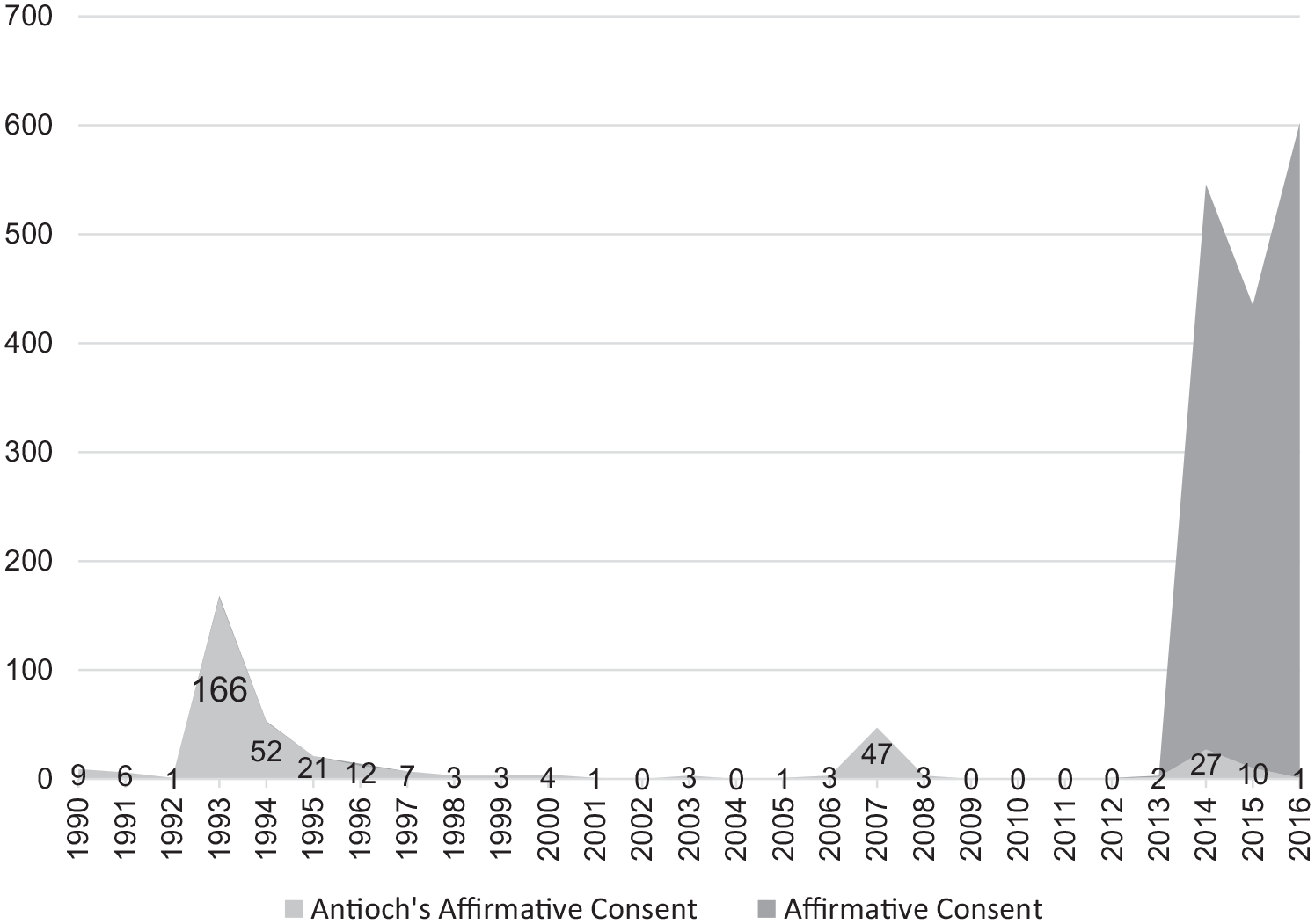
Media coverage of Antioch’s affirmative consent policy and affirmative consent policy from 1990 to 2016.
Valence of Newspaper Coverage
In 1993, coverage on affirmative consent was generally critical of the policy; out of 80 articles published that year, only 31 were in support of affirmative consent. Negative coverage persisted until 2014 when newspapers distributed more supportive than opposing takes. Newspapers did not cease to release critical reports on affirmative consent, but those in support continued to outperform those in opposition (see Figure 2 for more information on the type of media coverage over time).
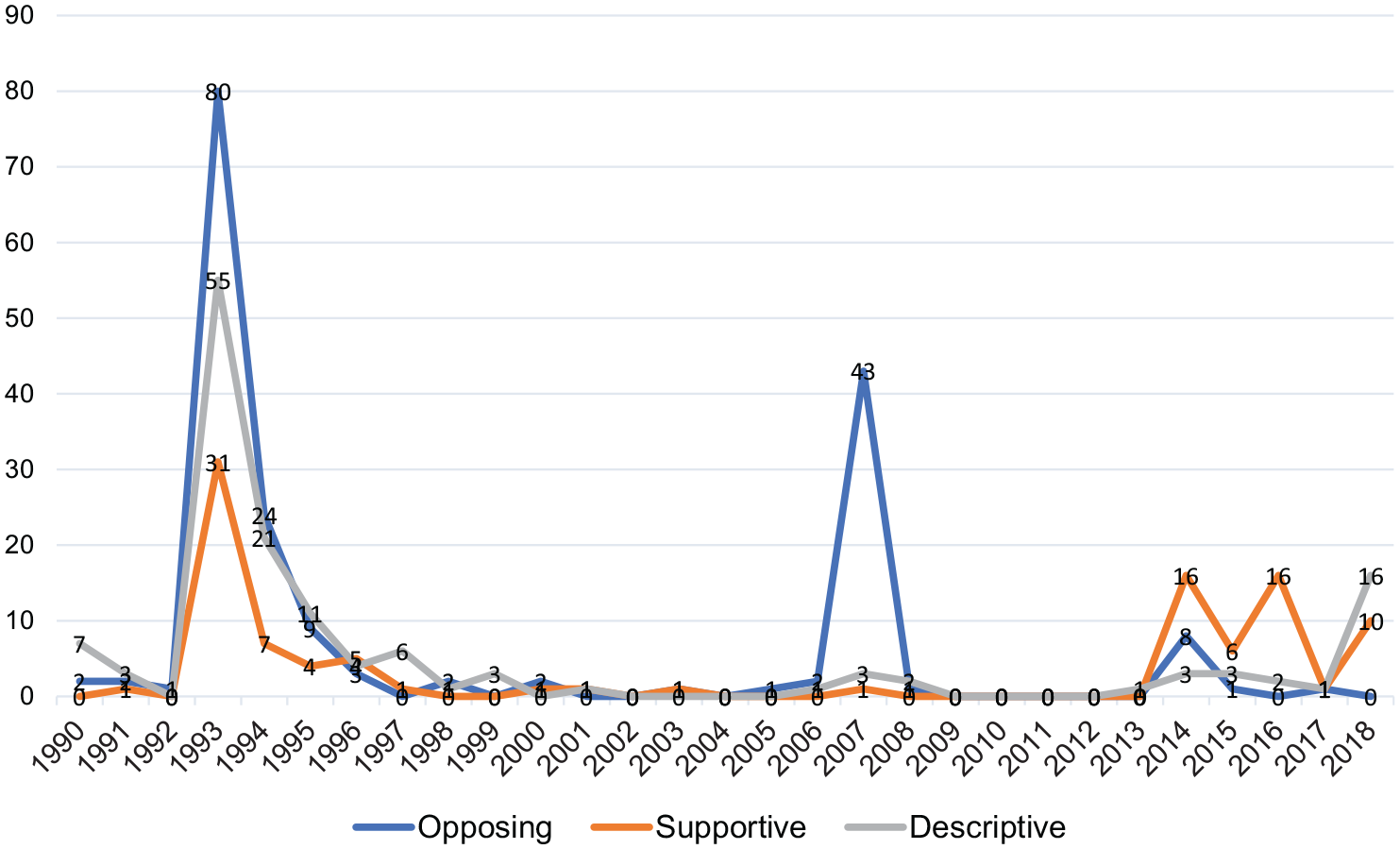
Valence of media coverage on Antioch’s affirmative consent policy from 1990 to 2016.
Content of Newspaper Coverage
Credited to campus feminists: date rape as a bad date
In 1993, campus feminists were credited for developing affirmative consent. After the release of journalist Katie Roiphe’s book,
9
The Morning After, critics introduced the “date rape as a bad date” frame. Roiphe’s book was a critical component of the backlash against the campus anti-rape movement (Heldman et al. 2018). A self-proclaimed feminist whose mother was active in the second wave of the Women’s Movement, Roiphe was an ideal candidate to challenge the premise of affirmative consent policy (Kretschmer and Meyer 2007).
10
In The Morning After, Roiphe described the burgeoning of a new culture of victimization on college campuses, which she attributed to the campus feminist movement. According to Roiphe, campus feminists embraced outdated assumptions about how men and women have sex: men were the silencers, whereas women were the silenced. In the introduction of her book, Roiphe claimed that Antioch College’s affirmative consent policy would allow feminists to take women back to a time of sexual repression, while creating “atmosphere of fear” (Roiphe 1993). The most quoted line in the book was that “someone’s rape may be another person’s bad night.”
11
In 1993, the Seattle Times reported on her stance on the campus anti-rape movement: Roiphe casts doubt on the dimensions of the so-called rape epidemic. (It is “more a way of interpreting, a way of seeing, than a physical phenomenon,” she writes. “It is more about a change in sexual politics than a change in sexual behavior.”) She is doubtful about claims that one in four college women is the victim of rape or attempted rape, that more than 50 percent of all female college students experience some form of sexual victimization or harassment. (Seattle Times, October 29, 1993)
Roiphe’s skeptical rejection of date rape as a social problem provided opponents a framework to attack affirmative consent and the problem it aimed to address.
Nested in the broader backlash to the Women’s Movement (Heldman et al. 2018), opponents offered three arguments to promote the date rape as a bad date frame: the policy put innocent men at risk for expulsion; would make sexual politics worse on campus by killing romance; and that students would not follow the consent rule even if schools adopted it. 12 Critics centered on the details of affirmative consent and the radical feminists who devised it to denigrate its utility as a potential solution (see Figure 3 for more details in shifts in public discourse over time).
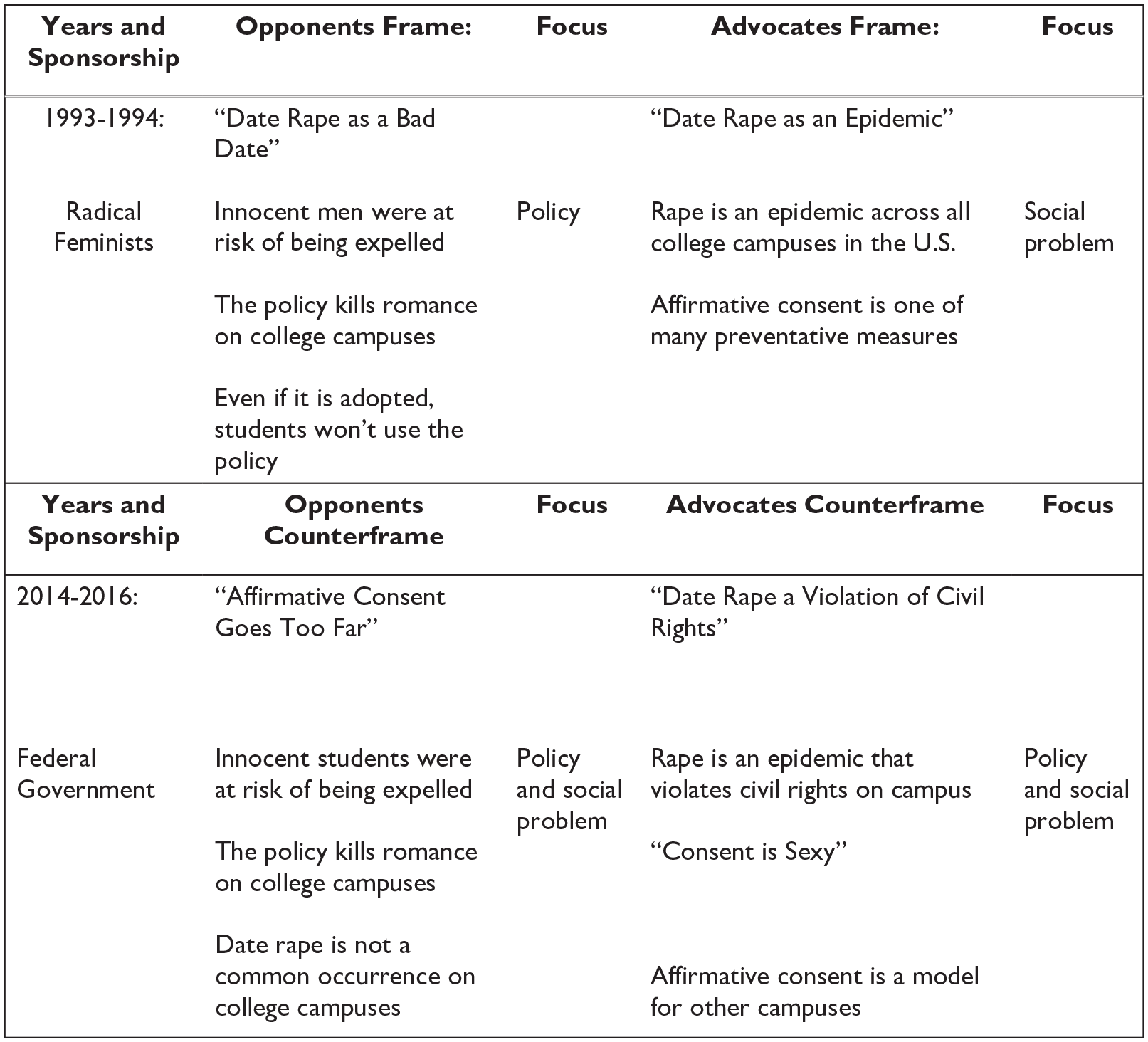
Discourse on affirmative consent policy from 1990 to 2016.
Opponents argued that affirmative consent was a dangerous policy because it put innocent men at risk of expulsion. An op-ed by neo-conservative columnist, Richard Grenier, illustrated this point by suggesting a double standard between men’s and women’s responsibility for having sex under the influence of alcohol: Real rape is a disgusting, vile, abominable practice for which no defense can be found whatever. But in recent times overheated feminists—toward whom intimidated campus males and many others are displaying remarkable cowardice—have expanded the definition of rape to absurd limits. If a woman gets drunk, drives an automobile, and runs someone over, she’s held strictly responsible. But if she gets drunk and while under the influence sleeps with a man at Antioch, she’s been raped. (The Washington Times, September 29, 1993)
Critics framed affirmative consent as dangerous to men by putting them at risk of expulsion, or worse, criminally charged. To them, the policy did more harm than good, making it an unwanted radical reform. Jane Gross noted that men on Antioch’s campus worried about expulsion: [Boy] said: “It’s not natural. Anyway, if I’m with a girl, I can tell if she wants to kiss me.” Helping conduct the [affirmative consent] workshop were upperclassmen, many of whom tried to pitch the code as a better way of communicating, a new way of thinking. But the freshmen were not buying it. “This is a real policy,” one of them pointed out. “I can get kicked out over this.” (The New York Times, September 25, 1993)
By claiming the policy put innocent men at risk, opponents attacked affirmative consent as a viable solution for rape prevention on campuses.
Opponents also argued that affirmative consent endangered romance on college campuses. They claimed anti-rape policies taught students that “dating is dangerous”
13
and stripped the excitement from sexual and romantic relationships. Clarence Page, a conservative columnist, illustrated how opponents insisted that asking for verbal consent would cause romance to be unnatural: The mind boggles at how stilted romance would become if anyone tried to follow this check-off romance policy to the letter. What should be a fun night out would become a legalistic nightmare, checking off anticipated moves like a grown-up version of “Mother, may I?” (Cincinnati Post, September 16, 1993)
Opponents emphasized that sex was instinctual and that requiring students to obtain consent would kill romance, transforming the sex into a formal contract.
Finally, opponents argued that it would be pointless for schools to adopt affirmative consent because it was unlikely that students would even follow such protocols. Reporters even quoted students expressing that they “broke the rules daily.”
14
Opponents claimed that students would see through the policy’s absurdity, leading them to disregard it. A local newspaper published an op-ed expressing this sentiment: The serious aspect of this farce is that Antioch administrators expect anyone—verily, everyone—to take such a policy seriously. The aspect of Antioch’s rules that inspires hope is this: Those dumb enough to consider them wise and obey them likely will never produce offspring, thereby resolving the matter through attrition. (Richmond Time-Dispatch, October 12, 1993)
This quote illustrates how opponents argued that few students would follow the consent rules, rendering it useless. Focusing on the details of affirmative consent and those devising it allowed opponents to denigrate the policy while attacking the significance of date rape.
Credited to campus feminists: date rape as an epidemic
The attacks on affirmative consent set the stage for the debate on the policy. Advocates framed their response to the attack by arguing that rape was an epidemic on college campuses, and regulations like affirmative consent are necessary to protect students. Rather than focusing on the policy’s feminist origin, advocates highlighted the urgency of combating campus sexual violence. A regional newspaper published an op-ed exemplifying this view: . . . more attention needs to be given to acquaintance rape and date rape . . . Those are the crimes most often mishandled by administrators. These rapes are a particular problem among college students because the victims and assailants are usually young adults who might not have the maturity to clearly communicate their sexual wishes. That is why some observers say a sexual conduct policy like the one at Antioch is so badly needed. (Lexington-Herald Leader, December 5, 1993)
15
Advocates used this focused public attention to frame affirmative consent as a solution that could go beyond Antioch. Those in support of the policy argued that regulations like affirmative consent would help students communicate their desires more clearly to one another, ultimately helping them navigate the gray areas of consent. They also promoted a series of remedies for campus sexual violence by urging colleges and universities to hold workshops on date rape, host self-defense classes, and revise their codes of sexual conduct. In this way, the advocates claimed that affirmative consent established a process for responding to campus sexual violence.
Credited to politicians: affirmative consent goes too far
By 2014, when public attention to affirmative consent peaked again (see Figure 1), the debate changed in subtle but meaningful ways (see Figure 3). In particular, the opponents conceded some of the issues they contested years earlier, first by acknowledging that rape was an issue facing college students, just not as frequent as advocates claimed. In 1993, their stance on date rape as a social problem was that it did not exist. By 2014, opponents also stopped overtly suggesting that affirmative consent put men at the risk of expulsion, arguing instead that all students, including women, were in danger due to such policies. Finally, opponents continued arguing that the policy would kill romance on campus.
Opponents argued that affirmative consent was too confusing, strict, and restrictive, putting all students at the risk of expulsion. In 2015, the New York Times published an op-ed exemplifying this view: But criminal law is a very powerful instrument for reshaping sexual mores. Should we really put people in jail for not doing what most people aren’t doing? . . . It’s one thing to teach college students to talk frankly about sex and not to have it without demonstrable pre-coital assent. (The New York Times, July 27, 2015)
16
This quote illustrates how opponents maintained that affirmative consent would unjustly punish innocent students for failing to follow the new rules.
In 2014, opponents acknowledged that rape was a problem, but not a common issue on college campuses. They argued that feminists overestimated the rate of campus sexual assault, claiming it to be a larger social issue than it truly was. A local newspaper published an op-ed exemplifying this change by stating, “rape is always a horrible and violent crime, but there’s hardly an ‘epidemic’ on campus that some make it to be.” 17 Downplaying the frequency of rape allowed opponents to argue that regulating consent was unnecessary; but, admitting that rape was a social problem shows how the battle lines of the debate on affirmative consent had moved in response to the shifts in the legal landscape surrounding campus sexual violence.
Credited to campus feminists: new standard on college campuses
By 2014, advocates continued to argue that rape was an epidemic on campus, but they drew upon Title IX to frame sexual violence as a violation of civil rights on campuses (see Cantalupo 2020; Reynolds 2019). Rather than merely discussing the severity of the problem, advocates argued that failing to implement policies like affirmative consent put colleges at risk of violating Title IX. The Star Tribune published an op-ed illustrating this shift: Within the past two years, California and New York legislators voted to require colleges and universities statewide to have affirmative consent standards, and scores of colleges already have their own rules. More than 20 years ago, Antioch College received a lot of ridicule for being the first college to adopt the standard. But the federal government has made it clear that colleges must do more. In 2011, the Office of Civil Rights issued a letter that reminded institutions of their Title IX obligations to report sexual misconduct. The “yes-means-yes approach’’ raises awareness and gives young men and women an additional way to protect themselves. (The Star Tribune, July 13, 2015)
Seizing upon Title IX, advocates emphasized that the rise in campus consent reform was in response to “. . . evolving federal guidelines about how universities must handle their response to and prevention of sexual assault on campus.” 18 In this way, advocates transformed their framing of affirmative consent from a solution addressing an epidemic on campuses to a solution helping universities avoid violating federal guidelines (see Figure 3).
Advocates also shifted their interpretation of affirmative consent by arguing that consent was “sexy.” They claimed the policy would lead to better sex by increasing and improving sexual communication. Micheal Kimmel and Gloria Steinem commented on California’s policy in 2014: But seriously, since when is hearing “yes” a turn off? Answering “yes” a turnoff? Answering “yes” to “Can I touch you there?” “Would you like me to?” “Will you [fill in the blank] me?” seems a turn-on and confirmation of desire, whatever the sexual identity of the asker and asked. Actually, “yes” is perhaps the most erotic word in the English language. (The New York Times, September 4, 2014)
19
Supporters of affirmative consent directly challenged claims that the policy would “kill romance” on campus, making a more affirmative case, rather than simply repeating the extent of the problem of sexual violence.
Advocates claimed that affirmative consent was a new standard for preventing campus rape and sexual assault. They argued it was a model for other universities to adopt. The New York Times’ editorial board came out in support of the policy: In addition to setting an “affirmative consent” standard, the bill requires California colleges to adopt transparent sexual assault policies, protect confidentiality and establish training programs for officials involved in investigating and adjudicating sexual assault . . . Sexual assault is rampant on campuses, and colleges have failed to respond adequately. “Yes means yes” won’t make these problems disappear. But the new standard is worth trying. (The New York Times, September 8, 2014)
20
Affirmative consent might not stop all acts of sexual assault, but advocates argued that it was a step toward improving the sexual culture on college campuses across the United States.
Credited to politicians: where did Antioch College go?
In 2014, only 27 of the 512 newspaper articles covering affirmative consent mentioned the policy’s origin (see in Figure 1). Opponents and advocates of affirmative consent approached its provenance in distinct ways. Opponents highlighted the role of radical activists to attack affirmative consent, whereas advocates downplayed the work of feminist activists while valorizing the efforts of politicians.
Opponents mentioned “Antioch College” to emphasize that policies regulating consent have failed before and are likely to do so again. As Mona Charen wrote, There’s really only one thing that progressives get wrong: human nature . . . California proposes to stop campus rape and sexual assault with a law redefining consent. Gov. Jerry Brown signed legislation last week specifying that verbal consent must precede all sexual activity . . . Twenty years ago, Antioch College promulgated similar standards requiring verbal consent to each and every sexual act . . . Antioch . . . was universally mocked, but it seems it was ahead of its time . . . For all of their bold talk about empowerment, feminists seem always to demand that they not be forced to deal with reality. . . Feminists have been lying to women for decades, thereby contributing to the “rape culture” they now decry. (Bluffton News-Banner, October 8, 2014)
Affirmative consent’s origin provided raw material to attack both the feminist movement and the policy. Opponents mentioned how Antioch College was ridiculed for their consent rules to claim that society has finally caught up to their radical ideas about sex, intimacy, and the feminist movement. Ignoring that California’s affirmative consent policy does not require verbal communication, opponents cited the policy’s originators in their attempt to discredit the reforms.
In contrast, rather than defending the prescience and persistence of the Womyn of Antioch, more recent advocates neglected the radical feminists and emphasized the role of government officials, college administrators, and attorneys in enacting the reform, especially the work of California Governor Jerry Brown in signing “Yes Means Yes” into action. Advocates also noted that, under the Obama Administration, the federal government threatened to cut federal funding for colleges and universities if they failed to address gender-based violence on their campuses, crediting Vice President Joe Biden for this shift. It was very unusual for the supporters to name the feminists who developed the policy (see Figure 1), but when they mentioned the college, it was only to declare that “no one is laughing” now: Antioch College in Ohio drew sneers in 1991 when it became the first campus to issue an explicit affirmative consent rule. Critics thought it ridiculous that students had to ask for permission to go to the next stage of a sexual encounter. Almost a quarter century later, no one’s laughing. Last fall, California became the first state to require the policy at all of its campuses. At least three Minnesota colleges . . . have similar policies. (Albert Lea Tribune, January 13, 2015)
This quote illustrates how a few advocates used Antioch College to demonstrate how far we have come in the fight to combat rape on college campuses.
We must understand the changes in public attention to, response to, and discourse on affirmative consent within the shifts in federal guidelines on campus sexual assault (see McCammon et al. 2007). In the following section, I outline the critical Title IX cases propelling issues of campus sexual violence on the national policy agenda, urging schools to revise their consent guidelines (Armstrong et al. 2019), creating an opportunity for advocates to reframe the history of affirmative consent.
Leveraging Title IX: How Institutional Action Shifts Policy Discourse
To examine how a diffuse collection of activists kept the ideas of the Womyn of Antioch alive, even when the policy was no longer on the public’s radar, I traced how activists leveraged existing laws to address campus sexual violence reform. Three bodies of law influence how colleges are expected to respond to sexual assault: the Clery Act, the Campus Sexual Violence Elimination Act (SaVE Act), and Title IX. In this section, I describe the history and content of each of these laws, tracing the mobilization responsible for driving these changes in federal legislation. I also outline how a diverse collection of activists used existing laws to encourage schools to reform their protocols for preventing campus rape, including the adoption of an affirmative standard for sexual consent (I outline the legislative shifts on campus sexual violence in Figure 4). Feminist attorney, Catharine MacKinnon, was the first to use Title IX in charges of sexual harassment against an educational institution in Alexander v. Yale (1980). Five students alleged a male faculty member sexually harassed them. 21 MacKinnon argued sexual harassment constituted sex discrimination and that the university was thus in violation of Title IX. Although the women did not win their case, they affected changes: Yale instituted a grievance procedure, and a court held that sexual harassment constituted sex discrimination, setting a precedent for survivors across campuses in the United States (see Figure 5 for an outline of cases propelling issues of campus sexual assault into policy agendas).
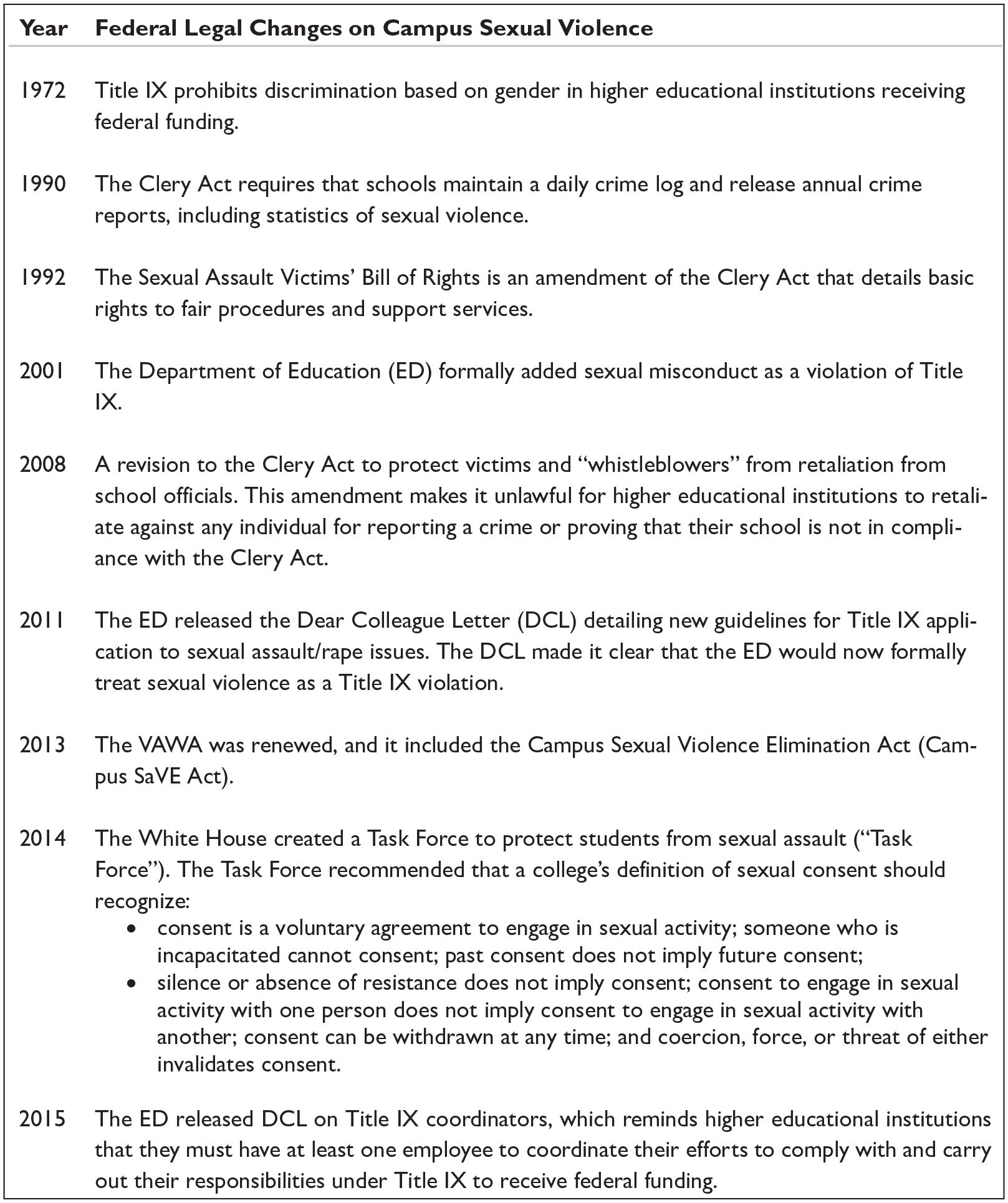
Federal legal changes on campus sexual violence from 1972 to 2016.
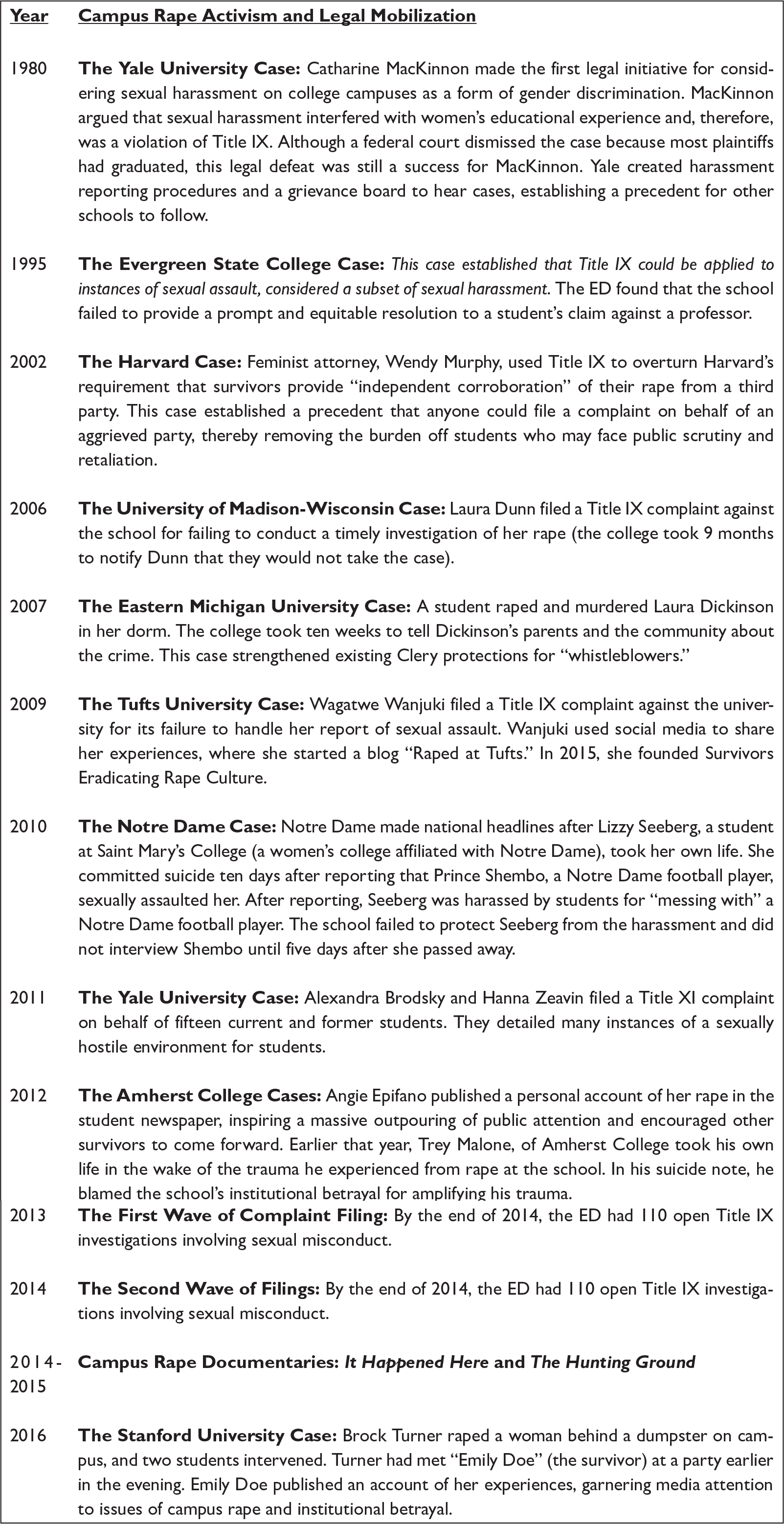
Campus anti-rape activism and legal mobilization from 1980 to 2016.
Following the first national debate surrounding Antioch’s affirmative consent in the early 1990s, activists across colleges in the United States devised campaigns to combat date rape. At Brown University, Wesleyan, and other schools, the activist wrote the names of men they said had assaulted them in bathroom stalls. Activists at various schools worked with faculty to host educational programs and events on safe practices of sexual consent. They used these programs and events to push schools to adopt an affirmative standard (Heldman et al. 2018; Whittier 2019). 22 Although the mobilization was not large or sustained, they helped maintain the feminist critique of sexual violence, which enabled the spread of protests around 2011 (Whittier 2019).
Not only were student activists using grassroots tactics to combat sexual violence on their college campuses, but legal activists continued to leverage federal guidelines to hold schools accountable for failing to address these issues. A decade full of Title IX complaints filed by Wendy Murphy and numerous survivor activists across the nation urged the federal government to address campus sexual violence (expressed in Figure 5). In response, the Department of Education (ED) issued a Dear Colleague Letter stating that, “The sexual harassment of students, including sexual violence, interferes with students’ right to receive an education free from discrimination, and, in the case of sexual violence, is a crime.” The ED added that it is the responsibility of colleges and universities to “take immediate and effective steps to end sexual harassment and violence,” which sent a signal to schools that the 2001 policy would now be the focus of their enforcement, making it clear that the ED would now formally treat sexual violence as a violation of Title IX. This shift in Title IX and new guidelines served to ignite the surges of complaints filed in 2013 and 2014.
Student activists used Title IX as a tool to compel change across schools throughout the United States. The first coordained wave of Title IX complaints within the campus anti-rape movement 23 began in January 2013, when University of North Carolina–Chapel Hill students Landen Gambill, Andrea Pino, and alum Annie Clarke filed Title IX and Clery complaints on the behalf of 64 other students and alums testifying egregious mishandlings of sexual violence cases. 24 A month later, over 300 students at Occidental College marched to demand that the college provide better transparency and adjudication of sexual misconduct on campus. By March 2014, students and faculty at the college filed Title IX and Clery complaints on the behalf of 37 survivors that the institution failed to prevent and adequately respond to instances of assault/rape. In addition to the complaints filed at UNC-Chapel Hill and Occidental College, survivor activists filed Title IX complaints at nine other higher education institutions across the country (see Figure 4). Their collective efforts secured national media attention; by 2013, mainstream media attention to campus sexual violence spiked with a total of 7,947 mentions (see Figure 6).
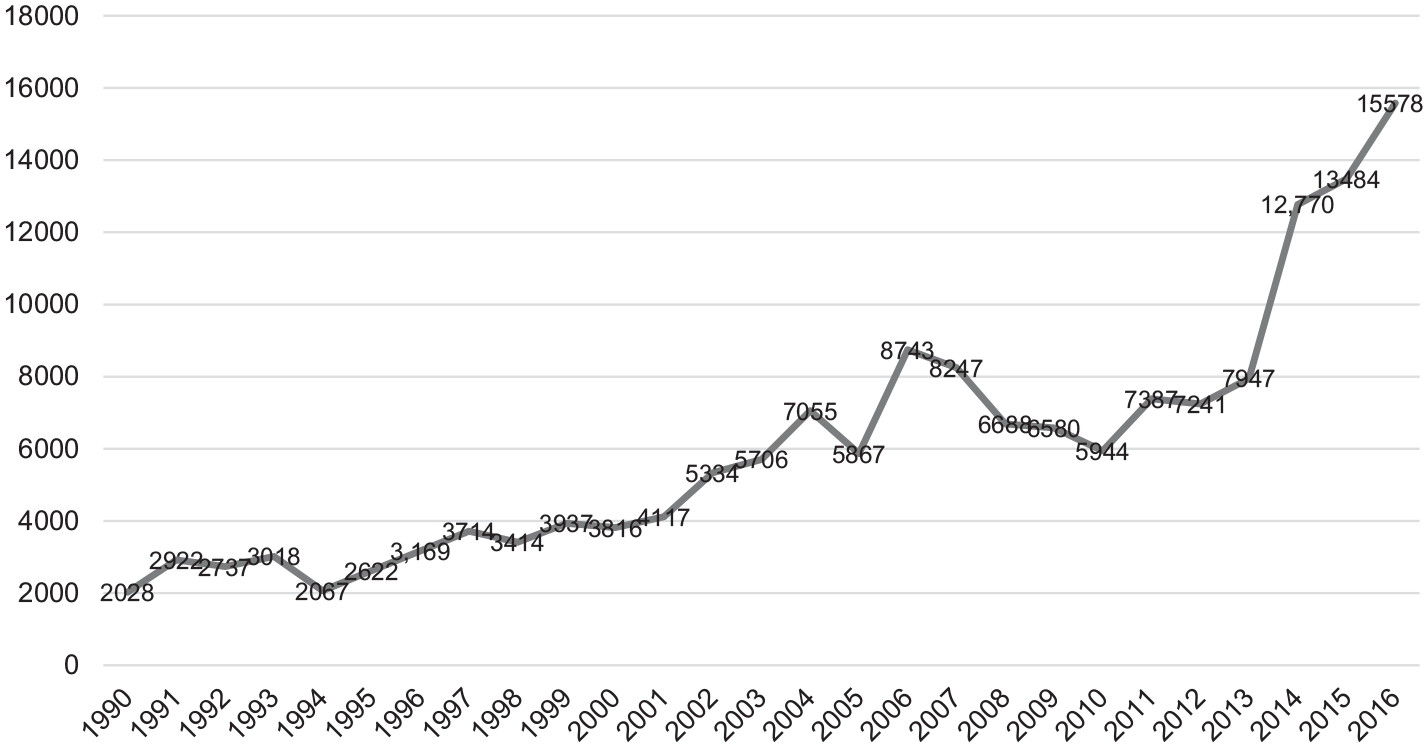
Local and regional newspaper mentions of campus sexual violence from 1990 to 2016.
While some participants of the policy relay leveraged Title IX, others pressed colleges and universities to adopt an affirmative consent standard (New 2014; Whittier 2019). A collection of social movement leaders, student activists, and legal scholars advocated to move from a “No Means No” standard for sexual consent to a “Yes Means Yes” (New 2014). Legal scholars, such as Nicholas J. Little, argued that affirmative consent policies would not “kill romance” and would, instead, grant both men and women equal ability to consent to sexual activity. 25 In addition, Laura Dunn, founder of SurvJustice—a national non-profit aimed at increasing the prospect of justice of survivors of sexual violence—advocated and organized along with various survivor and student activists to add an affirmative consent standard to the reauthorization of the VAWA in 2013 (New 2014; Whittier 2019). Although they were unsuccessful, their sustained efforts generated a collection of students, calling for a “Yes Means Yes” standard. Their dedication led to the Consent Is Sexy campaign: a poster campaign that uses sex-positive images and messages to define and promote consent, both as a mandatory and sexy practice. This poster campaign surged across campuses throughout the United States, as schools redefined their approach to responding to campus sexual violence to meet the standards of changing federal guidelines. 26
As public attention to campus sexual violence increased in 2013, activists continued to work with social movement organizations and political leaders to pressure the federal government to address campus sexual violence. Their sustained efforts contributed to the passage of the Campus SaVE Act. Congress included SaVE in the reauthorization of the VAWA effective as of 2014 (the same year that CA passed the “Yes Means Yes” law). The act establishes that colleges and universities are expected to provide programs to reduce and prevent acts of gender-based violence. Hence, schools are required to offer prevention workshops for all incoming students and new employees. These programs must include clear definitions of sexual consent, the procedures of reporting, advice on risk reduction, and bystander intervention training. After Congress passed the Campus SaVE Act, higher education institutions felt pressured to adopt preventative tools, such as an affirmative consent policy (see Figure 4).
During the second coordinated wave of filings, in 2014, the ED opened 110 Title IX investigations involving sexual misconduct. In the following two years, there were more than 200 Title IX complaints on issues of sexual violence (Reynolds 2019). Activists strategically used the complaints to put the issues of campus rape on the national agenda. With the support of President Barack Obama and Vice President Joe Biden, 27 activists urged the federal government to create a Task Force to Protect Students from Sexual Assault. 28 The Task Force provided recommendations for defining consent, emphasizing that it should be affirmative, voluntary, and not implied by silence, mirroring the language of Antioch College’s policy nearly 25 years earlier but without the requirement for verbal communication.
Years of mobilizing under the public radar shifted the legal terrain and public discourse on campus sexual assault. These changes eventually inspired states like California (2014) and New York (2015) to adopt affirmative consent policies. Although these policies do not require consent to be a verbal exchange, like the Womyn of Antioch’s version, each mandate that consent to sexual activity needs to be voluntary, continuous, and that silence or lack of resistance does not imply consent. Filing Title IX complaints urged the federal government to put pressure on colleges and universities to develop clearer standards of sexual consent. In response, politicians and campus administrators picked up and edited Antioch College’s formally mocked solution for campus rape. In this sense, survivor activists and feminist attorneys eventually made affirmative consent policy go from a national laughingstock to a standard for hundreds of college campuses across the nation (see Armstrong et al. 2019).
Discussion and Conclusions
Over 25 years, affirmative consent went from a tempest at a small liberal arts college, to controversy, to a part of federal guidelines for campus sexual consent regulations (Armstrong et al. 2019; Heldman et al. 2018). When we trace the origins and development of affirmative consent policy, we see an idea emerging from radical feminist analysis, picked up by student activists seeking a local solution, and attacked by cultural conservatives. While the policy disappeared from broad public visibility, it was embraced and edited by institutional actors with somewhat different concerns than the policy’s originators. These institutional actors transformed the idea into a model for preventing campus sexual assault. It would be easy to miss these connections without tracing the policy idea from its origin to implementation. But detailing the shifts in public discourse on affirmative consent and contextualizing those changes within broader reforms on campus sexual violence (McCammon et al. 2007; Rohlinger 2006) allows us to examine the unintended consequence of mobilization while exposing a nuanced process of movement influence: the policy relay.
Examining how actors use the policy relay to advance their goals requires us to extend our time frames for movement influence, diversify the range of actors and locations of mobilization, and examine how different actors frame ideas over time. Actors located in distinct arenas participate in the policy relay. There can be activists who establish the importance of a social problem (Kingdon 1995; Stone 2002). This set of activists, however, may not be the ones to carry the idea into implementation; other can seize upon it and pass the idea along until they transform it into a reform (Wasow 2020). This process is complicated, not linear, and can be easily missed by studies only focusing on the efforts of movement organizations or the effects of events such as protest on the policy process (see Amenta et al. 2012; Gamson 1990). However, by tracing a policy idea from its inception to widespread implementation, I developed a framework for investigating the complex and unintended ways that mobilization can spark reforms. This framework can help to better understand how a formerly mocked policy idea becomes a story of widespread solution, while uncovering why some controversial aspects, such as the policy’s originators and the need for verbal consent, are removed from narratives of reform (Bromberg and Fine 2002; Meyer and Rohlinger 2012; Taylor 1989).
The Womyn of Antioch started the policy relay in 1991 by defining a social problem and prescribing a potential solution. Grounded in the broader cultural backlash to the anti-rape movement, in 1993, opponents of affirmative consent, unwittingly, joined the relay by attacking the policy idea nationally. Their attacks focused on the details of the policy, particularly the need for verbal consent. Yet, by attacking the policy, the opponents unintentionally drew attention to issues of campus sexual violence, generating a platform for anti-rape advocates to urge the public and political leaders to take campus sexual violence seriously. Although their attacks created initial setbacks for the Womyn of Antioch’s policy idea, the ridicule alerted others to the public recognition of a problem as well as a possible remedy. This diverse collection of political actors mobilized across different settings to change how colleges and universities address campus sexual assault. They used existing laws, particularly Title IX and VAWA, to hold schools accountable for failing to secure an environment free from gender discrimination. These lawsuits drew public attention to the prevalence of campus rape while incentivizing schools to update their protocol for campus sexual violence. With this, advocates reframed the social problem as more than a potentially criminal interaction between students to a violation of civil rights, effectively providing a route to a remedy. By 2014, with the support of the Obama-Biden presidency, the federal government created a Task Force mandating schools to revise their guidelines on sexual consent. The administration’s support was critical in putting issues of campus sexual violence on the national policy agenda, likely creating a moment of opportunity for the success of the affirmative consent policy relay (see Meyer 2004; Meyer and Minkoff 2004). With this, state politicians and universities alike had an interest in generating methods to prevent campus sexual violence. A slightly reformulated version of affirmative consent became a common-sense solution.
By examining the policy relay, we can uncover the unexpected ways activists shape reforms (see Fetner 2001; Wasow 2020). The Womyn of Antioch never intended to focus public attention on issues of campus sexual violence, and the critics of affirmative consent did not aim to alert institutional activists to an obscure policy idea. But by tracing the different actors carrying affirmative consent, we can account for all consequential in the reform process, including those unintentionally involved (see Fetner 2001; Wasow 2020).
Tracing an idea over time also reveals how narratives of policy reforms can fail to reflect the complexities of the political process. The story shows that activists not only have a stake in constructing the reputations of a movement (Meyer and Rohlinger 2012; Taylor 1989) but the origins of their policy ideas as well. When the advocates of affirmative consent resurrected the policy in 2014, those that secured media attention stressed the accomplishments of politicians and college administrators in driving the reform. The opponents, however, called back to Antioch College as a way to invoke an image of radical feminists willing to control the sex lives of students. This contestation of provenance suggests that it may be in the interests of activists to tell partial stories of a policy’s history: a concise narrative with an uncontroversial origin story, likely to resonate with a broad base of support (see Meyer 2006; Meyer and Rohlinger 2012; Taylor 1989). It also suggests that analysts of social movements and social change pay careful attention to which actors the media prescribes credit to for various reforms and the implications these decisions have on our collective knowledge of the policy process (see Armstrong and Crage 2006; Eyerman and Jamison 1991; Meyer 2006; Meyer and Rohlinger 2012).
The choices we make about what to include in our analyses matter. Studying the influence of mobilization requires us to make decisions about where to begin our timelines and which actors, events, and tactics to include. 29 While studying anti-rape activism, scholars could begin their analysis with Black women fighting against white men using rape to maintain the racial order during the Reconstruction era (the 1880s) or with the second wave of the Women’s Movement (the 1970s) when activists redefined rape as a common experience for women of all races 30 (Armstrong, Gleckman-Krut, and Johnson 2018; Heldman et al. 2018)—to cite two, of many, possible origin points. Our starting point sets boundaries on our ability to draw connections between events, actors, and outcomes. We must be mindful of where we begin and, as a result, what we are excluding; otherwise, we risk producing and promoting distorted understandings of the mechanisms of social change.
What we exclude from our investigations also shapes our broader understanding of what ignites social change. For instance, failing to credit the Womyn of Antioch for developing affirmative consent contributes to a broader erasure of radical feminists from narratives of social change, while reinforcing the state and political leaders as chief promoters of reforms. The story of affirmative consent as a product of state politicians fails to contextualize the policy within a larger movement aimed at ending sexist and racist oppression (Collins 2000; Matthews 2005). This exclusion obscures the radical anti-rape movement’s efforts in igniting social change. Removing the role of grassroots movements in popular accounts of social reforms constrains how we imagine methods to ignite political transformation; in so far, that these stories emphasize the state while obscuring the impacts of movements on the policy process. Focusing on the state and political actors ultimately conceals how power relations shape dominant discourses of reform, influencing how we develop policy ideas and the routes we take to enact them.
Extending the timelines of influence and widening the range of political actors involved in the policy process presents opportunities for future research. The policy relay approach surely applies to a range of other movements. In addition to exploring the policy relay in other contexts, future research could examine how the institutional context of college campuses shapes the diffusion of a movement’s ideas over time. This information would provide valuable insights into the relationship between movement influence and campus context.
The dynamics of how activists construct stories of policy history are also worthy of further investigation. This process of framing the origins of a movement (de Moor and Wahlström 2019; Meyer 2006; Taylor 1989) and what sparked activists to mobilize (Lauby 2021; Polletta 1998; Swerts 2015; Van Dyke et al. 2021) has been an interest of social movement scholars. This process, however, has yet to be fully explored concerning the construction of the history of policy ideas. While I have illuminated how policy narratives and ideas change as different activists carry them to fruition, my data cannot speak to how activists make decisions while constructing stories of reform. Future research should further examine this process by studying how activists make decisions at different points in the policy relay.
This study demonstrates that extending our timelines for measuring movement influence and widening the range of political actors included in our analyses reveals a complex process of how activists advance their policy goals: the policy relay. This process helps to explain how initial setbacks can lead to unexpected opportunities for movements. It also demystifies the process of how a diverse collection of activists pick up an idea, and without coordination, pass it along to one another until they transform it into a widespread solution. The policy relay is complicated, and activists may choose to tell partial stories about this process. These strategically crafted narratives often obscure the role of radical ideas in igniting political transformation (see Armstrong and Crage 2006), leaving us with the assumption that movement ideas are unlikely to generate policy reforms. However, this paper shows that this is not the case. Despite these curtailed accounts, a movement’s ideas can ignite social change, but this process may simply take longer than what simpler narratives would lead us to expect.
Footnotes
Declaration of Conflicting Interests
The author(s) declared no potential conflicts of interest with respect to the research, authorship, and/or publication of this article.
Funding
The author(s) received no financial support for the research, authorship, and/or publication of this article.