




Abstract
The aim of this paper is to investigate to what extent the understanding of market categories changes over time and how this is reflected in the importance of different category signals in periods of category maturation and revival. We test the changing influence of different types of category signals on inclusion rates of surf music compilation albums, which represent the understanding of “surf music” from a market-based perspective. We find that “elaborate” signals to the category label of surf music showed to be important during both the stage of maturity and revival. However, restricted category signals using surf slang actually lost their importance over time. Finally, signaling surf-related locations had no effect in early times, but increased chances of inclusion during a revival. By addressing these changes over time in the importance of category signals, we add to recent studies on mechanisms of categorization during different stages of category development.
Introduction
In many social domains, systems of categorization impose coherence on the social world by partitioning items into groups and providing anchors for judgments about value and quality (Hsu and Hannan 2005; Vergne and Wry 2014). These categorical systems have important consequences for communities, organizations, and consumers that navigate these social domains. Prior research has indeed found that lack of fit with established categories can lead to penalties and lowered evaluations (Zuckerman 1999). As a result, actors often try to convey an identity that fits their desired category. One way in which actors do this is by signaling membership, by drawing attention to certain features institutionalized within the cognitive schema of that category (Hsu and Hannan 2005), or by signaling category-specific vocabularies (Loewenstein, Ocasio, and Jones 2012). Category membership itself can also act as a collective market signal (Negro, Hannan, and Fassiotto 2015). When high-quality actors find it easier to gain membership into a distinctive category than low-quality actors, categorical membership can become a signal for hard-to-observe quality differences.
Categories are, however, not stable and change over time. Categories are found to go through different stages of development (Granqvist and Ritvala 2016; Grodal and Kahl 2017), such as emergence (Ruef 2000), diffusion (Purdy and Gray 2009), maturity (Hsu and Grodal 2015; Lounsbury and Rao 2004), decline (Kennedy and Fiss 2013; Kuilman and van Driel 2012), and revivals (Lena 2012; Raffaelli 2013). What remains unclear in this literature, however, is how these dynamics affect the meaning and importance of different identity signals. Giacomo Negro et al. (2015)—one of main studies on categories and signals—focus on contemporaneous category signaling, where producers’ signaling and audiences’ response take place in a relatively short time span. Yet, we investigate how contemporary responses to category signals differ from retrospective responses in later stages of category development. William Barnett, Mi Feng, and Xaioqu Luo (2012) have shown how identity claims can constrain future opportunities of organizations, as identity claims from an earlier period—such as the names of organizations—can serve as a “residue of history.” This suggests that the effects of signaled identity claims remain stable over time and leaves historical traces of categorical membership, even if the history of the category is largely forgotten. Prior research has, however, not compared different types of signals. In this paper, we will argue that categorical dynamics can lead to changes in the importance of different types of signals. Although some types of signals remain important over time, other signals might be especially important in early periods and fade over time.
To make this argument, we draw upon a conceptual distinction from cultural sociology between “restricted” and “elaborate” codes. We argue that “restricted” signals play a more important role in gatekeepers’ boundary work in the original phase of a category than in times of category revival. “Restricted” signals are more specifically embedded in bounded cultural frameworks and are therefore more likely to lose their appeal over time. “Elaborate” signals, with a more general meaning, will remain important in categories’ boundary work in later phases of the development of a category. Finally, signals that follow collective narratives of a category, which have developed over time as indicators of authenticity, will have an increased importance in revival periods.
Empirically, we study categorical dynamics in the market category of “surf music.” This case is interesting for three main reasons. First, as detailed in the second section of this paper, surf has a clear pattern of emergence, maturation, decay, and revival (Crowley 2011). This pattern allows for studying effects of signals at different stages of the category life cycle. Second, the genre of surf music was a highly codified genre that was strongly connected to a particular location—California—and highly embedded in a subcultural scene of surf culture, with clear surfing vocabulary and membership codes, which makes the case interesting for analyzing how “restricted” membership signals fared over time as the category developed farther from its origins in time and space (Bergesen 1984; Cralle 1991). Third, the surf genre allows for the empirical study of signaling and genre inclusion due to the availability of archival data gathered by surf historians, which provides a comprehensive overview of a wide population of acts active in surf music. To study changes in the effects of different types of signals, we compare the inclusion rates of surf tracks that exhibit different signals, on compilation albums released during surf music’s heydays and during its revival. As compilation albums necessarily select from a wider population of artists and tracks, in the aggregate, the inclusion on compilation albums reflects how the understanding of the “boundaries” of the category of surf shifted over time, which allows us to assess how changes in categorical meanings affect the salience of different types of signals.
Our paper aims to make several contributions to the literature. The process of categorization is ubiquitous, and our findings contribute beyond the scope of surf music. In general, our study contributes to the understanding how changing standards of categorization impact what actors are successful. Our findings show how certain attributes of categorization lose their meaning over time, while others get more prominent roles in classification processes. Our study has some specific contributions to the study of categories. First, by specifying different types of category membership signals, we respond to calls for further research on how labels or names can be used by actors to position themselves in markets or categories (Granqvist, Grodal, and Woolley 2013; Verhaal, Khessina, and Dobrev 2015). Furthermore, by studying the effects of signaling over time, we also contribute to a growing body of research that is interested in category dynamics and evolution and the drivers of categorization in different stages of the category life cycle, specifically category revivals (Granqvist and Ritvala 2016; Grodal and Kahl 2017).
The paper is structured as follows: We first review the historical development of surf music. We then discuss studies from organizational sociology on different stages of the categorical life cycle and cultural sociological literature on linguistic codes and theorize why the impact of category signals might vary over time. In the subsequent section, we describe our data and methods. Next, we present our regression models and end with a conclusion and discussion.
The Genre of Surf Music
The surf music genre shows a clear pattern of emergence, diffusion, decay, and revival. Figures 1 and 2 illustrate how surf music emerged at the dawn of the 1960s, with a rapid rise in the number of new “surf” artists (Figure 1), and an increased number of compilation albums labeled as surf (Figure 2). Especially, artists like Dick Dale and the Beach Boys were important driving forces behind the growing popularity of this genre in this early period. Their first surf tracks are considered as starting point of the genre around 1961 (see Figures 1 and 2). As young artists, they created a sound that was imitated throughout the country and even the world (Crowley 2011). Figure 3 illustrates the diffusion of surf music in this early period. It first originated in California and around 1963 surf music had spread throughout the United States and was experiencing a boom in popularity. The great majority of the surf bands arose during this period, and artists working in different genres jumped on the bandwagon (Blair 2015).
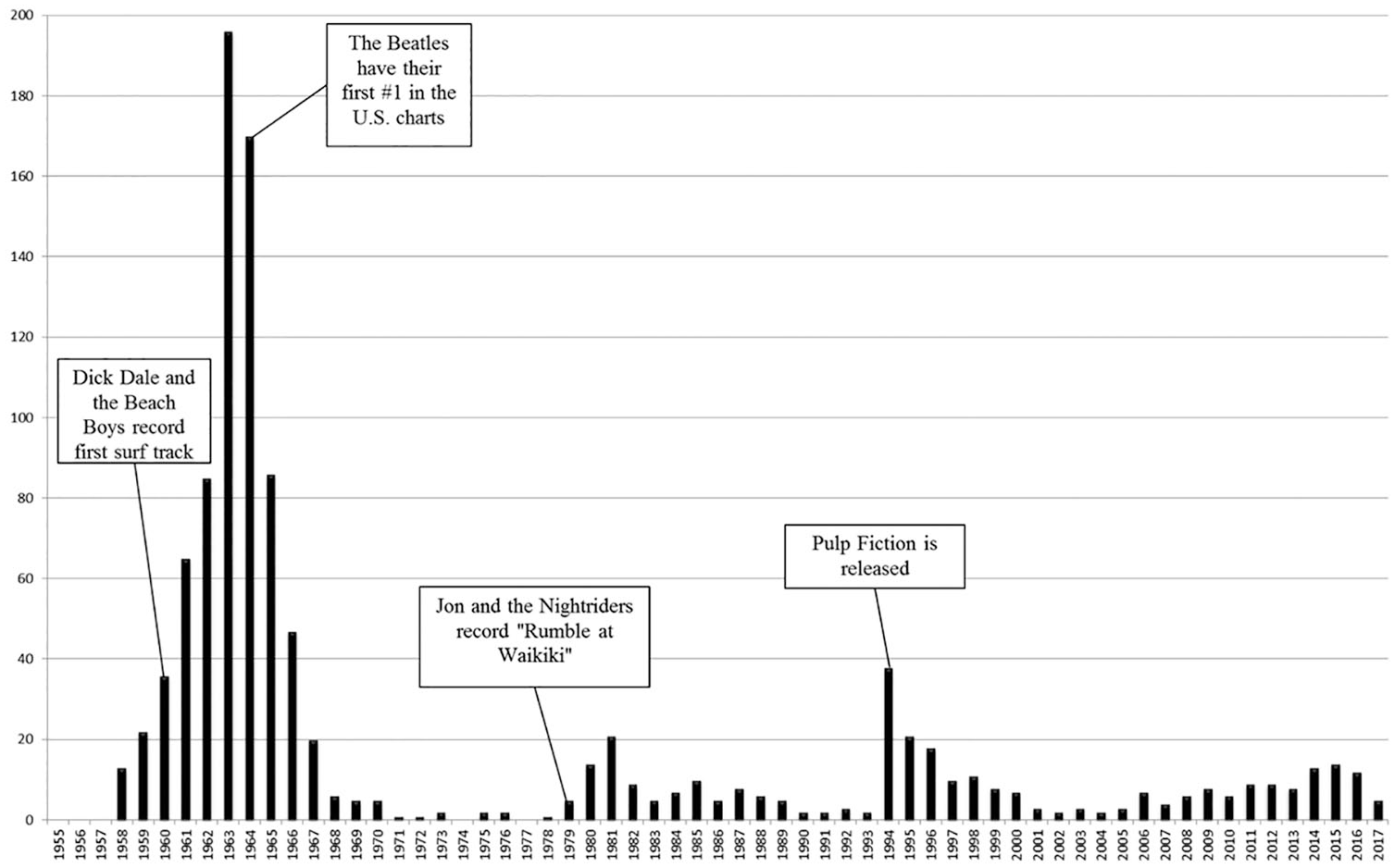
Number of new artists releasing a track in the surf genre for the first time each year (www.discogs.com) (n = 1,782).
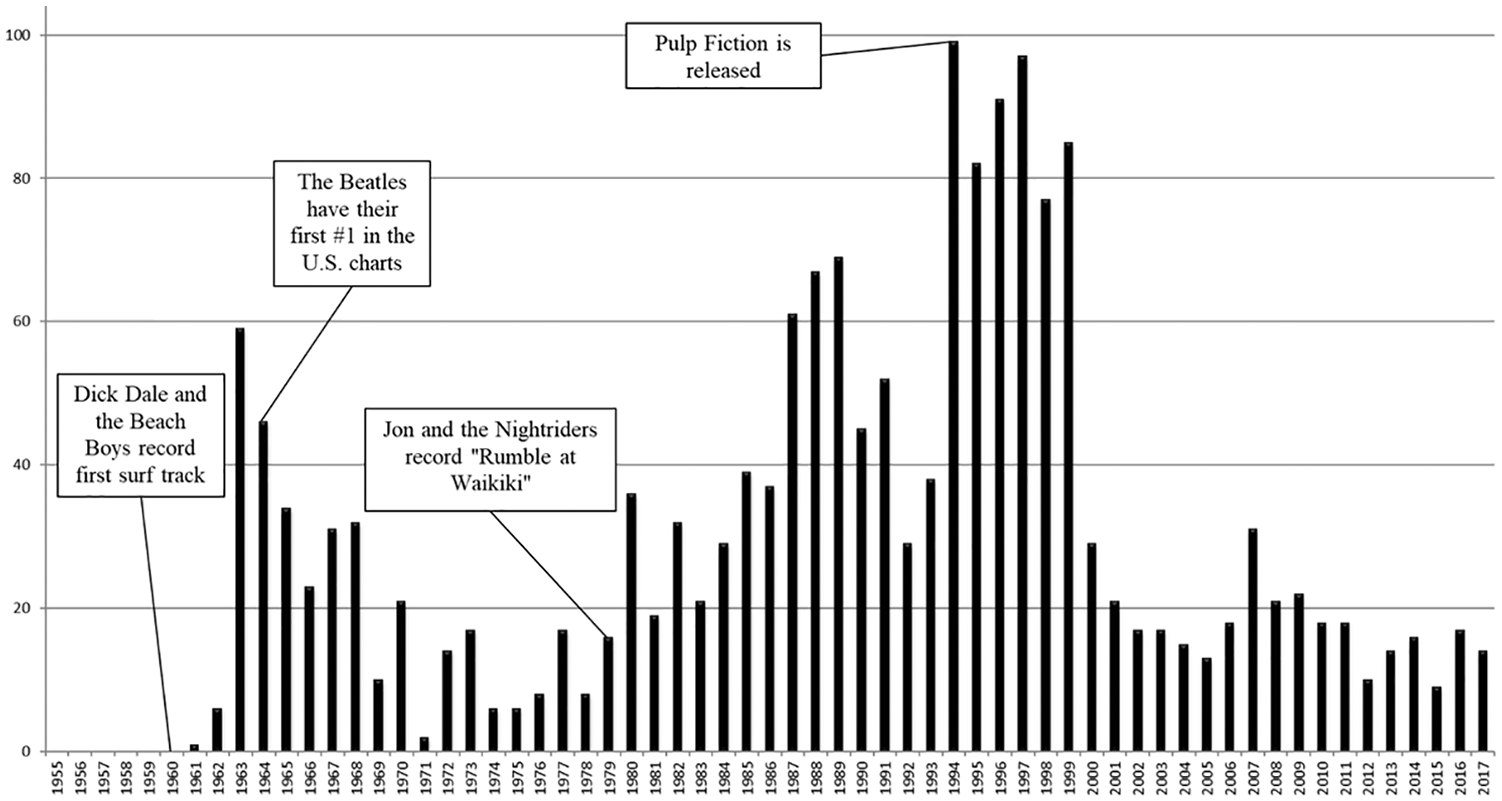
Number of surf music compilations albums released yearly (www.discogs.com) (n = 1,096).
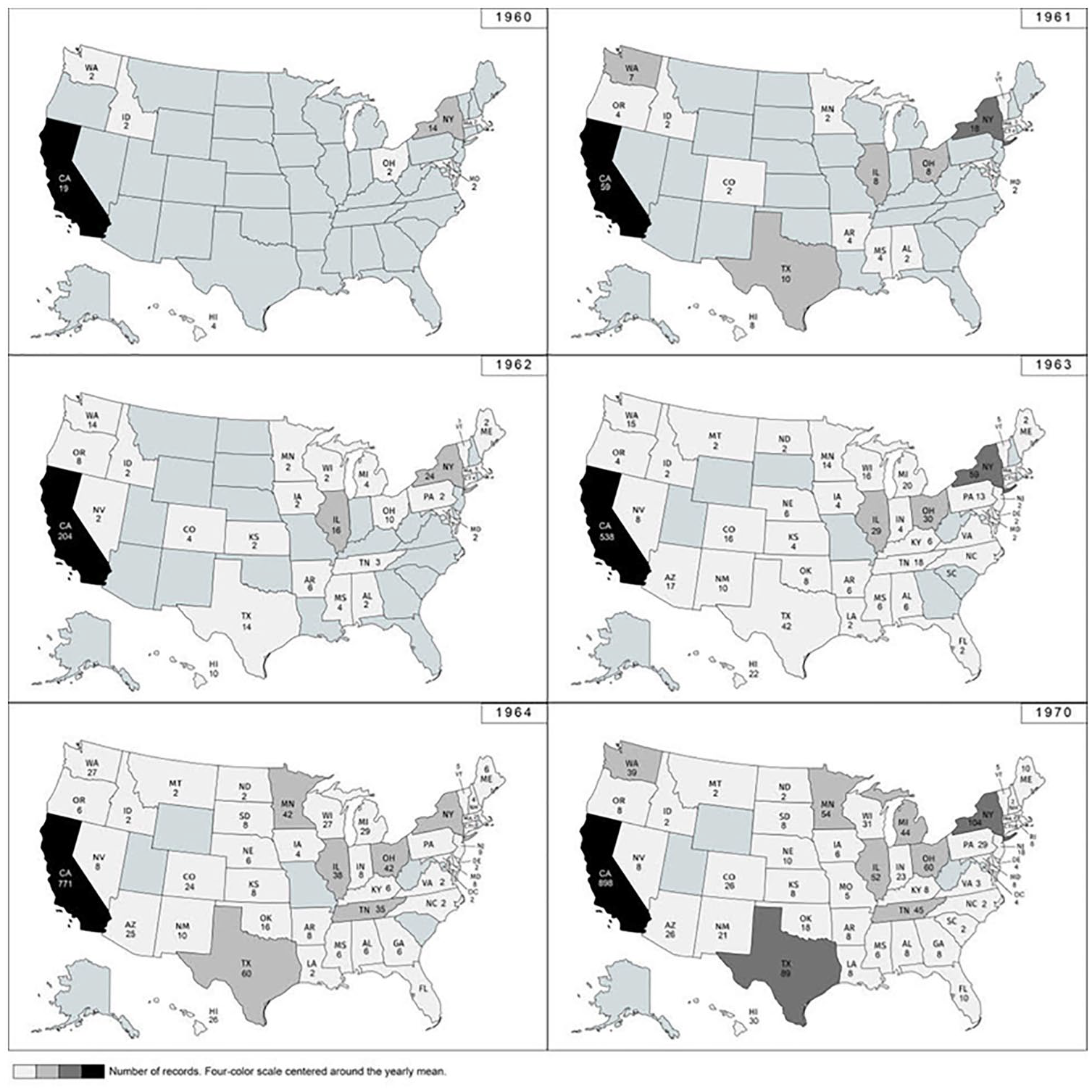
Distribution of surf tracks produced between 1959 and 1970 over the United States.
However, even at the end of the 1960s, still more than half of the surf tracks came from California (see Figure 3). A distinctive subcultural lifestyle also remained somewhat exclusive to California, as it was considered the “prototypical” surfing state (Crowley 2011). Indeed, the Californian roots were a strong identity feature of surf music, and the broader surf culture and artists tried to capture “the essence of being a teenager and living in Southern California” (Blair 2008: v). To signal this distinctive surf culture, band names, song titles, album titles, and lyrics often included references to specific subcultural lingo that surfers were using to describe a broad range of topics related to surfing (e.g., its participants, environment, and techniques; Cralle 1991), as well as the specific geographic locations (“California” or “Hawai”’) or locales (beaches, bays, piers, and coasts) that were important for surf culture (Blair 2015; Schmidt 2007).
Toward the end of the 1960s, the popularity of the genre diminished as sudden as it emerged. The “British invasion” of bands such as the Beatles to the United States resulted in a shift toward different music styles. This decrease set in during 1964, and both Figures 1 and 2 show that when the Beatles scored their first number one hit in the U.S. music charts, the number of artists entering the genre and the number of compilation albums using the “surf” label started to decrease. Toward the end of the decade, the genre had its sunset when “music turned away from the beaches” (Blair 2015:57) and both figures show that, after 1970, not many new artists or compilation albums entered the market.
During the early 1980s, surf music experienced a modest revival, often claimed to be ushered in by Jon & the Nightriders who did an homage to surf music in 1979 (Crowley 2011; Schmidt 2007). However, surf music’s biggest revival started around 1994, the release year of Quintin Tarentino’s Pulp Fiction. This film used surf tracks from the 1960s and the soundtrack of the film turned out to be a commercial hit (Blair 2015). Again, Figures 1 and 2 show an increase in artists entering the genre and compilation albums using the surf label from 1980 onward. This “second” and “third wave” popularized the genre with new audiences and did so with reference to its roots in the 1960s (Blair 2015). These revivals are most clearly depicted in Figure 2, with high peaks in the use of the surf label on compilation albums. The peaks in Figure 1 remain relatively modest, and, combined, these figures show that the reiteration of surf music was mostly driven by renewed attention for the music produced during the heydays in the 1960s. This also aligns with the narrative of surf, which indeed depicts these later waves of interest for surf music as “revivals” of the music produced in the 1960s, with only some redefinition by emerging artists (Crowley 2011; Schmidt 2007).
Categorical Dynamics and Membership Signaling
Among organizational sociologists, categories are considered as a group of similar organizations that, together with a set of relevant external audiences, come to a mutual understanding of what membership in this organizational category entails (Hannan et al. 2019; Vergne and Wry 2014). One of the central elements is the concept of identity, which serves as a taken-for-granted basis for audiences to assess membership and generate expectations. Greta Hsu and Michael T. Hannan (2005) define this organizational identity as consisting of “social codes, or sets of rules, specifying the features that an organization is expected to possess.” Recently, there is a growing emphasis in organization theory on understanding how categories and its boundaries evolve over time (Hannan et al. 2019), such as category emergence (Bogaert, Boone, and Carroll 2010; Ruef 2000), category durability (Lounsbury and Rao 2004), category change (Negro, Hannan, and Rao 2011), and category decline and demise (Kennedy and Fiss 2013; Kuilman and van Driel 2012).
Although much research stops after category demise, and ignores what happens afterward, categories can also go through revivals (Grodal and Kahl 2017). Several studies have pointed out how—even though a category might have lost its place in cognitive representations of audiences (Grodal and Kahl 2017; Kuilman and van Driel 2012) or has become an “empty category,” that is, a category without any active members (Kennedy and Fiss 2013; Kuilman and van Driel 2012; Pólos, Hannan, and Carroll 2002)—categories can experience multiple cycles and can be “forgotten” multiple times, each time having a revival in later periods (Grodal and Kahl 2017).
The narrative about the category can also change over time. Grégoire Croidieu and Narasimhan Anand (2018), for example, show how “memory work” shifted the meaning of one particular event (the “Paris event”) in the California wine industry from an anecdotal status to a turning point for this industry. Where in earlier times this event only played a marginal role in defining the California wine industry, historic notions of the industry changed so that it started to play a crucial defining role in later periods. Studies on artistic revivals found that, especially in these times, the narrative around a category changes, because revivals are often targeted at different audiences (Hill and Bithell 2014; Van Poecke 2017). The role of gatekeepers is especially important here, because their boundary work often connects products to contemporary audiences, even if that means extracting these products from their historical or cultural contexts (Griswold 1986; Hancock 2008).
The notion of membership signaling is already well discussed in literature on market categories. Here, signaling is often seen as a process of self-categorization to highlight categories that contribute to a positive identity in a certain situation (Granqvist et al. 2013; Negro et al. 2015; Verhaal et al. 2015). In this paper, we focus on linguistic signals (Kim, Buffart, and Croidieu 2016) following research on how vocabularies or specific words can shape (collective) action and achieve specific ends (Burke 1935; Mills 1939). In the context of category studies, this means that vocabularies can bridge individual cognitions and come to a collective understanding of a category or genre (Loewenstein et al. 2012). This implies the existence of a cognitive association between specific words and categories, meaning that different labels can be used to describe what a category is about. Prior research has shown that actors or products that are prototypical of a category are usually more appealing to audiences, but what this prototypicality means is subject to change over time (Hannan et al. 2019). We can thus expect that products that signal the prototypical identity features of the time will be more favorably evaluated by contemporary audiences.
In this paper, we argue that the effect of different kinds of signals on market category inclusion can vary in strength over time. Our basic assumption is that certain categorical attributes become more or less prevalent over time for defining the category. Following one of the main studies in category signaling by Negro et al. (2015), we expect to find these changes, especially, in the decisions made by gatekeepers of a field. Signaling has been included in previous longitudinal studies but mostly as a possible residue of history, especially when these signals are embedded in names or other static features of the organizational identity. Barnett et al. (2012) show, for example, how the market memory of organizational identity is often prone to forgetting and that organizational naming can counteract this lack of remembrance. Likewise, we argue that signals are indeed a way to enhance market remembrance, but that what is remembered, and therefore which signals are important for categorical inclusion, can change over time. Although signaling has often been interpreted as a way to counter the forgetting of identities, we will argue that signaling itself is also prone to change over time.
Elaborate and Restricted Category Signals
We draw upon Basil Bernstein’s (1964) sociolinguistic theory of language codes, and his distinction between “elaborate” and “restricted” codes, to argue that a shift can occur over time in the type of signal that is central to a category. Bernstein developed the concept of “elaborate” and “restricted” codes to understand how language or speech systems reflect differences in social organization and levels of solidarity. Albert Bergesen (1984) has applied these to the dynamics of art styles and has argued that the development in the social organization of art styles can lead to the use of different artistic codes. We expect a difference in the importance of “elaborate” and “restricted” signals in different phases of category development.
According to Bernstein (1964), elaborate codes develop among low-solidarity groups and start from an expectation of difference from other actors and are characterized by preparation and delivery of relatively explicit and universalistic meaning. This universalistic meaning implies that elaborate codes are also comprehensible for persons other than those in your peer groups. In terms of category signals, elaborate codes therefore can refer to signals that are also intelligible for external audiences. Most prior studies of categorical signaling have looked at the signaling of the category label itself as a very direct and general category signal (e.g., Jeroen Kuilman and Hugo van Driel, 2012, on labels such as “airways” or “airlines”; José Antonio Rosa et al., 1999, on the label “mini-van”; Nina Granqvist et al., 2013, on the nanotechnology label). In general, these studies agree that this “elaborate” category signaling of the category label is creating an association between the firms and the category (Granqvist et al. 2013). Moreover, prior studies have found that while the meaning of category labels can change over time, the labels themselves are durable over time (Loewenstein et al. 2012; Ocasio and Joseph 2005). For example, the importance of the “dot-com label” changed after the burst of the dot-com bubble (Lee 2001). However, in both periods, firms that were signaling the label were strongly associated to the market category of “Internet firms.” We argue that these elaborate codes do not easily lose their meaning and “transcend” time and place, because they are also intelligible for broader audiences that are targeted during revivals. As such, elaborate signals will have an enduring positive effect of market category inclusion.
Restricted codes tend to emerge in tightly bound social groups that are characterized by shared identifications in which communication relies heavily on tacit knowledge (Bernstein 1964). Because the use of restricted codes is often directed toward peers, these codes are used somewhat less consciously and have more particularistic meanings compared with elaborate codes (Bernstein 1964). In terms of category signals, restricted codes are thus constructed among other category members. Compared with elaborate types of signals, restricted category signals have only received scant attention. Some papers have shown how organizations can use rhetoric and language to signal the shared narrative of a market category (Lamertz et al. 2005; Verhaal et al. 2015). Damon Phillips (2011) describes the use of certain “slang” terms as signals in jazz whose meaning might have been known among jazz participants (“jelly”), but are probably less common knowledge. However, Phillips does not explicitly make a distinction between elaborate (“jazz,” “jass,” or “blues”) and more restricted signals (“hot,” “jelly”) and treats them as equally unambiguous signals. We argue that certain signals are more restricted as they function as code among high-solidarity groups, and others are more elaborate general signals. Bergesen (1984), for example, argues that with the growth of an artistic style, and the expansion of the audiences to which the art work needs to “speak,” the restricted code that made sense among a limited group of participants loses its appeal.
In line with this, we argue that, especially in times of category revival, restricted signals are more prone to lose their appeal, as, during revivals, gatekeepers are often targeting different and broader audiences and seek out cultural products with relevance for the time, that connect to these contemporary audiences (Griswold 1986). It seems doubtful whether restricted vocabularies find the cultural resonance needed to gain acceptance by contemporary audiences and can stand the “test of time” (Ocasio and Joseph 2005), specifically through times of inactivity without the “institutional maintenance” to preserve these restricted social codes (Jones and Massa 2013). In terms of category studies, one could thus say that what is prototypical of the category changes with the changing audiences from the original period to the revival period. Therefore, we expect that the situated meaning of restricted category signals might be more important as signals of prototypicality in the original period of the category when gatekeepers addressed a more specific insider audience. However, these restricted signals probably lose importance in the revival period as they are less likely to correspond with the prototypical view of surf music of broader audiences targeted in this period.
Following literature on category signaling in general would lead us to disregard time and predict as a baseline that restricted category signals will have a positive effect regardless of time (Hypothesis 2a). However, when we take time into account, we expect the effect of these restricted signals to decrease.
The Importance of Place Signals
Besides “elaborate” and “restricted” codes, place signals can also affect category market inclusion, especially in categories that are strongly “codified” as place-based. In the case of music, genres often tend to cluster in specific geographic areas as new conventions develop out of the activities of localized avant-garde “scenes” (Lena 2012). These geographic origins can become symbolically meaningful when the local site of production is “encoded” into the genres’ identity. In those cases, locations of production can be used as information cues toward audiences (Roth and Romeo 1992). “Emplaced” products are often seen as more authentic or meaningful to their local communities (Beverland 2005; Barnett et al. 2012; Cheyne and Binder 2010). Specific place signals can thus cause audiences to associate a product with particular categories. Mere emplacement is, however, not enough, but it requires the “right” place signals (Romanelli and Khessina 2005).
Notions of authenticity change over time, and therefore the importance of place signals might do so too. As already discussed above, Barnett et al. (2012) have argued that notions of authenticity are prone to forgetting and that time renders inaccurate our collective memory of what is actually authentic. Moreover, one might even say that images of authenticity always involve “projecting an image that is partly true and partly rhetorical” (Beverland 2005:1008). Over time, narratives arise that define and distinguish the authentic from the inauthentic (Fine 2003). This means that products are not authenticated for their material attributes, but rather for corresponding to biographical narratives of the category (Carroll and Swaminathan 1991; Kahl, Kim, and Phillips 2010; Svejenova 2005). This aligns with studies that show that, during artistic revivals, gatekeepers selectively employ the past (Hill and Bithell 2014), extracting the category from its historical and cultural contexts (Hancock 2008).
Narrativized notions of place specifically have been shown to play a vital role in the re-emergence of categories. R. Raffaelli (2013), for example, describes how in the re-emergence of the Swiss mechanical watchmaking industry the legacy identity as “Swiss” was invoked. Jeroen Kuilman (2005) also shows how Shanghai’s historic identity as China’s financial center enabled the re-emergence of foreign banks here after periods of economic isolationism. In these examples, place labels have gained a type of narrativized importance over time, and using these labels can have positive effects regardless of the actual material attributes of these products. From this perspective, place-based authenticity is a rhetorical tool used by gatekeepers and their narratives determine what aspects are highlighted (Carroll and Wheaton 2009). These narratives of authenticity are often intelligible for wider audiences as they function as prototypical representations of a category without having to understand the specific qualities of that category (Kovács, Carroll, and Lehman 2013). Following prior research, we expect that, during revivals, gatekeepers engage in a form of “demographic profiling” (Lena and Peterson 2008:706), by emphasizing narratives of origin that are prototypical to a category for the broader audience. Therefore, we argue that these narrativized codes will have an increased importance in the revival period compared with the original period.
We follow prior research in distinguishing location and locale as two dimensions of place, where the former refers to the macro-order dimension of place as a specific point on a map (e.g., California), while locale refers to the psychical settings and actual shapes and contours of places in which people live, social relations are constituted, and everyday interactions are routinized (Agnew 1987; Cheyne and Binder 2010). This seems particularly important for surf music, a genre where myths and narratives seem to flourish (Stranger 2017). Specifically, the broader surf culture in which the genre is embedded is characterized by narratives on both dimensions of place.
For the dimension of location, there are California myths (Crowley 2011; Leaf 1978) and Hawaiian legends of ancient sportsmen (Finney and Houston 1996). On the locale dimension, surf culture is characterized by narratives such as the myth of “the perfect wave” or “secret surf spots” and legends about the “Vals” (people from the valley; Stranger 2017). While market memory of where surf musicians originally came from will possibly fade over time, signals to locations and locales that correspond with narratives on surf music will find the resonance needed to gain attraction (Ocasio and Joseph 2005). We expect that the development of this place-based narrativization will result in stronger effects for place signaling in later periods than in earlier periods.
As with Hypothesis 2, following category signaling literature in general would lead us to disregard time differences and a baseline prediction of a positive effect for location and locale signaling (Hypothesis 3a/4a), while when time is considered, we expect the effect of this type of signal to increase:
Data and Methods
Research Sample
Our data collection is based on discographical data from John Blair’s (2008) “The Illustrated Discography of Surf Music.” This discography contains information about thousands of surf music tracks from the early 1960s. Blair’s discography is generally regarded as the most complete overview of surf music released in the early 1960. A key advantage of the discography is that it includes not only more renowned artists in surf music but also minor or unknown artists. From this discography, we obtained information on 2,547 surf music tracks released during the original period of surf music, between 1958 and 1970, with “tracks” being our unit of analysis. Blair’s inclusion of tracks into this surf discography is based on a systematic selection of songs based on a multiplicity of characteristics (i.e., instrumentation, sound, titles, lyrics). For a thorough understanding of the selection process, we refer to the detailed explanation in Blair’s discography (pp. vi–vii).
For collecting data missing in Blair’s discography, such as general information about tracks, artists, or labels, we consulted a number of online databases: auction Web sites for vinyl (www.discogs.com; www.45cat.com; www.popsike.com) and genre-specific Web sites (www.reverbcentral.com; www.surfguitar101.com).
Dependent Variable
To capture changes in the effects of category signals, we aim to explain the difference between the number of times a track is included in the market category “surf music” by gatekeepers during surf’s first wave and during the revival. Gatekeepers’ market category inclusion is operationalized through quantifying how often tracks are included on surf compilation albums in the early period (1959–1970) and in the late period (1980–2017). Tracks that are more often included on compilation albums can tell us what is considered prototypical surf music in those times. This operationalization tells something about how categorical signals are differently picked up by producers of surf compilations in the early and revival stages of the genre. Previous studies have often taken a different measure of market category inclusion in the music industry, including awards, chart success, or mentions in critical texts such as reviews or biographies. Compilation albums, however, allow us to take the granularity of musical categorization into account. Usually, there is much overlap in how different genres are treated by critics (Van Venrooij 2009), and the most specific music charts and awards are still on the level of meta-categories such as “rock” and “pop” (Schmutz 2005). For a small genre such as surf music, we therefore have to consider forms of “subcultural” market positioning and we argue that surf music compilation albums are a form of “subcultural canonization,” reflecting a practical classification (Bourdieu 1996) by grouping tracks considered most important for surf music as a genre.
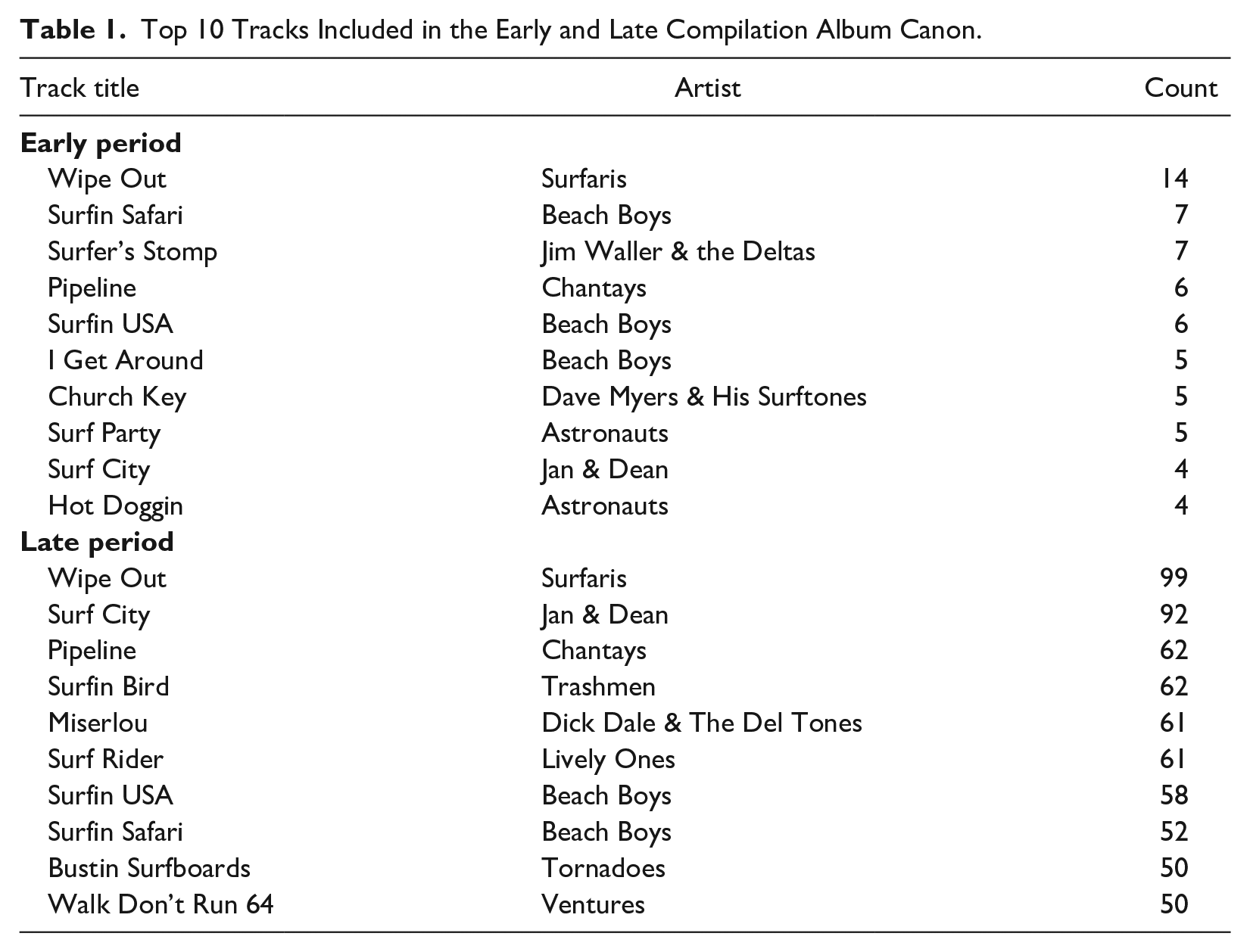
We compare inclusion rates of tracks on compilations between two different periods, which we demarcate based on our description of the development of surf music presented above. For the early period, we used the year of the first and last track in our sample (1958 and 1970). For the late period, we used 1980 as the start year of the “second wave” and gathered data until 2017, the last full year before we gathered these data. The variables of early and late compilation album inclusion are constructed using online discographic database and auction Web site Discogs (www.discogs.com). This user-generated database has a focus on Vinyl and CD recordings and with more than 16,000 releases categorized as “Surf” serves as a useful database for the current research (for more information and discussion on this database as a data source, see van Venrooij 2015). Using a Web site scraper, the tracks included on 1,782 compilation albums labeled as surf are collected, 263 for the early period and 1,519 for the late period. We only used compilation albums that contain various artists and single artist compilations are excluded. Subsequently, for each track included in our data set, we tracked how often it was included on surf compilation albums during both the early and the late period. To give an impression of the kinds of songs that fare well, a top 10 of tracks included on these compilation albums is found in Table 1.
Top 10 Tracks Included in the Early and Late Compilation Album Canon.
Independent Variables
In this article, we constructed four independent variables that represent the types of signals outlined above. These signals are examined in both the name of the artist and the title of the track. Lyrics are excluded because many surf tracks are instrumental. These independent variables are coded dichotomously, as either “containing” or “not containing” the specific vocabulary. The language used in both the track titles and act names is combined here, as there is no reason to expect a difference between their signals. By looking at the titles and names, we follow prior research that argues that these are by far the clearest symbolic signal (cf. Glynn and Abzug 2002; Phillips 2011).
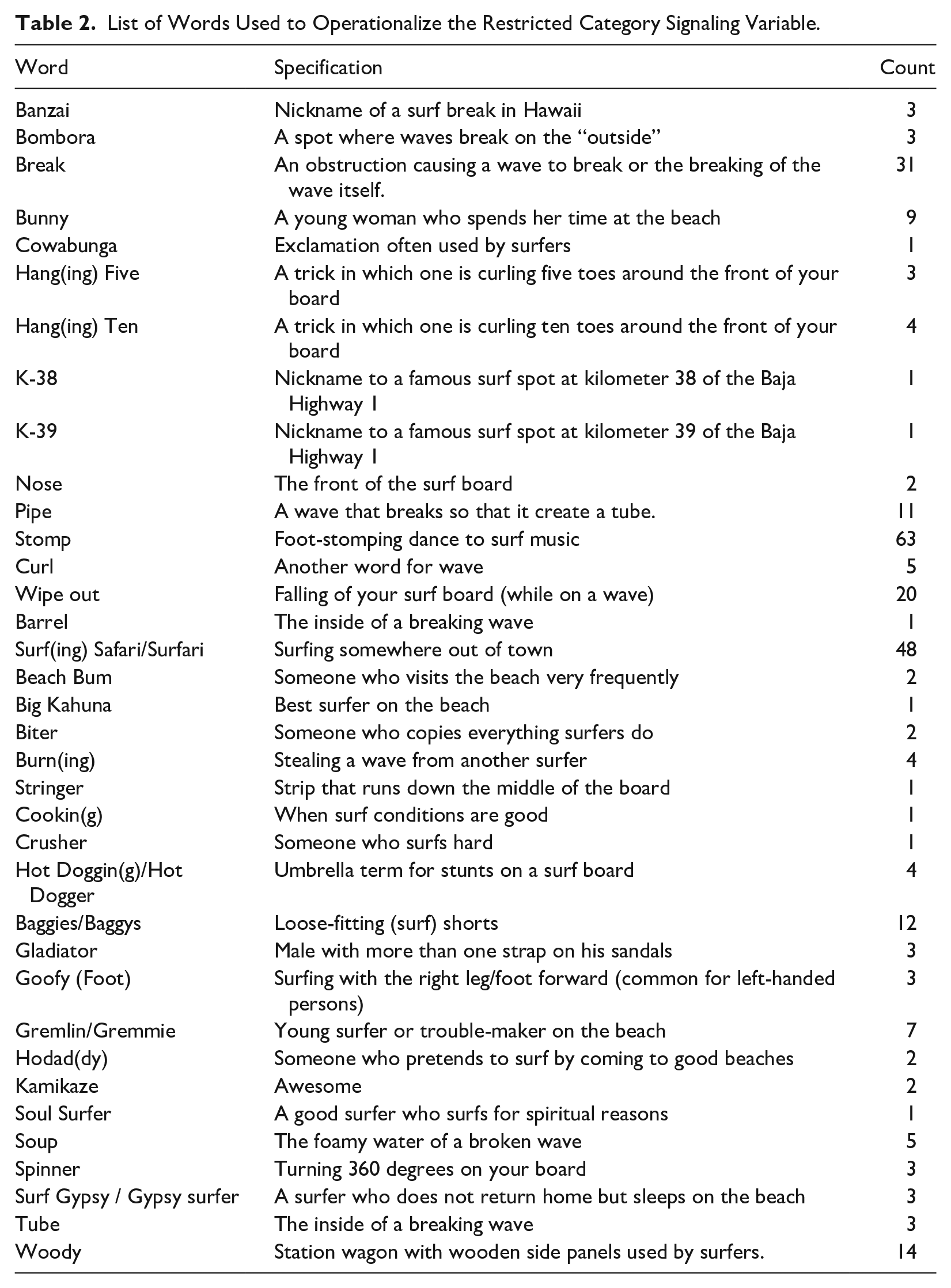
For each type of signal specified in the theory, we compiled a list of words that form one of the vocabularies discussed above. First, for the elaborate category signals, we follow prior studies on category signals and use the references to the category label “surf” or variations on this (i.e., mostly “surfin(g)” and “surfer”). We found 496 tracks signaling this category label in total. Second, the restricted category signals are based on an inductive coding of the track titles and band names. We analyzed the vocabulary in the track titles and band names by comparing them with specific vernacular described in reference works on surf music (Blair 2015; Crowley 2011; Schmidt 2007) and surf slang in particular (Cralle 1991). This mostly includes words that have little meaning outside of surf culture and are confined to members of surf culture. Many of these words originated in the California surf community but also spread to other surf communities across the country (Cralle 1991). This iterative process of moving back and forth between the titles and names in our sample and the reference work on surf music resulted in the identification of 36 surf slang words that were used 280 times in the track titles and band names (Table 2).
List of Words Used to Operationalize the Restricted Category Signaling Variable.
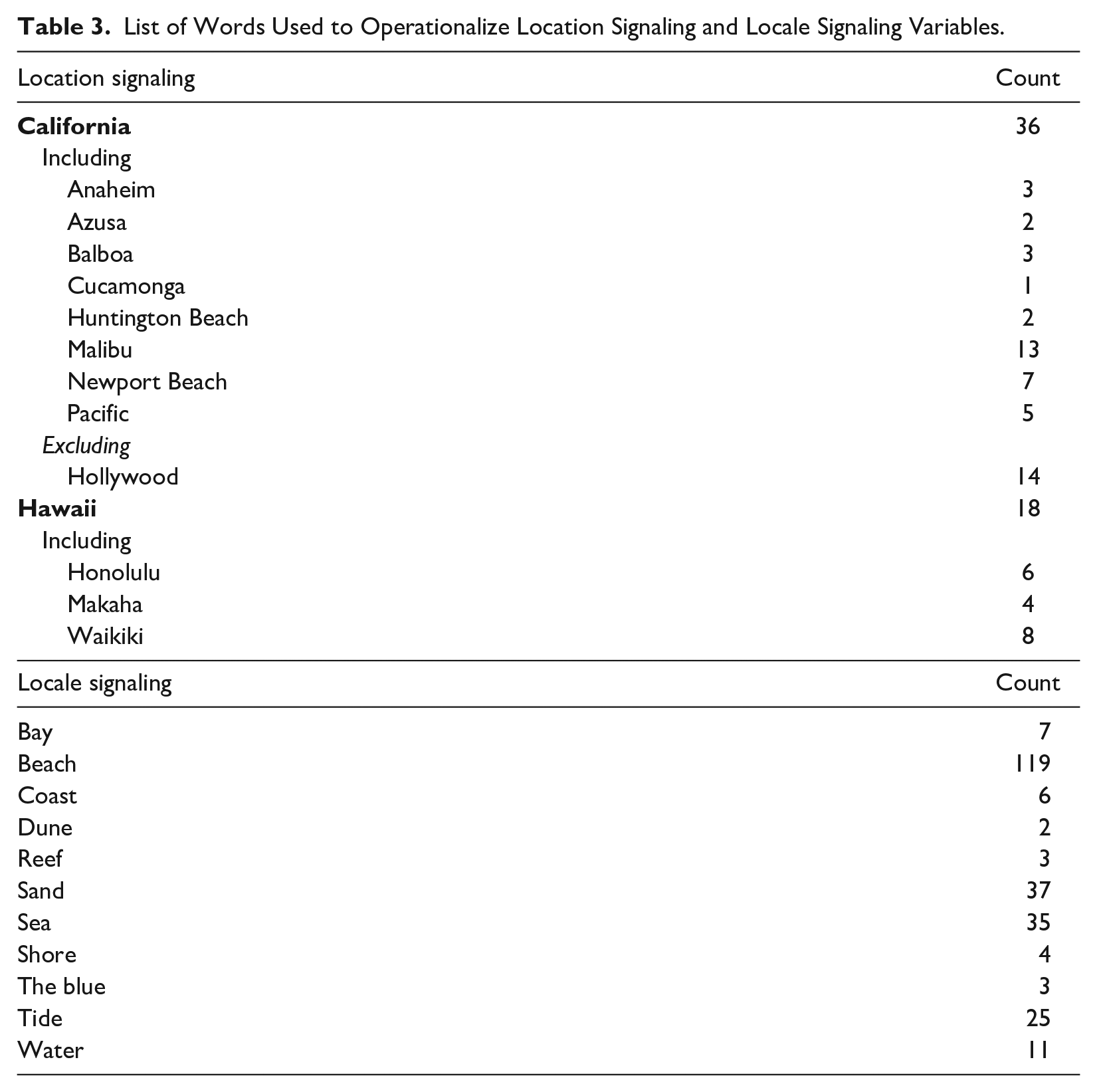
Third, for place signals we look at both location and locale. For location signaling, track titles and band names are inductively examined for references to California-related and Hawaii-related geographical locations. California is widely considered as the surfing state and was the most prominent home to the surfing life style. Hawaii is often mythologized as the “birth place” of surfing, and we found that references to Hawaii are included in many band names and track titles. Table 3 shows the specific geographical locations that were used for operationalizing the location signals. We excluded the word “Hollywood” in our operationalization of this variable, because this location probably has too many different connotations besides its connotation with California. 1 Only 54 location signals were used in our sample. Besides this, Table 3 shows the words used for operationalizing locale signals. We inductively studied the track titles and band names to find these locale terms. The definition of locale here is the actual physicality of space where people interact in their daily lives (Agnew 1987). For surfing, we found 252 locale references, mostly related to the beach or the sea.
List of Words Used to Operationalize Location Signaling and Locale Signaling Variables.
Control Variables
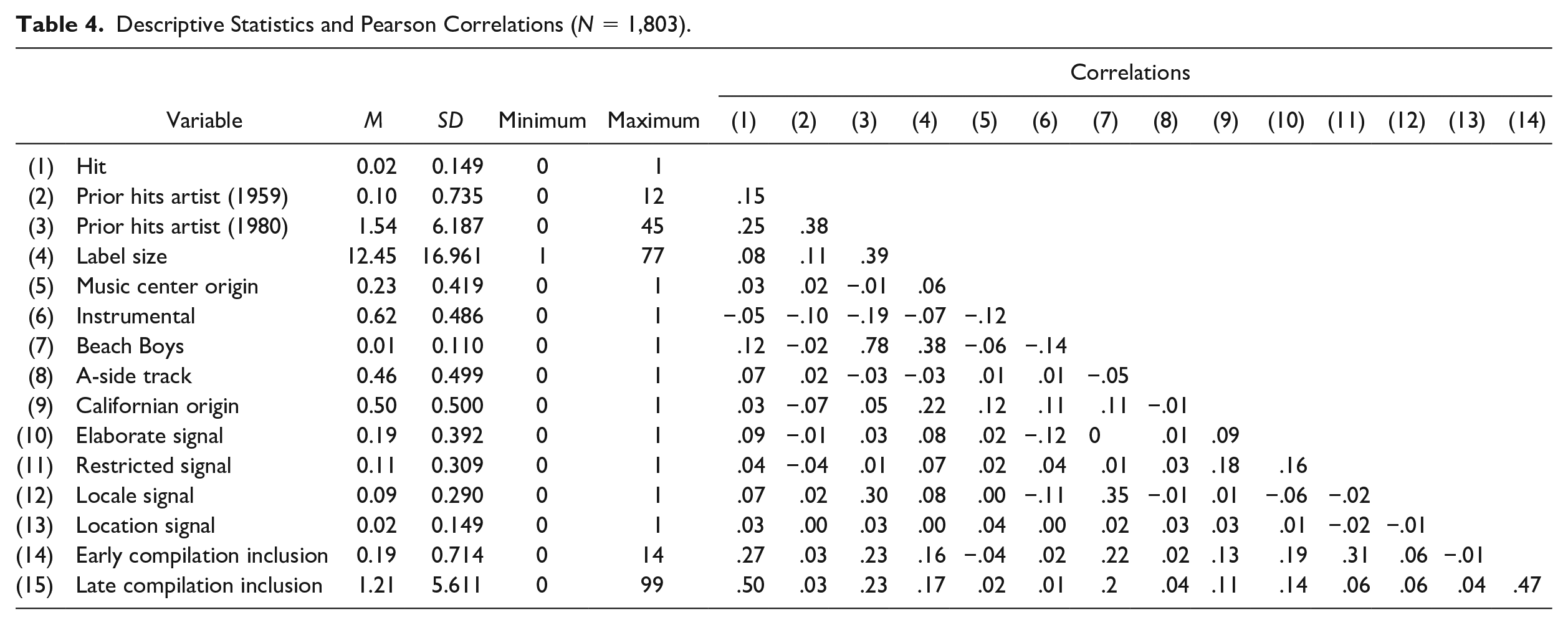
We included a number of control variables. First, we control for the possibility that commercial success, as measured by success in the Billboard Hot 100, influences the inclusion on compilation albums. Therefore, we consider whether the tracks in our sample were hits in the Billboard Hot 100 (www.billboard.com). Second, using the same data, we also considered the number of hits that artists had prior to the time of compilation inclusion. This means that for every artist, we collected the number of hits they scored up to 1959 for our early period and up to 1980 for our late period. A third variable measuring success is the size of the label on which the song was released. This variable is operationalized by taking the number of tracks released on each of the labels included in the discography by Blair (2008), thereby capturing the size of labels within the genre of surf music specifically. Fourth, we control whether artists originated from California, because, as detailed above, the genre of surf music was highly embedded in the Californian life style and this state experienced the most vibrant surf music scene (also see Figure 3). Fifth, we assess whether tracks originated from central music production cities. We use Richard Florida and Scott Jackson’s (2010) list of cities with the most musicians in 1970 to identity the central music cities during the heydays of surf music. Sixth, we included a dichotomous variable that measures whether the tracks were vocal or instrumental surf songs. Within the surf genre, different actors were active in either instrumental surf music or vocal surf music, both making authenticity claims when it comes to “true surf music.” These data were also derived from John Blair’s discography. Furthermore, we used Blair’s discography to control for whether a track was released on the A-side or B-side of a record, as A-side tracks might be more likely to be included on compilations. Finally, for the late period, we control for compilation inclusion in the early period. Table 4 shows the descriptive statistics of the independent and control variables and a correlation matrix. These independent and control variables were found for 1,803 surf tracks from Blair’s discography, and therefore, our analysis will be limited to these tracks.
Descriptive Statistics and Pearson Correlations (N = 1,803).
Negative Binomial Regression
Negative binomial regression was used to model the compilation inclusion of the tracks, as the dependent variable is constructed as count data or nonnegative integers and the data are overdispersed. To model changes in the effects of our independent variables on compilation inclusion in the two time periods, and test the first four hypotheses, we have constructed a panel data structure of track by time period (1.803 tracks in two time periods). Because standard errors in panel data can have heteroscedasticity and autocorrelation, we run our negative binomial regressions with robust standard errors using the sandwich package in R. We also include a period dummy and interact the independent variables with this dummy to capture these effects’ change over time.
To test the effects of different types of signaling, the independent and control variables are entered in blocks. To measure the model improvement of these different blocks, the log-likelihood of these different nested models is compared with each other and with the null model using the likelihood ratio test:

where loglik(m*) denotes the two models that need to be compared. This formula gives a log-likelihood ratio chi-square that can be used to evaluate the improvement of fit per model. The degrees of freedom, used for the test of significance, equal the number of unique variables from Model B. For negative binomial regression, B coefficients can be converted to the effect in percentages using the following formula:

This formula demonstrates the effect (in percentages) that a one-unit change in a variable will have on the expected number of compilation inclusions. This conversion allows for better comparison between the different variables.
Results
Table 4 presents descriptive statistics for all the variables. A first observation is that in both the early period and the late period, the average times a track was included on the compilation albums is relatively low (0.19 times in the early period and 1.21 times in the late period). As it is often the case in cultural fields, the distribution is highly skewed with a few tracks in our sample attracting most inclusions. What is more surprising, however, is the correlation between the early and late compilation inclusion, which, considering these dependent variables is operationalized identically, is “only” moderate (.47). This means that, although we measure the same compilation process, different tracks are included in the surf compilation canon in the different time periods. This might already suggest that different standards are used for inclusion by gatekeepers during these two periods. When looking at our four signaling variables, we can see that elaborate signaling is with 19 percent by far the most used type of signaling. Only 2 percent of the tracks included location signals—making it the least used form of signaling. What might be even more important is that our signaling variables show only weak correlations (with a maximum correlation of .16). This means that the use of these different types of signaling proves to be relatively exclusive and tracks (or their bands) do not often use different signals together.
Tests of Hypotheses
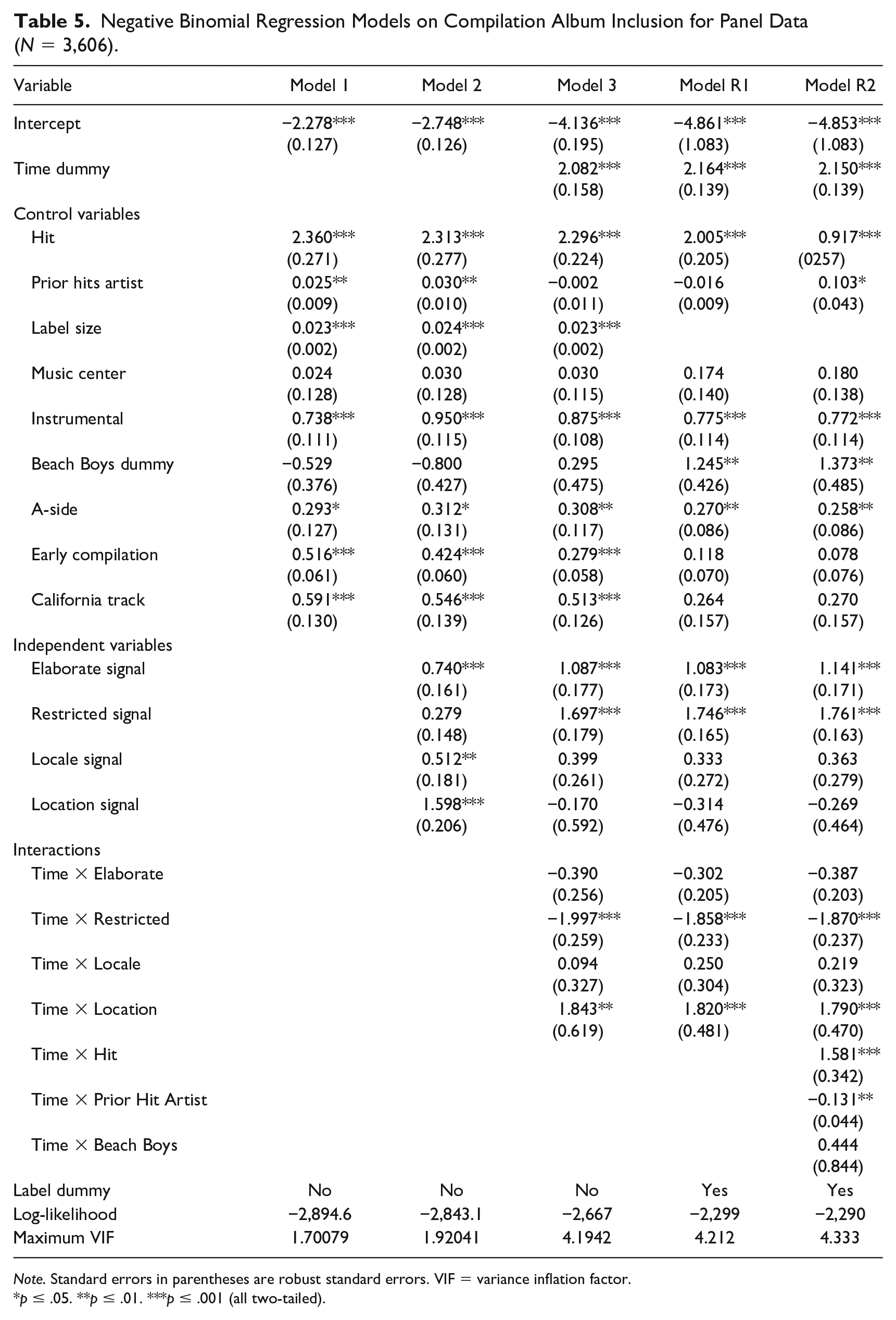
All models in Table 5 used panel data to test the four hypotheses. These models show variance inflation factors (VIFs) not exceeding 4.19, suggesting our variables do not seem to create problematic collinearity.
Negative Binomial Regression Models on Compilation Album Inclusion for Panel Data (N = 3,606).
Note. Standard errors in parentheses are robust standard errors. VIF = variance inflation factor.
p ≤ .05. **p ≤ .01. ***p ≤ .001 (all two-tailed).
Model 1 is the base model containing the control variables, and as expected, this model proves to be a strong significant improvement compared with the null model (χ2 = 598.98, df = 9, p < .001). In this first model, almost all control variables show a positive and significant effect. Unsurprisingly, this model shows that compilation inclusion in the late period increases when tracks were already included on compilations in the early period. In general, compilation album inclusion increases the most when the track was a hit in the 1960s. In addition, tracks are also more often included on compilation albums when they are instrumental or released on the A-side of a record. Label size also increases the number of times these tracks are included. Prior hits by the recording artist are significant in the first model but turn insignificant from Model 3 onward. Furthermore, tracks that originated from California had an increased inclusion. Indeed, these results show that, on average, tracks that originated from California had 80.6 percent higher inclusion rates on compilation albums compared with tracks that originated elsewhere.
In Model 2, the four different types of signals are included as time-invariant variables. This model shows a significant improvement to Model 1 (χ2 = 102.96, df = 4, p < .00). Because for every track these signals remain constant over the two periods of this research, we should interpret the signal variables in this model as time-invariant. This model thus shows that without making a distinction between the two periods, elaborate signals, locale signals, and location signals all show a significant positive effect, while in this model, restricted signals are insignificant. Compilation inclusion increases the most when tracks signal surf-related locations, followed by the elaborate signals of the surf genre label and the surfing locale signals. Following this model, we can confirm Hypotheses 1, 3a, and 4a and would have concluded that these three forms of signals are important for inclusion in market categorization devices by gatekeepers. However, when we consider the difference between the original period and the revival of surf music, we find a different pattern.
In Model 3, we interact a time dummy with the different types of signals to test whether the effects of these signals differ per period. Again, this model shows a significant improvement compared with Model 2 (χ2 = 353.21, df = 5, p < .001). In this model, the main coefficients for the different types of signals represent the effect of these signals for the early period. To obtain the effects for the revival period, we have to add the interaction coefficients to the main coefficient for each type of signal. The significant main effect for restricted signals indicates that, for the early period, tracks that signaled restricted vocabulary yield more inclusions than tracks that did not use this type of signal. However, the interaction effect between time and restricted signals is negative and significant, so this effect changed in the revival period. For the late period, the positive effect of restricted signals is completely diminished. Figure 4 shows the change in average marginal effects for our four types of signaling from the original to the revival period in Model 3, and here we can clearly see that the positive effect for restricted signals in the original period turns negative in the revival period. This strong negative interaction effect confirms Hypothesis 2b that the effect of restricted signals will decrease from the original to the revival period. The interaction effect between time and elaborate signals is insignificant, so our model shows no difference between the early and the late period for the effect of elaborate signals. This is also shown in Figure 4 by the relatively small difference in the average marginal effect between the two period, together confirming Hypothesis 1.
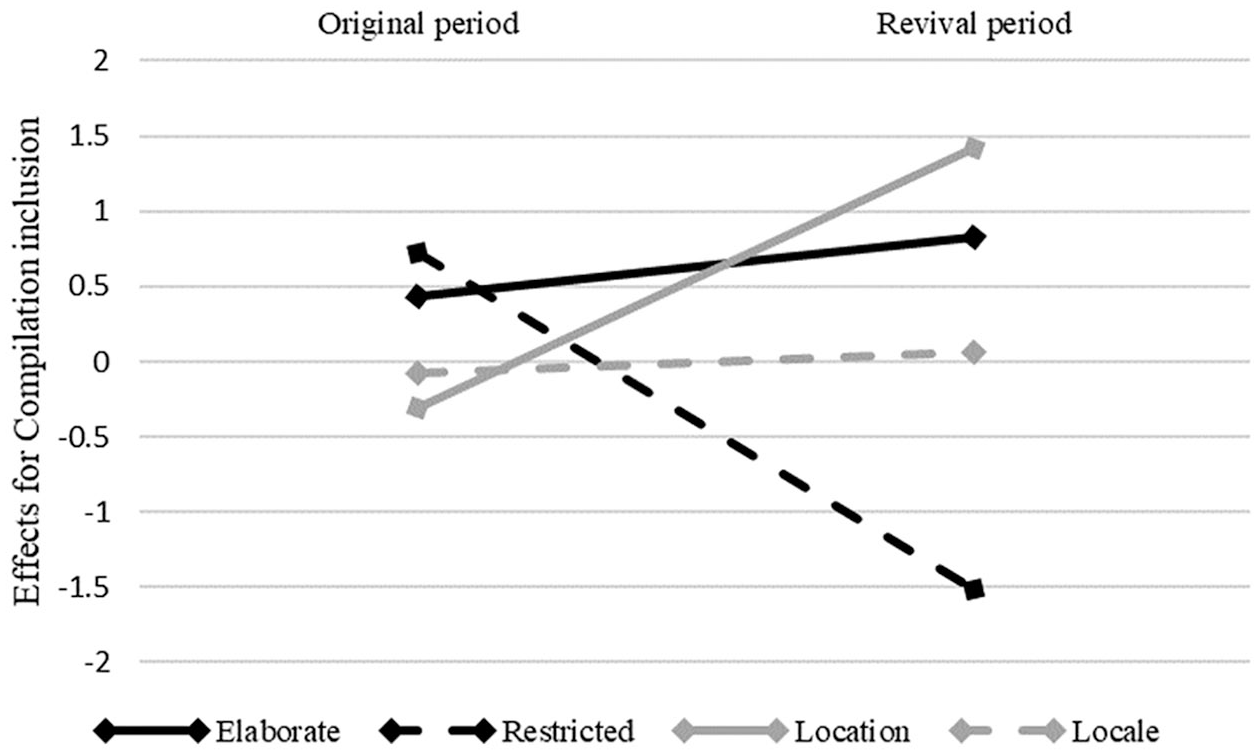
Average marginal effects for the four types of signaling in the two different time periods.
Model 3 shows a significant interaction effect between time and location signals, indicating that for the late period, there is an increased effect of location signals. Figure 4 also shows that the average marginal effect for location signals changes from a small negative effect to quite a strong positive effect. These findings confirm Hypothesis 3b that the effect of location signals will increase from the original to the revival period. Locale signals does not show an interaction effect in Model 3, which is also shown by the flat line in Figure 4, so we do not find support for Hypothesis 4b.
Finally, Table 5 also includes two robustness checks. In Model R1, we add the record labels on which the tracks were released as a dummy variable. This dummy variable needs to control for all the variance that might be explained by tracks being released on any of the different labels. We add this variable mostly because of the possibility that the labels that released the compilations (for both the original and the revival period) might be the same as or have commercial interests in the labels that released the original tracks. By controlling for the labels on which the original tracks were released, we do consider not only the size of the label but also their back catalog and other commercial interests these labels might have when they released compilations albums. This robustness model does not show any significant changes in our independent variables and also the effect sizes generally remain the same. In Model R2, we interact some of the success variables (hit, prior hit by artist, and the Beach Boys dummy) with a time variable. We control for this because artists that become more popular over time might be more likely to restrict the use of their music on compilations albums, which would mean that these variables have a different effect in the revival period. However, this model shows no real differences with our previous models, and mostly tells us tracks that were a hit are more often included in the revival period, while tracks by artists with prior hits are more often included in the original period.
A striking result throughout our models is that although elaborate signals show an effect in both periods, in neither period it proves the most important form of signaling. What is interesting here is that the forms of signal that show time-dependent effects have the strongest effects in their periods of relevance.
Conclusion and Discussion
The aim of this paper was to investigate to what extent the understanding of a category changes over time and how this is reflected in the importance of different signals in periods of category maturation and revival. As expected, signals to the general category label of surf music showed to be important during both the original heydays of the genre and during the later revival. This shows us that these elaborate category signals can stand the test of time because of their intelligibility to a broad audience. However, we also argued that not all signals that mattered in the early period retain their historical importance. We find that restricted category signals can actually lose their appeal for the category at large and become less important over time. Location signals, however, gain importance over time. Although these signals had no effect on compilation inclusion in the early period, in the late period, they increase the chances of inclusion. These results suggest that notions of prototypicality seem to change over time, from a more restricted in-group notion to a notion that follows a certain “myth of origin” that is better interpretable to a broader audience.
In broader sociological vein, our study contributes to the understanding of how changing patterns of categorization also change the ways in which individuals efficiently process information (Zerubavel 1996), in our case how producers of surf compilation albums decide on their selections. As such, our findings on the changing roles of signals throughout the life cycles of a genre have implications that go beyond the case of music. Categorization is a ubiquitous process, and changing signals can have similar importance in other markets or social domains. Although prior studies have shown that the same product can be differently evaluated in separated classification systems (Porac, Thomas, and Baden-Fuller 1989; Zhao 2008), our study argues that the same product can also be differently evaluated in the same classification system over time. Moreover, our findings add to the understanding of boundary work during times of genre revival. Previous studies already showed that, during revivals, different audiences are addressed compared with the original period and these audiences are not always aware of a genre’s history and origins (Hancock 2008; Lena 2012; Van Poecke 2017). As a result, gatekeepers’ boundary work often includes selecting products that resonate with contemporary audiences’ view of a genre (Griswold 1986). Our study contributes to the understanding of this boundary work by underlining the importance of changing notions of prototypicality for market category inclusion by gatekeepers.
The study of revivals also has more specific implications for the study of market categorization. Recent studies have shed light on the varying drivers of categorization during different stages of category development but often stop at the stage of category demise (Granqvist and Ritvala 2016; Kennedy and Fiss 2013). However, Stine Grodal and Steven Kahl (2017) have argued that some categories go through multiple cycles, opening up the possibility to study categories’ revival. Our study contributes to these studies on categorical life cycles by examining the dynamics during this stage of category revival. Previous research has already acknowledged the possibility for categories to stay “empty” for some time (Carroll and Swaminathan 1991; Dobrev 2001), but these studies found the “social codes” of categories to be unaffected by these periods of inactivity (Pólos et al. 2002). Our study thus adds to the understanding of changing “social codes” used by gatekeepers to assess market category inclusion during times of category re-emergence. However, we need to consider that we are studying an art form. Studying revivals has a long history in the sociology of the arts (Griswold 1986; Hancock 2008; Lena 2012), and, indeed, artistic forms might be more likely to be remembered over long intervals of time and thus more susceptible to revivals (Pólos et al. 2002). Future research could continue to examine the stage of re-emergence in other types of categories.
Although examining actors that emerged during times of revival is beyond the scope of our study, examining this stage of re-emergence opens up the opportunity to study how these revivalist actors build on their categorical ancestors after times of categorical inactivity, a process that is highly dependent on processes of remembrance, selection, and narrativization (Griswold 1986; Hill and Bithell 2014; Raffaelli 2013). This reviving and revising of the social codes of a historical category is an interesting addition to the notion of institutional maintenance, a more active form of maintaining the social codes and institutions in a specific field or market over time (Jones and Massa 2013). Our study suggests that more general and more easily narrativized features of a category are more likely to play a role in re-emergence. This might be an especially interesting avenue for research when we compare well-studied dynamics of category emergence (Bogaert et al. 2010; Ruef 2000) with dynamics during category re-emergence.
Although it is commonly acknowledged in category studies that external audiences impose constraints and create opportunities for category members (Hsu and Hannan 2005; Zuckerman 1999), little attention has been paid to changes in target audiences. Prior studies have made a distinction between insider and outsider audiences to study how their interaction influences meaning making and boundary work of a category (Hsu et al. 2009; Kocak et al. 2014). We contribute to these studies by arguing that changes in the extent to which audiences have expertise in or familiarity with a category can influence categorical schemas over time, in our case category signaling. Future studies could study the interactions among insider and outsider audiences in more detail, also including the role of gatekeepers in this process (Boulongne, Cudennec, and Durand 2019).
A limitation of our research in this sense is that the boundary work in our case is mostly represented by work done by producers of surf compilation albums. Compared with “traditional” gatekeepers, these producers are not only dealing with category boundary work but are also driven by commercial interests and the availability of tracks in their labels’ back catalogs. Future research could show us whether these dynamics of remembering and forgetting are also found when other cases and actors are considered. Moreover, our study has only implicitly theorized the relation between the strength of signals and the “costs” involved in acquiring these signals. Negro et al. (2015) have argued that more distinctive category signals function as stronger market signals but also involve higher costs that high-quality producers find easier to pay than low-quality producers. In our case, the restricted codes could also be argued to be costlier to acquire as these would require familiarity and knowledge of the subcultural codes. The finding that gatekeepers of the category of surf to a larger extent drew on these costlier codes in the earlier period could be a function of their stronger embeddedness in the scene, which would have enabled them to use the costlier, restricted codes in their construction of the category. The decline of the use of restricted codes over time could therefore also be a result of the costs involved in acquiring distinctive category signals—which were easier to acquire by the insider audiences in the original period of surf music, than by the outside members of the later period. As such, we extend the idea of Negro et al. (2015) by distinguishing between types of signals, and it would be interesting for future research to study how the costs for category signaling might change in different stages of category development.
Footnotes
Acknowledgements
The authors thank Koen Frenken, Jarno Hoekman, Laura Braden, Susanne Janssen and Candace Jones for their helpful comments and suggestions for earlier versions of this paper. We also thank the anonymous reviewers for their feedback and insight.
Declaration of Conflicting Interests
The author(s) declared no potential conflicts of interest with respect to the research, authorship, and/or publication of this article.
Funding
The author(s) disclosed receipt of the following financial support for the research, authorship, and/or publication of this article: This research was supported by Netherlands Organisation for Scientific Research (NWO) grants to both the first author (VICI grant 453-14-014) and the second author (VENI grant 275-45-003).