




Abstract
The debate on technology and the future of work has so far engaged little with the local state. This is surprising, since the local state's role as a potentially progressive actor in employment relations systems is attracting renewed interest in sociological scholarship. Through a study of warehousing in northern England, we examine how local state actors can mediate the relationship between technological change and work. We show that they often questioned the policy orthodoxy that private employer-led technological innovation always benefits local working populations, and we develop a typology of three strategies through which they sought to engage with technological trajectories in warehousing workplaces: engagement and advocacy, activation, and conditionality. Our study also shows how their regulatory capacity was limited by the opacity of technological innovation in warehousing, confining them to “soft” strategies which enshrined employer discretion and market imperatives. It concludes by reflecting on alternative visions whereby the local state may become more empowered to shape the future of work.
Sociological scholarship on technology and the future of work underlines how institutional factors mediate technology's workplace impacts (Damelang & Otto, 2024; Doellgast & Wagner, 2022; Dupuis et al., 2024). However, the local state (i.e., local and regional public authorities) is an important but neglected institutional component in this discussion. Policy debates on technology and work often reflect neoliberal assumptions about the benefits of private sector-led “innovation” for jobs (for critical perspectives on this see Berg et al., 2023; Oesch & Piccitto, 2019; Warhurst & Hunt, 2019), with little critical examination of the stakes for local states, or their role in shaping employment outcomes in a context of technological change.
This gap is surprising because the local state is emerging as an increasingly significant topic in scholarship on work and employment. There is much still to understand about its role, and existing debates are ambivalent about how local states shape work. An influential theoretical literature posits the “hollowing out” of local state institutions under neoliberalism (Jessop, 1999, 2003; Jones, 1998; Peck & Tickell, 2017), where they are subordinated to business interests, exercising minimal regulatory capability. Policy debates reinforce this shift, exhorting local states to compete to attract technologically-innovative firms and stigmatizing interventions to regulate working conditions (Berry et al., 2021). An important strand of scholarship on work and employment relations, however, highlights local states’ attempts to play a progressive regulatory role in employment systems (Bernhardt, 2012; Jaehrling et al., 2018; Johnson & Herman, 2024; Osterman & Chimienti, 2012). Yet this research rarely dedicates sustained attention to technology, despite its importance for workers. Therefore, we ask: how can local states mediate the impact of technological change on work?
Our study examines warehousing in a region of northern England, drawing on qualitative interviews with 48 key informants. In warehousing, technology is often complicit in poor working conditions, through routinization, deskilling, intensive performance management, and automation risks (Briken & Taylor, 2018; Gautié et al., 2020; Vallas et al., 2022). Warehousing jobs often proliferate in deindustrialized regions with weak labor market outcomes (see Briken & Taylor, 2018; Reese & Allison, 2023). Therefore, the local state's role in mediating technology's impact on work appears especially important in this context.
We find that local state actors held contested and critical views of technological “innovation” in warehousing. While the prescriptive policy literature celebrates local states competing to foster private-led technological development, our respondents were often concerned about warehousing employers’ technological strategies and sought to engage them with outcomes for local workers in mind. However, consistent with the “hollowing out” literature, we emphasize the constraints shaping these interventions. Our central contribution is to develop a typology of three ways in which local state actors sought to shape the relationship between technological change and work: engagement and advocacy; activation; and conditionality strategies. Generally, these were “soft” strategies which left employers significant discretion in technological choices. This “softness” is a consequence both of local authority weakness in the UK (see also Jones, 1998; Yates et al., 2021), but also the opacity of warehousing firms’ strategies, as our findings relate in detail.
The significance of the typology lies in illuminating different methods through which local actors- often quite indirectly- sought to influence employer strategies in a context of technological change. We argue this typology has relevance well beyond warehousing, providing a more general analytical tool for understanding how local states might engage with employers, in any industry where technological change has potentially important consequences for local workers (and hence creates high stakes for local policymakers). This is significant and timely in a context where scholarly interest in technology and the future of work is growing extraordinarily rapidly, creating an urgent need for more understanding of the institutional tools that can shape how workers experience these changes (Doellgast et al., 2023; Dupuis et al., 2024). Ultimately, our typology thus serves a dual purpose: exposing the limits of local state interventions under neoliberal governance, while opening a debate on what else might be possible.
The (Contested) Local State
Our analysis of the local state under neoliberalism begins with Jessop's (1999, 2003) theorization of the “Schumpeterian Workfare State” (SWS). In a SWS, the state's priority is facilitating competitiveness, including increasing labor market flexibility. This does not imply simply “weakening” the state but “hollowing out”: it no longer directly regulates economic activity, but instead seeks to catalyze private investment. Recent scholarship emphasizes the neoliberal state's disciplinary role in this context intervening to attract investment by easing labour regulations and weakening workers’ organizations (Bosch & Weinkopf, 2017; Greer & Umney, 2022; Howell, 2016).
In a “hollowed-out” SWS, local states, which maintain some contested autonomy from the center (Jessop, 1999; Jones, 1998), must embed themselves in private business networks, whose perceived needs dictate priorities as regions compete for investment. Local states succeed by attracting investment from “innovative” companies (Brenner et al., 2003), competing to offer favorable regulatory environments for employers (Peck & Tickell, 2017), while promoting capital investment to drive job growth. This is especially evident in England, where initiatives like Enterprise Zones and Local Enterprise Partnerships have created local institutions, whose functioning is “superseded by private companies” since the 1990s (Jones, 1998, p. 960). These institutions have more recently been subsumed into local or combined authorities (Yates et al., 2021), but the focus on business interests has remained in the establishment of business boards at the local government level. Importantly, this “hollowing out” in England occurred alongside the dismantling of local state infrastructure and capacity; a politically contested process. A historical tradition running from “municipal socialism” in Victorian Birmingham 1 (Gehrke, 2016) to the 1980s “new urban left” in cities like London, Sheffield and Manchester, envisioned the local state intervening more actively in steering economic activity, for instance through municipally-owned companies which could employ workers on better terms than offered by the market (Leopold & McDonald, 2012). One notable example of this contestation was the ‘Lucas Plan’, a union and activist attempt to democratize workplace technological development. Whilst this began within a single aerospace firm in the late 1970's, the ‘material possibilities’ of the plan were adopted by left-led local authorities, namely the Greater London Council (GLC), whereby voices were given to worker representatives on newly established local enterprise boards, focused on addressing issues related to workplace technological change (see Smith, 2014a, 2014b). The plan was short-lived, however, especially as union strength was comprehensively dismantled under Margaret Thatcher. The Thatcher government, in particular, brought local authorities to heel through showdowns with leftist local politicians who sought to maintain and extend municipal provision and intervention, including the GLC. This quashing of local economic interventionism remains a firmly established bipartisan consensus, especially since the Labour Party famously disowned local Militant councilors in the 1980s (Quilley, 2000). During this time, unionized industries declined, and worker power was weakened, giving rise to a situation whereby “…the social shaping of technology was left to market decision” (Smith, 2014a). To an extent, more democratic visions endure through initiatives like the “Preston model” inspired by American Community Wealth Building in cities like Cleveland (Hanna et al., 2018), whereby workplace democracy is linked to progressive civic and political engagement, centralizing the involvement of workers and their representatives (Bird et al., 2021). However, this example is an outlier, and England remains highly centralized.
Since the 1980's, local governments have also experienced fierce budget restrictions, intensified by post-2010 austerity, leaving them with even less opportunity to steer economic development. Throughout the same period, waves of privatization have engendered a ‘contract culture’ (Randall, 1995) whereby government became the purchaser rather than the provider of services. Furthermore, local policy and research capacities have withered away, leaving local authorities to focus on core statutory responsibilities, while competing to win private sector investment and “business confidence” (Greer & Umney, 2022). Concurrently, as mentioned, trade union strongholds like mining have been dismantled and replaced by service and logistics jobs, further bolstering private sector employers, vis-à-vis the local state and local workers, as the primary influence on local economic life. While England therefore appears a prime example of the “hollowed out” local state, it is important to note that internationally this issue is contested. Left movements have sought to reinvigorate alternative visions of the local state which empower activists and workers, and which intervene more directly to challenge private power; often grouped under the heading “new municipalism” (Joubert, 2023; Thompson, 2021). Indeed, employment scholars must, increasingly, critically interrogate this depiction of the hollowed-out local state, asking what other visions are possible, and what these may have to say about work and workers. Inevitably, actors within state institutions have their own priorities which might diverge from neoliberal imperatives (Greer & Umney, 2022; Jones et al., 2004; Martinez Lucio & MacKenzie, 2024). Accordingly, employment scholars have considered whether local states could be sources of progressive regulatory experimentation, even while national governments become more hostile. For example, local government – as the “contract state” – might exercise procurement conditionality (where purchasing power is leveraged to uplift job quality in contracting organizations– i.e., by only providing contracts to organizations that meet certain labor standards) (Bernhardt, 2012; Jaehrling et al., 2018; Osterman & Chimienti, 2012). Alternatively, they may harness “softer” tools like employment charters (regional initiatives that encourage businesses to voluntarily commit to better working conditions in exchange for charter status) (Johnson et al., 2022); or by committing to support voluntaristic pay-related campaigns (such as the “Real Living Wage” initiative in the UK) (Heery et al., 2018). Although charters can be considered a progressive example of involving union stakeholders at the local level throughout the consultation process, they are more often considered an accommodation to neoliberal institutional relations and lack enforcement power (Johnson et al., 2022). Rather than fundamentally challenging the “contract state”, they seek to turn it to workers’ advantage.
The local state is therefore contested. It is hollowed out by neoliberalism, but also a possible source of progressive change in employment systems. Unfortunately, this debate has not yet engaged systematically with technology, and with this research we hope to stimulate further development in this respect. Technology raises significant questions for local state actors, especially in industries like warehousing, where digitally driven deskilling and automation are prominent concerns. We therefore reflect further on these debates with the question of technology in mind.
The Local State, Technological Change and the Future of Work
The state is prominent in the literature on technology and the future of work, but is often discussed in prescriptive and policy-focused ways, reflecting the assumptions of the “hollowed out” SWS. Influential sources on technology and work present wide-ranging policy recommendations for how state actors can facilitate impending technological transformation, which are typically supply-side oriented (Warhurst & Hunt, 2019). For example, states should catalyze technological progress by providing tax incentives, subsidizing technological infrastructure, and integrating digital skills into training systems (Arntz et al., 2019; Berger & Frey, 2016). In these arguments, the priority is adapting local conditions to unleash business innovation, whereby technological innovation is conceived as an end in itself.
This is also evident in recent scholarship on innovation “ecosystems”; defined as a “set of interconnected entrepreneurial actors, institutions, entrepreneurial organizations and entrepreneurial processes which formally and informally coalesce to connect, mediate and govern the performance within the local entrepreneurial environment” (Mason & Brown, 2014, p. 5). Here, technological development requires the formation of regional industrial agglomerations which incubate collaboration and innovation (Sunley et al., 2023), driving virtuous circles of technological and economic development. Consequently, local states should adopt policies encouraging clustering and network-building between different actors (Brown & Mawson, 2019). This prescription resembles theories of “hollowing out”, which also analyzed local states’ shift towards network-building over regulation, but as critique rather than policy recommendation. Hence, the ecosystems literature is broadly consistent with neoliberal assumptions about the primacy of competition and private sector leadership in local state processes (Berry, 2020; Brown & Mawson, 2019).
“Ecosystems” overlap with other terminology like “clusters” and “agglomeration” which have become established orthodoxy (Berry et al., 2021), especially in countries like England where market-based coordination is pre-eminent in organizing economic activity (Tomaney & Pike, 2021). There is an important tension, however. Local states are encouraged to support the growth of technologically-innovative networks of private capital, yet in economies like England there is limited information sharing and coordination between private firms and other institutions concerning questions like skills provision and working conditions (Estevez-Abe et al., 2001), reinforcing power imbalances between state and private actors. Our empirical data will show how local state actors sought to develop systems that could engage with employers over local labor requirements, but the opacity surrounding firms’ application of technology rendered this profoundly difficult.
In summary, much current discussion around the local state, technology, and the future of work, is underpinned by neoliberal assumptions. Importantly, as Warhurst and Hunt (2019) argue, the uncritical prioritization of private-driven technological innovation allows little consideration of worker outcomes, or the role of collective worker voice in shaping technological trajectories. This problem is particularly pressing in warehousing, where digital technologies may have negative consequences overlooked by policy literature. For instance, workplace-level research underscores how digitalized performance management systems have exacerbated problems of routinization, work intensification, surveillance, and deskilling in warehouses (Dörflinger et al., 2021; Gautié et al., 2020; Holland & Vickers, 2021; Vallas et al., 2022). These accounts highlight the need for a deeper understanding of the local state's role in responding to technological trajectories, especially in deindustrialized contexts, where issues like skills and work quality are an urgent concern.
Methods
We address this issue by examining warehousing in a region of northern England – an illuminating case for various reasons. First, the region has witnessed ongoing experiments in reshaping the local state, through the creation of Combined Authorities. These are regional-level bodies in England that oversee functions like inter-regional policy, adult education, and inward investment, ostensibly as part of decentralizing powers and funding from national government. Although they cannot change employment or business legislation, which are determined centrally, Combined Authorities can use levers like the provision of grants and other incentives, long-term skills planning, land planning support, inter alia. For some, these institutional changes were an opportunity to put communities in control, yet others highlight persistent neoliberal assumptions which remain embedded in the Combined Authority model (Yates et al., 2021). Our case study region includes two Combined Authorities, in addition to numerous local authorities (comparable to city or town councils) involved in the delivery of statutory services and supporting the regional programs mentioned previously.
Many parts of our region increasingly depend on warehousing work, which employs up to 9% of the population in some local authorities (ONS, 2023). Like many warehousing-centric regions internationally, parts of the region have experienced the socio-economic challenges of deindustrialization, including comparatively low educational attainment, wages, and employment rates, where workers often have little labor market choice and large logistics firms are relied upon as major local employers. However, low land costs and proximity to major transport links make the region attractive to warehousing firms. Hence, local state actors are likely to be highly attentive to technological development in warehousing, with important stakes given risks like technologically-driven automation or deskilling. It therefore provides a compelling lens for our study.
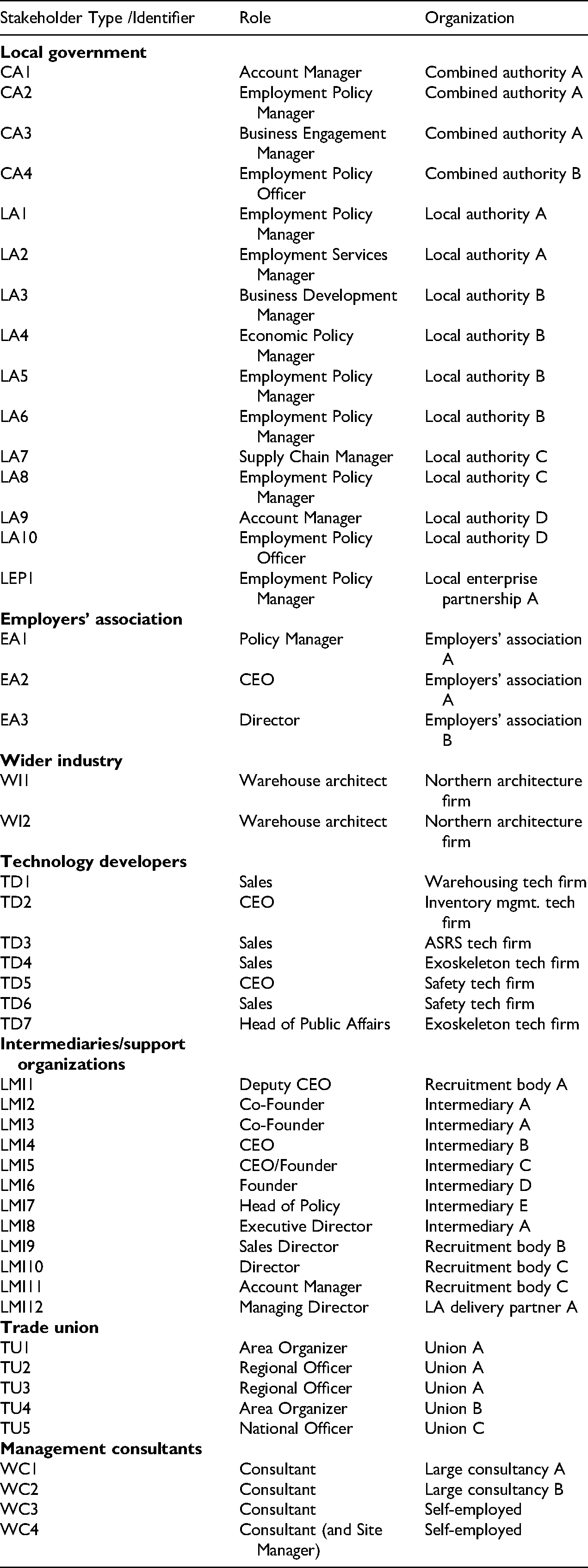
Our research instrument was qualitative interviews with diverse actors. Scholars examining the intersection of work and technology suggest considering the network of actors involved at the various stages of technological development and use (Williams & Edge, 1996). We were primarily interested in those parts of the local state most involved in developing the “ecosystem”– like business relationship managers and those responsible for skills. However, we were also sensitized to the relationships between state actors, private actors, and other parties like technology developers, employers, labor market intermediaries and unions, and draw on these interviews to provide important sectoral context. Prior to interviews, we analyzed economic strategy documents for each of the localities to inform our protocol development, since these often included issues related to technological change, logistics, employment, skills and inward investment. When developing our sampling criteria, we identified individuals who could provide specialized “insider” knowledge about the development of the warehousing industry in the region (see Appendix 1). These connections were established via project partners who acted as key gatekeepers to local government, employers’ association and trade union respondents; searches on LinkedIn identified individuals in relevant consultancy roles; and networks gained at industry conferences identified technology developers. In total, we interviewed 48 key informants from various fields.
The interviews were semi-structured with bespoke protocols for each respondent type. Interviews on the ‘industry-side’ sought to address questions about the status quo of technology development within the sector, whereas interviews with local government, unions and intermediaries focused more specifically on changes in labor market requirements; work quality in warehousing; and the role of policy interventions. Interviews were conducted online and in person between April 2023 and September 2024, lasting one hour on average. We carried out reflexive thematic coding (Braun & Clarke, 2020) as the interviews were ongoing, to establish a point where the interviews and themes derived had reached saturation. The typology of strategies discussed below was developed inductively during data gathering and the analysis of themes; thus, we completed the interviews when no new themes were emerging in new data.
Findings
Our findings are presented in two parts. First, we examine local state actors’ perceptions of technological change in warehousing work, in the context of the wider “ecosystem”. Second, we identify three strategies through which local state respondents sought to mediate the relationship between technology and work.
The Local State and Technological Change in Warehousing
Our research found that technology adoption in warehousing is uneven, broadly reflective of other studies in the US context (Gutelius & Theodore, 2019). This unevenness reflects the complexity of factors which influence technology use in warehousing. As Gutelius and Theodore (2019, p. 7) found, “the business profile of a company, including the specific activities occurring in warehouse facilities, amount of goods being moved, and product markets, all help determine the propensity for technology adoption”. In the UK context, we observed that most warehouses use a management system (WMS) to organize stock and workflow, but picking systems vary . Some still rely on goods-to-person picking, whereby workers locate items using handheld or headset devices and pick items on foot or forklifts. Others use goods-to-person solutions, a form of automation ‘slowly creeping into the sector’ (EA1) where goods are brought to a picker by robots or conveyors. While automation could, in principle, reduce labor requirements, rising demand for warehousing obscured this effect (CA2; LA7). Furthermore, these digital systems engendered greater opportunities for surveillance and individualized performance management systems, yet the extent of this varied. Warehousing has only 23.3% union density, but this remains higher than the private sector average (ONS, 2023). Hence, unions were sometimes able to ensure performance was assessed at the aggregate level: “Each warehouse has a productivity level or a pick rate that the picker is meant to work towards, but the wording of the agreement is such that it is a collective endeavor. So, the idea is that everybody is meant to pull together to achieve this pick rate.” (TU5)
Despite this, union respondents also reported numerous problems associated with individualized performance management in labor-intensive person-to-goods systems, including reduced job security (with some systems automatically dismissing workers for errors or ‘underperformance’ identified by the WMS); spikes in stress-related conditions detected through union casework; deskilling and routinization effects; and reduced staffing levels through non-replacement of leavers, comparable to observations made in the US warehousing context (see Gautié et al., 2020; Holland & Vickers, 2021; Reese & Allison, 2023; Vallas et al., 2022).
Highly sophisticated technological systems (e.g., robotic picking arms and forms of human augmentation like exoskeletons) remain unusual, underlining the gap between the theoretical possibilities of technology and reality (Umney et al., in press). This partly reflects the cost of technological projects and continued reliance on human judgment and dexterity for certain tasks (TD4). Furthermore, the possibilities of automation are shaped by technical contingencies invisible to non-industry specialists (e.g., types of packaging, or temperature conditions) (EA2). Exploring these in detail is beyond our scope and is well-documented in other scholarship on warehousing technology, but this brief overview helps establish the stakes of technological change for workers in the region (for a more detailed discussion see Gautié et al., 2020; Holland & Vickers, 2021; Vallas et al., 2022).
Given this variance, the work-related implications of new warehousing technologies are opaque for local and regional state actors. The range of technical and economic factors that drove or inhibited technological adoption was hard to disentangle from the effects of technological change. One respondent commented: “I feel like we’ve talked about automation and the risks of automation a lot, but… we have never fully understood exactly what that could mean for [Local Authority B]. We feel actually so far away from understanding in depth about the direction that the sector is going in.” (LA4)
Rather than optimism about the possibilities of technological innovation, this opacity generated skepticism and uncertainty, which permeated discussions with regional and local authorities. Historical precedent fed anxieties around the threat of automation and labor replacement in warehousing, in communities that were still experiencing the consequences of 1980s deindustrialization (LMI7; LA4). However, this was usually raised as a potential future issue, with little concrete idea of whether it was likely, or what they could do about it:
Some local authority officers wanted to be “part of a discussion of what the future logistics looks like” (LA4), yet direct dialogue with warehousing firms to plan for future employment and skills needs proved extremely difficult. This context, with participants reduced to guesswork about the technological future of such a prominent local industry, created an environment ripe for disagreement about the role of warehousing in regional strategies: “…when the council put anything out on social media about anything to do with logistics, it's always like ‘Why are you trying to attract all these low-skilled jobs’. We’ve had challenges from leadership etc. around the need to shift the balance and not be so heavily reliant on this sector… There are the potential risks and changes coming with automation, what that might bring to us… we need to not turn jobs away, but we also need to manage the risk of what that might bring for the future for us if we’re dominated by that sector that is going to go through radical change or not.” (LA8)
The frustration at the uncertainty surrounding the technological future of warehousing in the region is palpable in this quote. Nevertheless, some embraced warehousing, due to low levels of other investment, relatively high unemployment, and relatively high pay in warehousing compared to other local employers (LA1; LA2). Some participants were optimistic about the effects of technological innovation in warehousing, believing the risk of automation was outweighed by technology's potential to drive upskilling. A recurrent theme shared by different respondent types (CA1; EA1; TD3) was thus the notion of “fewer, better jobs”, where the warehousing industry might move from a large source of entry-level jobs to a smaller source of highly skilled, better-paid roles. However, this possibility exposed further lacunae in thinking about technology and warehousing work: given relatively weak local skill levels, respondents from government and unions did not know whether technologically-upgraded jobs would be attainable for local populations, instead potentially being filled by commuters from wealthier areas: “…of course, there'll be some people who are capable of it… and it'll be great for them. There’ll be some people who maybe aren’t capable sadly, there might be some people who just simply don't want to… It's not just as simple as saying ‘Well, don't worry there's all these new tech jobs coming, just re-skill and do one of those’ because it can be daunting.” (LEP1)
For others, the consequential issue of the pace of change, not just its nature, also raised uncertainty: “… if it happened overnight, it would leave a lot of people without the skills to be able to access those jobs.” (LA8)
Local and regional authorities generally did not believe warehousing employers would invest in the necessary training without their intervention, but they were also unable to identify training needs without engagement from industry.
In sum, this discussion offers a counterpoint to policy prescriptions exhorting local states to embrace technological innovation, while providing a qualification for theories of the hollowed-out neoliberal state. Our local state respondents generally had a contested and sometimes skeptical view of technological innovation, by no means accepting it as a self-evident good. However, this does not mean they intervened effectively to mediate its impact on work. They were troubled by the limits of their regulatory role, and as the next section shows, sometimes sought to expand it. These efforts, however, were constrained by a lack of clarity regarding how technological trajectories might evolve, at what pace, and with what consequences for workers.
How do Local States Attempt to Mediate Technological Trajectories?
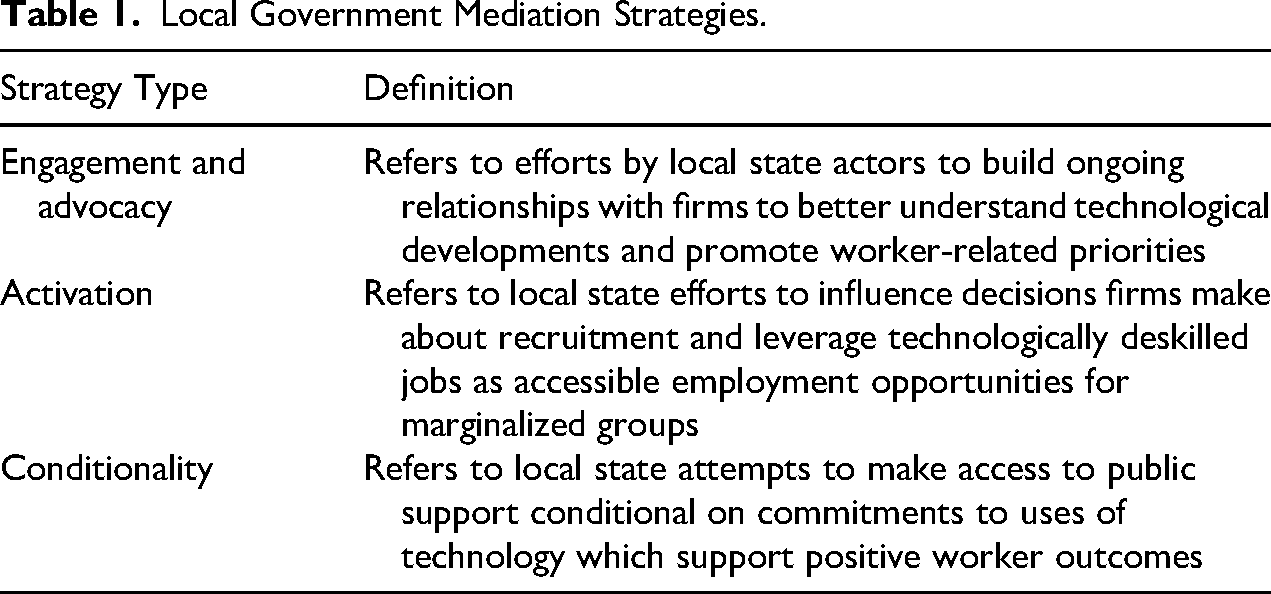
This section identifies three ways local state actors sought to mediate the relationship between technological change and work in warehousing: engagement and advocacy, activation and conditionality strategies (see Table 1). In most cases, they do not refer to direct influence over the kinds of technologies adopted; but rather more indirect strategies seeking to shape employer choices in a context of technological change. We present them in ascending order, beginning with the “softest” (i.e., most reliant on employer goodwill) and moving towards strategies that appeared to raise the possibility of stronger levers to impose change. Still, the approach remains predominantly voluntaristic, reflecting the problems described above.
Local Government Mediation Strategies.
Engagement and Advocacy Strategies
Engagement and advocacy strategies denote where local state actors seek to cultivate ongoing relationships and channels of communication with firms, either to better understand their technological plans or to get workers’ interests on firms’ agendas. Our local and regional authority participants sought to establish relationships with significant warehousing employers via business engagement functions, often investing substantial resources in these efforts – “the brokerage role of the state” (Briken & Taylor, 2018, p. 454). Some participants had developed promotional materials and hosted recruitment days for warehousing employers, including ones they viewed as having problematic employment practices. Local actors hoped that, via these connections, they could address information gaps and get a clearer idea of what kind of skills would be required locally, in a context of a possible technologically-driven shift towards “fewer, better jobs”. “…one of the things that we… do when we’re having the dialogue with the businesses, is look at upskilling the current workforce as well… We will encourage the employers to work with us and we will signpost across what's [publicly] available to try and upskill the workforce.” (LA2)
With these engagement strategies, the local state is not necessarily trying to alter technological trajectories, but address information deficits about the use of technology. It thus seeks to mediate the relationship between technology and work only insofar as it aims to render local populations better able to access new, technologically-driven work opportunities via local employment support and skills programs.
However, our participants found relationships particularly difficult to sustain in warehousing. Employers were more likely to engage with local government on issues related to planning and transport than labor and skills. They were generally only prepared to engage with local government “on their terms” (LA3) and were not forthcoming about making their operations any less opaque. Hence, participants remained pessimistic about their existing relationships, feeling unable to permeate a veil of secrecy around warehousing firms’ use of technology (LA4), undermining their engagement strategies. Another cause of this problem was that key decision-makers in the sector are rarely based locally, preventing effective engagement: “…the branches or the units that we get here aren’t the decision makers about the future of how that place is going to operate… you will have a site director but that is not the person that is… signing on the dotted line to order 100 of whatever from China….” (LA4)
Despite requiring significant resourcing, including dedicated teams to carry out this work, engagement strategies were widely adopted across our cases, as local states sought to adapt themselves to emerging local “ecosystems” centered on logistics.
Engagement and advocacy could also refer to local and regional authorities more proactively seeking to get work-related priorities on employers’ agendas. Key initiatives included developing tools like regional employment charters, an innovation of the Combined Authority model. When individuals involved in the development of a local fair work charter were interviewed, the scheme was couched not in “social good” language but that of productivity: containing norm-setting around good practice, and access to resources, on issues like employee training, voice, and wellbeing. As such, it constitutes an attempt to influence firms’ employment practices, yet the charter made little explicit reference to technology, nor had technology been extensively discussed when developing it (CA3; LMI12). Instead, it set out more general principles, which might indirectly influence how adhering firms approach technological adoption and implementation. Moreover, a significant challenge for such initiatives is the lack of a consistent definition of “good work” across regions (Dobbins et al., 2024) and the lack of coverage that other similar schemes have had across low-wage sectors (Johnson & Herman, 2024). Again, the exclusion of technology from charter initiatives must be contextualized in relation to technological opacity, since it is unclear from local actors’ perspectives what the main implications of technology actually are.
Activation Strategies
As a large literature has acknowledged, technology has often been used in a warehousing setting to fragment, routinize and deskill the labor process (Gautié et al., 2020; Holland & Vickers, 2021; Vallas et al., 2022). In the view of some local actors, this gave rise to opportunities to match individuals further from the labor market with jobs in the sector, in cases where technology has made the work ‘more accessible’. Thus, activation strategies in this context refer to local government attempts to indirectly influence the decisions employers make about recruitment in a context of technological change, rather than directly shape which technological systems are adopted and how they are implemented. This is highly relevant in a context where immense political and financial pressure is placed on local authorities to minimize welfare claims, including among people living with disabilities or neurodivergence. For example, some participants implied that a highly routinized, digitalized labor process may be preferable to an unpredictable one, for certain types of neurodivergent workers: “I don’t want to stereotype or typecast, but for clients with autism and learning disabilities, that type of role where it's that monotony, where we would essentially find it quite boring, where it's a system that is exactly the same each time, you can really hone that process and get it spot on, it's really appealing to someone with autism or learning disabilities. So, we’ve got kind of a different hat on now when we think about warehousing work.” (LA5)
These reflections, of course, need to be interrogated. Another local authority participant expressed concerns about the suitability of firms known to “crack the whip” (LA6) as vulnerable groups could be subject to intensified performance management measures. There was an uncomfortable tension between capitalizing on warehousing technologies to seek employment opportunities for marginalized populations, and protecting them from poor working conditions which could be exacerbated by these technologies.
The use of technology in warehousing was also viewed as a possible source of opportunity by organizations supporting other disadvantaged groups into employment. For example, one participant suggested that a sector with “high levels of control and discipline” (LMI8) could be suitable for rehabilitated ex-prisoners. A similar rationale was often applied by labor market intermediaries to racialized and migrant workers for whom English was a second language. When accessing employment support, migrant workers in the region were frequently encouraged to apply to (temporary) warehousing roles on the basis that barriers to entry were low in a context where the work had largely been deskilled by technology. However, for migrant advocacy organizations, this raised significant concerns, particularly around the lack of additional support for these groups when faced with poor training provisions and intensified algorithmic management. Furthermore, one participant emphasized, in a context of welfare conditionality, often migrant workers do not have a choice but to enter the sector: “…this is all systemic, so migrants will gravitate towards the warehouse, not because they're not skilled, but because they want somewhere which at least they are guaranteed survival.” (LMI5)
While the dataset does not allow us to explore this topic in depth, such accounts raise the possibility that negative and racialized stereotypes of marginalized groups of workers might be reproduced through activation strategies, if they become identified as a steady but disposable supply of labor in an often highly punitive and routinised workplace context. It is again important to stress that local government and other employment support providers are dealing with sustained cuts to funding for disadvantaged job seekers. This means that digitally-enabled work in warehousing appears to be a more favorable option when other choices are limited, and local power exists firmly in the hands of large employers. Ultimately, however, these approaches may reproduce problematic labor market structures, normalizing exploitative logics under the guise of technologically-driven inclusion. This remains a vital and under-explored question in understanding how local states respond to the work-related implications of technology
Conditionality Strategies
Finally, we identified strategies related to conditionality around access to support in the planning process and grant funding. There was little evidence of conditionality in local government procurement contracts (Jaehrling et al., 2018), but this nonetheless constitutes the strongest attempt to directly intervene in technological trajectories via conditionality. Some local authorities had contemplated using the land-use planning system and support grants to influence technology usage by granting resources only to ‘strategically important’ businesses. For example, Local Authority B assisted these firms with navigating land-use planning processes, as a lever to diversify their industrial base away from warehousing and towards advanced manufacturing, which they believed could provide more opportunities for tech-enabled upskilling. “…so advanced manufacturing is one example… to support them to make sure that they have the right access to whether it be funding, whether it be the council services, whether it be to partners in regional services to make sure they thrive and stay within the district.” (LA3)
Advanced manufacturing jobs were thus implicitly assumed to contrast with warehousing, where technology was more associated with deskilling, routinization and automation risks.
It is beyond our scope to critically interrogate this assumption. Nonetheless, this is an important example of local state actors, at least in principle, seeking to actively reshape how employers use technology and its implications for local workers. This strategy varied, however. Local Authority A's definition of ‘strategic importance’ included firms that created large quantities of ‘entry-level’ jobs in the region (in keeping with relative skill levels), with less concern over the quality of jobs created.
At the Combined Authority level, the allocation of grant funding was also used to leverage engagement from warehousing firms over issues such as longer-term skills planning: “…if you want a £10,000 grant, for example, we will say here are seven things and you’ve got to do three of those things on that list. And one of those is something like conducting, or sit down with our skills people and undertake a kind of skills review…” (CA1)
However, these strategies were generally difficult to implement in practice. As other empirical studies have shown, large warehousing firms have exploited local authority funding schemes in other parts of the country (Briken & Taylor, 2018). In this case, information deficits were again a critical limitation. For example, local authorities were not able to refuse planning permission to warehousing firms in preference to advanced manufacturing ones, because privately-owned land was bought and sold faster than they could track. Furthermore, consistent with the theoretical literature on the neoliberal local state, inter-urban competition was the underlying problem. There was widespread caution about “individual councils putting their neck on the line” (LA4). Hence, it is likely that any sort of conditionality is best coordinated at the regional level.
Discussion
This paper has examined how the local state sought to mediate the relationship between technological change and work in warehousing. Key findings are that local state actors were often skeptical about the implications of technological “innovation” in warehousing and attempted to carve out responses, including engagement and advocacy, activation, and conditionality strategies. However, their efficacy was undermined by the opacity of warehousing firms’ technological agendas and limited regulatory powers at local level.
The article contributes, firstly, by providing a critical alternative to the prescriptive policy literature on technology and the future of work. This literature emphasizes supply-side solutions broadly consistent with the neoliberal emphasis on private-led innovation (Arntz et al., 2019; Berger & Frey, 2016; Warhurst & Hunt, 2019). This assumption also characterizes much of the recent discourse on local industrial strategy and “ecosystems” (Berry, 2020; Sunley et al., 2023; Tomaney & Pike, 2021). We have considered the local state differently, examining not what it “should” do, but its institutional characteristics, its political constraints, and the ambivalence facing individuals working within it. We show how state actors are often skeptical of corporate-driven technological innovation, closely aware of risks like automation and deskilling, underlining the need for a more critical approach to the role of the local state in sustaining or mediating the effects of technological development.
This finding also contributes to critical theories of the neoliberal state (Jessop, 2003; Peck & Tickell, 2017) and its relationship with workplace technological change. While this literature is more critical of capitalist power relations than the ecosystems literature, there is a similarity. Both stress the “hollowed out” and business-facing nature of the modern state apparatus, focused on competing to build networks and relationships with private businesses. Nonetheless, the critical literature also calls attention to conflicting agendas within the state apparatus, requiring exploration (Greer & Umney, 2022; Martinez Lucio & MacKenzie, 2024). While the local states in our study arguably were “hollowed out”, insofar as they depended on creating a favorable environment to attract businesses rather than regulating their activities, respondents within them also mediated between conflicting priorities. Technology was the subject of troubling information gaps, which shaped how local authorities responded to the development of the warehousing industry and the internal debates among local state participants. Our account thus fleshes out our understanding of these dilemmas as they apply to technology, and centralizes the opacity surrounding employers’ technological strategies as a key institutional problem. We argue that contestation around how local state actors approach questions of technological “innovation” in their territories, and what this means for workers, are an increasingly urgent question in wider sociological and policy-related scholarship on work well beyond warehousing. Our typology is intended to provide analytical tools to grapple with this issue.
Our research also expands understandings of the local state as an employment relations actor. Some literature highlights the local state as, potentially, a progressive force which can regulate to secure better outcomes for workers (Bernhardt, 2012; Jaehrling et al., 2018 Johnson & Herman, 2024; Osterman & Chimienti, 2012 ). Our account underscores the huge challenges facing this conception of the local state, but also considers how we might develop it further. Our typology of strategies is not only applicable to questions of technology, since engagement and advocacy, activation, and conditionality strategies could feature in many other contexts. Yet, by understanding these strategies and their limits, our research helps clarify how the local state might mediate the impact of technological transformation on workers. It therefore has a dual purpose: revealing the weakness of local interventions in a context of neoliberal restructuring, austerity, and technological opacity; but also indicates ways through which local state actors might reassert regulatory agency, or at least attempt to ‘revise or resist’ from within the politics of neoliberal devolution (Jones et al., 2024, p. 106). This requires the significant caveat that some strategies (notably activation) could reproduce concerning dynamics around punitive approaches to vulnerable populations, centered on pushing them into work via the welfare system (Greer & Umney, 2022).
It is also important, however, to “zoom out”. Sometimes our participants saw it a rather obvious commonplace that they were largely disempowered regarding workplace technologies. In neoliberal England, this may be “obvious”, but it is important to challenge the limits of this debate. In different contexts, what else may be possible? How might we envision local authorities acting meaningfully to shape the relationship between technological change and work? First, historical context is needed. England has a partially-submerged history of contesting “entrepreneurial” conceptions of the local state, in favor of more radical local economic interventionism, sometimes expressly intended to empower workers. Municipal socialism saw the rapid expansion of the local state as an economic actor, particularly through municipal service provision (Leopold & McDonald, 2012), and episodes like the Lucas Plan reveal how unions and local authorities might work together to envision new technological futures (Smith, 2014a; 2014b). These experiments have faltered and resurfaced periodically, with lost episodes of defiance against Thatcherite neoliberalism among councils like Manchester, Liverpool, and London in the 1980s (Joubert, 2023). Without re-litigating the politics of these conflicts, the point is that these experiences encourage us to think about how local authorities might more proactively shape employment relations, including by intervening in the production process (Quilley, 2000). Municipal socialist authorities sought to decommodify local labor, whether acting as a direct employer operating to above-market standards (Gibbs, 2018) or demanding that government contracts be removed from firms economizing on labor costs (Leopold & McDonald, 2012). Thus, although the findings show a unilateral approach to technology use and adoption by employers, we stress that this is a product of political interventions, rather than a naturally occurring outcome. Our research ultimately seeks to open up these discussions and encourage scholars to rethink the local state as an employment relations actor.
Hence more ambition is needed in re-evaluating the local state as it grapples with the implications of technological change for local workers, especially in cases like our region where warehousing employers are so prominent but opaque. If they choose, firms can use technology to automate, deskill, or intensify work, and consequently local authorities must have stronger tools to engage meaningfully with them. Could planning permission be leveraged to prioritize technological investments which upskill local workers? Could direct public investment be deployed to support industries which embed good relations with unions and share information on technological planning and skill needs? The current national context in England makes these ideas seem remote, yet there is a tradition of thinking about these questions which, we argue, should be revitalized. Indeed, there have been recent attempts to unearth this tradition within the Labour Party (Hanna et al., 2018), though the current leadership appears unsympathetic. Empowering local government would require significant changes at the national level, including better resourcing and coordination, a greater mandate for decentralized economic leadership, and greater local government oversight over land-use and inward investment.
The international context also underlines the need for new thinking around the role of the local state in improving work standards and influencing technological transitions. “New Municipalism” has become more prominent internationally, advocating more activist economic roles for local governments (Joubert, 2023). This literature exhorts municipalities to empower actors like trade unions as major players in local economic development (Thompson, 2021). This is in stark contrast to our cases where unions were largely absent from discussions around technological investments, work quality, and skills. If local authorities need better access to information on employers’ technology usage, unions do too. At the state level in the USA, there are also experiments in directly legislating to regulate the use of technology in warehousing (Khan et al., 2024). For example, the Assembly Bill 701 2 in California specifically places restrictions on warehouse quotas (i.e., picking rates), ensuring that workers are not subject to quotas that prevent them from taking rest breaks, giving them additional rights to protect against performance-based dismissal. Similarly, in Europe, some attempts have been made to mobilize GDPR legislation to protect workers against unfair pick rates, although at present these appear not to have a significant impact (see Rozmysłowicz & Krzyżaniak, 2023). While UK local authorities cannot legislate in the same way as the Californian legislature, these initiatives could embolden them to make more active use of softer tools like fair work charters, expanding their scope (e.g., through linking charters to Real Living Wage initiatives or engaging with issues related to algorithmic management and computer generated dismissal), and, importantly, engaging more explicitly with the question of how technology can be applied in ways which benefit workers. Local actors could in theory strengthen the provision of these tools by allocating grant funding only to firms that meet charter standards, but as mentioned in relation to conditionality strategies, this would need to be negotiated at the level of the Combined Authorities, or indeed nationally.
Conclusion
Empowering local state actors requires many policy changes, including a reversal of market-centric policymaking and austerity-driven budget cuts, which have characterized recent UK political economy, and which have undoubtedly accelerated their “hollowing out”. However, our research identifies specific gaps in relation to technology and the future of work; notably the urgent need for greater access to information about firms’ technological planning, as well as greater autonomy from central government to introduce elements of work-related conditionality through processes like planning and procurement. Moreover, the relatively weak presence of unions in local authorities’ strategies was another important gap our study highlighted. Even among union participants themselves, there appeared to be little sense that much could be gained from engaging with local state actors. Our research thus highlights the need for greater empowerment and reinvigoration of local state actors’ regulatory role, as well as stronger institutional links between the local state, employers and unions.
As a qualitative case study, our article inevitably requires caution in drawing general conclusions. However, we believe the study has some general applicability. Key characteristics of the situation in our case are identifiable in many contexts internationally: a deindustrialized region suffering from deprivation and limited opportunities for good quality, skilled work, which becomes host to the burgeoning logistics industry. The challenges revealed in our findings are likely to be visible not just for many other local governments with similar social and industrial configurations, but states more broadly as they navigate the reality of neoliberalism, technological development and deindustrialization (see Briken & Taylor, 2018; Reese & Allison, 2023). Of course, the decisions state actors and other stakeholders make in responding to these issues will vary, and we believe this represents fertile ground for future research. Our typology of strategies can contribute to understanding possible forms of agency available even to a highly constrained local state confronting technological change and the future of work.
Footnotes
Acknowledgements
The authors would like to thank the editors of this Special Issue, Chris Tilly and Valeria Pulignano. In addition, we greatly appreciate the critical and constructive reviews which helped strengthen the paper – from the anonymous reviewers, Professor Mark Stuart, Professor Martin Krzywdzinski and colleagues at the LERA 76th Annual Congress.

Ethical approval and informed consent statements
Ethical approval for this project was granted by the University Research Ethics Committee (University of Leeds).
Funding
The authors disclosed receipt of the following financial support for the research, authorship, and/or publication of this article: This work was supported by the CHANSE ERA-NET Co-fund programme, which has received funding from the European Union’s Horizon 2020 Research and Innovation Programme (Grant Number 101004509).
Declaration of Conflicting Interests
The authors declared no potential conflicts of interest with respect to the research, authorship, and/or publication of this article.
Data availability statement
The data presented in this article will be shared with the UK Data Service in accordance with UKRI policy upon project completion.
Notes
Author Biographies
Appendix 1: List of Interviewees and Identifiers
| Stakeholder Type /Identifier | Role | Organization |
|---|---|---|
|
|
||
| CA1 | Account Manager | Combined authority A |
| CA2 | Employment Policy Manager | Combined authority A |
| CA3 | Business Engagement Manager | Combined authority A |
| CA4 | Employment Policy Officer | Combined authority B |
| LA1 | Employment Policy Manager | Local authority A |
| LA2 | Employment Services Manager | Local authority A |
| LA3 | Business Development Manager | Local authority B |
| LA4 | Economic Policy Manager | Local authority B |
| LA5 | Employment Policy Manager | Local authority B |
| LA6 | Employment Policy Manager | Local authority B |
| LA7 | Supply Chain Manager | Local authority C |
| LA8 | Employment Policy Manager | Local authority C |
| LA9 | Account Manager | Local authority D |
| LA10 | Employment Policy Officer | Local authority D |
| LEP1 | Employment Policy Manager | Local enterprise partnership A |
|
|
||
| EA1 | Policy Manager | Employers’ association A |
| EA2 | CEO | Employers’ association A |
| EA3 | Director | Employers’ association B |
|
|
||
| WI1 | Warehouse architect | Northern architecture firm |
| WI2 | Warehouse architect | Northern architecture firm |
|
|
||
| TD1 | Sales | Warehousing tech firm |
| TD2 | CEO | Inventory mgmt. tech firm |
| TD3 | Sales | ASRS tech firm |
| TD4 | Sales | Exoskeleton tech firm |
| TD5 | CEO | Safety tech firm |
| TD6 | Sales | Safety tech firm |
| TD7 | Head of Public Affairs | Exoskeleton tech firm |
|
|
||
| LMI1 | Deputy CEO | Recruitment body A |
| LMI2 | Co-Founder | Intermediary A |
| LMI3 | Co-Founder | Intermediary A |
| LMI4 | CEO | Intermediary B |
| LMI5 | CEO/Founder | Intermediary C |
| LMI6 | Founder | Intermediary D |
| LMI7 | Head of Policy | Intermediary E |
| LMI8 | Executive Director | Intermediary A |
| LMI9 | Sales Director | Recruitment body B |
| LMI10 | Director | Recruitment body C |
| LMI11 | Account Manager | Recruitment body C |
| LMI12 | Managing Director | LA delivery partner A |
|
|
||
| TU1 | Area Organizer | Union A |
| TU2 | Regional Officer | Union A |
| TU3 | Regional Officer | Union A |
| TU4 | Area Organizer | Union B |
| TU5 | National Officer | Union C |
|
|
||
| WC1 | Consultant | Large consultancy A |
| WC2 | Consultant | Large consultancy B |
| WC3 | Consultant | Self-employed |
| WC4 | Consultant (and Site Manager) | Self-employed |