




Abstract
This paper examines the role of first managerial experiences in shaping women top executives’ impact on workplace gender equality. Connecting literature on change agency with career imprinting, we present novel theorizing on how the representation and power of women in leadership experienced in the first managerial role shape women leaders’ impact on differences in outcomes between men and women. We used longitudinal register panel data on employee wages and linked them to the executive careers of the directors of Dutch organizations between 2006 and 2019. Fixed-effects panel regression analyses demonstrated that women executives exposed to same-gender peers in directorate boards and a woman CEO during their first executive role are more likely to become agents of change by furthering women employees’ wage progression and chances of receiving a permanent contract. Our study enriches the agents of change literature by drawing attention to the influence of early career experiences on women leaders’ impact on gender equality in workplaces.
Keywords
Women in management positions have the potential to challenge workplace gender inequality. As high-ranking corporate officials, they are visible and engage in decision-making processes affecting the entire organization and its employees (Neely et al., 2020). Findings are, however, surprisingly mixed: studies either report no, negligible, or even negative effects of women in executive positions on gender pay differentials (Dwivedi & Paolella, 2024; Srivastava & Sherman, 2015; Van Hek & van der Lippe, 2019, 2023; Zimmermann, 2022) or only among low-paying and less competitive organizational ranks (Abendroth et al., 2017). Most evidence on change agency arises from studies on mid-level managerial and supervisory women who personally mentor, hire, and promote employees (Abendroth et al., 2017; Cohen & Huffman, 2007; Fuller & Kim, 2024; Hultin & Szulkin, 1999, 2003; Kurtulus & Tomaskovic-Devey, 2012; Skaggs et al., 2012; Stainback & Kwon, 2012; Stojmenovska, 2019); however, their impact on policies and the firm's overall culture is much lower compared to that of high-level executives.
A possible explanation for mixed findings may be that women executives bring diverse past experiences from professional socialization, which shapes their cognition, internalized norms, and actions (DiMaggio, 1997). Regarding gender, social psychological work suggests that leaders’ identification with women at lower ranks and femininity is affected by exposure to norms of masculinity, sex prejudice, and misogyny while climbing the managerial career ladders dominated by men (Derks et al., 2016; Ellemers et al., 2012; Hart, 2024; Mickey, 2022). However, the role of career experiences has not yet been explored in the literature on women executives’ impact on workplace gender equality. This omission is important since there is considerable research evidence that organizational leaders’ earlier experiences are highly influential in interpreting their later choices (Azoulay et al., 2017; Higgins, 2005; Kacperczyk, 2009; McEvily et al., 2012; Tilcsik, 2012). Recent works showed that organizational leaders’ socialization and career experiences extend to organizational outcomes, such as wage-setting (Acemoglu et al., 2022), occupational activism in the field of sustainability (Augustine & King, 2024), the use of temporary employment (Wiersma et al., 2024), and corporate social responsibility (Choi et al., 2023).
The present study breaks new ground in the agents of change literature by addressing how women executives’ first managerial experiences shape wage and employment inequalities between men and women in organizations they lead later in their careers. We build on the concept and theory of career imprinting, which posits that individual experiences at sensitive points of their careers, such as the first experience in a new organizational role, have a long-lasting influence on their later dispositions and actions (Marquis & Tilcsik, 2013). While there is work on organization-level imprints of gender equality—for example, a study on how imprinted gender hierarchies are transmitted across Silicon Valley law firms through founders (Phillips, 2005)—the role of executives’ career imprints has not been featured in gender inequality literature.
We present novel theorizing on the potential ways that imprints from executives’ managerial role socialization contexts impact gender equality in the organizations they lead. Our main argument is that the context of role socialization into leadership—captured by the first top management assignment—leaves imprints on executives that shape their managerial decisions and personal agency, subsequently impacting organizational outcomes regarding (in)equality. We developed two mechanisms through which the context of executives’ first leadership role affects their likelihood of becoming an agent of change. First, we expect women executives exposed to same-gender peers in management to develop cognitive schemas and internalized norms that make them more sensitive to women's workplace positions. We labeled this the representation imprint, as encountering women in leadership normalizes their representation in higher organizational ranks and justifies actions toward mentorship and advocacy. Second, we expect that observing a woman executive in the highest corporate position (CEO) early in executive careers constitutes an empowering role model that makes women in management positions more likely to become agents of change. We refer to this as the empowerment imprint, highlighting the conceptual and theoretical distinction between women's presence and power in corporations (Kanter, 1977a, 1977b). When these women executives enter a board, their experiences can affect board-level decision-making and processes (Cho & Hambrick, 2006; Pan et al., 2024; Tuggle et al., 2010), making it more likely that boards advocate for gender equality in their organizations.
The context of our study is the Netherlands, a developed Western economy that—similar to other members of the Organization for Economic Co-operation and Development (OECD)—is characterized by persisting gender equality in wages (Jung et al., 2022) and the underrepresentation of women in corporate power: less than 25% of high-ranking management positions are held by women (Eurostat, 2023). We used linked employer–employee register data from the Social Statistics Database (SSB) of the Statistics Netherlands (CBS) between 2010 and 2019 on wages, employment, and the demographic information of the entire population of workers. A unique feature of the register microdata of the Netherlands is that it contains longitudinal information on executive appointments for the population of companies, alongside demographic and wage information on company directors. This allowed us to reconstruct the gender composition of organizational leadership and the career histories of the complete population of executives of Dutch organizations and link them to longitudinal data on wage and employment outcomes. Our study focuses on high-level executives’ impact (Cook & Glass, 2015), but we leverage the possibilities of large-scale population data to infer on managers who are in personal contact with employees by comparing results from large firms with small and medium organizations, where higher- and lower-level managerial roles typically coincide (see Zimmermann, 2022).
We investigated two persistent forms of gender (in)equality in organizations. First, we chose wage progression, as it is a key indicator of gender inequality in organizations. It is an often-used outcome in quantitative studies on the role of agents of change in workplace gender inequality (Abendroth et al., 2017; Srivastava & Sherman, 2015; Zimmermann, 2022). Since women earn less than men and receive fewer promotions in companies (Blau & DeVaro, 2007; Deschacht, 2017; Penner et al., 2023), we studied the differential wage growth of men and women within employment periods and how changes in managers’ gender and imprinted experiences impacted such differentials. Second, we examined the differential likelihood of women obtaining a permanent employment contract relative to men. Employment contracts are less often studied than wages as a source of gender inequality, although job precarity—of which temporary contracts is an important cause—is a key dimension of inequality (Kalleberg, 2018), and several studies indicate that, compared to men, women are more likely to be employed on a temporary, precarious work contract and have lower prospects of obtaining permanent organizational positions (Bryson, 2004; Giesecke & Groß, 2004; Latner & Saks, 2022).
Our findings provide consistent support for our theoretical argument that representation and empowerment encountered in early role socialization matter in the degree to which women in powerful organizational positions promote gender equality. We conclude this paper with the broader implications for literature on occupational activism (Coley & Schachle, 2023) and hegemonic masculine cultures in professions (Blair-Loy & Cech, 2022; Neely, 2022), as well as suggestions for future research on imprinting and change agency.
Theory: Gender Inequality, Organizational Leaders, and the Role of Imprints
Relational inequality theory argues that social relationships produce the categorization of people and value attributions, which are activated in the process of claims-making for organizational resources and result in inequality (Tomaskovic-Devey & Avent-Holt, 2019). Beliefs about particular jobs, occupational positions, and how workers’ performance is valued are inherently linked to gender categories (Britton & Logan, 2008). Dominant in most cultures, gender is a socially constructed (dichotomous) difference between men and women, and these images of gender are reinforced and perpetuated in organizations (Acker, 1990, 2009). Inequality is shaped by individuals assigning specific characteristics and roles to women and men, especially in the workplace (Glick et al., 2004; Heilman, 2012).
While gender distinctions are societally constructed, there is organizational variation in the degree to which categorical distinctions translate to inequality. Executives are key local actors in this process; their status and visibility help them advocate for issues and influence organizational culture, and they have formal authority to enact policies that govern the distribution of organizational resources. However, whether women who reach the highest positions are impactful advocates of workplace gender equity has been subject to debate. Due to “glass ceilings,” top management positions in organizations are dominated by men, and women have been underrepresented (Cook & Glass, 2014) 1 . Being a minority in top management positions, women executives may be deterred from challenging the gender status quo due to the anticipation of threats and negative reactions from men in similar positions (e.g., Domen et al., 2022). Environments dominated by men reduce the likelihood of solidarity and identification with other women in the organization and promote the internalization of negative gender stereotypes (Katz et al., 2002). Adapting themselves to these masculine cultures could even result in “queen bee” behavior: women in top management distancing themselves from lower-positioned women in the organization (Derks et al., 2016).
Conformity to the status quo, internalized sex stereotypes, and self-group distancing all have their roots in women's experiences of masculine culture during their corporate careers. While past experiences are pivotal in shaping cognition, attitudes, and agency (DiMaggio, 1997), the theoretical link between professional contexts during women executives’ role socialization and executives’ impact on organizational gender equality is currently underdeveloped in the literature.
Imprints of Representation and Empowerment
We argue that two key features of women executives’ role socialization context are particularly important for their later impact on gender equality: exposure to women peers and powerful women role models being in their first executive role. Imprinting theory states that (1) individuals encounter transition periods where they are highly susceptible to influences from the environment, (2) during which imprints develop that reflect elements from this environment, and (3) these imprints persist despite individuals moving on to a different environment (Marquis & Tilcsik, 2013). Entering a new professional role is a particularly sensitive period when individuals are susceptible to environmental influences (Dokko et al., 2009; Higgins, 2005; Marquis & Tilcsik, 2013; McEvily et al., 2012) due to a great degree of uncertainty, change, and the need to adjust to their new environment (Higgins, 2005; Marquis & Tilcsik, 2013). During this time, individuals are particularly likely to develop imprints that reflect the environment and persist, causing future actions and behaviors to bear the stamp of the environment they experienced during this sensitive period (Azoulay et al., 2017; Kacperczyk, 2009; Tilcsik, 2012).
Organizational conditions have the power to leave strong imprints since they affect the “taken-for-granted assumptions, beliefs, and values” of individuals (Higgins, 2005, p. 10). Dokko et al. (2009) highlight how individuals become familiar with organizational norms and practices during socialization into a new organization. These experiences get stamped onto the individual and are developed into persistent cognitive schemas (DiMaggio, 1997), scripts, and normative assumptions about what is accepted and appropriate in the organization. Organizational leaders’ imprints from the period when they first assumed a managerial role impact their future management style and decisions (Higgins, 2005; Schoar & Zuo, 2017). Therefore, entering a new organizational role, such as becoming an executive, is a source of imprinted experiences that have a long-lasting impact on actions in similar roles later in the career.
Based on this theory, we expect that experiencing environments with a greater representation of women in high positions will normalize the notion in women executives’ perceptions that women can achieve successful careers. Additionally, it will normalize the expectation that organizations should support women's advancement. Furthermore, women executives with exposure to a higher number of similar-status women peers in management are less likely to experience hostility and internalize negative stereotypes about women.
When women executives with such imprints enter a board, they can make a difference in board-level decision-making. Upper echelon theory (Cho & Hambrick, 2006) argues that new board members’ interests and experiences impact which issues are salient in top management teams through interactional processes (which topics are discussed informally) and agenda-setting (which topics are formally on the table in meetings). Cho and Hambrick (2006) found that in the case of airline deregulation, it was not the deregulation itself but the composition of top management teams that caused the greater shift in managerial attention. Tuggle et al. (2010) focus on how diverse experience backgrounds of board members either stimulate or hinder the discussion of entrepreneurial issues within the boardroom. Special attention in literature is on women executives, as studies show that the presence of women on boards facilitates the discussion of more diverse ideas (Hillman et al., 2002) and steers the strategic attention of the firm (Pan et al., 2024).
Based on these arguments and prior findings, if women on boards are more likely to advocate for gender inequality and challenge existing wage and contract inequalities, it is likely to encourage other executives to focus on, and even pursue action for, gender equality in their organizations (Domen et al., 2022).
Nonetheless, exposure to more women may fail to have such an equalizing impact since women often fulfill positions with less power and influence than men in organizational leadership (e.g., Cook et al., 2019). Therefore, despite being in management, women may have imprinted experiences of being less powerful and perceive fewer resources to become agents of change in negotiating resources for their employees (Blair-Loy & Wharton, 2002). Studies support that women in high organizational positions frequently display self-limiting behaviors due to having difficulty regarding themselves as adequate leaders (Sartore & Cunningham, 2007) and often report lower levels of job resources (Mickey, 2022; Stojmenovska, 2023).
Exposure to a role model in a powerful position during professional socialization could empower women about their abilities and capacity to create change, as well as in the face of potential backlash (Eble & Hu, 2017; Kofoed & McGovney, 2019; Rocha & van Praag, 2020). Senior, experienced workers are important (Marquis & Tilcsik, 2013), especially same-gender role models (Kofoed & McGovney, 2019; Rocha & van Praag, 2020), as individuals seek behavioral cues from others in their environment in the initial phase of filling new organizational roles (Higgins, 2005). In a study of the academic field, Azoulay et al. (2017) traced scientists’ patenting behavior to their early careers, where they were exposed to their mentor's orientation toward commercial science. Studies in corporate settings present evidence of similar imprinting processes: fund managers’ entrepreneurial choices have roots in founding preferences of experienced co-workers from their early careers (Kacperczyk, 2009), and early ties to mentors impact the future growth of young lawyers’ firms (McEvily et al., 2012). There is some evidence for an empowering effect of imprints from women as role models from a study on new venture creations: Rocha and van Praag (2020) discovered that founder women positively influence the likelihood of joiner women to start a new enterprise.
A potential objection to this argumentation could be if senior women are unsupportive toward their same-gender subordinates, which could weaken, or even entirely diminish, the empowering effect. However, based on recent evidence, we expect that women CEOs show supportive behaviors toward other women in the directorate. Experimental evidence shows that women in leadership positions behave in supportive ways toward women who are at a similar rank and whom they perceive to be successful, and more so than men do toward similarly ranked men (Faniko et al., 2016). The explanation is that negative behaviors may be directed to women subordinates at low ranks as they experience more stereotype threat from associating with women who confirm gender stereotypes, and they do not behave in such ways with women who are at a similar rank and whom they perceive to be successful. Observational studies with a quasi-experimental design confirmed this finding: executive women positively impact the career progression of managerial women in corporate contexts (Arvate et al., 2018), and randomly assigned women mentors increase the sense of belonging, self-efficacy, and motivation and the retention of junior women within men-dominated professions (Dennehy & Dasgupta, 2017). Building on these recent findings in the literature and refinements of the queen bee theory, women CEOs are likely to be empowering for agency and are more likely to be supportive than hostile toward managerial women.
Imprints in Top Management
Companies often have executive boards (or top-management teams) with multiple members, all of whom carry imprints from their past role socialization 2 . Based on the attention-based theory of the behavior of demographically and experientially heterogeneous top management teams (Cho & Hambrick, 2006), we expect that boards whose members carry imprints of representation and empowerment from their past will pay greater attention to gender equity (see Maoret et al., 2024 on the attention-based explanation of gender differences in executive compensation). Men's career imprints also contribute to this process, as exposure to women peers and senior women during early role socialization is likely to make them more sensitive to gender equity and lead to the development of imprinted gender egalitarian attitudes (see Meuleman et al., 2017 on exposure to women peers and supervisors in firms and men's work–family attitudes) 3 . Top management teams with imprints of representation and empowerment are supportive contexts that lower the perceived barriers for women executives to advocate for gender equality within the firm (Ashford et al., 1998).
Thus, we expect the following:
Data & Methods
The results of this study are based on estimations by the authors using register microdata from Statistics Netherlands on the complete population of companies, their functionaries, and employees between 2010 and 2019. We linked microdata from four administrative sources. First, we obtained microdata on company functionaries (job type, start and end dates of an appointment) from the Netherlands Chamber of Commerce (KVK) Functionary Register, which includes mandatory (self-)registrations of company functionaries. Second, we obtained microdata on organizations (e.g., size and sector) from the Company Register. Third, we utilized social security registration records to gather information on employees’ job periods, wages, and employment contracts. Finally, we used municipal registers to obtain demographic information on all individuals registered in the Netherlands (e.g., date of birth and administrative sex categories). We combined these data sources using unique company and personal identifiers to construct a linked employer–employee functionary dataset. Our analyses included all organizations in the public and private sectors and employees on regular employment contracts (excluding internships and sheltered employment).
We selected functionaries from the KVK registers who hold executive positions (bestuurder in Dutch), excluding non-executive officials responsible for overseeing the work of executives (toezichthouder in Dutch). They are often external, work part-time, are not involved in company operations and strategic decisions, and have little or no contact with the work floor.
Executives are challenging to reach for surveys or interviews (Cycyota & Harrison, 2006), leading to low response and potential biases. Since it is mandatory to register functionaries with the KVK, a distinct advantage of our data is that they do not suffer from omissions. We reconstructed the managerial career of each Dutch executive in our data using the dates of assignments. To capture imprints, we identified each executive's first job period and observed the gender composition of the directorate and the CEO's gender during their first executive experience. We subsequently aggregated this information per organization per year to construct aggregate imprints in directorates and complemented it with aggregate directorate composition (e.g., representation of women and average age among executives). We linked this dataset to individual data on wages and employment contracts of employees (available from 2010 onward). This final multilevel and longitudinal dataset enabled us to assess how the changing gender composition of directors and the presence of imprinted career experiences in the directorate impact women's and men's wage and contract changes.
The final dataset was an individual/year-level panel with 15,129,286 observations for 2010–2019, with an average of 1,526,925 employees per year.
Dependent Variables
Hourly Wage
The monthly tax register documents information on contractual wages and working hours for all Dutch employees, allowing us to calculate their average hourly wage. We opted for the hourly wage, as the Netherlands has a large proportion of women and a much smaller proportion of men working part-time (Wielers & Raven, 2013), which affects yearly earnings differences (Penner et al., 2023). We log-transformed the wage variable for our regression analyses.
Permanent Contract
The monthly tax register documents the type of employment contract (temporary versus permanent) for all Dutch employees. In the Netherlands, a temporary (i.e., fixed-term) contract indicates an employee on a contract with a fixed end date. Temporary employment contracts range from several months to a one- or two-year contract. At the time of writing, temporary contracts can be renewed twice within a period of three years (Rijksoverheid, n.d.). Employees holding a permanent employment contract are employed for an indefinite period and are protected against involuntary dismissal by Dutch labor law. We created a dummy variable indicating the type of contracts employees have (0 = temporary, 1 = permanent).
Independent Variables
Employee Gender (Women)
We created a dummy for each employee in our dataset, indicating whether they were women (0 = no, 1 = yes). Note that this variable does not change within employment periods and will enter into interaction with time-changing variables in our models.
Women Executives
We used a dummy to identify each executive's gender (0 = man, 1 = woman) and aggregated this information per organization and year to obtain the proportion of women executives present in the company directorate.
Representation Imprint
We created a variable for all executives in our dataset indicating whether the first executive job they had was in a directorate with a minimum of two women directors present, which is unlikely to capture situations of tokenized minorities in the typically small-sized boards (the average board size is just below three). Aggregating this information to the organizational level, we constructed this variable as a dummy (0 = no executive with a representation imprint, 1 = at least one executive with a representation imprint). We chose to construct a dummy since a version of the variable representing the proportion of executives with a representation imprint was heavily skewed due to many values of 0.
Empowerment Imprint
We created a variable for all executives in our dataset indicating whether the first executive job they had was in a directorate with a woman CEO. Since the KVK does not contain information on executive function (other than broad differentiation between executive and non-executive directors), we identified CEOs by linking their information to tax records to obtain their wages. We identified the executive with the highest hourly wage within the board as the CEO, as they typically earn the highest among directors (Cools & van Praag, 2000). Wage information was unavailable before 2006. Here, we identified the executive with the longest tenure as the source for the empowerment imprint as a proxy for the most experienced senior executive. Aggregating this information to the organizational level, this variable was constructed as a dummy (0 = no executive with an empowerment imprint, 1 = at least one executive with an empowerment imprint).
Controls
We accounted for time-invariant factors on the organizational, individual, and job level that may confound the impact of directorate gender composition and imprints with fixed effects for each employment period in our analyses. An employment period is defined as an individual's formal, paid employment period within an employing organization. When an employee leaves an organization and starts receiving a salary from another, a new employment period starts. As employment periods are perfectly nested within individual workers and organizations, this strategy also controls for all time-invariant individual worker characteristics. The education level of employees, which is commonly used when studying wage outcomes, is stable during the vast majority of employee job periods and was, therefore, excluded as a control. We did not include occupation in our longitudinal analyses of gender differences in wage promotions; within an employment period, wage change and occupation/task promotion are two sides of the same career advancement (e.g., getting a managerial position implies a pay raise).
Employee age
We controlled for each individual employee's age squared, as linear age is collinear with year dummies within job periods.
Directorate Composition
We aggregated yearly information on directorate composition in each organization. We controlled for the average age of directors and the highest tenure among directors to take into account effects of embeddedness and resistance to change among directors (Greenwood & Suddaby, 2006). We also controlled for the number of directors.
Organization Size
We operationalized organization size as the yearly number of employees and used a log version of the variable in our analyses.
Proportion of Women in the Workforce
We controlled for the yearly proportion of women in the organizational workforce since studies document that employees, particularly women, receive lower wages in organizations with a higher proportion of women (Heinze, 2009). We also included an interaction with employee gender to capture compositional differences that may confound the effect of women's presence in leadership.
Organizational Events
We controlled for organizational demographic events that can influence directorate change and impact wages and employment practices: (1) the birth of an organization, meaning that the organization first appeared in records that year; (2) death/collapse/combination birth and death of the organization, meaning that the current year is the final time this organization appeared in the records; (3) splitting, merging with another organization, or being taken over by another organization; and (4) restructuring of the organization.
Table 1 presents the descriptive statistics for all variables in our dataset. We observed a gender wage gap in our dataset, with the average (unlogged) hourly wage for women being €18.45 and that for men being €24.82. We also observed a permanency gap; 23.55% of all women were employed on a temporary contract, higher than the 16.95% of all men with a temporary contract.
Descriptive Statistics*
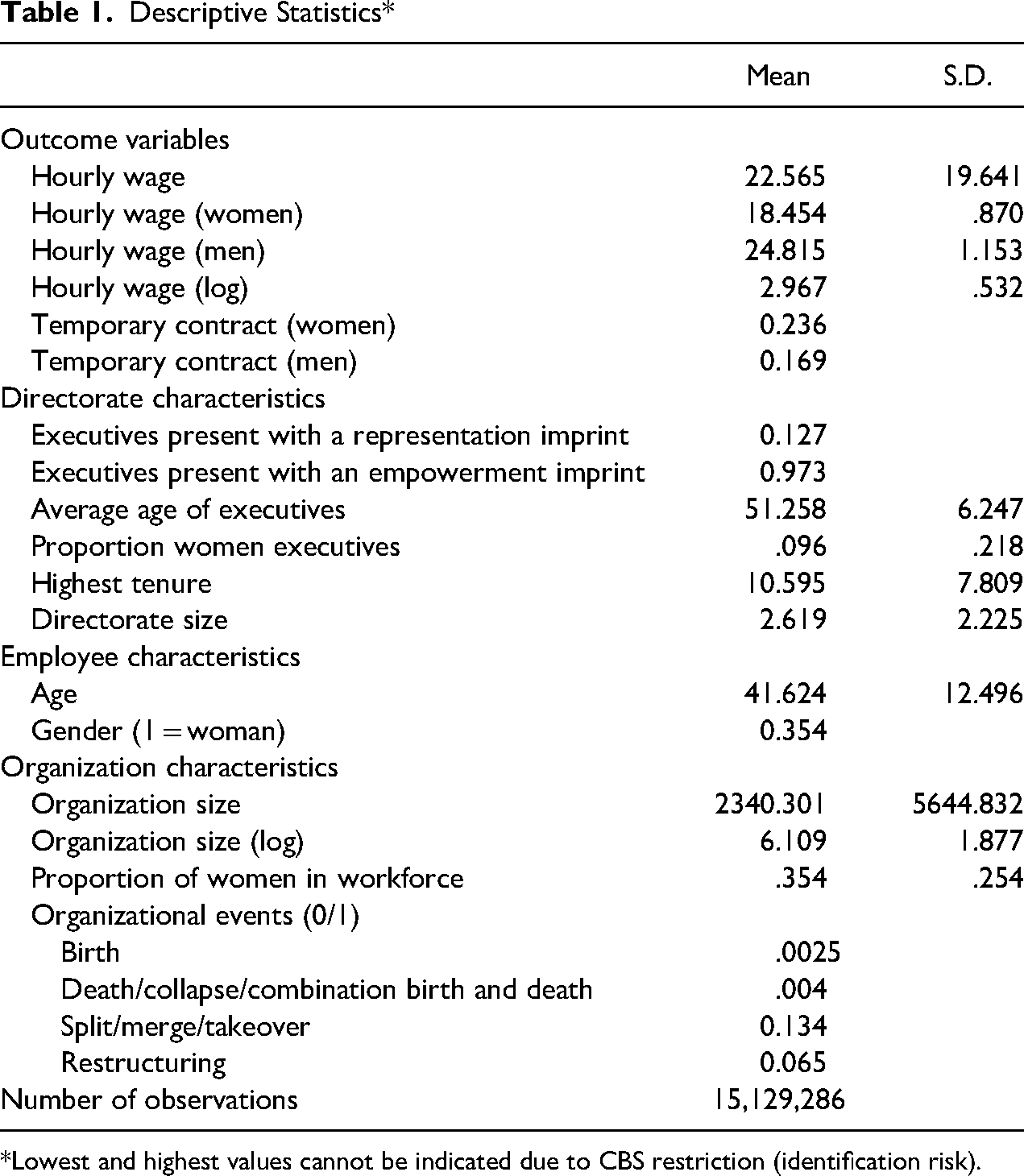
Lowest and highest values cannot be indicated due to CBS restriction (identification risk).
Methods
Our regression models included a fixed effect for each employment period and utilized variation within an employment period in directorate composition and outcomes (wage and contract type) while controlling for time-stable individual, job, and organizational characteristics. We included year-fixed effects to remove the impact of common temporal shocks that affect all jobs (e.g., changing economic conditions). Our dataset was unbalanced, as jobs have different tenures. However, fixed-effects methods make the necessary adjustments to provide robust results with unbalanced panel data (Wooldridge, 2010, 2015). Our analyses used cluster-robust standard errors to reduce biases due to heteroscedasticity and autocorrelation.
We used linear regression to analyze logged hourly wages and a linear probability model with permanent employment as outcomes. We followed recommendations to use linear probability models instead of nonlinear specifications (e.g., logit) in analyses that include panel fixed-effects (Beck, 2018; Gomila, 2021; Kwak et al., 2021).
Directorate changes do not instantly impact employees’ wages or employment practices (Fitza, 2014). Hence, we lagged the variables containing information on executive career imprints by one year (T − 1). As director composition changes (age, maximal tenure, and size) could influence the decision to employ or promote women executives, we lagged these composition variables by two years (T − 2).
Employee gender is time-constant, and the main effect of this variable was omitted from the analyses. We interacted gender with study variables that change over time to test gender differences. Consequently, our fixed-effects analyses did not capture the magnitude of the gender wage and permanency gap but showed gender differentials in the within-job change of wages and the likelihood of obtaining a permanent contract.
Results
Women Executives and Gender Differentials in Wage Progression and Permanency
Tables 2 and 3 present results for the logged hourly wage and the probability of obtaining a permanent contract. The baseline model (Model 1) presents the interaction between the presence of women executives and employee gender to assess whether women executives reduce gender differences in wage promotions or decrease the chance of switching to a permanent contract. We observed that the presence of women executives is associated with a reduction in hourly wages and an increase in the likelihood of a permanent contract among men. Women executives’ effect on wage reduction was even more significant for women employees (b = −0.017, p < 0.01); at the same time, they increased women's chances of obtaining a permanent contract more than for men (b = 0.010; p < 0.01). These findings corroborate earlier research highlighting that women executives’ impact on gender equality concentrates on less competitive, entry-level corporate ranks (Abendroth et al., 2017), where most employees start on temporary contracts. However, in terms of wage progression, women executives seem to lead to a reduction in wage progression for both men and women. Zimmermann (2022) found a similar result when investigating the effects of managerial women on wages, which he explains with selection effects: the share of women in management positions is higher in firms that pay less in general. However, such selection effects cannot explain our longitudinal finding that appointing women executives leads to a within-job decline in wage progression. We suspect that boards with more women differ in their practice of internal promotions and wage offers to employees from directorates consisting mostly of men. There is a fair amount of research evidence that women executives tend to have values (e.g., moral orientation) that are more aligned with ethical corporate behaviors (Byron & Post, 2016), and, therefore, they may formulate and practice stricter promotion guidelines that preclude large, more informal wage offers and promotions. This could explain why an increasing representation of women in leadership “slows down” the career progress of employees.
Linear Fixed-Effects Regression Results of Employees’ Hourly Wage (log)*.
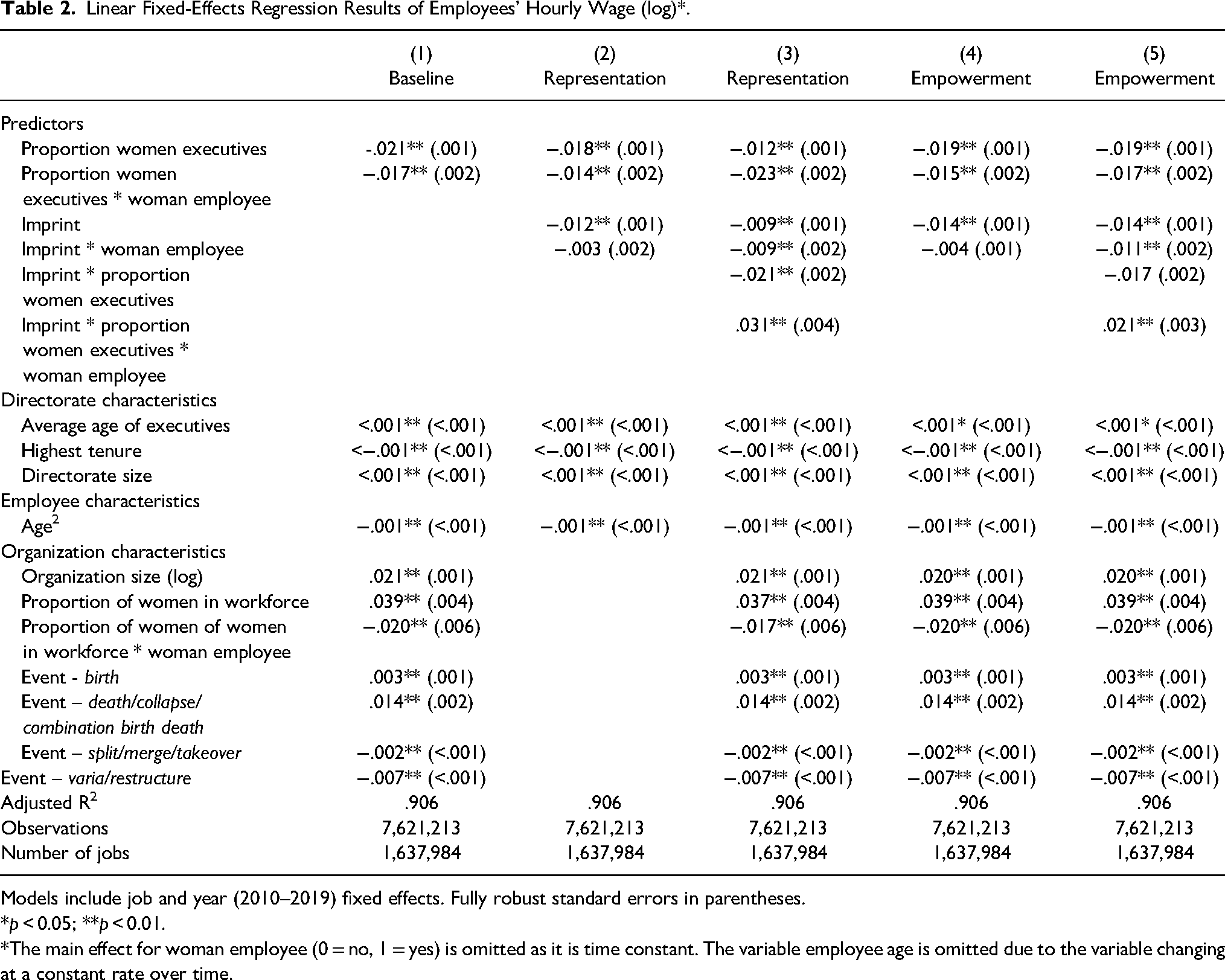
Models include job and year (2010–2019) fixed effects. Fully robust standard errors in parentheses.
*p < 0.05; **p < 0.01.
The main effect for woman employee (0 = no, 1 = yes) is omitted as it is time constant. The variable employee age is omitted due to the variable changing at a constant rate over time.
Linear Fixed-Effects Probability Models of Permanent Employment*.
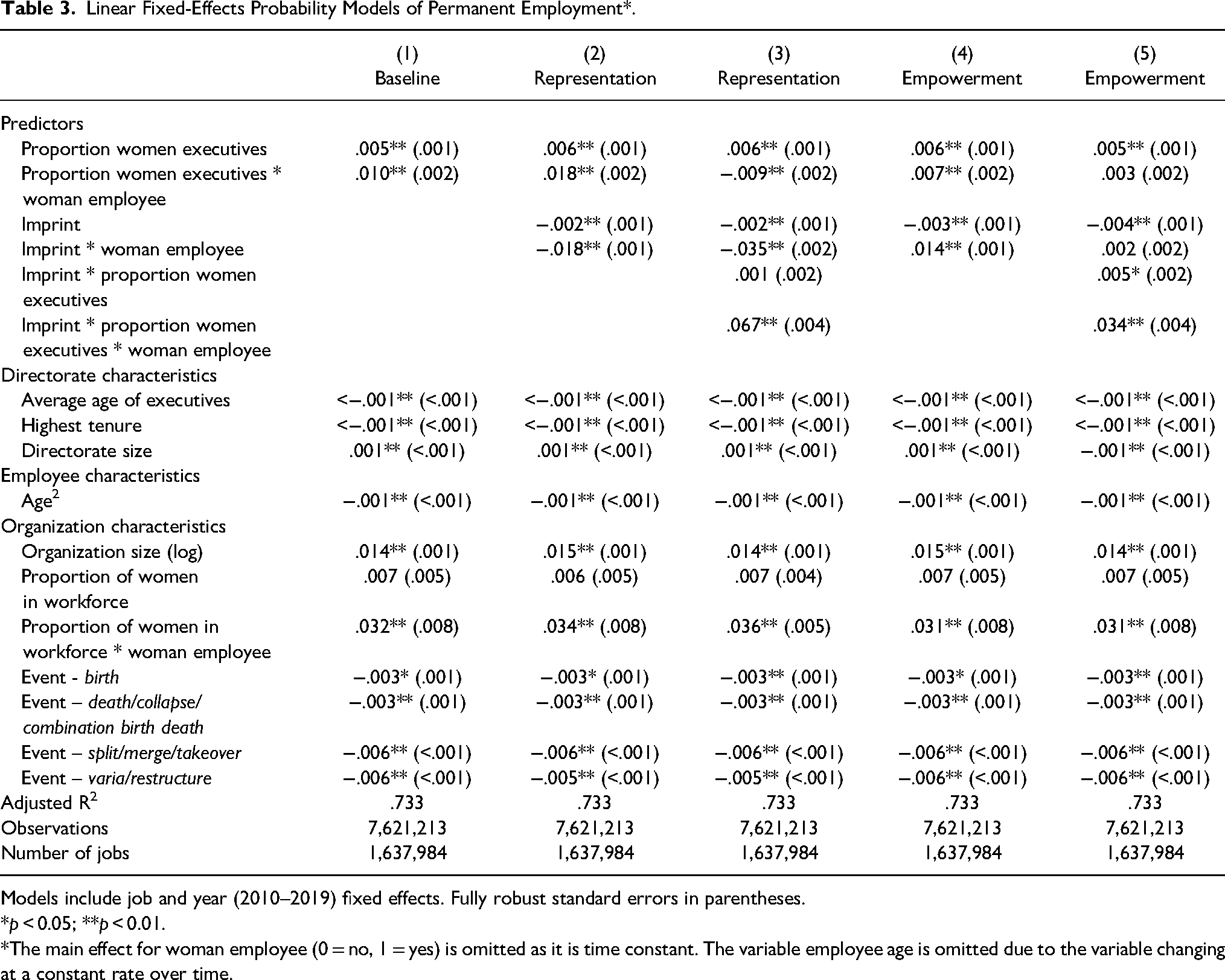
Models include job and year (2010–2019) fixed effects. Fully robust standard errors in parentheses.
*p < 0.05; **p < 0.01.
The main effect for woman employee (0 = no, 1 = yes) is omitted as it is time constant. The variable employee age is omitted due to the variable changing at a constant rate over time.
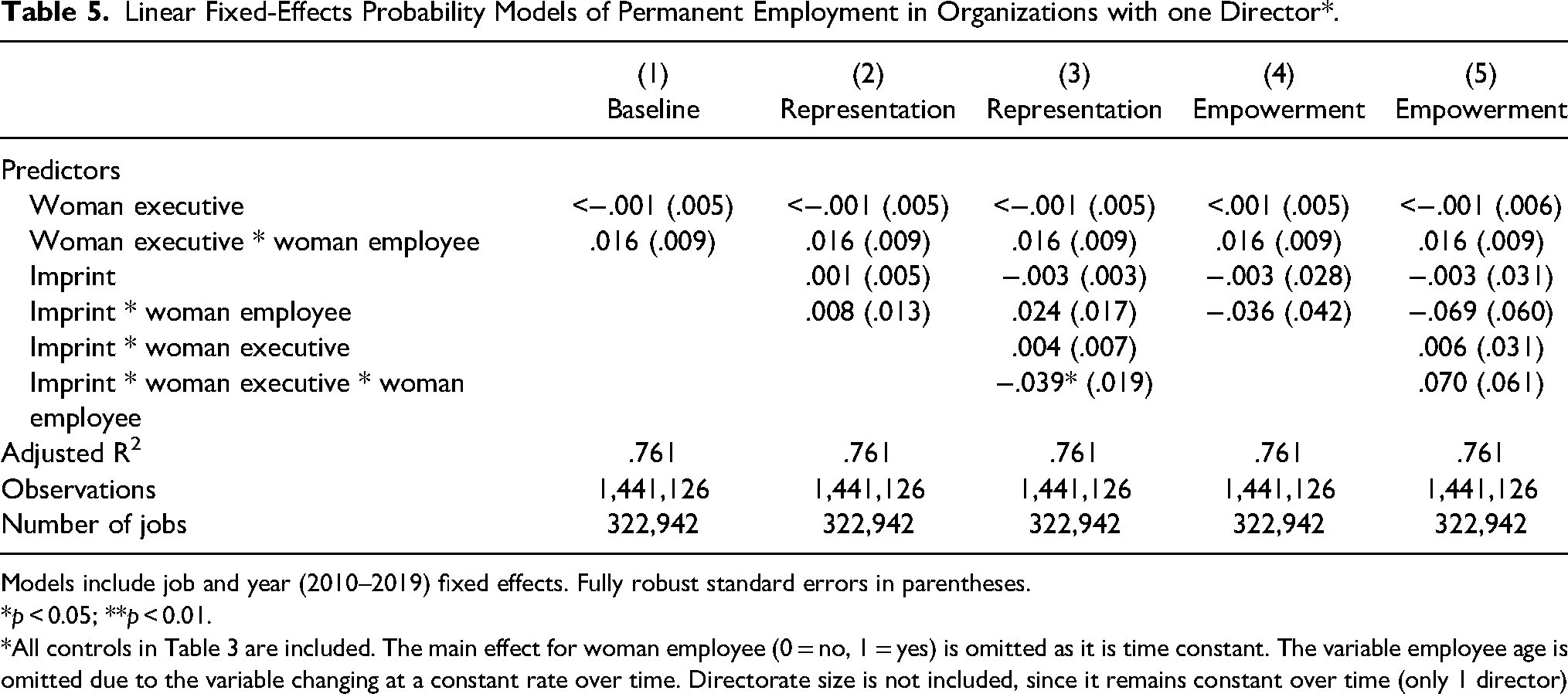
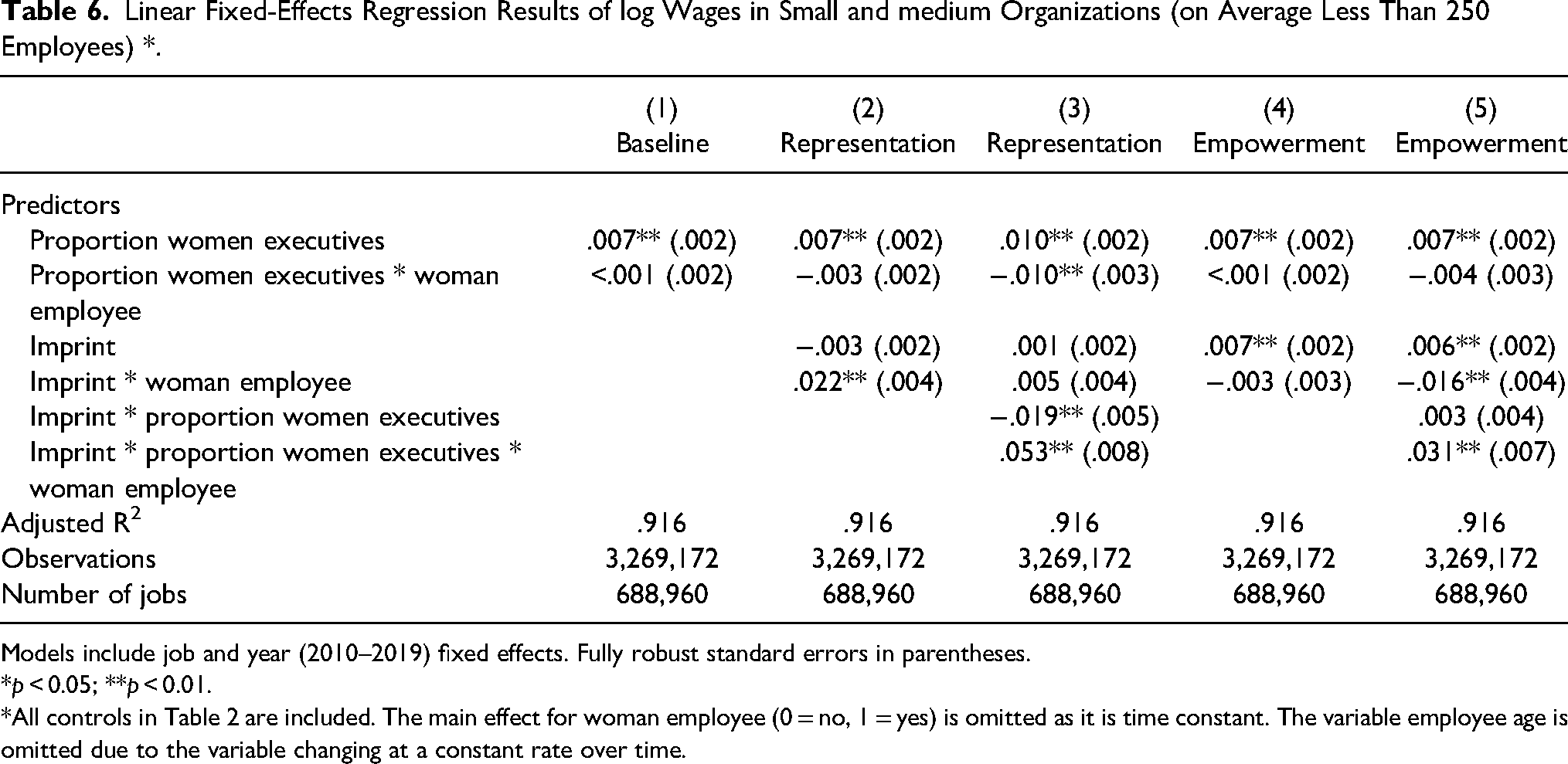
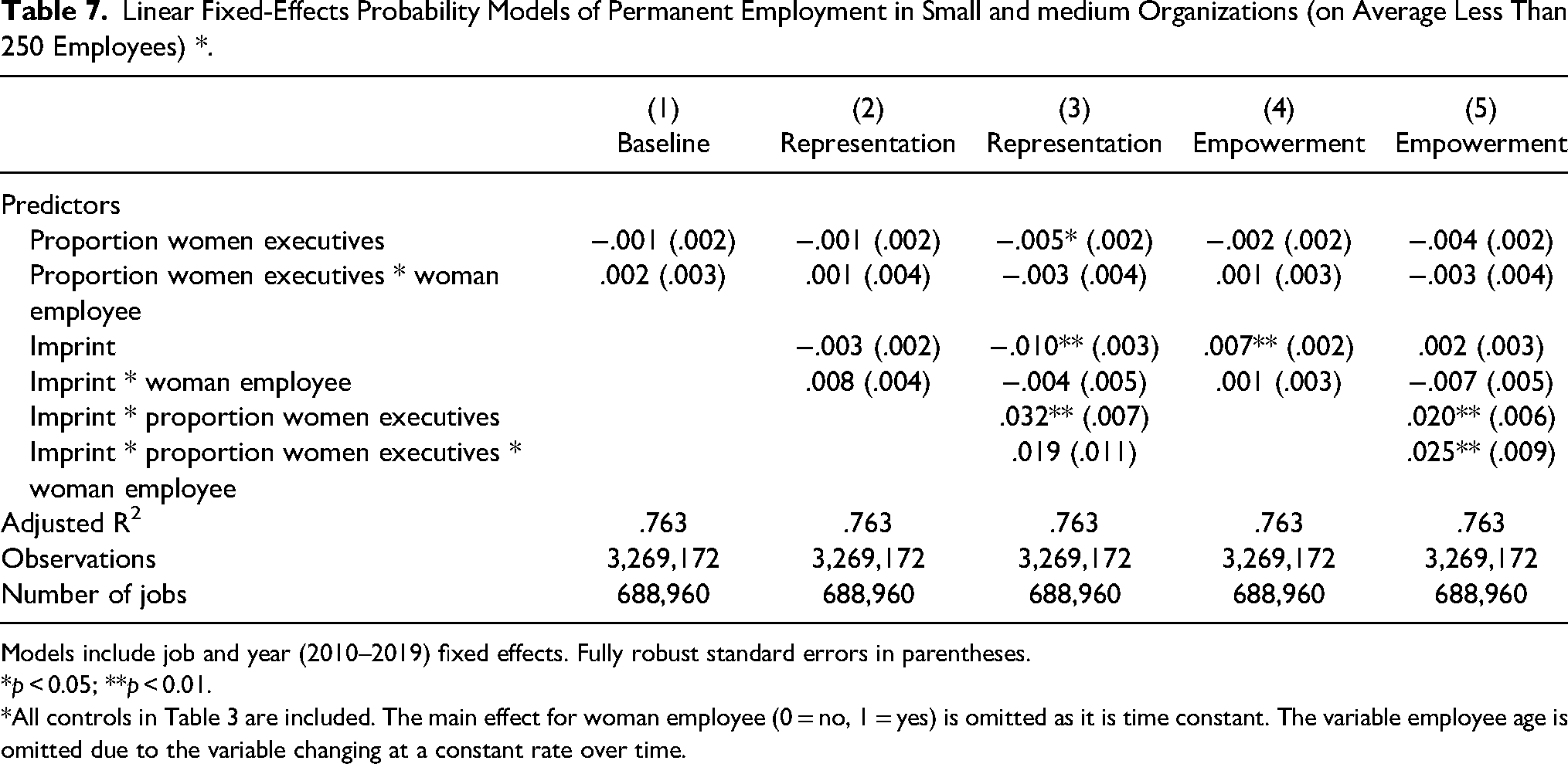
Such dynamics, however, do not explain why women executives disadvantage women. We repeated these analyses on subsamples of firms with a single director (around 38% of organizations—see the results in Tables 4 and 5) 4 and small and medium-sized organizations 5 (less than 250 employees on average, following the widely used criteria—see the results in Tables 6 and 7) 6 . In the single-director sample, we also observed that a top executive woman is associated with a reduction in hourly wage rates (b = −0.014, p < 0.01), but the wage reduction is smaller among women in the workforce (b = 0.07, p < 0.01). With a single high-level decision-maker in organizations, we observed change agency favoring junior women's wage progression. With respect to permanency, a woman top executive in single-director firms was associated with a higher probability of women in the workforce to obtain a permanent contract, although the effect was statistically insignificant (b = 0.016, p > 0.05). In the sample of small and medium-sized firms, women executives were associated with an increase in hourly wages (b = 0.007, p < 0.01); however, we did not observe statistically significant differences between men and women in the workforce. Nonetheless, this subsample corroborates that executive women foster the chances of women employees to obtain a permanent contract relatively more than men (b = 0.002, p > 0.05) 7 .
Linear Fixed-Effects Regression Results of log Wages in Organizations with one Director*.
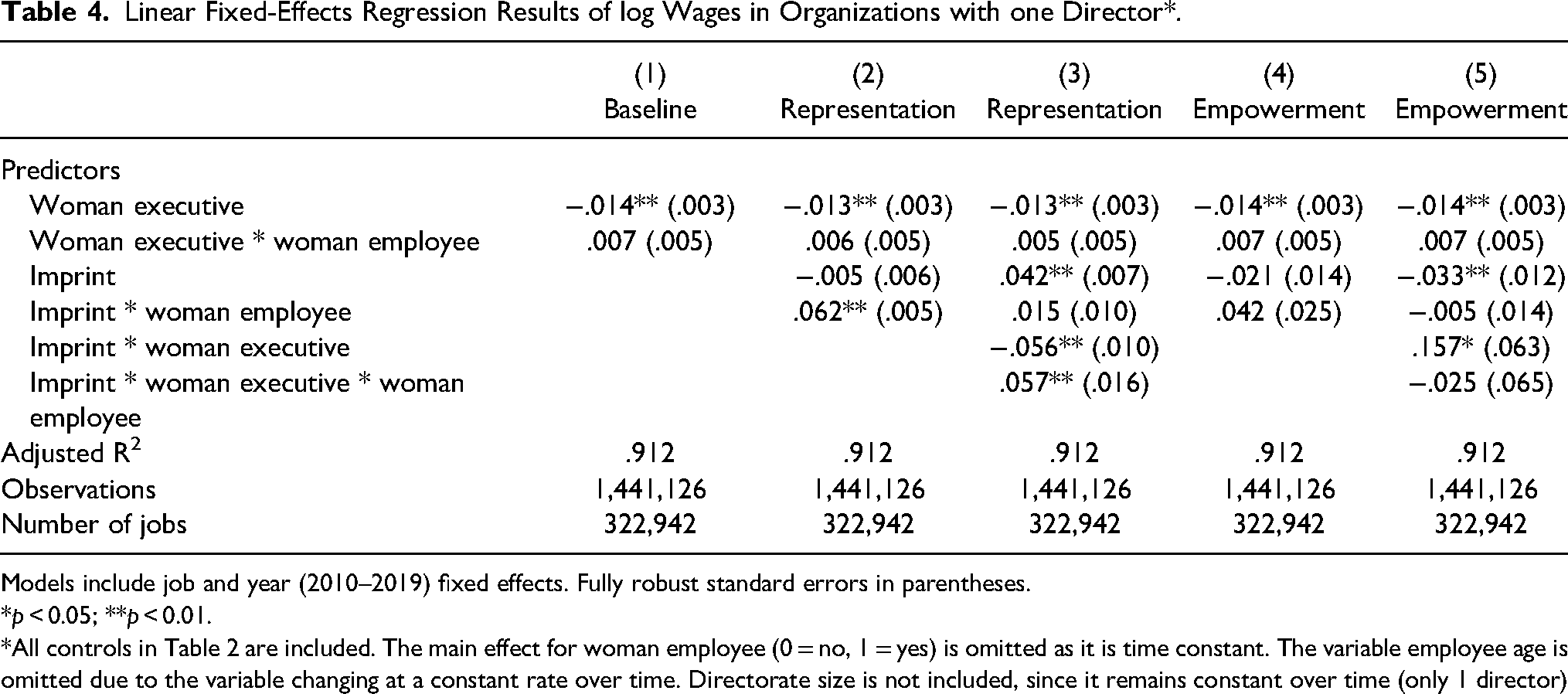
Models include job and year (2010–2019) fixed effects. Fully robust standard errors in parentheses.
*p < 0.05; **p < 0.01.
All controls in Table 2 are included. The main effect for woman employee (0 = no, 1 = yes) is omitted as it is time constant. The variable employee age is omitted due to the variable changing at a constant rate over time. Directorate size is not included, since it remains constant over time (only 1 director)
Linear Fixed-Effects Probability Models of Permanent Employment in Organizations with one Director*.
Models include job and year (2010–2019) fixed effects. Fully robust standard errors in parentheses.
*p < 0.05; **p < 0.01.
All controls in Table 3 are included. The main effect for woman employee (0 = no, 1 = yes) is omitted as it is time constant. The variable employee age is omitted due to the variable changing at a constant rate over time. Directorate size is not included, since it remains constant over time (only 1 director)
Linear Fixed-Effects Regression Results of log Wages in Small and medium Organizations (on Average Less Than 250 Employees) *.
Models include job and year (2010–2019) fixed effects. Fully robust standard errors in parentheses.
*p < 0.05; **p < 0.01.
All controls in Table 2 are included. The main effect for woman employee (0 = no, 1 = yes) is omitted as it is time constant. The variable employee age is omitted due to the variable changing at a constant rate over time.
Linear Fixed-Effects Probability Models of Permanent Employment in Small and medium Organizations (on Average Less Than 250 Employees) *.
Models include job and year (2010–2019) fixed effects. Fully robust standard errors in parentheses.
*p < 0.05; **p < 0.01.
All controls in Table 3 are included. The main effect for woman employee (0 = no, 1 = yes) is omitted as it is time constant. The variable employee age is omitted due to the variable changing at a constant rate over time.
The Moderating Effect of Imprints
To test our hypotheses regarding imprints, we estimated a three-way interaction between the representation and empowerment imprints 8 , the proportion of women executives, and the employee's gender (Tables 2 and 3, Models 3 and 5). The three-way interaction of the representation imprint was positive and statistically significant (b = 0.031, p < 0.01). This supports our hypothesis: in directorates where executives were exposed to women's representation on boards early in their managerial careers, women executives have a more positive influence on women employees’ wages. The three-way interaction was also positive and statistically significant when considering the probability of obtaining a permanent contract (b = 0.067, p < 0.01): women executives’ impact on women employees’ chance of receiving a permanent contract was more positive when directorate members had a representation imprint. We re-implemented this model to test our hypotheses on the empowerment imprint. Aligning with our hypothesis, the three-way interaction was positive and statistically significant (b = 0.021, p < 0.01). In directorates where executives were exposed to a woman CEO early in their managerial careers, women executives have a more positive impact on women employees’ wages. We obtained similarly confirmatory results for the role of empowerment imprint in women's likelihood of obtaining permanency compared to men: the positive and significant three-way interaction (b = 0.034, p < 0.01) shows that in directorates where an empowerment imprint is present, women executives have a more positive effect on women employees’ chances of receiving a permanent contract.
Repeated analyses of the subsample of single-director firms generally confirmed these findings (Tables 4 and 5). We established that a woman top executive who was exposed to a higher representation of women in the directorate during her first high-level managerial role has a more positive impact on women employees’ wages than top executives who were not exposed to women during the sensitive period of role socialization (b = 0.057, p < 0.01). We did not find support for the hypothesis regarding the empowerment imprint, as the three-way interaction was statistically insignificant (b = −0.025, p > 0.05). The results for permanency in this subsample are less supportive: the three-way interaction was negative and statistically significant (b = −0.039, p < 0.05), which is contrary to our hypothesis and earlier findings in organizations with multiple directors: a top executive woman imprinted with an experience of higher representation of women during role socialization reduces women employees’ chances of receiving a permanent contract. However, considering empowerment imprint, the findings align with our hypothesis of fostering change agency, albeit statistically insignificant (b = 0.070, p > 0.05).
In the subsample of small and medium-sized organizations (see Tables 6 and 7), the results align with the full sample: in directorates where executives have been exposed to women on boards early in their managerial careers, women executives have a stronger positive effect on women's wages than in directorates where imprints are not present (b = 0.053, p < 0.01). An empowerment imprint also increases women executives’ positive influence on women's wages, aligning with our hypotheses and earlier findings on the whole sample (b = 0.031, p < 0.01). For contract permanency, we did not encounter evidence that directorates with members carrying representation imprint enhance the effect of women executives on women's chances of receiving a permanent contract (b = 0.019, p > 0.05). Regarding the empowerment imprint, we once again obtained evidence for imprinting processes: imprinted experiences of a woman CEO within the directorates of small and medium-sized organizations increase the impact of women executives on women employees’ chances of receiving a permanent employment contract (b = 0.025, p < 0.01).
Conclusions and Discussion
Women are increasingly occupying high-ranking positions in firms; however, research has produced mixed results regarding their impact on gender equality in the organizations they manage. We aimed to break new ground in the agents of change literature by addressing how women's representation and power experienced by women in the highest organizational positions during their role socialization shape their impact on gender equality in organizations. We used linked employer–employee and functionary register data from the Netherlands to trace the careers of managers and the context of their first managerial assignments and link them to wage and employment permanency outcomes for men and women in firms. Our longitudinal analyses robustly support that personal pasts shape the degree to which women in high-ranking corporate positions serve as agents of change. We observed highly similar patterns in separate analyses for organizations with a single leader (CEO) and in small, medium-sized, and large organizations. Experiencing women on boards and in powerful positions early in their managerial careers is generally associated with women executives having a more positive effect on women's wages and job permanency on the work floor.
Our findings on the role of career experiences have important theoretical implications for understanding how professional cultures translate to inequality in workplaces. Recent in-depth analyses of inequality in finance (Neely, 2022) and in science, technology, engineering and mathematics (STEM) academia (Blair-Loy & Cech, 2022) argue that professional socialization reproduces hegemonic masculine cultures even when challenged by mainstream society. The executive profession is similar in its hegemonic masculine conceptions of the ideal worker and pushback against outside interventions. Our findings, while not questioning the importance of professional cultures, remind us that local organizational contexts, such as management teams and boardrooms, are important avenues of socialization where individual experiences can deviate from, overwrite, and challenge dominant patterns (Fine & Hallett, 2022). Attention to how influential actors’ past socialization experiences produce meaningful organizational change may help us understand incremental changes in inequality regimes in workplaces. Moreover, our findings also suggest that contested organizational diversity and inclusion efforts to represent and empower disadvantaged groups in organizational leadership could, in the long run, have a broader impact in workplaces.
Our study on the change agency of women executives has implications for new labor sociology's quest to understand worker agency in bringing about institutional change (Cornfield, 2023), particularly for the emerging literature on occupational activism (Coley & Schachle, 2023). Our focus on imprints from early role socialization into the occupational role mirrors the biographical focus of studies on occupational activists (Augustine & King, 2024; Coley et al., 2022; Cornfield et al., 2018). However, while these studies analyze the long-lasting consequences of social movement participation—or “schooling”—on labor activism throughout careers, we focused on the role of the socialization contexts in workplaces, particularly gender composition and power dynamics, during focal points in careers that can lead to transformative enactments of the managerial job. There are two main theoretical implications for occupational activism. First, while there are works on micro-mobilization within the context of social movements (Isaac et al., 2020), our study directs attention to socialization in work contexts and expands the understanding of which past experiences make occupational activism more likely (Coley & Schachle, 2023). Second, the focus on group processes within workplaces—women's representation and empowerment—extends our understanding of the factors that potentially make local contexts more conducive for peer-centered activism (Cornfield et al., 2018), complementing earlier work on the role of occupational contexts (Cornfield, 2015).
To further investigate the role of imprints in gender equality and address some of the limitations of our study, we suggest four avenues for future research.
Activism of Leaders
Although we did not frame our study around occupational activism, this literature provides insights for future research on change agency. First, women executives may have a transformative impact outside our focal workplace and encourage gender equality in the broader environment beyond their workplace. While our data did not allow us to study this, it would be interesting to examine such forms of values-centered occupational activism and understand the impact of women leaders as change agents beyond firms. Second, while we theorized that role models can be empowering, we were not able to directly study the degree to which and how women in managerial positions motivate their subordinates to engage in occupational activism. Clearly, more research is needed on how women executives engage in occupational activism (Coley & Schachle, 2023). Finally, political changes, primarily in the US but also elsewhere, have led to the quest for gender equality losing the societal legitimacy and legal/institutional support it enjoyed in recent decades. Change agency studies could draw on new labor sociology's insights on how professionals navigate hostile political environments (Kucinskas & Zylan, 2023) to understand how women executives will cope with the decreasing legitimacy, or even forced governmental dismantling, of equal opportunity and diversity initiatives.
(Career) Experiences as Imprinted Sequences
We endorse future studies to further explore and expand our knowledge of the ways in which past career experiences influence women's change agency. In line with the central tenet of imprinting theory, we focused on the most sensitive period of executive role transitioning, the first managerial role. However, appointment to an executive position is likely to occur after a significant time in a career. Perceptions may already be shaped in significant ways prior to executive appointment. Studies involving directors indicate that influential imprints also stem from educational or social class backgrounds (Kish-Gephart & Campbell, 2015; Sanders & Tuschke, 2007). Furthermore, individuals encounter many other transition periods throughout their professional lives (McEvily et al., 2012), and early imprints can impact the development of new ones (Cowen et al., 2022). While our data were inadequate to study early childhood and educational socialization, it would be beneficial for future research to study the full sequence of critical transitions in leaders’ lives and their interplay. It will be particularly interesting to examine whether experiences of environments dominated by men and devalued positions later in careers weaken early empowering imprinted experiences. Additionally, we should ask whether empowering experiences later overwrite early imprints that constrain women's agency.
Women in Positions of Authority at Different Stages of Their Careers
A limitation of our data is that we did not observe middle management or supervisory positions. Supervisors and mid-level managers are in the earlier stages of their careers and may be on track to later become executives. One concern of not observing them could be selection effects: it is possible that women executives in our dataset are the ones who were selected into and successfully assimilated themselves into environments dominated by men. Westphal and Stern (2006) demonstrate that personal influence strategies, such as opinion conformity, compensate for the disadvantage of minorities in accessing corporate leadership positions. This suggests that women-selected boards might be less likely to be vocal or critical of gender inequalities in the workplace to align with boards predominantly comprising men. However, Westphal and Stern (2006) also argue that ingratiation and interpersonal influence are exercised toward similar and lower status others, which implies support and encouragement to same-gender peers as mentors. Selective dropout can occur due to negative career experiences. Stojmenovska (2023) describes how women are more likely than men to leave jobs with higher levels of authority due to negative experiences, such as harassment and bullying. Another group of mid-level managers may have been pushed out of executive career tracks (Neely, 2022) and encountered different professional norms, expectations, and levels of competition. Such selection processes on executive career tracks might help explain why we discovered mixed evidence for women executives lowering inequality in their organizations in some of our baseline models. Nevertheless, our additional analyses of smaller organizations with fewer management layers and shorter career trajectories confirm the findings that imprints matter for the impact of women in leadership.
Cook et al. (2019) argue that women's influence through their board position, rather than solely their representation, contributes to greater equity within organizations. We have partially addressed influence by conducting our analyses in single-director organizations—where the sole top decision-maker is a woman—and by studying the imprint of women CEOs. However, our data lack information on women executives’ board positions (such as chair of a committee); therefore, we cannot address the role of influence in companies with larger directorates. Nevertheless, based on this early literature, we expect that women's influence within larger boards is likely to strengthen the effect of imprints, even more than their representation that we documented in this paper. We call for future analyses that include more levels of management and information on specific board positions to develop.
The Role of Organizational Imprints
Our study focused on individuals’ career imprints; however, imprinting also occurs on the organizational level (for an overview, see Marquis & Tilcsik, 2013). Organizations absorb elements from their environment during their founding and later sensitive periods that persist over time despite environmental changes (Johnson, 2007; Stinchcombe, 1965). Organizational imprints might play a role in the degree to which an organization is susceptible to the influence of women in leadership. Organizations that emerged during times of higher levels of gender inequality or consisted only of men in leadership positions during their inception might resist the influence of women executives to a larger degree. Future endeavors could investigate the interplay between individual agency and organizational imprints to add to the current theorizing on organizational conditions under which women in leadership positions can exert more influence on gender equality (see Fuller & Kim, 2024).
Our study also illustrates that change toward gender equality in organizations is not achieved by just hiring women. Policy efforts to achieve gender equality, such as corporate boardroom quotas, are often accompanied by gender essentialism: the idea that all women possess similar characteristics just because they are women (Mansbridge, 2005). To overcome this, we need to take a more rich and contextualized understanding of the change agency of women in powerful positions in organizations (Torchia et al., 2011). We hope that this study has taken a step toward this goal by shedding light on the importance of personal career experiences.
Supplemental Material
sj-docx-1-wox-10.1177_07308884251339683 - Supplemental material for Change Agents with a Past: Women Executives’ Early-Career Contexts and Gender Equality at Workplaces
Supplemental material, sj-docx-1-wox-10.1177_07308884251339683 for Change Agents with a Past: Women Executives’ Early-Career Contexts and Gender Equality at Workplaces by Sofie Wiersma, Zoltán Lippényi and Anja-Kristin Abendroth in Work and Occupations
Footnotes
Acknowledgment
The authors are grateful to Rafael Wittek and members of the ISOL working group and the ISA RC28 University of Melbourne participants for helpful questions and comments.
Data Availability
Statistics Netherlands microdata is non-public but accessible for statistical and scientific research upon request and following authorization. For further information, contact: microdata@cbs.nl
Declaration of Conflicting Interests
The authors declared no potential conflicts of interest with respect to the research, authorship, and/or publication of this article.
Ethical Approval
The study presents secondary data analysis of administrative register microdata provided by Statistics Netherlands (CBS). Ethical approval for this study was not required. CBS authorized the study and approved that its outputs meet the requirement of full anonymity of persons in the population registers.
Funding
The authors disclosed receipt of the following financial support for the research, authorship, and/or publication of this article: This study is part of the research program Sustainable Cooperation—Roadmaps to Resilient Societies (SCOOP), supported by the Dutch Research Council (NWO) and the Dutch Ministry of Education, Culture and Science (OCW) in the context of its 2017 Gravitation Program (grant number 024.003.025).

Supplemental Material
Supplemental material for this article is available online.
Notes
Author Biographies
References
Supplementary Material
Please find the following supplemental material available below.
For Open Access articles published under a Creative Commons License, all supplemental material carries the same license as the article it is associated with.
For non-Open Access articles published, all supplemental material carries a non-exclusive license, and permission requests for re-use of supplemental material or any part of supplemental material shall be sent directly to the copyright owner as specified in the copyright notice associated with the article.
