




Abstract
Materialist theories of disability link disability and labor, hypothesizing that under neoliberalism, disability stigma contributes to labor market precarity. These claims have not been evaluated empirically and the mediating role of the state remains underspecified. Ethnographic fieldwork in a job training program for people with psychiatric disabilities reveals two contradictions in the welfare state treatment of disability. First, disability benefits are set at low levels, yet means-testing limits earnings, channeling people with disabilities into low-wage jobs. Second, contradictory imperatives attached to state funding incentivize placement in temporary jobs. These welfare state contradictions produce disabled workers as a precarious labor force.
Keywords
I met Andrea, a woman with schizophrenia, after several months of ethnographic fieldwork in a state-funded nonprofit job training program for people with psychiatric disabilities. Andrea estimated that she had held 100 temporary jobs in her life. In 2019, she had completed a nine-month internship through Disability Works
1
as an administrative assistant in a welfare state agency, then obtained a “floater” administrative position with unpredictable hours. She explained to me, I got acquainted with the interns of [another Disability Works training program] and I got acquainted with the other clerks at Disability Works, and my impression is we’re all underemployed. We’re all working as clerks and receptionists. I mean, some of us have law degrees. Somebody has an economics degree. I have an architecture degree. There was somebody who was a nurse. See, we’re all highly educated people, but for some reason, because of this so-called disability, we’re underemployed. Like for some reason it's like a barrier or something … This is just to hold you over. This is better than having no job at all. This is just keeping busy. But there isn’t really a promise of a real job … They’re dead end jobs. They’re dead end jobs. They’re entry-level clerical jobs.
Andrea herself appeared baffled by the pattern she observed: “because of this so-called disability … for some reason it's like a barrier or something …” Why, she asked, did she and her friends with disabilities linger in low-wage, highly precarious jobs, in spite of their educational and professional experiences? Why did this pattern of precarity persist even among people receiving services through Disability Works and related government programs for people with disabilities?
One in five Americans has a disability, yet disabled people report employment rates below 50% nationwide and poverty rates over twice the national average (Brault, 2012; CPR, 2015). Increasing the employment of people with disabilities is an aim of many welfare state programs. Yet government data suggest that many disabled people enrolled in state-funded programs remain in long-term poverty, often lingering in low-wage jobs internal to employment programs rather than attaining community-based jobs, which might be more stable, pay higher wages, and enable social contact between disabled and nondisabled workers (NCD, 2018; US GAO, 2001). Many client-workers in disability employment programs are paid subminimum wages under a provision of the Fair Labor Standards Act (NCD, 2018). State management of the employment programs industry has thus been subject to sustained criticism from labor and disability rights activists (Gill, 2005; NCD, 2018; NFB, 2016). As Jocelyn, the director of Disability Works, remarked to me, “It's rewarding to help people get jobs, but it's also frustrating, because they can’t get out of poverty.”
This paper investigates this production and maintenance of precarity among people with disabilities, with an empirical focus on disability employment programs. While the employment programs industry enrolls only a fraction of the disabled population, this site renders the state management of disability empirically visible. I draw upon eight months of fieldwork in Disability Works to document ways that the organization of state disability benefits and the quantitative benchmarks attached to government funds funnel people with disabilities into low-wage, part-time, temporary jobs, with disability employment programs operating as middlemen in this process. Specifically, conflicting logics of resource distribution in the disability benefits system and in the contract goal system produce contradictions in downstream welfare state organizations such as Disability Works, and precarious placements emerge as a strategy to resolve these contradictions. These findings demonstrate that disability does not straightforwardly demarcate the “deserving poor,” as some research has posited, but operates as a fundamentally contradictory category which pushes disabled people into precarious jobs.
Disability and the Welfare State
The materialist model of disability, as distinct from medical and social models, illuminates disability as a category producing precarity. Traditional medical models analyze disability as an objective mental or bodily condition to be ameliorated through medicine (Haegele & Hodge, 2016). The social model of disability distinguishes between impairment and disability to argue that while impairment is distributed throughout the population, the stigma attached to certain impairments produces “disability” as a social category (Barnes, 2019; Oliver, 2013; Shakespeare, 2013). In the social model, disability resides not in a wheelchair user's paralyzed legs but in buildings without ramps and the stigmatizing gazes of strangers. While the social model recognizes disability as structurally produced, it maintains an abiding focus on the societal incorporation of individuals and neglects disability categories as integral to political economy. However, a handful of scholars develop a materialist model linking disability categories to the mode of production. Russell and Malhotra write that in contrast to analyses that focus on attitudinal and architectural barriers, “we take the view that disability is a socially-created category derived from labour relations, a product of the exploitative economic structure of capitalist society: one which creates (and then oppresses) the so-called ‘disabled’ body as one of the conditions that allow the capitalist class to accumulate wealth” (2002, pp. 211–212; see also Carmody, 2022; Gleeson, 1999; Mitchell & Snyder, 2015; Nibert, 1995; Oliver, 1990; Rose, 2017; Russell, 1998, 2019; Stone, 1984; Taylor, 2004). Under the materialist model of disability, attitudinal changes are insufficient remedies for the marginalization of disabled people, which scholars link to the dynamics of capitalism.
While this literature offers a somewhat totalizing view of capitalist production, I draw on it as a sensitizing lens, highlighting the aspects of disability as a labor market category which go neglected in the empirical literatures this paper extends. Specifically, the use of disability to sort subjects into work- and needs-based distribution systems illuminates contradictions observed at Disability Works. Stone (1984) argues that capitalist societies maintain separate distribution systems which provide resources on the basis of work and on the basis of established need. Stone defines the tension between these two systems as “the fundamental distributive dilemma” (1984, p. 17), writing that each society develops rules to allocate resources and individuals to one system or the other, with the overarching goal of maintaining a labor supply that suits the needs of capital. Work-based distribution refers to subsistence based on wage labor, while needs-based distribution refers to subsistence based on cash or in-kind assistance to those deemed to require it. Empirical work on the welfare state supports Stone's emphasis on this distributive dilemma (Berkowitz & DeWitt, 2017; Peck, 2001; Piven & Cloward, 1993; Steensland, 2006). Stone and Russell both argue that disability emerges as a category cultivated by capitalist states to sort subjects into one system or the other, resolving the distributive dilemma and regulating the labor supply (Russell, 2019, p. 17; Russell & Malhotra, 2002, p. 214; Stone, 1984). Boundary work around the category of disability facilitates capital accumulation, as the maintenance of a surplus population on the fringes of the labor market may drive down wages or, during periods of economic growth, expand the labor pool (see Denning, 2010; Foster et al., 2011; Magdoff & Magdoff, 2004 for Marxist precedents to this theorization of disability).
Historical research in this materialist tradition documents two major shifts in the category of disability corresponding to shifts in the organization of labor. First, in the transition from feudalism to capitalism, disability emerged as a new social category defined by disabled people's exclusion from wage labor and perceived drain on social resources (Carmody, 2022; Gleeson, 1999; Nibert, 1995; Oliver, 1990; Rose, 2017; Russell & Malhotra, 2002; Stone, 1984). Second, in the late twentieth century, the partial dismantling of welfare and advocacy for disabled people's involvement in wage labor contributed to reconstitutions of disability through rights claims based on potential productivity (Harris et al., 2012; Russell, 1998, 2019; Mitchell & Snyder, 2015; Soldatic, 2018; Wilton & Schuer, 2006). These rights claims culminated in the Americans with Disabilities Act of 1990, which sought to eliminate workplace discrimination in order to ensure disabled “economic self-sufficiency” and reduce “unnecessary expenses resulting from dependency and nonproductivity” (US Congress, 1990, p. 3). Disability activism also fueled legislation against workplace discrimination including the Rehabilitation Act of 1973 and the ADA Amendments Act of 2008, and legislation to reduce reliance on disability benefits including the Ticket to Work and Work Incentives Improvement Act of 1999. Bagenstos (2009) analyzes the disability movement of this period as beset by tension between activists’ fight for social provision (e.g., expanded benefits) and fight for economic self-sufficiency (e.g., workforce integration), with the latter emphasis on self-sufficiency triumphing due to its bipartisan appeal. This argument is supported by Pettinicchio's (2019) analysis of disability activists’ bipartisan strategy, which emphasized disabled workers’ potential productivity as an appeal to conservatives. This rhetorical emphasis on productivity supported the generally increasing cultural emphasis on work under neoliberalism (Peck, 2001; Soss et al., 2011).
Following these shifts, Russell hypothesizes that disability is defined today by the effort to draw surplus populations into the labor force and drive down wages for all. In her analysis, the push for employment constitutes people with disabilities as a “new reserve army of labor” whose entrance into the workforce will “put downward pressure on the now rising wages in a tight labor market” (Russell, 2019, p. 25; see also Hahn, 1987; Soldatic, 2018). In Stone's terms, Russell argues that while disabled people were subject to needs-based distribution during earlier phases of capitalism, today they are primarily subject to work-based distribution. Indeed, other research demonstrates that over the late twentieth century, the disability employment programs industry expanded rapidly, yet wages within these programs fell (Beckwith, 2016). This literature identifies people with disabilities as subjects of neoliberalism, in parallel to welfare recipients drawn into labor markets over the same period.
Building upon this literature, this paper asks: How does the neoliberal state use disability to regulate the labor supply? Materialist disability theorists claim a relationship between disability and the organization of labor, but do not identify their linking mechanisms, presuming a functionalist correspondence between disability and the mode of production. The mediating role of the state is underspecified. Furthermore, the materialist paradigm represents a “grand theory” of disability developed in activist writing and humanistic disability studies and has not been adequately empirically evaluated. Therefore, there is a need to synthesize this paradigm with existing empirical research on the welfare state, then apply this synthesis to new data. Linking the materialist model of disability to welfare state research may help scholars evaluate whether and how the category of disability produces precarity under neoliberalism. This paper focuses empirically on front-line welfare state organizations, inspired by calls to study the state from the ground up (Haney, 1996; Lipsky, 1983; Seim, 2017; Watkins-Hayes, 2009) and as a supplement to research addressing disability labor politics at higher levels of governance (Berkowitz & DeWitt, 2017; Maroto & Pettinicchio, 2014; O’Brien, 2012; Pettinicchio, 2019).
Poverty Governance
Much research presumes that the welfare state takes a lenient approach to the disabled poor. Prior scholarship argues that the divide between the “deserving” and “undeserving” poor has structured state regulation of the labor market since at least the Poor Laws. These moral judgments about poverty guide the distribution of resources, with state assistance offered to the “deserving poor” and withheld from the “undeserving poor” (Fraser & Gordon, 1994; Gritter, 2017; Katz, 1989; Schneider & Ingram, 2004; Skocpol, 1995; Steensland, 2006). To use Stone's (1984) terms, the deserving poor are generally subject to needs-based distribution logics, while the undeserving poor are subject to work-based distribution logics. Welfare state scholars often take people with disabilities to exemplify deservingness. For example, Steensland states in his overview of this dichotomy, “The ‘deserving’ poor were those people not expected to work because of their age, gender, family status, or physical limitations, and they were therefore deemed as meriting government support. The ‘undeserving’ poor, on the other hand, were expected to work” (2006, p. 1274, emphasis added; see Barrilleaux & Bernick, 2016; Gritter, 2017, pp. 31–46; Katz, 1989, p. 5, p. 12 for additional examples; see Erkulwater, 2006, pp. 14–15 on the incomplete picture these assumptions produce). Disabled people are assumed, but not empirically shown, to be exempt from state pressure to work. Little empirical research addresses disability as a potential tool of labor discipline.
However, materialist disability scholarship posits that the contemporary treatment of people with disabilities may not be so different from the treatment of the “undeserving” poor, with disabled people corralled into labor markets under neoliberalism. Histories of neoliberalism show that work has grown more precarious since the 1970s. The decline of unions, the deregulation of business, and the erosion of welfare have led to declines in employment tenure, increases in long-term unemployment, increases in perceived job insecurity, and – most important to this analysis – the growth of contingent work (Ayala-Hurtado, 2022; De Stefano, 2016; Hatton, 2011; Kalleberg, 2000, 2009, 2018; Lopez & Phillips, 2019; Smith & Young, 2017; Vallas & Prener, 2012; Vallas & Schor, 2020; Wacquant, 2008). These precarious jobs are located disproportionately in the service sector, which has expanded drastically in the last 50 years (Dwyer, 2013). Building on Piven and Cloward (1993), Soss et al. (2011) introduce the concept of poverty governance to analyze the state's involvement in the production and maintenance of precarity, which they define as a mode of governance “to secure, in politically viable ways, the cooperation and contributions of weakly integrated populations” (2011, p. 2). The “workfare” programs which exemplify poverty governance shuffle the poor off of state benefits and into low-wage labor markets (and particularly service jobs), reflecting the neoliberal shift from needs-based to work-based distribution logics (Dickinson, 2016; Hatton, 2020; Peck, 2001; Soss et al., 2011). Scholars invested in the deserving/undeserving poor distinction typically presume that disabled people have been exempt from neoliberal shifts and excluded from workfare programming, an assumption this paper problematizes.
Prior research on poverty governance as applied to people with disabilities focuses on the political consequences of medicalization, while empirical gaps persist around disability as a labor regulation category. Following federal and local welfare reforms throughout the 1990s, many members of the indigent poor were shuffled off of more general assistance programs and onto disability benefits, a transformation which some scholars term the medicalization of welfare (Hansen et al., 2014; Wong, 2016; Joffe-Walt, 2013). Qualitative studies of this transformation document increasing medicalization in social service fields including homeless sheltering (Gowan, 2010; Lyon-Callo, 2000) and domestic violence services (Sweet, 2021), with caseworkers guiding the poor toward disability-focused welfare state programs. This body of research argues that medicalized welfare legitimizes needs-based resource distribution by interpellating the poor as disabled and therefore as deserving of assistance. While this literature criticizes aspects of medicalization – its individualizing effects, for instance – it generally takes for granted this connection between disability and deservingness and, therefore, needs-based resource distribution. Evidence that the neoliberal welfare state may apply work-based distribution logics alongside these needs-based logics and use the category of disability to guide disabled people into precarious jobs has been comparatively neglected in the poverty governance literature, despite the hypotheses of materialist disability perspectives (Russell, 1998, 2019) and despite widespread evidence of employment precarity among people with disabilities (Brown & Ciciurkaite, 2022; Shuey & Jovic, 2013). Ultimately, I argue that this production of precarity occurs not in spite of, but through the needs-based distribution logics of medicalized welfare, and through welfare state actors’ attempts to resolve these logics’ tension with work-based distribution logics.
Poverty governance scholars’ analysis of the retrenchment of the welfare state contextualizes these clashing distribution logics. First, prior research finds that the outsourcing of state functions to private organizations is a central feature of contemporary poverty governance. Over the late twentieth century, criticism of “big government” led not to the withdrawal of the state, but to its reconstitution and retrenchment in more molecular, less visible forms (Fairbanks, 2009; Morgan & Campbell, 2011; Mettler, 2011; Soss et al., 2011). In particular, studies of precarious work demonstrate that state-funded labor market intermediaries play an important role in the temporary labor supply chain (Elcioglu, 2010, pp. 127–128; Dickinson, 2016; Hatton, 2020; Purser & Hennigan, 2018; Sheehan, 2021; Smith et al., 2005; Van Oort, 2015), driving my empirical focus on disability employment programs as an understudied labor market intermediary. Second, the poverty governance literature demonstrates that disciplinary power filters downwards from government agencies to the nonprofits that they partner with, and within these nonprofits, from managers to front-line caseworkers to client-workers themselves (Fairbanks, 2009; Haney, 1996; Seim, 2017, 2020; Soss et al., 2011; Watkins-Hayes, 2009; Zacka, 2017). This claim sensitizes me to contradictions at three successive levels: first, at the level of federal disability benefits; second, among state agencies funding disability employment programs; and third, within disability employment programs themselves.
Theorizing front-line welfare state work as a labor process illuminates effects of these contradictions. Here, I draw on Seim's (2017, 2020) labor theory of poverty governance, which focuses on the “horizontal and vertical relations of production” in which state workers are enmeshed. This paper focuses especially on vertical pressures stemming from the federal disability benefits system and Disability Works’ contracts with the state. Research further suggests that welfare state workers struggle to balance conflicting interests of managers and clients, a challenge identified as the defining characteristic of the service labor process (Lopez, 2010; Storer, 2023; Vermeerbergen et al., 2021). Vertical pressures drive in opposite directions, with some manifesting needs-based distribution logics and others manifesting work-based distribution logics, producing factionalism and uncertainty at Disability Works, especially when staff perceive tension between client-workers’ goals and the goals of outside agencies. Ultimately, I show that these pressures incentivize the placement of disabled client-workers in part-time, temporary, low-wage jobs as a provisional resolution of dueling distribution logics. This provisional resolution enables front-line workers to claim success on multiple contradictory metrics, maintaining their individual positions within Disability Works and maintaining Disability Works’ position as a favored service provider, but undercutting the material security of client-workers. The labor theory of poverty governance thus reveals precarity among disabled people as an outcome of scalar contradictions.
Research Design
Overview of Field Site
I investigate disability as a labor regulation category through eight months of ethnographic fieldwork in and around Disability Works, a job training program for people with mental illnesses. While findings of this paper may generalize to other disabilities, I focus on mental illness for two reasons: (1) Mental illness is an exceptionally important category for the contemporary welfare state, as disability claims on the basis of mental illness have skyrocketed in recent years, rising faster than other categories (Danzinger et al., 2009; Hansen et al., 2014). (2) The less visible nature of mental illness makes the social construction of disability more evident, rendering mental illness an effective “extreme case” for scholarship on disability as a labor market category. If, as the literature suggests, the assignment of people with disabilities to work- or needs-based distribution systems has shifted under neoliberalism, these shifts may be particularly visible in the welfare state treatment of mental illness, so this case provides analytic leverage on my theoretical questions. This focus on “pointy” qualitative cases follows the extended case method (Burawoy, 1998; Small, 2009).
Disability Works employs or provides case management services to an estimated 300 people with disabilities each year and maintains a staff of approximately 25. To be eligible for services, client-workers 2 must have an Axis 1 psychiatric diagnosis; diagnoses encountered frequently during fieldwork included depression, anxiety, bipolar disorder, and schizophrenia. Client-workers are predominantly people of color and a significant subset speak English as a second language. Most client-workers are low-income, but many are relatively well-educated, often reporting some degree of downward mobility following onset of mental illness symptoms. This pattern was not, however, as universal as Andrea claimed in this paper's opening vignette; while most client-workers have completed high school, I met a number of client-workers who had not attended college, and some client-workers are immigrants with degrees not recognized by American employers. Most client-workers are referred by therapists, psychiatrists, or other front-line representatives of the welfare state. Disability Works collaborates with mental health clinics and with other disability employment programs through a DVS-funded cooperative. The organization is based in a major city with a high cost of living.
Disability Works maintains four in-house programs in specific industries (e.g., warehouse work). These programs provide labor on contract to mental health clinics and for-profit businesses, and the client-workers they employ are usually hired for six to nine months at a time, though some positions are permanent. The work itself generally resembles other entry-level positions in each field, though is in some cases supplemented by unpaid classroom training. Some work within these programs is done at Disability Works’ offices, but much is conducted on contractors’ own premises (e.g., as receptionists). Most of these jobs are part-time and paid minimum wage, though some client-workers in permanent positions receive raises over the minimum wage and client-workers in the warehouse program are paid subminimum wages under section 14(c) of the Fair Labor Standards Act. 3 Since client-workers are employed through contracts between agencies, they are excluded from unions at their work sites. In addition to these in-house work programs, Disability Works’ job placement team provides case management services to client-workers, consulting about their personal and career goals and supporting their applications to in-house jobs and to jobs beyond the organization. Though case management services and in-house programs have distinct funding sources and budgets and are formally separate, many client-workers receive case management services while employed or seeking work in the in-house programs.
Caseworkers represent Disability Works’ largest staff team, with 4–8 caseworkers employed at any given time. Sadie, the job placement manager, oversaw the team of caseworkers, managing staff through team meetings several times a week, biweekly meetings with individual caseworkers, and review of monthly written reports. In addition to caseworkers, each of Disability Works’ in-house work programs employ 2–5 staff members to supervise these programs. Several supervisors had previously been employed as client-workers in these programs; this tendency to hire from the client pool aligns with practices documented in many other social service organizations (Gowan, 2010). The managers of Disability Works’ in-house work programs variously report to Eileen, Disability Works’ associate director, or Jocelyn, the program director. This paper investigates how vertical and horizontal relations of production shape the front-line staff labor process and, ultimately, investigates the client-worker outcomes emerging out of the staff labor process.
Disability Works is funded primarily through contracts with two government agencies, the state Department of Vocational Services (DVS) and municipal Department of Health (DoH), though it receives more limited revenues from smaller government agencies and contracts with for-profit companies. The DVS funds its case management services, while the DoH funds most of its in-house work programs. Tension between these two contracts’ resource distribution logics is a major focus of this paper, as elaborated below. However, this funding structure is not generalizable to all employment programs. Beyond this ethnographic site, some programs rely upon other sources of public funding (e.g., Medicaid) or private funding (e.g., donations, profits from business contracts). Local policy environments exercise significant influence on the availability of funds; the DoH is better-funded in Disability Works’ home city than equivalent departments in many other cities. Therefore, this paper does not attempt to generalize about the specific policy contradictions which might produce precarity in other empirical cases, but uses this single ethnographic case to foster evidence for a conceptual link between disability, welfare state contradictions, and labor market precarity. The extended case method (Burawoy, 1998) recommends this use of ethnography to reformulate theory.
Data Collection
This ethnography of Disability Works represents a subset of data from a larger project on the history and contemporary operation of disability employment programs, which incorporates archival research on this industry and interviews with industry representatives. In the course of this project, I identified Disability Works from Department of Labor records on disability employment programs and selected it as an ideal field site due to the range of industries it operates across. After cold-contacting Jocelyn, the program director, and pitching an ethnographic research project, Jocelyn became the project's primary advocate, contacting other administrators and arranging the additional meetings needed to achieve authorization from these administrators and from the organization's funders. Between June and August 2019, I spent approximately 20 hours per week in the field, conducting fieldwork nearly every business day. From September 2019 to March 2020 (with approximately a month away in December–January), I returned to the field one or two days each week, typically for 4–8 h at a time. This research was disrupted by the coronavirus pandemic, which led the organization to suspend all in-person operations in mid-March. I remained in contact with staff and client-workers via email and phone, checking in for updates on how the pandemic had destabilized the organization and the lives of individual workers. This crisis shed light on the structural instability of client-workers’ lives and the organizational protections available.
During fieldwork, I participated in activities including: in-house work programs in four different industries; information sessions, job fairs, and other public presentations of these programs; all-staff meetings, management meetings, caseworker meetings, and meetings with external funders; one-on-one supervision meetings and performance evaluations between front-line caseworkers and their managers; one-on-one case management sessions between caseworkers and client-workers; job interviews for new staff positions and new client-worker positions; parties to mark events including client-worker and staff departures; and summit meetings between Disability Works and other employment programs or mental health agencies. Client-workers and staff gave informed consent to my participation in these contexts. In between these activities, Disability Works assigned me to a desk in an office I shared with Sadie, the manager of the job placement team. Sadie kept her office door open and staff flowed in and out to discuss questions as they arose, granting me access to these informal interactions. I also interacted casually with other staff and client-workers throughout each day. When possible, I jotted handwritten notes in real time. I typed detailed narratives of each day over the afternoons, evenings, and weekends after returning home, eventually producing around 800 single-spaced pages of typed field notes in addition to several hundred pages of handwritten notes.
I supplemented this fieldwork with 16 tape-recorded interviews with key informants. I conducted three interviews with program managers, five with front-line staff, seven with client-workers, and one with a former client-worker who had been hired into a staff position. Interview questions were guided by my prior interactions with these informants in the field and by their respective roles in the organization (i.e., as managers, front-line staff, or client-workers). All direct quotations were recorded in real time or are drawn from tape-recorded interviews. Field notes and transcripts were analyzed recursively over the course of fieldwork, using procedures of the extended case method (Burawoy, 1998).
Throughout fieldwork, I focused on building solidarity with client-workers with disabilities, since my positionality in the field generated greater initial rapport with staff. As a white woman in my twenties enrolled in a graduate program, I bore demographic resemblance to some staff members at Disability Works, and to many front-line representatives of the welfare state more generally. Therefore, staff typically perceived me as “one of them” and client-workers sometimes perceived me as a managerial professional, leading staff to confide in me to a greater degree. I used several strategies to build rapport with client-workers. For example, I have an invisible disability which I shared with some client-workers. I sought to align myself with client-workers wherever possible, participating directly in work rather than observing from the sidelines and occasionally participating in client-worker resistance to management, e.g., assisting one client-worker in falsifying his time sheet. I exchanged contact information with client-workers to facilitate information sharing while staff were absent. I also repeatedly verbally assured client-workers that information would be kept confidential from management and deidentified in any publications. However, it is likely that these strategies failed to completely endear me to client-workers, and that my perceived alliance with staff on the basis of demographics inhibited trust throughout my fieldwork.
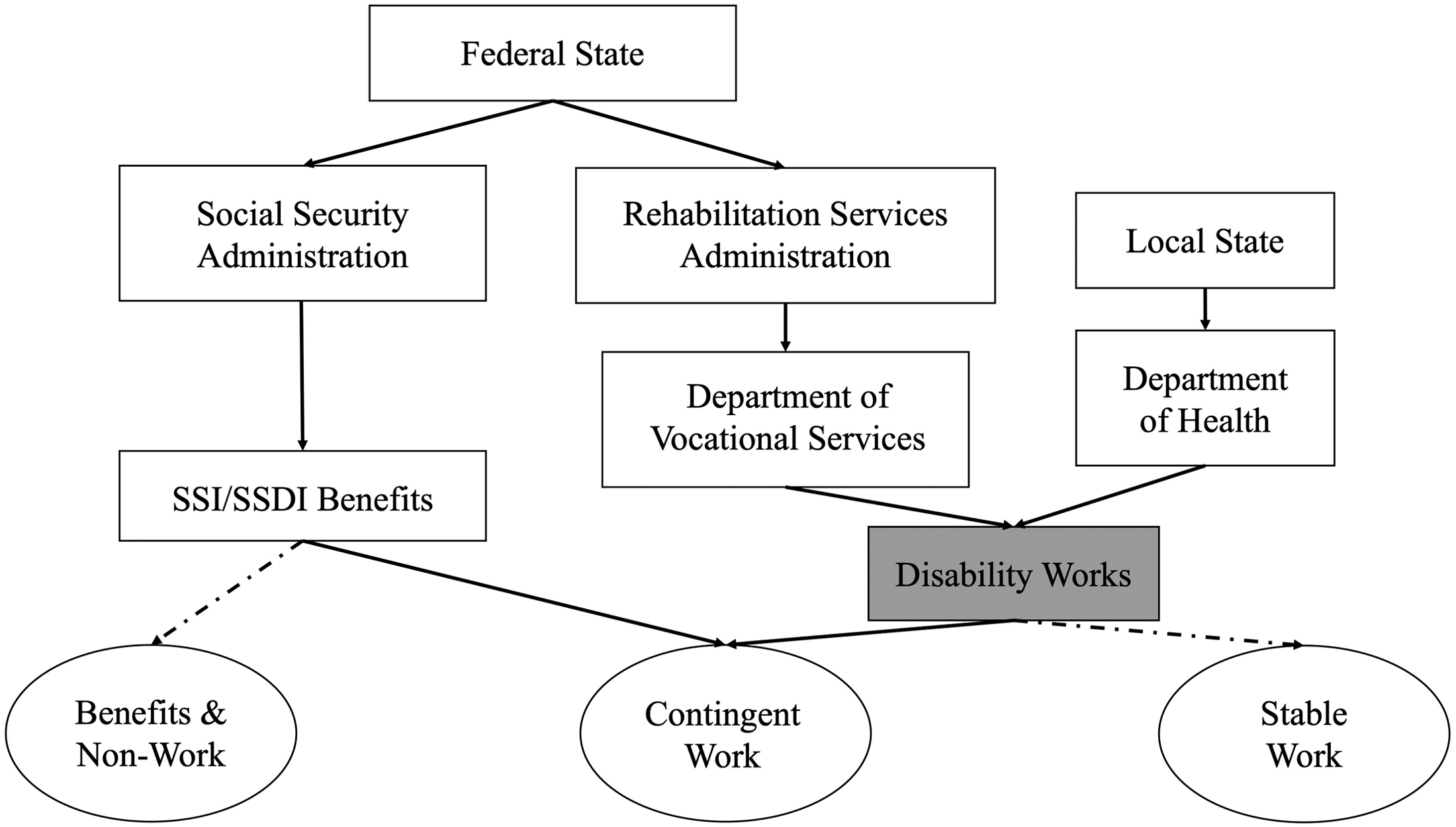
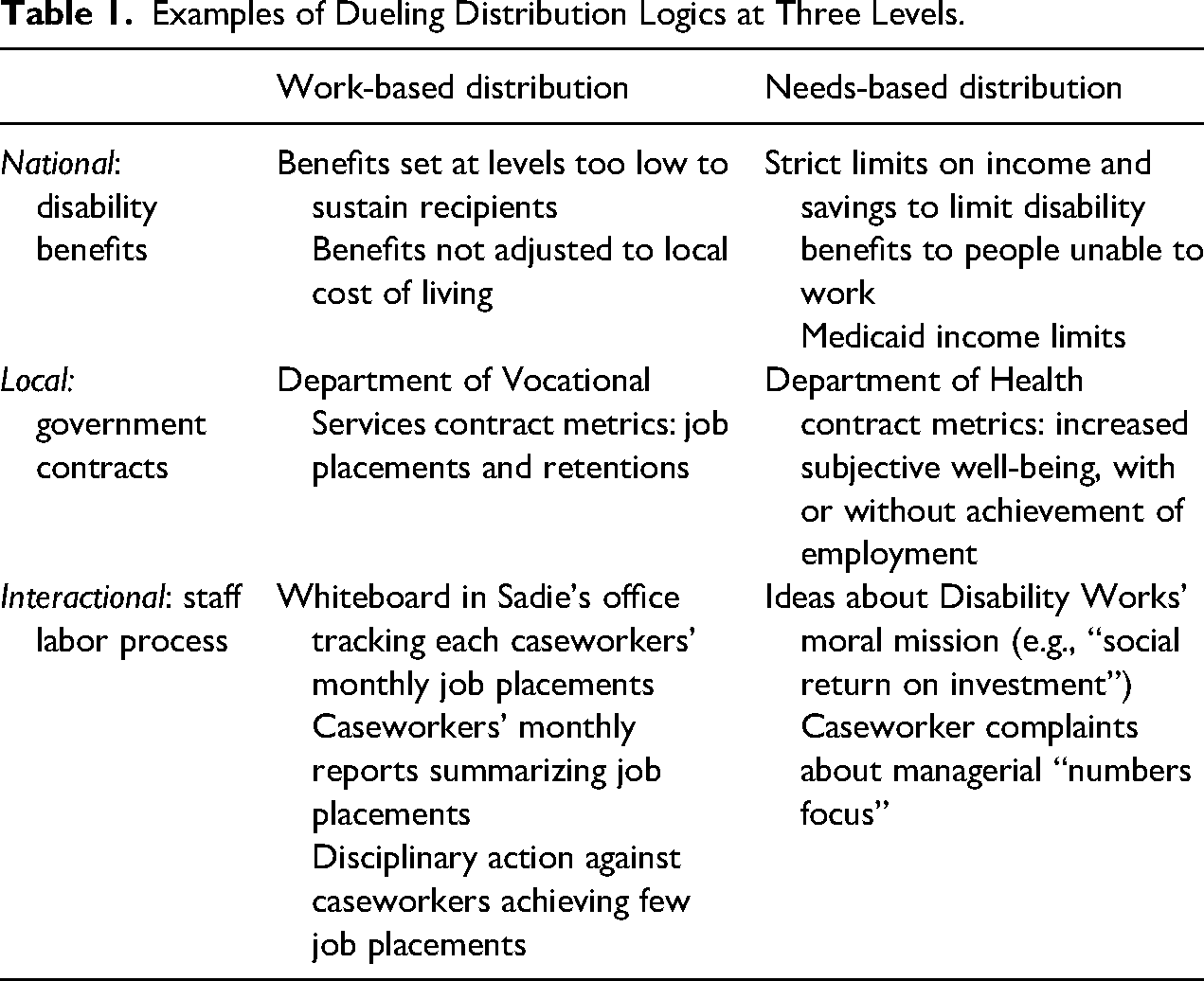
During fieldwork, contradictions at three levels emerged as mechanisms producing precarity. First, at the national level, the organization of federal disability benefits simultaneously incentivizes and disincentivizes work, a contradiction which guides benefits recipients into part-time, low-wage, and often temporary jobs. Second, at the local level, contracts with state and municipal agencies contain dueling logics of work- and needs-based distribution, motivating placement in temporary, in-house jobs as a provisional resolution of these contradictions. Third, at the interactional level, front-line staff and client-workers negotiate these structural pressures in varied ways, rhetorically mobilizing needs-based distribution logics to soften labor market pressures. Table 1 collects examples of these conflicting distribution logics, while Figure 1 maps their outcomes for client-workers. The next sections of this paper discuss welfare state contradictions at each of these three levels.
Disability works and the state.
Examples of Dueling Distribution Logics at Three Levels.
Contradictions of Disability Benefits
Welfare state benefits including Supplemental Security Income (SSI), Social Security Disability Insurance (SSDI), and Medicaid are designed to distribute resources on the basis of need, but eligibility restrictions and diminishing real value push many disabled people into the labor market, and specifically into low-wage, part-time, and often temporary jobs. SSI and SSDI aim to provide a safety net for disabled people whose embodied impairments make full-time work challenging (especially during periods of illness, as many disabled people's capacities fluctuate). Notably, not all disabled people are eligible for state benefits. Prior research documents significant obstacles to benefits access among people who self-identify as disabled (Dorfman, 2015, 2017; Grossman & Mullin, 2019). Therefore, while this paper's introduction discussed survey data identifying approximately 20% of the United States population as disabled, only a fraction of this population receives disability benefits. However, benefits merit analytic attention due to their importance for the welfare state construction of disability and control over people with disabilities (see Stone, 1984 as a key theoretical precedent).
Disability benefits offer relatively meagre resources. People eligible for benefits receive either SSI or SSDI, depending on work history, and on the rare occasions that they receive both it reduces the size of both payments. 4 As of March 2020, nearly 10 million Americans received SSDI, over 5 million received SSI, and nearly 3 million received both SSDI and SSI (SSA, 2020a). Individual SSI benefits were capped nationwide at $783 per month (SSA, 2020c). SSDI benefits vary based on individual earning history, but tend to be higher, averaging $1,258.67 per month (SSA, 2020b). In Disability Works’ home city, the median rent for a one-bedroom apartment surpassed $3,000, indicating the insufficiency of disability benefits for survival. Many client-workers told me that they sought job training because they could not make ends meet on benefits. However, wages must be reported to the Social Security Administration, and if monthly earnings exceed established caps, benefits can be reduced or withdrawn altogether. SSI recipients are also prohibited from holding more than $2,000 in savings at any given time. Disabled informants were highly concerned about exceeding these caps and losing the scant income that their benefits did provide. They needed to work to survive, but they sought and accepted marginal jobs in order to keep their earnings below a level which would affect their benefits.
Horror stories about benefit cuts were traded regularly among client-workers and staff. Courtney, who earned $900 per month in one of Disability Works’ in-house training programs, had her entire benefits check cut out of the blue and was told she owed the Social Security Administration an additional $1,300. Savanna, who was paid subminimum wages which fluctuated but rarely surpassed a few hundred dollars each month, lost her benefits check for one month and was told she owed an additional $40. When episodes like these occurred, neither client-workers nor the staff they spoke with were able to explain what change in their earnings had triggered benefit cuts, suggesting limited understanding among both groups of benefit regulations. While disability benefits specialists are available at the Department of Vocational Services, months-long waiting lists to meet with these specialists negate the value of their services; I did not meet a single client-worker who had worked with or even appeared aware of these specialists. Client-workers experience cuts to their benefits as random, and this apparent randomness keeps client-workers in a constant state of anxiety.
Since most client-workers rely on Medicaid, health insurance means-testing also serves a disciplinary function. Though income and savings limits for Medicaid are more generous than those for disability benefits, partially decoupling these benefits, disabled workers’ need for healthcare coverage makes it exceptionally dangerous for them to exceed earnings caps for Medicaid. Walter, whose temporary job had just ended at the time of this conversation, who did not receive SSI or SSDI benefits, and who characterized his finances as “very tight right now,” shared this anxiety with me directly. “I would like a full-time job just because you can earn more money, but the thing is, I have Medicaid and if it goes over $1,400 a month, then it gets discontinued. So, in order to get Medicaid, keep getting Medicaid, I have to get a part-time job … I take medicines [for schizophrenia] and they’re expensive, so with Medicaid I get them for free.” Josephine, who had bipolar disorder and had sought temporary work in Disability Works’ IT program because she could not survive on the disability benefits she received, described a similar dilemma: If I were to get a regular job, full-time, minimum-wage job, my life would be shit because I wouldn’t be able to pay for insurance, I wouldn’t be able to pay for my drugs … the psychiatrist that I see, [without Medicaid] it's like $35,000 a year just for the psychiatrist. There was a medication I was taking, oh my God, it's like a thousand dollars. It's unbelievable. Of course it makes you think, ‘Oh, God, I can’t lose this, because there's no way I could support that on my own’ … [To qualify for benefits] you have to be so impoverished but people are not in a position to be able to be that impoverished … People are just sort of caught between not poor enough, but you can’t earn enough to support yourself. I think it's just a nightmare for most people, actually.
A caseworker described Medicaid means-testing as one of the most significant obstacles that Disability Works faced: “A lot of clients are in a big crossroads of, ‘Okay, I want to work. I need to work’ … But if they do work, then their benefits are cut off. They may not be able to see their therapist. They may not be able to get their medication. But their part-time job doesn’t offer health insurance.” Because disabled people are uniquely reliant on quality, low-cost healthcare, and entry-level positions rarely offer the needed resources, disabled people may keep their work hours and wages low in order to avoid insurance coverage gaps.
These ethnographic findings are in line with prior work on the “benefits trap” as a mechanism keeping people with disabilities in poverty (Dorfman, 2015; Longmore, 2003; Newman, 2015; Olney & Lyle, 2011; Stapleton et al., 2006). In addition to employment in low-wage, part-time jobs, prior research shows that some disabled people manage benefits means-testing through work in the informal economy (Savin, 2019), a pattern I observed on occasion. Furthermore, fieldwork suggests that the casualizing effects of benefits means-testing may be especially pronounced in regions with a high cost of living, such as Disability Works’ home city, as disability benefit caps are not adjusted to cost of living. National flat caps on earnings leave people with disabilities uniquely vulnerable to gentrification or other shifts which increase the cost of living, yet excluded from local measures to ameliorate the effects of these shifts. For instance, when Disability Works’ home city increased its local minimum wage in response to the rising cost of living, staff reported that some client-workers requested hour or pay cuts in response to this increase lest higher wages endanger their benefits. As Jocelyn stated, “I would love to see the earnings [cap] increased in order for people to maintain benefits … Because it remains the same while wages go up, which, wages should go up, but as wages go up, the allowable earnings should go up.”
This catch-22 constitutes disabled people as a precarious labor force. Disability benefits are designed to support people whose embodied limitations make full-time work inaccessible, but in practice these benefits must be supplemented with paid work, especially for disabled people living in expensive areas. Yet strict earnings caps leave people with disabilities to populate the periphery of the labor market, as employment in stable, well-paying jobs may jeopardize benefits needed for survival. The organization of disability benefits thus undercuts the well-being of disabled people, but serves industries which rely upon a flexible, contingent labor force to increase their profits. This formulation of disability benefits as a functional subsidy to capital illustrates the state mobilization of disability categories in service of accumulation. It further illustrates that while disability benefits nominally manifest needs-based distribution logics, in practice, the low real value of these benefits forces many disabled people into the labor force. People with disabilities are thus caught between need- and work-based distribution systems, failed by both systems and pushed into precarious jobs on the fringes of the economy.
Contradictions of State Contracts
Disability Works’ contracts with the state come with conditions that exemplify the tension between work- and needs-based distribution logics and incentivize placement in temporary jobs. The most significant tensions arise between Disability Works’ work-oriented contract with the state Department of Vocational Services (DVS) and their health-oriented contracts with the municipal Department of Health (DoH). The DVS funds local employment programs statewide as a branch of the Rehabilitation Services Administration (RSA), a federal agency which funds DVS-like programs in every state. The RSA provides 80% of the DVS budget and exercises significant surveillance over the local DVS. The DVS contract mandates that Disability Works’ core team of caseworkers achieve a high number of annual placements and a moderate number of annual “retentions,” achieved when a client-worker remains in their job for 90 days. 5 By contrast, the municipal DoH operates much more autonomously and funds Disability Works’ in-house work programs. The DoH contracts do not require new job placements, but evaluate in-house work programs based on their “graduation rates” (the percent of each cohort that completes the six- or nine-month program) and client-workers’ responses to surveys about their well-being and professional development. Therefore, as these agencies’ names suggest, the Department of Health is oriented toward health and well-being, while the Department of Vocational Services is oriented toward work.
The DVS contract goals pervade daily practice and discourse. Every meeting with DVS staffers opened with a public recitation of each DVS-funded program's year-to-date progress toward their contract goals, and at some meetings, program managers or DVS staff distributed handouts tracking program progress toward these goals. Within Disability Works, Sadie, the job placement manager, kept a large whiteboard in her office tracking each caseworker's number of placements and retentions per month. As one top-performing caseworker, Dion, said of this whiteboard, That was my first position where I had any kind of metrics that I had to take into account for, you know. So it was hard at first … [The whiteboard], it's very stressful, you know. But for some people, if you’re competitive, then it's like, ‘Oh, I need to get on top or I need to be top three or something.’ I think I was that kind of person. Like I was very competitive. But I can see how it's also very stressful, right, because if you’re at the very bottom, it's like, ‘Well, what am I doing wrong?’
For these reasons, several caseworkers asked that this whiteboard be taken down, but it remained up for the duration of fieldwork. Sadie referred to this whiteboard in one-on-one meetings with caseworkers to discuss their rates relative to their colleagues’ rates and to their annual goals. Caseworkers produced monthly summaries for Sadie explaining whether they met their monthly placement goals and why or why not, and as I will describe later, caseworkers who fell behind were subject to discipline.
Contract goals are set at such a level that in order to approach the DVS benchmarks, employment programs must place clients extremely quickly and (if possible) achieve more than one placement per client per year, which leads to an organizational emphasis on temporary work. Client-workers who move from one temporary job to another can count double toward contract goals: as Dion said after his session with one such client-worker, “DVS will count any placement as long as it's with a different job. Doesn’t matter if it's contract, if it's part-time, if it's temporary, if it's permanent.” Therefore, the most efficient way to meet contract goals is to place client-workers in successive six- or nine-month in-house internships in Disability Works’ in-house training programs. The DVS produces annual public rankings of the top-placing programs, and Sadie identified Disability Works’ plethora of in-house temporary work programs as responsible for its high statewide ranking, explaining that rapid placements in external jobs would be comparatively more challenging. Indeed, one caseworker told me that she placed about 50% of her clients in in-house programs, while another estimated that he placed 70–80% of clients in in-house programs. The case management team thus facilitates churn between these programs, as in-house temporary placements are the most efficient way to meet placement benchmarks, yet less stable than permanent jobs.
Some caseworkers reported that the pressure to achieve rapid placements led them to push client-workers into temporary, low-wage, and potentially dissatisfying jobs. As Dion said in a later conversation, Because you kind of feel that pressure to place them and make those numbers, right. And so that may have equated into maybe not the best placement for that client. I could see that it would just equate to those trainees either quitting the job or being fired … So I think having those numbers kind of in the back of your head really does affect the quality of service … Sometimes it can be difficult to place someone, and then with deadlines looming, you just kind of look for the next best spot that's hiring anyone. So it might not be the best fit.
Caseworkers’ high caseloads and professional incentives mandate rapid job placements. By and large, temporary jobs tend to be more attainable than permanent jobs, low-wage jobs more attainable than living-wage jobs, and jobs at in-house work programs more attainable than community-based jobs, incentivizing placement in segregated, unstable, low-wage work.
However, the Department of Health contract goals motivate practices which diverge from the DVS goals. These goals are deemphasized relative to the DVS goals, but to the extent that they influence practices, the DoH goals encourage skill-building and wellness among client-workers and do not demand rapid movement into jobs. For example, staff in the IT program met weekly to discuss client-workers who might be facing obstacles to completion of internships (e.g., housing instability) and identify resources to offer these client-workers. In-house programs offer daily mindfulness meditation, worksheets and trainings in resilience, and connections to resources beyond Disability Works such as the aforementioned affordable housing resources. When one client-worker experienced a mental health crisis on the job, staff spent the entire day talking her through this crisis, and when this client-worker was later hospitalized for suicidal thoughts, staff called to offer their support. These practices frequently stabilize client-workers’ lives, subjectively if not objectively. However, the DoH contract goals may still contribute to the production of precarity in objective terms. Hiring managers in DoH-funded in-house programs prioritized client-workers already known to Disability Works, seeing their job performance as more predictable and their completion of internships as more probable, thus advancing progress toward contract goals. This reliance on “known quantities” may contribute to the production of a class of “permatemps,” as documented in Elcioglu's (2010) ethnography of a for-profit temp agency.
Staff provided conflicting explanations for the relationship between the case management team and the in-house work programs, which can be traced to the divergent aims of these programs’ funding agencies and which ultimately contribute to client-worker precarity. As I have indicated, in order to approach the DVS placement and retention benchmarks, caseworkers place many client-workers in consecutive temporary jobs in Disability Works’ in-house programs. These programs’ classification as legitimate placements were controversial: after decades of disability rights movement criticism of segregated disability employment programs, the DVS requires job placements to be in “competitive jobs” to count toward contract goals, so prior to fieldwork Disability Works banded together with a group of other disability employment programs to lobby the DVS to classify in-house work programs as competitive jobs. However, in contrast to the requirements of the DVS contract, in-house work programs’ contracts with the DoH are contingent on measures of client-worker well-being. As a result, work program supervisors framed their programs as “supported employment” for people unable to work in competitive jobs, thus justifying the need-based provision of mental health resources mandated by their contract with the state, while caseworkers and managers responsible for the DVS contract framed in-house programs as “competitive employment” to enable these placements to be counted toward their own contract goals. Staff responsible for the DVS contract consistently indicated that enrollment in case management services is meant to precede employment in in-house programs (with employment in these programs representing competitive job placements, the main DVS contract expectation), while work program supervisors consistently indicated that enrollment in case management services is meant to follow employment in in-house programs (with enrollment in case management services indicating personal growth and readiness for work, the main DoH contract expectation). In reality, client-workers moved back and forth between case management services and in-house work programs and often engaged with both at once, allowing both branches of the organization to claim success on their contract goals. Yet this back-and-forth destabilized client-workers’ lives by keeping them in successive temporary jobs rather than in permanent jobs.
These contradictions demonstrate that different hands of the state – the federally-funded Department of Vocational Services and the more autonomous local Department of Health – take different approaches to disability, with the former funneling disabled people into work-based distribution systems and the latter integrating work with healthcare provision in order to allocate resources on the basis of need. Disability Works staff recognized these contradictions within the welfare state: one manager told me that the DVS focuses on work while the DoH focuses on health, that the DoH is less influenced by statewide fiscal politics, and that the DoH accordingly demonstrates “more of an understanding” of the negative ramifications of quantifying placements and retentions. Disability Works’ partnerships with both state agencies demonstrates how the divergent mobilization of disability at higher levels of the state may fragment the ground-level practices of a single organization. It further demonstrates how caseworker-facilitated churn between temporary work programs smooths over these contradictions. Since this churn represents an unstable situation for client-workers, these contradictions in the contract goal system contribute to precarity, just as contradictions in the organization of disability benefits contribute to precarity.
Staff reported that the Department of Vocational Services contract was a more important driver of organizational practice than the Department of Health contracts, illustrating the comparative weight of work-based distribution over needs-based distribution for the neoliberal state. The DVS contract is worth more money than any given contract with the DoH and is scrutinized more closely by contract administrators. As Jocelyn told me, “So everything we do within Disability Works, regardless of funding, really comes down to the job placement goals … You’ve been in a lot of meetings and you hear us primarily talk about these two goals … We talk in lingo, contract lingo, a placement and a retention. So, everything we do in Disability Works is focused around the DVS goals. A placement and a retention.” Indeed, while the DVS contract goals were referenced almost every day, I rarely heard the DoH contract goals mentioned among staff. The importance of the DVS contract for day-to-day practices may reflect the comparative strength of state efforts to channel workers into the labor market in the contemporary United States.
Tensions between work- and needs-based distribution logics are replicated within funding agencies themselves, as one conflict at the Department of Vocational Services demonstrated. Every few months, Disability Works staffers gave a formal presentation to the local DVS. Midway through one presentation, a DVS staffer named Alexis reported working with a caseworker at another disability employment program who had a very high retention rate, which Alexis said she didn’t understand until she realized that this caseworker placed huge numbers of clients in temporary in-house programs. The two Disability Works presenters admitted that this practice is common. Alexis asked whether these temporary jobs ever fail to lead to a permanent job, and when the presenters said yes, Alexis began to berate them, insisting that it is wrong to file retentions if client-workers are employed in temporary jobs. Abashed, the presenters reminded the audience that DVS-funded programs had collectively agreed to these placement criteria and that other employment programs do the same thing. Alexis said yes, they do, and it is very problematic, launching into a story about a client-worker at another agency whose case was closed during a temporary job and who grew frustrated when she was unable to find a permanent job. Another DVS staffer stepped in to mediate: “I think if we didn’t have such large caseloads and [state capitol] didn’t care so much about if we got retentions, I would rather keep [client-worker cases] open … [state capitol] does want retentions.” This dispute made visible a phenomenon which daily practices tended to mask: the placement of client-workers in temporary jobs as a strategy to increase placements and retentions counted toward contract goals, not a practice necessarily serving client-workers’ needs. Alexis's intervention demonstrates that resistance to work-based distribution logics may come from any level, in this case from a DVS staffer. This episode shows that frontline DVS staff may acknowledge their work as at odds with the statewide DVS and the federal RSA, which demand high placement numbers even as staff know that these demands incentivize temporary placements and discontinuity in services.
Organizational Management of Contradiction
The state produces precarity through the internal contradictions of disability benefits and the contract goal system. Figure 1 presents relationships between agencies and how they motivate precarious placements. This figure and the data presented previously show that disciplinary power filters down from the federal government to state agencies to local government agencies to nonprofit managers to caseworkers to client-workers. At every level, needs-based distribution logics clash with work-based distribution logics. The following pages address these contradictions as an aspect of the labor process for staff and managers at Disability Works. Following Seim's (2017, 2020) labor theory of poverty governance, this treatment of front-line welfare state work as a labor process illuminates the consequences of this labor process for welfare recipients as well as front-line staff.
Staff struggled to reconcile Disability Works’ moral mission of needs-based service provision with the work-based distribution logics imposed by the contract goal system and the meagerness of disability benefits. Most staff saw themselves as aspiring mental health providers, in many cases working toward graduate education in social work, nursing, or other health and social services fields. Two caseworkers left the organization to pursue such degrees during my tenure. A few managers indeed held clinical degrees, though bachelor's degrees in psychology or related fields were more common among front-line workers. Alignment with managerial professionalism (for instance, via previous business experience) was less common, though seen among a few managers and one caseworker (Celina, discussed below, who ultimately left Disability Works for an HR position at a large corporation). Staff strove for lenience with client-workers, attempting to accommodate client-workers’ disabilities and regularly verbalizing their reluctance to push work upon client-workers who appeared hesitant about the job search process. These self-concepts as needs-based service providers emerged from staff shared professional experiences and socialization into Disability Works.
Tension between needs- and work-based distribution logics – the former more dominant among staff, the latter more dominant within higher-level welfare state agencies – produced organizational fragmentation. Caseworkers and managers criticized earnings caps on SSI/SSDI benefits and Medicaid, though they saw these caps as a fact of life and impossible to resist. Staff also called for balance between client-worker well-being and Disability Works’ contractual obligations. Sadie, the manager directly responsible for the DVS contract, was unequivocal when asked whether she must balance contract goals with other priorities: “Every minute of every day. It's every minute. This is every day, every minute.” As one illustration of the effects of welfare state contradictions, employee turnover was high across Disability Works, but appeared highest among workers whose roles forced them to confront the tension between needs- and work-based distribution. During eight months of fieldwork, over 80% of Disability Works’ core team of caseworkers left their jobs. The most senior caseworker had been employed for three years and recounted a crisis prior to fieldwork when half of the caseworkers left within a month. Many staff told me that they saw turnover as Disability Works’ biggest problem, encouraging me to investigate. Turnover in social services has many plausible causes; prior research emphasizes factors including emotional exhaustion and low wages (Morse et al., 2012; Paris & Hoge, 2010). However, staffers who came into less direct contact with these contradictions in the welfare state (such as work program supervisors) appeared to stay longer.
Some caseworkers acquiesced to the work-based distribution logics of SSI/SSDI benefits and the contract goal system, while others resisted. While most caseworkers fell between these extremes, the divergence between the caseworker whom Sadie identified as the job placement team's top performer (Celina) and the caseworkers whom she identified as its lowest performers (Cole and Tabitha) is illustrative. Celina maintained the team's highest placement rate and used this status to advocate for a raise. Yet Celina emphasized placement to such a degree that another caseworker expressed private concern to Sadie about assigning a significantly disabled client to Celina for fear she would immediately close the case, seeing the client's needs as too time-consuming to be worthwhile. When another client-worker received a job offer he felt reluctant to take, as he believed the job would not permit time off for psychiatric appointments, Celina rushed him into accepting the job that day. She further instructed this client-worker not to disclose disability or request any accommodations, as she feared that disclosure might jeopardize the placement. On the flip side, Cole deprioritized contract goals: I feel like if I think about the numbers too much, it feels more about being very formal about it, like walking a dog, keep them on a leash kind of thing … Because if I have to meet the numbers and I have to make sure this client gets the job, I’m just gonna toss them at any job, and that's not what I want for them and I’m sure that's not what they want. There have been some clients who’ll take any job, that's perfectly fine and normal, but the majority of them, I don’t want to just toss them to the wolves … if I had a manager that just focused on the numbers, which none of my managers have ever done that, and they just asked me to make sure my clients had a job by the end of the month, I know that my thought process would be like, ‘Okay, hey, Joe Schmoe, let's just apply to this job ‘cause you’ll get it for sure’ … DVS thinks they’re great ‘cause they still have the job, numbers-wise, like statistically, if you look at it that way, they seem fine … Those are the ones I feel like we might have – not failed, but disappointed them in terms being able to provide what I think would be the best service.
In contrast to Celina, Cole asked client-workers whether they wished to disclose disability or seek accommodations and discussed the pros and cons of both approaches with them. Tabitha told me that different caseworkers prioritized different things, but she herself prioritized “worker's rights.” She positioned these priorities in opposition to what she termed management's “numbers focus.” When searching for jobs for client-workers, Tabitha named unionization as her primary criterion and listed secondary criteria including high wages, healthcare benefits, consistent shift scheduling practices, and anti-discrimination policies.
As a result of these caseworkers’ divergent approaches, Celina achieved nearly twice as many placements as Cole and more than twice as many as Tabitha in the fiscal year preceding fieldwork. Both Tabitha and Cole were subject to managerial discipline: managers held more regular one-on-one meetings with them than with other caseworkers to monitor their practices, Cole was given assignments between meetings that managers hoped would boost his placement statistics, and Tabitha's requests for schedule flexibility were denied because managers did not trust her priorities. At one point, managers considered demoting Tabitha to a more junior caseworker position with a lower annual salary. Yet Tabitha and Cole's employment appeared secure overall, suggesting a wide range of permissible approaches among caseworkers. In the excerpt above from Cole's interview, he emphasized that none of his managers have reduced his job to the numbers. Indeed, Jocelyn counseled Sadie to value caseworkers’ divergent priorities, suggesting that each caseworker's organizational contribution need not be identical.
Jocelyn, the program director, maintained a critical stance on economic pressures in the employment programs industry. Caseworkers appreciated her critique, and in private conversations, often indicated that Jocelyn's moral orientation was one of their favorite things about the organization. As I negotiated ethnographic access, Jocelyn stated repeatedly that she hoped an ethnography of Disability Works would help funders see that Disability Works’ services went beyond what could be measured quantitatively. She termed these effects “social return on investment.” As she explained, I’m talking about the long-term impact on somebody changing their life, getting their life back, having a purpose. Not just somebody who's now earning and paying taxes. Because that's what so many people think. ‘Okay, well, we’re gonna help people get jobs and it helps the economy because they go from sitting on their sofa watching TV to paying taxes.’ I’m not talking about somebody paying taxes. I’m talking about somebody having a more meaningful life … So [starts to cry; voice cracking] we’re giving people a purpose. We’re helping people make their lives more meaningful and fulfilled. And [pause, crying] there's so much more to any dollar that we’re given by the government that is not measured because of just helping people get back to work. And we’re not measuring that … It's just not being measured [still crying].
Jocelyn's strong emotion demonstrates her commitment to Disability Works’ moral mission in the face of countervailing logics. She resented any effort to reduce Disability Works’ services to economics (“I’m not talking about somebody paying taxes, I’m talking about somebody having a more meaningful life”). Managers used “social return on investment” to indicate the overall well-being and fulfillment that they believed client-workers attained through Disability Works’ services, whether or not these client-workers found work and regardless of the industries or jobs that they were hired into.
In some instances, these moral logics motivated resistance against the production of precarity. From a pure contract perspective, permanent placements technically go against Disability Works’ interests, as client-workers placed in permanent jobs depart the agency and cannot be relied upon to boost subsequent placement numbers. Yet permanent placements were viewed as the crowning accomplishment of Disability Works’ mission and met with universal celebration. I never saw these placements mourned, as described in ethnographies of traditional temp agencies (Elcioglu, 2010). Additionally, when client-workers in temporary work programs sought external jobs without first enrolling in case management services, these jobs did not count toward Disability Works’ placement goals, yet staff respected these job searches and admired corresponding successes. For instance, when one client-worker in the warehouse training program found a permanent job that would not boost Disability Works’ placement statistics (because she had been hired before enrolling in case management services), the good news brought Jocelyn to tears. Following this news, Jocelyn indicated to another staffer that for some client-workers, a rapid job search without enrollment in case management services may even be a superior option. This response demonstrates caseworkers and managers’ deeply-held desires to lift client-workers out of poverty through stable work at a living wage, despite the countervailing pressures of the contract system and the disability benefits system.
These moral logics postpone but do not resolve the contradictions under which Disability Works operates. In our first conversation, Jocelyn described Disability Works’ approach as follows: “It's not always just focusing on work, work, work, but work being a part of making your life whole.” This claim counters the harsher work-based distribution logics of the DVS contract and poverty-level disability benefits. However, sans broader measures to guarantee the material stability of people with disabilities (e.g., universal basic income, affordable housing, or the provision of disability accommodations in stable, living-wage jobs), this rhetoric can only go so far. The weakness of the United States’ needs-based distribution system relative to its work-based distribution system undercut staff efforts to meet client-workers’ needs. Tensions between labor market pressures and Disability Works’ moral mission of health service provision stemmed from external sources, so they could not be wholly resolved within Disability Works. Instead they produced and reproduced the intrinsic contradiction between Disability Works’ operation as a mental health organization and its operation as a labor market intermediary. Disability Works’ emphasis on social return on investment did not resolve tensions in the state management of disability, but masked these tensions.
Client-Worker Outcomes
In the end, despite staff attempts to soften vertical pressures from work-oriented branches of the welfare state, the linked contradictions of disability benefits means-testing and the contract goal system led most client-workers to cycle through one temporary, low-wage job after another. Savanna, who had schizophrenia, worked in Disability Works’ warehouse for seven months before seeking work in the retail industry. She had first been hired into this warehouse program in 2001, then spent the intervening two decades cycling through temporary work programs in Disability Works, temporary jobs in other disability employment programs, and periods of unpaid care work. Walter, the client-worker concerned about losing access to Medicaid, had worked with a Disability Works caseworker for approximately two years. Over these years, he had completed a temporary stint working at a baseball stadium and two clerical internships with Disability Works, and at the time of our interview his caseworker was advising him to apply for further temporary jobs. Yet he told me, “I always wanted to get a permanent job. Just ‘cause I’ll be worrying about, you know, it's gonna end soon. And my past internship and this one just finished, they were for nine months.” Indeed, though this pattern was not universal, I witnessed several caseworkers encourage client-workers to apply for temporary jobs even when client-workers stated a preference for permanent work. In the vignette which opened this paper, Andrea reported 100 temporary jobs over her lifetime and dismissed the “dead-end jobs” she and her friends had obtained through Disability Works’ services. Some client-workers did obtain permanent jobs – including Andrea herself after the completion of a nine-month internship, though this job paid minimum wage and had an unstable schedule – but most available work remained low-paying and precarious. The churn of low-wage work represents the regular pattern of most client-workers’ lives and stems from dueling work- and needs-based distribution logics.
Disability Works did not maintain systematic data on the industries client-workers entered, but their training programs were oriented toward the service sector and most client-workers who found work beyond the organization entered service-sector jobs. Food service and janitorial work appeared as particularly common outcomes, although white-collar service work also emerged as a consistent outcome, with a number of informants (particularly those with college degrees) taking jobs as receptionists or administrative assistants. As in-house training programs frequently placed client-workers in other welfare state agencies focused on mental health, some client-workers found long-term work within the welfare state. Disability Works’ warehouse program represented an exception to their emphasis on the service sector, but most client-workers who completed stints in the warehouse program (which capped employment tenure at one year) entered service-sector training programs or service-sector jobs afterwards. I did not meet anyone who moved from this in-house training program into warehouse work outside of Disability Works. Indeed, managers indicated to me that the warehouse program had been much larger during the 1990s, but as contracts dried up, they placed increasing emphasis on the service-sector programs which acquired and maintained more consistent contracts with external partners. This job placement pattern reflects the growth of the service sector over the last several decades and clustering in this sector of the low-wage, part-time, temporary jobs incentivized by disability benefits and the contract goal system (Dwyer, 2013).
Discussion
Intrinsic contradictions fragment disability employment programming in the United States, as summarized in Table 1. SSI, SSDI, and Medicaid are founded on needs-based logics of social provision, which mandate the no-strings-attached delivery of resources to people deemed unable to work. Yet in practice, benefits are set at such a level that they do not meet the material needs of people with disabilities, forcing them into low-wage labor markets. The Department of Vocational Services and other state agencies funded by the federal Rehabilitation Services Administration are founded on work-based logics of social provision, so they focus on the integration of disabled people into the labor market and demand rapid job placements, including placements in temporary jobs. However, local funding agencies such as the Department of Health treat job training as a social or even medical service, prioritizing client-workers’ socioemotional needs over their workforce integration. Many staff share this needs-based approach, though some adopt a stronger orientation toward work in line with the DVS contract. State agents thus engage in contradictory practices, some of which push disabled people into the low-wage labor force, others of which seek to protect them from the traumatizing and impoverishing effects of labor markets.
In the contemporary United States, welfare state contradictions produce disabled workers as a precarious labor force, a process summarized in Figure 1. Disability marks client-workers as simultaneously suited for work- and needs-based distribution, producing internal contradictions within state-funded disability employment programs. Employment programs channel client-workers into temporary, part-time, low-wage jobs as a provisional resolution of this tension. At the level of disability benefits, employment in part-time, low-wage work enables client-workers to supplement their meager benefits with wages (work-based distribution) while maintaining some access to these benefits (needs-based distribution). At the level of contract goals, employment in temporary, low-wage, in-house programs enables Disability Works to maintain support from the federally-funded Department of Vocational Services (which promotes work-based distribution) and local mental health agencies (which promote need-based distribution). At the organizational level, struggles ensue over resource distribution logics, producing turnover among staff and churn between temporary jobs among client-workers. The tension between work- and needs-based distribution, central to the welfare state management of disability and replicated at multiple levels, thus directly contributes to the neoliberal production of precarity. Disability emerges as an important tool of poverty governance.
Who benefits from the contradictory state mobilization of disability categories? In the long run, capitalists stand to benefit, though they have not been an empirical focus of this paper. Disability Works operates as a nonprofit, so the in-house labor of client-workers does not contribute directly to corporate profits. However, the constitution of disabled workers as a precarious labor force may supply capital with a vast pool of workers who will accept the contingent, poorly-paid positions characteristic of economic restructuring since the 1970s. In particular, they supply companies with a pool of workers for the front-line service-sector jobs amassing over the last several decades. As many client-workers are hired by other welfare state agencies, they further enable state austerity measures, replacing unionized, better-paid workers in more stable jobs with temporary, poorly-paid, non-union “interns” and “floaters.” This project focuses on an early phase of this labor supply chain, the initial interpellation of disabled workers by the state. Future research should investigate later phases of this labor supply chain, such as disabled workers’ experiences of precarious work in for-profit companies. Based on findings presented in this paper, the state use of disability to regulate the labor supply may generate long-term profits for these companies. The contradictory state mobilization of disability may thus contribute to twenty-first century accumulation projects.
Conclusion
These findings extend the materialist model of disability and test its predictions about the neoliberal welfare state. First, they align with Russell's description of disability as “an important boundary category through which persons [are] allocated to either the work-based or needs-based system of distribution” (2019, p. 17; see also Stone, 1984). Some state institutions use the category of disability to guide needs-based distribution, other state institutions use the category of disability to produce a contingent labor force, and some – including Disability Works – do both at once. State responses to disability thus exemplify the contradictions of the welfare state mapped in the vast literature on the multiplexity of the state (Fairbanks, 2009; Haney, 1996; Morgan & Orloff, 2017; Wacquant, 2016; Zacka, 2017). Yet in contrast to Russell (1998, 2019) and Stone's (1984) theorizations of disability, this fieldwork demonstrates that disability employment policy and programming do not resolve the tension between work- and needs-based distribution, but manifest this tension. Contemporary policymakers and practitioners shuffle disabled people into work- and needs-based distribution systems simultaneously – in a larger historical sense, but also in some episodes from this fieldwork, in real time – thus limiting their access to both. This finding contributes to sociological understandings of the state across concrete institutional contexts. It demonstrates the value of ethnographic work on disability labor politics, as a supplement to the more extensive literature on the national legislature and courts.
The employment precarity observed among client-workers fulfills predictions of materialist disability theorists that disability stigma produces a supply of contingent workers under neoliberalism (Mitchell & Snyder, 2015; Russell, 1998, 2019; Soldatic, 2018). Journalists, activists, and humanistic disability theorists have speculated about disability as a category producing precarity under neoliberalism, yet these hypotheses had not received adequate empirical evaluation prior to the present study. Therefore, this paper refines the materialist model of disability by testing its claims about neoliberalism and specifying the role of the state. In particular, this paper specifies mechanisms in the production of precarity which prior literature had not identified, registering precarious placements as a provisional resolution of contradictions in the front-line labor process. This ethnographic analysis contrasts to the tacit assumption of materialist disability theory that the production of precarity results from the conscious designs of policymakers (see especially Russell, 2019). Indeed, in some ways precarity might be viewed as a partial unanticipated outcome of the disability rights movement's emphasis on economic self-sufficiency (Bagenstos, 2009; Pettinicchio, 2019), as some scholars suggest that this emphasis has weakened social provision and driven investments in DVS-like agencies (Bagenstos, 2009). As a case study of a single employment program, this study remains agnostic on the level of intentional coordination among higher-level state-decision makers involved in this production of precarity.
This paper supports the overall conceptualization of the welfare state in the poverty governance literature, while diverging on the specific function of disability for the neoliberal welfare state. Findings demonstrate limitations of the “deserving” versus “undeserving” poor distinction as a heuristic for welfare state practices. While disability may indicate deservingness within national discourse (Katz, 1989; Steensland, 2006), at the front lines of the welfare state, tensions between needs- and work-based distribution systems contribute to casualization among disabled workers. Research on the medicalization of poverty governance shows how classification as disabled grants access to resources such as SSI/DI benefits and RSA services (Hansen et al., 2014; Wong, 2016), but this paper demonstrates the insufficiency of cash assistance and shows that welfare state agencies shuffle even people with disabilities into the labor market. The treatment of people with disabilities, the supposed “deserving” poor, is not so different from the treatment of the “undeserving” poor. Following predictions of the poverty governance literature (Fairbanks, 2009; Hatton, 2020; Morgan & Campbell, 2011; Smith et al., 2005; Soss et al., 2011; Van Oort, 2015), governance is carried out through contradiction-laden partnerships between state agencies and private organizations. Specifically, honing in on the labor process of front-line staff (Seim, 2017, 2020) reveals that staff place client-workers in precarious jobs as a provisional reconciliation of conflicting vertical pressures. These findings demonstrate the utility of analytic synthesis of the materialist model of disability and the poverty governance literature, and they encourage future work within this research program.
As a case study of a single front-line organization, this paper is not able to evaluate whether the state production of precarity in disability employment programs is intentional. Are these precarious placements an unanticipated outcome of uncoordinated decisions by legislators, administrators, and others within the SSA, RSA, and other local and federal agencies, or have these state agents engaged in conscious, coordinated decision-making to produce this supply of contingent labor suited to the needs of capital? An ethnography of a single site cannot adjudicate between these possibilities. Instead, future historical institutionalist research might trace the logics guiding SSA, RSA, or other agency regulations over time. For instance, how have disability benefits fallen so low below livability alongside the strict maintenance of work restrictions? How does the RSA set contract goals, and how do RSA administrators interpret the precarious placements which tend to result from these contract goals? This ethnography suggests that some organizational tensions may be replicated at higher levels of the welfare state (for example, conflicts within the DVS shows that administrators disagree about the valence of rapid placements in temporary jobs). However, these questions merit future research using methods suited to the study of legislative and administrative decision-making over time. This research program may further illuminate connections between disability and the dynamics of capitalism.
Footnotes
Acknowledgments
While I am unable to thank research participants by name, I am indebted to all of the client-workers and staff at Disability Works who shared their work and lives with me over the course of my fieldwork. Additionally, I thank Carmen Brick, Michael Burawoy, Tessa Cookmeyer, Alinaya Fabros, Shannon Ikebe, Andrew Jaeger, Armando Lara-Millán, Cristina Mora, Tyler Leeds, Dhurata Osmani, Sarah Payne, Kelly Quinn, Ángel Ross, Leslie Salzinger, Sue Schweik, Mary Shi, Kim Voss, Paula Winicki, and workshop participants at the Center for Culture, Organizations, and Politics for feedback on previous drafts of this paper. I also thank three anonymous reviewers at Work and Occupations for their valuable suggestions. This research was funded by the Berkeley Social Justice Fellowship and a Berkeley Graduate Division Summer Research Grant.
Declaration of Conflicting Interests
The author(s) declared no potential conflicts of interest with respect to the research, authorship, and/or publication of this article.
Funding
The author(s) disclosed receipt of the following financial support for the research, authorship, and/or publication of this article: This work was supported by the Berkeley Social Justice Fellowship and a Berkeley Graduate Division Summer Research Grant.
