




Abstract
Drawing on my experience as a teaching assistant (TA), I expand on Michael Lipsky's concept of the street-level bureaucrat by focusing on how an agency's construction of the client shapes the work of the bureaucrat. I call this selective recognition. The university classifies students into three types: the archetypal student for whom the university is designed, the partially recognized student who receives accommodations, and the unrecognized student with responsibilities that make learning difficult. The result is an adaptation of the TA's three dimensions of the labor process: teaching, administration, and care work. The labor contract stipulates the first and a modicum of the second but not the third. Changing student demographics have increased all dimensions of TA labor, especially administrative tasks and the amount of invisible care work performed. The extractive university relies on this invisible and often overextended labor to dampen and conceal the reality of its own failing mission.
Nathan (2005, p. 147) explains that the undergraduate experience is “a liminal communal space where students…explore their identities, wrestle with their parents’ world, and wonder about their future.” Nathan employs the term liminal in the anthropological sense, a time of ambiguity when students no longer hold their pre-rite identity and are actively constructing their post-rite selves. To be an undergraduate is to undergo a rite of passage. Nathan argues that this liminal moment in a student's life “contains the seeds of enormous creativity and, indeed, of wider social change” (2005, p. 147). In its ideal form, the university provides students with a transcendent experience that can positively construct their own understanding of self and of the world, while simultaneously impacting the social fabric of that world. This is the social mission of the university—a mission that is implicitly known but seldom explored.
This, however, was not the case for me. As a Colombian immigrant with a complicated immigration case, I did not qualify for any type of financial aid, including private or public loans. I commuted my first quarter at UCLA and then moved into the nearby housing cooperative. In addition to the 4 hours of weekly chores I needed to perform at the cooperative, I worked as a tutor at a high school in South Central LA and at a call center near campus attempting to convince alumni to donate money to the university. In addition to these responsibilities, I enrolled in four classes each quarter to finish my bachelor's degree within a two-and-a-half-year self-imposed deadline. The key determinant of this deadline was the amount of tuition money my parents and I had saved, in addition to funds a generous group of UCLA alumni raised after the Alumni Association rescinded a scholarship due to my immigration status. My college experience cemented existing inequalities and a sense of alienation as I balanced the various responsibilities and stressors of a race against a dwindling savings account. I clearly remember driving to work as my car's gas gauge was nearing empty. I stopped at a nearby gas station just to have my debit card declined due to insufficient funds. When securing basic necessities is an everyday struggle, exploring my identity and building a better understanding of the world became the least of my priorities.
More than a decade later, as a teaching assistant (TA) in the Sociology department at UC Berkeley, I witnessed a retelling of my undergraduate experience in my students’ lives. This time, however, I found that beyond my students’ socioeconomic conditions, the university played a role in curating the undergraduate experience which actively influenced my ability to provide them with an equitable education. The ubiquity of these stories and my limited ability as a TA to support these students’ learning pointed to a more fundamental systemic crisis within the university.
In this paper, I expand on Michael Lipsky's concept of the street-level bureaucrat by focusing on how an agency's construction of the client shapes the work of the bureaucrat. I show how the university's recognition of its student body can enable or hinder the role of the teacher. I refer to this process as selective recognition, 1 leading the university to push the burden of teaching and the consequences of inadequately funded support programs onto some of its most vulnerable street-level educators.
TAs: Street-Level Educators in Higher Education
Lipsky's (1983) identification of street-level bureaucrats allows us to classify TAs as street-level educators. TAs interact with students on behalf of a bureaucracy (the university) and carry out most of the face-to-face teaching hours. We have substantial discretion. Largely unsupervised, TAs decide how to guide students through class discussions (Germain, this issue), give them the tools to understand complicated readings, and follow class lectures, cultivating critical thought. TAs also experience certain limitations, including the instructor's course design, managerial style (see Pasquinelli, this issue), and university and departmental policies, procedures, and deadlines.
A TA's work process involves a seemingly mundane set of dimensions: teaching, administrative, and care work. Some teaching and administration tasks are established in the collective bargaining agreement (CBA) our union negotiated. 2 Tasks associated with caring for and supporting students are often invisible and are relatively unknown to most instructors and administrators alike. Yet, they are the greatest source of unpredictability and variability in our labor process, where we are the most limited and have the most impact on our attempt to carry out and support the social mission of the university.
Teaching is primarily composed of two tasks: lesson planning and implementation. To plan lessons, we must attend weekly lectures and cover assigned readings. TAs do not usually teach the same class every semester, and if they do, the class content typically changes between instructors. TAs are often one reading ahead of their students. Aside from some classical texts, many of the readings in a class syllabus are new to TAs or are being presented to students through a new analytical lens that we must quickly master. Lesson preparation also requires deciding the best approach to making presentations to our section (e.g., PowerPoints, handouts, in-class activities, and group exercises). Although planning is crucial, implementing lessons as designed requires certain cooperation from our students outside of our control. Therefore, teaching also comes with a level of flexibility and reactivity to our students’ needs and their presence in our classroom.
TAs’ administrative work includes tracking section attendance and participation, answering emails related to class policies (e.g., extensions, attendance, grades, and other academic concerns) and class content, and supporting instructors with the everyday tasks involved in running the course. We must grade assignments and exams and provide instructors with final grades; meet weekly with instructors; update, maintain, and troubleshoot issues with the class website; and, as a result of the pandemic, TAs are often responsible for managing Zoom to support hybrid instruction for students exposed to or sick with the COVID-19 virus.
Care work is the third dimension of our position as TAs. It presents the largest variability within our day-to-day labor process, it is closely tied to the type of recognition the university confers on students and has deep emotional ramifications. Lipsky argues that a helping orientation of street-level bureaucrats is incompatible with the work required and does not dwell on the importance of care work, specifically when it comes to teachers (Lipsky, 1983, p. 72–75). Yet, “there is more than intellectual growth at stake in the teaching enterprise” (Noddings, 1988, p. 221). Care work in education requires tasks that are heterogeneous, emotionally intense, person-specific, and with qualities that are difficult to measure and monitor. The analysis of care work in education has deep roots in feminist and ethnic studies scholarship. These scholars have found that care is the cornerstone for developing moral citizens and transcending the structural barriers prone to replicating existing inequalities within society (Hooks, 1994; Noddings, 1984, 1988). This type of work, however, often leads to burnout, can be penalized as outside the purview of academia and is disproportionately performed by scholars of color (Cardozo, 2017; Castañeda & Isgro, 2013; Zambrana, 2018).
Similar to nursing, one of the key qualities of care work in teaching is its invisibility. For nurses, for example, feeding a patient requires the execution of a series of carefully orchestrated tasks with a tacit understanding of a patient's needs that only comes from years of experience. These additional tasks, such as knowing how to joke with a resistant patient to coax them into eating their breakfast, are unaccounted for in a patient's chart as part of the day-to-day work or as a skillset, one must develop (Diamond, 1992, p.133). TAs must also complete invisible tasks to accomplish the goal of teaching. Although the CBA recognizes holding weekly office hours and providing one-on-one or group tutoring, this is only a narrow understanding of this type of work. Many of the administrative and teaching tasks associated with classroom interaction require prior interventions that relate to care work. In addition, as one of the few members of the university community students sees on a day-to-day basis, students reach out to TAs for advice on personal and professional matters. This includes helping navigate friendships and familial relationships, mentoring students through future endeavors and career choices, and even providing letters of recommendation (co-written with or written for professors). The invisibility and disparity of care work provision in education became even more pronounced during the COVID-19 pandemic (Berheide et al., 2022). As Lopez (2006) argues for nurses, the failure to recognize care work as a key dimension of a TA's work affects how we experience this aspect of the work and results in a wide variety of responses.
For Lipsky (1983, p. 59), the client exists in punctuated social interaction with the bureaucrat, trivializing the impact the bureaucracy has in defining, sorting, and managing the conscription of the individual as a client. Korczynski (2009) has highlighted the importance of introducing the general qualities and characteristics of the client in the analysis of service-oriented bureaucracies. Other studies underscore the role of street-level bureaucrats as gatekeepers in various contexts, discriminating against clients based on their own biases, emotional involvement, and societal prejudices, especially along with the lines of race and gender (Bosk, 2020; Volckmar-Eeg & Vassenden, 2022). In some bureaucratic systems, as shown in Seim's (2017) research on ambulance workers, front-line workers sort and refer clients, or burden shuffle, to the appropriate organization based on their needs. However, these studies do not explore the consequences of the built-in biases within bureaucratic organizations and their processes to designate who is a client and what types of concessions and benefits those clients may receive.
In the case of street-level educators, the conception of students prior to interacting with them is critical to our work and largely out of our control. We select the sections that better fit our schedules, unaware of the demographic composition of each section. Therefore, when our classrooms are composed of students with various constraints and limitations, we must respond to their needs, with no ability to burden shuffle. Even if TAs are able to refer students to a program within the university, these programs rarely translate to pedagogical accommodations and, as I will show, they inadequately address the nature of their needs in the classroom. Similarly, none of the classifications, such as “first-generation,” “undocumented/AB 540,” or “commuting students,” used to understand the composition of the undergraduate student population translate to actionable guidance for our labor process.
Selective Recognition
Although the concept of selective recognition arises from my own experiences as a student and TA, its theoretical foundation can be traced to Pierre Bourdieu's conceptualization of identities within the state. In Identity and Representation, Bourdieu (1992, p. 222) argues that “the state takes a small subset of all socially recognized lines of difference” and, in effect, “sanctions them, sanctifies them, consecrates them, making them worthy of existing, in conformity with the nature of things, and thus ‘natural’.” Through this process of selective recognition, the institutions that state develop aim to represent and benefit those identities deemed as “natural.” The “unnaturals,” and anyone interacting with them, must bear the consequences of social structures that partially or incompletely identify these individuals.
The historical context that produced these social divisions frames the impact of selective recognition on a TA's work process. Although the classic American college culture arose from the elite male experience (Nathan, 2005, pg. 107), in the last half-century access has been expanded to a wider demographic population (Burawoy et al. this issue). This broader access has not been accompanied by corresponding changes in the operation and elite culture of the American public university to accommodate new types of students. Recent studies on the university experience portray its institution and infrastructure as catering to the specific needs of students from socially dominant groups (Arum, 2011; Armstrong & Hamilton, 2015; Scherer, 2020; Newfield, 2023) and using white cultural values to normalize the expectations of students’ performance (Ayala & Contreras, 2019; Yosso, 2005).
Using selective recognition, students can be classified into three types: the archetype, the partially recognized, and the unrecognized. I deploy these categories as a heuristic device to demonstrate how the university's conception of the student deeply affects the work TAs do in the classroom. These classifications “ideal types” provide a guide to the spectrum of students TAs encounter in their classroom. The archetype is the student the university has sanctified and consecrated as “natural”—a financially stable student, with little to no responsibilities outside of school, with the cultural capital to seamlessly navigate the institution. The archetype seldomly affects the role of the TA beyond the tasks specified and agreed to in the CBA. When students hold identities recognized by the university, such as student–athletes and DSP–students 3 , TAs must take on additional responsibilities that resemble the work of a private tutor. Finally, unrecognized students (i.e., student–workers, students that are primary caretakers, and undocumented students) are those students the university does not seem to identify as requiring additional accommodations and their needs are often left unaddressed. These unrecognized students must navigate some form of precarity while facing a seemingly insurmountable uphill battle to meet the basic expectations of attaining a degree. With unrecognized students, TAs may make the decision to become care workers, knowing that the emotional labor involved will not be recognized, effectively invisible to all but the individual student and TA.
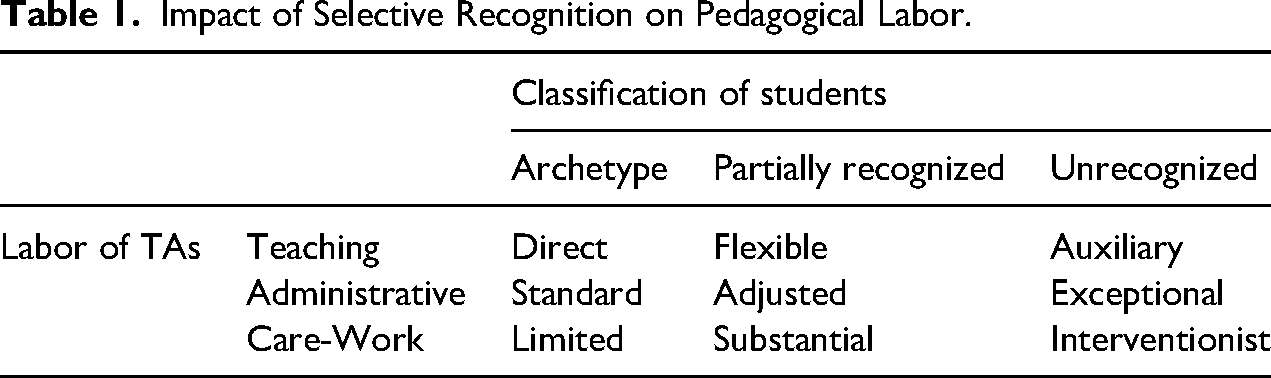
In Table 1, I outline the impact of selective recognition on the three types of TA labor—teaching, administration, and care work. In the sections that follow, I introduce the types of students with a brief description of their typical experience in the university. I then detail how the classifications limit and/or enable the three dimensions of our labor.
Impact of Selective Recognition on Pedagogical Labor.
The Archetype and the Contractual TA
The archetype needs little introduction. The experience of this type of student is thought to be ubiquitous, but it is only so in the minds and rules of university administrators. These students experience the university as it was designed to be experienced. They enjoy the various social and academic clubs available on campus, they can pick and choose extracurricular activities and responsibilities to accommodate their learning, and their familial responsibilities are often nonexistent. This type of student is rare within the sociology department and while I have encountered some in my almost two years of teaching, no one was as archetypical as Sam.
Sam was one of those students who made his presence known in the classroom; his confident demeanor made him seem more assured, more centered and focused, and relatively less stressed. On the odd times when Sam would appear a bit disheveled, he would admit in the interactions we had before class started that he was a bit hungover after a late night of partying. His academic work was consistent of high quality, both well-written and showing a grasp of the material covered. The lack of challenges outside of being a student meant that my work related to Sam was direct and resembled the contractually agreed job that our union has negotiated.
Teaching Dimension
Teaching students like the archetype requires little consideration of external challenges that may prevent a student from attending class, doing the required reading, or, at a minimum, taking the necessary steps to review course material. I knew that whatever I did to present the material to Sam would work, whether it be creating a PowerPoint or leading an in-class discussion aimed at expanding students’ understanding of the topic at hand. Sam's lack of external distractions and challenges allowed him to be a flexible student. If all students were like Sam, my work process would be direct, following the agreed-upon tasks associated with the work. I would read assigned readings and put together a lesson plan that would focus solely on engaging the students in order to foment a deeper understanding of the material.
Administrative Dimension
Sam did not place any additional burden or challenge on the administrative dimension in my role as a TA. I kept track of his attendance, his participation, and graded his assignments in a standard manner.
When grading his assignments, I didn’t have to take into consideration whether the assignment was late or if there were extraordinary conditions that could have affected his performance. His work could be assessed through merit alone, without any additional concerns for fairness toward his relative condition as a student. The lack of need for extensions and additional accommodations meant that my interaction with the online learning platform was minimal for this student.
Care Work Dimension
Sam came to office hours twice. Our conversations were straightforward lasting a maximum of 15 min, a standard amount for this type of interaction with students. He came with pointed questions aimed at resolving gaps in his understanding of the material and clarifying class expectations.
One of the last interactions I had with Sam was to discuss his desire to work as a public servant. To support him, I drafted a quick email and put him in contact with a close friend of mine who I knew could help guide Sam in his professional goals.
When I checked in on his well-being, both emotional and mental, he shared the regular stressors of deadlines and grades. At no point did I sense or hear him mention burdens due to outside responsibilities. Even if Sam experienced hardship, or had a challenge in class, he had the necessary tools to access the services provided to students to support their learning outside of the classroom. Therefore, he placed no expectation on me to connect him or guide him to those services. Instead of having to refer him to a support service and address the fallout when this service partially addressed the issue, Sam had the map and skills to maneuver campus resources to meet his needs. The university was constructed for Sam. He is the constant within an institution that has struggled to adapt to the quickly changing demographic profile of its student body.
Partially Recognized Students and the Private Tutor
Although the university is tailored to the archetype, it also recognizes other types of students and elaborates complex bureaucratic systems to accommodate their specific needs. These systems, rather than provide a university experience akin to that of the archetype student, place additional demands on students’ time, increasing routinization of their lives and overall surveillance. In this section, I will focus my attention on two of the most common partially recognized identities within the Sociology department: student–athletes and DSP students.
As full-time students competing at a high sporting level, student–athletes have a regulated and regimented life, unlike other students. These partially recognized students must comply with team rules (which regulate an extremely broad gamut of things, including what an athlete can post on their social media to their appearance while training); workout, travel, tutoring, and game schedules; maintain a minimum GPA; and, during the COVID-19 pandemic, periodic testing, and quarantining. All the requirements student–athletes must follow are enumerated within the National Letter of Intent. Four infractions of these rules, or as Kelsi, one of my student–athletes, referred to it, “if you are human four times,” the letter and, therefore, the scholarship is revoked. The confines of student–athletes’ lives tend to decimate their own sense of self and place enormous amounts of pressure that does not foster the inquisitive nature critical for the liminal experience Nathan describes.
Similar to the student–athlete, DSP students have additional rules and responsibilities they must meet in order to access an equal form of schooling. Andrea comes from an upper-middle-class family and has a nonvisible disability. Although her medical condition is stable, she needed certain accommodations to attend the various doctors’ appointments and to take the needed time to address the needs that arose due to the variability and unpredictability of her condition. Andrea was an excellent student, she actively participated in class and communicated with me when she missed class or needed additional guidance on her assignments. Applying for DSP accommodation requires students to provide copious amounts of private medical information to a system that is largely underfunded, with great constraints in its ability to support students. The DSP program is composed of specialists that are themselves street-level bureaucrats and who face many of the challenges Lipsky specifies in his book.
Once Andrea completed all the required forms, she was assigned to someone who was on parental leave, a fact that became clear when she emailed her DSP specialist and in response received an out-of-office message. This was not the only time Andrea had to find a new specialist. As Andrea explained, I've been passed along from one specialist to another. I have to constantly advocate for myself in order to get a specialist even though I have the documentation. If I don't reach out multiple times, I'll never get a response and then I'll just be in this limbo where I don’t know what's going on.
Teaching Dimension
Teaching partially recognized students requires large amounts of flexibility, both during lesson planning and in the execution of those plans. In one of my sections, over a third of the students were student–athletes. During one specific lesson well into the semester, I asked students to work in groups on a presentation using the course materials. As I monitored their interaction to address any questions, a specific conversation caught my ear. Adam was teaching Caleb, a student–athlete, how to access the materials through the course website. At this point in the semester and in remote learning, I had assumed that all students had interacted with this learning tool as most, if not all, classes rely on its functionalities. I decided to finish the activity earlier than expected and to use that class time to explain how to access all the necessary files.
The fear that other student–athletes might have similar gaps in knowledge fueled the impromptu change in the lesson plan. My work process quickly shifted from having students actively engage with the material to closely tutoring them. Because the rhythm of the semester is relentless, this seemingly small deviation had a domino effect on future lesson plans. Making the teaching dimension more complex as I not only had to finish an activity but also continue to cover the ongoing material.
Administrative Dimension
At the beginning of each semester, TAs receive a letter from each student–athlete and a DSP accommodation letter through a specific web portal. For student–athletes, the letters specify the game dates students plan to be absent from class. The DSP letters provide no information about the disability of the student, but a list of accommodations relating to attendance, submission of assignments, and condition and timing of tests and quizzes. In Lipsky's terms, the bureaucracy outlines the benefits these students can receive, and, as a result, the street-level educator has some ability to control and administer them accordingly.
These types of communications adjust the processes of my administrative work. I make special annotations that identify my students as partially recognized and track which game dates might interfere with the course, which students might need special accommodations for exams, assignments, and the attendance policy.
In one particular semester, almost 20% of the students enrolled in the course had some type of DSP accommodation. For those students who were allowed additional time to submit assignments, TAs needed to adjust the due date and settings for each assignment. For this class, it meant updating an average of four assignments weekly. Updating the due date for DSP students was something that I did inconsistently. For example, when the instructor created the assignments to submit weekly reflections, the due date was created to prevent submissions after the deadline. Although I tried to be diligent about updating the due dates, this was a task that was quickly overshadowed by more pressing tasks related to teaching or care work. During Spring Break (week 11), I realized I had not updated the deadline for these students since week 6 of instruction. I also noted that several of the DSP students counting on this accommodation had not submitted the reflections. When TAs fail to acknowledge or comply with the accommodations granted, students are made to feel invisible and at a constant disadvantage. Similar to Andrea's experience interacting with the bureaucratic system, the toll of having to constantly self-advocate had ramifications for her own self-conception of what she deserves as a student and as a human living with a disability. Again, this interferes with the potential for self-realization and self-knowledge that the university can confer.
When DSP students are present in our courses, grading, and exam proctoring require additional collaboration and logistical planning for the teaching team. During one course, the teaching team experienced an unfortunate event as we dealt with the format of one exam and the various accommodations requested. This required me to create three different quiz assignments and assign each student individually to the correct assignment depending on their accommodation. When proctoring the exam, we had to monitor three rooms: two Zoom rooms (one for DSP and one for non-DSP students), and the in-person classroom. The faculty member teaching this course offered her office as a distraction-free space, and they were responsible for monitoring this space. Even though we thought we were affording all of our students with their accommodations, several DSP students voiced their concern that our approach to the midterm would inadvertently penalize them. After several discussions of equity with the teaching team, the TAs decided to adjust each DSP student's grades. Adjusting our labor process to address the needs of partially recognized identities created large amounts of work and caused tensions between instructors and students. Even when changing the structure of work, as Lipsky (1983, p. 156) suggests, when unsanctioned biases are built into client processing, guaranteeing that the new work process won’t create additional inequalities or additional work is virtually impossible.
Care Work Dimension
In addition to my office hours, I host mid-semester and end-of-semester “catch-up sections” for student–athletes and DSP students where I can address missed material or clarify and reinforce concepts. Also, due to training conflicts, I make myself available to student-athletes who usually require additional office hours at odd hours (primarily early evenings). These additional tasks substantially expand this dimension.
The tasks TAs perform in the realm of care work can quickly shift from visible to invisible. During one evening office hour session, Taylor, a student–athlete, burst into tears as the due date of her final assignment fell on the same day as an away game. Worried that she would not be able to complete the assignment and achieve the required tasks to participate in the game, she broke down in nervous sobs. Reminiscent of Diamond's (1992) account of nurses, to fulfill the task of completing office hours, I needed to find the right way to reassure Taylor, based on her situation and our rapport, and provide an ad hoc solution. We started office hours at 8 p.m. and finished close to 9:30 p.m.
During my conversation with Kelsi, she explained the stress she feels with the expectations of being a student–athlete. As she became emotional, she reflected: “There are definitely days that are just hard, but you just keep moving through it. I swear I have a cry once a week, it just happens.” When our students carry with them such high levels of stress, any singular moment can become too much to bear. Due to our constant interaction with our students, more often than not, it is TAs who must respond and provide the care they need.
Unrecognized Identities and the Caring TAs
I became more attuned to the existence of unrecognized identities early on in the pandemic. I recall one specific instance when soon after meeting my class for the first time, virtually, I received an email from a student alarmed that they would be unable to comply with my no camera, no attendance policy. In their email, they explained that they would be connecting to class from their work site, as they were working two jobs in addition to being a full-time student. They wanted to ensure that I would not penalize them for turning their camera on and off throughout class. Although I attempted to appease their concerns, I knew this student would require additional attention. I remember making an annotation on my personal tracking to recognize the additional responsibilities and challenges they were facing.
It was soon evident that this student's predicament was far from unique. As the pandemic raged on, I will never forget finding out that one of my students was connecting to lectures while also doing agricultural labor with their parents in central California. This student quickly stopped attending class, and after several attempts to contact them, I was unable to figure out what became of them.
Students with unrecognized identities have become one of the most prevalent types of students at university campuses (Burawoy et al., this issue). These students with unrecognized identities include workers (outside the university), primary caregivers (parents, siblings, or children), and undocumented students. Although DSP students and student–athletes receive predetermined accommodations that allow TAs to make somewhat guided decisions within the three dimensions of our work, we are left mapless when it comes to these unrecognized identities.
As was my own experience, unrecognized students experience a watered-down version of the university, both pedagogically and socially. These students are the least likely to have a positive construction of their understanding of the self and of the world as they navigate the liminal experience of being an undergraduate. Ismael was the most nontraditional student I have taught so far: a father, a full-time worker (45+ hours a week), a transfer student, a reentry student, and a commuting student. When I asked Ismael to reflect on his sense of belonging as a student on campus, his unequivocal response was: “No. I never did… I never really felt like I belonged.” In the two years he attended UC Berkeley, he received the most basic offering a university can provide: a certificate as valuable as a receipt of a purchased education.
Teaching Dimension
As TAs, one of our main functions is to create an environment for lively discussion. Discussions are a key pedagogical tool that allows us to review the material covered in class and allows students to engage in critical thinking. Due to the various responsibilities students with unrecognized identities hold, their ability to familiarize themselves with the material is often thwarted. This directly impacts their engagement in class. The act of teaching to a class with students that have engaged with the material at various levels, some very superficially and others not at all, creates a challenge for lesson planning. Germain (this issue) presents the different teaching games a TA can develop and the general fulfillment one can experience from each. His “didactic” mode of teaching feeds our students what they need to know, bypassing the critical approach to the material. This style of teaching has become my default when engaging students with unrecognized identities. On one particular occasion, I spent three classes going over how to use Excel to complete one of the assignments required for class. This approach aimed at providing the most assistance to those students who I knew would not have the time to go through the demo videos provided. Once we were finished, I had to quickly cover two weeks of substantive material in the next class, through well-crafted and precise slides, highlighting key points only.
Administrative Dimension
Although there is no clear guidance on concessions or accommodations relating to these students, TAs are constantly confronted with their unaddressed needs. The most rudimentary support we can provide is assignment extensions, which are an incomplete and incompetent tool to address the root cause of our students’ struggles. Extensions are a quick fix. They provide a small respite in a moment of great stress at the cost of potentially overburdening our students further into the semester. Furthermore, granting extensions to students that do not have explicit accommodations can place us at odds with university policy and instructors who see extensions as benefiting archetypical students. Yet, TAs often have a finger on the pulse of our students’ well-being and know who needs additional time and who might just be taking advantage. Although providing extensions comes with similar challenges described in the partially recognized student section, for the unrecognized student, extensions usually occur on the date of the deadline when it is clear that they won’t be able to submit the assignment. Requests often come with emotional emails, received in the middle of the night, when students’ struggles and challenges are palpable.
Janet, who suddenly found herself the caretaker of her mother, emailed me at midnight the day the assignment was due. Although we had met the week before and I thought she was in a great place to complete the assignment, Janet was suddenly consumed with her new role. I gave her three extensions; each went by without a submission. A week and a half later, Janet notified me and the instructor she had decided to drop the class. Although creating and tracking new sets of deadlines for students adds additional work for TAs, it is incomparable to the feelings of sadness and failure that email conjured. Unfortunately, the extensions I provided were the only available tool within the limited dimensions of my work as a TA and her unrecognized identity.
With unrecognized identities, contractual tasks, such as tracking attendance or missing assignments, can quickly evolve into reimagined procedures that expand all dimensions within a TA's labor process. At the start of the semester, I encountered three such instances. Lily caught my eye at the beginning of the semester. She was friendly, articulate, intelligent, and ready to provide insightful answers when others would shy away from participating. Suddenly, around week 4, Lily disappeared. Her presence, so obvious before, became a gaping hole in my section. Absences quickly turned into missing assignments. Worried, I did a wellness check through email. After a few weeks without any response and two follow-up emails later, Lily finally responded. As an undocumented student in her last semester before graduating, she suddenly felt a wave of anxiety and panic for the future. The contractual task of taking and tracking attendance in this case, and in many circumstances revolving around unrecognized students, turned into a situation that required ongoing monitoring and an expansion of the care work dimension, as I explain in the following section.
Linda and Amelia are two other students whose inconsistent attendance and assignment submission led to ongoing email communication and additional work to provide extensions and even reimagine assignment requirements. Although I reached out to both students mid-semester, I did not get a response until the penultimate week of the semester. These students wrote me long emails explaining the circumstances behind their missed assignments and absences. Without much detail, Linda explained that she had become a survivor of domestic violence at the beginning of the semester. Although she reduced her course load, she could not drop all her classes as this would threaten her financial aid package. She asked me how she could make up the missing assignments.
Amelia's story was somewhat similar to Linda's. The previous semester, she became the caretaker of her sister who had to undergo emergency surgery. Amelia was quickly overwhelmed by the demanding responsibility of being a caretaker and a full-time student, and her academic performance suffered as a result. With her sister's health much improved, Amelia returned to school with regained focus only to find herself derailed once again. Amelia was a witness to a racially motivated hate crime early on in the semester. During our conversation, Amelia explained that this incident, unfortunately, triggered memories of previous abuse. Between attempting to support the victim of this attack, receiving a diagnosis of PTSD, participating in an active investigation of the incident, and stressing over her academic performance, Amelia found herself mentally and emotionally paralyzed.
The university is not designed for students undergoing such horrific experiences, yet these students exist in our classrooms and their realities contour our roles as TAs. Administratively, my work expanded into territories that challenged the instructors’ policies and pedagogical approach to the subject matter and increased my workload almost three-fold. For both students, I consolidated their assignments; I allowed them to submit all missing assignments at the last possible date before I had to submit grades; and considered their specific circumstances when grading. Although they were able to complete the work and both received passing grades, the amount of work required to get these students through the finish line, with at least some of the material completed, was exceptional and went beyond the required contractual hours.
Care Work Dimension
The expansion of the student support dimension is the most taxing aspect of dealing with unrecognized identities. The challenges in providing our students with support not only come from the amount of time and effort these contractually invisible tasks require but also from how ill-equipped TAs are to address our students’ problems.
The predicament of the student that was simultaneously working while participating in my section meant I had to meet with them several times outside of my scheduled office hours. Yet, this in no way addressed the fact that they could not be completely present during section, or that doing so meant forgoing wages, crucial for them to remain enrolled.
After Lily finally resurfaced, we met and spoke for an hour and a half about her experience. During our conversation, Lily became very candid about her mental health. She hoped that having a degree from UC Berkeley would allow her to break the barriers her immigration status had placed. Unfortunately, as graduation neared and her peers began to make plans for the future, she found herself facing the same barriers unabated. Although she had gone to the Undocumented Student Center, their services primarily addressed the needs of “DACAmented” students. 4 She also went to our campus wellness center, but Lily felt that the therapist did not have sufficient expertise to support the nuanced needs of undocumented individuals. Having had experience with a tricky immigration situation myself, I shared with Lily what I had faced and we discussed ways that I could support her. She also asked to meet with me weekly. Our meetings became spaces of what Lily called “trauma dumping” or the process of “unloading” on someone who might not be ready or equipped to handle what is being shared. Although I hope that Lily found some solace in our conversations, again, there was little I could actually do for her academically. She probably graduated and returned to working irregular jobs. It is difficult for me to say if her experience at university provided her with an elevated understanding of self that will bear the fruit of social change, but what I do know is that this experience cemented a sentiment of nonbelonging, the complete opposite of what we want our students to learn as part of the social mission of the university.
For Linda and Amelia, once I learned of their particular situations, I ensured they were connected with some type of support on campus or in their community to address their most immediate needs: safe housing and mental health. Pathetically, the only things I was able to offer were the administrative adjustment mentioned in the section above and to offer my time during the busiest part of the semester to talk through missed class material.
David, a first-generation student with a job, an internship, and who was the victim of a racially motivated hate crime during the first weeks of the semester, came to my office hours to speak of a plan to address the assignments he had missed as he dealt with the aftermath of the incident. Although I encouraged him to focus on his recovery process, he was adamant that he needed to keep his focus on his grades as he was thinking of applying to graduate school. This got us to the topic of his future plans. I realized David had a lot of questions regarding grad school applications and the admission process. Seeing his apprehension and confusion, I suggested he consider postponing his graduate school application and taking a year off to process his experience at university, continue working in his current job, and stay on top of the semester's workload. With unrecognized students, a simple meeting to discuss late assignments evolved into a coaching session. Although he emailed me a couple of days later, thanking me for the advice and telling me that, indeed, he had decided to take a year off before starting graduate school, I could not help but feel the heaviness of that advice. As a TA, I encouraged my student to make a decision with lifelong ramifications.
For Lipsky, the human approach to street-level bureaucratic work is, at its core, incompatible with the end of the work itself. Yet, for street-level educators, caring for our students means bringing them back into the classroom. Caring and advocating for students is a pedagogical necessity, without it, students like Janet, Lily, and Amelia would have just disappeared into the fold of their struggles. To care is to take the first step to provide visibility to these students as the complex individuals they are, worthy to be in an institution of higher education. After all, we can only be teachers, if we have students to teach. The challenge in doing so is the tools at our disposal, not the caring itself. It is within the constraints the university places on us and their ignorance toward the realities of unrecognized identities that street-level educators are, therefore, left wanting in any attempt to advance the social mission of the university.
Selective Recognition Within and Beyond the University
By understanding how the client is recognized within a bureaucracy, we can untangle the complexities of the hidden work of street-level bureaucrats and expose their hidden abode of production. The selective recognition of students within the university setting has serious repercussions for the various ways TAs experience their work and the type of tasks they are willing or need to perform. Moreover, the applicability of this concept is not confined to academia. In other labor settings dominated by street-level bureaucrats, the imperative of the bureaucracy itself, that is, the classification of the clients by the bureaucratic system, often overrides and outweighs the formal obligations of these front-line workers. Transportation Security Administration (TSA) agents, for example, make concessions for individuals who may have special conditions that prevent them from going through the routinized security process. Even with this recognition, TSA agents’ labor process is impacted. Opting out of the body scan requires an agent to remove themselves from their assigned duties to administer a pat down, which can create bottlenecks and challenges elsewhere in the security system, creating additional labor. Selective recognition also helps us understand the rationale behind burden shuffling, and thus how the organizational characteristics can enable the processing of clients and impact the quality of services provided.
When work becomes less hidden, we are also able to challenge the existing structures that generate contradictions and limitations to the full potential of public services. The experience captured in this article might seem unusual for TAs in other universities and even in other departments within UC Berkeley. Burawoy et al. (this issue) point to the distinctive profile of students who enroll in sociology classes that pose unusual challenges for the TA. Yet, as the extractive university continues to pledge an increase of students who are not archetypical while simultaneously holding a color-blind approach to teaching, TAs in all departments will see an expansion in their role from tutors to care workers. The limited approach the extractive university has to our increasingly more diverse undergraduate class damages students’ conception of self and overall well-being, contributing to the existing structural inequality while placing additional pressures on overburdened street-level educators. The deficit of care that Fraser (2016) identifies as a pillar of the neoliberal capitalist system has crept into various crevices of society—including the university. The need for care work is ubiquitous and inevitable so that it has become an integral part of any pedagogical methodology that aims at having students successfully learn in a positive educational environment.
This is not a plea to reduce diversity in incoming undergraduate classes but to reduce the barriers that are constructing partially and unrecognized identities and thereby cementing existing inequalities. A first step to addressing some of these barriers is tuition-free education. Once we return our students to the material conditions the archetype students have enjoyed for almost a century, the next step would be to honor one of the pillars of hook's (1994, p. 18) engaged pedagogy: to emphasize “the union of mind, body, and spirit, rather than the separation of these elements.” My only deviation from hooks is to look beyond the educator toward the entire university system for their reintegration.
There should be more meaningful solutions and support for students undergoing physical, emotional, and mental turmoil. In my experience, the siloed approach to students’ well-being places TAs in impossible situations, providing band-aids to tend broken bones. I attribute this approach to the invisibility of care work TAs perform. The university has failed to recognize the burden that under-resourced support systems place on street-level educators. It is convenient for the university to ignore these problems, but they do so at an enormous cost, both to the students and the street-level educators. There is no easy answer here, unfortunately. To prioritize the unity of mind, body, and spirit as a key component of higher education would mean the complete reconstruction of the Ivory Tower. As the extractive university continues to undermine the conditions of its own existence and hollow itself out, maybe a reconstruction is inevitable and in due course.
Footnotes
Acknowledgments
This paper was made possible thanks to the guidance and encouragement of Michael Burawoy and the unwavering support of Margaret Eby, Thomas Gepts, Justin Germain, and Natalie Pasquinelli. The author is grateful to Steve Lopez, Jeff Sallaz, Josh Seim, and Kim Voss who generously provided instrumental feedback, invaluable in shaping my theoretical framework, and refining my argument. The author also wants to acknowledge the support of Tim and Oliver for keeping me grounded throughout this process. Finally, the author is deeply thankful for my students, whose mere presence in my classroom inspires me to be a better teacher.
Declaration of Conflicting Interests
The authors declared no potential conflicts of interest with respect to the research, authorship, and/or publication of this article.
Funding
The authors received no financial support for the research, authorship, and/or publication of this article.