




Abstract
This study investigates a route to occupational activism whereby individuals with significant experience in a social movement enter organizational positions that have been established to address those same movement's concerns. Utilizing data on the career pathways of 800 individuals from the field of sustainability in higher education, we formulate and test hypotheses related to whether or not individuals with more experience in the environmental movement gain access to sustainability manager positions, and whether or not entry patterns change as the roles become more institutionalized. These questions matter because although movements pressure organizations to address issues such as equality, diversity, and sustainability, it is individuals inside organizations who are best positioned to institutionalize movement-aligned practices and policies. And if those individuals have movement backgrounds, they can be carriers of movement praxis and ideals. Through our analyses, we find that although individuals with more experience in the environmental movement have a higher likelihood of entering sustainability manager positions overall, their advantage diminishes as the positions become institutionalized as formalized organizational roles. Our findings contribute to scholarship on occupational activism and in particular to outstanding questions regarding the role of occupations and occupational members in furthering social movement ideals and initiatives inside organizations.
Scholarship on social movements and organizational change has theorized that movements transform organizations and workplaces either through external pressure created by mass movements, such as when a company is protested or boycotted (e.g., King, 2008; King & Soule, 2007) or via the internal mobilization of existing organizational members, which can occur through formalized mechanisms such as unions (Cornfield, 1991; Milkman, 2006; Rosenfeld, 2019; Voss & Sherman, 2000), or more informal employee networks that push for policies to address grievances or ideals (e.g., DeJordy et al., 2020; Raeburn, 2004; Scully & Segal, 2002). While the study of these two pathways has been incredibly fruitful in expanding our understanding of how social movements are a key source of organizational change (Briscoe & Gupta, 2016), until recently scholars largely ignored another important path for social movement-led change in organizations: occupational activism.
As Cornfield et al. (2019, p. 221) have theorized, occupational activism occurs through “socially transformative, individual, and collective action that is conducted and realized through an occupational role or occupational community.” Organizational change that is aligned with movement priorities, they theorize, can be furthered through “worker agency” whereby employees with experience in social movements can bring “ideologies and movement praxes” that inform how they work to help realize a movement's broader goals through their occupation (Cornfield et al., 2019, p. 220). In some cases, movement-aligned employees may be in jobs that are already well defined (e.g., as in the case of chemists in the study by Howard-Grenville et al. (2017)), and they attempt to exert influence in these positions to change the occupation from within to further their activist agenda. But in other instances, entirely new occupations may offer the opportunity to work directly on movement-backed issues.
In this paper, we theorize and empirically investigate this understudied model of occupational activism: the development and population of new occupations that have jurisdiction over social movement-backed issues. These types of occupations are increasingly prevalent in organizations. They include, for example, affirmative action officers (Edelman et al., 1991), ethics officers (Chandler, 2014), diversity managers (Buchter, 2020, Dobbin et al., 2007; Kelly & Dobbin, 1998), recycling managers (Lounsbury, 1998, 2001), corporate social responsibility managers (Risi & Wickert, 2017) and sustainability managers (Augustine, 2021; Wright et al., 2012). Social movements are an important precursor to the creation of these types of occupations. Movements agitate for organizations to change their practices in a certain area, and as part of their efforts to both appease movements and implement change (e.g., McDonnell et al., 2015), organizations create new positions tasked with overseeing these changes. For example, personnel managers (which later evolved into human resource managers) came about largely from pressures on organizations that stemmed from the Civil Rights movement (Dobbin, 2009; Dobbin & Kalev, 2021), and university recycling positions can be traced back to pressure from student environmental activists (Lounsbury, 1998; 2001). Thus, an important, but underexplored, pathway through which movements can shape organizations is through the creation of new occupations tasked with implementing a movement-backed agenda.
However, despite the potential of new occupations as a site of activism, a key puzzle is understanding who comes to occupy these roles. In particular, it is unclear whether or not individuals with social movement experience directly enter into these occupations. This question matters because, as Cornfield et al. (2019) and others have demonstrated, individuals who have been directly involved in social movements bring movement ideals and ways of working into their future endeavors (Coley et al., 2020; Isaac et al., 2012) and they can therefore become important sources of agency and transformation inside organizations (Apesoa-Varano & Varano, 2004; Scully & Segal, 2002). Individuals with direct movement experience act as movement “carriers” (Isaac et al., 2012), and they may be especially important in the early days of an occupation's formation when there are fewer established norms and practices and the occupational roles and associated jurisdictions are not yet institutionalized in the workplace. During this nascent phase of occupation, the individuals who occupy these roles have more ability to imprint them with their ideas, values, and practices. Therefore, we argue that gaining a better understanding of whether or not individuals with movement experience transition into formal occupations that have been largely created out of movement pressure can illuminate a key mechanism in the process by which movements can transform organizations and entire organizational fields (Dobbin, 2009; Kim et al., 2007; Lounsbury et al., 2003; Zietsma & Lawrence, 2010). Thus, we ask the following question to what extent do individuals with a movement background gain access to new occupational roles to further their activist efforts? Furthermore, how is their access to these roles moderated by the institutionalization of the role in workplaces?
To address these questions, we focus empirically on sustainability management in higher education—an area of work that was largely spearheaded by the environmental movement and was conceived of as a way to realize organizational commitments to improve environmental outcomes and impacts. We examine whether or not individuals with significant experience in the environmental movement entered into new positions as sustainability managers during the occupation's nascent phase. Further, we examine how the profile of new entrants changed over time as the role became more institutionalized.
In the following, we first describe our setting. We then draw on research related to social movements and occupational activism, scholarship on movements and organizational change, as well as theories of institutionalization to generate hypotheses about the likelihood of individuals with more experience in the environmental movement becoming sustainability managers. We subsequently test our hypotheses using panel data on the career pathways of individuals in the field of sustainability in higher education. Our findings reveal that even when individuals from a movement background are more likely to enter newly formed occupational positions, as these roles become more institutionalized, these movement carriers gradually lose their advantage compared to those without significant movement experience. We discuss the implications of these findings for our understanding of occupational activism as a strategy for how movements can change organizations.
Research Setting: Sustainability in Higher Education
The setting for this study is the occupation of sustainability management in higher education in the United States. The origins of this occupation were largely a result of efforts by university students in the 1990s and early 2000s who were connected to the wider environmental movement through organizations such as the National Wildlife Federation and the Student Environmental Action Coalition (SEAC; Creighton, 1998; Eagan & Orr, 1992; Keniry, 1995). During this period, students began pressuring their colleges and universities to undertake environmental audits and make commitments to address issues such as waste, greenhouse gas emissions, and environmental building standards. In response, higher education organizations made public commitments to change; for example, a document called the Talloires Declaration, which was first drafted in the 1990s, was eventually signed by over 500 colleges and universities. Signatories to the Talloires Declaration committed to incorporating sustainability and environmentalism into their operations and curricula. In 2006, a nonprofit organization that was mobilizing for change in this sector called Second Nature coordinated another commitment called the American College and University Presidents Climate Commitment. The Climate Commitment required signatories to set goals for reducing their carbon emissions, and to submit reports tracking their progress toward those goals; it was signed by 633 institutions between 2006 and 2016. Due in part to the need to fulfill these commitments, along with ongoing pressure from students and the environmental movement, colleges, and universities began to create formalized roles in sustainability management.
The resultant nascent occupational group grew quickly. A professional association for sustainability managers in higher education was founded in 2006, and by 2015 it had grown to over 2,000 members. Sustainability managers have come to oversee a similar program of work, including managing recycling, energy efficiency projects, sustainability reporting, and the adoption of standards such as organic certification for food and green building codes for construction projects. Sustainability management represents a nascent movement-backed occupation.
Over the course of these efforts to get higher education organizations to better manage their environmental impacts, there was an online forum that acted as an organizing space for facilitating these efforts. This forum, called The Green Schools Forum, was set up in 1992 as an extension of a book titled The Campus and Environmental Responsibility (Eagan & Orr, 1992). At first, the forum was primarily populated by students and other movement activists who were coordinating to exert pressure on their organizations to change and were also engaging in voluntary efforts such as collecting recyclables. Over time, as this field professionalized, newly appointed sustainability managers increasingly joined the forum. Even through this change, however, the forum served as a mobilizing space that included individuals in a range of different roles. Sustainability managers continued to connect on the forum with movement actors, students, and staff from other areas of universities such as facilities management, housing, and dining; furthermore, sustainability managers worked with one another on the forum to share experiences and coordinate projects such as developing rating systems to compare sustainability progress across institutions.
For our analyses, we are interested in understanding who came to occupy sustainability management positions, and we therefore examine the career trajectories of the participants from this online forum. 1 The benefit of this sample of individuals is that they were all connected to the conversation about sustainability in higher education, and would have therefore been aware of the professional opportunities in sustainability management as they arose. However, not all of these individuals became sustainability managers; in our final sample (which we describe in more detail in our methods section below) 40% of these individuals became sustainability managers. In the following, we generate hypotheses about entry into the movement-backed occupation of sustainability management.
Social Movements and Occupations
While social movement scholarship has often viewed the impact of social movements as an external force on organizations, there has also been some recognition of the role of insiders in working to further movement goals inside organizations. For example, Santoro and McGuire (1997, p. 504) highlighted the role of what they termed “institutional activists” in the civil service, “who pursue movement goals through conventional bureaucratic channels.” Recent work by Cornfield et al. (2019) has introduced the idea of “occupational activism,” to describe when individuals pursue movement goals through their work. Although the individuals whom Cornfield and colleagues studied worked in an array of different occupational roles, we theorize that roles that are established in particular due to movement pressure or to address movement demands on organizations, will be attractive for individuals from a movement background, as they would theoretically enable movement actors to engage in occupational activism.
Existing research gives us reason to believe that movement experiences shape individuals’ preferences toward certain future careers (Coley et al., 2020; Cornfield et al., 2019; Fendrich & Tarleau, 1973; McAdam, 1990; Pagis, 2018; Sherkat & Blocker, 1997). Coley et al. (2020) found, for example, that there was an increased propensity of individuals from a movement background later entering organizing and electoral politics. McAdam (1989) found that 46% of the individuals who participated in Freedom Summer strongly agreed with the statement “My participation in social movements affected my choices about work,” indicating that when individuals engage in a social movement, it has a lasting effect on their subsequent professional endeavors. Today, jobs that can theoretically further movements’ goals, such as ethics, equality, diversity, and environmental management are found in numerous types of organizations.
Movement participation not only affects career choices, but it can also affect how individuals enact their professional roles. Coley et al. (2020; see also Isaac et al., 2012) demonstrate that social movements serve as schools for future careers, inasmuch as movement activities train participants in relevant skills and imbue them with a set of values that they carry with them into their workplaces. Movements provide a transformative experience that prepares activists for change-related projects in other walks of life (Isaac et al. 2020; Pagis, 2018), and those who have direct movement experience embody a certain disposition, or praxis, in regards to the way they approach their work (Cornfield et al., 2019; Isaac et al., 2012). This research from the social movements literature aligns with broader studies on organizational change that have highlighted how an individual's personal background, including one's educational areas and work experience, affects how individuals approach organizational change efforts (Lockett et al., 2014).
Given these existing findings, we theorize that individuals with extensive experience in a related movement would be more likely than others to seek the opportunity to enter an occupation that is set up to work toward furthering movement-backed changes in organizations, as it would enable them to be carriers of movement ideals and practices. This also builds on Isaac et al. (2020, p. 160) who have conceptualized these individuals as “determined, effective, long-term movement agents.” We therefore construct the following hypothesis as it relates to our particular empirical case:
There is also reason to think that individuals with experience in a related movement would be more likely to enter movement-backed occupational positions when they are first established, but that they may not be as likely to enter them as they become institutionalized. Studies have found that individuals who are highly engaged in promoting a new area of work often become the “nascent professionals” tasked with codifying that area “in organizational routines” (Strang & Meyer, 1993, p. 495). They play the integral role of theorizing the possibility of and the need for a new model of action and work to make it an “institutional imperative.” In the nascent stage of an occupation, work is often less formalized and relies on people committed to the purpose and ideological underpinnings of the occupation (Nelsen & Barley, 1997).
Individuals who are most experienced in a related movement bring necessary resources in the early stages of the organizational integration of movement-backed policies and practices, which makes them ideal leaders for initially promoting causes. Therefore, individuals with extensive movement experience would be more likely to be seen by organizations as having the necessary knowledge and skills for implementation when an area is new and there is no established way of doing this work (Fayard et al., 2017; Nelsen & Barley, 1997). But, as an issue becomes more institutionalized, organizations might perceive a greater need for more professional involvement and less of a need for committed activists to play a central role (Jenkins, 1983; Schneiberg & Lounsbury, 2008). Over time, as a nascent occupation becomes more formalized and specialized, specific training and expertise may also increasingly be seen as required to enter it (Baumgartner & Winter, 2014). Therefore, in our case, it would be precisely when an issue area lacks legitimacy that these movement carriers’ efforts would be most valued and have a greater impact on the evolution of organizational change.
Additionally, while individuals with more social movement experience might not care as much about the degree of legitimacy of a position (because they are more committed to the ideals of change than the status or professional opportunity it affords), others may take more of an interest in a role or occupation as it becomes more legitimate through institutionalization; this can draw interest from a wider range of individuals in functionally adjacent areas. Therefore, as an occupation institutionalizes, members of adjacent occupations become more viable contenders for these positions. They may also be seen as bringing valuable resources that those from a movement background are less well-positioned to bring (e.g., knowledge about how to implement innovation or an understanding of how to navigate internal organizational bureaucracies). Social movement activists may become seen as too ideological and less pragmatic than their more professional peers vying to occupy newly institutionalized occupational roles.
Once a nascent occupation is taken-for-granted, the presence of movement activists in these roles is less central for ongoing institutional maintenance (Greenwood et al., 2002; Strang & Meyer, 1993, p. 495) and norms of behavior and institutional pressures develop that lead to self-propagation of the initial cause (Tolbert & Zucker, 1983). The cultural codes that movements helped to establish take hold and are imbued with value (Creed et al., 2002; Weber et al., 2008). The organizational commitments, voluntary standards, and new practices that they introduced become incorporated into organizational goals and evaluation measures. However, despite these benefits of institutionalization, many studies have also highlighted how institutionalization can spell demise of movements. It can lead to organizations pursuing less radical agendas and returning to “business as usual,” as has been found in a number of studies of both movements themselves (Michels, 1911; Staggenborg, 1988) as well as organizations attempting to pursue movement-backed objectives (Augustine, 2021; Dobbin & Kalev, 2021; Wright & Nyberg, 2017), which often end up in de-coupling their espoused pursuits from their actions (Crilly et al., 2012).
Research on sustainability in higher education supports the idea that as sustainability became institutionalized within colleges and universities, the meaning of sustainability changed from an issue that was largely movement-centric to an issue that served the functional and bureaucratic needs of the institutions (Augustine & King, 2019). In other words, it was seen less from a movement-centric lens and more as an issue integrated with other functions, such as waste and energy management. Thus, we expect that individuals with more social movement experience might become more peripheral to sustainability as the occupation of sustainability management became more institutionalized. Based on this theorizing, we offer the following hypothesis in relation to our particular empirical case:
Methods
LinkedIn Profile Data and Dependent variable
In this study, we use biographical data on individuals to assess the likelihood of individuals from different backgrounds becoming sustainability managers in higher education. As discussed above, we draw our sample from a population of individuals who were engaged in the Green Schools forum. The forum began in 1992, and we collected the names of all of the 1,435 individuals involved in the forum between 1992 and 2010 when the occupation of sustainability management became largely established (after the founding of the professional association in 2006 and the development of standards governing their work that were adopted in 2009). In constructing this sample, we considered how forum participation might bias the sample, as there are individuals who became engaged in sustainability in higher education who were not on the forum and the forum is not a random sample of the full population of all individuals in the field of sustainability management. As we looked into this, we found that the barriers to joining the forum are low. The forum has always been free to join and the administrators have enabled anyone to sign up for it (there is no screening mechanism or institutional membership requirement to join). Therefore, the barriers to joining are much lower than, for example, attending a conference or paying dues to a professional association. 2 The social costs of joining the forum are low as well, given that messages were for an internal audience of other forum members.
After identifying each of the individuals from the forum, we proceeded to gather their biographical data from the online resume repository LinkedIn. Of the 1,435 individuals who had been on the forum between 1992 and 2010, 800 (56%) had active and complete LinkedIn profiles, and therefore these individuals comprise our final sample. 3 One primary benefit of using data from LinkedIn is that we obtain the full career histories of each individual. For example, if an individual began their career in 1990 but did not join the forum until 1999, and left the forum in 2002, the LinkedIn data enables us to see the positions they held before, during, and after being on the forum. Our annual observations for individuals’ experiences therefore range from 1966 to 2018, when we completed our data collection. The 800 individuals comprise 12,841 person-year observations. 4
The dependent variable in our analyses is the entry of an individual into a sustainability manager role in a college or university. To construct this binary dependent variable, we hand-coded each individual’s work experience from their LinkedIn profiles, examining each job title and description for whether or not it was in sustainability management. In the majority of cases, titles were sufficient for coding the positions, but some positions had unconventional titles, such as “Environmental Stewardship Manager.” Therefore, we hand-coded all of the positions.
Independent Variables
There are two main independent variables in this study. The first is the degree to which an individual has experience in the environmental movement. To construct this variable, one research assistant and one co-author first hand-coded all of the 3,388 organizations that individuals in our sample had worked for to identify what sector the organizations were in. The categories that we used were public sector, for-profit, nonprofit, K-12 school, or other. From there, we identified 768 unique nonprofit organizations in our sample. Then, we utilized a database of nonprofit organizations called Candid 5 to narrow the 768 organizations down to those that best represent environmental movement organizations. The Candid database includes the National Taxonomy of Exempt Entities (NTEE) codes, which are IRS codes that categorize nonprofit organizations by their primary activities, such as whether or not they work on environmental or housing-related issues. NTEE codes are quite detailed, as the taxonomy includes 682 different types of organizations, for example, art museums, homeless shelters, business associations, protestant churches, recycling organizations, land conservation organizations, environmental advocacy organizations, and private grantmaking foundations. The Candid database also includes a mission statement and description of each organization's primary work. 6
We first coded each nonprofit organization for whether or not it worked primarily on environmental issues, which resulted in 486 environmental organizations. This excluded organizations that were working primarily in other areas, for example, human rights organizations, labor unions, or international aid organizations.
We then used the NTEE codes, along with each organization's mission statement and description in its Candid profile to determine if the organization was movement-oriented. As we have discussed, prior research has found that experience in a movement imbues participants with a certain praxis, or orientation towards change and repertoire for action. We theorize that individuals who have worked for more institutionalized nonprofit organizations, such as thinktanks, research institutes, and large foundations, do not develop the same praxis as those working in organizations that are movement-oriented, meaning that they are advocacy-oriented, grassroots, community-focused, and often orientated more toward direct-action tactics. With this in mind, we sought to operationalize this variable to exclude these more institutionalized organizations. This, of course, required some judgment and knowledge of the field. One of the co-authors who has researched the field of environmental sustainability and social movements coded the organizations for this characteristic of movement orientation. We decided that foundations, thinktanks, business associations, and research institutes would not have provided employees with an inherent movement orientation, so we excluded these from the variable construction, along with organizations such as garden clubs, farmer's markets, nature centers, and botanical gardens. Out of the 486 environmental nonprofit organizations, 385 were coded as movement-oriented. The environmental movement organizations include, for example, The Alliance to Save Energy, the Citizen's Climate Lobby, the SEAC, Friends of the Earth, the Sierra Club, and Greenpeace, alongside local advocacy organizations such as Sustainable South Bronx, the Alliance for the Great Lakes, state-based Public Interest Research Groups, and the Chesapeake Climate Action Network.
The final step in constructing this independent variable of experience in the environmental movement was to calculate how many years each individual had spent working in an environmental movement organization, up to and including the previous year. 7
The second main independent variable of interest aims to capture the degree of institutionalization of the sustainability manager position. Building on previous research, we consider that a key marker of institutionalization is when a position or practice becomes widely adopted and therefore seen as a necessary component across organizations (Greve, 2002; Hannan & Carroll, 1992; Strang & Meyer, 1993; Strang & Soule, 1998; Tolbert & Zucker, 1983). 8 Therefore, we operationalize the degree of institutionalization of the sustainability manager role as the number of previous entries by field actors into sustainability manager positions. Figure 1 shows a graph of this trajectory by year. This variable is measured by the cumulative entries into sustainability manager positions in our sample up to and including the previous year. 9
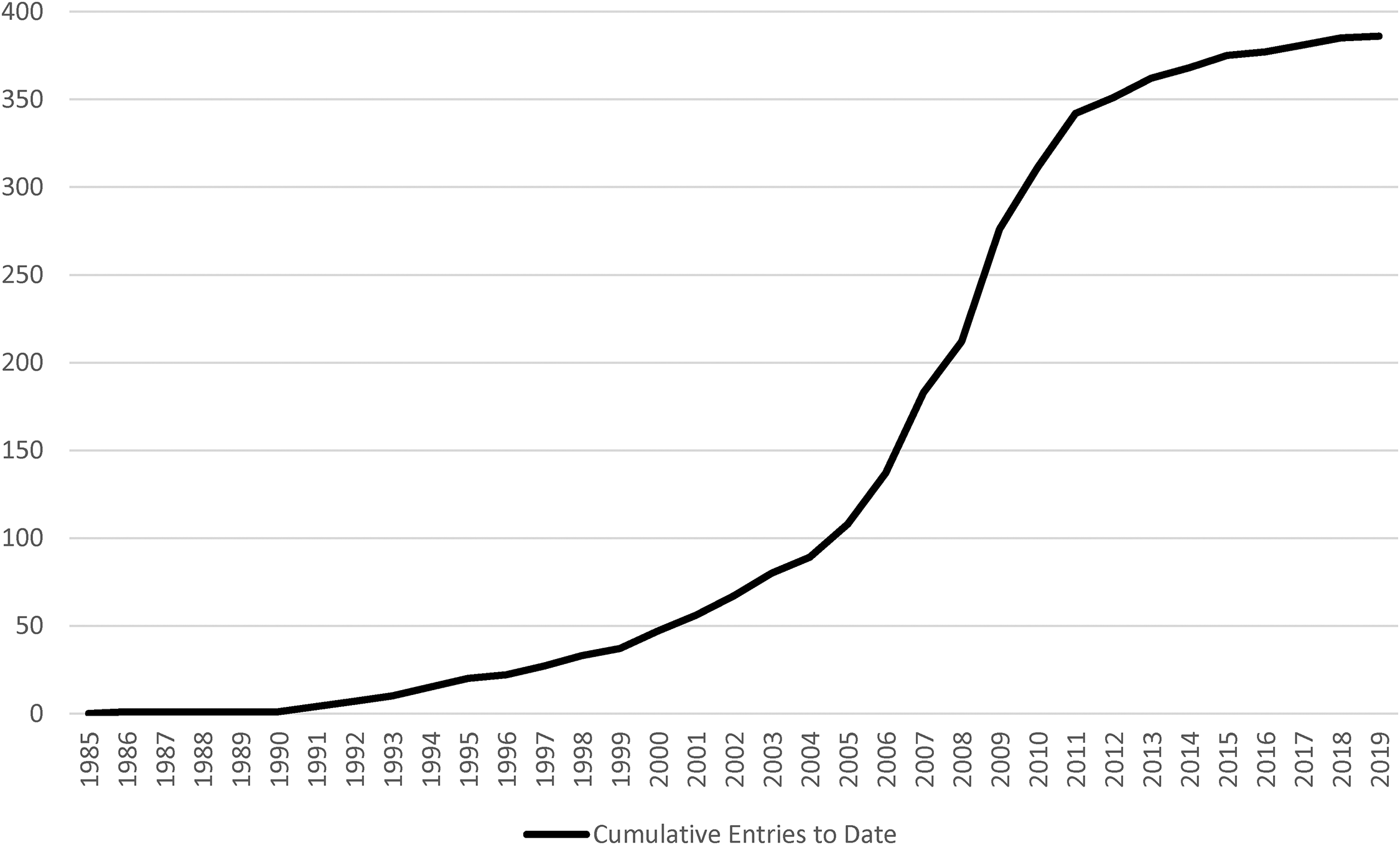
Cumulative field actors’ entries into sustainability manager positions.
This institutionalization variable is based on the number of entries into a sustainability manager role that we measure through our sample, and therefore it is important to recognize that the adoption curve in our sample may differ from that of the number of overall sustainability manager position entries. However, the general trend of the curve corresponds to other indicators (e.g., the beginning of professional associations, annual gatherings, certification programs, and the development of standards) that triangulate to support the idea that it was during the period between 2005 and 2010 that sustainability manager positions were becoming more institutionalized in this sector.
Control Variables
In addition to the two main independent variables of interest, we include a number of control variables related to the individuals in our models, including years of work experience, gender, and educational history (level and area of specialization). We also include a dummy variable to control for time.
To calculate the work experience variable, we calculated how many years each individual had recorded employment on LinkedIn. We then proceeded to code each individual's presenting gender from their first names. We did this by using the genderize.io program, which calculates the probability that a first name means the person is presenting as either male or female, based on the occurrence of that name in official sources such as the Social Security Administration records as well as in social media sources that ask users for their gender (Lerchenmueller, 2016). In our case, if the probability of a given gender for a name was less than 80%, as it was for names such as “Pat,” “Casey,” and “Jaime” we manually looked at the profile pictures of these individuals on LinkedIn to code the gender that we perceived them to be presenting. In our data, female is coded as 1 and male is coded as 0. 10
Our next step was to use the LinkedIn profiles to construct the variables related to educational history—including the degree level achieved and the undergraduate area of study—for each individual. We coded the highest degree level achieved as three mutually-exclusive dummy (0/1) variables: (1) undergraduate degree; (2) Master's degree; and (3) PhD. 11 The second set of variables reflects the undergraduate area of study. One co-author and one research assistant hand-coded the individuals’ undergraduate degrees into 10 categories. These were then transformed into a categorical variable that includes each of the following degree areas: (1) architecture; (2) business; (3) engineering; (4) environmental studies; (5) sciences; (6) humanities; (7) social sciences; (8) technology and computing; (9) other; and (10) unreported.
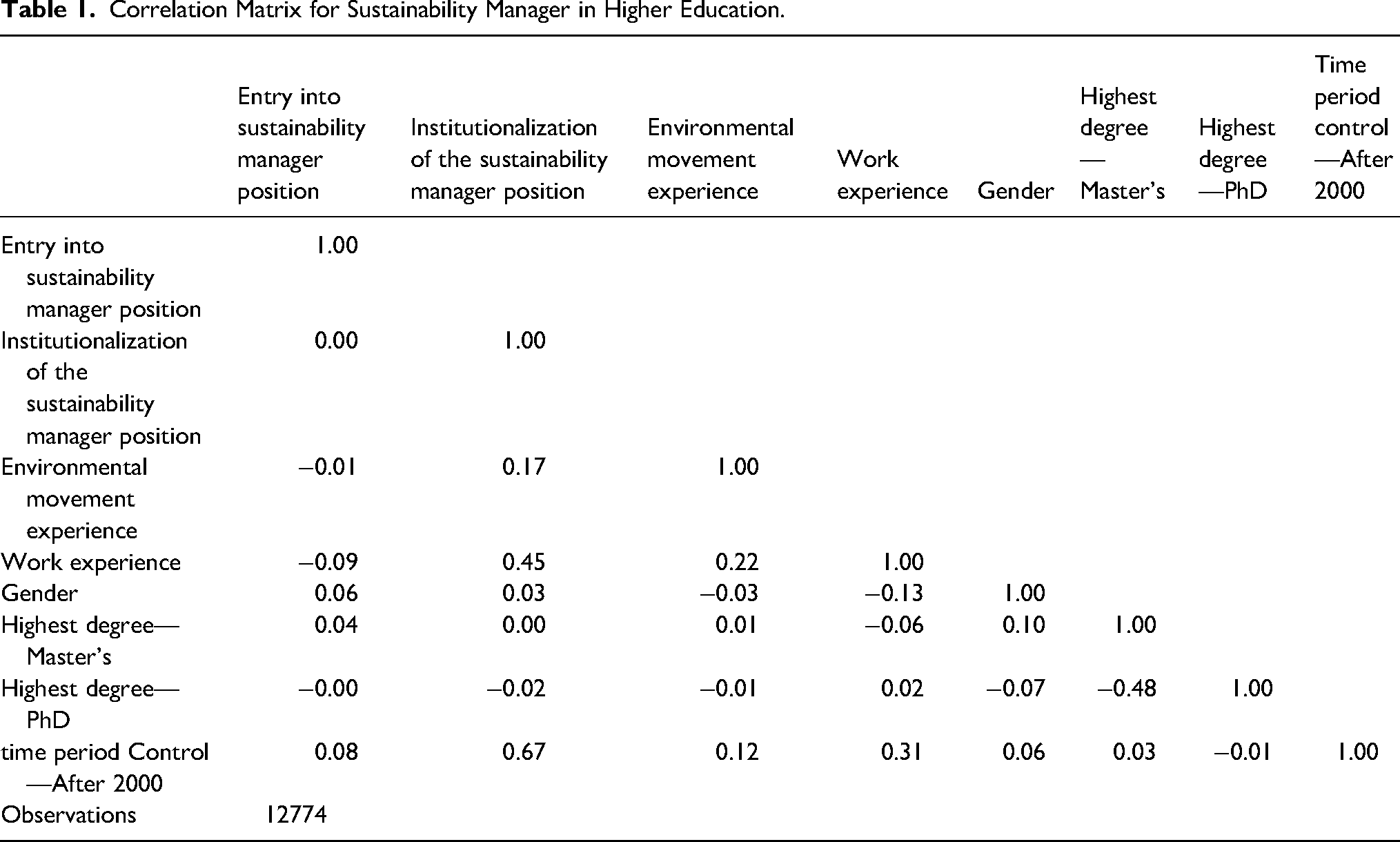
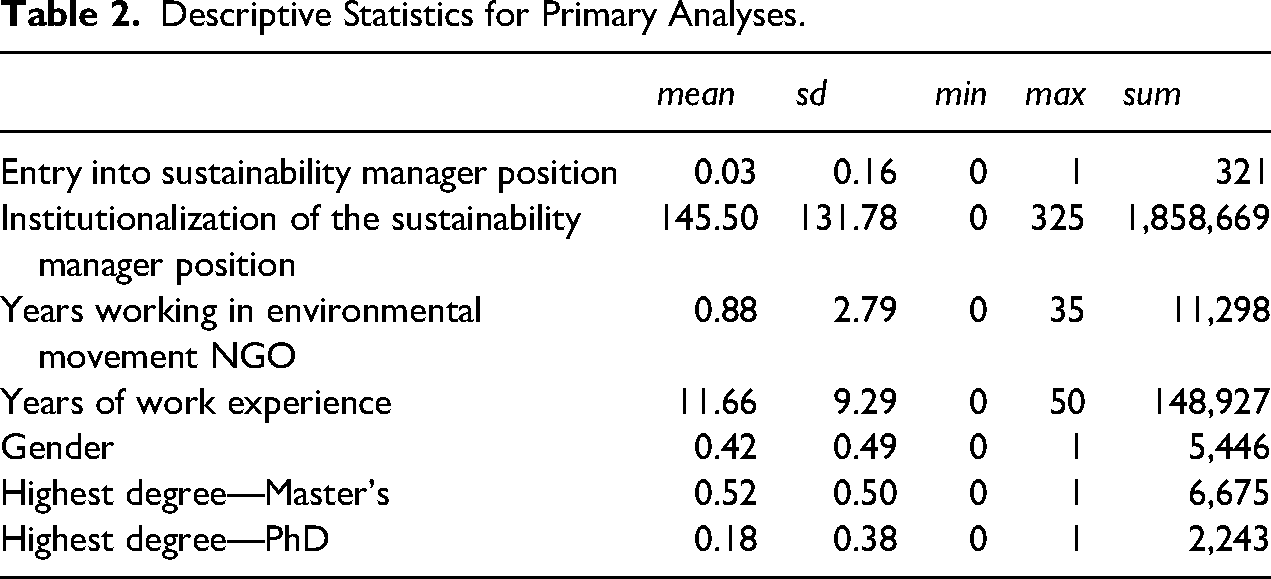
Finally, we include a control variable for time. It is a dummy (0/1) variable that is coded as 1 if the year is after 2000. The correlations and descriptive statistics of all the variables are shown in Tables 1 and 2.
Correlation Matrix for Sustainability Manager in Higher Education.
Descriptive Statistics for Primary Analyses.
Analyses
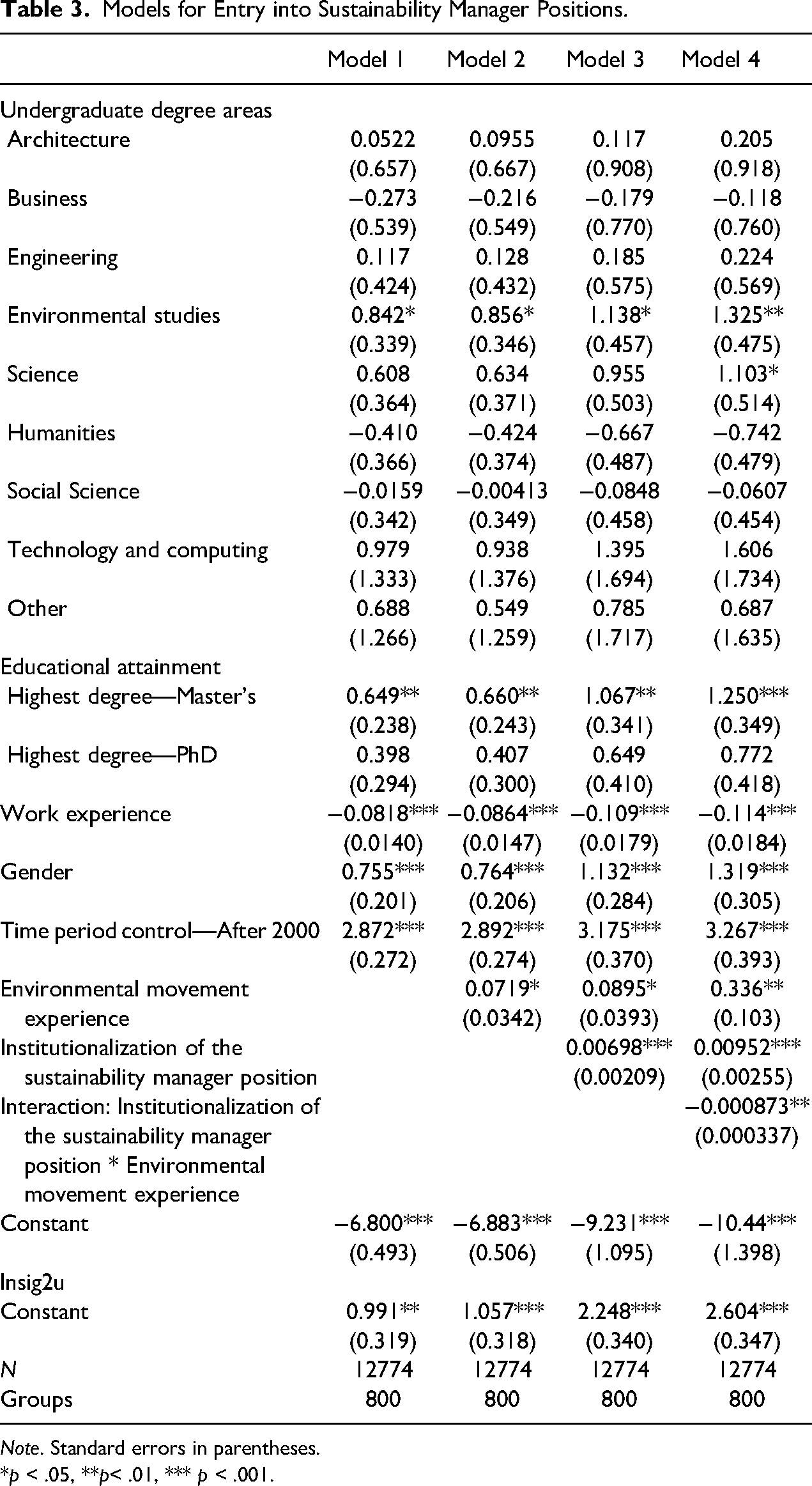
In our analyses, we run logistic regressions with random effects set up for panel data, and standard errors clustered by an individual to analyze the likelihood of individuals being hired as sustainability managers. We also ran post-estimation tests for multicollinearity after running standard OLS regression models with our variables of interest, which indicated that all of the variances of inflation scores were well below levels of concern. In all models, for the highest degree level achieved variable the category “undergraduate degree,” is excluded and therefore serves as a reference category. Additionally, for the undergraduate degree area variable, the category “unreported,” is excluded from the models and therefore serves as a reference category. Table 3 shows the results of the analyses.
Models for Entry into Sustainability Manager Positions.
Note. Standard errors in parentheses.
*p < .05, **p< .01, *** p < .001.
Findings
Model 1 in Table 3 includes all of the control variables. This model shows that some of the control variables are related to the likelihood of entering a sustainability manager role. First of all, the only degree area that is significantly correlated with later becoming a sustainability manager is that of environmental studies. This positive correlation is not a surprise, but it serves to largely confirm the quality of our data and also that this educational background is seen as valuable for sustainability manager roles. We also find that individuals with graduate degrees are more than twice as likely to become sustainability managers compared to those whose highest degree was an undergraduate degree. Additionally, years of work experience is negatively correlated with becoming a sustainability manager, which means that those people in our sample who became sustainability managers had less work experience on average compared to the wider sample. Being coded as female (gender = 1) is positively and significantly correlated with becoming a sustainability manager. Individuals who presented as female in our sample are more than three times as likely to become sustainability managers in colleges and universities compared to those who presented as men. Finally, the time period control variable is also positive and significant, showing that individuals in our sample were about ten times more likely to become sustainability managers after the year 2000. This aligns with what we know about when these positions were first established.
We run Model 2 to test the first hypothesis, that individuals with more experience in the environmental movement were more likely to become sustainability managers compared to those without this experience. We find that H1 is supported, as having more experience in the environmental movement is statistically significant (at the p < .05 level) and positively associated with becoming a sustainability manager. For each additional year of experience participating in the environmental movement, an individual was 7% more likely to become a sustainability manager.
We run Model 3 to introduce the variable of the degree of institutionalization of the sustainability manager role, and find the number of previous entries into sustainability manager positions is a positive and significant predictor of future entries into sustainability manager positions, which conforms to prior findings on institutionalization. The probability of becoming a sustainability manager is 2.44 times higher at the mean number of prior entrants compared to zero prior entrants. Furthermore, the probability of an individual entering a sustainability manager position at one standard deviation above the mean number of prior entrants is two times what it is at the mean. 12 Experience in the environmental movement remained positive and significant in Model 3.
Finally, we run Model 4 to test the second hypothesis that the likelihood of individuals with more experience in the environmental movement entering into sustainability manager positions will decrease as the positions become more institutionalized. We test this by interacting the variable of experience in the environmental movement with the degree of institutionalization of the sustainability manager role. We find that this interaction effect is negative and significant, which supports the second hypothesis by indicating that the degree of institutionalization of the sustainability manager role negatively moderates the effect of experience in the environmental movement on the likelihood of becoming a sustainability manager.
As shown through the interaction effects in Figure 2, although individuals with more experience in the environmental movement have a higher probability of becoming a sustainability manager overall, at higher levels of role institutionalization, the difference in likelihood between individuals with environmental movement experience and others entering the position is negligible and no longer significant. H2 is therefore supported. Our post-estimation tests show that, in our sample, after 150 individuals in our sample became sustainability managers (approximately 19% of our sample), having more experience in the environmental movement was no longer a statistically-significant predictor of entering into a sustainability manager position.
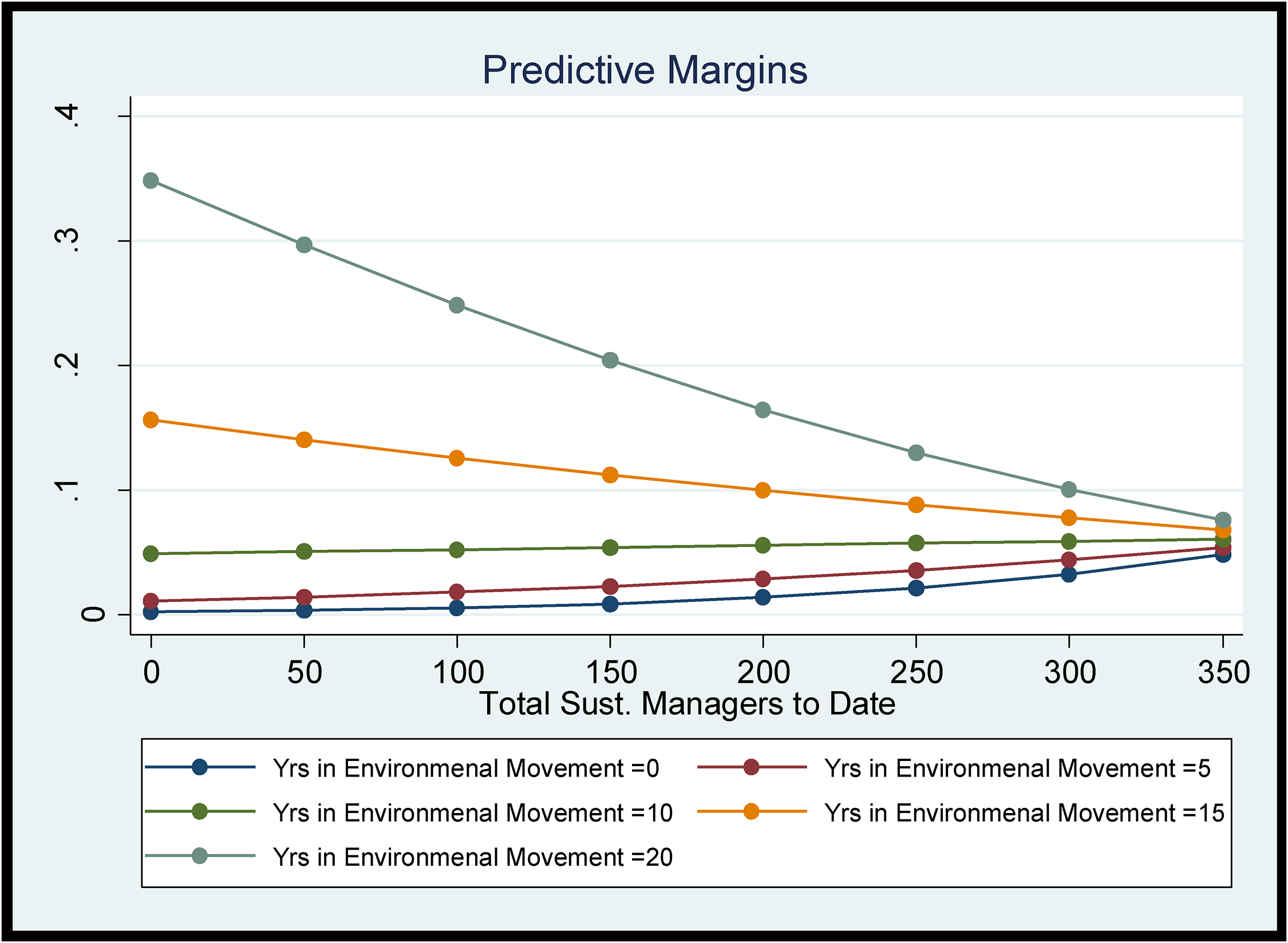
Marginal effect of previous sustainability manager entries on probability of becoming a sustainability manager at different years of experience working in the environmental movement.
Additional Considerations
There are a few additional considerations that we decided to investigate further to help us interpret our primary findings. The first is whether or not over time there were fewer individuals with experience in the environmental movement who were active on the forum. The reason that this is worth investigating is that if it were true, the decreased entry of these types of individuals into sustainability management positions over time could be attributed to a shrinking pool of potential applicants with this experience. To investigate this possibility, we examined the percentage of people in our sample each year who had experience working in the environmental movement. Importantly, the way our data are designed (for survival analysis), individuals who become sustainability managers in higher education drop out of the sample after this move, so our data is set up in a way that enables us to see who is left in the pool. The results are shown in Figure 3. As shown, the percentage of individuals in our sample with an environmental movement background increased steadily over our period of study. Based on these results, we feel relatively confident that our findings are not attributable to a decrease in the number of available individuals in our sample with environmental movement experience.
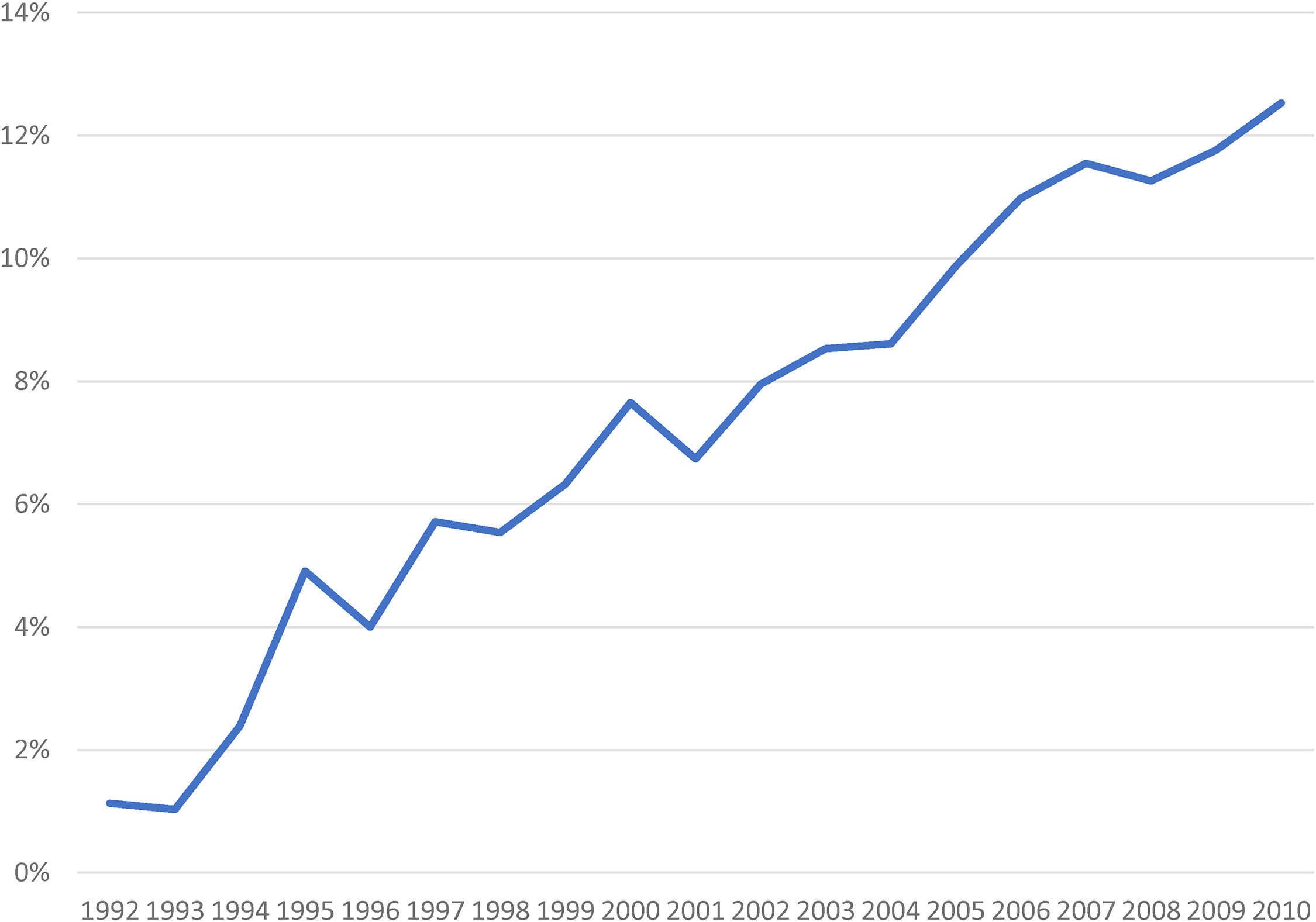
Percentage of individuals on the forum with environmental movement NGO experience.
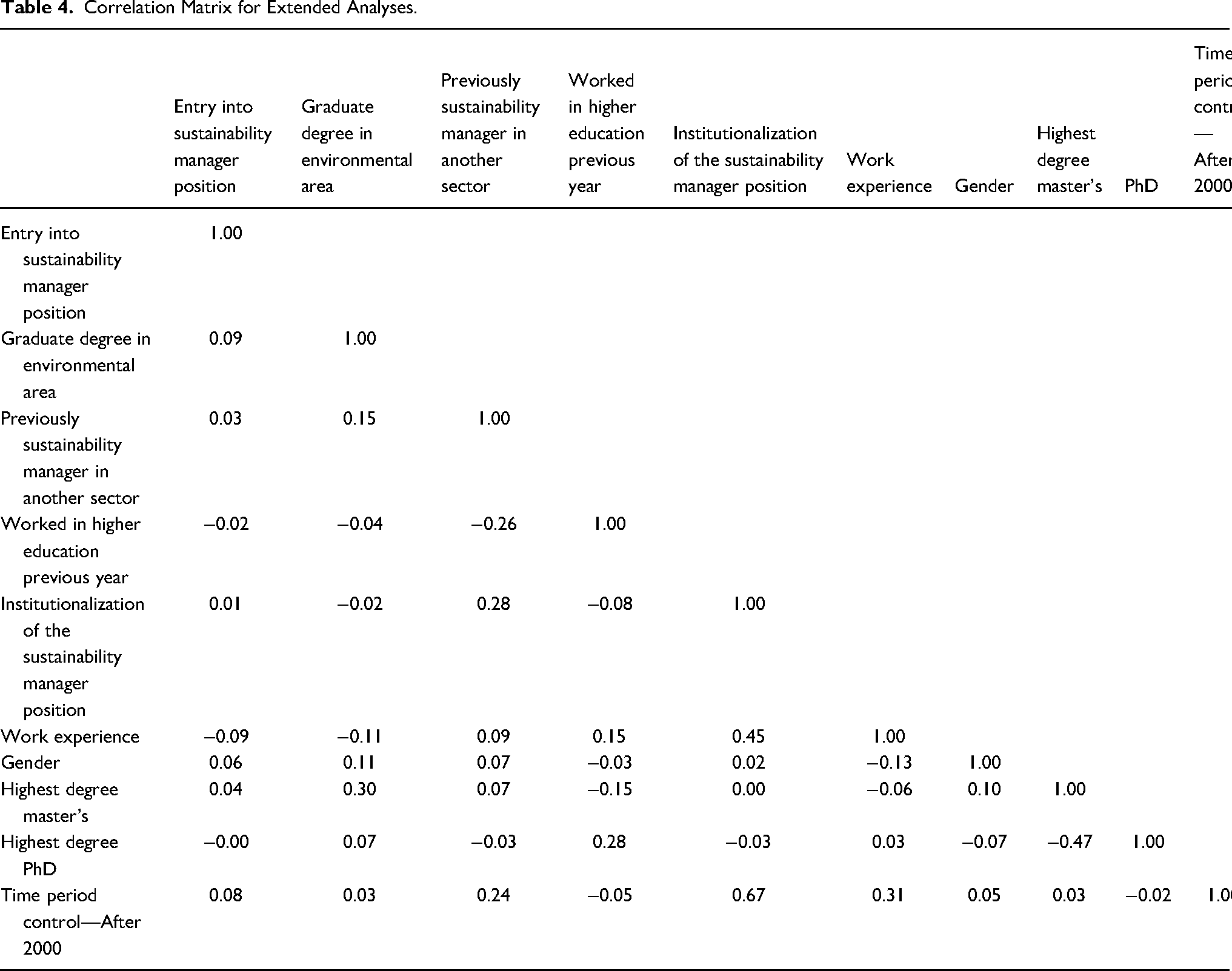
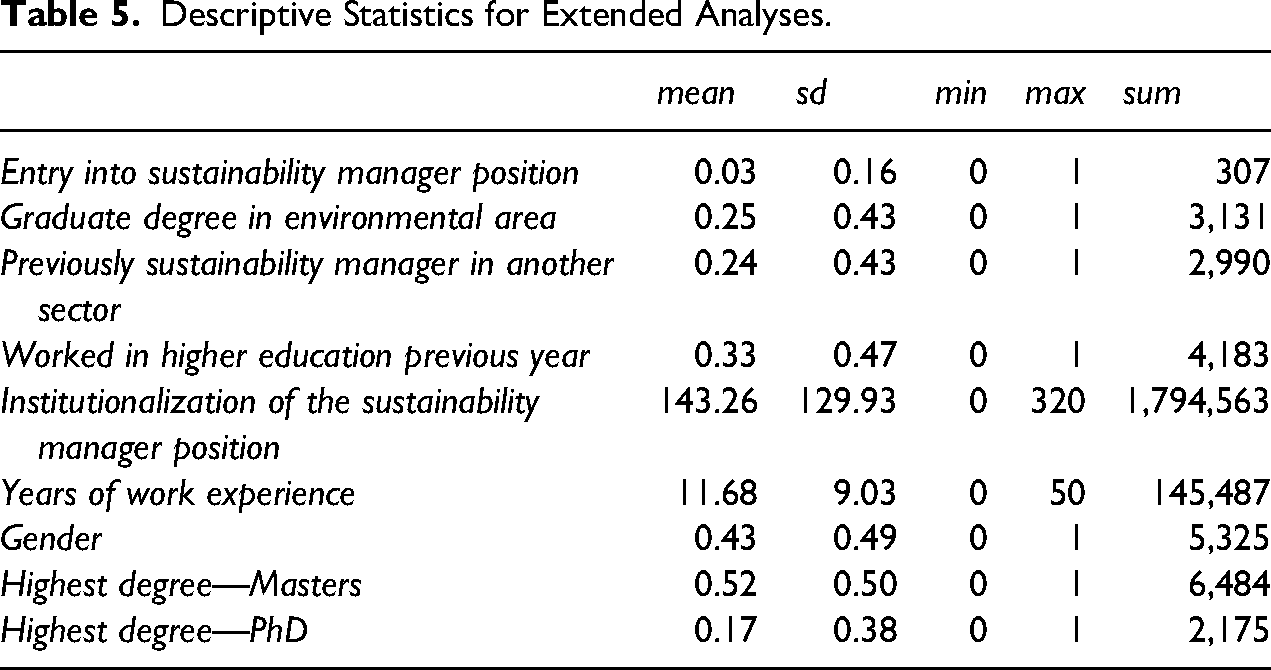
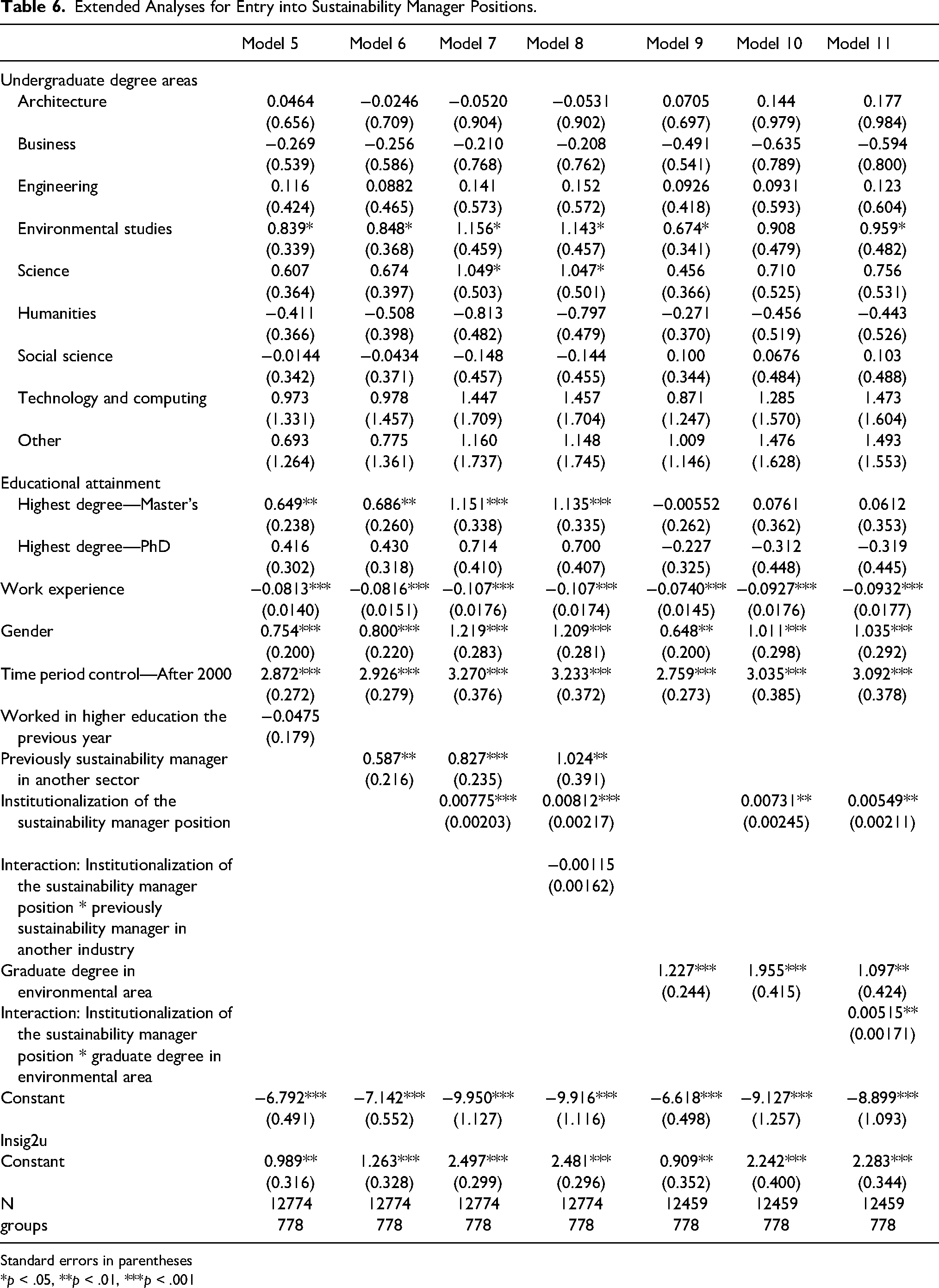
A second consideration of our findings is that we have not provided any answer as to who came to increasingly occupy these positions over time. We decided to investigate this further by generating possible explanations based on the literature on the institutionalization and professionalization of occupations. We examine these possibilities in a set of additional regression analyses. The correlations and descriptive statistics for the variables are shown in Tables 4 & 5, and the results are shown in Table 6.
Correlation Matrix for Extended Analyses.
Descriptive Statistics for Extended Analyses.
Extended Analyses for Entry into Sustainability Manager Positions.
Standard errors in parentheses
*p < .05, **p < .01, ***p < .001
One possibility that we consider is that as the sustainability manager roles became more institutionalized, perhaps an increasing number of individuals were entering the roles from within the sector of higher education. This explanation would fit existing theory regarding how adjacent occupations attempt to expand their jurisdictions (Abbott, 1989; Anteby et al., 2016). Perhaps, in our case, individuals from areas such as facilities management, recycling, housing, or dining began to expand their core work into new sustainability tasks and in turn were increasingly seen as having the essential knowledge and skills in this relatively new area, which made them suitable candidates to fill these positions when they were formalized. This process would reflect what Miner (1987, 1991) would have considered the development of an “idiosyncratic job,” crafted largely by individuals from within the organization. Therefore, we created a new binary variable for worked in higher education the previous year. The results of the subsequent analyses are shown in Model 5 in Table 6 (alongside our original set of control variables), and we can see that working in higher education the previous year was not a significant predictor of becoming a sustainability manager. 13 So, it seems that this is not a good explanation for who came to occupy sustainability manager positions as they were increasingly institutionalized.
Another consideration is that perhaps sustainability managers in higher education were increasingly coming from sustainability manager roles in other sectors. Theoretically, we might think that as this broader occupation became more institutionalized, it would have comprised a similar set of credentials, expertise, and experience across organizations and sectors (Abbott, 1989, 1991), making these lateral moves more likely over time. Therefore, we created a binary variable previously sustainability manager in other sector, and ran subsequent analyses including this variable. As shown in Model 6 in Table 6, indeed we find support for the idea that individuals who had been sustainability managers in other sectors were more likely than those without this experience to become sustainability managers in higher education. However, when we run the interaction effect of previously sustainability manager in other sector with the institutionalization variable (as shown in Model 8), the interaction effect is not significant. This means that the advantage that those with experience as sustainability managers in another sector have in entering these similar roles in higher education is not affected by the level of institutionalization of the position; they hold this advantage regardless. So, this does not help us answer the question of who came to increasingly occupy these positions as those with experience in the environmental movement became less likely to enter the roles.
Finally, to try to answer this question, we consider the effect of the formalization of abstract knowledge. Prior studies have shown that a key step in the institutionalization process for new occupations or professions is the attainment of expertise through such avenues as specialized degree programs and credentialing (Abbott, 1989; Freidson, 1988). So, we went back to our data and hand-coded each individual's area of graduate study, to code for whether or not their degrees were in environmental specializations. We created a binary variable for a graduate degree in an environmental area, and Models 9–11 in Table 6 include this variable. As shown in Model 9, having a graduate degree in an environmental area is positive and significant, indicating that individuals with these degrees are more likely than those without them to enter sustainability management positions. This variable remains positive and significant with the addition of the institutionalization of the sustainability manager position variable, as shown in Model 10. Finally, as shown in Model 11, when we interact graduate degree in environmental area with the institutionalization of the sustainability manager position, we see that each variable remains positive and significant, and the interaction effect is also positive and significant.
We interpret these findings to mean that those individuals with a graduate degree in an environmental area were even more likely to become sustainability managers as the position was institutionalized, which helps answer our question about who came to occupy these positions instead of those with experience in the environmental movement. The most common schools that individuals in our sample had received these degrees from included Tufts University, Yale University, the University of California—Berkeley, and the University of Michigan. The most common program at Tufts was the MS in Environmental Policy and Planning. According to the website of this program, it “prepares the next generation of leaders—‘practical visionaries’—who will contribute to the development and promotion of environmentally sustainable communities.” The programs at Yale, Berkeley, and Michigan have similar aims, and show how knowledge became codified and translated into the professionalization of this field over time.
We can conclude that as the field of sustainability management became more institutionalized, individuals with specialized education in environmental issues became more likely to enter these roles. While this particular finding largely conforms to existing understandings of the professionalization of new occupations, when it is viewed alongside our findings on the decreased access that those from a social movement background have to these positions, we show what the implications of these prototypical professionalization processes can be for occupational activism. While individuals with graduate degrees in environmentally-related areas might still bring passion, values-alignment, and expertise to these roles, if they do not have experience directly in social movements, they will not carry a movement praxis into the roles, which may mean that they are less likely to pursue radical change and less likely to employ key movement tactics such as mobilization, framing, and coalition building in the workplace.
Discussion and Conclusion
This study of the entry of individuals with extensive movement experience into movement-backed occupations provides a new angle for better understanding occupational activism. While scholars have previously defined occupational activism and demonstrated how it can take place, previous studies have primarily focused on the role of individuals as carriers of movement values and praxis in their occupation (Cornfield et al., 2019). Individual cases are certainly valid and meaningful, but our investigation “zooms out” to the consideration of activism at the level of the occupation, based on the early entry of a cohort of individuals with significant movement experience into a particular occupation. Building on an extensive body of work that shows that experience in a movement shapes future career choices and the ways that individuals enact their professional roles (Cornfield et al., 2019; McAdam, 1989), we argue that when new occupations are created to manage movement-related concerns, individuals with direct experience in the related movement will have an interest in overseeing and shaping this work inside organizations. Empirically, we indeed find that in the nascent phase of sustainability management, individuals with movement experience do access these positions at higher rates than those without this experience. Theoretically, this is important because collective moves can imbue entire occupations, not just individuals, with movement values and ways of working.
Our findings draw attention to an under-studied way that movements can influence organizational change. We know that organizations have created new roles to respond to movement pressure in areas such as diversity, ethics, and sustainability management (Augustine, 2021; Chandler, 2014; Dobbin, 2009; Edelman et al., 1991; Kelly & Dobbin, 1998; Lounsbury, 1998; Risi & Wickert, 2017; Wright et al., 2012). The creation of new occupational positions in organizations to further movement goals is part of a wider shift whereby social movements have increasingly targeted organizations directly, rather than working exclusively via regulatory channels, to shift organizational practices and policies (Walker et al., 2008; Weber & King, 2013).
However, it has not been clear to date who actually comes to occupy these positions—or who comes to “manage” movement-backed work (for an exception see Lounsbury (2001)). This is despite the fact that scholarship has emphasized that the process of furthering movement-aligned work inside organizations depends heavily on micro-level efforts at institutionalizing change (Buchter, 2020; Edelman et al., 1991; Kellogg, 2009; Soderstrom & Weber, 2020). Additionally, when these types of positions are established, their work is often ambiguous, and therefore early entrants are integral to defining whether or not, and to what degree, substantive organizational changes are pursued (Augustine, 2021; Edelman et al., 1991; Lounsbury, 1998, 2001). Therefore, our finding on movement actors entering into the occupation of sustainability management in its nascent phase is meaningful and contributes to existing scholarship, opening up a new avenue of study at the interface of movements and organizational change.
Our findings also contribute to the scholarship on how widespread external movement efforts can connect to internal efforts to progress organizational change (Briscoe & Gupta, 2016; DeJordy et al., 2020). Previous scholarship has highlighted how employee-driven efforts to change organizations have connected to external movements as allies in their efforts (e.g., Buchter, 2020; DeJordy et al., 2020; Dixon & Martin, 2012; Pamphile, 2021) and external movement activity has been shown to cross organizational boundaries in the form of support for internal efforts such as union organizing (Ferguson et al., 2018). Our findings add to this work by showing that external movements can enable change inside organizations by actually becoming the very agents of change themselves.
Our finding that individuals with greater movement experience are less likely to enter sustainability manager roles as the position becomes institutionalized highlights the double-edged sword of the institutionalization of movement efforts. In many ways, the increased institutionalization of movement-backed occupational roles is a positive outcome for the movement, as it reflects a greater acceptance of the movement's cause; theoretically, this is what movement actors seek when promoting a new ideal or goals. Movements work to increase their legitimacy—or the level of comprehensibility and taken-for-grantedness of their causes—by seeking to expand organizational missions to oversee functions and tasks key to the implementation of their objectives (Colyvas & Powell, 2006; Suchman, 1995). Within the field of sustainability, movements have worked to routinize practices such as green building standards (Hoffman & Henn, 2008), recycling (Lounsbury et al., 2003), and the consideration of environmental impacts in manufacturing (Howard-Grenville, 2007). Therefore, institutionalization may be an intermediary goal of occupational activism inasmuch as it reflects the formalization of the tasks and purposes associated with the occupational role and thereby expands the purposes of the organization to include the social movement's goals.
However, institutionalization is often viewed negatively by social movement scholars due to its propensity for greater bureaucratization, professionalization, and de-radicalization (Michels, 1911; Staggenborg, 1988). Our entry patterns show that although movement actors may enter (and persist) inside this occupation, they decreasingly have direct access to it over time as the positions become more widespread in the field. This finding reflects the downside of the institutionalization of movement work, as the nascent occupation of sustainability management becomes somewhat decoupled from the movement as it gains greater acceptance. Although the purpose of our study is not to examine how the work of sustainability managers changed over time, it seems logical that as individuals with a movement background were not as likely to become sustainability managers over time, and those with specialized graduate degrees were more likely to enter these roles, the role of sustainability manager likely became deradicalized. This would align with recent work by Augustine and King (2019), who found that in the early years of the formation of the field of sustainability in higher education, the discourse in the field was more movement-oriented and politically-oriented, but over time the discourse shifted to primarily focus on concerns of cost savings, efficiency, and metrics and evaluation. In this paper, we find that the effects of institutionalization go beyond discursive changes, to encompass who gains access to key positions inside organizations.
This finding also relates to why organizations may stall in furthering movement goals, even if they create new roles to manage this work. Existing studies show that many of these social change-oriented occupations have been very slow to make progress in line with what movements had envisioned for their roles (Kalev et al., 2006) and that organizations often return to business-as-usual, despite their espoused commitments to institute changes (Augustine, 2021; Wright & Nyberg, 2017). Dobbin and Kalev (2021) lament that after the passage of equal opportunity employment laws, personnel, equal opportunity, and affirmative action occupations eventually evolved into “human resources,” “diversity,” and “compliance” experts; they largely lost their connection to the underlying movement that had spurred their creation, and as they focused more on their own professionalization they instituted as set of practices that were largely ineffective for remedying inequalities. If individuals with direct experience within a movement are more likely to bring that movement's values and praxis into the workplace (Cornfield et al., 2019), and they lose access to these positions as they become institutionalized, then the ideals and values of the movement may become muted inside organizations.
However, we do not want to underemphasize how important it can be for a social movement to shape the early stages of a new occupation. In our case, the role of sustainability manager was created to respond to pressures from the environmental movement and the functions of the role were shaped early on by the initial cohort of occupants who had extensive social movement experience. As Van Wijk et al. (2013) theorized, movements often influence the early stages of institutionalization by serving the role of instigators, by sharing new ideas and ideals that organizations ought to embrace, but movement actors’ influence often wanes as organizational practices and roles became more institutionalized. Other members of established organizations increasingly serve as the cultural brokers that link movement ideals to the pragmatic demands of organizations, and in our case, a new generation of individuals with formalized education in a related area became more likely to enter these roles. We surmise that the process by which movement-backed occupational groups evolve is heavily shaped by which stage of institutionalization new organizational roles are in. Early on, as movement participants serve in these positions, the role likely fills an instigator function, but as the position becomes more institutionalized, pragmatic concerns are likely to dominate.
It is worth highlighting two important boundaries of our case: first is that it is set in the higher education sector and second is that it is focused on the environmental movement. In terms of the setting in higher education, it is possible that higher education organizations might be more likely than business organizations to hire individuals from a movement background. This is because the movement-oriented change in this sector often originates from direct pressure from students (Lounsbury, 1998, 2001; Rojas, 2010; Soule, 1997), and therefore colleges and universities may be under greater scrutiny to respond authentically to movement pressures by hiring someone who reflects the values and praxis of the movement. Additionally, as the missions of higher education organizations are more socially and community-oriented, they may be more likely to genuinely pursue movement-backed changes (by employing individuals with direct movement experience), compared to profit-driven organizations, who may be more likely to pursue a de-coupling strategy (as has been the case with the implementation of procedures related to Equal Employment Opportunity, as shown by Edelman et al., 1999). However, numerous studies have shown how businesses have come under greater scrutiny from social movements (King, 2011; Walker, et al., 2008; Weber & King, 2013). Moreover, in recent years, business organizations have been pressured by ideologically-oriented employees to take stands on social causes and to extend their social and environmental impact (e.g., Gupta et al., 2017; Wowak et al., 2022). In this sense, both higher education organizations and for-profit businesses seem to be susceptible to internal movement influence. Still, further work would be necessary to understand if what we have found in this sector is also true within other sectors.
There is also the question of how much we can generalize to other types of movements. Most of what we know about occupational activism and the biographical consequences of participation in movements comes from scholarship on the Civil Rights Movement (Cornfield et al., 2019; Isaac et al., 2020; McAdam, 1989). So, we are happy to add a different empirical setting, as it strengthens the evidence showing that individuals from movement backgrounds attempt to further their work through occupational roles. One difference between the environmental movement that spurred the creation of sustainability managers and the Civil Rights movement is that the movement we study was not underpinned by regulatory action. This is very different from how the Civil Rights movement pushed for regulation such as the Equal Employment Opportunity Act, which then spurred the creation of occupations to manage this work, such as personnel managers (Dobbin, 2009). Equality in the workplace was therefore seen largely as a compliance issue. At the time, regulation was seen as the culmination of the movement's goals (they had “won” and expected compliance to follow), even though today we know that the movement's primary concerns still persist within organizations. So perhaps the roles of personnel managers would not have attracted movement actors to the same extent.
We can also think of movements whose goals might be incorporated by an existing occupational group, rather than spurring the creation of entirely new roles. For example, the #MeToo movement might be logically seen as within the jurisdiction of human resource managers, and therefore it may not open up the same opportunity to join and shape a new occupation. However, movements like #MeToo could also expand or elevate the work of existing occupations. All in all, perhaps our case is best extended to movements that also put direct pressure on organizations (rather than operating exclusively via regulatory channels), and have demands that are relatively new areas of import for organizations (rather than those that highlight the limitations of existing efforts).
In addition to these boundary conditions, there are limits related to the data and analysis strategies that we have used. We first acknowledge that there are some drawbacks to utilizing data from LinkedIn, as the data are self-reported. Of course, the concerns of self-reported data apply across numerous data sources, such as those collected via surveys and interviews, but it is worth noting this limitation of LinkedIn data, as the profiles are public and therefore people might be more likely to withhold certain information. To remedy concerns of individuals only sharing part of their biographical information, we have only included individuals in our study whose profiles include details of both their work experience and educational background. Despite this, it is possible that other data are missing. Even though we have no reason to think that these data would be missing in a systematic fashion that would bias our analyses in a particular direction, it is pertinent to note the shortcomings of this type of data, especially as online data is becoming increasingly used by researchers.
The second primary limitation of our study is that we do not uncover the underlying push and pull factors that account for the decreased entry rate of individuals with more experience in the environmental movement into sustainability manager roles. Unfortunately, even though we have done an extensive data collection effort, we do not have data on applications to sustainability manager positions, which makes it difficult to attribute the decreased entry to choices by potential applicants to stop applying to these positions versus the possibility that organizations decreasingly value having a significant experience in a related movement over time. We have tried to answer this question in part by looking at who increasingly comes to fill these positions, but it does not provide a complete answer. These are important questions to address in future work, and we hope that our findings, which illuminate the outcome of this process and why this outcome is meaningful for our understanding of how movements can influence organizational change, take us one step closer to a fuller understanding of these processes.
Finally, we acknowledge that there are some limits to our consideration of the environmental NGOs in our sample. Although we coded them for their movement orientation, we may not have considered the full heterogeneity of these organizations. For example, some environmental movement organizations might use more radical tactics, or espouse more or less radical ideals, and these may imprint individuals differently and affect their odds of entering sustainability manager roles. We consider this an important avenue for future work. While we have found the main effect, there is a lot more nuance to be explored related to career and professional pathways for individuals from different types of movement backgrounds, especially when it comes to the establishment of movement-backed occupations. We encourage future work in this space.
In conclusion, our study helps open up a new area of scholarship on the effects of movements on organizations. We move beyond conceptualizations of either purely external pressures or internal grassroots employee mobilization efforts by highlighting the importance of new occupations that are largely created out of pressure from movements. We contribute evidence and theorizing of when individuals with significant movement experience might access new occupational roles tasked with managing movement-backed changes inside organizations. In particular, we find that in the field of sustainability in higher education, individuals with more experience in the environmental movement had a higher likelihood of entry into sustainability manager positions than others, but this access diminished as the occupational roles became more institutionalized. Further work is needed to understand the full effect of institutionalization on occupations created to address movement concerns. Our hope, however, is that this paper is the first in a line of future studies that will work to better understand how movements can operate through occupational activism to shape organizational change in areas such as equality, diversity, and sustainability.
Footnotes
Declaration of Conflicting Interests
The authors declared no potential conflicts of interest with respect to the research, authorship, and/or publication of this article.
Funding
The authors received no financial support for the research, authorship, and/or publication of this article.
