




Abstract
This article asks whether we can identify a vitalistic undertow in Friedrich Nietzsche’s philosophy that would make sense for contemporary political and constitutional theory as well. The arguments are presented by contrasting Nietzsche’s philosophy with the social theory of Herbert Spencer. After an introduction, the first main part discusses Spencer and his so-called ‘organic analogy’ in which he draws parallels between natural organisms and the body politic. Spencer’s social theory is a paradigmatic example of vitalism and organic state theory and, as a counterpoint, can help tease out Nietzsche’s vitalism as well. The article then examines Nietzsche’s admittedly fragmentary encounters with Spencer and his flirtations with vitalism and organic state theory. In the conclusions, the reconstructed narrative about Nietzsche’s vitalism is linked with Nietzsche’s main philosophical works in the hope of provisionally extracting a Nietzschean ‘constitutional theory’ from his notion of will to power.
Nietzsche’s monster
At the very beginning of his lectures on biopolitics, Michel Foucault dismisses the idea that the modern state could be thought of as a ‘cold monster’ and insists that it should, instead, be seen as ‘the correlative of a particular way of governing’ (Foucault, 2008: 6). In other words, the reification of governmental practices and technologies into a single behemoth will inevitably miss the point if one wishes to understand the ways in which power operates in contemporary societies (see also Dean, 2010).
Although Foucault’s anti-statist claim is completely in line with his more general criticisms of the juridical way in which liberal thinking frames power into hierarchies and institutional competences (also Minkkinen, 2009: 95–112; Villadsen and Dean, 2012), his use of metaphor, diligently set off with quotation marks, is, perhaps, less so. For the ‘cold monster’ that Foucault here so confidently dismisses is a reference to Friedrich Nietzsche, one of Foucault’s self-professed sources of inspiration (e.g. Foucault, 1977; also Mahon, 1992; Thiele, 1990). Foucault must be aware of this, and yet there is a clear sense of disdain in the use of the phrase. Be that as it may, in a speech addressing the new idol that men have come to worship, Nietzsche’s Zarathustra does, indeed, call the state the ‘coldest of all cold monsters’, and continues that ‘this lie slips from its mouth: “I, the state, am the people.”’ (Nietzsche, 2006: 34).
The aim of this article is to explore whether there is room for, if not a rehabilitation in any over-scholarly or historical sense, then at least a potential radicalisation of a vitalistic strain in Nietzsche that would make sense for contemporary political and constitutional theory as well. The arguments are presented by contrasting Nietzsche with Herbert Spencer, another figure rarely mentioned in contemporary political theory. Spencer is best known for his ‘social-Darwinist’ ideas on human evolution, but less so for his comparisons of the constitutions of living organisms and human societies and the conative life-force that animates both. After the introductory part on Nietzsche, the article proceeds to investigate Spencer’s so-called ‘organic analogy’ in more detail in which the apposition between living organisms and human societies is made. Although it would be misleading to claim that Spencer had anything resembling a direct influence on Nietzsche, his social theory is a paradigmatic example of vitalism and organic state theory as its corollary. As a sociologist, Spencer is present in Nietzsche’s texts often enough, although usually only as a springboard for the latter’s confrontational arguments. The second main part of the article examines Nietzsche’s admittedly fragmentary encounters with Spencer and his flirtations with vitalism and organic state theory. The work conducted here is far from comprehensive because it only seeks to reconstruct a narrative in which Nietzsche can be said to partake. Finally, in the conclusions, I tie the reconstructed narrative into Nietzsche’s better-known published works in the hope of being able to provisionally outline the premises of a Nietzschean ‘constitutional theory’.
‘Serious political thinking’?
Nietzsche may not be the first philosopher who comes to mind when we consider constitutional theory as the academic discipline that merges law with political theory (see however Kariel, 1963; Weisberg, 1988; more generally Goodrich and Valverde, 2005). In so far as the discipline, at least in its broadest meaning, is understood as academic enquiries into the state and its political and legal institutions, Nietzsche gives us mere traces (e.g. Nietzsche, 1967: 382–403). And for the most part, these traces will have to do. So yes, Nietzsche does talk about the state, as the quote above indicates: it is a deceitful monster. But even so, it would be hard to read him as a constitutional theorist in any conventional sense of the term.
Part of the difficulty arises from the distasteful emotions that Nietzsche stirs in predominantly liberal and even left-of-liberal political debates (Beiner, 2021). Martha Nussbaum (1997) goes so far as to claim that whatever contributions Nietzsche may have made to moral psychology, he cannot be taken ‘seriously’ as a political thinker. Nussbaum’s reservations are emblematic of how the liberal tradition sees Nietzsche, and the emphasis that she puts on ‘seriousness’ as a prerequisite of politically valid thinking is quite telling. It is as if she was personally offended by the rhetorical scorn that Nietzsche exhibits towards Nussbaum’s own political idols, John Stuart Mill in particular. So what should we make of Nietzsche’s influence on, say, Hannah Arendt (e.g. Honig, 1993) or Max Weber (e.g. Eden, 1983)? Are Arendt or Weber not ‘serious’ political thinkers either (also Siemens and Roodt, 2008)?
Hugo Drochon (2016: 49–70) pinpoints the reasons for the liberal tradition’s reluctance to acknowledge Nietzsche’s contributions to political philosophy to a certain eclecticism or lack of systematic focus noted by, among others, Brian Leiter (2015: 234–243). Drochon then continues to refute that reluctance by claiming that Nietzsche’s political philosophy can, indeed, be reconstructed in a systematic way from certain well-known texts augmented with observations from more marginal ones. Drochon’s reconstruction shows how such a political philosophy and the notion of state that accompanies it can be situated at a crossing point where Nietzsche’s criticism of the social contract tradition that is usually taken as a sign of ‘serious political thinking’ in the liberal tradition meets an alternative political philosophy built on the idea of the decay of the nation state. For Drochon, the ‘new world order’ that Nietzsche sees emerging from the ruins of its statist predecessors ‘will take the form of a European-wide decentralized and regulatory state, within which different institutions will be allowed freer rein to pursue their respective activities, some – the private companies, probably the vast majority – for private gain within a broader economic and material framework, while others – the new institutions, a select few – their cultural goals’ (Drochon, 2016: 68).
Lack of seriousness aside, admittedly Nietzsche’s published texts never include quite enough for an explicitly Nietzschean constitutional theory, as Drochon’s need for reconstructing a political philosophy illustrates. Rather, any such theory would have to be extracted and pieced together from both unpublished fragments and Nietzsche’s more general writings on power, and especially, as I will later argue, from Nietzsche’s writings on life and will to power (Warren, 1985, 1988; Conway, 1997a). Such an ‘eclectic’ method, criticised by the likes of Leiter, is, however, reminiscent of Walter Benjamin’s constellations (2009: 27–56), and ‘serious Nietzsche scholars’ will be equally quick to dismiss it (see e.g. Brobjer, 1998).
Even if we manage to piece together the scattered fragments where the state is mentioned, a larger problem arises from the very nature of Nietzsche’s philosophy. In his early essay ‘Nomad Thought’ from 1973, Gilles Deleuze (1977) claims that while the projects of the two other great representatives of modernity – Freud and Marx – are to recodify the disintegration of modern society’s private and public domains respectively, Nietzsche’s nomadic ‘counter-philosophy’ is resistant to every attempt at codification or recodification. The great pervasive instruments of the code, namely law, contract, and institution, are common to most modern societies, and in various combinations they partake in attempts to regulate life at a point in history when everything has become increasingly unregulated. Constitutions are, no doubt, such codes. As laws they coerce, as contracts they fuse nations together, and as institutions they soothe and stabilise the volatility of political life. But unlike Freud and Marx, Deleuze continues, Nietzsche makes no attempt to recodify: In his own writing and thought Nietzsche assists in the attempt at decodification – not in the relative sense, by deciphering former, present, or future codes, but in an absolute sense, by expressing something that can not be codified, confounding all codes. (Deleuze, 1977: 143)
Perhaps it would be a bit hasty to conclude that the end result, this ‘deterritorialised’ Nietzschean terrain, is free of all codexical elements. Whatever decodification practices one may identify, they will inevitably be met by resistance. For what is a code if not an attempt to domesticate a resistant force. In this sense one could, perhaps, claim that regulatory codes, like constitutions, arise at the intersections where uncoded or decoded forces clash with the regulatory frameworks that have been set up to channel them. A constitution is not a code as such but, rather, a tumultuous web where life takes on code and vice versa. To insist that a constitution is ‘merely’ a code, to somehow exclude the force that it is trying to domesticate, would simply repeat the static illusions of all the ‘positivisms’ in their attempts to pin the thing down. Codes without life are dead mechanisms. Even for Oliver Wendell Holmes Jr, US Supreme Court Justice and legal realist, the constitution is a ‘living’ codex the provisions of the Constitution are not mathematical formulas having their essence in their form; they are organic, living institutions transplanted from English soil. Their significance is vital, not formal; it is to be gathered not simply by taking the words and a dictionary, but by considering their origin and the line of their growth. (
Gompers v. United States, 233 U.S. 604 [1914]: 610)
Nietzsche’s claim can be interpreted in a number of ways. On the one hand, the ‘people’ can simply represent the fiction of a constituent popular will that a constituted state will always require. To talk about the state as the accumulated whole of constituted institutions, be they political or legal, necessitates logically a constituent subject, something or someone that has constituted those institutions and their interrelations. And if we were to go along with the constitutionalist tradition, we would simply leave it at that (see e.g. Loughlin and Walker, 2007; Arvidsson, Brännström and Minkkinen, 2020; Rubinelli, 2020).
But Nietzsche clearly wishes to push the argument further: State I call it, where all are drinkers of poison, the good and the bad; state, where all lose themselves, the good and the bad; state, where the slow suicide of everyone is called – ‘life’. (Nietzsche, 2006: 35)
Nietzsche often uses similar terms to erect the vitalistic strain in his philosophy, a strain that is equally often taken to be at least one source of both its overly simplistic conceptual arsenal and its condemnable politics (see Conway, 1997b: 34–39; generally Lash, 2006; Villadsen and Dean, 2012). Christoph Cox, however, claims, that although Nietzsche’s starting point may seem to arise from the fairly standard juxtaposition of mechanism and vitalism typical of his time, he will reject the ‘theological posits’ of both. Instead, he sees motion and change that are driven by ‘struggle and pathos: by attraction, repulsion, tension, resistance, integration, disintegration, assimilation, incorporation, alliance, and so on’ (Cox, 1999: 238; Allen, 2005). In other words, life is without foundation. It is only an observable movement, a struggle with no ultima causa.
But taken that Nietzsche is such a central figure in contemporary philosophy in general, and, I would argue against Nussbaum and others, in contemporary political philosophy as well (see Ansell-Pearson, 1994, 2013; Conway, 1997a; Widder, 2009; Owen, 1995; on Nietzsche and the French, see Schrift, 1995), what are we to make of this ‘secularised’ and anti-foundationalist vitalism today? Should we not be put off by the expired best-by dates that are written all over any attempt to rehabilitate vitalism as a political theory (e.g. Bergson, 2022; Canguilhem, 2008; also Agamben, 1999: 68–93)? Perhaps not. Deleuze once noted about Foucault that: When power becomes bio-power, resistance becomes the power of life, a vital power that cannot be confined within species, environment or the paths of a particular diagram. Is not the force that comes from outside a certain idea of Life, a certain vitalism, in which Foucault’s thought culminates? Is not life this capacity to resist force? (Deleuze, 2006: 77; also Normandin and Wolfe, 2013).
Spencer’s organic analogy
Myriapoda. – A class of the Articulata, including such as have an indeterminate number of jointed feet. (Gr. mynos, many, and pous, a foot.) (Jardine, 1913: 134)
In terms of constitutional theory, vitalism goes hand in hand with organic state theory – another tradition long past its best-by date but that continues to exert its influence. There is no shortage of literature on the organic emphases in social and political theory, ranging from Plato to the autopoietic analogies of systems theory. In the opening words of the introduction of Leviathan, Hobbes famously writes that the state is: but an Artificiall Man; though of greater stature and strength than the Naturall, for whose protection and defence it was intended; and in which, the Soveraignty is an Artificiall Soul, as giving life and motion to the whole body; The Magistrates, and other Officers of Judicature and Execution, artificiall Joynts; Reward and Punishment (by which fastned to the seat of the Soveraignty, every joynt and member is moved to performe his duty) are the Nerves, that do the same in the Body Naturall; The Wealth and Riches of all the particular members, are the Strength; Salus Populi (the Peoples Safety) its Businesse; Counsellors, by whom all things needfull for it to know, are suggested unto it, are the Memory; Equity and Lawes, an artificiall Reason and Will; Concord, Health; Sedition, Sicknesse; and Civill War, Death. (Hobbes, 1996: 9)
Fiat pacta! Although the body politic itself is ‘artificiall’ and man-made, the covenant that holds the individual components together is god-sent. It simply appears. Hobbes’s social contract, then, represents the type of ‘theological posit’ that Nietzsche would allegedly have objected to (on Nietzsche and Hobbes, e.g. Patton, 2001).
Herbert Spencer makes a passing reference to Hobbes’s introduction in his essay ‘The Social Organism’ from 1860 (Spencer, 1981; on Spencer, Peel, 1971; Harding, 1954; Simon, 1960; Gray, 1985; Taylor, 2007; Francis, 2007; Mingardi, 2013). With his reference, he wishes to show how analogies between the natural and social worlds have been part and parcel of political thinking ever since the days of the Ancients. But why Spencer? Talcott Parsons (1968: 3) rhetorically asked who would read Spencer any more and proceeded to answer his own question: no one. Spencer is dead, outdated, ironically caught up and surpassed by evolution. The irony, of course, being that, as many have noted (Peel, 1971: 255; Turner, 1985: 51), there are clearly identifiable similarities between Spencer’s organicism and Parsonsian functionalism.
Spencer claims that the main flaw in the theories of his forerunners is that they privilege the human body as the natural end of the analogy, whereas Spencer, making several admiring allusions to ‘physiology’ and ‘physiologists’ along the way, looks for the commonalities at much lower levels of natural evolution (on Spencer and lobsters, see Hiskes, 1983). Spencer begins with a general criticism of mechanistic social theories by arguing that the division of labour and the social structure that it has produced can be ascribed ‘neither to miracle, nor to legislation’ because industrial organisation, from main outlines down to the smallest details, has become what it is not merely without legislative guidance, but, in truth, in spite of legislative hindrances: ‘It has risen under the pressure of human wants and resulting activities’ (Spencer, 1981: 385).
Mechanistic social theories would view the individual components that make up social organisation as individual artefacts, the creation of which has been assigned to an external will such as a divinity or a lawgiver (e.g. Deutsch, 1951). Once detached from the will to which they owe their existence, the static artefacts of social organisation – e.g. constitutions – are understood and analysed as ‘lifeless’ mechanisms. Although the acts of legislators may be assigned an intermediate role, for Spencer the true sources of social evolution lie deeper. Laws are enacted by representative governments, and the enactments of such governments, for their part, must ultimately conform to a national will even if they may at times be out of sync with it. And so, Spencer concludes, the centrality of the national will implies that even the acts of lawgivers result from the average of individual desires and natures: ‘A law so initiated, therefore, really grows out of the popular character’ (Spencer, 1981: 386).
This ‘popular character’ is for Spencer the vitalistic energiser bunny, the conative ‘original source’ from which the life of the body politic emanates. Life expresses itself as natural wants and desires that the body politic then pursues quite irrespective of the possible efforts of lawgivers to channel it. Such a view is conveniently in alignment with Spencer the evolutionist (see Perrin, 1976; compare Haines, 1988). For one thing, the body politic will eventually always evolve towards more advanced forms of organisation anyway, even without legislative ushering or obstruction, unless the organisation is destroyed by catastrophe or war. This is the basic assumption behind the type of evolutionary theory that Spencer wishes to endorse. But because legislation itself is also ultimately an expression of the same ‘popular character’ responsible for those vitalistic wants and desires, Spencer’s state will always be a ‘social state’, a social structure that, in the endgames, will either politically conform to the ‘popular character’ in its pursuit of desires and wants or, alternatively, it will have to wither away.
In his ‘organic analogy’, Spencer outlines four basic parallelisms between societies and the lives of natural organisms: quantitatively both grow gradually in mass; qualitatively the structural complexity of both increases; in both the mutual interdependency of their respective individual parts gradually increases; and, finally, both survive as wholes despite the possibly shorter lifespans of their component parts (Spencer, 1981: 392–394). Spencer then juxtaposes these ‘points of analogy’ with four differences, all of which are, upon closer inspection, relative rather than absolute: unlike individual natural organisms, societies lack specific external forms; their living elements do not necessarily form a continuous mass; the elements are seldom fixed but are capable of moving; and, finally, all members of society are endowed with feeling (Spencer, 1981: 394–399). Spencer minimises the relevance of all these differences with rather far-fetched examples from the natural world that, although perhaps even accurate, are pitched so as to only emphasise the plausibility of the analogy.
Although the relationship between the natural and the social is merely ‘analogous’, Spencer is convinced that we are dealing with more than a resemblance: A metaphor, when used to express a real resemblance, raises a suspicion of mere imaginary resemblance; and so obscures the perception of intrinsic kinship. It is thus with the phrases ‘body politic,’ ‘political organization,’ and others, which tacitly liken a society to a living creature: they are assumed to be phrases having a certain convenience but expressing no fact – tending rather to foster a fiction. And yet metaphors are here more than metaphors in the ordinary sense. They are devices of speech hit upon to suggest a truth at first dimly perceived, but which grows clearer the more carefully the evidence is examined. That there is a real analogy between an individual organism and a social organism, becomes undeniable when certain necessities determining structure are seen to govern them in common. (Spencer, 1874: 330; also La Vergata, 1995).
Spencer will, as one can easily guess, find further support for the analogy in comparisons between evolution and differentiation in the animal and plant worlds, on the one hand, and in human societies, on the other. Similarly, we can detect in both a gradual progression in the division of labour from rudimentary to ever more complex structures. Structural analogies are then followed by analogies between processes of organic change and, further, by analogies between the circulation of blood and the circulation of commodities. After detailed – albeit insignificant – parallelisms, ‘we come at length to the nervous system’ (Spencer, 1981: 423). This seemingly long-awaited arrival at the nervous system is significant because it marks the endpoint of an arch. Spencer namely began his essay with a constitutional quote, that is, a dictum accredited to James Macintosh, Scottish lawyer and critic of the French Revolution, that ‘constitutions are not made, but grow’ (Spencer, 1981: 383; originally Mackintosh, 1828). A few years before Spencer, an American author referred to the same passage revealing the vitalistic undertow of constitutions well. Constitutional historians, he claimed: embrace in their inquiry not only the growth of imperial rule and legislative power, but they likewise embrace within their field of inquiry the development of the early barbarian and the succeeding village groups, towns, cities, classes, orders. They reveal the gradual process of expansion and change so far as it bore upon the unfolding of primitive local groupings into large territorial aggregates, as preserved and maintained by an elaborate system of government. (Cohn, 1892: 139–140 [my emphases])
No surprise, then, that even constitutional developments are portrayed through an evolutionary scheme from simpler structures involving the despotic rule of warrior lords to more differentiated forms of government with their intricate separations of powers and divisions of labour.
The natural end of the analogy is, however, much more striking. Spencer begins with the ‘unmodified ectoderm’ as the simplest of natural organisms, where all its individual parts are at first endowed with both ‘impressibility’ (i.e. irritability) and ‘contractility’ (i.e. elasticity). No functional differentiation has yet taken place. At the social end of the analogy, this corresponds with the undifferentiated functions of the directive and the executive, of the same social actor both commanding and carrying those commands out. Gradually, again, complexity and functional differentiation develops in both the natural and the social worlds. And at the far end of social evolution, in the ‘larger and more complex communities possessing, perhaps, a separate military class, a priesthood, and dispersed masses of population requiring local control’ (Spencer, 1981: 425–426), Spencer identifies the need for ‘subordinate governing agents’: ‘we may say that the form of organization is comparable to one very general among inferior types of animals, in which there exists a chief ganglion with a few dispersed minor ganglia under its control’ (Spencer, 1981: 426).
What does this type of ‘ganglionic constitutionalism’ imply? Ganglia are clusters of nerve cells that usually provide connections between different neurological structures, between, for example, the peripheral and central nervous systems. Spencer’s depiction of the natural end of the analogy is worth quoting here at length: Among other points of community between the successive rings which make up the body in the lower Annulosa [segmented invertebrates], is the possession of similar pairs of ganglia. These pairs of ganglia, though connected by nerves, are very incompletely dependent on any general controlling power. Hence it results that when the body is cut in two, the hinder part continues to move forward under the propulsion of its numerous legs; and that when the chain of ganglia has been divided without severing the body, the hind limbs may be seen trying to propel the body in one direction while the fore limbs are trying to propel it in another. But in the higher Annulosa, called Articulata, sundry of the anterior pairs of ganglia, besides growing larger, unite in one mass; and this great cephalic ganglion having become the coordinator of all the creature’s movements, there no longer exists much local independence. (Spencer, 1981: 426–427)
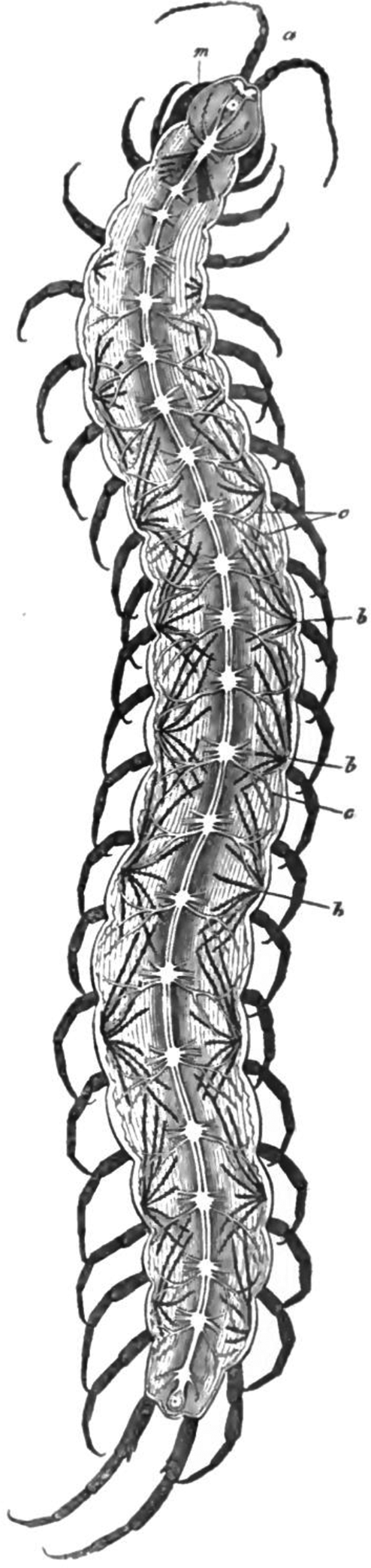
Centipede (reprinted from Rymer Jones, 1839–1847: 550).
The organism, the natural as well as the social, is animated by a conative life-force, by wants and desires that are then channelled by the organism’s nervous system, its ‘constitution’, and operationalised. In the Hobbesian variant, these wants and desires spring from a bellicose and destructive human nature, and they are regulated and transformed into purposeful action from a single sovereign point. For Spencer, the same wants and desires, all expressed in the ‘popular character’ of the nation, are never destructive. Such destructiveness would go against Spencer’s premises where natural evolution runs parallel to moral evolution. They are, perhaps, at worst misguided or inefficient. Further, unlike in the Hobbesian analogy, these potentially misguided forces are picked up by the peripheral ganglia that interpret the purposefulness of action from very localised agendas. The function of the central nervous system, the equivalent of Hobbes’s sovereign, is at most to coordinate the functional relationships between the ganglia without interfering with the life-force itself.
Drives and physiological self-regulation
In this final section, I would like to suggest that there is a certain affinity between Spencer’s vitalism and the way in which Nietzsche describes political life with similarly naturalistic expressions, although the two by necessity come to very different conclusions. Spencer’s constituent life-force is represented in a ‘national character’ that, through the expression of its desires and wants, pursues certain objectives. Unlike in the constitutional tradition, the constituent life-force is not centrally regulated by a sovereign lawgiver. Spencer’s political commitment to localised democracy only requires relatively independent ‘ganglionic’ regulators that are receptive to local agendas, leaving centralised government the tasks of facilitation and coordination (on Spencer’s science and politics, see Elwick, 2003).
Although it would be tempting to assume that Spencer’s fascination for centipedal ‘monsters’ found a keen reader in Nietzsche, the relationship between the two is not quite that simple. But Spencer is clearly significant. In fact, this ‘worthy but mediocre’ (Nietzsche, 2002: 144) ‘pedantic Englishman’ (Nietzsche, 2001: 238) is a regular point of reference for Nietzsche, albeit mostly as a target for his scorn as Nietzsche develops his own thinking (e.g. Call, 1998). But even scorn requires some affinity between the two thinkers before it can work. Both namely share a certain view of an organic theory, and both will assume a vitalistic energy that animates the social organism. If Spencer’s evolution progresses from the egoistic fulfilment of atomised desires towards the balanced altruism of what he called the ‘ideally moral man’ (Spencer, 2012: 75–76), for Nietzsche altruism would rather represent the ‘herd morality’ typical of slavish beings. In fact, Nietzsche’s evolutionary scheme seems to run in the opposite direction, from altruism towards egoism. Or to perhaps put it more accurately, it represents a continuous refinement of man’s natural egoistic drives. This is the main claim made in Gregory Moore’s (2002: 56–84) detailed comparison of the two (also Moore, 2006; Richardson, 2004: 133–218).
In Nietzsche’s version of the organic theory, all evolution is essentially based on a struggle for existence where conflicting drives collide both with each other and with external pressures. All drives are initially pleasurable in the sense that they strive by nature for discharge and fulfilment. But in the struggle for mastery within the organism, stronger drives may inhibit weaker ones from expressing themselves naturally. Moore shows how Nietzsche later finds confirmation for such a notion of conflicting drives in the works of natural and medical scientists such as Wilhelm Roux and Georg Heinrich Schneider: ‘The strongest drives, then, triumph in the internal struggle within the organism; it is these which, by dint of their domination over the weaker ones, give rise to what we call “morality” by sanctioning and reinforcing particular kinds of behaviour’ (Moore, 2002: 75). So morality will arise from the hierarchy or rank order of strong and pleasurable drives, while weaker ones that are restrained by their stronger counterparts will cause discomfort or anxiety.
For Nietzsche, the course of evolution runs from ‘altruistic’ organisms where the individual is merely a functional part of the whole to full individuation with, eventually, the ability of the individual to self-regulate. At earlier stages of development, man is reduced to a function of the social organism, the moral imperatives of which serve to merely strengthen the aggregate structure and to increase its superordinate powers. ‘Herd morality’ labels as ‘evil’ any egoistic impulses that threaten the continuity of the organism and encourages impulses that do the opposite. Morality is, then, ‘a doctrine of the power relations under which the phenomenon of “life” arises’ (Nietzsche, 2002: 20).
But with evolution, the individual severs themself from the functional identity of the social organism and acquires the ability to regulate their own drives. This takes place once the natural cycle of growth and decay has reached the point where the social organism begins to disintegrate. Moore explains: Once the self-regulative capacity [of the social organism] which prevented the internal collapse of a mesh of antagonistic constituent parts is destroyed – that is, in periods of moral degeneration and corruption – then ‘the liberated egos struggle for mastery’. This struggle characterises not only a process of emancipation, but of progressive individuation. (Moore, 2002: 82 [reference deleted]) We can only learn the affects of our drives: there is nothing original about them! They have no ‘natural state’! As parts of a whole we draw on them for conditions of existence and functions that apply to us as parts, and we use them to interconnect the experiences and judgements that were made as such. Later when the social bond collapses these will run into conflicts and relationships with one another: man must endure in himself the consequences of the social organism, he must atone for the purposelessness of the conditions of existence, judgements and experiences that were suitable for a whole, and finally he comes to a point where he creates in himself, by restructuring and assimilating, by excreting the drives, the possibilities of his existence as an individual. (Nietzsche, 1973: 409 [my translation, emphases deleted]) The freest man has the greatest feeling of power over himself, the greatest knowledge of himself, the greatest order in the necessary struggle of his powers, the relatively speaking greatest independence in relation to his individual powers, the relatively speaking greatest struggle in himself: he is the most discordant being, and the most varied, and the most longevous, the one who desires and feeds himself extravagantly, the one who defecates from himself the most and renews himself the most. (Nietzsche, 1973: 386 [my translation, emphases deleted]) the refinement of these egoistic impulses, with the individual progressing from being merely part of a whole, and organ within a social organism, to a self-legislating ‘cell state’. Where Spencer’s ‘ideally moral man’ is the embodiment of herd consciousness, Nietzsche’s Übermensch is a being who can master the conflicting perspectives and impulses that constitute his existence, who has emancipated himself from the alienating experience of serving ends which are not his own, and who is thus free to posit his own goals and values. (Moore, 2002: 83–84)
The structure of the insufficiently evolved social organism requires that its constituent elements, its ‘organs’, are defined by way of the functions that they provide for the whole. The organism itself has only one ‘superfunction’, namely ‘survival’, the continuation of its own existence. In this sense Nietzsche would not seem to be too far off from the Darwinistic paradigm that dominated the sociology of his time (e.g. Johnson, 2010). But if we accept survival as the ‘superfunction’ of the organism, then we must also assume an inherent threat or danger that all the organic functions are meant to act upon. Such an ultimate threat can, of course, only be the end of existence, that is, death.
The threat of death is posed by the internal conflicts created by the organism’s constituent organs, that is, by the individuals whose drives are not functionally channelled to support the whole. In an insufficiently evolved organism, these conflicts are not focused attempts to overthrow whatever bond might keep the organism together, but, rather, uncontrolled impulses resembling animal instincts. Fear comes to mind. But as the social bond gradually gives in to dysfunctional drives and decays, a space is created where man can exercise the mastery of their own egoistic impulses. No longer compelled to serve as a functional organ in a whole, man, now in full mastery of their individuality, channels their drives to autonomous legislation, to ‘positive law’ (see Nonet, 1990).
Does the full individuation of the ‘organs’ also mean the full dissolution of the organism that they once functionally served? If the state is the ‘cold monster’ that Nietzsche claims it to be, does it wither away at the egoistic pinnacle of evolution that the emergence of the Übermensch represents? Do fully individuated men ascend from the herd into a world of multiple sovereign masters that could, perhaps, only be described as a parallel of a Hobbesian bellicose state of nature?
This could not be the case. In Nietzsche’s world, a master needs by necessity someone or something to exercise their mastery on. A precondition for the emergence of the Übermensch is a world of rulers and those who are ruled. In fact, as Friedrich Balke (2005: 60–62) well demonstrates, Nietzsche’s social organism has three constitutional strata, each representing different social ranks. The middle rank represents society in general, the altruistic stratum, where the bond of ‘herd morality’ prescribes men to channel their drives into action that functionally supports the whole. The existence of the social organism is threatened by underdeveloped egoistic impulses that morality, as it is coded into laws and customs, redirects into functional and altruistic action. We then find different types of egoistic impulses both above and below the altruistic stratum. The stratum above represents the aristocratic rank that has been liberated from the common morality of the herd and has learnt to master its drives in its pursuit for autonomous ends, whereas the lower stratum is reserved for the criminal elements of society unable to master their egoistic impulses.
But existence on the higher aristocratic stratum is by no means tranquil either because, as Nietzsche seems to imply, aristocratic autonomy and freedom brings with it the willingness to accept life at the discordant junction of one’s own conflicting drives. Continuous conflict is the price of freedom. Mastery must by necessity also include the will and the ability to rule over others, to govern over the herd in a way that will serve the fulfilment of one’s own ends.
The ‘progressive’ Nietzsche?
At the end of the day, Nietzsche does not really have that much to say about either constitutions or states. For even his version of an organic state theory would require us to reconstruct from fragments scattered here and there. But Nietzsche is more explicit about politics. In, for example, Human, All Too Human, there is a chapter called ‘A Glance at the State’ (Nietzsche, 1996: 161–178), and one could well claim that Nietzsche’s notes on religion there contain his most coherent attempt at a critique of the liberal state. In fact, Tamsin Shaw attempts to create a normative Nietzschean critique of liberalism, drawing heavily on § 472 on religion. What Shaw calls Nietzsche’s political scepticism arises from the realisation that: stable political authority requires normative consensus; this consensus must be manufactured deiologically; and although Nietzsche wants to preserve political authority in some form, he cannot concede to the state this ideological power, for he wants to preserve evaluative freedom. (Shaw, 2007: 78)
Zarathustra equates life with will to power which the ‘secret life’ later confirms in a response: Only where life is, is there also will; but not will to life, instead – thus I teach you – will to power! (Nietzsche, 2006: 90).
But perhaps the more compelling traces of a Nietzschean constitutional theory can be found in Twilight of the Idols, where Nietzsche once again criticises liberalism’s self-contented idea of its own virtuous ‘considerate morality’. For Nietzsche, the loss of hostile instincts represents a loss of vitality which is always a sign of decay: Strong ages, noble cultures see pity, ‘neighbour love’, and the lack of self and self-feeling as something contemptible. Ages should be measured by their positive forces…we moderns with our anxious self-solicitude and our neighbour love, with our virtues of work, modesty, lawfulness, and science – accumulating, economic, machine-like – we are a weak age. (Nietzsche, 2005b: 212) As long as they are still being fought for, these same institutions have entirely different effects and are actually powerful promoters of freedom. On closer inspection, it is the war that produces these effects, the war for liberal institutions which, being a war, keeps illiberal institutions in place. (Nietzsche, 2005b: 213)
This acknowledged danger or threat, be it potential or actual, that necessitates the protection of principles or institutions by constituting them is what Schmitt means by ‘enmity’, an antagonistic and hostile ‘opponent’ that is also audible in Nietzsche’s ‘pathos of distance’. So long as the enmity continues to challenge constituted principles and institutions – and with Schmitt it never ceases to do so – the constitution remains ‘alive’ and animated with will to power. And so it seems for Nietzsche as well: For there to be institutions, there needs to be a type of will, instinct, imperative that is anti-liberal to the point of malice: the will to tradition, to authority, to a responsibility that spans the centuries, to solidarity in the chain that links the generations, forward and backwards ad infinitum. (Nietzsche, 2005b: 214) If we pose the question in this way, the response conforming to Nietzsche’s method would be: find the revolutionary force. The problem is always to detect the new forces that come from without, that traverse and cut across the Nietzschean text. (Deleuze, 1977: 146).
Footnotes
Acknowledgements
Early versions of this article were presented at staff seminars in Lund (Sweden) and Tilburg (the Netherlands). Peter Goodrich and Sakari Hänninen also kindly commented. I received insightful observations from the journal’s reviewers. My thanks to all. As usual, I am grateful to Emilia Korkea-aho. The responsibility for all remaining mistakes and inaccuracies lies, of course, with me.
Declaration of Conflicting Interests
The author(s) declared no potential conflicts of interest with respect to the research, authorship, and/or publication of this article.
Funding
The author(s) received no financial support for the research, authorship, and/or publication of this article.
Author biography