




Abstract
Keywords
The COVID-19 pandemic is expected to trigger a global increase in mental health problems. One of the many pathways by which COVID-19-related social changes might impact mental health involves circadian disruption, the focus of this commentary. Circadian explanations of mood disorder are reviewed, highlighting the role of timed behavior (e.g., cross-day stability of light exposure) in stabilizing circadian function. We then present preliminary evidence that COVID-19-related social changes (particularly various lockdown protocols) have indeed impacted the timing of daily behaviors, which in turn correlate with levels of depression in a mood disorder sample. Finally, we argue for the importance of developing a digital self-management intervention to build “circadian resilience” for the COVID-19 environment and the beyond.
Circadian Involvement in Mood Disorders
Earth’s environment is dramatically rhythmic, and evolution has favored organisms that are primed for the daily appearance and disappearance of sunlight. The circadian system—strongly conserved across evolution, observable at every level of biology—functions to optimize coordination of internal biological, neurocognitive, and psychological processes, and synchronization of these with the planet’s 24-hour light/dark cycle. In humans, the circadian system is best understood as an open, multilevel motivational system, providing the temporal framework to support more complex engagements with the environment. 1 The molecular genetic basis of 24-hour biological rhythmicity is well understood, leading to the 2017 Nobel Prize in Physiology or Medicine for 3 pioneering researchers.
A significant feature of the circadian system is its open nature, adapted to enable the biological clock to remain synchronized to seasonal variations in timing of sunrise and sunset. Environmental cues providing this synchronizing information to the clock are known as zeitgebers (German: “time givers”). Light is the most potent zeitgeber in mammals; in humans, nonphotic cues (eating, physical, and social activity) also act as zeitgebers. Exogenous events can also destabilize circadian function: The term zeitstorer (“time disrupter”) refers to events such as time zone travel and light exposure during the normal sleep phase (via, for example, screen usage or light pollution 2 )
Circadian explanations for illness genesis and vulnerability are common in psychiatry but have been most prominent in mood disorders where marked disturbances of circadian rhythms (the measurable physiological, cognitive, or behavioral processes exhibiting the approximately 24-hour imprint of the circadian system) are evident before, during, and after episodes of illness. 3 –7 As concluded in recent reviews, a range of evidence triangulates on the conclusion that circadian abnormalities are part of the pathogenic cascade to mood disorder. 8,9
The Social Zeitgeber Hypothesis and Social Rhythm Therapies
More than 30 years ago, it was observed that major life events associated with mood disorder (divorce, loss of job, life transitions) are not just psychologically challenging but also cause significant change to daily routines. 10 Unemployment, for example, may be associated not just with challenges to self-esteem but also with less regular bed-, wake- and mealtimes. This instability of daily routines, in turn, may have circadian impact through weakened zeitgeber information.
The notion that life events increase the likelihood of mood episodes via decreased zeitgeber scaffolding for a vulnerable circadian system has become known as the social zeitgeber hypothesis. 11 In the social zeitgeber literature, “social rhythms” refers to the cross-day stability of the timing of behaviors that act as zeitgebers. The brief Social Rhythm Metric identifies 5 such behaviors: out of bed, first social contact, commence work/school/etc., have dinner, and go to bed. 12 “Social rhythms” refer to the regularity of timing of these behaviors and are also described clinically as “daily routines.” Evidence for the social zeitgeber hypothesis is incomplete and circumstantial. Retrospective studies have found the expected relationship between daily routines and mood symptoms 13,14 ; a large prospective study found life events that disrupt social rhythms predictive of depressive but not manic symptoms 15 and baseline stability of social rhythms predictive of first prospective onset of major depressive, hypomanic, and manic episodes among those with bipolar spectrum disorders. 16 Stabilization of social rhythms is associated with decreased risk of episode recurrence in individuals with bipolar I disorder, 17 and social rhythm disruption has been found to mediate the relationship between rewarding life events and hypomanic symptoms in a sample with high trait reward sensitivity. 18 However, no study to date has employed rigorous circadian procedures (e.g., DLMO or 24-hour activity assessment) to confirm that associations between social rhythms and mood (symptoms or episodes) are in fact mediated through circadian changes.
The social zeitgeber hypothesis has treatment implications because it suggests that improved regularity of daily behaviors might be therapeutic for people with mood disorders and also build resilience against relapse. 19 Indeed, all of the evidence-based psychological treatments for bipolar disorder encourage stabilization of daily routines, and it is core to interpersonal and social rhythm therapy (IPSRT, 11,20 IPSRT is a manualized treatment addressing interpersonal problems and disrupted social rhythms with the aim of stabilizing underlying biological processes. Therapists use the social rhythm metric to monitor and improve regularity of timing of key daily behaviors, and patients learn to address potential sources of social rhythm disruption in their lives. A recent review by the Chronobiology Task Force of the International Society for Bipolar Disorders recommends IPSRT for acute bipolar depression and prophylaxis of mania and depression. 3 Sleep and mood have a bidirectional relationship, and from a circadian health perspective, stabilization of daily routines (as prescribed within IPSRT, for example) requires that any problems with sleep itself be addressed. Consequently, clinicians working with mood disorders need to be attentive to sleep components of their patient’s presentation and where necessary elevate sleep problems as targets of clinical attention in their own right. 4 Attention to other aspects of daily routines such as mealtimes and regular social activities may also be an important aspect of mood stabilization for those with mood disorders.
Importantly, patients appear to find this “routine–mood link” compelling and motivating: Patients with mood disorders often associate unstable routines with periods of poor mental health and are engaged by the hypothesis that purposeful behavior (such as getting up about the same time each day) can ameliorate a core aspect of the genetic and biological vulnerability to mood disorder.
Do COVID-19 Social Changes Promote Mood Disruption via Destabilized Routines?
Governments’ attempts to minimize COVID-19 transmission via lockdown regulations may constitute a circadian challenge to mental health. 21 As outlined above, the circadian system relies on regular inputs from the environment, and (like unemployment and divorce) lockdown protocols may weaken zeitgeber information via decreased stability of timing of daily behaviors, sleep, and light exposure. There is evidence that people with preexisting mood disorders may have a circadian diathesis that makes them particularly vulnerable to these challenges. 22
In the early weeks of multinational lockdown, our group acted promptly to develop a public service announcement about the importance of maintaining daily routines for mood (see Figure 1) and presenting tips for maintaining routine (Box 1). The information was published in scientific 21 and lay media and translated into 6 languages.
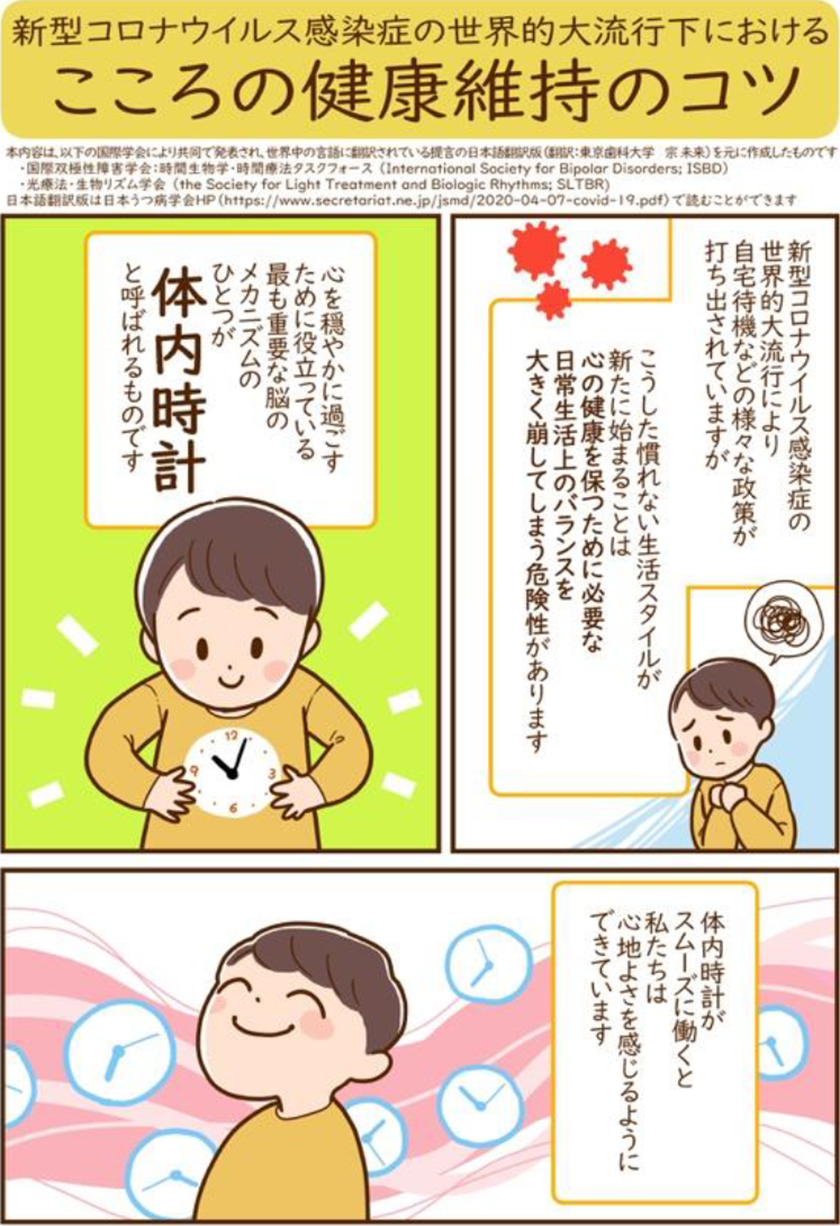
Public service announcement on social rhythms and mood during COVID-19 (representative panel, Japanese version). Note. Used with author Chiharu Umeyama’s permission.
Set up a routine for yourself while you are in quarantine or working from home; routines help stabilize body clocks Get up at the same time every day: a regular wake time is the most important input for stabilizing your body clock Make sure you spend some time outdoors every day, especially in the early morning; your body clock is regulated by the light–dark cycle If you can’t go outside try to spend at least 2 hours by a window, looking into the daylight and focusing on being calm Set times for a few regular activities each day such as home tutoring, telephone calls with a friend, or cooking; do these activities at the same time each day Exercise every day, ideally at the same time each day Eat meals at the same time every day; if you’re not hungry, at least eat a small snack Social interactions are important, even during social distancing; seek out “back and forth” social interactions where you share thoughts and feelings with another person in real time; videoconferencing, telephone, or real-time text-messaging is preferred to scrolling through messages; schedule these interactions at the same time every day Avoid naps during daylight hours, especially later in the day; if you must nap, restrict the nap to 30 minutes—napping can make it hard to fall asleep at night Avoid bright light (especially blue light) in the evening (e.g., computer screens, smartphones); blue spectrum light suppresses the hormone that helps us sleep
Our group is currently conducting an international multiwave survey study (Behaviour Emotion and Timing during COVID-19 [BEAT-COVID]) to investigate the relationship between COVID-19 restrictions, daily routines, mood, and sleep among people with mood disorders. The core hypothesis of BEAT-COVID is that weakened social rhythmicity (less stable daily routines) will be associated with increased levels of affective symptoms. Social rhythmicity is measured on a modified version of the Brief Social Rhythm Scale, 23 and depression is measured on the Patient Health Questionnaire. 24 Eligible participants (adults reporting having received a mood disorder diagnosis from a health professional) are being recruited through websites and mailing lists of consumer organizations in the United States, UK, New Zealand, Canada, Australia, and the Netherlands and invited to consent and complete an online questionnaire. Among the first 200 respondents, the vast majority (99.0%) reported that COVID-related social disruption had affected daily routines to at least some extent, and 57.9% described routines being “greatly affected.” Also as expected, less stable daily routines were associated with higher levels of depression in bivariate analyses, r (195) = .36, P = 0.000, and when controlling for age, gender, and country of origin in a regression (standardized β = 0.33, t = 4.87, P = 0.000).
Toward a Self-management Intervention to Support Social Rhythms among Those with Mood Disorders and Irregular Lifestyles
Arguments above provide theoretical and empirical grounds for seeking to improve social rhythmicity as a mood intervention for people with mood disorders, especially under lockdown conditions. As we write this, governments are progressively lifting lockdown requirements and if all goes well, COVID-19 lockdown may become a thing of the past. But lockdown is just one example of a social driver of impaired lifestyle regularity: Unemployment and other social dislocations remain a risk factor, particularly for people with preexisting mental disorders. We end this commentary with some considerations for a future circadian resilience intervention.
Content: In terms of formal interventions to improve daily routines, IPSRT and its variants are evidence-based interventions for improving mood outcomes (particularly depressive episodes and perhaps relapse prevention) among mood disorder patients.
25
But emerging evidence for active management of 24-hour light exposure (morning bright light, evening blocking of blue light, see Gottlieb et al.
3
) and the potential of integrating active and passive monitoring into digital treatments
26
should also be explored.
Modality: COVID-19 has led to a sea change in the acceptance and availability of digital mental health interventions. Even before COVID-19, the accessibility and cost advantages of digital interventions had encouraged large-scale investment by Australian and UK governments for high prevalence disorders including unipolar depression,
27
and there is growing evidence for the acceptability and safety of online interventions for serious mood disorder.
28
Importantly, an online version of social rhythm therapy has been piloted with promising results.
29
We know that online interventions must be delivered with some form of coaching support, with careful attention to user experience/interaction features including persuasive system design.
30
Codesign: As part of the BEAT-COVID survey, we are collecting qualitative data about particular social rhythm challenges and coping strategies that have emerged during lockdown. This data could form the basis of an initial set of discussions with end users about the detailed content and design of a novel online self-management intervention for developing circadian resilience under conditions of social disruption.
Conclusions
The year 2020 has taught us that no one can predict the future. However, strategic planning and investment must go on, and based on existing theory and data, this commentary highlights the public health importance of one particular pathogenic pathway in mood disorders. The circadian–behavior loop has sound scientific foundations, but as importantly, (i) there are grounds for believing that this pathway to illness can by modified through psychosocial interventions, and (ii) such interventions could be effectively and cost-effectively disseminated via digital self-management platforms.
Footnotes
Declaration of Conflicting Interests
The author(s) declared no potential conflicts of interest with respect to the research, authorship, and/or publication of this article.
Funding
The author(s) received no financial support for the research, authorship, and/or publication of this article.
