




Abstract
Introduction
Suicide prevention in youth, for whom suicide is the second leading cause of death, is a public health imperative. Bolstering coping strategies through universal school-based interventions offers potential primary prevention of risk of self-harm and suicide in youth. 1 While numerous suicide prevention interventions have been developed and implemented, effectiveness research remains scant, and the interventions are generally costly to implement, limiting “real-world” application. 2,3 The primary focus on imparting knowledge about suicide can be counterproductive, whereas stories of resilience and coping may impart protection (termed the Papageno effect) and mitigate the risks of focusing on suicide. 4 Our group previously published data regarding a unique resiliency curriculum imparting cognitive behavioural therapy (CBT) skills to youth through the 3rd book in the Harry Potter series. During the curriculum, youth learn to cope with distress alongside the protagonist and to recognize that the novel is an allegory for the author’s own coping efforts to overcome depression. 5 This prospective, pre–post, single arm intervention cohort feasibility study is the first to rigorously evaluate for effects on suicidality, anxiety, depression, and well-being in middle school-aged youth.
Method
Eight English teachers at a rural schoolboard in eastern Ontario were recruited to teach the curriculum with their grade seven and eight classroom students. The intervention was a novel study curriculum delivered over 3 months in January to April of 2019. Students read Harry Potter and the Prisoner of Azkaban and were taught CBT skills.
All subjects who, along with their parents, consented to participate in research completed 2 validated questionnaires—the Life Problems Inventory (LPI) and the Revised Children’s Anxiety and Depression Scale (RCADS), pre- and postintervention (i.e., late fall term/November 2018 and late spring term/May 2019, respectively). See Online Appendix for more details regarding the participants, curriculum, teacher training, data collection, and measures.
The primary outcome of interest was pre–post change in a composite variable of suicidality from four LPI items capturing attitude toward suicide as a way of coping, suicidal thoughts, suicide attempts, and self-injury without suicidal intent. Secondary outcomes were pre–post change in total LPI and RCADS scores. These analyses were run on SPSS version 24 using paired t-tests. Subanalyses examined differences according to high and low suicidality (see Online Appendix) and sex. Subanalyses were conducted via repeated measures MANOVA for global significance and subsequently analyzed using paired t-tests.
Results
A total of 176 students received the informed consent package with 83 (47%) consenting to enrollment into the study. Of these, 78 (94%), including 50 girls and 28 boys, had both pre- and post-measures and comprised the group used for data analysis. Results of the primary analysis are shown in Table 1. Suicidality scores improved by 44% following the curriculum with significant reductions for each of the four suicide questions. LPI scores also decreased by 11% overall with no significant change in RCADS scores (43.29 ± 24.59 vs. 40.37 ± 24.32; t = 1.48 df = 77; P = 0.14). Results of subanalyses are presented in supplementary Table 1.
Comparison of Suicidality, Life Problems Inventory (LPI), and Revised Children’s Anxiety and Depression Scale (RCADS) Scores in Middle Schoolers (N = 78) Prior to and After the Harry Potter Intervention.
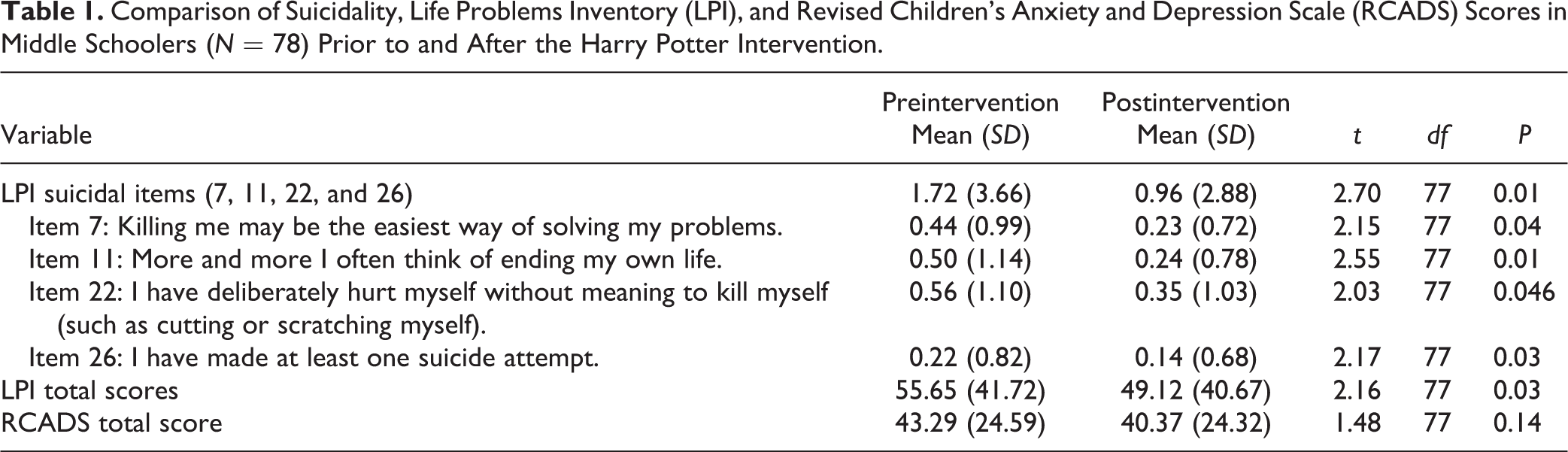
There were 50% and 32% reductions in suicide scores in the high and low suicide groups, respectively, with only the former significant. Sex-based subanalysis demonstrated significant improvements on the LPI and RCADS in boys (25% and 33% reductions) with a 75% reduction in suicidality scores that approached significance. Composite suicidality scores (P = 0.03) and suicidal ideation (P = 0.02) were significantly reduced in girls.
Discussion
This study found that a teacher-delivered, literature-based CBT skills curriculum was feasible and associated with reduced suicidality (ideation and behavior) in middle school-aged youth. The large (75%) numerical reduction in suicidality in boys along with an improvement in emotional dysregulation (33% reduction) as well as depression and anxiety scores (25% reduction) is notable given that males comprise the majority of suicide deaths. Furthermore, youth with high premorbid suicidality showed the largest reduction although both high and low suicidality groups experienced numeric improvement. This finding is noteworthy as suicide is an infrequent outcome in youth, and those who are at high risk represent only a small fraction of the general population. Yet, the fact that we observed significant improvement in this group is consistent with the notion that the intervention may provide general benefits but also targeted ones to those at greatest risk. Despite the fact that emotional dysregulation, depression, and anxiety symptoms were unchanged in girls, suicide scores diminished significantly by 30%. Taken with the primary findings, this suggests that the intervention had its intended result—that is, even those youth who continued to experience emotional distress learned how to manage it more effectively. This study had several limitations that are outlined in detail in Online Appendix, most importantly the lack of a control group. Nevertheless, it provides preliminary evidence of the potential feasibility and value of a simple, teacher-delivered, universal preventive intervention in schools. Further research with larger samples is warranted to evaluate this curriculum as a potential widespread approach to suicide prevention in youth.
Supplemental Material
Supplemental_material - The Feasibility of a Harry Potter–based Cognitive Behavioural Therapy Skills Curriculum on Suicidality and Well-being in Middle Schoolers
Supplemental_material for The Feasibility of a Harry Potter–based Cognitive Behavioural Therapy Skills Curriculum on Suicidality and Well-being in Middle Schoolers by Paula Conforti, Rabia Zaheer, Benjamin I. Goldstein, Anthony J. Levitt, Ayal Schaffer, Mark Fefergrad, Amy H. Cheung and Mark Sinyor in The Canadian Journal of Psychiatry
Footnotes
Authors’ Note
This study was approved by the Sunnybrook Health Sciences Research Ethics Board (238-2018).
Acknowledgments
We thank the staff and students at the Catholic District School Board of Eastern Ontario for their enthusiasm and participation in this project. Dr. Sinyor would also like to give special thanks to J.J. Sinyor for helping him devise the idea for the study.
Declaration of Conflicting Interests
The author(s) declared the following potential conflicts of interest with respect to the research, authorship, and/or publication of this article: MS declares that he has received in-kind assistance from staff at Google Canada to develop the intervention described here into a free website for teachers and youth.
Funding
The author(s) disclosed receipt of the following financial support for the research, authorship, and/or publication of this article: This work was supported by the Ontario Ministry of Research and Innovation (ER17-13-161). Salary funding for Dr. Sinyor was provided in part by Academic Scholars Awards from the Department of Psychiatry, University of Toronto and the Department of Psychiatry, Sunnybrook Health Sciences Centre.

Supplemental Material
The supplemental material for this article is available online.
References
Supplementary Material
Please find the following supplemental material available below.
For Open Access articles published under a Creative Commons License, all supplemental material carries the same license as the article it is associated with.
For non-Open Access articles published, all supplemental material carries a non-exclusive license, and permission requests for re-use of supplemental material or any part of supplemental material shall be sent directly to the copyright owner as specified in the copyright notice associated with the article.
