




Abstract
Objective:
Recent studies suggest that youth who have a mental health problem are more likely to be NEET—not in education, employment, or training—but findings remain mixed, and evidence from Canada is limited. We examined this association across a range of mental and substance disorders in a representative sample of Canadian youth.
Method:
Data were from the 2012 Canadian Community Health Survey–Mental Health (n = 5622; ages 15-29). The survey identified past-year mental (depression, bipolar, generalized anxiety) and substance (alcohol, cannabis, other drugs) disorders from a structured interview and included questions on suicidal ideation. We classified as NEET respondents who were not in school or employed in the past week. Logistic regression models tested the associations between mental and substance disorders and NEET status, adjusted for sociodemographic, health, and geographic variables.
Results:
About 10% of youth were NEET. Being NEET was associated with past-year depression (odds ratio [OR] = 1.67; 95% confidence interval [CI], 1.06 to 2.63); bipolar (OR = 2.31; 95% CI, 0.98 to 5.45), generalized anxiety (OR = 2.65; 95% CI, 1.37 to 5.12), and drug use (OR = 3.22; 95% CI, 1.33 to 7.76) disorders; and suicidal ideation (OR = 1.75; 95% CI, 0.99 to 3.09) but was not associated with alcohol (OR = 1.03; 95% CI, 0.63 to 1.69) or cannabis (OR = 0.97; 95% CI, 0.47 to 2.00) disorders.
Conclusions:
Poor mental health was associated with being NEET in Canadian youth. Efforts targeting NEET should include provisions for mental health. Moreover, youth mental health initiatives should consider educational and employment outcomes. Further longitudinal and intervention studies are warranted.
In the past 2 decades, advanced economies have grown increasingly concerned over the number of young people who struggle to transition from education into the workforce. 1,2 These young individuals, categorized as NEET—not in education, employment, or training—represent 14.0% of the population aged 15 to 29 in the countries of the Organisation for Economic Co-operation and Development (OECD), with national percentages ranging from 5.3% to 28.8% in 2016. 3 In Canada specifically, 13.8% of youth were NEET in 2016, representing about 1 in 7 young Canadians. 3,4 The economic and social costs of being NEET are substantial for young people, who are often disempowered, discouraged, and excluded, during a time in their lives when investments in skills and work experience can be foundational for their future. 5 –7
In addition, being NEET has been linked to symptoms of depression, anxiety, suicidality, and addiction. 8 –11 Poor mental health seems to increase the risk of becoming or remaining NEET. 11 –13 One study found that youth who experienced repeated symptoms of depression or anxiety during their adolescence (from the ages of 14 to 17 years) had 60% greater odds of being NEET at ages 20 to 21 compared to their peers. 13 Similarly, another study reported that young men (age range 17-28 years) with high depressive symptoms had an 11% greater odds of being NEET 15 months later. 11 Likewise, being NEET seems detrimental for mental health and well-being. 14 –16 In 1 study, adolescents who were NEET at age 15 years had increasing depressive symptoms over the next 2 years while their peers in school or at work experienced no change or a decrease in symptoms. 14 In another study, young individuals who were NEET during adolescence (ages 12-17 years) had a 1.7 times greater risk of developing mood disorders and a 2.4 times greater risk of attempting suicide 7 years later compared to their peers who were in school. 15 While the term NEET itself is not ubiquitous, the connection between vocational engagement and mental problems is also evinced by the broader literature on the links between school disengagement (i.e., early school leaving or dropout) 17,18 and unemployment 19,20 and poor mental health among youth.
However, NEET status has not been found to be consistently associated with all mental and substance use disorders. 9 –15,21 For example, 1 study 10 found that NEET status was associated with depression, anxiety, and addictive behaviours, while another 12 found the same association with anxiety but not with depression or substance use disorders. Similarly, several studies reported an association between being NEET and alcohol misuse, 8,10,15 but others found no such association, 12,22 and 1 study found an inverse relationship. 9 Furthermore, research indicates that NEET status relates to mental health differently across sociodemographic groups, such as sex, age groups, and socioeconomic classes. 1,10,16,21,23 In the Canadian context, evidence for the NEET–mental health connection comes from 1 study on service-seeking youth. 21 This connection has not yet been examined in the general youth population. This information is needed to design interventions and policies aimed at improving the productivity and well-being of young Canadians and ensuring their successful transition from education into employment.
The aim of this study was therefore to describe the associations between a broad range of mental and substance disorders and being NEET and provide evidence for these associations in Canada using a representative sample of youth. Since the relationship may vary by sociodemographic groups, we explored variations across sex, age, education, and income classes. We hypothesized that higher prevalence of mental health problems would be associated with being NEET.
Methods
Participants
Data were from the 2012 Canadian Community Health Survey–Mental Health (CCHS-MH), a nationally representative cross-sectional survey of 25,113 Canadians 15 years of age and older. 24,25 The survey used a 3-stage stratified cluster sampling design covering the Canadian population living in all 10 provinces. The CCHS-MH did not include Canadian territories and excluded individuals living on reserves and other Aboriginal settlements, full-time members of the Canadian Forces, and the institutionalized population. The interviews were conducted using computer-assisted interviewing. No proxy interviews were permitted. For this study, we included individuals between the ages of 15 and 29 (n = 5630), in line with Canadian and international definitions of NEET status, 3,4,26,27 and excluded those with missing data on school and work status (n = 8), for a total sample of 5622 participants.
Measures
NEET
The CCHS-MH survey asked respondents if they had worked at a job in the past week, including full-time and part-time (yes, no, or permanently disabled) and whether they had a job or business from which they had been absent in the past week (yes, no). The survey also asked whether respondents were currently attending a school, college, CEGEP, or university (yes, no). We classified respondents as NEET if they reported being neither in school (part-time or full-time) nor working in the preceding week, consistent with the OECD measurement of NEET status. 3,4 Individuals not working because they were absent from work or had a permanent disability were not considered NEET. In sensitivity analyses, we further categorized school and work status into 4 groups: school only, work only, school and work, or NEET.
Mental health measures
We included information on mental and substance disorders and suicidal thoughts in the past year. The CCHS-MH identified past-year mental or substance disorders based on criteria from the fourth edition of the Diagnostic and Statistical Manual of Mental Disorders (DSM-IV), using a modified version of the World Health Organization–Composite International Diagnostic Interview 3.0 (WHO-CIDI). 28 The survey assessed 3 mental disorders, including major depression, bipolar (both bipolar I and II) disorder, and generalized anxiety disorder (GAD), and 3 substance disorders, including alcohol, cannabis, and other drug dependence or abuse. The other drug use category included club drugs, heroin, solvents, or other illicit drugs or nonmedical use of stimulants, sedatives, or analgesics. Suicidal ideation was assessed by asking respondents if they ever thought about committing suicide or taking their own life in the past year.
Covariates
We selected health, socioeconomic, and geographic variables identified in the literature that could confound the association between mental health and NEET status. 29 –31 Health variables included reports of any chronic physical health condition (asthma, arthritis, back problems, high blood pressure, migraine, diabetes, heart disease, cancer, stroke, bowel disorder/Crohn’s disease/colitis, chronic fatigue syndrome, or multiple chemical sensitivities) and any neurodevelopmental disorder typically diagnosed in childhood (learning disability or attention-deficit hyperactivity disorder). Socioeconomic variables included information on age (15-19 years, 20-24 years, 25-29 years), sex (female, male), cultural or racial origin (white, nonwhite), immigrant status (born in or outside of Canada), education level (less than secondary school, secondary school graduation, some postsecondary school, postsecondary school graduation), living arrangement, and the household income decile of respondents. The CCHS-MH categorized living arrangements as unattached individual living alone, unattached individual living with others, spouse/partner living with spouse/partner, parent living with spouse/partner and children, single parent living with children, child living with a single parent, child living with 2 parents, and other. Household income represented the ratio of the household income to the low-income cutoff, adjusted for household and community size, and was divided into deciles. Geographic information included the urbanicity (lives in census metropolitan area or not) and province of residence to capture potential regional differences in culture, economies, and resources.
Statistical Analysis
Statistical analyses were conducted in Stata (version 14.1; StataCorp, College Station, TX). All analyses were weighted using survey weights to ensure that results were representative of youth in Canada. To account for the complex sampling design of the survey, we estimated variance and 95% confidence intervals (CIs) using bootstrap weights provided by Statistics Canada.
We conducted descriptive analyses of the sample by NEET status. We then examined the association between each mental health measure and being NEET separately, using logistic regressions. All models were adjusted for socioeconomic, health, and geographic variables. Covariates had less than 1% missing data.
We examined potential effect modification by separately testing interaction terms between each mental health measures with sex, age group, education level (less than secondary school graduation, secondary school graduation or above), and household income (low: bottom 2 quintiles; not low: top 3 quintiles) in the main models and conducted stratified analyses when the interaction terms were significant. In sensitivity analyses, we compared NEET status to school only, work only, and school and work to check whether results were sensitive to the choice of reference group, as previously observed. 14,15
Results
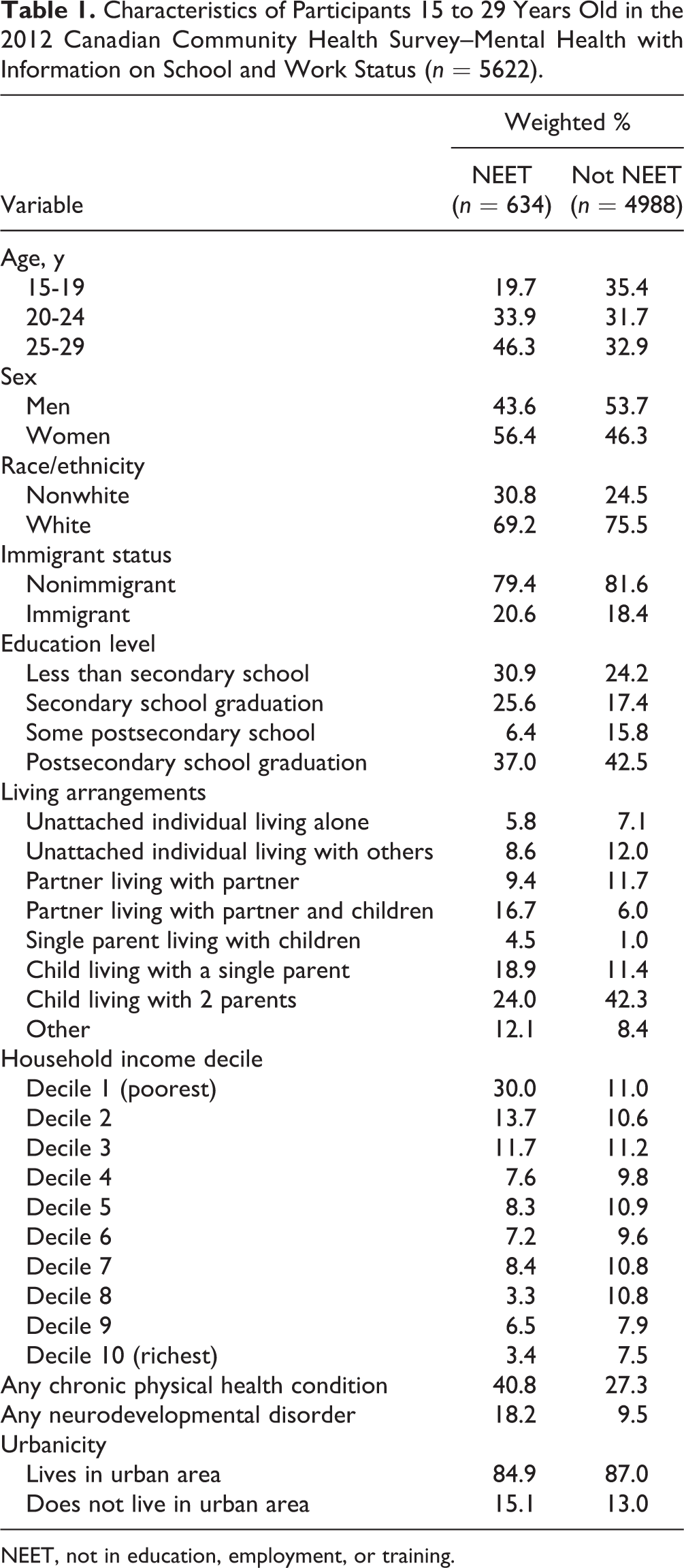
Youth who were NEET represented 9.6% (95% CI, 8.4 to 10.9; weighted) of the sample. Characteristics of respondents by NEET status are presented in Table 1. Briefly, youth who were NEET were more likely to be female, older, and nonwhite and have less education. They were also more likely to come from a lower-income household and be living with children. Furthermore, they reported having chronic health problems and neurodevelopmental disorders almost twice as much as their peers.
Characteristics of Participants 15 to 29 Years Old in the 2012 Canadian Community Health Survey–Mental Health with Information on School and Work Status (n = 5622).
NEET, not in education, employment, or training.
Regression analyses indicated strong associations between having a mental disorder or suicidal ideation in the past year and being NEET (Figure 1 and Suppl. Tables S1-S7). Individuals who experienced major depressive disorder in the past year had about twice the odds of being NEET (odds ratio [OR] = 1.67; 95% CI, 1.06 to 2.63), those who experienced bipolar or generalized anxiety disorders had about 2.5 times the odds (OR = 2.31; 95% CI, 0.98 to 5.45 and OR = 2.65; 95% CI, 1.37 to 5.12, respectively), and those who reported suicidal thoughts had close to twice the odds (OR = 1.75; 95% CI, 0.99 to 3.09). There was no association between past-year alcohol and cannabis use disorders and NEET status (OR = 1.03; 95% CI, 0.63 to 1.69 and OR = 0.97; 95% CI, 0.47 to 2.00, respectively; Figure 1 and Suppl. Tables S4 and S5). However, other drug dependence or abuse was linked to 3 times greater odds of being NEET (OR = 3.22; 95% CI, 1.33 to 7.76; Figure 1 and Suppl. Table S6). Findings were similar when using school only, employment only, or both school and employment as a reference group, respectively (Suppl. Tables S8, S9, and S10, respectively). We found no evidence of effect modification by sex, age, education groups, or household income (P value of Wald test of interaction >0.05).
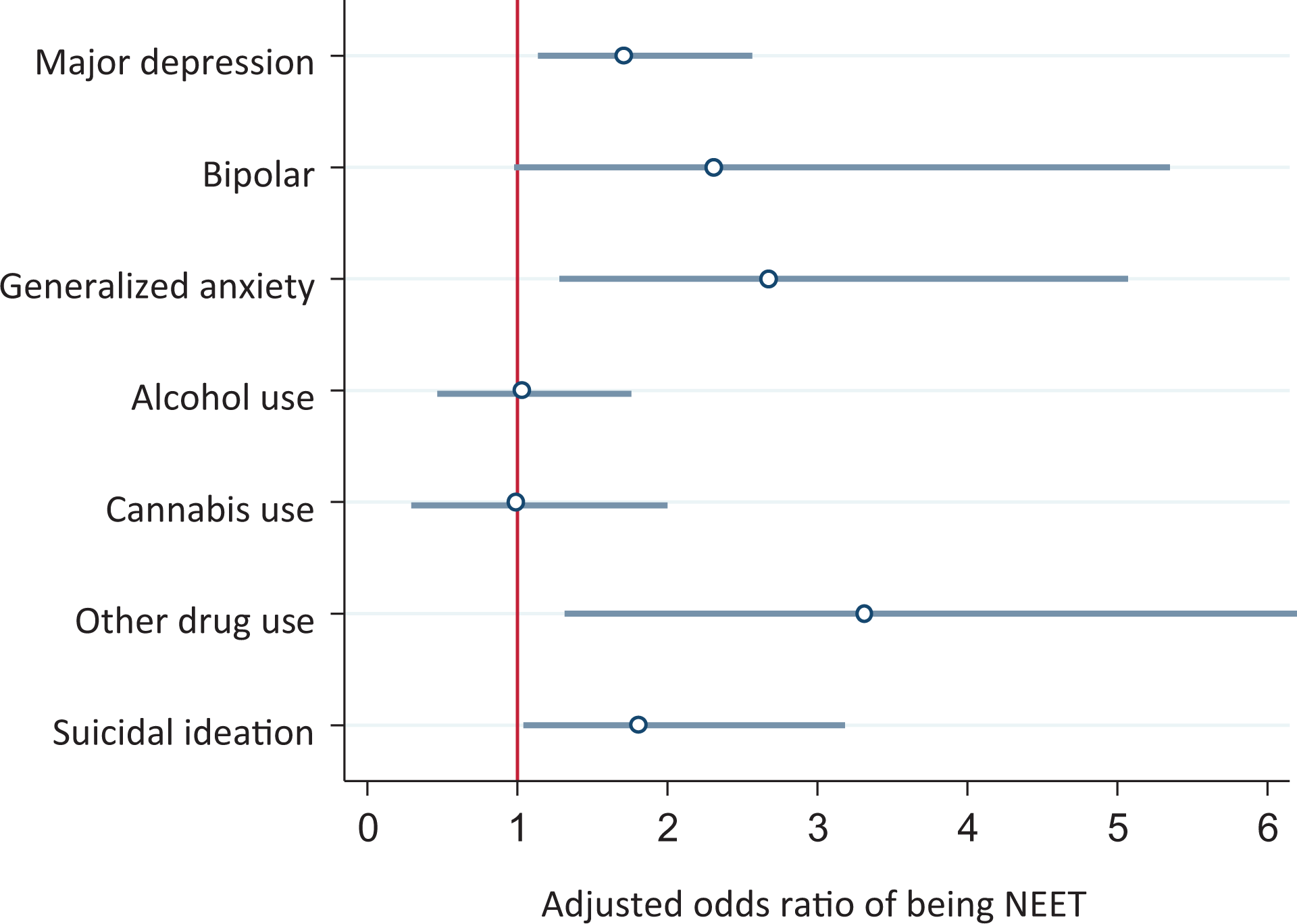
Associations between past-year mental and substance disorders and suicidal ideation and being not in education, employment, or training (NEET) in Canadian youth: adjusted odds ratios and 95% confidence intervals. All models were adjusted for socioeconomic characteristics (age, gender, race/ethnicity, immigrant status, education level, living arrangement, household income decile), health variables (any chronic physical health condition, any neurodevelopmental disorder), and geographic factors (urbanicity, province) and were weighted using survey weights. Confidence intervals were estimated using bootstrap weights. Full results from the regression models are available in Supplemental Tables S1 to S6.
Discussion
This study reports on the associations between a range of mental and substance disorders and being NEET in Canada. Results from a large representative sample indicate that young Canadians who had a mental disorder (including major depression, bipolar disorder, and generalized anxiety disorders), a problem with drug abuse or dependence (excluding cannabis), or suicidal thoughts in the past year were more likely to be NEET than their peers, independent of socioeconomic, health, and geographic factors. Alcohol or cannabis use disorders were not associated with being NEET. Furthermore, there was no evidence that the link between mental and substance disorders and a NEET status varied across sex, age, education, or income class. This study adds to the growing body of research that demonstrates a connection between having mental health problems and being NEET, 1,9 –16,21,23 and strengthens the evidence that this association differs across mental and substance disorders. 9 –15,21 Specifically, our results are in line with previous studies showing an association between NEET status and depression, 8,10,11,14,15,22 anxiety, 10,12,14 and suicidal ideation, 15 as well as the larger literature linking mental disorders with school disengagement 17 and unemployment 19 in young people. Our study is the first to examine and extend this association to bipolar disorder. These results provide a first look at the associations between mental and substance use disorders and being NEET among youth in Canada. While our findings may diverge from some studies reporting no link with depression, 12,32 anxiety, 8,22 and suicidal ideation, 9,12 these differences support the notion that the relationship between mental health and being NEET is complex and context specific.
The link between mental disorders and NEET status has been shown to be bidirectional. 11,14,15 The general understanding is that, on the one hand, having a mental disorder can affect the ability to successfully cope with school or work stress or deplete the drive, motivation, and energy needed to enter the workforce or continue training. On the other hand, being NEET is a stressful situation that affects the financial, social, and life opportunities of individuals, as well as their access to support and resources typically found in more structured environments like school and the workplace, ultimately leading to discouragement, disengagement, and mental health problems. Driving these mechanisms might also be more complex feedback loops, dynamic interactions, and contextual effects, such that the risk of having a mental disorder and being NEET is shaped by specific social, economic, and political contexts and might spread across networks of individuals. 33 For instance, some of the differing associations between mental disorders and NEET status in the literature could reflect cultural and political diversities between studies from the United Kingdom, 10,14 Australia, 13,22,32 Mexico, 8,15 Italy, 9 Ireland, 12 and Switzerland, 1 such as differences in out-of-work benefits or policies to prevent early school leaving, 31 or different economic realities at the time the surveys were conducted, such as during recessions. 34 These discrepancies may also be attributable to specific study populations. For example, studies of service-seeking youth reported fewer differences in mental health problems by NEET status 21,22,32 compared with population-based studies. 8,10,11,14,15 Research using longitudinal data over multiple time points and that considers complex dynamic interactions is needed to clarify the causal framework.
There was little evidence that Canadian youth who were NEET were more likely to misuse alcohol or cannabis compared to their peers. Similar findings have been reported elsewhere, 11 –13,22 although not consistently, 8,10,15 and differ from evidence linking cannabis use specifically to youth unemployment 35 and school dropout. 17 Further research is needed to confirm these findings. Nonetheless, these results indicate that prevention and intervention strategies aimed at alcohol or cannabis misuse should target all young Canadians irrespective of their NEET status. In contrast, youth with a drug use disorder (other than cannabis) were more likely to be NEET, reflecting findings from other studies. 8,15 Individuals with drug abuse or dependence problems might struggle to stay in school 17,18 and to transition into work 19,20 because of their addiction or drug use–related effects, or they might turn to drugs to cope with the stress of being unemployed and out of school. Studies show that drug use and unemployment are correlated in youth and adults, 36,37 including during the current opioid crisis in the United States. 38,39 More research is needed to understand the drivers of this association and develop tailored interventions for youth who are both NEET and have a drug use disorder.
This study is the first to examine the associations between mental health and substance use problems and being NEET in the general youth population of Canada. We used data from a large representative sample of young people across Canada, conducted effect modification and subgroups analyses to identify vulnerable sociodemographic subpopulations, and applied sensitivity analyses to test the robustness of our results. This study also had limitations. The data were cross-sectional, and the direction of effects could not be assessed. The survey asked about current student status and past-week employment. Current or past-week NEET status are currently the most widely used definitions of NEET in the literature. 3,4,8 –16 Nonetheless, information about the duration, onset, and recurrence of the NEET status could yield more nuanced insights. In Canada, school is compulsory until age 16 or 18, depending on the province. Therefore, NEET youth younger than the compulsory age of school attendance are expected to be absent from school temporarily because of various factors (e.g., school trips, sports, health problems), potentially biasing results toward more conservative estimates. The prevalence of youth who were NEET was lower in our data (10%) than in the 2012 OECD data for Canada (13%), 3 suggesting the potential for selection bias. Although we carefully controlled for many socioeconomic, health, and geographic variables, there may be other confounding factors that were not included in our study.
Conclusions
In Canada, poor mental health was associated with being NEET. This association held across a spectrum of mental health problems, including mental disorders, drug use disorder, and suicidal thoughts. According to the latest estimates, up to 1 in 7 young Canadians are NEET 3 and at risk for a number of poor outcomes and lifelong vulnerabilities. 5 –7 This study suggests that efforts to reduce the public and personal impacts of being NEET should include provisions for the prevention and treatment of mental health problems. Furthermore, youth mental health initiatives should focus on educational and employment reintegration to prevent NEET status and associated downward spirals. Intervention and policy impact studies are recommended. Future longitudinal studies are needed to clarify the nature of the relationship between NEET status and mental health in different subgroups and over time.
Supplemental Material
Supplemental Material, 815899_supplemental_materials - The Mental Health of Young Canadians Who Are Not Working or in School
Supplemental Material, 815899_supplemental_materials for The Mental Health of Young Canadians Who Are Not Working or in School by Geneviève Gariépy and Srividya Iyer in The Canadian Journal of Psychiatry
Footnotes
Data Access

Acknowledgements
The estimates reported in this article are derived from data collected by Statistics Canada, but the analysis and results are the sole responsibility of the authors and do not reflect the views of Statistics Canada.
Declaration of Conflicting Interests
The author(s) declared no potential conflicts of interest with respect to the research, authorship, and/or publication of this article.
Funding
The author(s) disclosed receipt of the following financial support for the research, authorship, and/or publication of this article: The Public Health Agency of Canada funded the Canadian Community Health Survey in Canada. This study was also supported by a salary grant and a research grant from the Canadian Institutes for Health Research awarded to S.I. G.G. is supported by a postdoctoral fellowship from the Canadian Institutes for Health Research.
Supplemental Material
Supplemental material for this article is available online.
References
Supplementary Material
Please find the following supplemental material available below.
For Open Access articles published under a Creative Commons License, all supplemental material carries the same license as the article it is associated with.
For non-Open Access articles published, all supplemental material carries a non-exclusive license, and permission requests for re-use of supplemental material or any part of supplemental material shall be sent directly to the copyright owner as specified in the copyright notice associated with the article.
