




Abstract
Objective:
Housing First (HF) has been linked to increased tenure in housing for homeless people with mental illness, but the effect of HF on housing stability for people with borderline or lower intellectual functioning has not been examined. This study of homeless adults with mental illness in Toronto, Ontario assessed whether the association between housing stability and HF differed for adults with borderline or lower intellectual functioning, compared to adults with above borderline intellectual functioning.
Method:
This study included 172 homeless adults with mental illness from the Toronto site of the At Home-Chez Soi randomized trial that compared receiving HF relative to treatment as usual. This sample was divided into two intellectual functioning groups: 1) adults with borderline or lower intellectual functioning (IQ < 85, 16%), and 2) adults with above borderline intellectual functioning (IQ ≥ 85, 84%). We compared these groups by modelling the percentage of days stably housed using a linear multivariable generalized estimating equation and included interaction between treatment and intellectual functioning. An interaction between treatment and time was also included.
Results:
There were no overall differences in housing stability for individuals with borderline or lower intellectual functioning compared to people with higher than borderline intellectual functioning in either the HF or the treatment as usual groups.
Conclusion:
This study is the first to demonstrate that for homeless adults with mental illness, borderline or lower intellectual functioning did not significantly affect housing stability. This accentuates the need for more research and potentially wider consideration of their inclusion in housing interventions, such as HF.
Keywords
Background
Housing First (HF) has been linked to increased tenure in housing for homeless people with mental illness. 1 –3 While cognitive impairment is prevalent among homeless people, 4,5 the effect of HF on housing stability for people with borderline or lower intellectual functioning (IF) has not been examined. This is particularly important because persons with low IF and intellectual disabilities have been shown to be overrepresented in homeless populations internationally, with prevalence estimates ranging from 12% to 37%. 6 –9 Moreover, since homeless people with low IF may require additional supports to exit homelessness, 9 they have traditionally not been considered good candidates for independent housing models. This study assessed whether the overall association between housing stability and HF depended on the level of premorbid IF for homeless adults with mental illness in Toronto, Ontario.
Methods
Sample
The study sample was composed of homeless adults with mental illness who were part of the Toronto site of the At Home-Chez Soi (AH/CS) randomized trial, which examined the effectiveness of HF in the Canadian context. HF is an intervention that treats housing as a human right and prerequisite for recovery. HF provides immediate access to housing and support services to homeless people with mental illness, without preconditions of treatment or sobriety. Individuals who had experienced both homelessness and serious mental illness were eligible. Participants were classified by support need level. Individuals in HF with high needs were provided with assertive community treatment, and individuals with moderate need were provided with intensive case management. Individuals randomized to the control group received no specific intervention but had access to locally available services (treatment as usual [TAU]). 10,11 More information on study protocols are provided elsewhere. 11,12
Housing information was collected for 575 enrolled participants who were followed for 2 years between 2009 and 2013. IF was assessed from 2016 to 2017 at the end of a continuation study on the long-term outcomes of HF. At this time, 364 of 575 participants (63%) were available. IF was assessed for 172 of the 364 individuals (47%) who were native literate English speakers and 70 years or younger at the time of assessment. Based on Fisher’s exact test, this sample was not significantly different from the remaining available individuals (n = 192) at assessment in terms of sex, level of mental health need, presence of mental illness diagnoses, alcohol abuse/dependence, or any traumatic brain injuries in the past 6 months. The IF-eligible sample, however, was significantly different in age, likely due to the exclusion of people older than 70 years (P = 0.04), and included a greater proportion of substance abuse/dependent individuals (P < 0.001).
The AH/CS study was approved by the institutional research ethics board at St. Michael’s Hospital and was registered with the International Standard Randomized Control Trial Number (ISRCTN 42520374) on August 18, 2009.
Variables
Housing information was reported by participants during interviews conducted every 3 months. Housing was defined as stable when individuals were expected to remain in the same housing for 6 months or more. The primary outcome was percentage of days stably housed during the previous 6 months, evaluated at 6-, 12-, 18-, and 24-month follow up.
While the IF of homeless persons often declines due to mental illness, homelessness, or acquired brain injury, 13 the Revised New Adult Reading Test (NAART/NART-R) identifies IF and cognitive limitations that begin in childhood (e.g., intellectual disabilities). It was used to measure premorbid IF in our study, similar to prior studies of premorbid IQ in homeless persons with mental illness. 13,14 To complete the NART-R, participants were asked to read 61 English words that do not follow regular grapheme-phoneme rules. 13,15 Similar to prior research, 9,16 verbal intelligence scores from the NART-R were converted to IQ scores, which were used to create 2 IF groups with scores 1) less than 85 (IQ scores less than 71 indicate intellectual disabilities, and scores from 71 to 84 indicate borderline [low IF]) and 2) greater than 84 (above borderline IF).
Analysis
For descriptive purposes, Mann-Whitney tests were used to compare the distribution of participants’ percentage of days in stable housing aggregated over the entire 24-month follow-up period between treatment groups, between IF groups, and between IF groups within treatment groups. To depict the role of time, we graphed the mean percentage of days in stable housing per 6-month period for people in each treatment overall and treatment by IF group.
We modelled the percentage of days stably housed during the 6-month period using a linear multivariable linear generalized estimating equation (GEE) with an exchangeable correlation structure that accounts for repeated measures from the same participant over time. The model included interactions between treatment and IF and between treatment and time. The relevant main effects of treatment, IF, and time were included. Time was in years and centered to be 0 at 6-month follow-up. Because the NART-R may overestimate IQ for people with lower IQ scores (i.e., below 90), 17 –19 we ran sensitivity analyses using different IF group cutoffs (90 and 95).
All statistical tests were 2-tailed, and statistical significance was defined as P < 0.05. Data analysis was conducted using R (version 3.4.1)
Results
The total sample had a mean premorbid IQ score of 96.94 (SD, 10.70). In the HF group (n = 103), 18 (17%) participants had low IF. In the TAU group (n = 69), 10 (14%) participants had low IF. As reported elsewhere, 9 the low IF group (n = 28, 16%) included more immigrants and persons with high school education or lower than the above borderline IF group (n = 144, 84%). Groups did not differ significantly in age, gender, ethnicity, disability income support, mental health disorders, addictions disorders, symptom severity, arrests, or community provider visits, as indicated by Fisher’s exact tests.
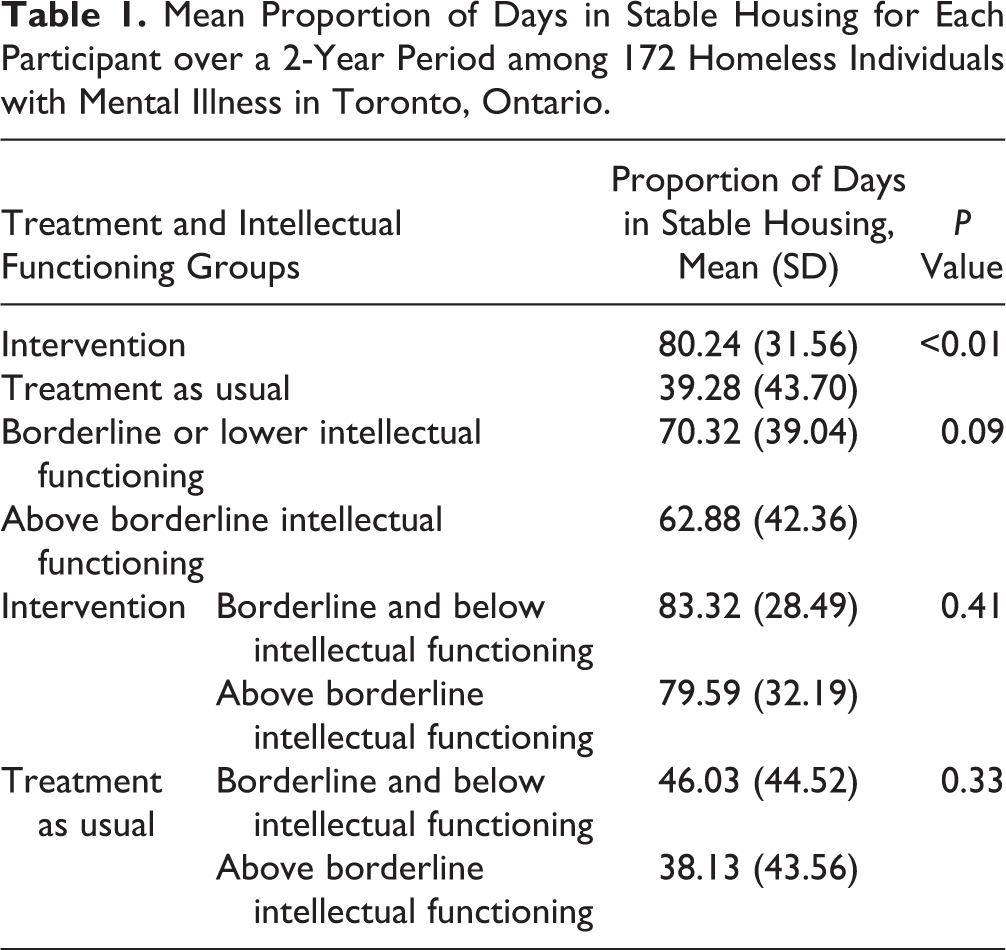
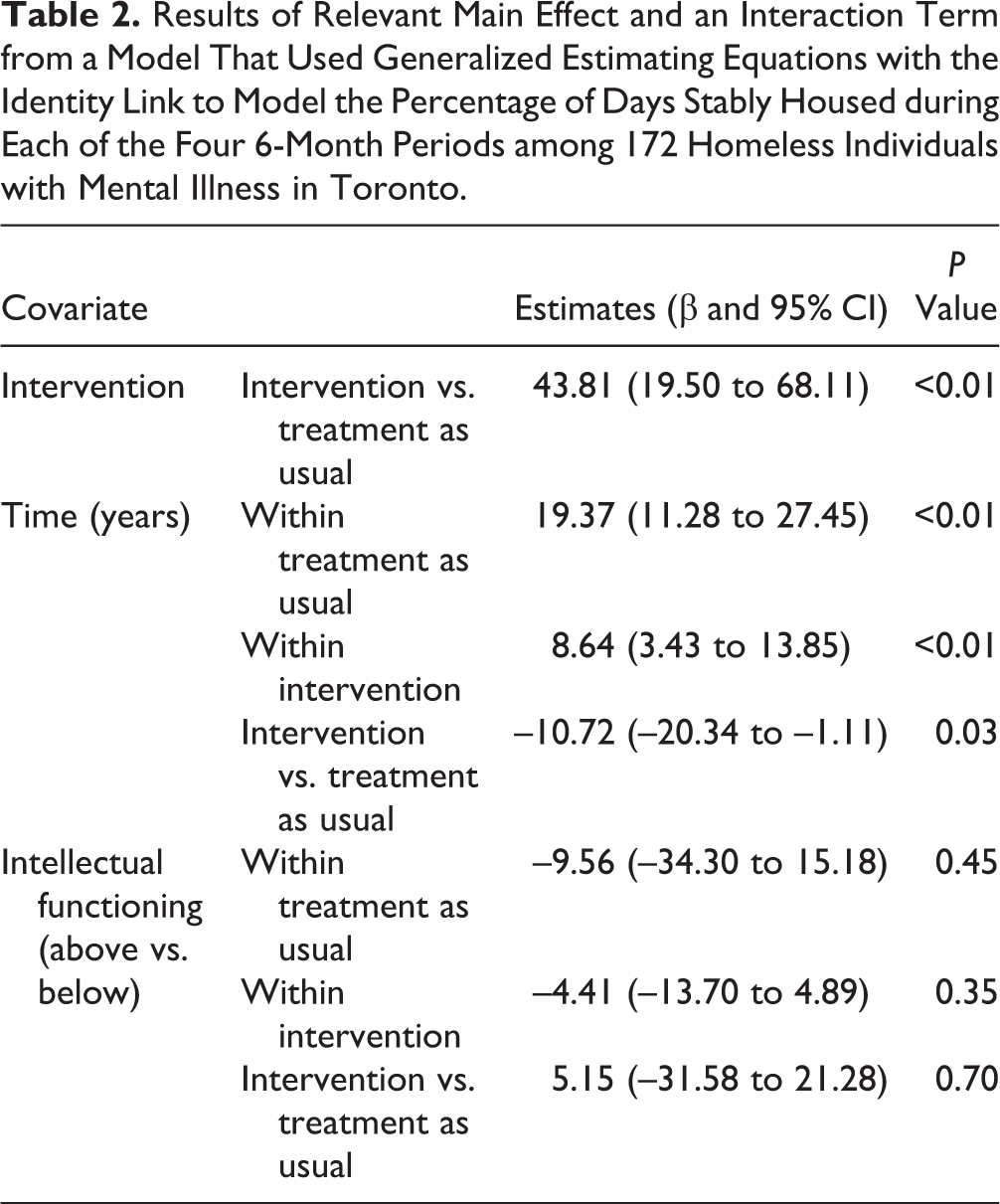
As reported previously, 1,10 the HF group had a higher percentage of days stably housed over the entire 24-month follow-up period, but there were no significant differences between IF groups in either treatment arm (Table 1; Figure 1). Likewise, in the GEE model, IF was not related to housing stability in either treatment arm (HF: β = –4.41, P = 0.35; TAU: β = –9.56, P = 0.45, for above versus low IF), and the relationship between the IF group and housing stability was not different in HF compared with TAU (β = 5.15, P = 0.70; Table 2). No changes in findings emerged from the sensitivity analyses using different IQ cutoffs.
Mean Proportion of Days in Stable Housing for Each Participant over a 2-Year Period among 172 Homeless Individuals with Mental Illness in Toronto, Ontario.
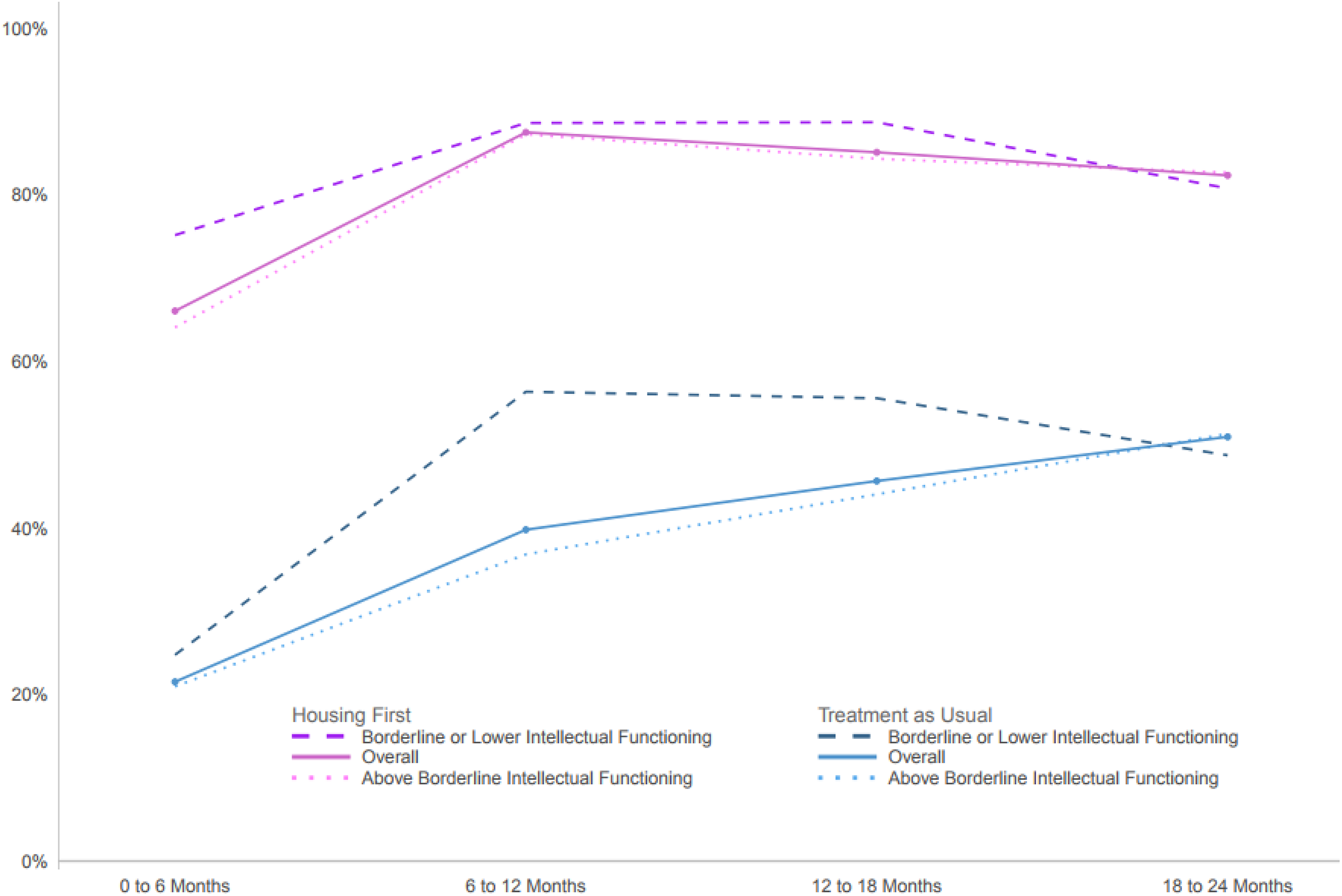
Mean percentage of days in stable housing during 6-month periods from randomization until 2 years postrandomization for the Housing First group and treatment as usual group by intellectual functioning group for 172 participants in the At Home/Chez Soi study in Toronto, Ontario.
Results of Relevant Main Effect and an Interaction Term from a Model That Used Generalized Estimating Equations with the Identity Link to Model the Percentage of Days Stably Housed during Each of the Four 6-Month Periods among 172 Homeless Individuals with Mental Illness in Toronto.
Discussion
As previously established, HF for homeless individuals with mental illness was associated with greater housing stability. Importantly, however, this study found that IF did not affect housing stability for participants in either the HF or the TAU groups, suggesting that interventions for homeless populations should not exclude those with intellectual deficits. This is the first study to illustrate that scattered site–independent housing with off-site support services was similarly successful in increasing housing tenure for homeless people with low IF and normal or higher IF.
Discussions on increasing access to independent housing models with off-site support services have generally revolved around homeless people with mental illness, so it is not surprising that people who also have low IF, such as those with intellectual disabilities, may struggle more to access housing. 9 The finding that in these housing models people with low IF fare as well as others accentuates the need for wider consideration of their inclusion in housing interventions, such as HF. The present findings also highlight the need to further investigate the impact of HF on other important outcomes (e.g., subjective well-being, ability to perform activities of daily living, hospital use, and criminal justice involvement). 6,20 Research on a homeless population from the Netherlands showed that the needs of individuals with suspected intellectual disabilities (e.g., support with finances) may be more enduring than for other homeless people. 6,21,22 It is possible that individuals with low IF are less able transition out of high-support models than other persons with mental illness, emphasizing the need for a greater supply of appropriate housing and support models.
Limitations
As noted earlier, the NART and NART-R can be applied only to literate, native English speakers. Also, as the NART overestimates IQ at the lower range, 17 –19 we conducted sensitivity analyses to examine the effect of using higher IQ cutoffs. In addition, the IQ cutoff between an intellectual disability and borderline IF (70) is lower than the minimum IQ score derived from the NART-R, meaning that our low IF group includes both people with borderline IF and people with intellectual disabilities. Previous studies have also combined these groups 8,16 to draw attention to the needs of this distinct homeless subgroup. Finally, the small sample of people with low IF prevented us from investigating the separate effects of intensive case management and assertive community treatment. It also prevented the inclusion of more covariates in the model, although the IF groups were not unbalanced in measurable characteristics. In addition, we did not have access to some relevant variables (e.g., literacy level, current IQ score), which should be measured in future studies on this topic.
The representativeness of this sample of the broader population of homeless adults with mental illness is unknown. However, this sample’s mean premorbid IQ score (96.9) was similar to the mean premorbid IQs reported for other homeless samples with mental illness in London, England, in the 1990s (94.2 to 98.1). 13,14
Conclusion
It is now well recognized that compared with TAU, HF is associated with greater housing stability for homeless individuals with mental illness. This study is the first to demonstrate that having low IF did not significantly affect housing stability for this population. Developing a better understanding of how homeless individuals with low IF differ from other homeless people and how individuals with intellectual disabilities compare to people with borderline IF will play a key role in helping better target interventions and increase access to appropriate care for these vulnerable groups.
Footnotes
Authors’ Note
Interested parties should contact Anna Durbin (
Declaration of Conflicting Interests
The author(s) declared no potential conflicts of interest with respect to the research, authorship, and/or publication of this article.
Funding
The author(s) disclosed receipt of the following financial support for the research, authorship, and/or publication of this article: This research has been made possible through a financial contribution from Health Canada and funded by the Mental Health Commission of Canada. The views expressed herein solely represent those of the authors.
