




Abstract
Objective:
Mindset is a short recently-published booklet funded by the Mental Health Commission of Canada outlining evidence-based guidelines and best practices for journalists writing about mental health and suicide. Our study aimed to assess fidelity to Mindset recommendations in Canadian newspaper reports of a recent celebrity suicide. A secondary aim is to identify common themes discussed in these newspaper articles.
Methods:
Articles about Robin Williams’ suicide from major Canadian newspapers were gathered and coded for presence or absence of each of the 14 recommendations in the “Covering Suicide” section of Mindset. A threshold of 80% was set to test for high fidelity to the guidelines. A qualitative content analysis of the articles was also undertaken to discern common themes and social issues discussed in the articles.
Results:
Fifty-five per cent of articles surpassed the 80% threshold for high fidelity, while 85% applied at least 70% of the recommendations. The recommendation most commonly overlooked was “Do tell others considering suicide how they can get help,” which was absent in 73% of articles. The most common themes discussed were those of addictions and stigma.
Conclusions:
The news articles generally follow the evidence-based guidelines regarding the reporting of suicide set out in Mindset. This is a welcome development. Future research should continue to examine reporting of suicide to assess for further improvements, while also examining the wider impact of Mindset on the reporting of mental illness per se.
Evidence suggests the media play a major role in shaping public opinions. 1 This influence is especially strong in relation to mental illness, 2,3 and particularly suicide. Contagion—an increase in suicide rate following a celebrity suicide—is a long-documented phenomenon. 4 Some research indicates that the magnitude of contagion is proportional to the amount, duration, and nature of suicide coverage in the media. 5 Cheng et al 6 showed that sensational language, repeated detailing of the suicide method, depiction of the suicide as martyrdom, and praising the celebrity in reports were linked to a marked increase in the suicide rate in Japan.
The development and implementation of evidence-based suicide reporting guidelines for journalists has been posited as an effective antidote to contagion. One study 7 found that the implementation of such guidelines in Austria led to a 75% decrease in contagion following a subway suicide. Similar results were seen with analogous guidelines in Switzerland. 8 Other countries and organizations, including the United States 9 and the World Health Organization, 10 have introduced their own guidelines, though no studies have examined their impact.
In this context, the Canadian Journalism Forum on Violence and Trauma, in collaboration with the Mental Health Commission of Canada and the Canadian Broadcasting Corporation, published Mindset: Reporting on Mental Health 11 in April 2014. Mindset is a short booklet outlining evidence-based guidelines and best practices for journalists writing about mental health and suicide, available in both English and French. More than 1000 copies were distributed to newsrooms across the country. The booklet provides information about mental illness and suicide, as well as best practice checklists.
Robin Williams died by suicide on August 12, 2014, less than 4 months after publication of Mindset, following a decades-long battle with bipolar disorder, major depression, and addictions. This event provided the first major opportunity to examine Canadian journalists’ fidelity to the suicide reporting guidelines in Mindset. As such, the primary aim of our study is to assess fidelity to these guidelines in Canadian newspaper articles reporting this suicide. A secondary aim is to identify common themes discussed in these articles.
Methods
Sample
Our paper is a component of a larger study examining trends in newspaper coverage of mental health and mental illness in Canada. 12 As such, the dataset used in this paper is a subset of data from the larger study. Media items were obtained using the search software FP Infomart and were collected from a total of 29 best-selling, English-language Canadian print newspapers and their websites. Only articles containing one or more of the terms mentally ill, mental illness, schizophrenia, or schizophrenic were collected for the purpose of the main study. These were further narrowed to those including Robin Williams’ name in the 30-day period following his death (August 12, 2014, to September 10, 2014). This data retrieval provided 66 articles.
Analysis
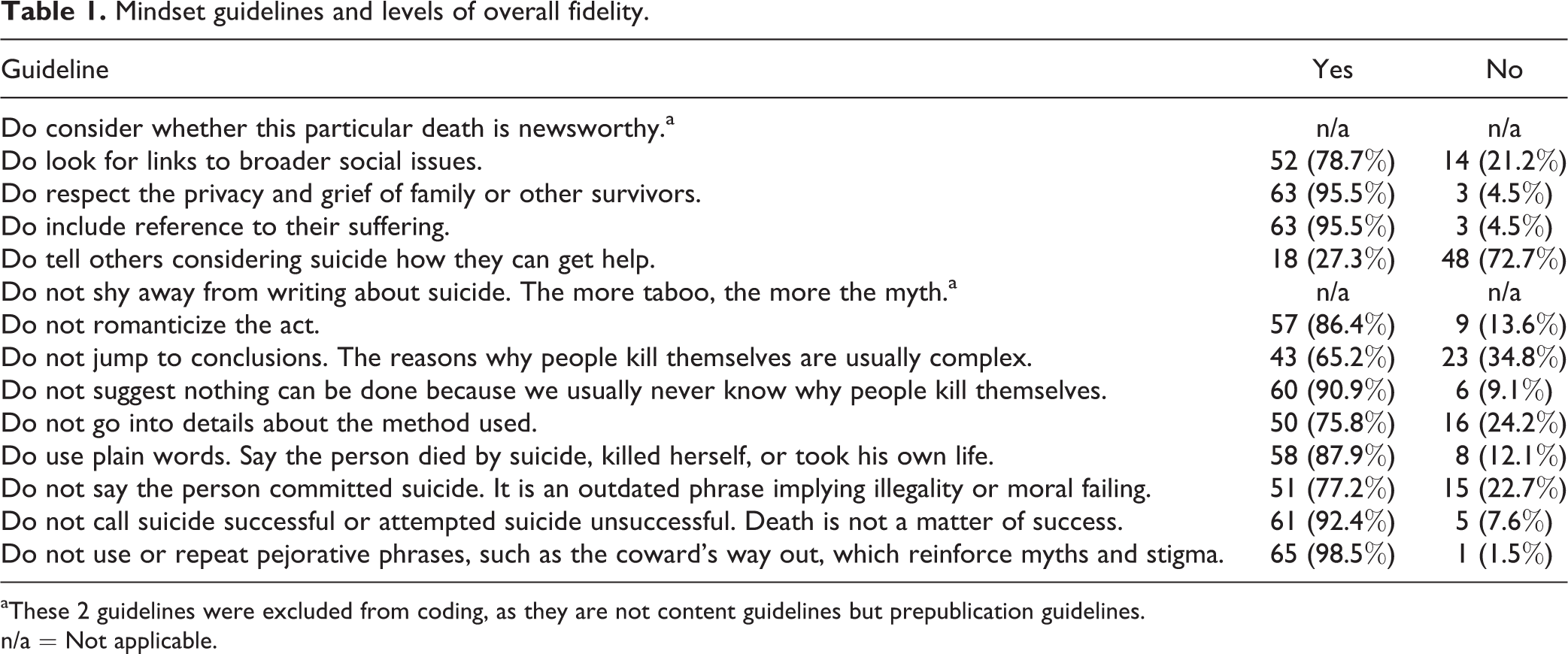
The Mindset guidelines for the reporting of suicide consist of 14 specific recommendations (Table 1). Each article was coded for presence (yes) or absence (no) of each guideline (except for 2 guidelines deemed nonapplicable). The first author, who was carefully trained and supervised by the second author in this process, conducted the coding. In line with thresholds in similar stigma research, 13 we set a threshold of 80% yes to assess if articles were considered to have high fidelity to the guidelines.
Mindset guidelines and levels of overall fidelity.
aThese 2 guidelines were excluded from coding, as they are not content guidelines but prepublication guidelines.
n/a = Not applicable.
A qualitative content analysis of issues and themes discussed in the articles was then undertaken using a general inductive approach. 14 Phrases or sentences emphasizing particular issues, or inferring causative factors in Robin Williams’ suicide, were extracted, and categorized into themes due to their commonality and overlap. These themes were then ranked in order of prominence and repetition.
Results
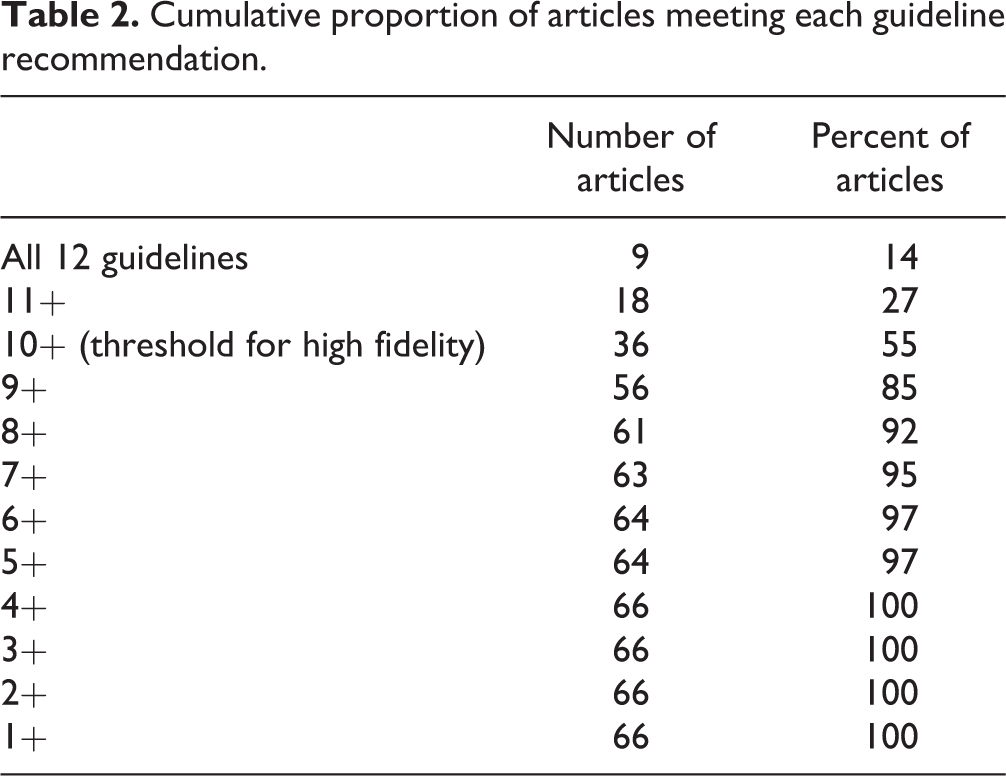
Among the 66 articles in the study, 36 articles (55%) met 80% or more of the recommendations, thus reaching high fidelity (Table 2). This figure rose to 56 (85%) when the threshold was lowered to 70%, which could be considered very good fidelity. Individually, each criterion was met in an average of 81% of articles.
Cumulative proportion of articles meeting each guideline recommendation.
It can be seen that certain recommendations were underapplied: 21% failed to link the death to broader social issues; 23% used the word commit in relation to suicide; 24% detailed the method used; and 35% jumped to conclusions about his death. Most notably, 73% of articles failed to provide information on where to get help if considering suicide. These are areas which can be improved on in future reporting.
Qualitative Content Analysis
The qualitative content analysis produced 9 different themes, with frequency counts tallied for total number of codes and percentage of articles including them (Table 3). The 2 most prominent themes were addiction and stigma. Common narratives included that “Williams made no secret about his battles with drugs and alcohol,” 15 with other articles recognizing stigma, coupled with social isolation, as an intrinsic barrier to care: “there are still far too many people who feel too alone or too ashamed to make use of the resources that are out there to help them.” 16 Other common themes included the pressures of success and celebrity status, with many dubbing Williams a casualty of success, noting he is part of a “long history of celebrities who have killed themselves, or tried to take their own life.” 17 Others remarked on the need to openly converse about mental illness, saying “the silver lining in the Robin Williams suicide is it has opened the discussion, again.” 18
Issues and themes extracted from qualitative analysis.
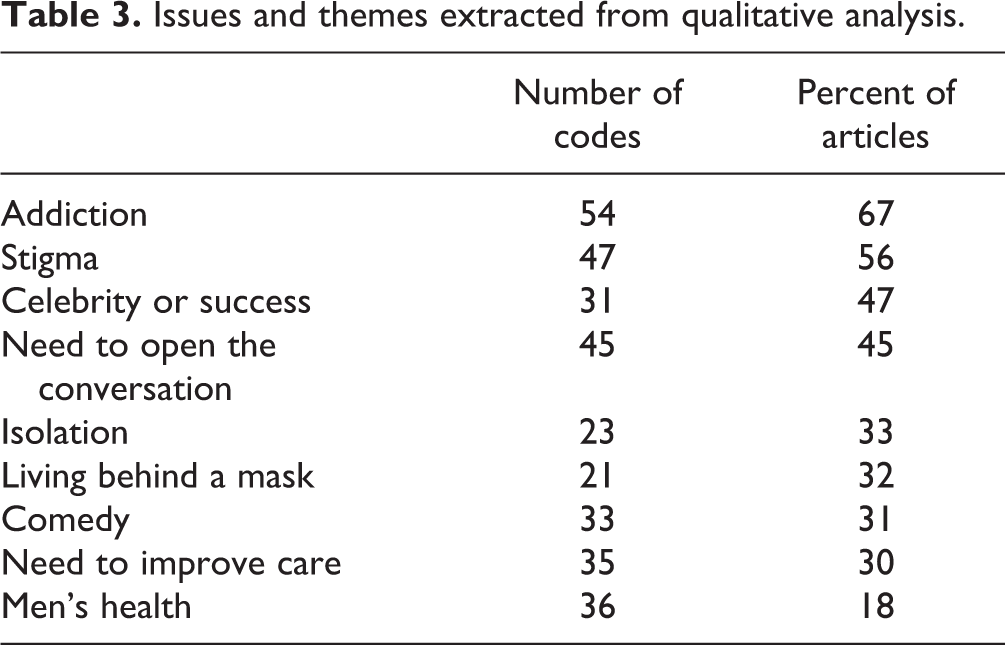
Notably, many articles neglected certain key issues: namely, the need to improve mental health care, and the issue of men’s health. It is worth noting that those who acknowledged these issues did so in great detail, given the disproportionately high total number of codes for the percentage of articles alluding to them.
Discussion
Overall, Canadian newspaper reports of Robin Williams’ suicide maintained high or very good fidelity to Mindset’s guidelines. Most articles applied at least 80%, while a mere 15% employed less than 70%, of the guidelines. Many key guidelines were met in most articles, such as avoiding stigmatizing language, not romanticizing the act, and respecting the grief and privacy of the family. This outlines a positive pattern of reporting, whereby journalists are portraying suicide through a compassionate and sympathetic lens, while retaining optimism regarding suicide prevention by actively not suggesting nothing can be done.
Nevertheless, there is still room for improvement. Notably, 24% of articles detailed the method used (that is, hanging). Some research suggests a correlation between the extent of reporting on the method used in a celebrity suicide, and subsequent suicide by this method in the general population, 6,7 thus it is critical not to elaborate on this. Perhaps most pressingly, 73% of articles failed to tell those considering suicide where they can get help. Providing information on resources is universally recommended in guidelines for reporting suicide, 9 –11,19 –21 as it may encourage people to seek medical assistance, preventing further suicides and limiting contagion; it is thus imperative to include them.
Our other key finding was that prominent themes focused on issues such as addictions, stigma, and issues related to celebrity or comedy culture. Interestingly, reflection on the role of gender and men’s health were generally absent from the articles. This is consistent with a previous study, 22 which found that journalists routinely provide extensive background and context when reporting on a woman with mental illness, but such information is generally absent in articles about a man with mental illness. This is concerning given that suicide rates among men, particularly those aged 40 to 54 years, are especially high, roughly 3 times higher than those for women. 23 Suicide by prominent men may be an opportunity to highlight issues pertaining to men’s mental health in newspapers, such as intense occupational stress or the negative impact of divorce.
To conclude, we note some limitations to our study. The study focused on English-language Canadian newspapers only. This was deliberately a narrow focus in the interests of practicality. We did not assess other media outlets such as television, radio, or social media, which may have given different results. The use of a data subset, only using articles meeting the inclusion criteria for the primary study, may have led to the exclusion of otherwise relevant articles (though pilot testing showed that most articles pertaining to mental health issues are captured by the 4 terms used here 22 ). Finally, we cannot impute the positive results of the study to the implementation of Mindset, as we did not assess suicide reporting before its distribution.
Conclusion
The results indicate that Canadian journalists are generally following the evidence-based guidelines regarding the reporting of suicide specified in Mindset. This is very welcome news, especially as previous studies have suggested that many Canadian newspaper reports perpetuated stereotypes and stigma regarding mental health problems. 12,24 Future research should continue to examine reporting of suicide to assess for further improvements, while also examining the wider impact of Mindset on the reporting of mental illness, including in social media. Newspaper editors and journalists could be interviewed to further assess Mindset’s implementation. Furthermore, new research could formally examine the contagion effect by investigating the link between suicide rates following a celebrity suicide and fidelity to Mindset guidelines in prominent media. This is research we hope to conduct in the near future.
Footnotes
Acknowledgments
We would like to thank the Mental Health Commission of Canada, which is funded by Health Canada, who financed the study. We would particularly like to thank Mike Pietrus and Romie Christie for strong support throughout the study. We would also like to thank members of the Opening Mind's Principal Investigators Group who provided helpful feedback on earlier drafts of this article.
Declaration of Conflicting Interests
The author(s) declared no potential conflicts of interest with respect to the research, authorship, and (or) publication of this article.
Funding
The author(s) declared receipt of the following financial support for the research, authorship, and/or publication of this article: This research was funded by the Opening Minds initiative of the Mental Health Commission of Canada.