The Economics Department at the University of North Carolina at Chapel Hill (UNC) has had a long-term commitment to offering extra-curricular opportunities for undergraduate students to enhance their learning beyond the classroom. These opportunities include research, problem-solving, leadership development, Undergraduate Learning Assistance (ULA), peer tutoring, and networking events, among others. Given the Economics program’s substantial size within UNC’s College of Arts and Sciences—with over 1400 declared or intended majors in recent years—it is important to structure the activities in a manner that accommodates students’ diverse interests as well as their time constraints. In this paper, we introduce these different activities and discuss their scope, skill objectives, and time commitment. The benefits to students include opportunities for community, networking, exposure, application, teamwork, presentation, analysis, and research. We also discuss several challenges a department faces to successfully offer these diverse opportunities.
The University of North Carolina at Chapel Hill (UNC), the first public university in the country, educates close to 20,000 undergraduate students and offers 78 bachelor’s degree programs (www.unc.edu). For several years, economics has been a declared major of over 1400 undergraduate students per year, and a total of 442 undergraduate degrees in Economics were awarded in 2023. These numbers firmly establish Economics as the fourth most popular major at UNC. The Economics Department offers two bachelor’s degrees (BA and BS), master’s and PhD degrees, and a joint undergraduate degree with the National University of Singapore. The department also offers credentials (i.e., departmental recognition for completion of three specific courses and related activity participation) in DATA (Data-Acumen-Theory-Application) Science and Quantitative Financial Economics (QFE). Currently, the faculty body consists of 28 tenure-track professors and six teaching-track professors.
Complementing our dedication to excellent academic training are the department’s continuing efforts to offer more, diverse avenues for student enrichment outside the classroom.1 Co-curricular activities, or ancillaries, help develop a wide range of skills for students who participate in them. These skills include leadership, teamwork, organization, time-management, research, problem-solving and presentation, among others. Ancillaries such as the Carolina Economics Club (CEC) and Women in Economics (WIE) focus on informing, developing community (belonging), and networking. Engagement as an Undergraduate Learning Assistant (ULA) or peer tutor deepens one’s understanding of economics and expands services to peers and instructors. The Federal Reserve Challenge, Federal Deposit Insurance Corporation (FDIC) Academic Challenge, and Case and Data Science Competitions provide platforms for students to practice and improve problem-solving, teamwork, research, and presentation in local, regional, and national competitions.
To facilitate discussion, we group the co-curricular activities into four categories delineated by the time commitment required by the student participant. That is, in the next section, we describe the purpose and structure of student experiences that require: an hour or two here and there; days, weeks, or months; a summer; and a semester or academic year. Having described the ancillary activities, we then discuss the benefits and the challenges—financial, time, and retention—in offering successful ancillaries for undergraduate students.
Description of Ancillaries
Over the last ten years, 70% of our graduating majors have listed Economics as their first major, with almost 36% of those students having a second major. The most popular second majors in 2023 were Political Science, Public Policy, Exercise and Sport Science, and Statistics and Analytics. Among the 30% who list Economics as their second major, the most common first majors were Business, Statistics and Analytics, and Computer Science. Over half of our majors pursue a minor degree, with an increasing proportion (up to 13%) graduating with two minors. Our BA degree requires 30 credit hours (9 courses), while our (three-year-old, STEM-classified) BS degree requires 50 credit hours (15 courses). We provide these data to suggest that most students majoring in Economics have demanding academic schedules. The available time for expanding one’s skills outside the classroom is constrained, while the opportunities abound. As a department, we are competing with other majors and minors for each student’s time. As such, we have chosen to offer a variety of opportunities with varying levels of time commitment from the student.
Student Commitment: An Hour or Two—Here and There
The Carolina Economics Club (CEC) is the oldest student organization in the Economics Department with a membership of about 300 students in Fall 2023. The club provides opportunities to network with peers through enrichment activities such as lectures and panel discussions, resume and interview workshops, alumni career panels, and game nights. The time commitment is one hour per week two to three times a month on a specific day of the week. Membership is open to both economics and non-economics majors. The Club has a faculty advisor, which is required by the University of all registered student organizations. While the Economics Department provides most of the funding for the Club’s activities, registration of the organization allows access to some funding from student activities fees.
The Women in Economics (WIE) group was founded in 2016 to promote diversity within the economics major and to provide a supportive platform for skill development. Open to all students, the group has almost 500 members in the WIE GroupMe, of which 75 were active in the group’s monthly meetings and social outings this past year. Membership requires attendance at two, one-hour academic events and one social event, participation in one mentor/mentee meeting (that pairs first year students with older students), and $5/semester dues. The group is officially registered with the university, there is a faculty advisor, and the Economics Department provides additional funding. WIE hosts networking events with faculty and staff, lectures, panel discussions, course information sessions, and social events such as dinners, game nights, and end-of-year celebrations.
The department hosts a DATA Science Seminar Series as part of our DATA (Data-Acumen-Theory-Application) Science Credential that was established two years ago to provide our economics majors with in-demand data skills with an emphasis on economic applications and the importance of theoretical guidance. In addition to three required courses in coding, econometrics, and machine learning, the seminar series (that is open to all students) brings in two to three speakers each semester to share their experiences in combining data skills with foundational knowledge of economics to frame and solve economic questions using data. Students have interacted with economists and data scientists from Zillow, Airbnb, Indeed.com, WestJet, Volatility Protocol, Voltron Data, Cambly, Teladoc Health, Blue Cross Blue Shield, Cox Communications, Booz Allen Hamilton, J.P. Morgan, AlixPartners, Academy Sports, and WebMD.
Student Commitment: Days, Weeks, or Months
Throughout the academic year, the department finances student-initiated Adventures in Economics for our majors. A generous alumni of our program established an “Economics Adventures Fund” five years ago to encourage students to explore their interests in economics beyond the classroom. The only requirement is that the student be able to explain the link between their proposed adventure and an economics subject. Funded adventures have included an interview with the chief operating officer of the Security and Exchange Commission, a visit to the headquarters of Uber, and attendance at conferences ranging from sports analytics to games, decisions, and risk. The funding cannot be used to buy textbooks, pay school fees, fund internships, or finance study abroad.
For four consecutive years, the Economics Department has funded the participation of two students per year at the Sadie T.M. Alexander Conference for Economics and Related Fields (SACE) using our Belonging and Engagement Fund. As their website states, our students meet Black women economists, learn about different career paths for economists, and are exposed to research done by and about Black women and the Black experience. This fund allows us to support a wide range of experiences for students who may be underrepresented in the major and the profession.
Our economics majors are encouraged to participate in the increasingly popular Data Science Competitions. Our department sent a team of eight students and one faculty member to The Econ Games (https://www.theecongames.com) in 2022. Chicago’s Econometric Games is another example. These competitions typically occur over one weekend and require varying degrees of pre-competition preparation.
Since 2014, the Carolina Economics Club and the department jointly host annual Case Competitions to help students prepare for job interviews with consulting firms. In recent years, these competitions, and the cases themselves, have been developed with companies that are prospective employers of UNC graduates. The case competition requires a time commitment of two to three weeks from the kick-off date to the final round. Last year, eight teams of four or five students participated. The teams are required to give an oral presentation in front of a panel of judges and to respond to panelists’ questions. In addition to cash prizes, in some years, the winning team has also qualified for the first round of interviews with the sponsoring company. Participation in this ancillary activity develops teamwork, problem-solving, and presentation skills. Students also have an opportunity to put into practice the analytical skills they have learned in their economics courses.
Student Commitment: Summer
Summer research awards facilitate research experience for our majors. While the department’s Senior Honors Thesis program offers outstanding economics students the opportunity to work closely with an individual faculty member on a specialized research topic of the student’s choice during the senior year, admission to the program is selective and only 15–20 students are invited to participate each year. These traditional research opportunities, including those with a broader reach via capstone courses, are highlighted in a recent Journal of Economics Education symposium (Hoyt & McGoldrick, 2017). To expand research experiences at UNC, we offer funded, faculty-led research opportunities to an additional 10–15 students over the summer months. An economics major may apply, in a competitive process, as an individual or with a partner (as a pair) to develop and implement a research plan on an economic issue of their choosing. The students work with a faculty advisor (who receives $1000 per pair supervised) over the summer and submit a brief research paper suitable for circulation among faculty in September. Last year, each student researcher received $4000 upon completion of the final project. Our program is donor funded. We provide an archive of these research papers on our departmental website.
Student Commitment: Semester or Academic Calendar Year
The Economics Department was instrumental in the creation of the now College-wide Undergraduate Learning Assistant (ULA) program. Started in 2014, this highly successful program has provided classroom support to instructors and peer tutoring to students. Additionally, those serving as ULAs have reported the experience as one of the most useful and enjoyable extra-curricular activities during their time on campus. The benefits to student ULAs include development of collaborative problem-solving skills and effective communication of ideas among members in the peer group (Otero et al., 2010). Over the last five years, an average of 43 students per semester have served as ULAs in Introductory Economics, Intermediate Microeconomics, Intermediate Macroeconomics, Econometrics, and some elective courses. Students receive academic credit for participation and are required to enroll in a ULA preparatory course taught by a faculty member. In addition to strong grades, effective ULAs demonstrate skills in problem-solving, organization, and presentation. ULAs are present in a course throughout the semester and work closely with the instructor to facilitate active learning strategies in the classroom.
The Federal Deposit Insurance Corporation (FDIC) began hosting an annual FDIC Academic Challenge in 2020–21.2 Each year, the FDIC releases a broad research question and supplies data for the competition. For example, the research prompt for 2022–23 was “The Impacts of Higher Interest Rates on the Banking Sector. Students are provided data on bank variables such as deposits, assets, and different types of loans, as well as macroeconomic data such as unemployment rate, inflation rate, interest rate, and personal income, and other types of data that vary by year. This “big data” exercise requires a range of skills from simple data analysis and visualization to more advanced techniques such as panel data regressions. The teams are fielded early in the academic year and meet regularly (once or twice a week) with a faculty advisor over two to three months in the fall semester. If a team qualifies for the final round, these regular meetings extend for two months into the spring semester. In 2022–23, faculty from our department mentored a total of six teams consisting of five members and one or two alternates. The Economics Department supported the teams and their advisor(s) by providing food during training, research, and practice sessions. The FDIC paid all travel and accommodation expenses for the teams advancing to the final round. UNC has been a finalist (top five in the country) for the past three years of the competition. The specific skills used in this competition are data analysis, research, teamwork, and presentation (Stone, 2023). As discussed by Stone, the competition also provides scope for addressing equity as well as efficiency by, for example, exploring experiences in unbanked and underbanked areas.
UNC’s participation in the Federal Reserve Challenge (Fed Challenge) began 15 years ago and was amplified by our Quantitative Financial Economics (QFE) credential, which launched in 2016. Students pursuing the credential—a three-course sequence providing the theoretical knowledge of financial markets and the practical experience of financial-market transactions—embraced this national competition (organized and led by the Federal Reserve Board) as their own challenge. The UNC teams—consisting of both QFE students and non-QFE-affiliated economics majors—have consistently performed well in competitions. We structure this ancillary activity in a way that accommodates all students who want to participate. While the presentation team consists of five students and two alternates, a research team with unlimited student participation supports the presentation team in data collection, presentation development, and research. Preparation for and participation in this very popular activity promotes cooperative learning (Bansak & Smith, 2015). They find that students who participate in the Fed Challenge “learn more economics, enjoy learning more, and develop skills transferable to the workplace”. At UNC, the Fed Challenge participants are advised by a faculty member and meet weekly throughout the academic year. In the fall semester, the team prepares for the annual competition run, which includes local and regional events to qualify for the national competition; in the spring semester, the club holds in-house competitions to prepare for the next year. Economics and non-economics majors may participate in the Fed Challenge. While many universities offer their Fed Challenge experience as ancillaries, a few have also structured it as an academic course (Gulley & Jackson, 2015).
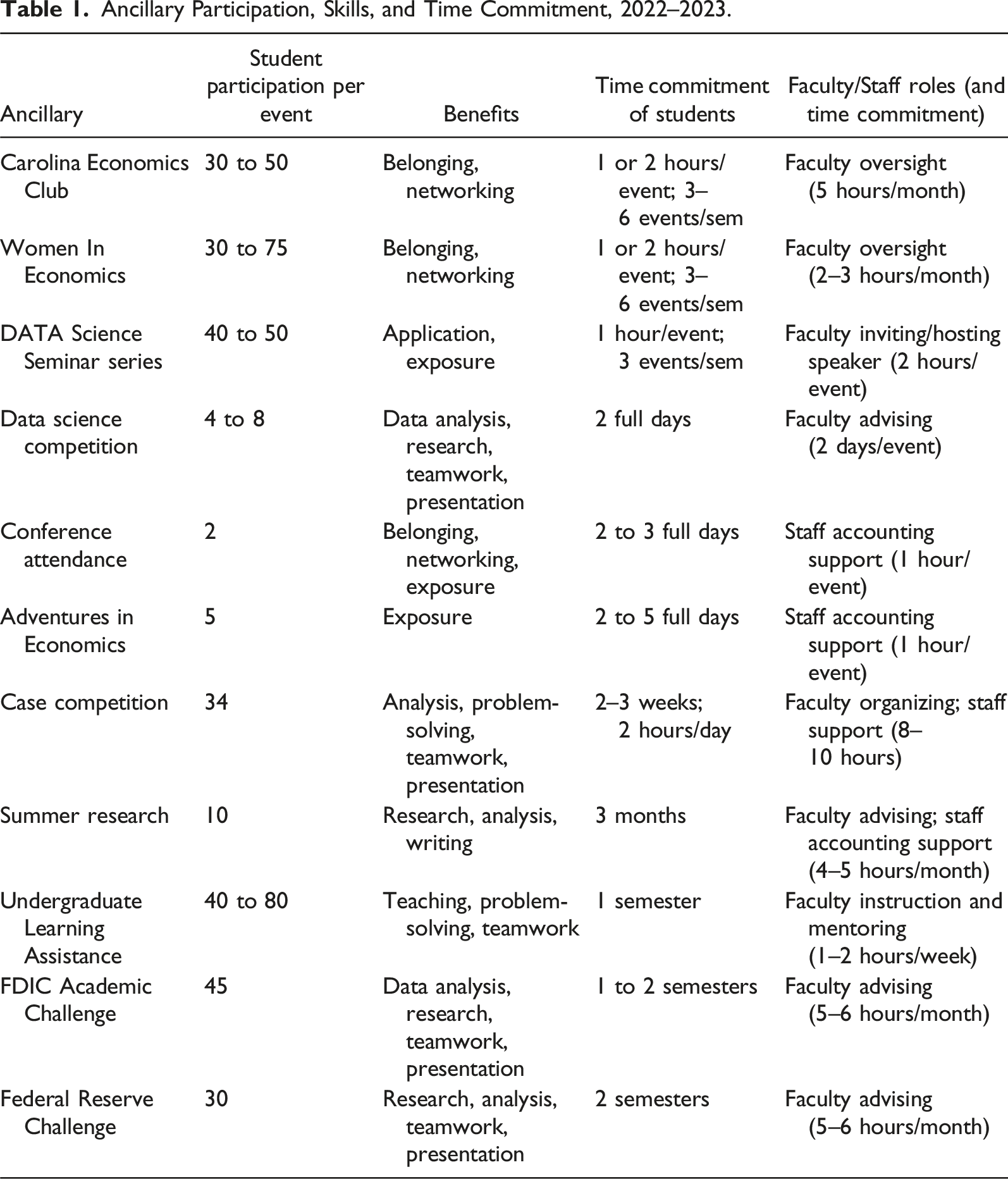
Table 1 summarizes important details of the different ancillaries in the Economics Department at UNC. As the table indicates, we offer opportunities for students with varied interests and with different levels of time commitment.
Ancillary Participation, Skills, and Time Commitment, 2022–2023.
Ancillary
Student participation per event
Benefits
Time commitment of students
Faculty/Staff roles (and time commitment)
Carolina Economics Club
30 to 50
Belonging, networking
1 or 2 hours/event; 3–6 events/sem
Faculty oversight (5 hours/month)
Women In Economics
30 to 75
Belonging, networking
1 or 2 hours/event; 3–6 events/sem
Faculty oversight (2–3 hours/month)
DATA Science Seminar series
40 to 50
Application, exposure
1 hour/event; 3 events/sem
Faculty inviting/hosting speaker (2 hours/event)
Data science competition
4 to 8
Data analysis, research, teamwork, presentation
2 full days
Faculty advising (2 days/event)
Conference attendance
2
Belonging, networking, exposure
2 to 3 full days
Staff accounting support (1 hour/event)
Adventures in Economics
5
Exposure
2 to 5 full days
Staff accounting support (1 hour/event)
Case competition
34
Analysis, problem-solving, teamwork, presentation
2–3 weeks; 2 hours/day
Faculty organizing; staff support (8–10 hours)
Summer research
10
Research, analysis, writing
3 months
Faculty advising; staff accounting support (4–5 hours/month)
Undergraduate Learning Assistance
40 to 80
Teaching, problem-solving, teamwork
1 semester
Faculty instruction and mentoring (1–2 hours/week)
FDIC Academic Challenge
45
Data analysis, research, teamwork, presentation
1 to 2 semesters
Faculty advising (5–6 hours/month)
Federal Reserve Challenge
30
Research, analysis, teamwork, presentation
2 semesters
Faculty advising (5–6 hours/month)
Benefits of Ancillaries
These co-curricular activities benefit student participants in ways that may be difficult to facilitate during classroom instruction. The diverse ancillary offerings provide opportunities to experience community and to network with students, alumni, potential employers, and invited speakers. Some provide exposure to economics in practice or of one’s own talents to others. Other ancillaries offer the opportunity to apply economics, to engage in teamwork, and to present ideas. Some offer opportunities for a deep level of analysis and involve research. While classroom time touches on these areas, our activities outside the classroom are purposely tailored to offer students “hands-on” participation. Although we have only anecdotal evidence, the literature suggests that participation improves soft skills, may offer stress relief from challenging coursework, improves focus and time-management skills, and strengthens job and graduate school applications (Ribeiro et al., 2023). The parent paper in this volume reports survey respondent views on several benefits of ancillaries (Hoyt & O’Sullivan, 2024).
As designed, the benefits of these opportunities extend beyond the undergraduate years. For example, to get a sense of the research process, one of our students participated in a faculty-led summer research project exploring the subscription video-on-demand industry. He shared the research experience with other students during university research week and with our alumni board (who funded the summer project). Having discovered his love of the in-depth study of economic behavior, this student applied to our honors thesis program and graduated with highest honors. He received offers to work as a research assistant (pre-doc) in labs at MIT and Harvard. He is completing a two-year position at Harvard’s Opportunity Insights and is applying to economics PhD programs.
Having served as co-president of the Carolina Economics Club, another UNC economics major joined ABC Insights (now HelioCampus) after graduation to assist higher education institutions in adopting and expanding the use of data analytics. She is currently a PhD student in the Department of Leadership, Policy, and Organizations at Vanderbilt University. Another student availed himself of multiple opportunities in our department. He conducted summer research, participated in a department-funded data science camp and completed our DATA Science Credential, networked with our alumni board members, led the FDIC Academic Challenge team that placed in the top five nationally, and served as an undergraduate learning assistant and peer tutor. He is now a pre-doctoral fellow at Harvard Business School.
Challenges to Offering Ancillaries
Provision of these co-curricular activities is met with three main challenges: financial needs, non-financial demands, and commitment. While our Economics Department enjoys the gifts of generous alumni that allow us to adequately cover the financial costs of the ancillaries described above, the costs are not trivial. The largest financial costs involve summer funding for research experiences and travel to attend competitions and conferences. It is important for departments who wish to offer these opportunities to engage with alumni who have benefitted from the training and experiences they acquired at their alma mater and who desire to “pay it forward”.
The non-financial demands include recruiting faculty, disseminating information, scheduling, and optimizing participation. The largest non-financial constraint in providing successful experiences for our majors is faculty time. The mentoring time required to shepherd student groups and advise research can be quite substantial and can increase with scale. The burden often falls on faculty members who are regular volunteers and those whose teaching mission is at the undergraduate level. Often, faculty view their own commitment of time as low value professionally. Additionally, information dissemination can be time-consuming and, if done well, requires communication creativity (both in terms of method of delivery as well as visual appeal). Delivery of events requires scheduling (of meeting time, location, and mode) and efforts to minimize conflicts with other student (and faculty) events and commitments. Lastly, we attempt to solicit demand by requiring registration (e.g., QR code linked to registration survey) in order to optimally plan for an appropriate event venue. Registration also allows us to remind forgetful or distracted students as the event date nears.
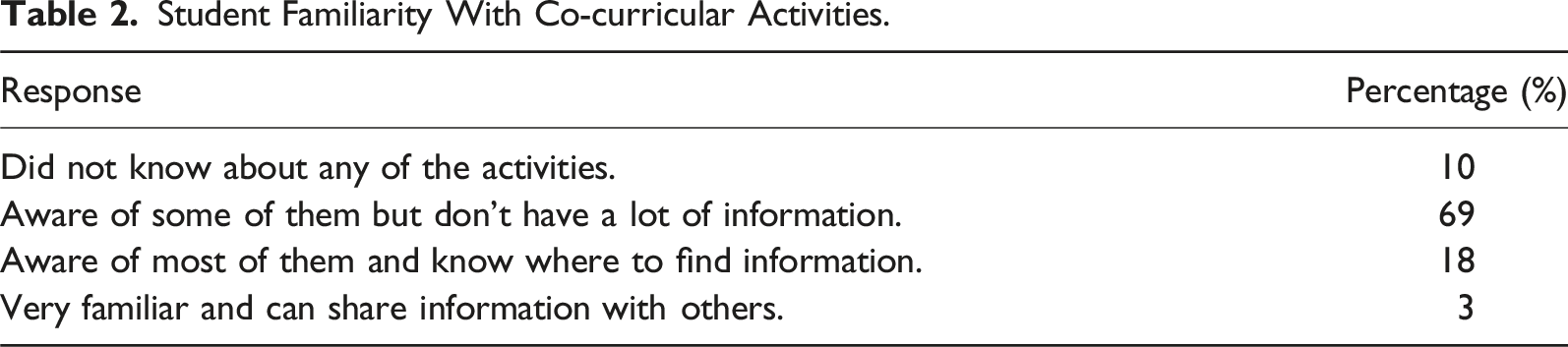
A final challenge is two-fold and involves both encouraging student participation and ensuring their sustained involvement. We conducted an informal survey—distributed to students enrolled in Fall 2023 economics courses—to elicit student awareness of our offerings and constraints on participation.3Table 2 indicates that only 21% of the respondents were well aware of the opportunities. To advertise our co-curricular activities, we employ email and social media, instructor announcements (both verbal and through the course management systems), yard signs, and flyers. According to survey responses, the most favored and impactful mode of communication is when it originates from an instructor.
Student Familiarity With Co-curricular Activities.
Response
Percentage (%)
Did not know about any of the activities.
10
Aware of some of them but don’t have a lot of information.
69
Aware of most of them and know where to find information.
18
Very familiar and can share information with others.
3
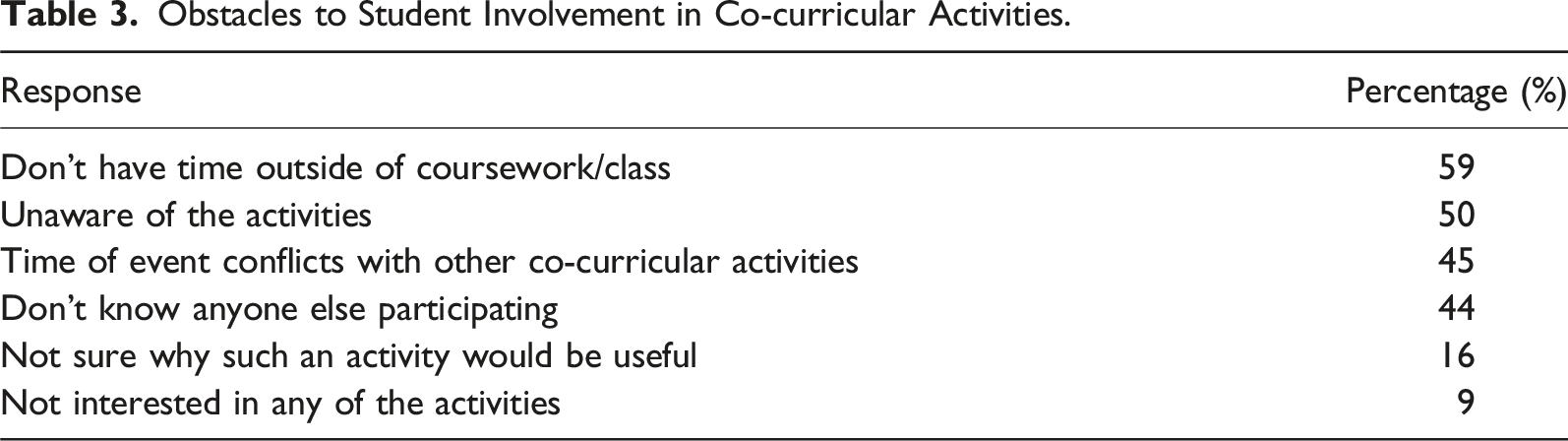
Our survey also sought to determine the obstacles that students face when it comes to participation.4 Over 3/5ths of respondents indicated a lack of time outside of coursework as a reason for not participating in co-curricular activities (Table 3).
Obstacles to Student Involvement in Co-curricular Activities.
Response
Percentage (%)
Don’t have time outside of coursework/class
59
Unaware of the activities
50
Time of event conflicts with other co-curricular activities
45
Don’t know anyone else participating
44
Not sure why such an activity would be useful
16
Not interested in any of the activities
9
Given competing demands for student time, students must evaluate which activities to pursue. Accurate valuation of the time commitment as well as the benefits of participation falls on the department to convey. Interestingly, while uncertainty about an activity’s usefulness was not a large impediment among students (16%), uncertainty about peer participation was mentioned by nearly half (44%) of survey respondents. A related challenge is high attrition rates for ancillaries that require teamwork and extended preparation time, such as the Fed Challenge, FDIC Academic Challenge, or data science competitions. During any one cycle, initial participation may be high from eager students seeking the enrichment, but the high burden of the work involved in preparing for competition leads to departures. It is for these reasons that we offer a range of activities with different levels of time commitment to accommodate students with heterogenous preferences, constraints, and expectations.
Conclusion
Evidence of success or impact of the co-curricular offerings is often intangible. Do our majors develop or improve their skills through participation in these enrichment activities? Do they have an increased sense of belonging? Does word of mouth about these experiences attract more students to the major?
We have some evidence that the opportunities we provide are of high quality: our consistent top placement of UNC teams in competitions such as the Fed Challenge and FDIC Academic Challenge. Additionally, anecdotes suggest that the experiences are rewarding and the mentorship/advising is beneficial. As funding for these co-curricular activities has increased, participation has increased as well. Greater participation is likely to enhance word-of-mouth information sharing. Indeed, as knowledge of these experiences, our successes, and student engagement has spread among the faculty, faculty enthusiasm for these activities as a regular part of our offerings has grown. We will continue to make meaningful opportunities outside of the classroom an important part of the training and experience we provide our economics majors. Future goals include measuring benefits, disseminating value (to both students and faculty), and sharing impacts.
Footnotes
Declaration of Conflicting Interests
The author(s) declared no potential conflicts of interest with respect to the research, authorship, and/or publication of this article.
Funding
The author(s) received no financial support for the research, authorship, and/or publication of this article.
ORCID iDs
Donna Gilleskie
Geetha Vaidyanathan
Notes
Author Biographies
Donna Gilleskie is a Professor of Economics at the University of North Carolina at Chapel Hill, where she is completing a five-year term as chair of the Economics Department. She is a fellow at the International Association of Applied Econometrics and the Carolina Population Center and has previously served as President of the Southern Economic Association.
Geetha Vaidyanathan is a Teaching Professor of Economics at the University of North Carolina at Chapel Hill. She has served as Director of Undergraduate Studies, Academic Director of the Shuford Program in Entrepreneurship, and Academic Advisor.
References
1.
AnchoI.SerboR. (2019). Authentic learning in teaching economics. Journal of Research, Policy & Practice of Teachers & Teacher Education, 9(1), 1–11. https://doi.org/10.37134/jrpptte.vol9.no1.1.2019
GulleyO.JacksonA. (2015). Teaching a class dedicated to the College fed challenge competition. Eastern Economic Journal, 41(4), 484–503. https://doi.org/10.1057/eej.2015.11
4.
HoytG.O’SullivanR. (2024). The ancillaries of undergraduate economics programs: Results of a departmental survey. (Working Paper No. SSRN4811107). https://SSRN.com/abstract=4811107
5.
HoytG. M.McGoldrickK. (2017). Models of undergraduate research in economics: Advice from eight exemplary programs. The Journal of Economic Education, 48(4), 288–289. https://doi.org/10.1080/00220485.2017.1353465
RibeiroN.MalafaiaC.NevesT.MenezesI. (2023). The impact of extracurricular activities on university students’ academic success and employability. European Journal of Higher Education. Published online. https://doi.org/10.1080/21568235.2023.2202874