




Abstract
This study examines the effects of gender on performance for students taking one of two different intermediate microeconomics courses: a quantitative, calculus-based course and a non-quantitative, non-calculus-based course. We also assess how gender differences in students’ math and verbal abilities and college achievement affect intermediate microeconomics course grades. Our results indicate gender is not a significant indicator of intermediate microeconomics course performance. Math SAT scores and principles of microeconomics course grades are significant predictors of performance for non-quantitative course students only. Cumulative GPAs have strong, positive correlations with grades for students in both course types. These findings have implications for students’ economics major selection and are positive in the context of closing the gender gap in economics degree attainment.
Introduction
Studies of economics major curriculum requirements at U.S. colleges and universities find an intermediate microeconomics course is a nearly universal requirement for students to earn an economics bachelor’s degree (Bosshardt et al., 2013; Petkus et al., 2014; Siegfried & Walstad, 2014). Petkus et al. (2014) examine core curricular requirements at 792 U.S. institutions, finding 99% of economics departments at universities require students to complete an intermediate microeconomics course, as do 82% of departments at baccalaureate schools. Using a sample of 182 U.S. institutions identified by an American Economic Association mailing list, Bosshardt et al. (2013) find almost all Bachelor of Arts (B.A.) in economics and Bachelor of Science (B.S.) in economics degree programs require an intermediate microeconomics course. Siegfried and Walstad (2014) use data from 337 U.S. schools, finding 99% and 95% of economics departments located in arts and sciences colleges and business schools, respectively, require an intermediate microeconomics course. This work suggests intermediate microeconomics courses may represent barriers for students wishing to pursue further economics study. Students may be prevented from taking upper-division economics field courses and earning an economics degree if they perform poorly in an intermediate microeconomics course.
Students taking intermediate microeconomics courses may also be expected to be proficient in calculus. Differential calculus is a useful tool in intermediate microeconomics courses for solving problems of constrained maximization of utility, profits, etc. Integral calculus is helpful in studying concepts, such as consumer and producer surplus and deadweight loss. Butler et al. (1994) argue “integral calculus can also help instructors to escape from the implausible assumptions of a linear world” (p. 186). Using data from 656 institutions conferring economics degrees in 2019, Marshall et al. (2023) find 63% of departments require single-variable calculus as a prerequisite for the intermediate theory (microeconomics and macroeconomics) courses. That requirement is related to institutional characteristics and types of economics degree programs. Economics departments at doctoral universities and select liberal arts colleges require calculus-based intermediate theory courses more frequently than departments at master’s and baccalaureate institutions. Additionally, a larger share of STEM-designated economics degrees require calculus-based intermediate theory courses relative to non-STEM economics degrees.
Because of these differences in degrees and calculus course requirements, departments may offer different types of intermediate microeconomics courses. Goolsbee (2019) discusses the “classic divide” between calculus-based and non-calculus-based intermediate microeconomics courses that differ considerably in curriculum and assessment methods (p. 270). The author argues intermediate microeconomics students tend to be heterogeneous, taking the course for a variety of reasons, and this “heterogeneity gets reflected in the many different types of intermediate micro [sic] textbooks” (p. 269). In a survey of intermediate microeconomics textbooks, Goulet (1986) finds differences in the level of mathematics required. Some textbooks include calculus in the body of the text, while others either have no calculus or integrate it into footnotes or appendices. By contrast, all textbooks require knowledge of algebra. This work suggests mathematics proficiency plays an important role in intermediate microeconomics courses, although the level of mathematics required differs across course types.
Despite the importance of intermediate microeconomics courses in the curriculum, few studies have explored the determinants of performance in these courses. Moreover, study results have been mixed. For instance, Butler et al. (1994) find positive effects on intermediate microeconomics course performance from an increase in students’ math SAT scores, while Buschena and Watts (2001) find math SAT scores have no significant effects. Other work indicates male and female students perform equally well in an intermediate microeconomics course (Von Allmen, 1996; Buschena & Watts, 2001; Yang & Raehsler, 2007), although one study finds women outperform men (Butler et al., 1994). Additionally, the prior research has limitations. For example, several studies have small sample sizes with fewer than 500 students (Von Allmen, 1996; Williams et al., 1992; Yang & Raehsler, 2005, 2007). 1 Many studies do not include gender in their analysis (Fleisher et al., 2002; Pyne, 2007; Raimondo et al., 1990; Yang & Raehsler, 2005). Even the previously mentioned studies that do control for gender do not account for gender differences in academic characteristics, such as men having higher average math SAT scores than women (Davison et al., 2014), that may differentially affect male and female students’ intermediate microeconomics course performance. Furthermore, research finds positive effects of calculus course completion and grades on intermediate microeconomics course performance (Butler et al., 1994; Von Allmen, 1996; Yang & Raehsler, 2007). Yet to the authors’ knowledge, no prior studies have assessed student performance in different types of intermediate microeconomics courses, including calculus-based and non-calculus-based courses.
This study remedies the aforementioned limitations of the prior work. Using a sample of 1248 students from a large, land-grant university, we study the effects of student gender, SAT scores, and college course performance on final letter grades in one of two types of intermediate microeconomics courses: (1) a quantitative, calculus-based course; and (2) a non-quantitative, humanities-oriented course that does not require calculus. We also assess the effects of differences in male and female students’ math and verbal abilities and college achievement on intermediate microeconomics course performance. The results suggest gender is not associated with significant differences in performance in intermediate microeconomics courses of either type. There are also no significant gender differences in intermediate microeconomics course performance associated with SAT scores, principles of microeconomics course grades, and cumulative GPAs. Students taking a quantitative, calculus-based intermediate microeconomics course may earn significantly lower course grades than students who take a non-quantitative, humanities-oriented course, which is likely explained by the increased rigor of the former. Math SAT scores and principles of microeconomics course grades are significant and positive predictors of earning an A– or better letter grade only for students taking a non-quantitative course. Having a higher cumulative GPA entering an intermediate microeconomics course is associated with better performance for students in all estimates.
Prior Literature
At least half of students who enroll in an intermediate microeconomics course take it as a “terminal” economics course (Goolsbee, 2019, p. 269). That is, they have no intention of pursuing an undergraduate economics degree and are taking the course as an elective or to fulfill a requirement for another academic degree. Surveys of principles of economics course students find many students, especially women, perceive economics to be uninteresting, too difficult and confusing, and requiring too much math (Bansak & Starr, 2010; Worthington & Higgs, 2004). Moreover, only about one-tenth of students who take a principles of economics course enroll in an intermediate theory course (Emerson et al., 2012; Ahlstrom & Asarta, 2019). In this section, we examine the prior research about students’ intermediate microeconomics course persistence and performance.
Intermediate Microeconomics Course Persistence
On the topic of intermediate microeconomics course persistence, prior work suggests a larger share of male students who take a principles of economics course enroll in a subsequent economics course relative to their female peers (Ahlstrom & Asarta, 2019; Emerson et al., 2012). These studies use different data sources and methodologies. Emerson et al. (2012) is a cross-institutional study using data for more than 150,000 students who completed a principles of economics course at one of several large, research universities. They assess gender differences in the determinants of intermediate (microeconomic and macroeconomic) theory course enrollment and explore differential effects for female students by interacting the female indicator with variables, such as principles of economics course performance and cumulative GPAs. Additionally, the authors examine students’ likelihoods of choosing an economics major after completion of an intermediate theory course. By contrast, Ahlstrom and Asarta (2019) is a single-institution study, using data for over 7000 students who completed a principles of macroeconomics course at the same large, public land-grant university as in this current study. 2 The authors assess the determinants of student enrollment in an intermediate microeconomics course upon completion of a principles of macroeconomics course, using separate regressions for male and female students. Ahlstrom and Asarta (2019) also explore students’ selection between a B.S. in economics degree and a B.A. in economics degree after having completed an intermediate microeconomics course.
The results of these studies are somewhat mixed. Emerson et al. (2012) find strong principles of economics course performance is related to an increased probability of taking an intermediate theory course for students of both genders, but there are no significant differential effects of principles of economics course grades for female students. An important finding from this work suggests female students who take economics courses beyond the principles level may be academically stronger than their male counterparts, having higher average cumulative GPAs. Furthermore, the authors find intermediate theory course grades are negatively associated with students’ likelihoods of selecting a major in economics, although there are no significant differential effects for female students. Ahlstrom and Asarta (2019) find math SAT scores and principles of macroeconomics course grades are significantly and positively associated with enrollment in an intermediate microeconomics course for students of both genders. In contrast with the prior study, the authors find earning a higher intermediate microeconomics course grade is a significant and positive predictor of a male student’s completion of a B.A. in economics degree. However, intermediate microeconomics course grades are not significant predictors of male students earning a B.S. in economics degree or female students earning either type of economics degree.
Intermediate Microeconomics Course Performance
Little prior work explores student performance in intermediate microeconomics courses. Except for Williams et al. (1992), which examines students’ intermediate microeconomics test performance, all prior work assesses student performance using final course letter grades as the outcome variable. Several studies use data from large research universities (Buschena & Watts, 2001; Butler et al., 1994; Fleisher et al., 2002; Pyne, 2007), while Williams et al. (1992) and Yang & Raehsler (2005, 2007) use data from master’s universities. Von Allmen (1996) uses a small sample from a baccalaureate institution. These studies have assessed the effects on intermediate microeconomics course performance of variables, such as student gender (Butler et al., 1994; Von Allmen, 1996; Yang & Raehsler, 2007), SAT scores (Buschena & Watts, 2001; Williams et al., 1992), and principles of microeconomics course performance (Fleisher et al., 2002; Pyne, 2007; Yang & Raehsler, 2007). The results have been mixed.
Several studies of intermediate microeconomics course grades have examined the role of pre-college abilities and college course achievement, and the findings differ. Some work suggests total SAT scores are positively correlated with students’ intermediate microeconomics course grades (Williams et al., 1992; Yang & Raehsler, 2005). Other studies have focused on students’ math proficiency. Using data from 609 students at a private research university, Butler et al. (1994) find increases in math SAT scores have small, positive effects on student performance. Conversely, Von Allmen (1996) and Buschena and Watts (2001) find math SAT scores are not significant predictors of intermediate microeconomics course grades. Results from Williams et al. (1992) indicate students’ grades in a college algebra course are not significant predictors of intermediate microeconomics test performance. Moreover, Yang and Raehsler (2007) find no significant differences in intermediate course grades for students who do and do not take a remedial math (intermediate algebra) course in college.
On the other hand, research consistently finds calculus course completion and performance are strong predictors of intermediate microeconomics course grades (Butler et al., 1994; Von Allmen, 1996; Yang & Raehsler, 2007). Butler et al. (1994) find students who take two calculus courses have significantly higher intermediate microeconomics grades than students who take a single calculus course. Additionally, when students take only one calculus course, earning a higher grade in the course is associated with better intermediate microeconomics course performance. Von Allmen (1996) finds performance in a calculus course that covers single variable differentiation and integration is a significant, positive predictor of intermediate microeconomics course grades for students at a small, selective liberal arts college. Yang and Raehsler (2007) use data for 169 students at a public, master’s university, finding that students who earn a higher average score on an assessment in their pre-calculus and business calculus courses are more likely than their lower-achieving peers to perform better in an intermediate microeconomics course.
Prior studies have also assessed the effects of students’ GPAs and principles of microeconomics course performance on intermediate microeconomics grades. Buschena & Watts (2001) and Yang & Raehsler (2005) find significant, positive effects of students’ cumulative GPAs. Also, Butler et al. (1994) find a higher freshman-year GPA is associated with better performance in an intermediate microeconomics course. Several studies indicate higher principles of microeconomics course grades are associated with better intermediate microeconomics course grades (Buschena & Watts, 2001; Butler et al., 1994; Fleisher et al., 2002; Von Allmen, 1996; Yang & Raehsler, 2007). By contrast, using data for students at a large, Canadian university, Pyne (2007) finds principles of microeconomics course grades are not significant determinants of students’ intermediate microeconomics course performance. Moreover, taking a longer break between the principles and intermediate microeconomics courses is related to a significant decrease in intermediate course grades, suggesting retention of introductory economics concepts may decline as students take more time between courses, as one might expect. However, Pyne (2007) does not control for students’ demographic characteristics, pre-college abilities, or college GPAs.
When looking at the effects of gender on performance in intermediate microeconomics courses, Butler et al. (1994) find women outperform men in intermediate microeconomics courses. Notably, the female students in their sample completed more calculus courses than their male peers, although the study does not assess gender differences in the effects of calculus completion on intermediate microeconomics course performance. Other studies find male and female students perform equally well in intermediate microeconomics courses (Buschena & Watts, 2001; Von Allmen, 1996; Yang & Raehsler, 2007). At the same time, none of these prior studies explores whether gender differences in students’ abilities and achievement affect academic outcomes in intermediate microeconomics courses. Research on SAT scores finds men earn higher mean math SAT scores than women, whereas women earn higher mean verbal SAT scores than men (Davison et al., 2014). Since SAT scores may be an important determinant of intermediate microeconomics course grades (Butler et al., 1994; Williams et al., 1992; Yang & Raehsler, 2005), gender disparities in math and verbal SAT scores may differentially affect students’ intermediate microeconomics course performance. Furthermore, some work indicates men may outperform women in principles of microeconomics courses (Ballard & Johnson, 2005; Elzinga & Melaugh, 2009), although other studies find women outperform or perform equally as well as men (Johnson et al., 2014; Swope & Schmitt, 2006). Nonetheless, gender gaps in principles of microeconomics course performance may lead to disparities in male and female students’ intermediate microeconomics course grades. Alternatively, if women who persist in economics beyond the principles courses are academically stronger than their male peers, as suggested by Emerson et al. (2012), then gender differences in cumulative GPAs may differentially affect students’ intermediate microeconomics course performance. This study explores the relationships between gender and these measures of ability and college achievement.
Background and Data
Description of Variables.
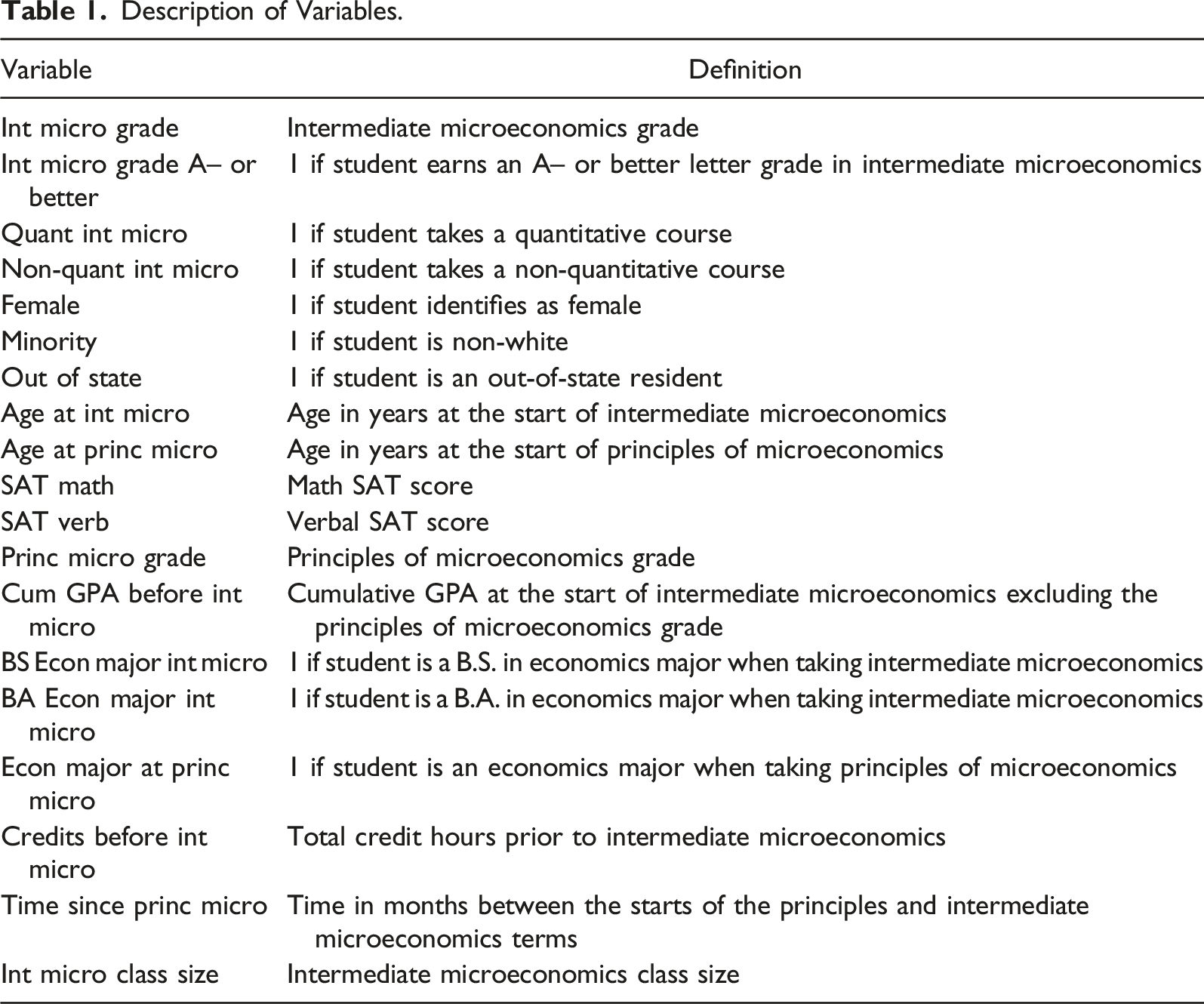
The Department of Economics at this university is housed in the business school and offers two types of intermediate microeconomics courses corresponding to two economics degrees. Students may choose between a B.S. in economics that requires calculus and three additional advanced math courses and a B.A. in economics that has a foreign language proficiency requirement in lieu of the calculus and advanced math requirements. Students selecting a B.S. in economics degree must take a quantitative intermediate microeconomic theory course, hereafter referred to as the “quantitative course,” which requires calculus. Students selecting a B.A. in economics degree may choose between the quantitative course and a humanities-oriented intermediate microeconomics course not requiring calculus, henceforth referred to as the “non-quantitative course.” The department offers two to three class sections of each course a semester. The course descriptions for the two courses are similar, although the quantitative course description notes the use of calculus. Both courses have a single math course prerequisite. The quantitative course requires students to complete a course in differential calculus. Non-quantitative course students may satisfy the math prerequisite by taking a calculus or pre-calculus course or a lower-level math course designed for liberal arts majors that focuses on college algebra and statistics, including regression analysis. A review of syllabi indicates the quantitative course relies heavily on the use of calculus to assess economic models. The non-quantitative course requires students to analyze economic models mathematically but with algebra, rather than calculus. Both intermediate microeconomics courses emphasize real-world applications of economics concepts and incorporate readings from scholarly journal articles, making connections to applied microeconomics fields, such as health economics, environmental economics, and others. Although our data does not allow us to examine course grading and teaching practices, the instructors for each intermediate course type were generally consistent over the length of the study. Five faculty members taught only the quantitative course, and another five taught only the non-quantitative course. Two additional instructors taught both course types. Instructors select their own textbook and curricular materials, but the economics department emphasizes consistency across class sections in terms of curriculum, course design, and assessment methods.
All students in our sample completed intermediate microeconomics as a face-to-face course during a traditional fall or spring semester. All B.S. in economics majors completed the quantitative course, while all B.A. in economics majors took the non-quantitative course. Additionally, students who are not economics majors may take either type of intermediate microeconomics course as an elective as long as they earn the prerequisite C–letter grade or better in a principles of microeconomics course. For this reason, we limit our sample to students who completed a principles of microeconomics course at this institution. 3 A small number of students who were non-economics majors completed both intermediate microeconomics courses. Our data suggests these students may have been dissatisfied with their grades in their first intermediate microeconomics courses and were trying to improve these grades (and perhaps their cumulative GPAs) by taking the other intermediate microeconomics course. Also, a student who earns a C– letter grade or better in the first intermediate microeconomics course must receive departmental approval to take the other course. For these students, we use their grades from the quantitative courses in our estimates since the quantitative course is academically more rigorous than the non-quantitative course.
Descriptive Statistics
Means (and Standard Deviations) by Intermediate Microeconomics Course Type.
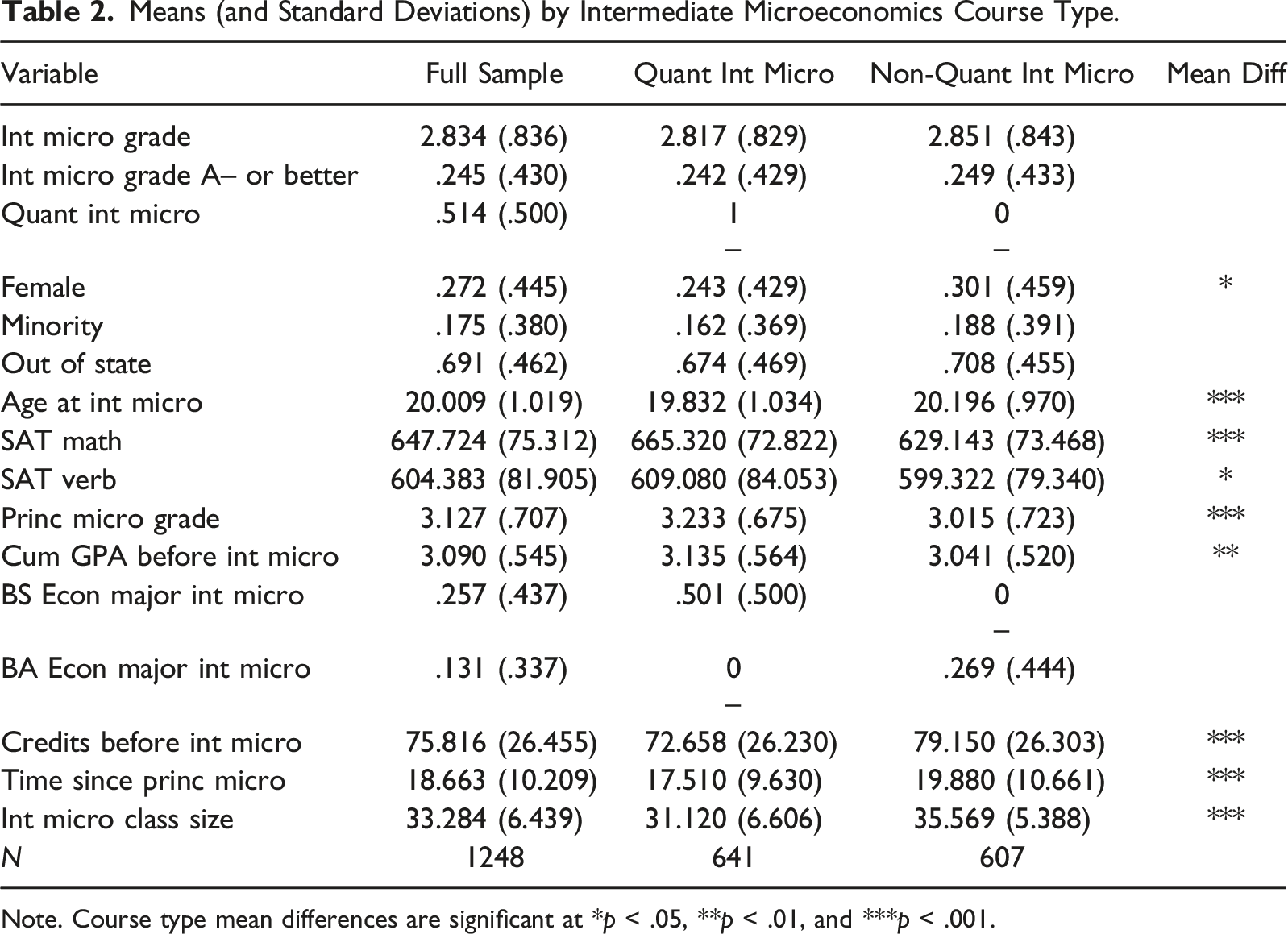
Note. Course type mean differences are significant at *p < .05, **p < .01, and ***p < .001.
We also examine the Pearson’s R correlation coefficients for the relationship between our variables of interest and students’ intermediate microeconomics course grades. The correlation coefficients for students’ math SAT scores are about .40 in both course types. By contrast, the correlation coefficients for students’ principles of microeconomics grades are .57 for the non-quantitative course and .61 for the quantitative course. Moreover, the correlations between students’ cumulative GPAs prior to intermediate microeconomics excluding their principles of microeconomics course grades are slightly stronger at .66 and .70 for non-quantitative and quantitative course students, respectively.
Means (and Standard Deviations) by Gender and Intermediate Microeconomics Course Type.
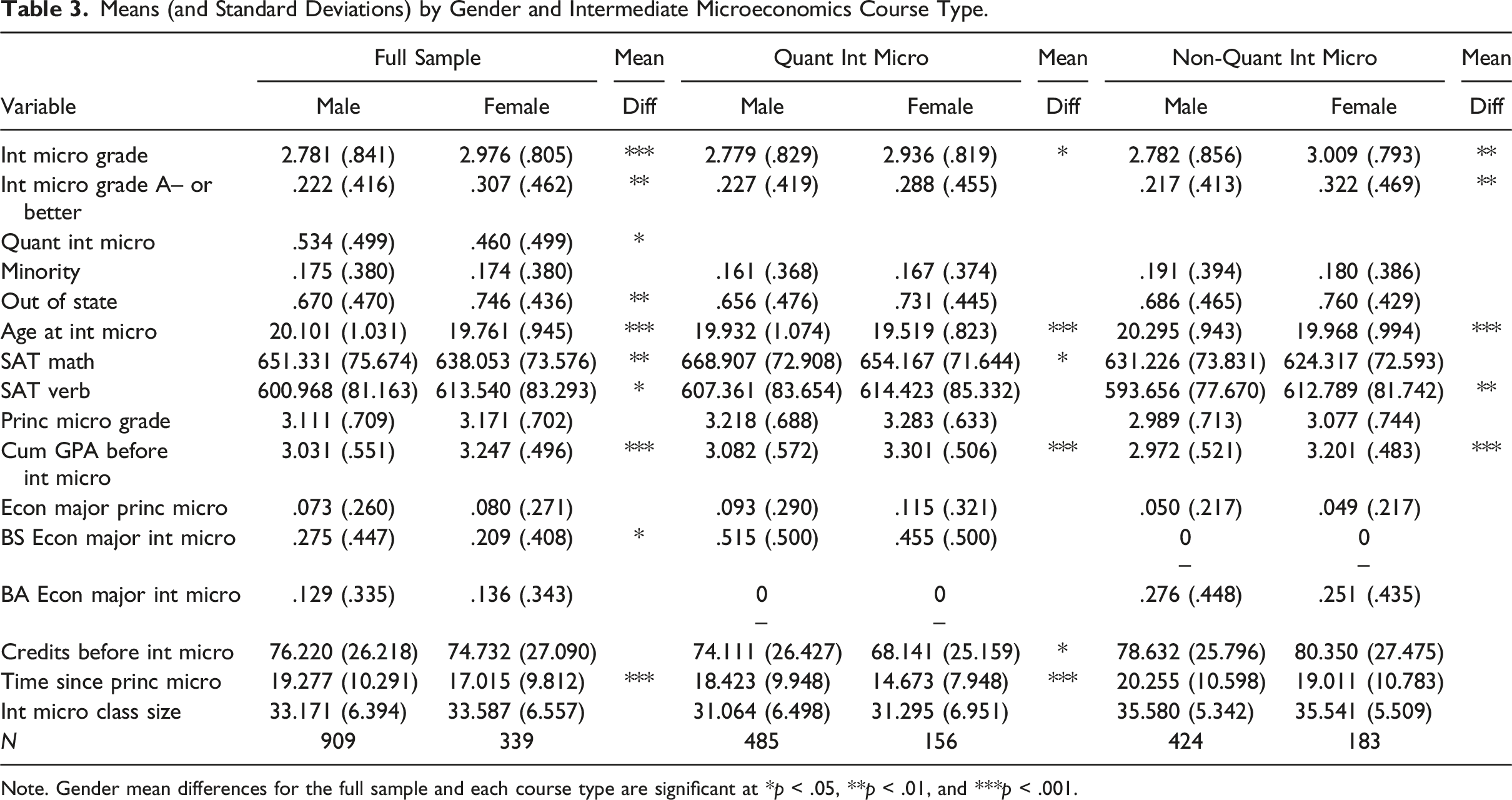
Note. Gender mean differences for the full sample and each course type are significant at *p < .05, **p < .01, and ***p < .001.
We recognize students may select into a quantitative course rather than a non-quantitative course for a variety of reasons. Using logit regressions, we assess students’ preferences of intermediate microeconomics course type. The outcome variable is equal to 1 for students who take a quantitative course and 0 otherwise. The results are shown in Table 1A in the Appendix as average marginal effects and are generally consistent with the means comparisons results for course type and gender in Tables 1 and 2. We estimate two specifications. Model 1 excludes gender interactions, while model 2 includes interactions between the female indicator variable and all other independent variables. We find no evidence of a significant gender difference in students’ preferences for a quantitative course when controlling for other factors. Students’ math SAT scores are significant and positive determinants of choosing a quantitative course, which is an expected result since students with higher math SAT scores are more likely to take a calculus course (Butler et al., 1994). We also find an increase in verbal SAT scores is associated with a lower probability of taking a quantitative course only for female students. This finding may be related to our sample having more female than male B.A. in economics majors, all of whom took the non-quantitative course. Furthermore, an increase in principles of microeconomics course grades may be significantly and positively associated with a preference for a quantitative course for male students only. Still, we interpret these findings with caution as they may be influenced by other variables for which we are unable to control, such as a student’s interest in studying economics.
Methodology
Ordered Logit Regressions for Intermediate Microeconomics Course Grade
Our outcome of interest is a student’s intermediate microeconomics final course grade. Students at this school receive final course letter grades on an incremental (plus and minus) 4.0 grading scale. An A letter grade is equal to a 4.0, and an F is a 0. Thus, recognizing that a student’s final course letter grade is a discrete variable, we estimate a series of ordered logit regressions following the work of Yang and Raehsler (2007). 4 Using this method, course grades are rank ordered. An A letter grade is an ordered outcome of 11, and an F is an ordered outcome of 0.
Since we are also interested in whether the type of intermediate microeconomics course a student completes affects their course performance, we include a dummy variable that equals 1 if a student takes the quantitative course and 0 otherwise. Also of interest is gender, and we include an indicator for a student identifying as female. We incorporate dummy variables for being a minority student or an out-of-state resident and control for a student’s age in years at the start of the intermediate microeconomics course term. To assess the effects of students’ precollege abilities on intermediate microeconomics course performance, we include their math and verbal SAT scores. To control for prior performance in economics, we incorporate students’ principles of microeconomics course grades, measured as incremental letter grades on the 4.0 scale. We also control for students’ cumulative GPAs at the start of their intermediate microeconomics course terms excluding their principles of microeconomics grades. Indicators are used to control for a student selecting either a B.A. or a B.S. in economics major at the start of the intermediate microeconomics course term. We also include students’ credit hours completed prior to the intermediate microeconomics course term and the length of time in months between the beginnings of their principles of microeconomics and intermediate microeconomics course terms, as previous research indicates the longer the break between the two courses, the lower the intermediate microeconomics course grade (Pyne, 2007). Since a student’s intermediate microeconomics class environment may influence performance, we control for intermediate microeconomics course class sizes. Additionally, we estimate two specifications for these ordered logit regressions. Model 1 excludes gender interactions. Model 2 interacts the female indicator with the indicator for taking a quantitative course and students’ math and verbal SAT scores, principles of microeconomics course grades, and cumulative GPAs. Standard errors are clustered by a student’s intermediate microeconomics course section.
Logit Regressions for the Probability of Earning an A– or Better Letter Grade
We next use a series of logit regressions to estimate the probability a student will earn an A– or better course letter grade in an intermediate microeconomics course. Our outcome variable in these models is equal to 1 if a student earned an A or A– letter grade and 0 otherwise. We report estimates both for the full sample and separately for each intermediate microeconomics course type. Since our interest is also in gender differentials, we examine two specifications for each set of regressions. The first specification excludes gender interactions. The second specification interacts the female dummy variable with the indicators for taking a quantitative course along with students’ math and verbal SAT scores, principles of microeconomics course grades, and cumulative GPAs at the start of their intermediate microeconomics course terms excluding their principles of microeconomics course grades. Regression models also include indicators for being a minority student, an out-of-state resident, and either a B.A. or B.S. in economics major at the time of taking the intermediate microeconomics course. We control for students’ ages and credit hours completed prior to their intermediate microeconomics course terms as well as the length of time in months between the beginnings of their principles of microeconomics and intermediate microeconomics course terms. All models control for intermediate microeconomics course class sizes. Standard errors are clustered by students’ intermediate microeconomics course sections.
Results
The ordered logit regressions identify the contribution of each student demographic and academic characteristic to the final course grade. The results of these regressions are presented for the full sample of students, controlling for the type of intermediate microeconomics course taken. The logit regressions narrow this analysis to the probability of earning an A– or better letter grade, and findings are displayed for the full sample and separately by intermediate microeconomics course type. We find no evidence of significant gender differences in performance in any of the regressions. In the ordered logit results, students’ math SAT scores, principles of microeconomics course grades, and cumulative GPAs are significant and positive indicators of performance for students of both genders. However, in the logit regressions, we find math SAT scores are significant and positive predictors only for students taking the non-quantitative course. Furthermore, when gender interactions are added into the model, principles of microeconomics course grades become insignificant in the estimates for the quantitative course students.
Ordered Logit Results of Intermediate Microeconomics Course Letter Grade
Marginal Effects for Ordered Logit Regressions of Intermediate Microeconomics Course Grades by Gender.
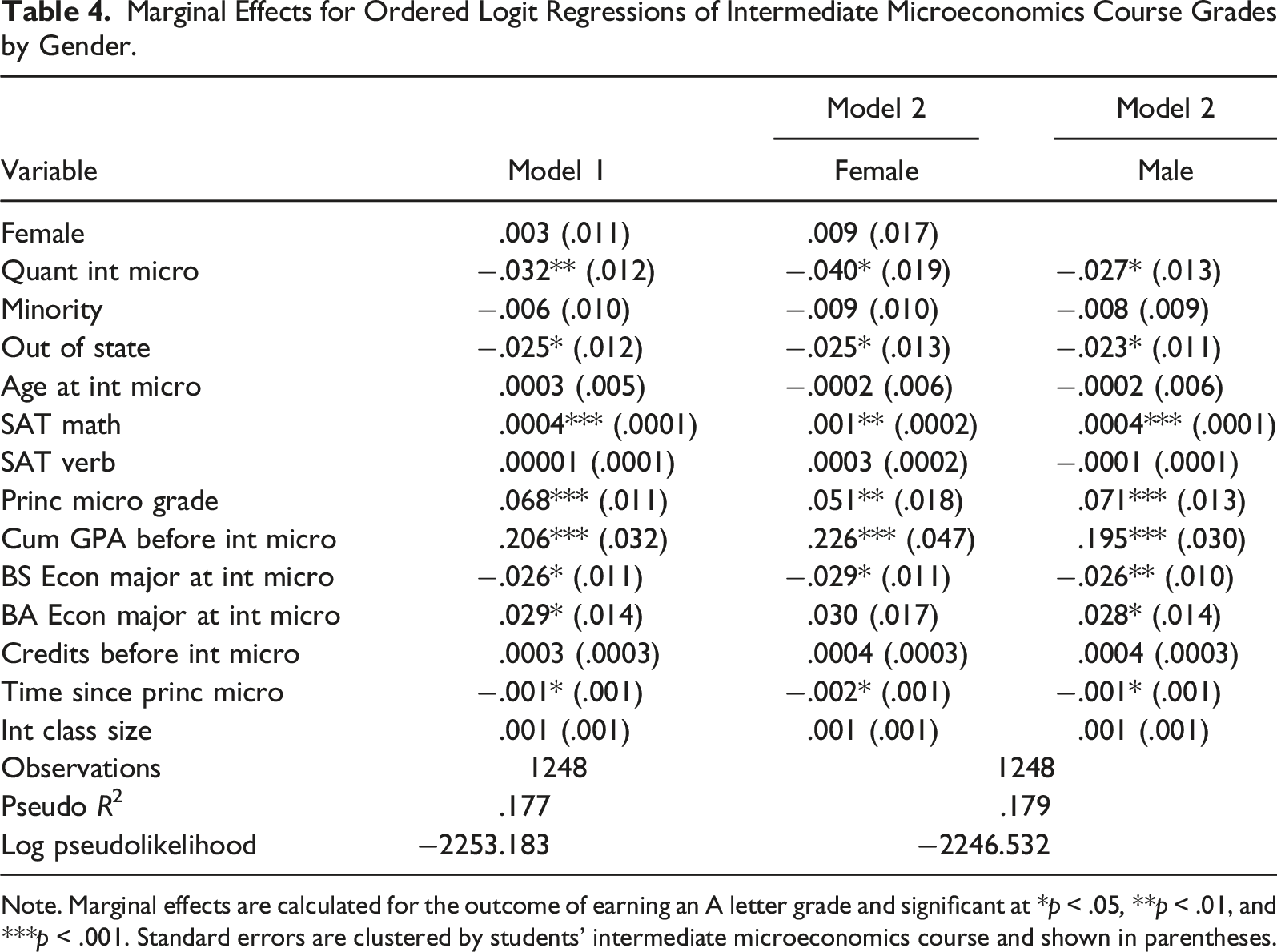
Note. Marginal effects are calculated for the outcome of earning an A letter grade and significant at *p < .05, **p < .01, and ***p < .001. Standard errors are clustered by students’ intermediate microeconomics course and shown in parentheses.
We find no significant gender differences in course performance, which is consistent with findings from prior work assessing students’ intermediate microeconomics course grades (Buschena & Watts, 2001; Von Allmen, 1996; Yang & Raehsler, 2007). This finding is encouraging in the context of economics degree completion; it suggests gender differences in intermediate microeconomics course performance may not be a factor contributing to the gender gap in economics degree attainment. At the same time, students of both genders who take a quantitative course have significantly lower probabilities of earning an A letter grade than their peers who take a non-quantitative course. This finding could reflect the calculus requirement and increased rigor associated with the quantitative course. Consistent with prior work, we find math SAT scores are significant, positive predictors of performance in an intermediate microeconomics course (Butler et al., 1994; Williams et al., 1992). Although the sizes of these effects are relatively small, the math SAT score coefficient is larger in magnitude for female than male students. The female students in our sample have significantly lower average math SAT scores than the male students, suggesting math SAT scores may be a more important predictor of earning an A in an intermediate microeconomics course for women relative to men. Similar to prior studies (Buschena & Watts, 2001; Von Allmen, 1996; Yang & Raehsler, 2007), students’ principles of microeconomics course grades are significant predictors of their intermediate course performance. A one-point increase from the mean in a student’s principles of microeconomics course grade (e.g., from a B to an A letter grade) increases the probability of earning an A letter grade in an intermediate microeconomics course by 5% points for women and 7% points for men. Also consistent with prior work is the positive, significant effect of a student’s cumulative GPA (Buschena & Watts, 2001; Yang & Raehsler, 2005). In our estimates, students’ cumulative GPAs have the strongest effects on their intermediate microeconomics course performance. A one-point increase from the average cumulative GPA is associated with an increased probability of earning an A letter grade by 23% points for women and 20% points for men. Notably, tests on the magnitudes of the coefficients for male and female students’ math SAT scores, principles of microeconomics course grades, and cumulative GPAs do not reveal any significant differences. These findings suggest male and female students may experience similar grade benefits in intermediate microeconomics courses as a result of higher math ability and achievement in college courses, including principles of microeconomics. 5 Additionally, consistent with results from Pyne (2007), a longer time in months between the starts of the principles and intermediate microeconomics course terms leads to a significant decrease in the probability of a student earning an A letter grade. The effect size is small, but it is twice as large for female students, suggesting that women may be harmed more than men when they wait a longer time between the two courses. Although our regressions do not include instructor characteristics, as a robustness check, we have estimated regressions using instructor fixed effects and robust standard errors; the results do not change significantly from our initial estimates and are available upon request.
Logit Results for the Probability of Earning an A– or Better Letter Grade
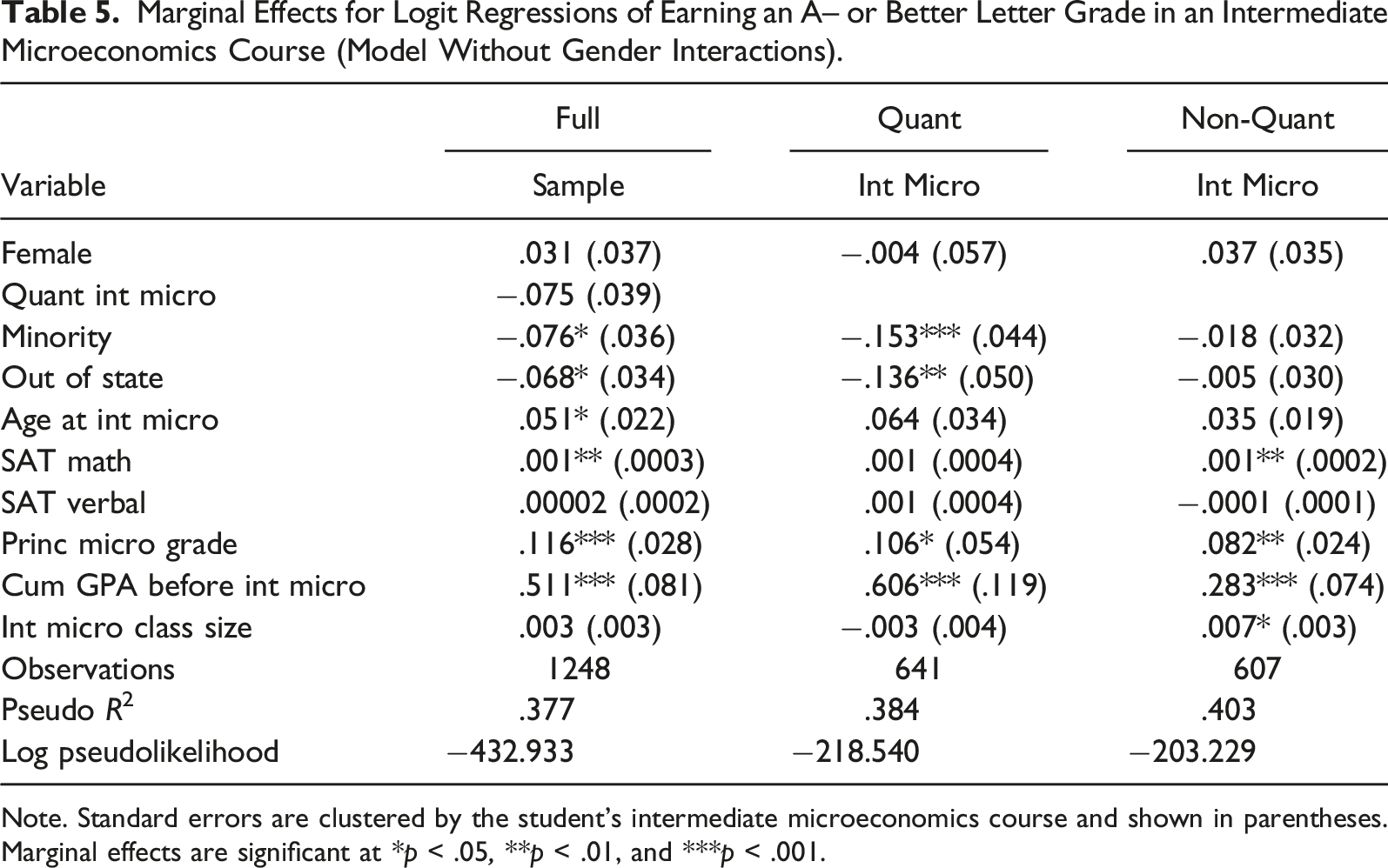
Marginal Effects for Logit Regressions of Earning an A– or Better Letter Grade in an Intermediate Microeconomics Course (Model Without Gender Interactions).
Note. Standard errors are clustered by the student’s intermediate microeconomics course and shown in parentheses. Marginal effects are significant at *p < .05, **p < .01, and ***p < .001.
Like the findings from Table 4, there are no significant gender differences in a student’s probability of earning an A– or better letter grade in any of the estimates. Male and female students perform equally well in intermediate microeconomics courses regardless of course type. This finding suggests that economics departments interested in requiring calculus for an intermediate microeconomics course may be able to do so without contributing to gender gaps in economics course performance. In contrast with the ordered logit results, however, we find taking a quantitative course does not significantly affect students’ grades. Additionally, a higher math SAT score is positively correlated with the probability of earning an A– or better letter grade in a non-quantitative course, although the size of this effect is small. Moreover, no similar effect is found for students who take a quantitative course; this result may be related to the higher average math SAT scores for the quantitative course students in our sample. Our results suggest the effects of math SAT scores on student performance may be related to the intermediate microeconomics course type and level of math expected in the course. Since students taking the quantitative course already exhibit higher math skills, the importance of math in determining grades is diminished. We also find students’ principles of microeconomics course grades are significantly and positively associated with an increased probability of earning an A– or better letter grade in all estimates. A one-point increase from the mean principles of microeconomics grade (e.g., from a B to an A) is associated with an increase in a student’s probability of earning an A– or better letter grade by 11% points for quantitative course students and by 8% points for non-quantitative course students. Additionally, in all estimates, students’ cumulative GPAs at the start of their intermediate microeconomics course terms are positive and significant. Interestingly, the magnitude of the effect of a one-point increase from the mean cumulative GPA is more than twice as large for students taking a quantitative course as for their non-quantitative course peers.
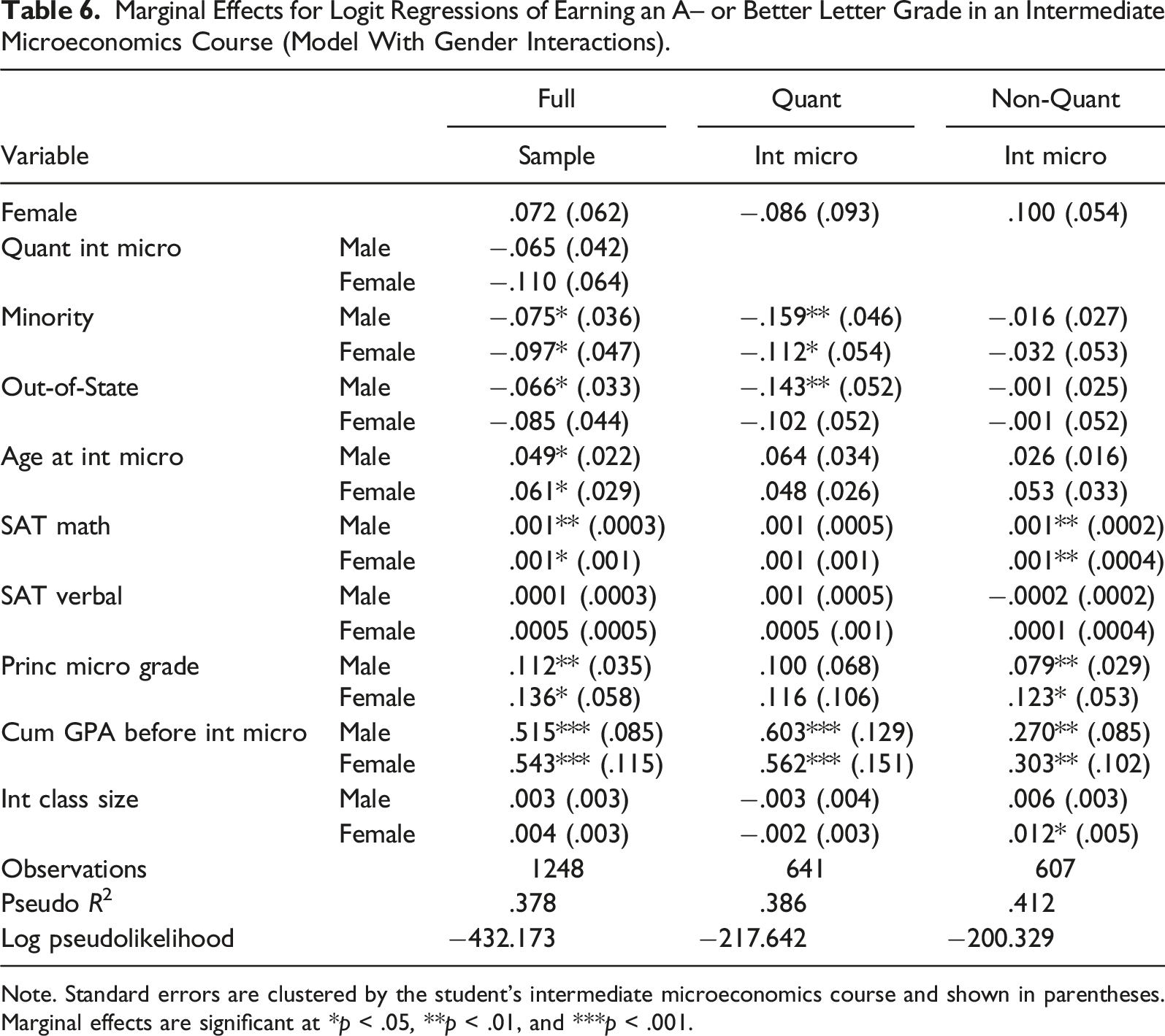
Marginal Effects for Logit Regressions of Earning an A– or Better Letter Grade in an Intermediate Microeconomics Course (Model With Gender Interactions).
Note. Standard errors are clustered by the student’s intermediate microeconomics course and shown in parentheses. Marginal effects are significant at *p < .05, **p < .01, and ***p < .001.
Notably, we find no significant gender differences in the magnitudes of these effect sizes. In all estimates, a student’s cumulative GPA prior to the intermediate microeconomics course is a strong, significant, and positive predictor of intermediate course performance. Furthermore, the sizes of the cumulative GPA coefficients are considerably larger for the quantitative course students than for the non-quantitative course students. Even so, we find no significant gender differences in the effect sizes for students’ cumulative GPAs in any of the estimates.
Discussion and Conclusion
Overall, this study represents the first examination of gender differences in performance in different types of intermediate microeconomics courses. Our findings confirm prior work that male and female students may perform equally well in intermediate microeconomics courses (Buschena & Watts, 2001; Von Allmen, 1996; Yang & Raehsler, 2007). Moreover, these results are consistent for both the quantitative, calculus-based and non-quantitative, non-calculus-based course types, suggesting that men and women who take an intermediate microeconomics course may experience similar academic performance regardless of the level of math required. Furthermore, by offering both types of intermediate microeconomics courses, students may select their intermediate microeconomics course types according to their levels of math proficiency. We find no significant gender differences in student selection into a quantitative course, although math SAT scores matter, indicating students of both genders may choose the type of intermediate microeconomics course for which they are best suited. Additionally, at this institution, instructors of both intermediate microeconomics course types use real-world examples and incorporate articles from scholarly economics journals. Goolsbee (2019) contends “citing empirical studies can keep a lot of students interested in micro [sic] who might have drifted away had it remained overly abstract” (p. 270). Female students may be particularly attracted to economics when they are able to see its real-world applications (Ferrara & Asarta, 2022). Prior studies in mathematics have also found significant and positive correlations between interest and course performance (Köller et al., 2001; Schiefele & Csikszentmihalyi, 1995). Thus, by applying course concepts to real-world events and using research from empirical microeconomics studies, instructors may promote interest and belonging among female students, benefitting them academically. Additionally, our results are promising in the context of the gender gap in economics course completion and degree attainment. Our findings suggest female students may not be discouraged from earning an economics degree because of potentially lower intermediate microeconomics course performance than their male peers.
At the same time, the type of intermediate microeconomics course a student takes may affect their performance. We find some evidence that students of both genders who take a quantitative course earn lower grades than those who take a non-quantitative course. This result may be associated with greater difficulty in the quantitative course at this institution due to the calculus requirement. We also find that the time between the principles and intermediate microeconomics courses has a small negative effect, consistent with previous research (Pyne, 2007). As such, students would be advised to take intermediate microeconomics shortly after taking principles. The size of this effect is also larger for female students, so advisors may particularly want to encourage female students to take intermediate microeconomics shortly after completing the principles course.
Consistent with prior literature, the ordered logit regression results indicate that principles of microeconomics course grades are significant and positive predictors of intermediate course performance (Buschena & Watts, 2001; Fleisher et al., 2002; Von Allmen, 1996; Yang & Raehsler, 2007). Conversely, the logit regression results for the probability of earning an A– or better letter grade suggest principles of microeconomics course grades may affect student performance differently depending upon their intermediate microeconomics course type. Principles course grades are significant predictors only for non-quantitative course students, although these results are consistent for men and women. Also, similar to prior work, the ordered logit results indicate students’ math SAT scores are associated with small, positive effects on intermediate microeconomics course grades (Butler et al., 1994; Williams et al., 1992). At the same time, math SAT scores are positive and significant predictors of earning an A– or better letter grade for non-quantitative course students only. In our sample, the students taking the quantitative course have significantly higher mean math SAT scores and principles of microeconomics course grades. It is possible that being academically stronger than their non-quantitative course peers may reduce the significance of the effects of these variables on quantitative course students’ performance. Conversely, we find students’ cumulative GPAs are positive and significant in all estimations, similar to prior studies’ results (Buschena & Watts, 2001; Yang & Raehsler, 2005). Moreover, the magnitudes of the cumulative GPA coefficients suggest students’ college achievement in courses outside of principles of microeconomics is strongly correlated with their intermediate microeconomics course performance.
One limitation with our work is that factors associated with students’ choices to take an intermediate microeconomics course may be correlated with the factors related to their performance in these courses. Prior studies have shown students who persist from principles of economics courses to intermediate theory courses tend to be stronger academically, having higher SAT scores and cumulative GPAs than their peers who take no economics courses beyond the principles level (Ahlstrom & Asarta, 2019; Emerson et al., 2012). Additionally, our methodology does not allow us to control for a student’s choice of intermediate microeconomics course type, although we do find students with higher math SAT scores may be more likely to take a quantitative course. It is possible that the lack of significance in the math SAT scores for the quantitative course students in our sample may be related to this choice. Also, we do not control for instructor demographic characteristics, although robustness checks indicate adding instructor fixed effects does not considerably change the results. 6 Furthermore, variables for which we are unable to control, such as student attendance, motivation, and interest in economics, may also affect our results. Future studies assessing intermediate microeconomics course performance may attempt to control for students’ selection and omitted variables.
To sum up, our results suggest gender may not significantly affect intermediate microeconomics course performance, a positive finding in the context of closing the gender gap in economics majors. Instead, overall college achievement, as measured by cumulative GPA, is the strongest predictor of intermediate microeconomics course performance, a result that is consistent for both course types. The importance of other factors, such as students’ math abilities and principles of microeconomics course grades, may be related to the type of intermediate microeconomics course a student takes. Given the importance of intermediate microeconomics courses in the economics major curriculum, these findings may have implications for students’ economics degree attainment.
Footnotes
Declaration of Conflicting Interests
The author(s) declared no potential conflicts of interest with respect to the research, authorship, and/or publication of this article.
Funding
The author(s) received no financial support for the research, authorship, and/or publication of this article.

Notes
Appendix
Table 1A presents average marginal effects for logit regressions for students’ preferences for a quantitative course. We find no significant gender differences in the choice of a quantitative course. For students of both genders, a higher math SAT score is associated with a higher probability of taking a quantitative course. Principles of microeconomics course grades are significant and positive determinants of quantitative course selection for male students only.
Marginal Effects for Logit Regression of Quantitative Course Selection. Note. Standard errors are clustered by the student’s principles of microeconomics course and shown in parentheses. Significant at *p < .05, **p < .01, and ***p < .001.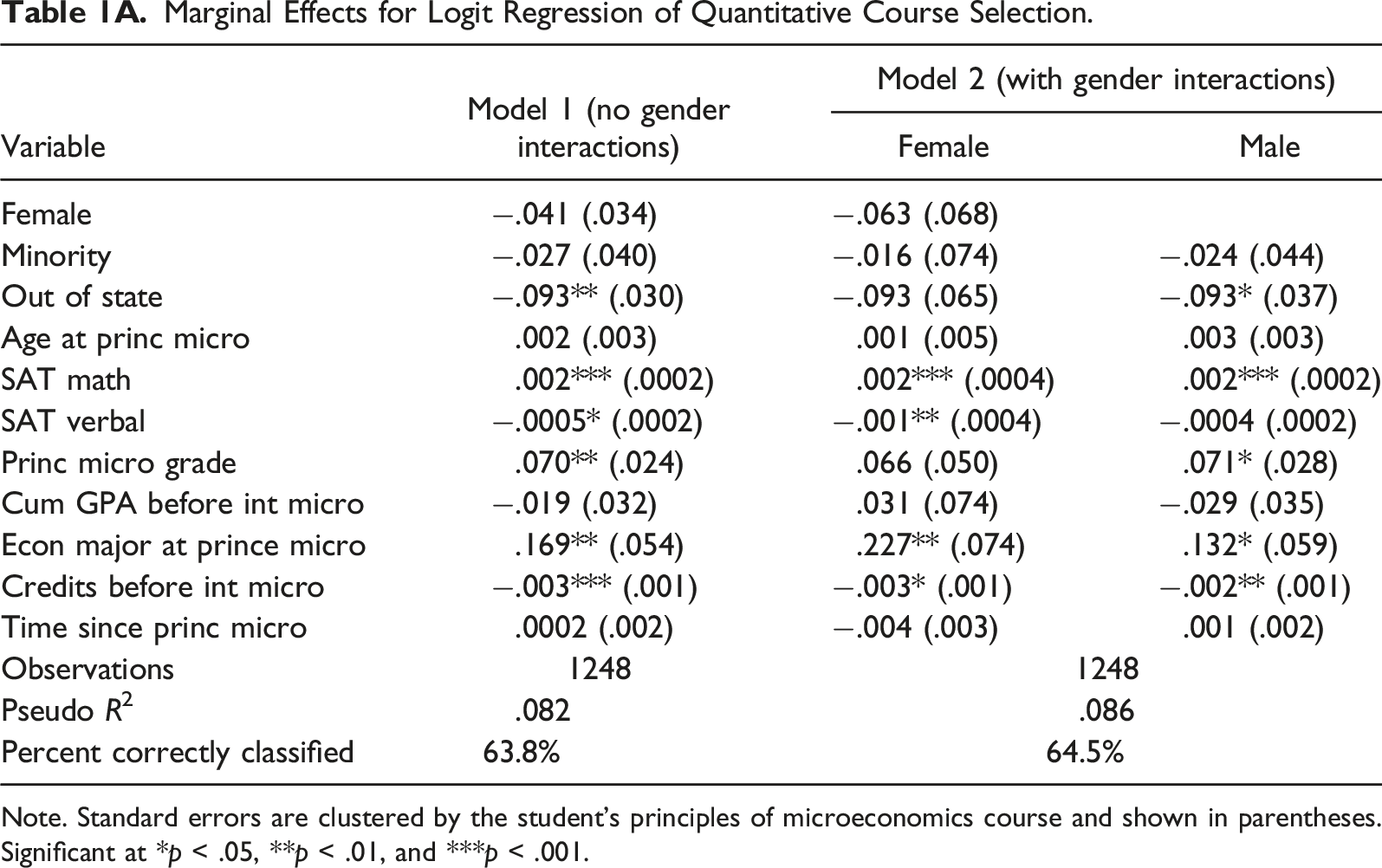
Variable
Model 1 (no gender interactions)
Model 2 (with gender interactions)
Female
Male
Female
−.041 (.034)
−.063 (.068)
Minority
−.027 (.040)
−.016 (.074)
−.024 (.044)
Out of state
−.093** (.030)
−.093 (.065)
−.093* (.037)
Age at princ micro
.002 (.003)
.001 (.005)
.003 (.003)
SAT math
.002*** (.0002)
.002*** (.0004)
.002*** (.0002)
SAT verbal
−.0005* (.0002)
−.001** (.0004)
−.0004 (.0002)
Princ micro grade
.070** (.024)
.066 (.050)
.071* (.028)
Cum GPA before int micro
−.019 (.032)
.031 (.074)
−.029 (.035)
Econ major at prince micro
.169** (.054)
.227** (.074)
.132* (.059)
Credits before int micro
−.003*** (.001)
−.003* (.001)
−.002** (.001)
Time since princ micro
.0002 (.002)
−.004 (.003)
.001 (.002)
Observations
1248
1248
Pseudo R2
.082
.086
Percent correctly classified
63.8%
64.5%