




Abstract
A sandstone included in the Bagh Formation occurs at Belam Bujurg, District Khargone, Madhya Pradesh. Its stratigraphic position is controversial. Bose considered it as Nimar Sandstone. His observation, that it is capped by a limestone containing bryozoans, implies that Sitapuri Bryozoan Limestone directly overlies Nimar Sandstone at Belam Bujurg. However, it is contradictory to Chiplonkar’s (1982) observation that Nodular limestone is invariably associated with Nimar Sandstone. According to Roy Chowdhury and Sastri (1954, 1958), this sandstone is an intercalation within the Sitapuri Bryozoan Limestone. Later, Badve (1987) correlated this sandstone with Nimar Sandstone on the basis of similar ichnofauna and believed that overlying limestone cap represented calcareous facies coming at the top of Nimar Sandstone. However, elsewhere frequency and variety of trace fossils are distinctly more in limestone layers, in comparison to sandstone layers. Moreover, the presence of similar trace fossils indicates similarity in the conditions of deposition, rather than correlation. Recent fieldwork by the present authors corroborates that this sandstone is an intercalation within Sitapuri Bryozoan Limestone. Identification of the bryozoan Limestone was confirmed by petrographic study in thin section.
Keywords
Introduction
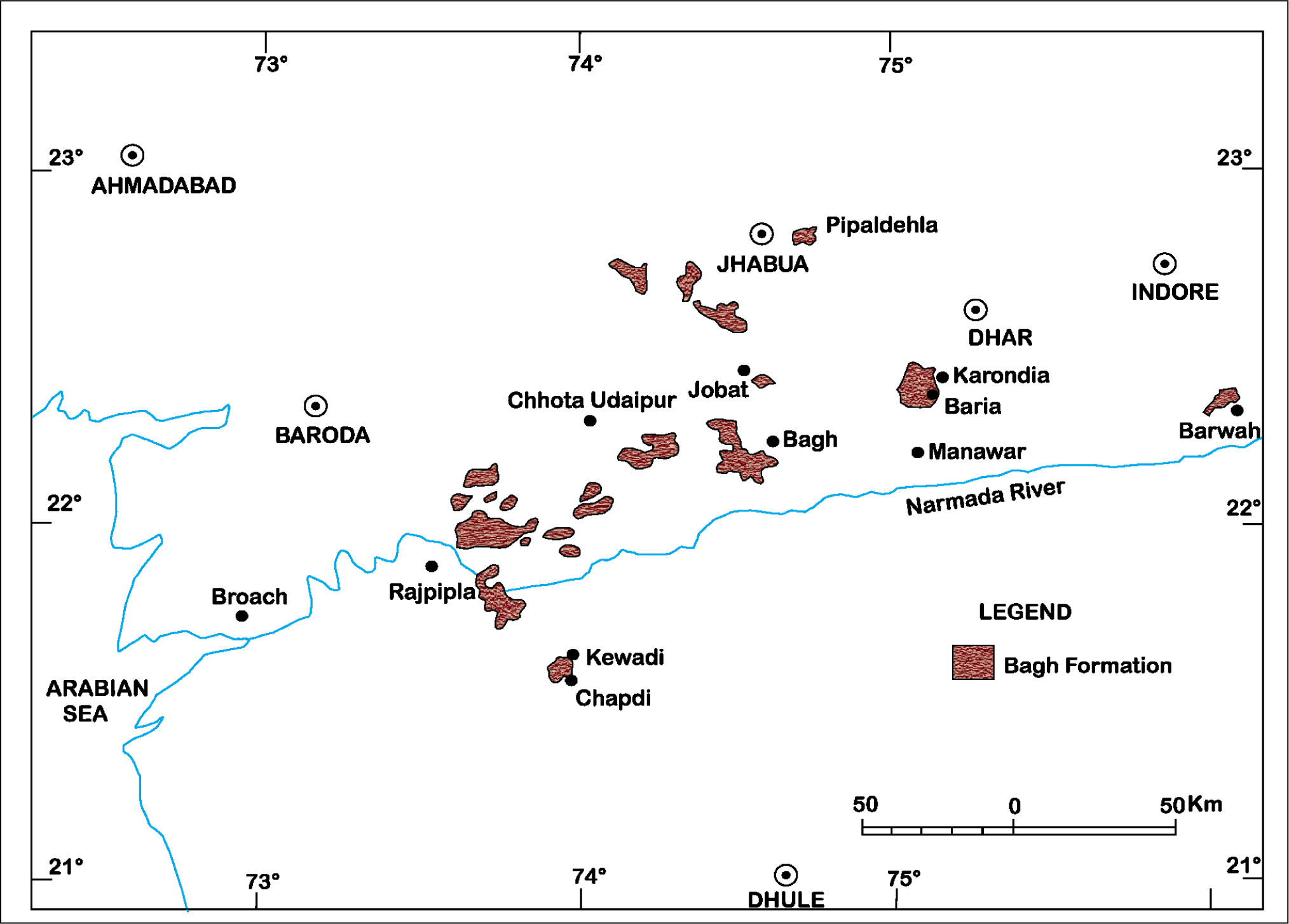
The Bagh Formation occurs as a belt of detached outcrops in the Lower Narmada Valley (Figure 1). This belt, about 260 km long, extends from Uchad in the Narmada District of Gujarat in the west, to Barwah in the Khargone District of Madhya Pradesh in the east. There are some controversies regarding the lithostratigraphy of the Bagh Formation. One such controversy revolves around a sandstone unit, exposed in the Kholar River at Belam Bujurg (22°16'35"N, 75°57'45"E), Khargone District, Madhya Pradesh.
According to some, it represents the Nimar Sandstone, overlain directly by the Sitapuri Bryozoan Limestone (Bose, 1884; Dassarma & Sinha, 1975). A couple of research communications (Badve, 1987; Sanganwar & Kundal, 1997) opined that the sandstone is the Nimar Sandstone and the limestone, which caps it, represents calcareous facies coming at the top of the Nimar Sandstone in Gujarat and parts of Madhya Pradesh. However, according to Singh (1950) as well as Roy Chowdhury and Sastri (1954, 1958), the sandstone under question forms an intercalation within the Sitapuri Bryozoan Limestone. The present authors undertook the study of this sandstone as an attempt towards resolving the issue.
The sandstone exposure under dispute is a part of the easternmost cluster of the outcrops of the Bagh Formation (Figure 1), located near Barwah (vide supra). It was spotted first by Blanford (1869), who observed that the sandstone at Belam Bujurg reminded him of the sandstone, which underlies the Nodular Limestone at Bagh. Furthermore, from a small limestone outcrop, 1.5 km north of Barwah, Blanford procured a fragmentary ammonoid, a brachiopod, a few oysters and a tiny bivalve resembling Astarte. It helped him to recognise the existence of the Bagh Formation in the Barwah cluster.
Distribution of the outcrops of Bagh Formation (After Kulkarni & Uchman, 2022).
Later, Bose (1884) undertook a detailed survey of the Bagh Formation. He proposed a lithostratigraphicclassification, which is reproduced here in Table 1. Bose stated that the sandstone at Belam Bujurg represented the Nimar Sandstone. He also noticed that the sandstone under consideration is capped by a thin band of limestone containing bryozoans. This observation by Bose connotes that the Nimar Sandstone here is directly overlain by what was conventionally called as the Coralline Limestone. In the present communiqué, the Coralline Limestone is referred to as the Sitapuri Bryozoan Limestone following a suggestion by Borkar and Kulkarni (2021).
Lithostratigraphic classification of the Bagh Formation (Slightly modified after Bose, 1884).
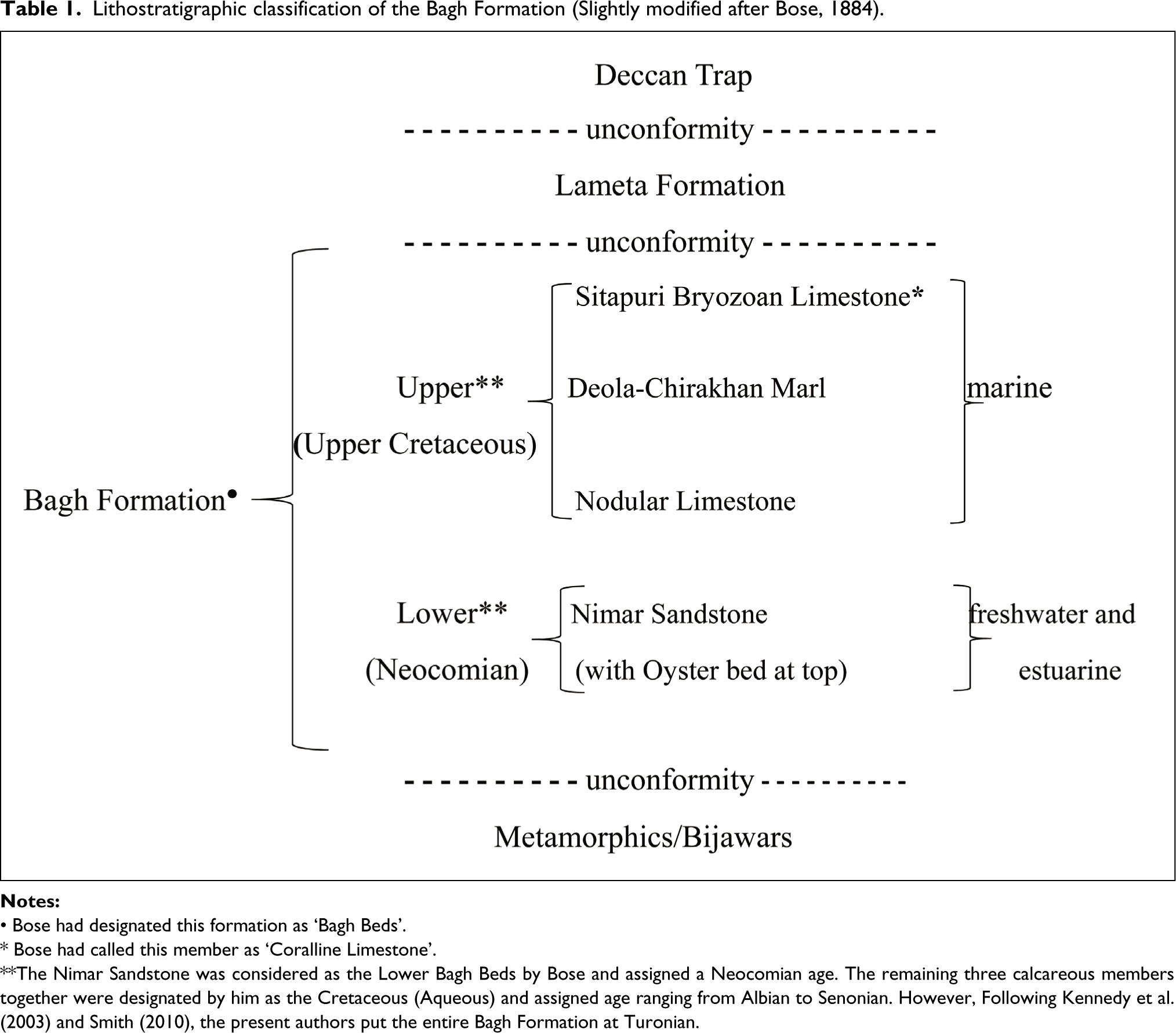
• Bose had designated this formation as ‘Bagh Beds’.
* Bose had called this member as ‘Coralline Limestone’.
**The Nimar Sandstone was considered as the Lower Bagh Beds by Bose and assigned a Neocomian age. The remaining three calcareous members together were designated by him as the Cretaceous (Aqueous) and assigned age ranging from Albian to Senonian. However, Following Kennedy et al. (2003) and Smith (2010), the present authors put the entire Bagh Formation at Turonian.
When Singh (1950) studied this area with the aim of documenting microfossils from the Bagh Formation of the Barwah area, he explicitly stated that the sandstone at Belam Bujurg is just a parting within the Sitapuri Bryozoan Limestone. However, his research communication was a brief note without field details. Hence, it is not clear why he formed an opinion, contradictory to that of Bose.
A little later, Roy Chowdhury and Sastri (1954, 1958) undertook a detailed study of the Barwah area. They inferred that the Bagh Formation here is represented by the Sitapuri Bryozoan Limestone with a few lenticular intercalations of sandstone. While reviewing the lithostratigraphic classification of the Bagh Formation based on the study of the Man River Section, Dhar District, they reiterated their view (Roy Chowdhury & Sastri, 1962).
Dassarma and Sinha (1975) held that the Sitapuri Bryozoan Limestone occurs in the Kholar River, but rejected the idea of the sandstone being an intercalation within it. They believed the sandstone under consideration was the Nimar sandstone, implying that it was directly overlain by the Sitapuri Bryozoan Limestone.
Badve (1987) refuted the views expressed by Roy Chowdhury and Sastri (1954, 1958, 1962) and stated that the limestone layer underlying the sandstone at Belam Bujurg was not the Sitapuri Bryozoan Limestone; but a calcareous sandstone. He also discarded that the limestone bed which caps the sandstone was a bryozoan Limestone. He equated it with the calcareous facies developed towards the top of the Nimar Sandstone, seen in several other parts of the belt of outcrop. Badve explicitly stated that the entire thickness between the Bijawars below and the basaltic flows above belonged to the Nimar Sandstone.
While describing ichnofossils from the sandstone exposed near Belam Bujurg, Sanganwar and Kundal (1997) accepted the view expressed by Badve (1987) that this sandstone belongs to the Nimar Sandstone, without giving any reasons.
Of late, Tripathi (2006) included this sandstone in what he recognises as the Bariya Member of his Nimar Sandstone Formation.
Field Observations
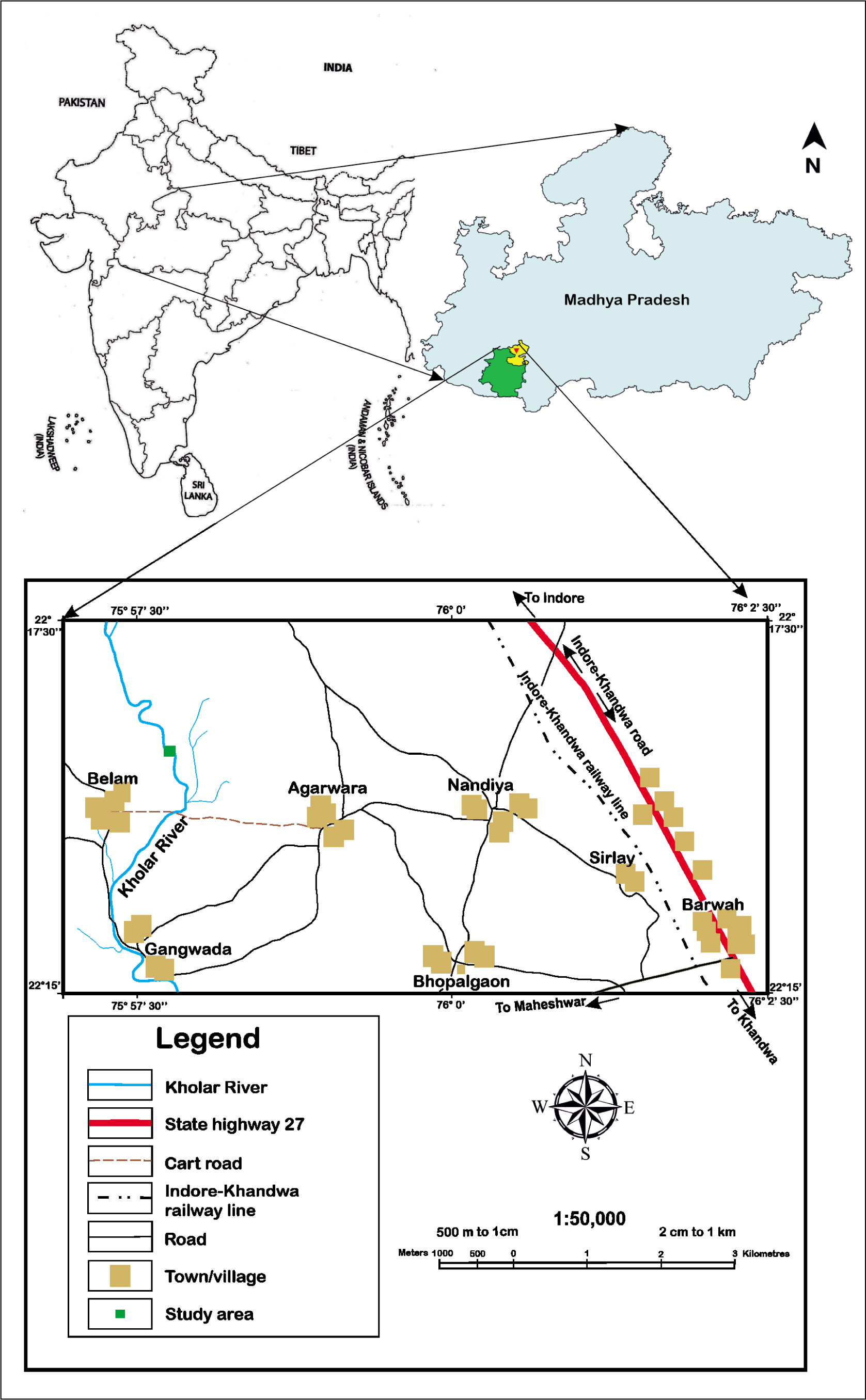
The oldest rocks in the study area are the Dolomites, conventionally considered as representing the Bijawar Group of the Bijawar Basin. However, now they are better identified as outcrops of the Lohar Formation of the Kishangad Group of the Barwah-Kishangad-Harda Basin (Mohanty, 2023). In the Kholar River, these dolomites are exposed some 150 m downstream of the causeway on the Kutcha road leading from Belam Bujurg to Agarwara (Figure 2). A 7 m thick pile of sedimentary rocks, which overlies the dolomites of the Lohar Formation, represents the Bagh Formation at Belam Bujurg (Figure 3) and is seen exposed in the escarpments of Kholar River bed for a distance of about 300 m upstream of the outcrop of the Lohar Dolomites.
Location map. Study area demarcated by solid green square.
Litholog of the exposure near Belam Bujurg.
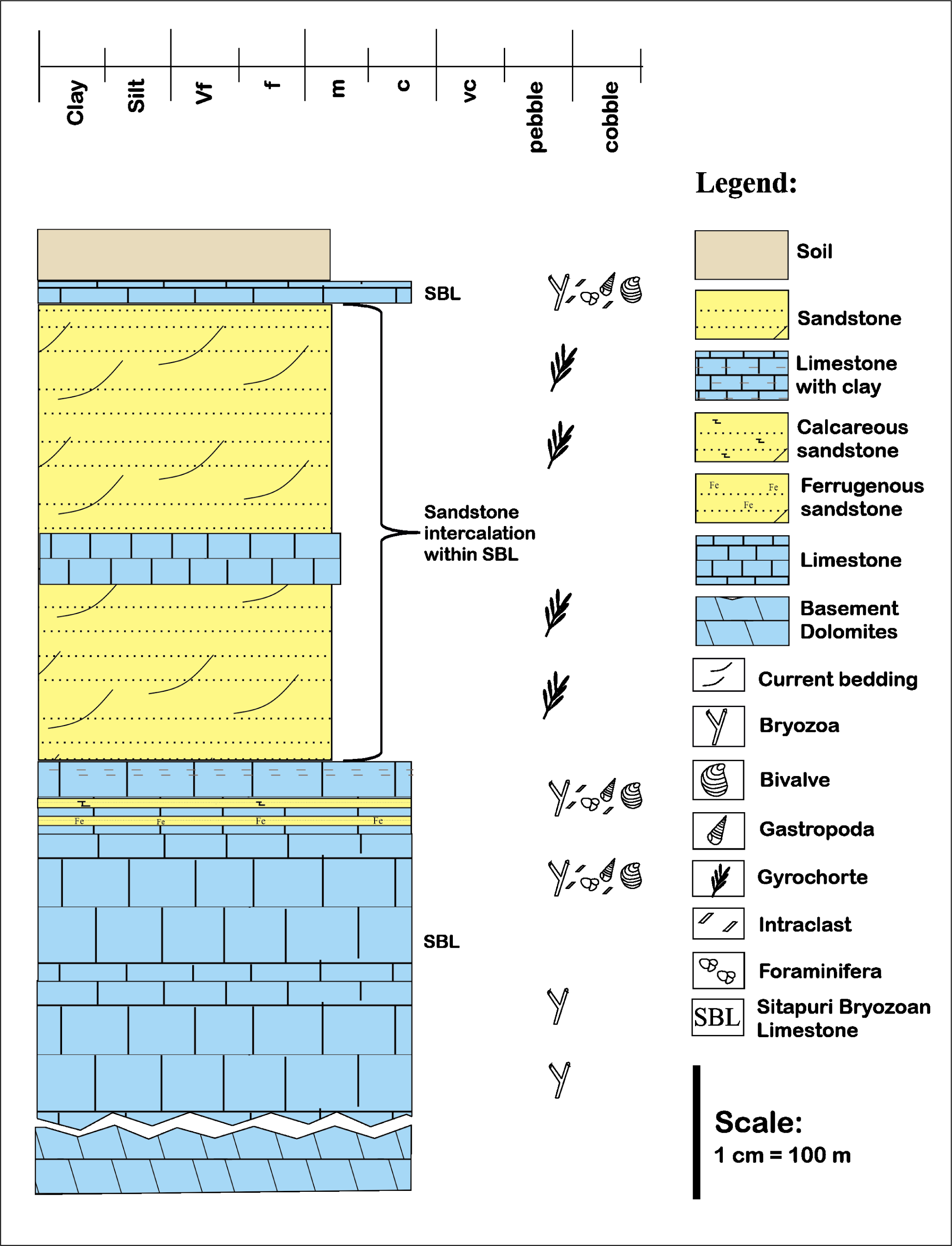
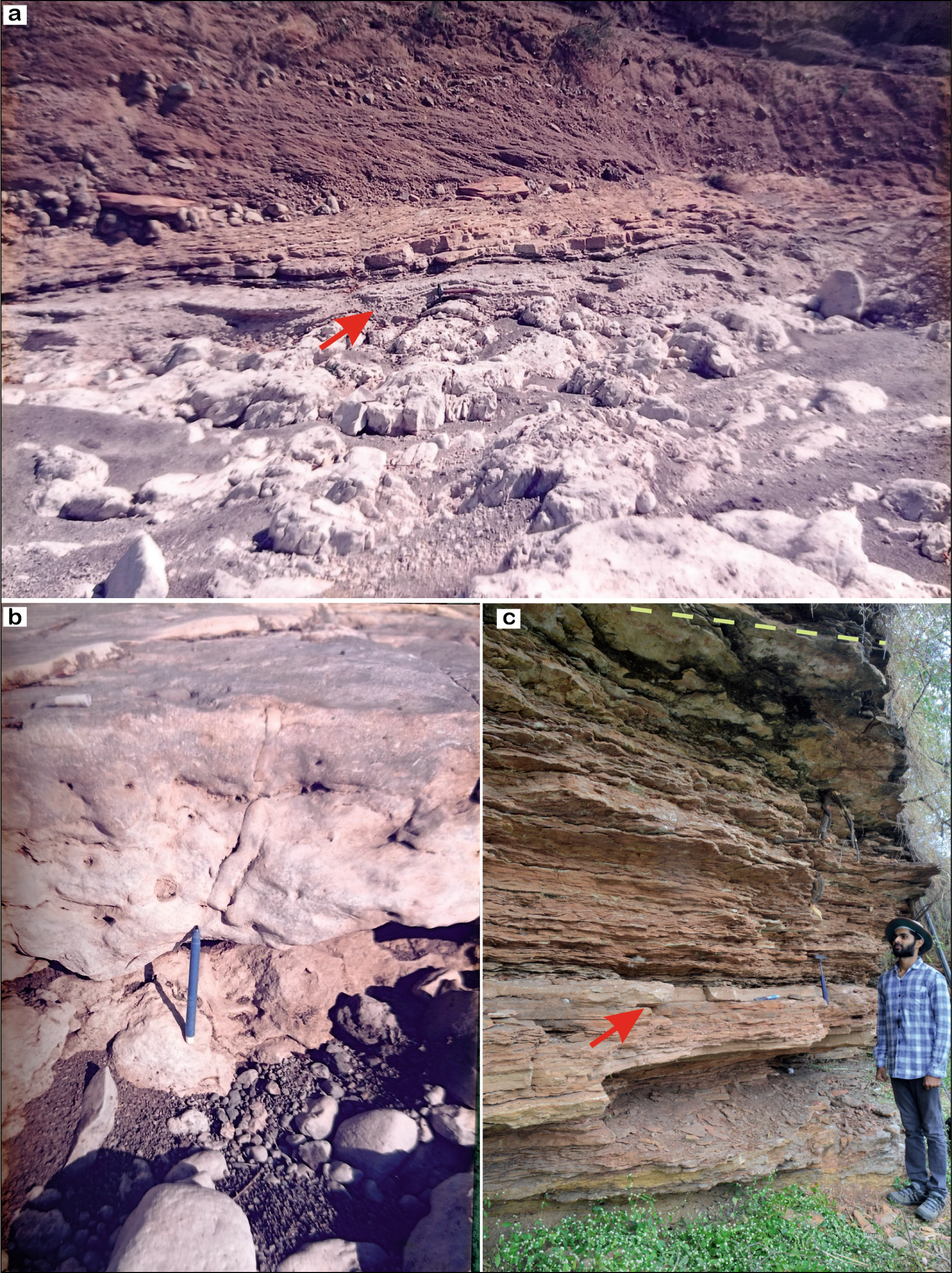
The rock which immediately overlies the dolomites is the oldest lithounit of the Bagh Formation developed here. It is a yellowish brown, well-laminated, hard, limestone; with very fine, low-angled cross beds. It forms flags of moderate thicknesses on weathering (Plate 1a, b). Fragments of bryozoans are readily detected with a hand lens. There is no doubt that this is Sitapuri Bryozoan Limestone.
When tracked further upstream, this bryozoan limestone is followed by a lilac-coloured arenaceous limestone, almost 110 cm thick (Plate 1a). The presence of bryozoans can be detected in this arenaceous limestone also, but they are not as abundant as in the underlying well-laminated limestone.
Field photographs of the exposures at Belam Bujurg; (a) Sitapuri Bryozoan Limestone. The beds show typical well-indurated beds with parallel, horizontal lamination is seen in the foreground. The overlying arenaceous limestone is in the background (indicated by an arrow); (b) Sitapuri Bryozoan Limestone shows a portion of Thalassinoides. (Scale: length of pen 14 cm); (c) A 4m thick section of sandstone comprising calcareous sandstone and limestone at base; and Sitapuri Bryozoan Limestone at top. Note: A 38 cm thick limestone intercalation is shown by arrow. (Scale: height of the person 175 cm).
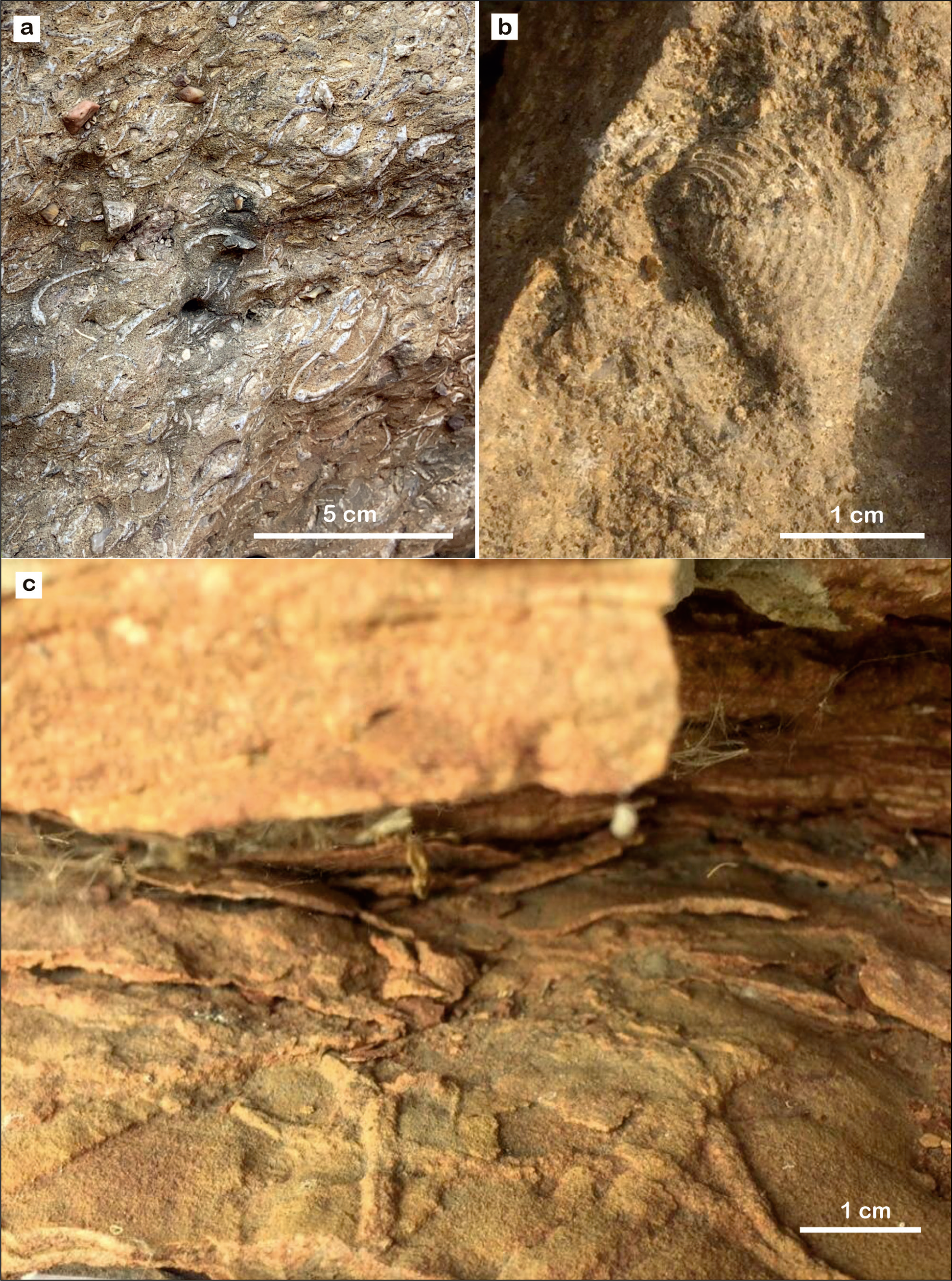
It is overlain by a buff coloured, arenaceous limestone, and its thickness being 55 cm. It shows the presence of oysters and the bivalve genus Jhabotrigonia (Plate 2a, b). The presence of Jhabotrigonia was also recorded here earlier by Badve (1987). This lithounit shows a thin, 5 cm thick parting of reddish, ferruginous sandstone, roughly at the middle of its thickness.
It is followed by reddish brown, fine-grained, calcareous sandstone, measuring about 3.40 m thick (Plate 1c). Abundance of trace fossils is noteworthy, Gyrochorte being the most common ichnogenus (Plate 2c). Very gentle current bedding is observed. Many laminae show asymmetrical ripple marks, some of the laminae were of cement grey colour. A 38 cm thick layer of compact and massive sandstone is present in between these thinly laminated layers (Plate 1c).
Field photographs showing representative fossils; (a) Arenaceous limestone showing the presence of oysters; (b) Arenaceous limestone showing the presence of the bivalve genus Jhabotrigonia; (c) Calcareous sandstone with Ichnogenus Gyrochorte.
This pile of sandstone layers is followed by a 26 cm thick, hard, brownish limestone, with bryozoans.
Further upstream, the strata of the Bagh Formation are overlain by a couple of lava flows of the Deccan Trap, with a fossiliferous intertrappean bed in between.
The youngest rocks are of the Quaternary age and represented by alluvium as well as by discontinuous shingle, consisting of trappean pebbles, overlying the Bagh sediments.
Discussion
The field observations by the present authors revealed that ca 1.5 m thick rock, unequivocally identified as Sitapuri Bryozoan Limestone, is seen exposed in the Kholar River. It overlies the dolomites of the Lohar Formation with an unconformity. It is followed upward by layers of sandy limestone and calcareous sandstone, measuring together almost 5m. This is the controversial sandstone of Belam Bujurg, varying in characters from arenaceous limestone to calcareous sandstone. In turn, this sandstone is capped by a bed of limestone, containing bryozoans. These observations clearly evince that the sandstone under dispute constitutes an intercalation within the Sitapuri Bryozoan Limestone. These observations of the present authors are in agreement with those of Singh (1950) as well as Roy Chowdhury and Sastri (1962)
Bose (1884), Dassarma and Sinha (1975) and Tripathi (2006) were of the opinion that the sandstone at Belam Bujurg was Nimar Sandstone. As regards the limestone band capping it, Tripathi (2006) has offered no comment. However, Dassarma and Sinha (1975) have ascertained the presence of Sitapuri Bryozoan Limestone in the area, whereas Bose (1884) described it as limestone containing bryozoa. Opinions expressed by Bose (1884) as well as by Dassarma and Sinha (1975) imply that in Barwah area, the Nimar Sandstone is overlain conformably by the Sitapuri Bryozoan Limestone. Nodular Limestone and Deola-Chirakhan Marl, which occur between the two in the Man River Section of the Dhar District, are missing in the Kholar River section.
An evaluation of this implication vis-à-vis the observation by Chiplonkar (1982) is necessary. He observed that Nimar Sandstone is a constant associate of the Nodular Limestone. Indeed, these two members of the Bagh Formation are always seen together wherever they occur. In Gujarat as well as in Alirajpur and Jhabua Districts of Madhya Pradesh, the Bagh Formation is represented by only these two members. Therefore, the implication that the Nimar Sandstone is directly overlain by the Sitapuri Bryozoan Limestone does not appear plausible. It needs to be emended.
As regards the opinion expressed by Badve (1987), he has identified the Sitapuri Bryozoan Limestone, underlying the sandstone pile at Belam Bujurg, as a Siliceous limestone. At the same time, he agreed that this limestone resembles the rock designated as the Coralline Limestone; and stated that it forms the pavement of the river bed. Also, the limestone bed which caps the Sandstone is identified by Badve (1987) as the calcareous facies developed towards the top of the Nimar Sandstone, though it contains bryozoan remains. Thereby, he reckoned that the entire strata between the Lohar Formation below and the basaltic flows of the Deccan Trap above was stratigraphically the Nimar Sandstone.
Along with oysters and Jhabotrigonia; comparable ichnofauna is reported from the Nimar Sandstone elsewhere (Badve & Ghare, 1980; Chiplonkar & Badve, 1969, 1970; Ghare & Badve, 1980; Kundal & Sanganwar, 1998, 2000; Verma, 1971), Badve (1987) gave weightage to the occurrence of these fossils in the sandstone lithounit of Belam Bujurg, in equating it with The Nimar Sandstone.
The fieldwork carried out by the present authors in the Ambadongar area and Devganga Valley in Gujarat has revealed that frequency and variety of trace fossils are remarkable in the limestone layers occurring at the top of the Nimar Sandstone, often referred to as the calcareous facies at the top of Nimar Sandstone. Trace fossils do occur in sandstone layers, but their frequency and variety are comparatively reduced. The reverse is the case with Belam Bujurg, the trace fossils occur in great numbers in arenaceous layers, while their variety and frequency decrease in limestone below as well as above.
Borkar and Kulkarni (2021) have described the Sitapuri Bryozoan Limestone as a well indurated, hard rock, yellowish or reddish in colour. It breaks into thick slabs owing to remarkable induration and parallel, horizontal lamination. Bearing these attributes of the Sitapuri Bryozoan Limestone in mind, it is to be appreciated that the aforesaid limestone gets this pavement-like appearance in the bed of the Kholar River as observed by Badve (1987), because it weathers into moderately thick flags within the river bed. Its resemblance to the typical Sitapuri Bryozoan Limestone is not just superficial, as Badve had thought. Along with slabby nature, its colour, excellent induration and horizontal stratification are the characteristics of the Sitapuri Bryozoan Limestone occurring in the Man River Section in the Dhar District. As such, the limestone layer at this spot is actually an outcrop of the Sitapuri Bryozoan Limestone (Plate 3).
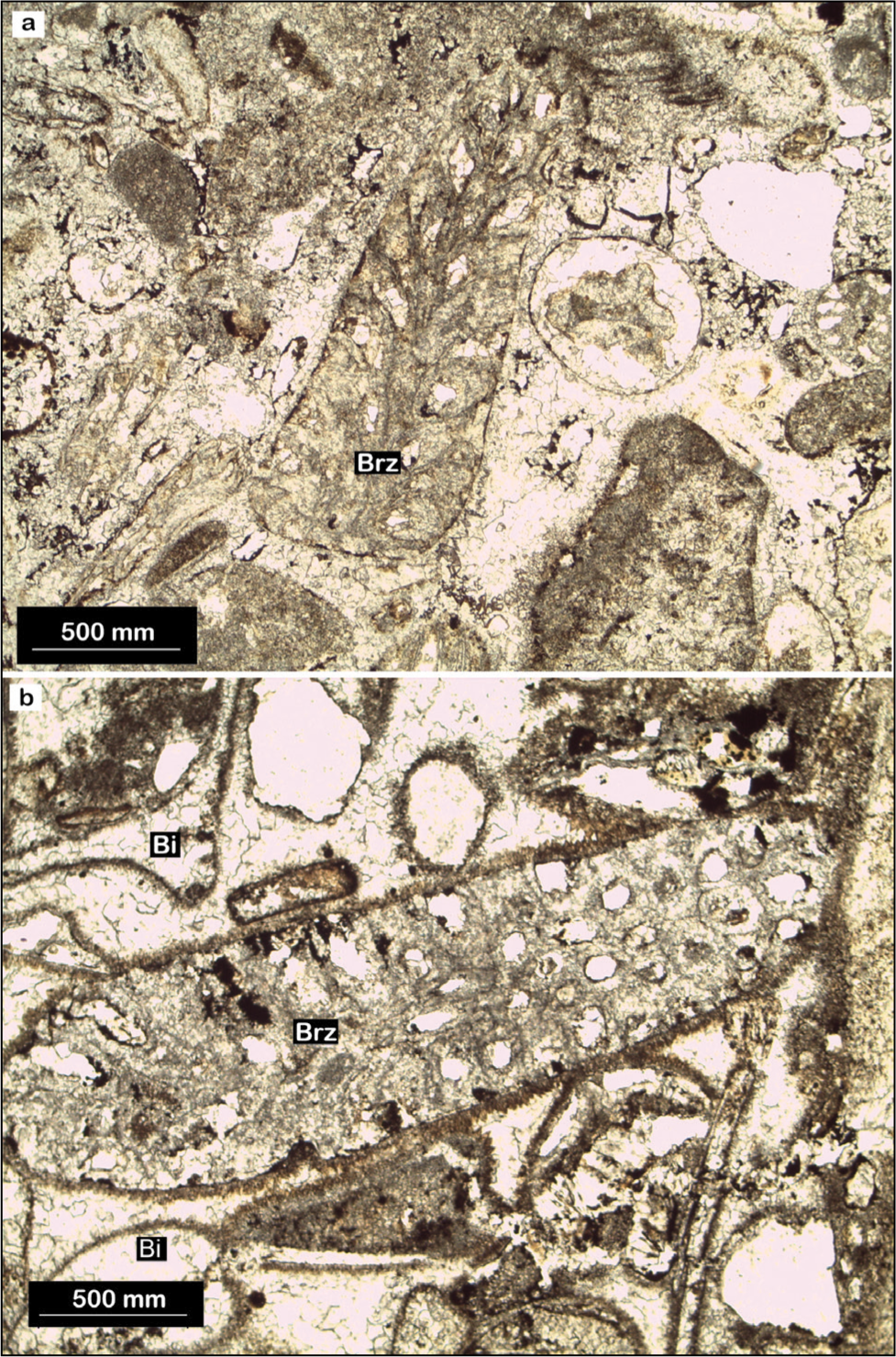
(a) Photomicrograph of arenaceous limestone containing bryozoa exposed at the base of section at Belam Bujurg;(b) Photomicrograph of limestone containing bryozoa (Brz) at the top of the section at Belam Bujurg. Also seen fragment of a bivalve shell (Bi).
Roy Chowdhury and Sastri (1958) had recorded exposures of the Sitapuri Bryozoan Limestone at a few places other than Belam Bujurg, they include Agarwara, Ghatia and 1.5 km north of Barwah. Bose (1884) also had identified rock at Agarwara as the Sitapuri Bryozoan Limestone. But even these exposures are identified by Badve (1987) as sandy limestones.
Out of these exposures, that at Agarwara is just 2 km east of Belam Bujurg exposure. The ground between these two exposures is near-horizontal. Also, the rocks of the Bagh Formation in this area are horizontal to sub-horizontal. These facts help postulating that the sandstone exposed at Belam Bujurg pinches out laterally, and bryozoan packstone at the base and the top of the sandstone merge laterally as traced eastward, in the direction of Agarwara.
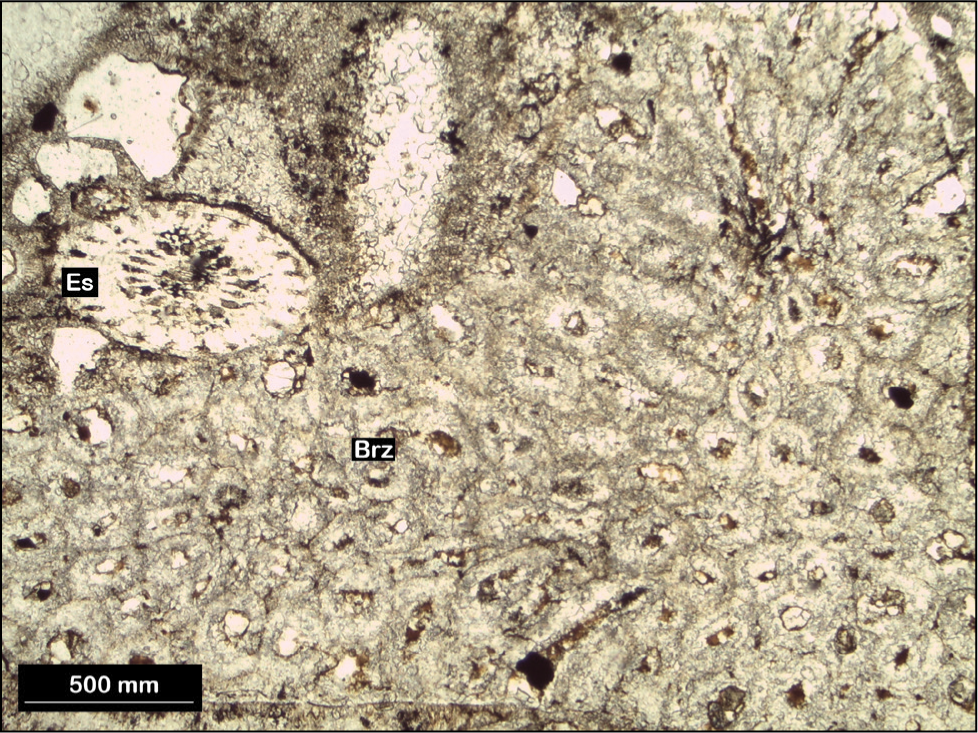
For accurate identification of the rock exposed at Agarwara, examination of thin sections was resorted to. Petrographically it is a bryozoan packstone. Cement is calcitic; at places, it is micritic, while at places sparitic (Plate 4). The bioclasts comprise mainly bryozoan fragments. Also seen are algae, echinoid spines, fragments of echinoid plates, molluscan shell hash and a few foraminifers. As such, there should not be any difficulty in identifying it as Sitapuri Bryozoan Limestone.
Photomicrograph of limestone containing bryozoa (Brz) exposed at Agarwara. Also seen Echinoid spine (Es).

A graphical representation depicting various interpretations regarding the stratigraphical position of the sandstone under dispute, arrived at by different workers, is given in Figure 4.
Stratigraphic position of the sandstone at Belam Bujurg, as interpreted by various authors: a diagrammatic representation.
Age of the Bagh Formation
On the basis of his studies on gastropods, bivalves, ammonoids, echinoids, rhynchonellids and bryozoans; Chiplonkar (1942) suggested a Cenomanian-Turonian age for the Bagh Formation. Later Gangopadhyay and Bardhan (2000) and Bardhan et al. (2002) inferred a Coniacian age based on the discovery of Barroisiceras (Barroisiceras) anilayense and Placenticeras kaffrarium.
Subsequently, occurrence of the ammonoid Prionocyclus germari prompted Kennedy et al. (2003) to deduce a Turonian age. It was corroborated by Smith (2010) when he revised the study of echinoids from the Bagh Formation. Smith (2010) pointed out that Cenomanian-Turonian species of the spatangoid genus Mecaster show semi-ethmolytic apical plating and strongly oblique sternal suture, while Coniacian representatives show fully ethmolytic apical disc and almost symmetrical sternal suture. As all the specimens of spatangoid genus Mecaster from the Bagh Formation show semi-ethmolytic apical disc and strongly oblique sternal suture, Smith preferred to assign a Turonian age to them.
Nonetheless, in both these research communications (Kennedy et al., 2003; Smith, 2010) a probability of the upper part of the Nodular Limestone and the Sitapuri Bryozoan Limestone being of Coniacian age has not been overruled.
Conclusion
In the Barwah cluster of outcrops of the Bagh Formation, the limestone exposed at various places, like Belam Bujurg, Agarwara, Ghatia, etc., is identified as the Sitapuri Bryozoan Limestone. It is evinced by its lithological attributes. Abundance of bryozoan fragments noticed during the examination of thin sections further confirms it.
The 5 m thick pile of sandstone is conformably underlain and overlain by beds of bryozoan packstone. Therefore, this sandstone needs to be recognised as an intercalation within the Sitapuri Bryozoan Limestone. It does not represent the Nimar Sandstone.
Footnotes
Acknowledgements
We are grateful to Dr Ravindrasing Pardeshi, Principal, Fergusson College (Autonomous), Pune for extending the facilities. Our sincere thanks to the reviewers, Professor Dhirendra K. Pandey, Central University of South Bihar and Dr Debahuti Mukherjee, Director, Palaeontology Division, Geological Survey of India, Kolkata for their critical assessment, which has helped the refining of the manuscript. Encouragement by Dr Rajani Panchang, Guest Editor, Special Issue on Proceedings of 28th ICMS-2022 held in Pune, needs a special mention.
Declaration of Conflicting Interests
The authors declared no potential conflicts of interest with respect to the research, authorship and/or publication of this article.
Funding
The authors received no financial support for the research, authorship and/or publication of this article.