




Abstract
It is proposed to consider Narmada Valley Late Cretaceous sequences in three sectors with proper selection of stratotype in each sector: Eastern Sector: comprising of Lameta group of rocks with type area in Jabalpur area, essentially laid down in lacustrine-paedogenic milieu and containing a variety of fossils including dinosaur remains of Late Maastrichtian age. No evidence of sea incursion is available in the Eastern Sector either via the Narmada lineament or the K-G Basin. Central Sector: comprising of the Bagh Group in ascending order of: Nimar Sandstone Formation–Nodular Limestone Formation–Coralline-Bryozoan Limestone Formation, laid down in estuarine complex entirely within Turonian without any evidence of Cenomanian and Coniacian age calcareous nannofossils or other fossils being present. In the western part of Central Sector: Siliciclastic rocks and limestones referred to as Nimar Sandstone Formation curiously lack Late Cenomanian marker species, hence could be of Early Turonian age. Western Sector: comprises of Lacustrine sediments associated with Deccan Flood Basalt. The absence of the Cenomanian/Turonian Boundary and Black shales negates the presence of global OAE2 events in the Narmada lineament, but several OAE events are recognised in the Cauvery Basin, southeastern India. Uranium- and Thorium-rich Lower and Upper Nimar Sandstone Formation overlying crystalline basement are interpreted to have been essentially laid down in a fully marine estuarine milieu with reworked plant, and palynofossils including dinosaur remains. Calcareous nannofossils recovered from Upper Nimar Sandstone Formation over four decades ago and assigned Late Turonian age is revised based on modern data incorporating calcareous nannofossil and planktonic foraminifera datum and now suggest an older age of Early Turonian matching a zone with FAD of Quadrum gartneri at the base and FAD of H. helvetica at the top. It must be emphasised that except for the solitary and unique incursion of Early Turonian (ca. 93.9 Ma) sea along the Narmada lineament reaching eastward (>300 km) up to the present town of Indore, no other marine intrusion ever took place on Indian shield except along collision facing Subathu–Dogadda lineament during Late Maastrichtian. It would be erroneous to suggest that the global eustatic rise of sea level caused the entry of the Turonian sea along the Narmada lineament; instead, it was earlier speculated by me that Large Igneous Province activity of Mahajanga Flood Basalt of Madagascar (ca. 93.9 Ma) could have most probably caused a short-lived Turonian sea to enter Narmada lineament from the west around C/T boundary.
Introduction
The modern Narmada River is the largest westward-flowing River of Peninsular India, originating in the Amarkantak mountains of Madhya Pradesh. During Late Cretaceous (Turonian = Base 93.9 Ma – Top 89.8 Ma = 4.1 Ma, as per ICS 2022), a more prominent estuary extending >300 km eastward up to the present town of Indore bears evidence of the reactivation of lineament (Jha et al., 2016), in which Bagh Group of siliciclastic and carbonate sediments in Central Sector of Lower Narmada Valley were deposited on crystalline basement rock. The Bagh Group is comprised in ascending order of: High-energy transgressive Nimar Sandstone Formation, moderate-energy Nodular Limestone Formation and high-energy regressive Coralline-Bryozoan Limestone Formation. A large number of important freshwater tributaries from northern and southern highlands brought nutrients into the Narmada River, making it a hotspot for the flourishing of a variety of biota, as evidenced by the recovery of a rich fossil biota during the last 200 years. Much confusion continues to exist as no formal lithostratigraphic sections have been designated, despite some excellent exposures in the field (Bajpai et al., 2013). It is, therefore, strongly advisable to consider the entire Bagh and Lameta group of rocks as three distinct sectors: (i) Eastern Sector comprising of the Lameta group of rocks with type area in Jabalpur, laid down essentially in lacustrine-paedogenic sediments containing a variety of fossils including dinosaur remains of the latest Maastrichtian age (Tandon, 2000; Tandon et al., 1995). Lameta group name should not be used for lithounits in the Central Sector and Western Sector. (ii) Central Sector comprising of main Bagh Group in ascending order: Nimar Sandstone Formation, Nodular Limestone Formation and Coralline-Bryozoan Limestone Formation, Glauconitic Sandstone essentially laid down in a unique estuarine complex entirely during Turonian without any concrete evidence of Cenomanian or Coniacian age critical index fossils being present (Table 1). The western part of the Central Sector comprises siliciclastic sediments and limestones bearing evidence of doubtful Cenomanian age fossils, which could be of the Early Turonian age (Figure 1). Black shales are missing in this succession and the Central Sector.
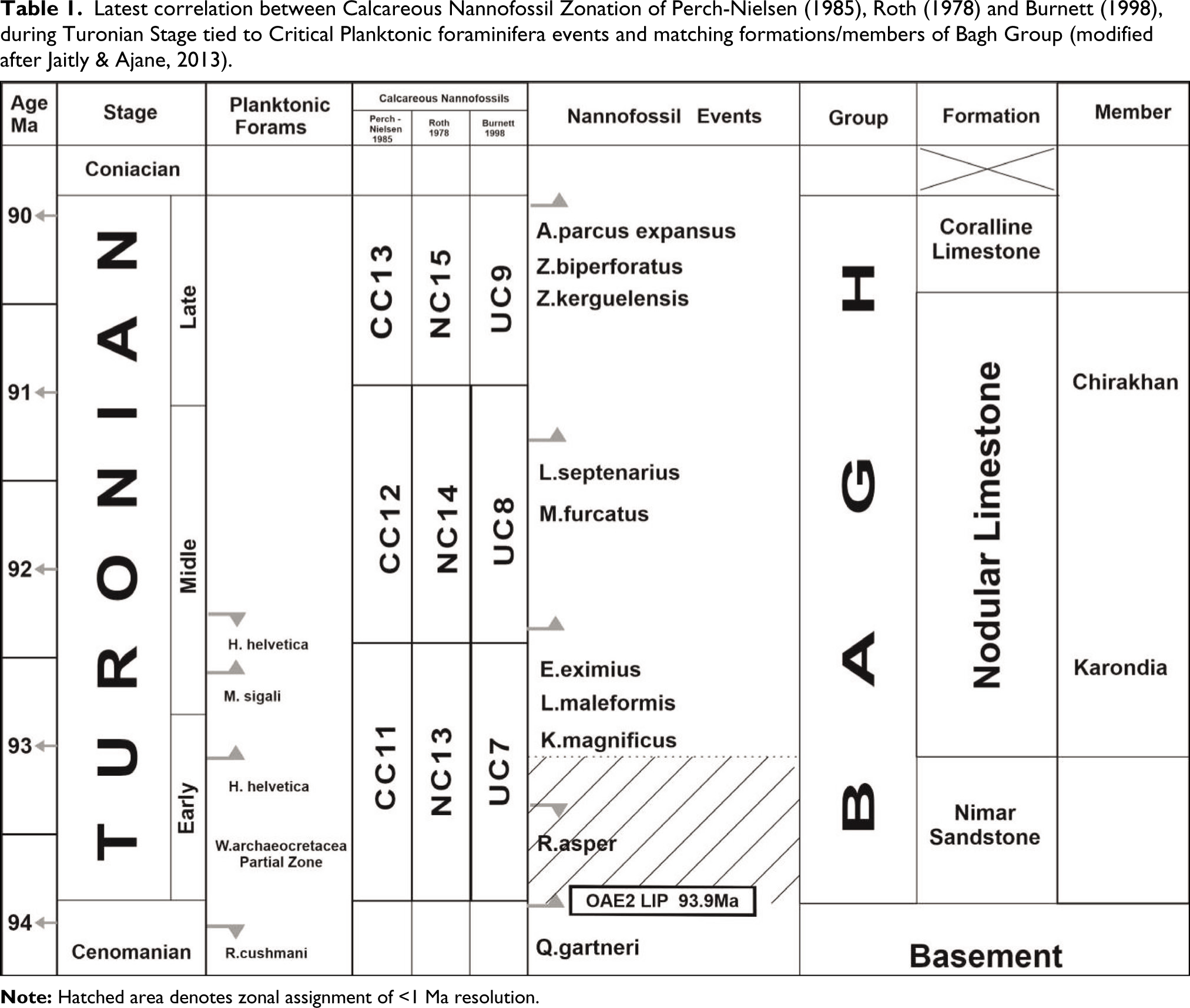
Latest correlation between Calcareous Nannofossil Zonation of Perch-Nielsen (1985), Roth (1978) and Burnett (1998), during Turonian Stage tied to Critical Planktonic foraminifera events and matching formations/members of Bagh Group (modified after Jaitly & Ajane, 2013).
Geological Map of India showing the distribution of Deccan Traps and associated infra-and inter-trappean sequences including Bagh-Lameta Beds in Peninsular India. Bold broken lines suggest tentative demarcation of proposed sectors: Western sector-Central sector-Eastern sector (simplified from Kumari et al., 2023).
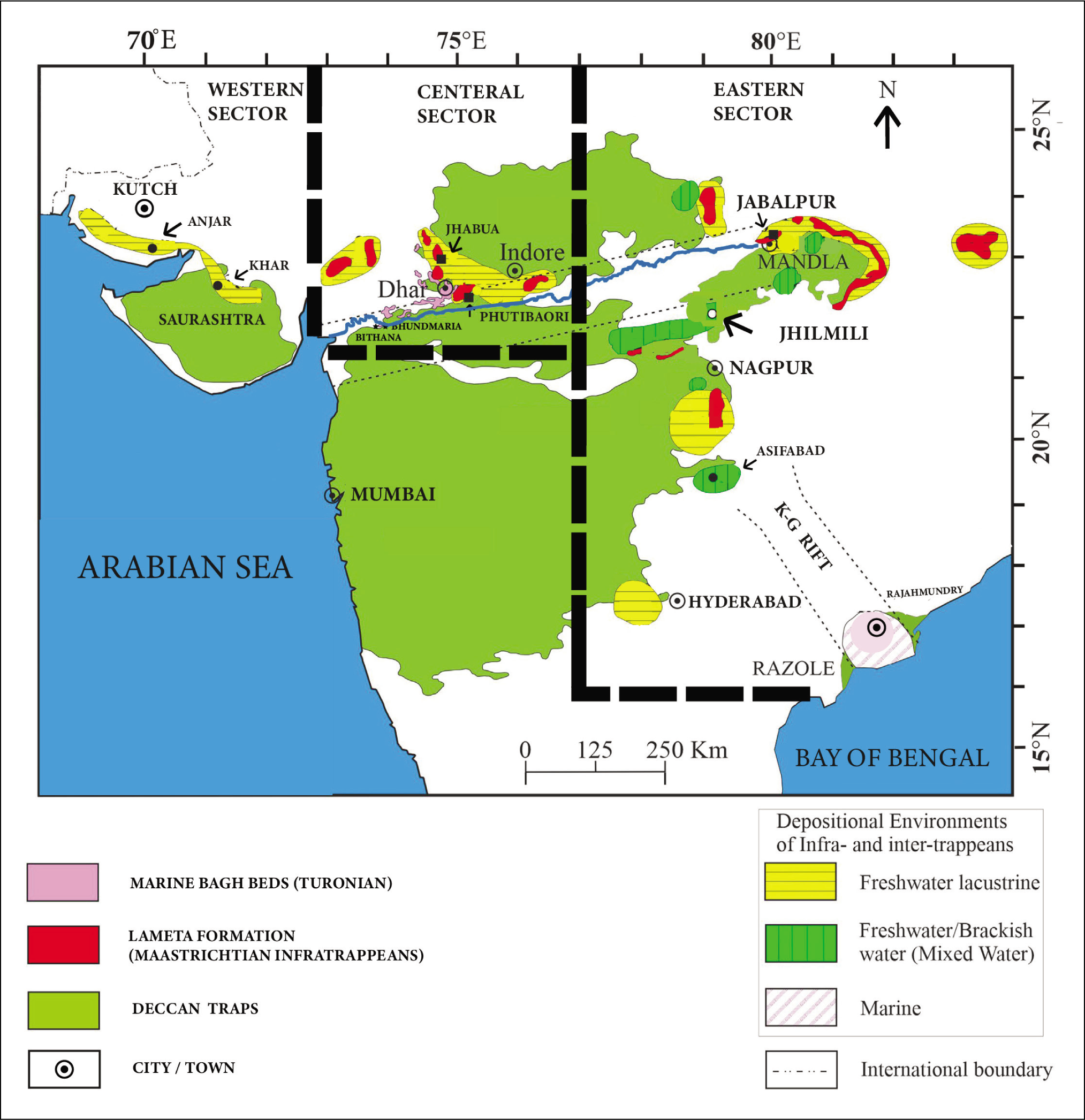
The Western Sector essentially consists of freshwater lacustrine sediments associated with Deccan Flood Basalt.
Carving of Indian Shield
It is important to understand the sequence of tectonic events leading to the final carving of the Indian shield from the supercontinent Pangaea to study the possible deep incursion of the sea during the Turonian and Late Maastrichtian-Danian. Extensive volcanism of east Africa, Antarctica and Madagascar combined with rifting of Madagascar–Seychelles–India–Australia–New Zealand produced the Proto-Indian Ocean during the early Jurassic (Pliensbachian ca. 185 Ma). Early Cretaceous (Berriasian ca. 145 Ma) rifting and concomitant Rajmahal volcanism produced the eastern Indian Ocean with aulacogens and triple junctions at marginal basins of Cauvery, Palar, Krishna–Godavari and Mahanadi (Jafar, 1996, 2016a,b). It must be pointed out that during this time, Madagascar reached its current position relative to Africa and India–Madagascar, separated from Antarctica–Australia–New Zealand. As the juvenile Indian Ocean grew, rifting further separated Australia–New Zealand from Antarctica (Albian ca.105 Ma ago). One of the most prominent plate tectonic events was the rifting causing the separation of India–Seychelles from Madagascar and the episode of sub-aerial Large Igneous Province (LIP at ca. 93.9 Ma, as per the latest radiometric dating of Mahajanga Flood basalts, Madagascar, Cucciniello et al., 2021). This unique event closely coincides with the refined age of Early Turonian (ca. 93.9 Ma), deep sea incursion (>300 km) along Narmada lineament presented in this article and further awaits the supporting evidence of carbon, oxygen, Hg and osmium isotopes. Besides this, the only other deep sea incursion on the India shield was produced by the Réunion hotspot-induced eruption of massive Deccan Flood Basalt (LIP 66 Ma) during Late Maastrichtian-Danian, covering 500,000 sq km of Indian shield and attracted global attention for exceptionally well-preserved fossil fauna and flora in intertrappean lacustrine sediments straddling the Cretaceous/Pg boundary (Jafar, 2016a,b; Khosla & Verma, 2014). No other concrete evidence of deep sea incursion either via the Narmada lineament or Krishna–Godavari lineament could be found, except along the Lesser Himalayan Subathu–Dogadda lineament, which bears evidence of Late Maastrichtian-Danian fossils, including rich calcareous nannofossils (Jafar & Kapoor, 1988; Jafar & Singh, 1992; Mathur et al., 2008; Thakur et al., 2013).
Purpose and Objective of the Present Research
It is beyond the scope of this paper to deal in detail with a historical account of the lithology and stratigraphy of the Bagh Group of rocks (See Chatterjee & Ruidas, 2021; Kumar et al., 2018; Ruidas & Zijlstra, 2022; Ruidas et al., 2018). Shithole et al. (2021) attempted to choose lithostratotypes for the Bagh Group of rocks as per the International code of stratigraphic nomenclature.
Being the oldest Formation of Bagh Group of rocks, the facies and fauna of the Uraniferous Nimar Sandstone Formation, yielding calcareous nannofossils, will be dealt with herein.
This paper will present a much refined biostratigraphic scheme of much higher resolution based on freshly collected samples for calcareous nannofossils from Nimar Sandstone, Nodular Limestone and Coralline Limestone Formations.
Based on modern biostratigraphic data, the ideas presented in the paper of Jafar (1982) would be critically evaluated and revised.
The isolated occurrence of Cenomanian age marine rocks exclusively in the western part of the Central Sector of Narmada lineament and the possible occurrence of OAE and Cenomanian-Turonian Boundary would be critically evaluated with reference to the proposed marine transgressions on the Indian Shield other than of well-documented Early Turonian/Late Maastrichtian age.
Material and Methods
Two productive samples from which 31 species of calcareous nannofossils were earlier documented in Jafar (1982, Figure 1), were collected from upper calcareous Nimar Sandstone Formation just below Nodular Limestone Formations at Chikli and Baria Nadi sections at Sitapuri village, in the Central Zone of Narmada lineament. High-power light microscopy was done to document better-preserved forms, as calcareous nannofossils were stunted, scarce and overgrown. In May 2019, Mr Vishal Verma collected a number of samples for calcareous nannofossil studies from the Bagh Group of rocks, but only a few proved productive. Borewell material is usually better preserved but could not be procured. Out of nine samples collected: (i) Lower Nimar Sandstone—behind DCL Brown Cement Factory; (ii) Nimar Sandstone upper unit Shark bearing—Karayda, Bagh River; (iii) Lowermost carbonate layer of Nodular Limestone overlying Nimar Sandstone, Sitapuri, Man River Section. (iv) Pink Deola Chirkhana Marl, Sitapuri village, Sanjay Khandelwal Mines, Man River Basin. This sample proved productive and dominated by fairly large overgrown species of calcareous nannofossils belonging to the Genera Eprolithus–Lithastrinus complex. (v) Yellow chalky Deola Chirkhana Marl underlying Coralline-Bryozoan Limestone at Sanjay Khandelwal Mines, Sitapuri, Man River. (vi) Coralline-Bryozoan Limestone Dhursal Road Side, Man River Basin, hard grey Mudstone. (vii) Topmost Mudstone of Bagh Beds, Man River. (viii) Glauconitic Bryozoan Sandstone, Shark fossil-bearing, Phutibowri village, Man River. (ix) Supra Bagh Formation, Chrakhan Village, Man River.
Mr Vishal Verma collected another set of samples in April 2021, and out of 14 samples, only 1 from Coralline-Bryozoan Limestone proved productive under the High Power Light- microscope using an oil immersion objective. Samples and smear slides are deposited in the Palaeoclimate Group of the National Centre for Polar and Oceanic Research Institute in Goa, India.
Age and Facies of Nimar Sandstone Formation
Pioneering geologists over 200 years ago laid the essential foundations of the lithostratigraphic succession of the Bagh Group of rocks in Narmada Valley. Captain Dangerfield (1818) described sandstones of ‘Panch Pandoo’ caves at Bagh. Blanford (1869) published litho-succession of Bagh Beds comprising prominent arenaceous facies at the base designated as ‘Nimar Sandstone’. Bose (1884) did not include Nimar Sandstone in Bagh Beds. Several authors in the past have interpreted the Lower Nimar Sandstone as of fluviatile origin owing to the paucity of marine fossils (Bhattacharya et al., 2021; Dassarma & Sinha, 1975; Jaitly & Ajane, 2013). It must, however, be understood that in warm, humid climates, even if present, fossil shells are readily leached out, such as in coarse arenaceous facies of Lower Nimar Sandstone. Saha and Shukla (2022), after a detailed facies analysis of Nimar Sandstone, considered it as Lower Nimar Sandstone (river dominated estuary containing reworked plant fossils) and Upper Nimar Sandstone (tide-dominated estuary) as per the model proposed by Dalrymple et al. (1992).
Geomorphologically, an estuary can be considered as a semi-enclosed body of water, wherein landforms are shaped by both fluvial and marine processes, and latter contain sediments that were significantly transported landward by tidal, wave and wind forces. However, Saha and Shukla (2022) and Racey et al. (2016) erred in assigning the age of Hauterivian-Albian and Pre-Cenomanian age to Lower Nimar Sandstone and Cenomanian age to Upper Nimar Sandstone. The entire succession of the Nimar Sandstone Formation, despite containing reworked plant and palynofossils in the Lower Nimar Sandstone from Early Cretaceous Jabalpur Formation present in the Narmada basin is essentially river- and tide-dominated estuarine complex and is of Early Turonian age as revised in this paper (Table 1). As a rule of thumb, if the Upper Nimar Sandstone has been earlier dated as Late Turonian, now revised to Early Turonian, based on calcareous nannofossils and Turonian based on foraminifera (Jafar, 1982; Nayak, 1987), the undatable Lower Nimar Sandstone should also be considered as of the same age, as datable Upper Nimar Sandstone, till we have evidence to the contrary. Calcareous nannoplankton recently recovered from younger Nodular Limestone and Coralline-Bryozoan Limestone Formation suggests the Middle-Upper Turonian age without recovery of any Coniacian age marker species. The presence of calcareous nannoplankton in the warm, well-lit photic zone of the Narmada estuary signifies sufficient depth to permit the free and efficient exchange of surface global phytoplankton and not permit the entry of deep water open oceanic currents. Calcareous nannofossils of Cenomanian-Turonian Boundary recognised in southern Tibet as Disaster nannofossils (Wan et al., 2003): Corollithion signum, Garterago obliquum, Quadrum gartneri and Microrhabdulus decoratus, are present in upper calcareous part of Nimar Sandstone Formation.
Black Shales and OAE2
Organic-rich Black shales of academic and immense economic importance are found from Precambrian to recent shallow epicontinental and deep sea sediments. OAEs signify intense changes in the planet’s climate and palaeoceanographic setting, representing large disturbances in the global carbon cycle (Gangle et al., 2019; Jenkyns, 2010; Schlader & Jenkyns, 1976). However, the magnitude and duration of organic-rich Black shales varies substantially at different locations as forcing factors remain enigmatic. Some global organic matter-rich Black shales have been identified in early late Jurassic Toarcian Posidonianschiefer Event, T-OAE, 183Ma. Other OAEs are Early Aptian (Selli Event, OAE1a, 120 Ma). Early Albian (Paquier Event, OAE1b, 112 Ma) and Cenomanian–Turonian (Bonarelli Event C/T OAE2, 93.9 Ma, Keller et al., 2021), which could all be found in Cauvery Basin, India (Nagendra & Reddy, 2016). In shallow marine platforms and coastal areas, organic matter-rich Black shales are partially present or absent and display low diversity of long-ranging species, offering poor age control (El-Sabbagh et al., 2011; Gertsch et al., 2010; Sabba et al., 2023). Early–Middle Albian age (Chiastozygus litterarius Zone CC7 of early Albian and Prediscosphaera columnata CC8 Zone of Middle Albian age) organic matter-rich shales of Dalmiapuram Formation in the Cauvery Basin could be related to Early Albian Paquier OAE1b 112Ma Event (Jafar & Rai, 1989).
Another OAE2 event in the western part of the Central Sector of Gujarat state of India evoked global interest and was recently proposed by Keller et al. (2021) with several contradictions:
It must be noted that calcareous nannofossils offering the highest resolution of age among all other marine microfossils were described over four decades ago from the Upper Nimar Sandstone Formation of the Central Sector of Bagh area and were assigned Late Turonian age (Jafar, 1982). However, more recent publications of calcareous nannofossils and planktic foraminifera prompted the reassignment of the same assemblage to the lower parts of the older CC11 zone of Perch-Nielsen, 1985, NC13 zone of Roth, 1978 and UC7 zone of Burnett, 1998, matching Early Turonian rather than Late Turonian age as earlier discussed in this paper. Incidentally, both in the western part of the Central Sector of the Narmada lineament (Keller et al., 2021) and Jhilmili of K-G Basin (Keller et al., 2009), the calcareous nannofossils are curiously missing, and the presence of rich assemblage in Central Zone of Narmada lineament demands a fresh look at the western part of Central Sector for the recovery of calcareous nannofossils (Jafar, 1982; Jafar 2016; Keller, 2014). At Bilthana and Bhundwari, the section appears to be an expanded part of Nimar Sandstone Formation of the Central Sector, displaying more carbonate and lying on Precambrian crystallines. Carbonates of the Turonian age seen in Central Sector are missing here. The earlier Cenomanian age was assigned in this section based on Ostracods and calcareous Algae (Kundal & Sangawal, 1998). Keller et al. (2021) pointed out that planktonic foraminifera are few to rare, small, long-ranging, stress-tolerant species but not age diagnostic. Benthic foraminifera are also not age diagnostic. Late Cenomanian marker species cited by Keller et al. (2021, p. 82): Wheiteinella archaeocretacea, Dicarinella hagni and Dicarinella imbricate actually range from Late Cenomanian to Early Turonian (Franco, 2003). Even ammonite Placenticeras mintoi occurs in Turonian age rocks (Kumar et al., 2018). There is no concrete evidence of Cenomanian age rocks, and the presence of OAE2 in the western part of the Central Sector of Narmada lineament as compared to other parts of the world (Petrizzo et al., 2021) remains enigmatic. Both the sections dealt with by Keller et al. (2021) may be of Early Turonian age and the fully marine variant of Nimar Sandstone Formation of Central Sector matching the UC7 zone of Burnett (1998), signifying the first and solitary major transgression along the Narmada lineament. Keller et al. (2021) erred in speculating that the Early Turonian seaway may have further penetrated 800 km eastward along the Narmada lineament and reached via Jabalpur to Jhilmili area in the K-G Basin by the end of the Late Maastrichtian (Jafar 2016a; Keller et al., 2009, Kumari et al., 2020). The concept of Trans-India Narmada–Godavari Seaway also seems doubtful as supporting ground truth data are fragile (Kumari et al., 2020, 2023).
Refined Age of Calcareous Nannofossils of Nimar Sandstone Formation
The first report of calcareous nannofossils over four decades ago from the upper calcareous part of the Nimar Sandstone Formation of the Bagh Group of rocks was a significant finding (Jafar, 1982, Pl. 1, Table 1). Thirty-one species of calcareous nannofossils having global distribution were documented under the crossed polarised light illumination. Critical evaluation of the published records of various mega- and microfossils from different litho-units of the Bagh Group of rocks coupled with calcareous nannofossil data had suggested an age neither older nor younger than Turonian. The calcareous nannofossil assemblage was assigned to Eiffellithus eximius Zone: Verbeek (1976) emended Manivit et al. (1977).
Definition: Interval from the first occurrence of Eiffellithus eximius s.l. to the first occurrence of Marthasterites furcatus Deflandre. Age: Late Turonian to early Coniacian. Although some good specimens of Eiffellithus turriseiffeli (Jafar, 1982, Pl.1, Figs. 8, 25) were documented, typical specimens of Eiffellithus eximius sensu Verbeek or Eiffellithus eximius sensu stricto were not documented (Gaer & Watkins, 2020). The view that Marthasterites furcatus marks the Turonian–Coniacian boundary has also now been found to be erroneous, as it widely occurs in Late Turonian (Burnett & Witham, 1999). The recent state-of-the-art publications on calcareous nannofossil based on exhaustive biometric analysis of Eiffellithus turriseffeli–Eiffellithus eximius complex suggested that FAD of Eiffellithus eximius sensu Verbeek is an indicator for the Early–Middle Turonian boundary while FAD of Eiffellithus eximius sensu stricto occurs near Middle-Upper Turonian (Gaer & Watkins, 2020) and is widely used as a reliable marker species. As such scarce Eiffellithus eximius sensu Verbeek identified in an earlier publication (Jafar, 1982) has been used for revision to the Early Turonian age. The same assemblage can now be assigned to a zone marked by FAD of Quadrum gartneri at the base and FAD of H. helvetica at top, matching lower parts of the UC7 zone of Burnett, 1998, NC13 zone of Roth, 1978 and CC1 zone of Perch-Nielsen, 1985, which marks Early Turonian age for Nimar Sandstone Formation (Table 1). Crossbar angles of 20–10 degrees define Eiffellithus eximius sensu Verbeek, and crossbar angle of <10 degrees defines Eiffellithus eximius sensu stricto. Both these variants are found in Nodular Limestone Formation. Calcareous nannofossils also occur in younger Nodular Limestone Formation and Coralline-Bryozoan Limestone Formation (Jafar, unpublished data). A recent publication by Corbett and Watkin (2014) on nannofossil Eprolithus-Lithastrinus suggests that Eprolithus moratus, Eprolithus octopetalus and Eprolithus floralis, which are frequently found in Nodular Limestone suggest Turonian age. Coniacian age markers such as Lithastrinus grilli and Lithastrinus septenarius are not recovered from Nodular Limestone and Coralline-Bryozoan Limestone samples.
Discussions
Detailed facies analysis of entirely marine Uraniferous Nimar Sandstone Formation (Samanta et al., 2018) suggests deposition under estuarine conditions and a two-fold subdivision, the Lower Nimar Sandstone Formation largely fed by fluvial sediment source and Upper Nimar Sandstone predominantly fed by marine sediment source under the influence of tides, currents and waves (Saha & Shukla 2022). The Lower and Upper Nimar Sandstone Formations contain land-derived remains of sauropod dinosaurs of the Turonian age, and not the Cenomanian age as claimed earlier (Khosla et al., 2003). Land-derived plant fossils and palynofossils from Early Cretaceous Jabalpur Formation preserved in Lower Nimar Sandstone Formation led several workers to assign mistaken Albian age (Racey et al., 2016). Entirely marine Nimar Sandstone Formation based on fairly diverse calcareous nannofossils recovered earlier suggested Late Turonian age, which has been now reinterpreted as belonging to a zone with FAD of Quadrum gartneri at base and FAD of H. helvetica at the top matching lower parts of zone UC7 of Burnett, 1998, NC13 of Roth, 1978 and CC11 of Perch-Nielsen, 1985, of Early Turonian age offering a higher resolution of less than 1Ma (Table 1).
Detailed facies and ichnofossil analysis of the Nimar Sandstone Formation suggests entirely marine deposition under estuarine setting against a popular counter view (Bhattacharya et al., 2021). The Lower Nimar Sandstone was predominantly deposited under fluvial influence in estuarine setting, whereas calcareous Upper Nimar Sandstone was predominantly deposited by landward transport of marine sediments in estuarine setting, by wind, tide and waves and vertical rain of planktonic shelly biota. Upper Nimar Sandstone signified deposition in the photic zone when the estuary exchanged surface currents with the open ocean bringing global fresh phytoplankton. On multiple and reliable evidence, the entire Nodular Limestone Formation (Naik, 2013) and Coralline-Bryozoan Limestone Formation overlain by Glauconite Sandstone are of Turonian age correlatable with deep sea sequences (Huber et al., 2018). It should further be borne in mind that all fossil records need to be examined in the backdrop of two distinct biogeographic provinces: Indo-African and Euro-American, with Bagh Group ammonites, inoceramids closely matching Indo-African forms in Madagascar (Walaszczyk et al., 2014). However, Tethyoceras modestoides marking Turonian and Tethyoceras madagascariensis marking basal Coniacian are missing from Bagh Beds. Even Cremoceramus deformis erectus marking basal Coniacian in Euro-American Global Stratotype is missing from Bagh Beds. Barroiceras ohilahyense Basse, 1947 recovered from Coralline-Bryozoan Limestone ranges from Late Turonian to Coniacian. Most species of Ammonites, Inoceramids and other invertebrate fossils described from the Nodular Limestone (Kennedy et al., 2003) and Coralline-Bryozoan Formations suggest the Turonian age (Kumar et al., 2018; Ruidas et al., 2018). Sharma (1976) provided camera-lucida drawings of planktonic foraminifera from Deola-Chirakhan Marls of Nodular Limestone Formation that can be interpreted as Planoheterohelix globulosa, Praeglobotruncana delrioensis, Helvetoglobotruncana praehelvetica and Helvetoglobotruncana helvetica, suggesting Turonian age. There is no evidence of Cenomanian or Coniacian age rocks in the Narmada rift.
Overwhelming evidence suggests a short-lived invasion and retreat of the Turonian Sea, depositing unique rocks in an estuarine setting. A fresh look at calcareous nannoplankton from younger Nodular Limestone and Coralline Limestone Formations did not yield any taxa suggestive of Coniacian age. The entire Bagh Group was deposited within the span of Turonian despite consideration of minor hiatuses and hard grounds (Table 1). Since Late Cenomanian marker species are not seen in the Bagh Group and western Narmada Valley (Chaudhari & Nagori, 2017), Cenomanian–Turonian Boundary event marked by Black shales, and OAE2 is likely to be absent in Narmada Valley. It, therefore, seems that sea inundation in the Narmada rift was probably not due to global eustatic rise during Cenomanian. Jafar (2016a) earlier speculated that the episode of LIP of Mahajanga Flood Basalt of Madagascar ca.93.9 Ma ago (Cucciniello et al., 2021) over spilled sea and invaded Narmada rift ca. 300 km eastward as far as the present town of Indore. The presence of marine sediments of Turonian and Late Maastrichtian in the Eastern Sector caused due to alleged deep entry of sea either from K-G or Narmada lineament, as proposed by earlier workers, seems incongruous (Keller et al., 2021; Saha et al., 2010; Shukla & Srivastava, 2008). Lameta Formation, with its type area in Jabalpur, is of Fluvio-paedogenic origin and well-dated as Late Maastrichtian age (Tandon 1995; Tandon & Andrews, 2001). It must be borne in mind that except for the intrusion of the Turonian sea, no other marine incursion ever took place on the Indian shield, except along collision facing the Subathu–Dogadda lineament during Late Maastrichtian (Jafar, 2016a, b; Jafar & Kapoor, 1988; Jafar & Singh, 1992; Kumari et al., 2020).
Conclusions
Overlying crystalline basement, both the lower and upper parts of the Nimar Sandstone Formation are interpreted to have been essentially laid down in a fully marine estuarine milieu. Plant remains and palynofossils of the early Cretaceous age are recognised as reworked elements of the non-marine Jabalpur Formation. Dinosaur remains of the Turonian age were derived from coeval terrestrial fauna.
Vertebrate, invertebrate and microfossils, including calcareous nannofossils from Nimar Sandstone, Nodular Limestone and Coralline-Bryozoan Formations, suggest eastward entry of the sea only up to the present town of Indore and retreat of the sea from Narmada lineament was entirely within Turonian with no evidence of Cenomanian and Coniacian age marker species.
It is strongly suggested considering Narmada Valley sequences in three distinct sectors: Eastern Sector: Lameta group with type area in Jabalpur, essentially laid down in lacustrine-paedogenic milieu during latest Maastrichtian. Central Sector comprising of main Bagh Group essentially laid down in estuarine complex during Turonian. The western part of Central Sector: Siliciclastic sediments and limestones in isolated outcrops that lack in age diagnostic Cenomanian fossils, which could be of Early Turonian age. The lack of Black shales and Cenomanian–Turonian Boundary make the presence of OAE2 doubtful.
A solitary and unique entry of Early Turonian (ca. 93.9 Ma) sea on the Indian block only up to the present town of Indore (>300 km) and not beyond is aligned with the triggering of Mahajanga Flood Basalt episode (ca. 93.9 Ma C/T boundary) of adjoining Madagascar. This is supported by the revised age furnished by Mahajanga Flood Basalt (Cucciniello et al., 2021) and calcareous nannofossils of Upper Nimar Sandstone Formation matching a zone with FAD of Quadrum gartneri at base and FAD of H. helvetica at top of Early Turonian age (ca. 93.9 Ma), calibrated with lower parts of Zones UC7 of Burnett, 1998, NC13 of Roth, 1978 and CC11 of Perch-Nielsen, 1985, with a resolution of less than 1 Ma duration.
Footnotes
Acknowledgements
This article is dedicated to my childhood friend and colleague, the Late Prof Indra Bir Singh of the Geology Department, University of Lucknow. Gratitude is expressed to Mr Vishal Verma of Manawar, District Dhar, Madhya Pradesh and Prof Ashok Sahni, Lucknow, for their help in procuring the Bagh samples. Thanks are due to Dr M. Ravichandran, Director National Centre for Polar and Ocean Research, Goa, for providing various lab facilities. Gratitude is expressed to the Chief Editor of JPSI, Prof Mukund Sharma, Joint Editor Dr. Mrs. Anju Saxena of JPSI and Sage Publishers for their gracious editorial support and reviewers, Prof Sampat K. Tandon, Bhopal, and Prof Ashok Sahni, Lucknow, for their extremely insightful evaluation of the paper. The team of Doctors at Narayana Hrudayalaya and Manipal Hospitals, Bangalore, are thanked for keeping me fit to finish writing this paper. The support of my family is deeply appreciated.
Declaration of Conflicting Interests
The author declared no potential conflicts of interest with respect to the research, authorship and/or publication of this article.
Funding
The author received no financial support for the research, authorship and/or publication of this article.