




Abstract
The emergence of the supply chain as a site of critical inquiry follows the tendency in humanities and social sciences to position key social and environmental conflicts in the logistical infrastructures where raw materials, commodities, and bulk energy supplies circulate at startling magnitudes. This article positions supply chains as important sources of differentiation internal to the logistical field, and considers the standardized moments of supply chains as the site, method, and object of infrastructural study. To do so we offer a review of the recent scholarly literature on the critical, aesthetic, and environmental affordance of tending to scenes of logistical circulation and their significance for what we are terming “supply chain criticism.” In configuring geometries of supply chain capital as primary sites of both economic and ecological causality, we argue that reading the logics of this causality is at minimum necessary for any hermeneutic invested in mitigating, repurposing, or abolishing its flows. Thinking from the specifically aquatic spaces that connect most supply chains to one another, we open by offering a set of methodological terms for humanities scholars to consider in order to read the “seam,” the “interval,” and the “hold” of maritime capital. We then trace these sites in relation to our ongoing experience of logistics fieldwork around the ports of the North Sea. This particular economic and environmental milieu has required us to adopt a situated ethic of theorization, one that draws us into affective proximity the material frictions and flux of otherwise abstract flows. Adopting a rhythmic reading practice that runs counter to clean aesthetics of supply chains, we consider how the calibration of space, time, and volume is central to how supply chains are managed, made, and remade across distinct tempos and terrains, concluding that if logistical power is reproduced through the strategic inflection of friction and difference, then these tensions can be productively harnessed in the creation of different social practices and forms of life.
In the 21st century, supply chains of nearly all commodity types are global in scale and are largely invisibilized or rendered strategically unemphatic in public culture. At least in cultural geographies that benefit from the assembled “end” of the chain, where commodities congealed with geologic matter, human labor, and so-called value-added services appear as so many goods for convenient purchase. Regions characterized by first-stage supply chain in the form of extraction, on the contrary, are under no illusion of the fetish: most commodities on the market begin somewhere on earth, in a mine, under social conditions of extreme exploitation, ecological sacrifice, and social dispossession. Which is to say, living in relation to particular nodes of supply chains is a universal condition of social life in the 21st century, but what it feels like to live and work at one end will be very different than on the other. As the structuring form of contemporary capitalism, supply chains distribute and organize patterns of time, space, and social activity, determining what kinds of social roles and privileges accrue around its various junctures and terminals. The question is where in the supply chain you get to live and what relation to power you are able to exercise relative to the physics of value that compound in complex and contradictory rhythms from extraction to high-skill assembly, distribution, and purchase. Every commodity imagines a supply chain; and every point in every supply chain is a site of political and aesthetic mediation. The operational fantasy of supply chains is riven through with contradictions in which the circulatory imperative of capital brushes against recalcitrant ecologies and unruly social forms that demarcate these scenes. What if we centered the contradictions of supply chains in our social and cultural critique, both in an effort to get more technical in our analysis of social injustice and in our collective struggle for anticapitalist emancipation?
In our shared experience of fieldwork in capital’s logistical spaces, we have learned like so many others that if you get too close to logistical infrastructures, or fix your attention on the social and material cultures reproducing their function, you will be made to leave. This is because the logistical spaces that coordinate the production of value in and as materials are critical infrastructures in the fullest sense: base process and general condition for the particularization of so many services and goods at another point and moment of the supply chain—or, what the economist Maurice Godelier designated at the beginning of the logistical revolution, “a combination—which exists in all societies—of at least three series of social and material conditions that enable a society’s members to produce and to reproduce the material conditions of their social existence” (Godelier, 1978: 763). These include (1) the ecological terrain from which “a society exists and from which it extracts its material means of existence,” (2) the forms of material and intellectual labor processes required for a society “to work upon nature and to extract from it their means of existence,” and finally (3) the “social relations of production” including access and control over the means of production, the allocation, and organization of labor processes, and the social forms of distribution and circulation that accompany production (Godelier, 1978: 763–764).
Drawing from the Marxist tradition, Godelier is here demarcating grounding functions of capital production and accumulation that coincide in both concrete topographies and abstract determinations. That is, logistical spaces are a complex assemblage of physical technologies and their social relations: software and hardware, ecological milieu and histories, and labor processes and their indexical social forms (forms divided by so many valuations on labor time, including none at all). They are fundamental to the reproduction of capital in general not just because they are chokepoints (though they are) but because of the work of mediating matter, labor, and capital into new grounds for surplus value accumulation. Supply chains are also value chains, but while these are overlapping topoi, they possess quite distinct logics and processual orders. Supply chains consist of transnational nodes of dense and heavy logistical cartographies, legally and geographically distinct spaces designated as such by municipalities and regional governments in exurban terrain often in, or easily connected to, maritime access points. The form of contemporary maritime infrastructures (and their regional labor markets) has grown in magnitude both horizontally and vertically with such intensity as to warrant entirely new professions to manage the algorithmic complexity of seaborne trade: laws to be developed to facilitate the exceptional scale of ports and throughput; recursive sectors of the economy to emerge; but also because the very character of capital moving goods and labor through the channels of trade appears to function semi-autonomously from the parameters of the state-bounded private sector. This semi-autonomy matters politically because, as Keller Easterling (2014) demonstrates, “dynamic systems of space, information, and power generate de facto forms of polity faster than even quasi-official forms of governance can legislate them” (p. 15). When these infrastructures fail or are made to fail, as in natural disaster, maritime accident, or acts of sabotage, the reverberation of lost capacity and disappeared value is often swift, enormous, and incalculable. The attendant rise of contemporary state-led discourses of “critical infrastructure” indexes the interconnection between supply chain and value chain, where the designation of a mine, pipeline, port, or railroad as the literal matter of “national security” ensures economic security and state territorial claims (Spice, 2018: 43), including emergent forms of imperial coercion as in the Belt and Road initiative (Neel, 2025). Secure the material flow of goods, and you secure the ideological apparatus of capital. Step too close to one of these industrial projects and you may swiftly find yourself subject to domestic terrorism charges.
Take, for instance, the blockage of the Suez Canal in 2021 when, buffeted by unprecedentedly high winds from seasonal dust storms, the Ultra Large Container Vessel (ULCV) Ever Given ran aground in its shallow waters. Responsible for between 12% and 15% of seaborne trade and roughly 30% of global container traffic (Myers, 2021), the 6-day stoppage scuppered the flows of capital to the tune of US$400 million an hour. For 60 days following its dislodging, financial losses continued to ripple along the value chain as 80% of container traffic was forced to travel around the Cape of Good Hope, adding distances upward of 4000 nautical miles (between Shanghai and Rotterdam) and extended sailing times of up to 2 weeks resulting in higher freight rates coupled with unexpected surges in warehousing capacity and port storage pricing across the globe. The Egyptian Suez Canal Authority (SCA) seized the ship, subsequently filing a US$915 million claim, later lowered to US$550 million, against the Japanese-owners Shohei Kisen for compensation to cover salvage efforts, reputational damage, and lost revenue. Since late 2023 the Suez Canal has seen further drastic reduction in shipping traffic (42% compared with its peak) due to the increase of insurgent activity against merchant vessels by Houthi Rebels along the Bab al-Mandab strait (UNCTAD, 2024). Acting in response to Israel’s genocidal occupation of Palestine, in November 2023 rebels began targeting vessels traveling from and to Israel as well as ships associated with countries supportive of Israel’s settler–colonial regime, with major shipping groups once again forced to reroute traffic around the Horn of Africa it is estimated that the SCA has lost in the region of US$175–$350 million over the past year in transit fees alone (Notteboom et al., 2024). In December 2023, the US-led multinational military operation “Operation Prosperity Guardian” was launched in an effort to secure the free flow of trade under the auspices of “freedom of navigation” (Notteboom et al., 2024). Space, time, and value collide within the turbulent corridor cartographies of the Suez Canal as the restriction of trade volume, lengthier sailing times for rerouted vessels, and increased sailing speeds (with accompanying higher CO2 emissions) required to maintain port schedules produce frictions that reverberate across global value chains (Figure 1).
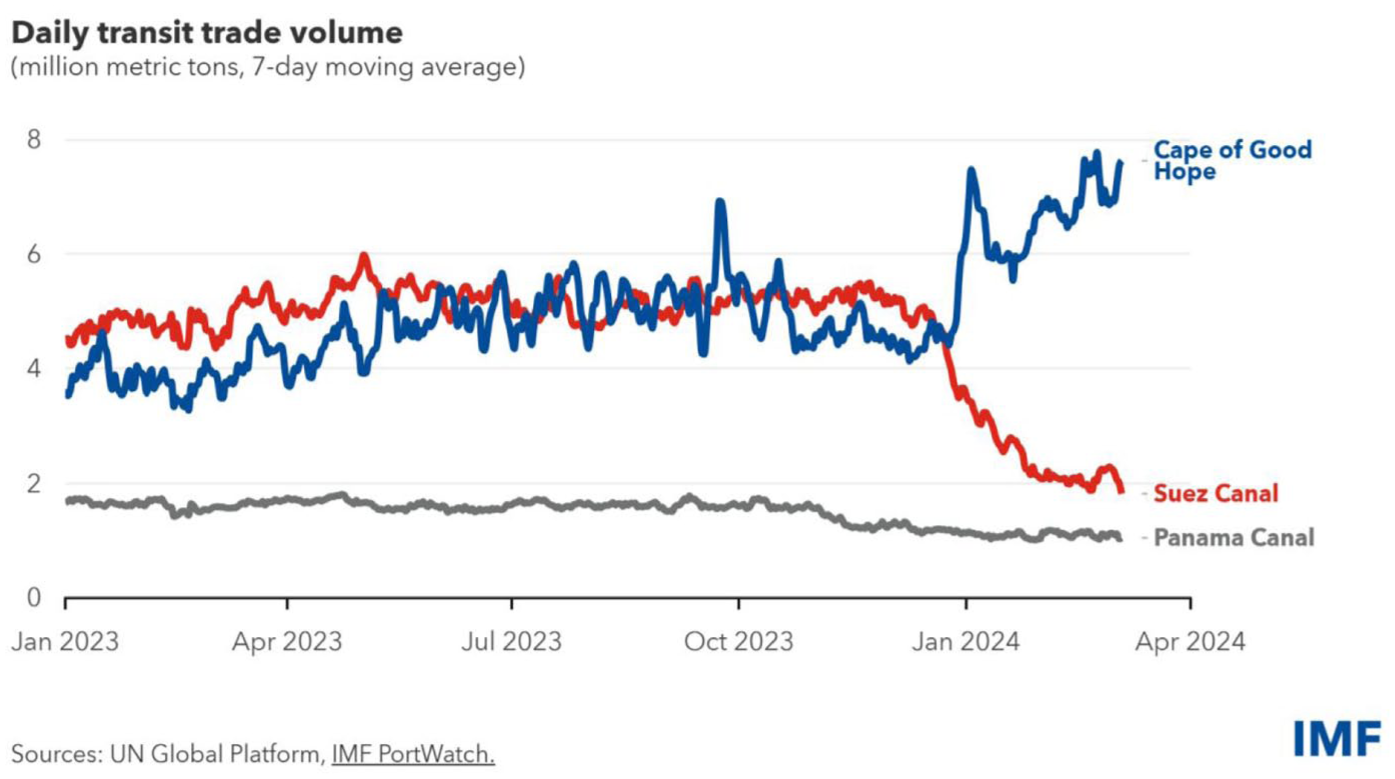
Graph depicting daily transit trade volume through the Suez Canal, Panama Canal, and Cape of Good Hope. IMF, March 7, 2024. (https://www.imf.org/en/Blogs/Articles/2024/03/07/Red-Sea-Attacks-Disrupt-Global-Trade|).
It is no wonder then, as Deborah Cowen’s (2014) work has so acutely identified, that “the protection of commodity flows, and the transportation and communication networks of infrastructure that support them” has become a central facet of contemporary value chains (p. 77). As Laleh Khalili’s work further emphasizes, the securitization and standardization of maritime infrastructure underpins logistical fantasies of free flow, in which forms of “port and terminal management is meant to address friction resulting from human resistance, the obduracy of the world’s environmental and geophysical features, and the very stubborn materiality of the work of transport” (Khalili, 2021: 163). The sanitization of space and sociality become central mechanisms for securing flow, with the management of “value-chain friction” essential to the continued circulation of capital (Khalili, 2021: 267). As we will see, however, it is not the total elimination of friction from the supply chain that ensures conditions of circulation, but rather the careful modulation of structural instabilities and inequalities toward forms of value-generation. Our conceptualization of supply chain criticism follows in the wake of critical logistics scholars, suggesting that reading with supply chains exceeds acts of geographic mapping and requires us to contend with the logistical infrastructures that shape crucial moments of mediation and exploitation.
Contextualizing the logistical turn
Critical and proud commentators alike understand the post-1970s era as one fundamentally inflected by the rise and expansion of logistical infrastructures and maritime commodity circulation. Following in the wake of the “revolution in logistics,” total tonnage in seaborne trade increased from 2500 to 8.2 billion, fundamentally altering the global geography of trade (Cowen, 2014: 57). Since the lion’s share of the new infrastructure required to manage this flow of goods has been developed under the auspices of free trade, special economic zones, or export processing zones, that allow supply chains to expand and flourish, governance (and even oversite) has been largely replaced by logics of optimization, efficiency, and automation. While questions remain regarding the novelty of the so-called “logistics revolution”—Campling and Colás (2021), for example, demonstrate in Capitalism and the Sea that capitalism has always depended historically on its exploitation of maritime resource and rhythm—the statistical surge in the scale of maritime logistics and security infrastructures in the post-1970s era marks a qualitative challenge to organized labor and critical mediation. As Charmaine Chua (2021) has argued, we can read “the rise of global supply chains and the logistics industry as a dialectical countermovement by capital to labor’s mid-century advances” (p. 1453) with the disappearance of laboring forces from scenes of value accumulation not incidental but a strategic component of logistical regimes.
The subsequent rise of the supply chain as a site of critical inquiry follows recent trends in humanities and social sciences that position the structural transmutations internal to logistical capitalism and the liberatory potentials of the “infrastructural turn” as their critical horizon. Perhaps most extensive and field defining has been MIT’s “Infrastructure” series edited by Paul Edwards (2002), whose own “Infrastructure and Modernity” essay from 2002 helped coordinate the theoretical bridge between technology studies and infrastructure’s specific spatial organization of social systems. Taking infrastructure as the site, method, and object of analysis, the flurry of recent special issues, articles, book chapters, and edited collections that have emerged under the banner of “infrastructure humanities” and “critical infrastructure studies,” invariably seek to redress dominant perceptions of that which we call “structure” as fixed and concrete, instead of reconceiving it as “a historical and contingent nexus of material conditions amenable to re-arrangement through struggle and different forms of habitation and dispersal” (Vishmidt, 2021: 14). Operating between the material and the possible, infrastructural critique emphasizes the transitivity and contingency of seemingly intractable forms, prompting critical attention to the material and ideological conditions of their reproduction. Given the extent to which logistical systems are essential in structuring and mediating conditions of life, dictating the what, how, where, and when of (re)production, consumption, and distribution, it is unsurprising that the reconstitutive capacities of infrastructural critique has found traction in recent examinations of contemporary circulation struggles. For our purposes, we are less interested in the revelatory impulse that characterizes much of this work—in which the “inversion” or “invisibility” thesis incurs a figure-ground reversal that reveals that which is otherwise rendered background, mundane, and invisible—than in pursuing the efficacy of infrastructural critique for engaging questions of social and economic reproduction on one hand, and the transitivity of political energies and materials on the other; in other words the forms of life that logistical infrastructure enables or disables. Our adoption of infrastructural critique enables us to conceive of supply chains beyond their common architectural functioning as networked cartographies of trade and transport, repositioning them as lively infrastructures of “turbulent conflict and potent possibility” (Chua et al., 2018: 621). Moreover, we are interested in the methodological affordances for environmental humanities researchers and political organizers alike of refocusing critique on supply chains.
In reorienting critical attention on logistics from a focus on the “art of ‘circulating stuff” to the infrastructural work of “sustaining life” (Cowen, 2014: 3), our conception of supply chain criticism is necessarily dimensional rather than directional, less concerned with the movement of goods across the supply chain (though that remains important) than with the ideological, social, and material conditions of their bearing. While the political significance of supply chain criticism is evident to us, less apparent are the methods and heuristics that enable its interrogation. This is in part because the cultural geographies embedded in the life of the commodity and the chains of value-added services congealed into the cartography of capital are planetary and choreographed by algorithmic complexity. In addition, many of the spaces where logistical work takes place are difficult (or illegal) to access, putting pressure both on critical analysis and representational intervention. For scholars and artists interested in the relationship between the ecology of commodity supply and the economics of class composition, this spatial inaccessibility asks for creative forms of field inquiry and the situated ethic of theorization. As a historical field of study, and an economic field of force, logistics and its frictions ask for a unique readership—one attentive to the historicity of what it intends, but also the materiality of its detailed and daily habits. Reading its behaviors and practices is important for scholars attentive to the intersection of economics and ecology because the logistical field is fundamentally entangled with the coastal and oceanic environments bearing the climate of the commodity writ large: taken as a totality across the planet, these logistical spaces include nearly all the fossil fuels, raw materials, infrastructures, and security cultures of the global economy before they are unleashed into the urban and agricultural fields of global capitalism. In other words, the logistical field of supply chain capital is a primary site of both economic and ecological causality, and reading the logics of this causality is at minimum necessary for any hermeneutic invested in mitigating, repurposing, or abolishing these flows.
Situating inquiry in the field where these ecologies and economies inflect one another is one analytic approach that we draw out here, in keeping with a growing cohort of scholars developing critical methods of situated knowledges. 1 But supply chains are also abstract (and painfully real) patterns for the transnational choreography of labor and matter, asking for an interpretive practice that moves beyond the oppositions of universal and situated, as well as surface and depth. Indeed, the debates in literary studies following the influential Fall 2009 special issue of Representations regarding the critical affordance of surface versus what the editors imagined to be its opposite in “symptomatic” reading were also debates about the relative status and character of domination (over subjects) and exploitation (in objects). Although the legacy of surface reading persists in and through what Anna Kornbluh (2024) has termed the turn to “immediacy” in contemporary criticism, dissenting voices to that initial turn pointed out immediately the bizarre fantasy that interpretation was primarily a question of what the subject felt to be true instead of the far more perplexing question of how an object works, especially in a world like ours which is a world completely saturated in commodities (and their logic). 2 Commodities do not wear their exploited labor on their sleeve—that is the whole point about the commodity fetish, which indeed is for Marx an ideological hardening of the bourgeoisie’s self-interest into an inverted claim about empiricism as such: objects have a price and the price is on the surface and there is nothing more to know. Interpretation that imagines itself to be free from the contradictions of the commodity are strange at best, and are at worse normalizing a commodity fetishism that seeks its problems on the surface of market appearances. So by shifting the critical inquiry back to the object, and the object in its determination across complex mediations of global supply chains, we are also asking how commodities do what they do before they are fully formed surfaces with a price. In so doing, we further seek to address what we consider to be a concerning tendency in humanities scholarship in which the domain of subjectivity, rather than the material histories of economic violence, dictate the trajectory of critique. Indeed, in the same special issue as the turn to “surface” was announced was Chris Nealon’s convincing rebuttal to this subject-centered idea of what interpretation was for. As many Marxists have demonstrated, the post-1970s globalization of supply and labor chains works in step with a gradual waning of class struggle (Benvegnù et al., 2019; Chua, 2021; Jameson, 2013; Mitchell, 2009), in addition to a range of hermeneutic orientations that forego criticality and periodization in favor of what Nealon (2009) calls an institutional focus on “injury and its repair at the expense of the question of liberation” (p. 32). In more direct terms, the expansion and management of commodity supply chains accelerated in the 1990s and 2000s in step with a general waning of critical attention and sensitivity to labor-based forms of organizing and tangible foreswearing of (if not outright ridicule for) collective struggle indexed to the political economy of value production. This disdain can be explained with reference to the predominance of various currents of post-critical and reparative theories within the academy (Galloway, 2016). For the social and humanistic sciences, this is a problem. It is a problem for us and many other scholars because it means that we are first of all, in a position of playing catch-up to the infrastructures and logics that regulate the reproduction of capital today; second, because curriculum and analytic standards across western universities have virtually no quality control for the real-world economic determinations that pass in and for everyday life under 21st-century capitalism; and because academic disdain for working class politics has left us largely un-allied and detached from the people and processes most proximate to the world-making (and destroying) infrastructures weighing on the path-dependencies leading us into over-determined futures. This is to say, for all this qualitative weight laced into the logistical channels of global trade, less attention has been paid to how the logistical revolution has (or has not) influenced critical methods of reading in the humanities.
In order to counter this tendency, therefore, we next read a number of critical currents in contemporary scholarship for a logistical hermeneutic and reflect on the affordances of this hermeneutic for what we are calling “supply chain criticism.” We do this by offering the geometry of the logistical seam, interval, and hold, as scenes unique to the dialectic of time and space conjugated by the extraction, movement, and accumulation of value-added labor across cartographies of supply chains. Reading against the surface of logistical hygiene, we note in our ongoing fieldwork in logistical space how these scenes actively mediate labor, materials, and value abstraction in medias res and hence trouble the conceit of containment otherwise dominating logistical aesthetics.
Toward a logistical heuristic
Raising environmental and political questions about supply chain composition has required a unique cohort of interdisciplinary scholars refining critical inquiry from and with the logistical field itself. Scholars from geography, international development, media studies, architecture, urban studies, and philosophy have across a number of special issues and collections helped coordinate a veritable turn to critical logistics in the past decade. The epistemic range of these contributions to a theory of the field of logistics is recursive to the challenge of reading the tectonic shifts in the organization and management of space and time. As Cowen (2014) emphasizes, “arguably the most under investigated revolution of the twentieth century, the revolution in logistics was not the upheaval of one country or political system but a revolution in the calculation and organization of economic space” (p. 23). Logistical power hinges on the production and management of space. The expansion of global manufacturing and transportation infrastructures has radically enlarged planetary “horizons of consumption and dispossession” through the integration of systems of extraction, production, and distribution (Danyluk, 2018: 631). Logistics is thus “understood as a calculative rationality and a suite of spatial practices aimed at facilitating [. . .] the circulatory imperatives of capital” (Chua et al., 2018: 618). To apprehend, understand, and critically map the intensity of logistics requires a mode of reading that not only attends to the objects and discourses of the field, but the constitution of the field itself (Diamanti, 2022). This is because logistical capital is deeply immersed, and invested in, the material flux of the field; resilient, adaptive, and responsive, it not only seeks the most efficient routes between zones of extraction, production, and distribution but actively feeds on moments of material rupture, delay, and breakage. The physical conditions of circulation become central to the reproduction of capital, where the “calculative politicization of rhythms and tempos of exchange” determines patterns of accumulation along and through the supply chain (Chua, 2021: 1454). Reading the thick currents of “logistics-inaction” (Gregson et al., 2017: 382) prompts attentiveness to how logistical systems calibrate differences between and across space, time, and volume in the production of value. Put simply, to critically read for supply chains is to read with material rhythms, not abstract flows.
Any logistics company worth its salt peddles the promise of seamlessness. Whether it be the intermodal forms that enable the movement of goods across land and sea, the intertemporal character of route planning and demand prediction, or the international scales of supply chain management, the logistical field is demarcated through seams of relation. These seams variously emerge as lively scenes where the hardware and software of logistics inflect and comingle in place, as ecotonal junctures that mediate the abstraction of matter into goods, and where the time signature of commodity circulation is choreographed. The politicized rhythms of logistical relation are secured through a range of “geo-economic calculative imaginaries” in which processes of making and moving are translated into measurable forms that can be calibrated for optimal efficiency across distinct terrains (Cowen, 2014: 104). One of the chief calculative technologies of logistics is the shipping container. In 1956 the world’s first containership, the Ideal X, a converted oil tanker, set sail from New Jersey to Port of Houston signaling the dawn of a new age of integrated transportation. Envisioned as a neutral medium whose standardization of time and space serves to eradicate conditions of difference in the pursuit of friction-free circulation, the container functions as a black box technology, its universalizing form obfuscating the racialized and colonial logics of dispossession, extraction, and exploitation that underlines the (re)production of logistics space. By drawing spatial difference into synchronicity, the container’s form not only ensures the efficient transportation of goods but literally and figuratively carries an ideology of flattening in its wake. As an optimizable form, the container predetermines patterns of movement that are conducive to seamless circulation, enacting forms of spatiotemporal control that seek to overcome the tensile relationships between land and sea, hardware and software, and climate and capital.
As a bridging unit across distinct ecologies and transport infrastructures, the container becomes emblematic of supply chain logics of integration in which the capacity to move seamlessly across physically distinct terrains produces a surficial geography that is at once ecologically indistinct and “immune to socially generated friction” (Steinberg, 2001: 180). For Harney and Moten (2021), the spatiotemporal tyranny of logistical regimes is embodied not so much in the container as it is in its accompanying structures of socio-spatial organization, what they term the logistical “flow line, the straight line,” which in the demand for “total access + total movement” not only enacts a rationalized ordering of space, but further regulates forms of sociality that unfold in its wake (p. 38). This flattening of relation patterns the composition of logistical space-time, drawing all into the repetitive pulse of the “settler rhythm, this one-two of capitalist production” that renders everything and everyone discrete, measurable, and manageable (p. 55). The rhythmic ordering of commodity movement strips the maritime field of its antagonistic “cacophony of beats, lines, falsettos, and growls,” streamlining all that rubs against the grain of optimization (p. 55). Smoothed in the name of seamless connectivity and rendered compatible to circulation, both space and sociality are stripped of their subversive, unseemly, properties. But as Craig Martin (2013) notes, logistical frictions are “not annihilated as such: rather they become standardized by the apparent compatibility” of distinct surfaces and systems, with the “infrastructural power of the critical moments of linkage” located in their capacity to facilitate adjustment and integration (p. 1031). Attending critically to logistical seams reveals that the fantasy of seamless circulation is acutely recursive to the existence of friction and difference within the logistical field. As much as they try to convince us otherwise, supply chain geographies are not linear or surficial, but are punctuated by turbulent seams that suture the spatial and temporal gaps between land and sea, production and consumption, arrival and departure, and software and hardware.
To suggest that the rapacious drive of capital is not always already contoured by deep-seated engagements with friction, is to subscribe to the fantasy of logistical optimization that evacuates supply chains of their inherent productive contradictions (Tsing, 2009). Recent provocations to attend more closely to the material conditions of unevenness that underscore global supply chains and the multidimensional sphere of “logistics-in-action” prompts for a renewed attentiveness to how categories of depth, volume, and duration shape conditions of both value creation and its potential disruption (Gregson et al., 2017: 382). Where the seam prompts us to think with the spatial logics of the supply chain and its impulse toward material compatibility, thinking with the interval prompts us to attend more closely to its temporal and volumetric qualities. Beneath the promise of spatially “integrated and coordinated flows” lies the reality of accidental and intentional interruptions that are actively exploited to realize and extract value across the length of the supply chain (Gregson et al., 2017: 384). In recognition of this flux, the work of Nicky Gregson et al. (2017) conceives of logistical power as that which creates “temporal gaps for the coordination of networks of freight cargo flow, across and between maritime and terrestrial space” (p. 384). The logistical interval functions as a medium of “space-time coordination in which the different velocities, rhythms and capacities” of capital’s circulation can be accommodated and exploited (Gregson et al., 2017: 392). The interval emerges here as a productive friction, a site of uneven, unequal, and incommensurable relation that can be leveraged by particular actors and agents in the creation and capture of value. As Jess Bier has argued, while the standardized form of the container reproduces a horizontal geography of trade, attending to practices of cargo stowage and loading reveals a wider volumetric matrix of value capture that is central to supply chain capitalism. The container functions simultaneously as a technology of supply and of storage, allowing goods to be routed in line with the surges and rhythms of market forces. Cargo is thus loaded not simply in accordance with standardized metrics of shape or weight but stowed in accordance with a range of external conditions so as to maximize profit at the point of unloading. Rather than a linear process, the multidimensionality of cargo stowage practices and maritime routing follows a “fractal geometry” that corresponds to the elemental milieu, social disorder, and economic fluctuations of logistics space (Bier, 2022: 679). As “the route is folded into the hold through the ordering of containers,” a different form of dimensionality emerges, one that is sensitive to factors such as “political events, strikes, trade agreements, weather disasters and piracy” that shape the lively realities of logistical seam space (Bier, 2022: 679–680). The enfolding of temporal and elemental difference recasts friction as productive, rather than innately obstructive, of value creation. In other words, supply chain criticism reveals that interruption, shocks, and friction are not aberrations of supply chain management but that logistical intervals are “part of how value is made and captured” (Gregson et al., 2017: 383).
In attending to dimensions of depth, duration, and volume that shape the material irregularities of logistics space, supply chain criticism necessarily concerns itself less with the logics of containment, than with the with the politics of holding. As Bier’s work demonstrates, rather than following a linear back-and-forth, supply chain geometries are choreographed as continuous loops that require managerial structures that can handle “volume” to the extent that “the layout of every intermediate port along the route are also folded into the ship” (Bier, 2022: 681). Here, the multidimensional realities of the “hold” subverts the surficial ideology of supply chains and their attendant logics of containment and capture. As Johnson (2021) notes, there has been a tendency within infrastructure studies to focus on the relation between supply and containment as commensurate with “transportation and distribution networks, with a focus on movement, extension, and delivering rather than the moment of [. . .] holding or carrying” (p. 113). Rather than focusing on the linear geometries of gridded movement, an infrastructural analysis of logistics points us not only to what it facilitates—the movement of goods and circulation of value—but “the work and process of enabling itself” (Johnson, 2021: 113). Against a critical episteme that tends to restrict analysis to acts of paranoid revelation (what’s in the box?) and cartographic exposure (where is it going?), supply chain criticism prompts us to direct attention toward those forms of maintenance, care, and enablement that characterize the ongoing work of “holding together” worlds (Gregson et al., 2017). As Moten and Harney (2018) propose, while the hold functions as the primary site of logistical violence (invoking legacies of the slave ship), it also harbors forms of antagonistic sociality, its form engendering a collective mode of being “held together” that stirs “up ripples of daily care that expand into tidal waves of fugitive power” (p. 172). Given how forms of racial and gendered difference structure the extraction of value across supply chains (Tsing, 2009), engaging with Black and Feminist studies approaches is a minimum for any scholarship seriously invested in critiquing logistical power. Spinning these critical threads together we read the logistical “hold,” not simply in terms of its operative role in material practices of cargo stowage but as fundamentally interpolated with the social reproductive labor of carrying, enablement, or bearing. As Johnson provocatively hints, this shift is significant as it “keeps in view both a certain transitivity as well as the exertion or weight—and perhaps the exhaustion—of such enabling” (Johnson, 2021: 111). Attending to the logistical work of “holding together” means renewing critical focus on the intertwined forces of labor (both paid and unpaid) and ecology that maintain, reproduce, care for, and bear the weight of supply chain capitalism writ large. The concept of “the hold” importantly expands the terrain of logistical life to encompass forms and subjects of car(ry)ing not traditionally included in discussions of circulation struggle, enabling us to perceive what forms of life we can no longer afford to bear and the modes of fugitive sociality that might refuse its continued enabling.
Field rhythms
Against a critical tendency to analyze logistical surfaces then, reading and thinking with the seam, the interval, and the hold allow critique “to account for the chaotic but rhythmic turbulence of the material world, in which, even amidst unique events of coming together, there is a persistent, underlying churn” that persists beneath the veneer of logistical hygiene (Steinberg and Peters, 2015: 248, emphasis in original). Supply chain criticism recasts seemingly neutral processes of transport and trade as lively domains of contestation and tension in which the force of capitalist abstraction continually rubs against forms of life that move in and against logistical rhythms of exchange and commensurability. The managerial logics of the logistical field forces a hermeneutic of surface and regulated flow, but in fact the tempo of trade is just as much regulated by tides, currents, rust, and salt. Most commodities moving through the channels of maritime trade change hands and containers both physically and virtually en route to delivery point—that is if they even make it there. These reconfigurations happen in specific moments and spaces in the chain, and they often thicken the time and space of commodity chains. Spending time in the logistical field, one immediately senses the significance of depth and volume to the production and management of logistics space: from the cyclical rise and fall of tides, changing buoyancies as ships move up and down lochs, through salt and sweet waters, the dredging and widening of marine space to accommodate deepwater economies, to variances in ship draft as a cargo is un/loaded, the “three-dimensional and turbulent materiality” of logistical seams is undeniable (Steinberg and Peters, 2015: 248). Reading with the unruly currents of logistics space necessitates that we reconfigure saline territories—the prime movers of logistical capital—as voluminous, contested, and unstable. In our identification of these logistical hermeneutics, we offer a theorization of supply chain criticism as that which invites attentiveness to uneven processes of translation, consolidation, and regulation that underscore supply chain imaginaries of seamless flow. We close our analysis with an extended theorization of the socio-material rhythms immanent to the form of logistical regimes, attending to how the supply chain is managed, made, and remade across distinct tempos and terrains.
Conducting a week of collaborative, open-plan fieldwork with 20 researchers and artists in the logistical waters of IJmuiden and the Port of Amsterdam in the Netherlands during spring 2022, we began to calibrate our critical approach to supply chains to the rhythmic patterns shaping the movement of matter, value, and bodies in situ and in the abstract. In the words of the collective Field Docket our group composed, “This making and remaking corresponds with the logistical infrastructure of marine capital but also importantly includes those circadian cycles, planetary bodies and sedimental states that logistics seeks to ‘smooth’ at all costs” (Carter and Diamanti, 2023: 83). We learned here and from the scholarly literature that spending time in the field of logistical circulation, attending to its seams, intervals, and suspensions, yields alternative methods of reading that extend beyond the horizontal rationalities of the supply chain. Lingering within the folds and junctures of logistical relation, analyzing the frictive and tensile relations between, our method of analysis evinces a rhythmic reading practice that attends to the ways in which regimes of value circulation are scored by the interplay of lapses, returns, and suspensions, as much as by continuities. Significantly, by reading logistics as a field formed through interwoven currents of constriction and disruption, our discussion of logistical hermeneutics avoids mapping any easy equivalence between material disruption and the abolition of logistical capital. As the work of Charmaine Chua (2017) contends, critical figurations of logistics space as smooth and seamless risks too easily valorizing tactics of material interruption, noting that “struggling against supply-chain capitalism requires much more than episodically interrupting its material flows, and instead requires working to rearrange the social connections by which they are sustained” (p. 80). More recently she suggests, along with Kai Bosworth, that the power of logistical disruption emerges not from: the event of interruption itself but in the mobilization of collective knowledge about how workers and surplus populations are composed in society, what kinships are held and formed in the process, and how cultural practices and access to support structures shape and enable [. . .] interventions. (Chua and Bosworth, 2023: 1309)
Where field theory invites affective attenuation to the “brute materiality” of logistics space, Chua and Bosworth (2023) remind us that critical engagements with the spatial force of logistics cannot sacrifice concern for its social power (p. 1302). Following their invitation to reread logistical interruption through the sphere of social reproduction and solidarity politics, and mindful of Gregson et al.’s (2017) insistence that logistical power is enacted not through the securing of linear value chains but through active “processes of consolidation and deconsolidation” involving myriad actors (p. 383), we consider how this reorientation of the logistical field shapes our own rhythmic reading practice.
If there is “a rhythm making a world” (Harney and Moten, 2021: 54), what worlds can we detect emerging from the antagonistic rubbings and productive frictions of the logistical field? Furthermore, how might rhythmic modes of reading shift the aims and intention of environmental humanities scholarship, especially when we ground our critical methodologies in the often securitized and recalcitrant infrastructures of logistical space? For one, the shift from frictionless flow to the contractions of rhythm means avoiding an orthodoxy that concludes its thinking before exposing its interpretive tools to the field in which its objects draw determination. In suggesting that reading with the thick currents of the logistical field entails the adoption of “rhythm as reading praxis” (McKittrick et al., 2018: 871), in this closing section we follow theorizations of field theory that insist upon twinned attentiveness to the social and the material. Through practices of working together, among and between, rhythmic reading eschews the singular and linear through the “intertemporal, intergeographic, interhuman, co-relation, interdisciplined analytic refusal of colonial time-space” (McKittrick et al., 2018: 872). By placing emphasis on the multidisciplinary and multi-species qualities of field work, rhythmic reading prompts us to linger within the productive interstices of collaboration and recursive ecological contact. The synergetic stories that emerge from this intimate and incomplete practice gesture toward the possibility of a field-recursive culture, a tender and reflexive mode of reading and thinking more adequate to the nested and messy scales of determination responsible for the actuality of a field.
Completed in January 2022, the world’s largest sea lock was opened in the Netherlands at the Port of Ijmuiden, increasing the transshipment of commodities from 92 to 125 million tons per year through to the Port of Amsterdam, one of the world’s largest handlers of bulk cargo including coal, oil, agribulk, and industrial minerals. Promising to enable 24/7 sea freight access independent of tides, the sea lock infrastructure materializes the logistical demand for seamless flow. In practice, however, the maritime rhythms of the IJmuiden emerge as an impediment to circulation, with the seams between salt and sweet waters, land and sea proving a continued barrier to circulation. Due to the sheer volume of saltwater passing through its gates upon each opening—roughly 10,000 tons—combined with increasingly low levels of fresh water due to year-on-year droughts in the region, the IJmuiden sea lock is currently restricted to opening only once every 12 hours and is often out of commission for weeks on end due to risky saline levels upriver. The brackish waters of the IJmuiden materialize a form of logistical arrhythmia: a route in want of regular and measured rhythm. The free flow of goods into the world’s largest gasoline port is suspended by the unruly forces of tide, salt, and moon. The delicate ecology of the IJmuiden unsettles the logistical desire for homogeneous composition, introducing different speeds, textures, and directions into the otherwise rationalized measures of circulation. As previously noted, ruptures of the supply chain are not necessarily opportunities or inlets for radical action, but exposures in the limits of optimization that can and must then be subjected to improvement for capitalist expansion and the production of surplus. Nowhere is this clearer than in the brackish waters of the Ijmudien in which the hydraulic regime of the Dutch state continues to invest in costly infrastructural projects in a bid to maintain the continuum of commodity circulation. In order to keep value flowing, new technologies of “selective abstraction,” ever-deeper canal dredging, “climate-proof water supply” policies and the introduction of new passage regimes that maximize port traffic have been deployed in a desperate bid to maintain the supply chain. Three years after our initial foray into the field, the lock is still unable to fulfill its promise of 24/7 unimpeded flow. The long-heralded salt barrier which proclaims to sift salt from the Nordzeecanal’s increasingly threatened fresh water supply, is unable to operate at full capacity due to insufficient water levels with the current proposed solution to this new infrastructural failing being “the installation of deeper and more modern pumps” (Port of Amsterdam, 2025). This pathological commitment to infrastructural development provides us with a vital example of the manifold contradictions that weave their way across supply chains, with the arrhythmic flows of the IJmuiden corridor proving a recalcitrant reminder of the climactic costs of circulation.
By shifting attention to the constitution of the field (the reproductive work of enablement), rather than the objects that pass through it (what is enabled), different modes of rhythmic relation emerge that carry with them alternative models of social and ecological relation. Rhythm composes the ordering of labor and commodity as extension through the processual combination of repetition and difference—through reformatting and refiguring. It is the flux of movement and interruption, of absence and presence, of energic release and supply, of expansion and contraction, and of stoppage and flow. The constant movement between interval and stimulus, the syncopation of beat and pause means that rhythm cannot be formed in isolation. There is no rhythm without relation, no relation without rhythm. As Marxist geographer Henri Lefebvre (2013) argues, rhythm interleaves the spatial and temporal: “Everywhere where there is interaction between a place, a time, and expenditure of energy, there is rhythm” (p. 25). As we have seen, logistical systems seek to optimize, improve, and make efficient this “expenditure of energy” with the logistical impulse to secure flow exhibiting a desire for absolute control over these sensuous seams of relation, evacuating rhythm of its potential for disruption or dissonance by rendering “every thing equal to every other thing” (Harney and Moten, 2021: 55). By rendering matter into metrics, the logistical logics subject social relations to a syntax of optimal flow, imparting a metrical violence that calibrates space, time, and energy into equivalent, predictable, replicable, and endlessly improvable lines. As Lefebvre (2009) argues, capitalist productions of space are established through the forced equivalence of non-identical fragments that are rendered “exchangeable and interchangeable” (p. 233). Writing on the character of the modern state, he describes how the production of “homogenous, logistical, optico-geometrical, quantitative space” (Lefebvre, 2009: 238) is inherently reliant upon the “repetition of gestures, of actions, of everydayness”; in other words logistical rhythms of relation that constitute and reproduce capital’s determinate forms of sociality through the regulation of difference (Lefebvre, 2009: 245). Importantly, Lefebvre’s theorization of the state’s logistical form is careful to note how capital’s reproductive morphology is fundamentally reliant upon conditions of conflict, concluding that rhythm cannot exist “without a rupture (catastrophe)” (Lefebvre, 2009: 245). Here, logistics is conceptualized “not just as a spatio-political fix for a potentially stagnating capitalism, but as a contradictory strategy of state power,” one riven through with a range of recalcitrant polities that emerge from within the dialectical tensions of the global supply chain (Toscano, 2014). The question becomes: how might we inflect the “antagonistic and ruinous tendency” of capitalist production away from reproducing the same broken system, toward the production of different forms of life (Lefebvre, 2009: 248)?
As much as logistics seeks to render all relation equivalent and exchangeable, as we have demonstrated, one cannot evacuate the logistical field of its fundamental reliance on difference. Indeed, capitalist constitutions of the logistical field “fits poorly with the realm of the lived, for its dependence on logic and identity implies the abolition of lived experience” leading to a range of “obstacles and conflictual situations [that] resist this comprehensive process” (Lefebvre, 2009: 246). If as Harney and Moten (2021) suggest the “killing rhythm” of commodity production seeks to impose “a position, direction, and flow on our movement” (p. 55), our attention to the lively rhythms of the logistical field reemphasizes the relational and transitive properties of seam space, teasing out potential nodes of resistance and their accompanying forms of social refusal. The interplay of the immiscible within the IJmuiden ecology alerts us to the existence of spatial arrangements that move counter to capital’s killing rhythm. As Stefano Harney notes, the logistical impulse toward cohesion and regulation has always been accompanied by “practice of resistance, autonomy, and most of all a tradition of producing other lines, other rhythms, in a militant arrythmia” (Harney, 2015: 177).
The qualifier of “militant” is significant here. As we have argued, supply chain structures trend toward the arrhythmic through the calibrated instantiation of temporal intervals and structures of difference through which value is calculated and captured. To conceive of a militant arrythmia, however, emphasizes the persistence of a range of energic and ecological relations that exceed the operational fantasy of logistical equivalence. Disrupting the syntax of seamless transition between land and sea, raw material and commodity form, salt and sweet waters, and worker and machine, the IJmuiden port is marked by a “rhythm and density of relation across contested terrains and temporalities” that continually refuse mechanics of optimized flow (Carter and Diamanti, 2023: 8). Where the concept of arrythmia lends itself to capitalist schemas of optimization, the twinned social and material horizons of supply chain criticism attune critique toward the political affordances of “polyrhythmic” relation that reverberate through the logistical field. Rather than seeking to regulate conditions of elemental and social turbulence, polyrhythmia takes its form from the inherently, unsettled conditions and “atmospheric intra-vulnerability” of the field (Harney and Moten, 2021: 161). Naming that which draws together space, time, and energy through the recursive contact between—rather than forced equivalence of—interdependent and contrasting rhythms of relation, polyrhythmia “instanstiates and materializes [an unruly] sociality” (Harney and Moten, 111). Instead of the commensurable oscillation between zero and one, between the eternal production of the discrete and the same, polyrhythm reaches out through the sensuous multiplicity and errancy of daily habits of relation. As Davis (2008) has it, polyrhythms carve out space as “autonomous milieus which are layered, stacked, and constantly interpenetrating” to the extent that “polyrhythm has little to do with pure repetition” (p. 61). Rather than the pathological reproduction of the same, polyrhythmic compositions distort, cut, break, glitch, and swerve in a manner that refuses the calculative rigor of endless optimization. By “remaining constantly open to productive chaos” the atmospheric antagonism of polyrhythmic arrangements, recursive to the field of their composition, refuses the logistical impulse to “settle into a singular basin of attraction” (Davis, 2008: 61).
To close then, we want to gesture toward rhythms of antagonistic relation and the collective forms of “insurgent hapticality” that emerge through the dialectical “interplay of access and ungovernability” along the supply chain (Harney and Moten, 2021: 172, 112). In the brackish basin of the IJmuiden, polyrhythmic refusal emerges in the forms of elemental antagonism that constitute circadian cycles, tidal flows, and sedimental states that logistics seeks to smooth at all costs. We see this sense of elemental antagonism interrupt the “flow line” of logistical capitalism at multiple points along the IJmuidencanal infrastructure: it is the sand dunes that shift along tidal flats to the extent that entire port structures have to be abandoned and remade, it is the undulating form of wave patterns, and it is the pull of the moon whose magnetic governance of tides prevents ships from moving quickly or easily down the Noordsee canal. At the same time, these ecological impediments to smooth flow intermix with other forms of maritime friction in the shape of collective struggle, from dockworker strikes and ports to social struggles and coordinated transnational actions among precarious labor forces (see Anderson, 2022; Boyle, 2024; Chua and Bosworth, 2023; Toscano, 2014; Transnational Social Strike Platform, 2017). By shifting the focus of inquiry back to the logistical mediations shaping the commodity form today, supply chain criticism is uniquely able to attend to the materialization of environmental and economic flows in medias res, situating inquiry in the logistical fields where new and historical materialist sensitivities are co-equally necessitated. Even while the interpreting subject here is methodologically situated in the field and actively involved in their own experience, supply chain criticism also asks for a collectivization of inquiry and a clear orientation toward collective struggle—a rejoinder against the liberal narcissism of post-critical hermeneutics. It is by reading with and against the currents of logistics space that we can begin to identify the intimate forms and haptic compositions of unsettling, polyrhythmic relation. Reading with the field in this manner entails an immanent analysis of how objects come to do what they do before they arrive on the market, and how the ecologies of these discrete logistical spaces provide orientation for our situated inquiry. It also involves an interdisciplinary effort in counter-cartographies, retracing the patterns of trade and commodity formation across the points of the supply chain. Attending to the wayward movements of the logistical field, we become acutely aware of how seemingly entrenched and intractable infrastructures of circulation harbor the germ of alternative compositions of social being. Within the hold of the militant interval, the seams of the global supply chain—the potential for new infrastructures of sociality and life emerge that fundamentally refuse the one we are living.
Footnotes

Funding
The authors received no financial support for the research, authorship, and/or publication of this article.
Declaration of conflicting interests
The authors declared no potential conflicts of interest with respect to the research, authorship, and/or publication of this article.