




Abstract
In this article, we analyze the relative (in)visibility of authors in four countries that are central to the global production of sociology: France, the United States, the United Kingdom, and Germany. A cross-comparison of these national fields shows that, although citation distributions consistently follow a power law, authors who are the most frequently cited in their national field are not necessarily those who are the most frequently cited abroad. Mapping the space of national and international visibility of authors in each analyzed country shows an invariant structure: a majority of authors are only visible nationally, fewer authors reach a large national visibility and relative international visibility, and even fewer authors reach a large national and international visibility. Thus, only a very few authors of the four countries achieve what we can call a ‘global’ visibility, which is associated with the production and circulation, through translations, of works of theoretical nature. Our findings generalize Etienne Ollion and Andrew Abbott’s analysis of the reception of French sociologists in the field of American sociology, by showing that their results have nothing specific to the French case and rather constitute a very general result that applies to the distribution of citations within any national field.
Introduction
Since about the turn of the new millennium, there has been much promotion of the ‘internationalization’ of the social sciences and criticism of so-called ‘methodological nationalism’ (Gingras, 2019; Sapiro and Fondu, 2023). One striking institutional effect of these discourses has been the decision of many French social sciences journals to translate in English all the papers that were published in French as if only language constituted an obstacle to the international circulation of knowledge (Gingras et al., 2023). However, given that social scientists study phenomena that are spatially localized and not universal like electrons or galaxies, it should be expected that particular empirical studies of a given society will circulate less easily outside national fields than abstract concepts and general theories (Gingras et al., 2023). One consequence of that specificity of the objects of the social sciences is that even when the language barrier is crossed through translation, local papers do not significantly rise their visibility outside national fields (Gingras and Mosbah-Natanson, 2010).
Another consequence of the ontological specificity of the social sciences is that we can expect that the international visibility of sociologists will be strongly related to the kind of objects they study. In their article on the reception of French sociologists in the field of American sociology, Ollion and Abbott (hereafter O&A) have shown that ‘a small minority receive[s] considerable attention, while the others are virtually invisible’. The two authors have also found that ‘when cited in the US, French authors are mobilized almost only as social theorists’ (Ollion and Abbott, 2016: 331). Now, these two conclusions are consistent with the idea that only social theory can easily circulate beyond national borders once translated in English or in the language of the receiving country. Moreover, from a bibliometric point of view, the first conclusion is not surprising when we take into account Lotka’s (1926) law that applies to a sufficiently large number of authors and which can be summarized by the 20/80 rule: only about 20% of authors usually account for about 80% of the citations received by a given group. Such a power law also accounts for the distribution of papers and grants (Larivière et al., 2010).
That being said, to better understand the reasons that affect the international circulation of social sciences results and concepts, one must look at various combinations of receiving countries, since focusing only on the case of French authors in the American field of sociology could lead one to conclude (maybe falsely) that the results obtained by O&A are specific to the French case. To show that the observed concentration of cited French sociologists in US sociology is in fact a very general result that even applies to the distribution of citations within national fields, we here propose to analyze the relative visibility of sociologists in four countries that are the most central in the global production of sociology: France, the United States, the United Kingdom, and Germany. By looking at the distribution of citations to national and foreign authors, we can establish whether or not the conclusion obtained for French sociologists in the American sociological field is ‘peculiar’ as suggested by O&A (Ollion and Abbott, 2016: 331) or if – as we think – this relative lack of visibility also applies to British, German, as well as to US sociologists in foreign sociological fields. Through such a comparison of different national fields, we will also be able to assess whether the ‘top cited’ authors are the same in all these national fields or if they vary significantly from country to country.
Methodology
To define the perimeters of national sociologies, we use a different methodology than the one applied by O&A who defined ‘US sociology’ on the basis of 34 so-called ‘central journals’. The problem with that approach is that it is obvious that non-US sociologists (in our case French, British, and German) can also publish papers in these so-called ‘American’ journals, which are often relatively international and not strictly national ones reserved to local authors. As an example, in 2018, among the 183 authors and co-authors who published in the Journal of Marriage and Family, one of the 34 journals used by O&A to operationally define the field of ‘American sociology’, 35% were actually written by sociologists located outside the United States. To obviate this problem, we do not rely on journals to define national fields, but rather on the institutional addresses used by authors who publish in sociology journals. Each national field is thus defined by articles signed by authors having a primary address in that country. In other words, what we consider a French, US, British, or German sociologist is not necessarily a citizen of one of these two countries, but rather an author of a sociological article who used an institutional address from France, the United States, the United Kingdom, or Germany. Also, citing articles with institutional addresses from more than one country, let us say France and Germany, are separately counted as articles from each of these two countries. Finally, we use the term ‘sociologist’ as a convention since it is possible for an article published in a sociology journal to be written by an author from another discipline, for instance, an anthropologist or a historian.
To define the field of sociology, we use the journals listed under the specialty of ‘sociology’ in the Clarivate Web of Science (WoS) database, which contains 165 titles. We removed 10 journals from this list, which we considered much closer to other social sciences disciplines or specialties, such as Human Ecology Review and Crime and Media Culture. On the contrary, we added to this list of 155 sociology journals 35 other journals that are listed in the Clarivate database either under ‘science studies’ (e.g. Social Studies of Science), ‘general social sciences’ (like Social Science Information or Sociologia Ruralis), or ‘miscellaneous social sciences’ (like Sociology of Sport Journal). We have thus identified 190 journals as providing our operational definition of a global field of sociology, even though the borders with other disciplines (like anthropology or political science) can sometimes be fuzzy. One of the well documented limits of the coverage of the Clarivate WoS database of social sciences and humanities journals is its strong bias toward Anglo-Saxon journals. This bias not only artificially increases the share of US and British publications compared to publications from other countries but also inflates the visibility of US- and British-cited authors (Gingras and Khelfaoui, 2018; Mongeon and Paul-Hus, 2016). Nonetheless, since French and German authors also publish in these journals and since some of the most important French and German sociology journals as well as other journals of European reach are covered in the WoS (e.g. Revue française de sociologie, Sociologie du travail, Actes de la recherche en sciences sociales, Zeitschrift für Soziologie, Berliner Journal für Soziologie, Kölner Zeitschrift für Soziologie und Sozialpsychologie, European Journal of Sociology/Archives européennes de sociologie, European Sociological Review), we are confident that the citation patterns of French and German sociologists are well reflected in our sample of 190 sociology journals and are certainly more representative of ‘sociology’ as a field than the use of only 34 so-called ‘central’ journals.
In the first part of this article, we analyze the distribution of citations received by sociologists from each of the four chosen countries in the other three national fields and thus see which ‘foreign’ sociology is generally more visible in other national fields. By comparing the different distributions of citations, we can also quantify the difference in concentration between countries using the Gini index: a value close to 0 indicates a large spread of citations among many authors while a value close to 1 indicates a very high concentration of citations among a few authors. We expect that while following a power law, the distribution of citations to national sociologists should be less concentrated than the distribution of citations to foreign sociologists. This prediction is made on the hypothesis that, as we pointed earlier, sociology is more indexical and rooted in local objects. Sociology also tends to be written in national languages despite the rise of English in the social sciences since the 1980s (Gingras and Mosbah-Natanson, 2010) and thus authors tend to cite local colleagues rather than foreign ones who work on similar national objects. The localized character of social science and humanities objects also affects book reviews that are published in the scholarly journals of these disciplines, and reviewers tend to be ‘primarily interested in the books that have been written by someone from their own country’ (Larregue et al., 2019: 95).
In the second part of the article, we establish the list of the most cited French authors in France and in the three other national fields and see whether it stays relatively the same or not. As noted by O&A, among the French authors cited by US sociologists, ‘theory’ papers tend to be more visible than empirical ones. Our data now make it possible to see if this finding also applies to Germany, the United Kingdom, and even the United States. If that were the case, O&A suggested explanation of the visibility of French social theorists in the US field of sociology by the tendency of US sociologists to eschew ‘general conceptual systems’ and turn toward those proposed by French and European scholar as a resource, would not hold.
Finally, in the third part of the article, we assess the international visibility of French authors not only in terms of their ranking according to the number of citations they receive from sociologists abroad, but also in terms of the distribution of these citations among citing journals. This approach makes it possible to better distinguish authors who have a similar volume of citations (like, e.g. Bourdieu and Latour) but occupy a smaller or larger surface of the field by being visible among few or many or specialties of the discipline as measured by the diversity of citing journals. To obtain such a measure, we calculate the Herfindahl–Hirschman index (HHI) of the 50 most cited French authors in US sociology between 1970 and 2018. The maximum value of the HHI corresponds to a cited author that receives all his citations from a single journal of the 190 journals that represent the global field of sociology in the WoS. The lower and closer to 0 the value of the HHI is for a given cited author, the more its citations are spread among the 190 journals.
Results
Distribution and concentration of citations
Figure 1a to 1d shows how US, French, German, and UK sociologists (as defined above) cite US, French, British, and German authors over a period of almost 50 years, between 1970 and 2018. The count is limited to the first 150 cited authors, after which authors become essentially invisible given the typical power law distribution of citations. The first important observation is that sociologists first cite colleagues from their own country. This could be expected on the basis of social networks as well as research objects which, as we said, tend to be local, with the obvious exception of theoretical papers. The observed differences between national/local citations and citation to foreigners is, however, smaller for France, Germany and the United Kingdom than for the United States, whose sociologists, being part of a dominant field in terms of visibility (and also in terms of number of researchers), see less need to search resources outside their local field. This fact also explains that the rate of international collaboration is lower for US social scientists than for French, German or British ones, for instance (Heilbron and Gingras, 2018). Figure 1.1 shows that US sociologists see (and cite) their non-US colleagues in a similar manner, the distributions of citations to French, German, and UK authors being very close, though UK authors are slightly more visible, probably in good part for reasons of language.
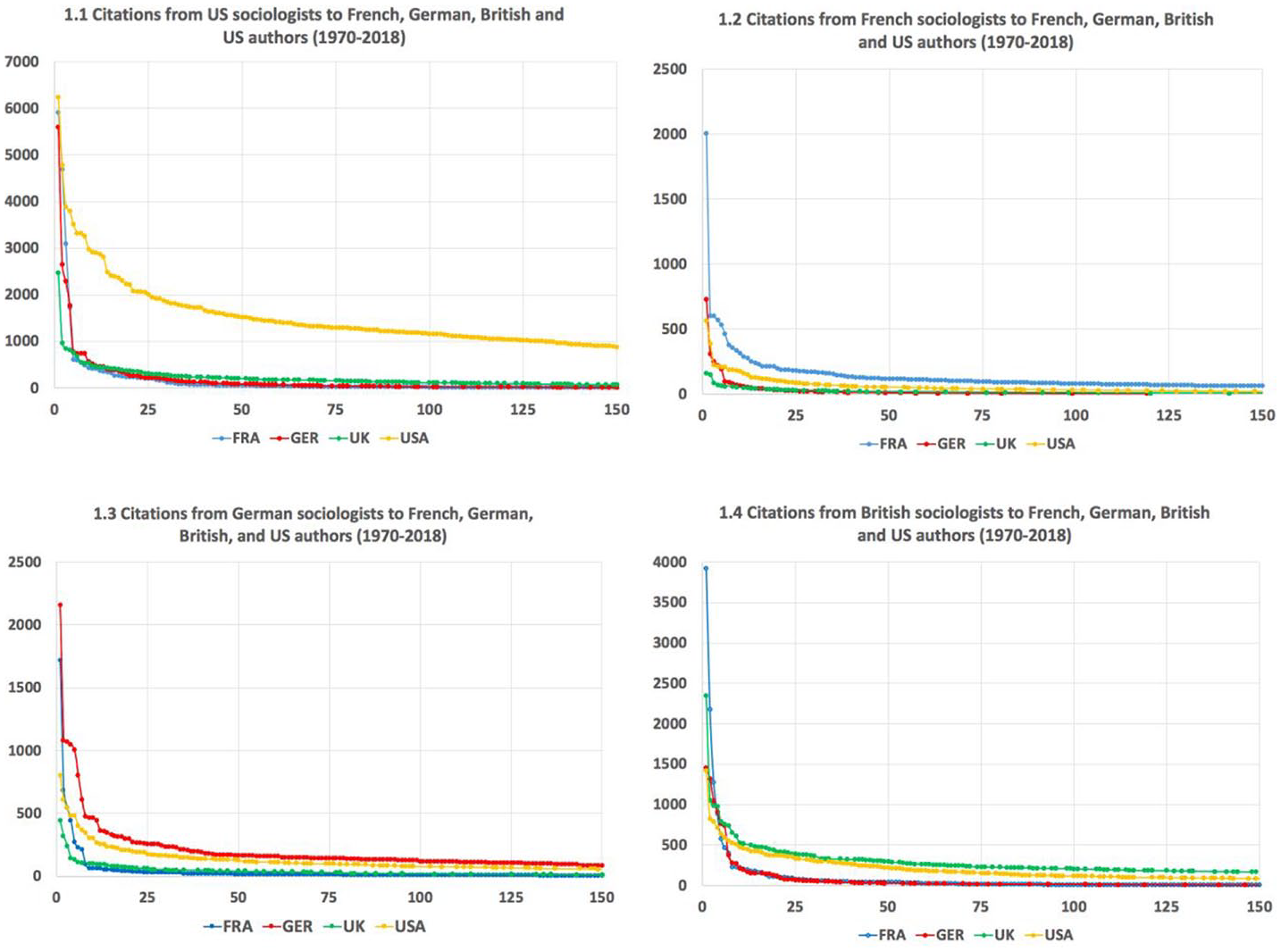
Citations from US, German, British, and French sociologists to US, German, British, and French authors (1970–2018).
Figure 1.2 shows that French sociologists cite significantly more US authors than UK and German ones. The same observation applies to UK sociologists (who cite more US authors than French and German ones, Figure 1.4), and to German sociologists (who also cite US authors more than French and British ones, Figure 1.3). Taken together, the last three figures confirm the central position of US sociologists in the global field of sociology compared to French, German and British sociologists, even among the tails of the curves where authors are less cited. On the contrary, the upper parts of the curves, where highly cited authors appear, show that for US sociologists, French authors are more visible than British and German ones, suggesting a more central position of French sociology compared to German and British sociology. The stronger visibility of French authors in the upper parts of the curves is also true in the German and British national fields. For French sociologists, the upper part of the curves shows a stronger visibility for German and US authors as compared to British authors.
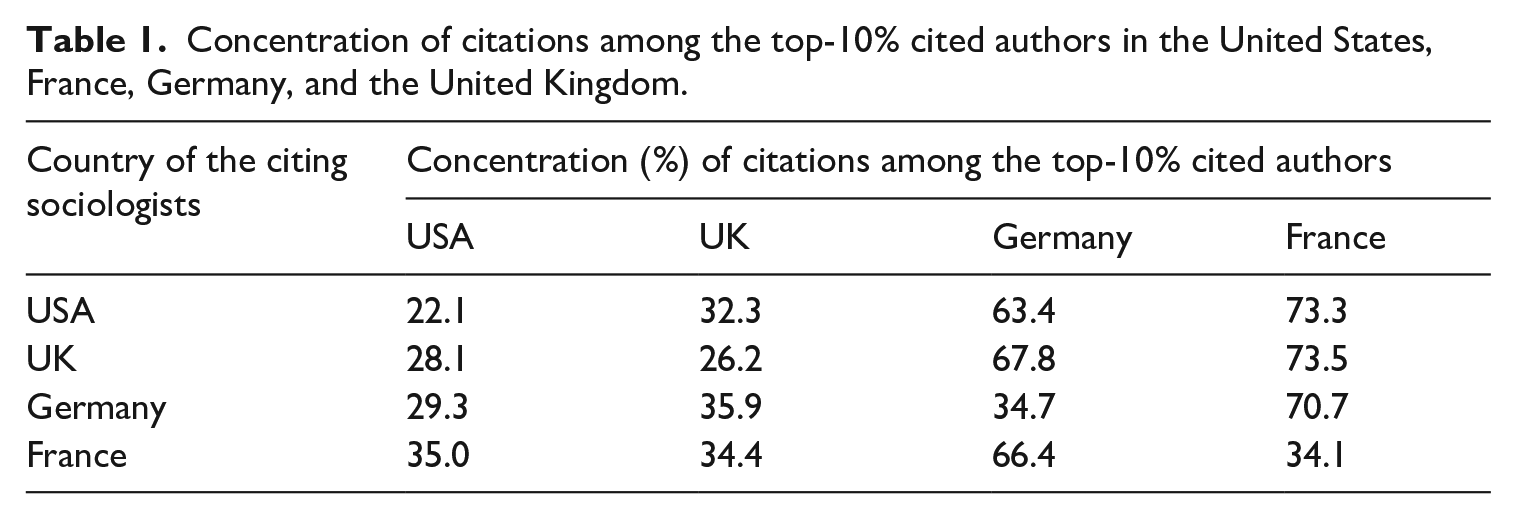
Altogether, the four figures confirm that in each national field a minority of authors concentrate the majority of citations. To get a more nuanced view of this result, we have calculated the percentage of citations that are concentrated among the top-10% cited authors of each country, that is the top-15 most cited authors among the 150 listed (Table 1), as well as the Gini coefficient of each citation distribution (Table 2). These two measures indicate that citations to the most cited authors are less concentrated when the sociologists of the four countries cite authors from their own country. In other words, the citations of sociologists are not only more frequent to authors from the same country, but they are also more equally distributed among them than they are among ‘foreign’ cited authors. For instance, the Gini coefficient of the curve of US sociologists citing US authors is 0.23, while it is 0.39 for US sociologists citing UK authors, 0.73 for US sociologists citing German authors, and 0.81 for US sociologists citing French authors. This order also applies to the concentration of citations among the top-10% cited authors by US sociologists: 22.1% for the top-10% cited US authors, as compared to 32.3% for the top-10% cited UK authors, 63.4% for the top-10% cited German authors, and 73.3% for top-10% cited French authors.
Concentration of citations among the top-10% cited authors in the United States, France, Germany, and the United Kingdom.
Gini coefficients of the citation distributions.
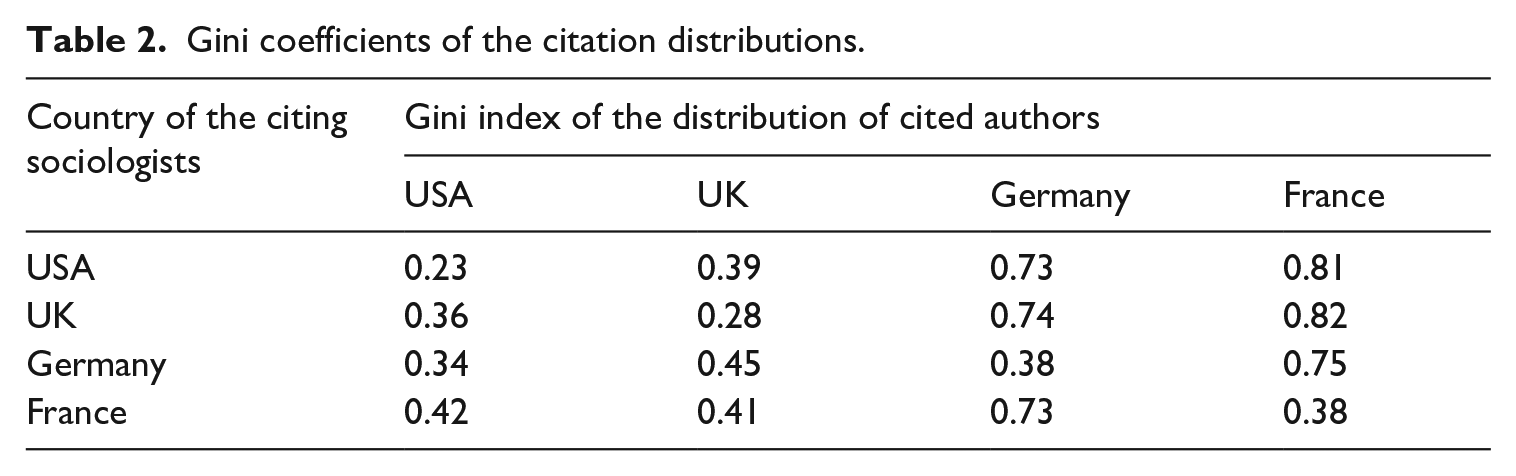
These numbers show that the distribution of citations from US sociologists to French authors is more skewed than the same distribution of citations to German and British authors. While this observation could suggest that the reception of French in the US field of sociology is ‘peculiar’, our data show that this situation is actually similar in the United Kingdom and Germany, since the distribution of citations from sociologists of these two countries to French authors are more skewed than the distribution of citations to authors of the other countries. Moreover, citations from US, French, and British sociologists to German authors are also highly concentrated with nearly identical Gini coefficients of 0.73, 0.73, and 0.74, respectively. Thus, the way French authors are cited in the United States has nothing peculiar or specific, since citations from US sociologists to German authors are just slightly less concentrated.
Figure 2 further confirms that the distributions of citations from US, UK, German, and even French sociologists to French authors, follow a similar trend in the four national fields, with a minority of authors receiving the bulk of attention whether from colleagues of the same country or from abroad. More than 80% of the total of citation from US, UK, and German sociologists to French authors are concentrated among about 100 individuals (87% in the case of the US curve, 80% in the case of the German one, and 86% in the case of UK one). This again shows that the distribution of the visibility of French authors in US sociology is no different from that in UK, German, and even in French sociology. Of course, since the WoS database is biased toward US and UK publications, in absolute terms, the top-5 French-cited authors appear much more visible in the US and UK fields than in the German and French fields, and the distribution has a longer tail in the United States.
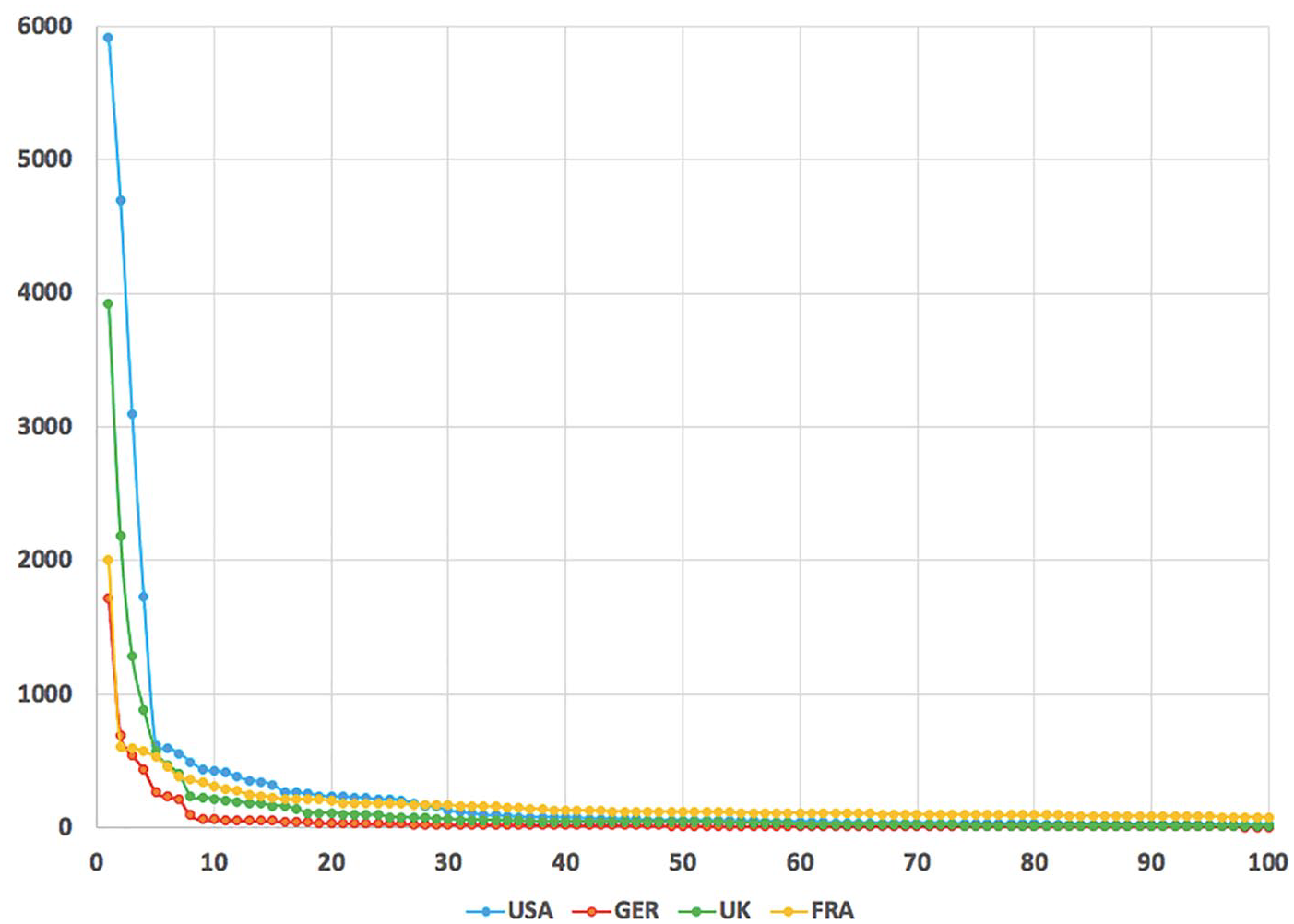
Citations from US, German, British, and French sociologists to French authors (1970–2018).
Linguistic barriers to the international circulation of knowledge
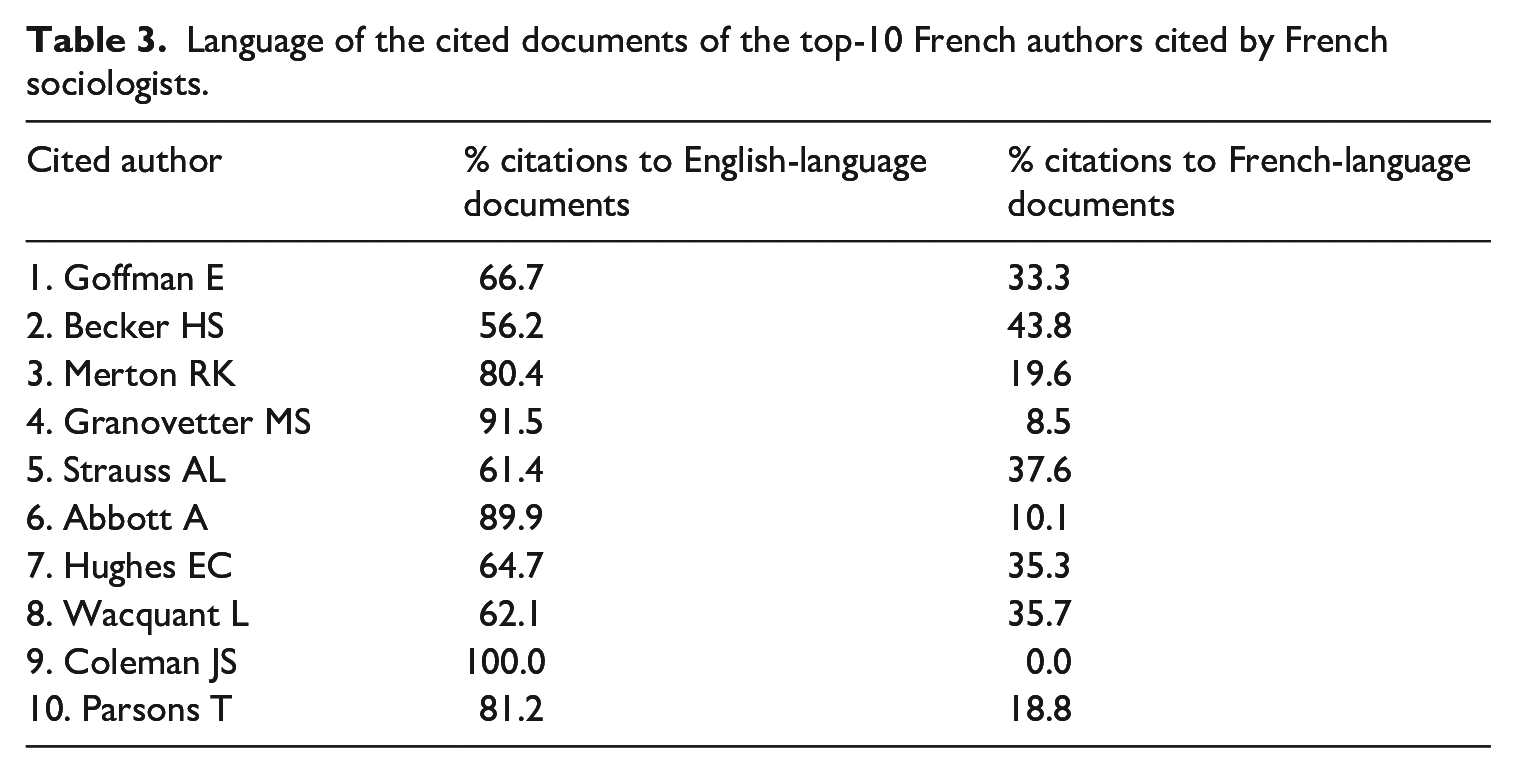
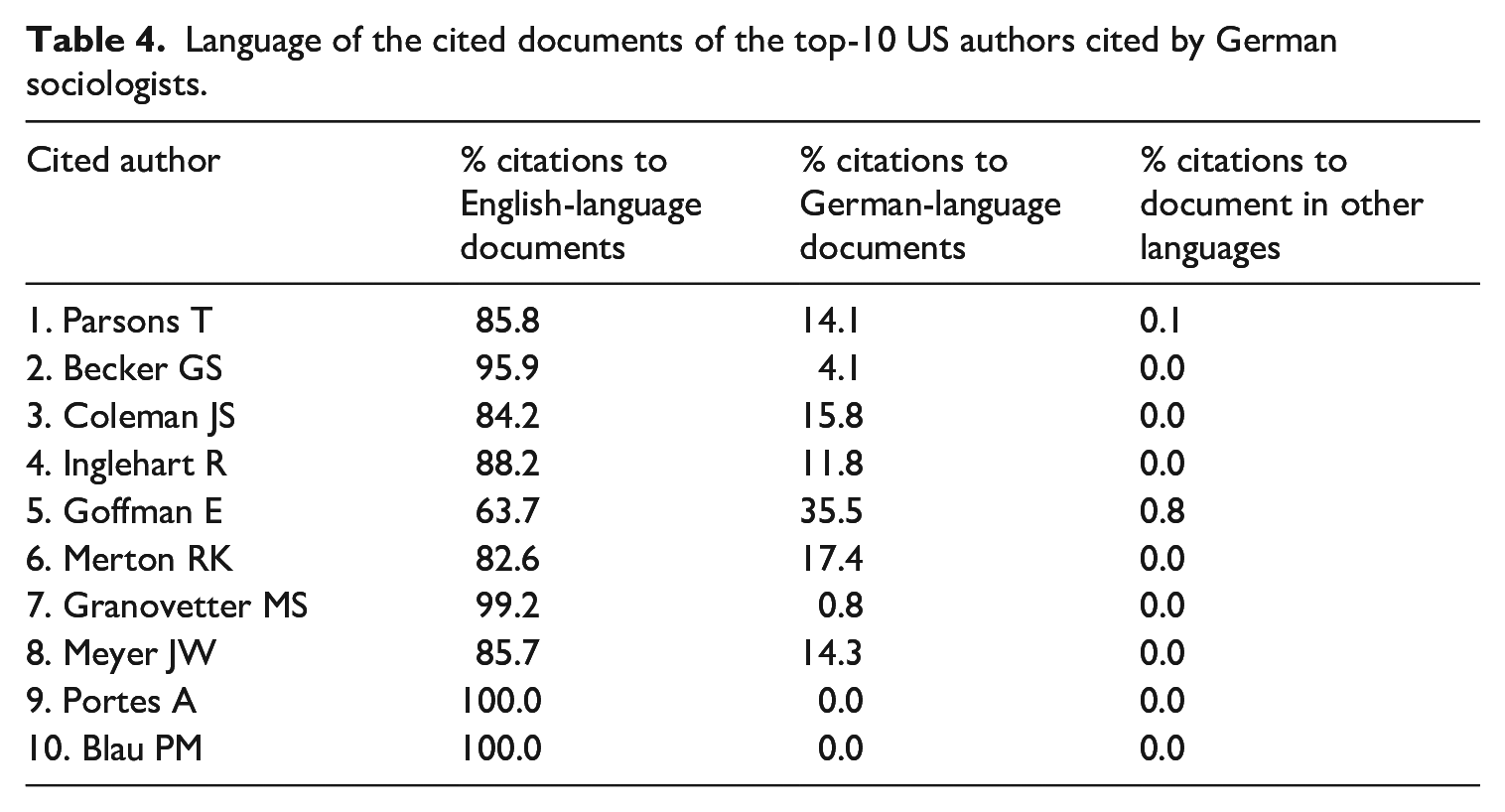
As shown previously in Tables 1 and 2, since citations from British and US sociologists to German and French authors are much more concentrated than citations to British and US authors, who generally write in the same language, it could be assumed that this difference has a linguistic aspect to it. Indeed, the vast majority of citations from US and British sociologists to the most cited French and German authors are either to English translations of books or to articles published in English-language scholarly journals. On the contrary, the most cited US and British authors by French and German sociologists are not affected by this language barrier as English is much more generally read by sociologists (and scholars in general) than French or German. Taking the example of the United States, as shown in Table 3, a majority (generally around two thirds) of the citations to US top-10 cited authors in the French field of sociology are made to their original works in English. Table 4 shows a similar situation in Germany where, except for the case of Erving Goffman, less than 18% of citations to US top-10 cited authors are made to German translations of their works.
Language of the cited documents of the top-10 French authors cited by French sociologists.
Language of the cited documents of the top-10 US authors cited by German sociologists.
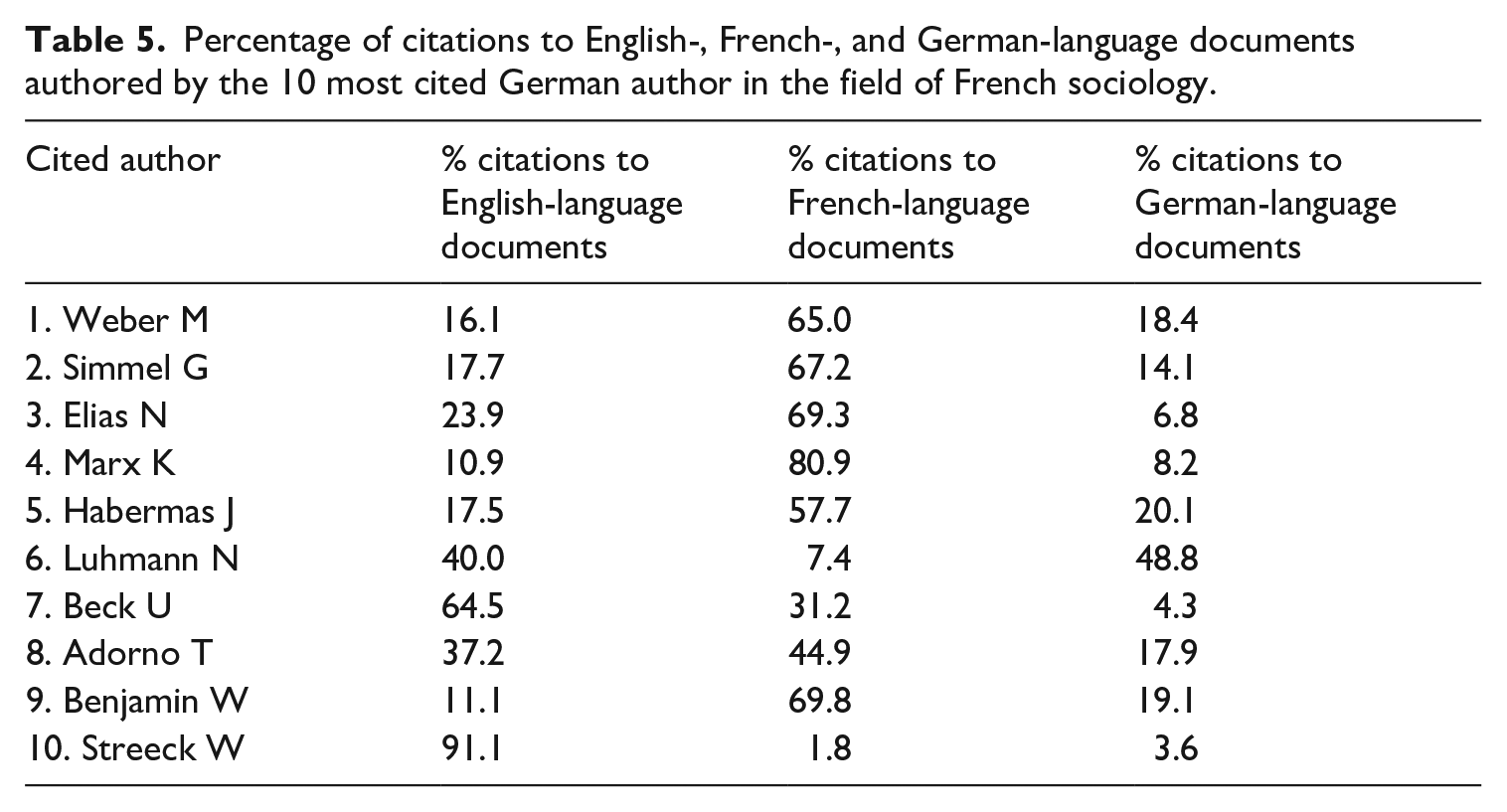
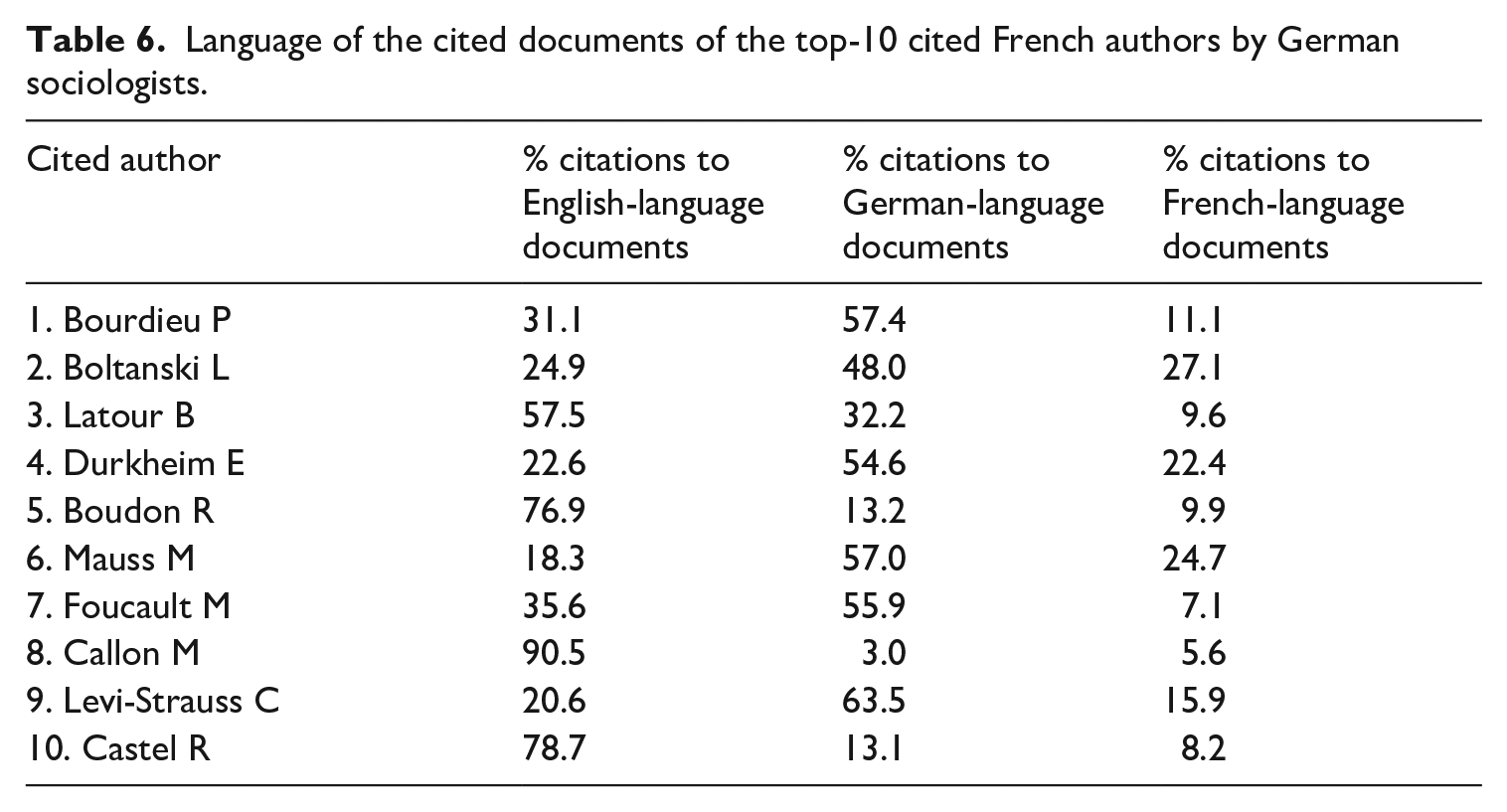
The linguistic barrier to the circulation of the works produced by French-speaking authors, in the Anglo-Saxon field of sociology, which is overcome for the most visible of them through translations, obviously also applies when it comes to their circulation in the German field of sociology. The same observation can be made about the circulation of the works produced by German-speaking authors in the French field of sociology. As shown in Table 5, the citations of French sociologists to the most visible German authors are mainly to books that have been translated from German to English or French and, to a much lesser extent, to articles published in English-language sociology journals. This is true not only for classic sociologists, such as Max Weber (64% of the citations are to French and 16% to English translations of his books), Georg Simmel (67% of citations to French and 18% to English translations), or Norbert Elias (69% of citations to French and 24% to English translations), but also for more contemporary sociologists of international renown, such as Jurgen Habermas (57% of citations to French and 17% to English translations), and Ulrich Beck (64% of citations to French and 31% to English translations). In the list of the top-10 cited German authors by French sociologists, only Nicklas Luhmann is an exception with almost half of his citations being to German-language books. The reverse situation is also true, since citations from German sociologists to French authors consist mainly in citations to French-language books that have been translated into English or German (Table 6). Indeed, more than 75% of the citations made by German sociologists to Bourdieu, Durkheim, Mauss, Foucault, Latour, Callon, Castel, and Levi-Strauss are to English- or German-language documents. Only Boltanski has more than a quarter of his citations made to original publications in French.
Percentage of citations to English-, French-, and German-language documents authored by the 10 most cited German author in the field of French sociology.
Language of the cited documents of the top-10 cited French authors by German sociologists.
Overall, these data illustrate the comparative advantage that English, as the contemporary lingua franca of science, confers to US or British authors who do not need to have their works translated to be read and cited by authors from other countries. Our data also confirm that, for French and German authors, reaching visibility in other national fields necessitates the translation of their works, preferably into English, given its global status. Of course, translations are themselves conditioned by many factors (Sapiro, 2008, 2019), two of them being the symbolic capital of the translated authors and the theoretical nature of their works, which facilitates their circulation across national fields as compared to empirical works. We will now analyze how these two characteristics affect the visibility of authors in the different national fields of French, US, UK, and German sociology.
National, international, and global visibility of sociologists
Though we have analyzed the period 1970–2018 and observed obvious changes in the rankings, as authors and research topics change over time, we will focus here on the recent period 2000–2018.
The most striking observation to emerge from a comparison between the list of the 50 most cited French authors in French sociology and the same list in the United States, the United Kingdom, and Germany is that they are far from being identical. As Table 7 shows, among the 50 most cited French authors in the French field of sociology, only 18 are also ranked among the 50 most cited French authors by US sociologists, 21 among the 50 most cited by German sociologists, and only 13 are also among the 50 most cited by UK sociologists. Among the ‘top-5’ cited authors of the French ranking (Bourdieu, Boltanski, Latour, Maffesoli, and Callon), the name of Michel Maffesoli appears as an anomaly. That is, however, easily explained by the fact that our list of sociology journals contains Sociétés, a journal founded by Maffesoli, which is largely devoted to his own works. That sole journal in fact accounts for 80% of all the citations he received. As has been shown elsewhere, this journal as well as Maffesoli himself are hardly cited in the French field of sociology (Gingras and Bertin, 2015). As for his relative presence in the United Kingdom (rank 26), it is essentially due to citations to the translation in 1996 of his book The Time of Tribes (Maffesoli, 1996). The case of Edgar Morin (ranked 32 in France), who writes essentially theoretical essays more attuned to the French intellectual field than to the field of sociology (Jacob, 2011), is also an artifact for he is in large part cited by Maffesoli’s journal (63% of citations to his works).
Ranking of the 50 most cited French authors by French sociologists, and their position in the ranking of the most cited French authors by US, UK, and German sociologists (2000–2018).
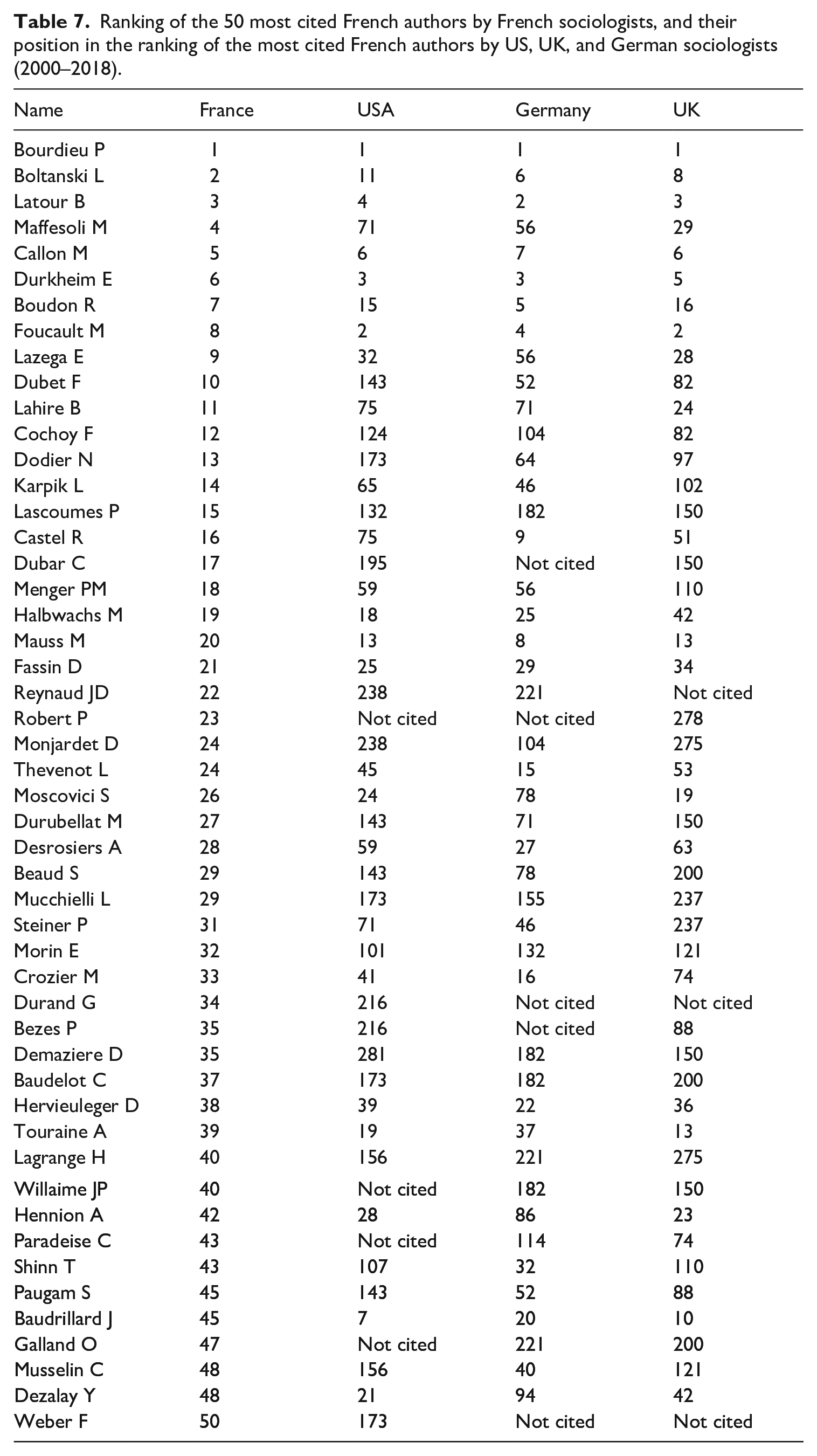
More generally, Table 7 reveals three categories of French-cited authors: the first comprise sociologists who rank highly in the four national fields analyzed here and we consider them as having a ‘global’ visibility; a second category is composed of sociologists who have a certain international visibility as they are highly ranked in France and in one or two other national fields; and finally, a third category is composed of those who have only a local or national visibility as they rank highly only in France.
Figure 3 shows the list of the 50 most cited French authors in the field of French sociology according to these three categories. The global sociologists comprise 13 authors who are generally recognized for their theoretical and conceptual contributions. These include authors of seminal works, such as Pierre Bourdieu, Luc Boltanski, Bruno Latour, Émile Durkheim, or Marcel Mauss for the most renowned. Also included in this category are authors who built their investigations on universal concepts. This is the case, for example, of Maurice Halbwachs (1980), who owes his national and international visibility to his sociological work on the notion of ‘collective memory’, published in 1925 in his book Les cadres sociaux de la mémoire first translated into English in 1980. Another example is Alain Touraine (1971), whose most cited book, articulated around the concept of ‘post-industrial society’, was translated into English fairly quickly after its initial publication in French in 1969 . The case of sociologist of religions Danièle Hervieu-Léger (2000) offers a good example of an author that owns a large part of her global visibility to the development of a theoretical concept, religion as a ‘chain of memory’, in a book originally published in French in 1993 but mainly cited abroad in its English translation.
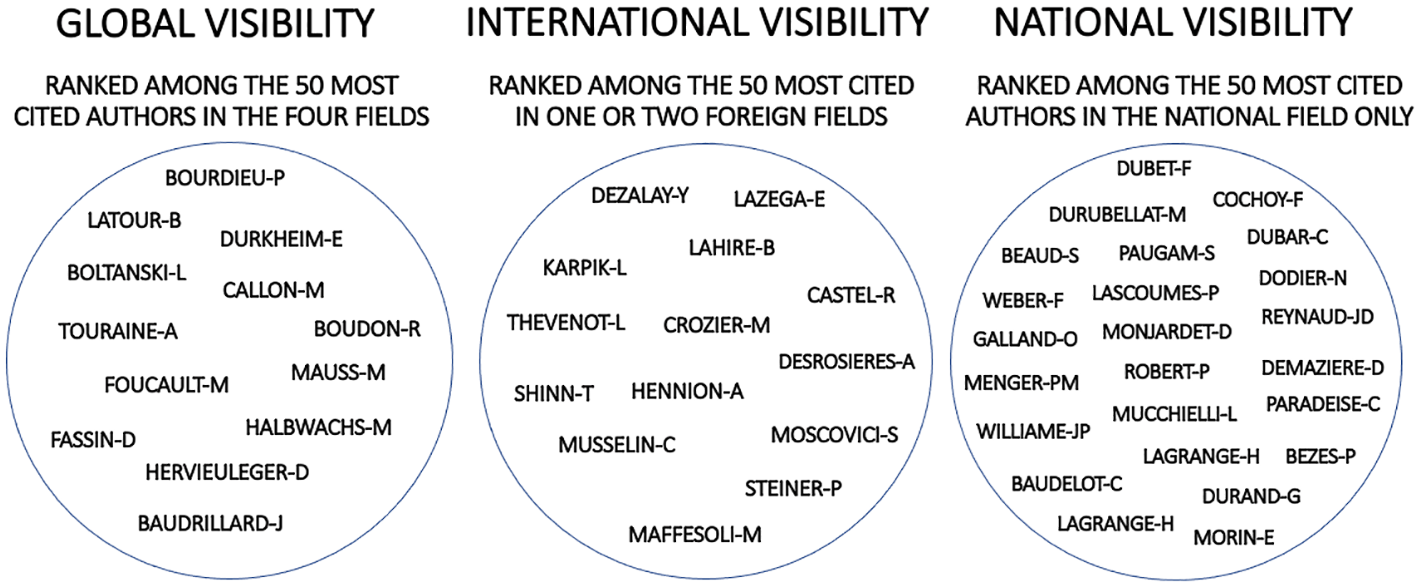
The 50 most cited French authors in the French field of sociology and their relative international visibility (2000–2018).
The second category of international French sociologists comprises 14 authors. As was the case for the first category, this one includes sociologists that are cited for empirical studies that rest on more specialized theoretical models. This is, for instance, the case of the sociology of organizations’ pioneer Michel Crozier, whose theoretical works on bureaucracy and the systemic analysis of organizations were quickly translated into English after their original publication in French. Other examples include Bernard Lahire, who owes his international visibility, mainly in the United Kingdom, for theoretical publications in the field of cultural sociology (Lahire, 2003, 2008), or Lucien Karpik who is cited outside France mainly for his book on ‘economic singularities’, originally published in French in 2007 and translated in English 3 years later (Karpik, 2010). The presence of Emmanuel Lazega in this category, mainly cited for his publications on the sociology of networks, shows that the use of quantitative methods that can be applied in different social contexts can also, like theoretical concepts, circulate beyond their field of origin. Finally, the presence in this category of authors, such as Christine Musselin (2009), cited for her publications on the European higher education market and Yves Dezalay, who is cited for his books co-authored with British sociologist Bryant Garth on the sociology of international law and order (Dezalay and Garth, 1998; Dezalay and Garth, 2002), show that international visibility can also be gained through works on transnational objects.
The third category of local or national authors is naturally the largest. It comprised recognized experts in different subfields of French sociology, such as the sociology of public administration and public policies (Philippe, Bezès, and Pierre Lascoumes), the sociology of public institutions – such as the police (Dominique Monjardet) and the education system (Christian Baudelot) – the sociology of French urban or rural social classes (Florence Weber and Stéphane Beaud), the sociology of labor and professional groups (Catherine Paradeise, Claude Dubar, and Didier Demazières), and the sociology of criminality (Philippe Robert and Laurent Mucchielli). These authors share the particularity of working on objects that are embedded in the specific context of French society. Some of them produce studies that are essentially empirical in nature, which makes it more difficult to circulate beyond French national borders.
The stratification of the visibility of French sociologists being closely related to the indexicality of their objects of study, there is no reason to think that this relationship is specific to France. We can test this hypothesis by applying the same method to the 50 most cited German, American, and British authors. As shown in Figures 4 to 6, we find the same three categories of global, international, and national authors. What distinguishes global and international authors from their national colleagues is also the fact that the works of the former two categories have a more theoretical and conceptual nature that those of the latter category. It is thus not surprising to find among the first category of German authors, well-known scholars, such as Nicklas Luhmann, Ulrich Beck, Max Weber, Georg Simmel, or Jürgen Habermas. In the United States, we find of course classic authors, such as Merton, Goffman, or Tilly and also more contemporary sociologists, such as Michèle Lamont, the only female author to reach a global visibility among US authors, and Andrew Abbott. As for the United Kingdom, we find of course the name of Anthony Giddens, along other sociologists known for theoretical and conceptual contributions, such as John Goldthorpe in studies of mobility and social stratification, Nikolas Rose on the concept of governmentality or David Harvey for his sociological analysis of urban geography.
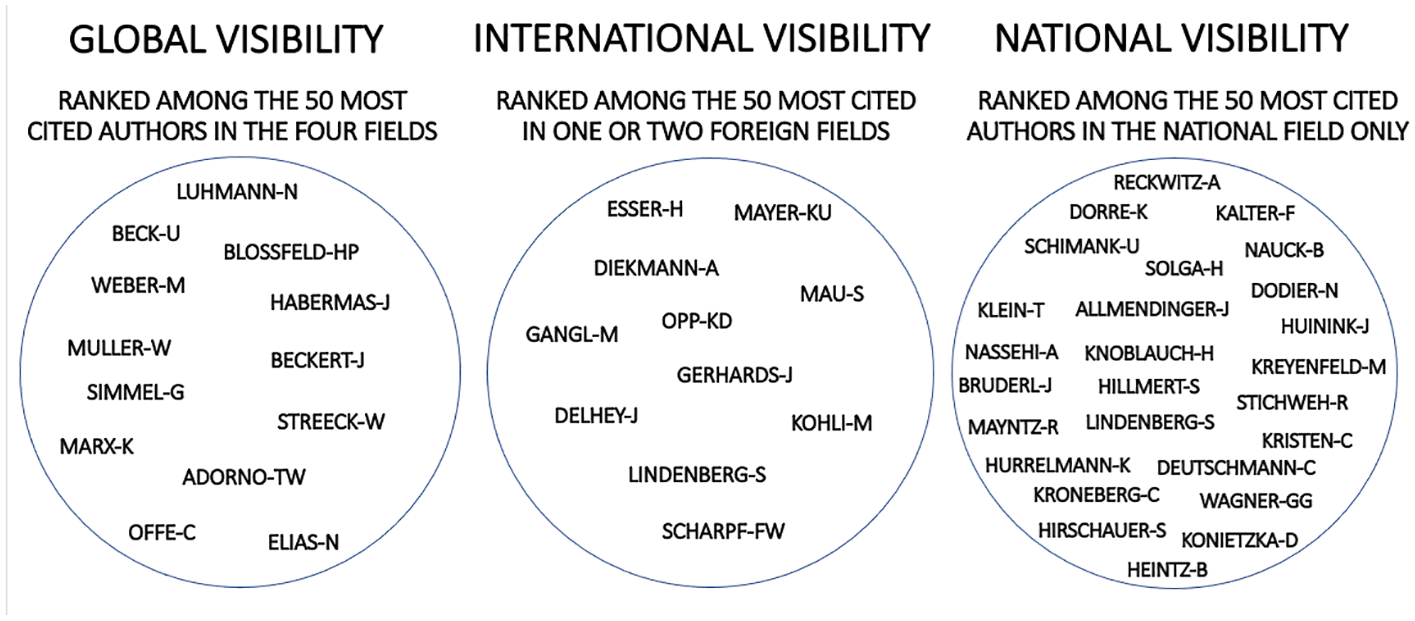
The 50 most cited German authors in the German field of sociology and their relative international visibility (2000–2018).
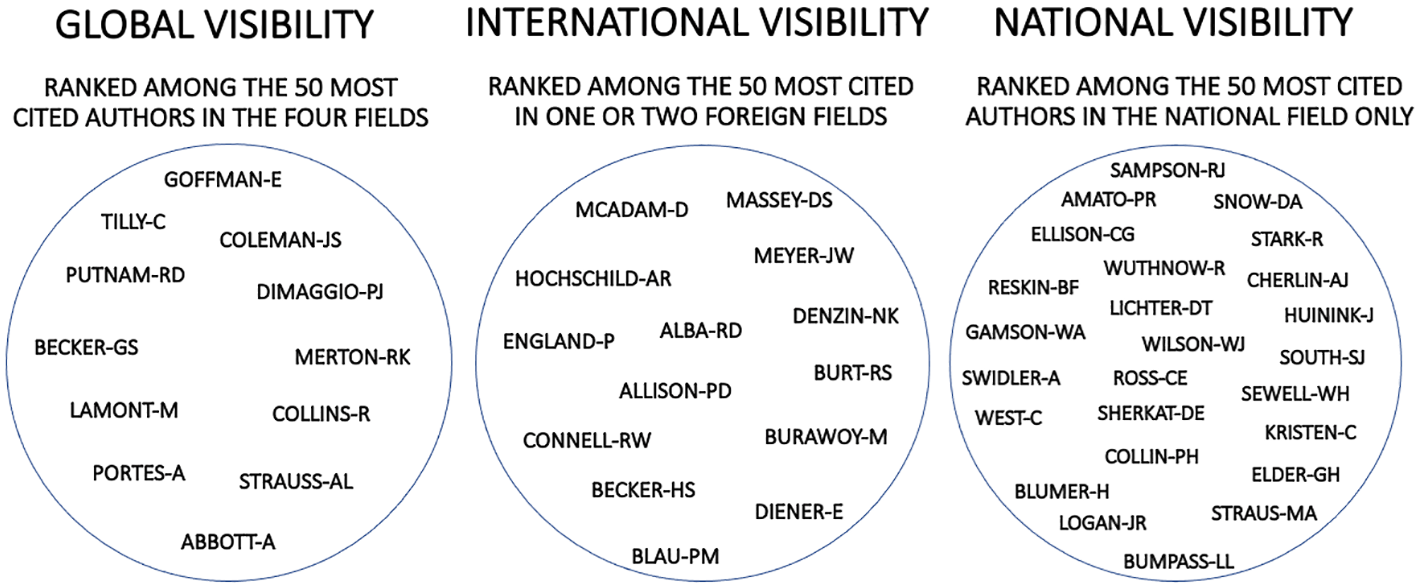
The 50 most cited US authors in the US field of sociology and their relative international visibility (2000–2018).
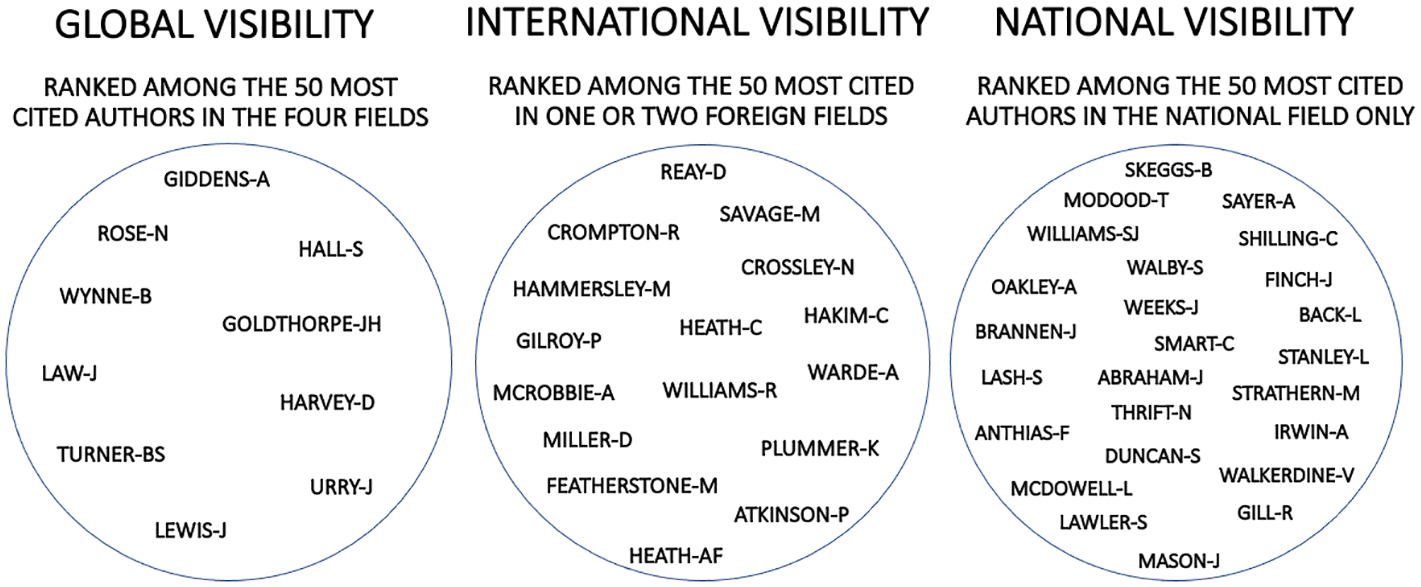
The 50 most cited British authors in the American field of sociology and their relative international visibility (2000–2018).
The above analysis tends to confirm that only a minority (about a dozen) of sociologists attain a global or largely international visibility, while a little more attain some international visibility, whereas the majority remains visible mainly/only in their national field. But, can there be authors that are highly visible in foreign fields while enjoying little or no visibility in their national field? To answer this question, we show in Table 8 the rankings of the 50 most cited French authors by US, UK, and German sociologists, and compare them to their rankings in France. A striking observation is that among the most visible French authors in the fields of US, UK, and German sociology, we find philosophers like Gilles Deleuze, Roland Barthes, Michel de Certeau, Maurice Merleau-Ponty, and Paul Ricoeur, who are absent from the top-50 most cited authors by French sociologists. Other authors that are highly ranked among US, British, and German sociologists but marginally cited by French sociologists include authors of classic or influential books from disciplines other than sociology and philosophy, such as anthropologist Claude Levi-Strauss, historian Fernand Braudel, or economist Thomas Piketty. Of course, some of these French scholars are only visible in one or two of the three other countries, such as Jean-Paul Sartre, Louis Althusser, and Gaston Bachelard who are highly ranked in the United States and the United Kingdom but not in Germany. This structure reflects what Joahn Heilbron (2024) calls the ‘national trajectories of the social sciences’, as French sociology, for instance, has constructed itself in opposition to philosophy, which is a dominant discipline in the French academic field. We find the same situation in Germany, since many German philosophers are relatively invisible in the works of local sociologists while being highly cited by French, US, and British sociologists. Among these authors are classical philosophers Friedrich Nietzsche, Edmund Husserl, Martin Heidegger, and social philosophers Axel Honneth and Max Horkheimer. One can thus identify a fourth category of authors composed of scholars who are highly visible in foreign fields of sociology but of marginal interest to sociologists of their own country. Any detailed analysis of such cases must rely on the local history of the national fields.
Ranking of the most cited French authors among US, UK, and German sociologists and their ranking in the field of French sociology (2000–2018).
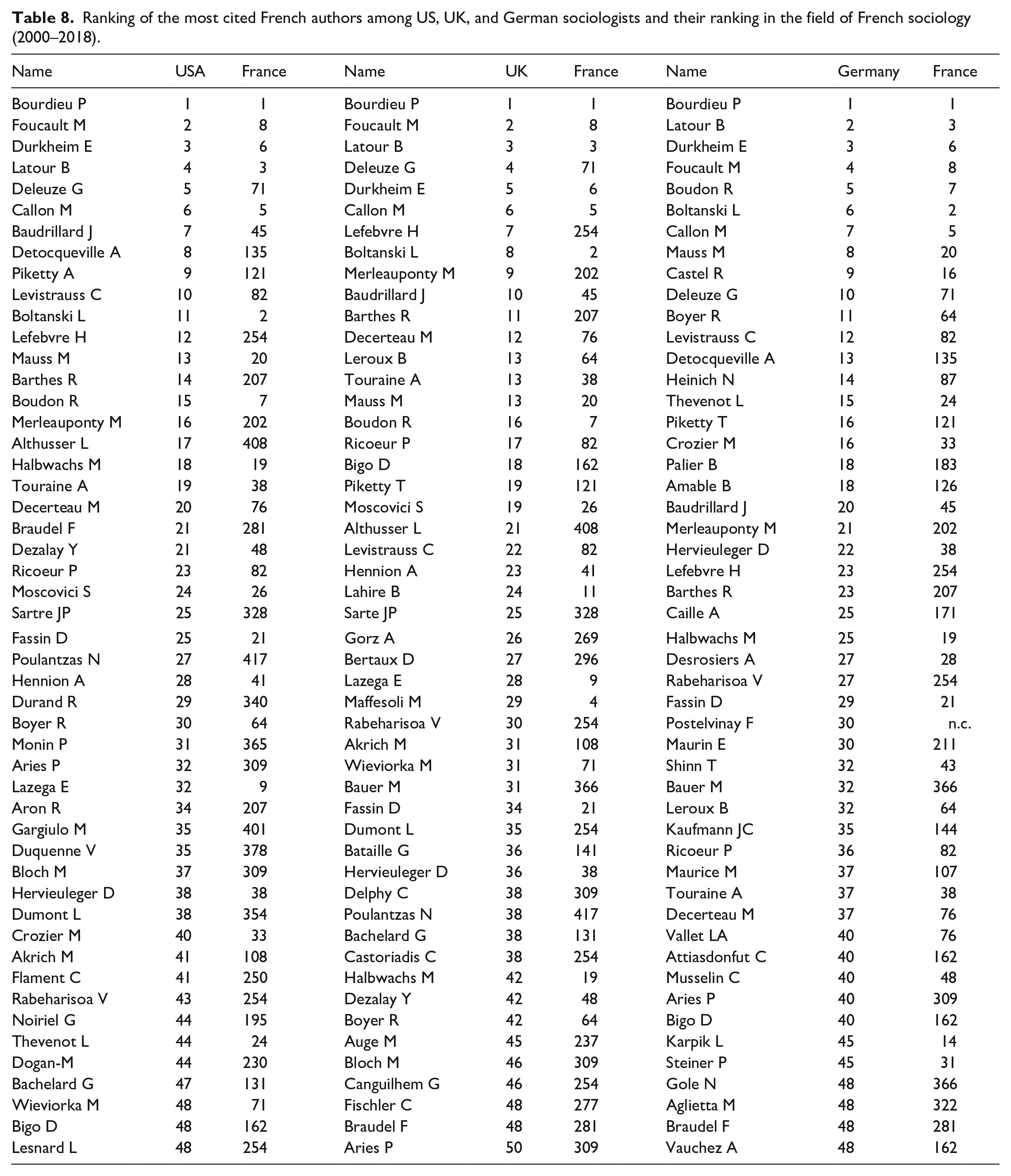
Figure 7 shows through a Venn diagram how the international visibility of French scholars is distributed among US, UK, and German sociologists. The central part of the diagram delimits the space of global French authors, those that rank among the 50 most cited in the three fields studied. This space not only includes some of the most influential French sociologists (Bourdieu, Latour, Callon, Boltanski, Durkheim, Boudon, etc.) but also several French philosophers, the majority of whom are barely visible in the French field of sociology (Michel Foucault excepted and, to a lesser extent, Jean Baudrillard). Outside this space, French authors are either visible in two or only one of the three other countries. For instance, Emmanuel Lazega or Yves Dezalay are ranked among the top-50 cited authors in the United States and the United Kingdom but not in Germany, while Michel Crozier is ranked among the top-50 cited authors in the United States and Germany but not in the United Kingdom. Such differences of visibility among the three countries might be explained by the specific topic of the cited authors’ research as well as by the focus of interests of the citing sociologists. For instance, comparative sociological studies between France and Germany, as done by Bruno Palier (Palier and Thelen, 2010) or Bruno Amable (2003), explain the visibility of these two authors in the German field of sociology and their relative invisibility in the US and UK fields. Another interesting example is that of historian Gérard Noiriel (1996) who owes his sole visibility in the US field to the interest of US ethnic and racial studies scholars in his sociohistorical works on immigration in France, the most important being his book The French Melting Pot: Immigration, Citizenship and Identity in France first published in 1988 and translated into English in 1996.
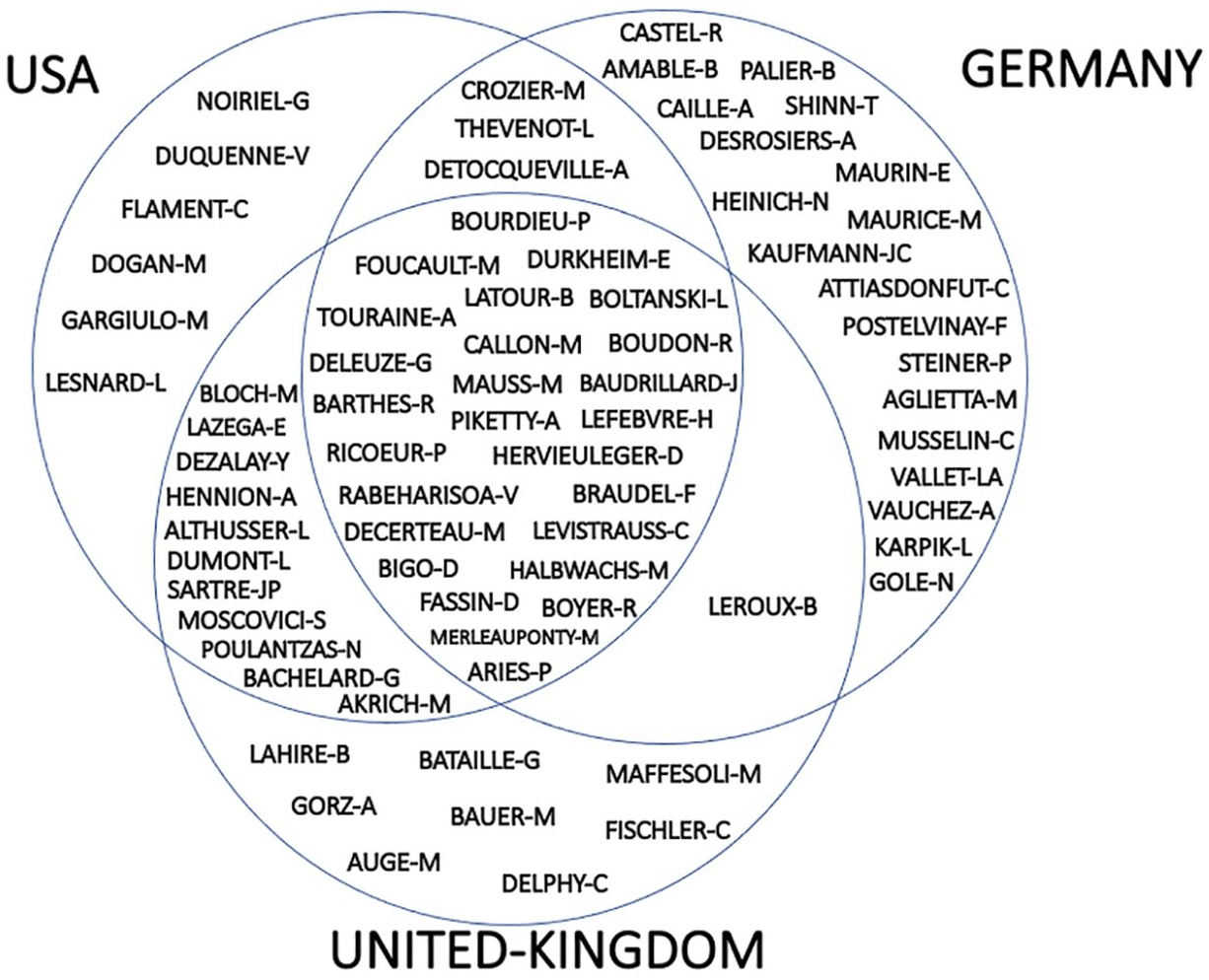
The 50 most cited French authors cited in the US, British, and German fields of sociology (2000–2018).
The changing international visibility of the most visible French authors in the French field of sociology is thus mostly conditioned by the theoretical and conceptual nature of their works. This observation extends O&A’s finding that French ‘social theorists’, along with similar European authors, such as Giddens, Simmel, or Weber, are the most cited authors by US sociologists. O&A explained their result by the fact that US sociologists have eschewed producing ‘general conceptual systems’ and rather relied on the general theoretical works produced by French and more generally by European theorists. However, our data suggest that the visibility of French ‘social theorists’ abroad is not a phenomenon unique to the United States, since even in a country, such as Germany, which has produced its fair share of ‘social theorists’, the same French authors are also highly ranked among German sociologists. Moreover, when mapping the space of international visibility of the 50 most cited German scholar among US, UK, and French sociologists (Figure 8), we find a structure that is similar to that of the 50 most cited French authors in the United States, the United Kingdom, and Germany. The more global space of visibility of German scholars, defined as the intersection of the most cited ones in the US, UK, and French national fields of sociology, includes the most influential German sociologists in Germany (Habermas, Simmel, Weber, Luhmann, and Beck) along others who are nowadays more visible abroad than in Germany (Tönnies and Mannheim). We also find in this global space of German cited authors, as was the case for France, social philosophers and theorists, especially those associated with the Frankfurt School and critical theory (Horkheimer, Adorno, and Honneth), as well as other renowned philosophers, such as Husserl, Nietzsche, Heidegger, and Arendt.
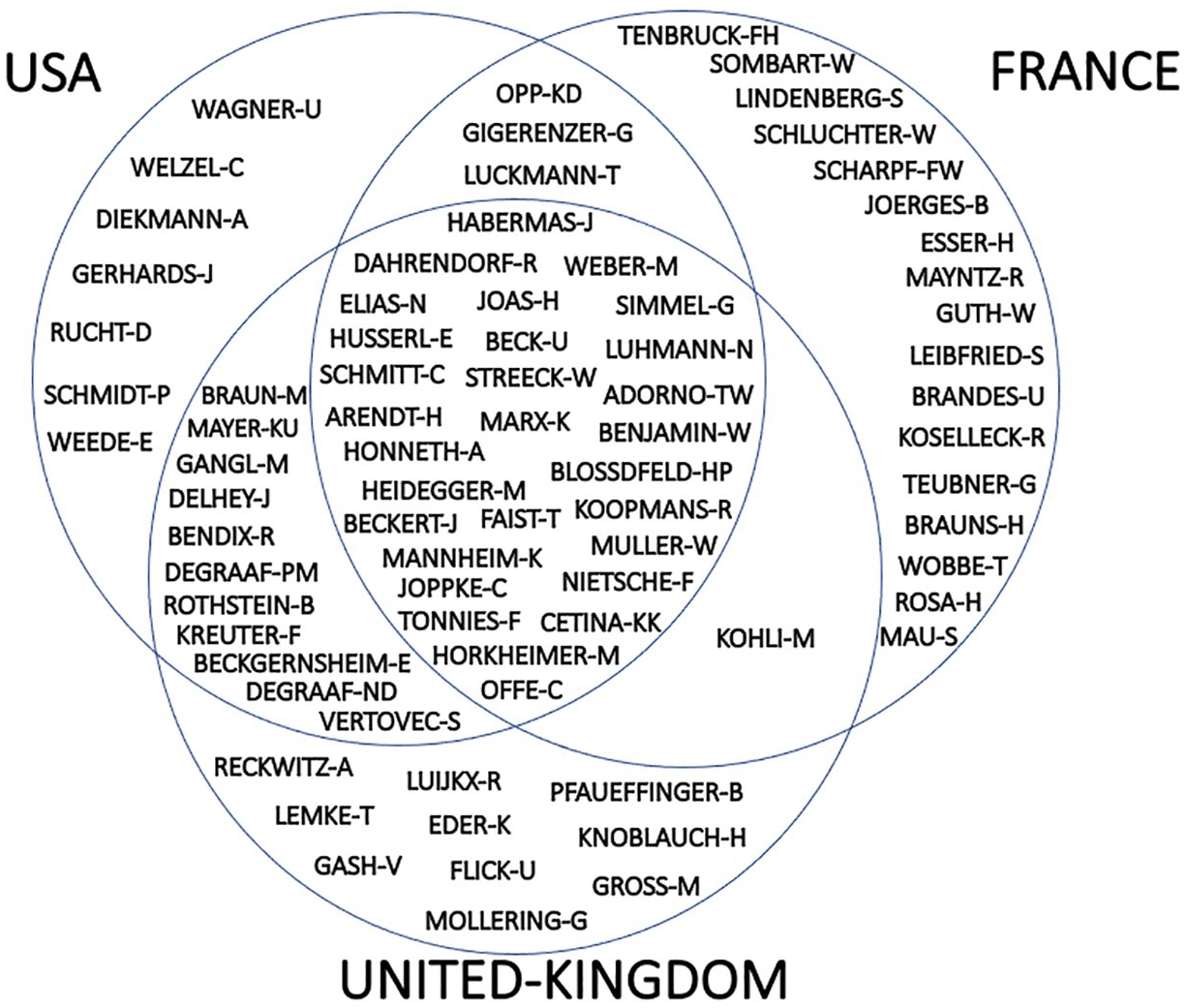
The 50 most cited German authors in the US, British, and French fields of sociology (2000–2018).
When mapping the space of international visibility of the 50 most cited British scholars among US, German, and French sociologists (Figure 9), we still find a structure similar to the one found for French and German scholars. The cited British authors that attain a more global visibility are either sociologists known for their conceptual and theoretical contributions (Anthony Giddens, John Goldthorpe, Stuart Hall, Ernest Gellner, and Nikolas Rose), or similar influential authors from other social sciences and humanities disciplines, such as geographer David Harvey, psychologist Henri Tajfel, and philosopher Karl Popper (as well as historians Eric Hobsbawm and Edward P. Thompson in France and the United States). One can also see that British sociologists have been particularly influential internationally in the subfield of sociology of science and technology, with the presence of Harry Collins, John Law, Donald Mackenzie, and Brian Wynne in the central space of the Venn diagram, as well as David Bloor in France and Germany.
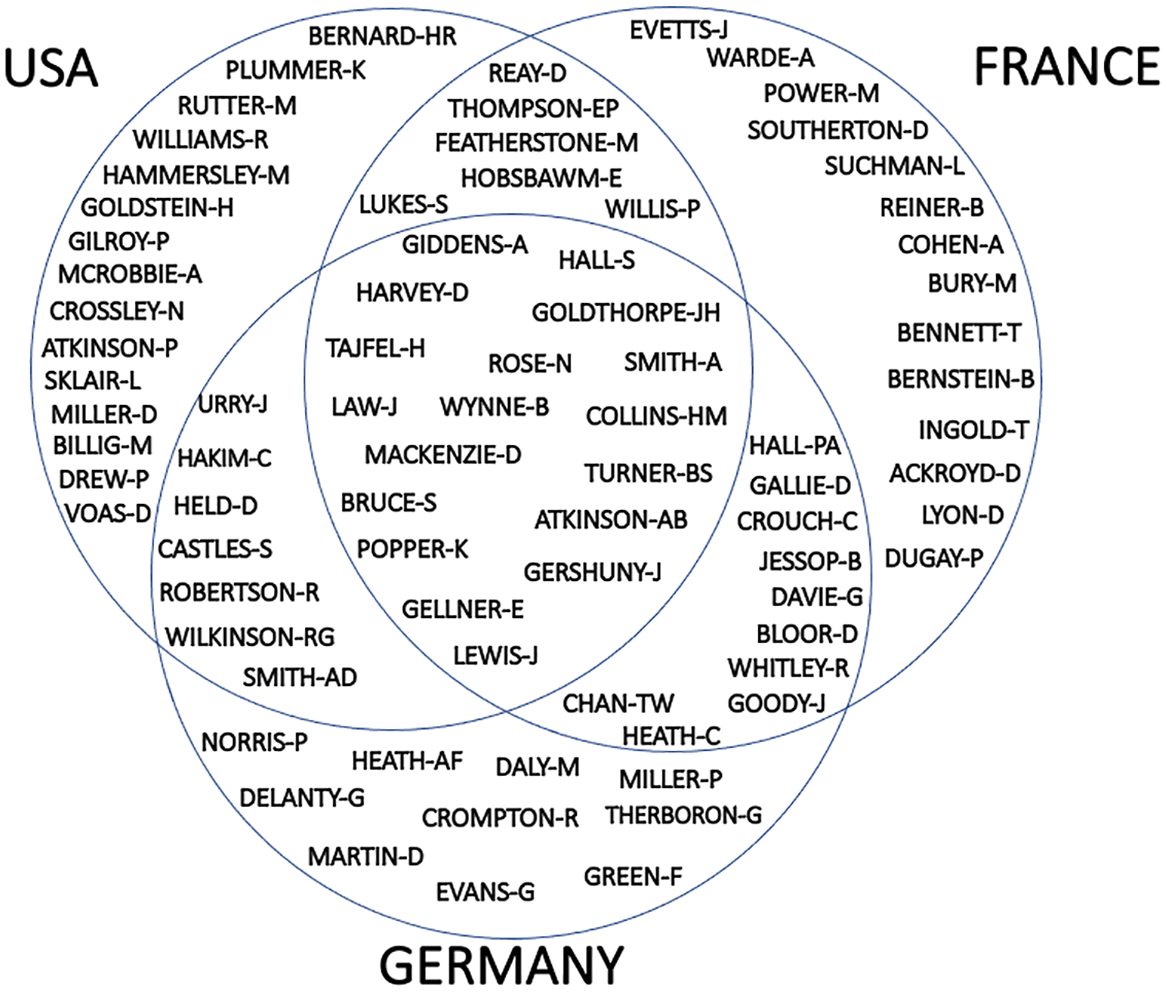
The 50 most cited British authors cited in the US, German, and French fields of sociology (2000–2018).
Finally, when mapping the space of international visibility of the 50 most cited US scholars among British, German, and French sociologists (Figure 10), we again find a structure similar to the one found for French, German, and British scholars. US authors who are visible in the global field of sociology comprise sociologists well known for their major theoretical and conceptual contributions (Merton, Parsons, and Goffman). Also present in this global field are sociologists who have made important conceptual contributions in different sub-fields of sociology: Randall Collins in microsociology, Andrew Abbott in the sociology of professions, or Mark Granovetter (1973) in the sociology of networks with his seminal paper on the ‘strength of weak ties’. Immigration and ethnicity sociologist Alejandro Portes, while being cited in part for studies embedded in the US context, owes the majority of his citations to more conceptual works on social capital, transnationalism and assimilation (Portes et al., 1999; Portes, 1998; Portes and Zhou, 1993). Sociologists, Harold Garfinkel (ethnomethodology) and Anselm Strauss (grounded theory), are rather globally cited for methodological and conceptual contributions. Economist Gary Becker (1964) and political scientist Robert D. Putnam (2000) are the only authors from other disciplines than sociology to be visible globally, thanks to their works building on the concepts of human capital and social capital. Several other US authors from different social sciences and humanities disciplines, also known for theoretical and conceptual contributions, are visible internationally, such as philosophers A.O. Hirschmann, John Dewey, Judith Butler, economists Herbert Simon and Daniel Kahneman, anthropologists Mary Douglas and Clifford Geertz, or historian Benedict Anderson. In short, as in the case of France, Germany and the United Kingdom, it appears that US authors who benefit from a global visibility are generally those whose work has strong theoretical and conceptual roots.
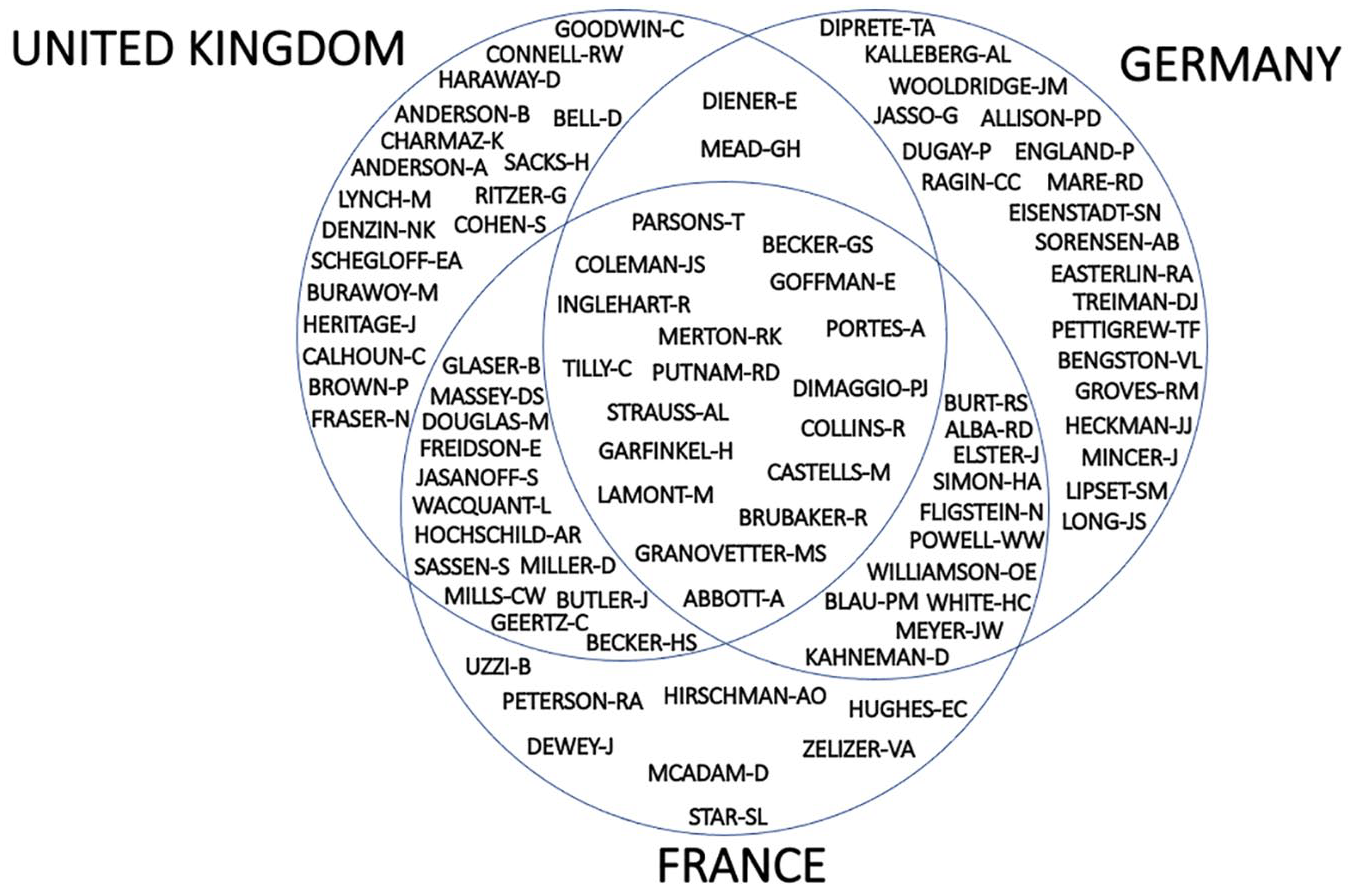
The 50 most cited US authors cited in the British, German, and French fields of sociology (2000–2018).
Visibility: volume and surface
Focusing on the total number of citations received in a given field is certainly a useful first measure of visibility in terms of ‘volume’ of symbolic capital, but it can hide the fact that citations, and thus visibility and recognition, can be either dispersed among many specialties and journals or concentrated in a few ones. We have already mentioned the extreme case of Maffesoli’s relatively high rank among French sociologists but we can more generally rank authors according to a measure of the concentration of the sources of their citations (i.e. the citing journal) as a measure of the ‘surface’ occupied in the field. To give an example of the difference in rankings based on volume as opposed to surface (or scope) of citations, we have calculated the HHI of the 50 most cited French authors among US sociologists between 1970 and 2018. As shown in Table 9, whereas Bourdieu and Latour were comparable in ranking (first and third) based on the volume of citations received from US sociologists, their concentration index clearly shows that the distribution of citations to Bourdieu (third of the HHI ranking) occupies a much larger surface among citing journals and specialties than the citations to Latour (39th of the HHI ranking), who receives 36% of his citations from only two journals: Social Studies of Science and Science, Technology, & Human Values, central outlets for the specialty of sociology of science. Likewise, 38% of the citations received by his long-time collaborator Michel Callon, who ranks seventh among the top-50 most cited French authors by US sociologists, come from the same two journals thus moving his rank down to the 41st position of the HHI ranking.
Ranking of the most cited French authors by US sociologists based on HHI and total citations.
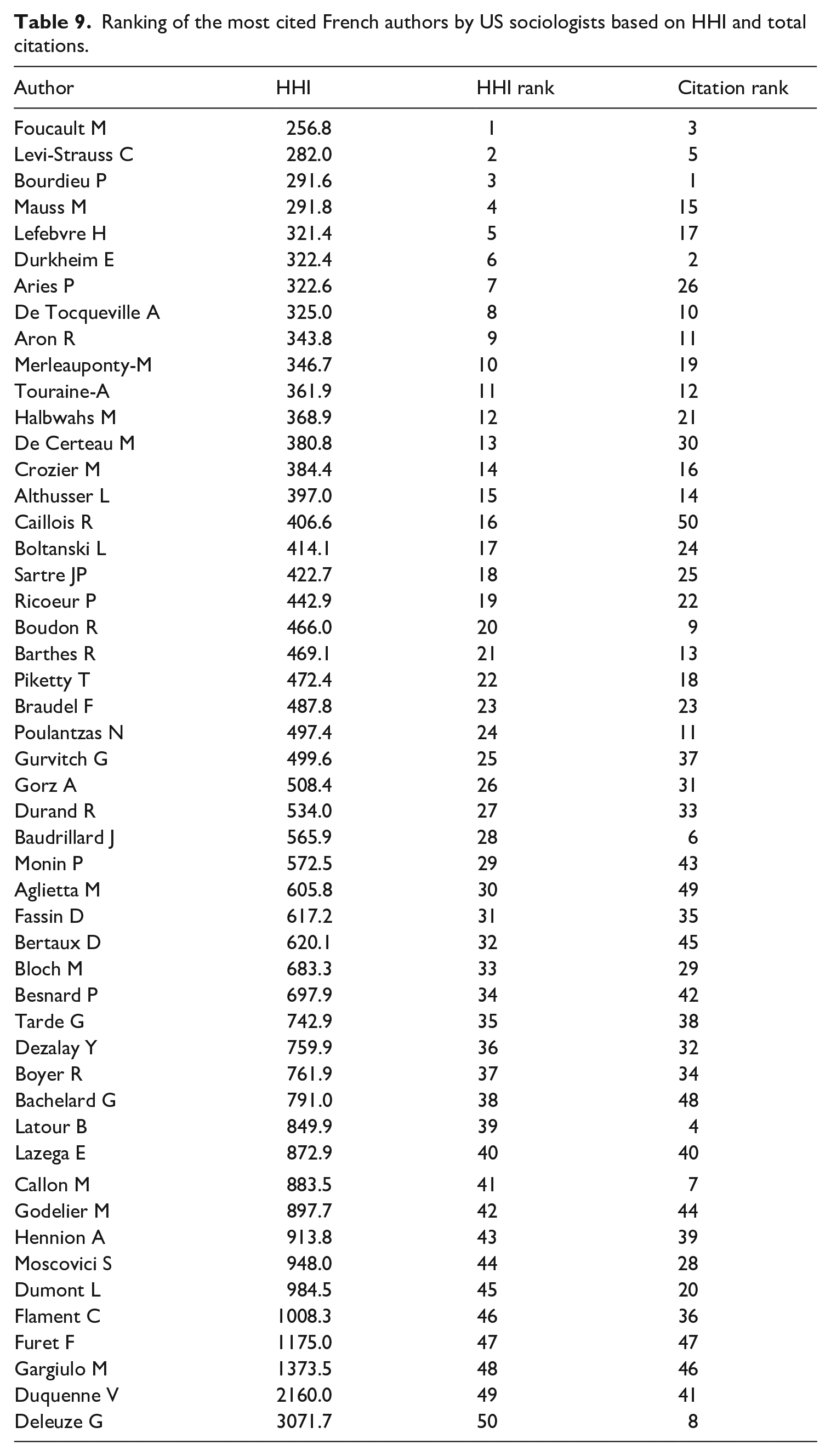
Generally speaking, a low HHI identifies sociologists who transcend specialties thanks to their theoretical contributions (Bourdieu, Mauss, Durkheim, Halbwachs, and Crozier) or authors from other social sciences and humanities disciplines who have been influential across disciplines (e.g. Claude Levi-Strauss, Philippe Ariès). This can also explain that the HHI of philosophers, such as Michel Foucault, Maurice Merleau-Ponty, Roland Barthes, Raymond Aron, or Michel de Certeau, is lower than that of sociologists who specialize in a given subfield, like, for example, Emmanuel Lazega in network analysis whose citations are highly concentrated in one journal (41% of citations from Social Networks), sociologist of organizations Martin Gargiulo who gets 47% of his citations from Social Networks and American Journal of Sociology, or quantitative sociologist Claude Flament who receives 35% of his citations from Social Networks and from Journal of Mathematical Sociology. An exception to this observation is the case of philosopher Gilles Deleuze whose visibility is largely due to citations coming from a single journal (55% of citations from Qualitative Inquiry).
Conclusion
Given that all disciplines are composed of specialties having their specific objects and methods, it is to be expected that only very few scholars will reach a significant visibility beyond their specialty and also beyond their country. Coupled with the fact that the empirical objects of sociology, and more generally of the social sciences, are relatively indexical and localized, it was to be expected that delocalized theoretical discourses have much more chances to circulate beyond the national fields than specific empirical studies. There is thus nothing peculiar in the distribution of citations to French authors by US sociologists, its general distribution being also observed in other national fields. That being said, the global economic and cultural dominance of the United States, which contributed to making English the lingua franca of international academic exchanges not only in the natural but also in the social sciences since the 1980s (Gingras, 1984, 2002), may explain in part that American sociologists are more visible than their French, German or British colleagues in the tail of the distributions. In addition to the fact that the over representation of Anglo-saxon journals in the database may contribute to the higher visibility of US sociologists, a more important factor is that American sociologists are also larger in number than their French German or UK colleagues. One should also take into account the tendency for non-American authors who want to publish in US journals to overcite American papers (Mosbah-Natanson and Gingras, 2014).
Finally, the ontological characteristics of social sciences’ objects also helps explain the limits of the ‘internationalisation’ or ‘globalization’ of the social sciences (Gingras, 2019) and the persistent existence of ‘national traditions’ in social sciences and humanities disciplines (Heilbron, 2008, 2015, 2024). As O&A rightly observe, there can be virtues to ignorance and, whether or not this is making virtue out of necessity, the fact remains that the relative autonomy of national fields in the social sciences is not a negation of ‘internationalism’ or a form of autarchy but a direct effect of the specific content of the knowledge associated with objects that are fundamentally rooted in space and time. Though that may seem paradoxical, such a conclusion about the limits of the international circulation of knowledge in the social sciences can only be obtained by taking a ‘transnational’ and thus a ‘global’ approach to the analysis of the dynamic of social sciences disciplines (Heilbron et al., 2009; Heilbron et al., 2018).
Footnotes
Funding
The author(s) received no financial support for the research, authorship, and/or publication of this article.
