




Abstract
The notion that the world has been witnessing a profound neoliberal transformation since around the 1980s onward is widely accepted in many parts of social science and the humanities. Moreover, the overarching impression is that this transformation has mostly been regrettable in economic, political, and other social terms. At the same time, careful interdisciplinary research recently uncovered that neoliberalism has been notoriously hard to define. Based on that research, this article first clarifies the conceptual confusion surrounding neoliberalism and presents a broad, synthetic institutions-based working definition of it that captures its typical contemporary usages. The article then asks if a systematic empirical assessment of neoliberalism’s social impact over the past decades across the world is even possible. It suggests it is by empirically operationalizing neoliberalism in three distinct, yet potentially overlapping, ways that appear in the literature: first, as a broad set of economic institutions measured by economic freedom indexes; second, as the process of international trade liberalization (itself proxied by import shocks); and third, as shock-therapy type institutional reforms in (parts of) post-communist Europe. Synthesizing the findings of the existing vast research literature, the main conclusion of the article is that neoliberalism’s social impact has been more nuanced than suggested by prevailing discourse.
Introduction
The world has arguably gotten much more neoliberal over the past four decades as economies across the globe started opening up at what some would call break-neck speed (Gwartney et al., 2021; Ostry et al., 2016). To many, this is not at all a questionable statement, even though the neoliberal phenomenon is notoriously hard to define (Boas and Gans-Morse, 2009; Venugopal, 2015). In academia, highbrow newspapers, and activist circles, neoliberalism is regularly presumed to be a, if not the, dominant ideological and material force in the contemporary world. What is even less controversial in the eyes of many of its critics is that neoliberalism has been responsible for a host of the most pressing social issues today, from poverty and stagnant living standards to skyrocketing inequalities and looming catastrophic climate change, from war and the rise of illiberal populism to the loneliness epidemic, the erosion of social trust, and flourishing of self-centered individualism that threatens to unravel the social fabric (Brown, 2019; Bruff, 2014; Fahnbulleh, 2020; Harvey, 2005; Klein, 2007; Monbiot, 2016; Patnaik, 2020, 2021).
Miatta Fahnbulleh (2020), the Chief Executive of the New Economics Foundation, recently claimed that the original capitalist promise of growth helping all the ‘proverbial boats’ to rise (even though some have always risen faster than others) has been belied by the much less promising neoliberal reality of the past few decades. In this period, the rising of all boats has ‘stopped happening’, she writes, and it has become clear that ‘the system [. . .] is not working in the interest of the majority of people’ (Fahnbulleh, 2020: 38–39). As the title of her article suggests, a broad kind of ‘neoliberal collapse’ has been palpably on display in the developed world for quite some time now. This has already been observed by Ostry and colleagues in 2016, when they wrote for a publication of the International Monetary Fund, warning that ‘Instead of delivering growth, some neoliberal policies have increased inequality’ (Ostry et al., 2016: 38).
Already at the beginning of the 21st century, David Harvey (2005: 154) reported in his widely acclaimed A Brief History of Neoliberalism that neoliberalism’s ‘actual record turns out to be nothing short of dismal’. He goes on to explain that neoliberalization has broadly failed to stimulate worldwide growth. In some cases, such as the territories of the ex-Soviet Union and those countries in central Europe that submitted to neoliberal ‘shock therapy’, there have been catastrophic losses. (Harvey, 2005: 154)
Neoliberalism had long been touted as the main mechanism for achieving economic growth and development around the world by politicians such as Ronald Reagan and Margaret Thatcher – and economists such as Friedrich Hayek and Milton Friedman – but according to Harvey this has turned out to be a great falsehood. He goes on to claim that neoliberalism has also eroded both ‘social protections in advanced capitalist countries’ and ‘in many of the ex-communist countries of the Soviet bloc’ has destroyed civil rights, especially ‘women’s rights’, in a fashion that ‘has been nothing short of catastrophic’ (Harvey, 2005: 170). Neoliberalism’s animosity toward democracy can also be felt in the developed world specifically: because of the ‘profoundly anti-democratic nature of neoliberalism [. . .] [t]he democratic deficit in nominally “democratic” countries such as the US is now enormous’. Harvey’s incredibly influential book has been cited more than 40,000 times in the past 15 years alone.
In The Shock Doctrine, a popular social science work cited more than 12,000 times since its release in 2007, Naomi Klein (2007: 405) likewise claimed that everywhere neoliberalism has triumphed, ‘between 25 and 60 percent of the population’ had been turned into a ‘permanent underclass’. Neoliberalism and economic wellbeing do not mix well. Moreover, like Harvey she also speaks of neoliberalism’s ‘potential incompatibility’ with, and ‘antipathy’ toward, democracy (Klein, 2007: 540). This seems to be a very prescient pronouncement given that the contemporary neoliberal world has been flung into a global ‘democratic recession’ (Diamond, 2015) and has been witnessing the process of ‘democratic backsliding’ (Bermeo, 2016) since right about the time Klein’s book was published.
Harvey and Klein might be the most famous critics of neoliberalism, but they are not at all alone in reaching their critical conclusions. Bruff (2014: 116) has argued along similar lines that ‘we are witnessing the rise of authoritarian neoliberalism’, because the capitalist status quo is not able to deal peacefully and democratically with economic crises, such as the 2007 global financial crisis. Patnaik (2021) has also been clear that ‘[t]he neofascist assault on democracy is a last-ditch effort on the part of neoliberal capitalism to rescue itself from crisis’. As he explained elsewhere (Patnaik, 2020: 47), ‘we are stuck with a perennial presence of fascism as long as neoliberal capitalism lasts. [. . .] Fascism is neoliberal capitalism’s “gift” to mankind in the period of its maturity’. In the introduction to a recently published edited volume Nine Lives of Neoliberalism, Slobodian and Plehwe (2020: 7) concur, stating that it would be a mistake to see neoliberalism declining with the rise of illiberal populism; instead, neoliberalism goes hand in hand with the contemporary right-wing onslaught on democracy (the same is argued in Brown’s (2019) study).
These are serious – yet completely plausible – charges against the neoliberal economy, and it can hardly be doubted that various social developments, movements, and phenomena mentioned by the authors above corroborate the general critique, at least prima facie. For instance, the current democratic recession and the rise of illiberal populism have happened while the world has moved further in the direction of neoliberal capitalism (as one measure of this, see Gwartney et al., 2021). Moreover, since the 1980s, wealth and income inequalities have increased around the world. The shock-therapy transitions of Central and Eastern European post-communist countries to capitalist economies have been socially and economically devastating in the 1990s. But can the above indictments of neoliberalism be sustained (and perhaps even amplified) under a more systematic and quantitative empirical treatment? To what extent can they be so sustained? Are (some of them) false? The past 20 years have seen an accumulation of a vast, rigorous, and systematic body of scholarly research, and in this same period there has been an outpouring of high-quality descriptive data on the topic, so such a reexamination should in principle be possible.
A gap in the existing literature on neoliberalism
Many existing scholarly treatments of neoliberalism have run in one of four directions. First, there are individual quantitative studies that empirically operationalize the phenomenon in some way and test a particular hypothesis (e.g. de Soysa and Vadlamannati, 2021a, 2021b). Second, there exist conceptual review papers that wade through a wider collection of individual empirical studies with the aim of uncovering the various meanings and operationalizations of the term as they appear in the literature with varying frequency (e.g. Boas and Gans-Morse, 2009; Flew, 2014; Venugopal, 2015). Third, there are big-picture conceptual studies that employ a particular theoretical perspective, historical research, or textual exegesis to argue that, for instance, neoliberalism has broadly been misconstrued by scholars and that there exists some ignored ‘true’ or ‘truer’ meaning of the phenomenon that has so far been overlooked (e.g. Mirowski, 2009; Ryan, 2015). Finally, there are conceptual articles arguing against the use of the term either because it is ostensibly analytically incoherent or because there is little to gain from its employment politically (e.g. Dunn, 2017; Rodgers, 2018).
What tends to be missing from the contemporary literature on neoliberalism – especially the literature that falls in the second, third, and fourth category – is an attempt at a pragmatic and empirically minded, yet conceptually informed and systematic, examination of what exactly the decades of research have shown about neoliberalism’s real-world performance. Of course, investigating what neoliberalism means, or should mean, is important and is a fundamental conceptual precondition for such an exercise. But the final point of social-scientific inquiry is to understand how the social world actually works. Are the critical theses of Harvey, Klein, Patnaik, Fahnbulleh, Plehew, Slobodian, and others empirically correct, and to what extent are they correct, given what these critical scholars mean with the word neoliberalism? The present article aims to address this gap in the literature by employing a pragmatic and synthetic approach to the issue. Such an approach would first try to propose a broad and inclusive (because relatively abstract) working definition of neoliberalism, on the basis of which one could then, second, suggest more concrete (but still fairly broad) operationalizations of the term, so that – third – an empirical review of the existing quantitative work could be performed with the aim of evaluating the real-world performance of neoliberalism.
Due to space limitations, the examination in this article has to be limited to the particular claims about neoliberalism quoted above, namely claims having to do with economic development, living standards/income, inequality, and democracy. These are the claims that have been most commonly put forth in the existing critical literature on neoliberalism, and fortunately they are also the claims for the evaluation of which we have collected the most data and study findings. For a critical review of empirical literature on how markets in general, and neoliberalism in particular, relate to other crucial social issues, such as human pro-sociality (i.e. cooperation, trust, corruption), violence (both interpersonal and state-level), and various forms of discrimination, see Wright (2018), Storr and Choi (2019), and Rutar (2023a).
Toward a broad and empirically minded working definition of neoliberalism
‘Neoliberalism’ has become common currency both in academia and in intellectual public discourse during the 1990s and the early 2000s, the heyday years of globalization. Typically, it was used as a term of abuse, and it still carries with it profoundly negative connotation today. But at the same time, scholars have – ironically – struggled to precisely define neoliberalism, let alone agree on its meaning. Almost a decade ago, Terry Flew (2014: 49) justifiably observed that the ‘uses of the term need to be dramatically narrowed from its current association with anything and everything that a particular author may find objectionable’. Daniel Rodgers (2018) similarly lamented that ‘[n]eoliberalism is the linguistic omnivore of our times, a neologism that threatens to swallow up all the other words around it’. Just recently, a study investigating the potential explanatory power of the term for understanding the long-term evolution of evaluative bibliometric systems in a set of societies found that ‘if used without clarification, “neoliberalism” is a concept too broad and diluted to be useful’ (Hammarfelt and Hallonsten, 2023: 414).
That this really is a serious concern can be gleaned from a comprehensive review study which found, in a sample of more than 100 scholarly papers on neoliberalism published between 1990 and 2004, that the term was regularly left simply undefined (Boas and Gans-Morse, 2009). This was not just the case in the more humanistic academic disciplines, but even in quantitative, empirical papers that used neoliberalism as a key independent or dependent variable. Moreover, of the minority of papers that actually tried to define neoliberalism, most used the term quite differently to mean several distinct phenomena, some of which overlap only partially and very vaguely or not at all. The authors of the study concluded that ‘[i]n present usage, neoliberalism conveys little common substantive meaning but serves as a clear indicator that one does not evaluate free markets positively’ (Boas and Gans-Morse, 2009: 145). A more recent study came to a similar troubling semantic conclusion (Venugopal, 2015).
The present article intervenes in these older and more recent debates surrounding neoliberalism by first proposing an overarching and synthetic definition of the phenomenon as a broad, yet distinctive, set of particular economic institutions that together form a family resemblance. This definitional proposal is not made in a substantive vacuum, but rather flows out of two sets of sources. First, this article relies on the critical work on neoliberalism as embodied, for instance, by authors such as Klein, Harvey, Ostry, and others. Second, in presenting its definition, the article also draws on the most common and mutually compatible past scholarly usages of the term that come from the ostensibly more neutral, less politically inflected, and thoroughly peer-reviewed empirical literature (drawn from Boas and Gans-Morse’s review of more than 100 scholarly papers).
Because of the disputed nature of neoliberalism as a term, the article will be examining the phenomenon by operationalizing it in not only one way, but three distinct (yet mutually compatible) ways: (1) as a set of economic institutions measured by a variety of economic freedom indexes, (2) as the process of international trade liberalization (itself proxied by import shocks), and (3) as shock-therapy institutional reforms in (parts of) post-communist Europe.
The definition of neoliberalism that will be proposed and empirically investigated is not meant as a distillation of the essence of the phenomenon. This is virtually impossible because neoliberalism seems to possess some of the characteristics of an essentially contested concept (Boas and Gans-Morse, 2009). Thus, the article will not be providing the necessary and sufficient conditions that make up neoliberalism. Nor will it be engaging in deep exegetical work that strives to uncover the true meaning of the term by way of textual investigation of self-described neoliberals (such people are, at any rate, very few in number). Instead, the article takes a more pragmatic definitional approach. First, it takes the critics at their word and investigates neoliberalism as a cluster of phenomena that they have associated it with over the years, namely liberalization, privatization, modest government or deregulation, globalization, shock therapy, and so on, even if self-described neoliberals from the past would disavow such elements as constitutive of their project. We are less interested in whether these and related phenomena ‘truly constitute’ neoliberalism and more interested in whether they have the social consequences that neoliberalism’s critics typically claim they do – whatever concrete label we apply to them. Second, the article relies on common substantive definitions that repeatedly appear in the empirical scholarly literature (see Boas and Gans-Morse, 2009). Again, this literature might not capture what neoliberalism ‘truly is’, but it does register and fix some of the main connotations that contemporary defenders, critics, and investigators alike have in mind when using the troublesome term.
All this means that some will, no doubt, contest the present working definition. For instance, one contemporary movement that calls itself neoliberal is explicitly positioned as left-of-center and is not at all in favor of significant and overall reduction of the role of government in the economy (Mortimer, 2021; Neoliberal Project, 2022; see also Bockman’s (2011) historical analysis, which provocatively argues that neoliberalism’s roots are to an extent left wing and even socialist in spirit). Moreover, careful investigations of intellectual history demonstrate that the self-avowed 20th-century neoliberal movement was not as simplistic in its advocacy as its critics take it to be. To take just one example, historic neoliberals did not simplistically want to get rid of the government. Instead, they were in favor of certain, but not other, forms of government intervention. As Mirowski (2009: 436) puts it in his attempt to set out what historic neoliberalism really meant, ‘A primary ambition of the neoliberal project is to redefine the shape and functions of the state, not to destroy it. [. . .] In practice, “deregulation” cashes out as “re-regulation”, only under a different set of ukases’. Something similar, even if more extreme and less well demonstrated, is argued by Graeber (2015: 9), whose Iron Law of Liberalism states that any market reform, any government initiative intended to reduce red tape and promote market forces will have the ultimate effect of increasing the total number of regulations, the total amount of paperwork, and the total number of bureaucrats the government employs.
However, this effort to uncover what neoliberalism ‘truly means’ is beyond the scope of the present article, and we instead opt to test the effects of neoliberalism as typically construed by its critics and contemporary investigators.
According to Boas and Gans-Morse (2009), scholars – when they were careful enough to define neoliberalism in their studies – typically assigned it one of four distinct meanings. In most cases, they defined it (1) as a set of economic reform policies, (2) as a certain economic developmental model, (3) as an overarching ideology or worldview, or (4) as a theoretical economic paradigm (see the surveyed articles in Boas and Gans-Morse, 2009: 143–145).
Unpacking these four meanings, (1) neoliberal reform policies are simply various individual efforts at trade liberalization, the privatization of state-owned enterprises, macroeconomic stabilization, reduction of government subsidies, and so on. The neoliberal (2) developmental model can then be thought of as the conscious striving toward a more comprehensive, package-deal implementation of most or all of these reform policies with the intention of spurring on development; this model can thus be contrasted with state-led developmental models such as ‘import substitution industrialization’. As an (3) ideology, neoliberalism is taken to be a worldview that sees and recommends market-based principles and individual autonomy (instead of government involvement) as the most reliable and justified means to solve all or most of the problems a society is facing. Finally, some take neoliberalism to simply be a particular type of (4) economic theory, such as standard neoclassical economics, or public choice theory, or the Chicago School of neoclassical thinking, or the Austrian School of economics, and so on. This last definition might be the least internally coherent of all four because the enumerated types of economic thinking, even though they are all generally related to each other in their strong endorsement of market principles, nevertheless also share several serious disagreements with one another (for a deep investigation of these and other issues surrounding the last two meanings of neoliberalism, see Bockman, 2011).
Now, even though these are distinct definitions not readily interchangeable, one can detect a certain elective affinity between them. The common thread running through them is that all of them are focused on, and oriented toward, a certain set of market institutions – that is, social rules guiding and incentivizing certain ways of economic behavior – which themselves form a recognizable and internally coherent economic core. Therefore, an overarching cluster definition of neoliberalism is at hand. Neoliberalism is a particular set of economic institutions (to be enumerated in more detail below), with (1) neoliberal policy prescriptions or reforms being discreet efforts which advance institutional reform in that direction, (2) the developmental model or system being the practical embodiment and operation of these institutions, while (3) the ideology and (4) theoretical paradigms are efforts at its ideational analysis and promotion or prescription.
For the purposes of this article, neoliberalism at the most abstract level will be thought of as a particular set of economic institutions that have to do with, or are certain forms of, markets, private property, government regulation and involvement in the economy, macroeconomic stability, inflation, fiscal austerity, and so on. More precisely, liberalized markets with few price controls and trade barriers, secure property rights and strong, impartial enforcement of contracts, high level of private entrepreneurship in the overall economy, only modest government regulation of business, a tight money supply, relatively low taxes, and so on are all economic institutions that comprise the core of the neoliberal package (some of the enumerated phenomena, such as a high level of private entrepreneurship, are not really institutions themselves but outcomes or processes of institutions). The more a society’s institutions point in that direction, the more neoliberal they are; the more they point in the other direction, the less neoliberal they are.
Measuring neoliberalism’s impact through indexes of economic freedom
There are several ways in which neoliberalism, as defined, can be measured. The Fraser Institute’s index of economic freedom is perhaps the gold standard in quantitative measurements of which societies are most neoliberal and what statistical effects neoliberalism has on various variables (Gwartney et al., 2021). Regularly published since the 1990s, with many data points and estimates stretching even further back in time, the index is composed with third-party data and it not only allows for detailed, systematic, and broad comparisons, but also maps quiet neatly onto the proposed institutions-based definition of neoliberalism. This and other similar economic freedom indexes, like the Heritage Foundation’s index, are regularly employed as statistical variables in scholarly studies (see Hall and Lawson, 2014; Lawson, 2022).
Especially over the past decade, more and more scholars have been agreeing to measure neoliberalism with the help of indexes of economic freedom. For instance, McLean et al. (2019) have recently employed it in their International Journal of Sociology study on the connection between ‘neoliberalism and homicide’. The political scientists Indra de Soysa and Krishna Vadlamannati have published a significant number of quantitative studies on ‘free-market capitalism’ in highly regarded journals from various social-scientific disciplines by relying on indexes of economic freedom. The critical historian Slobodian (2019), who has written a highly acclaimed book diagnosing and critiquing neoliberalism titled Globalists: The End of Empire and the Birth of Neoliberalism, has claimed that indexes of economic freedom clearly ‘carry the neoliberal banner’ in the way they construe and measure freedom. He is critical of the indexes in the sense that he does not think a society that is ‘truly’ economically free from his normative perspective would have a low level of taxation (which the indexes take as a positive or high indication of economic freedom), but he agrees that such a definition of freedom is precisely how neoliberalism would advertise itself. So, for the purposes of this article, indexes of economic freedom should be a proper way of measuring neoliberalism (even if they are, from Slobodian’s emancipatory perspective, not a good way of measuring true economic freedom in the progressive sense of empowering ordinary people).
The Fraser Institute’s economic freedom index ranks countries from 0 to 10 along five different socioeconomic domains (namely, size of government, legal system and property rights, sound money, freedom to trade internationally, and regulation), with 10 in all of these categories denoting the highest level of economic freedom (Gwartney et al., 2021). This means that countries high on the list have, on average, a modest government, a robust legal system with strong enforcement of property rights, low inflation, a modest amount of tariff and non-tariff trade barriers and capital controls, and modest credit, labor, and business regulation. In 2019, the top 10 countries by this metric were Hong Kong, Singapore, New Zealand, Switzerland, Georgia, United States, Ireland, Lithuania, Australia, and Denmark (Gwartney et al., 2021).
Economic development and wellbeing in a global perspective
Hundreds of published peer-reviewed studies have used the index, and according to one broad literature review from 2014, the vast majority of studies (134 out of 198) using the index as an independent variable has found it to correlate with a ‘“good” outcome such as faster growth, better living standards, more happiness, etc.’ (Hall and Lawson, 2014: 1). One of the most robust findings of this literature review, a finding which has been replicated in a series of studies following the literature review (Bennett et al., 2017; Faria et al., 2016; Grier and Grier, 2021; for an earlier broad literature review, see De Haan et al., 2006), is that economic freedom is an important contributor to economic development measured as gross domestic product (GDP) per capita, at least as far as causality can be inferred from statistical studies employing control variables. An updated literature review (Lawson, 2022), which includes 143 studies solely on the relationship between economic freedom and growth of income and GDP per capita, reveals that more than two thirds of the 143 examined studies found a robust positive effect (in total, the review analyzes more than 700 individual studies on various social correlates of economic freedom, which are outside the scope of this article).
This finding is important not because economic growth is valuable in itself, but because growth is strongly associated with poverty reduction and increases in material wellbeing both in the developed and developing world (Moatsos, 2021). Moreover, the famous Dollar–Kraay finding (Dollar and Kraay, 2002), namely that economic growth in times of globalization has materially benefited the global poor because the ‘incomes in poorest quintiles on average increase at the same rate as overall average income’, has recently been successfully replicated (Dollar et al., 2016). In fact, since 1980 all world percentiles – including the Western working and middle classes – have seen their real incomes rise over time (Alvaredo et al., 2018; Lakner and Milanovic, 2016; Milanovic, 2013). The real pre-tax income of the bottom 50% of European population has grown by 26% between 1980 and 2016, while the middle 40% of Europeans have seen their incomes rise by 34% (Alvaredo et al., 2018). In the United States and Canada, the income of the bottom 50% before taxes has moved upward only very slightly (5%) in the same period, but the incomes of the middle 40% have increased by robust 44% (Alvaredo et al., 2018).
One detailed study (Compton et al., 2014) looking solely at the impact of increasing economic freedom on income growth across American quintiles between 1981 and 2004 confirmed that the majority of people indeed benefited but warned that the positive effect was strongest at the top (see also Ashby and Sobel, 2008). Another recent study employing global data for the period between 1975 and 2015 finds that, holding all else constant, increases in economic freedom resulted in no differences in income growth across all five quintiles (Bergh and Bjørnskov, 2021). As the authors put it, ‘our findings clearly suggest that the consequences of reforms that increase economic freedom will boost medium-run growth for all five income quintiles. In other words, economic freedom does seem to lift all boats’ (Bergh and Bjørnskov, 2021: 183).
What can we infer from these findings?
On the one hand, they strongly suggest that neoliberalism’s economic performance has been overlooked or underplayed by the critical literature. One would expect to see a much higher proportion of mixed (or negative) findings if it were really the case that neoliberalism has ‘failed to stimulate worldwide growth’ (Harvey, 2005: 154) or that the rising of all proverbial boats has ‘stopped happening’ (Fahnbulleh, 2020: 38) or that the system ‘is not working in the interest of the majority of people’ (Fahnbulleh, 2020: 38–39).
On the other hand, we can also see a certain amount of corroboration of the critical account. For instance, Compton et al. (2014) have shown that there have been multiple years in their US sample when the bottom quintile has not benefited from increasing economic freedom in material terms. Moreover, we can clearly see from the data cited above that income growth has been highly unequal among different world percentiles. Between 1988 and 2008, the 30th–70th world percentiles (the ‘emerging global middle class’) and the top world percentile (the ‘developed rich’) have grown at similar rates. However, the 80th–95th world percentile (parts of the ‘developed working and middle class’) has grown much slower (Lakner and Milanovic, 2016; Milanovic, 2013). Certain groups of people around the 80th percentile have even stagnated completely. Such inequality is less stark considered over the whole 1980–2016 period of globalization, but it still shows up (Alvaredo et al., 2018) and is significant. Perhaps most worryingly and in line with the standard critique of neoliberalism, there have been some groups of people in parts of the developed world, such as American men with only a high school degree (or less), who have seen their real earnings decline since 1980 (Autor, 2014).
Is neoliberalism associated with (or causative of) high and rising inequality?
Unsurprisingly, then, one of the central problems associated with neoliberalism today is the ostensibly extraordinary rise in income and wealth inequality across the world. The United States offers a stark example. The share of total societal wealth going to the top 0.1% of wealthiest Americans has increased from about 7% in the late 1970s to almost 20% in 2016 (Zucman, 2019: 119). At the same time, the top 1% has gone from a wealth share of 23% in the late 1970s to almost 40% in 2016 (Zucman, 2019). In China, the increase has been somewhat more modest, but still large (Zucman, 2019). For the wealthiest 1% of Russians, their social wealth share increased from about 20% in the early 1990s to 45% in the early 2000s (Zucman, 2019). Inequalities of income have also increased significantly since the late 1970s in the United States, China, the United Kingdom, and – since the fall of communism – in Russia as well (Zucman, 2019). So, neoliberal reforms might have materially paid off for the majority, but they seem to have come at the cost of skyrocketing inequalities.
Nevertheless, the critical narrative of ever-increasing inequalities all over the world, ostensibly fueled by neoliberalism, does hide important differences and nuances as well. First and most importantly, statistical studies looking solely at the hypothetical causal connection between economic freedom and inequality (controlling for confounds) have come to mixed conclusions (see the survey in Bennett and Nikolaev, 2017; see also Bergh and Bjørnskov, 2021; de Soysa and Vadlamannati, 2021b). Some samples and time-periods corroborate the conventional wisdom, others challenge it. Furthermore, different aspects of economic freedom (like free international trade) seem to typically correlate with an increase in inequality, others (like sound monetary policy) with a decrease. There seems to be no simple, uniform trend in inequality associated with economic freedom.
Second, even looking only at simple descriptive data, we can see that as the world has gotten more neoliberal, inequalities have not been increasing everywhere and throughout the period. For instance, the wealth share of the richest 1% in the United Kingdom is today actually lower than it was in the pre-neoliberal 1970s, and it is only a few percentage points higher than in the 1980s: it stands at 20% and it has not moved in the past two decades (Zucman, 2019). The same goes for income inequality in the United Kingdom: according to World Bank (2022) data, it has remained stagnant since the mid-1990s. Moreover, in one of the historically most unequal regions of the world, Latin America, income inequality has been on a decline – not an increase – all through the past two decades in almost every single country (Roser and Ortiz-Ospina, 2013b). Most EU countries, too, have not seen their income inequality rise since the early 2000s (OECD, 2022). Given the lack of reliable data for global wealth inequality, Zucman has constructed a proxy measure, combining data for China, Europe, and the United States, to see how ‘global’ wealth inequality has changed since the 1980s. Over the whole period, the ‘global’ top 1% has moved from a wealth share of around 26% to around 33%, so a definite increase. Nevertheless, the data also clearly show that the increase stopped already in the late 1990s and has remained stagnant ever since. Figures 1 and 2 present the data for one salient measure of income and wealth inequality calculated as world averages, measured within countries.
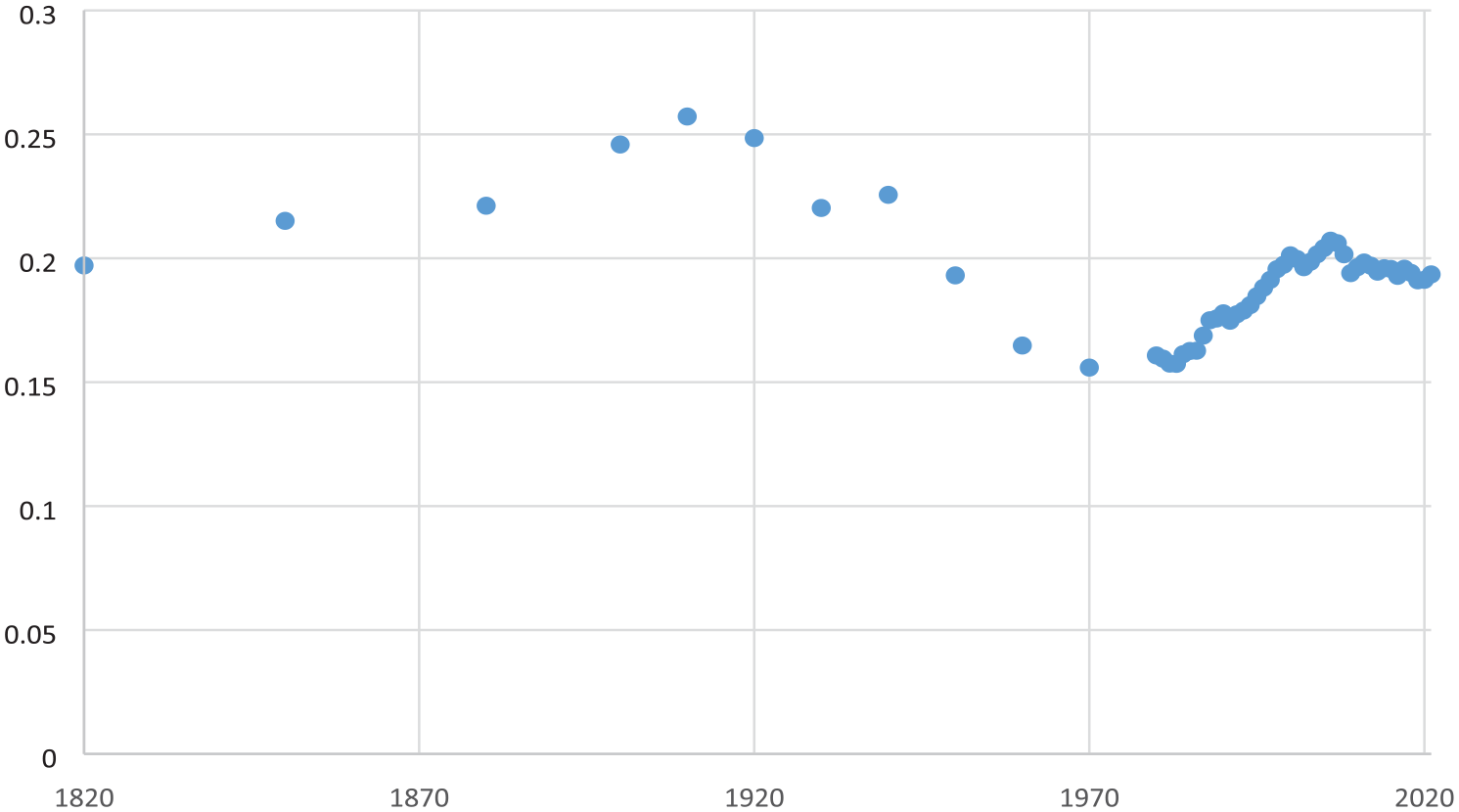
Top 1% share of pre-tax national income measured within countries, World 1820–2021.
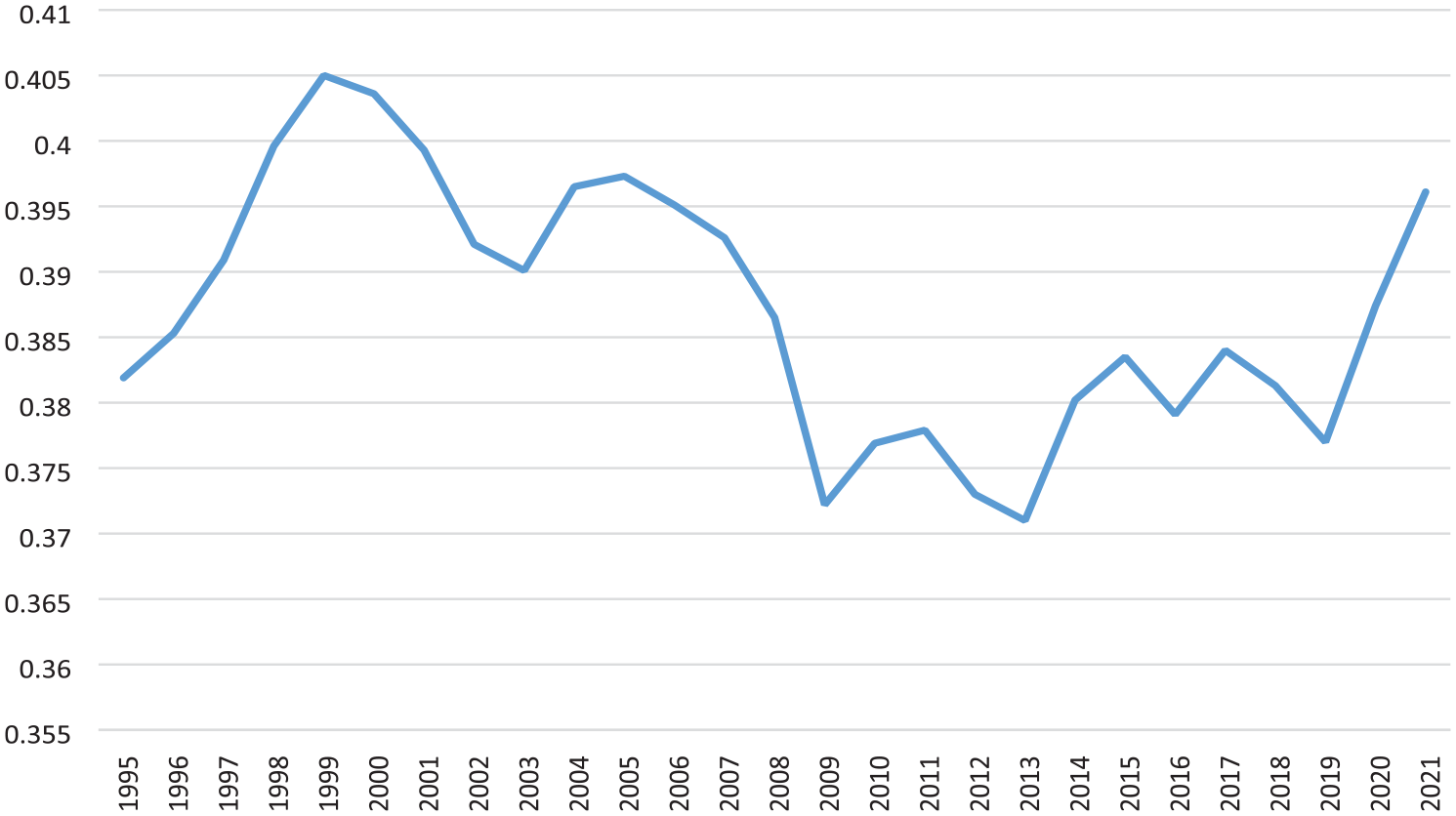
Top 1% net personal wealth measured within countries, World 1995–2021.
Given that the neoliberal transformation of the world (proxied by indexes of economic freedom) was not confined solely to the 1980s and 1990s, but has continued apace in the first two decades of the 21st century (see measures in Gwartney et al., 2021; Ostry et al., 2016), some of these data are hard to reconcile with the narrative that claims neoliberalism inexorably and continually drives up inequalities to very high levels or that it is positively associated with inequality in a linear fashion. The trend lines are clear in the 1980s and 1990s, but not everywhere and not after the end of the 20th century.
The relationship between neoliberalism and democracy: A potential cause of the democratic recession
Whether economic growth in some way contributes to the emergence and consolidation of democratic political and civil rights – what is usually called the modernization hypothesis in the literature – has been a thoroughly researched question in a variety of social-scientific disciplines. At the most general level, the findings are somewhat mixed and robust consensus is lacking. A recent meta-analysis of 33 individual empirical studies found no statistically significant and quantitatively meaningful relationship between income and democracy (Broderstad, 2018; see also Fritzsche and Vogler, 2020). However, a specific contemporary version of modernization hypothesis, which explicitly looks at a lagged relationship between the two variables and excludes oil-related income, received more empirical support (for a broad review, see Treisman, 2020). If this turned out to be true, one could plausibly claim that neoliberalism – to the extent that it contributes to economic growth – indirectly helps, not hurts, democracy. More research is needed.
For present purposes, however, we are more interested in the direct relationship between neoliberalism and democracy. Unfortunately, there is currently a paucity of research on the direct association between the two phenomena. One study looked at the impact of economic freedom on democratic survival (Boudreaux and Holcombe, 2017) and found that the outcome is positive and somewhat sizable. A different study (Bjørnskov, 2018) explored whether economic freedom aids press freedom (an important component of democracy) and likewise found a positive relationship. When looking at the disaggregated index, the study uncovered that the relationship is wholly driven by market openness (not, for instance, small government or any other component of economic freedom). There are currently no other detailed investigations along similar lines.
This paucity of research is troubling, especially because simple descriptive data clearly show that, as the world has been experiencing the democratic recession in the past decade (Diamond, 2015), the average economic freedom of the world has at the same time improved (Gwartney et al., 2021). This seems to suggest that there is no strong positive causal effect of neoliberalism on democracy. Instead, the reverse might be the case.
Below, the article engages in a few simple exploratory exercises to shed a bit more light on this potentially troubling development and to prompt more detailed research on the topic. Instead of looking solely at average world trends, let us turn instead to individual trends evinced by countries on both ends of the democratic recession, those which lost their footing and those which, despite all odds, held their own and even improved. The 2020 V-Dem Democracy Report (V-Dem Institute, 2020) provides us with two lists of the 10 most democratizing and 10 most autocratizing countries between 2009 and 2019. Relying on the 2021 Fraser Institute’s Economic Freedom of the World report (Gwartney et al., 2021), one can readily learn that the average change in economic freedom across the globe between 2009 and 2019 was +.18. Using the Fraser Institute’s dataset on economic freedom (Fraser Institute, 2022), we can also quickly calculate the average change in economic freedom for the most autocratizing and democratizing countries between 2009 and 2010. It turns out that economic freedom of the top autocratizers declined, on average, by −.01 between 2009 and 2019, while the most democratizing countries on average improved by +.34 in the same period. Table 1 presents the data in more detail.
Top autocratizers and democratizers, and changes in economic freedom (2009–2019).
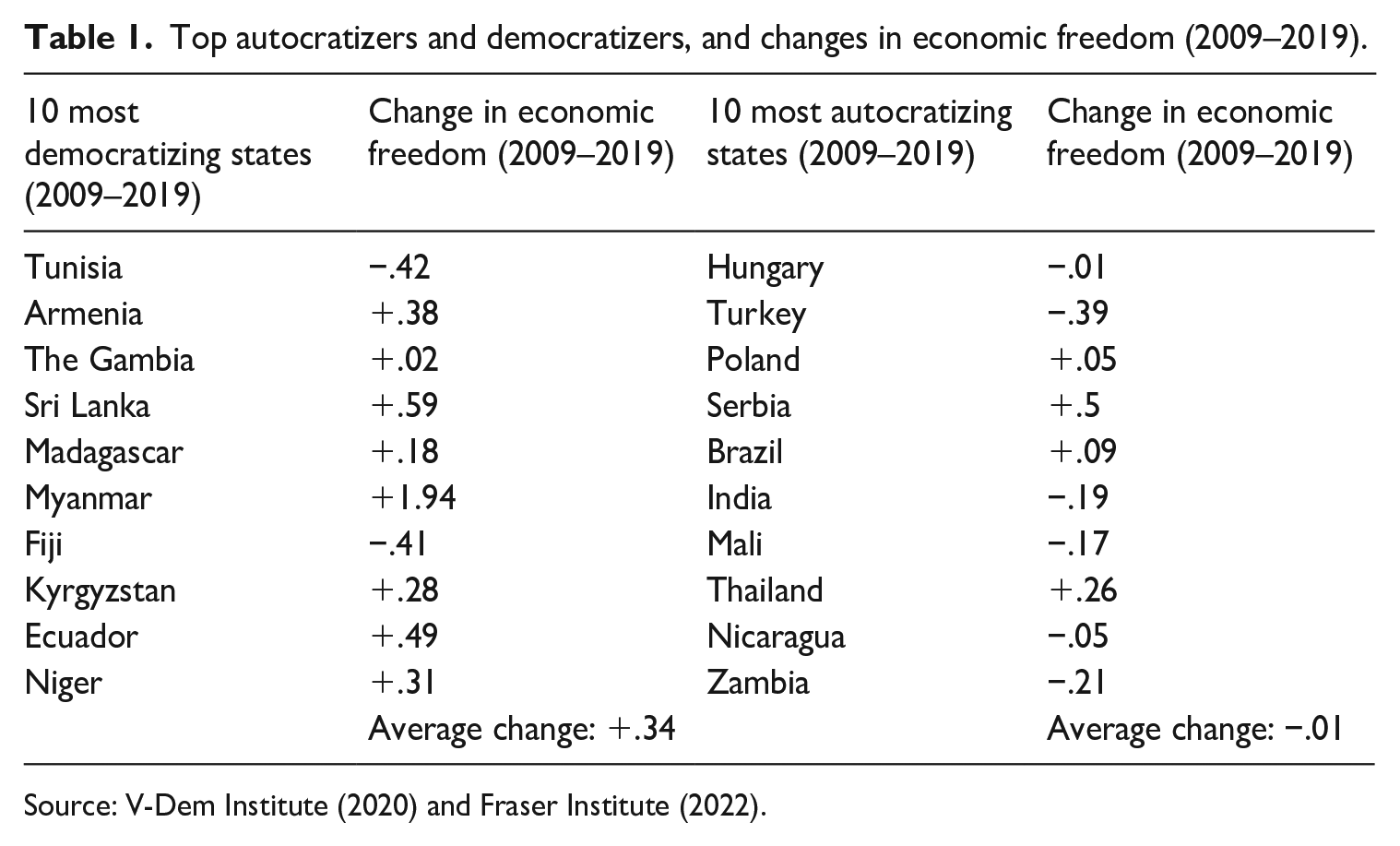
Source: V-Dem Institute (2020) and Fraser Institute (2022).
At least within these two subsamples, it can be seen that more economic freedom is not associated with more autocratization. The group where economic freedom improved by .34 (on average) is the group of democratizing states, while in the autocratizing group economic freedom barely moved in either direction (−.01). Myanmar seems to be an outlier in the democratizing group, but even if we remove it, the average change in the democratizing group still turns out to be positive (.16).
We can also look at a broader sample of all the 43 countries which, according to V-Dem Institute (2020), experienced a statistically significant and substantively meaningful democratic decline or improvement between 2009 and 2019. If we calculate the average change of economic freedom among the 18 democracy-improvers (2 countries had to be dropped due to missing data for economic freedom), we see that it has increased by +.28 in the same period. Among the 22 decliners (1 country had to be dropped due to missing data for economic freedom), economic freedom on average also improved but only by +.03.
These two admittedly simplistic exercises shine at least some exploratory doubt on the claim that neoliberalism strongly erodes democracy or that it overwhelmingly fuels the democratic recession.
In another exploratory probe, all 40 individual countries that experienced democratic decline or improvement between 2009 and 2019 are plotted against the change in their economic freedom score (Figure 3). It turns out that there is no statistically significant relationship between the two (p > 0.05), although the correlation coefficient points in the positive direction (r = 0.21). This does not tell us much, but at least it suggests that neoliberalism probably could not have had an overwhelmingly negative or overwhelmingly positive causal impact on democracy between 2009 and 2019, as such strong effects would likely show up in a simple scatterplot regression even with all the confounding factors that such simple correlation does not control for.
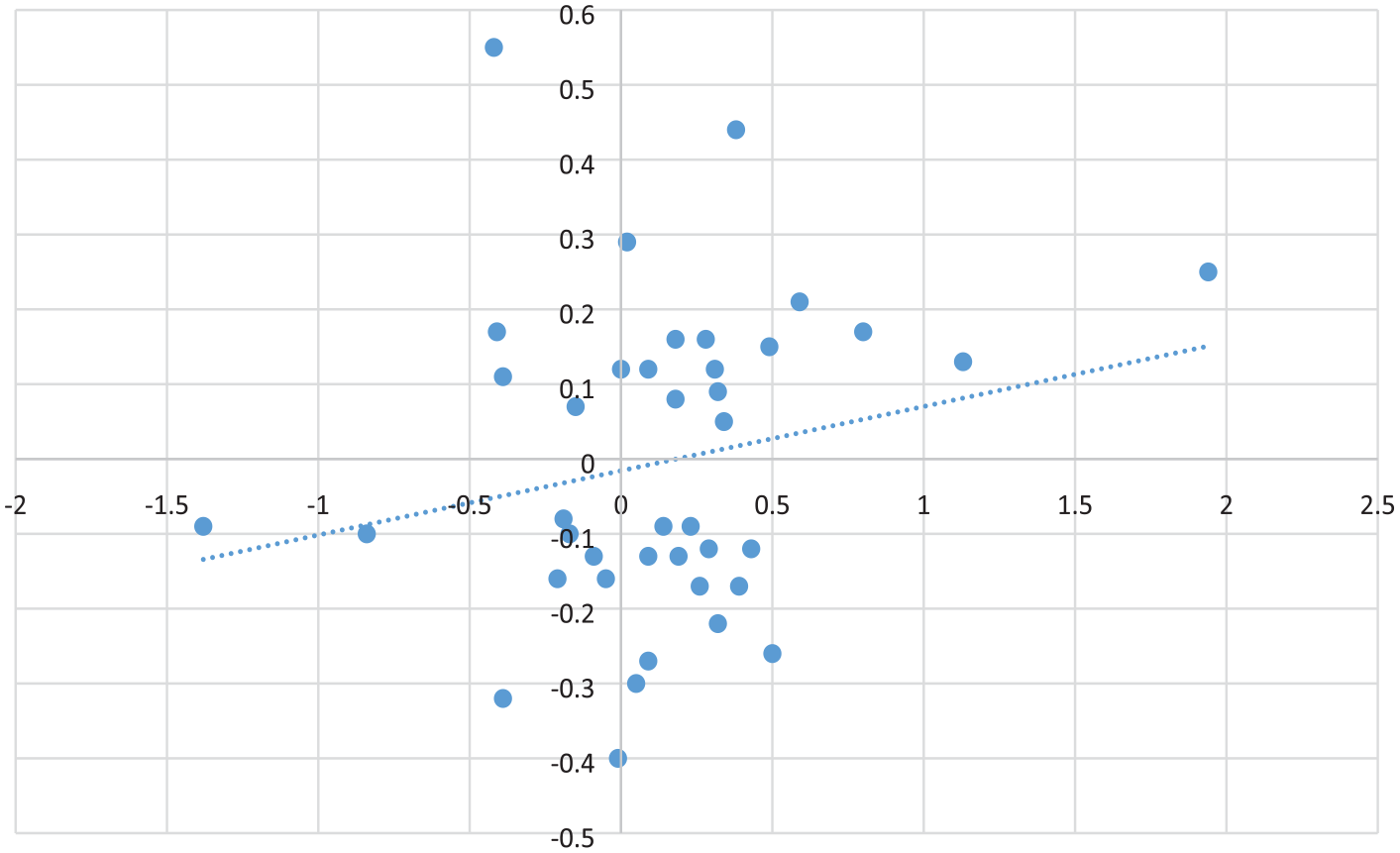
A scatterplot of changes in economic freedom (x-axis) and democracy scores (y-axis) in 40 countries (2009–2019).
This area (economic freedom and the democratic recession) definitely calls for further research, but what has been presented above suggests that neoliberalism (as proxied by economic freedom) might not be to blame as a prominent cause of the democratic recession. Rutar (2023b) has recently investigated the issue in a panel dataset of 141 countries and with a more rigorous methodological design that controls for confounding. The main finding is that there is no negative relationship between aggregate economic freedom scores and democracy in the first decade of the democratic recession.
Measuring neoliberalism’s impact through import shocks and competition: Are they responsible for the rise of illiberal populism?
Putting aside the general relationship between neoliberalism and democracy, a plausible thesis has it that at least when it comes to the rise of illiberal populism (itself a threat to democracy), neoliberalism has helped cause it, which would mean that it indirectly undermines democracy. Inequality is alleged to be on the rise across the world, and, at least in the developed world, serious economic displacement due to outsourcing and deindustrialization is affecting large communities of people. Both are said to be consequences of neoliberalism either as a domestic or a global phenomenon, and both are claimed to fuel economic anxiety resentment that is then victoriously reaped at the ballot box by populists like Donald Trump, Jair Bolsonaro, Viktor Orbán, the Brexiteers, and many others. That is how neoliberalism might unintentionally and indirectly undermine democracy. As Francis Fukuyama (2019: 168) put it, ‘I concur with the commonplace judgement that the rise of populism has been triggered by globalization and the consequent massive increase in inequality in many rich countries’.
This is a complex topic that belies simplified narratives, but the research literature does present suggestive evidence of economic change related to globalization, free trade, and deindustrialization driving an important part of the populist backlash of the 2010s and even in the decades before that.
In recent years, it has been demonstrated that both in the United States and United Kingdom, import competition from China negatively affected certain regions and importantly contributed to increasing electoral support for anti-globalization populists and politics in the past 5 or 6 years (Autor et al., 2017; Colantone and Stanig, 2018a). One article (Colantone and Stanig, 2018b) extended the analysis to Europe at large and found similar results: import shocks that are due to globalization have contributed to electoral support of nationalist and radical-right parties between 1988 and 2007. To get a handle on what this means more specifically, consider the following example. The Brexit referendum was very close, decided as it was by a 3.8-percentage-point margin. According to Colantone and Stanig’s (2018a) analysis, the difference between the regions most and least extremely exposed to the trade shock would be 4.5 percentage points for and against Brexit. This means that the shock was clearly a strong – perhaps even crucial – contributor to the victory of the ‘Leave’ option. A similar dynamic was in effect in the United States. According to analysis by Autor et al. (2017: 156), ‘if the import shock had been half of what it was, the margin in favor of the Republicans in Pennsylvania would have shrunk by 1.7 percentage points, and the Democrats would have won the state by 0.5 percent’.
If import shocks are taken as a kind of proxy measure of neoliberal globalization, the latter does seem to have played an important role in propping up populist leaders in the developed world. Nevertheless, there are three important qualifications to this statement that complicate it in interesting ways.
First, there is both individual and systematic evidence that challenges the results of the studies quoted above. The scholarly debate over causes of populism has not yet been settled. For instance, Diana Mutz (2018) uses panel data to show that Trump’s 2016 election was not driven by those economically left behind by globalization, instead being fueled by status anxiety among American high-status groups. The extensive research by Pippa Norris and Ronald Inglehart (2019: 166) suggests authoritarian values ‘are more strongly linked with the respondent’s birth cohort than with any of the economic indicators’. For this and other reasons, they ultimately settle with a cultural, not economic, explanation for populism. Perhaps most importantly, a recent study (Bergh and Kärnä, 2021) using data on vote shares for 267 left-wing and right-wing populist parties in 33 European countries found ‘no evidence of a positive association between (economic or other types of) globalization and populism’ in the period between 1980 and 2017. Further research is needed if the existing mixed findings are to be resolved.
Second, even if it ultimately turns out to be the case that globalization and its economic features are the key factors in the rise of populism, this does not work as some critics think it does. The vast majority of studies exploring voter behavior (for a review, see Hainmueller and Hopkins, 2014; Rho and Tomz, 2017), whether or not they attribute it to global economic conditions, finds voters to behave sociotropically, not egocentrically. This means that voters do not evaluate their own, individual position in society (say, their employment status or their household income) and then decide who to vote for based on that personal evaluation. Instead, voters vote based on their evaluation, or perception, of what is happening in the broader community or region in which they live. As Colantone and Stanig (2018a) themselves found in their Brexit study, people in regions hit by import shocks voted for Brexit regardless of whether they were themselves personally exposed to import competition. But how do voters form their perception of what has been going on with other people’s lives in the region and what is good for the future of region by relying on their own limited political knowledge and the news (Mansfield and Mutz, 2009)?
This implies that if voters are somewhat ignorant or misinformed, their perceptions – which are the basis for their votes – of globalization’s true impact will be shaped not solely by globalization’s actual impact itself but also by ignorance, misinformation, and misperception of globalization’s impact. Given the vast research literature on voter ignorance and misperception (Brennan, 2017; Converse, 2000; Somin, 2016), especially when international trade is concerned, and given the strong correlation between voting for populists and lower education, this eventuality must not be ignored. In short, neoliberal globalization could play a crucial role in the populist backlash, but it would likely do so through the (causally just as crucial, yet orthogonal) prism of voter ignorance and misperception.
Finally, there is an important theoretical distinction that needs to be made between ‘explanatory significance’ and ‘outcome significance’ when discussing the role of economic factors in explaining the ascendancy of populism (Margalit, 2019). This distinction tries to capture the difference between globalization hypothetically explaining the bulk of voting shares for populists and only a marginal – although electorally crucial – share. Reviewing the research literature, Margalit (2019) notes that no present study shows globalization and other economic factors explain why, say, 52% of the UK electorate decided to leave the European Union (explanatory significance). At best, the studies demonstrate that globalization tipped the scales such that the ‘Leave’ vote garnered a few percentage points more of the total vote share (outcome significance). This latter fact is, of course, extremely important, and – if correct – shows that neoliberalism (proxied here by the import shock) played a crucial role in the victory of the populist policy. The referendum was, after all, won on the margin. But what neoliberalism – as a marginal cause – cannot explain is why, even without it, slightly less than half of the UK electorate still would have voted ‘Leave’. Progress in research on the connection between globalization and illiberal populism will come from nuanced synthetic treatments that more explicitly incorporate these differences.
Measuring neoliberalism’s impact through post-communist shock therapy
The lightning-fast approach to economic liberalization and privatization of state-owned enterprises that was adopted in several post-communist Central and Eastern Europe (CEE) and Russia has commonly been seen as a clear – and clearly destructive – instance of neoliberal policies (Becker, 2022; Ghodsee and Orenstein, 2021; Harvey, 2005; Klein, 2007). At least one widely adopted view on the matter says something along the following lines: Western liberals or neoliberals rushed into Eastern Europe to create a capitalist utopia and worked with reformist elites who used the enormous legitimacy of Western advisors to generate great wealth for themselves. The majority of the people, in this view, were disenfranchised during the transition. (Ghodsee and Orenstein, 2021: 16)
To evaluate this indictment today, with the benefit of 30 years of data, we would first need to identify which post-communist states opted for the shock-therapy type of transition to capitalism. Unfortunately, Klein (2007) and Harvey’s (2005) famous critiques never provide a full and clear classification, apart from mentioning Poland or Russia as ostensibly typical examples. A recent and much more nuanced book-length study of the same phenomenon (Ghodsee and Orenstein, 2021) similarly never says which of the newly independent states that were transitioning during the 1990s opted for shock therapy instead of taking on a more modest and slower paced transitional process called ‘gradualism’.
Helpfully, however, one scholar (Marangos, 2013: 139) presents the exact dates at which different countries initiated a shock-therapy type of transition to capitalism. The countries (and dates) are as follows: Poland (beginning on January 1, 1990), Czechoslovakia (January 1, 1991), Bulgaria (February 1, 1991), Russia (February 2, 1992), Albania (July 1992), Estonia (September 1992), and Latvia (June 5, 1993). Marangos also provides a fuller list of 24 post-communist states (relying on Kennett, 2004: 478), according to which Poland, Czech Republic, Slovakia, Bulgaria, Russia, Albania, Estonia, and Latvia are all shock-therapy countries, while the other 16 are coded as gradualist.
In its 1996 World Development Report, the World Bank (1996: 23) likewise identifies an almost identical set of shock-therapy countries. Poland, Albania, the Baltic states, Czech Republic, and Slovakia all make the list. So, too, do Bulgaria (which the report qualifies by saying there had been ‘something of a reversal’ after fast initial reforms), Russia (though the report notes that, even after substantial liberalization of prices, ‘extensive export restrictions remained in place until 1995’), and the Central Asian Kyrgyz Republic.
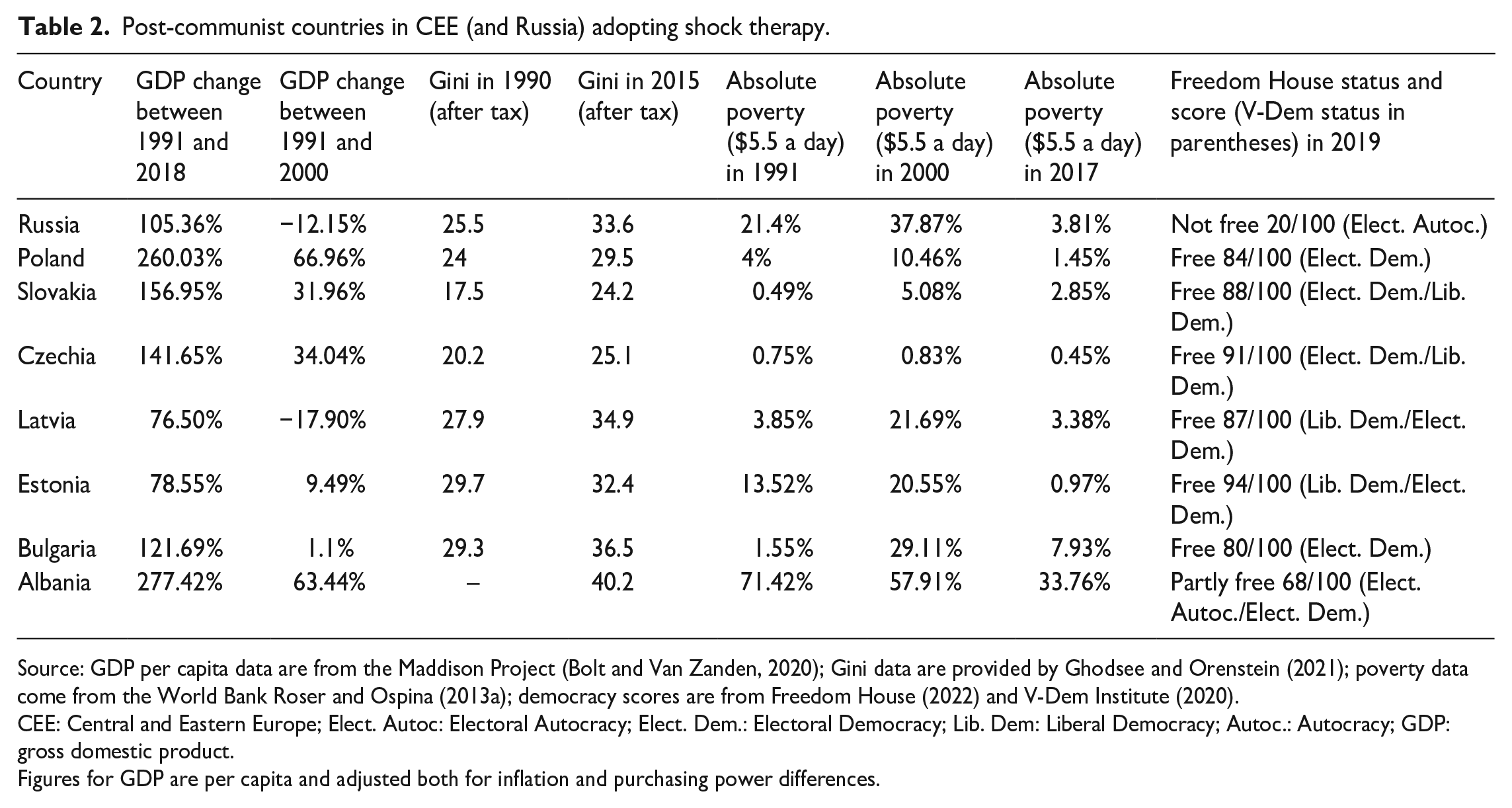
Using these classifications, it can be seen from Table 2 that after 1991, economies of three shock-therapy countries – Russia, Estonia, and Latvia – indeed cratered and then managed to recover their previous per capita GDP only after the year 2000, a whole decade later. Bulgaria’s economy was not hit as hard by shock therapy, but it had stagnated completely between 1991 and 2000. Only Albania, Poland, Slovakia, and Czechia, the last four of the post-communist countries that opted for shock therapy instead of gradualism, saw significant expansions of their economies in the 1990s.
Post-communist countries in CEE (and Russia) adopting shock therapy.
Source: GDP per capita data are from the Maddison Project (Bolt and Van Zanden, 2020); Gini data are provided by Ghodsee and Orenstein (2021); poverty data come from the World Bank Roser and Ospina (2013a); democracy scores are from Freedom House (2022) and V-Dem Institute (2020).
CEE: Central and Eastern Europe; Elect. Autoc: Electoral Autocracy; Elect. Dem.: Electoral Democracy; Lib. Dem: Liberal Democracy; Autoc.: Autocracy; GDP: gross domestic product.
Figures for GDP are per capita and adjusted both for inflation and purchasing power differences.
But even with these latter economic successes one has to keep in mind that metrics other than GDP paint a much grimmer picture for the early years of the transition, in line with the critical literature on neoliberalism. Various measures of poverty, for instance, soared after the early 1990s and then remained quite high (as high or higher than in the 1980s) well into the early 2000s. Table 2 reports data for absolute poverty defined as living with $5.5 a day or less. Moreover, several countries, such as Russia, Latvia, Bulgaria, and Estonia, saw a life expectancy reduction in the initial years of the transition, a trend that started reversing itself only after the mid-1990s; in Russia, the improvement only began in the early 2000s (Roser et al., 2013). There is careful quantitative evidence that mass privatization, in particular, was a significant cause of the decline (Stuckler et al., 2009). Finally, income inequality increased from a very low average Gini of 25 in 1990 to a higher average Gini of 31 in 2015, although it has stopped increasing once reaching this middling level in the last decade (OECD, 2022).
At the same time, however, decades after they embraced shock therapy, Russia, Estonia, Latvia, Albania, Bulgaria, Poland, Slovakia, and Czechia now all stand as economically significantly more developed than they had been at the time of communism’s collapse. Several of them have even become high-income countries. Poverty has also been slashed in all of these countries since its peak in the late 1990s and early 2000s, the middle class has expanded, and in the majority of countries virtually all absolute thresholds of poverty calculated by the World Bank are significantly lower today than they had been on the eve of 1989/1991 (for a complete time series, see Roser and Ortiz-Ospina, 2013a). Life expectancy has improved significantly both in comparison to before the transition and its mid-1990s bottom, increasing on average by more than 6 years (Roser et al., 2013). This includes Russia, by far the worst performer, which stood at 67.6 years in 1991, 65 years at its bottom in 2002, and has now reached 72.6 years in 2019 (Roser et al., 2013). With the sole exception of Russia – a very important exception, given its large population and the length of its post-transition suffering – all other seven states that embraced the doctrine also transformed either into electoral or liberal democracies during the 1990s and early 2000s and have remained democratic in subsequent decades. (The quality of Poland’s democracy has decreased notably since 2015, but it remains democratic both according to Freedom House and Varieties of Democracy dataset.)
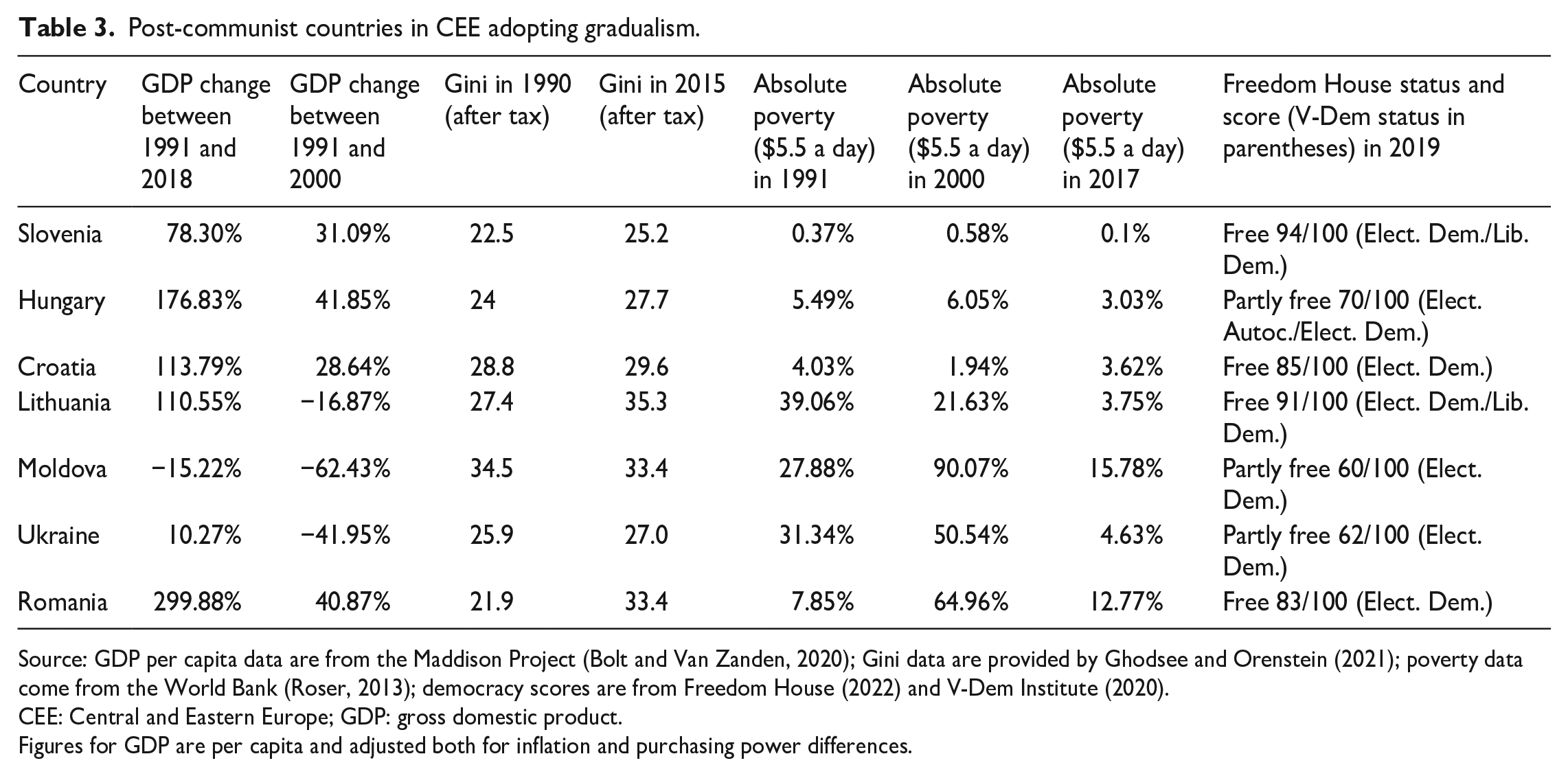
Shock therapy in the post-communist world has been very economically painful in the short term, just as the standard neoliberal critique charges. Interestingly, however, shock therapy seems not to have been dismal in the middle to long term. Of course, it is impossible to infer causality from a mere time sequence of events. But what we can do is compare the economic performance and social outcomes in the group of post-communist CEE countries that underwent shock therapy with the other group in the same CEE region that instead opted for gradualism. The fact that countries in both groups are culturally similar, that they were all socialist before the transition, that they were all similarly developed at the end of 1980s, and that one country in both groups underwent a civil war in 1990s (although Croatia’s was much more lethal and longer lasting than Albania’s), but that at the same time one group opted for shock therapy while the other did not, makes possible a serious and fair, potentially even tentatively causal, comparison. The data for the comparison group are reported in Table 3.
Post-communist countries in CEE adopting gradualism.
Source: GDP per capita data are from the Maddison Project (Bolt and Van Zanden, 2020); Gini data are provided by Ghodsee and Orenstein (2021); poverty data come from the World Bank (Roser, 2013); democracy scores are from Freedom House (2022) and V-Dem Institute (2020).
CEE: Central and Eastern Europe; GDP: gross domestic product.
Figures for GDP are per capita and adjusted both for inflation and purchasing power differences.
Now, it is true that there are important differences (both cultural and developmental) within groups. For instance, with a GDP of almost $20,000 in 1989, Slovenia was significantly more developed than the other countries in its group (in 1989, most had a GDP of around $12,000), while Estonia was significantly more developed than the other countries in its group (it also had a GDP of around $19,000 as compared to around $12,000 for most of the others). Something similar could be said about the levels of income inequality or absolute poverty, as shown in Tables 2 and 3. There are, undoubtedly, important differences within groups. However, crucially, these within-group differences are mirrored in both groups, so that overall there are no large asymmetries between the two groups. That should make us more confident when assessing the difference in performance between groups.
What do the data suggest? If we compare figures from Tables 2 and 3, what first stands out is that the short-term increase in absolute poverty that happened in all countries (but one) in the shock-therapy group does not occur in the majority of countries opting for gradualism. This is an important observation that again corroborates the standard critique of neoliberalism. Second, however, it can also be seen that both short- and long-term economic performances of both groups of countries have been relatively similar. In the short term, there are positive and negative changes of GDP per capita in both groups. In the long term, most societies in both groups have experienced significantly positive economic change, with the only two exceptions (in the gradualism group) being Moldova and Ukraine. The same holds for life expectancy. As was the case for several shock-therapy countries, life expectancy also decreased in several gradualist countries, such as Lithuania, Ukraine, and Moldova, during the first years of their transition, and it remained stagnant during this same period in Romania (Roser et al., 2013). In subsequent decades, however, life expectancy has improved everywhere, increasing on average by almost 6 years (comparing the 2019 data to before the transition and to the mid-1990s). Third, inequality has, on average, risen in both groups, although the rise has been slightly more pronounced in the shock-therapy group (from an average of 24.9 to 30.9) than in the gradualist group (26.4 to 30.2). Fourth, with two exceptions in the shock-therapy group and one exception in the gradualist group, absolute poverty has declined over the long term and it has declined mostly to low levels. Fifth and finally, electoral and liberal democracy abound in both groups, with the shock-therapy group outperforming the gradualist group.
The overall verdict, then, should have two parts. First, over the short term, CEE post-communist neoliberal transition has indeed verged on the ‘catastrophic’, ‘dismal’, or ‘disastrous’, as the critical scholars of neoliberalism have charged (Becker, 2022; Ghodsee and Orenstein, 2021; Harvey, 2005: 154, 170). It has also created a large ‘underclass’ of citizens (Klein, 2007: 405), although not a ‘permanent underclass’. However, second and contrary to critics’ insistence, over the longer term neoliberalism’s performance has not been nearly as dismal. To be sure, it does not seem to have outperformed gradualism, as proponents of shock therapy have touted. But it also does not seem to have significantly underperformed in comparison to it.
Conclusion
As a social-scientific term, neoliberalism is fraught with severe problems. First, it is widely and commonly used, but many scholars tend to be vague or overly abstract in what they take the term to mean, so that it is regularly left undefined or underspecified. Second, an a priori negative normative connotation has too often been worked into the term, which makes it harder to use in dispassionate descriptive analysis. Third, when the effort is made to actually provide a more concrete definition of the term, there are multiple distinct definitions on offer. Conceptual ambiguity can thus proliferate, even as researchers strive to be more careful in handling the neoliberalism’s meaning. Fourth, if we take neoliberalism to be, at the most general level at least, a set of economic institutions oriented toward free-market principles, then the systematic empirical evaluation of its economic and political performance becomes possible; but it turns out that such an evaluation at least so far points in a more complicated and mixed direction as far as neoliberalism’s economic, social, and political performance is concerned than what the most critical scholars have suggested.
This article has argued that, if proxied by indexes of economic freedom, neoliberalism tends to be associated with economic growth and rising incomes across broad social classes, not solely the rich (or those living in the developed world). Furthermore, the relationship between neoliberalism and inequality is mixed, not simply positive. More generally, in the past two decades as neoliberalism has ostensibly grown in power, several regions of the world have not seen their income or wealth inequality increase at the same time, or have even witnessed a decline (e.g. Latin America). As far as democracy is concerned, both neoliberal institutions themselves, and especially economic growth as one of their consequents, might be positively (not negatively) associated with democratization and democratic survival, but there is currently no clear or robust consensus on these issues, and research on direct effects of economic freedom on democracy is very sparse. Finally, so far there is no simple correlation between increases in economic freedom over the past decade and the ongoing democratic recession.
If proxied by globalization (or more precisely, import shocks due to import competition), evidence is accumulating that neoliberalism in part fuels illiberal populism in the developed world. In this respect, the critics could well turn out to be right that there exist indirect negative political ramifications of economic liberalization. However, the evidence is not strong and unambiguous as there is a variety of studies that find no association between economic globalization and the rise of populism.
Finally, if we take neoliberalism to be the shock-therapy type of transition to capitalism that several CEE countries opted for after the fall of Communism, there is little, if any, evidence that its long-term effects have been negative in the sense argued by the critics (e.g. that growth was modest, that poverty increased and persisted, that life expectancy has remained stagnant). Shock-therapy CEE countries have mostly witnessed economic and political improvement 25 years after the transition on their own terms and have not fared worse than CEE countries opting for gradualism instead. Over the short term, however, shock therapy has had significant negative effects, especially for economic growth and poverty.
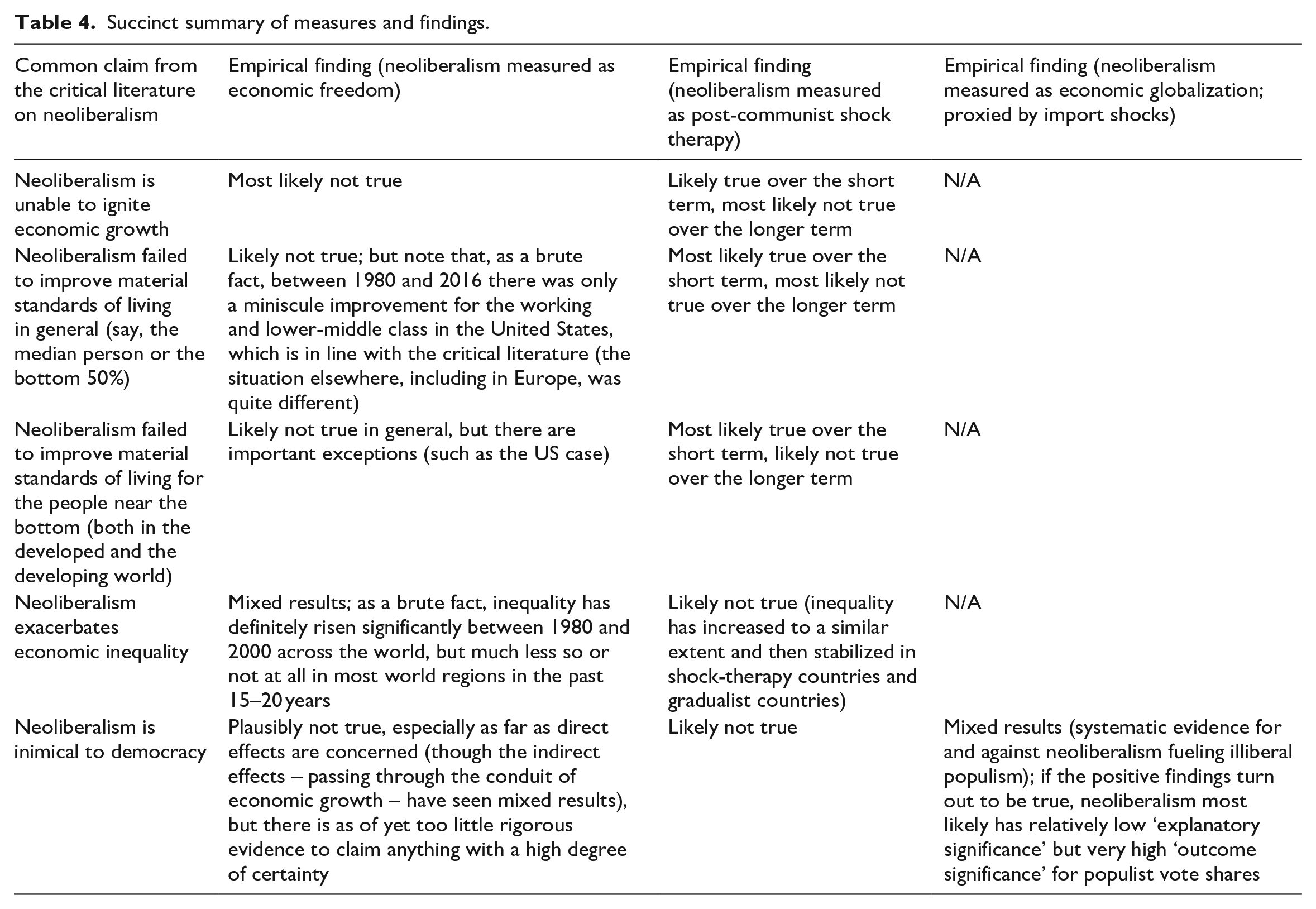
Synthesizing the findings of the existing vast research literature (see Table 4), the main conclusion of the article is that neoliberalism’s social impact has been more nuanced than suggested by prevailing discourse.
Succinct summary of measures and findings.
Footnotes
Funding
The author(s) received no financial support for the research, authorship, and/or publication of this article.
