



Abstract
Discussions about funding research grants by lottery have centered on weighing the pros and cons of peer review, but this focus does not fully account for how an idea comes across in the field of science to those researchers directly dependent on research funding. Not only do researchers have personal perspectives, but they are also shaped by their experiences and the positions they occupy in the field of science. Applying Bourdieu’s field theory, the authors explore the question of which field-specific problems and conflicts scientists identify and for which they could imagine using a grant lottery in the allocation of research funding. Under what conditions does such a solution, which is external to the field of science, seem justified to them? The results show that different areas of application are conceivable for a lottery mechanism in the field of science but that its use seems justifiable only for legitimate field-specific quandaries.
For the past 15 years, scholars (Avin, 2015, 2018, 2019; Barnett, 2016; Brezis, 2007; Fang and Casadevall, 2016; Gillies, 2014; Guthrie et al., 2013; Roumbanis, 2019, 2020) have increasingly turned their attention to the possibility of using lottery procedures – also referred to as random selection, funding-by-lot, grant lottery, and random grant allocation – in the selection of research-grant proposals. The primary reason for this interest is the desire to mitigate flaws in the process of peer review. The repeatedly criticized shortcomings of peer review, a tool developed by the scientific community itself, include its great cost, conservatism, susceptibility to stereotypes and biases, and limited utility for fine-tuning the ranking of research proposals that have, in principle, received equally favorable evaluations. By contrast, lottery procedures are said to hold the prospect of making the selection of research proposals more efficient, diverse, equitable, and fair (Avin, 2015; Barnett, 2016; Brezis, 2007; De Peuter and Conix, 2021; Fang and Casadevall, 2016; Gildenhuys, 2020; Gillies, 2014; Gross and Bergstrom, 2019; Guthrie et al., 2013; Höylä et al., 2016; Roumbanis, 2019). Funding-by-lot purportedly addresses not only problems of research-specific origin but also those of an externally caused nature, notably the quandary that arises when restricted funding necessitates a choice between proposals whose scientific merits are judged to be equally fundable. However, outside of the academic debate, different research councils (e.g. Denmark: Royal Danish Academy of Science and Letters, 2020; Germany: Wissenschaftsrat, 2017; Canada: Council of Canadian Academies (CCA), 2021) support trails with grant lotteries and some funding organizations are already practicing it (see Avin, 2019; Chawla, 2021), such as the New Zealand Health Research Council (HRC), the German Volkswagen Foundation, the Austrian Science Fund (FWF), and the Swiss National Science Foundation (SNF).
At this point, one might ask what the status of random grant allocation is in the field of science. To Max Weber (1946: 350), ‘the force with which energies flow into rational achievement’ is ‘greatest and most principled’ in the ‘sphere of intellectual knowledge.’ In that sense, it is surprising that sphere is precisely where recourse to lottery procedures is so widely and heatedly discussed: for science, in particular, one would expect neither luck nor chance to determine research decisions. Luck should certainly not be relied on consciously; it overrides the scientific field’s very logic, which is to generate new knowledge in a theoretically guided and methodologically controlled manner.
Comments on random grant allocation have thus far come mainly from scholars who study science itself or who are involved in science policy. This group has split into supporters of the grant lottery (Avin, 2015, 2019; Fang and Casadevall, 2016; Gildenhuys, 2020; Roumbanis, 2019, 2020) and opponents thereof (Bedessem, 2020; Reinhart and Schendzielorz, 2020). One reason for these different positions is that the debate has narrowed to a comparison between peer review and funding-by-lot. Second, this contraction obscures the complexity and multilayered nature of the problems that a grant lottery is supposed to diminish. Third, scientists who do not deal with this topic in research or science policy are, as it were, marginalized. For example, their attitudes toward random grant allocation have gone largely un-investigated (for exceptions, see Ambrasat and Heger, 2020; Liu et al., 2020; Philipps, 2021b). Moreover, it would be worth asking what familiarity scientists have had with peer review and how they would solve or alleviate its identified problems by using or not using random grant allocation. This article therefore focuses on the experiences and views of scholars to highlight the views of those who are not engaged in the debate and to show the complexity of the issue from their perspective. What problems, conflicts, and inconsistencies do these scientists perceive with the process of peer review in research funding? Which of these difficulties can they imagine addressing by turning to random grant allocation? Under what conditions does such a solution, which is external to the scientific field, seems justified to them?
This article 1 begins with Pierre Bourdieu’s field theory, according to which the field of science has produced its own rules but is also shaped by external expectations and internal conflicts. Against this backdrop, we use semi-structured interviews to examine scientists’ points of view on funding-by-lot as a procedure external to the field in Germany. The section on data and methods presents the sample, the data collection, and the analytic methods underlying this inquiry. That information is followed by a systematic review and discussion of the results and by our conclusions.
The field of science
Weber’s (1946) characterization of science as the most far-reaching and consistently structured processing of intellectual knowledge is shared by various science researchers. Merton (1942), too, attests organized skepticism as science’s own ethos, while Polanyi (1962) refers to procedures of scientific self-regulation and Bourdieu (1975, 2004) speaks of the scientific field’s own rules. These authors all argue that science has historically produced its rules and procedures to arm itself against external (especially ideological, political, and economic) appropriation or misappropriation. However, Bourdieu also emphasizes that the field-specific rules and procedures in science stem from struggles within the field as well. Consequently, rules have been set up and introduced to deal with problems in the field of science that are rooted in conditions both within and outside that field. It is, moreover, a characteristic of the scientific field that a structural antagonism between orthodoxy and heresy is inscribed in its own logic and this possesses functional significance for generating and verifying new scientific knowledge. Bourdieu’s concept of the field also makes it possible to analytically distinguish between problems and inconsistencies that result from (social) struggles within the scientific field and those that are rooted in the field’s own logic.
Although Bourdieu’s field theory makes it possible to understand how field-specific rules have emerged historically, it remains unclear how procedures external to the field are adopted and assimilated into its logic. Grant lotteries in particular contradict the nomos – the specificity – of the scientific field, for they suspend the procedures and rules that have been forged in a protracted, often contentious process and that come to guarantee relative autonomy. What is the origin of the current interest in resorting to random selection to solve problems in the field of science? What problems, conflicts, and quandaries do scientists – the key actors in the field of science – associate with the process of peer review? What significance can random selection have as they see it?
According to Bourdieu (1997b: 119), processes of differentiation lead to the existence of autonomous paths, with each of the paths corresponding to a fundamental point of view on the world that creates its proper object (objet propre), from which the specificity of each field derives. In the field of science, the proper object is the striving for objectivation through the constant generation of new knowledge. The nomos is functionally justified and legitimized, but it is also socially contested because it is associated with the allocation of socially advantaged and less advantaged positions in the field. Individuals and groups occupying advantaged positions within the field essentially have the resources and the power to decide which forms of practice and which schemes are appropriate for the nomos, how they are to be used, and which of them contradict the nomos and should therefore be branded as external to the field. To analyze the resources that individuals have at their disposal, Bourdieu (1990) introduced the concept of capital. For the scientific field, he distinguished two kinds of capital: ‘a capital of strictly scientific authority’ (Bourdieu, 2004: 57), which he also called pure scientific capital, and a ‘capital of social authority’ (Bourdieu, 1991: 7), which is also known as institutional scientific capital (Bourdieu, 1990). Bourdieu (1991: 7) notes that the first ‘rests upon the recognition granted by the peer competitors for the competency attested to by specific successes’ (e.g. highly ranked publications, scientific prices for discoveries). The second kind represents ‘a capital of power over the scientific world’ (Bourdieu, 2004: 57) that can be accumulated by high-level positions such as leadership or membership of exclusive academic organizations.
The main forms of practice and schemes in the field of science include, in particular, the procedures of consecration that are of that field and, hence, logical within it. These include all processes of scientific quality control, especially peer review, but also evaluations, qualification for doctoral degrees, and scientific advisory boards. The field of science is also exposed to expectations and interventions from other fields. Bourdieu (2003) therefore distinguishes between the relative autonomy and heteronomy of a field. A field’s degree of autonomy is measured by its ability to build resistance to external interventions and constraints – that is, to reject external demands or at least moderate them. If little or nothing can be done to achieve such change, the field is regarded as being subject to a high degree of heteronomy (external domination). This dépendance dans l’interdépendance (dependence on interdependence) is characteristic of the relation between autonomy and heteronomy in the field of science (Bourdieu, 1997a: 48). On the one hand, the field of science possesses the minimum degree of state-guaranteed autonomy necessary to carry out its field-specific tasks and services; on the other hand, the state can impose constraints (Bourdieu, 1997a: 48). The field-specific dependence in independence is particularly striking when the independence of research funding is concerned. To conduct research at all, a scientist must acquire resources: Without them, most of the wherewithal for research is lacking.
According to Bourdieu, the specific characteristics of the scientific field, as for all fields of culture, also include the fact that they are determined by a structural antagonism between orthodoxy and heresy: ‘No doubt this opposition, although its constituent elements may differ according to the fields, constitutes an invariant in the field of cultural production’ (Bourdieu, 1990: 61). The antagonism has structural qualities because it has functional significance for the field of science; it is a ‘motor of change’ (Bourdieu, 2004: 15). It pervades all forms of practice, procedures of consecration, and allocations of positions. Its functional significance is that it both guarantees the generation of original knowledge and ensures that that knowledge conforms to the standards of science (i.e. that it is scientifically tested knowledge). Field-specific inconsistencies can grow out of the antagonism between orthodoxy and heresy (Barlösius, 2018). For example, antagonism is inscribed in the peer-review process for appraising research proposals. After all, the question of what new knowledge to generate must receive consideration, but the feasibility of a research project must also be assessed. In other words, can it meet scientific standards? Research on peer review has shown that the antagonism in the assessments often tips toward favoring orthodoxy, which is why peer review tends to be predominantly conservative (Chubin and Hackett, 1990; Guetzkow et al., 2004; Lamont, 2009; Langfeldt, 2001).
In summary, according to Bourdieu’s field theory, it is likely that various structurally conditioned conflicts and problems and functionally based inconsistencies and quandaries occur in the field of science. Some of them presumably have field-specific causes and others external ones. But the question of which problems scientists address and what solutions they see remains open. In addition, it is largely unclear, especially with lottery processes, how procedural logic external to a given field is received within it. Although evidence suggests that a grant lottery meets with both approval (Liu et al., 2020; Philipps, 2021a, 2021b) and rejection (Ambrasat and Heger, 2020) among scientists, what field-specific problems do scientists examine as actors of the scientific field, and what is their attitude toward funding-by-lot? What connections do they draw between perceived problems, conflicts, and inconsistencies in the field and the possibility of resolving them with the aid of a procedure external to the field?
Data and methods
Semi-structured, problem-centered interviews (Witzel and Reiter, 2012) were conducted with scientists occupying different positions in the field. The sample was shaped in five ways (see also Philipps, 2021b). First, although it is possible to see the field of science as consisting of different realms, we confined this study’s interviews to the one in which the use of random grant allocation to fund research has been found almost exclusively: natural science. Second, we recognized from studies of science and technology (Becher, 1994; Lamont, 2009) that disciplines differ in how they deal with scientific criteria and the peer-review process. Our aim to investigate possible disciplinary differences in viewpoints therefore led us to conduct the interviews with researchers primarily from biology (including veterinary medicine and biochemistry) and physics. Third, the sample included both established researchers (professors and senior researchers) and less established ones (postdocs and doctoral students). Not only are these academic positions differently endowed with scientific and institutional capital (Bourdieu, 1975, 2004); they reflect dependence and independence, especially in Germany. For example, a full professorship usually signifies the greatest possible freedom in research, with all the attached subordinate positions usually standing in a dependency relationship with it (Waaijer, 2015). Fourth, we took care to ensure that part of our sample consisted of persons who had already been through the scientific review process and that another part comprised persons who were able to influence the review processes to some extent as reviewers themselves or as panel members in funding organizations. These aspects were intended to ensure that interviewees would examine peer-review and lottery processes from different standpoints. Fifth, one of the authors also interviewed scientists who had successfully obtained a research grant in the Volkswagen Foundation’s funding program known as ‘Experiment!’ We focused on those applicants who had submitted a project idea after 2017, the year when some of the research proposals in the program began to be selected by lot. We also wanted to learn what views of the grant lottery have emerged among respondents who may have already undergone it. Because no lists of all applicants to the Experiment! funding program are available, the sample is limited to scientists who received funding from that program. The names of the latter group are listed on the website of the Volkswagen Foundation.
A total of 32 interviews were conducted between August 2019 and May 2020 (see Table 1). To formulate empirically based assumptions, hypotheses, and theories, we broadly followed the theoretical sampling strategy presented by Glaser and Strauss (1967), which aids the search for patterns and specifics in the data by including maximum – and minimum – contrast cases to identify commonalities and differences in what respondents think. In keeping with this approach, we conducted and analyzed initial interviews, then sought additional contrasting cases, and interviewed the scholars involved. The study began with a comparative analysis of the comments and representations of postdocs and professors. Further interviews were conducted with PhD students, academics who have served on review panels, and successful applicants to the Experiment! funding program, shifting the focus of the study from highly contrasting cases to less or minimally contrasting cases. Interview participants were recruited until new interviews provided no further substantive insights into the topic.
Partial description of the sample’s composition (N = 32).
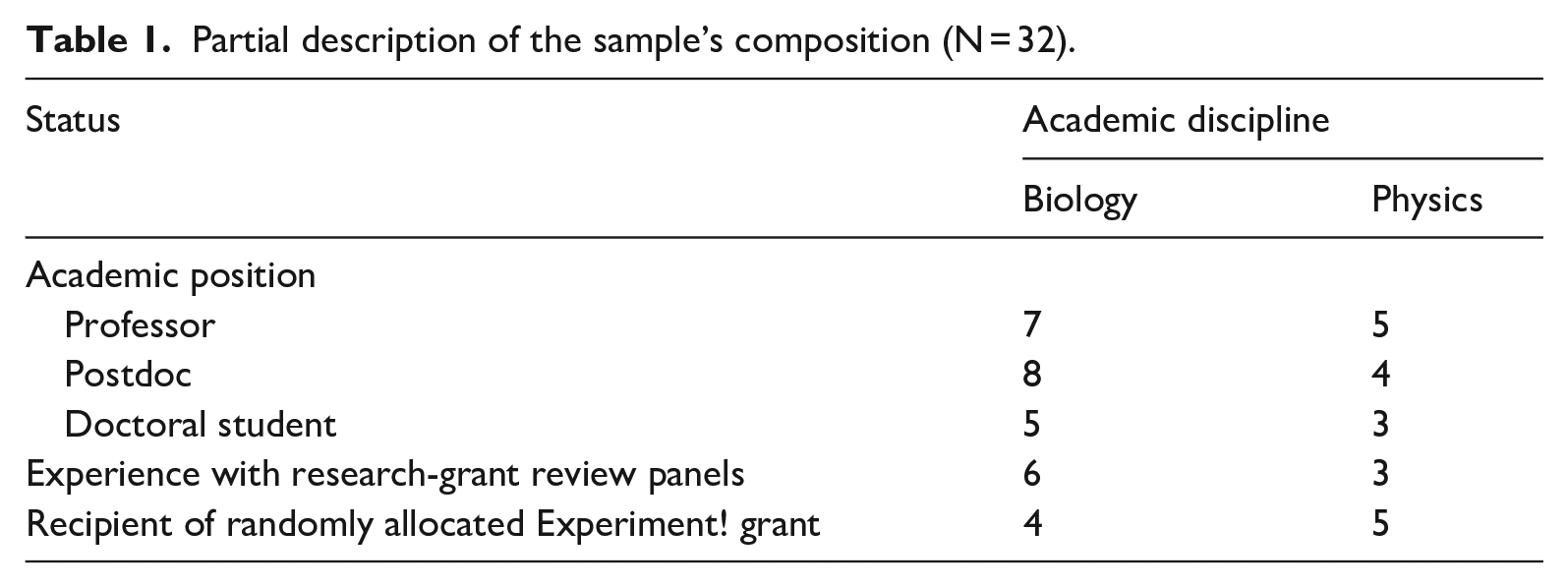
In the semi-structured qualitative interviews, the respondents were asked to describe their academic careers and to report on their personal experiences in science, particularly with externally funded research. This part of the interview was followed by general questions on the procedures of peer review in science and about the potential use of random grant allocation in research funding. Respondents expressed their views on these matters as active researchers. Because no one is a proven expert on peer review and random grant allocation in science, the statements made in the interviews provide no overarching insights. Instead, they convey the view of the individual interviewees. In the context of problem-centered interviews (Witzel and Reiter, 2012), the interviewees were also asked about ambiguities and incompatibilities in their accounts to clarify their stance on the grant lottery.
During the evaluation, the members of our research team jointly read all transcripts of interview sessions, interpreting the material line by line. Case descriptions were then created on this basis and systematically combined and compared with regard to the questions of interest. This approach made it possible to work out specific perspectives on problems, conflicts, and quandaries in the field of science in general and on the grant lottery in particular. For this purpose, the evaluation procedure was largely based on thematic coding according to Flick (2014) and supplemented by overall interpretations of individual cases so that we could comprehend the views and argumentations in the individual cases. In some places, we highlighted striking correspondences between certain views and positions within the field of science of the interviewees, without claiming that these tendencies can be generalized.
Problems addressed in the field of science
The interviewed scientists were asked to talk about their experiences with research funding and peer review. Against this background, they addressed a number of problems, conflicts, and inconsistencies in the field of science. The following presentation (see Table 2) focuses on the remarks related to peer review as a main standard procedure in science. The items are sorted according to problems caused within and outside the field, as well as according to legitimate inconsistencies and illegitimate conflicts.
Three types of issues in processes of peer review: Potential solutions.
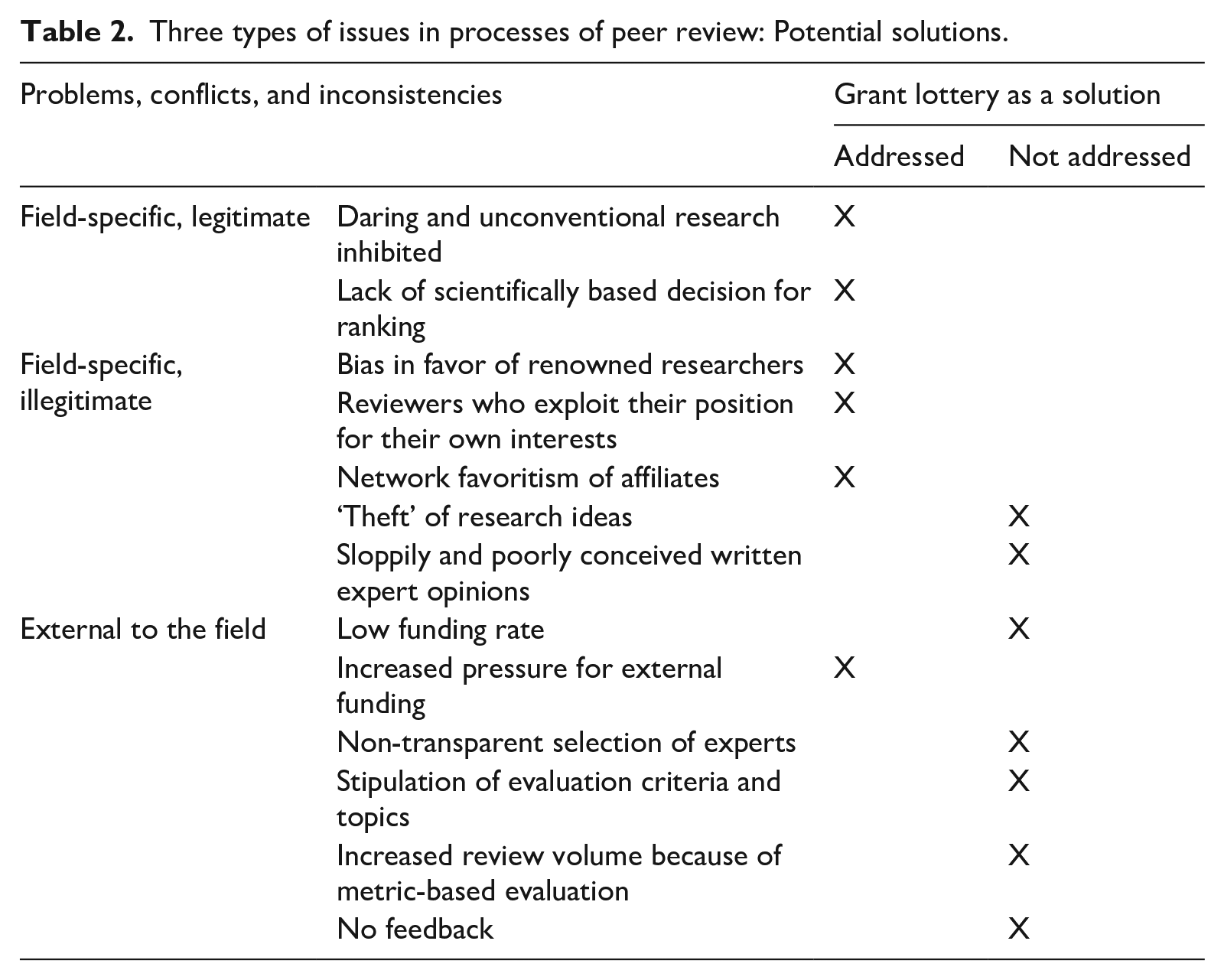
Along with the distinction between the field-specific and what is external to the field – which comes from Bourdieu’s observations on the relative autonomy of the field of science – a further difference emerged from the systematization of the respondents’ accounts. We identified substantive inconsistencies and quandaries that largely correspond to the nomos – the field’s own rules and claims and its internally developed forms of practice and procedures of consecration. At the same time, however, we also found that respondents addressed field-specific conflicts that, strictly speaking, violate the field’s rules. We therefore also differentiated the addressed inconsistencies and conflicts into legitimate and illegitimate ones. The peer-review process, for example, is legitimately implemented when the sole – or at least primary – consideration is the scientific quality of the research. Only then does this procedure of consecration fulfill its function in accordance with the logic of the field of science. If, however, other criteria and characteristics are applied to peer review (e.g. criteria such as seniority or equality in peer review), then the procedure departs from its original function. Finally, the peer-review process is implemented illegitimately if it is influenced, for example, by networks, cronyism, or strategic preferences. External orientations and interventions, too, are apt to slide into the realm of the illegitimate if they exceed the bounds of heteronomy considered acceptable for the dependence on interdependence typical of science (Bourdieu, 1997a: 48). This overstretch includes, for example, interventions that affect the nomos – the core of science – by restricting the autonomy of the scientific field and anchoring to it what is external to science, such as the nomoi of other social fields.
By focusing on the issues with the peer-review process, the results section does not address the entire variety of problems, conflicts, and inconsistencies in the field of science. For instance, the interviewees also critically noted the fact that work and family were difficult to reconcile with an academic career because total commitment to science was required for a professorship. Furthermore, the academic career path to a professorship compels early specialization and a unique selling point to achieve high visibility. The interviewees pointed out that this necessity undermines the incentive to pursue different, new research topics and methods. Likewise, they criticized that jobs have been cut among Germany’s mid-level faculty (teaching and research staff). As a result, earning a doctorate was said to depend largely on external funding and doctoral candidates are exploited. In particular, dependence on supervisors was perceived to have increased.
Inconsistencies and conflicts generated within the field
Two types of problems generated within the field itself were apparent in the responses of the interviewees. The first type stemmed from functional causes and originated in the fact that the forms of practice and the procedures of consecration for realizing the nomos harbor dilemmas that are rooted in the logic of the field. These inconsistencies arise primarily from the field-specific antagonism between orthodoxy and heresy. According to Bourdieu (1990), the antagonism has a structural quality because it has functional significance for the field of science and therefore pervades all forms of practice, procedures of consecration, and allocations of position. The second form of conflict generated within the field itself was evident in the interviewees’ responses about the lack of unambiguous orientation to the nomos of the field. Our respondents stressed that social attributes and processes dominate the functional orientation. Social attributes and processes were therefore described as illegitimate bases for field-specific practices and evaluations. Before we go into detail, the next paragraphs are about dilemmas due to structural antagonism in the field of science.
Field-specific, legitimate
Overall, two legitimate field-specific inconsistencies were cited. The first was said to be closely related to a peculiarity of the peer-review process. Peer review was considered a specific procedure to ensure scholarly treatment and, hence, conformance to the nomos of the field of science. This expectation of the peer-review process was shared by the interviewees when they considered it ‘just totally necessary […] in order to guarantee quality’ (15, biology, postdoc, 58). 2 In the same vein, peer review is ‘an absolute necessity’ (19, physics, postdoc, 57) because only peer scientists can judge whether a research idea makes scientific sense and ‘whether it works’ (19, physics, postdoc, 57). These respondents thereby expressed that peer review was intended to eliminate arbitrariness in research and to ensure that it is built on the state of the art. However, this demand placed on peer-review procedures in science also gives rise to a kind of conservatism, a favoring of incremental research (10, physics, professor, 52). Such assessments generally entail three requirements, which are also recurrent themes in the interviews. The interviewees said that their research projects are expected (a) to follow from previous scientific research, (b) build on previous work, and (c) qualify as feasible. The interviewees repeatedly mentioned that these expectations create a dilemma. Especially daring, innovative ideas, which are conceived to explore hitherto untreated and uncertain paths, would stand little chance of approval. First, this type of unconventional research usually has no previous work to stand on, so assessment of its feasibility would be limited. Second, a ‘certain tunnel vision’ (19, physics, postdoc, 59) characterizes reviews, for unconventional approaches have difficulty gaining acceptance if the reviewers are unfamiliar with them and if the applicant ‘looks too far ahead’ (19, physics, postdoc, 59).
The second legitimate field-specific inconsistency arises from the fact that reviewers have to differentiate between proposals that have similar research topics, comparable disciplinary approaches, a promising prospect of valuable scientific results, and, in many cases, equal quality. According to the established interviewees in particular (many of whom also have experience with panel meetings on research funding), there is at least the expectation that scientific quality will be assessed according to criteria such as originality, relevance, and feasibility. Nonetheless, it was said that the reviewers repeatedly find themselves unable to distinguish scientifically and objectively between research proposals that should be funded and those that should not. One physicist goes even further: Journals or external funders want peer reviews for the top 10 per cent, and I think that’s an illusion. In my own experience with reviewing externally funded projects or articles that have been submitted, I can immediately identify the worst third. In other words, I can immediately identify what is not good. The best 20 per cent is extremely difficult for me. (05, physics, professor, 46)
As described in Lamont (2009), Luukkonen (2012), and Roumbanis (2017), other interviewees also reported that, as panel members, they recurrently reach their limits to finely distinguish between research proposals. Even peers who are familiar with the theories, methods, and body of knowledge in their discipline would not always be able to rank the eligible proposals in a peer-review process based on scientific merit. Elster (1989) suggests that this dilemma in the field of science is due to the overestimation of science-driven evaluations of research ideas. Although the peer-review process is intended to ensure that research is in keeping with scientific standards, not all aspects of research (e.g. originality and relevance) can always be weighted according to qualitative scientific criteria. According to the interviewees, this indeterminacy means that scientifically illegitimate assessments and criteria have sometimes been used to rank research projects.
Field-specific, illegitimate
According to the interviewed scientists, one of the illegitimate field-specific conflicts was the fact that reviewers do not always abide by the rules of the peer-review process. One assertion was that they are guided in their evaluation by the characteristics of the applicants, not solely by the scientific quality of the proposal. The interviewees maintained that younger people and female scientists are especially disadvantaged in research proposals and it is ‘always the same people’ (01, physics, professor, 123) who see their proposals accepted. Others state that the ‘famous’ (01, physics, professor, 123), ‘big name[s]’ (27, physics, predoc, 36), and ‘top dogs’ (18, biochemist, postdoc, 61) were favored. As suggested by the Matthew effect (Merton, 1968), the chances of success are thus often derived from earlier successes or, as Bourdieu might put it, the chances of success are related to the volume of scientific capital. An interviewee in the field of biology vividly summarized this criticism: Of course, there are certain luminaries or people of repute. They outshine others, leaving many young scientists no chance. In a way, this means that those who already get a lot are always given even more. Unfortunately, this is often the case. (18, biochemist, postdoc, 61)
This perspective reflects a common criticism of the peer-review process, especially of bias among reviewers. Unsurprisingly, interviewees pointed to the results of studies showing that women (Kaatz et al., 2015; Magua et al., 2017; Wennerås and Wold, 1997), applicants of color (Ginther et al., 2011, 2016), and researchers early in their career (Tabak and Collins, 2011) are at a disadvantage in the allocation of research funding. The respondents did not always know the details of these studies, but what they did know of them reinforced the assumption that reviewers are guided by biases and stereotypes.
As seen primarily by young academic respondents, another illegitimate deviation from the field-specific rules was the fact that many reviewers exploit their position and make interest-driven assessments to reduce the chances of their scientific competitors. Reviewers were said sometimes to judge a proposal more negatively if the research idea ventured into an area of their own study (17, biochemist, postdoc, 48): ‘The project could only really be evaluated by someone who is doing something similar’ (22, physics, postdoc, 58). But if a reviewer is a ‘rival, [she or] he will not always evaluate fairly, […] for that could drain his or her own research funds’ (22, physics, postdoc, 58). Similarly, ‘the reviewers themselves sometimes have an interest in rejecting a proposal because they want to do it themselves’ (24, physics, postdoc, 96).
In general, the less established interviewees unanimously saw another illegitimate defect of the peer-review process in the emergence of groups that coordinated internally and favored the members of networks. In this way, too, field-specific rules were broken, according to the interviewees. To describe this rule violation, they used clear words such as ‘cartel’ (22, physics, postdoc, 62) or ‘old-boy networks’ (21, biology, postdoc, 72), referring primarily to cliques of established (older), often male scientists, and they mention a ‘culture of old men’ (16, biology, postdoc, 126) and of ‘older professors’ (exclusively men) who often had ‘problematic characters’ (13, biology, postdoc, 20). To these respondents, the formation of such groupings implied that the participants protect each other from negative evaluations.
Two other shortcomings of the peer-review process were also mentioned in the interviews. First, the peer-review process was suspected of encouraging the theft of research ideas. One interviewee (10, physics, professor, 48), for example, saw this potential problematic situation. ‘The greater danger’ in his eyes, however, was this ‘sloppy, this wishy-washy peer review’. It was stated that peer reviewers are not investing the requisite care in disregarding the field-specific expectations of reviewers. As another interviewee complained, the high volume of reviews means that ‘certain reviews are not qualitative; the time is not taken’ (21, biology, professor, 42). Yet, another respondent criticized that some of the reviewers ‘work very sloppily, very quickly, very superficially, very incompetently’ (05, physics, professor, 52).
What the above-mentioned illegitimate conflicts within the field have in common is their origin in the fact that scientists do not orient themselves to the obligations and norms woven into the peer-review process but sometimes seem to disregard them deliberately for their own benefit. This behavior is field-specifically illegitimate because peer review is a procedure of consecration developed by the field of science itself. It was especially apparent when some of the interviewees found clear words for these rule violations and thus indirectly advocated compliance. According to Bourdieu (1990), some of these illegitimate conflicts could be considered a misuse of the capital of social authority.
However, the interviewees did not conclude from the illegitimate behavior that the peer-review process was unsuitable to its assigned function. Instead, in the part of the interview about peer review, the criticism was often accompanied by suggestions for using the field’s own means and procedures to remedy such inadequacies internally. Some interviewees hoped, for instance, that an increase in the basic financial resources of universities or a reduction in the volume of grant applications would reduce the pressure and effort involved in applying for and monitoring research grants. Others hoped that comprehensive anonymization or the double-blind procedure (the field-specific regulation by which neither the applicants nor the reviewers are identified by name) would eliminate prejudices against certain groups (e.g. women and young researchers) and favoritism among members of networks. Conversely, a strictly open review (identification of reviewers) could help reviewers develop thorough and well-reasoned assessments. Other respondents are more skeptical about such transparency, fearing that scientists would then withdraw from the review process and set store instead by an increase and expansion of the circle of reviewers and on their training.
Problems generated outside the field
As the interviewees saw it, the field of science produced more than just internally generated problems. A number of field-external problems were also mentioned in the interviews. Problems generated outside the field generally result from claims and demands in the field of science that disregard procedures of consecration and run counter to both the scientific nomos and internally developed forms of practice. Such problems come about mainly through excessive curtailment of the autonomy of the field of science. Most such influences are caused by governmental regulations and financial constraints – that is, by field-specific dependence in independence.
According to the interviewees, these restrictions include, first, too little research funding for the numerous projects considered eligible to receive it. The respondents found this constriction to mean that the proposals initially assessed as eligible for funding are further segregated into those that actually receive funding and those that do not. The respondents imagined that this second step, too, is taken in the peer-review process, although the very small percentage of projects that can or may be funded (the funding quota) would make differentiation between them too fine to meet scientific standards. In other words, the field-specific claim that projects are selected according to purely scientific criteria is being abandoned. Nevertheless, funding organizations sometimes urged reviewers to make reasonable decisions for proposals of equal scientific quality. It was expressed that such decisions are, in some cases, then based on criteria that defy scientifically legitimate justification (criteria such as subsidiary issues, minor ambiguities, and biases): At 5 per cent [as a funding quota], it is incredibly difficult to determine the order. Even with the DFG [the German Research Foundation], the pain threshold fell below 20 per cent, and if you had less than 20 per cent, then it really became a bit erratic. I mean, these are simply good proposals and to say now that one is really what’s going to be funded and the other belongs in the garbage can, that’s really difficult. (09, biology, professor, 74)
In this interview and others, the respondents reported their experience that the rate of eligible proposals that are selected purely on the basis of scientific criteria lay between 30% and 50%. Within this range, the scientific field’s specific standards enabled decision-makers to cope with the task of differentiating between projects to be funded and those not to be funded. By contrast, setting a funding quota lower than that range would often elicit a scientifically unjustifiable basis for further differentiation between the eligible projects and would thereby compel decisions that would contradict the logic of the field of science.
Second, the interviewees were of the opinion that dependence on external funding, combined with a reduction in the basic funding of the universities, has resulted in further distortion of the field of science. The severe shortage of basic funding in recent decades has, they said, increasingly forced scientists to acquire external funding to be able to conduct research at all. They are thus constantly obliged to spend a good deal of time writing proposals instead of pursuing their own research. As the respondents see it, the original task defined by the nomos of the field of science has thus shifted from the generation of new knowledge to the acquisition of financial resources for research. Reduced funding and the pressure to find external funding have had a structural impact on the organization of research. As one respondent noted, I actually find it a very sad aspect of proposal writing that, in my experience, many proposals are written just to maintain the size of a working group, not because it’s a really good fit at the moment. (20, physics, postdoc, 20)
Third, the interviewees complained that the funding organizations sometimes apply their own, non-transparent criteria to select reviewers. 3 Whether a proposal was approved therefore often hinged on the choice of the reviewers to whom one’s application had been sent for evaluation – ‘a lucky draw’ (13, biology, postdoc, 522). By describing the choice of reviewers by the funding organizations as being based on luck (see also Bornmann and Daniel, 2009; Cole et al., 1981), the interviewees also underscored the difference that a science-guided choice of reviewers makes. They pointedly showed not only that funding organizations operate outside scientific claims and rules but also that leaving funding decisions solely up to a lottery is precisely the opposite of what scientists consider to be in keeping with the field of science.
Fourth, some interviewees criticized the fact that a growing reliance on external funding in research has led organizations to set ever greater store by reviews and to introduce their own evaluation criteria. These criteria entail stipulations and additional steps in the preparation of the proposal, which not only means a good deal of work but often implies compromises in the formulation of the research question and the planned procedure. The concern was that these criteria would externally standardize the field of science and undermine its logic, ultimately increasing the external influence on the research. As one biochemist put it, I often have the feeling that reviews are really being engineered. An expert opinion has to be sought for every piece of rubbish. The reviewers are also overburdened. To keep things under control, the funding organizations then start specifying what [the review] should look like. I think that’s why the funding organizations suddenly – and quite unintentionally – acquired power they shouldn’t have. (07, biochemistry, professor, 50)
This shift in power contradicts the logic of the field in that funding organizations increasingly use their power to anchor their own scientific and political agendas in the field of science. In addition to thematic priorities imposed on research and frequently mentioned elsewhere (e.g. Gläser and Laudel, 2016), such externally introduced standardizations include formal obstacles complicating the application process. One biologist sums it up: As far as these applications and this structure are concerned, the DFG is totally conservative because things have to be planned out. The BMBF [German Federal Ministry of Education and Research] often has these aspects of knowledge transfer. That means you can’t start completely from scratch there, either. You have to lean toward practical matters. (16, biology, postdoc, 102)
Fifth, the interviewees saw a further distortion of the field of science in the fact that funding organizations are relying increasingly on metric evaluation criteria in the reviews. The focus was no longer on scientific quality, said the respondents, but rather on formally countable criteria such as the number or type of publications. A biologist described this problem as follows: Nor do I think much of the bean-counting increasingly being done in German research funding where publications have appeared. Instead, the question of what has been published is much more relevant. And these are trends – in both America and Germany – [indicating] that the contributions to the cause of science are no longer being read but actually reduced to parameters. (08, biology, professor, 28)
According to Bourdieu, the conflict with the nomos of the field of science is that publications no longer primarily fulfill their original function – that of making new scientific knowledge publicly accessible and feeding scientific discourse. Rather, a purpose external to the field has become pervasive in publication. With reviewers paying more attention to where articles are published, scientists seeking external funding are gaining competitive advantage by publishing as many articles in as many high-ranking journals as possible.
The final point criticized by interviewees in our study was the divergence in the review processes across the various funding organizations. For example, some lines of funding were noted as giving only insufficient feedback on the research projects. For the interviewees, however, the review process in science depends on constructive criticism. Not only does it help ensure scientific quality, but applicants can also use it to improve research projects. It is alleged that funding organizations, however, undermine this principle when they abridge their review process by not commenting on funding rejections. As one respondent said, It’s totally frustrating when you don’t get constructive feedback. Either you get such positive feedback that you don’t understand why it’s not being funded or you don’t get feedback that . . . you can work well with. (16, biology, postdoc, 50)
Overall, the interviewees addressed various problems pertaining to the scientifically key procedure of peer review. They clearly did not share the view that the field-specific regulations and requirements in the field of science largely function to facilitate its tasks and services smoothly. Instead, these respondents noted that field-specific procedures and external influences produce problems, conflicts, and inconsistencies. Interestingly, the interviewees also identified a number of ways to solve problems within the field. As becomes clear in the following section, however, they were also open to trying out random selection as a decision-making aid outside the field in an effort to overcome internal and external problems.
The lottery as a way to ‘repair’ problems
The first thing to notice in our data is that almost all of the interviewed scientists attached great importance to scholarly peer reviews that identify the eligibility of projects for a grant before they are chosen by lottery. When deliberating about lottery procedures, respondents were unable and unwilling to imagine resorting to a grant lottery prior to selection based on science-specific criteria and procedures. One of their reasons for explaining why this sequence is indispensable was that the quality of the proposals would otherwise decline. The interviewees were convinced that researchers would ‘just push qualitatively inferior proposals through the system’ (16, biology, postdoc, 140) and that ‘there would probably just be chaos, with everyone just kind of doing something that really shouldn’t be done that way’ (17, biochemistry, postdoc, 66; see also Philipps, 2021b).
Overall, the interviewees do not see the lottery as the sole ‘savior’ (11, biology, junior professor, 58). One criticism is that a grant lottery would undermine the system of scientific reputation by not appropriately honoring past scientific achievements. Another reservation is that a wholesale switch to a grant lottery would prevent research continuity because follow-up funding would be left to chance. Yet, they also addressed internally generated and externally conditioned problems by suggesting several remedial approaches compatible with the nomos of the field of science. They suggested, for example, that reviewers who exploit their scientific capital of social authority for their own interests be reported to funding agencies and suspended. Another suggestion was to expand the circle of reviewers to include less established academics. It has already been urged that greater emphasis be placed on strict anonymization or double-blind review procedures to avoid discrimination and the preferential treatment of network members. The interviewees also saw the possibility of responding to insufficiently elaborated evaluations by inviting open peer reviews, training reviewers, or offering incentives such as a reduction of the reviewer’s teaching load. Some of the interviewees could also imagine reforming existing structures in academia. Such ideas range from limiting the volume of applications to reorganizing the funding structure.
The aforementioned concerns and field-specific alternatives notwithstanding, the interviewees did not outright oppose random grant allocation in research funding. Rather, they saw it as a possible solution to some of the problems in the field of science.
Mitigating field-specific inconsistencies and conflicts
Field-specific, legitimate
In response to the field-specific dilemma of the peer-review process (the fact that research projects are expected to be original but tend to be evaluated conservatively), the main interviewees to consider the grant lottery were those whose applications presenting a daring research idea had been approved for funding from the Volkswagen Foundation’s Experiment! program. They and others saw a lottery as a way to reduce the latent conservatism of scientific reviews (Luukkonen, 2012). The overall tenor of the interviews was reflected in the following statements: If you had first asked me what I think of rolling the dice, of a random selection process as it were, I would have said I think it’s great, because I believe [that] if you . . . also accept crazy ideas to a certain extent, or ideas that maybe make you think, is that possible, can they pull it off, I think that makes it possible to do really innovative things. (03, physics, professor, 58) I think […] the random selection process can in fact break up structures, and that’s what science thrives on – that we don’t just always think in fixed patterns, that we instead want to break up structures, that we want to do new things. (16, biology, postdoc, 150)
It was presumably no coincidence that other interviewees also repeatedly used the word ‘crazy’ (01, physics, professor, 107; 12, biology, professor, 52; 19, physics, postdoc, 83; 20, physics, postdoc, 68; 21, biology, postdoc, 90; 27, physics, predoc, 42) to denote those research ideas that would have a better chance of being funded through a grant lottery (see also Roumbanis, 2021). ‘Crazy’ meant that the ideas clearly departed from previous research traditions and programs. Respondents thereby indirectly reformulated the antagonism between orthodoxy and heresy that often inhibits original and creative research. If funding-by-lot is to be used primarily in special funding programs or for a small percentage of applications that have been positively evaluated in principle, then it serves to shift the balance of the field-specific conflict between orthodoxy and heresy. It would tilt that balance more toward particularly original research than has been the case. At the same time, the dominance of the logic of the field of science would remain unscathed because funding-by-lot would be secondary and subject to the field’s own procedures.
By contrast, some of the veteran scientists interviewed, who had experience with panel meetings in research funding, discussed a different field of use. To them, drawing lots was a suitable procedure for making decisions when it is not possible to rank research projects according to scientific criteria. Particularly when the academic review process is no longer able to help reviewers discern scientifically grounded qualitative differences between research projects, these interviewees thought that a lottery approach could be a fair and unambiguous alternative basis on which to make funding decisions. As two of them attested, At a small level, around the last 10 per cent, when you can’t decide anymore through a peer review process and you’ve exhausted all the other criteria, there’s still something left, and then you can honestly perhaps admit: Okay, now we roll the dice. (06, physics, professor, 100) There are situations where you can’t rank and yet don’t have enough money. You have to draw a line between funding and non-funding at a point that doesn’t really exist. And in those situations, a lottery is appropriate. If you have equivalent applications and have to decide between them, the matter could be decided by lot. (01, physics, professor, 203)
The statements make it clear that if it is not possible to make a choice based on scientific criteria, but that the evaluation must nevertheless be conducted in a scholarly manner, then the interviewees regarded the procedure as inconsistent with the rules governing the field of science. Not only does it pose a factual scientific problem; it also breaks the social rules that apply in the field of science. It is thus a normative problem that can be circumvented by means of a grant lottery. Although funding by lot is external to the field, it would perform a function appropriate for the field of science. Without having to overstretch science’s field-specific logic, the grant lottery would make it possible to reach a decision even in the absence of a scientifically justified choice between research projects. Some of the interviewees seemed to favor the use of the lottery at least under these conditions.
Field-specific, illegitimate
Less established researchers in our sample spoke more frequently than the established scientists did about random grant allocation as a way to reduce the bias problems of the peer-review procedure. They argued that a grant lottery would be blind to big names, socio-structural characteristics (e.g. gender and age), cronyism, and networks of relationships. Random selection is also oblivious to the different kinds of scientific capital. That is why the preferences and disadvantages resulting from upstream evaluations rather than from the scientific quality of the research project have less of an impact. In the words of one of our interviewees, ‘This [funding-by-lot] is a good starting point for young scientists, who don’t yet have such a long publication list enabling them to simply hit the jackpot’ (15, biology, postdoc, 88). For the interviewed scientists, the use of random selection in such cases could help solve the conflict inherent in the fact that review procedures entail preconditions favoring certain groups of applicants even when the research idea and the planned project are rated equally in terms of scientific quality. Applicant characteristics, the positions they occupy, and the capital of social authority credited to them thereby come to outweigh the evaluation of the research proposal’s scientific quality. Random grant allocation would take these characteristics, positions, and the power of statutory authority out of the equation and afford all applicants an equal chance (see Lee et al., 2020). As seen by some of the interviewees, peer-review cliques and networks would no longer have a bearing, either If you have worked for a long time in Germany and have established those kinds of connections, of course you know all the people in the respective faculties who review the proposals. If you were to say, we’ll make a basic selection according to quality and after that the decision is made by rolling the dice, of course, it’s definitely objectively fairer; you can’t just rely on your connections. (13, biology, postdoc, 48)
The aim in the aforementioned areas for use of the lottery is to improve the scientific field’s attainment of its own objectives through the logic of random selection. Consequently, such an approach would not invalidate the nomos of the field. Instead, it would operate in the field of science in ways that reduce the effect of breaching its social rules, meaning primarily those that result from its social structuring and consist mostly in the fact that ‘statutory authority’ (Bourdieu, 1990: 55) is exercised beyond scientific goals and justifications.
‘Repairing’ field-external problems by lottery
Whereas respondents discussed a relatively wide range of external influences on the field of science, the grant lottery was rarely mentioned as a way to deal with externally induced problems. A few of the interviewees stressed that random grant allocation could alleviate the amount of work and time involved in the review process. A small number of them saw the grant lottery as an option for funding research more quickly and effectively than is currently the case: [I] also think that it [a lottery] solves other problems […] You’d have so much more time that you can spend on other things […] We spend so much time working on these grant proposals and thinking over them sentence by sentence, trying to make them perfect [to] increase the likelihood of getting a grant. But if you know that it’s random anyway, you write it […] the best you can and then […] just leave it up to chance. I think that takes a lot of the time […] and […] brainpower out of it […] That means that you can do other things with that time and brainpower, which […] I find very attractive. (23, biology, postdoc, 72)
On the whole, few respondents raised the grant lottery as a solution to externally produced problems in the field of science. Of those few, the cited biologist (23, biology, postdoc) formulated a radical way to address the increasing burden of externally funded research. In the view of the interviewees, the reduction of the basic funding of universities and the increased reliance on research funding from external institutions seems to justify a funding-by-lot to regain more time for research.
Discussion
This study explored conditions and for which reasons scientists can imagine using a grant lottery to select research proposals. The first and central finding is that the interviewed scientists neither rejected a lottery outright nor advocated its arbitrary or extensive use. Specifically, our analysis has shown that the use of random grant allocation is closely linked to the perceived acceptance of identified conflicts and inconsistencies in the field of science and to the available field-specific solutions. Bourdieu’s (1975, 2004) conception of the scientific field has proven highly useful for systematizing the various problems mentioned by the interviewees. Viewing science as a socially structured field, for example, has opened access to field-specific conflicts that are perceived as illegitimate and as matters to be settled within the field of science. The concept of dependence on independence made it possible to discern problems generated outside the field and to understand why a solution to them is not seen to lie in a logic such as drawing lots, which is external to the field of science. As predominantly assessed by the interviewees, inconsistencies resulting from the field-specific antagonism between orthodoxy and heresy are legitimate – that is, not a danger to the field of science. In Bourdieu’s terms, this stance can be attributed to the fact that this antagonism is functionally relevant to the field of science. In this regard, we therefore speak of inconsistencies and dilemmas. It would be instructive to examine whether the distinction we have introduced between legitimate and illegitimate problems is found for other procedures of consecration in the field of science as well. Bourdieu (1996) holds that the field of art is also determined by an antagonism between orthodoxy and heresy. It would be intriguing to see whether a distinction between illegitimate and legitimate problems is identifiable there as well. The system we have elaborated distinguishes between three types of issues in the field of science:
Legitimate field-specific inconsistencies that derive their legitimacy from the fact that they stem directly from the scientific field’s structuring antagonism between orthodoxy and heresy and are embedded in the field’s own practices and rules. These inconsistencies are therefore also closely interwoven with the nomos and the functions of the field of science.
Illegitimate field-specific conflicts resulting from noncompliant use of statutory authority and rooted in the misuse of scientific functions with structuring power.
Externally induced problems that are imported into the field of science and caused by the field-specific dependence in independence. They are therefore the result of relative autonomy.
Most interviewees did not regard drawing lots as a suitable procedure for all problems, conflicts, and inconsistencies. Nor did they all consider random grant allocation to be equally suitable for dealing with, let alone resolving, the variously conditioned dilemmas and conflicts. For the interviewees, funding-by-lot was thus only another potential procedure suitable only under certain conditions in a limited realm. The respondents were able to imagine using a grant lottery solely in combination with a rather extensive prior examination of scientific quality. After such a scientific examination, however, random selection could perform a number of tasks in the field of science (see also Avin, 2019; Brezis, 2007; Fang and Casadevall, 2016; Gillies, 2014; Roumbanis, 2019):
A grant lottery could mitigate conservative selectivity in the peer-review process because the final selection or a certain percentage of research projects to be funded would be random. In the view of the interviewees, this arrangement would improve the chances that daring research ideas would receive funding. In Buchstein’s (2009) words, such an approach would tap ‘creative reserves’ (p. 303, our translation) in science. Furthermore, the prospects of receiving a grant would increase for academics not yet able to show any preliminary work or scientific success.
If the peers in review processes are obliged to differentiate further – to choose – between the applications deemed eligible for a grant according to scientific criteria even though that shortlisting cannot be scientifically justified, then some of the interviewees were able to imagine using a lottery instead. The advantage of drawing lots would be that funding decisions could be made without having to be presented as scientifically justified. The justification for using a lottery would, in principle, follow from the fact that logical considerations had reached their limits (see Elster, 1989) when there are either no differences or when the differences are so great that applications cannot be compared with each other (i.e. are incommensurable). As Stollberg-Rilinger (2014) notes, random selection in such constellations can transform equality into inequality and create differences between incommensurable applications. By means of random selection, equally fundable yet incommensurable applications could be differentiated into those to be approved and those not to be approved.
Mainly the young and less established interviewed scientists (including doctoral students and postdocs) in particular expected lottery procedures to reduce the field’s structural privileges and disadvantages that result primarily from unequal distribution of the capital of social authority. According to the nomos of the field of science, only the scientific quality of the project should be decisive for the approval of research proposals. In practice, however, this group of interviewees perceived favoritism of established scientists, who possess statutory authority and are often suspected of using it to their own advantage. Random selection would afford all equally warranted research proposals the same chance of being funded – regardless of the applicant’s position in the field of science – because the lottery is socially neutral. All participants who meet the same requirements would be treated the same (see Goodwin, 2005).
In view of the steadily increasing burden on the scientific review system, random grant allocation appeared to some respondents to open up new perspectives. In their thinking about lotteries, they argued that funding decisions would be made more efficiently and quickly. The time and effort required to write and review research proposals would be eliminated and researchers would once again have more time for research. The efficiency of a grant lottery has repeatedly been a main argument for using it in research funding (see Avin, 2015, 2018; Brezis, 2007; Fang and Casadevall, 2016; Gillies, 2014). However, in most cases this advantage of lotteries was outweighed by loss of control over scientific quality.
The statements of the interviewed actors in the field of science made it clear that they are surprisingly open to funding-by-lot (see also Philipps, 2021a, 2021b), although it is a logic external and utterly contrary to the field of science. This openness varies neither widely in the two disciplines considered in this article (biology and physics) nor markedly along the social positions occupied by the respondents in the field of science. However, there is a tendency for younger and less renowned scientists to support the use of lottery procedures, among other things, to allay disadvantages that result from the social structuring of the field of science and that often have an illegitimate character. Established scientists, by contrast, are more in favor of other, generally field-specific solutions to these problems and conflicts. 4
However, this difference is largely blurred insofar as functionally conditioned dilemmas and incompatibilities are concerned, such as the limits of fine differentiation or the latent conservatism of the peer-review process. Lacking a satisfactory field-specific answer to these inconsistencies, many of the interviewed scientists found the use of funding-by-lot worth considering for this purpose. It would enable decisions to be made without overburdening the field’s own rule of debating exclusively on scientific grounds. The grant lottery clearly signals that no scientifically legitimized decision was made. Openness to adoption of a random grant allocation in no way implies that respondents want to replace field-specific rules and procedures with the extraneous logic of a lottery. In fact, the opposite seems to be true: The lottery is to be used predominantly in a way that improves the validity of both the functionality and the social rules of the field of science. Approval of the grant lottery is not at all explained by the fact that the interviewed scientists disagree with the nomos (the field’s own procedures or social rules), which is why they set store by random grant allocation as a logic external to the field. This reasoning was particularly evident in the interviewees’ attitudes toward the peer-review process. Although the interviewees criticized much about the practice of this procedure and even saw problems embedded in it, they did not reject it entirely, but rather emphasized that it is indispensable and represents the best peer-review procedure.
When we consider this viewpoint, the question of why the interviewees are open to the lottery – in which chance and luck are given decision-making power – becomes particularly pressing. First of all, the advantage of funding-by-lot, though external to the field, is that it does not represent the logic of another social field. It is not, for example, an instrument of so-called New Public Governance or part of the metric procedures for measuring scientific quality. The latter procedures can be thought of, to borrow Bourdieu’s (2003) terms, as one field capturing another. However, the logic of drawing lots does not threaten to invalidate the nomos of the field of science or to penetrate headlong into other scientific fields. It remains intrinsically external to the field, with its use having to be – and, above all, able to be – justified from within the field of science. The field of science itself thus remains uppermost in mind when the lottery is used. The relative autonomy of the field of science is therefore not attacked by the self- or field-determined use of random selection. The situation is different when logics from other social fields are anchored in the field of science, for they are accompanied by increased heteronomy, with the rules and functionalities of other fields becoming embedded and curtailing the field-specific logic of science. This concern also explains why some interviewed scientists believed that funding-by-lot should be used in a way that helps bring the inherent logic of the field of science to bear.
Conclusion
Overall, the recent debate on random grant allocation in science can be interpreted as showing that not all problems can be adequately addressed even with rules and procedures pertaining to the entire field. In the field of science in particular, massive restructuring has taken place in recent decades. Its most striking attributes are the steep increase in performance comparison, the enormous growth in international competitiveness, and, in Germany, the various kinds of excellence competitions. These processes have expanded the vertical differentiation of the field of science enormously, unveiling the field-specific ‘illusion’ (Bourdieu) that scientific quality should be the sole decisive factor in the approval of external funding. That precept has proven inconsistent with scientific practice. Equally important is that dependence on external funding has soared because of the decline in basic funding, a development that has thrust research funding into the role of controlling the field of science externally. Random selection offers at least one solution to some of the adversities resulting from these two processes.
Although this study can show which problems the interviewed natural scientists identified in the field of science and for which inconsistencies they regarded the use of the grant lottery as suitable, the limited number of qualitative interviews does not permit any distributional statements. In particular, tendencies among the interviewees and suggested correlations between certain statements, sociodemographic characteristics, and the volume of scientific capital must be tested in representative surveys such as that by Philipps (2021a). Nonetheless, it is already clear from our investigation so far that part of the scientific community is open to field-external logics such as lottery procedures if they can be tamed by the logic of the field of science and prove to be particularly suitable for resolving field-specific dilemmas and conflicts.
Footnotes
Funding
The author(s) disclosed receipt of the following financial support for the research, authorship, and/or publication of this article: The research was supported by the German Federal Ministry of Education and Research (Grant 01PW18004).
