



Abstract
This article examines the multifaceted nature of freedom in relation to the world’s efforts to cope with the Covid-19 pandemic. The aim is to show that in democratic societies, increasing societal regulation to stop the spread of the virus does not necessarily curtail all possible conceptions of freedom. On the contrary, we can even construct new institutional realms or community-strengthening mechanisms through which some forms of freedom can materialise in an unforeseen manner. The heuristic model that informs the analysis is composed of six different embodiments of freedom.
‘I will not trade my freedom for your safety’
1
A set of analytical dimensions could be invoked for the assessment of the consequences of Covid-19. By way of example, the pandemic could be considered to constitute both a victory for the nation state and the beginning of a new era of international consciousness and collaboration; even though the crisis has been, and will be, handled primarily at the domestic level, similar kinds of restrictive policies have been adopted across the interlinked globe. We could also assess the consequences of the pandemic by examining it on a line where democracy represents one end and autocracy the other, or on a line between justice and efficiency. From an even more distinct normative perspective, we could gauge the effects of the crisis on those living in material poverty and those living in abundance, or from a perspective that pits selfishness against altruism and solidarity.
I am inclined to argue, however, that the most central source of tension, partly also encompassing the ones listed above, has proved to be that between regulation and freedom. We have seen our politicians curtail our basic liberties, close our borders, hinder our movement, and enhance the monitoring of our digital activities. Our states have begun to exert more control over the economy and its production chains, all in the name of fostering societal security. As testified by the anti-restriction demonstrations in a range of countries, these regulatory measures have been rife with significant problems related to the limits of public power, the safeguarding of our constitutional freedoms, and the equal treatment of individuals. A liberal and free society must protect its basic values, but the actual scope of this ideal can prove unclear and vague –as we have repeatedly seen during the Covid-19 crisis. The question is ultimately judicial in nature, a matter of legal interpretations of the importance of various conflicting values.
It is not the purpose of this essay to ponder upon the most likely path that the Covid-burdened societies will opt for on this analytical line; neither is the aim to analyze what kinds of constitutional principles are possibly required for solving the tension between the ideal of freedom and utilisation of regulative measures. Instead, my objective is to emphasize the need for examining the multifaceted nature of freedom during the pandemic time from a more nuanced perspective than has usually been the case in our coronavirus-filled discourses; a wholly judicially oriented scrutiny does not suffice. So, as we reflect upon the pandemic’s long-term effects, it is essential to examine the different dimensions of freedom and their positive and negative consequences – and to show that what in the context of regulation may appear as a loss of people’s liberty can, in a deeper analysis, actually broaden the collective’s faculty of freedom.
The heuristic model that structures the ensuing discussion is composed of six different conceptions or embodiments of freedom. These can be divided into two interlinked triangles based on two distinct forms of logic: the negative-positive distinction of freedom and the level at which freedom operates (see Figure 1). For reasons of space, it is not possible to discuss the philosophical intricacies of, and interlinkages between, the two logics in any detail here. 2 It suffices to note that the linkages or pairwise combinations between these two tripartite divisions are not necessarily symmetrical; negative and positive freedoms can indeed materialise at many different levels of human action, but their relative significance varies greatly between these levels (e.g. collective institutions tend to focus on positive rather than negative freedoms). The emphasis herein, then, lies in providing a few empirical examples of the ways in which each of these six forms has endured, or will possibly endure, in the course of the Covid-19 pandemic –perhaps arbitrary examples given the all-encompassing nature of the crisis, but through these a picture of the complex constellation of human freedom under exceptional circumstances begins to take shape.
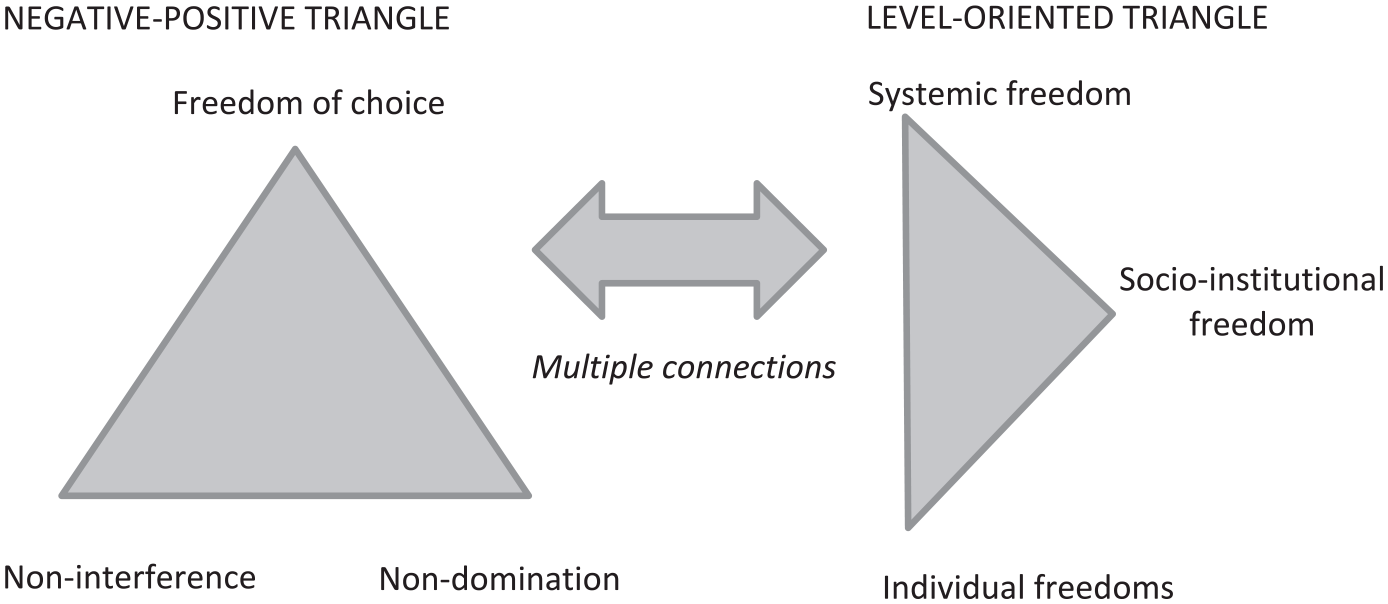
The six conceptions of freedom.
Non-interference – freedom of choice – non-domination
The distinction between negative and positive freedom, in many respects a simplistic one, was popularised by the liberal philosopher Isaiah Berlin (1969 [1958]) in the 1950s and 1960s. Negative freedom, one can argue, primarily materialises as non-interference, i.e., the absence of (unwanted, harmful?) interference by outsiders, be that an individual, the state, or an intergovernmental organisation. Positive freedom, by contrast, emerges –at least to the extent that is pertinent here – through the existence of a sort of opportunity space, the opportunity and ability to make the desired choices while also taking the needs of others into account. Such ideas as self-development and self-fulfilment also belong to this category, not only at the individual but also at collective level; national independence materialises for its protagonists in terms of national self-fulfilment.
In the 1990s, Berlin’s original division was supplemented with a third dimension of freedom, although one that is closely related to non-interference, namely non-domination (e.g. Pettit, 1996; Skinner, 2002). For example, in a scenario where a small country becomes the target of political and cultural influence exerted by a hegemonic power, the freedom of that country can be considered limited, even if the hegemon in question never directly interferes in its affairs. Non-domination can also be understood from a less material perspective. The pessimistic idea of liberalism of fear serves as an apt example: during the decades after the Second World War, the fear of humanity slipping into the clutches of evil –that is, communism or a new wave of fascism– defined, or even dominated, the nature of politics in liberal Western societies (Shklar 1989).
During the coronavirus pandemic, the ideal of a society of non-interference has suffered an inevitable setback. Most states have been forced to interfere with the lives of their citizens at a much greater rate than before, and severely limit their right to, for example, move about and mingle; with ever new corona waves many people feel and fear that the limitations have become permanent. What is important, however, is that the extent to which people interpret the restrictions as justified and necessary determines how severe a curtailment of freedom these actually represent; both executive overreach and underreach ought to be avoided (cf. Pozen & Scheppele 2020). As we have seen in many countries, skilful communication by the decision-makers can certainly enhance the sense of justice and minimise fears attached to interference. 3
At a higher level – relations between states – the principle of non-interference has been challenged in ways that previously could hardly have been imagined. The world’s superpowers, and perhaps even some smaller actors, have been provided with new ways to utilise the ‘soft power’ at their disposal. Already during the first months of the pandemic, we witnessed China’s and Russia’s attempts to accrue more political capital through medical material support. Whether the vaccine production of these powers offer them future ways to interfere in the affairs of those countries that purchase the vaccines remains to be seen; in any event, vaccine nationalism may include a subtler dimension than the straight-forward protection of the state’s own population (cf. Bollyky & Bown, 2020). 4 Indeed, the introduction of new tools for interference as societies feel threatened and operate under a state of exception constitutes a potential gamechanger within the international system of states. It can lead to unexpected concentrations of power, create new vulnerabilities and undesired interdependencies – even though the processes of globalisation in terms of the flows of people, information, consumption and money will generally not revert; they will merely assume new modes. The logic behind this is self-evident: the successes of vaccine development have testified how important and beneficial these global flows ultimately can be (Maull, 2021).
When the ideal of non-interference clearly suffers, one could naturally assume that the space of opportunities and choice that is available to us will also be limited in a very tangible way. True, we may no longer even be able to dream of jetting off to New York, Shanghai, or Athens with a short notice. If the cogs of the global economy and supply chains are constrained permanently, we may witness the selection of options available in our corner shop become smaller; and we may no longer have the same material conditions for self-development as before. Or perhaps such phenomena are already a reality.
However, the significance of the number of opportunities available to us is, in essence, a question of values that we hold dear. A historical parallel may be useful here: With and after the collapse of communism in Europe in 1989–1991, the citizens of the revolutionized countries began to dream of a new type of material plenty. Many of them soon found, however, that the (Western?) hubris of a material freedom of choice easily turns into a matter of comparison with others and it seldom occurs in a just manner; it soon dawned that some people were to have significantly more opportunities for consumption than some others. Emphasizing other aspects of the transformation (e.g. basic political rights or national cultural values) may therefore have assumed a more important role in many people’s overall interpretations of the process of transformation in the 1990s (Vogt, 2005). Indeed, it may be that, as we encounter restrictions to our individual or collective spaces of opportunity, we start looking for other spaces, for new enlargements of our space of activity, and simultaneously acknowledge that some freedoms are more important than others. 5 For example, at the local level – and we have been more locally bound than before for some time now – we may come to witness new types of communal, shared activities that will help expand our opportunity space. Teivo Teivainen and Pauli Huotari (2020) provide a fitting description of this in their early optimistic analysis of the consequences of the coronavirus: ‘[. . .] the crisis can also trigger non-state forms of collective organization. Mutual aid, emphasized historically by many anarchists, becomes concrete in many localities’. This also relates to the argument that a sense of community – a community within which an individual can safely and trustfully operate – appears to be an important explanatory factor for the different paths of success and failure that countries have followed during the pandemic (cf. Rainio-Niemi, 2020; Etzioni, 2021).
Closely related to this, political freedom of choice is a crucially important category that we should try to safeguard in our Covid-19-tinged reality. The most dystopic scenario for the future is one where the crisis turns us citizens into obedient followers of experts and their scientific conclusions, resulting in a form of ‘expertocracy’ where the uncertainties inherent to any scientific process are ignored and political options, to the extent there are any, are presented as plainly fact-derived. Uncertainty with regard to potential developments in the future is always the deciding factor in one’s political choices, even if we emphasize that these choices should be based on as strong a selection of facts as possible. In this respect, what we have seen over the past year in many corners of Europe – i.e. impassioned debates on the justifiability of the taken policy choices and large anti-restriction demonstrations – may actually enlarge the scope of politics in these societies (cf. Celermajer & Nassar, 2020). Such incidences make the breadth of democratic alternatives evident, however weird or non-scientific the protest opinions may occasionally be.
The special viewpoint related to non-domination resembles this aforementioned argument. If democratic societies blindly adhere to a (pandemic) crisis narrative that demands stringent measures of regulation and overall preparedness, the democratic credentials of these societies may permanently suffer (cf. White, 2021). Maintaining a state of emergency of sorts, even if it has not been formally declared, can turn into a permanent mechanism of freedom-curtailing domination; emergency becomes a state of mind. This could also lead us to believe that the narrative of the efficiency with which authoritarian societies have been able to control the pandemic – and not just the pandemic, but many other issues as well – represents the correct and desirable one. From this perspective, it is crucially important to try to return to a state of normality as soon as possible, a normality that would not be primarily described as ‘new’ but rather emphasized continuities with the pre-pandemic era.
Covid-19 may also come to alter the states’ power relations in terms of submission and domination and therefore, ultimately, the basic tenets of world order. For example, the independent vaccine programmes of such countries as China, Russia, Cuba, and even Finland, can be understood as attempts to modify the prevailing patterns of domination in world affairs. Many countries of the global South, notably in Africa, have sought to alter the existing images of underdevelopment by appealing to their particular successes in coping with the pandemic – unfortunately with a somewhat questionable record thus far (cf. Hirsch, 2020). But if the current brutal injustice in the global delivery of vaccines backfired in the form of new virus variants in the hemisphere of the ‘richer’ countries, this might indeed encourage efforts to restructure the relations between the northern and southern halves of the globe in the long term.
In the European (Union) context, non-domination figures high on the agenda. The idea of Europe’s strategic autonomy assumed new importance in European public debates during the Trump presidency, but it has now been imbued with a wholly new dimension – and new credibility: Europe must cope with the spread of contagious diseases with specifically European resources (e.g. Borrell, 2020; Biscop, 2020). How this objective of autonomy, or demand of less domination, will eventually mesh with the ideal of global collaboration – the basic pillar of the liberal international order that Europe wants to preserve – remains to be seen.
Freedom of individuals, systems, and shared institutions
The second triangle is based on the level at which freedom operates or materializes. One corner of this triangle represents individual freedoms and rights, in both negative and positive senses. These embodiments of freedom encompass all thought and operation models that emphasize the opportunities provided to individuals or the protection of their personal spheres, be they related to work or travel, recreational pursuits, or the respect of individual values. The constitutional framework, and the judicial system’s safeguarding acts within that framework, normally lay the foundation of these types of individual rights and freedoms in democratic polities. Sometimes, in many policy agendas, individual rights are articulated in collective terms, for example, when Country X’s development policy focuses on the rights of women.
As indicated earlier, during the coronavirus pandemic our individual rights and freedoms have been put to a severe test, occasionally necessitating awkward compromises. Above all, we – or our decision-makers – have repeatedly been forced to strike a balance between epidemiological logic and legal justice: The former may require closing some schools for the sake of securing a manageable contagion rate, but justice requires that all children be provided with equal educational opportunities (Wefing, 2020). What is particularly important in this exceptional context, and will also be during the recovery, is that we should not compromise our individual freedoms too easily. Whenever any mitigation measures are to be implemented, questions concerning individual freedoms need to be raised time and again, even with respect to those considered more subjective in nature. The tension between legality and legitimacy plays a crucial role here: even if something is based on law, it could still be considered unjust – and for good reason. On a positive note, it has in fact been encouraging to see how well constitutional principles have worked in the majority of European countries over the past months. Executive overreach has generally been avoided (with Hungary as a possible exception), although during the first weeks of the pandemic this was not always self-evident. Mechanisms of legal oversight have, by and large, proved sufficiently strong (cf. Pozen & Scheppele, 2020; Merkel, 2020; Salminen, 2020).
Other types of aspects related to individual freedoms have also come to the fore during the Covid-19 crisis, with potentially progressive consequences. The living conditions and treatment of marginalized individuals and disadvantaged groups in society are an important example here. We have heard, almost on a daily basis, how the number of infections has been particularly high among immigrant populations across the European continent; and many industrial conglomerations, from German slaughterhouses (e.g., Hecking & Klawitter, 2020) to Finnish shipyards, with a high number of employees from poorer countries, have become hotspots of new corona waves. One can hope that increased awareness among the public of these types of issues, of the inadequate social conditions many people encounter to earn their living, can ameliorate the situation in the long run. (Exploring the relations between freedom and inequality under the Covid-19 crisis would undoubtedly warrant a separate article.)
Systemic freedom focuses on entire societal systems, particularly those of states. As it tends to draw its (rhetorical) power from the ideals of non-interference and non-domination, it often represents an exclusionary form of freedom. It thus easily rejects those who do not belong to the system, often even treating outsiders with fear. It is also functionally undifferentiated: it does not differentiate between societal structures or their subsystems or institutional expressions. The articulated hope is simply that one’s own nation, state, civilization, or minority is, according to some oft undefined metric, truly free. President Donald Trump’s ‘America First’ rhetoric epitomizes this logic in an archetypal manner.
It is still too early to judge what kinds of aftereffects in terms of systemic freedom the Covid-19 pandemic will engender. Many are already anticipating the emergence of a world comprised of major regions where each subregion or cluster of nations will increasingly emphasize its special nature while simultaneously engaging in ruthless competition with one another – clash of civilizations 2.0. US animosities towards China during the first year of the disease seem to represent this mode of thought, but a realistic interpretation of Europe’s focus on strategic autonomy could also be interpreted from this perspective. If extreme patterns of this thinking are allowed to further pervade our societies, it will inevitably be to the detriment of the collaborative efforts and ideals traditionally championed by the various organisations of global regulation. Large-scale interdependence – which the pandemic has obviously made more visible – would recede to the background, displacing trust as the foundational character of the global governance system (cf. Harari, 2020).
In principle, a new wave of cosmopolitanism could be the alternative to this negative scenario, a common and shared narrative developed by the world’s leaders within which the systemic level would be truly global in nature. Reaching this type of narrative seems unlikely at the time of writing these lines, however, although one can also point to societal signals that would merit a more optimistic conclusion. For example, waiving the intellectual property rights guaranteed for vaccine developers for the sake of global welfare still seems to be a distant dream; leading European politicians have proved hesitant to express their support for such a policy measure – but the fact that President Joe Biden did just this a few days ago (in early May 2021) may of course change the game significantly. All in all, a world-leader rhetoric that would, time and time again, emphasize the common fate of humankind, and the concomitant necessity of systematic cooperation across ideological, religious and cultural boundaries, remains conspicuously absent, even under pandemic conditions. 6
The third level, socio-institutional freedom, is perhaps the most interesting of all. It draws from Axel Honneth’s (2011) much-discussed ideas concerning social freedom (soziale Freiheit in German). 7 Institutional frameworks create spaces of freedom when they are allowed to grow organically from the bottom. For those participating in an institution’s activities, the mundane practices that have emerged and been tested in social interaction with others feel legitimate, thus allowing both legitimacy and legality to be realized simultaneously. The institution’s space must remain open in a figurative sense, i.e., it must be public and dialogic in nature. A school institution whose activities rely on the strong support of parents might qualify as one example of this type of edifice, as might a public health care system that is based on continuous evaluation of patients’ experiences and wishes. Honneth himself even lists well-functioning markets as a space for this type of freedom.
When we assess the aftereffects of Covid-19, we should pay particular attention to the socio-institutional arrangements of each society. The virus has demonstrated how vital well-functioning institutions are – and how problematic it can be when they function badly and people do not trust them. Some of the problems that for example France and Italy have encountered during the pandemic may possibly be explained by this; by contrast, Finland and Norway, two countries with high levels of institutional trust, have been able to employ very successful crisis strategies. Institutions foster societal resilience only as long as they are in a balanced manner embedded in society’s citizen-formed structures. The ability of teachers to set up functioning remote teaching practices, or the ability of labour market organisations to discover mutual solutions that help protect jobs – rarely have we seen trade unions and employers agree on so many issues as they have during the past year – are concrete examples of the institutional capital required under exceptional conditions. But remote teaching, for instance, also requires parents’ strong involvement – which all parents cannot offer, and this in turn leads to increased inequality between schoolchildren with different backgrounds. The question, then, is how we can (further) strengthen our institutional frameworks during these exceptional times, or perhaps even because of them, through civic activities that are based on an idea of ‘us’ and everyone working together (cf. Celermajer & Nassar, 2020; Chernilo, 2021).
A steadfast optimist could also argue that Covid-19 has, in fact, shown how governance institutions that operate well across the globe represent an opportunity for supporting the (socio-institutional) freedom of a great number of individuals. After all, the objective of such institutions is, or should be, to introduce sustainable solutions with which to protect the world’s human communities and simultaneously provide them with spaces for freedom – even beyond the constraints imposed on them by their respective states. This requires institutional openness, the ability to weigh solutions with a wider audience, skilful communication of the reasons and justifications for the decisions that have been made and, above all, strong participation by the society of states. Indeed, in spite of the general difficulties the institutions of global governance have been facing in recent years, including such challenges as coordination amongst the multiplicity of competing regimes and growing global multipolarity (Hale et al., 2013), granting resources to an ever thicker institutional framework beyond the state level may be the best way to prepare for any future global-scale crises.
Systemic freedom-oriented rhetoric and the ideas related to socio-institutional freedom thus often contradict one another; the former works top-down and easily turns exclusive, the latter necessarily remains open and processual. The goal must be to emphasize the socio-institutional dimension and to help people contribute to maintaining the capacity of their institutional arrangements so that these can fulfil their basic tasks under the recovery from the Covid-19 pandemic and beyond.
Concluding remarks
This essay has examined the ways in which we could speculate about the various conceptions of freedom as we assess the consequences of Covid-19. It is apparent that some of the possible developments related to these conceptions seem deeply problematic, while others give cause for optimism. The threat of increased subjugation and domination is truly significant, but the idea of positive freedom may provide new opportunities for solidarity and sense of community under this novel situation. When we assess the new prerequisites for international order, systemic freedom – to the extent it undermines state actors’ willingness to mutual collaboration – and the potential freedoms associated with shared global institutions seem to be heading in significantly different directions. In any event, what is especially important is to resist the allure of any excessive regulatory domination spurred by the pandemic and instead emphasize honing the freedom that is tied to institutions and their ability to function even under exceptional conditions in a self-conscious, freedom-preserving manner.
The most pertinent point however, at least if we believe in strong individual agency, is that the pandemic disruption will allow us to find new paths of societal and individual development that help foster freedom. Even though the regulation of our societies is likely to (further) increase in the short term – the recovery from Covid-19 must be thoroughly regulated in order to remain legitimate – within these frameworks of regulation we can help build institutional and/or civic structures in which we can cultivate our individually interpreted categories of freedom, together with others; or at least we can pose questions about the chances of freedom vis-à-vis each regulatory measure. In this respect, the division between freedom and regulation is not a categorical one, it is not a line drawn between black and white. Regulation, if it is tied to legitimate institutions and prudent open decision-making, can even be seen as a force of (democratic) freedom in socio-institutional terms. The realm of (regulatory) politics can turn into a realm of freedom.
During the pandemic, there has been a great deal of discussion of a new type of ‘normal’ that could, at some point, be achieved. ‘Normal’, however, can also represent one facet of freedom. During the downfall of communism around 1990, many Eastern Europeans dreamed, often idealistically, of a type of normal life that was not controlled by the ruling party and its all-encompassing ideology. It is somewhat difficult to imagine that this type of freedom could be achieved in our Covid-19-tinged world, as our lives will inevitably be controlled by new forms of regulation and anti-virus measures for the foreseeable future. However, the utopian hope of normality, even if it may currently seem abstract, is set to play a vital role in the years to come.
Footnotes
Funding
The author disclosed receipt of the following financial support for the research, authorship, and/or publication of this article: Academy of Finland’s Strategic Research Council, grant number 312671, 345950 and 345951, and the Academy’s special funding for research on Covid-19, grant number 335690.
