



Abstract
One of the central problems of social-theoretical sustainability studies is their high degree of arbitrariness. To increase the transparency of these studies, this article outlines a frame of reference for a systematic comparison of theoretical sustainability approaches that intends to clarify their thematic focus, theoretical premises, implicit assumptions and blind spots. This frame of reference will then be applied to the research program ‘Futures of Sustainability: Modernization, Transformation, Control’ directed by Frank Adloff and Sighard Neckel at the University of Hamburg.
One of the central problems of sustainability research in the social sciences is its high degree of arbitrariness. This does not concern primarily the government-funded, problem-oriented transdisciplinary research, which usually remains within a prescribed, reform-oriented framework, but rather the more comprehensive social-theoretical sustainability studies. Alongside conceptions of a ‘great transformation’ (WBGU, 2011) currently in progress and conceived as a historical turning point in civilization, we can also find analyses of the transformation of modern societies into a new ‘green capitalism’ (Neckel, 2017), as well as the diagnosis of a structurally fixed ‘sustainable non-sustainability’ of modern ‘consumer democracies’ that exhaust themselves in simulative activities (Blühdorn, 2007; Blühdorn, et al., 2020). These contradictory interpretations are due not only to the heterogeneity and multi-perspectivity of the social sciences. They are also fundamentally tied to the vagueness of the concept of sustainability, which results in a high degree of arbitrariness in sociological research on sustainability.
Given the broad consensus about the great urgency of sustainability problems, it would certainly be desirable to increase the transparency of sustainability research in the social sciences and to limit its arbitrariness. To this end, this article will outline a frame of reference for a systematic comparison of theoretical approaches to the analyses of sustainability that intends to clarify their thematic focuses, theoretical premises, implicit assumptions and blind spots and thereby foster a more transparent discussion. This frame of reference will then be applied to the research program ‘Futures of Sustainability: Modernization, Transformation, Control’ directed by Frank Adloff and Sighard Neckel at the University of Hamburg (Adloff and Neckel, 2019) and may serve as the basis for a critical discussion.
In order to define the object of investigation more precisely, the first section of this article will briefly reconstruct the political formative context, the structure and the different manifestations of the concept of sustainability since the 1980s – as well as the controversial assessment of its institutional effects. In a second section, three central strands of contemporary social research on sustainability will be distinguished. Section three will present the frame of reference for a systematic comparison of sustainability theories, and in section four this reference frame will be used for a critical discussion of the Hamburg approach.
Structure and development of the current concept of sustainability
The concept of sustainable development, which emerged in the 1980s from discussions at the World Commission on Environment and Development (WCED, 1987), at least initially, had little in common with the tradition of sustainable forestry established in the early 18th century in Germany by Carl von Carlowitz. While the principle of planned, sustainable use of natural resources spread in the late 19th and early 20th centuries, at the same time a new preservation and conservation movement gained increasing significance in Western countries that stood in clear opposition to the ever-expanding industrial use of nature. When at the end of the 1960s a new environmental debate arose that focused on health risks and ecological hazards, these two older discussion strands were integrated into the new political paradigm of ‘environmental protection’. The term ‘sustainable development’, in contrast, was supposed to tie together systematically not only the various discussion strands around global environmental issues but also the North-South debates on development and social inequality that had previously been regarded as separate and at odds with each other.
This was achieved in the WCED report by means of two conceptual shifts. First, the previous notion of sustainability, which had focused on the continual safeguarding of environmental resources, was transformed into an understanding of sustainability that referred to a continual satisfaction of basic human needs (of current and future generations). Second, instead of emphasizing the ecological limits to growth, now a new focus was on the development of an environmentally compatible ‘qualitative growth’ as a prerequisite for sustainable development. This would presuppose not only new technologies, improved resource efficiency, and a rational, science-based global resource management, but also a broad participation of civil society in order to make possible an integrative way of addressing ecological, social, and economic problems on the various levels of action.
At the United Nations Conference on Environment and Development (UNCED) Conference in Rio in 1992, this specific understanding of sustainable development was established as the new global guiding principle for an environmentally compatible and socially just development. It replaced not only the paradigm of (a primarily technical) ‘environmental protection’ that had been institutionalized in Western industrial countries since the 1970s, but also the development policy paradigm of ‘catch-up development’. Even if this did not eliminate the tensions between ecology and global justice (see Sachs, 1999), a new discourse oriented to the connection of both goals was established. Thus, a broad international consensus exists that the principles of (future-oriented) intergenerational and (social) intragenerational justice were of central importance to the concept of sustainable development.
From the beginning, the understanding of sustainable development as green capitalist growth met with sharp criticism from non-governmental actors in environmental and development politics, however. This criticism was based, on the one hand, on an eco-centric world view that emphasized the intrinsic value of nature, the incorporation of human life into natural cycles and the limits to the human use of nature (radical ecology, conservation movement, ecofeminism, strong sustainability, survivalism, etc.); on the other hand it was also based on various critiques of the traditional, capitalist-industrial ‘development’ model (Marxist political ecology, theories of post-development and post-growth, caring economy, degrowth movements etc.). The debate on sustainable development, thus, has to be understood as a controversially structured field of discourse which allows for very different understandings and implementations of sustainability (see Brand, 2015).
In this way, the ecological, social and economic dimensions of sustainability attained a very different resonance in industrial, emerging and developing countries (see Brand, 2017). The meaning of sustainability also changed over time, in response to changing problems and crisis experiences. While in the 2000s the normalization and differentiation of the sustainability concept generally led to a reduction of its transformational claims, in the 2010s a new radicalization of the sustainability debate occurred as a result of the global financial crisis and the intensification of climate change. Discussions on a necessary ‘great transformation’ pushed the concept of sustainable development into the background, at least temporarily. On the UN level as well, a new, much more urgent and concrete plan of action was adopted in 2015, ‘Transforming Our World: The 2030 Agenda for Sustainable Development’ (with its seventeen current Sustainable Development Goals).
Assessing the effects of sustainability processes since the nineties, one can come to very different conclusions, depending on the problems being addressed, the understanding of sustainability and the radicality of the demanded change. Even if there is a relatively broad consensus that non-sustainable trends have an almost unbroken effect in the realm of global environmental changes, successes or failures of sustainable development cannot be measured solely in terms of ecological goals, but also of the eradication of poverty and extreme hunger, improvements in healthcare and increases in educational opportunities. All of these are constitutive elements of the Sustainable Development Goals of 2015 – and in this regard the record appears more respectable (see UN, 2015). From a critical perspective, one can nevertheless also thematize the limits of a transformation discourse framed by the mainstream concept of sustainable development. Doesn’t it necessarily incorporate societal transformation into a reform strategy that aims at an ecological modernization of global capitalism, thereby marginalizing positions critical of capitalism and growth? Is sustainable development thus merely a new ideology that disguises the fact that global North’s established ‘imperial way of life’ is safeguarded and stabilized by this concept only in a new way (Brand and Wissen, 2017; Blühdorn, 2017)? Or does the principle of sustainable development work as a utopian force that promotes a global ‘cultural revolution’, the formation of a new, sustainable post-fossil civilization that offers equal opportunities to all people within the planetary limits (Schneidewind, 2018)?
Irrespective of these different assessments of the effects and the societal role of sustainability principles, their progressive institutionalization in politics and economy in organizational practices and everyday life has set in motion a comprehensive social change meanwhile. The direction in which this change leads, the possible sustainability trajectories that emerge from these dynamics, still remain an open question however (see Adloff and Neckel, 2019).
Sustainability research in the social sciences: Three different research strands
How does social-scientific research on sustainability react to these changes in sustainability debates and practices? In general, three ideal-typical strands of research can currently be identified:
First, there is problem-oriented, inter- and transdisciplinary research on sustainability problems that seeks to provide practical solutions in the various fields of action. Since the turn of the century, government-funded programs have significantly promoted this kind of research. Central objects of study here are the impediments to sustainable development on the level of individual and organizational action; the issue of uncertain knowledge and how to deal with it (new transdisciplinary research methods, scenario techniques and complex modeling, ‘real-world’ experiments and laboratories); questions of path dependencies, policy integration and the governance of sustainable developments, etc. In this context the theory of ‘sustainability transition’ has attained great significance over the past years (see Avelino, et al., 2016; Grin, et al., 2010; Markard, et al., 2012). At the center of this complexity-theoretical approach is the question of how and under which conditions sustainable niche innovations can be established as new ‘regimes’ (see Geels and Schot, 2010; Rotmans and Loorbach, 2010).
One critical side strand of this transformative research is the radical transformation debate by post-Marxist and degrowth theorists that critically scrutinize central elements of the reform-oriented mainstream of the sustainability debate, especially its focus on technical concepts of ecological modernization (Mol, et al., 2009) and its concentration on visions of green economy (see Brand, 2012; Unmüßig et al., 2012). In its post-Marxist version, the power relations constitutive of capitalist societies, and the structures of dependency and inequality in the relations between the global North and South move to the foreground of analysis (see Brand and Wissen, 2017; Lessenich, 2019). From this perspective, capitalism as such – even in the form of green capitalism – is regarded as the central impediment to the realization of a ‘truly’ sustainable development. In its growth-critical version the transformation debate focuses less on capitalism but on the basic role of economic growth in economic, political and social life as the central impediment to a more radical sustainability transformation of modern, industrial societies. The focus here was initially on the unsustainable patterns of consumption and the Western way of life. Parallel to the rise of degrowth movements, however, the critique of growth has in recent years become much more differentiated (see D’Alisa, et al., 2014; Demaria, et al., 2013; Welzer, 2011). In both versions radical social movements and the spread of new, solidary, sustainable models of life are seen as key factors of this post-capitalist, socio-ecological transformation.
Parallel to these transformation-oriented strands of research on sustainability, there were also, from the beginning, more distanced, reflexive strands of sustainability research by social scientists. Their research has focused not on the analysis of the appropriate conditions and instruments for realizing particular sustainability goals, but rather on the critical observation and empirical analysis of sustainability processes and their social consequences (see for example Adloff and Neckel, 2019; Neckel, et al., 2018).
In this context, sociological research has been predominated by discourse studies on sustainability, by analyses of the selective, contradictory integration of sustainability principles in institutional contexts and everyday practices, the analysis of new social differentiations, inequalities and power structures arising from these dynamics, or by more general theories on the societal role of sustainability transformations. Among political scientists, in contrast, there has been more overlap between transformative and a more distanced, reflexive research. Here the center of focus has typically been the dynamics and selectivities of sustainability politics, issue-specific constellations of actors, interests and power relations, the emergence and course of environmental conflicts, or the complex structures of multi-level politics that deal with sustainability issues (see for example Adger and Jordan, 2009).
Even if these three strands of sustainability research clearly differ from each other in their self-perception, they nevertheless overlap in many respects. They all move in the same social context of value horizons, public debates and crisis experiences. This context shapes, at least implicitly, the sustainability concepts, the perception of what should be changed and how, of all kind of sustainability researchers.
Vagueness and arbitrariness: An analytical framework for the systematic comparison of sustainability theories and research approaches in the social sciences
One specific characteristic of sustainability research in the social sciences is the heterogeneity of its approaches. This is due, on the one hand, to the multi-paradigmatic character of social sciences. While this does raise the question of integrating heterogeneous knowledge, the diversity of perspectives on sustainability processes can also be understood as a productive principle in understanding complex and ambivalent change dynamics. On the other hand, the heterogeneity of social theories and empirical analysis of sustainability is also due to the object of study itself, to the vagueness of the principle of sustainable development. This vagueness favors a certain arbitrariness of sustainability research. It makes it possible to operate with entirely different definitions of the objects of study, of the basic problems the study refers to and of the underlying assessment standards.
In order to limit this arbitrariness, a frame of reference for a systematic comparison of the various approaches to sustainability research in the social sciences has been outlined below. The intention here is not to restrict the multi-perspectivity of diagnoses and research approaches, but rather to make more transparent the constructive principles and implicit assumptions of the various approaches. This analytical framework (see Figure 1) identifies the central dimensions that are constitutive for transformative as well as more reflexive, critically observing approaches, even if each dimension does not have the same significance for every approach. This includes:
Research perspective: transformative (however radical) or critically observing
Central concern: starting point, issue and aim of the approach
Special object of study: thematic focus, selected aspects and scope of the study
Definition and normative vision of sustainability/sustainable development (and the assessment standards arising from this)
Problem diagnosis: How are the root causes of the problems under study determined?
Theoretical concepts of analysis (disciplinary access, theoretical approach, concepts of analysis)
Transformation models: Which theories and models of sustainability transformation underlie the analysis?
Social theories of current (global) changes that form the historical, macro-structural context of sustainability transformations
Socio-spatial level of reference: To which societies and regions does the analysis refer?
Observation period: To which time period does the analysis refer? Which temporal dynamics and phase shifts are considered?
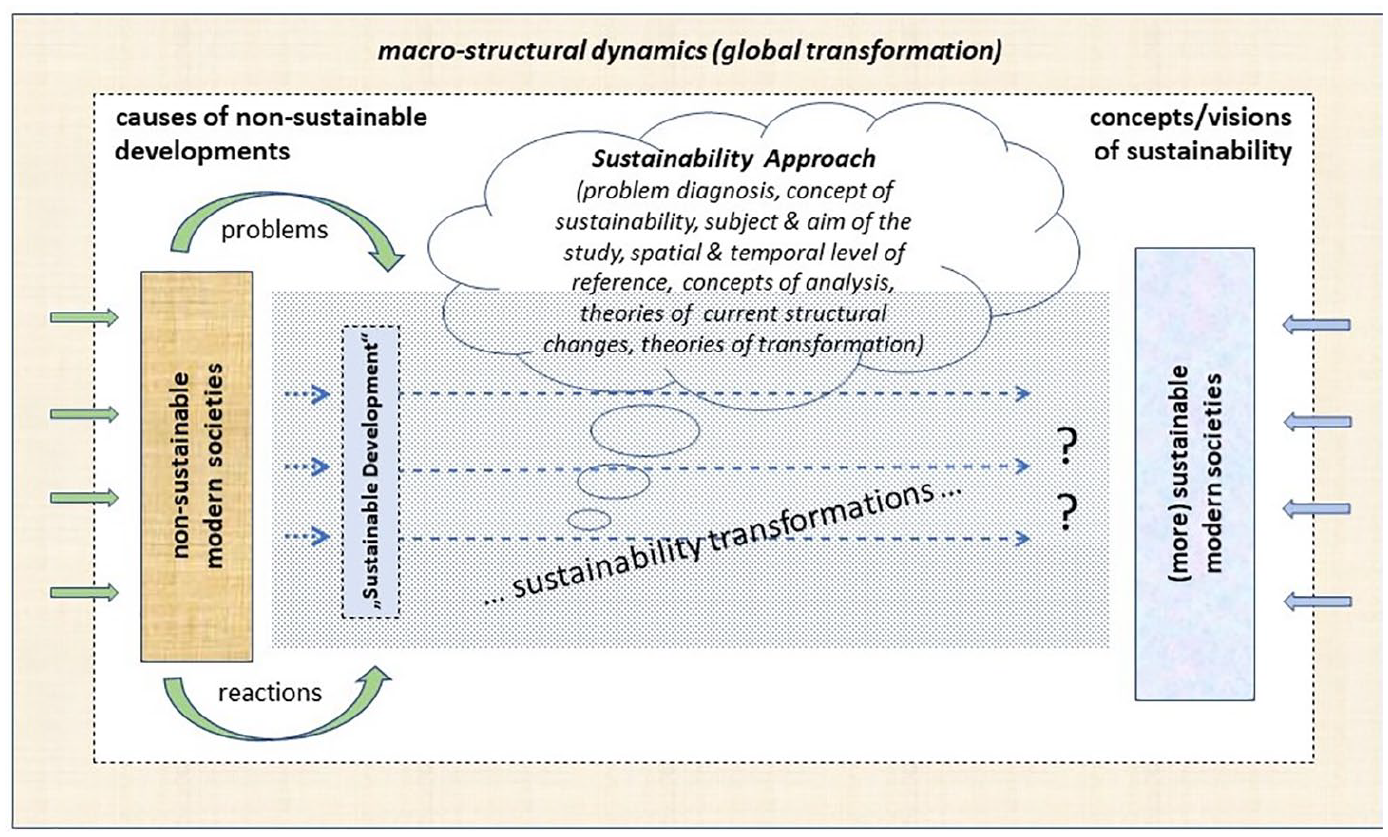
Analytical framework for comparing sustainability approaches in the social sciences.
This analytical framework will be used below for a critical discussion of the research program of the newly established Humanities Centre for Advanced Studies ‘Futures of Sustainability: Modernization, Transformation, Control’ at the University of Hamburg. This discussion will be based on two publications: an outline of the research program’s theoretical frame of reference (Adloff and Neckel, 2019) and a publication by Neckel et al. (2018) with a slightly different empirical focus on typical strategies of incorporating the principle of sustainability in economic and social life.
‘Futures of sustainability as modernization, transformation and control’: A critical analysis of Adloff and Neckel’s research approach
For the heads of the Hamburg research program ‘sustainability has become a key concept of social change on the level of world society’ (Adloff and Neckel, 2019: 1). Their object of study, thus, is the question how and in which direction sustainability discourses and practices transform societies.
To answer this question, the authors choose as the starting point for their analysis a definition of sustainability and sustainability problems which draws – in a broad sense – on resource economics. According to Adloff and Neckel, the debate about sustainability is ‘caused primarily by the exploitation of resources that are vital to the survival of present-day societies – be it the natural resources of our ecosystem, the economic resources that guarantee our wealth, the social resources of care and solidarity, or the personal resources of professional capacity and private lifestyles’ (Adloff and Neckel, 2019: 1). In their view, the principle of sustainability provides us with a response to these different resource problems. The empirical focus of their research program, then, relies on ‘the emergence of new conflicts, inequalities, hierarchies, and justification patterns that result from including imaginations of sustainability into different fields, institutions, and value systems’ (Adloff and Neckel, 2019: 2).
Theoretically Adloff and Neckel’s empirical field of investigation is structured in two respects. On the one hand, they structure the field of possible transformations by three ideal-typical sustainability trajectories guided by competing ‘imaginations of sustainability’: sustainability as (1) ecological modernization (green economy), (2) radical socio-ecological transformation (degrowth, convivialism, post-development etc.), and (3) authoritarian control (in reaction to ecological emergency). On the other hand, they use three basic analytical concepts – ‘imaginations’, ‘social practices’ and ‘structures’ (especially ‘infrastructures’ as socio-material components of societies) – as theoretical tools to analyze the dynamics of transformation in the tension between these three possible sustainability trajectories.
Using the analytical framework outlined above, in the following the constructive principles as well as the weaknesses and blind spots of this research approach will be discussed in more detail. The focus will be on (a) the definition of sustainability and the central problems of sustainability, (b) the socio-spatial level of reference, (c) the structuring of the field of study by the three sustainability trajectories, (d) the underlying, implicit model of sustainability transformation as well as (e) the – also implicit – social diagnosis of current global changes as macro-structural context for sustainability transformations.
(a) While Adloff and Neckel do refer in their program outline to the concept of sustainable development that was worked out in the Brundtland Commission, anchored at the UNCED Conference in Rio in 1992 and updated in the Sustainable Development Goals of 2015, they immediately abandon this broad, integrative model of sustainable development in favor of a concept of sustainability drawn from resource economics. As Neckel writes, ‘sustainability stands for a societal development goal that aspires to provide for the future by reaching an equilibrium between the consumption of resources and their conservation. In the time horizon of the present, sustainability is understood as a mode of action by means of which the overexploitation of resources can be curbed and the development goal of resources security can be achieved’ (Neckel, 2017: 47). The fact that this goal has attained such a great transformative force for society in the past decades is tied to the growing pressure of this problem; this makes a ‘modernisation of capitalism’ inescapable. ‘The key problems of social reproduction that a sustainable modernisation of capitalism seeks to overcome are, firstly, the need to safeguard the renewability of the ecological, economic, social and subjective resources that social institutions require for their survival and must utilize for their own further development’, and, secondly, ‘the need to ensure the potentiality of future development opportunities, which must not be destroyed or substantially circumscribed by the resource problems of the present’ (Neckel, 2017: 49). In the struggles for a sustainable modernization of capitalism, Neckel argues, sustainability is gradually emerging as a new justification pattern of social order. In this sense, sustainability can be understood as ‘the new spirit of green capitalism’ (Neckel, 2017: 49).
While this understanding of sustainability processes, modeled on Luc Boltanski and Ève Chiapello’s work on The New Spirit of Capitalism (2007), does outline one of the three possible sustainability trajectories – the currently dominant neo-liberal ‘modernization’ path – it curtails the meaning of sustainable development as a guiding principle of social transformation in a problematic way. Sustainable resource management, even in a broader sense, is only one of the discussion threads that contributed to the formulation of the concept of sustainable development. What is new about this principle is precisely the integrative perspective, the linking of global social and ecological goals. In international negotiations, national sustainability strategies and local sustainability processes, but also on the level of individual actions (for example, as part of ‘fair’ and ‘sustainable consumption’), the ecological and social dimensions of sustainable development are always connected with each other – even if in a very different way in different social contexts. It is precisely this broad, integrative horizon of meaning that has enabled the most diverse social actors to take up sustainable development as a guiding principle – and also to claim its utopian surpluses.
The substantive narrowing of the concept of sustainability also suggests false or at least one-sided analogies – for instance, when a ‘structural homology, an elective affinity between the lifestyle of the middle classes’ and regenerativity and potentiality as the basic principles of sustainability is asserted (Neckel, 2018: 65). Furthermore, the narrowed conception of sustainability provides no basis for a more radical socio-ecological transformation strategy. Sustainability concepts drawn from resource economics offer few systematic links to transformation paths oriented towards principles of social justice. When Adloff and Neckel consider socio-ecological visions of solidarity-based ways of living as a possible driver of sustainability transformations, they have to follow a broader, integrative understanding of the principle of sustainability.
(b) The conceptual narrowing of the understanding of sustainability is crucially tied to the Western bias of the research program. It is focused on the dominant ecological understanding of sustainability in Western countries. Non-Western regions of the world, countries such as China, India, Brazil or Russia, play a growing role in the dynamics of (non-)sustainable development, however, not only as affected parties, but also as causes of sustainability problems and as transformative political actors. These countries are shaped by very different political cultures and historical legacies, by different economic structures and social problems, by different political regimes, social cleavages, power relations and social movements. This all deeply affects the possible pathways of sustainability transformations (see Brand, 2017; Martinez-Alier, 2002).
(c) The three sustainability trajectories outlined by Adloff and Neckel (modernization, transformation, control) distort the empirical field of study for sustainability transformations not only in the above-mentioned regions, but also in Germany and other Western countries. Do not, for example, post-growth visions based on sufficiency give rise to sustainability paths that are very different from those arising from anti-capitalist visions of a ‘solidarity-based economy’? Does it make sense to combine technology-based visions of a capitalist ‘green economy’ with socio-political visions of a ‘Green New Deal’ into a single sustainability path (modernization), if political sustainability debates in the coming years will be played out in Western countries most probably along the conflict line between these two visions of sustainability? And do not principles of resilience also play a central role in post-growth debates and socio-ecological transformation models (for example, in the transition-town movement or the debate about the re-localization of global food chains) – not only in the context of emergency and control regimes? All of this suggests a somewhat different design of ideal-typical sustainability trajectories for Western countries as well, to cover the central cleavages in the debates over the futures of sustainability.
(d) As regards the theoretical framework, the concepts of collective imaginations, social practices and (infra)structures provide a multi-dimensional access to the empirical analysis of social changes arising from the integration of sustainability principles. They systematically link cultural, social, political, technical, corporeal and natural dimensions of sustainability transformations. Whereas this conceptual frame is rather convincing, it is all the more striking that the research approach has no elaborated theory of social transformation in general, and sustainability transformations in particular. At no point, Adloff and Neckel develop a theoretical concept of how radical transformations of modern societies work and how and to what degree these transformations can be politically shaped.
Transformative approaches to sustainability research are certainly under more pressure than approaches with a more reflexive stance to explicate their own theories of transformation. They require a more precise knowledge about the possibilities for intervening in and shaping transformation processes in the various fields of action. However, even a more distanced observation of the dynamics, dilemmas and paradoxes of sustainability transformations employs, at least implicitly, specific models of social change to interpret these ambivalent developments. These assumptions require explication. Evolutionary models of functional adaptation drawn from modernization theory, as these are suggested by some contributions to the Gesellschaft der Nachhaltigkeit (Neckel, et al., 2018), are in any case far too undifferentiated to grasp with the complexity and conflictual dynamics of structural sustainability transformations.
(e) A final point concerns the analysis of the global, macro-structural context of sustainability transformations. In this regard as well, Adloff and Neckel do not provide any theory that would allow us to locate sustainability transformations within the specific historical context of present-day crisis of the political and economic world order. Just as the framing and dissemination of the concept of sustainable development was closely tied to the establishment of neo-liberalism world-wide and the unfolding of new globalization dynamics, the conditions for sustainability transformations will significantly change with the decline of neo-liberalism as the hegemonic regulatory model. By avoiding to contextualize present and future sustainability transformations more precisely in global technical, political, economic and cultural changes, Adloff and Neckel lose sight of the decisive factors that influence the futures of sustainability.
Summary
Although the Hamburg research program, with its open, empirical configuration and its elaborate conceptual instruments for analyzing possible ‘futures of sustainability’, does compare positively to many one-sided, normatively overburdened sustainability studies, the critical discussion of this approach has identified a series of inconsistencies and blind spots.
The central problem is the program’s narrow definition of sustainability. If sustainability is understood as a principle to safeguard the renewability of natural, economic and social resources, this understanding takes up only one – even if a more broader defined – dimension of the Rio-concept of sustainable development. The central innovation of this concept, however, was the integrative linking of the principles of ecological sustainability with those of social justice. Only following this integrative perspective the principle of global development offered a common ground for very different imaginations of a sustainable future. The one-sided definition of sustainability narrows both the empirical field of analysis and the scope of theoretical interpretation. As a result, inconsistencies between the research program’s concept of sustainability and the three ideal-typical sustainability trajectories emerge. De facto, the research program restricts itself to the analysis of the ‘futures of a halved sustainability’.
These theoretical inconsistencies are supported by the Western bias of the research program. Viewed globally, sustainability dynamics unfold in a great variety and with a much broader spectrum of imaginations and possible futures than the three trajectories (and their mixtures) envisioned by Adloff and Neckel. To map out plausible alternative futures of sustainability requires moreover a specific transformation theory. And it also requires a social theory of current global changes, in order to grasp the specificity of the historical conditions that shape the ways of and opportunities for sustainability transformations. At least all of this would be a desideratum for a more transparent, less arbitrary research on sustainability.
Footnotes
Funding
The author received no financial support for the research, authorship, and/or publication of this article.
