




Abstract
I identify a hitherto unrecognized contribution of labor to production stemming from an innate sense of psychological ownership of the fruits of one’s labor. This is rooted in the consciousness accompanying all human activities and is distinct from legal ownership. Consciousness is inalienable; it cannot be contracted on. Labor’s psychological ownership generates quasi-rents, which can be appropriated by capitalist firms with market power. Monopsony power, now empirically seen to be ubiquitous in labor markets, has more serious efficiency and equity consequences than recognized. In a neoclassical framework, I also show why labor is uniquely vulnerable to exploitation—reconciling it with Marxian views. If capitalist owners are taken to be unaware of their workers’ psychological ownership, this exploitation occurs even in competitive labor markets.
1. Introduction
A few years ago, the moral philosopher Elizabeth Anderson (2017) delivered a scathing attack on some aspects of American capitalism in her book Private Government. She argued that, in their treatment of workers, private firms are virtually communist dictatorships within which there are few checks and balances of the sort that democratic governments operate under. While some of her claims may seem contentious to economists, there is little doubt that the facile assumption economists make that workers are under free and voluntary relationships with their employers in ways no different from those of customers and their grocers does violence to the reality. This raises the issue of whether, when viewed through the lens of neoclassical economics, there is anything in the very nature of capitalism that lends itself to what we may call “exploitation.” Since exploitation is a term that has many connotations, I hasten to add that I shall adhere to the strictly neoclassical definition of it in the tradition dating back to Pigou (1920); namely, there is exploitation if the wage rate falls short of the marginal revenue product of labor. In this article, I investigate the question: If there is exploitation of production inputs in contemporary capitalist economies even with voluntary contracts, what is it that fundamentally renders labor more vulnerable to it? That is, while the neoclassical definition of exploitation can apply to any input of production, what it is about labor that might make it uniquely susceptible to it?
While a basic tenet of neoclassical economics is that the wage rate of labor is equal to its marginal product in competitive labor markets, the evidence shows that this claim is strongly violated in labor markets. 1 One explanation for this, backed by a considerable amount of empirical work, is that even in highly developed market economies like the United States, the labor markets are monopsonistic. 2 In this article, I unpack the wedge between the marginal product of labor and the wage rate to isolate the unrecognized—and arguably the most human—contribution of labor. I show that even in a neoclassical framework, exploitation of labor exists and that it arises from the appropriation of quasi-rents generated by labor.
These quasi-rents are tied to the question I pose above, being the core feature that renders labor vulnerable to exploitation. And it also speaks to the pervasive and persistent feeling of being exploited among low-income workers in highly developed capitalistic countries (see, e.g., Kantor, Weise, and Ashford 2021). My theory does not posit any explicitly coercive workplace practices, whatsoever—such as requiring workers to do tasks not covered by contract. The workers are assumed to voluntarily offer their labor in exchange for the contractually agreed upon wage rate. This, however, does not deny that various forms of coercion do exist in the reality of the workplace, but only that my theory does not require coercion in the workplace for exploitation to obtain.
My point of departure is to examine the psychology of work, which reveals a sense of psychological ownership arising from the activity one engages in. This is a deep-rooted and entrenched tendency for which there is evidence in the field of psychology. It was very likely hardwired by evolution to ensure the performer’s attachment to the fruits of their labor so that it can promote survival through defense against interlopers if required (Eswaran and Neary 2014). This view is consistent with what was probably the earliest theory of the emergence of private property, namely, that due to John Locke ([1869] 1967), in which he posited the expenditure of one’s labor to be crucial to establishing a legitimate claim to property as private.
This sense of psychological ownership accompanies all our actions—indeed, without this automatic association between an action and the innate ownership of it, we would be unable to even make the tacit claim “I performed such and such an action” or ever feel responsible for it. If workers confer their labor on a product that belongs to a capitalist, it may well preclude any legal claim on the output if the effort has been paid for as per the contract. But it does not eliminate the sense of psychological ownership over the fruits of their labor, a feeling that has been shaped by evolution. Psychologists going back to William James (1890) observed and emphasized this proclivity. Recent literature in neuroscience and psychology has been trying to come to an understanding of the link between the physical self (the body) and the psychological sense of ownership of the former’s actions (see Truong et al. 2016; Constable, Kritikos, and Bayliss 2011; Arzy and Schacter 2019). It is surprising, however, to see almost no reference to the psychology of work in the literature on the economics of work.
This form of ownership is an unappreciated noncognitive and innate trait that is important for production. This is so because it manifests a commitment to effort that enhances the intensity with which labor works on the job. The framework I adopt to spell out my view is a standard neoclassical one in which inputs are presumed to receive a remuneration that corresponds to their marginal contribution to the output unless there is market power. The increased output that is purely due to the psychological sense of ownership constitutes quasi-rents generated by labor. But these quasi-rents do not necessarily accrue entirely to labor; they can partly accrue to capital. As a result, in a monopsonistic labor market, labor ends up receiving even less than its marginal product (while capital receives more) than would be inferred from standard models of monopsony.
Labor is voluntarily provided in accordance with the contract at the wage rate specified but what is actually delivered is the consciousness-augmented labor of the worker that necessarily accompanies the worker. 3 It is the consciousness of a sentient being animating this input (without which there is no sense of psychological ownership) that separates the input of a worker from those of nonhuman production inputs like land, robots, or any form of capital other than human capital. The exploitation addressed here consists, then, of the part appropriation of that contribution of labor that is quintessentially “human,” namely, consciousness. This aspect of labor’s output and of its exploitation has not been recognized by researchers. This phenomenon contributes to the wedge between the marginal product of labor and the wage paid in monopsonistic labor markets, and also accounts for the workers’ sense of alienation.
The next section summarizes the empirical evidence on the relationship between the wage rate and the marginal product of labor, especially at the lower income levels. Section 3 discusses what makes labor different from all other inputs used in the production process. The nature of the sense of psychological ownership is discussed, as documented in the psychology literature. In section 4, I work out some of the economic consequences of the sense of psychological ownership in terms of what it means for workers’ productivity.
Section 5 presents the simplest possible model—that of a classical firm—in a monopsonistic labor market to illustrate how labor’s quasi-rents get partly appropriated to increase profits and is an inherent source of exploitation in the workplace. I assume that the monopsonist recognizes that higher wage rates incentivize workers and increase their labor intensity. Some implications of the theoretical findings are discussed in section 6, and my concluding thoughts are presented in section 7.
2. Brief Survey of the Empirical Evidence on Wage Rate Markdown
This section briefly outlines the evidence on the gap between the wage rate and the marginal revenue product of labor. What would be most relevant are studies that look at disaggregated data, estimate the marginal productivity of labor, and compare them with the respective wages. The results of such studies are mostly the ones I briefly summarize here.
The results of the first postwar attempt to test marginal productivity theory of wages attempted by Gottschalk (1978) have withstood the test of time and more sophisticated empirical techniques. Using the 1958 manufacturing data from the United States, he estimated the marginal productivities of various labor groups (eight in all) and of capital and compared them with the median earnings of these inputs. The estimation was cross-sectional, over states and industries. He found that capital received more than its marginal product (131 percent). As a whole, labor received less than its marginal product but there was substantial variation across the different labor groups. The ratio of earnings to marginal product was higher for white collar workers than for blue collar workers. In fact, there was a statistically significant negative correlation between the marginal product of a group and its earnings. Gottschalk and Tinbergen (1982) claim that these results are substantially unchanged when some of the potential estimation issues are addressed. Kampelmann and Ryx (2012), who used Belgian data, found results were consistent with, and did not substantially alter, those of Gottschalk (1978).
More generally, Appelbaum (1978) tested the neoclassical production theory, an attempt that clearly has an important bearing on the issue at hand because this theory also determines the distribution of income across the various inputs in an economy. Among the various tests he conducted, one was to see whether the inverse derived demand for inputs predicted by the theory as being related to the cost of production held up empirically. He found that the theory decisively fails this test. This is an important finding, since neoclassical economics arrives at the marginal productivity theory of wages by equating the derived demand for labor equal to its wage rate.
In recent years, there has been a renewed interest in characterizing the market structure of the labor market and questioning the presumption that it is typically competitive. The evidence, summarized by Boal and Ransom (1997), Manning (2011, 2021), Booth (2014), Sokolova and Sorensen (2021), and Card (2022), shows that there is considerable monopsony power in the labor market. Instead of directly estimating the difference between the marginal revenue product of labor and the wage rate, recent studies have typically inferred monopsony power by estimating the elasticity of the labor supply and the associated wage markdown it implies. They find that monopsony power is substantial and that this results in lower posted wages.
There are too many empirical studies to be individually reviewed here, but I mention the paper by Azar, Marinescu, and Steinbaum (2022), where the authors find concentration in the labor market across the United States. Benmelech, Bergman, and Kim (2022), using data on manufacturing from the US Census Bureau over the nearly forty-year period 1978–2016, find that local concentration in the labor market leads to lower wage rates in the absence of unions. The recent review by Sokolova and Sorensen (2021) is particularly useful here because the authors perform a meta-analysis of the 1,320 published estimates of the elasticity. Apart from the expected variation in the estimates, the findings seem to consistently differ depending on whether they were obtained from directly estimating the elasticity of the labor supply on the wage rate or inversely by estimating the elasticity of the wage rate with respect to the labor supply. They find that the implied wage markdowns vary between 1.16 and 1.05.
Among more recent papers, Yeh, Macaluso, and Hershbein (2022) estimate the wage markdown directly. For the entire manufacturing sector in the United States, the labor market cannot be characterized as anywhere near perfectly competitive. They find that, on average, the ratio of the marginal revenue product of labor to its wage rate is roughly 1.53, implying that for every dollar’s worth of marginal contribution by labor to its revenues, it is paid only about 65 cents.
Since the exploitation of low-wage workers would be deemed a more pressing issue to policy makers, it is noteworthy that there is evidence of strong monopsony power in the gig economy, too. Recently, Dube et al. (2020) offered compelling experimental evidence showing that the elasticity of labor supply is very low (as low as 0.1) even for online jobs entailing low search costs, despite search costs being posited in the literature as an important source of monopsony.
In sum, the evidence strongly suggests that the bottom of the labor occupational hierarchy receives less than its marginal revenue product. Given the demonstrated pervasiveness of monopsony in labor markets, monopsony power may be seen as an explanation. 4
However, I claim that there is an additional, fundamental, and unrecognized reason for the magnitude of the wage markdown and my article focuses on this. I propose an explanation consistent with the empirical findings even when the labor market entails no search costs and when there is no human capital acquisition possible on the job. My formal explanation requires monopsony but claims that the efficiency loss and the exacerbation of inequity under monopsony are greater than what they are thought to be hitherto. And the nature of this appropriation may be responsible for workers’ keen sense of being exploited.
But first, we must discuss why labor is distinct from other inputs of production. In particular, we need to isolate the aspect of labor that generates quasi-rents in a neoclassical model and renders it especially vulnerable to the possibility of exploitation by capitalist firms.
3. The Nature of Labor and Psychological Ownership of the Fruits of Labor
This brief section proceeds in three steps. First it identifies what it is about labor that is unique to it as an input of production and sets it apart from all other inputs. Having done so, it discusses how and why the conferring of labor on a product induces an unconscious psychological sense of ownership, irrespective of legal ownership. Finally, it argues that this sense of psychological ownership matters because it raises labor’s productivity and generates quasi-rents. Although the main focus of this article is on the exploitation of low-income workers, what is said in this section applies to all forms of labor, whether it is the crudest and least skilled or the most creative and highly skilled.
3.1. On the psychological nature of work
Providing labor clearly requires the workers to apply themselves along with the service they provide. The very act of bestowing effort involves the individual, engaging their consciousness and their mind in the process because they cannot be separated from the activity being performed. The workers have to impart their own sentience or consciousness and being into the activity they undertake. 5 Of course, to provide their input, they must also make their skills available—which is their alienable property. But along with effort and skills, they have to provide that which is inalienable—their consciousness.
The same is obviously not true of other, nonhuman inputs of production. A piece of land or of machinery has no consciousness or being that it can impart to its services. There the consciousness belongs to its owners, who are not engaged in the provision of the actual services. They only legally own the asset that they rent out; they supply only what is alienable, without adding anything that is inalienable. In contrast, workers provide what is alienable and also what is inalienable. 6
We have to understand whether the unique nature of the labor input matters and, if so, in our theorizing we have to incorporate that difference between a service provided by an inanimate factor of production and that provided by a conscious human being. They cannot be equated merely because both services are “rented.” Moral hazard in the case of labor is a very partial aspect of this difference and it is the aspect that is emphasized in standard economics. The distinction, however, is far more fundamental.
I propose below that there is a contribution to output which comes from that part of labor that is inalienable, and so cannot be contracted on. This contribution is rooted in consciousness, which is always present in all the activities of humans and, therefore, cannot possibly be withheld in the performance of any activity. The next subsection discusses how this manifests in a manner that is very relevant to economic production.
3.2. Psychological ownership over the fruits of one’s work
Perhaps the most fundamental notion that individuals entertain of themselves is the concept of self. It is the concept that they believe answers the question, “Who am I?” This sense of self, or of identity, has the aspect of consciousness and, therefore, is not an object that can be concretized, bought, or sold. Consequently, it is not an economic entity in the usual sense.
In his classic Principles of Psychology, William James (1890) considered even a person’s various possessions to contribute to the sense of identity, of who they take themselves to be. This is why even a loss of possessions that have no financial value may be deeply felt (like the loss of a cherished object of sentimental value or even the loss of a long-held belief). These losses are felt as damaging to the identity of the person. James considered the tendency to claim ownership as partly instinctual in humans, as in animals. Contemporary psychologists and sociologists have clearly demonstrated that a sense of ownership is implicated in the development of self from a very young age (Furby 1991; Dittmar 1992) but is entrenched in adults. This sense of ownership is an avenue through which the self extends itself beyond the body and mind to form an “extended self” (Belk 1988), which is also what James (1890) referred to as the “empirical self.” This empirical self blurs the distinction between “me” and “mine,” a blurring that is brought into sharp focus when we lose a possession that was of value to us. 7
James (1890) made a further point that is very relevant to this paper: An. . . instinctive impulse drives us to collect property; and the collections thus made become, with different degrees of intimacy, parts of our empirical selves. The parts of our wealth most intimately ours are those which are saturated with our labor. (ch. 10, emphasis added)
In this, James drew a strong link between the labor conferred on an object and the subsequent sense of ownership of it. There is a primitive but strong sense of ownership at the psychological level that forms the underlying notion of proprietary rights, which is why we observe territoriality in animal species (Kline and France 1898). The claim to ownership, then, is not restricted to legal systems. Furthermore, this sense of psychological ownership is especially strong when we have expended effort in an activity (“saturated with our labor”). The extent to which the self is linked to possessions depends on the extent to which the object is salient to their domains of self-worth (Ferraro, Escalas, and Bettman 2011). This would matter a great deal on issues pertaining to work because, for the vast majority of people, the job they do is a matter of great importance to them and success in it is a very significant domain of self-worth. Any possession pertaining to their work, therefore, acquires considerable salience.
In fact, the link between the labor applied in any endeavor and property rights has a much more ancient legacy. This innate sense of property rights is very likely to have arisen because natural selection found it expedient for individual survival. The emergence of such rights at the psychological level would elicit a defense against appropriation by interlopers of the energy spent on productive activities. No doubt this is why we tend to lay claim to the fruits of our labor and are averse to seeing it appropriated by others. Eswaran and Neary (2014) provide a formal theory based on this idea. Given this deeply entrenched trait in human nature of psychological ownership over one’s endeavors, it would not be unreasonable to infer that the law subsequently merely formalized what would have been inefficient or wasteful to thwart.
The neoliberal view of private property derives from the theory of Locke ([1869] 1967) in his famous essays on government. Locke developed what has been dubbed the “labor theory of property.” He addressed the issue of when private property may be justified in a world where the earth’s resources are commonly owned. He famously argued that if a person worked a piece of land (by “mixing their labor”) and increased its productivity, they can subsequently claim that piece of land as their own and withdraw it from the commons. He had a qualification—subsequently called the Lockean Proviso—that this withdrawal from the commons is permissible if enough land is left over for others and what is claimed is not wasteful. 8 There is a literature in psychology where scholars have documented evidence showing a sense of ownership especially when one has expended effort, even if they were not the original owners. 9
3.3. Why psychological ownership matters
What people do for their living becomes a part of their identity. Among economists, this has been first recognized in the work of Akerlof and Kranton (2000, 2005). We have seen, because one’s labor imbues a sense of ownership of the activity and its product, it feeds into our sense of self. I argue that psychological ownership increases the intensity with which one labors on a product. The standard reason, based on legal ownership, presumes that ownership incentivizes a person to confer more effort because it would increase the value of the product and that would increase their future wealth. While this is an expedient analytical objective invoked in neoclassical economics, wealth maximization is not the only motivation humans are driven by; there is a more primitive and compelling motivation. Since what one owns is intimately linked to one’s sense of self, working more assiduously on their product unconsciously enhances their self-concept. And, in a virtuous circle, a more powerful self-concept improves performance, which in turn increased survival chances in our evolutionary past. Evidence from psychology confirms this view in the context of contemporary organizations (Tannenbaum 1983; Pierce and Rodgers 2004).
This route, whereby a person confers their creativity and effort to enhance the worth of their product because it unconsciously promotes the survival of self (which is the overseer of the individual’s body and mind) is hardwired and is independent of the claim that ownership will increase future wealth. Agents may have no legal claim on the output, but their innate sense of psychological ownership will induce a higher intensity of effort because that proclivity, which has been wrought by evolution, is neither easily dislodged nor entirely superseded by the presumed objective of wealth maximization. The greater the labor bestowed on an activity in the past, the more it is valued because the more it embodies the person’s self-concept, as James (1890) pointed out, the more engaged we would expect the person to be in their work.
In fact, I conjecture that, if the same income is earned from an impersonal asset and also from another asset that was generated by one’s labor, the latter income will be valued more because it is accompanied by a sense of ownership and enhances the person’s self-concept. Apart from the income generated, in other words, the work one has done significantly impinges on one’s sense of identity. This would be a stronger version of the endowment effect proposed by Kahneman, Knetsch, and Thaler (1991), which reveals that people value the products they own more than the market values those products. The ostensible reason for this effect is “loss aversion”—losses are perceived as more painful than gains. But psychologists have been coming to the view that it is not loss aversion that is responsible for the endowment effect. Rather, it is the ownership of objects that renders people prone to value their own possessions more than others’ (Morewedge et al. 2009; Ferraro, Escalas, and Bettman 2011).
The endowment effect, it turns out, is intimately tied to ownership, which is tied to the sense of self. This, in fact, was precisely what was demonstrated in the evolutionary model of Eswaran and Neary (2014). In a later paper, again using an evolutionary model, Eswaran and Neary (2016) showed that there is an intimate relation between the notion of sunk costs and the self-concept because the labor we have devoted to an activity inevitably becomes a part of our self-concept. In other words, Darwinian natural selection has wrought a deep connection between spent labor that cannot be retrieved, the attachment to these sunk costs, and the sense of psychological ownership—which is arguably the evolutionary foundation of the endowment effect that renders us partial to what we own.
In economic production, legal property rights over the output are presumed to incentivize economic agents to work hard because they garner the full benefits of their effort. But the absence of legal ownership of the output does not eliminate the sense of psychological ownership in the employees—they are not mutually exclusive. In the past few decades, evidence on the beneficial effects of psychological ownership has been documented as an empirical fact even in modern organizations (Pierce and Jussila 2010; Dawkins et al. 2017).
Psychological ownership essentially leads to psychological commitment to work, and it increases workers’ productivity beyond what has been contracted on but is typically unmeasured and can be, at least partly, unrewarded. We may legitimately consider it a productivity-enhancing intangible asset—after all, its close cousin of legal ownership is deemed to be highly productive. This contribution to productivity of the sense of psychological ownership sans legal ownership has not been recognized in the conceptual framework of neoclassical economics.
Absence of free riding in the application of effort is associated with full legal ownership because the fruits of our effort accrue entirely to us. Standard models of production invariably emphasize the moral hazard aspect of hired labor, couching it in terms of the labor-leisure tradeoff (Alchian and Demsetz 1972). It is very likely, however, that psychological ownership reduces free riding because ownership is not viewed only in terms of the income or wealth but is tethered to the notion of self. With income generation, one’s effort can be substituted by inputs like other people’s effort. A case in point is teamwork, where each agent bears only a fraction of the cost of their moral hazard but the full benefit of the attendant leisure. But with psychological ownership, it is one’s own action that is warranted for self-actualization. Psychological ownership, therefore, is less vulnerable to moral hazard and, in fact, attenuates the proclivity for free riding by inducing a commitment to work.
It must be pointed out that some activities of production may be less open to psychological ownership than others. For this feeling of ownership to arise, there needs to be a well-defined service or product for which one’s actions are more or less the cause. Most production activities tend to have this feature, but some do not. Assembly line work, where each worker has a small task in the ultimate production of a product is an example of the latter. Workers are limited in the autonomy they can exercise to shape the product, and their pace is set by mechanical contrivances like a belt moving at a steady clip. It is hard to imagine that workers who see themselves as small cogs in the wheel would cultivate a sense of psychological ownership toward their job. For such jobs, the theory offered in this article would not apply. But it would for the bulk of economic activities that permit some scope for autonomy. 10
4. The Productivity Consequences of Psychological Ownership
Traditional neoclassical models of capitalist production emphasize the roles of incomplete markets, asymmetric information, and employee moral hazard. In order to isolate and focus on the mechanism that I am proposing, I shut down these well-studied avenues and set up the simplest model sans bells and whistles so as to bring out the new conceptual contribution of this article.
4.1. Consequences for labor intensity
Consider nonunionized workers who are hired for 2 periods by a firm (two periods being the minimal number required to capture the idea in the simplest possible manner). The workers are to be paid the same wage rate, denoted by w, in each period and the intensity of the labor they each apply in period t is denoted, respectively, by
The utility function of a worker comprises the income earned in the period, which is just
The explicit utility derived from the sense of ownership,

where the parameter

where the first and last terms of (2) are standard, and
Attachment to one’s work cannot arise in the abstract. Essentially, the attachment of workers to the fruits of their labor arises after they begin engaging with the work and, as an instinctive by-product, they acquire a sense of psychological ownership of it. This tendency, as I have argued in the previous section, is a proclivity very likely hard-wired by natural selection in the evolution of humans (and other species).
Once employees begin their work, they will realize that the (endogenous) intensity with which they engage in the work will condition how they feel about it now and in the future. They will anticipate how their current labor intensity will impinge on future outcomes and so, to determine their labor intensity, we work backwards from the second period. The discount factor is taken to be 1 for simplicity.
In period 2, since

which yields:

and the second period utility,

In period 1 the worker faces the problem:

Since

where the function
We see that the period 2 labor effort at wage w is higher when there is a sense of ownership (
In the context of their monopsony model, Langella and Manning (2021) allow for a worker’s effort and productivity to be influenced by the wage rate. They cite the evidence provided by Coviello, Deserranno, and Persico (2022) for a minimum wage increasing worker productivity.
12
The same remarks apply here to my model, too, though in my model this productivity increase is magnified by psychological ownership. As mentioned,
The feeling of psychological ownership, which depends on past effort applied on the job, magnifies (and makes permanent) the positive effect of wages. As a result, the difference between (6) and
There are three additional points that we may note. First, I assumed that there was no discounting between the two periods. Had the discount factor been less than 1, it is easy to show that when
Second, in his empirical work Lazear (2000) found that the productivity of a worker was increasing in tenure, and he attributed much of it to learning—as is standard in the labor economics literature. However, this empirical fact is also consistent with the mechanism emphasized here, namely, greater psychological ownership in their work as time progresses will increase the worker’s productivity, and this increase will arise even if the work offered no possibility of learning.
Third, as I have argued, the endogenous sense of psychological ownership is intimately related to a worker’s identity. Since it increases with the wage rate, the respect that a worker would feel is their due is increasing in the wage rate. The sociological literature refers to this as “dignity” (e.g., Hodson 2001). In recent empirical estimations by economists that allow for wages and amenities (many of which pertain to workers’ dignity), it is found that the wage rate and amenities are complementary in the employment package (Sockin 2021; Dube, Naidu, and Reich 2021). That is, wages are not a compensating differential for poor amenities; wages and amenities are positively correlated. Job satisfaction increases with high-paying jobs, even after accounting for the effect of higher pay; in fact, Sockin (2021) found that higher wages explain no more than 19 percent of job satisfaction, the rest being due to nonwage amenities. The higher productivity from psychological ownership, which increases well-being even if it is not fully compensated financially, will generate precisely these outcomes. These empirical findings, therefore, fit in well with the theory being proposed here.
I summarize the above implications in the following proposition:
Proposition 1: Workers’ innate sense of psychological ownership of their work
(i) magnifies the productivity increase in labor brought about by a wage increase,
(ii) increases their productivity over time even when there is no scope for learning, and
(iii) induces a sense of self, whose strength depends positively on the wage rate.
5. The Exploitation of Labor in a Classical Firm
I now address the issue of how the quasi-rents of workers from psychological ownership can get partly appropriated by firms. As already noted, in recent decades the field of labor economics has come to the view that the labor market is best described as monopsonistic. Estimates of the elasticity of the labor supply with respect to the wage rates suggest that the labor markets are not even remotely competitive. Deviations of the wage rate from marginal productivity can possibly be entirely explained by monopsony power. But it must be recognized that some of the underpayment to labor is to an inalienable but productive input that is uniquely human. The appropriation of quasi-rents of labor pointed to is likely to contribute more to labor’s sense of being exploited than would a mere deviation of wage from marginal product.
To get an idea of the output attributable to labor’s psychological ownership that ends up partly accruing to capital, I consider a simple classical firm, comprising an owner-capitalist and workers. The firm is assumed to be a price-taker in the product market (with product price normalized to 1). I assume that the firm incurs a fixed cost, F, and that the output, Q, is given by the Cobb-Douglas production function:

where
Assume that the classical firm’s owner is a monopsonist in the labor market, consistent with the emerging empirical evidence in the past three decades or so. Consider a wage-posting model with the firm in question facing an upward-sloping supply curve because the alternative opportunities to potential workers differ. Suppose the number of workers with an opportunity cost no greater than w is given by
The monopsonist recognizes that the productivity of a worker depends on the wage rate offered, in accordance with Langella and Manning (2021). Though the labor intensity is not observable, nevertheless, a monopsonist who recognizes the productivity increase that is brought about by the workers’ sense of psychological ownership will correctly infer what this intensity would be. I assume this to be the case here. With full awareness that a worker’s labor intensity will be

For the rest of the article, I posit a constant elasticity supply function for the number of workers,

where
Substituting (6) and (9) into (8) and solving the ensuing first-order condition yields the optimal monopoly wage rate,

where

Substituting these expressions into the objective function in (8) and simplifying, we obtain the optimal profit,

In setting the optimal wage rate, the monopsonist takes into account the fact that a higher wage incentivizes workers to increase their labor intensity. And, with the recognition of workers’ sense of psychological ownership of their work, the optimal wage is even higher. The monopsonist also increases production by hiring more workers. The optimal profit, therefore, is increasing in both
Proposition 2:
(a) A monopsonist who acknowledges workers’ psychological ownership (i.e., (b) When workers are incentivized to apply higher labor intensity with higher wages (i.e.,
It is useful, as a benchmark, to determine the equilibrium that would prevail if the labor market were perfectly competitive. We can readily compute the equilibrium wage if the firm (now treated as a representative firm) behaves atomistically and takes the wage rate as given. The problem it confronts is to choose the number of workers, N, to hire at an exogenous wage rate w so as to solve:

from which the number of workers demanded is seen to be given by:
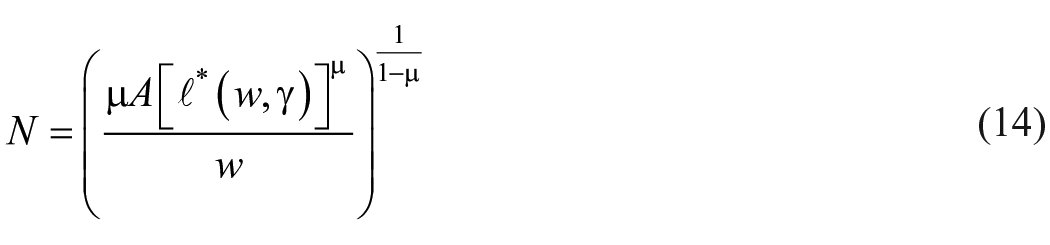
Setting this demand equal to supply given in (9), we obtain the equilibrium wage rate,

and the number of workers employed,

Comparing (10) with (15), (11) with (16), and noting that
Note from (11) and (16) that the disparity between
5.3. Identifying the nature of the exploitation of labor
The wage markdown, as noted, is the ratio of the marginal product to the wage rate. The marginal product of a worker, of course, is wage-dependent in this model because labor intensity depends on the wage rate.
15
At the monopsonist’s optimum, the marginal product, say

which, on substituting from (10) and (11) into the derivative and simplifying, yields:

so that the wage markdown is given simply by:

The wage markdown has the familiar value
At the monopsonist’s optimal employment level, the total underpayment to labor relative to its marginal product denoted by


From (12) and (19), we see that the magnitudes of the monopsonist’s profits and the underpayment of labor both increase in the extent of worker’s psychological ownership.
The ratio of the underpayment to labor relative to the monopsonist’s profit is thus given by:

which, note, is independent of
In a market system, the fact that part of the contribution of labor derives from a noncontractible input (because inalienable) does not mean it would necessarily be unremunerated. It will receive its remuneration at least partially as long as its contribution to output is observable or correctly inferred, as we assume here. In a perfectly competitive labor market (
We see from (17) that the size of the underpayment to a worker
Proposition 3: The wedge between the marginal product of labor and the wage rate in a monopsonistic firm is increasing in labor’s exogenous psychological ownership parameter
While working, the workers create quasi-rents in the form of psychic benefits that induce a commitment to work. But the associated increase in productivity due to the attendant increase in labor intensity is not entirely compensated and its monetary benefits partly accrue to the monopsonist (owner of capital).
16
Therefore, when
When a monopsonist pays a worker below the marginal revenue product, Robinson ([1933] 1969) referred to it as exploitation. What is brought out here in my analysis is that some of this exploitation has a nature that is unique to human labor. Standard underpayment by a monopsonist would arise even if the service were provided by machines with an upward-sloping supply curve and alienable skills identical to those of humans. A machine whose services are contracted for
Proposition 4: If machines have identical alienable skills and upward-sloping supply curve as labor, the wedge between marginal product and the remuneration will be higher for labor. The monopsonist’s profits will also be higher with human labor.
In the light of the above, we can identify where the sense of exploitation of workers comes from. Owners of machines or inanimate inputs rarely complain that the returns of their assets’ contributions have been appropriated; but workers do. This, I contend, is because part of the contribution of the most intimate and unique aspect of labor is being appropriated. 17 In this formal model, labor is fully remunerated for its contribution only in a perfectly competitive labor market, which the recent evidence is revealing it to be a mere theoretical construct that is absent in the real-world labor markets.
6. Relevance of the Theory to Contemporary Empirical Findings
The recognition and incorporation of workers’ psychological ownership of their work as modeled here has some insights to offer on observed empirical regularities. I discuss several.
Higher wages induce greater labor intensity, as we have seen, which in turn leads to a stronger sense of psychological ownership and identity. Therefore, workers with high wages will be more assertive in ensuring access to better amenities, as found by Sockin (2021). Wages and amenities are not substitutes but, rather, are complements (Dube, Naidu, and Reich 2021). This would also explain their finding that high-wage employees respond to better outside offers by asking for a raise, but low-wage employees respond by quitting. This discussion also points to the potential importance of psychological ownership to job turnovers. 18
My theory has implications for worker cooperatives and for worker participation in capitalist firms. Worker participation firms typically have long-term employment (Levine and Tyson 1990). There are many reasons for this, but one plausible reason is that long-term contracts protect workers’ quasi-rents. Pencavel and Craig (1994) examined the behavior of worker cooperatives and conventional firms with regard to price changes and found that in adversity cooperatives adjust pay to prevent layoffs, whereas the conventional firms keep the wage rate fixed and adjust the quantity of labor. I suggest that this is because the identity benefits from psychological ownership are not lost in the former strategy, which worker cooperatives are in a position to adopt. Kurtulus and Kruse (2017) find that American firms with some employee ownership are more stable and have longer lives than conventional firms. Even though their wages are normally at least as large as wages elsewhere, during downturns they cut wages but tend to keep employment stable. I venture that these findings arise because the quasi-rents of workers are enjoyed only as long as they are employed, and more effort would be devoted to ensuring firm survival and employment.
This article has implications for the efficacy of unions. Much has been written about how unions affect a firm’s efficiency. The fact that unions tend to increase the wages of labor may be seen as remuneration wrested for the higher productivity of labor due to the psychological sense of ownership, thereby compensating, in monetary terms, at least some of the quasi-rents that labor generates. In fact, Klein, Crawford, and Alchian (1978), who introduced the importance of quasi-rent considerations in the vertical integration of firms, argued that labor unions often protect the quasi-rents of labor by thwarting employer moral hazard. They were referring to the quasi-rents from the firm-specific human capital of workers, but the same argument would apply for quasi-rents from psychological ownership, which is job-specific by its very nature.
This article has implications for the practice of long-term employment. It brings attention to the fact that culture and cultural institutions play a role in labor market phenomena and, therefore, in the appropriation of labor’s quasi-rents. The Japan scholar Dore (1973) compared a large British firm with a large Japanese one to understand the difference in industrial relations. He suggested that the former fostered individuality, market orientation, and mobility, while the latter promoted organization-orientation, permanent employment, and within-firm careers. Abegglen (1959) has similar observations on the comparison between Japanese and American employment practices. Permanent employment, as it was practiced in Japan may in fact be motivated by a more community-oriented ethic, which may also exhibit respect for the psychological ownership aspect of workers. With long-term employment, the firm promotes productivity in two ways, alluded to above. First, by respecting the labor productivity contributed to an organization through a sense of psychological ownership and, second, by facilitating faster accumulation of firm-specific human capital. This motivation is very different from that posited in neoclassical models in which permanent employees are paid an efficiency wage to curb moral hazard.
7. Concluding Thoughts
In this article, I explain why labor is paid less than its marginal product in monopsonistic labor markets for a reason other than that recognized hitherto. The difference arises from the fact that labor, being a conscious input, has an aspect that is inalienable—it cannot be bought or sold. The sense of psychological ownership of the fruits of one’s actions, which is not possible for inanimate inputs, is generated as a byproduct of work voluntarily done on a specific job, increases labor’s productivity, and creates job-specific quasi-rents. Residual control of firms enables capitalists in monopsonistic labor markets to appropriate part of the output from the higher productivity due to workers’ sense of psychological ownership. Since the recent literature has shown the ubiquity of monopsony power in labor markets, I submit that this contribution of labor exacerbates the workers’ sense of being exploited—even when the labor effort is entirely voluntarily supplied after the contract is signed. My theory reconciles, to some extent, the neoclassical and Marxian approaches to exploitation (for it is consistent with aspects of both paradigms) by recognizing the crucial missing ingredient in the analyses, namely, consciousness.
In capitalism, the appropriation of labor’s quasi-rents is an additional cost to society of the practice of hiring labor in monopsonistic labor markets and is the fundamental source of labor exploitation. It is exploitation that certainly has serious consequences for income distribution and ethics. It also has serious implications for efficiency because resources are misallocated. The pervasiveness of monopsony revealed by the recent literature brings home the point that perfect competition in the labor markets is merely a concept with no actual referent in the real world. Given that, this article demonstrates that generally capitalism purloins from workers the contribution of what makes them quintessentially human—their consciousness, their being—and tends to treat them, if not on par, at least partly as inanimate inputs of production.19,20 Thus, even in a strictly neoclassical model, we see that Marx was correct about the exploitation of labor in capitalism.
In the model, I explicitly assumed that firms know of and acknowledge workers’ psychological ownership, and that they build it into their profit maximization. As a result, realized labor intensity is equal to anticipated labor intensity, consistent with the assumption of rational expectations. In this case, labor’s quasi-rents are partly appropriated in monopsony but not in perfect competition. However, if employers are not fully aware of the psychological ownership of their workers, they will hire fewer workers, pay them less, and also earn lower profits. 21 But this would imply that realized labor intensity will differ from anticipated intensity, violating the assumption of rational expectations. If we accept that deviations from rationality can occur, as emphasized by behavioral economics, then the appropriation of labor’s quasi-rents will obtain even under perfect competition and the existence of exploitation of the kind addressed in this article will be independent of market structure. Perfect competition will lose its theoretical claim to efficiency. More importantly, the exploitation of labor would then be seen as endemic to all of capitalism. Marx’s theory claims that labor exploitation exists under competitive conditions in the labor market. 22 Whether this occurs in reality or not, of course, is an empirical issue and turns on the extent to which firms acknowledge workers’ sense of psychological ownership. 23 In the absence of any solid evidence on the matter, however, I can only claim that the quasi-rents of labor are partly appropriated only if there is monopsony power.
Finally, I point out that exploitation via the appropriation of labor’s quasi-rents arising from workers’ humanness has implications on workers’ mental health, in line with emerging evidence on the link between exploitation and mental health. Using data from the nationally representative US cohort study (PSID) over the period 1983–2017, Prins et al. (2021) find a strongly positive correlation between exploitation (operationalized as a measure of unpaid labor hours) and mental illness. In a Lancet study, Ervin et al. (2022) conducted a systematic worldwide survey of studies on the correlation in employed adults between unpaid labor and mental health. They find strong evidence that, for women, unpaid labor is correlated with poorer health, though for men the results are not so clear cut. Since much of women’s unpaid labor is done in the household, we would expect that a high degree of psychological commitment would be present, especially if children are involved. Psychological ownership may still be relevant even though this phenomenon falls outside the purview of my model. This may partly explain why women’s unpaid labor has adverse consequences for their mental health.
Footnotes
Acknowledgements
I am grateful to Deepankar Basu, Curt Eaton, and Sabri Öncü for their helpful comments; to David Green for a useful conversation; and to Enid Arvidson for her helpful editorial input. All remaining shortcomings are mine alone.
Declaration of Conflicting Interests
The author declared no potential conflicts of interest with respect to the research, authorship, and/or publication of this article.
Funding
The author received no financial support for the research, authorship, and/or publication of this article.
Dedication
In the memory of my former teacher and colleague Keizo Nagatani (1937-2021) and of my former coauthor and friend Ashok Kotwal (1945-2022).
