



Abstract
Masstige, or luxury for the masses, is a phenomenon that requires a heterodox economic approach based on Original Institutional Economics view of corporate power combined with Marxian concept of brand fetishism and post-Keynesian theories of pricing and consumer choice. The attitude toward luxury in classical works on political economy is briefly outlined. By applying the post-Keynesian theory of oligopolistic pricing, we show how the power of luxury brands enables high profits of luxury conglomerates. We use the post-Keynesian theory of consumer choice to differentiate between various types of masstige buyers.
1. Introduction
At the turn of the twentieth century, personal luxury goods “left the temple” of elite class consumers, and the so-called democratization of luxury began. 1 Extending old-luxury brands to middle and lower social classes has over the last twenty-five years become one of the strategies of many luxury producers. By offering lower-priced versions of goods that were traditionally reserved for the rich, luxury companies have initiated the process of bringing luxury brands closer to the masses. This new phenomenon, that Silverstein and Fiske (2003) named “mass prestige” or “masstige,” has turned out to be yet another feature of modern capitalism that defies orthodox economic analysis and requires a broader interpretation. In this article, we approach the phenomenon of masstige from the perspective of heterodox economic theories, especially Original Institutional economics and post-Keynesian economics, which continue the tradition of Thorstein Veblen, John K. Galbraith, Alfred Eichner, William Dugger, etc. Generally, heterodox economics builds on the paradigm of reproductivity and growth, which has its origins in classical political economy of Adam Smith, David Ricardo, Thomas Malthus, and Karl Marx. According to original institutionalists, large corporations play the main role in modern capitalism (Berle and Means 1932; Galbraith 1967; Dugger 1989). They determine the path of macroeconomic dynamics and influence the consumers’ behavioral patterns. The principal goals of corporations are long-term growth and expansion of power, which, in post-Keynesian theory of the firm, is combined with oligopolistic price-setting strategies and procedures (Eichner 1976; Downward 1999; Lee 1998; Arestis 1992: 139–62). For corporations of brand luxury, one of the strategies in pursuing these goals has been making some of their brand products accessible to ordinary people. While making small luxuries affordable to ordinary people, masstige products have also secured high profits to their producers.
The article is organized as follows. Section 2 deals with the evolution of the phenomenon of masstige. It is divided into two subsections. The first subsection outlines the approach toward luxury in the works of classical political economists. In a recent article on the evolution of masstige marketing (Kumar, Paul, and Unnithan 2020), the classical roots of masstige have been entirely overlooked, and so has been the concept of brand fetishism. In the second subsection, we define masstige goods on the basis of standard luxury attributes found in marketing and business literature, and then proceed with characterization of masstige consumers. Section 3 is divided into three subsections dealing with heterodox economic perspectives on masstige. First, the origins of masstige are considered using Marx’s concept of fetishism. Then, an institutionalist view of masstige is developed from Veblen’s concepts of conspicuous consumption and invidious comparison, and from Galbraith’s concepts of revised sequence and dependence effect. Central to the article is the third subsection, in which we present two views of masstige based on the post-Keynesian theoretical framework as proposed by Lavoie (2014). The firm-centric view applies the post-Keynesian theory of corporate pricing to companies of luxury and producers of masstige. The consumer-centric view focuses on the categorization of masstige consumers, and applies the post-Keynesian theory of lexicographic ordering of goods. In the Conclusion, the main features of the heterodox approach to masstige are summarized.
2. On the Phenomenon of Masstige
2.1. Masstige in the works of classical political economists
Although masstige 2 seems to be a relatively new concept, the phenomenon of affordable luxury can be traced back to classical political economy. The idea of wage-based consumption of small luxury within the working class is present already in the works of classical economists. They did not refer to the key attribute of masstige—the luxury brand—but they did notice that in a growing economy many commodities that had been in the past classified as luxuries were gradually becoming part of the worker’s standard wage basket.
Smith divided consumable commodities into necessaries and luxuries, with the latter being mainly reserved for rich capitalists and landowners. However, by necessaries Smith understood not only the commodities “that were indispensably necessary for the support of life” but also things which the “custom of the country” or “the established rules of decency have rendered necessary to the lowest rank of people” (Smith [1776] 1976: 870). He gave the example of linen shirts and leather shoes, which in England of his time were necessaries, while in France were still considered as luxuries. All other things he called luxuries, but “without meaning. . . to throw the smallest degree of reproach upon the temperate use of them” (Smith [1776] 1976: 870) by all classes of the society, which means that even workers could enjoy certain small pieces of luxury, for example, in periods when wages were above the subsistence level. Smith also observed some kind of a trickle-down of the luxury products. When the rich grew weary of certain pieces of noble furniture or clothes, the lower ranks were able to purchase them, and their general position improved (Smith [1776] 1976: 347).
Some considerations about luxury, especially its taxation, are present also in the work of Ricardo. Like Smith, Ricardo distinguished between necessaries and luxuries, but divided the latter into nonreproducible (rare statues and pictures, scarce books and coins) and producible luxuries (silks, velvets, furniture). In line with the classical paradigm of reproductivity, Ricardo excluded from his analysis the nonreproducible commodities, whose value depended on scarcity alone, and dealt only with reproducible commodities, whose quantity can be increased “by the exertion of human industry” (Ricardo [1817] 1951: 12). A tax on necessaries would raise wages and lower profits, while “a tax on (reproducible) luxuries would have no other effect than to raise their price” and would “neither increase wages nor lower profits” (Ricardo [1817] 1951: 215, 244). From the perspective of masstige it is interesting to see Ricardo’s observations that workers in times of prosperity “command a greater proportion of the necessaries and enjoyments of life” and that there are “those other necessaries, besides food, on which the wages of labor are expended,” to which he adds that “(t)he necessity which the laborer would be under of paying an increased price for such necessaries, would oblige him to demand more wages” (Ricardo [1817] 1951: 94, 118). Ricardo here obviously referred to petty luxuries for ordinary people and thus implicitly introduced what today is called affordable masstige luxury.
Approving statements about masstige can be found in the work of Malthus who believed that an “increase in the proportion of the middle classes of the society” was needed (Malthus [1820] 1951: 375) and that “it is the spread of luxury. . . among the mass of the people, and not an excess of it in a few, that seems to be most advantageous, both with regard to national wealth and national happiness” (Malthus, Essay on the Principle of Population, 1806; quoted in Eltis 1984: 114). Availability of luxury goods made people happier and more industrious, which raised their productivity. It also affected the habits of people, raising their aspirations and creating the conditions for social progress. In his essay on population Malthus also wrote that “the condition of the laboring poor, supposing their habits to remain the same, cannot be very essentially improved but by giving them a greater command over the means of subsistence.” However, “manufactures, by inspiring a taste for comforts, tend to promote a favorable change in these habits” (quoted in Eltis 1984: 113–14). According to D. Winch, this then helped to create, along with education, and civil and political liberty, the conditions for the emergence of the middle class (Winch 2013: 66).
2.2. Modern masstige, “new” luxury criteria, and masstige consumers
Masstige products could be defined as prestige products (re)produced by companies of luxury for the masses. They usually belong to categories of personal luxury such as jewelry, watches, apparel, beauty, handbags, and shoes (D’Arpizio et al. 2019: 1). Within these categories of luxury, many other goods are produced by ordinary nonluxury firms, but they lack the most important attribute of a masstige product—the power of luxury brand stemming from the brand’s heritage and usually supported by the brand’s iconic product(s). Besides, in comparison with other goods within each category, masstige goods are overpriced, which makes them apparently more “rare” but still affordable.
Nevertheless, masstige does not meet all the criteria of luxury. In business literature, criteria for luxury goods and brands are diverse and refer to various attributes taking narrower or broader approaches to luxury (e.g., Kapferer and Bastien 2009; Keller 2009). The broadest set of luxury criteria is proposed by Sjostrom, Corsi, and Lockshin (2016), who present a list of fifteen attributes of a luxury brand, beginning with (1) premium price as the most important attribute, and followed by (2) premium quality and craftsmanship, (3) authenticity, (4) brand architecture and name, (5) uniqueness, (6) paucity, exclusiveness, (7) performance and reputation, (8) pedigree and heritage, (9) personal founder/designer reputation, (10) placement and location, (11) public figure, (12) method of production (e.g., wines), (13) country of origin, (14) low commercial links, and (15) recognizable style. Masstige products in many cases do not fulfil criteria such as uniqueness, exclusiveness, placement and location, method of production, country of origin, and low level of advertising. On the contrary, masstige products are not unique and exclusive, although they maintain perceived exclusivity, access to them is not limited, they could be purchased almost everywhere (offline and online), methods of their production are standardized, they can be produced in different countries with no tradition of luxury style and design, and many masstige products are strongly promoted, although in a specific manner.
Masstige thus “lies at the intersection of exclusivity and mass consumption” (Kastanakis and Balabanis 2012: 1399). The basic contradiction (cf. Ghosh and Varshney 2013) of masstige goods production is that they are on the one side massively produced, and, on the other side, they should be viewed as rarities or exclusivities. Companies of luxury systematically try to overcome this contradiction by blending the image of masstige products with iconic products of the brand. A masstige product cannot be separated from the luxury brand, it is intrinsically linked to it. The brand gives to masstige product the “honorific element” (Veblen [1899] 1979: 157), making it an object of admiration, respect, and luxury brand fetishism. The aura of the brand, dispersed on the masstige products, compensates the absence of certain luxury attributes of masstige products and enables their relatively high prices and masstige profits to the company (cf. Kapferer, Klippert, and Leproux 2014).
The survey by Miller and Mills (2011) has shown that nearly all studies of brand luxury include, explicitly or implicitly, high, prestige, or premium price as the essential attribute of a luxury good. All other attributes of luxury may be subsumed into an integral attribute of luxury called brand power. In the next section we therefore explore, using the concepts of post-Keynesian economics, the pricing of masstige goods and the relation between masstige prices and different levels of luxury brand power.
Masstige consumers can be classified in accordance with categorizations proposed for luxury consumers by Jäckel (2018) and Trigg (2001). Jäckel first excludes large segments of people that have no interest in luxury as well as those who conspicuously show abstinence from or even detest of luxury products and brands. The remaining segment, consumers of luxury, is then divided into reasonable enjoyers 3 and conspicuous consumers. Most of the masstige buyers are recruited from the latter segment. Trigg distinguishes between different lifestyles, basing his classification on cultural capital and economic capital. Following Pierre Bourdieu, he defines cultural capital “as the accumulated stock of knowledge about the artistic and intellectual traditions, which is learned through educational training and—crucially for Bourdieu—also through social upbringing” (Trigg 2001: 104), which helps acquiring social assets needed to maintain social status and perpetuate inequality in the social structure. Economic capital is based on income and real as well as financial assets. Trigg also provides some typical examples: architects and lawyers have both cultural and economic capital, teachers have cultural but no economic capital, small-business people have economic capital but “do not show any interest in the arts” (Trigg 2001: 111), working class has neither cultural nor economic capital. In our classification of masstige consumers (section 3.3.2.), we have narrowed Trigg’s criterion of cultural capital to “knowledgeability of luxury brands.” Like in Jäckel’s analysis, the majority of population such as workers can be excluded as potential buyers of masstige, since they have neither economic capital nor knowledge about luxury (brands). Very susceptible to masstige are small-business people with their lifestyle based on growing economic capital, some knowledge of luxury (brands) and desire to show off.
Luxury and masstige consumption depends on realistic purchasing abilities based on incomes, financial assets, and property, and on behavioral features of luxury consumers. 4 An early attempt in evaluating the income criteria for luxury consumption is to be found in Dubois and Duquesne (1993), who conclude that only a smaller percentage of family income is allocated to luxury products, but with rising incomes (according to Engel’s law) luxury consumption is rising in absolute terms. Although the article was published in the early 1990s, which is still the pre-masstige era, it already implicitly indicated potential space for masstige consumption even in the lower income households.
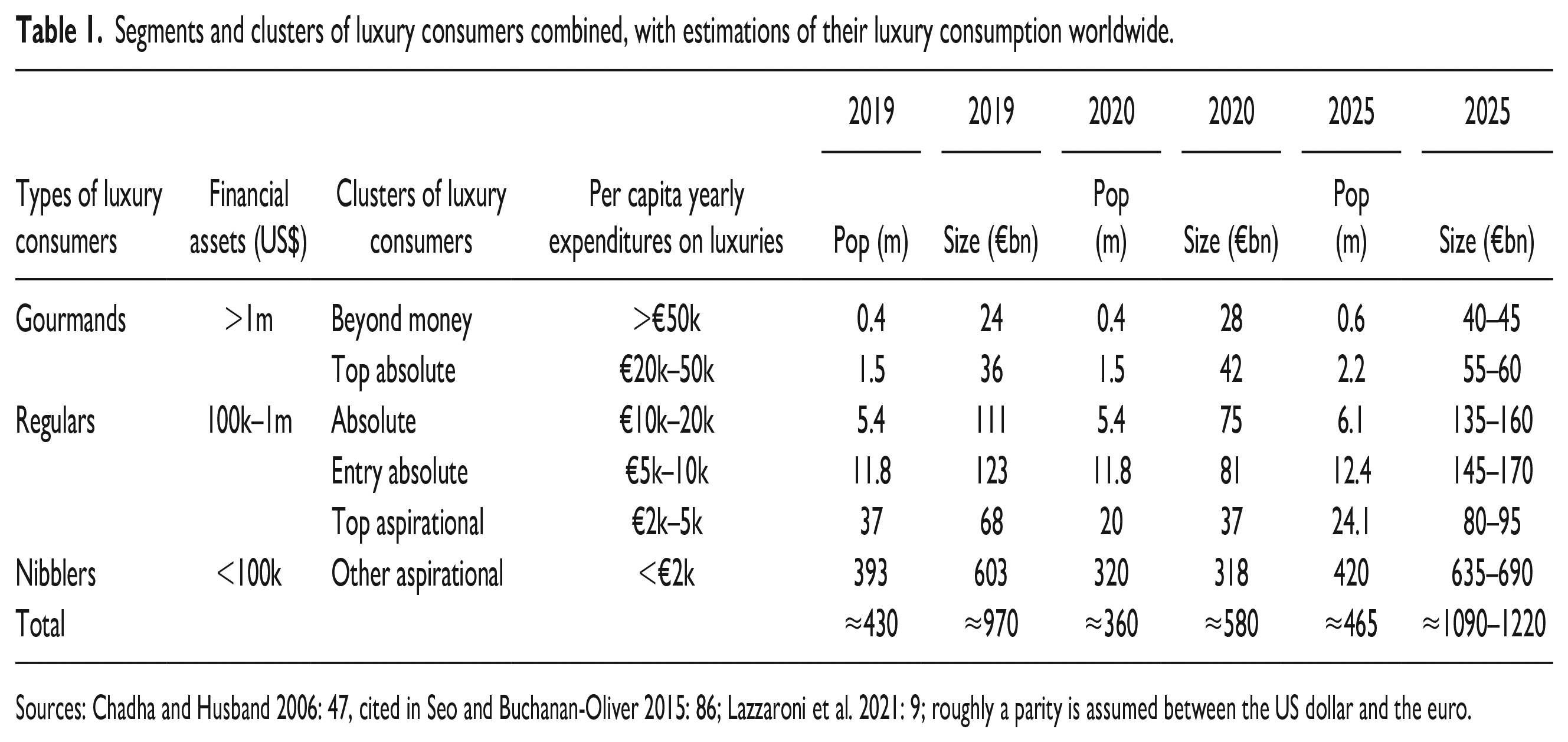
Financial assets of individuals as a criterion for luxury consumption are used by Chadha and Husband (2006), who have identified three distinct socioeconomic segments: (1) “luxury gourmands” with more than a million US dollars in financial assets, (2) “luxury regulars” with financial assets in excess of US$100,000, and (3) “luxury nibblers” with less than US$100,000 in financial assets, but with an increasing income-generating capacity thanks to a decent education and well-paying job (Chadha and Husband 2006: 47; cited in Seo and Buchanan-Oliver 2015: 86). Nonfinancial assets could also be included in the category of regulars, with total assets representing an economic “life security” criterion for further segmentation of this category. On the other side, Lazzaroni et al. (2021) define six clusters of luxury consumers based on their individual yearly expenditures on luxury—“other aspirational” (<€2k), “top aspirational” (€2k–€5k), “entry absolute” (€5k–€10k), “absolute” (€10k–€20k), “top absolute” (€20k–€50k), and “beyond money” (>€50k)—and provide estimations of consumers and luxury consumption globally in each segment. Both classifications are combined and summarized in table 1. “Luxury nibblers” correspond to the cluster of “other aspirational” luxury buyers. “Top aspirational,” “entry absolute,” and “absolute” clusters of luxury consumers represent “luxury regulars,” while “top absolute” and “beyond money” are “luxury gourmands.”
Segments and clusters of luxury consumers combined, with estimations of their luxury consumption worldwide.
Sources: Chadha and Husband 2006: 47, cited in Seo and Buchanan-Oliver 2015: 86; Lazzaroni et al. 2021: 9; roughly a parity is assumed between the US dollar and the euro.
The most important buyers of masstige are “luxury nibblers,” who represent the largest potential for luxury consumption. In 2019 this segment had 393m consumers worldwide (91.4 percent of all luxury consumers) with consumption of €603bn (62.1 percent of all luxury consumption). In 2020, because of the pandemic, the consumption of luxury nibblers declined (to €320bn), but has since then recovered, so that by 2025 the number of luxury nibblers worldwide is expected to exceed 460m with consumption of over 1 trillion euros. The number of luxury gourmands remained stable during the pandemic and their consumption even increased (from €24bn to €28bn), while the category of regulars shrank and their consumption in all subsegments declined. But recovery is underway and projections for 2025 are bright for both categories.
The segment of “luxury nibblers,” as predominant consumers of relatively low-priced masstige products, is very broad: it encompasses consumers ranging from those with low (€10k–€20k) financial assets to those with up to €100k. The masstige “luxury nibblers” might also be called “the excursionists” (Dubois and Laurent 1995; see also Kapferer, Klippert, and Leproux 2014) who occasionally take a trip into the world of luxury. They have interest in luxury, but because of their lower purchasing power they combine masstige products with other products. This can be taken as an example of what Migone (2007) calls hedonistic consumerism in the post-Fordist era. A suitable name for these masstige buyers would also be “luxury combiners.” Regarding the prices of masstige products of personal luxury, the entry prices start from €100 for a cosmetic product and end at €2k for a wristwatch (see Pianon, Abtan, and Bonelli 2017: 3). As can be calculated from table 1, an average nibbler spent around €1530 on luxury in 2019. One can speculate that, given its broadness, the segment of luxury nibblers can be further divided into poorer nibblers with “one shot” of masstige yearly (e.g., a perfume) and relatively wealthier nibblers with “few shots” yearly, combining an exceptional piece of masstige (e.g., a pair of luxury branded shoes, a handbag, a wristwatch, etc.) with lower-priced masstige. Regulars and gourmands may also buy masstige products, but they represent a minor share of masstige buyers.
3. Masstige from the Perspective of Heterodox Economics
3.1. Marx and Marxian views
Marx did not deal explicitly with luxury brands. The phenomenon of masstige can be implicitly related to at least three crucial parts of his theory of capitalism. The first is the concept of commodity fetishism, which Marx used to show how market exchanges of commodities essentially hide the relations between men. His example of gold (and money) as a fetish is paradigmatic. Although Marx did not extend the fetishist character of gold to other luxuries (and luxury brands), it is clear that he considered luxuries the most fetishist of all commodities. For Marx, behind the consumption of luxuries lay the class relations between men. Secondly, the value of labor power, the pivotal element of Marx’s exploitation theory, is a relative concept, because its determination “contains a historical and moral element” (Marx 1976: 275). This means that, historically, the growing capacity of mass production of use values has affected the value of labor power by making some of the massively produced prestige goods (masstige) part of its physical composition. Such explanation also leads to the modification of the famous reproduction schemes. The third and perhaps the most important implication regarding the perspectives of capitalism is related to Marx’s law of the falling rate of profit. Production of masstige opens new possibilities for production of surplus value and profits, and consumption of masstige amplifies the countervailing forces against the law. Moreover, the fact that the working class can afford the same luxury brands as capitalists gives workers the illusion of similarity with capitalists, alleviates class tensions, and stabilizes class production relations. Incorporating the phenomenon of masstige into Marx’s theory thus broadens Marxian critique of capitalist economy.
Similarly, as fetishes are objects that are a substitute for spiritual or religious feelings (cf. Dant 1996), the “masstige objects” are a substitute for feelings of luxury. Assaf (2010) has extended Marx’s “fetishism of commodities” to “brand fetishism,” which is also related to luxury (prestige) brands. According to her, “brand fetishism” is essentially “the phenomenon of perceiving trademarks as spiritual entities rather than as informational devices. . . reducing consumers’ search costs” (Assaf 2010: 83). Already before her, Baudrillard (1998) argued that brands are coded systems that communicate ideological values in the society. The basic functional value of commodities thus becomes less important. By using masstige goods, lower class people try to communicate their fine taste and belonging to a higher class.
According to Assaf, brands can be manipulated: “Modern corporations strive to create brands with personalities and souls, brands that tug at consumers’ heartstrings” (Assaf 2010: 83). They try to make each brand a powerful “religious icon around which an entire ideology of consumption is articulated” (Assaf 2010: 86). In the case of luxury, the fetishist character of original iconic brand product is even more important, because the luxuriousness of the brand is extended not only to other products of the same category (vertical cognitive brand transfer—e.g., an iconic Montblanc pen or a Grace Kelly bag and new versions of pens or bags), but also to products of other categories (horizontal cognitive brand transfer—e.g., a scarf or a tie with the logo of an original luxury brand). Prestige brands, as distinct from functional brands, “are primarily perceived in terms of image” and lead to common associations even when related to very different products (Assaf 2010: 100).
The argument about countering the falling rate of profit can also be interpreted within Marx’s thesis of “bring(ing) forth a new need” (Marx 1976: 201), which was broadened by Baran and Sweezy (1966). In the epoch of monopoly capitalism, giant corporations must create new needs and wants, and stimulating demand to absorb the rising surplus brought about by high profit margins becomes “a life-and-death issue for the system” (Baran and Sweezy 1966: 114). This can only be achieved through “tremendous growth of the sales effort” in the form of “advertising, variation of the products appearance and packaging, ‘planned obsolescence,’ model changes” and other ways of sales promotion (Baran and Sweezy 1966: 115). Baran and Sweezy believed that “monopoly capitalism is characterized by a tendency to chronic stagnation” and that there is a “complex nature of the way in which advertising operates to counteract it” (Baran and Sweezy 1966: 125)—a view that has remained relevant ever since. In their time, production of luxuries was still “in the temple” and reserved for small markets of elite consumers. However, in the 1990s, when luxury got out of the temple, masstige opened new possibilities for advertising and selling activities. Baran and Sweezy noticed that advertising had many forms and that by “employment of increasingly refined and elaborate techniques of suggestion” it could induce “the consumer to pay prices markedly higher than those charged for physically identical products which are not backed by suitable advertising techniques” (Baran and Sweezy 1966: 121). In the case of masstige, the stimulation of demand has taken specific forms related to the perception of the luxuriousness of brands.
3.2. Veblen and Galbraith
The tradition of economic thought associated with Thorsten Veblen forms the central pillar of the Original Institutional Economics. In his work, Veblen provided many insights into human behavior that remained relevant for the analysis of luxury consumption. For example, he showed how people of great wealth, the leisure class, were not satisfied only with taking care of their needs and wants, but rather wished to display their wealth by consuming conspicuous luxuries or by conspicuous leisure (Veblen [1899] 1979). Showing off wealth indicated their power, prestige, and success; it helped them preserve social status and reputation within the circles to which they related as well as maintain social distance from the lower classes. But, according to Veblen, the phenomenon of conspicuous consumption could be observed in all social strata: In modern civilized communities the lines of demarcation between social classes have grown vague and transient, and wherever this happens the norm of reputability imposed by the upper class extends its coercive influence with but slight hindrance down through the social structure to the lowest strata. The result is that the members of each stratum accept as their ideal of decency the scheme of life in vogue in the next higher stratum and bend their energies to live up to that ideal. (Veblen [1899] 1979: 84)
His implicit claim was that the working class was driven to emulate the leisure class behavior, although at a lower scale and with more affordable luxuries, but still with the purpose to gain and grow in social status and power. This was an early indication of masstige and its social function.
One should note here that A. Marshall, Veblen’s contemporary, was critically disposed toward display of luxury, too, and saw “some misuse of wealth in all ranks of society” (Marshall [1890] 1920: 136). However, distinct from Veblen, whose analysis of conspicuous consumption was based on his wide knowledge of psychology and anthropology, Marshall’s critique was rather moralistic: (We) may say that every increase in the wealth of the working classes adds to the fulness and nobility of human life, because it is used chiefly in the satisfaction of real wants; yet. . . there are signs of the growth of that unwholesome desire for wealth as a means of display which has been the chief bane of the well-to-do classes in every civilized country. . . . It would be a gain if the moral sentiment of the community could induce people to avoid all sorts of display of individual wealth. . . . So long as wealth is applied to provide for every family the necessaries of life and culture, and an abundance of the higher forms of enjoyment for collective use, so long the pursuit of wealth is a noble aim. (Marshall [1890] 1920: 136–37)
For Veblen, on the other side, the process of “pecuniary emulation,” that is, the constant struggle of individuals to catch up with and surpass those in the next social stratum was the result of long historical evolution, during which accumulating wealth and creating invidious distinctions in possession of wealth became “intrinsically honorable” (Veblen [1899] 1979: 29). Moreover, given that this struggle “is substantially a race for reputability on the basis of an invidious comparison, no approach to a definitive attainment (of a point of satisfaction) is possible” (Veblen [1899] 1979: 32), which opens infinite profit opportunities for producers of all kinds. Companies of luxury recognized the latent potential how to make good use of this social process.
Veblen’s theory of conspicuous consumption has been developed further in sociological circles. As already mentioned, Bourdieu proposed the concept of cultural capital, incorporating social assets based on education, lifestyle, manners, etc., as a subtle but important determinant of social stratification and inequality. Lower classes, when consuming masstige, try to overcome their economic and cultural inferiority and the reproduction of inequality (in vain). Similarly, Baudrillard analyzed how “objects and their signified meanings operate in their definition and attribution of status for consumers” (Patsiaouras and Fitchett 2012: 165). Commodities do not have only use value and exchange value, but also sign-value, which simulates style, prestige, luxury, power, etc.; and “the truth of objects and products is their brand name,” which is “the super-sign” (Baudrillard 1998: 116, 148, emphasis in the original). Monopoly capitalism has brought not only proliferation of goods but also proliferation of sign-value. Like Veblen, Baudrillard believes that display of commodities is not characteristic only for the rich but has become extended to the whole consumer society. Accessibility of luxury brands through masstige products has only intensified this process.
John K. Galbraith is another economist in the old institutionalist tradition whose work is a fertile ground regarding the tools for masstige analysis. Concepts such as revised sequence, dependence effect and social imbalance (Galbraith 1958, 1967) are particularly relevant in this respect. Galbraith revised the accepted sequence of consumer sovereignty. In the affluent economy, big corporations, rather than passively responding to consumers’ demand, actively determine what products are offered to consumers. For Galbraith, it is predominantly advertising that creates and molds consumers’ wants and thereby the demand. In this way, “(p)roduction only fills a void that it has itself created” (Galbraith 1958: 153). The wants are more or less urgent. Here, interestingly, Galbraith cites Keynes, who: observed that the needs of human beings “fall into two classes—those needs which are absolute in the sense that we feel them whatever the situation of our fellow human beings may be, and those which are relative only in that their satisfaction lifts us above, makes us feel superior to, our fellows”. . . conceding that the second class of wants might be insatiable. (Galbraith 1958: 151)
The want for luxury falls into the second class of insatiable wants. The more wants are insatiable the more dependent they are on advertising and other selling activities.
Although Galbraith did not delve into various forms of advertising, his “dependence effect” and his claim that “simple minds. . . are the easiest to manage” (Galbraith 1958: 279) can easily be extended to the fields of luxury and masstige. Here, the concept of marketing mix—the famous 4Ps (product, price, place, promotion) from marketing literature—has specifics compared to ordinary mass consumer products. Regarding place, for example, luxury shops are on exclusive locations in the cities, fashion shows are glamorous events, and sponsorships of art exhibitions by companies of luxury together with public relations strengthen the desire for masstige brands. Regarding promotion, besides traditional offline advertising, still typical in fashion magazines, there are new forms of indirect want creation for masstige luxury, such as, for example, celebrity endorsement: celebrity, wearing a luxury branded bag, “produces” an initial luxury brand want, which is strongly multiplied through media coverage and word of mouth. In the online world, global want creation for masstige is stimulated by utilizing consumer tracking software used in customer relationship management and through other channels of influence. The illusion of rarity, so important for luxury, is created with artificial waiting lines, limited access, and interactive communication between sales staff and customers. Online influencers “neutrally” review masstige products and hide the real purpose of paid advertising. Promotion budget for such masstige activities is planned and controlled.
Eventually, Galbraith pointed to the growing social imbalance in affluent societies as a result of increasing want creation and production of private corporations, which is the “cause of crisis in the supply of public services” (Galbraith 1958: 251). “Advertising operates exclusively. . . on behalf of privately produced goods and services,” consequently, “public services will have an inherent tendency to lag behind” (Galbraith 1958: 260–61). The overall impact of masstige to the social imbalance might be less important compared to the impact of other private sector industries, especially ecologically problematic industries or military industry, but it adds to it. Especially in less affluent societies, the masstige effect imported from developed rich economies is significantly stronger in this respect. Therefore, Galbraith stood for improved social balance leading to better education that “might well be expected to lessen the effectiveness of synthesis and emulation in the manufacture of new wants” (Galbraith 1958: 279).
3.3. A post-Keynesian framework for the analysis of masstige
While post-Keynesianism, as one of the leading heterodox schools in contemporary economics, builds primarily on Keynes’s macroeconomics characterized by fundamental uncertainty of market economic environment and consequent volatility of expectations and aggregate demand (Davidson 1984), it has also developed a realistic microeconomics, in which it has effectively brought together many elements of the original institutionalism, above all the concept of powerful corporation on the one side, and several psychological concepts (including Veblen’s conspicuous consumption), relevant for understanding modern consumer’s behavior, on the other (e.g., Lavoie 2009: 25–53). Both strands of post-Keynesian microeconomics turn out to be helpful in addressing issues related to the phenomenon of masstige.
3.3.1. Firm-centric view of masstige: post-Keynesian theory of corporate pricing
At the firm level, post-Keynesian economics continues the tradition of Veblen (1904), Berle and Means (1932), and Galbraith (1967), who concentrated on large corporations and their quest for power and long-run growth (see also Eichner 1976: 46; Lavoie 2014: 128–34). The quest for power and growth as the main characteristic of corporate behavior in the post-Keynesian theory of the firm also reinstates the classical paradigm of reproductivity, which the neoclassical microeconomics has long ago abandoned on account of priority given to scarcity and allocation principles (cf. Lavoie 1992b: 54). According to Eichner, one of the founders of post-Keynesianism, the typical firm in contemporary capitalism is a powerful “megacorp” characterized by (1) separation of management from ownership, (2) multiple-plant operation, (3) membership in at least one industry characterized by interdependence and joint profit maximization, and (4) maximization of long-run growth (with the crucial link between pricing and investment decisions) (Eichner 1976: 3). These characteristics are extended by Dugger (1989), who introduced the concept of conglomerate corporation. Its top management is a powerful “control tower” (Jo 2019: 604) that coordinates corporation’s production plants and its subcontractors, and manages the conglomerate of its final products (see Lah and Sušjan 2022).
The concept of the conglomerate corporation can be applied also to companies of luxury and to the production and supply of masstige products. 5 There are at least three reasons for this: (1) global companies of luxury today manage production, distribution, and, most importantly, promotion of many luxury brands/goods. Under the umbrella of each luxury company, there is a conglomerate of luxury brands 6 with different brand powers; the company’s portfolio of brands is controlled from the headquarters, usually located in Western capital cities that monitor the profitability of its brand products in different markets across the world; (2) multiplant operation is typical. Luxury and masstige products are produced either in corporations’ own plants or by subcontractors whose location is not always known (nontransparent supply chains). The decisions about outsourcing are made by the “control towers.” The make-or-buy calculus is extremely important, and many concepts from transaction cost economics (belonging to new institutional economics) could be applied, since transactions take place in very different institutional environments; and, (3) finally, competition among companies of luxury and their brands is harsh and dynamic, and its measurement cannot be simplified to static neoclassical “big four” concentration ratios (Capoglu 1991: 50–51). Profits are uncertain. Brands, managed by a particular company of luxury, have different economic power and success. Therefore, the logic of conglomerate, which is based on its ability to synergize costs and to cross-subsidize its different branches, is suitable to maintain profitability in the uncertain business environment. It is predicated on sustaining high margins with the stronger brands supporting the weaker ones. Already in the 1990s, that is, still in the pre-masstige era, Kapferer envisaged that “(t)he perenniality of griffes depends on their integration in industrial conglomerates capable of providing the financial and technical means (R & D) to launch new worldwide products” (Kapferer 1997: 255). Masstige goods today represent an important part of these worldwide products.
One of the distinctive features of post-Keynesian economics is mark-up pricing theory. Corporations as representative microeconomic units are price setters and determine their prices by adding a mark-up, that is, profit margin to average costs. In reality, mark-up pricing allows firms to pursue various strategies regarding their positioning in the market and attaining growth. This approach is relevant also for pricing of masstige products, where prices are successively determined for each production planning period and remain fixed. In luxury, pricing policies defy standard optimization principles of neoclassical microeconomics, where prices equilibrate supply and demand (within the optimization framework, Groth and McDaniel [1993] attempted to relate pricing of luxury goods to maximization of “exclusive value premium” stemming from brand exclusivity). Luxury prices reflect the intangibles such as history, legend, long-lasting tradition, reputation, and prestige of the brand. Consequently, luxury companies make use of the Veblen effect, according to which higher prices make a luxury product even more attractive and desirable. From the Marxian perspective, the level of mark-ups of masstige products can be taken as an indicator of the level of brand fetishism. With masstige products, however, pricing is more delicate. The price of a masstige product should be affordable but at the same time high enough to preserve the brand’s flavor of luxury and not to dilute brand capital. A parallel can be drawn between masstige and the concept of industrial segniorage. Essentially, industrial segniorage (see Melmiès 2017) has to do with cheaper inputs reducing production costs. Many of the masstige products are not produced in the original countries of luxury (i.e., France and Italy) but by subcontracting firms in countries with no luxury tradition (e.g., China, Romania, and India). These masstige goods are later assembled and presented as products produced in the country of luxury brand origin.
When planning mark-ups for masstige products, corporations of luxury, which manage conglomerates of luxury brands, have to take into account different powers of brands in various markets as well as potential cross-subsidization between the markets. The masstige price should be set above the (price) threshold of what is still considered luxury in a particular market (Kapferer, Klippert, and Leproux 2014). These thresholds differ from market to market, but generally, because of the power of the brands, the masstige mark-ups are much higher than those of ordinary products in same categories.
Figure 1 shows a comparison of costs and profit margins in the production of an ordinary product (e.g., a scarf or a belt) and a masstige brand product within this same category of goods (in the figure, variables related to ordinary product have subscript 0, variables related to masstige product have subscript 1). Dashed lines indicate the cost and price structure of the ordinary product, and solid lines refer to the cost-price structure of the masstige brand product. In post-Keynesian microeconomics, the firm’s average variable costs (AVCs) and marginal costs (MCs) are assumed to be L-shaped, that is, constant up to the level of planned full capacity (FC), after which they rise steeply (cf., e.g., Lavoie 2014: 149–52; or Eichner 1976: 32–33). For the sake of simplicity, we assume that AVC and MC are equal for both products. But the fixed costs differ, since the masstige good producer has higher costs of design and marketing (e.g., fashion shows with celebrities, high rents for monobrand luxury shops in city centers, and creation of shopping experiences) than the producer of the ordinary good (AFC1 > AFC0). For example, a marketing campaign for launching a new perfume costs as much as the planned first-year profit (Cristini et al. 2017: 103). Consequently, the average costs of the masstige brand product are higher than the average costs of the ordinary product (AC1 > AC0). However, the masstige brand product is priced much higher (p1 > p0), because the brand name allows a significantly higher profit margin. Two further implications follow from the higher price-cost margin: (1) the break-even of the masstige brand product is reached at a lower quantity (q1 < q0), and, more importantly, (2) if both types of products are sold at full capacity quantities, the profits of the masstige brand product are significantly bigger (p1 − AC1 > p0 − AC0).
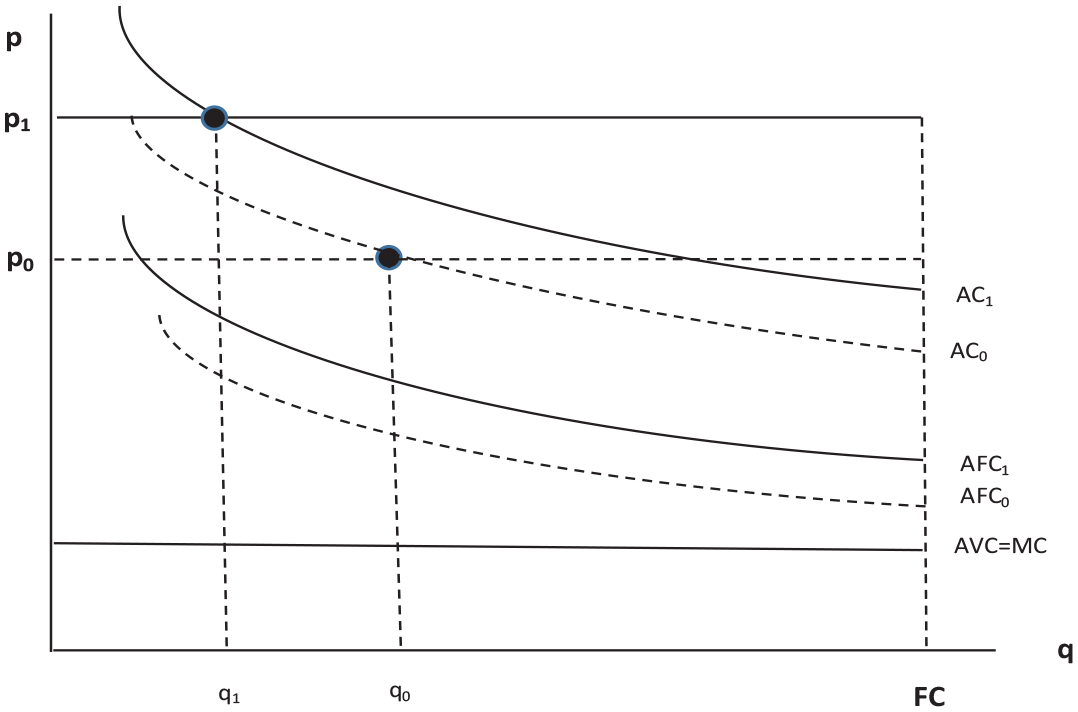
Price-cost structures of a masstige product and an ordinary product compared.
If some masstige product of a luxury company brings loss, not reaching break-even quantity of sales (q1), the company does not—in neoclassical supply-and-demand manner—lower prices. Instead, it often destroys the unsold products to “protect” the rarity of the brand. For example, Burberry used to burn tens of millions of dollars a year of unsold clothes, handbags, and cosmetics. Similarly, Swiss luxury umbrella Richemont destroyed $560 million of top-end timepieces by Cartier, Piaget, and Vacheron Constantin in two years, rather than have them appear on the resale market (Matthams 2019). Since in France recently the destruction of unsold products has been banned through anti-waste legislation, luxury companies have found new solutions for unsold goods: either selling them at a good price to the staff (150,000 employees at LVMH, 38,000 at Kering, 16,600 at Hermès) or giving them as donations to associations (Fashion Network 2022). The loss is covered by bigger profits from other masstige products or brands within the same conglomerate. A conglomerate company can always undertake costly offensive or defensive practices with one brand or in one market, because of its revenues from other brands or other markets (Dugger 1989: 19). Such cross-subsidizing leads to the final result of joint profits.
3.3.2. Consumer-centric view of masstige: post-Keynesian theory of consumer choice
According to Dubois and Laurent (1995), in the 1990s, still in the “temple” era of luxury, the average European bought two luxury items every year. The profile of the average European consumer has since then changed, mostly due to the EU enlargement. It could be estimated that in the twenty-first century (the masstige era) the number of luxury items bought annually by the average European has grown. Understanding the choice criteria of luxury buyers is thus becoming even more relevant.
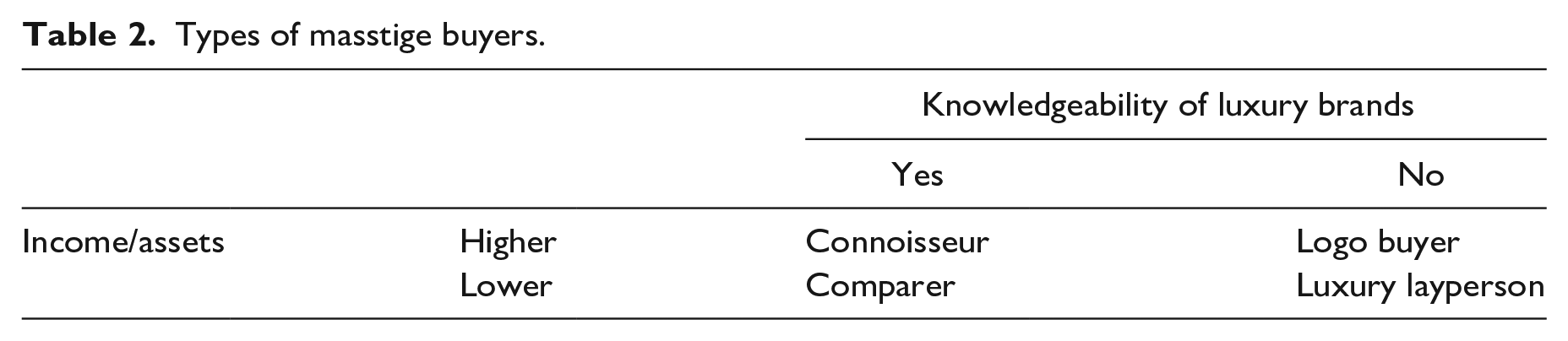
Four profiles of masstige consumers can be identified based on their purchasing power and (culturally determined) knowledgeability of luxury brands: connoisseur, comparer, logo buyer, and luxury layperson (see table 2). Connoisseur has knowledge about brands and their heritage. (S)he has enough money for permanent consumption of luxury, and buys several masstige products from selected brands as well as higher-valued nonmasstige luxury items, possibly moving to regular luxury consumption. (S)he might also be called a snob masstiger since (s)he wants to be distinguished from other masstige consumers. Comparer is a systematic and permanent buyer of masstige, knowledgeable about and interested in luxury brands, but due to lower income (s)he has to “calculate” and ponder the attributes of masstige products, mostly brand power and price. Logo buyer is ignorant about luxury brands and leaning toward more expensive masstige products with big logos. Since price is for him/her an important indicator of conspicuousness, (s)he will, after reaching the threshold level of brand luxury, buy a luxury item with a Veblenian “conspicuous price.” Luxury layperson has some interest in masstige brands; hence, his/her saturation level of luxury is unclear and varying. Because of his/her low income, (s)he is an occasional buyer of masstige. His/her choice cannot be predicted; it is chaotic yet mostly price sensitive.
Types of masstige buyers.
Following the above classification of masstige consumers, we can sketch their decision-making rules using the post-Keynesian theory of choice based on lexicographic ordering, as presented in Lavoie (2014: 105–22) and Lavoie (1992a: 67–72; see also Lah and Sušjan 1999). The theory is built on seven principles: subordination of needs, procedural rationality, separability of needs, satiable needs, growth of needs, nonindependence, and heredity (Lavoie 2009: 27; cf. Lavoie 2014: 96ff). Technically, it developed from nonorthodox ideas about multistage consumer decision making focused on various characteristics (attributes) of a good and related saturation levels (e.g., Lancaster 1976). This is shown in figure 2. A masstige buyer views (nowadays more and more online) ordinary, premium, and luxury goods, ranging from expensive masstige (watches, jewelry, suits) to cheaper masstige (scarfs, ties, sunglasses, fashion apparel, cosmetics, perfumes). We assume that the buyer of masstige concentrates on two basic attributes: brand and price. Brand is the dominant attribute but, in the eyes of the masstige buyer, different brands have different fetishizing powers. (S)he values each product on the market according to the fetishizing power of the brand relatively to his/her threshold level of luxuriousness of the brand (cf. Lavoie 2014: 106). If his/her threshold level of the luxury brand power is at S1, then all products/brands to the left of S1 (masses of ordinary, e.g., J, H, I, or even premium products, e.g., G) are perceived as too weak and are automatically dismissed, irrespectively of price (note that in the diagram price is shown inversely: the position of more expensive products is lower). Hence, the masstige buyer chooses among a selection of goods to the right of the threshold level satisfying his/her aspirational brand luxuriousness.
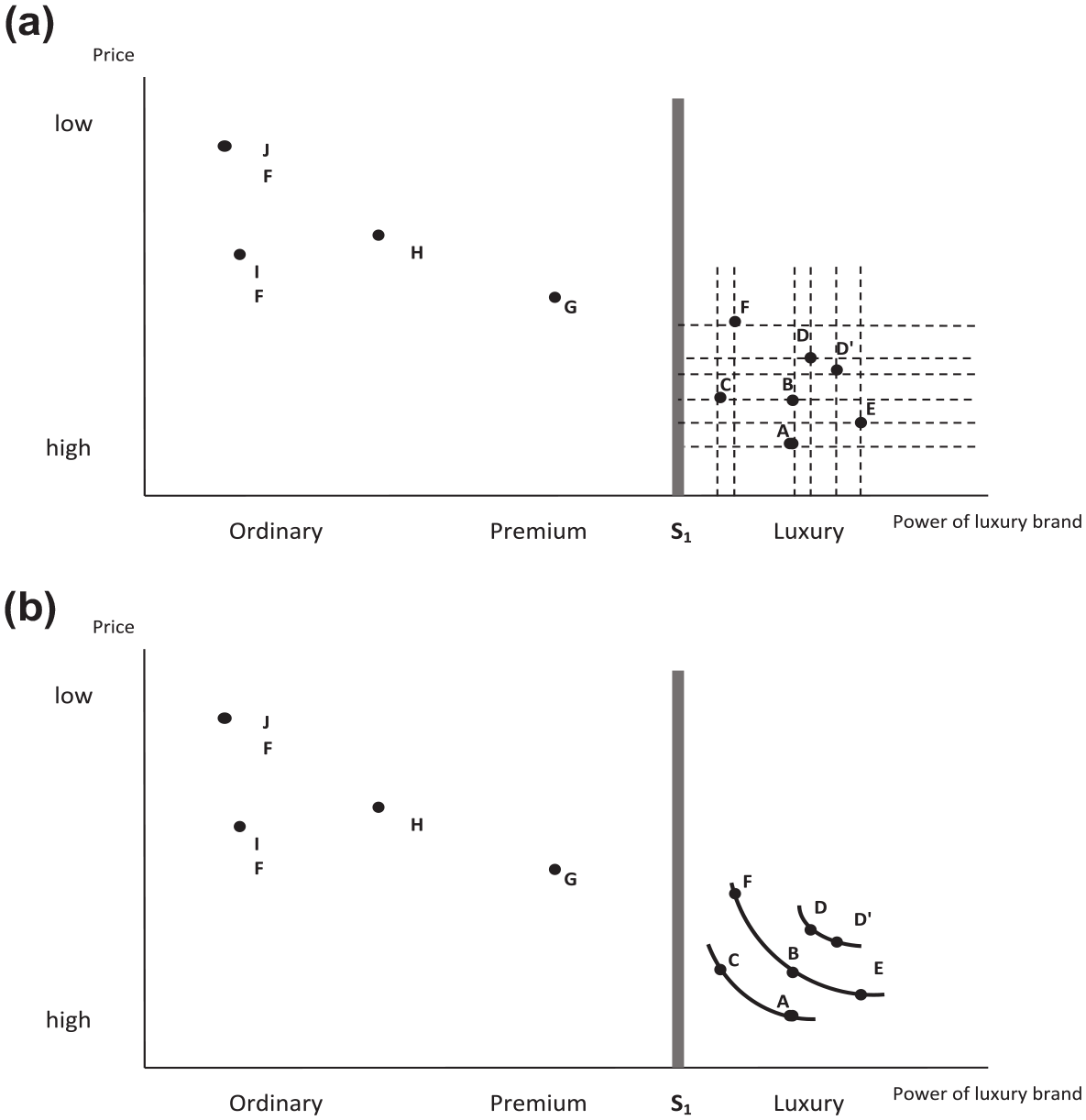
Masstige buyer’s lexicographic ordering of goods: graph (a) illustrates the preference rule and the rules related to quasi indifference curves and reverse indifference; graph (b) illustrates the rule related to indifference curves between different combinations of attributes.
Post-Keynesian theory of choice proposes various rules of consumer decision making. The first rule is the preference rule based on absolute priority given to a certain attribute (Lavoie 2014: 105). If the buyer follows the power of luxury brand, irrespectively of price, the strongest brand for him/her is E (which is also highly priced). The buyer’s ranking (vertical dotted lines in figure 2a) is E > D′> D> B = A > F > C. Masstige goods B and A have equal value of power brand, so the second attribute—(lower) price is applied, therefore B> A. This rule might be typical for a knowledgeable masstige buyer who sticks to a certain preferred brand—(s)he is a relatively rich masstige connoisseur. It can be also assumed that this type of masstige consumer affords buying higher priced categories of masstige (jewelry, watches).
The second rule is related to indifference curves between different combinations of attributes beyond S1. In this case the buyer of masstige weighs the luxuriousness of a brand with the product’s price—lower brand power is compensated by favorable price and vice versa. (S)he chooses the highest indifference curve (Lavoie 2014: 107). His/her ranking (see figure 2b) is D′ = D> F = B = E> A = C. Masstige goods on each of the three indifference curves are treated as substitutes with inverse relation between price and brand power. These choices are equal. Only here the neoclassical indifference principle of the compensation of attributes is relevant. This opens the door for potential inclusion of the third attribute, for example, atmospherics, suggestions of the sales staff, etc. Such situation might be typical for a “poorer” (and therefore price-sensitive) but brand-knowledgeable masstige consumer, who compares the attributes—(s)he is a “comparer” who chooses among the relatively low-priced masstige products.
The third rule refers to what Lavoie (2014: 108) calls quasi indifference curves. It applies in a situation where the masstige buyer perceives the power of luxury brands as equal. After the luxury threshold has been reached, 7 all the observed goods are similar—there are no preferred brands. Therefore, (s)he jumps to the next attribute—price. (S)he chooses the least-priced good / brand F, his/her order of valuation being F> D> D′ > B = C> E > A (horizontal dotted lines in figure 2a). This situation is typical for a price sensitive and luxury brand ignorant buyer—a luxury layperson, who chooses the cheapest masstige product from his/her imagination of luxury.
Finally, one can think of a situation in which the inverse quasi indifference rule applies. It is typically followed by a relatively rich masstige buyer, who, after satisfying his/her imaginary threshold of brand luxury, does not distinguish between brand powers, and values all brands to the right of S1 equally. When (s)he is choosing among these products, the Veblenian effect comes into play. The Veblenian masstiger is a logo buyer who decides for the brand product with the most conspicuous price (or logo), that is, A. His/her valuing chain (in figure 2a) is A > E > B = C > D′ > D> F.
4. Conclusion
Orthodox economics views masstige as a successful allocation of productive factors matching consumers’ demand. Its approach is based on the law of supply and demand and concepts of marginal utility, optimization, etc. That such approach is not suitable for the analysis of masstige is admitted even in business literature (e.g., Kastanakis and Balabanis 2012: 1400). Business and marketing literature, while generally approving “masstigification,” analyzes it partially, overlooking broader social and historical implications of the phenomenon. Nevertheless, with its various disciplinary perspectives and concepts, business and marketing literature represents a valuable source for heterodox economic analysis and interpretation.
The growing consumption of masstige goods might be interpreted as a process of democratization of luxury and a way of reducing inequalities and class tensions not only in rich economies but—given that masstige goods are sold in less developed countries, too—also on a world scale. However, such interpretation blurs the class foundation of masstige, which is the starting point of the heterodox approach. The underlying platform of heterodox economic analysis of masstige consists of the interests of the capitalist class (corporations) on the one side and the motives of modern lower and middle paid labor class (consumers) on the other. The beginnings of class approach to luxury for the masses could be traced back to classical political economy and to the works of Marx and old institutionalists. We have added to this tradition the post-Keynesian economic theory. In our view, classical paradigm of capitalist growth, Marxian concept of brand fetishism, the law of the falling rate of profit and its counterfactors, and institutionalist theory of corporate power related to post-Keynesian microeconomics contribute together to the understanding of increasing production and consumption of masstige and its role in modern capitalism. In fact, such approach represents the case for methodological pluralism as proposed, for example, by Dow (2002) demonstrating that combining different heterodox traditions and research programs leads to a holistic analysis of a particular economic phenomenon and better understanding of its underlying mechanisms.
We have shown how institutionalist theory of the conglomerate firm, combined with post-Keynesian theory of mark-up pricing, enables relevant insights into the behavior of luxury companies and the pricing of masstige products. High profit margins reflect the power of the luxury brand, including its fetishist character, and open the possibility of cross-subsidization within the conglomerate, which sustains its profitability over the long run. On the demand side, we have applied the post-Keynesian theory of consumer choice, based on lexicographic ordering and threshold levels, to differentiate between various types of masstige buyers. The majority of masstige consumers belong to lower or lower middle classes of society. Their decision-making rules cannot be explained by standard neoclassical optimization procedures. As we have indicated, these rules require a broader investigation incorporating economic factors such as purchasing power on the one side, as well as sociological and behavioral factors, such as sign-value of goods, bandwagon effect, brand fetishism, and cultural capital on the other.
Footnotes
Acknowledgements
The authors would like to thank Mary Wrenn, John Willoughby, Brigitte Bechtold, and Enid Arvidson for very helpful comments on earlier versions of this article.
Declaration of Conflicting Interests
The author(s) declared no potential conflicts of interest with respect to the research, authorship, and/or publication of this article.
Funding
The author(s) received no financial support for the research, authorship, and/or publication of this article.
1
According to  , since 1996 luxury market has gone through several stages of growth, beginning with “sortie du temple” (1996–2000) and “democratization” (2001–2007), followed, after short crisis (2008–2009), by Chinese acceleration (2010–2014) and “reboot” (2015–2016) leading to “new normal” (2017– ). The last stage was temporarily interrupted by Covid crisis in 2020, followed by a rebound in 2021.
2
In business literature, beside democratization of luxury, mass prestige, and masstige, various other expressions—such as populence, bandwagon luxury, mass affluence, massification, accessible luxury, masstige marketing, and prestige brands—are related to the phenomenon of masstige (see e.g., Kumar, Paul, and Unnithan 2020). From the economic perspective, the most appropriate term is bandwagon luxury, originally defined in Leibenstein’s seminal article ().
3
4
study asked 3,926 affluent consumers about the threshold where luxury starts. Survey respondents met the following income thresholds in local currencies: United States $150,000; United Kingdom £60,000; France, Germany, Italy €50,000; China 1 million CNY; and Japan ¥15 million. Therefore, most of the people in the mentioned European countries could be treated as luxury consumers, while in the United States, China, and Japan the threshold is set higher.
5
Their interest in production of masstige can be illustrated by the words of Bernard Arnault, CEO of the biggest global luxury conglomerate Moёt Hennessy Louis Vuitton (commonly known as LVMH), that what interests him in luxury “is not creativity, but the idea of transforming creativity into profitability” (Cristini et al. 2017: 103). B. Arnault is currently (2023) the richest man in the world, and Françoise Bettencourt Meyers of L’Oréal Luxe is the eleventh ().
6
7
While knowledgeable connoisseurs and comparers are able to determine their individual luxury threshold levels clearly, the situation in this respect is different with consumers who are ignorant about luxury brands and their power. In this case, their threshold level is determined arbitrarily, based on their imaginary picture of luxuriousness, and the price attribute becomes more important.