




Abstract
Background
Interleukin-27 (IL-27) is a cytokine composed of two subunits, EBI3 and p28, which is an important mediator in regulating the differentiation of TCD4 + cells and plays an important role in immune-related disorders. This study aimed to elucidate the potential association of single nucleotide polymorphisms (SNPs) of the IL-27p28 gene with serum IL-27 levels and the risk of allergic rhinitis (AR).
Materials and methods
The study included 130 patients with AR and 130 healthy individuals. To evaluate the association between IL-27p28 gene SNPs (rs153109 and rs181206) and the risk of AR, the Polymerase chain reaction-restriction fragment length polymorphism method was used
Results
Our results did not show a significant relationship between IL-27p28 gene polymorphisms (rs153109 and rs181206) with the risk of AR and serum IL-27 levels. However, our results indicated that the serum level of IL-27 in patients with AR (342 ± 299 pg/mL) was significantly lower than the healthy controls (455 ± 274 pg/mL) (p = 0.02).
Conclusion
Our findings suggested that IL-27p28 SNPs (rs181206 and rs153109) are not associated with susceptibility to AR, but decreased serum IL-27 levels may be associated with the development of AR.
Keywords
Introduction
Allergic rhinitis (AR) is an inflammatory disease of the upper respiratory tract mediated by immunoglobulin E (IgE). AR is the most common type of rhinitis, affecting approximately 20 to 30% of adults and 40% of children, and is characterized by symptoms of nasal congestion, itchy nose, sneezing, and rhinorrhea.1,2 T Helper (Th) cells and related cytokines play a key role in causing and controlling allergic inflammatory responses. 3 For example, Th2 and Th17 cells and their related cytokines are key regulators to develop allergic reactions, while Th1 cells and regulatory T cells (Treg) act as inhibitors of allergic reactions. 4 Interleukin-27 (IL-27) is a pleiotropic cytokine that is involved in regulating the differentiation of Th subsets. 5 Actually, IL-27 promotes Th1 and Treg cells differentiation but suppresses Th2 and Th17 cells polarization.6,7 As a member of the IL-12/IL-6 family, IL-27 consists of two subunits, IL-27p28 and Epstein-Barr virus induced gene 3 (EBI3). The human IL-27p28 gene contains 5 exons and 4 introns and is located on chromosome 16p11. 8 This cytokine is mainly produced by dendritic cells, macrophages, inflammatory monocytes, and microglia. 9
Although the true cause of allergic rhinitis is still unknown, studies show that both genetic and environmental factors are involved. 10 Numerous studies have been conducted to understand the genetic basis of AR disease, and in recent years, a relatively large number of troth genes and genetic polymorphisms correlated with AR disease have been identified. In fact, evidence suggests that polymorphisms in some cytokines genes, such as IL-1, IL-4, IL 12, and IL-17, may have a role in the creation and intensity of allergic rhinitis11–14
Single nucleotide polymorphisms (SNPs) are the most common genetic changes observed in the human genome. They are particularly important as may affect protein function, gene splicing, and gene expression. 15 Recent studies have reported that some SNPs of the IL-27p28 gene, including rs153109 and rs17855750 polymorphism, are associated with the pathogenesis of certain immune-related diseases such as asthma, AR, autoimmune diseases, tuberculosis, and chronic obstructive pulmonary disease (COPD).16–22 Numerous studies have shown that decreased IL-27 level in AR patients is associated with increased levels of IL-17 and IL-23 cytokines, increased proliferation of type 2 innate lymphoid cells (ILC2), and increased secretion of type 2 cytokines, which may lead to exacerbation of AR.23–25 Therefore, as a new therapeutic target, the use of recombinant IL-27 has been proposed to reduce the pathogenesis of AR and Th-2-related diseases through interaction with IL-27R. 25 Due to the importance of IL-27 in the pathogenesis of AR, this study was performed to determine the effect of IL-27p28 SNPs (rs181206 and rs153109) on serum IL-27 levels and susceptibility to allergic rhinitis in the population of Kermanshah, Iran.
Materials and methods
Single nucleotide polymorphisms (SNPs) selection for genotyping
rs181206T>C and rs153109A>G SNPs of the IL-27p28 gene were selected as candidate sites according to our previous study. 26 The IL-27 gene is known to have a large number of SNPs. To predict which of the vast number of IL-27 gene SNPs are deleterious to gene function or likely to be disease-associated, we conducted a bioinformatics analysis in our previous study. 26 Briefly, we first recovered human IL-27 gene SNPs from the dbSNP (http://www.ncbi.nlm.nih.gov/SNP/). Next, a total of 114 SNPs of human IL-27 gene with minor allele frequency (MAF) > 0.01 were analyzed using 9 different bioinformatics predictive tools. Finally, we found 22 SNPs as deleterious variants in this gene. In the present study, 2 SNPs (rs181206T>C and rs153109A>G) were chosen to investigate their association with AR.
Study participants
This case-control study was performed on patients with AR referred to the Allergy Clinic of Dr. Mohammad Kermanshahi Hospital as well as healthy individuals in Kermanshah province, Iran, from August 2018 to September 2018.
This case-control study was conducted on subjects referring to the Allergy Clinic of Dr. Mohammad Kermanshahi Hospital in Kermanshah province, Iran, from August 2018 to October 2018. In total, 130 AR patients and 130 healthy individuals (matched for age, gender, and ethnicity) were included in this study. Inclusion criteria for patients with AR were: Diagnosis of allergic rhinitis by an allergist based on practical guidelines for the management of allergic rhinitis and no use of systemic corticosteroids in the past 3 months, except for topical nasal and/or anticonvulsant steroids. Exclusion criteria: having inflammatory diseases other than allergic rhinitis and pregnant women. Inclusion criteria for healthy individuals were: no history of allergies, no inflammatory or infectious disease at the time of registration, and resident of Kermanshah province. Exclusion criteria were: suffering from any inflammatory and infectious diseases, taking steroid drugs for any purpose in the last 3 months, living outside Kermanshah province, and pregnant women. This study has been approved by the ethics committee of Kermanshah University of Medical Sciences (agreement code: IR.KUMS.REC.1397.159). All participants signed the written consent form after learning the details of the study.
Blood samples and DNA extraction
A 5 mL blood sample was taken from each participant in the study, part of which was transferred to a tube containing EDTA (ethylene diamine tetraacetic acid), and the other part was transferred to the clot tube. Using the salting-out technique, genomic DNA was isolated from blood samples containing EDTA. 27 The quality of the isolated DNA was determined by measuring its adsorption at 260, 280, and 230 nm, and then kept at −20° C until use. Serum was removed from the clotted blood sample and kept at −80° C until use.
Determination of IL-27p28 gene genotype
Primer sequences used for PCR–RFLP analysis of the IL-27p28 polymorphisms.

Determination of serum IL-27 levels
Serum levels of IL-27 were determined by enzyme-linked immunosorbent assay (ELISA) kit (EAST BIOPHARM, HANGZHOU, China). The sensitivity and detect limitation of the kit were 2.57 pg/mL and 5 pg/mL to 2000 pg/mL, respectively. The range of detection and sensitivity of the kit was 5 to 2000 pg/mL and 2.57 pg/mL, respectively.
Statistical analysis
Statistical analysis of the results was performed by use of SPSS software version 18.0. Chi-square (χ2) test was used to analyze Hardy–Weinberg equilibrium (HWE) between AR patients and healthy individuals. χ2 test was also used to test the genotypic and allelic frequency of polymorphisms between AR patients and healthy individuals. To determine the relationship between genotypes/alleles and AR risk, 95% confidence interval (CIs) and odds ratio (ORs) were calculated. Serum IL-27 levels were compared between the two groups using Mann–Whitney U test. In addition, One-way analysis of variance (ANOVA) was used to determine the association between serum IL-27 levels and genotype. p-values ≤0.05 were considered statistically significant.
Results
Demographic features of the study subjects
Demographic characteristics of study subjects.

Association of IL-27 gene polymorphisms with the risk of AR
The genotype and allele distribution of IL-27p28 SNPs in study participants is shown in Table 3. The genotypes distribution of IL-27p28 SNPs (rs181206T>C and rs153109A>G) in AR patients and healthy individuals was in Hardy–Weinberg equilibrium. The image of electrophoresis bands of PCR-RFLP technique products on agar gel is shown in Figures 1 and 2. Our results showed that there was no statistically significant differences in rs181206T>C genotype distributions and allele frequencies between AR patients and healthy individuals (p > 0.05). In addition, although the frequency of GG genotype (p = 0.086, OR 0.548, 95% confidence interval (CI): 0.274–1.095) and G allele (p = 0.055, OR 0.703, 95% CI: 0.491–1.008) of rs153109A>G was lower in AR patients than in healthy individuals, but it was not statistically significant (p > 0.05). Furthermore, the relationship between IL-27p28 SNPs (rs153109, rs17855750) and the clinical characteristics of AR patients was analyzed. However, there was no association between the clinical manifestations of AR patients and IL-27p28 SNPs (p > 0.05). IL-27p28 (rs181206T>C) PCR product after digestion with fauI enzyme. Homozygotes wild TT genotype (472bp); heterozygous TC genotype (472bp, 288bp, and 184bp); mutant CC genotype (288bp, 184bp). IL-27p28 (rs153109A>G) PCR product after digestion with XhoΙ enzyme. Homozygotes wild AA genotype (691bp); heterozygous AG genotype (691bp, 395bp, and 296bp); mutant GG genotype (395bp, 296bp). The genotype and allele frequencies of IL-27p28 SNPs in AR patients and healthy controls.


Serum IL-27 levels and AR risk
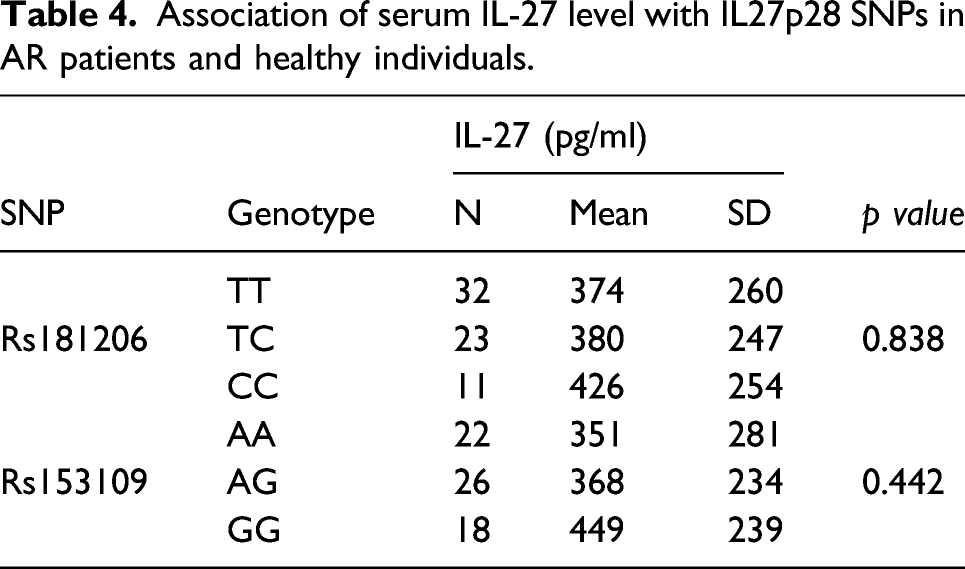
Serum IL-27 levels in the study participants were measured by ELISA. Our results showed that serum IL-27 levels in patients with AR (299 ± 342 pg/ml) were significantly lower than healthy subjects (274 45 455 pg/ml) (p = 0.02) (Figure 3). However, no correlation was found between serum levels of IL-27 and IL-27p28 SNPs (rs181206T>C and rs153109A>G) (Table 4). Serum levels of IL-27 in patients with allergic rhinitis (AR) and healthy individuals. Measurement of serum IL-27 levels by ELISA method showed that serum IL-27 levels in patients with AR (342 ± 299 pg/mL) were significantly lower than in healthy controls (455 ± 274 pg/mL) (p = 0.02). Association of serum IL-27 level with IL27p28 SNPs in AR patients and healthy individuals.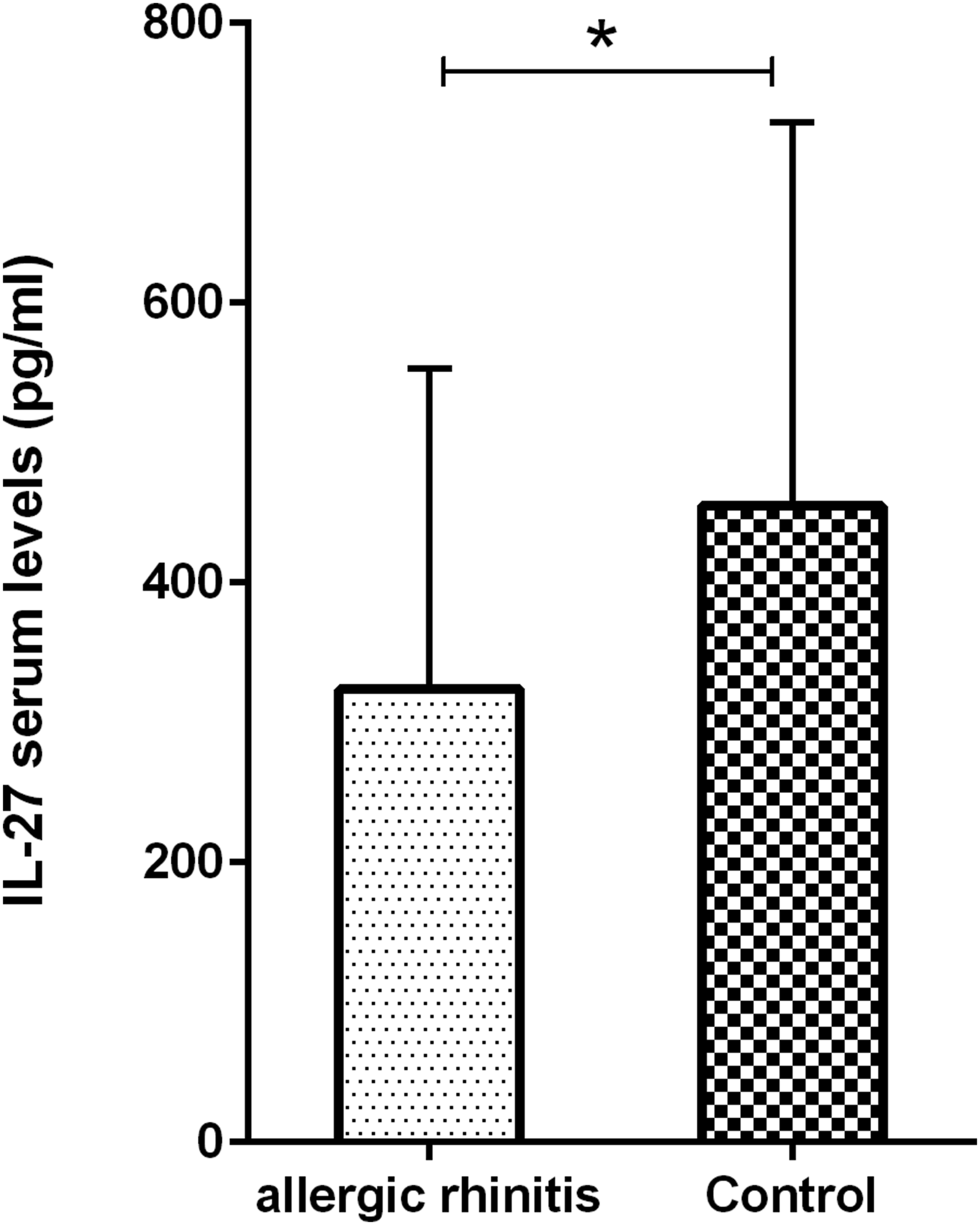
Discussion
Allergic rhinitis (AR) is known as the most common allergic disorder caused by a complex interaction between several environmental and genetic agents. 28 IL-27 is a heterodimeric cytokine consisting of the EBI3 and IL-27p28 chains that has a modulatory effect on AR and asthma. It has been shown that while IL-27 receptor deficiency (IL-27R-/-) increase asthma phenotypes in mice challenged with ovalbumin (OVA), 29 administration of IL-27 reduce respiratory tract inflammation and improve airway hyper responsiveness (AHR) in a mouse model of chronic asthma. 30 This study aimed to evaluate the influence of two selected IL-27p28 SNPs (rs181206 and rs153109) on serum IL-27 level and AR risk in an Iranian population.
The results of our study showed that there is no significant relationship between IL-27p28 SNPs (rs181206 and rs153109) polymorphisms and AR risk in Kermanshah population. On the other hand, our results revealed that serum levels of IL-27 in patients with AR were significantly lower than in controls. However, no significant correlation was found between IL-27p28 SNPs and serum IL-27 levels.
The rs181206T>C and rs153109A>G genetic variants of the IL-27p28 gene have lately been recognized and the association between these polymorphisms and the risk of allergic diseases in several ethnic groups has been investigated. In a study by Yang Shen and coworkers, they showed that there was a significant difference in the genotype and distribution of the rs153109 polymorphism allele between AR patients and healthy individuals in the Chinese Han population. Nevertheless, they found no association between rs181206 polymorphism and risk of AR. 17 The study by Soo-Cheon Chae et al. also revealed a significant relationship between rs153109 SNP and asthma in a Korean population. However, they found no significant relationship between rs181206 polymorphism and asthma. 16 On the other hand, in accordance with the findings of our study, Ji-In Yu and coworkers found that the frequency of alleles and genotypes of rs181206 and rs153109 SNPs in AR patients and the healthy controls in a Korean population were not significantly different. 31 Therefore, the results of this study, consistent with our findings, indicate that IL-27p28 SNPs (rs181206 and rs153109) may not be associated with AR susceptibility in some populations.
IL-27, a new member of the IL6/IL12 family, plays an essential role in the attenuation of respiratory tract and pulmonary inflammation during the development of allergic asthma by its inhibitory effects on Th2 cytokine production. 29 In this study, our analysis showed that serum IL-27 levels were significantly reduced in the AR patient compared with the control group. In line with our findings, it has already been shown that the serum level of IL-27 protein and its mRNA level in AR patients is reduced compared to healthy controls and is negatively correlated with Th2 cytokines. 24 In addition, another study has shown that serum IL-27 levels in AR patients decrease and are negatively correlated with IL-17 and IL-23 levels. 23 Further, Xi Luo and colleagues demonstrated that serum IL-27 protein expression was significantly lower in AR patients compared to controls. 25 In vitro studies have shown that although IL-27 plays a pro-inflammatory role when administered alone, but when administered in combination with IL-4, regulates IL-4–induced chemokine production in human bronchial epithelial cells and down-regulates bronchial epithelial cell activation. 32
Therefore, the results of our study together with the results of other studies suggest that low serum IL-27 levels may be associated with AR development by increasing the secretion of Th2, ILC2, and Th17 cell cytokines such as IL-4, IL-5, IL-13, IL-17, and IL-23.
On the other hand, in our study, no correlation was found between serum IL-27 level and IL-27p28 SNPs (rs181206 and rs153109). Although in few studies that have been performed on the association of IL-27 polymorphisms with AR risk, serum IL-27 levels have not been measured, however, in studies on the association of IL-27 polymorphisms with tumor risk, IL-27 levels have been measured and the association of IL-27 polymorphisms with serum IL-27 levels has been investigated. Most of these studies have shown that rs153109 IL-27 polymorphism significantly increases the risk of cancer. 33 However, no association was found between serum IL-27 levels and IL-27 polymorphisms. In a study conducted by Yu Jin Tong in patients with osteosarcoma, no significant relationship was observed between rs181206 and rs153109 polymorphisms and serum IL-27 levels. 19 Also, in Alireza Ghavami’s study in Iran, no correlation was observed between serum IL-27 levels and rs153109 polymorphism in patients with ALL. 34 Furthermore, Bin Zhu et al. showed that plasma levels of IL-27 in bladder cancer are not associated with rs153109 polymorphism. 35 These results recommend that rs181206 and rs153109 SNPs of the IL-27P28 gene may not influence IL-27 production. However, it is worth noting that in the present study we faced some limitations. First, due to financial and equipment constraints, the sample size was considered small. Second, this study was conducted on the population of one of the regions of Iran, which due to ethnic diversity in Iran; these results may not be generalizable to the whole of Iran. Therefore, more studies with larger sample sizes as well as studies on other Iranian ethnic groups are needed to confirm our findings. Third, the present study does not cover all genetic polymorphisms of the IL-27p28 gene. Thus, we cannot provide a comprehensive view of the possible association of genetic diversity in the IL-27p28 gene with serum IL-27 level and AR risk.
Conclusion
Overall, our results suggest that decreased serum IL-27 levels may be associated with an increased risk of AR; however, IL-27p28 SNPs (rs181206T>C and rs153109A>G) may not play a role in the serum IL-27 levels and AR susceptibility in an Iranian population.
Footnotes
Acknowledgments
The authors appreciate all participants for their collaboration. The authors also thank the financial support of the Research Council of Kermanshah University of Medical Sciences. [97206].
Abbreviations
SNP: Single nucleotide polymorphism; IL-27: Interleukine-27; AR: Allergic rhinitis; Th cell: helper T cell; Treg cell: regulatory T cell; EBI3: Epstein-Barr virus induced gene 3; IL-27R: IL-27 receptor; COPD: chronic obstructive pulmonary disease.
Author’s contribution
Ali Gorgin Karaji planed and supervised the study. Farzaneh Koohyanizadeh performed the experiments and wrote the first draft of the manuscript. All authors participated in data collection, analysis, and interpretation, and approved the final version of the manuscript.
Declaration of conflicting interests
The author(s) declared no potential conflicts of interest with respect to the research, authorship, and/or publication of this article.
Funding
The author(s) disclosed receipt of the following financial support for the research, authorship, and/or publication of this article: This study was supported by Kermanshah University of Medical Sciences. [97206].
Ethics approval
Ethical approval for this study was obtained by the Ethics Committee of Kermanshah University of Medical Sciences (agreement code: IR.KUMS.REC.1397.159).
Informed consent
Written informed consent was obtained from all subjects before the study.
