




Abstract
Although several therapeutic approaches are available at present for the treatment of chronic pharyngitis, new therapeutic strategies acting on pharyngeal mucous function should be investigated in order to improve symptoms and quality of life. High-molecular weight hyaluronate performs important functions on mucociliary clearance, tissues hydration, defense against micro-organisms, and on tissue repair as well, but at present there is no clinical evidence of its exogenous use in patients with chronic pharyngitis. Our open, randomized controlled study was carried out to investigate efficacy, and tolerability of exogenous high molecular weight sodium hyaluronate (SH) at the dosage of 9 mg three times a day for a period of 30 days, in patients with chronic pharyngitis. Results show significant improvements of symptoms and cytology in active group (A, n = 10) vs. control group (B, n = 10). Good compliance and no adverse events were reported in group A. In conclusion, SH was effective and safe in patients with chronic pharyngitis.
Introduction
Chronic pharyngitis is a common inflammation of the pharyngeal mucosa whose origin can be infectious (bacterial or viral) or irritative (chemical or physical), is characterized by a persistence for at least 1 year, for more than 6 h a day, for more than 2 weeks a month, for more than 3 months a year.
Epidemiological data show that at least 20% of the adult population globally is affected by chronic pharyngitis and its prevalence is expected to increase further.
From a clinical point of view, chronic pharyngitis is divided into three forms: single or acute, hypertrophic, atrophic. While subjective symptoms are mainly represented by sore throat, hoarseness, sensation of postnasal drip, and sensation of foreign body, objective symptoms include hyperemia of the pharyngeal mucosa, presence of either mucopurulent or catarrhal secretion, evidence of lymphoid follicles on the rear wall (hypertrophic forms), atrophy of the mucosa which appears dry, smooth, shiny (atrophic forms).
In pharyngeal chronic phlogosis, the microscopic morphological profile is characterized by hyperemia and edema of the mucosal chorion which becomes thickened and full of lymphocytes; furthermore, the epithelial lining is both hypertrophic and hyperplastic at onset, while it undergoes progressive atrophy involving the glandular formations in the chronic phase.
For the abovementioned reason, most clinicians have approached various therapeutic strategies to achieve both clinical and cytomorphological improvement. 1
The deterioration of the pharyngeal mucosa is partly due to an alteration of physiological mucous secretion.
Hyaluronate, which is the main glycosaminoglycan (GAG) produced by pre-respiratory mucosa, is a polymer formed by a chain of dimers which consist of one molecule of D-glucuronic acid and DN-acetylglucosamine. While performing important functions on mucociliary clearance and hydration, hyaluronate acts as a barrier against the spread of micro-organisms, toxic substances, and foreign bodies. 2
We decided to conduct a pilot study to test the hypothesis that exogenous administration of high molecular weight SH, at the dosage of 9 mg three times a day for a period of 30 days, could determine positive effects on symptoms on the basis of tissue repair claimed by SH and on quality of life and cytology of patients suffering from chronic pharyngitis.6–25
Material and methods
Study design
The study was designed as a monocenter, prospective, open-label, two parallel-group study, to be carried out at ENT Department of Monaldi Hospital in Naples, Italy.
Patient population
A total of 20 outpatients affected from chronic pharyngitis, who met all selected criteria, were enrolled in the study.
Main inclusion criteria were: age >18 years; history of pharyngeal disease; and physical examination positive for chronic pharyngitis.
Exclusion criteria were: systemic diseases; gastroesophageal reflux disease; oncologic diseases; ongoing treatment for chronic pharyngitis during the last 30 days; history of alcohol or drug abuse within the previous 12 months; clinically significant laboratory abnormalities detected within 30 days before inclusion; pregnancy and/or breast feeding; history of hypersensitivity to SH; participation at any other clinical study in the previous 3 months; and psychiatric disorders or any other clinical condition judged to be not adequate by the investigator.
Women suspected of pregnancy were required to have a negative urine pregnancy test and to be using appropriate contraception throughout the study.
Patients were randomly assigned to two groups, according to a predefined randomization list in the ratio 50:50.
Medication
While patients of group A were treated with SH, patients allocated to group B received saline solution.
Group A were treated with 9 mg of high molecular weight SH which was administered by spray nebulization 0.3% high molecular weight SH into the oral cavity three times daily, for a period of 30 days; 3 each puff of 140 µL was equivalent to 0.42 mg of hyaluronic acid.
Procedures
All patients were required to attend a screening visit before inclusion in the study; if enrolled in the study the patients were requested to attend the baseline visit (day 0) and the final visit after 30 days from randomization either to group A or to group B.
Anamnesis and physical examination data were collected before treatment. The physical examination was performed through direct observation and by the use of a fiberscope to assess the state of the mucosa. The following subjective symptoms have been evaluated:
itchy throat
hoarseness
pain
odynophagia
cough
otalgia
Each symptom was associated with an ordinal scale of intensity: 0, absent; 1, low intensity; 2, intense; 3, very intense.
At baseline and at the end of the study an exfoliative cytological sample was taken through a modified Ayre spatula, by using its convex side to increase the quantity and quality of cells.
The exfoliated cells have been placed both on normal slides and on special polarized slides, in a standardized space. The first ones were stained with the Papanicolaou method, while the second ones were subjected to immunocytochemistry staining for Ki67 expression. The slides were then observed through 60× magnification optical microscope (Nikon Eclipse 200) on 50 different microscopical fields and the cell count was recorded in a specific form for grading. 4
The assessed parameters were the following: number of squamous and pathological cells, presence of bacteria and inflammatory cells, inclusions of keratin, and percentage of activated cells.
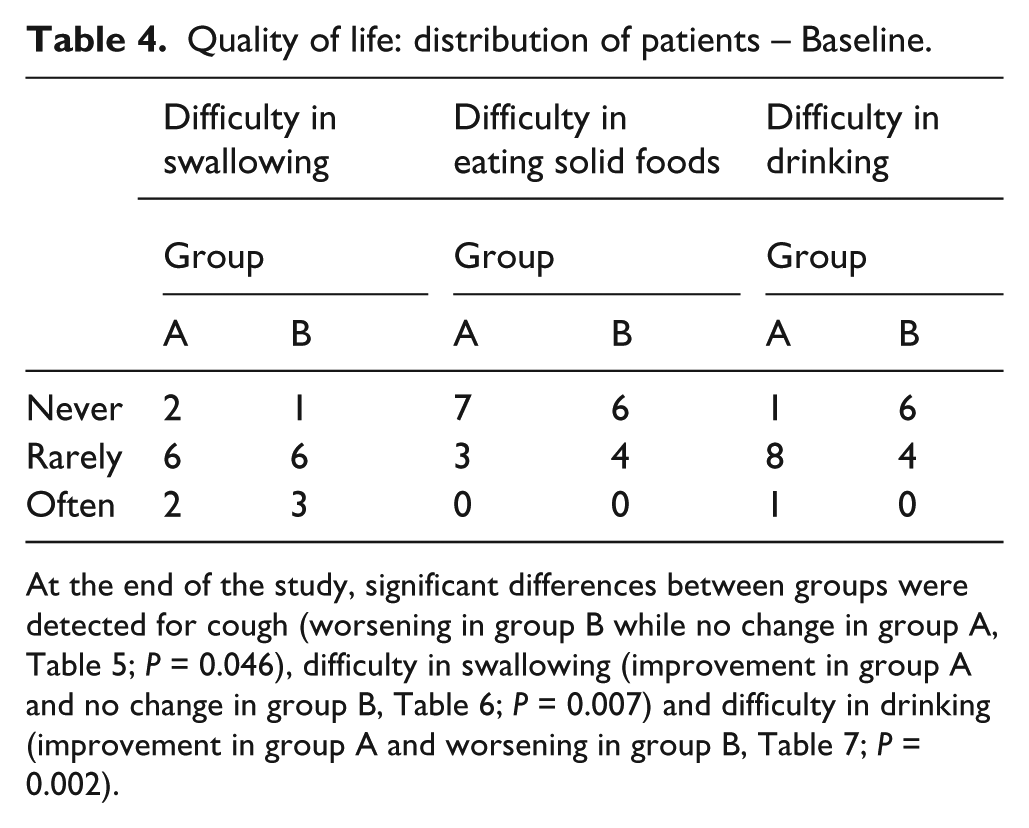
In order to evaluate the quality of life pre and post treatment, an adapted version of ALSAQ-5 scale was used by taking into accounts the following three items: difficulty in swallowing, difficulty in eating food, and difficulty in drinking. 5
Endpoints
The primary endpoint of this study was the variation of symptoms and quality of life while the secondary endpoint was the cytological changes detected through exfoliative cytology of pharyngeal mucosa.
Both primary and secondary endpoints were assessed by measuring the difference post-pre values as mentioned in the section of statistical methods.
Safety endpoints were measured by assessment of adverse events at any time during the study; vital signs (arterial blood pressure, heart rate) and laboratory parameters were evaluated at baseline visit and final visit.
Sample size
As a pilot study no specific sample size was predefined and 20 patients were considered sufficient to achieve preliminary results.
Statistical methods
The analysis was performed for each of the observed symptoms, for the variable Ki67 (%) and for the ratio between number of abnormal cells and total number of cells (abnormal + squamous).
The pre-treatment distributions and the changes from baseline were compared between groups using Wilcoxon Two-Sample Test (t approximation); significance level was set at 0.05 (P <0.05 was considered as statistically significant).
Results
A total of 20 patients aged 20–70 years (mean age, 44.5 years) were recruited in the current study. Six of them were men and 14 of them were women (3 men and 7 women were equally distributed in each of the two treatment groups). Three of the patients enrolled for each group were smokers (⩽15 cigarettes per day). All the patients completed the study according to the procedures foreseen in the protocol.
As far as baseline characteristics are concerned, more patients had cough in group A (though the difference between groups was not significant) while odynophagia was more frequent in group B (P = 0.06), as reported in Table 1.
Symptoms – Baseline.

Moreover, patients in group A were worse than those in group B as regard to the ratio between pathological cells and total cells (Table 2, P <0.05, intergroup).
Ki67 and ratio between pathological cells and total cells – Baseline.

P <0.05.
Discussion
In patients suffering from chronic pharyngitis new therapeutic strategies are required in order to improve symptoms and quality of life.
Beneficial effects of high molecular weight hyaluronate on mucous membranes are reported, but no clinical evidence in literature of its use in chronic pharyngitis, so we decided to test the use of exogenous SH at high molecular weight, to assess the lubricating and repairing action of this substance and its effects on subjective symptoms, quality of life, and cytological changes, in patients suffering from the above mentioned disease.
Data in literature have been proved that SH clearly contributes to tissue repair by favouring the below mentioned events:
The results of our pilot study demonstrated that SH can improve endoscopic findings (Table 3), quality of life (Table 4), symptoms (Tables 5–7) and cytology (Table 8) after a period of 30 days of administration compared with no improvements observed in control group treated with saline solution.
Mucosa and secretions – Baseline.

Quality of life: distribution of patients – Baseline.
At the end of the study, significant differences between groups were detected for cough (worsening in group B while no change in group A, Table 5; P = 0.046), difficulty in swallowing (improvement in group A and no change in group B, Table 6; P = 0.007) and difficulty in drinking (improvement in group A and worsening in group B, Table 7; P = 0.002).
Symptoms – End of study.

P <005.
Quality of life: Difficulty in swallowing – End of study.

P <0.05.
Quality of life: Difficulty in drinking – End of study.

P <0.05.
The ratio between pathological cells and total cells showed large decreases in group A while only small changes in group B (mean = −39.7% vs. 4.1%, respectively, P = 0.002 intergroup, Table 8).
Ratio between pathological cells and total cells (%) – End of study.

P <0.05.
The analysis of changes in symptoms and in quality of life showed some statistically significant differences between the two groups, indeed. More in detailes, as regards to subjective symptomatology, we point out the improvement in swallowing and drinking observed in group A compared with the increase of cough in group B.
Furthemore, beneficial effects on cytological and immunohistochemical patterns have been proved to follow the beneficial effects on symptoms, after administration of SH. In all the patients of group A were achieved improvements in the cytology, caused by the decrease of the ratio between pathological and total cells, and improvements in the immunohistochemistry, determined by the reduction of Ki67 values; both events were associated to a regression of the inflammatory process (Table 9).
Ki67 (%) – End of study.

P <0.05.
We remarks that positive action of SH on cytology and immunohistochemistry is relevant as it is based on objective evaluations, differently from symptomatology and quality of life which have been assessed by the patients.
One of the potential mechanism of SH which decreases symptoms may be tissue repair action, while effects on angiogenesis, colonization, remodeling and migration need further study.
Although in a few patients, it should be remarked that our study provides evidence of beneficial effects in symptoms and cytological features even in smokers, after treatment with SH; on the contrary, no substantial changes were detected in patients with smoking habit assigned to group B.
No adverse events were reported among the patients of group A, thus giving confirmation about the tolerability of SH and the consequent high compliance which can derive from its use.
The small sample size considered in our study represents a major limitation as it doesn’t allow to get definitive results.
Despite of this limitation, we believe that the results of the present study can offer interesting information of chronic pharyngitis treatment and can be useful to investigate the use of SH in a more extended population.
In conclusion, the data on symptoms and the cytological/ immunohistochemical analyses of present study allow to state that exogenous high molecular weight SH at the dosage of 9 mg is an effective molecule which can be a valid therapeutic alternative for the treatment of chronic inflammatory diseases of the pharynx. Moreover, the absence of side effects and the good compliance support the reliability of this molecule. Therefore, we believe that the current study provides additional and useful information about the treatment of chronic pharyngitis by using exogenous SH although more extended studies are needed to confirm the result obtained from our research.
Footnotes
Funding
This research received no specific grant from any funding agency in the public, commercial, or not-for-profit sectors.