




Abstract
Recent studies showed prominent antimicrobial activity of some plant extracts on some pathogenic microorganisms so we evaluated antimicrobial activity of aqueous extracts of clove and cinnamon using the agar well diffusion method. An in vivo study was carried out on 40 adult healthy male albino rats divided into four groups: Group 1: negative control group (received intragastric saline solution daily); Group 2: injected with mixed bacterial suspension of S. aureus and E.coli as a model of pyelonephritis then received intragastric saline solution daily; Group 3: injected with the same dose of mixed bacterial suspension then received intragastric clove extract 500 mg/kg/day; and Group (4): injected with mixed bacterial suspension then received intragastric cinnamon 500 mg/kg/day. Five rats from each group were sacrificed after 1 and 4 weeks. Serum and blood samples were collected for lysozymes activity and nitric oxide production, lymphocyte transformation test, as well as counting of both total and differential leukocytes and erythrocytes. Kidney samples were tested histopathologically. Both in vivo and in vitro results confirmed the efficacy of clove extract as natural antimicrobials and suggested the possibility of its use in treatment of such bacterial infections.
Plant extracts have been widely used in herbal medicine, both prophylactically and therapeutically, for controlling diseases. The antimicrobial activity of several plant-derived compounds has been reported to be synthesized in the secondary metabolism of the plant and is produced as a result of interactions between plants, microbes, and animals. 1 Plant-derived antimicrobials do not exhibit the side effects often associated with use of synthetic chemicals. 2 The World Health Organization (WHO) estimates that more than 80% of healthcare needs in developing countries are met through traditional healthcare practices. 3
Cloves (Syzygium aromaticum, syn. Eugenia aromaticum or Eugenia caryophyllata) are the aromatic dried flower of a tree in the family Myrtaceae. Cloves are used in Chinese medicine and Western herbalism. Cloves are used as a carminative, to increase gastric hydrochloric acid, and to improve peristalsis. It is also used in dentistry where the essential oil of clove is used for dental emergencies. In addition, cloves have anti-inflammatory, antioxidant, anti-ulcerogenic, anti-thrombotic, and anti-parasitic effects. 4 Cinnamon (Cinnamomun burmanii) has long been used as a spice in food preparation and as traditional medicine. Nowadays, cinnamon is also used as a raw material for functional foods and drinks. The part from the cinnamon plant usually used is the stem which contains essential oil with the major components cinnamaldehyde and eugenol. 5 The chief significance of this study is to test the antimicrobial activity of cinnamon and clove extracts in inhibiting the growth of Staphylococcus aureus (S. aureus) and Escherichia coli (E. coli) as complementary or as an alternative to antibiotics. In addition, the minimum inhibitory concentration and minimum bactericidal concentration were measured so as to minimize their side effects and to study their effect on immune response – either cellular or humoral – and their effect on blood picture in cases of acute pyelonephritis.
Materials and methods
The present study was carried out on 40 adult healthy male albino rats in the Department of Medical Laboratories, Faculty of Applied Medical Sciences, Taif University (Turabah), Saudi Arabia. Rats were examined to rule out the presence of any disease. The animals were housed in separate cages, supplied with food and water, and allowed to live in optimal conditions according to the hospital housing protocol of the Laboratory Animals Unit, Taif University.
Preparation of the crude aqueous clove extract
Cloves were crushed to a coarse powder and sieved through a No. 20 mesh. One hundred grams of clove powder were boiled in 1 L of deionized water until a final volume of 100 mL was reached. The concentrated mixture was filtered using Whatman number one filter paper. It was then preserved in a refrigerator until use. 6
Preparation of cinnamon water extract
Cinnamon bark was purchased from local markets. The plant was pulverized and soaked in one volume of water for 48 h at room temperature, and further dissolved by sonication for 1 h. The extract was filtered. It was then preserved in a refrigerator until use. 7
In vitro study
A total of two strains were used in the study (S. aureus ATCC 25923 and E. coli ATCC 25922, to induce acute hematogenous pyelonephritis). These strains were freshly prepared before working by overnight incubation in tryptic soy broth (TSB) for E. coli and tryptic soy broth with 7.5% NaCl tubes for S. aureus (Oxiod Company). Antimicrobial activity of cinnamon and clove extracts was measured using the agar well diffusion method according to the procedure of Hazir and Keskin. 8
The minimum inhibitory concentrations (MICs) of all the extracts (clove and cinnamon) were determined by microdilution techniques in Mueller–Hinton broth. 9
In vivo study
In vivo study was carried out on 40 adult healthy male albino rats which were divided into four groups of 10 rats each: Group 1: negative control group (received intragastric saline solution [0.5 mL/kg] daily); Group 2: positive control group (injected with mixed bacterial suspension containing 1.5 x 10⁶ colony-forming units (CFU/mL) of S. aureus and 3.0 x 10⁶ CFU/mL of E. coli in the caudal vein at a dose of 0.5 mL/kg and then received intragastric saline solution daily; Group 3: injected with mixed bacterial suspension containing 1.5 x 10⁶ CFU/mL of S. aureus and 3.0 x 10⁶ CFU/mL of E. coli in the caudal vein at a dose of 0.5 mL/kg and then received 500 mg/kg cinnamon extract intragastrically daily; 10 and Group 4: injected with mixed bacterial suspension containing 1.5 x 10⁶ CFU/mL of S. aureus and 3.0 x 10⁶ CFU/mL of E. coli in the caudal vein at a dose of 0.5 mL/kg and then received 500 mg/kg clove extract intragastrically daily. 11
Five rats from each group were sacrificed after 1 and 4 weeks of treatment. Four weeks after treatment, blood samples were collected for measurement of lysozymal activity, nitric oxide production in blood, and lymphocytes proliferation assay. Both total and differential leukocytic and erythrocytic counts were done after 1 and 4 weeks.
Induction of a model of acute hematogenous pyelonephritis in the rat
Mixed bacterial suspension containing 1.5 x 10⁶ CFU/mL of S. aureus and 3.0 x 10⁶ CFU/mL of E.coli was inoculated in the caudal vein at a dose of 0.5 mL/kg. Control animals were received the same amount of saline solution. Pyelonephritis was confirmed by differential leucocytic count and histopathological study of the kidneys. 12
Histopathological examination
The collected specimens of kidneys from the sacrificed rats were fixed in 10% buffered neutral formalin solution for at least 24 h and then routinely processed. Paraffin sections of 5 micron thickness were prepared, stained with Hematoxylin and Eosin stain (H&E) and then were examined microscopically.
Total and differential leukocytic and erythrocytic count
Samples were taken into an evacuated tube containing dry K2 EDTA and a full blood count was performed on a Bayer-Technicon H2 counter.
Measurement of lysozymes activity by using agarose gel cell lysis assay
The lysoplates were kept in their plastic bags at room temperature. Wells were filled with 25 µL of serum samples from each group treated with clove and cinnamon aqueous extracts in addition to the negative control group. 13
In vitro lymphocytes proliferation test assay
Lymphocyte proliferation test using MTT (3-(4, 5-di-methyl thiazol-2-yl) 2, 5-diphenyl tetrazolium bromide) was carried out. 14
Measurement of nitric oxide production in blood
The test depends on nitrite which is the stable product of nitric oxide oxidation that correlates with the amount of nitric oxide produced in blood; in 96 microwell plates, 50 µL of serum samples and 50 µL of colorless Griess reagent. 15
Statistical analysis
Results are expressed as means ± SE of five different rats per each group. Statistical analysis was done using ANOVA and Fischer’s (LSD) post hoc test, with P <0.05 being considered as statistically significant.
Results
Sensitivity test
The obtained results included testing of whole aqueous extracts of cinnamon and clove against S. aureus and E. coli. Results revealed that clove extract had antibacterial effect on the tested organisms with varying degrees in the range of 10–20 mm with S. aureus and a weak effect on E. coli except at a concentration of 100 µL as in Table 1 and Figure 1.
Inhibition zone (mm) of natural plant extracts (µL) on tested organisms.
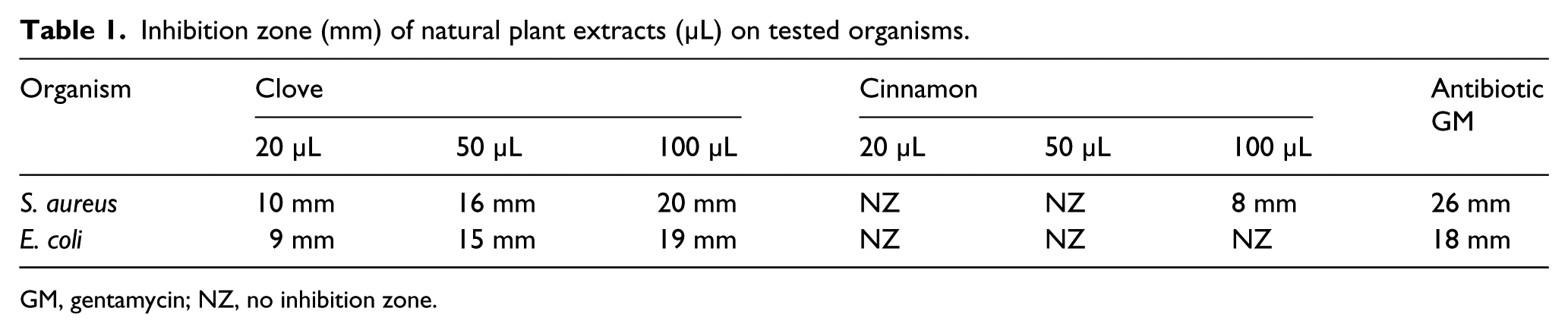
GM, gentamycin; NZ, no inhibition zone.

Results of sensitivity test. Inhibition zones of clove extract with E. coli (A) and with S. aureus (B). Inhibition zone of cinnamon with S. aureus (C) and with E. coli (D).
MICs of clove and cinnamon extracts
Results showed that the MIC of clove extract that inhibited visible bacterial growth of S. aureus was at a dilution of 2 and MBC was 2.5 with no activity on E. coli as illustrated in Table 2.
MIC/MBC of natural plant extracts (mg/mL).

NT, not tested.
Lysozyme activity of clove and cinnamon extracts on treated groups
The serum samples of clove group challenged with S. aureus and E. coli showed increased lysozyme value in all tested serum samples and the value was in the range of 3–4 mg/mL. There was no significant increase in lysozyme value in the cinnamon group as illustrated in Table 3.
Lysozyme activity using lysoplate assay of clove and cinnamon extracts in addition to negative control serum 4 weeks after treatment.

Values of clove group are statistically significant at P <0.05 vs. the control and cinnamon group.
Nitric oxide activity of clove and cinnamon extracts on treated groups
Results denoted that all tested serum samples from groups given clove extract showed high nitric oxide value which was in the range of 45–60 (µg/mL). On the other hand, samples from the group given cinnamon extract showed no changes and the value of nitric oxide was in the range of 10–15 (µg/mL) as shown in Table 4.
Nitric oxide test of serum samples from groups treated with clove and cinnamon extracts for 4 weeks in addition to negative control group.

Values of the clove group are statistically significant at P <0.05 vs. the control and cinnamon group.
Results of LTT of clove and cinnamon extracts
The results of LTT showed that clove extract when added to PHA showed decreased LLT value in all tested samples and LTT was in the range of 1.2–1.89. However, the samples of cinnamon extract also showed no changes when added to PHA (Table 5).
Lymphocyte transformation test of clove and cinnamon extracts in addition to PHA as a positive control.

Total and differential leukocytic count
1 week post treatment
Results of WBCs, lymphocyte, monocyte, granulocyte, and erythrocyte count are summarized in Table 6. Total leukocytic count was increased in the infected group (15.1 x 10³/uL) as an indication of pyelonephritis. Lymphocytic count was also elevated in the infected group (7.9 x 10³/uL). Granulocyte count was markedly elevated in the infected group (2.5 x 10³/uL) with decreased count in mainly the clove group (1.2 x 10³/uL). No changes were detected in erythrocytic count.
Results of WBCs, lymphocyte, monocyte, granulocyte, and erythrocyte counts in infected and treated groups 1 week post treatment.

Values of clove and cinnamon groups are statistically significant at P <0.05 vs. the control group.
Four weeks post treatment
Results of WBCs, lymphocyte, monocyte, granulocyte, and erythrocyte count are summarized in Table 7. Total leukocytic count was increased in the infected group (15.1 x 10³/uL). Lymphocytic count was also elevated in the infected group (9.8 x 10³/uL). Monocyte count was increased in all groups. Granulocyte count was markedly elevated in the infected group (3.6 x 10³/uL) with decreased count in the clove group (0.9 x 10³/uL). No changes were detected in erythrocytic count.
Results of WBCs, lymphocyte, monocyte, granulocyte, and erythrocyte counts in infected and treated groups 4 week post treatment.

Values of clove and cinnamon groups are statistically significant at P <0.05 vs. the control group.
Results of histopathologic examination
Infected group
After 1 week of the co-infection procedure, the kidney showed congestion of renal blood vessels with perivascular edema, focal aggregation of lymphocytes, and hydropic degeneration of renal tubules (Figure 2B). Cloudy swelling of renal tubules was seen together with cystic dilatation of the surrounding tubules. Intra-luminal hyaline casts were also detected with severe degenerative changes of renal tubules by the end of the fourth week (Figure 2C). Severe hemorrhage was also seen within the renal tubules.

Results of histopathologic examination. (A) Kidney of control group showing normal renal structure with normal glomerular and tubular architecture (HE X300). (B) Kidney of infected group showing focal aggregation of lymphocytes (*) and hydropic degeneration of renal tubules (arrow) (HE X300). (C) Kidney of infected group showing severe degenerative changes of renal tubules with intra-luminal hyaline casts (arrows) (HE X300). (D) Kidney of cinnamon supplemented group showing degeneration of the renal tubules (arrow) (HE X300). (E) Kidney of cinnamon supplemented group showing severe hemorrhage (arrow) and congestion of renal blood vessels (*) (HE X300). (F) Kidney of clove supplemented group showing normal renal structure with normal glomerular and tubular architecture and absence of apparent pathological changes (HE X300).
Cinnamon group
Kidney of cinnamon supplemented group showing degeneration of the renal tubules with severe hemorrhage and congestion of renal blood vessels after 1 and 4 weeks (Figure 2D and E).
Clove group
Kidney showed normal renal structure with normal glomerular and tubular architecture and absence of apparent pathological changes (Figure 2F). No difference was detected after 1 or 4 weeks.
Discussion
Clove and cinnamon have been employed for centuries as food preservatives and as medicinal plants due to their antioxidant and antimicrobial activities. Nowadays, many reports confirmed the antibacterial, antifungal, antiviral, and anticarcinogenic properties of spice plants. Clove in particular has attracted the attention due to the potent antioxidant and antimicrobial activities standing out among the other spices. 16
Antibacterial sensitivity assay shows promising evidence for the antibacterial effect of clove aqueous extract against S. aureus and E. coli. Antimicrobial activity of aqueous extract of clove was better than the extract of cinnamon. Water extract of clove showed maximum zone of inhibition in the range of 10–20 mm against S. aureus while the minimum was 9 mm against E. coli. The results of the present study agree with those reported by Burst and Reinders 17 who stated that clove oil was effective against E. coli ‘O157:H7’. Similarly, in another study clove oil was found effective against foodborne Gram-positive bacteria (S. aureus). 18
On the other hand, the aqueous extract of cinnamon had no effect on the tested organisms, this result is in agreement to those reported by Nahed et al. 19 The minimal inhibitory concentrations for clove and cinnamon extracts against examined bacterial strains showed that the highest dilution of clove extract that inhibited S. aureus growth was 2 and MBC was 2.5 with no activity on E. coli. These results are in agreement with Sethi et al. 20 Syzygium aromaticum (clove) extract showed excellent antimicrobial activity against organisms. Clove oil administration did not depress the innate immune system of mammals (lysozymes activities). 21 This study shows an increase in lysozymes activity and nitric oxide in clove treated groups but no effect in cinnamon-treated groups, which may be attributed to enhancement of innate immunity. Nitric oxide is produced in large quantities by the inducible nitric oxide synthases (iNOS) in activated macrophages and neutrophils during defense and immunological reactions.22,23 Reactive oxygen and nitrogen species are generated in phagocytes in order to neutralize the invading organisms, therefore having an important role in the host defense mechanism. In this study there is a significant increase in nitric oxide values in the clove group compared to the control group and cinnamon group at 4 weeks. These results agree with Tsai et al. 24 and Saini et al. 25 as increased nitrate levels associated with increased macrophage was seen in animals fed on clove oil supplements. Experimental model of acute hematogenous pyelonephritis in the rat showed congestion of renal blood vessels with perivascular edema, interstitial leukocytic infiltration and hemorrhage, cloudy swelling of renal tubules together with cystic dilatation of the surrounding tubules. Intra-luminal hyaline casts were also detected with severe degenerative changes of renal tubules by the end of the fourth week. These results were similar to other studies that showed that tubulointerstitial renal changes were the predominant histopathologic finding.26,27 These changes could be attributed to the virulence factors of E. coli and S. aureus which enable them to invade the urinary tract, and cause symptomatic disease. 28 Virulence factors of uropathogenic E. coli include its ability to adhere to uroepithelial cells and certain specific serotypes O and K antigens which enable it to resist phagocytosis and bactericidal action of normal serum. Other factors known to contribute to the virulence are the production of α hemolysins, colicins, aerobactin, cytotoxic necrotizing factor, and cell surface hydrophobicity.29,30 S. aureus possesses many potential virulence factors: as surface proteins that promote colonization of host tissues; invasins that promote bacterial spread in tissues; 31 surface factors that inhibit phagocytic engulfment; biochemical properties that enhance their survival in phagocytes; immunological disguises (Protein A, coagulase); membrane-damaging toxins that lyse eukaryotic cell membranes (hemolysins, leukotoxin, leucocidin); exotoxins that damage host tissues or otherwise provoke symptoms of disease; and inherent and acquired resistance to antimicrobial agents. 32 The results of total WBCs were increased in infected groups (15.1 x 10³/uL) when compared to the cinnamon, clove, and control groups (9.8 x 10³/uL, 7.2 x 10³/uL, and 8.6 x 10³/uL, respectively). On the other hand, Clove extract produced significant reduction of WBCs and granulocytes (1.2 x 10³/uL). This reduction could be attributed to the fact that the extract might contain some bioactive agents that could cause destruction or impair production of WBCs or contain some components that reduced the production of these regulatory factors or interfere with the sensitivity of the committed stem cells responsible for the production of white blood cells. 33
Lymphocytes transformation test using MTT showed remarkable reduction in proliferation and cell growth (less than 2). These results agree with that obtained from Dwivedi et al. 34 The eugenol present in clove oil extract is an effective cytotoxic agent for different type of cancer cells and it is endowed with apoptotic inducing capability. Finally we concluded that both in vivo and in vitro results confirm the efficacy of clove extract as a natural antimicrobial and a natural immunostimulant as it enhances non-specific innate immune response. This study suggests the possibility of using it in treatment procedures in case of acute hematogenous pyelonephritis.
Footnotes
Declaration of conflicting interests
The author(s) declared no potential conflicts of interest with respect to the research, authorship, and/or publication of this article.
Funding
This study was supported by Taif University, Kingdom of Saudi Arabia (research project number 3306-1-435).