




Abstract
This study was conducted to investigate the antipyretic effect of the hydroalcoholic extract of Corchorus depressus Linn. against Escherichia coli (E. coli)-induced pyrexia in rabbits. Hydroalcohalic extracts of C. depressus were given orally at 25, 50, and 100 mg/kg for antipyretic affect in E. coli-induced fever in rabbits. The animals were divided into five groups of five each. Among these five groups, three received various doses of experimental treatments, whereas the fourth one served as positive control and received paracetamol. The fifth group of animals served as negative control and received no treatment. The body temperature of the rabbits was measured rectally over a period of 5 h. C. depressus exhibited better effects at dose rate of 25, 50, and 100 mg/kg. The hydroalcoholic extract of C. depressus has significant antipyretic effect. These results lend support to the popular use of C. depressus in traditional medicine as a remedy for pyrexia and suggest that the characterization of the principles for such activity deserves further investigation.
Introduction
Pyrexia is not a disease but is a sign of numerous diseases usually caused by various bacteria and viruses. 1 Cholistan desert is located in south-west of Punjab province of Pakistan. 2 This sandy desert is endowed with 138 plant species including 64 medicinal plants, 3 which are extensively used by the traditional herbal practitioners (Hakims) and local people for the treatment of different infectious and non-infectious diseases. 4 Of importance, this area is isolated from the modern amenities, and inhabitants have traditionally utilized several plant species of this region for fulfilling their healthcare needs. Data regarding ethno-botanical or ethno-pharmacologically characteristics of this region plants are almost non-existent except very few reports from our group. 5 The folklore importance of medicinal plants from Cholistan desert prompted us to systematically investigate their potential for different ailments.
Corchorus depressus (C. depressus) locally called as BaoPhal belongs to family Tiliaceae. It is much branched and legume herb usually utilized by local people of Cholistan desert to cure fever, spermatorrhoea, and uro-genital disease. 6 Interestingly C. depressus is also claimed to have anti-inflammatory and antipyretic properties in the local people of the Cholistan desert, Pakistan. There is no precise information existing to authenticate the claim of Hakims and local people of Cholistan desert regarding the efficacy of this plant to cure pyrexia and bacterial infections. Therefore, this study was conducted to evaluate ethnopharmacological claim of the plant. C. depressus is utilized for the treatment of gonorrhea. Leaves are utilized for the treatment of stroke and cardiac disorders. It is considered to be useful in the treatment of hepatitis, neurological disorders, and menstrual problems. It is also utilized in the treatment of male sexual dysfunction and impotency
Materials and methods
Plants collection
For the evaluation of antipyretic activity, C. depressus was selected. Plant material was collected from the Cholistan desert and recognized by authenticated source, Department of Botany, The Islamia University of Bahawalpur.
Preparation of plants extract
The plant extract was prepared by modified method of Banerjee, one part of plant material was soaked in nine parts of solvent. 7 Ethanol (70%) and distilled water (30%) were used as solvent. Plant powder (100 g) was soaked in solvent (900 mL). The plant material was soaked for 7 days and shaked vigorously for 10 min twice daily. The flask was placed in laboratory on room temperature (20°C). At the end, filtration of soaked plant material was done using numerous layers of muslin cloth for coarse filtration. Whatman #3 filter paper was used for filtration of the coarse filtrate. Rotary evaporator was used for evaporation of solvent under reduced pressure, and hydroalcoholic extract were placed in bottle on (20°C) temperature.
Procurement of animals
Rabbits (both male and female) of local strain (Oryctolagus cuniculus) weighing 1000–1200 grams were obtained from local market. The rabbits were acclimatized in an environment of controlled temperature 22°C–25°C and light/dark 12-h/12-h cycle for 7 days prior to study. Water and food were withdrawn from all the experimental animals for 1 h prior to drug administration. Water and food was continued just after the drug administration. All the study done were approved by ethical committee of Sargodha University.
Management of animals
The animals were placed in animal house situated in The Islamia University of Bahawalpur. Water, wheat grains, maze, bread, and grass were given to rabbits. The study was initiated after 1 week of animal acclimation.
Preparation of Escherichia coli suspension
Escherichia coli (E. coli pure culture) was incubated at 37°C for 24 h. The colonies were calculated, and one colony was chosen, cleaned in normal saline, and re-cultured on agar-plate and incubated for 24 h. Again one colony was chosen and re-cultured on nutrient broth and incubated for 24 h. A 10-fold dilution of the suspended broth culture was arranged with normal saline and total number of E. coli in 1 mL volume was maintained as 127 × 107. 8
Drug administration
The fever was produced after 1–2 h injection of E. coli suspension. The rectal temperature of rabbits elevated 2.0°F–3.8°F from normal body temperature of rabbits. The plant extract was given orally to rabbits at the dosage rate of 25, 50, and 100 mg/kg dissolved in distilled water (3.0 mL).
Study protocol
Digital thermometer was used for record of rectal temperature at 0 h, and E. coli suspension was introduced. After 1 h, again rectal temperature of the rabbits was noted and plant extracts were given to the treatment groups and paracetamol (150 mg/kg) was administered orally to the positive control group. The rectal temperature was noted at the interval of 1 h for 5 h. Each group contained five rabbits. Two groups were considered as positive control (paracetamol 150 mg/kg administrated) and other as negative control.
Antipyretic activity
E. coli suspension was used for induction of pyrexia in rabbits under study. Concentration of E. coli suspension was used at 0.01 mL per kg that was injected in the marginal ear vein of the animals. The rabbits were divided in to five groups with five animals in each group, and extracts were given orally as follows:
Group 1: Negative control: given only vehicle (E. coli suspension 0.01 mL/kg);
Group 2: Positive control: given paracetamol (150 mg/kg);
Group 3: Treatment group 1: extract 25 mg/kg;
Group 4: Treatment group 2: extract 50 mg/kg;
Group 5: Treatment group 3: extract 100 mg/kg.
Statistical analysis
The result and data of the study were examined statistically using SPSS 17. One-way analysis of variance (ANOVA) was used for multiple comparisons followed by least significant difference (LSD) post hoc test.
Results
Hydroalcoholic extract of C. depressus indicated antipyretic activity and decreasing E. coli-induced pyrexia in animals. The temperature reduced significantly after first hour of the drug treatment and then it started gradually rising after third, fourth, and fifth hours of drug administration at the concentration of 25, 50, and 100 mg/kg (Table 1). The dose dependent antipyretic activity in hydroalcoholic extract of C. depressus was observed. After first hour of 25, 50, and 100 mg/kg treatments, reduction in rectal temperature of rabbits was observed as 2.7°F, 2.9°F, and 3.1°F, respectively. Interestingly, the effect of even the lower dose (25 mg/kg) of C. depressus was 99.9% of that produced by paracetamol. Over all, the antipyretic activity profile of C. depressus was better as compared to paracetamol. Similarly, after second hour of 25, 50, and 100 mg/kg treatments, reduction in rectal temperature of rabbits was observed as 2.2°F, 3.2°F, and 2.3°F, respectively. C. depressus antipyretic activity profile of hydroalcoholic extract is similar to the positive control (paracetamol) which showed the same trend of rise in temperature (Table 1).
Antipyretic activity of Corchorus depressus plant extract on E. coli-induced pyrexia in rabbits.
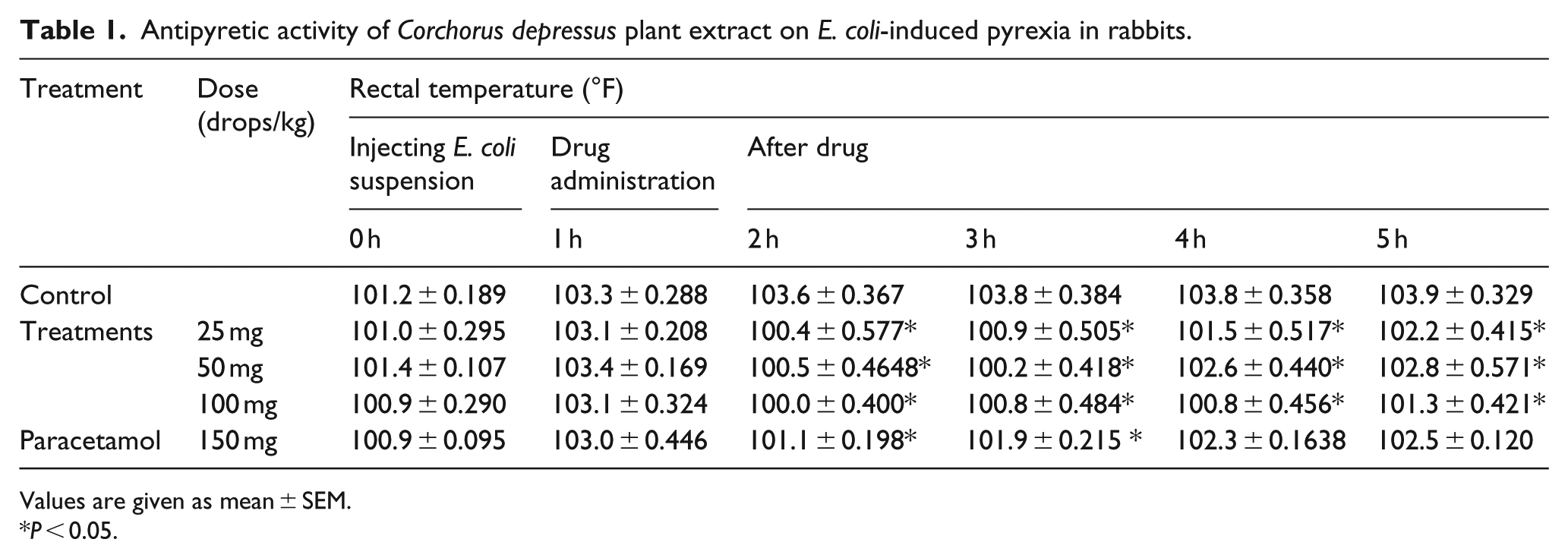
Values are given as mean ± SEM.
P < 0.05.
Discussion
In general, pyrexia is considered to be caused by some endogenous substances. 9 The antipyretic effect of hydroalcoholic extracts of C. depressus might be linked to the prevention of prostaglandin formation. Antipyretic drugs such as acetylsalicylic acid reduce body temperature by inhibiting the synthesis of prostaglandin in hypothalamus. Similarly, paracetamol gives antipyretic effect by inhibiting the cyclooxygenase (COX) iso-enzyme in brain. 10 Non-steroidal anti-inflammatory drugs (NSAIDs) like acetylsalicylic acid exert their antipyretic action by inhibiting prostaglandin synthesis (E-type) in the hypothalamus. 11 As a result, elevated plasma prostaglandin level, as observed in fever is suppressed. Paracetamol, the reference antipyretic drug used in this study, also has same effect by a selective action on a specific cyclooxygenase (COX) iso-enzyme in the central nervous system (CNS). 12 It might be likely to conclude that the C. depressus extract prevents the prostaglandins synthesis. Plant extract exhibited significant reduction in the rectal temperature of rabbits as compared to negative and positive control groups. The results obtained reveal the significant antipyretic effect of the hydroalcoholic extract of extract of C. depressus. These results also propose that the presence of certain active principles may partly be accountable for the reported antipyretic effect of C. depressus, the separation of which could facilitate to obtain better antipyretic drugs with precise mechanism of action. Further study is under way in our laboratory to isolate the active molecules from C. depressus and to set up the accurate mechanism of action of the C. depressus extract.
Footnotes
Acknowledgements
The authors acknowledge the persons, especially Khurshid, who helped us in animal handling as well as Muhammad Waris for feeding of animal. The authors acknowledge Dr Muhammad Arshad (Late), who always helped us in plant authentication.
Declaration of conflicting interests
The author(s) declared no potential conflicts of interest with respect to the research, authorship, and/or publication of this article.
Ethical approval
This study was approved from animal ethical committee, The Islamia University of Bahawalpur, Bahawalpur, Pakistan
Funding
The author(s) received no financial support for the research, authorship, and/or publication of this article.
