



Abstract
Objective:
To obtain the prevalence of lower urinary tract symptoms (LUTS) in young female population in tertiary care centre.
Method:
We conducted a descriptive and analytic study with ques tionnaire based data collection. All subjects were interviewed using conventional method and International Consultation on Incontinence Questionnaire (ICIQ) Female LUTS form in the urology outpatient department, SMS medical college and hospital, Jaipur (India).
Result:
Total 1278 patients enrolled in study. Using the well-structured questionnaire using ICIQ-FLUTS form, the prevalence of LUTS was 78.01% while conventional method having only 35.8%. This result revealed that LUTS is a common condition among young Indian female population with vaginal delivery as the common risk factor.
Conclusion:
Screening for LUTS using a structured questionnaire identified a significantly higher prevalence of LUTS than the conventional method. The ICIQ-FLUTS form is a robust questionnaire that can be recommended for use in epidemiological research as well as routine clinical practice.
Introduction
The term lower urinary tract symptoms (LUTS) encompasses a wide range of symptoms, categorized by the International Continence Society (ICS) as storage, voiding, and postmicturition symptoms. 1 Urinary incontinence as a LUTS component was considered a major problem in women and the prevalence is 17%–50% in the adult population around the globe. 2 LUTS negatively affects the quality of life leading to depression, anxiety, stress, and reduced sexual activity and satisfaction . 3 Despite this, not all people visit clinicians feelings shame and embarrassment. 4 LUTS is a condition commonly seen in women, mostly in old age. 5 Women who have urinary incontinence have an increased risk for UTI and experience increased incontinence during an acute episode. 6 Several studies have explored the relationship between UI and specific variables, some of which suggest causal links between physiological changes and incontinence. Incontinence in women is perhaps most often attributed to the effects of childbearing, aging and hysterectomy patients. 7 Risk factors of LUTS such as old age, parity, mode of delivery, obesity, hysterectomy, drugs affecting micturition, menopausal state and family history of LUTS were also studied in the various research and establish the distribution of population. 8
In many countries, a standardized questionnaire to inquire for clinical symptoms of lower urinary tract disturbances is used in everyday practice. Many clinicians depend on a simple question asking whether the patient had any urination disturbance. This is perceived as the conventional method for screening of LUTS in daily clinical practice. Questionnaire based practice is currently not a regular in India.
Because of the paucity of epidemiological data on young age group, we aimed at evaluating the prevalence of and risk factors for LUTS in a female population with a special focus on younger age group, using a standardized questionnaire. ICIQ-FLUTS form is an extensive questionnaire to assess LUTS in women, which has already been adopted in many hospitals worldwide in many languages from its English version.
Methods
This study is a descriptive cross sectional study. The Institutional Ethics Committee authorized the study protocol (NO.117MC/EC/2021), which was carried out in accordance with the Declaration of Helsinki’s principles. It was conducted in Department of Urology SMS medical college and hospital in Out Patient Department (OPD) from 2022 to 2023. With the diversity of patients, SMS hospital, Jaipur, Rajasthan (india) representative of standard in health platform.
The study included young women attending the urology OPD with age between 18 and 30 years. Pregnant and neurogenic bladder patients were excluded since itself causes a physiological change in the micturi tion pattern. Each subject was interviewed using conventional method and standardized questionnaire comprised of : “Do you have any complaint of urination?” and a set of ICIQ-FLUTS form questionnaire. Information of several risk factors affecting LUTS were also obtained, including BMI, age, parity, mode of delivery, obesity, drugs affecting micturition and family history of LUTS. Other data such as history of stroke or other accompanying disease were also recorded, with the consideration that this condition could also contribute to changes in voiding pattern.
Research subjects underwent height, weight and blood pressure measurements. Then a series of questions from the research questionnaire conducted by the researcher and trained medical students. Participants with LUTS underwent further examination to determine the possible etiology of LUTS.
Statistical analysis was performed using Statistical Package for The Social Sciences (SPSS) version 6, Cronbach’s α was calculated to evaluate the questionnaire’s internal consistency. A minimum value of 0.70 was desirable for this study
Results
This study used Questionnaire for research until the minimal number of subjects were obtained. A statistical analysis generated the Cronbach’s α value of the questionnaire; the internal consistency was satisfactory with Cronbach’s α of 0.78
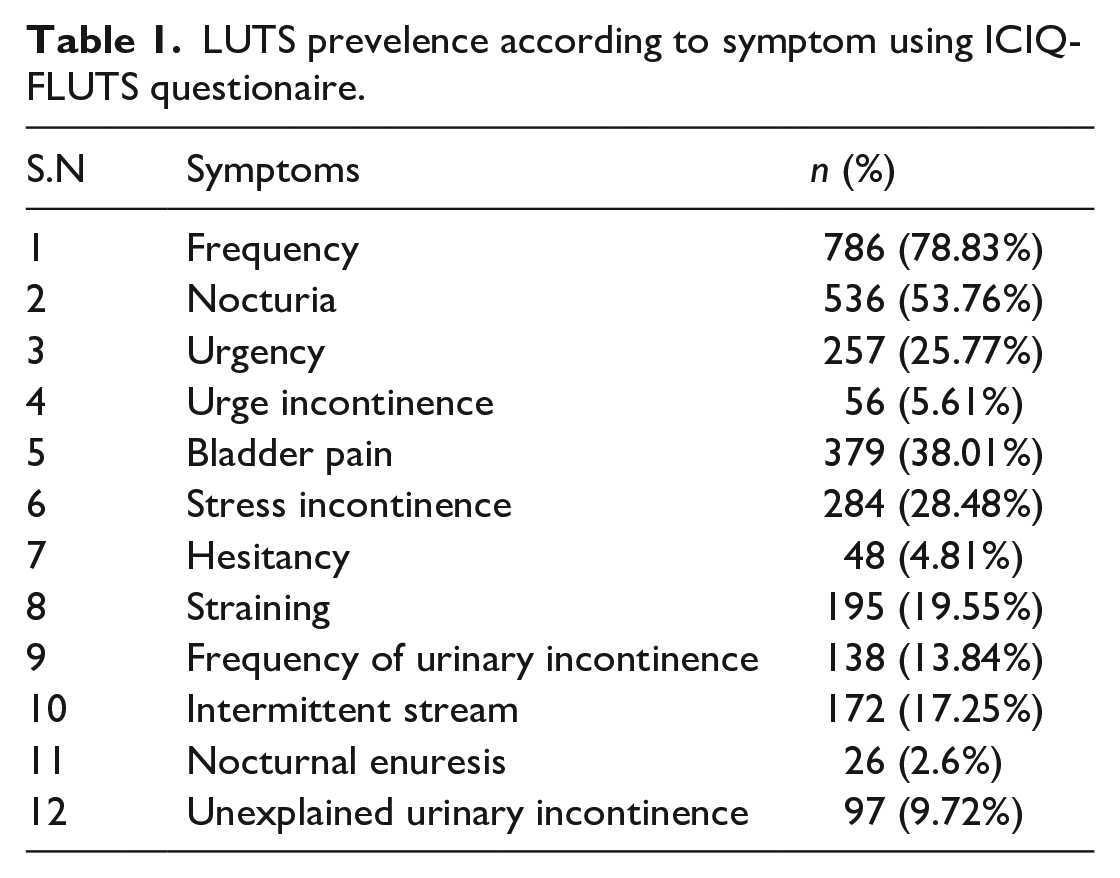
A total 1278 women participated in this study, with all of them completing the research question naire with each method, conventional and ICIQ-FLUTS questionnaire. Based on the conventional method, LUTS prevalence was only 35.8%, with 458 women frankly complaining about disturbance in urination process. After that, the same subject questioned directed by the researcher in order to complete the ICIQ-FLUTS form, we obtained a LUTS prevalence of 78.01% (997). Frequency contributed to as much as 78.83%, followed by noctura amounting to approximately 53.76%. Table 1. Showing prevalence of LUTS using ICIQ-FLUTS Questionnaire.
LUTS prevelence according to symptom using ICIQ-FLUTS questionaire.
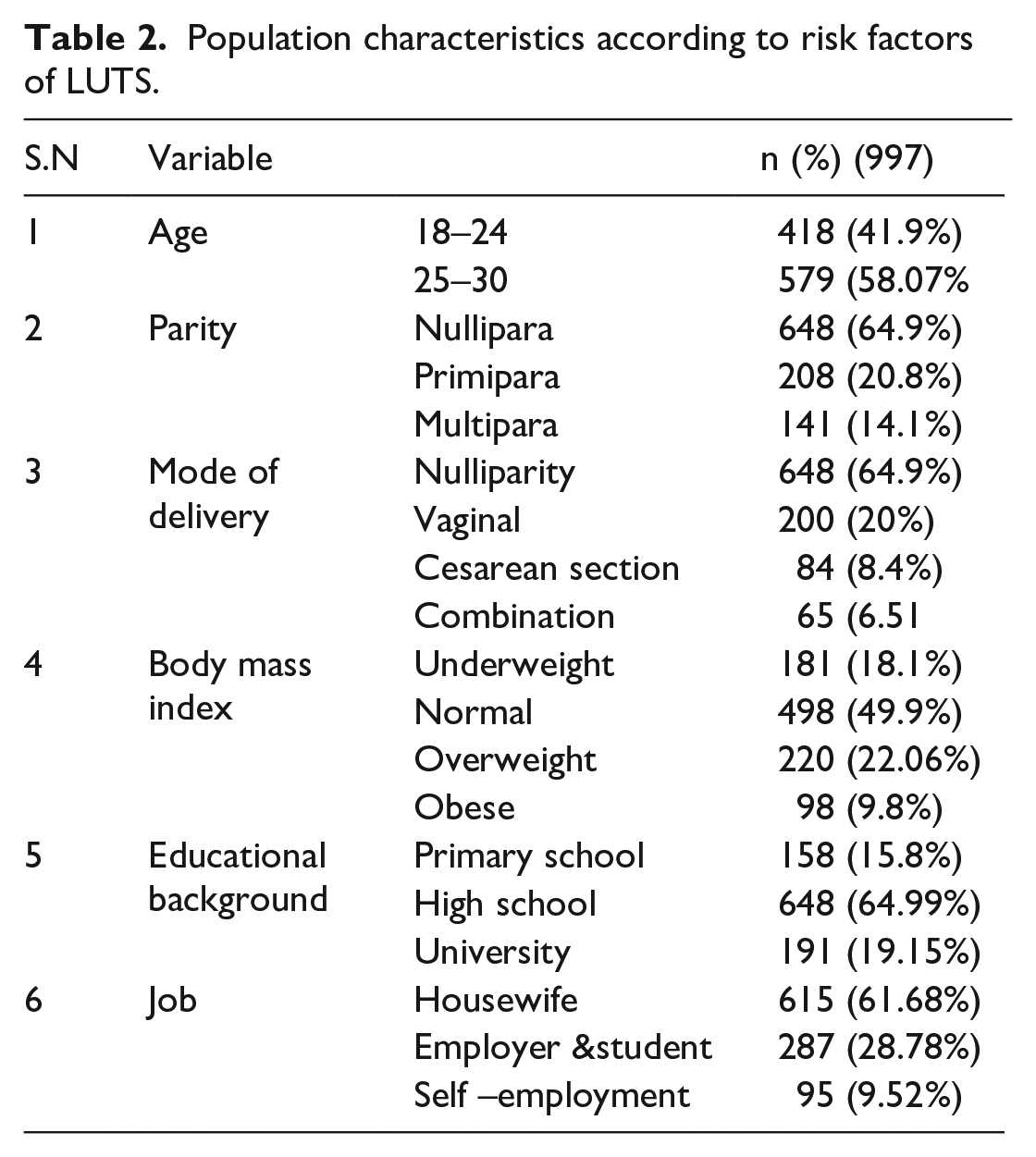
As much as 58% of our sample were between 25 and 30 years old. Around 64.9% were nulliparous with primipara and multipara were 20.8%, 14.1% respectively.(Table 2) The BMI of the samples was 49.9% had normal, obesity only making up 9.8% of our sample. Prevelence of stress incontinence (28.48%) higher correlating with more number of vaginal delivery (20%).
Population characteristics according to risk factors of LUTS.
Questionnaire method using the comprehensive ICIQ-FLUTS form had yielded quite a different outcome of LUTS prevalence in comparison to the conventional method. Using the questionnaire method, the proportion of subjects with positive LUTS based on the questionnaire method was 78.01% versus 35.8% based on the conventional method.
Discussion
Our study we found that conventional method could only screen 35.8% LUTS patients in a popu lation, contrast to the detailed questionnaire increase prevalence to 78.01%. Only 458 participants responded to have LUTS in the initial conventional method. The remaining 539 participants declined to have any urination disturbances in the conventional method, while later most of them were positive with LUTS with one or more positive symptoms based on the questionnaire method. This could occur because LUTS is possibly not the main reason they presented to the hospital in the first place, instead seeking medical attention for other symptoms. Being unaware of the extensive range of symptoms in LUTS most of the participants were not aware of the urination disturbances they were experiencing. This research may not entirely represent the female population in India, since selection bias due to the fact that it cannot be excluded completely. Further population based research is needed to refine the LUTS prevalence in Indian women. Extended range of prevalence indicates that with the right method, LUTS can be better screened in the population.
In this study, the overall prevalence of lower urinary tract symptoms was considerable, that is, 78.01%. This figure is much higher then with a previous study reporting prevalence of 31.5% by Savithaet al. 9 However, there are wide variations in the prevalence of lower urinary tract infections. Rate as high as 66.78% has been quoted by Mamesh et al. but still lower then our study 10 Hunter et al. in a similar study using a questionnaire among older women receiving home support found the prevalence of LUTS to also be high, accounting for up to 91% of all research population. 11 This prevalence was higher from study by Swithinbank et al. (69%) 12 and by Zhang et al. in an Asian population (39.7%). 13 A reason for such wide variation in these estimates could be the use of selected groups of women, for example, pregnancy, elderly women, young women, etc. in their study. Earlier research demonstrated that despite the presence of symptoms, women do not immediately seek medical advise for UTI. 14
Frequency contributed as the most common symptom indicating LUTS based on the ICIQ-FLUTS questionnaire. The second most prevalent symptom was nocturia, affecting 536 participants (53.76%). Age distribution our research was 18–30 years old. It was estimated that the risk of developing LUTS increases with age.15–18 Also corresponding with previous studies, this research found that most women delivered their babies vaginally. This could explain the high prevalence of stress urinary incontinence among the population. Compared to several studies documenting increasing risk of incontinence in obese women, this study documented a surprising domination of women with normal BMI (49.9%) in the population, with only 9.8% classified as obese. Obesity is not the only risk factor but also play a role contributing in the development of LUTS.
Estrogen plays an important role in the voiding process, so it is predicted that menopausal state will increase LUTS prevalence in women. 5 All of our sample were premenopausal female. This indicate that LUTS also affects premenopausal women, especially with other contributing risk factors. This could also represent the possibility of higher LUTS prevalence in a wider, more balanced community consisting of an equal proportion of pre and post menopausal women. This will be a good focus for further studies.
Systematic review by Brown et al. concluded that women above 60 years old with hysterectomy operation had six times the relative risk for developing urinary incontinence. 19 Mushkat et al. stated that genetic transmission correlates with incidence of stress urinary incontinence in first stage relatives. 20
A small number of participants (4.8%) consume regular medication that may affect the urination process. Diuretics, calcium channel inhibitors used for hypertension medication. NSAID utilization will cause water retention while ACE inhibitors will cause cough that further exacerbates existing stress incontinence. Calcium channel inhibitors have the side effect of overflow incontinence and urinary retention. On the other side, consumption of coffee or alcohol cause alteration in urination frequency.
Limitations and recommendation
We acknowledge that this study had several limitations. First, this study had a sample from an urban tertiary care centre and not included rural population. Thus, we cannot generalize our findings for the general population. It is recommended that a multicenter trial, with better sampling proportions of representative age groups, be conducted in future. Furthermore, to date there is no published local study that assesses barriers to seeking medical intervention among female with LUTS. A qualitative study is recommended to explore the sociocultural barriers that may influence our multiethnic population and their decision to actively seek medical intervention for LUTS
Conclusion
Method of screening plays an important role in producing an accurate rate of prevalence. Conventional method lacking information in detailed symptoms lead to false LUTS prevalence. This data proved that LUTS is a frequent condition among the young females also with the risk factor of vaginal deliveries. Wrong perception of LUTS only in old aging, diabetic, multipara women. Good screening method will be the first step to recognize any pathology of the lower urinary tract in women. The ICIQ-FLUTS form questionnaire is a brief and robust questionnaire that is recommended for use in epidemiological research and routine clinical prac tice.
Footnotes
Acknowledgements
We would like to express our special thanks of gratitude to our patients and staff in Urology Department SMS medical college
Author and contributions
1. Dr Saurabh Kumar Negi, Post-Doctoral Trainee -Conception, Design, Materials, Data collection and processing, Analysis and Interpretation, Writing. 2. Dr. Sandip Desai, Post-Doctoral Trainee - Materials, Data collection and processing, Analysis and Interpretation, Writing, Literature Review. 3. Dr Gaurav Faujdar, Post-Doctoral Trainee - Materials, Data collection and processing, Analysis and Interpretation, Writing, Literature Review. 4. Dr. Nachiket Vyas, Professor - Design, Supervision, Analysis and Interpretation, Writing, Critical Review. 5. Dr Shivam Priyadarshi, Senior Professor and Head of department - Design, Supervision, Analysis and Interpretation, Writing, Critical Review
Declaration of conflicting interests
The author(s) declared no potential conflicts of interest with respect to the research, authorship, and/or publication of this article.
Funding
The author(s) received no financial support for the research, authorship, and/or publication of this article.
Ethics committee approval
Approved by Institutional Ethics Committee.
• Institute name—SMS Medical College, Jaipur, Rajasthan, India
• Approval number—117MC/EC/2021
Patient Consent
Obtained.
