



Abstract
Background:
Food and nutrition insecurity continues to be one of the persistent challenges in Ethiopia. The country has been responding to the challenges in various ways to foster sustainable development.
Objectives:
The objective of the study is to assess national food and nutrition security policy and strategic responses.
Method:
A qualitative review of policies, strategies, programs, guidelines, and a government commitment, document was conducted. Interviews with experts from food and nutrition-implementing governmental and nongovernmental organizations were also employed. Thematic analysis with description was used.
Results:
The results of the study revealed that global initiatives stimulated Ethiopia to progressively take various strategic directions to address the ongoing food and nutrition challenges. In addition to various policy directions, the country has been implementing nutrition-specific and nutrition-sensitive programs under the multisectoral approach. The concepts and practices of food and nutrition security shifted from simply balancing the demand and supply of food to a broader and more inclusive food system approach with the involvement of multiple actors. However, more has been said than done. The policy, strategic objectives, and initiatives have not been adequately translated into practices. Actions toward ensuring food and nutrition security, on the other hand, are constrained by institutional, environmental, technological, and emerging priorities like an outbreak of a pandemic and political instability.
Conclusion:
The study concluded that available policy and strategic intents have sufficiently addressed food and nutrition challenges in documents and need to be fully translated into practices.
Plain language title
Ethiopia’s Policy and Strategies to Ensure Food and Nutrition Security
Plain language summary
Ethiopia is facing food and nutrition insecurity problems that require multidimensional action. We studied how the country is responding to the challenges through national food and nutrition security policies and strategies. We found that global initiatives stimulated Ethiopia to progressively take various strategic directions to address the ongoing food and nutrition insecurity problems. The country has devised nutrition-specific and nutrition-sensitive programs under the multisectoral approach, which incorporates policy, strategies, program, guidelines, and a political commitment document. The concepts and practices of food and nutrition security have evolved from balancing the demand and supply of food to a broader and more inclusive food system approach with the involvement of multiple actors. However, the country did not fully translate the policy response into the ground. Interventions to ensure food and nutrition security are challenged by institutional, environmental, technological, other priority agenda, and political instability. Based on the study, we conclude that the country has a fertile policy environment that needs to be translated into practices uniformly across all regions.
Introduction
Food and nutrition security has become one of the most pressing challenges facing nations around the world. It is at the center of the agenda for local, national, and international development. Malnutrition in all its forms represents the number one risk factor in the global burden of disease affecting productivity. It is not only a public health concern but also an impediment to global poverty eradication efforts, productivity enhancement, and economic growth. 1 According to Agriculture and Food Systems for Nutrition, 2 malnutrition has far-reaching consequences, especially for children, affecting survival, overall cognitive development, school performance, lifetime earnings, and vulnerability to infectious and chronic diseases in adulthood. From a shred of evidence, it is frequently noted that the food and nutrition security of citizens is a prerequisite for the creation of a productive workforce, longevity of life, improved livelihood, and innovative capacity that would foster the sustainable development of nations. 3,4 Despite a strong association between food security, nutrition, and human well-being, the number of undernourished people in the world continues to increase. 5 The same report on the state of food security and nutrition in the world shows that the world is progressing neither toward the sustainable development goals (SDG) target of ensuring access to safe, nutritious, and sufficient food for all people all year round nor toward the target of eradicating all forms of malnutrition. Food security and nutrition interventions in general target either tackling the root causes or treating the symptoms of the effects. However, reports in terms of bringing about desired changes as a result of such interventions are not effective. 6
The prevalence of malnutrition and associated problems in developing countries, especially in Africa, is rampant. 5 According to the Global Report on Food Crises, 135 million people from 53 countries were acutely food insecure in crises in 2019, and more than half of the affected were reported from Africa. 7 In Ethiopia, about 8 million people were estimated to be in crisis at the same time. The report from the National Demographic and Health Survey shows that 37% of under-5 children are stunted, 7% wasted, 21% underweight, and 2% overweight, including micronutrient deficiencies. 8 -10 The annual costs associated with child undernourishment are estimated at 55.5 billion Ethiopian birr, which was equivalent to 16.5% of GDP at the time. 11 Malnutrition (both under and over) is caused by different factors that could be categorized as basic, underlying, and immediate. 12 These widely accepted causes of food and nutrition problems, in one way or another, are attributed to social, economic, environmental, institutional, and political conditions. 13 These factors, if not at all, are strongly linked and conditioned by the policies and strategies in place. On the other hand, courses of action or policy interventions aimed at ending food insecurity and malnutrition must be evidence-based.
With various degrees of intervention and focus areas, countries around the world are striving to tackle the problems of food and nutrition. Food security and nutrition interventions in general target either tackling the root causes or treating the symptoms of the effects. However, reports in terms of bringing about the desired change as a result of such interventions are not effective. 5 Likewise, efforts to create conducive policy environments, interventions, and outcomes need to be documented and communicated across practitioners, researchers, policymakers, and implementing bodies. This study aims to investigate policy responses and interventions for food and nutrition security in Ethiopia.
Methods
The study heavily relied on a review of policy documents and an interview with experts from key food and nutrition implementing bodies in the country. Some qualitative data were also taken from interviews with experts on key nutrition-implanting bodies. International conventions, declarations, shared development goals, and frameworks responding to global food and nutrition challenges were included. The documents under the UN systems were mainly extracted from the Food Security and Nutrition-Global Issue of the UN Digital Library. Likewise, the national documents, which include policies, strategies, programs, plans of action, and frameworks targeting tackling food and nutrition security, were taken from institutional websites and repositories. Twenty-four national food and nutrition policy-related documents and implementation modalities in Ethiopia were collected from the repository systems of national and international organizations and agencies. Except for the international documents, the national policy-related documents put in place since 1987 were included.
The review was supplemented with interviews with federal, regional, and district-level experts from implementing government sectors and nongovernmental organizations. Nutrition experts of the health sector; animal husbandry, crops, science experts, extension, and nutrition-sensitive agriculture focal persons of the agriculture sector; consumer and producer cooperatives experts; academia, researchers, and experts from supporting nongovernmental organizations such as the Agricultural Transformation Agency were included in interviews. The interviews with experts were focused on the implementation of policies, strategies, programs, and support for diversified production and consumption and the challenges of food and nutrition security.
The information obtained from policy documents was condensed and categorized into different themes. Thematic analysis, which involves breaking up qualitative data into meaningful categories 14,15 was used to identify how national policies and their derivatives are responding to the challenges of food and nutrition security. The themes include policy, strategies, programs, declarations, and frameworks. Under each category, further decomposition in terms of goals set, anticipated targets and outcomes, approaches designed, focus areas identified for food and nutrition interventions, and implementation modalities were undertaken and examined. Descriptions and themes were used to understand the underlying assumptions and priorities of policy responses. Data obtained from interviews were analyzed using qualitative techniques, including content analysis and description.
Results and Discussion
Ethiopian Response to Global Concerns of Food and Nutrition Insecurity
There are persistently increasing concerns about food insecurity and malnutrition globally. There is also a wider understanding that food security and nutrition problems are not only fundamental human rights but also important components of ensuring sustainable development. Since the Universal Declaration of Human Rights, 16 in which adequate food for all people has been recognized as part of the right to an improved standard of living, the global response has increased and now becomes consistent. The responses include but are not limited to the International Covenant on Economic, Social, and Cultural Rights, 17 which describes what governments should do to discharge their obligations under the right to food, the Rome Declaration and the World Food Summit, and development goals that emphasize interventions on food and nutrition security.
The then Millennium Development Goals (MDGs) 18 and the current SDGs 19 are important, globally shared commitments of governments across nations in which food and nutrition security challenges have gained attention. Plans of action such as the United Nations Decade of Action on Nutrition (2016-2025) 20 that provide a common framework for countries and stakeholders, including the Global Strategic Framework for Food and Nutrition 21 and the Global Nutrition Monitoring Framework, 22 are part of efforts toward ensuring food and nutrition security. Scaling up Nutrition 23 and the Comprehensive African Agricultural Development Program (Maputo Declaration) 24 are also important global initiatives. However, given all these global policy responses and interventions, food and nutrition security remain the greatest challenge. Consequently, the government and policymakers in Ethiopia are highly convinced that the challenges of food security and nutrition are on the priority agenda of poverty reduction and promoting sustainable development.
Ethiopia has a track record of active engagement in almost all global responses to food and nutrition security. However, deep-rooted problems of food security and nutrition triggered many countries to cascade a global response tailored to their contexts. As part of its shared global commitment and responsibilities, Ethiopia has adopted national policies, strategies, programs, frameworks, declarations, and interventions to ensure food security and nutrition and foster sustainable development. Except for the 1987 National Food and Nutrition Strategy, which served as a transitional strategic document to the new millennium, most of the responses are the effects of the shared vision of the then MDGs and the current SDGs, under which food and nutrition issues have been considered important development agenda items.
Food and Nutrition Policy
Food and nutrition policy 3 and consecutive national nutrition programs have served as important courses of action guiding the implementation of food and nutrition security endeavors. Before the endorsement of the national food and nutrition policy, the subsequent national nutrition program served as an important guiding document for practitioners.
The Food and Nutrition Policy of Ethiopia was developed during the implementation period of the Food Security Strategy, 25 the National Nutrition Strategy (NNS), 26 the National Nutrition Program II (NNPII), 27 the Seqota Declaration Roadmap, 28 the Nutrition-Sensitive Agriculture Strategy, 29 the School Health and Nutrition (SHN) Strategy, 30 and consecutive Productive Safety Net Programs. The policy takes into account both nutrition-specific and sensitive interventions and the food value chain approach in the food system. It aims to serve as an enabling environment for various food and nutrition interventions to meet their objectives. Moreover, it anticipates ensuring food and nutrition security by linking key interventions in the food system, including food safety and the value chain. The policy is based on a global conceptual framework of nutrition security that targets immediate and underlying causes. Food and nutrition are considered cross-cutting issues that require multisectoral coordination (Table 1).
Food and Nutrition Policy of Ethiopia.
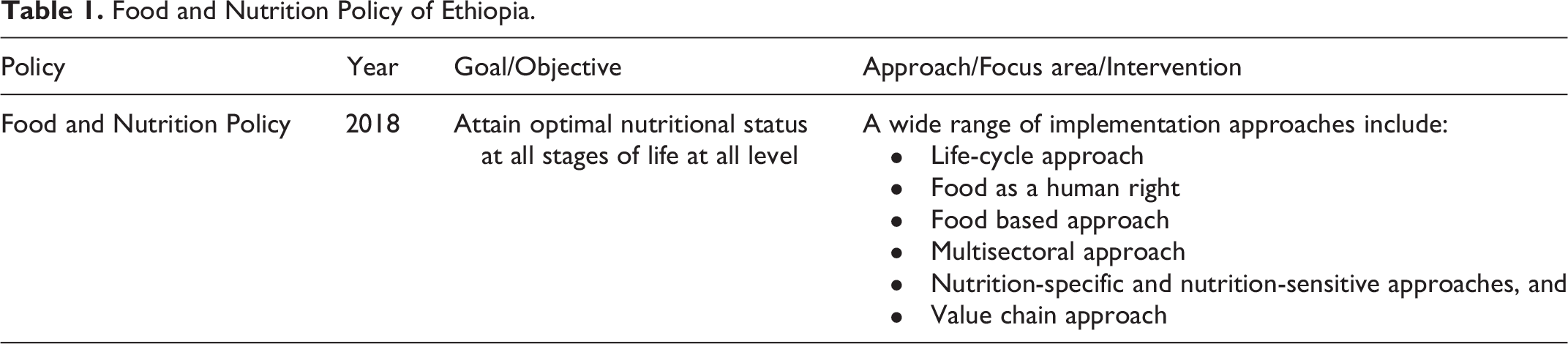
The Food and Nutrition Policy of Ethiopia, which is an extension of the NNPII, comprises 27 strategies to meet 11 objectives. The policy directions include ensuring food and nutrition security, safety, and quality from farm to table; postharvest management; a life cycle approach to nutrition; food and nutrition emergency responses; food and nutrition communication; and governance of food and nutrition interventions. The implementation mechanism of the Food and Nutrition Policy links specific intervention approaches to legal frameworks, institutional arrangements, capacity building, food and nutrition communication, and sustainable financing. A wide range of approaches to food and nutrition that include life cycle, human rights, food-based, multisectoral integration, coordination, linkage, nutrition-specific, nutrition-sensitive, and farm-to-table approaches have been adopted.
Though the policy pays attention to food quality and safety, interventions are largely limited to political responses rather than technical ones. Good agricultural practices, which are instrumental in ensuring food quality and safety and promoting traditional underutilized foods, are seldom considered. Institutional arrangements, however, focus on ad hoc representation of the different stakeholders from the federal to the kebele levels.
Strategies to Ensure Food and Nutrition Security
The National Food and Nutrition Strategy of 1987 31 served as a transitional strategic response to the new millennium. With variations in strategic goals, objectives, focus areas, approaches, and interventions, there are different national strategies for food and nutrition security. The strategies include the Food and Nutrition Strategy (FNS), 32 the Postharvest Management Strategy in Grains in Ethiopia, 33 the National Nutrition Sensitive Agriculture (NSA) Strategy, 29 the National SHN Strategy, 28 the NNS, 34 the National Strategy for Child Survival in Ethiopia, 35 the National Strategy for Infant and Young Child Feeding (IYCF)], 36 and the Food Security Strategy. 22
The Comprehensive FNS of Ethiopia is intended to attain optimal nutritional status at all stages of life and conditions that are consistent with quality of life, productivity, and longevity. The strategy promotes a multisectoral approach, and delegates from 9 ministries have shown their commitment to implementing the strategy by signing the document. Food and Nutrition Strategy has clearly been stated as a strategic document to implement national food and nutrition policy with 13 strategic objectives that can be attained through food and nutrition-sensitive and specific interventions; food and nutrition governance; and infrastructure invention pathways. The strategic objectives are cascaded into directions, initiatives, actions, and then key performance indicators. For each action and key performance indicator, lead and collaborating indicators have been identified.
Postharvest management significantly affects food availability, access, and safety at different levels. To this effect, a Postharvest Management Strategy in Grains in Ethiopia, which aims to reduce food losses through adaptation and/or adoption and the implementation of appropriate postharvest management systems along with the agricultural value chain, has been devised. The strategic objectives focus on reducing postharvest loss, improving agricultural inputs and output marketing efficiency, accessing finance for postharvest management, and promoting the value chain. The strategy clearly indicated policy implementation mechanisms from the planning to monitoring and evaluation phases. Although the strategy targets the pressing challenge of food and nutrition security through reducing losses, fruits and vegetables, which are important sources of micronutrients but highly exposed to postharvest loss, are neglected.
Recognizing the role of agriculture as a major source of foods (from plant and animal sources), the NSA Strategy, which is the first spectacular strategy linking agriculture with nutrition outcomes, was developed in 2016. The main intent of the strategy is to improve the nutritional status of children and women by increasing the quantity and quality of food available, accessible, and affordable, and promoting the utilization of diverse, nutritious, and safe foods for all Ethiopians at all times. The strategy advocates different pathways to ensure food and nutrition security through agricultural interventions. The strategic interventions of agriculture in nutrition include leveraging nutrition into agriculture policies, strategies, programs, and plans; diversified production of plant- and animal-sourced foods and consumption; strengthening institutional and organizational structure and capacity; targeting vulnerable groups; empowering women and youth; and multisectoral integration. The NSA strategy also promotes participation, women’s engagement, evidence-based interventions, inclusion of stakeholders, environmental friendliness, and sustainability as governing principles.
Aiming to improve food access and educational achievement of schoolchildren through health and nutrition interventions, the National SHN Strategy promotes a multisectoral approach to improving school health and nutrition. The Focusing Resources on Effective School Health framework has been used in the national SHN strategy. The primary strategic components of the national SHN program include health and nutrition-related policies, a safe and sanitary school environment, skill-based health and nutrition education, and school-based health and nutrition services. The strategy proposes establishing an institutional framework, collaboration, networking, and monitoring and evaluation schemes as implementation strategies. With the framework of promoting a multisectoral approach, the SHN strategy has clearly indicated the responsibilities of implementing sectors, communities, and other stakeholders.
The NNS was developed with the intent of ensuring that all Ethiopians secure adequate nutritional status in a sustainable manner. Community participation, establishing and strengthening community-based nutrition programs, establishing coordination mechanisms, targeting vulnerable groups, and improving nutrition knowledge and skills are identified as implementation principles of the strategy.
A wide range of strategies, such as promoting essential nutrition actions, child growth monitoring and promotion, building knowledge, attitudes, and practices for improved nutrition using different mechanisms, and improving the care and nutrition status of people living with HIV/AIDS, were proposed. It also targets strengthening nutrition in emergencies, strengthening food security activities, micronutrient supplementation, and fortification (Table 2).
Strategies of Food and Nutrition Security in Ethiopia.
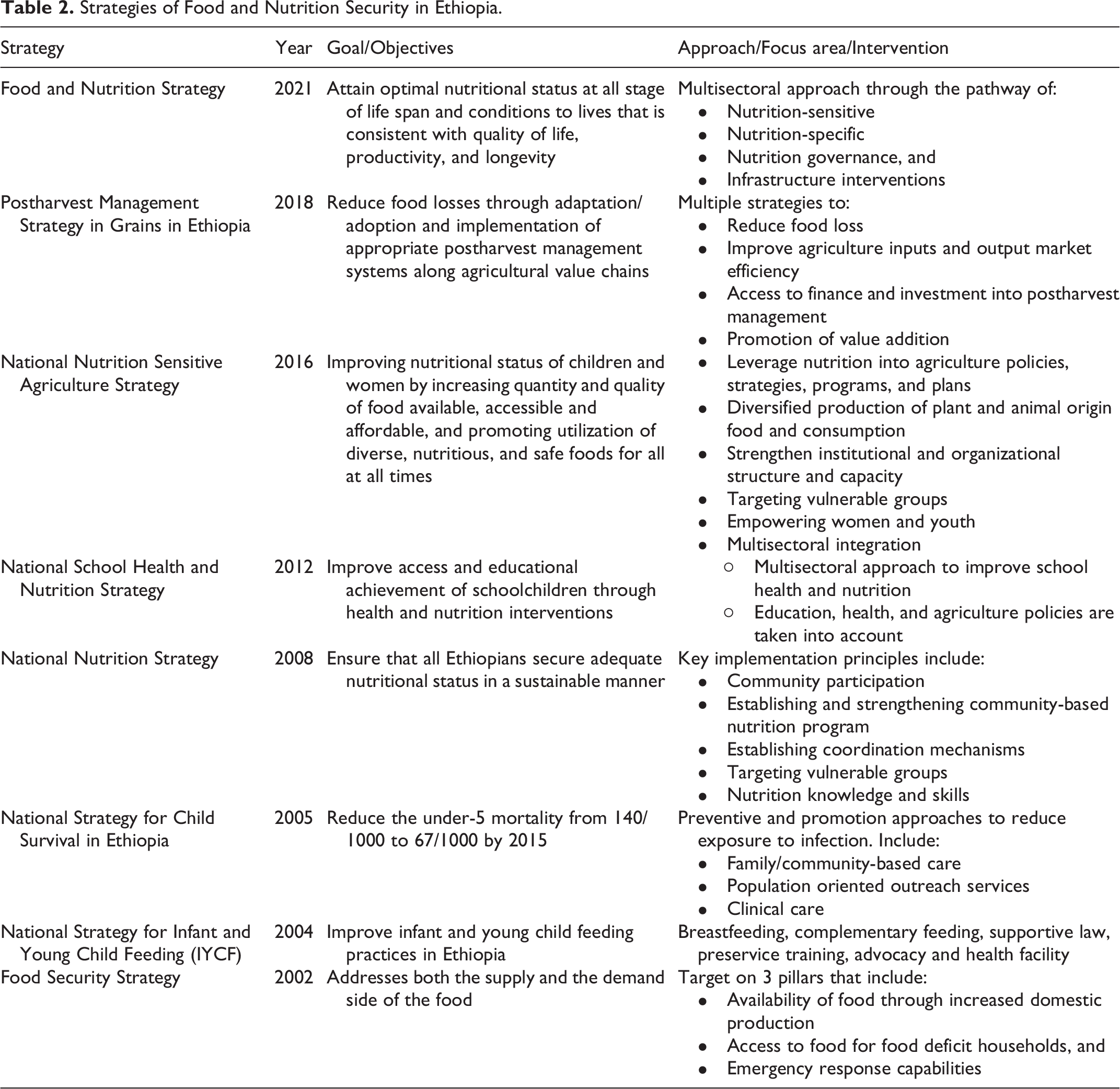
Food standard enforcement, diet-related noncommunicable diseases, improving water and sanitation services, and strengthening nutrition information systems were also devised. The strategy promotes integrated multisectoral approaches and the establishment of coordinating bodies at different levels. The IYCF strategy of the country, on the other hand, focuses on nutrition-specific interventions such as breastfeeding, complementary feeding, supportive law, preservice training, advocacy, and health facilities. In general, the strategies related to food and nutrition security in Ethiopia have evolved from simply meeting the gaps in demand and supply to integrated and multisectoral approaches.
Programs of Food and Nutrition Security in Ethiopia
In addition to national food and nutrition policy, programs and plans have also been devised to positively impact the nutritional status and health of citizens. Subsequent national nutrition programs have implemented various interventions. The NNP II of 2016 is an extension of the National Nutrition Program I. In line with the SDGs, the goal of NNP II was to reduce malnutrition to achieve zero hunger by 2030. As an approach for program implementation, the national nutrition program promotes a life-cycle approach, especially a 1000-day window, multisectoral coordination, and implementing both nutrition-specific and nutrition-sensitive interventions.
The major intervention areas of NNP II include optimal breastfeeding, optimal complementary feeding, mitigation and prevention of micronutrient deficiencies, water, sanitation, and hygiene, deworming, food fortification, and management of acute malnutrition (Table 3).
Programs of Food and Nutrition Security in Ethiopia.
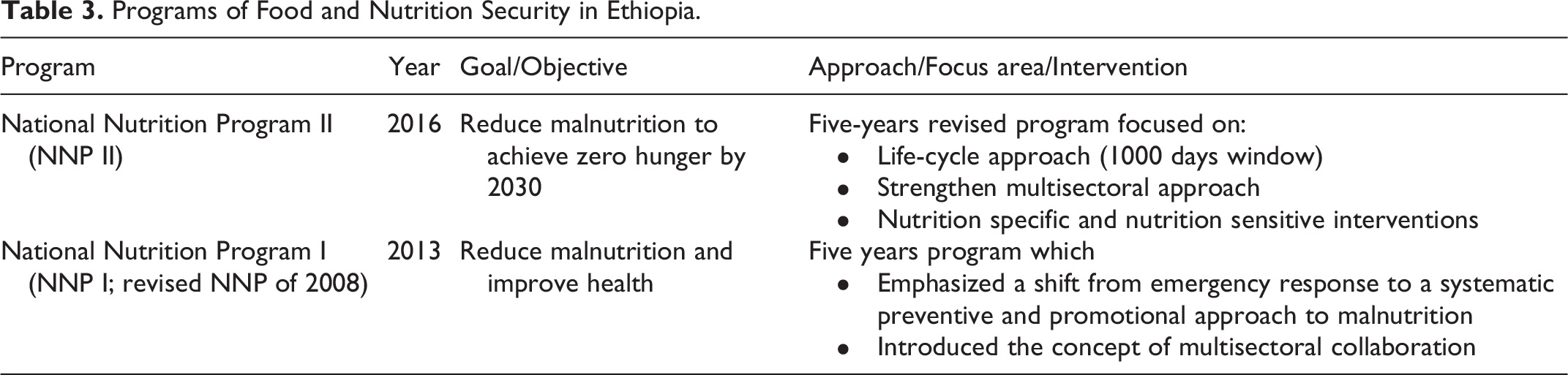
The program was comprehensive and composed of 5 strategic objectives, 25 intended results, and 143 initiatives to meet objectives in 2020. Specific strategic objective 4 of the program, on the other hand, focuses on strengthening the implementation of nutrition-sensitive interventions across sectors and comprises 5 targets, 11 results, and 69 initiatives.
The NNP II promotes nutrition implementation and governance as important factors in addressing the multidimensional challenges of malnutrition. It also promotes political commitment and a policy framework, multisectoral nutrition coordination, capacity building for nutrition, the gender dimension of nutrition, and nutrition communication. Though multisectoral coordination and linkage are promoted, almost all of the activities are given to the health sector. It lacks information on recruitment criteria for grass-roots nutrition coordination bodies and technical committee members. From the estimated budget of the NNP II, 88.6% was proposed for nutrition-specific interventions, which indicates the program, was geared more toward addressing immediate causes than the promoted underlying ones.
Declaration, Guidelines, Framework and Packages
The policy and strategy responses to food and nutrition security in Ethiopia are not limited to the policies and strategies. High-level government commitment documents, guidelines for interventions, and packages are found to be important responses toward ensuring food and nutrition security. The Seqota Declaration Roadmap, 26 the National Guideline for Controlling and Prevention of Micronutrient Deficiencies, 37 and the National Nutrition Communication Frameworks 38 are devised to impact the positive nutritional and health outcomes of the citizens.
The Seqota Declaration is a high-level political commitment document of the government to ensure nutrition security as an implementation strategy of the national nutrition program and agricultural growth program. As a government commitment document, the Seqota Declaration recognizes and promotes a multisectoral approach. The commitment plan aims to achieve (1) zero stunting in children younger than 2 years; (2) 100% access to adequate food all year round; (3) transformed smallholder productivity and income; (4) zero postharvest loss; (5) innovation around the promotion of sustainable food systems, which includes climate smart interventions; (6) improving the accessibility and coverage of adequate and safe drinking water supply, 100% open defecation-free kebeles (the lowest administrative structure) by 2030, irrigation for supporting agriculture, as well as access to water sources; (7) increasing efforts to educate women and girls; and (8) focusing on poverty reduction and resilience building through predictable cash transfers to the most vulnerable group. The document also promotes targeted support for school feeding programs, pregnant and lactating women, and children younger than 2 years.
The comprehensive plan of government, as part of the Seqota declaration, promotes both nutrition-specific and nutrition-smart interventions using a multisectoral approach. The Takeze River basin, where a high prevalence of food insecurity problems is found, is identified as the implementation area for the first phase plan of the Seqota declaration. However, the implementation plans show that most of the activities and resources, including the budget, are geared more toward the health sector than others. The pilot projects in the Takeze basin, which are expected to be scaled out, are operating far behind schedule.
Ethiopian Food-Based Dietary Guidelines (FBDGs) 2022, 39 which were considered the game-changing solution for Ethiopian food systems, aim to reduce malnutrition and diet-related public health problems in the country. The document integrates cultural, economic, ecological, and environmental aspects into a wider food system. The guideline adopted principles of acceptability, cultural appropriateness, comprehensiveness, and practical applicability of foods. Unlike other strategies and programs, the FBDGs of Ethiopia recognized the strategic responses of existing policies, strategies, programs, and initiatives and were designed as a tool to achieve anticipated objectives through multisectoral engagements. Eleven key nutritional messages with the recommended amount of diet to be eaten in a day and week are also included in the guideline.
The multifaceted dimension of food and nutrition insecurity is not limited to economic and physical access to nutritious food but is also highly associated with people’s social and cultural contexts. In recognition of this, the National Nutrition Communication Framework was developed to provide comprehensive contextual, societal, and personal behavior-related information. Nutrition information, education, communication/Behavioral Change Communication, advocacy, and social mobilization are found to be approaches of the framework. The framework guides to consider context, government policy, economic, sociocultural, and gender domains for nutrition communication to be implemented at the individual, family, community, and societal levels.
The national nutrition communication framework has well-articulated implementation modalities that link objectives with activities, methods, and responsible bodies. However, instead of exploring available national, regional, and local sectors, significant parts of communication activities have been given to donors and UN agencies (Table 4).
Declaration, Guidelines, and Package Related to Food and Nutrition Security.
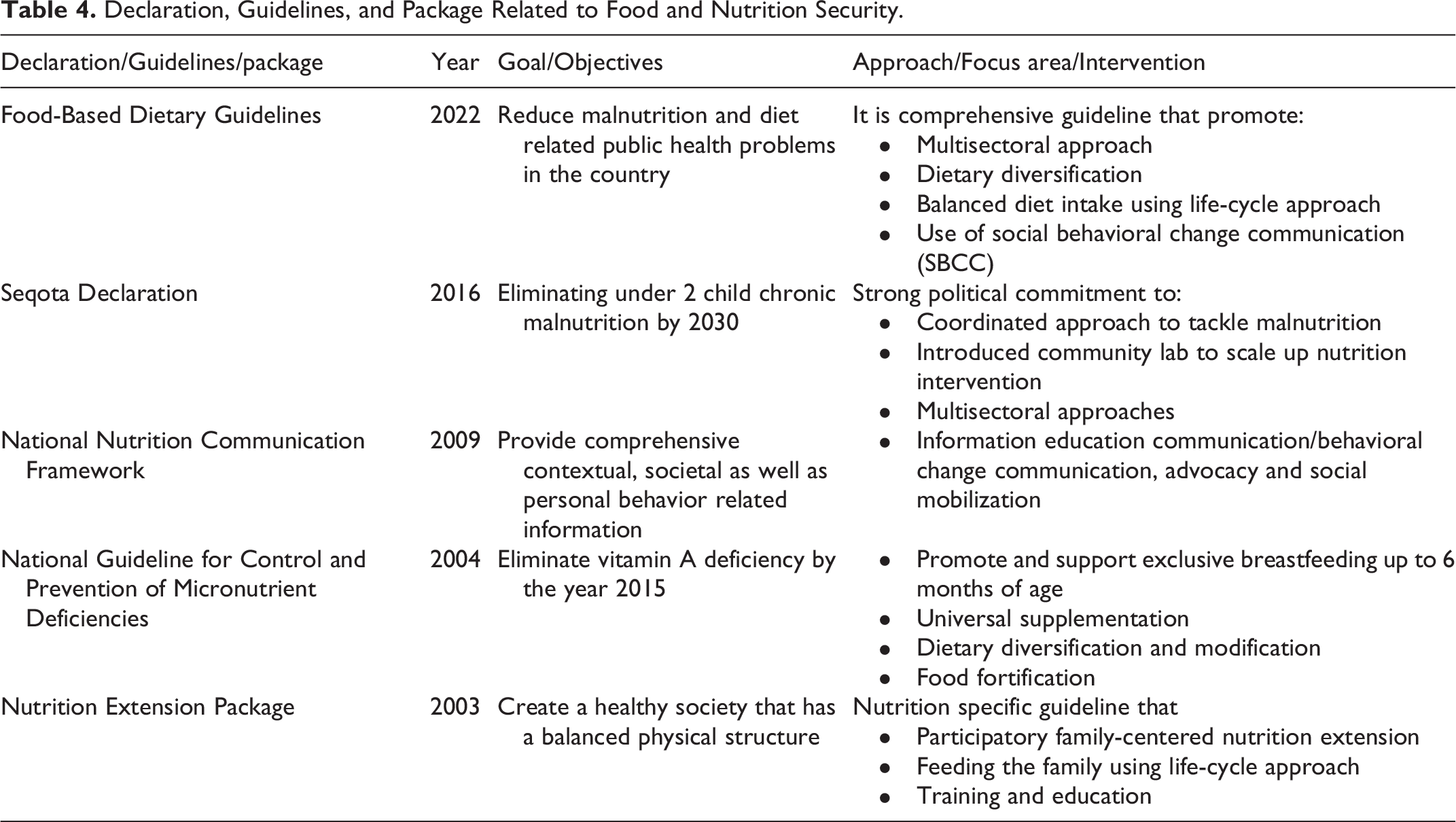
Like the national framework for nutrition communication, the Nutrition Extension Package 40 is also designed to create a healthy society with a balanced physical structure. It is a family-centered, informative package aimed at tackling the immediate causes of malnutrition by feeding the family through the life-cycle approach. The package advocates participatory family-centered nutrition extension and the prevention of diseases caused by malnutrition. However, the nutrition extension package lacks the incorporation of nutrition-sensitive interventions and food environments in the process of tackling malnutrition.
The problems of malnutrition are largely addressed in terms of protein-energy malnutrition. However, micronutrient deficiency, which is the major cause of hidden hunger, is also equally important for the healthy and active lives of human beings. In the process of eliminating hidden hunger, the National Guideline for Control and Prevention of Micronutrient Deficiencies was intended to eliminate vitamin A deficiency by the year 2015. It recommended the promotion and support of exclusive breastfeeding up to 6 months of age, universal supplementation, dietary diversification, and food modification or fortification.
Food and Nutrition Interventions: Focuses and Limitations
Translating existing policies and strategies for food and nutrition security into result-oriented practices requires investment in the broader food system, which involves different actors and stakeholders. A qualitative assessment of various sectors under the multisectoral approach revealed that health, agriculture, industry, trade, irrigation, nongovernmental organizations, UN organizations, cooperatives, academics, and research institutes have participated in the implementation of policies, strategies, and programs. However, engagements are limited to a few sectors (not as specified in documents) and vary from sector to sector depending on organizational objectives. Many food and nutrition interventions have been implemented by nongovernmental organizations in collaboration with a few government agencies and institutions, largely based on external funds.
In response to exciting policies, strategies, programs, and high-level political comments, food and nutrition security interventions in Ethiopia can be seen as nutrition-specific, nutrition-sensitive, and nutrition-smart, which are described as fundamental elements of the current global nutrition interventions. 41 Nutrition-specific interventions mainly implemented by the health sector include maternal and newborn child health and nutrition; infant and young child feeding; vitamin A supplementation; zinc and oral rehydration salt for treatment of diarrhoea; universal salt iodization; and severe acute malnutrition (SAM) management. Deworming, breastfeeding, growth monitoring, Social Behavior Change Communication, family planning, institutional delivery, vaccination, and other medical services are also included.
Promotion of diversified, nutrient-dense animal and plant food production, production of neglected but nutrient-dense crops, and management of environmental resources aim to enable the transition to more sustainable livelihoods. However, because of the poor extension for nutrient-dense crops such as vegetables, pulses, and fruits, smallholder farmers focus more on quantity than quality. Program-based interventions in which governmental and nongovernmental organizations have actively participated include government food security programs, food security projects, emergency food aid, protected relief and recovery operations, targeted supplementary food programs, productive safety net programs, and children in local development such as school feeding. There are also food and nutrition-related livelihood support programs that provide small ruminants and poultry for women. Nevertheless, the mix of interventions on food and nutrition security being implemented in Ethiopia is not fair in addressing all regions of the country, as the government and funding agencies focus on food-insecure areas mainly in the form of emergency responses.
Implementing food and nutrition interventions is not as easy and straightforward as they are presented in policies, strategies, and plans of action. The absence of a system or working structure from the federal to grassroots levels is the major problem in implementing the policy and strategies. The competing priorities of the government, such as the COVID-19 pandemic and war, climate change, rapid population growth, misalignment of policy and strategic intents and priorities across implementing sectors, and technological pitfalls have contributed to the failure to put them in place. Policy, strategy, and program intents are also not well communicated and equally understood among actors and stakeholders. Despite increasing concern for nutrition, multisectoral intervention is not well integrated into existing relevant organizations. For instance, in response to the Seqota Declaration, most interventions have been performed by the health and agricultural sectors as part of their regular activities. Other concerned bodies, including the signatory government sectors, are either not convinced or have failed to actively engage because of institutional setups. Moreover, the means of mobilizing the ad hoc mix of multisectoral actors are not clearly indicated.
The gaps in intended policy and strategic objectives and actions for food and nutrition security are also attributed to miscommunication of national policies, strategies, and plans of action across implementing bodies, stakeholders, and beneficiaries. The multisectoral approach to food and nutrition security has failed because of the lack of specific actions and responsibilities allocated to implementing bodies. Except for the national food and nutrition strategy, which specified the lead and collaborative sectors for specific strategic objectives and performance indicators, most strategies have failed to specify actions. For example, despite 13 signatory ministries on NNP II, multisectoral coordination and linkage for nutrition are indicated as just an ad hoc body. The recent food and nutrition policy also simply mentioned the roles of the governmental, nongovernmental, and private sectors and the community in general instead of allocating specific actions and responsibilities.
In general, Ethiopia’s policy and strategic response to food and nutrition security are heavily driven by international conventions and shared goals rather than internally felt problems. Ambitiously devised policy, strategies, programs, guidelines, frameworks, and government commitment documents for ensuring food and nutrition security have devised interesting goals, objectives, initiatives, and implementation modalities. However, these policy and strategic intentions are not fully translated into practices uniformly addressing the population. Rarely implemented interventions are also mainly undertaken by nongovernmental organization with funds received from donor agencies.
Conclusion
The global initiatives and commitments to tackle the pressing challenge of food and nutrition security, coupled with persisting problems, triggered Ethiopia to devise policies, strategies, programs, and initiatives tailored to the existing context. The attempts to create conducive policy environments, strategies, and programs, along with strong political commitments linked to the overall economic development strategies of the country, are notable concerns. Emerging concepts and practices resulted in policies and practices of food and nutrition interventions shifting from simply balancing food demands and supply to a broader food system, integrating nutrition-specific, nutrition-smart, and nutrition-sensitive interventions under a multisectoral approach with stakeholder engagement.
Although there are many policies, strategies, and programs focusing on tackling food and nutrition insecurity with various objectives and intervention modalities, gaps in communicating and mainstreaming the interventions are observed. The intended objectives and initiatives have not been fully translated into practices. Overwhelmingly emerging strategies, programs, and initiatives toward food and nutrition security strongly recommend multisectoral approaches. However, other than stating the ad hoc mix and its responsibilities, mechanisms for operationalizing at the grassroots level are not clearly indicated. Endeavors to ensure food and nutrition security are also constrained by institutional, environmental, financial, technical, and political instabilities. At the policy and strategic level, the food and nutrition insecurity challenges are sufficiently addressed and need to be fully translated into practice.
Footnotes
Acknowledgments
The authors would like to thank Bahir Dar University and Urban Agriculture for Advanced Healthy Food Systems in Ethiopia, funded by IDRC, Canada, for their small financial support and the University of Gondar for the support during data collection. They would also like to thank the participants in the study.
Declaration of Conflicting Interests
The authors declared no potential conflicts of interest with respect to the research, authorship, and/or publication of this article.
Funding
The authors received no financial support for the research, authorship, and/or publication of this article.