



Abstract
Background:
Madagascar is among the 10 highest burden countries for malnutrition. Protein-energy malnutrition, anemia, and vitamin deficiencies are major public health problems. Hunger is exacerbated by an annual locust invasion. The current policy of large-scale government spraying of pesticides from planes is logistically complex, costly, and damaging to the environment.
Objective:
Our research aimed to study the feasibility of turning the locust invasion into a protein-rich food supply for families and an economic opportunity for youth.
Methods:
We conducted 20 focus group discussions (FGDs) with females and males aged 18–24 and 25 years or older and with female artisans in 6 swarm communes in Madagascar’s south to understand enablers and barriers to collection, preparation, and consumption of locusts.
Results:
Enablers include consumption by all ages in Antandroy culture and perception of locusts as a delicacy, tasty, and free. Family members have different roles in the collection and preparation of locusts. Local technologies for mass collection include digging trenches in fields and entrapment via sisal netting. Common preparations include boiling in salted water, drying, skewering, frying, and grinding locusts into flour. Disablers include pesticide contamination of locusts and the view that locusts are a famine food.
Conclusion:
Our research provided a first step in demonstrating the feasibility of transforming locust infestations into economic and nutritional opportunities in a fragile environment with high levels of poverty and malnutrition. It contributes to advocacy in Madagascar to end the use of pesticides. It responds to the government desire to address the protein-energy malnutrition burden and youth poverty in an integrated way.
Plain language title
Qualitative Research as a Basis for Transforming an Annual Plague Into an Economic and Nutrition Opportunity for Youths and Their Families in Madagascar: “From Harmful to Useful Critters”
Plain language summary
Populations in Madagascar have limited access to animal-source foods. Protein-energy malnutrition is high and is among the major public health problems in the country. We studied the feasibility of reducing malnutrition and lowering unemployment among rural youth by turning the annual locust infestation into economic and nutritional opportunities. We looked at enablers and disablers of transforming the locust infestation into income-generating activities for youth and promoting the consumption of locusts as a natural source of protein. Our results will help to design and implement strategies to engage young entrepreneurs in the collection, processing, and trade of locusts and to train them for start-ups based on local technology and appropriate product development and marketing. Interest by government and donors in empowering vulnerable youth, in protecting the environment, in promoting food security/local resilience, and in the unique nutritional properties of insects is high. The Malagasy government has been searching for new approaches to its severe development problems.
Introduction
Despite the richness and diversity of its natural resources, Madagascar is among the 10 highest burden countries for malnutrition 1 and ranks 173 (of 191) in the 2021 United Nations Development Programme (UNDP) development index. 2 The underemployment of youth whose families engage in subsistence farming is explosive; 1 of 2 Malagasy aged 18–24 years is affected. 3 To confront poverty, various initiatives have been launched in Madagascar, including collective microenterprises in the informal sector. In 2012, 2 283 000 microenterprises identified in the country contributed to 24% of the total gross domestic production (GDP). 4
Protein-energy malnutrition, anemia, and vitamin A deficiency are major public health problems in Madagascar. 5 With limited access to animal-source foods, most people rely on maize or beans and famine foods, such as cactus and tamarind, which are consumed only in times of severe food shortage. In 2012, hunger affected about 13 million people. Hunger was further exacerbated by annual locust invasions during the period 2012–2015. 6 On average, 500 billion locusts descend on Madagascar annually, 7 damaging the south region—an area with high rates of poverty and malnutrition, little access to services, and a fragile environment.
Locusts are a culturally acceptable part of the Malagasy diet and are a common snack food. Their nutritional quality is high in terms of protein, vitamins A and C, iron, and riboflavin. 8 However, large-scale pesticide spraying poses a health risk to humans and, in particular, is an obstacle to safe consumption of locusts. Pesticides enter the food cycle; people consume the poisoned locusts. Because pesticides are classified as endocrine disrupters, 9 they cause serious health problems and threaten the well-being of local populations. They also threaten pollinators, 10 a wide range of livestock who consume locusts, and the overall food chain.
Pesticides also present a risk of contamination for the overall environment.
Several government departments are involved in locust control strategies in Madagascar. The National Centre of Locust Control (NCLC) of the Ministry in charge of agriculture and livestock is the main body responsible for coordinating activities of various partners. Regulations pertaining to locust control strategies are laid out as part of different national policies.
This research aimed to describe current practices, perceptions, and community roles (eg, gender, age groups) surrounding the collection and consumption of locusts. We conducted the research as a basis for designing a pilot to test the feasibility of safely turning the annual locust invasion into a source of income for rural youths through support to local start-ups and provision of a protein-rich food supply for families.
Material and Methods
Research Locations
The south of Madagascar is an extremely hard-to-reach area due to insufficient and degraded roads. An arid climate makes agriculture difficult and results in poor quality and low quantity of food. Each year, most of the south regions of Madagascar are threatened by food shortages or even famine (kéré). Hunger is exacerbated by an annual locust invasion. These infestations devastate thousands of hectares of cereal crops and contribute to the extreme poverty of the country, including among rural youth. Food insecurity, combined with very limited access to services, has contributed to high levels of chronic malnutrition and growth retardation; 1 of every 2 children younger than 5 years is affected in the south of Madagascar. 5
Data Collection
We collected qualitative data through 20 focus group discussions (FGDs) (5–10 participants per discussion) with four populations: (1) youth, both females and males, aged 18–24 (to study their potential participation in locust trading); (2) males aged 25 years or older having some knowledge and experience collecting locusts and with marketing and selling practices around locusts or other insects; (3) females aged 25 years or older with extensive experience preparing locusts for consumption (different techniques); and (4) female artisans aged 25 years or older (to investigate their potential involvement in making tools for locust collection). We conducted FGDs in 6 swarm communities (presence of at least 2000 locusts per hectare) in the south of Madagascar during November to December 2016, where the Antandroy is the most dominant ethnic group. These communities included Lavanono, Agnalandeby, Ihodo, Soatsifa Anivorano, Analamary Centre, and Anbondro.
We briefed each commune or village chief in each selected swarm area in order to gain support for our research, and the chiefs subsequently organized community-awareness sessions; however, they did not select participants. (Villagers learned of the time and place of FGD in their community via public announcement by megaphone and small posters in the market.) We used a systematic random sample to choose attendees exiting the awareness sessions who met the study criteria and invited them to participate as study volunteers. Table 1 summarizes the samples by category and location.
Number of Focus Group Discussion and Sample Sizes by Target Group and Site.
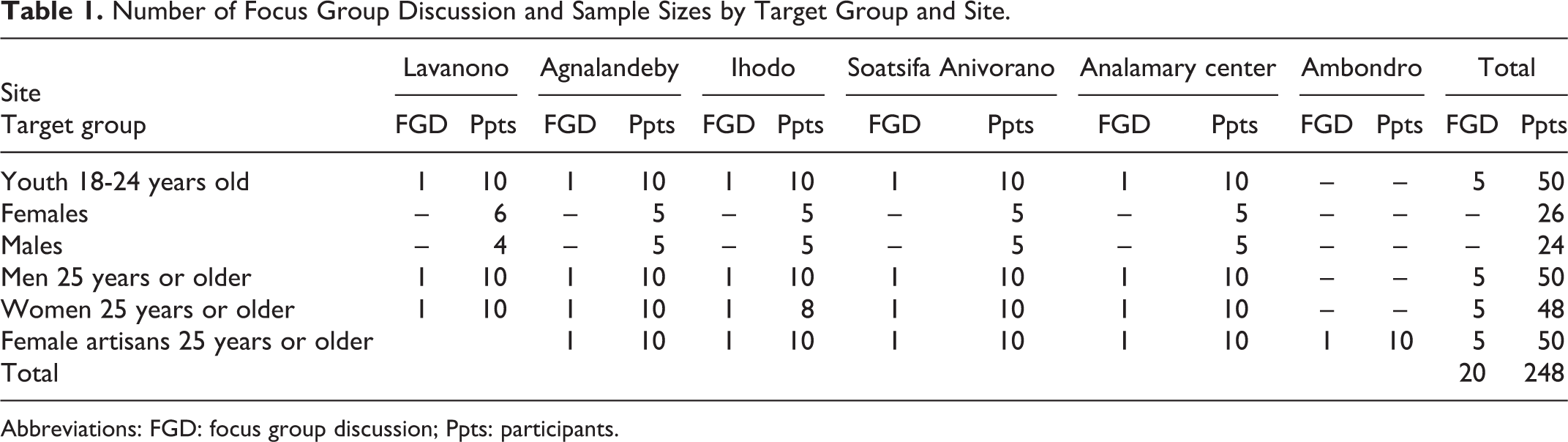
Abbreviations: FGD: focus group discussion; Ppts: participants.
The Madagascar Biomedical Research Ethical Committee and the FHI 360 Protection of Human Subjects Committee approved the study protocol.
The discussion guides included general questions on youth unemployment; prevalence of hunger; locust infestations; strategies to fight locust invasions; locust collection, consumption, and preparation methods; and perceptions of active youth participation in the locust trade. The discussion guide for female artisans included questions about their current local handicrafts, basket making in general, different raw materials used for collecting locusts, organization of existing women cooperatives or groups focused on handicrafts, and potential motivations for their involvement in the locust trade.
Two researchers fluent in the Antandroy language facilitated and audio-recorded all FGD sessions. All FGDs were conducted at the main city of the swarm commune. Locations for the FGDs were chosen (for the most part, 1 per village per target group) based on the following criteria: must be seen as neutral, not too noisy, private, airy, pleasant and friendly, accessible to all of the participants, but not tied to any specific group or association. The principal investigator observed all group discussion sessions. Each discussion aimed to create a dynamic that encouraged exploration of different points of view in an atmosphere of mutual respect and used probing approaches to encourage participants to be specific and to clarify their answers and justify their ideas. To facilitate capture of participants’ verbatim comments and minimize the difficulty of capturing nonverbal aspects and silences, review and quality control were carried out after each session. This included enhancing notes and completing the transcriptions by listening to the audio tape recordings.
Data Analysis
Participants’ verbatim comments were organized around specific research questions. Two different subteams (the first composed of the principal investigator and one researcher and the second composed of an anthropologist and a second researcher from the University of Androy) used a double-coding approach to ensure the consistency of analysis. We looked at types of locusts available, methods of collection, preparation, roles of different community members, perceptions of locust infestations, and control strategies. Analysis focused on identification of the subthemes or “constant” themes that emerged and on synthesis of all the themes in the study. The synthesis was categorized by research objectives, questions, and assumptions.
Results
Utilization of Locusts
Locust availability
Several species of locusts are known to be present periodically in the south of Madagascar. The most important and the most frequently consumed (cited by all participants) are Locusta Migratoria capito (or “valala vao”), which are migratory locusts, and Nomadacris septemfasciata (or “valala mena elatra”), which are nomad locusts. A small number of women, men, and young people also cited Phymateus saxosus, (or “valalan’amboa”), Gastrimargus africanus (or “valala adrisa” or “aketa”), and Catantopsis sacalava (or “valala sorakely”).
Most participants mentioned that migratory locusts are primarily available during the rainy season, which is usually between late November and late March. But in recent decades, the arrival of rains has varied from year to year, and significant rainfall deficits have made locust availability irregular and noncyclical. For example, some women mentioned the additional presence of migratory locusts during the dry season, around the months of August and September. Nomadic locusts swarm around the months of January to May and also in October and November.
Locust collection
In general, participants said locusts are collected directly from household courtyards or fields. All households and members of the community—older members, adult men and women, young people, and children—are involved. Collection techniques are diverse but are rather rudimentary and are clearly differentiated among men, women, and children. One common practice used by males (whether adult or young) is the digging of trenches in the fields. All men in different villages said they are responsible for building the trenches. Participants in one village described a process of collectively digging trenches 1 m deep, 3 km long, and 50 cm wide, into which they basically sweep the locusts at night (when they are not flying). The men shovel locusts from these ditches into large bags. Women often use branches, mosquito nets, mats, baskets, and bags; whereas children (both girls and boys) collect the locusts individually by hand for fun—keeping them in bottles or putting them end-to-end and threading them one-by-one through a sisal thread to create a necklace. Participants reported that the amount of locusts collected varies depending on the method of collection. On average, they said when locusts abound, an adult or young man can collect from 5–7 large bags (250–350 kg) of locusts per day; a woman can collect about 8–10 large baskets (80–100 kg) per day by threshing, mowing, or collecting with nets.
Locust preparation
According to most participants, preparation of locusts (like the preparation of family meals) is mainly an activity of women and girls. During the last locust infestation [in 2012], we decided to share the tasks. My dad and my four brothers collected locusts in the fields. My mother, my three older sisters, my two little sisters, and myself, we collected the locusts that were only in our yard and garden. Then we fried them in oil with a tiny bit of salt or boiled them in salted water, then dried under the sun on four or five large mats (vinda). Our dads and brothers were just eating and snacking. (FGD, youth/female) According to our tradition, a married man should not cook, prepare food, and meals. It is only their wife’s or daughter’s 15 years of age or older duty. Men are already tired from the fieldwork, raising our cattle all day. In the evening, when they come back home, they are very tired. They wait for dinner and then go to sleep. (FGD, woman) In our family, we prefer to boil locusts in salted water. It eliminates the bitter aftertaste. I feel that the locust tastes like butter, and it is melting in the mouth. (FGD, youth/male) Yes, it is true, locusts boiled in saltwater are delicious. You can’t smell the earth, their flesh is much softer, and the salty taste enhances their flavor. But we also fry them, after removing their head, because it may take a long time and require a significant amount of oil. The fried locusts are very crispy, and I like to nibble them. (FGD, youth/female) Boiling, frying, drying, or grilling locusts are our traditional methods of preparation. They are cheaper, because if you have to braise or sauté, you have to buy other ingredients such as pepper, tomatoes, and others that are not always available and are expensive. They are only accessible to families who have money. (FGD, woman) I grill the locusts and grind them. Then I give the flour (boo) to my children who don’t have teeth yet or who are not able to chew, with boiled rice (vary sosoa) in the morning, and cassava or sweet potato puree at noon and in the evening. (FGD, woman)
Locust consumption
Participants claimed that all family members except newborns consume locusts. Migratory and nomadic locusts are the species most preferred and most consumed. They reported that, on average, a young woman or man can eat a full pot (“type 38,” or more than 500 insects) per day. An adult woman or man can eat 200 insects per day. While children younger than 5 years can consume about 50 insects per day, those locusts are most often without heads or wings (which are difficult to digest) or legs (which have small, sharp spines that can injure the tongue and mouth). Locusts are food for the whole family. My husband, my children, and even the little ones like it. It reminds me of the taste of turkey, my favorite Christmas dish. My sons snack them like cookies, when entering and leaving the house. They say that the taste of these insects is a little sweet. (FGD, woman) I love locusts. I never get tired of them. I feel like they go into and strengthen my muscles. Most often I eat them grilled. They taste like salted cookies. (FGD youth/male) I had always consumed locusts, even during the large spraying of pesticides from planes to fight locust infestations in 2013. Unfortunately, I had allergies. I had a lot of redness in my neck, arms, shoulders, and armpits, I had to stop eating them, and I really miss it. (FGD, woman) My daughter and I, too, had problems with diarrhea and vomiting and stopped eating them. (FDG, woman)
Locust Infestations
Perceptions of locust infestations
Most women and men aged 25 years or older reported a change in the occurrence of locust infestations in southern Madagascar. They mentioned that before 2000, “black clouds or eclipse of migratory locusts,” or “red clouds or fireball of nomadic locusts” occurred regularly almost every 2 years between months November and January. From 2000 on, the period of locust infestation has been variable due to irregularities in rainfall seasons, major rainfall deficits, or drought. They had arrived around the end of March in 2010 and between May and July in 2012. (FGD, man) They destroy all that is in their path, but especially the fields of cereals and food crops, maize, sweet potato, and cassava. They invade all areas, streets, homes, courtyards, and forests. (FGD, man) Staple foods, corn, cassava, sweet potatoes, were no longer available. (FGD, man) Our children under five, all, were like corn stalks, very thin, most had their skin on their bones, their stomachs swollen as if they had been stuffed with parasitic worms. (FGD, man)
Control strategies: Locust collection versus chemical control
Perceptions of strategies for controlling locust infestations were mixed. Both control strategies (chemical spraying and locust collection) were seen to have partial efficacy. For most participants, collecting all locusts found and scattered in nature seemed practically impossible. Similarly, killing all locusts with pesticides was also seen as not feasible. Participants believed locusts have already developed resistance to chemicals and are highly mobile, moving easily to other fields that have not been sprayed and then destroying those fields and crops.
Almost all women and men appeared to be more supportive of locust collection activities than of using pesticides to control the infestations. The first major advantage they cited was that this collection symbolizes social cohesion and mutual assistance, because the whole community mobilizes and organizes to fight and defeat locust swarms and to help households that are specially affected. The second advantage they mentioned was that collection protects the “meat” quality of locusts from chemicals. According to them, locust collection does not destroy or alter the taste of “this delicious free meat coming out of the ground” (FGD, woman), but use of pesticides does. The third advantage of collection is social and cultural. For the Antandroys, collection is a common practice already part of people’s usual routines. In addition, Old, adults, young, tall, and small are involved, even if, according to the idiom “ny valala maro tsy vakin’amboa” (“the locust swarm, a dog does not disperse them”). Together, we are stronger and able to kill and disperse them. We collect for about 2–3 days the quantity of locust as much as we can. Men, adult and young, collect locust especially at night. Women, adult and young, collect locust especially earlier in the morning, before the locusts wake up. For the little ones, the collection is a game they make during the day. They compete, the girls against the boys, and those who collect the most are the winners. (FGD, man) I would like to highlight the great invasions of 1992–1993 and 2012–2013. They were the consequences of the political crises of 1990 and 2009 that our country had experienced. Because of the national strike, the government could not obtain funds to purchase the pesticides and to implement chemical spraying activities in the field. (FGD, man)
Chemical controls, on the other hand, were viewed as having a negative impact on the health of the population and on animals and the environment. Most participants mentioned that pesticides are present all along the human food chain. Chemicals also affect livestock (poultry, sheep, ducks) and many insects besides locusts. Participants mentioned that many goats, sheep, chickens, and ducks died after eating dead locusts in fields or courtyards. This further weakens the household economic situation. Last time, in November 2015, many children and women had diarrhea and vomiting after eating locusts killed by pesticides. Some women and I were suffering from itching, skin problems, and allergies. (FGD, woman) Contaminated locusts pose a great risk not only to the people who secretly consume them, but our livestock and poultry are also victims. I had lost about 30 sheep, a few goats (about 10) and several chickens that had eaten locusts killed by pesticides. Some of us were afraid to eat them and threw them away. It’s a lot of waste for us poor households. (FGD, man) I feel like the bees were all extinct. I don’t see them anymore, which is why our mango and papaya trees aren’t giving much fruits, like before. I mean, before 2000. (FGD, woman) The health workers and sprayers who supervised and wanted to seize our locusts were almost killed by the villagers. It’s their fault! They wasted and destroyed our food. We collect them and eat them without their knowledge. (FGD, woman)
Potential Players in Locust Trade and Feasibility of a Startup
In the discussions, we asked participants how common trade in locusts is at present and also probed the possibility of forming small start-ups to conduct such trade.
Most participants said trade in locusts at the village level is not common yet. There is little demand because locusts are available at no cost and collecting them from nature is “everyone’s business.” Almost all participants mentioned that families collect quantities of locusts based solely on their own consumption needs. However, the project’s pilot aims to introduce several new products, preparation techniques, and recipes and to create demand for these new products and techniques. The majority of participants believed that the sale of surplus locusts as part of this strategy at the marketplaces of large cities in neighboring districts is a key opportunity. At the village level, there are no customers to buy locusts. No one is going to buy them anymore, because all the families collect them with no cost, without paying anything. (FGD, man) Last time, three years ago, we couldn’t eat the quantities of locusts we collected, so my mother and I took advantage of selling our remaining, let’s say about three to four large baskets, at the marketplace of Tsihombe. (FGD, woman) Women and especially girls in our community are very interested and used to small business. For example, some sell sweet potatoes, cassava. Some sell only a few dozen of tomatoes, coarse salt, or peanuts. Others, on the other hand, sell cooked foods such as grilled meats (maskitas) of beef or sheep in small grocery stores in their home’s backyard, which is very popular with men, (adult and youth), and other women too. (FGD, woman)
Female artisans mentioned that women with certain skills could also help with this trade, especially those who are already members of village associations or female artisan associations. They can fabricate and supply locust collection tools such as mats, baskets made with sisal, or other locally available raw materials (reeds or vina). The female participants were also interested in selling locusts at the marketplaces. Some mentioned they would be interested in volunteering to promote consumption and new locust-based local recipes in their communities. I can make large sisal mats and sell them to youths or women who collect locusts and prevent them from using the insecticide-treated mosquito bed nets. (FGD, woman artisan) It’s true, I’m a female artisan, but first and foremost I’m a mother. I have a 6-month-old boy and 2 daughters, one 3 years old and the other 7 years old. I can create improved recipes made with locusts and local foods such as sweet potatoes and corn, or even cactus fruits. And if it turns out to be succulent, I can promote among other mothers in my neighborhood. I’m very interested in that. Because I was already a volunteer and did sensitization activities during the vaccination campaigns. (FGD, woman artisan)
Discussion
This qualitative research was the first aimed at examining the current practices, perception, and roles of community members surrounding the collection and consumption of locusts in southern Madagascar. We conducted this study as a basis for designing a pilot to test the feasibility of turning the annual locust infestation into a source of income for rural youths and provide a protein-rich food supply for families.
Importance of Locusts
Locusts are consumed by all categories of the population—adults, young people, and children. Entomophagy (or consumption of insects) is common in many cultures (in Africa, 11 China, 12 and Latin America 13 ) although not in developed countries. 14 Trading locusts could be a potential income-generating activity and an attractive livelihood diversification strategy for Madagascar. In Madagascar, locusts could be sold freshly dead (whole), grilled (barbecued), or fried/sautéed at the marketplace or as street foods.
The focus groups indicated clearly that taste is the most important factor for individuals in terms of consuming locusts and supports their key place in the Antandroy diet. All participants said they consider locusts delicious and enjoy eating them, which can make it easy to incorporate locusts—with their high nutritional value—into regular local eating habits and improve the quality of Antandroy diets. A few younger female and male participants qualified locusts as “famine food,” which are often associated with poverty, and remind people of difficult periods and devalues them as foods. Nevertheless, our research suggested that the risk of rejection of locusts and any derivative products would be very low.
To date, no cases of transmission of zoonotic diseases have been reported in connection with the consumption of locusts. No participant raised concerns about zoonoses. However, we need to explore evidence that preparation and consumption of locusts is safer and healthier than that of most conventional protein sources. The presence of pesticides in different locations and at different times is critical to this discussion.
Processing locusts in relatively simple ways would also provide additional business opportunities. In the local culture, these would include grinding into a powder or flour, 15 especially for children (and even infants), given that women already use flours (boo) to enrich their young children’s diets. The flour can be promoted as a source of high nutritional quality. Locusts could be processed in more complex ways—for example, extracting their protein isolates to make preferred types of snacks, cookies, biscuits, and protein bars 16,17 or to make protein powder 18 for young men (and others) interested in gaining muscle strength. Properly processed locusts could also potentially provide a basis for new formulations of ready-to-use therapeutic foods to treat malnourished children. Using a local source of protein would significantly reduce the costs of such supplements. 19
Considerations for Mass Locust Collection
The Antandroys collect locusts mainly in the fields and areas directly surrounding their dwellings. Methods used most widely (digging trenches, threshing, mowing, and collecting with nets) require very basic equipment and minimal expense, making locust collection economically attractive. The species most collected and consumed (L. migratoria capito and N. septemfasciata) are classified as insect pests and are able to multiply quickly and ravage all crops in their path. (Especially dangerous is L. migratoria capito, which can migrate long distances.)
The dangers of spraying pesticides are well known and were observed/experienced by our focus group participants. Women in particular noted the health and environmental hazards of the chemicals.
Mass collection of locusts presents an alternative that avoids these dangers to both human and other animal health and the overall environment. Regardless of the strategy used (whether mechanical control such as mass collection or chemical control such as spraying), fighting locust infestations effectively is very difficult because of the vast area in which locusts can be found, the difficulty of accessing these often very isolated areas, and related security issues.
Our research also showed that people collect only such quantities as are wanted for household consumption. Collection is not currently at a scale to significantly reduce the numbers of locusts in very large areas.
Our research aimed to understand whether local populations could be motivated to collect larger quantities of locusts than they could consume, primarily for economic reasons but with an appreciation for the nutritional value of different products. Our intended model at this early stage of research was youth-based start-ups, with the involvement of local artisans.
Our results revealed that the fundamentals and tools of the tasks to collect locusts in limited quantities are already part of the culture; everyone, from children to youth to older household members, has a well-defined role and responsibility. Given this cultural factor and the collective, participatory nature of the activity, locust collection can be promoted while broadening the range of actors involved. In addition to the general community and microenterprise start-ups, other actors may include government and their partners (reinforcing laws to withhold the use of pesticides) at different levels (community, district, region, and national) and researchers within the Agricultural Research Centre and the Department of Plant Protection. It will be helpful to redefine their respective tasks at each stage of collection (eg, regulation and use of biopesticides in hard-to reach areas).
Prevention of swarming per se is a tactic not yet employed in Madagascar and would be another possible asset of encouraging more widespread and organized locust collection. As a solitary insect, the locust is harmless; in swarms, they are dangerous. It is difficult to track and detect swarms in a timely way or to predict resurgences of infestation due to the irregularity of rainfall (and rainfall deficits). Current monitoring techniques are limited to 10-day monitoring activities monthly in a few acridian zones, 20 so it is difficult to predict locust infestation. However, local populations can be trained in the life cycle of migratory and nomadic locusts so they can detect groupings of isolated individuals during the solitaro-transien stages. A monitoring system that involves young people, farmers, ranchers, and government technicians—including those at the locust eradication center and representatives of the National Bureau of Risk and Catastrophe Management (NBRCM)—would allow authorities to alert and mobilize communities to initiate early locust collection, either during their “concentration or multiplication” phase or during their “local grouping” stage in the fields where crops and livestock are raised, in workplaces, or dwellings. This approach is in line with the current NBRCM initiative to build local community capacity in early detection of natural disasters and making immediate collective decisions and taking action, instead of waiting for directives from the central levels.
In view of recent swarming history, locust collection could take place almost 7 months of the year at present (if no chemicals and pesticides are used) and could be organized according to the development stages of the locust species. Abundance of migratory locusts occurs between the months of November and March and of nomadic locusts between October and November. Locust processing and trade could take place on an ongoing basis throughout the year.
Increase Nutritional Awareness
Although our results showed participants viewed locusts positively in terms of their nutritional value, this was not a primary factor in their collection or participants’ preference for and enjoyment in eating the insects. Information about the nutritional benefits of locusts and about new preparation techniques could increase public awareness of locusts as an interesting and cheap source of protein and other nutrients. Several studies have shown that locusts of different varieties provide protein and nutrients (iron, zinc, and folate) of high nutritional quality. 21 (Our detailed analysis of the nutritional quality of red locust N. septemfasciata Serville is pending publication.) The protein composition of commonly consumed insects compares favorably to conventional protein sources such as beef. 22 Finding ways to combat child malnutrition has been a public health challenge in Madagascar for more than 5 decades. Insects could be proposed as an alternative source of protein for malnourished children. Further testing would be required to confirm that processed locusts would provide the protein quality necessary for therapeutic food standards. 23
This would also help counter the current connotation of locusts as only a famine food, to be looked down upon. The benefits for children and infants, in particular, could be highlighted, along with simple recipes (perhaps including some already used). Further steps could include integrating related messages into nutritional recommendations that promote food diversification in collaboration with government organizations or local or international nongovernmental organizations promoting improved infant and young child feeding in Madagascar. Messages could also be promoted through community workers, women’s groups, or female artisans (as part of home visits or cooking demonstrations at nutrition or health centers) or through the mass media.
Limitations
This study had 3 limitations. In Madagascar, food consumption habits are strongly associated with household income and economic level, 24 with the richest generally preferring conventional protein sources rather than insects. (For some, these are associated with poverty or “dirt.”) In this qualitative study, we did not determine the specific socioeconomic status (SES) of the various participants. However, almost all participants were either farmers, stay-at-home mothers, housewives, or high school students, and they were generally in a lower SES group. We did not find a bias against eating insects among our participants, so any such barrier would be unlikely in our intended target group.
Seasonality causes variations in eating habits related to the availability of different foods. However, participants were asked to reflect on nutritional practices throughout the year. In addition, locust collection could potentially last 7 months of the year, and Antandroys could consume them throughout the year, most frequently during the entire collection period (January through June) and with stocks potentially available from July through December (particularly as dried and powdered products are popular).
We delayed publishing these results because we wanted first to confirm the high nutritional quality of the locust species we studied in Madagascar. Unfortunately, our nutritional analyses were delayed because of the COVID-19-related closures (between 2019 and 2021) of the 2 laboratories conducting that work. (The profile is now complete, and results submitted for publication.) The results show that N. septemfasciata Serville is a nutritious food (high in protein and rich in key micronutrients). 25 The gap in time, however, is unlikely to have affected the currency of our qualitative study, either in terms of Antandroys’ dietary behaviors or perceptions of study participants. No major changes in food and nutrition policies, Antandroy demographic patterns, habits or culture, or significant/measurable climatic conditions or locust dynamics have been reported in the interim.
Conclusion
This study highlighted the fact that, like other natural disasters, locust infestations are difficult to predict. Their occurrence has become irregular in recent decades. The development of the locust trade, including mass locust collection, marketing, and promotion of consumption, can nevertheless be part of a mechanical control and prevention strategy for locust swarms and provides a model of sustainable development adapted to the Malagasy context. Consumption of locusts is widespread, and locust collection is traditionally a cooperative activity involving all members of the community. Development of a local locust trade would involve a range of actors at all levels, with youth (rural and start-ups) playing central roles. Our research provided the basis for a subsequent youth contest and pilot supporting local start-ups to support youth to collect and market locusts (article forthcoming). For youth in particular, development of a locust trade would provide an opportunity to engage in a productive economic activity where there are currently few alternatives. Complementary efforts to promote the nutritional benefits of locusts (to various audiences) can also help change the common perception of these insects as only a “harmful public enemy” into a “useful” insect with value beyond that of a mere famine food. These shifts, however, will require an effective and robust advocacy system for the development of well-articulated national policies focused on innovative locust swarm surveillance and to end the use of expensive and harmful chemical controls.
Government financial resources are limited, and the country is not able to produce enough food to meet the needs of the Malagasy population. Our research provided a first step in demonstrating the feasibility of transforming locust infestations into economic and nutritional opportunities in a fragile environment with a high level of poverty and malnutrition. We hope it will also serve as a catalyst for testing further strategies in Africa and elsewhere.
Footnotes
Acknowledgments
This article was made possible by the support of the FHI 360 Catalyst Fund. The contents are the responsibility of the authors and do not necessarily reflect the views of FHI 360 or its Catalyst Fund Board. The authors are grateful to Eulalie Ranaivoson (independent researcher) and John Walson René (National Locust Control Center) for supporting the original grand concept and for reviewing the original manuscript. The authors are also grateful to Mara Edouard (Regional University of Ambovombe) for his helpful technical and administrative support.
Declaration of Conflicting Interests
The author(s) declared no potential conflicts of interest with respect to the research, authorship, and/or publication of this article.
Funding
The author(s) disclosed receipt of the following financial support for the research, authorship, and/or publication of this article: This study received financial support from the FHI 360 Catayst Fund for the initial phases of the research described here. The author(s) received no support for the writing of this article.
