



Abstract
Background:
Prior research has indicated a varying relationship of food security and obesity risk between men and women yet factors affecting this relationship are unclear.
Objective:
The objective of this study was to examine factors related to the gender disparity in the food insecurity–obesity paradox within a sample of low-income parents.
Methods:
Low-income cohabiting mother and father pairs (n = 25) living with their child were interviewed individually using the United States Department of Agriculture Household Food Security Module, Center for Epidemiological Studies Depression Scale, and Coping Strategies Index to examine gendered factors related to the food insecurity–obesity paradox.
Results:
There was a significant (P = .003) difference in report of adults in the household sacrificing consumption to feed young children between mothers (2.91 ± 0.92) and fathers (3.59 ± 0.73), with mothers reporting greater sacrifice and compromised diet quality to feed their children, but no significant correlation among body mass index, depression, and food insecurity was detected.
Conclusions:
Food insecure mothers may be more likely to compromise their diet quality to feed their children than fathers. This could help explain why the food insecurity–obesity paradox is significant only in women, and this work gives insights into gender-based differential consequences of food insecurity.
Introduction
Food security means access by all people at all times to enough food for an active, healthy life. 1 The United States Census Bureau monitors national rates of food insecurity using the Household Food Security Survey Module (HFSSM). Food insecurity is associated with increased overall risk of chronic disease such as heart disease, cancer, and diabetes. 2 The exact etiology of these health disparities is unclear, but impaired diet quality and stress may be factors. 3,4
“Food insecurity” and “hunger” are terms often used interchangeably when referring to people who cannot afford enough food. “Hunger” may evoke the idea of a person in an energy deficit who as a result may lose weight and/or be at a lower weight. In reality, food insecurity may increase risk of obesity, a phenomenon known as the food insecurity–obesity paradox. However, this correlation is only statistically significant among women in the United States, not men. 3 Previous research in the United States, Canada, and New Zealand also suggests that women report higher rates of food insecurity 5 -7 and that they sacrifice their diet quality to feed their children. 8 Food insecure women with children are also more likely to be overweight and obese than their food insecure but childless counterparts, 9 suggesting that this sacrifice in diet quality can be obesogenic. These findings suggest that the experience of food insecurity may differ between men and women.
Depression symptomatology has also been associated with food insecurity status 10 -12 and obesity 13 and may be more pronounced in women than men. 14 -16 Previous research has associated food insecurity to depression in men and women 17 and mothers specifically. 18 Specifically, studies have shown relationships between food insecurity, depression, and emotional eating in women 19 -21 ; depression is a strong predictor of high body mass index (BMI) and poor diet quality among men and women in food deserts. Therefore, depression may be a factor that relates to both food insecurity and obesity.
The overall goal of this study was to examine factors that may be related to the food insecurity–obesity paradox within a sample of low-income mothers and fathers. The objectives were to determine: (1) whether relationships exist between food insecurity, depression scores, and BMI in this sample of mothers and fathers of young children and (2) differences by gender in reports of parents’ sacrificing their own diet to feed their children. Findings were contextualized with quotes from participants, explaining these experiences in their own words.
Materials and Methods
Participants and Recruitment
A total of 25 mother–father pairs were interviewed between April 2016 and August 2017. Eligibility criteria for both parents included cohabitation for at least 4 days a week with the other parent and their child aged 2.5 to 10 years, parental age of 18 years or older, ability to speak English, and at least 1 parent responding affirmatively to 1 of the first 4 items of the United States Department of Agriculture (USDA) HFSSM to indicate food insecurity in the household. Participants were recruited from various sites in the greater Hartford, Connecticut, USA area that serve as proxies for income, such as Head Start and food pantries. Those parents interested in participating provided contact information and were subsequently called for eligibility screening and scheduling.
Study Design
As this was a mixed methods study, interviews had an open-ended section to elicit qualitative data as well as survey instruments to collect quantitative data. Written informed consent was obtained prior to interviewing. Participants were given the option to choose a pseudonym or have one assigned to them. Interviews for mothers and fathers were conducted separately by researchers trained in cognitive interviewing techniques. The interviews were 60 to 90 minutes in duration. To reduce bias, interviewers were trained to avoid asking leading probes and giving advice or opinions. Interviewers debriefed following each interview, and videotapes were reviewed to ensure that interviewers were using the same techniques. Each parent received a USD$20 gift card as an incentive at the end of the interview.
Instruments/Measures
The interview contained both qualitative and quantitative components. Qualitative data were generated from an audio-recorded, semi-structured in-depth interview that included the USDA 18-item HFSSM 22 with related scripted and unscripted probes. Quantitative data were collected via a series of questionnaires, including the Center for Epidemiological Studies Depression Index (CES-D), and the Coping Strategies Index (CSI). The CES-D has been validated to assess symptoms of both depression and anxiety, and higher scores indicate more severe presence of depressive and anxious symptomatology. 23 The CSI contains 13 strategies and asks about how frequently these strategies are employed using a Likert scale; lower scores reflect greater use of coping strategies and indicate that the family may be more food insecure. 24
Parents’ height and weight were measured with a stadiometer (Seca 213) and scale (Seca 876) using standard anthropometric techniques to calculate BMI. 25
Data Analysis
All quantitative statistical tests and descriptive statistics were analyzed using IBM SPSS Version 24 software (Chicago, 2017). Normality of the data was checked, and if data were not normal, nonparametric tests were used. Significance level was set at P < .05. Qualitative interview components were manually transcribed verbatim, coded using a basic inductive approach 26 and query searched in NVivo 11 Software to identify sections of interviews related to proposed questions. Multiple rounds of coding and subsequent theme generation were completed independently (E.A.T.), then reviewed by another researcher (J.S.F.). Memo writing both post-interview and during coding aided the analytic process.
The relationship between depression, BMI, and food insecurity was initially assessed using Pearson correlation matrices to determine whether bivariate correlations were significant between any of the 3 factors. Multiple regression and mediation analysis were planned if correlations were statistically significant.
To assess differences between mothers and fathers in reports of sacrificing to feed their children, both Wilcoxon Signed Rank test and paired t test were used to compare mothers’ and fathers’ scores on CSI Item i. “[In the past 30 days if there have been times when you did not have enough money to buy food, how often has your household had to:] Restrict consumption by adults in order for small children to eat? 1 = All the time/every day; 2 = Pretty often/3-6x/week; 3 = Once in a while/1-2 x/week; 4 = Never/0x/week.” A higher score indicates less frequent employment of the coping strategy.
Results
The majority (58%) of the sample was overweight or obese (76%) and white (58%; Table 1). There were no significant associations (P > .05) between food insecurity, depression, and BMI of mothers or fathers based on bivariate Pearson correlations; therefore, further regression or mediation analyses were not conducted. Qualitative interviews included probes about mental health such as: “When you worry about running out of food, are there other changes in your health or mental health as a result?”
Demographic Characteristics, Weight Status Measures, and Federal/State Assistance Program Participation of Low-Income Mothers and Fathers.
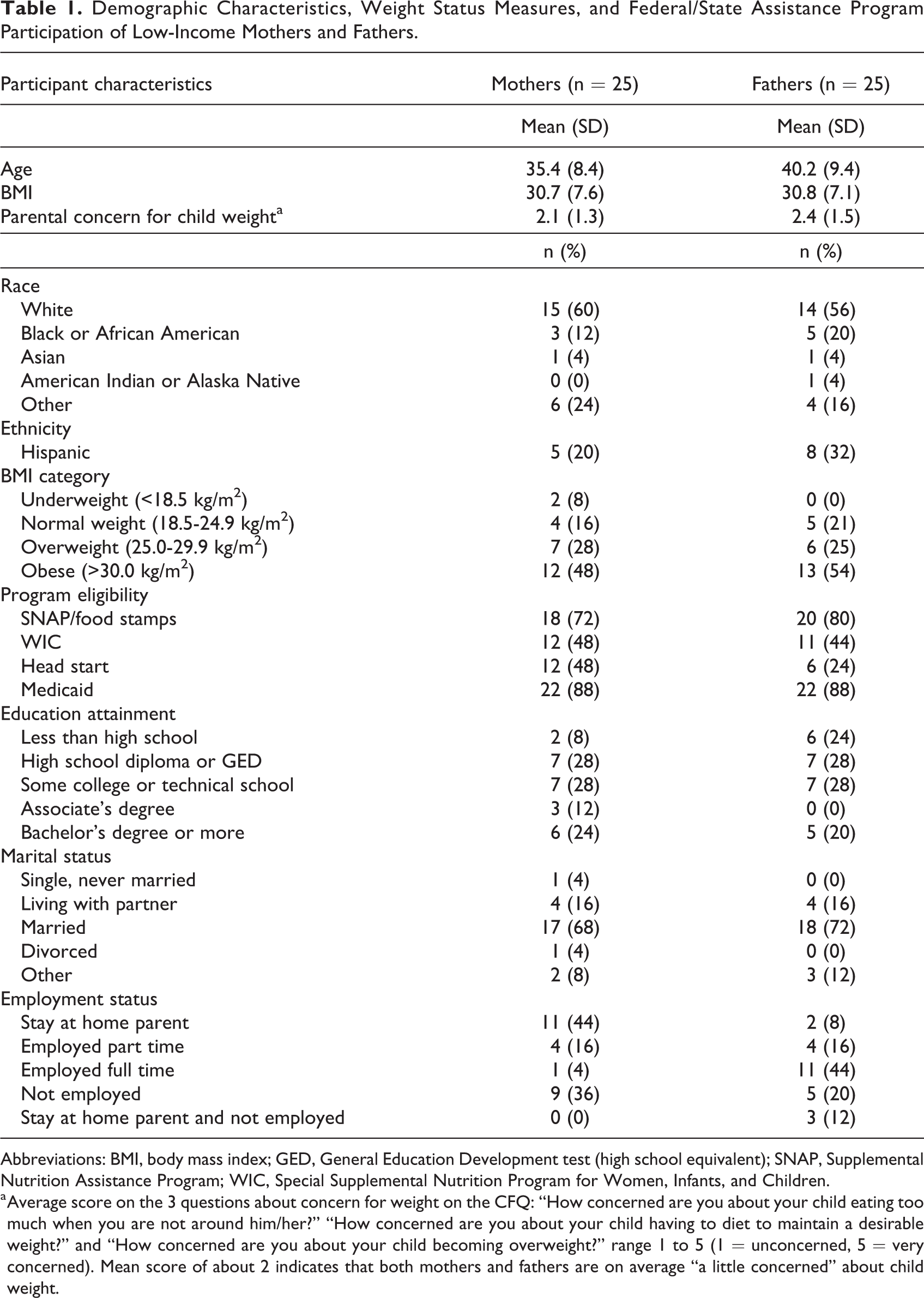
Abbreviations: BMI, body mass index; GED, General Education Development test (high school equivalent); SNAP, Supplemental Nutrition Assistance Program; WIC, Special Supplemental Nutrition Program for Women, Infants, and Children.
a Average score on the 3 questions about concern for weight on the CFQ: “How concerned are you about your child eating too much when you are not around him/her?” “How concerned are you about your child having to diet to maintain a desirable weight?” and “How concerned are you about your child becoming overweight?” range 1 to 5 (1 = unconcerned, 5 = very concerned). Mean score of about 2 indicates that both mothers and fathers are on average “a little concerned” about child weight.
Both mothers and fathers described the effects of food insecurity on their mental health. For example, Ray (all names have been changed to protect privacy) responded, “It plagues you” because “you don’t know where it’s coming from next.” Jeremy noted that him and his wife “both struggle with depression so that’s already occurring, so then to add on to stuff on top of that, it’s tough.” Carmen mentioned that she has panic attacks from worrying about food. Natasha described the effect of worry about finding food for her son to eat as, “its anxiety. Wicked. It’s horrible.” One mother even discussed stress from food insecurity causing emotional eating. “When I stress a lot, I, I feel like I tend to eat more,” Karen noted, “To kind of like, comfort myself. Um. [clears throat] So when I’m stressed, I know that I do that. I see myself, I catch myself like, you can’t do that. [laughs]” Participants also mentioned mental health in other components of the interview with more mothers mentioning depression or anxiety than fathers.
Mothers (2.91 ± 0.92) were significantly (P = .003) more likely to restrict their own food to ensure their children had enough to eat compared to fathers (3.60 ± 0.73; See Table 2). Sacrificing to feed children was a commonly discussed topic throughout many of the qualitative interviews with both mothers and fathers with more mentions of sacrificing diet quality to feed children from mothers than fathers.
Comparison of Mothers’ Versus Fathers’ Self-Restriction of Food When Coping With Food Insecurity.
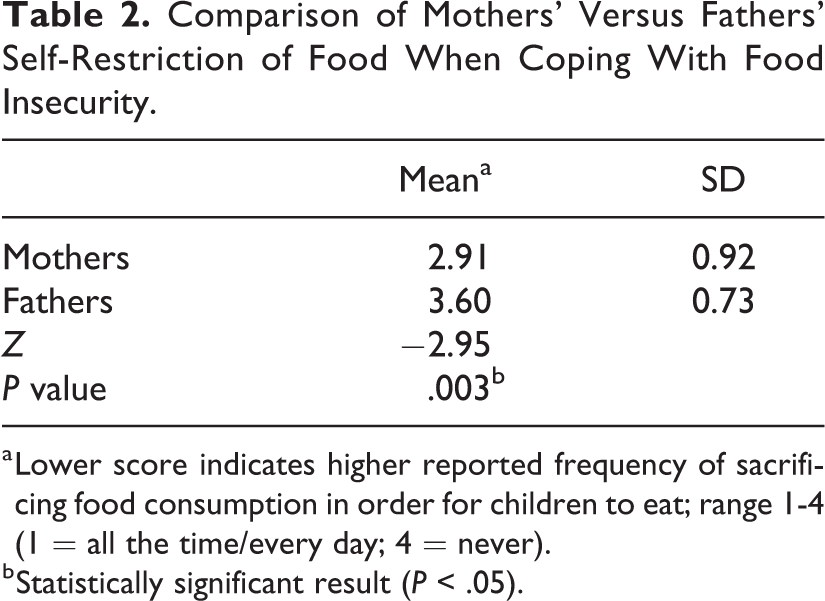
a Lower score indicates higher reported frequency of sacrificing food consumption in order for children to eat; range 1-4 (1 = all the time/every day; 4 = never).
b Statistically significant result (P < .05).
When faced with food insecurity, parents reported sacrificing food for children. For example, Sharon mentioned that when there is not enough food “The kids would get theirs first, and then me and my husband would split the difference” even though “It might not be as much as we [her and her husband] would like.” Similarly, others spoke in terms of priorities. Scott reported that money goes first to “the kids’ nutrition/food, then it goes to the bills, then it goes to the adults’ nutrition/food.” Parents also mentioned eating something else if there was not enough of the meal to go around. For example, Gordon shared that he “might just eat a piece of toast” instead of a meal to leave food for his child. Parents felt strongly about the importance of sacrificing for their children. Neil said that it was part of his role as a “parent and provider.” However, Jesus indicated that though their food situation did not require him to do so, sacrificing to feed his children would be a first priority. Interestingly, Jesus’s wife, Rainstorm, reported that sacrificing to feed their children was something that she and her husband actually do, not just a theoretical. She said that “sometimes my husband may not eat, sometimes if there’s only enough to eat for the kids, my husband, I might eat cereal.” This is something she has “gotten used to” and she’ll “just do.”
Discussion
Mothers reported that adults in the household often sacrifice food to feed children, supporting reduced diet quality to feed children as a possible contributor to the food insecurity–obesity paradox, which is only statistically significant in women. There were no significant correlations of depression, food insecurity, and/or BMI or significance by gender. Although relationships between food insecurity, depression, and BMI exist in the literature, examining associations or mediation of these factors and comparing results by gender remains a gap in the literature. Future studies with larger sample sizes including both men and women would provide an opportunity to evaluate more complex relationships.
In the present study, mothers were significantly more likely than fathers to report adults sacrificing diet quality to feed children in the household. 27 The differences in social roles between mothers and fathers may contribute to this finding. Traditional gender roles place fathers in the role of breadwinner and provider, while mothers stay in the private domain and take care of children and household tasks. 28,29 Previous qualitative research with low-income and working class fathers found that these men placed a high value on the role of provider, viewing this as an “unquestioned” pillar that structures the life of a man. 30 Constructs of masculinity also dictate that men must be tough, self-reliant, and emotionally controlled. 31 Likely because of this gendered socialization, it is documented in scientific literature that men are less likely to seek out professional help for mental and physical health. 31 Knowledge of masculinity, coupled with the previous finding that men are less likely to report food insecurity than women, 6,7,32 may indicate that men are less likely to admit that they need to use coping strategies to feed their families.
Previous research indicates that food insecure mothers have lower diet quality scores compared to their children. 8 Gender roles that place women in the private sphere also dictate that meal planning, cooking, and otherwise managing the household food supply is a woman’s task. 33 Research shows that women are more likely to assume these traditionally “feminine” household tasks than their husbands when they have children. 34
The major strength of this study is that it examined mothers and fathers living in the same household, and the first of its kind to compare food insecurity, depression, and coping by sacrificing food to feed children between mothers and fathers using a mixed methods approach. Although the sample size was sufficient to examine qualitative results, it was small to detect significant results for the quantitative data. Further, the results may not be generalizable to other geographic regions.
While there were no significant relationships between depression, food insecurity, and BMI in mothers or fathers, mothers discussed anxiety and depression more frequently in the context of food insecurity and reported significantly greater frequency of sacrificing food consumption to feed children. This may be a factor in the food insecurity–obesity paradox, which is only statistically significant among women. Further research is needed to understand these relationships.
Footnotes
Acknowledgments
The authors would like to thank FoodShare, Inc, for allowing us to recruit participants from the mobile pantry sites in Connecticut.
Declaration of Conflicting Interests
The author(s) declared no potential conflicts of interest with respect to the research, authorship, and/or publication of this article.
Funding
The author(s) disclosed receipt of the following financial support for the research, authorship, and/or publication of this article: Funding was provided by the University of Connecticut Scholarship Facilitation Fund and Summer Undergraduate Research Fund.
