




Abstract
Background:
Food and nutrition insecurity continue to affect societies in both developed and developing countries even in years of bounty harvest. This confirms that availability of food does not automatically translate to food and nutrition security (FNS). Even when food is available it may not be accessible to everyone who needs it, and sometimes available and accessible food may not provide all the nutrients required to nourish the body to develop, grow, resist diseases, and meet ordinary physiological demands. Sometimes, food is plenty and accessible but not acceptable or sustainable. All such instances constitute potential food and (especially) nutrition insecurity.
Objective:
We intend to establish a theoretical framework for investigating food and nutrition security.
Method:
This is a theoretical paper drawing on previous publications within the scope of food security and nutrition security.
Results:
The review found that it is imperative to consider carefully the definition of FNS to ensure the two concepts (food security and nutrition security) are adequately and sufficiently addressed in the implementation of food policies and strategies without sacrificing one concept over the other. This balance can be achieved through a thorough needs assessment analysis following the livelihood and the vulnerability approaches to FNS. The analysis should take into account the four conceptual dimensions to FNS to holistically cover every aspect of FNS.
Conclusions:
The information gathered from the analysis will help prioritize and focus food and nutrition support efforts to the people who really need it, yielding impact measured in public health indicators, education, productivity and the broader national/regional economy.
Introduction
The purpose of this article is to explore the importance of integrating in practice food security and nutrition security without sacrificing one concept over the other. To lay a base, a definition of food and nutrition security (FNS) is presented. It paints a clear picture of the factors to be considered when dealing with FNS issues. Specifically, 4 dimensions (categorical, socioeconomical, managerial, and situational) of FNS are presented to provide context for understanding FNS theories. Much attention will be given on the key factors to be considered during assessment, program development, policy formulation, and provision of food and nutrition support. The whole purpose of this is to unearth the tools required to implement strategies that focus on identifying, categorizing, and prioritizing responses to food and nutrition insecurity and further develop sustainability programs. In addition to unearthing tools required, this article also seeks to explore the engagement of key stakeholders from grassroots level to policy makers, and from household to regional level, based on the knowledge and understanding acquired from the dimensions of FNS.
Food and Nutrition Security
Food and nutrition security can only be achieved when all people have, when needed, physical, social, and economic access to adequate, safe (free of contaminants), and nutritious food to satisfy their dietary needs and choices for an active and healthy life. To establish a comprehensive definition of FNS, first requires a definition of food: a substance one eats and/or drinks to support life and body development. 1 Thus, for this article, food excludes water (even though it is essential to life) and commodities such as alcohol and medicines. Secondly, it is useful to consider the dimensions of FNS, of which, conceptually, according to Gross et al, 2 there are 4: categorical, socio-organizational, managerial, and situation-related.
Discussions of the Dimensions of FNS
Categorical Dimension
The categorical dimension of food security most commonly has 4 pillars: availability, access, utilization, and stability. 1,3 To achieve FNS, each of these 4 pillars must be satisfied at all times without neglecting one in favor of the others. Thus, it is essential to explore each pillar. Each pillar can and should be viewed from at least 3 perspectives: individual, household, and national/regional food security. 2 These are vital distinctions because it is entirely possible (as is often the norm) for a nation or region to be considered “food secure” while simultaneously households and individuals within that nation or region experience food insecurity. Conversely, it is also possible for individuals and households to be food secure when a nation or region is not, as is often the case with highly inequitable economies.
Each of these pillars (in particular the first 3) are functions of the physical environment, social environment, and policy environment. They directly influence FNS, particularly at the household level. 4 Factors such as extreme weather (eg, floods and droughts), inadequate roads and transport, social conflict, and ineffectual government policy may limit the ability to produce, distribute, and/or access food and the stability thereof. Such vagaries affect not only current production and availability but often lead to the loss of productive assets such as land, livestock, equipment, and infrastructure, affecting individual households, regions, and even whole nations. This loss of productive capacity is not always easily regained and usually requires a considerable amount of time to recover, potentially creating long-term challenges to achieving FNS.
Food availability
Availability is defined by Riely et al 5 as the physical existence of (potentially obtainable) food, either from own farm produce or purchased from off-farm (eg, from markets). It is evident from this definition that, particularly in the case of own production, land and the other means of production such as funds, workforce, knowledge and skills are important components of availability and, therefore, of food security. Food availability at national level is a combination of commercial production, household production, food imports, international donations, and domestic food stocks. Most commonly, food availability refers to food at household or regional levels. It is rarely considered at individual level. Food availability at these latter 3 levels are part of, and are influenced by, the national availability of food. However, as noted earlier, it is possible for a household to be food and nutrition secure when a region or nation is not.
Thus, determining food availability is complex, and it is often difficult to distinguish between household and national or regional food availability. Of course, availability of food on its own does not translate to FNS because it represents only potentially accessible food in a society. Determining that food is available does not necessarily confirm whether individual households or individuals within households can actually access, use, and utilize the food.
Food accessibility
Accessibility is a state of households and individuals within households having sufficient means and/or resources to obtain the food required for a nutritiously complete diet—in this instance, the food is taken to be available. 4 Access to food has 2 fundamental aspects “physical accessibility” and “financial accessibility.” Accessibility is determined by availability of recourses such as capital (to pay for the food), human mobility (to physically obtain the food), and knowledge (to enable decisions about accessing the food). This suggests that adequate access to food cannot only be determined by households being able to produce food but also having the ability to get to and purchase food from the market. Thus, even when a household is able to produce food, its ability to generate income is pivotal to achieve food and nutrition accessibility. Simply put, food accessibility ensures people are able to acquire food, both physically and economically, through various means which include growing, purchasing, gifts, food aid, and bartering or trading. 5
Food utilization
Food utilization is defined as the ability of a person’s body to assimilate nutrients in consumed food. Optimum calorie and nutrient consumption by a person is an outcome of good care and dietary habits, food preparation, variety of the diet, and intrahousehold distribution of food. Combined with good biological utilization of food consumed, all of these factors determine the nutritional status of individuals. 6 Another element of utilization is the socioeconomic aspects of food including knowledge, habits, and decision-making (which are greatly affected by culture and education levels) regarding what food to buy, the methods of preparation and, of particular importance, about who in the household consumes what food and when—with an eye on fair distribution. 7
Stability/sustainability
Stability/sustainability refers to the time frame over which FNS is being considered. 4 There is always a prevailing possibility, that at any time, food security could be lost or gained. 8 This suggests that, even if one’s food consumption is optimum today, one may still be food and/or nutrition insecure if access to the correct food cannot be sustained as long as it is needed. Specifically, intermittent access to (correct) food is associated with compromised nutritional status. Therefore, to sustain FNS, stresses and shocks such as climatic conditions, conflicts borne of unstable political environment, and economic attributes (eg, unemployment, rising food prices) need to be managed as they may have an impact (directly or indirectly) on FNS status. 6 Hence, the need to put in place means to stabilize all the factors that impact on ensuring the stability of FNS.
As shown in Figure 1, the ultimate aim of food security is nutrition security. It also highlights the consequential relationship among the 3 pillars—availability, accessibility, and utilization. Utilization is possible only if food is accessible, which is possible only if food is available. Stability of each of the 3 pillars is critical. To achieve nutrition security, availability of the correct food must be stable, access to that food must be stable, and utilization of that food must be stable. The stability of food availability is self-evident. The stability of access implies that the physical and monetary means to access food is stable. And the stability of utilization suggests, at the very least, stability of the health of the body to assimilate the required nutrition and the consistency of preparation of food to ensure it consistently delivers the required nutrition. Further, the complex nature of stability of each of the 3 pillars and the dynamic relationship among the 4 pillars suggest that FNS is not the responsibility of just one entity or agency but requires coordination and collaborative efforts from various stakeholders and role-players in the whole food system to ensure FNS at all level.
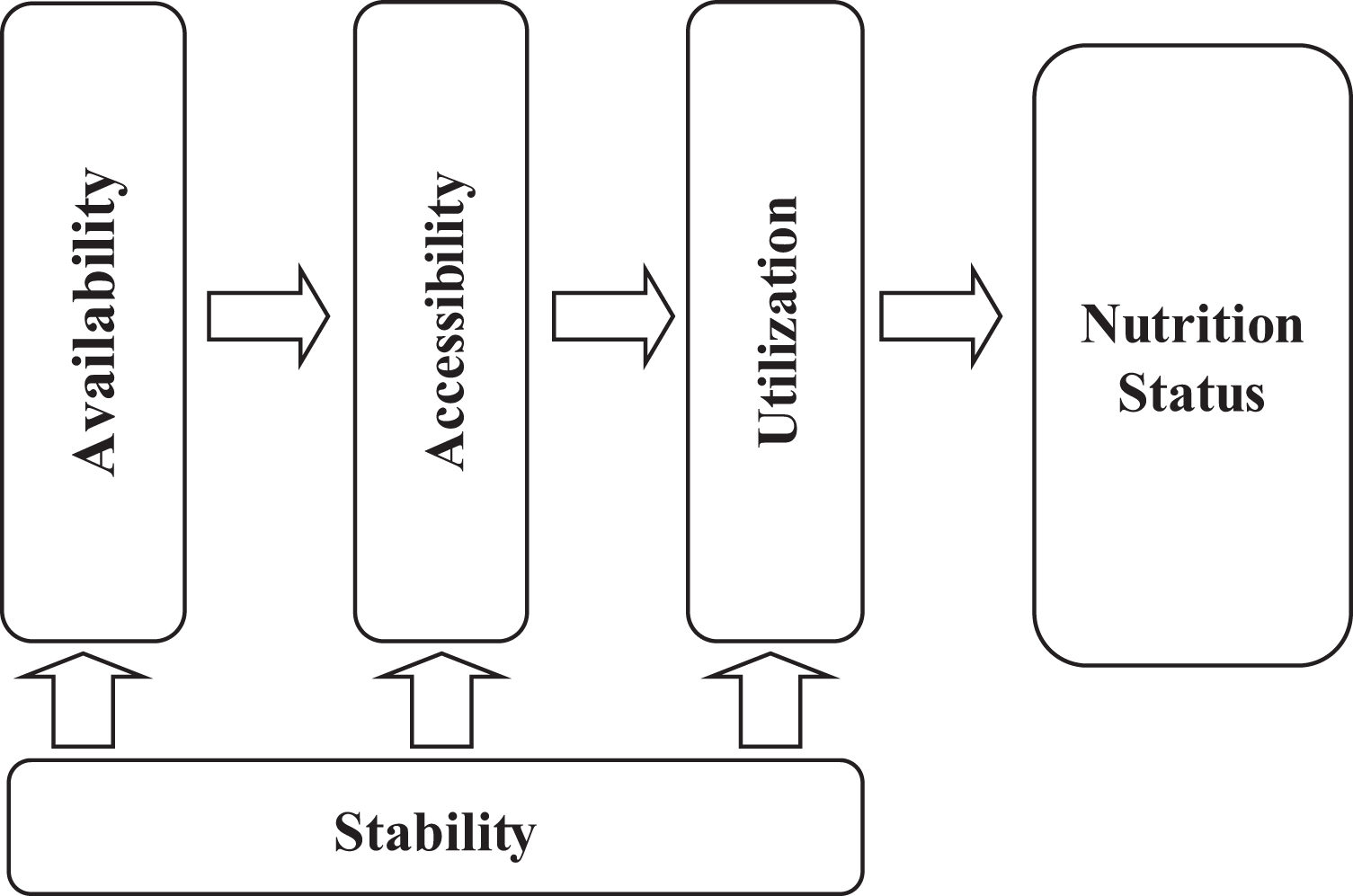
The relationship among the categorical elements of framework of food and nutrition security. 4
Socio-Organizational Dimension
The elements of the socio-organizational dimension of FNS are macro-, meso- and micro-perspectives, which can, respectively, be defined
4
as follows: Macro: Encompasses world, regional, and national food and nutrition status; Meso: Focuses on community (province/city; district/town; village) food and nutrition status; and Micro: Centers on the household/family and individual food and nutrition status.
As shown in Table 1, the categorical elements of FNS are applicable to all of the levels of the socio-organizational dimensions. However, the significance of each element varies with each level. For example, instruments to assess FNS at different social levels vary.
Examples of Varying Instruments to Assess Food and Nutrition Security Situation at Different Social Levels. 2
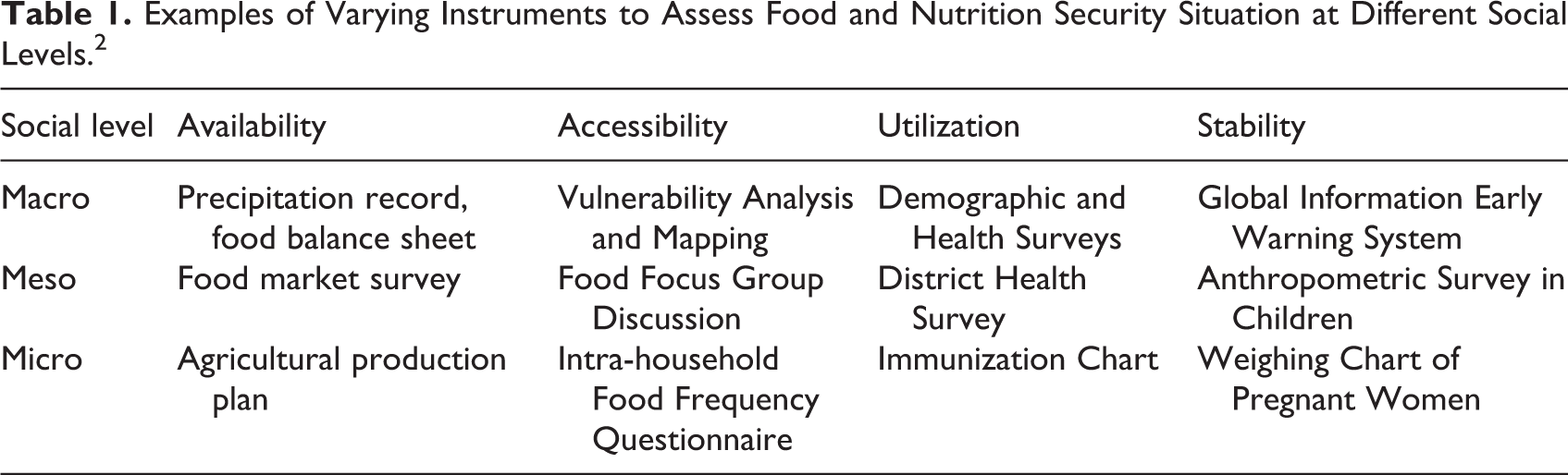
At the macro-level, food availability (at least in terms of coarse grains) can be determined through the amount of rain recorded to predict yield. Food balance sheets can also provide data on food availability at national level. The Vulnerability Analysis and Mapping intervention helps analyze the vulnerability to food insecurity of target populations, which speaks to the accessibility and relates to food availability. The common survey periodically done in countries, Demographic and Health Survey, provides health data for national policy formulation which informs utilization. The Global Information Early Warning System, developed by Food and Agriculture Organization, gathers information relevant to short-term food insecurity which corresponds to the stability pillar.
At the meso level, food market surveys give information on the availability of food. Surveys such as food focus group discussions provide data on accessibility of food, especially for populations at risk of malnutrition. Health outcomes that reflect food utilization can be traced through district health surveys.
At the microlevel, several instruments exist. Agricultural production plans, intrahousehold food frequency questionnaires and interviews, immunization surveys, and anthropometric measurements of pregnant women and children under 5 can be used to assess the availability, accessibility, and utilization of food and its stability. 2
Managerial Dimension
The third dimension of FNS is the managerial dimension. Alshuniaber 9 argues that “food security governance is a complex issue.” He suggests that understanding food security frameworks facilitates planning and managing food security systems. Tibbo and Drimie 10 raised the concern that many development initiatives fail to have real impact because the management of programs focuses on what the programs “look like, not what they do.” Both authors promote employing iterative, reflexive management systems to provide mechanisms for managing processes, programs, and initiatives, in this instance, related to FNS. Figure 2 presents a project management cycle with key elements of a project cycle (assessment, analysis, and action) 11 embracing the underpinning elements of planning, intervention, monitoring, and evaluation or reassessment.
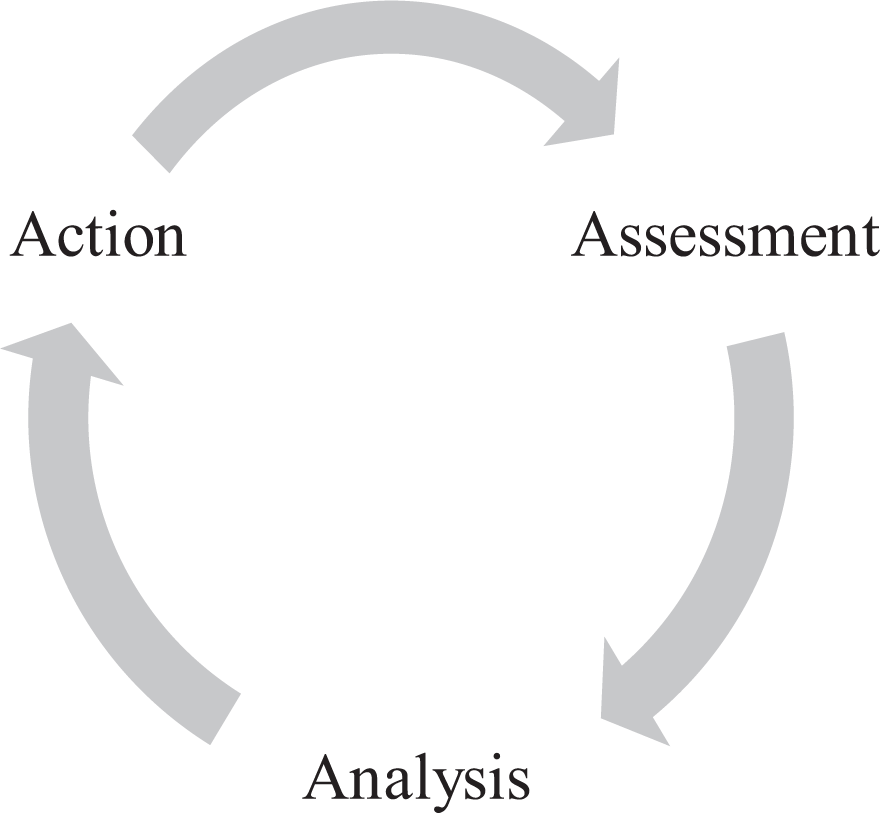
Concept of “triple A”. 11
The concept of the “triple A” project management cycle illustrates the fundamental process that can be followed to address problems such as FNS and possible remedies to be identified through what is essentially a reflexive process. 11 When this process is followed, it helps make available necessary information to identify critical root causes of food and nutrition insecurity through a comprehensive and systematic analysis that involves all stakeholders. This leads to identifying and implementing interventions which, in turn, will be subject to scrutiny and assessment—renewing the cycle. Following the process will make actions and interventions more efficient, effective, and sustainable and also acceptable to all stakeholders, in particular the affected population targeted by the intervention. 2 In other words, the managerial dimension highlights the necessity of fact-finding and analysis before implementation to minimize errors, unintended consequences, and lack of ownership by those most affected by the initiative(s). It encourages a balanced approach embracing bottom-up and top-down approaches to project design and implementation. As posited by Bellamy, 11 “the ‘triple A’ cycle of Assessing a problem, Analysing its causes and taking Action based on this analysis can be used at all levels of society to create processes whereby people’s right to good nutrition is fulfilled.”
Situation-Related Dimension
The fourth dimension of FNS is the situation-related status of a program. The situation—its underlying causes and short- and long-term impacts—influences the response. Figure 3 captures 3 key stages of FNS: Survival Aid, Integrated Food and Nutrition Security Programs (IFNSPs), and Technical Cooperation (TC) Programs. 2 This scale is similar to the 4 generations of development identified by United Nations 13 addressing relief, community development, sustainable systems development, and people’s movements. Both frameworks speak to a continuum of response in action influenced by the situation—dealing first with the immediate crisis (if there is one) and moving toward more enduring and sustainable responses that address core causes—ultimately focusing on developing human capacity.
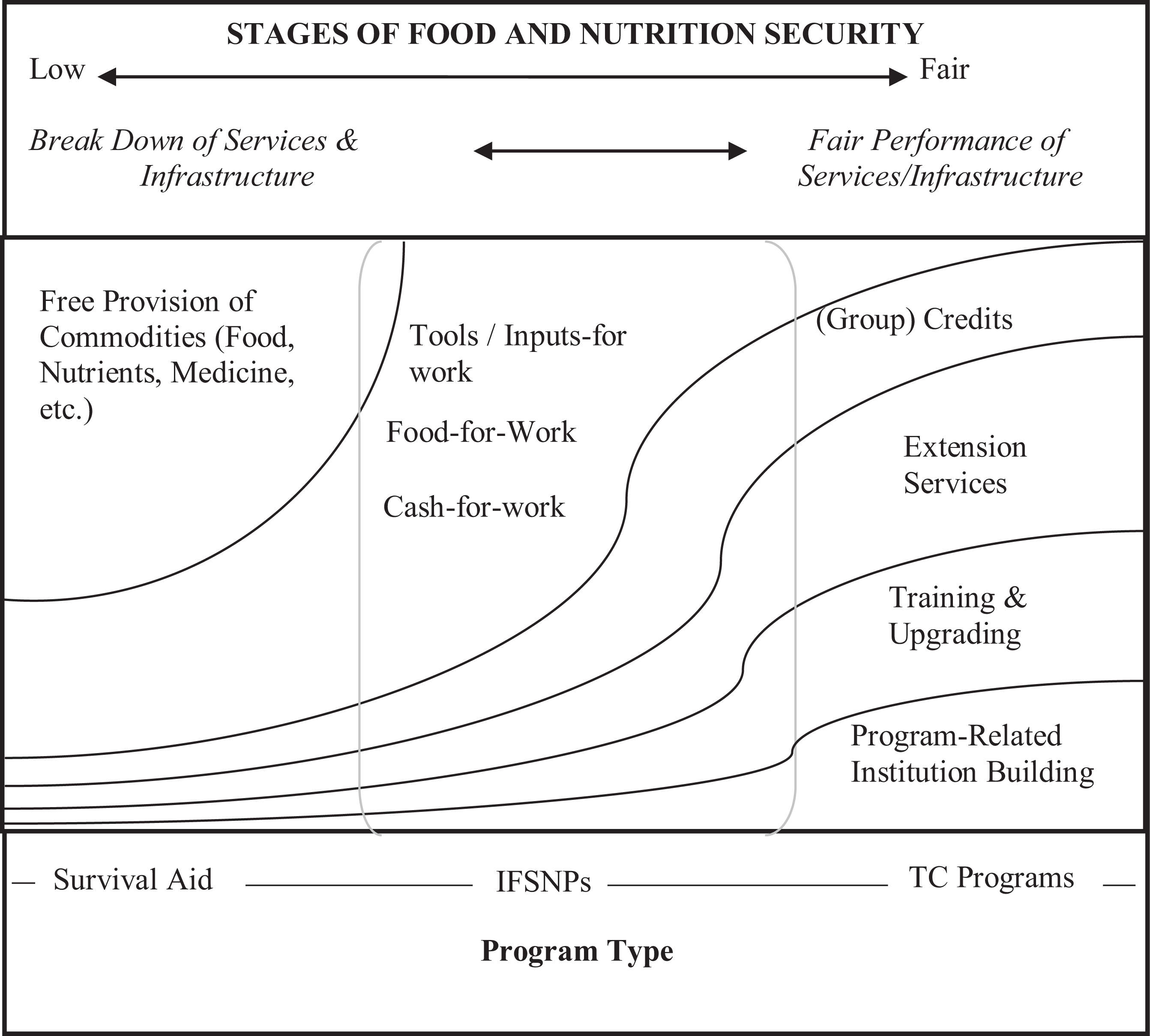
Importance of implementation tools at meso level in different stages of food and nutrition security. 2
Figure 3 specifically outlines the trajectory of action for FNS programs. When the food insecurity situation is critical (eg, no food is available), emergency response is required to rescue the affected lives. Relief programs are necessary in such situations to alleviate an immediate threat—in this instance providing food relief. Services are normally provided very quickly as and when they are needed and thus require flexibility on the part of the service providers. Once lives have been rescued, sustainable development measures can then be established among the affected population, in this instance, IFNSPs, which include self-help measures such as cash-for-work, food-for-work, tools, and inputs-for-work. The outputs of IFNSPs include basic infrastructure such as drinking water, toilets, irrigation systems, reforestation, health posts, and waste management. The third stage, TC, involves a range of activities implemented gradually and gaining intensity—including credit programs, extension services, training, and institution-building. All of these target building sustainability and resilience to reinforce FNS and the human and institutional capacity that supports it.
Nutrition Security
Dating from the early 1970s, food security was conceptualized primarily as sufficiency of food on a global scale. The 1974 World Food Conference defined food security as the “availability at all times of adequate world food supplies of basic foodstuffs to sustain a steady expansion of food consumption and to offset fluctuations in production and prices.” 11 It was not until the 1990s that the concept of nutrition security was included in the definition. Despite the passage of more than 2 decades, nutrition is not implicit in discussions, policy, or practice of food security. Thus, current nomenclature uses the term “food and nutrition security.” This helps ensure that nutrition is not lost in theory, policy, or practice. Nutrition security is defined 14 as a state when a person has a nutritionally adequate diet, the food consumed is “bioavailable” for the body to perform adequately in maintaining various physiological processes including growth, resisting or recovering from disease, pregnancy, breastfeeding, and physical activities. Additionally, Wall 15 posits that nutrition security encompasses physical, economic, and social access to a balanced diet, safe drinking water, environmental hygiene, primary health care, and primary education. As seen, nutrition security involves both food and nonfood attributes. Hence, while water, for example, may not be considered food in the definition of food security, it is a vital part of nutrition security. Further, these definitions suggest that nutrition (and food) security is, in part, dependent on health services, healthy environment, and care practices 16 and that nutrition security can only be realized when there is secure access to an appropriately nutritious diet in a healthy environment (including clean water and sanitation and no pollution) together with adequate health care services for all members of the household. Thus, the difference between nutrition security and food security is that nutrition security demands access to essential nutrients, not just calories as is most often the case when food security is considered.
A review by Hwalla et al 17 argued that nutrition is an integral component of food security and should be embedded within all 4 of its dimensions: availability, access, utilization, and stability. The review highlighted that the availability, accessibility, utilization, and stability of both macro- and micronutrients should be incorporated into all 4 dimensions of food security as applied to analysis, policy, and programming. Thus, it can be argued that if one is not nutritionally secure, one is not food secure.
With regard to food availability, improvement in the quality and quantity of nutrients within foods can be made to achieve nutrition security. For instance, staple foods can be fortified with β-carotene to improve its nutritional composition to alleviate a vitamin A deficiency in a population. Government policies can be structured to support such fortification programs 17 and other processes that support the improvement of the nutritional value of food.
Importance of Nutrition Security in Food Security
Nutrition security and food security are interconnected and must be dealt with simultaneously. 18 Diet quality is an important factor of the FNS of a society. It is determined by food availability, access, utilization, and affordability at national, household, and individual level and by the nutritional quality of the available and accessible food. Within this dual context, it is understood that poor diet quality is often linked with compromised socioeconomic status. 19 Further, food price increases (which affect accessibility) lead to diets lower in micronutrients. 20 Hence, it can be argued that income, socioeconomic status, and food prices significantly influence FNS and should, thus, be taken into account when considering FNS and insecurity.
In the quest to improve their economies through agriculture, governments often promote cash crop (as opposed to food crop) farming. However, undernutrition is significantly greater in regions that primarily produce cash crops. 20 Lack of nutrition leads to decreased productivity levels among adults and poor performance of scholars. Further, undernutrition often passes from one generation to another. When undernutrition is not dealt with, children will grow into malnourished adults and their children will experience similar problems. This affects not only families but also the overall local economy. 21 In 2016, 155 million children were reported stunted, which implies that these children will fail to achieve their genetic potential and will not realize their full developmental ability and will suffer, among other things, cognitive deficits and diminished economic opportunities. 22 Specifically, Black et al 23 highlighted that stunting happens early in a child’s life—within the first 1000 days (between conception and 24 months of age)—causing permanent damage to brain development. This has educational, income, and productivity implications throughout the life of the individual—from childhood through to senior adulthood.
The human cost of undernutrition is devastating, impacting negatively and significantly on the most vulnerable in the developing world. Undernutrition in developing countries causes populations to suffer from deficiencies of one or more micronutrients and, in addition to retarded and limited development, can also lead to child deaths. 23 Malnutrition is the main contributor to child morbidity and mortality worldwide. 24
Another substantial nutrition-related concern is the concurrent burden of obesity among adults and children, and stunting among children, occurring in developing countries. This occurs mainly among those of low-income and middle-income status. 22 It is unfortunate that the poor are the ones who suffer the most by this double burden, which predisposes them to health risks and economic shocks.
Analysis of FNS
Analysis of FNS is pivotal when addressing food security issues. Before developing food security policies or programs, it is essential to analyze the current FNS situation of the population. This analysis helps to understand clearly the circumstances of people who are food and/or nutrition insecure and vulnerable in terms of quantities, quality, location, and possible reasons for being insecure. Thorough understanding facilitates developing appropriate interventions. Commonly used approaches for analysis are vulnerability approach and sustainable livelihood approach. 25
Vulnerability Approach
Vulnerability is one of the measures of the stability pillars in food security. The greater the vulnerability, the less the stability of FNS. Vulnerability can be viewed in 3 aspects: an outcome of an event; a product of a threat of damage, injury, liability, or loss; and an outcome of the failure to ameliorate these threats. 1 Vulnerability is a function of exposure to risks and shocks and the resilience against their impact. In this context, risks and shocks are trends and events that threaten households’ food access, availability, and utilization and hence their food security status 26 by making them susceptible to become or remain below the preset minimum FNS line. The line could be caloric-based, nutrition-based, or may include other basic needs that impact indirectly on FNS. 27 This article would argue that the line must address food and nutrition—not only one element.
Another aspect of vulnerability to food and nutrition insecurity is that insecurity may not be experienced at the moment but could be a challenge in the future. It is, therefore, important to have 2 kinds of responses: one to alleviate the risk and the other to improve resilience against potential food and nutrition insecurity. 1 A person can be vulnerable to food and nutrition insecurity even if having a surplus of nutritious food at a particular moment. Food and Agriculture Organization 12 suggests a vulnerability analysis that aligns with the study by Gordillo et al 1 and argues that there are 2 major responses to vulnerability to food and nutrition insecurity: addressing the current risk exposure to insecurity and fortifying the capacity to withstand and manage the risk. Food security policies and programs must be broadened to cover both current and future challenges to FNS so as to accurately account for vulnerability. 6 Fortifying the capacity to manage risk aims at creating resilience which is a function of risk management strategies (mitigate, transfer, and cope) and the availability of necessary resources. 26
Vulnerability correlates with the unpredictability of events, which, again, is an aspect of stability. As a result, all people are potentially at risk to food insecurity, but the risk is disproportionately greater among some sectors of the population. For an example, people living in an area where households are poor and who depend primarily on their farm produce for food or to earn a living are much more vulnerable to food insecurity in the event of a natural disaster that destroys crop fields than those who have other sources of food and income. Essentially, the less diversified the livelihood strategies of farming households and the more dependent they are on the crop for survival, the greater their vulnerability. 28
Vulnerability can be potential or chronic, and it can be created by a range of factors including climate change (and other natural “disasters”), as well as social, political, and economic factors. 29 The families (individuals, regions, and countries) that have generally been able to sustain themselves through their own production (eg, for food or income) experience potential vulnerability created by the many risks associated with production, such as weather and price risk. The probability of the realization of these risks varies according to many factors, including historical trends. Chronic vulnerability is self-evident; it refers to situations where families have experienced, continue to experience, and are likely to continue experiencing vulnerability to food insecurity. This is often the result of structural problems and/or of altered climate that perpetuates their vulnerability. Understanding food security vulnerability is critical and, in many aspects, supersedes the narrower focus on food availability to a “broader understanding of risk, including the role of access and entitlements in food insecurity.” 10
There is need to pay attention to risk factors that seem to threaten food security at any point in time as they increase the probability of vulnerability. For instance, at the household level, a main risk factor is health that can present in the form of illness, disability, and/or injuries. Another risk factor can be life cycle-related (old age, death). Social-related risk factors include those which can arise due to inequitable food distribution among households in a society or among household members within individual households. Economic-related risk factors may manifest due to unemployment and harvest failure. 26 These risk factors exacerbate food and nutrition insecurity by decreasing food production (availability), diminishing income and other assets (access), escalating debt (stability), and decreasing recommended consumption of macro- and micronutrients (utilization) as a consequence of the other risk factors.
One of the main merits of the vulnerability approach in analyzing food insecurity is that it is dynamic and progressive in that it focuses not only on the immediate outcome but also scans for possible future incidents. In this way, the approach is applied ex ante (based on forecasts rather than actual results) rather than ex post (based on events that have occurred). The second advantage is that the vulnerability approach is cast in a stochastic (randomly determined) framework and can, therefore, fully consider the uncertainties associated with future FNS, such as the role of external shocks and the strategies that households, communities, and institutions can adopt in order to minimize the likelihood of negative outcomes. 30
Sustainable Livelihoods Approach
The sustainable livelihoods approach was developed to understand the context in which households pursue livelihoods and food needs. It examines the assets available to develop livelihood strategies and investigates the influence of macro-level policy and institutions on assets and strategies. Livelihoods comprise the capabilities, material and social assets, and activities required for a means of living. 31 A livelihood is sustainable when an individual or household can adapt to threats such as negative natural or economic trends and crises and can maintain or enhance its capabilities and assets without compromising the livelihoods of others. 32
A livelihoods approach focuses on people and tries to analyze the diversity of (poor) people’s livelihoods in totality giving particular attention to the interrelationship between community-level activities, broader policy, and institutional frameworks. “Sustainability” covers economic, environmental, institutional, and social parameters. Thus, adopting a livelihood approach requires focusing on the people’s way of life and factors influencing their ways of living and dynamic lifestyle patterns. The approach efficiently exposes gaps and possible points of action. 12
One of the most basic livelihood activities is food production which can be a main source of food availability and access, especially for rural households. Also important is the capacity of households to buy food in the market which is a determinant of food access; purchasing capacity rests mainly on the household’s means to generate income.
Food and nutrition security is supported by livelihoods in a way that households get access to resources and assets in their dwellings in order to satisfy their needs. Livelihood analysis of households and individuals starts with investigating the 5 livelihood assets—physical, financial, natural, social, and human capital—present in the assessed area. Then identifying the range of livelihood strategies into which people translate assets follows. Therefore, a successful livelihood strategy is seen in the outcome of achieved FNS. 33 In brief, FNS is a fundamental goal of all livelihood strategies.
In addition, the focus of FNS and livelihood approaches is on the household FNS elements of the underlying agencies of malnutrition, examining the availability, quality, and use components related to household FNS. The vulnerability aspect is incorporated into livelihood assets and strategies and also into FNS. 33 The integration of the 3 concepts results in a conceptual overlap; hence, they should be treated inseparably during an FNS analysis.
The Overall Conceptual Framework for FNS
As the discussion thus far suggests, measuring FNS is complex. It is difficult, if not impossible, to observe FNS outcomes directly. The study by Aurino, 34 as noted by Riely et al, 5 stated that “Food security indicators for food-supported maternal and child health programs, for example, might be quite different from those which are appropriate for food-for-work programs. Similarly, food security indicators that are appropriate in the humid tropics of Latin America may have little validity in the semi-arid areas of sub-Saharan Africa. And, finally, indicators that are useful for on-going program monitoring purposes may not be appropriate in the context of an impact evaluation.” Thus, one of the great challenges of measuring, monitoring, and intervening in FNS is establishing a common framework of indicators to capture both the dynamics of FNS and the multiple contextual variations in which FNS must be addressed. 34 Figure 4 presents the Food Insecurity and Vulnerability Information and Mapping Systems (FIVIMS) framework. 12 It addresses food insecurity and vulnerability across 3 fronts: collective (including national, subnational, and community levels), households, and individuals. Some of the key elements of the framework are discussed below.
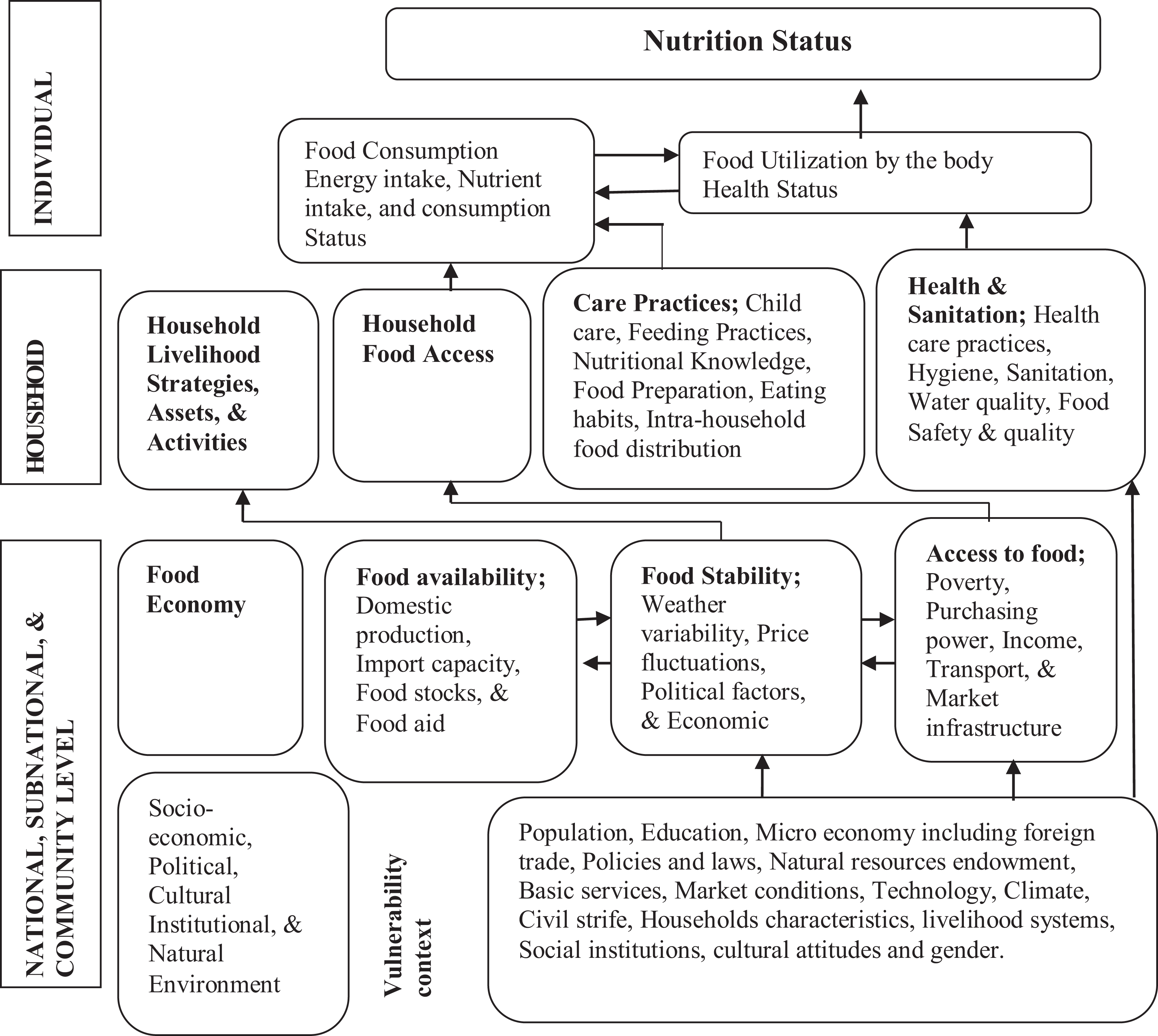
The Food and Agricultural Organization-Vulnerability Information and Mapping Systems (FAO-FIVIMS) framework. 12
Socioeconomic, political, institutional, cultural, and natural environment issues
This part of the diagram (residing under national, subnational, and community level) depicts the underlying factors in the food economy that affect the FNS availability, access, and stability pillars. These include population, the macro-economy, technology, climate, livelihood systems, and market conditions. These factors also have direct and indirect impacts on household-level activities and processes including livelihoods, food access, care practices, and health and sanitation. Together these elements create the overall “vulnerability context” of households.
Food consumption and utilization at the individual level
Ultimately, as seen in Figure 4, food security is essentially a matter of the nutritional status of individuals. The mapping highlights the fact all of these processes affect the nutritional status of individuals by affecting food consumption and utilization of food by the body. Specifically, individual nutrition security is affected by food access and care practices at household level. Because an individual’s food consumption is reliant on access to food at household and higher levels, it is, in effect, determined by poverty/income, buying power, transfers of income, market infrastructure, and quality of transport. The care practices that affect consumption encompass allocation of food within households, cultural beliefs and practices, and understanding of nutrition and food preparation. Specifically, the health status of an individual determines the efficiency and effectiveness of the body to utilize (assimilate) food, and health status is dependent on the overall health and sanitation conditions. As the diagram depicts, these conditions are directly influenced by the vulnerability context prevailing at the collective levels. It is thus argued that, even where appropriate foods are stably available and accessible, if the body (particularly because of external factors in society and the environment) is limited or compromised in its ability to utilize the food, then the individual cannot be food secure.
The FIVIMS framework clearly shows the linkages and interactions of key factors contributing to an individual’s nutritional status. And while food security is often reviewed from grander perspectives, in the end, food security is about the nutritional status of each individual in a societal setting. Thus, exploring the challenges of food security must embrace—in addition to the well-established 4 pillars—the factors affecting, directly and indirectly, the nutritional status of individuals.
Conclusion
A filled stomach is not enough. The food a person eats should be complete and safe, balanced (containing all required nutrients), and available and accessible for as long as it is needed. Food and nutrition security is possible only when the 4 pillars (availability, accessibility, usability, and sustainability) are in place. Thus, a person is considered food and nutrition secure only when the food consumed is nutritionally adequate and assimilated by the body to nourish itself for development, growth, resist diseases, and meet ordinary physiological demands of work and life.
Understanding the different dimensions and approaches to FNS helps enable the provision of efficient and effective food and nutrition support. This understanding also draws attention to the fact that not only do many players form part of the FNS network, they must work coherently in collaboration.
Where FNS is achieved, sustainable livelihood in households thrives, health improves, education improves, and the economy thrives. But the reverse is also true. Where livelihoods thrive, FNS is possible and sustainable. When livelihoods are vulnerable, household FNS is also vulnerable. Thus, FNS analysis must always give priority in assessing vulnerability in the context of sustainable livelihood in order to identify and classify populations at risk, to estimate the extent of vulnerability, and to determine kind of response be it relief, community development, sustainable systems development, or broad “people’s movements”—making sure to address the root of the vulnerability and not simply the symptom of immediate hunger or shortages.
Footnotes
Authors’ Note
The study did not include human participants that would require an informed consent but only a review of published work is included into this paper.
Acknowledgments
The authors wish to thank the University of KwaZulu-Natal and University of Eswatini for affording access to their library resources and services. Appreciation is also directed to Cebsile Ngcamphalala for proofreading this review paper.
Declaration of Conflicting Interests
The author(s) declared no potential conflicts of interest with respect to the research, authorship, and/or publication of this article.
Funding
The author(s) received no financial support for the research, authorship, and/or publication of this article.
