




Abstract
The first follow-up study of the original Institute of Nutrition of Central America and Panama Longitudinal Study was conducted in 1988 to 1989 when participants were between the ages of 11 and 27 years. The longer term effects of the original supplementation in early life of either high protein and energy, Atole, or no protein and low energy, Fresco, were seen in anthropometry, skeletal maturation, physical work capacity, and intellectual development, with maximum benefit seen in those participants who had maximum exposure to the supplementation during prenatal and early postnatal years. No effects were observed in bone mineralization and menarche. The long-term positive effects are consistent with the promotion of improved nutrition during the first 1000 days and established the foundation for further follow-up studies as the participants move into adulthood and further develop their human capital.
Introduction
In 1988 to 1989, the first follow-up of the original cohort born into the Institute of Nutrition of Central America and Panama (INCAP) Longitudinal Study was conducted to examine the longer term effects of nutritional supplementation during pregnancy and preschool ages between 1969 and 1977. The design of the INCAP Longitudinal Study is described elsewhere in this volume. 1 This article presents a summary of the results of the first follow-up as published in a supplement to the Journal of Nutrition in 1995 2 entitled “The effects of improved nutrition in early childhood: The Institute of Nutrition of Central America and Panama (INCAP) follow-up study.” There have been subsequent publications that refer to the results of the first follow-up. In 2010, the proceedings of a symposium held at the American Society for Nutrition annual meeting, entitled “The development and legacy of the INCAP Oriente studies, 1969-2009,” was published in the Journal of Nutrition in 2010. 3 The objective of the first follow-up study was to test the hypothesis that improved nutrition in early childhood results in enhanced growth, maturation, and function in adolescents and young adults. Diet during the early years was modified according to a study design that treated 2 villages with a high-protein, high-energy nutritional supplement (Atole) and 2 control villages with a low-energy, no protein supplement (Fresco). The objective of this review is to summarize the findings from the first follow-up study.
Methods
As shown in Table 1, a battery of measurements was made to assess growth, development, and function in the participants at follow-up. In this article, we summarize the previously published results of (1) anthropometry for body size and composition, (2) hand–wrist X-rays for skeletal maturation, (3) medical examination for menarcheal age, (4) photon absorptiometry for bone mineral content (BMC), (5) a graded exercise test of physical work capacity, and (6) psychological test of functional competence, intelligence, and information processing. Approximately 72% of the original participants in the supplementation phase of the longitudinal study participated in the first follow-up. 4
Coverage Rates by Study Domain for 1988 to 1989 Follow-Up Cohorts.a
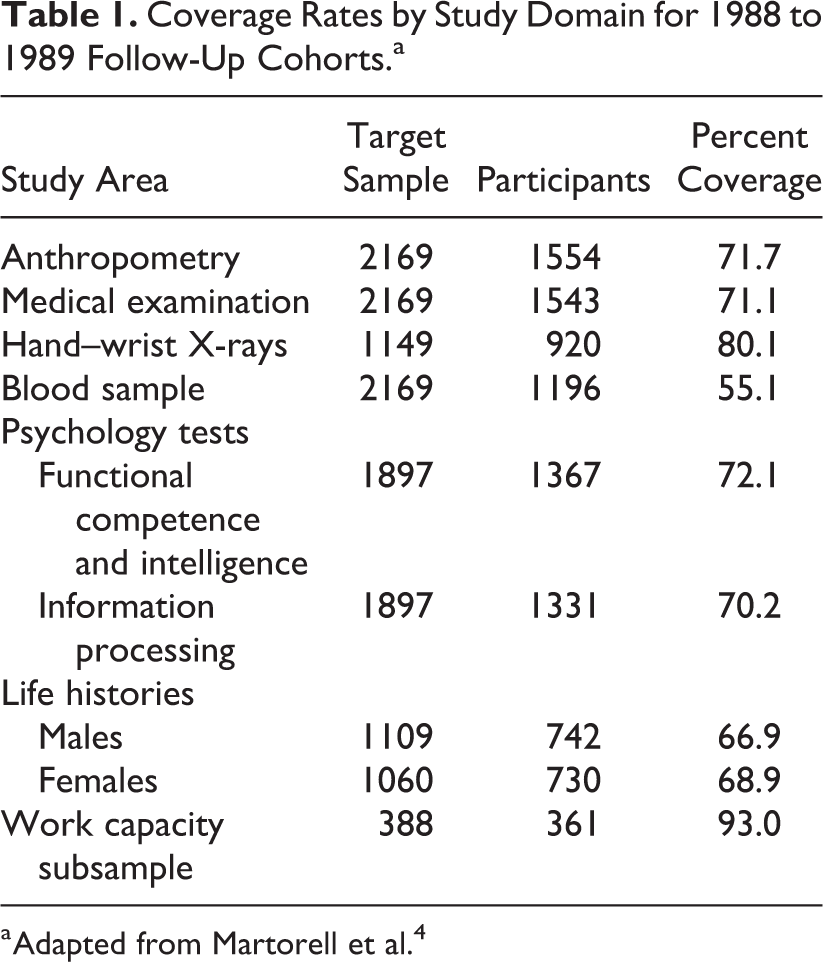
a Adapted from Martorell et al. 4
The age groups included in these analyses were adolescents between 11 and 18 years of age or young adults between 19 and 27 years of age. Due to the long recruitment period, 1969 to 1977, and a broad age range at recruitment (prenatal to 7 years), individual participants at follow-up had different ages and duration of exposure to the dietary intervention. The analyses of most outcomes at follow-up were conducted for 3 cohorts of participants, as shown in Figure 1. Cohort 2 who was between 14 and 18 years of age at follow-up had the maximum exposure to the intervention at an early age, with complete exposure throughout gestation and the first 3 years of postnatal life. This cohort is assumed to have benefited the most from the nutritional supplement. 5 This assumption was based on analysis that showed the maximum impact of the nutritional supplement on linear growth occurred before 3 years of age. 6 Cohorts 1 and 3 had maximum exposure to the supplement at different ages and some limited exposure at yet other ages.
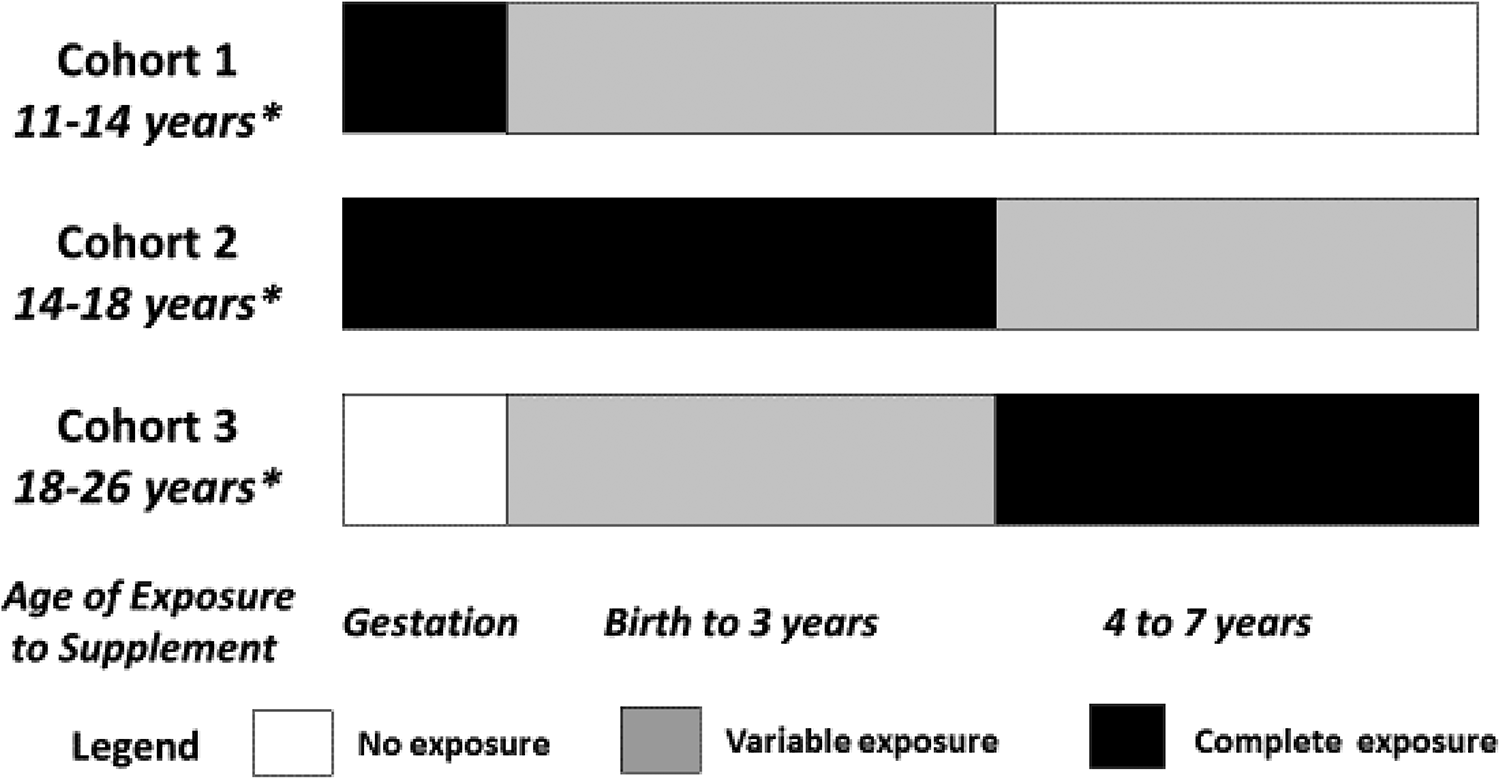
Age at exposure to supplement by cohort. *Age at follow-up. Adapted from Haas et al. 5
Most analyses conducted on the participants at follow-up tested for differences in the outcomes listed in Table 1 between participants in Atole versus Fresco supplement groups. Although the original study design was meant to allow a test of causal effects of exposure to Atole versus Fresco during early life, there were limitations in making causal inference at follow-up. Outcomes were measured 11 years after the intervention stopped in 1977 and no assessment was made of the potential supplement group differences in environment or characteristics of those lost to follow-up during the intervening years. Also, factors such as enrichment of both supplements with micronutrients and different levels of both energy and protein for Atole versus Fresco make it impossible to determine the nutritional source of any observed group differences in outcomes. These and other challenges to causal inference resulted in reliance on secondary analysis to examine the plausibility of the intervention effects. 7 These included analysis conducted to test effects of supplement dose on selected outcomes, the determination of a relationship between early growth and later growth and development, and the analysis of the relationship between achieved physical size during the follow-up period and other measures of maturity and function.
Results
This review summarizes the published results of the intervention on (1) growth in body size and composition, (2) maturation during adolescence, and (3) physiological and psychological function.
Effect of the Intervention on Adolescent Body Size
Description of adolescent growth
The patterns of linear growth in the participants of the INCAP cohort study were assessed using their length data from birth to 7 years of age and their height data from the cross-sectional follow-up of this cohort of participants when they were 11 to 24.9 years of age. 8 The resulting linear growth patterns of the Guatemalan children, adolescents, and young adults were compared with reference data for the US general population and for Mexican Americans. The latter is a reference population of similar ancestry as the study population and therefore may have a similar growth potential; however, they lived in an environment that does not constrain growth. At birth, the median length of the Guatemalan children was at approximately the 16th percentile of the US reference population (2 cm shorter); by 6 months of age, the average length of the Guatemalan children was below the 5th percentile of the US reference (about 5 cm shorter), and by 3 years of age, the difference was about 10 cm. In contrast to the Guatemalan children, the average length of the Mexican Americans during this first 3 years of age was remarkably similar to the US reference. Relative to the United States, these Guatemalan adults were about 13 cm shorter. This absolute difference compared with the US reference population was roughly maintained at all ages between 11 and 24 years, indicating that the linear growth patterns of the study participants during adolescence were largely similar to those observed in the US reference population. In summary, during the first 3 years of age, linear growth failure occurred in Guatemalan children relative to the US and the Mexican American reference populations, but adolescence is not a period when growth is significantly constrained in these participants.
Effect of the intervention on body size
Effects of supplementary feeding during pregnancy and the first years of life on growth have been documented for over 40 years in populations with evidence of growth restriction, when the dietary intake of women and children was truly improved. 9 This evidence includes the findings of effects of supplementation on the attained body size at 3 years of age of supplemented children who participated in the INCAP Longitudinal Study from a population that experienced a history of marked growth failure in the first 3 years of life. 10 However, prior to the INCAP follow-up study in 1988 to 1989, the long-term effects of supplementary feeding during early childhood on anthropometric measurements had not been studied. Therefore, one of the analyses conducted with data from the INCAP follow-up study was the assessment of the effects of supplementary feeding during early childhood on body size and composition at adolescence. It was hypothesized that the effects of supplementation on growth at 3 years of age persist into adolescence. 11
The analysis included assessment of the effects of supplementation on length and weight at 3 years of age, using data from the 1969 to 1977 INCAP Longitudinal Study, and of height and weight at adolescence, using data from the cross-sectional follow-up of the same participants in 1988 to 1989. Children from Atole villages grew better during the preschool period than children from Fresco villages. Unadjusted differences in favor of Atole villages were 0.7 and 1.2 kg in weight and 1.6 and 2.7 cm in length, for males and females, respectively (all Ps < .05). Multiple regression models were used to adjust for a number of variables that were associated with length of children <3 years, including maternal height, socioeconomic status (SES), percentage of time with diarrhea, and home diet. Since randomized assignment to Atole and Fresco was not at the individual level, and therefore potential confounders were not necessarily evenly distributed between treatment groups, we needed to adjust for variables that could explain the differences in length other than the intervention. Adjusted differences at 3 years were 0.7 and 1.3 kg in weight and 2.0 and 2.9 cm in length, for males and females, respectively (all Ps < .05).
Estimates of the effects at adolescence were also assessed using multiple regression models, adjusting for both the variables used as covariates in the analyses of length at 3 years of age and pubertal maturation status (skeletal age) which is associated with height. Adjusted group differences in favor of the Atole group at adolescence were 1.2 kg (P > .05) and 2.0 kg (P < .05) in weight and 1.2 cm (P > .05) and 2.1 cm (P < .05) in length, for males and females, respectively. In sum, adolescent girls from Atole villages were taller and weighed more than those from Fresco villages. Although adjusted mean heights in adolescent boys were consistently greater in Atole villages, the differences between Atole and Fresco villages were not statistically significant. In both sexes, the absolute differences in weight at adolescence were larger than those observed at 3 years of age, while differences in height were attenuated. The differential response to supplementation at 3 years of age and at adolescence is difficult to explain. It appears that this gender difference was mainly due to differences already existing at 3 years. Attenuation of differences at adolescence was the result of better growth after 3 years for children in the Fresco villages. The smaller magnitude of the difference in males at 3 years of age combined with larger standard errors in adolescence resulted in differences between Atole and Fresco at adolescence that were no longer statistically significant. Larger standard errors in adolescence are believed to be due to variations in maturity. While a large proportion of females had reached maturity at the time of the follow-up, this was not the case for males. Skeletal age was used in the analyses to control for maturation; however, extreme variations in height associated with differences in maturity could not be completely controlled for.
In conclusion, our results show that investments in nutrition during early childhood have effects on growth that persist into adulthood. This was clearly demonstrated in adolescent girls, most of which had reached maturity. In males, it is likely that variations in height associated with different maturation stages led to large standard errors and lack of statistical significance of the differences in favor of Atole. Greater height may have effects on reproductive performance in females, notably on fetal growth and therefore on the health and survival of the next generation, which could be examined in subsequent follow-up studies.
Effect of the Intervention on Adolescent Body Composition
Fat-free mass
Although the previous section reports a marginal effect of the nutritional supplementation on weight during adolescence, it is important to recognize that body weight is a composite measure of the many body compartments that could be differentially affected by past or current nutrition. Age-related changes in body composition, expressed as body fat and fat-free mass (FFM), are identifying features of adolescence and are influenced in part by the course of sexual maturation experienced during puberty. The component of body weight that is FFM was estimated from anthropometry using a prediction equation developed specifically for this population. 12 After controlling for a number of covariates, including height and maturation status, females from Atole villages had a 1.2 kg greater FFM compared to females from Fresco villages (P = .052). Consistent with findings for body weight, the 0.02 kg difference in males was not significant. 10
Bone mineral
Linear growth, reflected in height, is supported in part by the process of bone mineralization that occurs during infancy, childhood, and adolescence. Adult bone mineralization is dependent on the amount of mineralization that occurs during the period of linear growth. The effect of the early nutritional supplementation on adolescent bone mineralization was determined in a subsample of 356 follow-up participants of the INCAP Longitudinal Study. 13 Measures of Bone mineral content (BMC), radial bone width (BW), and bone density (BD) were obtained from a scan of the radius using a single-beam photon absorptiometer for boys and girls between 11 and 23 years of age. Consistent with findings for growth in stature, the Guatemalan boys and girls at all ages had less BMC and BD relative to a comparison sample of German adolescents but showed a similar trend of increasing BMC and BD with age. Those girls who consumed Atole had significantly wider bone (BW) than the Fresco girls, none of the other measures of BMC and BD were significantly different for either sex between the Atole and Fresco samples. A secondary analysis using linear regression on the entire sample of participants showed a significant relationship between the amount of energy (kcals) consumed during infancy and early childhood and the measures of BMC, BD, and BW at adolescence after controlling for age, gender, and supplement type. However, when stature and weight were controlled in the linear regression analysis, none of these relationships remained significant. The authors concluded that although nutritional supplementation during childhood may have a positive impact on later bone mineralization, the effect is probably due to overall somatic effects of the supplementation.
Effect of the Intervention on Adolescent Maturity
The patterns of physical growth in body size and composition during adolescence are largely dependent on the process of biological maturation that is the hallmark of puberty. The impact and mechanisms of nutrition supplementation during the preschool years on later adolescent growth should consider the role that maturation plays as a specific outcome of adolescent development as well as its role in defining the age-related changes in physical growth and performance. Various dimensions of the maturation process were assessed in the follow-up study. These include skeletal maturation and age of first menstruation (menarche) in girls.
Skeletal maturity
The timing of appearance of centers of ossification and the age-associated course of ossification and fusion of bones in the skeleton is a reliable indicator of biological maturation during the first 2 decades of life and is correlated with stages of sexual maturation during adolescence. Participants (n = 663) in the follow-up study between 11 and 18 years of age were assessed for skeletal age using the score derived from the radius-ulna-short bones option of the Tanner-Whitehouse-2 (TW2) method 14 for assessing maturation of the hand and wrist. 15 An individual’s skeletal age can be compared to their chronological age to determine relative maturity. When the entire sample of adolescents was compared to the British reference, which is the basis of the TW2 method, significantly delayed skeletal maturation was only observed in the younger boys (11-14 years) and not in older boys (14-19 years) or girls at any age. The TW2 method is not a useful tool for assessing maturation status for those who are approaching or have already reached skeletal maturity, such as the older girls (>14 years) in this study. The differences between Atole and Fresco villages were only statistically significant for younger females (<14 years) who were 0.39 years more advanced in the Atole villages. However, when SES and village size were controlled, these differences were no longer significant.
Menarche
Although assessment of maturity based on skeletal age in adolescent girls has limitations, documentation of age at first menstruation (menarche) provides another useful marker of the maturation process. Atole versus Fresco differences in age at menarche were determined from recalled menarche for 832 females (15-30 years) obtained during a resurvey of study participants in 1991 and 1992. 16 No significant differences between supplement types were observed, with both Atole and Fresco groups experiencing mean age at menarche at 13.7 years (standard deviation [SD] = 1.29). These are later than age at menarche observed for girls in industrialized counties and marginally later than for girls living under better socioeconomic conditions elsewhere in Latin America. The authors observed a trend toward decreasing menarcheal age with increasing SES within the study population as well as earlier menarche for those who were youngest at the time of the of the survey. The results of analysis of skeletal age and menarche are consistent in support of a conclusion that exposure to Atole in early life has no effect on maturation during adolescence.
Functional Consequences of the Intervention
The objective of the first and subsequent follow-up studies, stated as a hypothesis, was “improved nutrition in early childhood leads to enhanced human capital formation.” 4 Human capital is a broad term that in the context of the follow-up study reflects the realized potential to lead healthy and productive lives. Although many of the measurements listed in Table 1 are a reflection of this potential, perhaps the most directly relevant to human capital formation are assessment of physical work capacity and intelligence. These domains are meant to define specific functions that are translatable to current and future economic productivity and positive societal participation.
Physical work capacity
The ability to perform moderate to heavy levels of physical work is reflected in standard laboratory tests of physical work capacity. These tests are particularly relevant to agrarian societies in less industrialized countries where physical labor is a major limitation to worker productivity and achievement of economic gains needed to support basic physical and societal needs. A measure of oxygen uptake during maximum exertion (
A random subsample of 364 participants who were participants in the original longitudinal study were selected for testing of
In general, based on
In a secondary analysis to test for a dose response among those participants who consumed Atole and were members of cohort 2, males, but not females, showed a significant positive relationship between the amount of supplement consumed over the first 3 postnatal years and
Intellectual performance
Effects of supplementary feeding during pregnancy and/or the first years of life on behavioral development were documented in the 1980s and 1990s. In general, nutritional interventions had a small (∼0.2 SD) but significant association with performance among infant and toddlers on mental and motor development. 19 However, prior to the INCAP follow-up study in 1988 to 1989, information about the long-term effects of supplementary feeding during early childhood on behavioral outcomes was scarce. Results of only 2 follow-up studies of early supplementary feeding were available, but only in the form of abstracts in conference proceedings, and results were mixed. Therefore, the effects of early supplementary feeding on cognition were investigated using data collected during the INCAP Longitudinal Study from (1969-1977) and during the cross-sectional follow-up of former participants carried out in 1988 to 1989. Performance was assessed on a battery of psychoeducational and information processing tests that were administered during adolescence.
The psychoeducational test battery included tests of literacy, numeracy, general knowledge, the Raven’s Progressive Matrices, and 2 standardized educational achievement tests (vocabulary and reading), which were part of the Interamerican Series. The purpose of this battery was to measure general abilities, aptitudes, and achievements that are influenced heavily by experience, education, and cultural upbringing. Information processing comprised a computerized battery of tests, which included simple choice and memory reaction time.
Consistent differences between supplement groups were observed on psychoeducational tests. Participants exposed to Atole during the prenatal and early postnatal period scored significantly higher on tests of numeracy, general knowledge, and the 2 achievement tests: reading and vocabulary, than those given Fresco. In addition, there were significant interactions between supplement type (Atole and Fresco) and SES of participants. In Atole villages, there were no differences in performance between participants in the lowest versus highest SES categories. On the other hand, performance in Fresco villages was better in the highest compared with the lowest SES group. It is well established that SES correlates well with scores on psychoeducational tests, including vocabulary. 20 Therefore, the findings that the strongest beneficial effects of Atole on vocabulary were observed among those at the lowest end of the SES distribution and that the effect was sufficient to cancel the expected score differences between the lowest and highest SES distribution were interpreted by the authors as the supplementation acting as a social equalizer. After adjusting for all potential confounding, Atole ingestion also was associated with faster reaction time in information processing tasks.
In conclusion, the dietary changes produced by supplementation provide the strongest explanation for the psychological test performance differences observed in the follow-up between participants exposed to Atole and those exposed to Fresco supplementation.
Conclusions
A major conclusion from the studies conducted at follow-up in 1988 to 1989 is that there are long-lasting positive effects of early life improvements in nutrition in a wide range of indicators of human capital formation measured during adolescence. The strongest impacts were seen in those participants who were exposed to Atole during prenatal and early postnatal life. This finding provides support for the need to invest in improved nutrition, as well as health and child care during the first 1000 days of life if one is to achieve positive development and well-being in later life.
Footnotes
Declaration of Conflicting Interests
The author(s) declared no potential conflicts of interest with respect to the research, authorship, and/or publication of this article.
Funding
The author(s) received no financial support for the research, authorship, and/or publication of this article.
