




Abstract
Background:
Micronutrient deficiencies have been a serious public health problem among women of reproductive age in low- and middle-income countries including India, adversely affecting maternal and child health and human capital outcomes. Fruit and vegetables are important sources of micronutrients, and consumption of these foods is less than recommendations.
Objective:
The objective of this study was to identify perceived barriers and facilitators to fruit and vegetable consumption among women of reproductive age living in rural communities in the State of Maharashtra, India.
Methods:
Women aged 18 to 40 years were recruited from 8 villages surrounding the city of Wardha, Maharashtra, India. We used qualitative methods and held 9 focus group discussions and 12 one-to-one interviews. The data collection was stopped when no new information emerged. We used inductive thematic coding to analyze the data.
Results:
Women knew that fruit and vegetables were beneficial to health and expressed that they wanted to increase the intake of these foods for themselves and their children. Seven main themes were identified as being barriers or facilitators to fruit and vegetable consumption: (1) personal factors, (2) household dynamics, (3) social and cultural norms, (4) workload, (5) time pressures, (6) environmental factors, and (7) cost.
Conclusions:
Rural Indian women consumed fruit and vegetables infrequently and said they would like to consume more. Several potentially modifiable factors affecting the intake of fruit and vegetables were identified. Value chain analyses of fruit and vegetables in these communities will be important to identify opportunities to intervene and increase consumption.
Introduction
Micronutrient deficiencies are prevalent among women of reproductive age in low- and middle-income countries (LMICs). 1 -4 The World Health Organization states that malnutrition is directly or indirectly linked to major causes of death and disability worldwide. 5 -7 It is estimated that South Asia faces the greatest hunger burden, with about 281 million undernourished people. 8 Sustainable Development Goal 2 is to “end hunger, achieve food security and improved nutrition and promote sustainable agriculture.” 8 To attain this goal, it is important to have a clear understanding of the barriers to a sustainable, nutritious diet for all.
Diets in many rural parts of India are often of poor quality, carbohydrate-based, 9 -11 and lack micronutrient-rich foods. 12 Micronutrient intakes are usually inadequate when access to a diverse and high-quality diet is limited 1,13,14 ; this may be because a diverse diet is unaffordable, 15 locally unavailable, or unacceptable for cultural or religious reasons. 16 Also, average fruit and vegetable intakes are below the recommended 5 portions or 400 g per day 11,17 -19 in rural areas, and lower than those in urban areas. 20
Our study was conducted in villages surrounding the city of Wardha in the state of Maharashtra. The climate in this area is hot and dry, and the agricultural land is mainly rain-fed and used for commercial crops including cotton and soybean. 21 The majority of the workforce is occupied within the agricultural industry. Fewer than 20% of households in rural Maharashtra have a refrigerator, 22 and approximately 30% of women in the state report that they never consumed meat, fish, or eggs. 22 Dietary data from the villages around Wardha indicate that wheat, rice, and sorghum (millet) are the staple cereal foods. 23 Intakes of virtually all micronutrient-rich foods have been reported to be below 20% of the recommended daily intake (RDI), for example, mean daily consumption of green leafy vegetables is less than 10 = g/d and fruit is 16 g/d compared with an RDI of 100 g/d for both food groups. Half of the women were chronically energy deficient (body mass index <18.5 kg/m2) and over 75% of nonpregnant and non-lactating women were anemic. 23
This study focuses on fruit and vegetables because a large proportion of the Indian population is vegetarian, and therefore, these foods are acceptable to the majority. Furthermore, their consumption is associated with reduced risk of micronutrient deficiencies and non-communicable diseases. 24,25 The most recent Global Burden of Disease Analysis estimated that 4.9 million deaths per year were attributable to low fruit intake and 1.8 million were attributable to insufficient vegetable intake. 25 Therefore, fruit and vegetables are an essential component of a healthy diet. We recognize that there are other foods such as pulses, meat, fish, eggs, nuts, and whole grains that are also important and we would advocate that barriers and facilitators to consumption of these foods are studied in detail. However, these food groups are beyond the scope of the present study.
There have been few reports from LMICs concerning determinants of fruit and vegetable consumption. The majority of studies have been conducted in Europe and North America. 26 -28 A systematic review concluded that availability was a key factor in the United States and European populations. 29
A study in an urban slum in North India 30 among pregnant women reported that the majority of women were aware that they should eat green leafy vegetables frequently but in fact a quarter ate them once a month or less. The women reported lack of availability of vegetables and that they had few decision-making powers and low status within the household. The choice about what they ate was not necessarily their own.
A qualitative study in the Pabal district of Maharashtra aimed to understand why newly married rural women tended to be underweight. 31 The factors they identified were: isolation from their own families; inability to relax in their in-law’s home and eat adequately; high workload; lack of financial autonomy; and regular fasting. These are complex findings, and it is clear that there is no one cause of underweight and therefore unlikely to be one remedy.
A recent report from an urban setting in Fiji found that participants had positive perceptions of fruit and vegetables and were aware of their health benefits. However, lack of access to high-quality, affordable fruit and vegetables was an important barrier to consumption of these foods. 32
The Leveraging Agriculture for Nutrition in South Asia (LANSA) Consortium leads several projects in India and the rest of South Asia to improve nutrition and health through identifying opportunities to intervene in agriculture, markets, and the food system. A recent report by Maestre et al 33 described a series of 5 requirements for foods to be purchased and consumed: (1) consumers must be aware of the beneficial effects of improved nutrition and diet diversity for themselves and household members, (2) they must be able to determine which foods are nutrient-rich, (3) nutrient-rich foods should be physically available either by home production or from markets, (4) foods must be affordable to consumers, and (5) foods must be acceptable to consumers in terms of appearance, preparation, social and cultural norms, and taste.
The Ottawa Charter for Health Promotion states that “Political, economic, social, cultural, environmental, behavioral and biological factors can all favour health or be harmful to it” and advocates a social-ecological model for health promotion. 34 The social-ecological model 29,35,36 broadly defines barriers to health behaviors to occur at the individual, interpersonal, and environmental or ecological level. Examples of such barriers are (1) taste preferences, (2) expectations of others in the household and community, and (3) access to land upon which to grow fruit and vegetables or opportunities to obtain paid work, respectively.
Our aims were to (1) explore perceived barriers and facilitators to fruit and vegetable consumption among women of reproductive age inhabiting rural villages around the city of Wardha, Maharashtra and (2) suggest approaches and potential interventions to increase the consumption of fruit and vegetables.
Methods
This study was qualitative in design and comprised 9 focus group discussions (FGDs) and 12 one-to-one interviews aimed at understanding barriers and facilitators to consumption of fruit and vegetables by women of reproductive age and their families. We decided to conduct interviews in addition to FGDs as it was thought some women may feel more comfortable discussing the research topic on a one-to-one basis.
For the purposes of this study, the terms “fruit” and “vegetables” were considered to refer to all edible fruit and vegetables including leafy vegetables, roots, starchy vegetables, and fresh, dried or preserved foods.
Setting and Participants
The data collection took place from June 2015 to November 2015 in 8 villages in the Wardha district of eastern Maharashtra. This region is highly dependent on agriculture for food and income. It is a challenging environment with temperatures regularly exceeding 45°C (113 F) in the summer months (April, May, and June) and frequently poor, unpredictable rainfall in the monsoon season (June–September). The study was carried out in collaboration with MS Swaminathan Research Foundation, and the women were recruited via key persons in each village who had an established rapport with the staff from the Foundation.
The Government of India uses the terms “scheduled tribes.” “scheduled castes,” and “other backward castes” to describe groups that are socially, educationally, or economically disadvantaged. 37 We selected the study villages in order to recruit women from each of these castes.
Within the villages, a convenience sample of women was selected based on eligibility and willingness to participate. Women were eligible to take part if aged 18 to 40 years, and this was based on self-reported age. We also recruited approximately equal numbers of married and single (widowed, divorced, separated, and unmarried) women and approximately equal numbers of landed and landless women (women who lived in households that owned or did not own land, respectively).
Focus Group Discussions and Interviews
A total of 9 FGDs were held with 88 women (of these, 40 women were single and 38 were landed). The FGDs were held in the villages where the women lived in community centers or at one of the women’s homes. No financial or other incentives were offered, but tea and snacks were provided to the women prior to the discussion. In order to encourage open discussion, the women were grouped by caste and land ownership status. The FGDs were led by a facilitator and an observer was present to take notes and prompt the facilitator where necessary. All discussions were held in the local language of Marathi, and were digitally audio-tape recorded, transcribed, and translated to English. The facilitator transcribed and translated the discussions with input from the observer.
In addition to the FGDs, 12 one-to-one interviews were held. The interviews were also conducted at community centers or in the women’s homes, audio-tape recorded, transcribed, and translated to English. Facilitators, observers, and interviewers were trained in qualitative methods prior to conducting the research. The FGDs and interviews were guided by a schedule (available on request), which was informed by discussions at 2 stakeholder workshops held in Mumbai and Wardha in May 2015. Briefly, women were invited to reflect on their likes and dislikes in terms of fruit and vegetables, meal times in their households, how decisions were made about food choices, preparation and intake, their daily activities, seasonal influences on diet, and any other factors that affected their food intake.
We used thematic analysis to identify emerging themes from both the FGDs and the interviews. Analysis was conducted at the group level and an inductive coding approach was used. Three transcripts were used to create an initial coding frame, and this was applied to all further transcripts. The coding frame was continually discussed and adapted based on new information from the transcripts. Four researchers (V.D., S.B., R.K., and S.K.) read and coded the transcripts, and following the discussion, the final coding template was created. The final template was applied to all transcripts by S.K.
Results
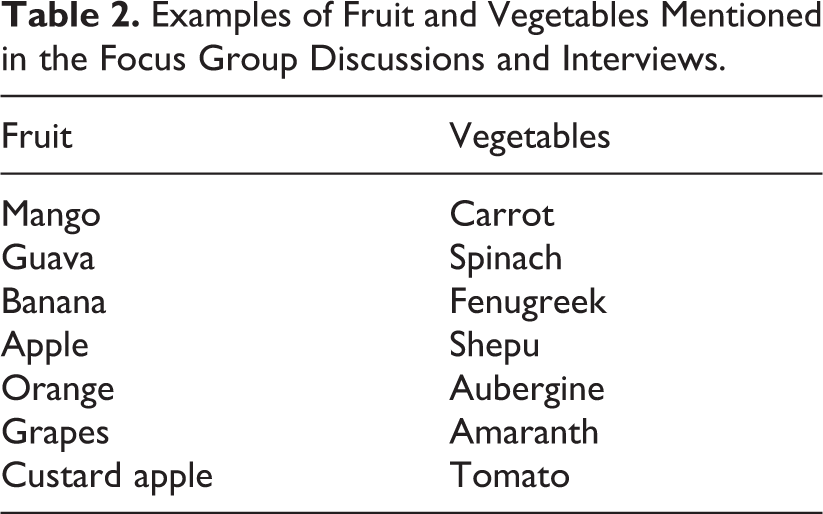
Table 1 shows the participant characteristics. Examples of the fruit and vegetables mentioned during the data collection are shown in Table 2. We identified 7 main themes as reported barriers or facilitators to fruit and vegetable consumption during the data analysis. These were (1) personal factors, (2) household dynamics, (3) social and cultural norms, (4) workload, (5) time pressures, (6) environmental factors, and (7) cost.
Participants’ Characteristics.
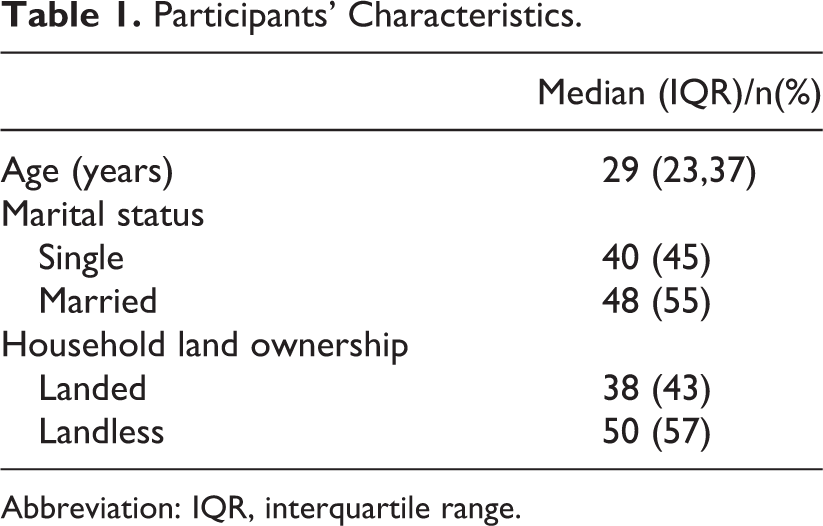
Abbreviation: IQR, interquartile range.
Examples of Fruit and Vegetables Mentioned in the Focus Group Discussions and Interviews.
These themes are now presented with illustrative quotes:
Personal Factors
These included the women’s own likes and dislikes of certain foods. Fenugreek and spinach are the only two green leafy vegetables I like. (Interviewee 5, married, landless, age 23 years) Old women eat indigenous plants, but youngsters think they are bad for health. They look dirty. (FGD participant, single, landless) My daughters have (fruit); this is more than enough. I am not bothered about myself. I overcome my craving. (Interviewee 8, married, landed, age 28 years)
Household Dynamics
Many women reported that decisions about what to eat were made by their husbands or their mothers-in-law and fathers-in-law. There is a big family; hence there is no option for us to decide. Whatever [vegetables] we get, we prepare. (Interviewee 3, married, landed, age 30 years) Women do not get to eat proper meals the way they are supposed to. Men get a proper meal. (FGD participant, married, landless)
Social and Cultural Norms
Women talked about the norm that men would shop in the market and therefore choose the foods that were consumed within the household. It was reported that for some castes, it was not considered acceptable for a woman to go to market. Also, the time and workload burdens on women were not alleviated by their husbands because it would be improper for a man to do household work, and others in the community would gossip if this happened. How can he [husband] help me? If he helps me with household chores, then everybody in the village will gossip about him or say bad things. (Interviewee 11, married, landed, age 32 years) Papaya is hot. [This] means if you have it during pregnancy then there is more chance of miscarriage. My grandmother said. (Interviewee 10, married, landless, age 28 years)
Workload
Many women stated that their appetite for some foods including fruit and vegetables was affected by the daily activities they performed. These activities included getting children ready for school, cooking, household work, and farm work. We have to fetch water, wash utensils, get flour from the mill, go to the farm. That is what women have to do. After that she gets to eat. (FGD participant, married, landless) I get tired in the evenings. So I do not have meals, somehow I gulp a morsel or two and go to bed. (Interviewee 3, married, landed, age 30 years)
Time Pressures
Travel to the farm for work and time spent at work itself were the major components of the women’s daily routine. The routine was often influenced by the time of year. Women who plucked cotton for a living would spend as much time as possible working during the cotton picking season, and some reported missing meals so that they could work all day. Many women also talked of spending time working on household chores and childcare activities. I don’t have a full meal in the morning because I have to rush to the farm. (FGD participant, single, landless) I don’t like having unfinished work. I am ok if do not get food but I am happy if I finish all my work within time. (Interviewee 11, married, landed, age 32 years)
Environmental and Practical Factors
These included season of the year. Summer was reported to be a time where fruit and vegetables were in short supply, expensive, and often of poor quality. Many women reported preserving certain vegetables to be consumed during the summer. Water availability was an important factor governing whether households could maintain kitchen gardens and therefore grow their own fruit and vegetables. Cold-storage facilities were often lacking; hence, it was not possible for households to store vegetables for any length of time, particularly in the hot summer months. Availability of land for growing fruit and vegetables was mentioned. Those who have space can cultivate green vegetables at home. Those who do not have space cannot cultivate. They do not have any option other than buying [vegetables]. (FGD participant, single, landless) Whenever we go to Wardha we get [fruit]. Every day we cannot have fruit. We go to Wardha once in one or two months. (Interviewee 4, married, landed)
Cost
Most women stated that cost was a major factor in terms of the fruit and vegetables they consumed. The decision about which vegetables to buy in the market was often based on the price, and this was considered more important than quality. Many women talked about being poor and having to manage on very low incomes. They often mentioned compromising by buying small amounts of fruit or vegetables and giving these to the children before eating themselves. Food price inflation was mentioned. When there is inflation, they mostly invest their money in the farm and in the house; hence they create a thrifty condition in the home. (Interviewee 1, married, landed, age 24 years) During summer, the vegetable which is 5 rupees (US$0.08) per 250 g becomes 20-25 rupees (US$0.32-0.40) per 250 g. (FGD participant, married, landless)
Discussion
We used qualitative research methods to examine factors that influenced consumption of fruit and vegetables by women of reproductive age in a rural Indian community. We found that factors operating at the intra- and inter-individual, household, environmental, and economic levels were perceived to prevent women from consuming adequate fruit and vegetables. Personal food dislikes, preferences of other household members, distribution of food within the household, social and cultural norms, summer season, lack of availability and access, and cost were all reported as barriers to fruit and vegetable intakes. Water availability and access to land, which allowed for the cultivation of fruit and vegetables in a kitchen garden, were important facilitators.
It would appear from our findings and those of other studies 29,32 that knowledge of health benefits of fruit and vegetables is not necessarily a barrier to consumption of a quality diet. The women in the present study said that they knew fruit and vegetables were beneficial to health and often this led them to give the majority of healthy food, particularly fruit, available to their children. The implication of this finding is that education programs aimed at increasing knowledge of the health benefits of fruit and vegetables are unlikely to be an effective strategy on their own. On the other hand, changing women’s attitudes to indigenous vegetables and increasing their knowledge of how to prepare these foods may be an effective strategy as described later.
The social-ecological framework states that behavior is affected by (1) factors unique to the individual, (2) relationships with others (eg, friends and family), (3) the environment in which the behavior occurs including physical, political, and cultural, and the interactions between all 3 factors. 29,35,36 The model has been used in a wide variety of settings and population groups to study barriers to health behaviors and to identify interventions that will lead to positive health outcomes. 38,39 Using this framework, the women’s behavior can be considered to be affected by (1) individual, (2) interpersonal, and (3) environmental and economic factors.
Individual-Level Factors
We identified personal taste as a factor in determining which fruit and vegetables were consumed. Dislikes of particular foods were reported, and these tended to be varieties of green leafy vegetables and particularly indigenous vegetables. Promoting increased usage of indigenous vegetables such as Hibiscus cannabinus (Ambadi) and Portulaca oleracea L. (Ghol) offers an attractive potential for intervention as these foods grow readily in the climatic and environmental conditions. They tended to be disliked by younger women who considered them to be dirty and also claimed that they did not know how to prepare and cook them. Other reports from India state that there are a large number of such indigenous plants that are nutritious and could provide a sustainable vegetable supply as well as the potential to generate income. 40
Moving away from consumption of indigenous plants as part of the diet is occurring in many settings 41 and has been attributed to the proximity of villages to cities, contact with nonindigenous populations, and obtaining financial resources. These changes lead to greater consumption of fruit and vegetables that are sold in markets and the perception that such foods are somehow superior to indigenous plants.
Interventions that aim to increase knowledge of preparation methods and to change the perceptions of these nutritious and readily available foods particularly among younger women could be a low cost means of improving diets.
Interpersonal Factors
Women reported that they ate after other household members and that their diets were less varied than the rest of the family. After marriage, women tend to move in to their husband’s family homes and often have a lower status than other members of the family. Decisions about which foods are eaten and how food is distributed in the household are usually made by the mother-in-law and husband. This has been observed in a previous study in rural India. 31
Religious and social norms were observed to have an impact on which foods can be eaten by women particularly during pregnancy and lactation. Certain foods are considered to be “hot” or “cold” and to be avoided during pregnancy and lactation, respectively. These beliefs have been documented and studied previously and are described as food taboos. 42 The evolution of such taboos, which are generally not representative of Indian national dietary recommendations, is thought to be due to the group cohesion and sense of belonging that they bring. 43 Other suggestions are that they are developed in order to conserve resources. 42 Such beliefs are very much part of the culture and it is questionable whether and how they should be challenged. Any approach would require “buy-in” from the community and their input in developing educational interventions for example. It has been reported that milk was avoided by the Khasi tribe in the northeast of India until recent years when intakes started to increase. 44 Understanding how the beliefs about milk as a “taboo” food have changed and/or why the behavior of the Khasi tribe has changed may provide insight.
Social norms also have an impact on how food is distributed within the household, with women usually eating after all other family members and often being left with smaller quantities and less variety of food. Evidence from the Young Lives study in Andhra Pradesh and Telangana suggests that this custom starts in early life. This longitudinal study found that boys consume a more diverse diet than girls between 5 and 15 years and that the disparity between genders increases with age. 45 The disparity was largely driven by boys consuming more protein- and vitamin-rich foods than girls. The size of the difference in dietary intake between boys and girls was not associated with maternal education, poverty, or living in a rural/urban residence. The authors argue that this finding supports interventions aimed at improving the diets of children and adolescent girls. It is noteworthy that the National Food Security Act 46 brought about a change such that the oldest woman above the age of 18 years became head of the household for issuing ration cards for public distribution of food grains. This has been described as a progressive step based on women’s lack of autonomy regarding household food acquisition and spending. 47
Women also reported that it was not socially acceptable for men to assist with chores in order to relieve them of time and workload pressures. A report of a qualitative study investigating food insecurity in Kenya recommended that cultural change interventions whereby men were supported to ensure food and nutrition security was achieved for all members of the household would be beneficial. 48 Furthermore, an intervention study in Tamil Nadu, India, found that the introduction of lifelong learning activities to increase economic and knowledge empowerment among men and women led to changes in gender relations including greater decision-making of women as a result of their increased economic contribution to the household. 49 However, this finding must be balanced with evidence that increased participation in agricultural work has been associated with adverse outcomes in terms of health-care-seeking behavior and child survival due to reduced time available for caring activities. 50
Environmental and Economic Factors
Access and affordability were important factors in determining whether fruit and vegetables were consumed. Season had a strong influence on cost and availability of fruit in particular. In the summer months, the majority of families that did not have their own fruit trees or plants did not consume fruit at all, and vegetables were consumed only on the day of purchase. Often families relied on door-to-door vendors to obtain vegetables which were more expensive than they would be at the market. Conversely, there were times of the year when fruit and vegetables were plentiful and the cost was low. Interventions should be designed and targeted with these seasonal variations in mind.
A more detailed understanding of the supply chain actors and activities is required in order to develop interventions that might enable fruit and vegetable supply to increase while keeping the prices stable. We have conducted interviews with value chain actors, and the results of these will be published in a separate article.
Study Strengths and Limitations
We grouped women for the FGDs based on their caste and other factors such as age and land ownership in order to make them feel as comfortable as possible so that they would share their views freely. We recruited women based on their availability and willingness to take part in a the study. It is possible that the factors affecting fruit and vegetable consumption among women who were not able and/or unwilling to participate were different from the themes we identified. Furthermore, our findings are likely to be context-specific. Our aim in this study was to obtain insight from the women as to their perceived barriers to fruit and vegetable consumption. In order to determine how and where to target intervention efforts, some quantitative data from a larger, more representative sample is likely to be useful. Such a survey would be designed based on the responses in the present study.
Due to time and resource constraints, we selected 2 food groups to study in detail here. Future research would include discussions with the women about barriers and facilitators to other food groups such as pulses, wholegrains, meat, fish, eggs, milk, and nuts and ask about how they perceive their diet as a whole.
Conclusion
We conclude from this qualitative work that there are multiple factors affecting fruit and vegetable consumption in this community. Identifying modifiable factors and designing interventions to enable increased intakes of fruit and vegetables by rural women should be a high priority. A value chain analysis of actors and activities within supply chains of exemplar foods is to be conducted in the study area to facilitate with selecting and designing successful interventions.
The aim of such interventions would be to create an enabling environment which would remove barriers at the personal, household, community, environmental, and economic levels. At the household level, it would be important to increase awareness and change attitudes among all family members around ensuring that women are adequately nourished and rested, particularly during pregnancy and lactation.
At the community level, we suggest tackling conceptions about indigenous green leafy vegetables that are nutritious and grow abundantly in these areas, but that are considered to be unfit for consumption. Working with communities to reduce the time and workload burdens on women by breaking down gender stereotypes around household chores is also likely to be beneficial. Such social changes will take time and perseverance but this should not be a reason to discount them. Most importantly, the community should take ownership of the challenges and be involved in solution design and implementation.
In terms of environmental and economic factors, it is of course essential to address the access availability, affordability, and sustainability issues. The majority of rural poor in India rely on markets to obtain fruit and vegetables; therefore, supply-side interventions will be necessary to increase the consumption of fruit and vegetables. The inclusion of dried fruit and vegetables in the public distribution system along with cereals and other foods could be considered. In addition, poverty and lack of employment for the rural population must be addressed at the district, state, and national levels. Migration to cities is increasing, and there must be an incentive for people to remain in rural areas and a means for them to earn a living wage.
Recommendations for actions would ideally be informed by analysis of quantitative survey data from a larger and representative sample of women. This would enable prioritization and targeting of interventions. In the interim, based on the findings of the current study, the following recommendations are made: Discussion between members of the Government Ministries of Agriculture, Health and Women and Child Development, Education, and Agencies at state and national level about the range of different factors impacting on diet quality. It is important to secure government support for actions. Anganwadi centers are part of the Indian public health-care system. Part of their role is to provide nutrition education to communities. Such education programs could incorporate a focus on the barriers identified in the current study. For example, educating all members of the household about the potential benefits of consuming nutritious indigenous plants. Anganwadi staff could also act as facilitators to find solutions within households to the challenges of workload and time pressures on women. Schools could also be engaged in interventions. Children and youth could be educated about the nutritive value of indigenous crops, and if considered appropriate could be encouraged to play a role in addressing social norms in relation to gender imbalances in workload and food distribution within the household.
Footnotes
Authors’ Note
S.H.K., K.K., A.G., R.R., and C.H.D.F. formulated the research question and designed the study. S.H.K., K.K., V.D., S.B., R.K., S.A.S., and R.D.P. carried out the study. S.H.K., V.D., S.B., R.K., W.L., and I.B. analyzed the data and interpreted the findings. S.H.K. wrote the manuscript, and all authors contributed to the drafting of the manuscript, reviewed its content, and have approved the final version submitted for publication. This study was conducted according to the guidelines laid down in the Declaration of Helsinki and all procedures involving human subjects were approved by the University of Southampton ethics committee. Written informed consent was obtained from all participants. The underlying research materials can be obtained by contacting the corresponding author.
Acknowledgments
The authors acknowledge the support of the staff at MS Swaminathan Research Foundation, in Wardha and Chennai, the key persons in the study villages and the Leveraging Agriculture for Nutrition in South Asia (LANSA) research consortium. The authors thank the participants for their time and interest in the study.
Declaration of Conflicting Interests
The author(s) declared no potential conflicts of interest with respect to the research, authorship, and/or publication of this article.
Funding
The author(s) disclosed receipt of the following financial support for the research, authorship, and/or publication of this article: This research is part of the research generated by the Leveraging Agriculture for Nutrition in South Asia (LANSA) research consortium under a Responsive Window Grant, and is funded by UK aid from the UK government. The views expressed do not necessarily reflect the UK Government's official policies.