




Abstract
Objective:
The purpose of this study is to explore stakeholders’ views about quality and safety of edible oils from farm to industry and propose policy options to address these challenges.
Methods:
Semistructured, face-to-face interviews were conducted with 11 experts in the edible oil industry. Participants were selected through purposive and snowball sampling. Open-ended interview questions were used to identify the edible oils’ challenges from farm to industry. All interviews were recorded and final transcripts were re-read to obtain categories until themes were developed using directed content analysis and constant comparison methods.
Results:
Six categories in 14 themes with 49 sub themes were explored based on the perspectives of the stakeholders who were responsible for edible oil industry: (1) safety, (2) imports, (3) factory, (4) edible oils’ monitoring, (5) edible oil industry, and (6) building consumer trust. The participants’ views showed that to increase the quality and safety of edible oils, the following approaches are required: updating food safety regulations, effective inspection, monitoring and surveillance systems, updating laboratory equipment, and controlling the media advertising.
Conclusions:
In order to build and maintain effective edible oil safety systems, strong links must be established between all sectors responsible. The key players need to have access to reliable and up-to-date information so that timely collective action can be taken. It is recommended that governments face up to this task and lead the way. The research findings seek to offer policy options for government and the stakeholders for challenging future strategies for edible oil industry.
Introduction
Safety of edible oils is a major and urgent challenge in the 21st century and one that has to be tackled for the protection of human health. The importance of oils and fats, apart from the health-related issues, is in their role in commerce and economy. Plant-derived oils provide substantial promise as a renewable resource for industrial applications. 1 The quality of oils is dependent on their resistance to 2 major chemical reactions: hydrolysis and oxidation. 2
World Health Day in April 2015 focused on food safety under the slogan “From farm to plate, make food safe” in order to draw global attention to the importance of this issue and highlight the need for everybody including governments, manufacturers, retailers, and the public to play a role in ensuring food safety. On the way from farm to industry, passing through different stages including harvest, transport, and handling of oil seeds, plenty of potential hazards can influence the quality of oil, while reports on their contamination are scarce. 3 Based on the latest national comprehensive study on household food consumption pattern and nutritional status in Iran in 2005, oil and fat consumption per capita was reported to be approximately 40 to 50 g/daily. 4 Also, in 2010, the Iranian Vegetable Oil Industry Association reported that the oil and fat consumption per capita is 18 kg per year. 5 A great portion of edible oils in Iran is imported from other countries. 6 Since there is limited access for all to planting to harvest processes, greater attention must be paid to edible oil industry. This qualitative study was done in the framework of “assessment of the quality and safety of frying oils (qualitative and combination features) in fast-food restaurants in Tehran and the design and development of oil optimization policies.” Thus, to our knowledge, this is the first study to explore policies for safe edible oils from farm to industry in the views of stakeholders, and it seeks to offer policy options for government for challenging future strategies for the edible oil industry.
Methods
The use of qualitative techniques has some methodological advantages, because they employ open-ended questions and probe a range of views. 7 In addition to responding to the researcher, the participants respond to each other, thus producing new ideas, questions, and priorities. Views and perspectives change and develop during the discussions, leading to the generation of critical comments and potential solutions to problems. 8
Study Design and Participants
In this qualitative study, semistructured, face-to-face interviews were conducted with 11 acknowledged Iranian experts in the edible oil industry in 2018. A pilot interview was conducted with a few stakeholders who were not included in the main study before conducting the main study.
Participants were recruited through purposive and snowball sampling. Experts were considered eligible for inclusion if they were Iranian academics acknowledged to be expert in the food and edible oil fields, practitioners who had key roles in professional governmental and nongovernmental organizations (NGOs), and recognized experts in the edible oil industry. Open-ended interview questions were used to identify edible oils’ challenges from farm to industry. The experts’ voices were recorded, and the final transcripts were read to obtain categories for developing themes using directed content analysis and constant comparison methods. The interviews were held until reaching saturation (which means no new idea or comment). 9 The purpose was to match all team members’ performance and to check the questions’ intelligibility.
Participants
The stakeholders were identified and prioritized from government, private sector, and NGOs and included (1) a university faculty member and member of the board of directors of edible oils affiliated to the Industries Development Company, (2) former head of Nutrition Improvement Office and head of the Food and Nutrition Support Association, (3) an officer of the General Administration of Food and Drug Administration in edible oils and fats field, (4) former director of a food factory and member of Tehran Chamber of Commerce, (5) chief executive officer of oils and fats laboratory and secretary of Iranian Oil Association, (6) quality control manager of an edible oil factory, (7) quality control manager of an edible oil factory and food poisoning laboratory, (8) former director of quality control of an edible oil factory and counselor of an edible oil factory, (9) director of the Iranian Vegetable Butter Association, (10) deputy director of planning and R&D of edible oil company, and (11) R&D manager of an edible oil company.
Data Collection
The data required for the study were collected via semistructured in-depth interviews. The study was ethically approved by the Research Council and Ethics Committee of National Nutrition and Food Technology Research Institute, Faculty of Nutrition Sciences and Food Technology, Shahid Beheshti University of Medical Sciences, Tehran, Iran (ID 190). Most of the stakeholders signed a written informed consent form before the beginning of the interview, and explicit permission was sought for audio taping. 10 Each interview lasted from 60 to 80 minutes. The responses of other participants were recorded only upon their agreement. Wherever it was not possible to record the interview, notes were taken. Moreover, the interviewees were assured that the collected data would remain strictly confidential. In order to protect their identity, each participant received a coded number, which was used instead of their actual names during the data analysis. The interviews were conducted by the first author, who had good communication and interviewing skills with an interest in food safety.
The interviewer, who was also qualified on conducting qualitative method researches, started the interviews by presenting the objective of the study. She used a question guide that included the main questions. Open-ended interview questions were developed by the study authors and reviewed by an academic review panel. The questions explored the experts’ attitudes regarding the important issues of edible oils from farm to industry.
The questions were then evaluated for their content by 2 experts. Then they were pretested with 2 stakeholders from edible oil industry. Finally, minor changes were made on the basis of their feedback. A semi-structured guide that consisted of open questions enabled the respondents to fully explain their personal opinions, perceptions, and experiences. 11 The main questions were followed by some probe questions to fully acquire the required data. The researcher stopped the interview once data saturation occurred (ie, no further code was identified through the last interview). 12
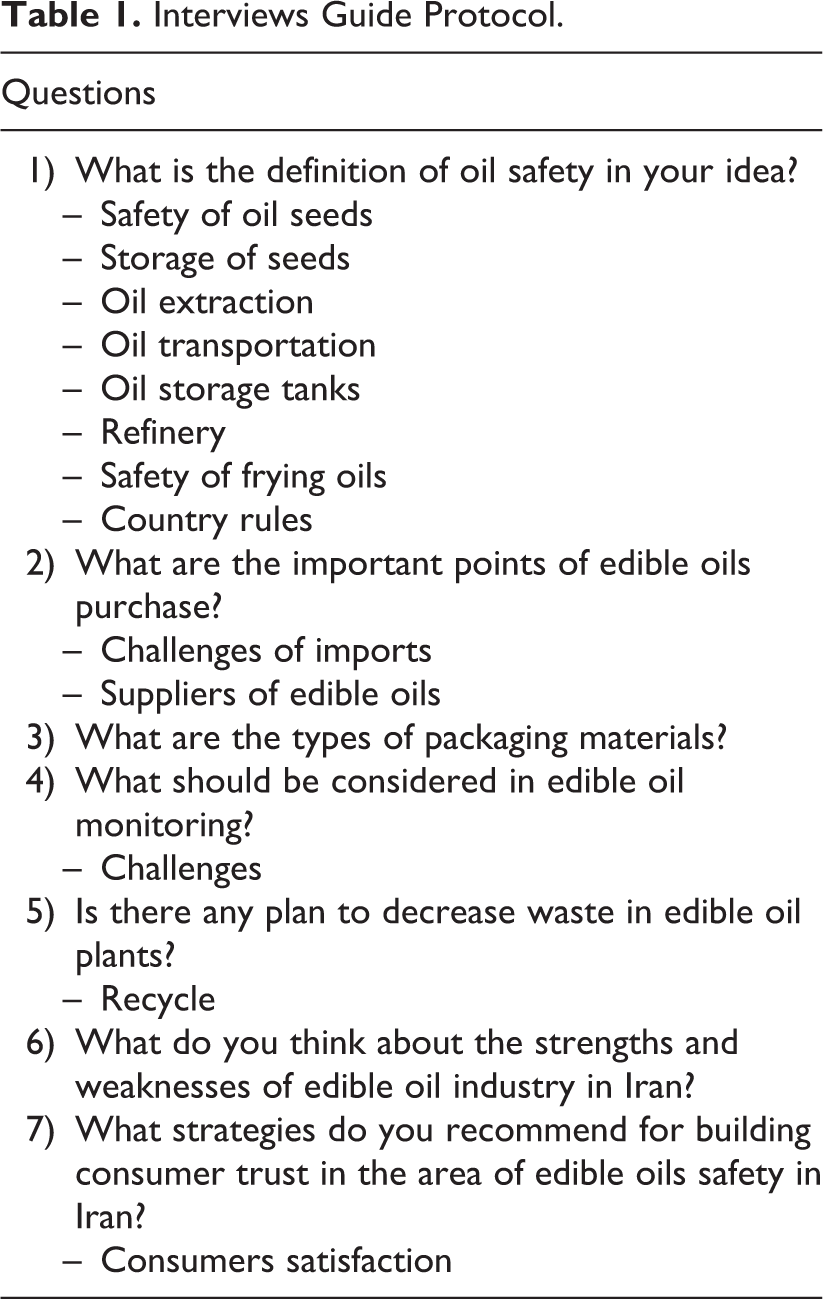
At the beginning of each session, the moderator introduced the survey team and explained the purpose of the study. Each team consisted of 1 moderator, 1 observer, and 2 notetakers. The moderator was a flexible, open-minded, active listener, able to establish a rapport with the participants and encourage them to talk comfortably. The moderator also provided a short orientation as a discussion icebreaker. The notetakers were swift and accurate in writing. The observer watched what happened but had no active part in the discussions. 13,14 The participants were encouraged to state their opinions freely by the moderator. Then they were informed that their voices would be recorded by a digital recorder. They were also assured that their names and wordings would not be revealed to anyone other than the research team. The questions explored the experts’ views to identify the edible oils’ challenges from farm to industry (Table 1).
Interviews Guide Protocol.
Triangulation has been viewed as a qualitative research strategy to test the validity of data through the convergence of information from different sources. This method involves the use of multiple methods of data collection about the same phenomenon. Data source triangulation involves the collection of data from different types of people, including individuals, groups, families, and communities. In the present study, triangulation was done by collecting data from the stakeholders with different responsibilities in the edible oil industry. In order to ensure data accuracy and consistent interpretations during the course of data analysis, the research team kept decision trails to document the decisions made over the course of the study. The results were also checked and confirmed by some of the key informants who met the inclusion criteria, but did not participate in the research. To confirm dependability, 4 faculty members conducted a second review. The results were further checked and confirmed by some of these key informants. All research details including procedures, actions, and decisions were documented for audit purposes. 15
Data Analysis
After each interview, the notes were organized based on the interviews’ questions and probes, and the expressions of emotion such as laughter sighs were noted. The record of each interview was transcribed verbatim and compared to the notes to fix potential discrepancies. The final transcripts were read repeatedly to achieve immersion and obtain a sense of the whole as one would read a novel.
All the data relevant to each category were identified and examined using the constant comparison method. 16 For this purpose, each item was checked or compared with the rest of the data to establish analytical categories by hand, reading and rereading the developing codes and themes, and discussing the transcripts at the team meetings. Then the data were read word by word by the team members independently to derive codes by highlighting the exact words from the text that appeared to capture key thoughts or concepts. These often came directly from the phrases that frequently appear in the text, which were then became the initial coding scheme. Next, the codes were sorted into categories based on how they were related and linked. The emerged categories were used to organize and group the codes into meaningful themes. The constant comparative method was used to identify the emerging themes. 17 In this study, the step-by-step strategy for constant comparative method was used. 18 According to the method of Graneheim and Lundman, all the recorded interviews were transcribed into a Microsoft Word file, which were then read several times to obtain full understanding of the acquired data. 11 The first 3 steps of this approach relevant to our study data included (1) comparison within one interview to develop categories and to label them with suitable codes, (2) comparison between interviews belonging to the identical group of experts who share quite similar experience (eg, group of food industrial experts, group of food scientists), and (3) comparison between interviews from different groups to develop and deepen the information and complete the picture. 18 The coding was undertaken by 2 of the authors in an iterative manner. Also some manual coding was undertaken as a measure to confirm reliability of the coding process. The condensed meaning units were summarized and labeled with codes. Then the codes were classified into categories and subcategories by comparing their similarities and differences. Finally, a theme that expressed the latent content of the text was obtained. 11
Results and Discussion
According to the results, 6 categories in 14 themes with 49 subthemes were explored based on the perspectives of the participants who were responsible for edible oil industry (Table 2).
Open Coding Results (The Most Important Concepts Extracted According to Priority).
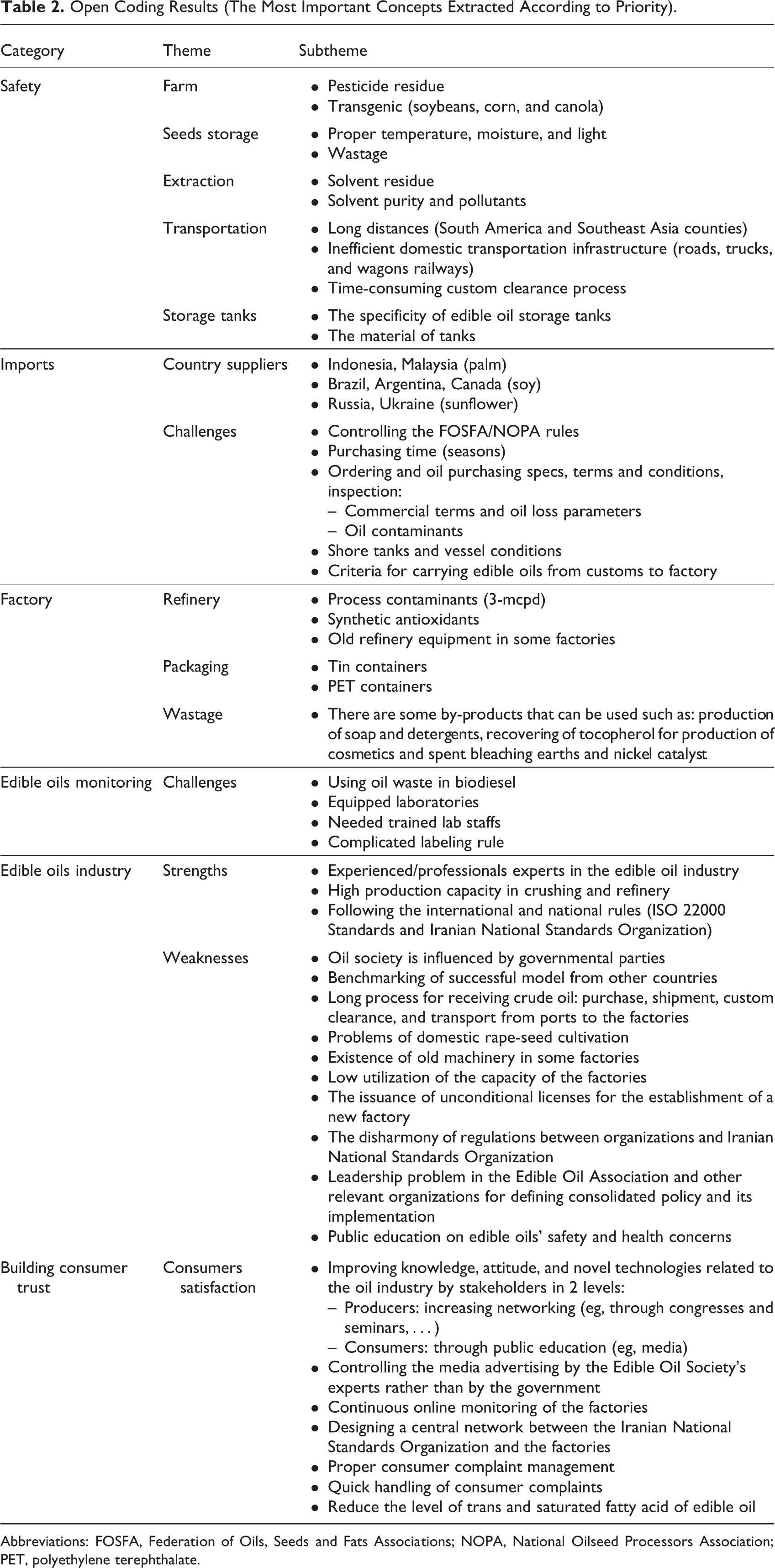
Abbreviations: FOSFA, Federation of Oils, Seeds and Fats Associations; NOPA, National Oilseed Processors Association; PET, polyethylene terephthalate.
Safety (From Farm to Storage)
The majority of the interviewees mentioned the following points: The safety of oil seeds depends on different stages such as harvesting, storage, and seed drying methods. Paying due attention to each of these steps is essential for safety guarantees.
Pesticides residue
In the cultivation process, use of various agricultural pesticides (authorized and unauthorized) out of the permitted limit or in inappropriate intervals results in higher pesticides residue in the final products. 19,20 Agricultural pesticides are oil-soluble components, which can be removed in various proportions through the refining process; however, unnecessary use of them can result in increasing the amount of residue in the refined oils. For meeting the increased demand of edible oils, future crop production research should focus on sustainable land use, water-saving irrigation, and integrated nutrient management, as well as control of pests, diseases, and weeds. New cropping systems to increase land productivity, maintain their resource base, and facilitate biodiversity in agricultural landscapes need to be developed. 21 Pesticides are hardly removed by neutralization and bleaching. Removal experiments with oils and fats spiked with pesticides are not allowed in industrial-scale food production. 22
Transgenic
The majority of the interviewees mentioned the following points:
In Iran, most of the canola and soybean grains are genetically modified (GM). Determination of GM grains in extracted oils is impossible due to the fact that there is no DNA content in the extracted oils. All of the transgenic products that are imported have codes that should be licensed and are subject to the verification of Ministry of Health. 23 In the world, the bulk of maize and soybeans has been transformed. In general, the laboratories that can detect GM foods are very limited in Iran. In addition, the transgenic nature of the seed does not change the oily part, because the oil formula is the same. But it may change in the part of the meal that is consumed by livestock, while not being monitored.
A particular focus of this effort has been the identification and transgenic expression of the genes that encode enzymes involved in the synthesis of novel fatty-acid structures. 1 Finally, transcription profiling data from developing seeds may suggest new sources of promoters that can optimize the timing of transgene expression to produce increased amounts of unusual fatty acids in engineered oilseeds. 1
Seeds storage
If the storage and transport conditions are not appropriate, the problems will be transferred to the purification stages. Also the storage conditions of oil seeds before industrial extraction might influence the tocopherol contents of the crude oil. Besides, it is, generally, accepted that the color of crude oils can be directly affected by the oil seed storage conditions (time, temperature, oxygen availability, air to oil ratio, etc). 24
The quantitative and qualitative wastes of oil seeds in Iran are not considered due to lack of proper ventilation in silos storing oilseeds, lack of control of moisture content in various stages of processing, failure to comply solvents for oil extraction by international standards, old machinery, equipment and production lines, lack of the availability of financial resources for the timely purchase of grain, lack of adequate support from the private sector, and lack of sufficient competition. Oil seed crops are the basis for biological systems that produce edible oils and contribute to renewable energy production. 25 Moisture measurement of oil seed is an inevitable operation in harvesting and in almost the whole postharvest processing such as handling, storage, milling, and oil extraction. 26 Providing convenient facilities for modernization, structural modification, establishment of equipped centers, and the implementation of Hazard Analysis and Critical Control Points (HACCP) and ISO 2002 quality control systems in the processing units can help solve some of the above problems.
Extraction
The majority of interviewees mentioned the following problems:
The most common solvent extraction is hexane. However, flammability, toxicological risks, health, and environmental concerns have motivated interest in replacing hexane. During the past 3 decades, fats and oils processing using supercritical carbon dioxide (SC-CO2) has developed from focusing only on extraction to fractionation of complex lipid mixtures, conducting reactions in supercritical fluid media and particle formation techniques for the delivery of bioactive lipid components. Considering the increasing consumer demand for “natural” products and stricter government regulations on the use of organic solvents such as hexane, the future of SC-CO2 processing of lipids is bright. 27
Transportation
Some factors including long distances (from South America and Southeast Asia countries to Iran), inefficient domestic transportation infrastructure (roads, trucks, and wagons railways), and time-consuming custom clearance process can increase the acidity and decrease the quality of edible oil.
Imports
Supplier countries of edible oils
About 88% to 95% of crude edible oils in Iran are imported from different countries (eg, palm from Indonesia and Malaysia, soybean from Brazil, Argentina, and Canada, and sunflower from Russia and Ukraine). Therefore, different international legislations including Federation of Oils, Seeds & Fats Associations (FOSFA), Codex, and National Oilseed Processors Association (NOPA) are needed in order to simplify edible oil trade. There are many sources of oils and fats, but soybean oil, palm oil, sunflower seed oil, and rape-seed oil contribute to 60% to 70% of the world’s production. Every country based on its climate conditions is appropriate for cultivation of specific seeds. 2
Challenges
In order to import crude oil, different factors should be considered including seeds’ free fatty acid (FFA) content, peroxide value (PV), and Total Volatile Nitrogen (TVN). Besides, different types of edible oils contain different quality factors. For instance, palm oil contains monoglycerides and diglycerides in different amounts, which cause an increase in oil loss during the refining process.
Different quality levels (rejection and acceptance range) should be considered before importing edible oils: edible oil type, fatty acid profile, acidity, moisture content, phospholipids and sterol content, and oil pollutant. Controlling the FOSFA/NOPA rules, Purchasing time (season), Ordering and purchasing, oil specifications, terms and conditions, inspection: Commercial terms, oil loss parameters, Oil contaminants, Shore tanks and vessel conditions, Criteria for carrying edible oil from customs to factory.
Factory
Refinery
Several factors may affect the quality of final refined oil, including delay in grain clearance (that causes mold growth and aflatoxin production); oil extraction with solvents such as hexane; presence of heavy metals such as arsenic; different pollutants including mineral oil residues, polyaromatic hydrocarbon, and polychlorinated biphenyl; inappropriate storage conditions (temperature, light, and moisture content); quality of crude oil such as high PV and FFA content; and synthetic antioxidants. In recent years, considerable effort has been directed toward genetically improving the industrial properties of oils derived from established crops. One of the important factors that can affect edible oil reefing process is old and traditional equipment. Other factors include 3-monochloro-1, 2-propanediol fatty acid esters (3-MCPD esters) and glycidyl esters, which are formed during the deodorization stage of the refining process due to the effect of high temperature that would pose a substantial challenge for the oil processors. 28 A study conducted in 2011, as the best strategy for reduction in 3-MCPD esters, used acid solutions (formic acid) instead of water for generation of strip steam during deodorization. This resulted in a reduction of the formation of glycidyl esters for about 35%. 29 In addition, further improvement in stability of finished oil may be achieved through addition of one of the approved “synthetic” antioxidants such as Tert-Butylhydroquinone (TBHQ), Butylated hydroxyanisole (BHA), and Butylated hydroxytoluene (BHT). Since the negative effects of these compounds on human health have been shown in numerous studies, compliance with the limitations of the use of these compounds by manufacturers and the detection and measurement of the correct amount of these compounds in edible oils is very important. A number of studies have shown that using more than standard limitations (75 ppm) of TBHQ can result in DNA damage and cancers and liver disease. 30 -32
Packaging
According to the participants’ views, based on oil type and application, different types of packaging including transparent packaging for zero palm cooking and frying oil, nontransparent packaging for palm oil or other edible oils containing tri-saturated triglycerides, and tin packing for bulk applications are used in oil packaging in Iran. Based on tin plate safety issues such as the corrosive impact, its application has been limited in food industry, while other materials such as polyethylene terephthalate packaging have been authorized. 33 Furthermore, there are regulations in terms of the monomer migration from the packaging material into food products. Several intrinsic factors may affect the oxidative stability of edible oils, including composition of fatty acids and concentration of transition metals, pigments, phospholipids, FFAs, monoacylglycerols, diacylglycerols, and antioxidants. 34 The oxidative stability of edible oils is affected by the O2 permeability of monolayer polymer packaging materials. 35
Wastage
The interviewees mentioned that there are some by-products that can be used (eg, production of soap and detergents, recovering of tocopherol for the production of cosmetics and spent bleaching earths, and nickel catalyst) in Iran’s edible oil industry. However, there is not any specific plan for recycling of such a valuable wastage. Production of biodiesel from the wastage of edible oils is a common approach in the developed countries.
Biodiesel production is a very modern and technological area for researchers because of petroleum price increase and the environmental issues. Currently, biodiesel is mainly prepared from rapeseed, soybean, sunflower, and palm oils, and thus may lead to reduce food versus fuel issue. The extensive use of edible oils may cause other significant problems such as starvation in the developing countries. The use of nonedible plant oils when compared with edible oils is very significant in the developing countries because of the tremendous demand for edible oils as food, and they are far too expensive to be used as fuel at present. 36 Several studies report on the environmental, social, and economic gains and detriments that can arise from increased biodiesel production and consumption. 37
Edible Oils Monitoring
The monitoring of edible oils’ quality is very important to ensure safety of the product for consumption. There is an official standard set for evaluating edible oils’ quality in Iran. The Institute of Standards and Industrial Research of Iran is the Iranian governmental institution for standardization and certification. 32 Free fatty acid content, PV, and p-anisidine value are commonly used in industry to report the edible oils’ quality. 38 In the view of participants, equipped laboratories, trained lab staff, and labeling guidelines are needed for professional monitoring. Also they mentioned that there are some challenges between national rules and industrial rules.
Edible Oil Industry in Iran
Iran’s edible oil industry enjoys some strength points including experienced experts in the edible oil industry, high production capacity in crushing and refinery, and following the international and national rules (ISO 22000 Standards and Iranian National Standards Organization). On the other hand, there are several weaknesses in this industry as well. The Oil Society is influenced by governmental parties, long-time process for receiving crude oil (purchase, shipment, custom clearance, and transport from ports to the factories), problems of domestic rapeseed cultivation, existence of old machinery in some factories, low utilization of the capacity of the factories, issuance of unconditional licenses for the establishment of a new factory, disharmony of rules between organizations and Iranian National Standards Organization, leadership problem in the Edible Oil Association and other relevant organizations for defining a consolidated policy and its implementation, and weak public education on edible oil safety and health concerns.
Building Consumer Trust
The interviewed stakeholders believed that improving the producers and consumers’ knowledge and attitude and employing technologies related to oil industry can increase trust. Also policy makers should control the media advertising because it has effect on food pattern of community and promote unhealthy diet. 39 Continuous online monitoring of edible oils industry is also suggested. Designing a central network between the Iranian National Standards Organization and edible oil producing factories for sharing the implications is helpful in building consumer trust. Finally, rapid response and quick handling management are necessary for consumer complaints. Subsequently, reducing the level of trans and saturated fatty acid may increase consumer trust. Recently, a study in Iran showed that trans fatty acid intake decreased from 12.3 g/d in 2007 to 1.42 g/d in 2013 by planning. 40
The only limitation of this study was merely focusing on the stakeholders’ views since the issues are organization wide. Therefore, the future research could use longitudinal designs and multiple respondents.
Policy Analysis
Reviewing the history of edible oil industry in Iran shows that improvements are possible, though they are not always easy. Approaches that are based on working with the existing situation and gradually improving it have shown some success. However, these approaches cannot have long-term success unless they are accompanied by motivation for changing behavior. Where value chain stakeholders are not using modern edible oil industrial technologies, simple innovations can result in substantial improvements to food quality. Risk analysis, farm to industry, and HACCP approaches have been very successful in improving food safety. However, they need adaption in order to be applied them to the informal market where most of the edible oils are traded. Regulations are important, but the harmony of regulations between organizations and Iranian National Standards Organization is more important.
There are many aspects of small-holder production and traditional retail that are not beneficial to Iran’s edible oil industry. As such, improving the systems of current factories and utilizing the empty capacity, as well as allowing development and modernization, are advised. Finally, Ministry of Health, Ministry of Agriculture, and Ministry of Industry and Trade that are responsible for food safety in Iran should develop a better coordinated mechanism for edible oil industry among the edible oil factories.
It is important to continue developing a legislative framework, with a focus on simplicity, a clear mandate, flexibility, and focus on safe edible oil outcomes. In addition, the above-mentioned ministries and other related agencies should develop a coordinated plan for communicating in one voice with all affected parties during edible oil crises such as palm oil. 41
Conclusion
The contributions of this study are highlighted from the result of the following strategies to increase the quality and safety of edible oil: updated food safety laws and regulations, food standards and quality control management, effective food inspection and enforcement services, food monitoring, and surveillance systems with adequate laboratory equipment. In order to build and maintain effective food safety systems, strong links must be established between all sectors that have a bearing on food safety, including public health, agriculture, consumer and school education, science and research, trade, industry, and regulatory authorities.
It is the public health sector that needs to take the lead in building this community of stakeholders and sharing common goals and responsibilities. The key players need to have access to reliable and up-to-date information so that timely collective action can be taken. It is recommended governments face up to this task and lead the way. The present findings could be applied as a guide to design appropriate strategies to improve sustainable edible oil industry in Iran.
Footnotes
Authors’ Note
Ethical issues (including plagiarism, informed consent, misconduct, data fabrication, and/or falsification, double publication and/or submission, redundancy, etc) have been completely observed by the authors.
Acknowledgments
The authors would like to appreciate the Research Council of National Nutrition and Food Technology Research Institute, Faculty of Nutrition Science and Food Technology, Shahid Beheshti University of Medical Sciences for financial support. All stakeholders are appreciated for their valuable help in conducting this study. Also thanks to Zahra Saghafee for her assistance.
Declaration of Conflicting Interests
The author(s) declared no potential conflicts of interest with respect to the research, authorship, and/or publication of this article.
Funding
The author(s) disclosed receipt of the following financial support for the research, authorship, and/or publication of this article: National Nutrition and Food Technology Research Institute, Faculty of Nutrition Sciences and Food Technology, Shahid Beheshti University of Medical Sciences, Tehran, and Iran (Grant no. 190, 1130-7).