



Abstract
Introduction:
Policy interventions can encourage healthier dietary choices and help prevent noncommunicable diseases (NCDs). Consequently, governments are seeking to develop and implement food-related policies, but little research on food-related policies is available to guide policy development.
Objective:
This study aims to provide an in-depth examination of barriers and facilitators to food-related policy development in Fiji.
Method:
Case studies were undertaken on 7 food-related policies that were recommended for action in 2010. Data were collected in 2015 through 20 key informant interviews with purposely selected officers from relevant government ministries, consumer advocacy groups, and academia as well through document reviews. The interview data were analyzed thematically.
Results:
Findings were categorized into major themes: leadership, nature of the policy and political environment, and collaboration within and across sectors. Barriers included leaders not being supportive of progressing policy, the content of the policy influencing its adoption, and a lack of consultation with relevant stakeholders. Facilitators included certain leaders’ commitment to driving the policy combined with the support of government at time of deliberation. Good collaboration between government sectors and other stakeholders also facilitated policy endorsement.
Conclusion:
Attention to leadership, collaboration, policy content, and political environment is likely to enhance the process of developing and implementing food policies targeting NCD prevention in Fiji.
Introduction
Noncommunicable diseases (NCDs) are the leading cause of mortality in majority of Pacific island countries (PICs), accounting for more than 70% of deaths. 1,2 Globally, poor diet has become the leading factor contributing to obesity and the NCD crisis. 3 Population surveys in the Pacific, using the World Health Organization STEPwise approach, reveal obesity prevalence rates as high as 80% and diabetes prevalence rates above 30% for some PICs. 4
Multiple strategies have been recommended to tackle diet as a contributor to obesity and NCDs. These range from increasing public awareness through nutrition education, the promotion of the production of healthier food products through to fiscal measures to alter the available food supply. 5 The use of food-related policies to change food environments where less healthy foods are easily accessible has been shown to influence diets. 6,7 In PICs, globalization is influencing food systems, with countries transitioning from traditional diets to a more Westernized one with increased provision of, accessibility to, and promotion of less healthy, ultra-processed food products. 8 Food-related policies in the Pacific closely align with agricultural and economic imperatives that reduce reliance on food imports and encourage local food consumption. 9,10
Pacific Health Ministers have recognized the need for stronger food control systems for some time. 11 In 2009, in response to regional interest, the Pacific Obesity Prevention in Communities (OPIC) project worked with local stakeholders in Fiji, including government ministries, to develop 22 food policy recommendations likely to positively impact health by influencing food choices and consumption. 12 -14 Subsequently, a follow-on project in 2010 to 2012, the Translation Research on Obesity Prevention in Communities (TROPIC), built local policy-making capacity through a knowledge-brokering approach and a focus on food policy. 15,16 Participants gained knowledge and skills in developing policy briefs as an initial step in the policy development process.
This study describes the progress of these food policy recommendations from OPIC and TROPIC in the 5 years, since they were proposed with the purpose of understanding how the food-related policy making process can be enhanced. It describes food policies that have been endorsed as well as policies that have yet to be endorsed. Factors influencing the progress of policies through the policy cycle as either barriers or facilitators are analyzed and discussed.
Methods
Study Design
A case study methodology was used, and barriers and facilitators to policy development were identified. Policy development for the purposes of this article describes the initiation and preparation of the policy up until the point it is signed into legislation. This approach allowed in-depth assessments of policies and enabled analysis of how policy development progressed or was obstructed with reference to selected policy theories discussed in the analysis section. A case study approach also allowed us to build on prior learnings and to triangulate multiple forms of evidence including key informant interviews and document reviews to fully capture the nature of the policy and its development process. 17,18
Data Collection
Of the 22 food policy recommendations collectively conceived through a participatory approach during the OPIC project, 14 participants of this study discussed 7 of these policy recommendations based on their familiarity and involvement with the policy. The remaining 15 policies were not discussed, as those interviewed did not have any involvement or more the case were never initiated. Data collection involved a review of public documents and conducting key informant interviews.
Document Review
Reviewing documents is an “unobtrusive method, rich in portraying the values and beliefs of participants in the setting”. 19 Relevant documents supplement information from other data collection methods such as key informant interviews, therefore enabling greater understanding of the policy under study. 20 Formal government documents such as budget statements, organizational policy guidelines, and policy documents as well as consumer advocacy websites and media reports were reviewed for the 2010 to 2014 period. These documents were sources from government websites or directly from government departments and officials. The review was conducted to clarify progress and status of the selected OPIC recommended policies (whether they were in the process of being developed, already approved, or implemented) and provide information to supplement the views of key informants. Formal budget statements and draft regulations confirmed dates and nature of the food tax policies passed. Organizational policy guidelines determined the process within organizations and specific roles and responsibilities. Consumer advocacy websites and media reports provided information on the chronological order of events to supplement information from participants.
Key Informant Interviews
Participants were government and civil society stakeholders who had been involved in the initiation or development of the policy recommendations during the OPIC study. Private sector stakeholders were not included because other research was being conducted with this sector.
To access participants, Permanent Secretaries (PS) of relevant government ministries and agencies (Ministries of Health, Education, Finance, Trade, and Primary Industries and the Consumer Council of Fiji) were formally contacted to seek endorsement of the study and approval to interview their staff. An initial group of 25 participants was then purposively selected from a list of personnel who took part in the TROPIC knowledge-brokering workshops, supplemented by recommendations from the PS. Recommended participants were contacted through e-mail or telephone and were asked to provide written consent before being interviewed. A snowball sampling technique was used to identify additional participants. 21 Recruitment of participants continued until there was no additional information or themes coming from the interviews.
From the original list of 22 policy recommendations, participants were given the choice of policies to be discussed based on their familiarity with the policy and their involvement in its development. As the policy-making process or cycle was unique for each of the policies, participants who were familiar with more than 1 policy were questioned separately on each. Interviews took between 30 minutes and 1 hour.
An interview topic guide was developed to ascertain barriers and facilitators in the policy development process. The development of the questionnaire was informed by consideration of the policy development process and theory. In particular, it was guided by the policy cycle of Howlett and Ramesh. 22 Questions were asked regarding the reason for the policy recommendation, the nature of the policy, who were involved, and what factors hindered or ensured its approval and implementation.
To ensure the interview questions were easily understood, they were pretested with researchers within the Pacific Research Centre for the Prevention of Obesity and Non-Communicable Disease (C-POND) who were also involved in food policy research. Key informant interviews were conducted in English by C.L. and J.C., each of whom took turns leading an interview with the other taking notes. The second researcher could also ask questions to clarify or elaborate on a particular issue.
Study Participation
Of the initial 25 stakeholders identified as having worked on the formulation of policies, 15 did not participate for the following reasons: 3 had either been transferred to rural areas or another government department, 5 had migrated overseas and could not be contacted, 2 had passed away, and 3 had retired and were uncontactable. Finally, 2 refused to be interviewed because of their limited initial involvement. The remaining 10 participants were interviewed. In addition, a further 10 participants within the same government ministries, identified through snowball sampling, were interviewed, making a total of 20 interviewees.
Ethics approval was received from the Fiji National Ethics and Research Committee (2014.63.MC) and Deakin University Human Research Ethics Committee, Australia (HEAG-H 169_2014).
Data Analysis
Each policy reviewed had a unique set of barriers and facilitators, but the purpose of our analysis was to identify barriers and facilitators that were common to the selected food policies. To capture these themes, key informant interviews were audio-recorded and transcribed with the participants’ consent. Transcripts were validated by a second researcher for accuracy. Transcripts were coded and further categorized, allowing themes to emerge from the data. The organization and coding were conducted manually. The reviewed documents were used to supplement and confirm information from the interviews.
Results
Pacific Obesity Prevention in Communities Policy Recommendations
The 7 policy recommendations investigated and their status at the time of the interviews are briefly outlined in Table 1.
Status of Policy Recommendations Made in 2010 During OPIC (As of October 2017).
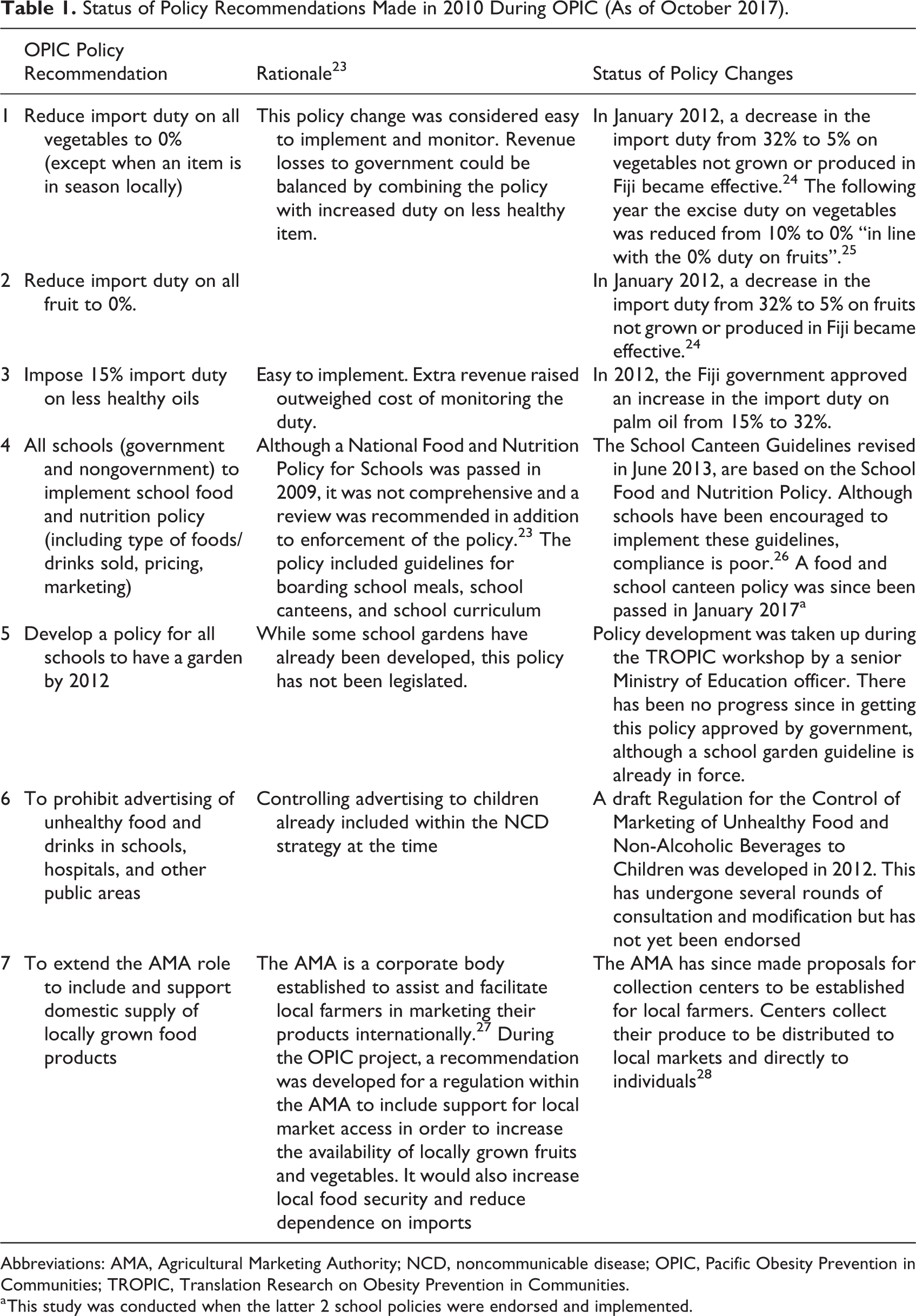
Abbreviations: AMA, Agricultural Marketing Authority; NCD, noncommunicable disease; OPIC, Pacific Obesity Prevention in Communities; TROPIC, Translation Research on Obesity Prevention in Communities.
a This study was conducted when the latter 2 school policies were endorsed and implemented.
To date, 3 of the 7 OPIC policy recommendations have progressed and been approved by the Cabinet (palm oil in 2012, fruits and vegetable import duties in 2012); the other 4 policy recommendations have not been approved (at the time of undertaking this research) and were at various stages of the policy approval process.
Policy Context
This research focused on policies and the policy environment in the last 10 years (2006-2016). This coincided with a significant change in the policy development processes following a coup in 2006. During this time, the Fijian government was dissolved and replaced by an interim government. It remained in power until a democratically elected government was formed in September 2014. During the time of the interim government, democratic processes such as the requirement for parliamentary approval for all legislation were removed. Most policies discussed here were passed prior to September 2014 by Cabinet only.
Currently, for fiscal policies in Fiji, government ministries are asked to submit budget proposals, and, in parallel, the public can also submit recommendations for deliberation and consideration by the Budget Committee with a final endorsement being given by Cabinet and tabled in Parliament. The process for developing regulation is more complex, with initial policy development generated from within a government Ministry, sometimes in response to public demand. Draft regulations are usually taken through rounds of consultation by a lead government Ministry, before eventually being passed on to Cabinet for discussion and approval.
Themes
Participant perspectives were interpreted based on the policy triangle framework identifying which actors were involved in the policy process as well and what contextual factors were there and how they influenced the process of policy making. Analysis of these policies identified 3 broad themes that influenced their progression: leadership, the political environment and nature of the policy, and collaboration and networking. These themes were seen as both barriers and facilitators in the process of policy making.
Leadership at Various Levels of Government
Participants described leadership and drive of departmental heads as critical in getting a policy issue on the government’s agenda and moving it forward. Conversely, a lack of leadership often hindered progress.
Leadership Advancing Policy
Specific leaders within organizations were mentioned as facilitators of the policy process. For example, proposal to change import duties of palm oil and vegetables was supported by the Minister of Health who brought the issue on the agenda before its submission to the budget committee for deliberation. In other policies, leaders within departmental sections were also mentioned as playing important roles in moving policy proposals forward. [Leader A] was the one behind its revision…as soon as we forward it, she would send it [on]…she was the one behind the move to get it revised…[Government Official]
Leadership Hindering Policy Advancement
Leadership was also sometimes seen as a barrier to policy development, particularly at the Cabinet level. It was observed that when leaders who make the final decisions were not familiar with, and/ or committed to a specific policy, no progress was made in advancing it to the final stages of the policy development cycle. For example, the regulation to control marketing of unhealthy food to children was drafted and submitted to the Solicitor General’s office in April 2014 and has since gone back and forth to the office but has still not been finalized or endorsed. Reasons given included staff turnover, a lack of priority afforded to this policy, and a lack of commitment at the top level to “move it along”. The leadership is good there [at the Ministry], but [some leaders are] working towards their own ends. What you need is committed people to do it. [Government Official]
Participants explained that, in the past, external consultants were contracted to develop policies. This in turn led to a lack of capacity building on policy development within ministries such that when policy development tasks were directly assigned to staff within an organization, they floundered. Most of us are operational people. We don’t think policy. We are more implementing the policy. So that’s another different kettle of fish…you know we didn’t come through USP [University of the South Pacific] [as] experts in policy.” [Government Official] It [the Policy Unit] was formed when the previous Minister came through, because he wanted an engine room that churned out the direction for both health financing and public health and clinical interventions. And we lacked that capacity to do it. We [used to] rely on external partners to do policies for us, we relied on external consultants to do this. So, this became our engine room for progress and progressive action. [Government Official]
Nature of the Policy
Another theme identified from the interviews was the nature and content of a policy. Policies perceived to have a minimum negative fiscal impact on consumers appeared to pass through the development process more quickly and easily. As one informant noted: Palm oil [import duty tax] went easily. I think oil is not much of a big thing in the Fijian diet system and fruit and vegetables no problem. When you come to meat and fizzy drinks and marketing to children—that’s where—that’s where the money is. [Non-government Official]
Another respondent spoke of the abstract, intangible nature of nutrition policies to prevent NCDs which, in their view, made the policies difficult to understand and therefore difficult to progress. They noted that it is hard to see the impact of nutrition changes and by implication, the impact of nutrition policy even if the policy is working well. Even where the value of the policy was clear, the benefits would not be realized until well into the future, arguably putting the policy beyond the scope of the incumbent government. Nutrition is not like a toothache. You remove the tooth and it goes away. It’s there—it’s very tangible. You only get to know of it after a long-term…[Non-government Official] I think a lot is to do with understanding the policy. What will it do? What was the expected outcome of these policies? But I know all these ones were geared towards NCD prevention and management…. We need to appreciate how these policies will help…how the implementation of these policies will ultimately affect the lives of these people. [Government Official]
Political Environment
There was a sense from participants that a favorable political environment facilitated progression of the palm oil and fruit and vegetable policies. As one informant mentioned: the government at that time being interested in supporting the Ministry of Health with taxation changes and then having well documented briefs. [Non-government Official] It was still in the process when [a key leader changed, government changed and the Minister changed]. That makes a lot of things, a lot harder. I was really part of it, doing it in the drawing board, and it was supported by [key leaders], I was just waiting for the right timing and the whole political scenario changed. [Government Official] …we also look at the economic side of things, especially if it’s going to affect the new local industry that comes up with a particular product, because we always want to encourage local firms. [Government Official] …they [Food industries] would then go to authorities higher than me—they would then, put the pressure. And they [government] would not move things along…[Government Official]
Collaboration at Different Stages of Policy Development
Communicating policy outcomes and working in partnership with stakeholders from the outset were cited by participants as important factors that influenced policy development. Examples were cited of effective communication and partnerships having led to policies moving forward; conversely, other examples were given where a lack of collaboration resulted in policy development being stalled.
The Ministry of Health also enjoyed a close relationship with C-POND based at Fiji National University in Suva; this key research body was instrumental in the provision of evidence and conducting the earlier research projects (OPIC and TROPIC) that informed the policy development phase. In addition, the partnership between the Ministry of Health and the Consumer Council of Fiji was described as complementary, whereby advocacy efforts were combined for added effect. The Consumer Council of Fiji has representation on the Food Taskforce Technical Advisory Group which provides advice to the Ministry of Health as well as the Central Board of Health within the Ministry. The collaborative lobbying across organizations ensured quicker endorsement of the palm oil and fruit and vegetable policies. So, we had people [from the Research center]…pushing in policy briefs—getting in that evidence. Because if it had to be Ministry of Health—and if we didn’t work in partnership, I think this would have taken a whole lot longer to get done. [Government Official] “…one of the issues that came through pretty clearly was the lack of proper consultation…with the other stakeholders…consultation to me is the key and particularly in Pacific societies. You can’t just push your own oar and expect everybody else to come to the party, they won’t…[Non-government Official] …so, one of the critical things about getting a policy implemented and successful is proper consultations at the initial phases, and until that happens you will still have a failure to progress the policies. And you’ll have a failure of implementation especially if it’s top level. And you know the consumers themselves don’t have an input into the policies—because ultimately that is who the policy will affect. So that’s critical. [Government Official]
Discussion
Food-related policy development and implementation in Fiji have strengthened over the last decade but remains patchy. Factors influencing the endorsement or otherwise of these policies include leadership at various levels of government, the nature of the policy and the political environment at the time, and the ability to form successful collaborations at different stages of policy development.
Our findings reinforce the central role of actors in policy change. Actors working collaboratively enhance the policy-making process. This supporting actor role is in line with Sabatier policy model, where advocacy coalitions made up of individuals inside and outside agencies advocate for specific policy changes. 30 The level of awareness raised through advocacy and health education by different stakeholders is also paramount in ensuring that a policy issue is on the agenda of government.
This study echoes the findings of previous research on the development of Pacific public policies. 31,32 Thow et al looked at trade policies across 3 Pacific Island Countries and Territories, including Fiji, and noted the importance of agenda setting and the role of actors. 31 Collectively, these studies and ours highlight the importance of engaging key stakeholders at an early stage of policy making, as this will improve collaboration and partnership throughout the entire process.
Weible et al have emphasized that actors involved in policy process and change require deep analytical and local knowledge because public policies “are rich in their histories, real in their interdependencies with individuals and contexts, and complex in their attributes of the problem and solutions” (p.17). 33 Our findings suggest that these analytical skills can improve with deeper consideration of the issues and more information about the policy system at an organizational level. Interventions that influence contextual factors such as understanding the bigger policy picture and policy analysis should help build skills in the negotiating and collaborating phases of the policy process.
The increasing burden of NCDs in Fiji and the Pacific and the 2011 UN high-level meeting and political declaration on the prevention of NCDs 34 highlighted the problem and need for new strategies to tackle NCDs during the period of our study. There was increased attention on the policy problem, and strategies to address this problem had been laid out. The political climate at the time was not averse to tax changes, as the mandate for the government was economic growth. This constituted a perfect “policy window” for a successful policy change. 30
This theme also emphasizes the policy context and content factors in the policy triangle framework and its role in influencing the policy development process. This is especially important to consider when developing a new policy.
The third theme of the study also demonstrated that sometimes government ministries worked in silos on nutrition-related issues. Without successful collaboration and partnerships, the ability to convince consumers to exert that social pressure was substantially diminished. Maintaining positive communication with food interest groups was also a critical factor. Cross-sectoral collaboration in various settings could be applied in the policy development process and has been conducted in Fiji. 35
Strengths and Limitations of Study
The key strength of this study was the feedback obtained from policy makers directly involved in policy development. Their candid responses provided rich information regarding barriers and facilitators to public policy development. Their contribution will inform the policy-making process in Fiji and will underpin the formulation of initiatives to rectify some of the current shortcomings. A second strength was the ability to verify key informant interviews with information from the document review. A third strength was the identification of high-level themes. Lifting the barriers and themes out of the specifics of the policy-making process in Fiji means that they can be applied in other developing countries. Neighboring PICs who share the same problems of human resources competency and capacity in health promotion and more specifically public policy development will benefit.
The study also has a number of limitations. As noted above, a few potential participants refused or were not able to be contacted for interviews; their participation may have produced different perspectives on the research questions. Second, some insights into the policy-making process may have been held back by participants worried that information they shared may impact their employment. Participants were protected from this through anonymity, but with such a small group of policy makers this may still have been a concern. Finally, our findings are limited to a government sector and civil society perspective.
Conclusion
This research has shown that leadership, collaboration and policy content, and environment influence the policy development process in Fiji. To enhance food-related policy making in Fiji, we suggest increasing awareness on policy development and its complexities across sectors and building the capacity of relevant stakeholders to conduct policy analysis through knowledge exchange programs. Increasing collaboration across sectors in relation to food-related policies is also important considering the multisectoral nature of NCDs and obesity prevention. To strengthen cross-sectoral collaboration on food policy, further research by Fiji National University in collaboration with Deakin University is being conducted. A system dynamics approach adapted from a previous study 36 is used with participation from various government departments in Fiji. To further enhance the policy development process, research is also needed on the impact of policies that have been successfully enacted as well as more in-depth studies on the policy environment—especially in small developing countries such as Fiji. Globally, many countries are considering new policy for preventing NCDs. Our research suggests that, in addition to considering policy context, policy makers need to consider the policy process and political environment.
Footnotes
Declaration of Conflicting Interests
The author(s) declared no potential conflicts of interest with respect to the research, authorship, and/or publication of this article.
Funding
The author(s) disclosed receipt of the following financial support for the research, authorship, and/or publication of this article: Supported by National Health and Medical Research Council.